📌 Key Takeaways
Inspection anxiety disappears when documentation, access, and staff training become routine habits instead of last-minute scrambles.
- Your Binder Is Your First Line of Defense: A single, organized folder containing your FOG permit, five years of signed manifests, and service records turns a potential violation into a fifteen-minute formality.
- The 25% Rule Isn’t Negotiable: Houston requires cleaning whenever grease and solids reach 25% of your trap’s wetted height or every 90 days minimum—whichever comes first.
- Monthly Measurements Prevent Emergency Pump-Outs: Recording grease depth, solids depth, and total wetted height once a month lets you schedule service at 20% instead of scrambling at 25%.
- Staff Coordination Beats Individual Knowledge: When every shift lead knows their role—who grabs the binder, who opens the sample well, who manages safety—inspections become predictable instead of chaotic.
- Licensed Haulers Protect Your Business: A properly credentialed hauler who pumps fully, provides complete manifests, and disposes at approved facilities eliminates liability that cheap service creates.
Prepared operations pass quietly. Unprepared ones scramble, fail, and pay.
Houston restaurant owners, general managers, and facilities managers will find the complete compliance framework here, preparing them for the detailed checklist and regulatory guidance that follows.
The lunch rush just ended. You’re restocking the line when an inspector walks through the door with a clipboard. Your heart rate spikes—but it doesn’t have to.
A Houston FOG (Fats, Oils, and Grease) inspection verifies that you’re cleaning your grease trap on schedule, staying under the 25% accumulation threshold, and maintaining proper documentation. Think of it as your kitchen’s registration check combined with a maintenance audit. If your car needs current tags and service records, your grease interceptor needs a valid permit and signed manifests showing where your waste actually went.
Here’s what a prepared operator looks like: The inspector arrives unannounced during dinner prep. Your general manager calmly walks to the office, pulls out a labeled binder, unlocks the sample well in under two minutes, and provides every document requested. The inspection wraps up in fifteen minutes with zero violations.
This checklist aligns with City of Houston Code Chapter 47, specifically sections §47-512 and §47-513,[1][2] so you can pass that inspection without the panic.
Your Pre-Inspection Document Binder
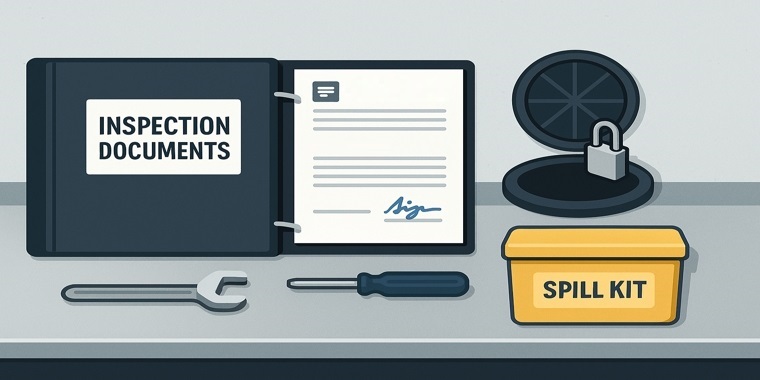
Keep these items together in a dedicated binder or clearly labeled folder that’s always on-site: your current FOG permit, signed waste manifests covering the past five years, any Notice of Waiver documentation if you’ve applied for adjusted cleaning intervals, and service invoices from your hauler.[1][3]
Set up a simple index tab system—Permits / Manifests / Waivers / Previous Inspections. Train your shift managers to locate any document in under sixty seconds. When your hauler completes a pump-out, that manifest goes straight into the binder before the end of business that day. This isn’t busywork. Houston Health Department inspectors can request records spanning years, and gaps in your documentation raise immediate red flags.[3]
If you use professional grease trap cleaning services like Drane Ranger, you’ll receive a signed manifest after every service that documents the volume removed, the disposal site, and the hauler’s credentials.
Make the Sample Well and Interceptor Accessible
Inspectors need quick, safe access to your sample well and interceptor for visual inspection and measurement. Keep lids clear of equipment, supplies, and debris. The area should allow safe opening without moving heavy items or creating a safety hazard.[4]
Tape a laminated “Open/Close” standard operating procedure directly at the well location. Stage the basic tools nearby—typically a specialized key or wrench for your specific lid type. Add a small spill kit within ten feet. These steps show operational readiness and prevent the awkward scramble when someone needs to open your interceptor under time pressure.
The 25% Rule and Cleaning Cadence
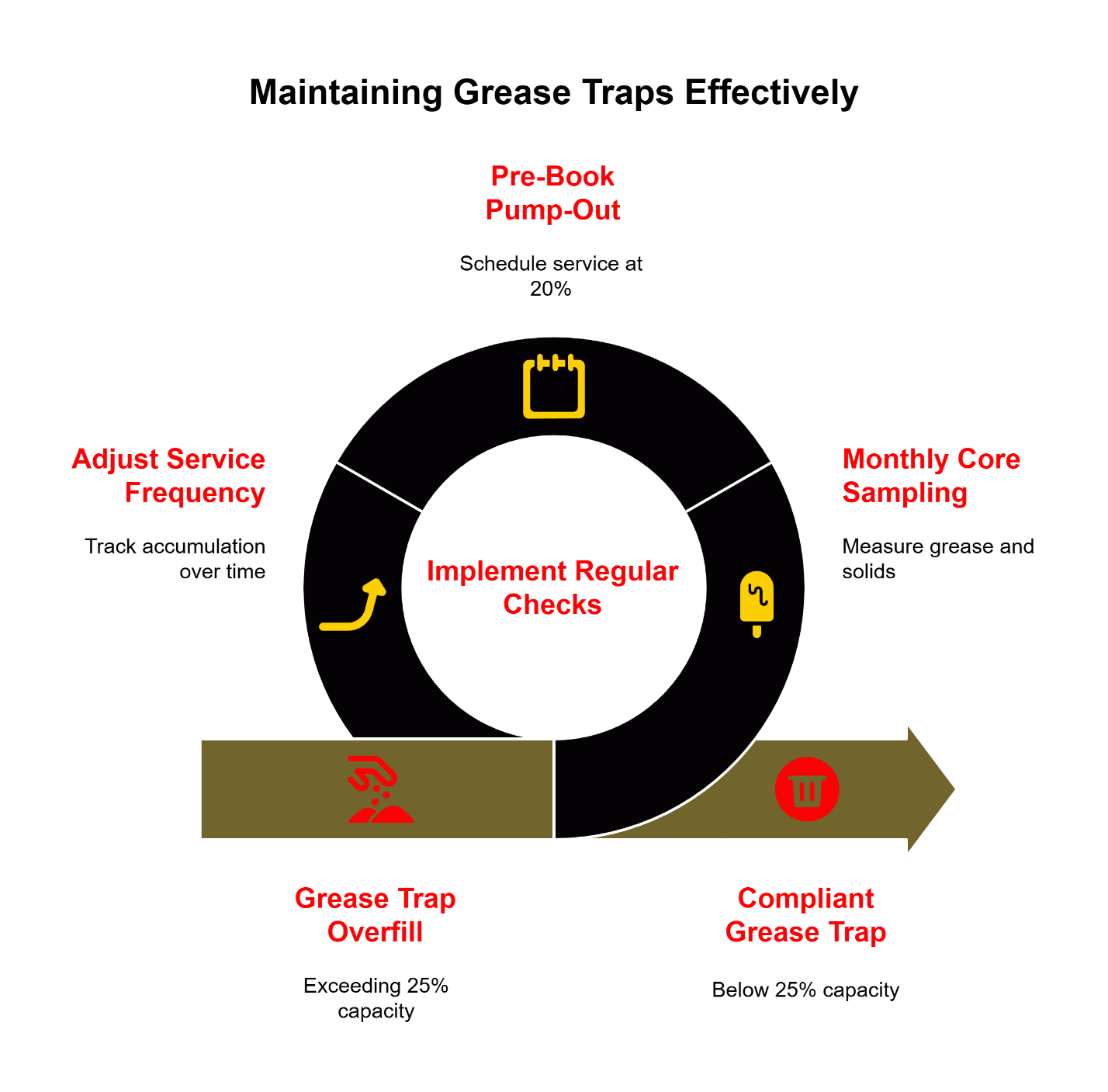
Houston requires you to clean your grease trap whenever the combined depth of floating grease and settled solids reaches 25% of the wetted height inside the interceptor, or at minimum every 90 days—whichever comes first.[1][5] This isn’t a suggestion. It’s enforceable code designed to prevent line blockages and protect the city’s wastewater infrastructure.
Most operators benefit from adding a simple monthly core sample check to their routine. Use a dipstick or core sampler to measure accumulation, recording the date, grease layer depth, solids depth, and total wetted height in a simple log. If a measurement hits around 20%, pre-book your pump-out service immediately. Waiting until you’re at or over 25% puts you in violation territory, and it only takes one delayed service call to fail an inspection.
High-volume kitchens and operations with heavy frying schedules often need service every 60 days or less. Track your accumulation pattern over three months. If you’re consistently approaching 25% before the 90-day mark, it’s time to adjust your service frequency.[5]
Staff Briefing Before the Visit
Your staff doesn’t need to become FOG regulation experts, but shift leads should be able to answer four basic questions: where does kitchen wastewater go, who hauled it last, when was the last pump-out, and where is the documentation binder located.[1][3]
Run a five-minute pre-shift huddle. Assign clear roles: one person retrieves the binder, another handles sample well access, a third manages safety and keeps the area clear during the inspection. Practice this drill once per quarter so it feels routine when an actual inspector arrives. Business continuity during an inspection depends on smooth coordination, not improvisation.
The Houston-Specific Pre-Inspection Checklist
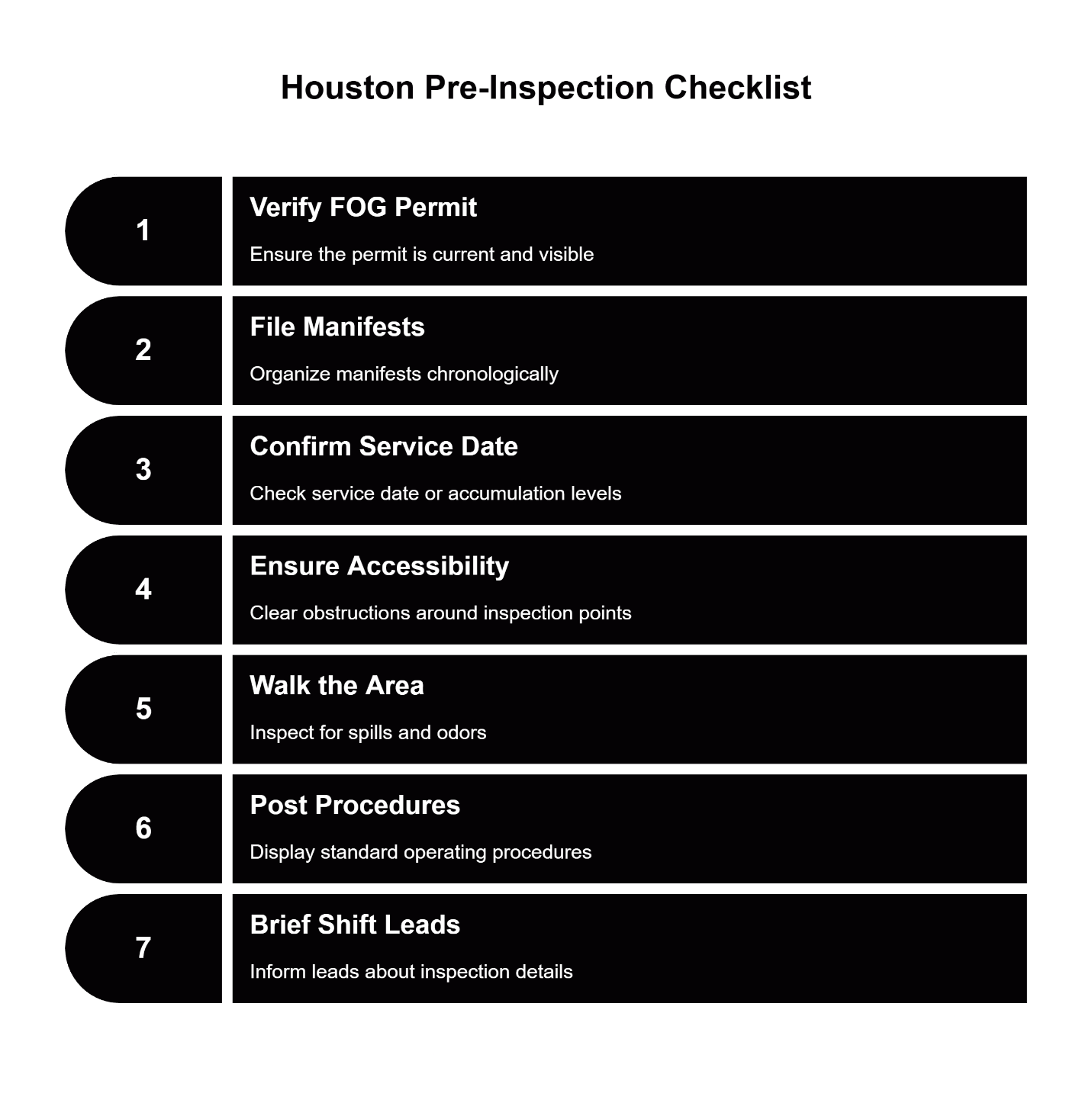
Follow these steps in order before any inspection:
- Verify your FOG permit is current and placed at the front of your document binder.[1]
- File signed manifests in reverse chronological order covering five full years, checking that each shows hauler information, waste volume, date of service, and the disposal site.[2]
- Confirm your last service date was within 90 days or that current accumulation measures below 25%.[1][5]
- Ensure sample well and interceptor lids are accessible with no obstructions, and opening tools are staged nearby.[4]
- Walk the immediate area—no spills, pooling water, or persistent odors around the trap, dumpster, or rendering bin.[4]
- Print and post your standard operating procedures for opening the interceptor, sampling protocol, and emergency contact information.
- Brief shift leads on who meets the inspector and where everything is located.
“The best time to prepare for an inspection is yesterday.”
When You’ll Need Service Sooner
Certain operational profiles demand more frequent attention than the 90-day minimum. If you run a high-volume kitchen, do significant frying, or notice recurring odors or slow drainage, your interceptor is telling you it can’t keep pace with your grease load.[5]
Book recurring service intervals through a licensed hauler. Require a signed manifest documenting every pump-out. This creates an audit trail that protects you during inspections and demonstrates your commitment to maintaining compliant operations. For Houston restaurants needing reliable service, grease trap cleaning in Houston through established providers ensures proper manifesting and lawful waste disposal.
What Happens If You Fail
A failed inspection typically results in a notice of violation and a mandatory re-inspection. Missing manifests, expired permits, or accumulation over 25% can trigger extended scrutiny of your entire FOG management program. In serious cases, violations may lead to escalating enforcement actions or referrals to other city departments.[1][2]
If you receive a violation notice, arrange same-day corrective pump-out if needed, provide any missing manifests immediately, and schedule your follow-up cleaning cadence to prevent recurrence. The re-inspection process adds time, stress, and potential city fines to your operation. Most violations are entirely preventable through basic documentation habits and consistent service scheduling.
Common Questions About Houston Grease Trap Inspections
How often must we clean our grease trap?
At minimum every 90 days, or before the combined grease and solids exceed 25% of the wetted height—whichever comes first.[1][5]
What documents must be on-site during an inspection?
Your current FOG permit, five years of signed waste manifests, any approved waivers, and records of previous inspections.[1][2][3]
Will inspectors check the sample well?
Yes. They need safe access for visual inspection and may take measurements there, so keep it accessible and maintain opening tools nearby.[4]
Why Cutting Corners Costs More
Some operators choose the cheapest available hauler without verifying credentials or manifest procedures. This is a false economy. You need a properly licensed hauler who pumps the interceptor fully, provides a complete signed manifest after every service, and disposes of waste at approved facilities. A low bid that skips essential paperwork isn’t a deal—it’s a risk that exposes you to health code violations, city fines, and potential liability if waste isn’t handled correctly.
The other common mistake is waiting for odors before scheduling service. By the time you smell problems, you’re often already flirting with the 25% rule violation or dealing with a backup. Proactive maintenance costs less than emergency pump-outs and prevents the operational disruption of a failed line during service.
Moving Forward
Inspection preparation isn’t complicated—it’s consistent. A well-organized binder, accessible equipment, trained staff, and scheduled service intervals eliminate most violation risks. Houston’s regulations exist to protect the city’s wastewater system and your business continuity.
Drane Ranger has been serving Greater Houston within a 100-mile radius since 1985, providing comprehensive liquid waste management services that include proper manifesting and documentation. As Harold R. noted: “My experience with Drane Ranger was a very organized, professional and on time experience. I was kept informed of what was happening and a suggested time of cleaning again.”
Ready to set up a recurring service schedule that keeps you compliant? Contact Drane Ranger to arrange your next pump-out and establish a maintenance cadence that works for your operation.
References:
[1] City of Houston Code of Ordinances, Chapter 47, Section 47-512 (Grease trap cleaning requirements and inspection authority). Retrieved from library.municode.com
[2] City of Houston Code of Ordinances, Chapter 47, Section 47-513 (Waste manifest retention requirements). Retrieved from library.municode.com
[3] Houston Permitting Center, Waste Generator Requirements (Documentation required during FOG inspections). Retrieved from houstonpermittingcenter.org
[4] Houston Health Department, Waste Generator FAQ (Sample well inspection procedures). Retrieved from houstonhealth.org
[5] Texas Commission on Environmental Quality, FOG Program Guidance (State regulatory context and best practices). Retrieved from tceq.texas.gov
Disclaimer: This article provides general guidance on preparing for Houston grease trap inspections based on current City of Houston regulations. It is for informational purposes and should not replace consultation with qualified professionals regarding your specific operational requirements or compliance obligations.
Our Editorial Process
The Drane Ranger Insights Team is our dedicated engine for synthesizing complex topics into clear, helpful guides. While our content is thoroughly reviewed for clarity and accuracy, it is for informational purposes and should not replace professional advice. For specific questions about your grease trap system, FOG permit requirements, or service scheduling, contact our team directly.