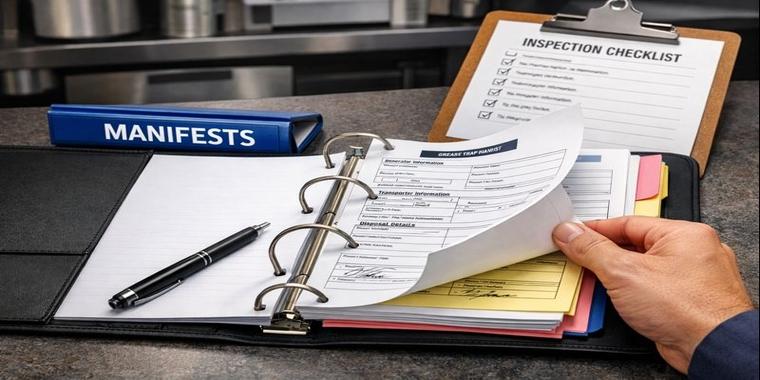
📌 Key Takeaways
Grease trap manifests track waste custody from pickup through disposal—invoices alone don’t prove legal compliance.
- Five-Year Retention Is Mandatory: Houston requires generators to maintain manifests for five years and produce them immediately upon inspector request.
- Manifests Need Eight Critical Fields: Generator information, service date, waste type, quantity, transporter details, disposal facility, disposal date, and required signatures must all be complete.
- Verify Haulers Before Hiring: Confirm transporter registration numbers, disposal facility relationships, and immediate manifest delivery before signing any service contract.
- The Compliance Binder System Works: Organized tabs for permits, chronological manifests, service logs, correspondence, and waivers enable 30-second document retrieval during audits.
- Missing Manifests Can’t Be Recreated: Contact haulers immediately for copies, document all outreach attempts, and replace vendors who refuse to provide proper documentation.
Incomplete paperwork shifts disposal liability back to you, regardless of what you paid.
Houston restaurant owners navigating FOG regulations will gain audit-proof documentation strategies here, preparing them for the compliance system implementation that follows.
The health inspector walks into your kitchen during Friday dinner rush. She’s polite but direct: “I need to see your grease trap service records for the past five years.” Your manager freezes. The binder is… somewhere. Maybe in the office. Or was it with the old paperwork that got tossed last spring?
This scenario plays out more often than it should, and the consequences go beyond embarrassment. Without proper manifesting documentation, you can’t prove your grease trap waste was disposed of legally—even if you paid someone to haul it away.
Grease trap manifesting is the chain-of-custody paperwork that tracks your liquid waste from pickup through final disposal. It’s not just a maintenance task—it’s a compliance event with documentation that must stand up to regulatory scrutiny. Think of it like a tax receipt during an IRS audit: payment alone doesn’t prove compliance. The manifest shows where the waste went, who handled it, and that it reached an approved disposal facility. In Houston, where commercial kitchens operate under strict FOG (Fats, Oils, and Grease) regulations, this documentation is your primary defense during inspections.
The good news? A simple compliance binder system—combined with vendor verification before you sign any service contract—makes audits routine instead of terrifying. This guide walks you through exactly what Houston requires, what a compliant manifest must include, and how to organize records so you can produce them in under 30 seconds.
What ‘grease trap manifesting’ actually means (and why invoices don’t protect you)
A manifest is a legal document that tracks liquid waste through every stage of handling. It records who generated the waste, who transported it, how much was collected, and where it was ultimately disposed. An invoice, by contrast, simply proves you paid for a service.
Here’s the critical difference:
| Document | What It Proves | Legal Weight in an Audit |
|---|---|---|
| Invoice | You paid someone to pump your trap | Minimal—payment doesn’t prove legal disposal |
| Manifest | Where the waste went and who handled it at each stage | Primary compliance documentation required by ordinance |
Houston’s municipal code requires generators—that’s you, the restaurant owner—to retain manifests for five years and make them available immediately upon request.[1] The city expects you to have both the initial service copy (signed at pickup) and the final return copy (certifying disposal) organized and accessible on-site.[2] While many haulers use traditional multi-part carbon forms (often white and yellow), digital manifests are increasingly common and equally valid provided they contain all required signatures.
Payment is not proof of disposal. If your hauler took shortcuts or disposed of waste improperly, you remain liable unless you can demonstrate you verified their credentials and retained proper documentation. The manifest creates that paper trail.
When Houston asks for your paperwork: inspections, audits, and spot checks
City health inspectors and FOG program auditors typically request manifests during routine inspections, complaint-driven visits, or when investigating permit renewals. Paperwork is often the first thing requested because it’s the fastest way to assess compliance behavior. The first thing they ask for is your service documentation—not because they doubt you’re getting the work done, but because they need to verify the waste disposal chain.
When you can’t produce manifests quickly, inspectors escalate their scrutiny. What might have been a five-minute records check becomes a detailed facility inspection. Missing documentation signals operational disorganization, which raises questions about other compliance areas.
“Survive” in this context means having an on-site system that any manager can access immediately. The inspector shouldn’t wait while you search through file cabinets or call your vendor hoping they kept copies. Your records should be organized, complete, and ready to review.
For comprehensive guidance on inspection preparation beyond just manifesting, see our article on how to prepare your kitchen for a City of Houston grease trap inspection.
What a compliant manifest must include (field-by-field cheat sheet)
Every manifest must document the complete chain of custody. Missing even one required field can render the document useless during an audit. Here’s what Houston expects to see:
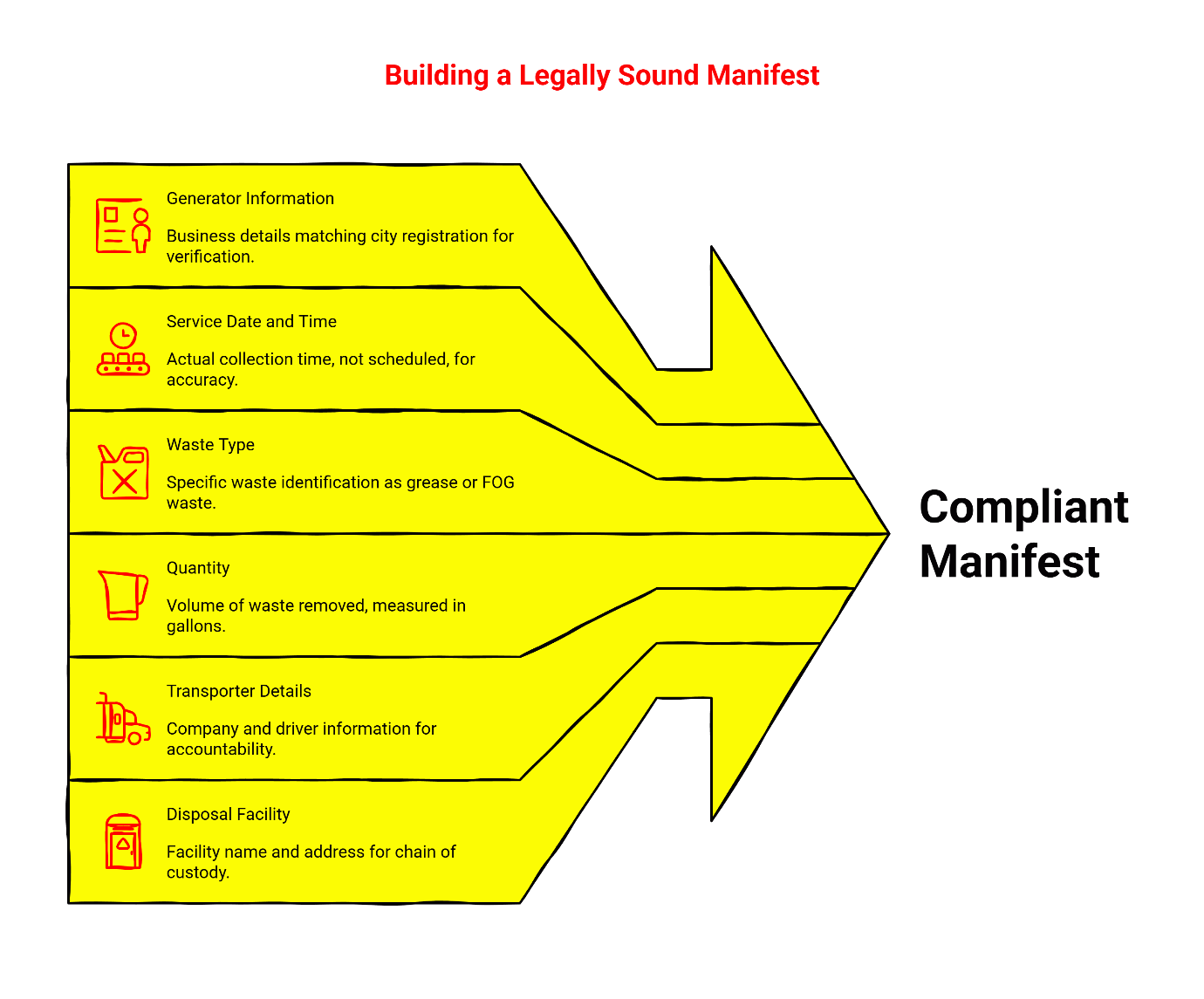
Must-Have Fields:
- Generator Information: Your business name, physical address, and contact information exactly as they appear on your city registration
- Service Date and Time: When the waste was actually collected (not when it was scheduled)
- Waste Type: Specifically identified as “grease trap waste” or “FOG waste” (generic terms like “liquid waste” don’t satisfy requirements)
- Quantity: Volume removed, typically measured in gallons
- Transporter Details: Company name, registration number, permit identifier, and driver signature
- Disposal Facility: Name and address of the facility that received the waste
- Disposal Date: When the waste reached its final destination (may differ from pickup date)
- Required Signatures: Generator representative, transporter, and disposal facility operator where applicable
Common errors that make manifests legally insufficient include missing generator signatures (meaning you never verified the information), incomplete transporter permit numbers (making it impossible to verify registration), and missing disposal facility information (breaking the chain of custody). If the hauler leaves your site without getting your signature, chase them down before the truck pulls away—you can’t fix it after the fact.
Annotated Sample Manifest
[WASTE MANIFEST / TRIP TICKET]
① GENERATOR INFORMATION
Business: [Your Restaurant Name]
Address: [Full Street Address, Houston, TX 77XXX]
Contact: [Phone Number]
Generator ID: [Your City Registration Number]
② SERVICE DETAILS
Service Date: 12/15/2025
Service Time: 10:30 AM
Waste Type: Grease Trap Waste (FOG)
Volume Removed: 450 gallons
③ TRANSPORTER INFORMATION
Company: [Licensed Hauler Name]
Registration #: [State/City Permit Number]
Driver Name: [Name]
Vehicle #: [Truck Identifier]
Driver Signature: _________________ Date: _______
④ GENERATOR CERTIFICATION
I certify this waste was generated at the above location
Generator Signature: _________________ Date: _______
Print Name: _________________________
⑤ DISPOSAL INFORMATION
Facility Name: [Approved Disposal Site]
Facility Address: [Full Address]
Disposal Date: 12/15/2025
Facility Rep Signature: _________________ Date: _______
COPIES:
White – Generator (Retain 5 years)
Yellow – Generator (Retain 5 years)
Pink – Transporter
Green – Disposal Facility
What the inspector looks for at a glance:
- ① Matches your business registration
- ② Shows service within 90-day requirement
- ③ Confirms transporter is registered/permitted
- ④ Proves you verified the information before truck left
- ⑤ Matches the final ‘Return Copy’ to the initial pickup ticket to prove disposal occurred
Who is responsible for what: generator vs transporter vs disposal site
Responsibility in waste manifesting follows a clear hierarchy, but the generator—your restaurant—cannot outsource legal liability even when you hire professionals to handle the physical work.
Generator Obligations (You):
- Verify transporter is properly registered before hiring them
- Sign the manifest only after confirming all fields are complete and accurate
- Retain copies for the full five-year period
- Make records available immediately upon regulatory request
- Report manifest discrepancies or missing return copies
Transporter Obligations:
- Complete all manifest fields accurately
- Provide generator copies before leaving the site
- Deliver waste only to approved disposal facilities
- Submit required copies to regulatory agencies
- Return completed manifest showing final disposal
Disposal Site Obligations:
- Accept waste only with proper manifesting
- Verify waste matches manifest description
- Complete their portion of the manifest
- Process waste according to permit requirements
- Maintain disposal records
The critical point is this: even though you pay someone else to pump your trap and haul the waste, you remain the responsible party if that waste isn’t handled legally. Hiring a registered transporter and maintaining complete manifests is how you demonstrate due diligence.
How long to keep manifests—and how to store them so you can find them in 30 seconds
Houston requires five-year retention with immediate availability.[3] “Immediate” means the inspector shouldn’t wait while you dig through storage or contact former employees who might remember where old files went. You need an organized, on-site system.
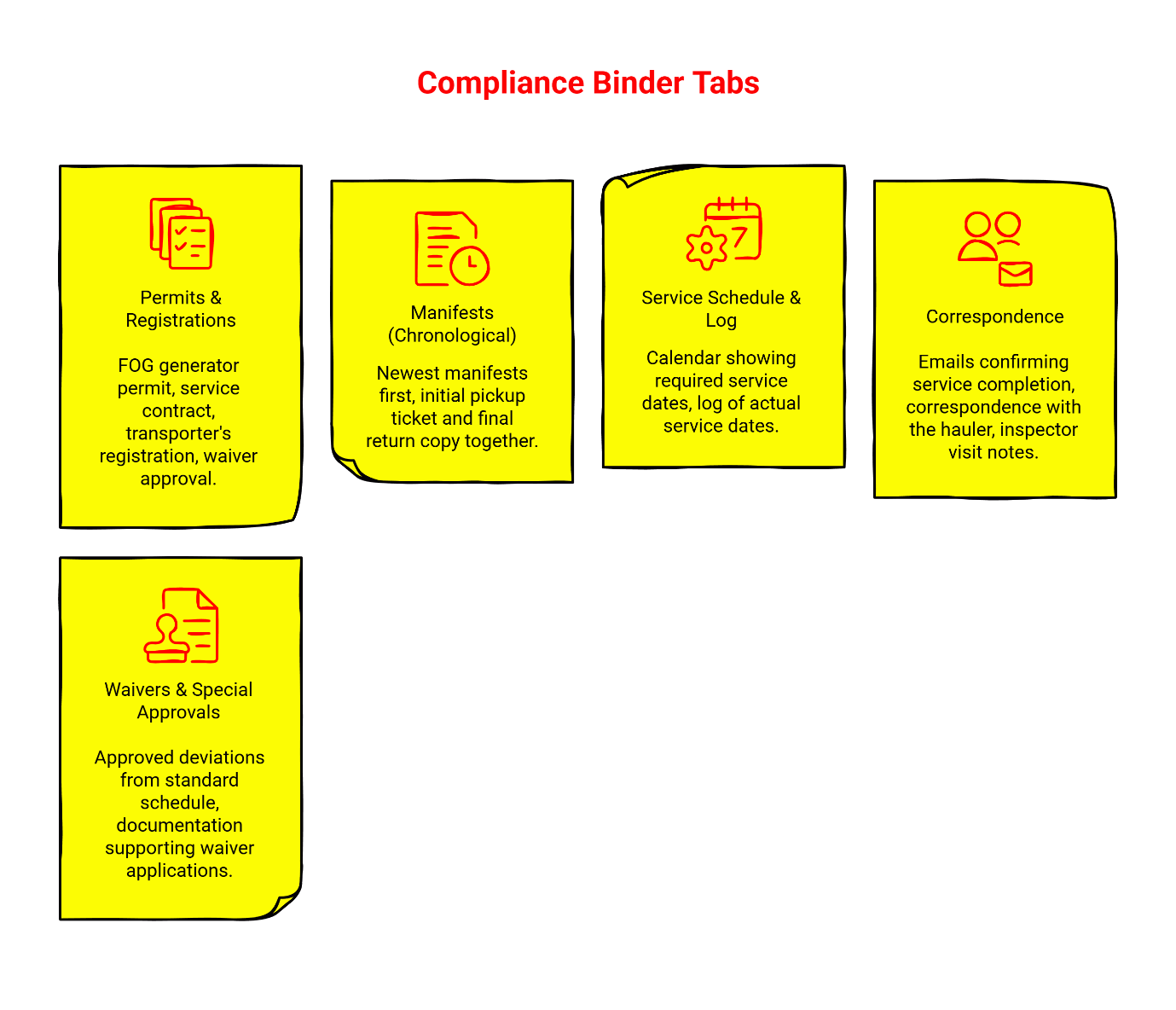
The Compliance Binder System provides that organization. Use a three-ring binder with labeled tabs:
Tab 1: Permits & Registrations
- Your FOG generator permit
- Current service contract
- Transporter’s registration certificate (verify annually)
- Any Notice of Waiver approval if applicable
Tab 2: Manifests (Chronological)
- Newest manifests first
- File both the initial pickup ticket and the final return copy together
- Add new manifests immediately after each service
- Use sheet protectors to prevent damage
Tab 3: Service Schedule & Log
- Calendar showing required service dates
- Log of actual service dates vs. scheduled dates
- Notes about any missed appointments or rescheduling
Tab 4: Correspondence
- Emails confirming service completion
- Any correspondence with the hauler about issues
- Inspector visit notes and corrective actions
Tab 5: Waivers & Special Approvals
- Any approved deviations from standard 90-day schedule
- Documentation supporting waiver applications
- Renewal dates for time-limited approvals
This binder lives in your office where managers can access it without your presence. When the inspector asks for records, your GM hands them the binder—complete, organized, and demonstrating operational competence.
Many operators also maintain digital backups by scanning manifests monthly and storing them in cloud folders organized by year. This protects against physical damage and makes sharing records with corporate or legal teams straightforward. The physical binder remains your primary system because inspectors expect to review on-site documentation, but digital backups provide insurance against lost or damaged papers.
Audit-Ready Compliance Binder Checklist
Before the truck leaves your property:
- ☐ All manifest fields completed (no blanks)
- ☐ Date and time reflect actual service (not just scheduled time)
- ☐ Quantity matches visual observation (reasonable volume for your trap size)
- ☐ Transporter permit number is present
- ☐ Designated disposal facility is listed (Name/Address)
- ☐ Your signature is on the generator certification line
- ☐ You received your initial ‘Generator’ copy immediately
- ☐ Copies are legible (carbon forms can be faint—verify before driver leaves)
Within 24 hours of service:
- ☐ File initial manifest copy in Tab 2
- ☐ Log service date in Tab 3 schedule tracker
- ☐ Scan manifest for digital backup folder
- ☐ Note next required service date (90 days or per waiver)
Monthly maintenance:
- ☐ Verify all services from past month are documented
- ☐ Check for any missing return copies from multi-part manifests
- ☐ Review upcoming service dates in next 30 days
- ☐ Confirm binder is in designated office location
Annual review:
- ☐ Verify transporter’s registration is still current
- ☐ Confirm disposal facility is still approved/permitted
- ☐ Archive manifests older than 5 years (if any)
- ☐ Review service contract for renewal dates
- ☐ Update emergency contact information
For deeper insight into timing your service to maintain compliance, see The 25% Rule Explained: When to Schedule Your Pump-Out to Stay Compliant.
How to vet a hauler before you hire them (the ‘cheap hauler’ trap)
Price matters in any business decision, but the cheapest hauler often creates the most expensive problems. A low price is not a bargain if documentation is incomplete or disposal cannot be verified. When a hauler fails on documentation or disposal verification, you inherit their liability. The few dollars saved per pump-out become irrelevant when you’re facing fines or explaining incomplete records to an inspector.
Six Questions to Ask Before You Sign:
- What is your transporter registration number? Verify this with TCEQ or city records. Unregistered haulers cannot provide legally valid manifests.[4]
- Which disposal facility do you use? Call the facility directly to confirm they accept FOG waste and that your prospective hauler is an approved transporter to that site.
- Do you provide generator copies before leaving the property? If they mail manifests later or promise to “drop them off next time,” find a different vendor. You need copies immediately.
- How do you handle manifest corrections if there’s an error? Professional haulers have a clear process for correcting mistakes. Vague answers suggest operational problems.
- Can you provide references from other Houston restaurants? Contact those references and ask specifically about manifesting reliability, not just pumping quality.
- What happens if you can’t complete service on the scheduled date? You need advance notice to reschedule and maintain your 90-day compliance window. Haulers who simply skip appointments without communication create compliance gaps.
The “cheap hauler” trap works like this: you hire the lowest bidder, they pump your trap adequately, and you pay the invoice. Months later during an inspection, you discover the manifests are incomplete, the disposal facility is no longer accepting waste, or the hauler’s registration lapsed. You cannot retroactively fix these problems. The inspector doesn’t care that you paid in good faith—you’re still the generator, and you’re still responsible.
For business owners facing this common objection—”You don’t need a premium hauler; just get it pumped for the lowest price”—consider this reality: cheap haulers often fail on manifests or legal disposal verification, which leaves you exposed to fines and operational disruption. The risk isn’t worth the modest savings. Professional commercial grease trap cleaning cost slightly more because they maintain proper registration, use approved disposal facilities, and complete documentation correctly the first time.
Audit survival plan: what to do if you’re missing manifests
Despite best intentions, you might discover during an inspection—or before one—that manifests are missing or incomplete. You cannot retroactively create manifests, but you can demonstrate good faith efforts to correct the situation.
Immediate Actions (Within 24 Hours):
Identify the gap. Review your service log against your manifest files. Note specific dates when service occurred but documentation is missing or incomplete.
Contact your hauler immediately. Request return copies of missing manifests via email (creating a written record of your request). Professional haulers maintain duplicate copies and can provide them within a few business days.
Document your outreach. Save all emails, text messages, or written requests. If the hauler doesn’t respond, follow up in writing every 72 hours. This documentation shows the inspector you took immediate corrective action.
Request transporter and disposal facility information. If manifests cannot be recovered, ask the hauler for written confirmation of their registration number, the disposal facility used, and disposal dates. This partial documentation is better than nothing.
Stop using vendors who won’t provide manifests. If your hauler refuses to provide missing documentation or cannot produce it after reasonable requests, replace them immediately. Continued use of a non-compliant vendor demonstrates knowing negligence.
Establish a new system immediately. Implement the compliance binder system for all future services. Even if historical records remain incomplete, demonstrating a robust current system shows inspectors you’ve addressed the problem.
Consider professional compliance assistance. If gaps are extensive or an inspection is imminent, consult with a compliance professional who can help you document your good faith efforts and develop a remediation plan.
What to tell the inspector: Be direct about the gap and what you’ve done to correct it. Explain when you discovered the problem, what steps you took immediately, and show documentation of your vendor outreach. Inspectors appreciate honesty and visible corrective action far more than excuses or deflection.
Missing manifests from past services cannot be undone, but establishing a reliable system going forward demonstrates operational integrity. Most inspectors will work with businesses that show genuine commitment to compliance—especially when you can prove you’ve replaced non-compliant vendors and implemented better controls.
How Drane Ranger helps you stay audit-ready (without living in paperwork)
Compliance doesn’t require endless administrative work—it requires partnership with a service provider who treats documentation as seriously as pumping. Since 1985, Drane Ranger has served Houston restaurants by delivering both components: thorough cleaning and complete manifesting.
Our approach is straightforward. We maintain all required registrations and use only approved disposal facilities. Before our truck leaves your property, you receive complete manifest copies with every field properly documented. We don’t mail them later or promise to drop them off “next time”—you get them immediately because we understand they’re not optional paperwork but legal requirements.
Regular scheduling eliminates compliance anxiety. We work with you to establish service intervals that meet Houston’s 90-day requirement (or your approved waiver terms if applicable). You’ll receive advance appointment confirmations and service reminders, so you’re never surprised by an approaching deadline. If we need to reschedule, we provide advance notice and prioritize your rescheduled service to maintain your compliance window.
As Shelley M. noted in her Google review: “Drain Ranger is very professional and reliable. Basically they can take care of all your grease drain needs.”
Harold R. added: “My experience with Drane Ranger was a very organized, professional and on time experience. I was kept informed of what was happening and a suggested time of cleaning again. I will use them again and will definitely recommend them to anyone I speak with.”
That organization and communication makes audit preparation automatic instead of stressful. When you know your manifests are complete, filed properly, and backed up by a service provider who maintains proper credentials, inspections become routine business rather than crisis situations.
We’re a Better Business Bureau accredited company because we believe accountability matters.[5] Whether you need help establishing a compliance system for the first time or you’re looking to replace a vendor who hasn’t prioritized documentation, we can help.
Start your service today—call 281-489-1765 or contact us to discuss your specific needs and schedule your first service.
FAQ: grease trap manifests in Houston
Is an invoice enough to prove compliance?
No. An invoice proves you paid for a service, but it doesn’t establish where the waste went or who handled it. Houston’s ordinance specifically requires manifests showing the complete chain of custody from generation through final disposal.
Do I need a manifest every single time my trap is pumped?
Yes. Every service that removes liquid waste requires manifesting documentation. There are no exemptions for small quantities, routine maintenance, or emergency services. Each pump-out must be documented.
How often should my grease trap be evacuated?
Houston requires quarterly cleaning (every 90 days) unless you have an approved waiver.[2] High-volume kitchens may need more frequent service based on accumulation rates. When your trap reaches 25% accumulation of FOG and solids, service is required immediately regardless of the schedule.
What if my vendor won’t give me a manifest or says they “don’t do that”?
Replace them immediately. Any transporter handling grease trap waste in Houston must provide manifests—it’s not optional. Vendors who refuse or claim they don’t need to provide documentation are either unregistered or cutting corners that expose you to liability.
Can I keep digital copies instead of paper?
You can maintain digital backups for your convenience, but Houston requires on-site documentation immediately available upon request. Inspectors may want to see physical copies or at minimum, need you to pull up digital files instantly. The safest approach is maintaining both: a physical compliance binder as your primary system and scanned digital copies as backup.
What should I show an inspector who asks for grease trap records?
Hand them your compliance binder opened to the manifest tab. A compliance-ready packet should include the most recent manifests, your complete set covering the five-year retention window, and any waivers or approvals applicable to your facility’s service interval. The binder should also contain your current service contract and your transporter’s registration information. Don’t make them ask for individual pieces—the complete binder demonstrates you take compliance seriously.
What happens if I discover errors on a manifest after the hauler leaves?
Contact your hauler immediately and request a corrected manifest. Professional transporters maintain duplicate copies and can issue corrections. Document your request in writing. If correction isn’t possible, note the discrepancy in your compliance binder and keep documentation of your attempt to resolve it.
Do manifests need to be on specific forms?
While standard forms exist, Houston doesn’t mandate a specific template. The manifest must contain all required information fields regardless of format. Most professional haulers use standardized multi-part carbon forms that automatically create the required copies for all parties.
Stay ahead of audits with organized compliance
Grease trap manifesting transforms from bureaucratic burden to straightforward routine when you understand what’s required and establish simple systems. The compliance binder, vendor verification before hiring, and immediate manifest filing take minutes per service but eliminate hours of panic during inspections.
Houston’s regulations exist because improper grease disposal damages infrastructure and creates environmental hazards. The manifesting requirement protects both the city and responsible business owners by creating clear accountability. When you can produce five years of complete documentation in 30 seconds, you’re not just surviving audits—you’re demonstrating the operational competence that builds trust with regulators, landlords, and customers.
If you’re ready to establish audit-proof documentation systems, Drane Ranger provides both the service quality and compliance support that Houston restaurants need.
For additional context on common inspection mistakes, see The ‘Sample Well’ Myth: Why Visual Checks Fail to Detect Sludge.
Disclaimer: This content is for informational purposes only and does not replace professional legal or regulatory guidance. For the most current requirements, consult the City of Houston and applicable state agencies.
Our Editorial Process: Our expert team uses AI tools to help organize and structure our research, but every article is carefully reviewed by expert humans on our Insights Team to ensure accuracy and clarity.
About the Drane Ranger Insights Team: The Drane Ranger Insights Team is our dedicated engine for synthesizing complex topics into clear, helpful guides. While our content is thoroughly reviewed for clarity and accuracy, it is for informational purposes and should not replace professional advice.
References
[1] City of Houston Code of Ordinances, §47-512, https://library.municode.com/tx/houston/codes/code_of_ordinances
[2] Houston Permitting Center, Generator Registration at Food Establishment (HHD1017), https://www.houstonpermittingcenter.org/hhd1017
[3] Houston Health Department, Special Waste Generators (FOG Program), https://www.houstonconsumer.org/services/permits/special-waste-permits/special-waste-generators
[4] Texas Commission on Environmental Quality, Transporting Waste in Texas (RG-86), https://www.tceq.texas.gov/downloads/permitting/waste-registration/pub/rg-086.pdf
[5] Better Business Bureau, Drane Ranger Vacuum Service Profile, https://www.bbb.org/us/tx/houston/profile/septic-tank-cleaning/drane-ranger-vacuum-service-0915-31003989