The 25% Rule Explained: When to Schedule Your Pump-Out to Stay Compliant

📌 Key Takeaways

Houston’s grease trap compliance hinges on one measurable threshold: when floating grease plus settled solids reach 25% of your trap’s liquid depth, schedule service immediately—regardless of the calendar.

  • Core Sampling Reveals What Visual Checks Miss: Bottom sludge accumulates invisibly beneath a seemingly clean surface, making core sampling through the sample well the only reliable measurement method inspectors accept.
  • The 25% Rule Overrides the 90-Day Clock: High-volume kitchens often hit the 25% threshold in six to eight weeks, triggering mandatory service even when the quarterly deadline hasn’t arrived—compliance follows accumulation, not the calendar.
  • Manifests Prove Legal Disposal, Not Just Payment: A signed waste manifest creates a chain-of-custody record that protects restaurants from liability if haulers dump illegally, making it the critical compliance document inspectors require.
  • Measurement Drives Predictable Scheduling: Taking core samples every two to three weeks reveals each kitchen’s actual accumulation rate, enabling operators to pre-book service before hitting the 25% trigger rather than reacting to odors or backups.
  • The Three-Step Compliance Loop Prevents Violations: Measure with core sampling, schedule proactively based on trend data, and maintain organized manifests—this systematic approach keeps Houston restaurant kitchens audit-ready and operations running smoothly.

Measure before you’re mandated, schedule before you’re late, document before you’re inspected.

Houston restaurant owners, general managers, and facilities managers will find this framework here, preparing them for the detailed measurement and scheduling guidance that follows.

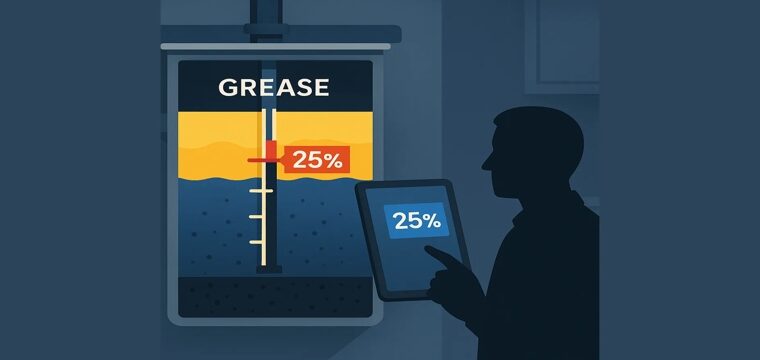
The 25% rule defines when Houston restaurants must clean their grease traps: when the combined depth of floating grease and settled solids reaches approximately one-quarter of the trap’s total liquid depth. Think of it like an oil-change indicator—hit the line, you service now.

Picture this scenario. It’s Friday lunch rush, and a city inspector walks into your kitchen. They ask to see your most recent core sample reading. You check your log. The measurement shows 28%.

That simple number tells the inspector everything they need to know—and it determines whether you’re compliant or facing a violation. Schedule your pump-out before reaching 25% or by the quarterly mandate, whichever comes first.


What is Houston’s 25% Rule?

What is the 25% rule for grease traps?

The 25% rule is the operational threshold that triggers mandatory grease trap cleaning in Houston. It measures total accumulation—both the floating grease cap at the top of your trap and the settled solids at the bottom—as a percentage of the trap’s liquid depth.š

When these two layers combined equal roughly one-quarter of the total depth, the trap has reached its functional limit. At this point, the trap can no longer effectively separate fats, oils, and grease (FOG) from wastewater.

This isn’t an arbitrary number. The 25% threshold represents the point where trap efficiency degrades significantly, increasing the risk of FOG entering the municipal sewer system.š City ordinances in Houston recognize this as the functional compliance trigger, meaning you must schedule service when you hit or exceed this accumulation level.

Treat 25% as your “service-now” line. Waiting until you’re well past this threshold—or worse, waiting until you smell problems—puts your business at risk of violations, backups, and costly emergency service calls.


25% vs. 90 Days—Which Comes First?

Houston restaurants face two overlapping requirements: the 25% accumulation threshold and the quarterly (90-day) cleaning mandate. You must clean at whichever trigger comes first.š

For many operations, especially high-volume kitchens, the 25% threshold arrives well before 90 days have elapsed. A busy restaurant producing significant grease loads might hit 25% in just six to eight weeks. When this happens, the clock doesn’t matter—the accumulation level takes priority.

The quarterly mandate serves as a backstop. Even if your trap measures below 25% at the three-month mark, city regulations for traps within Houston limits still require cleaning.š This ensures that lower-volume operations maintain regular service intervals and proper trap function.

Understanding which trigger applies to your specific operation requires measurement and tracking. High-volume kitchens need shorter service intervals; lower-volume operations may run closer to the quarterly schedule. The key is measuring regularly to know where you stand and adjusting your maintenance calendar accordingly.


How Inspectors Measure It (and How You Should Too)

How do inspectors measure the 25% rule—do visual checks count?

Inspectors don’t rely on visual surface checks. They use core sampling through your trap’s sample well to get an accurate cross-section of all three layers: the grease cap, the clear water zone, and the settled solids at the bottom.

A visual check from the top only shows you the grease cap—and even that measurement is unreliable without proper tools. The real problem lies beneath the surface. Settled solids accumulate at the trap bottom, invisible to anyone just lifting the lid for a quick look. These solids count toward your 25% total, and inspectors know that surface appearances miss this critical layer. Visual checks alone cannot prevent the sewer blockages and overflows that FOG regulations are designed to stop.

Core sampling provides a complete vertical profile. The sampler—commonly called a sludge judge—captures material from top to bottom in a single pull. This allows for precise measurement of both the floating grease thickness and the depth of bottom sludge.

Your measurement protocol should match the inspector’s method. Use a core sampler designed for grease traps, accessed through your trap’s sample well. Record the top grease layer thickness, the clear water zone depth, and the bottom solids depth. Calculate these measurements against your trap’s total liquid depth to determine your accumulation percentage.

Visual checks fail inspections. Core sampling passes them. Make the investment in the right tool and the right technique.


Step-by-Step: Take a Core Sample in 5 Minutes
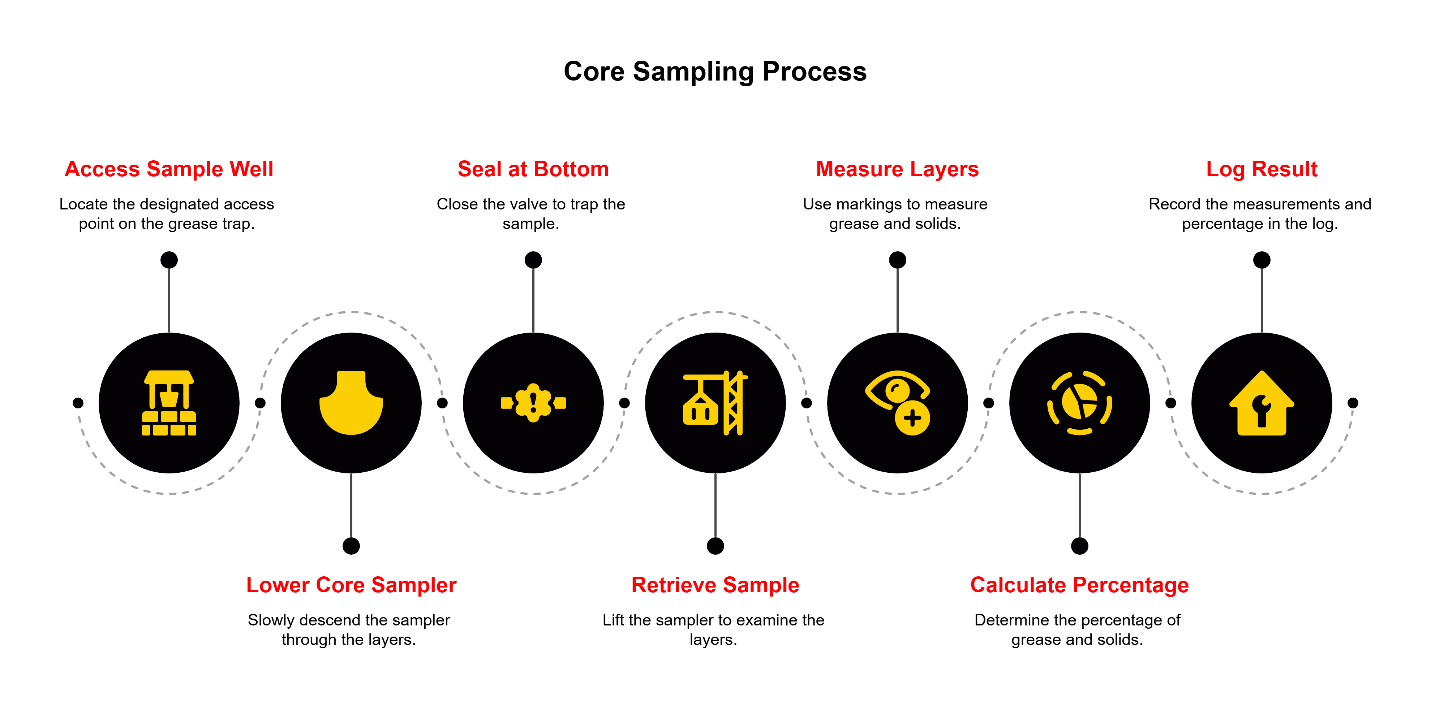
Core sampling process infographic showing steps to access sample well, lower and seal core sampler, retrieve sample, measure layers, calculate grease and solids percentage, and log results.


Does floating grease count toward the 25% rule?

Yes. Both floating grease and settled solids count toward your 25% total.š Here’s how to measure both layers accurately:

Access your sample well. Most grease traps have a dedicated sample well or measurement port. Locate this access point—it’s typically marked and provides a clear vertical path to the trap bottom.

Lower your core sampler slowly. A sludge judge or similar core sampling tool should descend through all three layers without disturbing them. Keep the bottom valve closed during descent to prevent water from entering the tube prematurely.

Reach the trap bottom, then seal. When you feel the sampler touch bottom, close the bottom valve to trap the vertical sample inside the tube. This captures a complete cross-section from top to bottom.

Retrieve and read the layers. Lift the sampler straight up and examine the captured sample. You’ll see three distinct zones: grease at the top (often yellowish or tan), clear water in the middle, and dark settled solids at the bottom.

Measure and calculate. Use the graduated markings on your sampler to measure:

  • Top grease layer depth
  • Bottom solids layer depth
  • Total liquid depth (grease + clear water + solids)

Add the grease and solids measurements, then divide by total depth and multiply by 100 for your percentage. If grease is 2 inches, solids are 3 inches, and total depth is 20 inches: (2 + 3) á 20 = 0.25, or 25%.

Log the result immediately. Record the date, time, all three measurements, and the calculated percentage in your maintenance log. This documentation proves you’re monitoring compliance between service visits.

Assign this task to a designated kitchen manager or facilities lead. Taking a reading once every two to three weeks gives you advance warning before you hit the 25% threshold.


Scheduling Logic: Turn Readings into a Maintenance Calendar

Raw measurements mean nothing without a maintenance plan. Use your readings to establish a service cadence that prevents you from ever reaching the 25% trigger unexpectedly.

Start with a 90-day baseline if you’re new to systematic tracking. Schedule your first professional cleaning, then begin taking core samples every two weeks. Track the accumulation rate over the first three months. This data reveals how quickly your specific operation approaches the 25% threshold.

High-volume kitchens often discover they need service every six to eight weeks. Lower-volume operations might find they run comfortably at 75 or 85 days. The measurement trend tells you what your kitchen actually needs—not what a generic schedule suggests.

Once you know your accumulation rate, schedule the next service appointment before you project hitting 25%. Build in a safety margin. If your readings suggest you’ll reach 25% at week 10, book service for week 8 or 9. This buffer accounts for unexpected volume spikes during busy seasons or special events.

Pre-booking service creates schedule certainty. This quiet protection—operating like an invisible shield between your kitchen and expensive sewer problems—means you avoid last-minute emergency calls, and your service provider can plan routes more efficiently. Many operators find that turning measurements into a reliable schedule reduces both stress and cost over time.


Compliance Paperwork: The Manifest Is Your Proof

Cleaning your grease trap removes the waste. The manifest proves you disposed of it legally.

A waste manifest is a legal tracking document that follows your grease trap waste from your property to its final disposal site. It identifies the waste generator—your restaurant—along with the hauler, the transport vehicle, and the receiving facility.¹ All parties sign the manifest, creating a chain-of-custody record.

For Houston restaurant operators, this document serves two critical functions. First, it demonstrates compliance with city FOG (fats, oils, and grease) ordinances that require proper waste disposal. Second, it protects you if there’s ever a question about where your waste ended up. If a hauler dumps illegally, the signed manifest proves you fulfilled your legal responsibility by hiring a registered service provider.

After every pump-out, file the signed manifest in a dedicated Compliance Binder. Organize manifests chronologically with the most recent on top. Keep this binder readily accessible for inspector visits. Regulatory guidance recommends retaining manifests for at least five years to cover typical audit windows.š

Missing manifests raise red flags during inspections. An inspector sees a clean trap but no paperwork trail and must assume non-compliance. That gap can trigger fines even if you’ve been cleaning on schedule. The cleaning proves operational maintenance; the manifest proves legal compliance.

“Organized, professional and on time… suggested time of cleaning again,” one Houston-area operator noted after establishing a consistent manifesting routine with a reliable service provider. That level of systematic documentation turns a potential compliance vulnerability into a strength.


Common Pitfalls That Trigger Fines
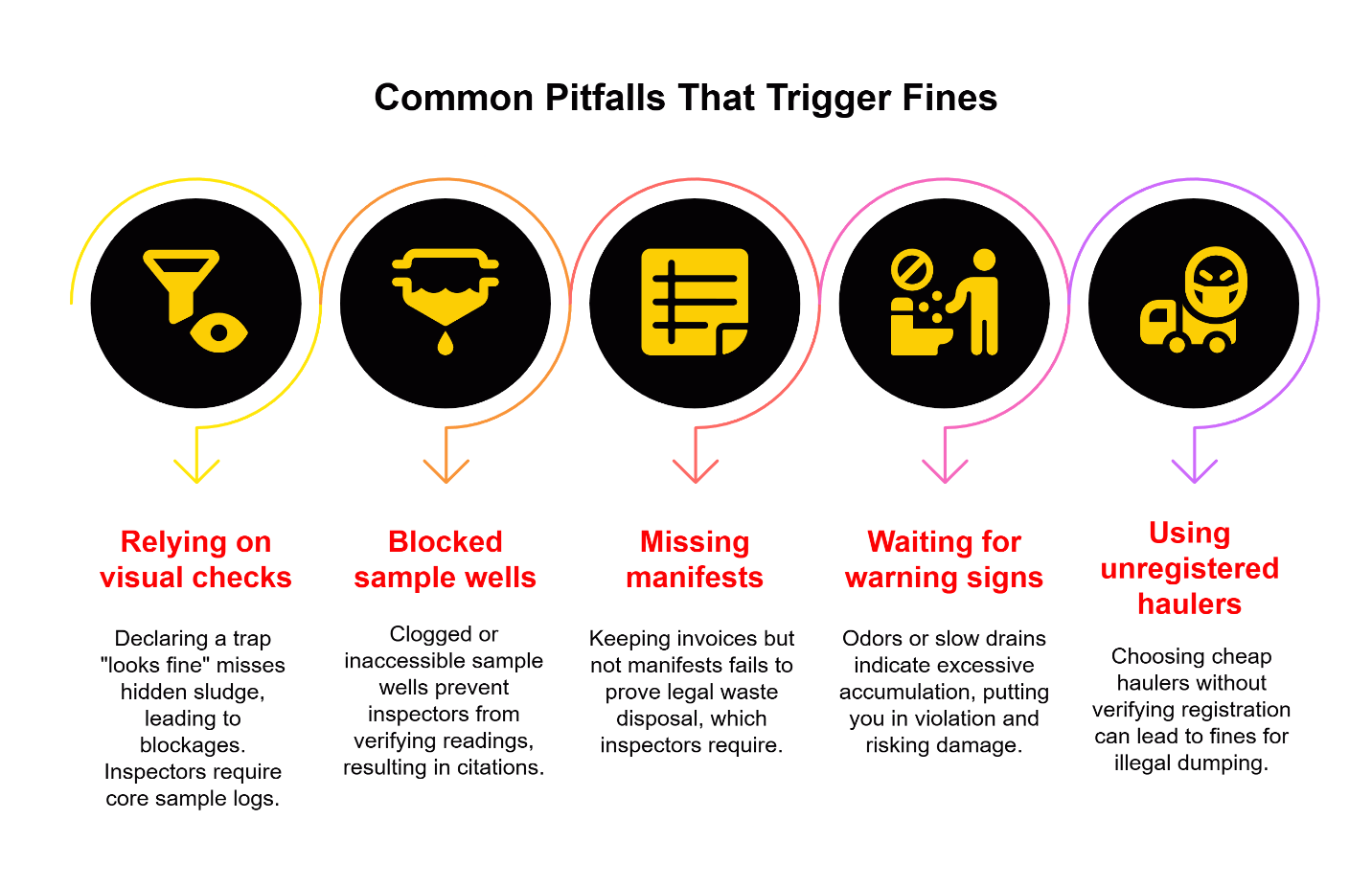
Infographic showing common pitfalls that trigger grease trap fines, including relying on visual checks, blocked sample wells, missing manifests, waiting for warning signs, and using unregistered haulers.


Relying on visual checks only. Walking past the trap, lifting the lid, and declaring it “looks fine” misses the bottom sludge layer completely. This hidden accumulation contributes directly to the sewer blockages and sanitary sewer overflows (SSOs) that FOG regulations aim to prevent. Inspectors know this. They’ll ask for your core sample log, and if you don’t have one, the visual assessment means nothing.

Blocked or inaccessible sample wells. Sample wells can become clogged with grease or covered by equipment over time. If an inspector can’t access your sample well to verify your readings, they may cite you for non-compliance regardless of when you last cleaned the trap.

Missing or incomplete manifests. Some operators keep invoices but not manifests, not realizing these are different documents. An invoice shows you paid for a service; a manifest proves legal waste disposal.š Inspectors require manifests.

Waiting for warning signs. Bad odors, slow drains, or visible backups mean you’re well past 25%—possibly at 40% or 50% accumulation. By the time you smell a problem, you’re already in violation and facing potential backup damage.

Using unregistered or non-compliant haulers. Some operators choose the cheapest service without verifying the hauler is properly registered and insured. When these haulers skip manifesting or dump illegally, you can still be on the hook as the generator—the legal term for the restaurant that produced the waste.š As one satisfied customer shared: “Drain Ranger is very professional and reliable. Basically they can take care of all your grease drain needs.” That reliability includes proper manifesting and disposal—protections worth far more than the small premium over cut-rate alternatives.

These pitfalls share a common thread: reactive rather than proactive management. Houston’s 25% rule exists to prevent problems, not document them after they occur. Everything else is noise.


Frequently Asked Questions

What exactly counts toward the 25%?

Both floating grease and settled solids count toward total accumulation. The clear water zone in the middle does not count—only the material at the top and bottom of the trap.¹

Do I pump at 25% or every 90 days?

You must clean at whichever trigger comes first. If you reach 25% accumulation at week 7, you clean at week 7. If you’re still below 25% at day 90, the quarterly mandate requires service anyway.š

How do I measure it?

Use a core sampler (sludge judge) accessed through your trap’s sample well. The sampler captures a vertical cross-section showing all three layers. Measure the grease cap depth, the bottom solids depth, and the total liquid depth, then calculate the percentage.

Is a clean-looking surface OK?

No. Surface appearance reveals nothing about bottom sludge accumulation. Inspectors require core sampling data, not visual assessments, because visual checks consistently underestimate total accumulation and cannot prevent sewer blockages.

What paperwork do I keep?

Keep signed waste manifests from every pump-out. Organize them chronologically in a dedicated compliance binder. Maintain these records for at least five years for audit readiness.


Measure, Don’t Guess: Book Before You Hit 25%

The 25% rule transforms grease trap maintenance from guesswork into a measurable process. Floating grease plus settled solids equal your total accumulation. When that total reaches one-quarter of your trap’s liquid depth, schedule service immediately.š

Core sampling through your sample well provides the accurate measurement inspectors require. Visual checks miss the bottom layer where significant solids accumulate. Take readings every two to three weeks, log the results, and track your accumulation trend over time.

This measurement-based approach reveals your kitchen’s actual service interval—whether that’s every six weeks for high-volume operations or closer to the 90-day maximum for lower-volume establishments. Use this data to pre-book maintenance appointments before you hit the threshold, not after.

The documentation loop completes the compliance picture. Measurement identifies when to clean. Professional service removes the waste. A signed manifest proves legal disposal.¹ Together, these three elements—measure, schedule, manifest—create an audit-ready compliance system that protects your business.

“He has done all my septic work and is the best!” one long-term customer shared. That expertise extends to helping Houston restaurant operators establish systematic maintenance programs built on measurement data, not reactive crisis management.

Understanding what to expect from a professional grease trap cleaning helps operators recognize quality service. Avoiding common FOG violation myths prevents costly mistakes that trigger fines despite good intentions.

The math is simple: measure regularly, schedule proactively, and maintain complete documentation. That systematic approach keeps Houston restaurant kitchens compliant, inspectors satisfied, and operations running smoothly.

Call Drane Ranger to set your maintenance schedule and establish a measurement-based compliance program tailored to your kitchen’s actual service needs, or contact us to request a 25% reading and service quote.

References

  1. Texas Commission on Environmental Quality (TCEQ). FOG control and interceptor maintenance guidance. Sample ordinance provisions covering 25% accumulation standards, quarterly cleaning requirements, and recordkeeping expectations for waste generators.

About the Drane Ranger Insights Team

The Drane Ranger Insights Team is our dedicated engine for synthesizing complex topics into clear, helpful guides. While our content is thoroughly reviewed for clarity and accuracy, it is for informational purposes and should not replace professional advice.
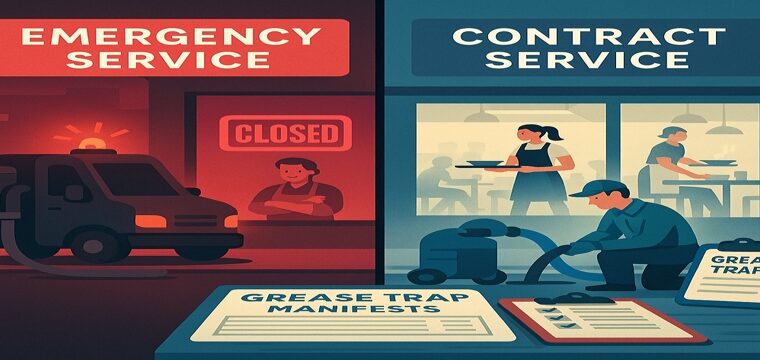
The Real Cost of a Backup: Why Emergency Pumping Costs More Than a Contract

📌 Key Takeaways

A backup doesn’t announce itself with an invoice—it arrives with closed doors, idle staff, and guests walking out.

  • The Real Bill Hides in Downtime: A four-hour shutdown during peak service can cost $2,600 in lost margin before you factor in the emergency pumping premium, overtime, or spoiled inventory.
  • Contracts Cost Less Than Crises: One emergency event—combining service premiums, downtime, refunds, and potential fines—typically exceeds the annual cost of a scheduled maintenance contract designed around your actual kitchen volume.
  • The 25% Threshold Protects Your Operation: When fats, oils, and grease reach a quarter of your trap’s capacity, cleaning becomes necessary to maintain proper function and avoid system failure, regardless of your quarterly baseline.
  • Documentation Keeps Inspectors Satisfied: Manifests, service logs, and waste disposal records produced through scheduled maintenance create the compliance trail that health inspectors expect during unannounced visits.
  • Frequency Should Match Your Reality: High-volume kitchens running fryers all day need more frequent service than the quarterly minimum, with intervals tuned to actual FOG output rather than calendar convenience.

Maintenance is an investment; emergencies are an expense.

Restaurant owners, general managers, and facilities teams overseeing commercial kitchens in Greater Houston will find the operational details here, preparing them for the comprehensive cost analysis and contract evaluation framework that follows.

A grease trap backup happens when your trap exceeds its capacity—fats, oils, and grease accumulate beyond safe levels, causing slow drains, overflows, or complete line blockages. In Houston, city regulations require commercial kitchens to empty traps quarterly at minimum, and cleaning becomes necessary when accumulation reaches 25% of the trap’s total capacity. The EPA has documented how FOG buildup contributes to sewer blockages and system failures. But those thresholds aren’t just regulatory checkboxes. They’re your early warning system.

Think of grease trap maintenance like oil changes for your vehicle. Skip a few, and you might get away with it for a while. Then one day, your engine seizes on the highway. Now you’re paying for a tow truck, a rental car, and a complete engine rebuild—all because a $40 oil change seemed easy to postpone.

Picture this: Friday night during your dinner rush. The kitchen sinks start draining slower. Then that unmistakable smell hits. A floor drain burps wastewater onto the kitchen floor right in the middle of service. Servers notice. Guests notice. Your line cooks are working around standing water while you’re on the phone desperately searching for someone—anyone—who can pump your trap right now. You watch parties of four walk past your door and choose the restaurant next door instead.

Here’s the practical reality. Sign a commercial grease trap cleaning services contract with scheduled cleanings, and you avoid that emergency entirely. You get predictable costs, priority service, and the documentation inspectors actually want to see.


The Problem You Don’t See: Why Backups Blindside Your Budget

Emergency pumping doesn’t just cost more per service. It triggers a cascade of expenses that most restaurant operators don’t calculate until they’re already paying them. The direct service premium is real—after-hours rates, expedited dispatch, and short-notice availability all command higher prices. But that’s just the beginning.

When you wait for a crisis, multiple costs land at once: emergency call-out premiums, lost revenue during shutdown, staff standing idle on the clock, possible food loss and refunds, and compliance actions if inspectors find you’ve fallen behind on your maintenance cadence.

Watch for these early warning signs before you cross the quarterly threshold or hit that 25% accumulation level: persistent odors near floor drains, slower drainage in prep sinks, gurgling sounds when water flows, or visible grease in unexpected areas. When you spot any of these, you’re already approaching the danger zone.


What Makes Emergency Pumping Expensive

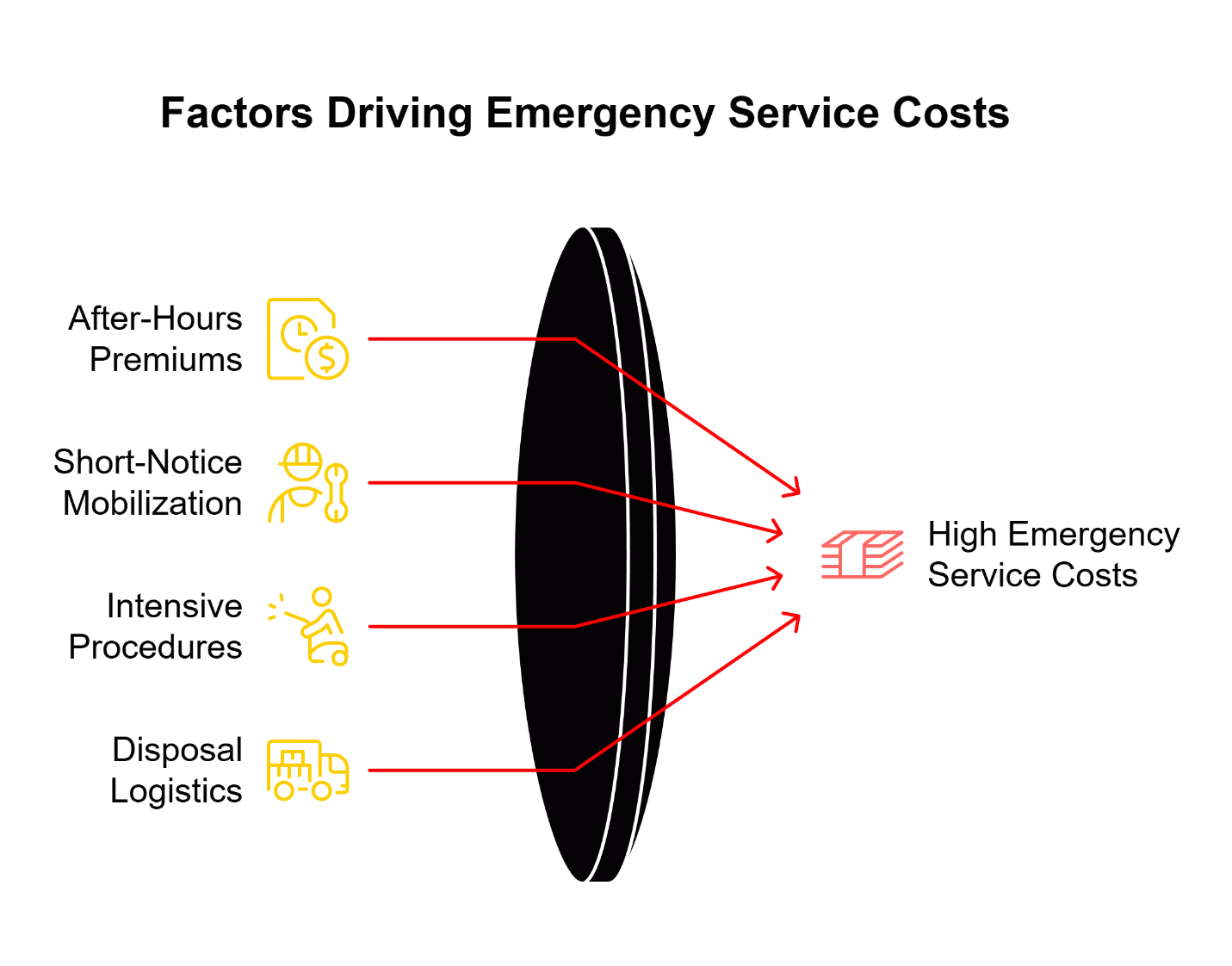
Infographic titled “Factors Driving Emergency Service Costs” showing after-hours premiums, short-notice mobilization, intensive procedures, and disposal logistics with arrows converging toward high emergency service costs.


Several factors drive emergency service costs higher than scheduled maintenance. After-hours and weekend premiums apply when you need service outside normal business hours—which is exactly when most backups force your hand. Short-notice mobilization means your service provider has to rearrange their schedule, potentially pulling technicians from other jobs or calling them in on their day off.

The work itself often requires more intensive procedures. A backup usually means the trap is completely full and the lines may be partially clogged, requiring hydro-jetting to clean surfaces down to bare metal. Scheduled maintenance, by contrast, prevents buildup before it hardens and adheres to trap walls.

Disposal logistics become complicated in emergencies. Texas regulations on municipal liquid waste transport require proper vehicle authorization and manifesting for grease trap waste. With scheduled service, waste manifesting and transportation are planned and streamlined. During an emergency, those same logistics happen under time pressure, and proper documentation—critical for compliance—can become rushed or incomplete.

Reputable providers like Drane Ranger have maintained proper manifesting and legal disposal practices since 1985, ensuring every load is documented regardless of service timing. The City of Houston’s special waste program outlines clear expectations for FOG management that professional haulers must follow. But not every provider maintains those standards when responding to panic calls.


The Hidden, Bigger Bill: Downtime Math

The real expense of a backup isn’t the pump truck—it’s what happens to your operation while you wait for help. Use this formula to calculate your actual exposure:

Lost Sales = (Average tickets per hour × Hours closed or limited) × Gross profit margin

Here’s a concrete example: A restaurant serving 40 tickets per hour at $25 average check, closed for 4 hours during peak service, with a 65% gross margin loses $2,600 in margin alone. That’s before you add labor costs for staff standing idle or working overtime, inventory loss from food that spoiled or had to be discarded, or refunds and comped meals for guests who experienced the problem.

“The most expensive grease trap cleaning is the one you didn’t plan for.”

Now consider the reputation cost. Negative reviews don’t itemize on your P&L, but they compound. One dinner service interrupted by a grease trap emergency can generate social media posts and online reviews that affect your revenue for months. And if a city inspector happens to visit during a backup? Violations, fines, and potential closure orders become part of your emergency total.

In Houston’s commercial restaurant environment, where health department visits can happen without notice, operating with a full or malfunctioning trap carries regulatory risk that extends well beyond cleanup costs. Many busy kitchens with high FOG output need more frequent service than the quarterly minimum to avoid overloading their traps.


Why Contracts Win on Total Cost

Scheduled grease trap cleaning in Houston through a maintenance agreement delivers predictable rates across the year. You know your quarterly costs upfront, which simplifies budgeting and eliminates surprise expenses. More importantly, contract customers receive priority scheduling. When weather events, busy seasons, or unexpected demand spikes create service backlogs, contract customers get handled first.

Service frequency gets aligned to your actual needs—not just the regulatory minimum. Municipal FOG management guidelines describe how the 25% rule works for determining cleaning frequency based on actual trap performance. Busy kitchens with high-volume fryers may need cleaning every six to eight weeks, while slower operations stay compliant with standard quarterly service. A good provider helps you determine the right cadence based on your menu, volume, and trap size.

The documentation benefit alone justifies the contract approach. Each service generates manifests showing proper waste handling, cleaning records that demonstrate compliance, and maintenance logs that inspectors view favorably. When a health inspector asks to see your grease management records, you hand them a complete file instead of scrambling to remember when you last called someone.

As one Houston restaurant manager shared: “My experience with Drane Ranger was a very organized, professional and on time experience. I was kept informed of what was happening and a suggested time of cleaning again. I will use them again and will definitely recommend them to anyone I speak with.” — Harold R.


Simple Scenarios: One Backup vs. One Year on Contract

Consider this cost comparison. Keep in mind these are illustrative examples based on typical industry scenarios—actual costs vary by trap size, location, and specific circumstances. Contact Drane Ranger at 281-489-1765 for a site-specific quote.

Cost Item Single Emergency Backup Annual Contract (4 Services)
Emergency pumping & deep clean $1,400 Included in scheduled visits
After-hours/rush premium $300 $0 (daytime scheduling)
Downtime loss (based on example above) $2,600 $0 (no operational disruption)
Overtime & additional cleanup $400 Minimal
Potential fines/re-inspection costs $500+ Avoided through compliance
Estimated total single-event impact $5,200+ Predictable annual budget

The emergency scenario above doesn’t even account for longer-term revenue impact from negative reviews or customer loss during the shutdown.


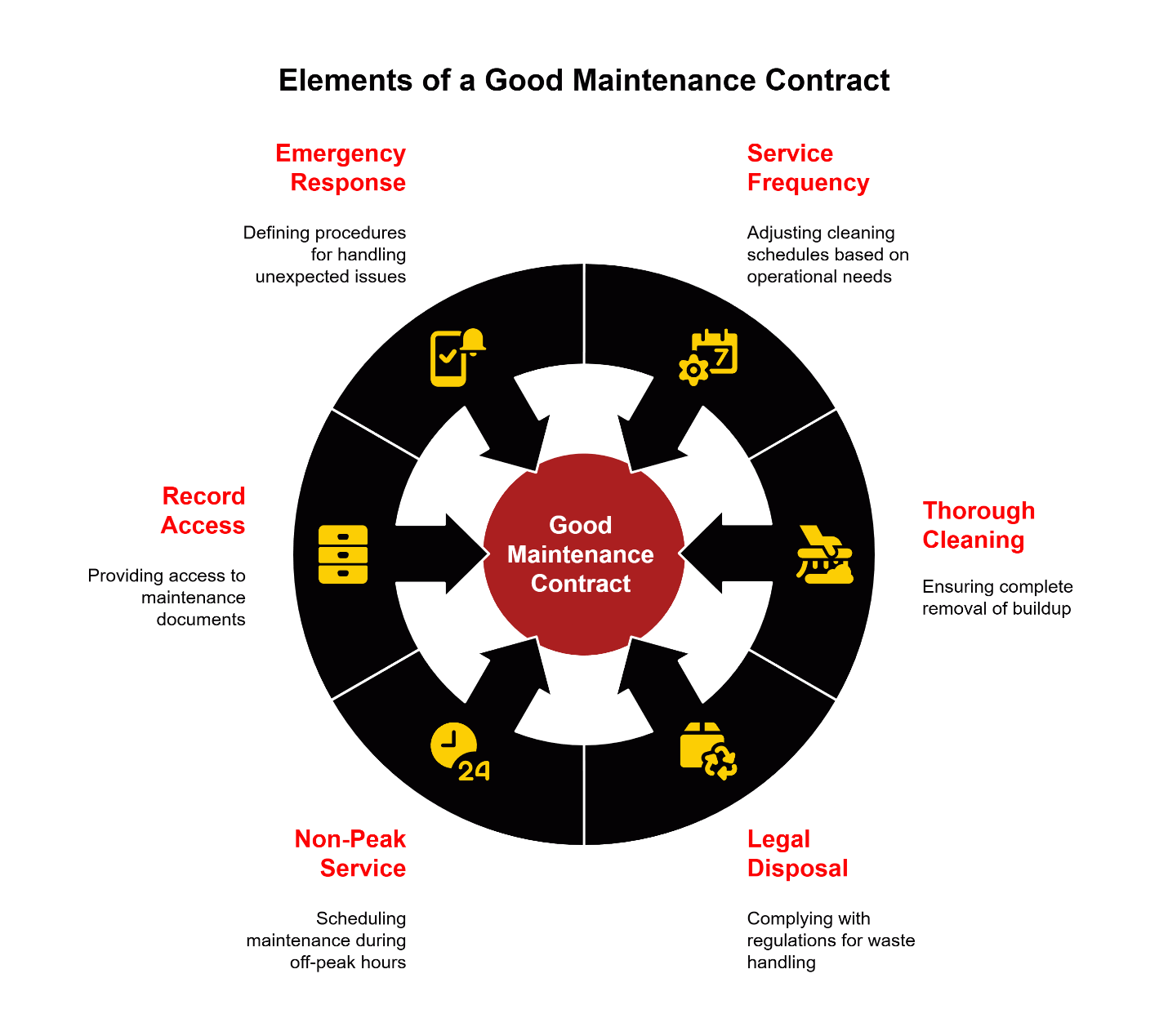
What a Good Contract Includes

Diagram showing core elements of a good maintenance contract, including cleaning, disposal, service frequency, and emergency response.


Look for these elements when evaluating maintenance agreements:

Service frequency tuned to your operation. Cookie-cutter quarterly schedules work for some kitchens, not all. Your contract should specify cleaning intervals based on your trap size, cooking volume, and menu type—aligned with the 25% accumulation threshold that triggers necessary cleaning. Busy kitchens frying food all day need more frequent service than operations with lower grease output.

Thorough cleaning to bare surfaces. The contract should specify complete pump-out and interior cleaning—not just surface removal. This prevents the hardened buildup that causes premature failure and costly deep cleans later, ensuring FOG and solids are removed to restore full working capacity.

Proper manifesting and legal disposal. Every load removed should generate a manifest documenting proper handling and disposal at licensed facilities. This isn’t a luxury—it’s a legal requirement under Texas rules that protects you from liability. Your provider should demonstrate clear compliance with state and local waste transport regulations.

Non-peak service windows. Quality contracts schedule service during your closed hours or slower periods, eliminating operational disruption entirely.

On-site record access. You should receive and retain copies of all service records, manifests, and inspection reports. These documents prove compliance when regulators ask and provide the service history inspectors want to see.

Clear emergency response terms. Even with preventive maintenance, unexpected issues occasionally arise. Your contract should spell out how emergency situations get handled for existing customers.

Drane Ranger has served the Greater Houston area—within approximately 100 miles of our Houston location—since 1985. Our approach focuses on safe, compliant collection and disposal practices, not just getting in and out as quickly as possible.

Request a contract quote to see how these elements apply to your specific operation.


Next Steps

Don’t wait for a backup to force your hand. If you’re stretching beyond quarterly cleaning inside Houston city limits or hitting the 25% accumulation level between visits, you’re likely overdue for a new maintenance schedule.

Call 281-489-1765 Monday through Friday, 9am to 6pm, to discuss your trap size, service frequency, and contract options. Our team will help you determine the right maintenance schedule based on your operation’s specific needs, ensuring you stay ahead of both the quarterly city requirement and the 25% accumulation threshold that triggers necessary cleaning.

Alternatively, visit our contact page to request a contract quote online. We’ll respond within 24 hours with a customized proposal for your location.

Maintenance is an investment. Emergencies are an expense. Choose predictability.

About the Drane Ranger Insights Team

The Drane Ranger Insights Team is our dedicated engine for synthesizing complex topics into clear, helpful guides. While our content is thoroughly reviewed for clarity and accuracy, it is for informational purposes and should not replace professional advice.
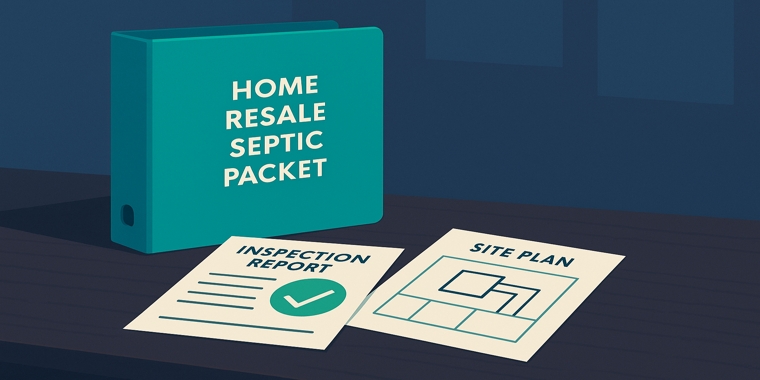
Documenting Septic Service for Home Resale: A Seller’s Guide

📌 Key Takeaways

Missing septic documentation can transform a smooth home sale into a stalled negotiation with price reductions, delayed closings, or lost buyers.

  • Documentation Equals Negotiation Power: Complete septic records shift you from defensive seller to confident homeowner, eliminating buyer leverage before it starts.
  • The Pre-Listing Inspection Advantage: Scheduling a professional assessment before listing gives you control over the timeline, budget, and narrative—avoiding rushed repairs under transaction pressure.
  • The Home Resale Septic Packet Wins Sales: A organized file containing inspection reports, pumping records, system specifications, and provider contacts answers buyer questions immediately and speeds transactions.
  • Proactive Transparency Beats Reactive Disclosure: Including maintenance recommendations and clear system history demonstrates honest stewardship that buyers value more than claims of perfection.
  • Lender Requirements Follow Appraiser Flags: While not automatic, financing conditions often arise when appraisers note system concerns—making documentation your insurance against late-stage complications.

Prepared sellers close faster with fewer concessions and stronger buyer confidence.

Houston-area homeowners selling properties with septic systems will find essential guidance here, preparing them for the detailed documentation process that follows.

The “For Sale” sign is up. Showings are scheduled. Then a potential buyer’s inspector asks the question that makes your stomach drop: “When was the septic system last serviced, and do you have documentation?”

For homeowners in Houston and surrounding areas like Alvin, this moment can determine whether your closing proceeds smoothly or stalls indefinitely. A septic system represents one of your property’s most critical—yet often overlooked—infrastructure components. When you’re preparing to sell, the difference between a confident answer and an awkward silence can cost you thousands of dollars or derail your sale entirely.

A Septic System Maintenance Inspection is a diagnostic assessment of the tank and components to verify function. It’s like a ‘Check Engine’ diagnostic for your yard. Imagine the confidence of handing a potential buyer a certified report saying your septic system is in perfect health. Schedule this before listing your home or if you suspect a problem but don’t see sewage yet.


Why Documentation Is Your Most Important Home Sale Negotiation Tool

Your septic system operates silently beneath your property, breaking down waste and protecting your family’s health. Because it’s hidden underground, most homeowners adopt an “out of sight, out of mind” mentality. This approach works fine—until you try to sell your home.

Proper documentation of septic system maintenance inspections has become a non-negotiable requirement for many home sales. Lenders may demand proof that this essential system functions correctly before approving mortgages, particularly if the appraiser notes any concerns during the property evaluation. Title companies will verify that no recorded liens or violations exist related to septic system failures. Buyers want peace of mind that they’re not purchasing a property with a ticking time bomb buried in the backyard.

The documentation serves multiple critical functions. It proves responsible homeownership. It provides a clear maintenance history. Most importantly, it transforms an invisible system into a tangible asset with documented value.

Think of your septic documentation the same way you’d think about service records for a vehicle. A car with complete maintenance records commands a higher price and sells faster than an identical car with no history. Your home’s waste management system deserves the same treatment. When you can demonstrate consistent, professional maintenance, you’re not just meeting a requirement—you’re building buyer confidence from the first showing.

The Seller’s Nightmare: How Missing Paperwork Can Kill Your Closing

Consider what happens when you can’t produce maintenance records. The buyer’s agent raises concerns. Their inspector notes the unknown condition in the report. Suddenly, your perfectly functional home has developed a perceived problem.

A lack of records can spook buyers or trigger financing issues, delaying the sale. In the best case, the buyer requests a professional inspection before proceeding, pushing your closing date back by weeks. In worse scenarios, they demand a significant price reduction to account for the “risk.” The worst outcome? They walk away entirely, concerned about inheriting an expensive problem.

The anxiety of not knowing the system’s condition creates legitimate fear. Septic system failures don’t announce themselves gradually. A homeowner might experience slow drains for weeks, then wake up to sewage backing up into their home. Repair costs can be substantial, particularly if the drain field requires replacement. No buyer wants to assume that risk based solely on a seller’s verbal assurance that “everything seems fine.”

Lenders view undocumented septic systems as potential red flags. If the appraiser notes concerns during the property evaluation—such as standing water near the drain field, unusual odors, or evidence of system distress—lenders may request a professional inspection and proof of proper function before approving the loan. If your buyer needs financing and you can’t produce inspection records when concerns arise, the approval process can stall or require additional conditions. Your perfect buyer, with their perfect offer, faces unexpected obstacles because of missing paperwork.

The timeline matters too. If you wait until a buyer requests documentation to schedule an inspection, you’ve lost control of the process. Should the inspector discover issues—a tank that’s too full, a damaged baffle, or early signs of drain field saturation—you’ll face those repairs under pressure, likely paying premium rates for rush service. Worse, you’ll need to disclose these newly discovered problems to future buyers even if your current deal falls through.


The Home Resale Septic Packet: What to Gather Before You List

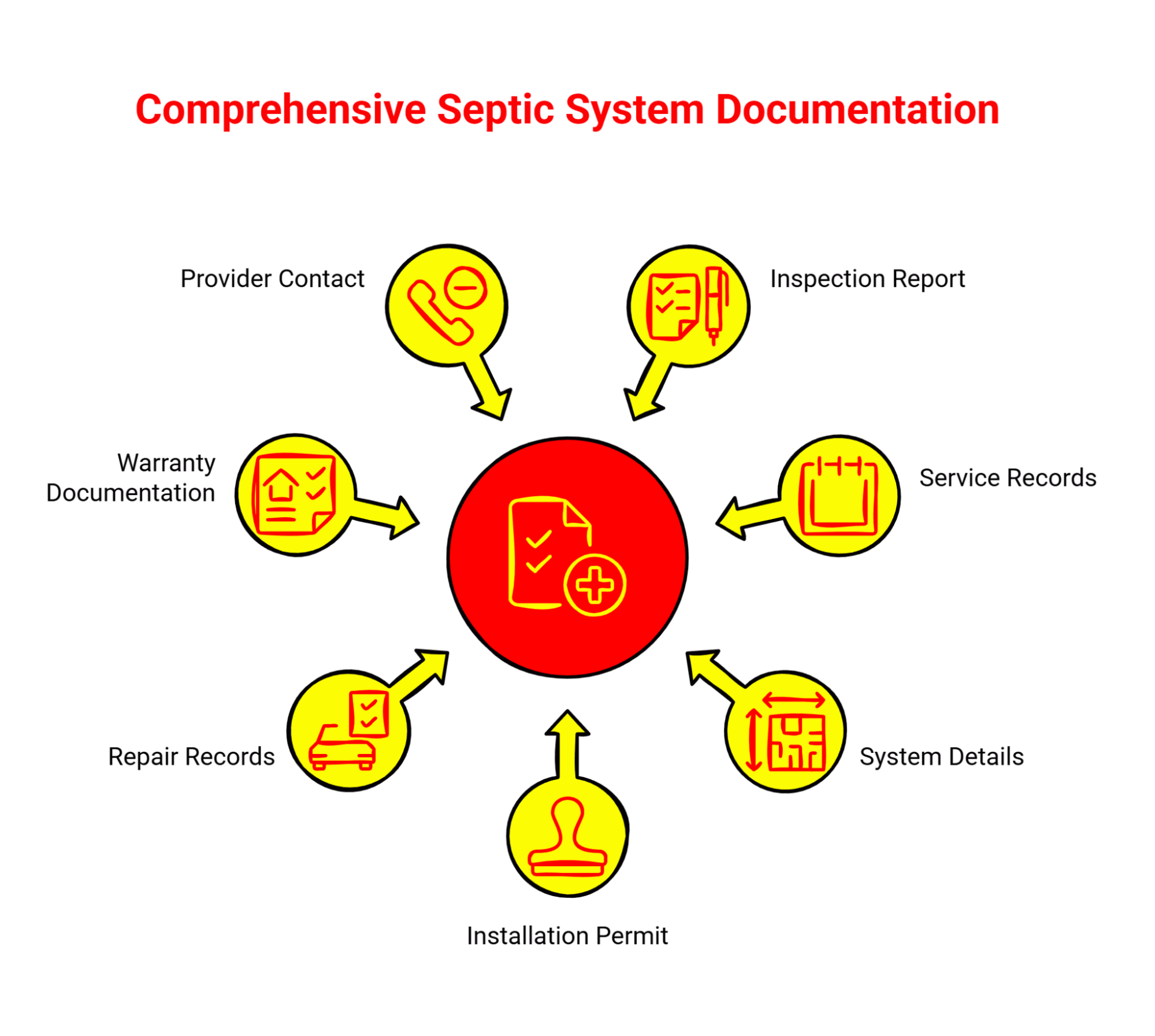
Proactively scheduling an inspection and gathering records turns a potential liability into a selling point. Here’s exactly what belongs in your documentation packet:

Essential Documentation Checklist:

Infographic of key septic system documentation components.

☐ Most Recent Inspection Report (ideally within the past year) showing tank levels, structural condition, and component function

☐ Pumping Service Records for at least the past five years, including dates and service provider details (typically every 2–3 years depending on household usage)

☐ System Details and Specifications including tank size, location map or description, access points/risers, and system age if known

☐ Original System Installation Permit (if available) showing the system design and approval

☐ Any Repair or Upgrade Records with contractor information and work completed

☐ Warranty Documentation for any system components replaced within their coverage period

☐ Provider Contact Information for verification or follow-up questions

Start by contacting Drane Ranger or your regular service provider to request copies of all past service records. Professional companies maintain detailed records of every visit, including tank measurements, waste removed, and observations about system health.

If you’ve lived in the home for years without service, schedule an inspection immediately. This proactive step accomplishes two critical goals. First, it gives you an accurate picture of the system’s condition. Second, it starts creating the documentation trail that buyers and lenders require. The inspection process is straightforward and costs far less than what you’d lose negotiating from a position of uncertainty.

For older homes where original permits may be difficult to locate, contact your local health department. Most jurisdictions maintain records of septic system permits going back decades. While retrieving these documents requires some effort, they provide valuable proof of proper installation and system specifications.

Organize these documents in a clear folder or binder. During showings, mention the packet’s existence. When buyers express interest, provide copies immediately. This transparency demonstrates responsible homeownership and differentiates your property from others where the septic system remains a question mark.

For additional guidance on maintaining proper records, see our detailed article: How to Document and Track Septic Service for Future Home Sales.


A Step-by-Step Guide to Proactive Septic Documentation


Infographic showing a proactive septic documentation timeline with steps from locating access to keeping digital copies.

Follow this process to create a clean, buyer-ready file:

Step 1: Locate Access and Confirm Basics

Ensure tank lids and risers are accessible. Note the tank size and approximate age if known. This preparation makes the inspection process smoother and demonstrates proactive maintenance.

Step 2: Schedule a Septic System Maintenance Inspection

This professional assessment is the cornerstone of your documentation file. A current inspection validates that you’ve been a responsible homeowner who maintains critical infrastructure properly.

Step 3: Complete Pumping If Recommended

If inspection findings suggest it’s needed—or if you’re due based on your maintenance history—complete a pump-out and keep the receipt. This shows you’ve acted on professional recommendations.

Step 4: Assemble Your Complete Home Resale Septic Packet

Combine the inspection report, recent pumping records, service notes, system details, and provider contact information into a single, organized file.

Step 5: Share Early and Proactively

Provide the packet to your listing agent, include highlights in disclosures, and make it available during showings. Don’t wait for buyers to ask.

Step 6: Keep Digital and Hard Copies

Store PDFs for quick emailing and keep a printed set for open houses and inspections. Having both formats ensures you can respond immediately to any request.

Understanding the Risks and Your Protection Plan

Risk in the Sale Process Practical Mitigation
Buyer confidence drops due to limited records Present a fresh inspection report up front and attach the packet to disclosures
Lender or underwriter requests proof late in the process Keep digital copies ready to send same-day; include provider contact information
Delayed service availability during option period Book the inspection before listing to avoid last-minute scheduling conflicts
Confusion about system location during buyer inspection Include a simple location sketch or description in your packet
Negotiation leverage shifts to the buyer Use proactive documentation to frame the home as responsibly maintained, reducing concessions


Turning a Liability Into a Selling Point: How Proactive Inspection Wins Buyers

The transformation happens when you shift from defensive to confident. Instead of hoping buyers don’t ask difficult questions, you lead with proof of excellent maintenance.

Professional inspections validate that your system operates correctly. The report details tank capacity, measures current sludge and scum levels, verifies that baffles and tees function properly, and confirms the drain field shows no signs of failure. When you hand this report to a potential buyer, you’re providing peace of mind.

Frame your documentation as evidence of responsible property stewardship. You’ve protected your investment. You’ve ensured your family’s health and safety. You’ve maintained your home’s infrastructure with the same care you’ve given to its visible features. This narrative resonates with buyers who want assurance they’re purchasing from someone who took homeownership seriously.

The documentation also speeds transactions. When buyers know the septic system’s condition upfront, they face one less unknown during their due diligence period. Their inspector will likely still examine the system, but they’re verifying your documentation rather than investigating a mystery. This reduces the chance of surprising discoveries that derail negotiations.

Some sellers even include maintenance recommendations in their packet. If the inspection shows the tank is at fifty percent capacity and the service provider suggests pumping within the next year, include that guidance. This transparency demonstrates honesty and helps buyers plan their first year’s maintenance. Rather than viewing it as a defect, they appreciate the clear roadmap.

Consider the competitive advantage. In neighborhoods where multiple similar homes are for sale, documentation sets your property apart. When a buyer compares two nearly identical houses—one with complete septic records and one without—the choice becomes obvious. The documented property represents less risk, fewer potential surprises, and evidence of careful ownership.

The investment in a pre-listing inspection protects against potential losses during negotiations. It shifts you from hoping nothing goes wrong to knowing exactly what buyers will discover. That certainty is invaluable during negotiations.

For Houston area homeowners, proper septic system maintenance isn’t just about passing inspection. It’s about demonstrating that you understand how responsible waste management protects property values and community health. When you present comprehensive documentation, you’re signaling that you’re the type of owner who maintains infrastructure responsibly.

Drane Ranger has served the Houston area since 1985, providing professional septic services with a commitment to transparency and customer care. You can verify our credentials through our Better Business Bureau profile or find us on Google Maps.

Your home sale shouldn’t hinge on a buried system that works perfectly but lacks proof. Take control of the narrative. Schedule your inspection, gather your records, and transform your septic system from a potential obstacle into a documented asset. The buyer who ultimately purchases your home will thank you for the clarity. More importantly, you’ll thank yourself when closing proceeds without septic-related delays or last-minute negotiations.

Resources

Ready to Get Started?

Don’t let missing documentation become a closing-day crisis. Contact us today to schedule a comprehensive septic system inspection and start building the documentation packet that will set your home sale up for success. You can also reach us directly at 281-489-1765 to start your service today.

Disclaimer: This article provides general information about documenting septic service for home resale for educational purposes. Individual circumstances vary significantly based on factors like regulatory requirements, specific inspection procedures, and property age. For personalized guidance tailored to your home sale documentation needs, it is recommended to consult with a qualified professional.


Our Editorial Process

Our expert team uses AI tools to help organize and structure our initial drafts. Every piece is then extensively rewritten, fact-checked, and enriched with first-hand insights and experiences by expert humans on our Insights Team to ensure accuracy and clarity.


Author Byline & Bio

The Drane Ranger Insights Team is our dedicated engine for synthesizing complex topics into clear, helpful guides. While our content is thoroughly reviewed for clarity and accuracy, it is for informational purposes and should not replace professional advice.
What Actually Happens During a Septic Pump-Out? A Step-by-Step Walkthrough

📌 Key Takeaways

Missing a scheduled pump-out turns a $400 maintenance task into a $20,000 drain field replacement.

  • The Two-Layer System Explained: Your septic tank relies on floating scum, settling sludge, and a clear middle zone—when sludge exceeds one-third of tank depth, solids escape to your drain field and cause irreversible damage.
  • The Seven-Step Reset Process: Professional service includes arrival prep, lid removal and inspection, complete vacuum extraction, hydro-jetting to remove compacted buildup, component checks for cracks or clogs, compliant waste disposal, and a documented maintenance plan for your next cycle.
  • Frequency Follows Household Math: A four-person home with a 1,000-gallon tank needs pumping every 2–3 years, but adding two more people or heavy garbage disposal use cuts that timeline in half.
  • Early Warning Signs Override Schedules: Sewage odors outside, slow drains, gurgling toilets, or standing water near your tank location signal an urgent need for service—waiting turns fixable problems into emergency repairs.
  • Government Standards Protect Community Health: The EPA, Texas Commission on Environmental Quality, and CDC all emphasize that proper septic maintenance prevents groundwater contamination and protects public health beyond your property line.

Regular maintenance preserves system lifespan and prevents catastrophic failure.

Greater Houston homeowners managing septic systems will find clear guidance here, preparing them for the detailed step-by-step walkthrough that follows.

Your septic system works quietly beneath your property, handling waste day after day without complaint. But like any hardworking system, it needs regular maintenance to keep functioning properly. If you’ve never scheduled a pump-out before, the process might seem mysterious or even intimidating.

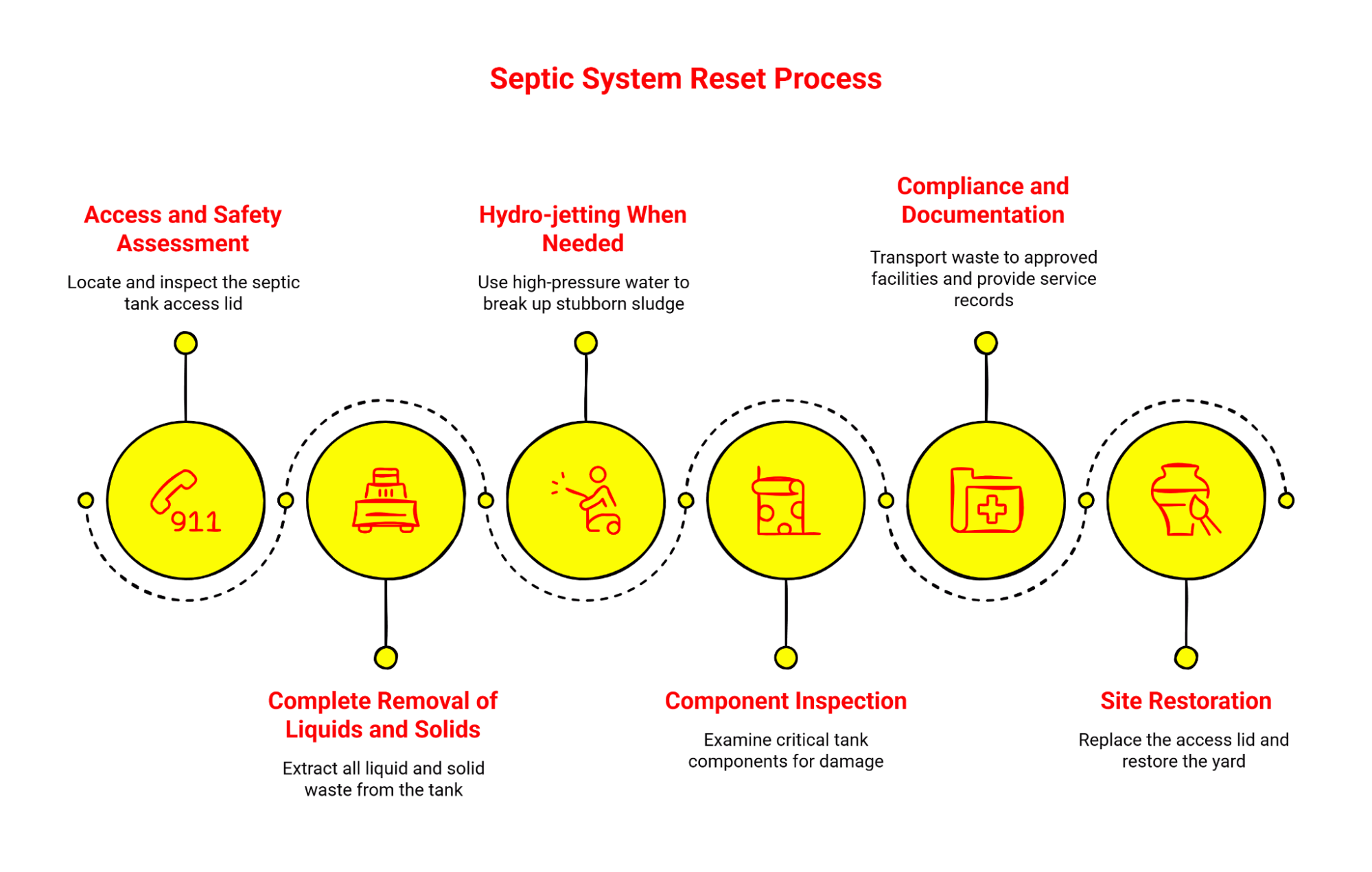
A septic pump-out starts by exposing and inspecting the tank, then vacuuming all liquids and sludge with a professional vacuum truck. Technicians break up compacted solids, clean interior surfaces (often with hydro-jetting), check baffles and tees, reseal the lids, and dispose of waste responsibly—leaving the system reset and ready.

Residential Septic Tank Cleaning is the professional removal of solid waste and wastewater to restore system capacity. Think of it like an oil change for your home’s plumbing—skip it and the engine seizes. Imagine flushing with total confidence and zero yard surprises. The solution is straightforward: schedule service every 2–3 years to prevent system failure.

Here’s what actually happens when a professional crew arrives at your home, from the moment the truck pulls up to the final inspection and recommendations. Understanding the process helps you know what to expect, why each step matters, and how to choose a provider you can trust.


Why Septic Pump-Outs Matter

Your septic tank separates solid waste from liquids through a natural settling process. Heavier solids sink to form a sludge layer at the bottom, while lighter materials like oils and fats float to create a scum layer on top. The relatively clear liquid in between flows out to your drain field for final treatment.

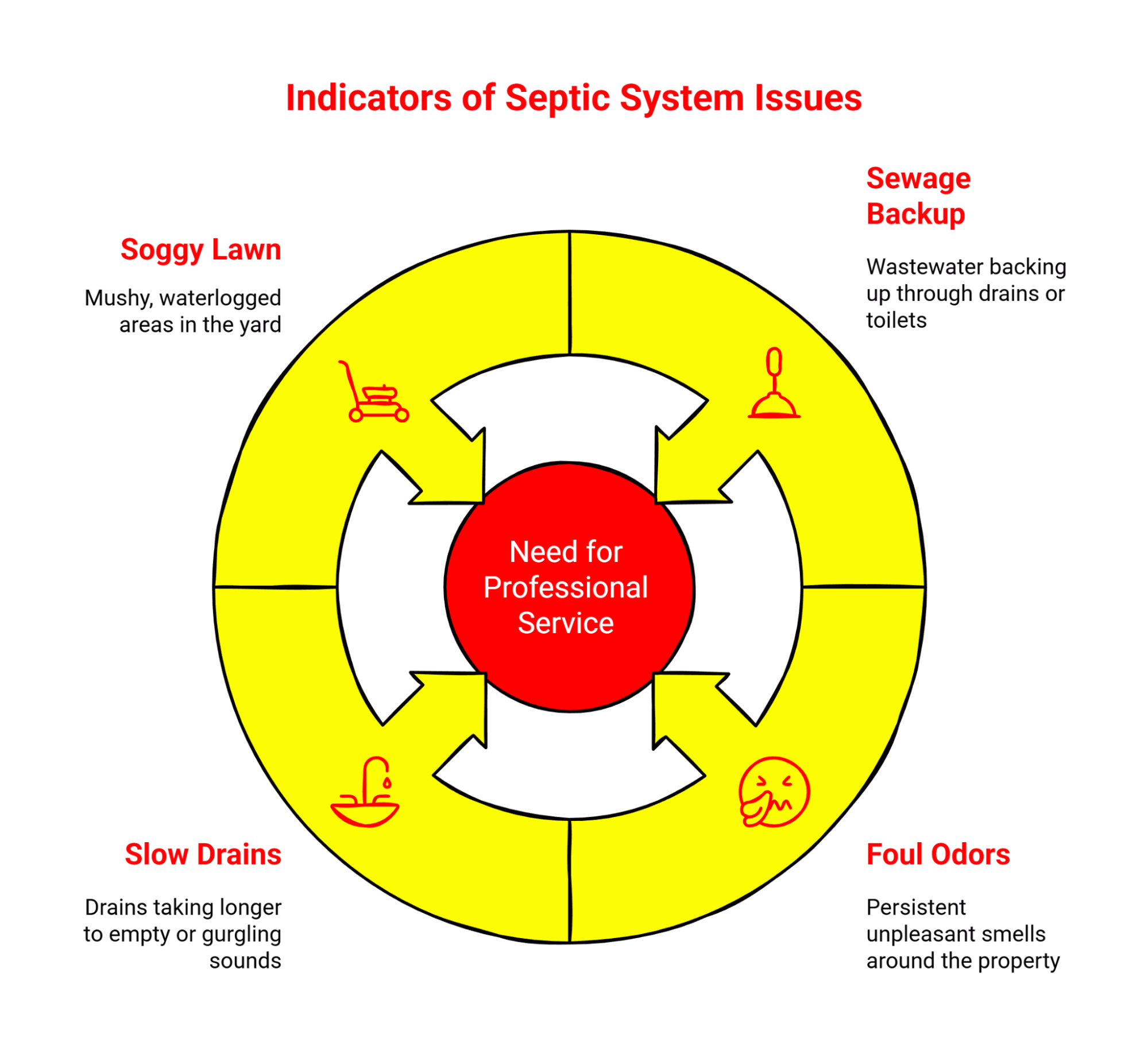
Over time, those sludge and scum layers grow thicker. When they take up too much space, several problems emerge. The tank loses its capacity to separate waste effectively, which means solids can escape into your drain field and cause expensive damage. You might notice slow drains throughout your house, unpleasant odors near the tank or in your yard, or gurgling sounds when you flush toilets or run water.

Pumping removes the accumulated solids and liquids, restoring the tank’s working capacity. Professional Houston septic tank cleaning goes further by including interior cleaning—sometimes with high-pressure hydro-jetting—to break up stubborn, compacted material and truly reset your system.

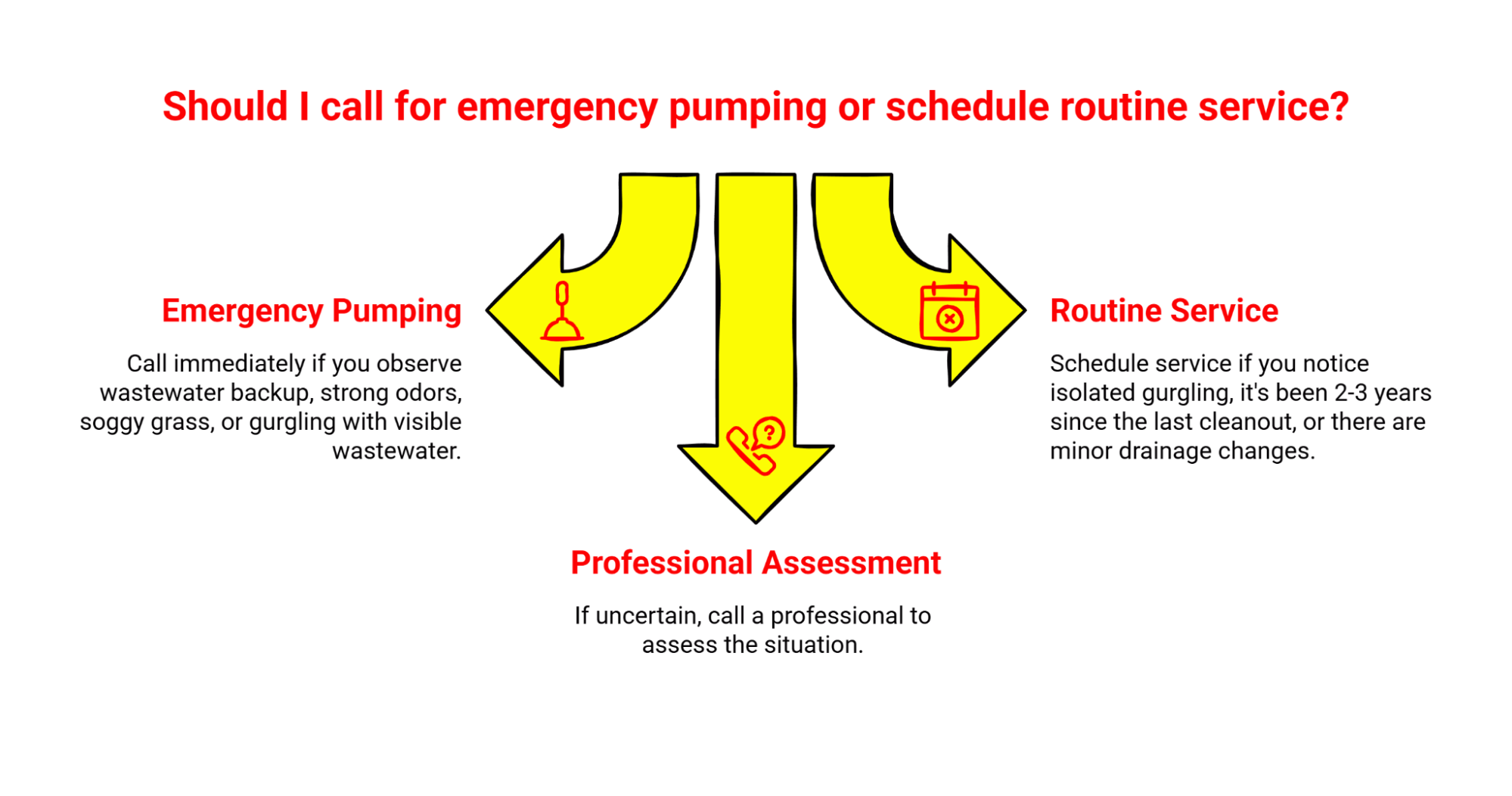
Most households need service every 2–3 years. That baseline shifts based on your household size, tank capacity, water usage patterns, and whether you use a garbage disposal frequently. If you notice any warning signs—sewage odors, slow drains, standing water near the tank, or actual backups—don’t wait for your regular schedule. Call immediately.

Maintaining this routine protects your investment. Septic tank services prevent the kind of catastrophic failures that lead to thousands of dollars in emergency repairs, environmental contamination, and potential health hazards for your family.


The Pump-Out, Step by Step

Visual guide showing stages of septic service.

Professional septic service follows a systematic process designed to be thorough, safe, and compliant with local regulations. Here’s what happens during a typical service call in Alvin, Pearland, Sugar Land, Friendswood, and across Greater Houston.

Arrival & Site Prep

The service truck arrives at your scheduled time. Technicians confirm the exact location of your tank—sometimes using property records, sometimes following obvious access points like concrete lids or risers. If your tank is buried and the location isn’t immediately clear, they may need your help locating it.

Before opening anything, the crew prepares the work area. They lay down protective covering if needed, move any lawn furniture or decorations, and ensure they have clear access to the lids. This is also when they’ll ask about pets (which should be secured indoors) and verify that there’s adequate space for the vacuum truck’s hose to reach the tank.

Open & Inspect

Technicians carefully remove the tank lids, exposing the interior. This is the first opportunity to assess what’s happening inside. They check the current liquid level and measure the thickness of both the scum layer on top and the sludge layer at the bottom.

A properly functioning tank should have relatively clear liquid in the middle zone, with scum and sludge layers taking up no more than about one-third of the total depth. If the sludge has built up past that point, it’s confirmation that the pump-out is needed.

The crew also inspects the inlet and outlet tees—the T-shaped pipes that direct wastewater into the tank and allow treated liquid to flow out. These components can deteriorate or become clogged with debris, and identifying problems early prevents more serious issues down the line. They examine visible baffles, which help direct flow and keep floating solids away from the outlet.

Vacuum Extraction

This is the core of the service. The technician connects a large-diameter hose from the vacuum truck to the tank opening. The truck’s powerful pump creates suction that pulls liquids and solids out of the tank and into a sealed holding compartment on the vehicle.

For tanks with heavily compacted sludge at the bottom, technicians use the hose to agitate and break up the material, ensuring it can be removed effectively. This step is critical—simply removing the liquid without addressing compacted solids leaves your tank only partially cleaned and shortens the time until your next service.

The extraction continues until the tank is essentially empty, with only a small amount of liquid remaining. This complete removal is what differentiates a thorough pump-out from a partial one.

Tank Interior Cleaning

Once the bulk of the material is out, the real cleaning begins. Technicians rinse the interior walls and floor of the tank, using water pressure to dislodge any stuck-on waste and ensure all surfaces are as clean as possible.

For tanks that haven’t been serviced regularly or show significant buildup, crews may use hydro-jetting—high-pressure water jets that scour the interior surfaces and break apart any remaining compacted material. This process essentially resets the tank to a like-new condition, maximizing efficiency and extending the time until your next service.

The rinse water and dislodged material are vacuumed out as well, leaving the tank clean and ready to resume normal operation.

Component Check

With the tank empty and clean, technicians have a clear view of all the interior components. They re-inspect the inlet and outlet tees, baffles, and the tank walls themselves, looking for cracks, deterioration, or damage that could compromise system function.

This is when problems often come to light. A cracked baffle, a deteriorating tee, or a damaged tank wall might explain issues you’ve been experiencing—slow drains, persistent odors, or gurgling sounds in your plumbing. Identifying these problems now allows for repairs before they cause a complete system failure.

The crew also checks the tank’s structural integrity. Concrete tanks can develop cracks over time, and older tanks may show signs of corrosion or settling. Catching these issues early means you can address them proactively rather than waiting for a costly emergency.

Responsible Disposal

The waste removed from your tank isn’t just dumped anywhere. Professional septic service companies transport it to approved treatment facilities where it’s processed according to environmental regulations. This protects local water sources, prevents contamination, and ensures compliance with all local and state requirements.

Drane Ranger uses vacuum truck services specifically designed for safe, compliant waste handling. The sealed systems on modern vacuum trucks prevent spills and odors during transport, and all disposal follows strict environmental guidelines.

Close-Out & Recommendations

After cleaning and inspection, technicians reseal the tank lids, ensuring they’re secure and properly positioned. They clean up the work area, removing any equipment or protective covering and restoring your property to its original condition.

Before leaving, they provide you with a service record documenting what was done, any issues found, and their recommendations. This typically includes confirmation of your next recommended service date—usually 2–3 years out, though the timeline may be shorter if you have a larger household, a smaller tank, or if they identified any concerns during inspection.

This is also when you can ask questions about anything you noticed—unusual sounds, slow drains, or odors—and get expert advice on whether additional maintenance or repairs might be needed.


How long does a pump-out take?

Most standard residential pump-outs take 60–120 minutes. Time varies with tank size, lid accessibility, sludge thickness, and whether additional cleaning like hydro-jetting is needed. Proper service can’t be rushed—thoroughness matters more than speed.

What We’ll Need From You

To help the service run smoothly:

  • Clear access to your septic tank location (or your best guess if lids aren’t visible)
  • Pets secured indoors and gates unlocked
  • Adequate space in the driveway or along the curb for the vacuum truck
  • Any past service records, if available (helpful but not required)


How Often Should You Pump?

Septic pumping frequency chart based on household size, tank size, and usage.

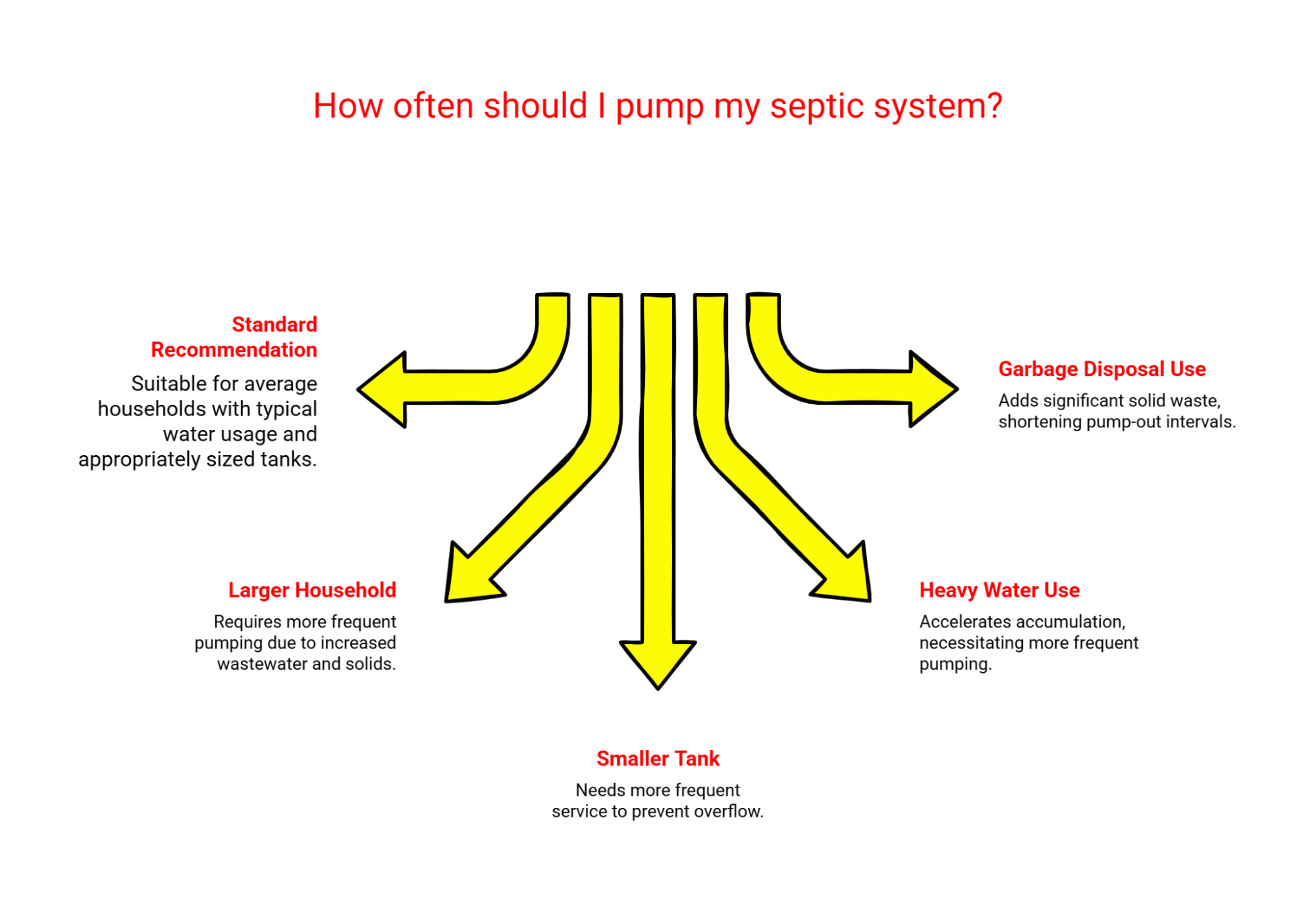
The standard recommendation for most residential septic systems is service every 2–3 years. That baseline assumes average household size, typical water usage, and a tank sized appropriately for the home.

Several factors influence your specific schedule. Larger households generate more wastewater and solids, which means the tank fills faster. If you have a smaller tank relative to your home size, you’ll need more frequent service. Heavy water use—multiple loads of laundry daily, frequent dishwasher cycles—accelerates the accumulation of material in your tank.

Using a garbage disposal regularly adds a significant amount of solid waste to your septic system, which can shorten the interval between pump-outs. Some experts suggest pumping annually if you rely heavily on your disposal.

Septic Health Interval Calculator

Use this as a quick-glance guide. Real-world usage patterns—particularly garbage disposal use and high water consumption—may shorten these intervals. Act sooner if you notice warning signs like odors, slow drains, or standing water.

Household Size Tank Size (Gallons) Recommended Interval
1-2 people 750-1,000 Every 3-4 years*
3-4 people 1,000-1,250 Every 2-3 years*
5-6 people 1,250-1,500 Every 1-2 years*
7+ people 1,500+ Annually*


*Act sooner if you notice warning signs. Usage patterns may require shorter intervals.

Warning signs override any schedule. If you smell sewage odors outside your home, notice slow drains or gurgling sounds, see standing water or unusually lush grass near your tank location, or experience any sewage backup, contact a professional immediately. These symptoms suggest your tank is full or your system is experiencing a failure that requires urgent attention.


What It Costs to Wait (and Why It’s Risky)

Delaying septic maintenance seems like a way to save money, but the opposite is true. A neglected septic system leads to increasingly serious problems that become exponentially more expensive to fix.

When your tank overfills, solids begin escaping into your drain field. The drain field is designed to handle clear liquid, not solid waste. Solids clog the soil pores, preventing proper drainage and causing sewage to back up onto your property. Drain field replacement typically costs $5,000 to $20,000 or more—a devastating expense compared to routine $300-500 pump-outs.

Sewage backups create immediate health hazards. Raw sewage contains bacteria, viruses, and parasites that pose serious risks to your family and pets. The Environmental Protection Agency’s guidance on septic systems emphasizes that proper maintenance protects both household health and community water quality. Cleanup after a backup often requires professional remediation services, and contaminated areas of your home may need extensive restoration.

Environmental damage is another consequence. Failed septic systems contaminate groundwater and surface water with harmful pathogens and nutrients. The Texas Commission on Environmental Quality provides detailed regulations for on-site sewage facilities, and homeowners are legally responsible for maintaining compliant systems. Violations can result in substantial fines and mandatory costly repairs.

Property damage extends beyond the drain field. As the CDC notes in its wastewater and health guidance, sewage pooling in your yard kills vegetation, creates foul odors, and may even compromise your home’s foundation if backups occur into the basement. The longer the problem persists, the more extensive—and expensive—the damage becomes.

Regular maintenance prevents all of this. A routine pump-out every 2-3 years protects your system’s lifespan, prevents emergencies, and maintains your property value. It’s not an expense; it’s an investment in avoiding catastrophic failure.


Why Choose Drane Ranger in Greater Houston

Since 1985, Drane Ranger has been the trusted name for septic service throughout the Greater Houston area. Our team combines decades of experience with ongoing training to ensure every service call meets the highest standards for quality and customer care.

Our technicians are trained, certified professionals who understand both the technical requirements of septic systems and the importance of treating your property with respect. We arrive on time, complete the work efficiently, and leave your property clean—commitments we’ve upheld for nearly 40 years.

We serve a comprehensive area within a 100-mile radius of Houston, including Alvin, Pearland, Sugar Land, Friendswood, League City, Manvel, Rosharon, Angleton, and Texas City. Whether you’re in Harris County, Fort Bend County, Montgomery County, Brazoria County, or Galveston County, our team is ready to help.

Our fleet of modern vacuum trucks represents significant investment in equipment that makes the job faster, cleaner, and more thorough. High-capacity systems mean we can handle any residential tank size, and our trucks are maintained to the highest standards for reliability and environmental compliance.

One customer captured the experience well: “My experience with Drane Ranger was a very organized, professional and on time experience. I was kept informed of what was happening and a suggested time of cleaning again. I will use them again and will definitely recommend them to anyone I speak with.” — Harold R.

When you choose Drane Ranger, you’re choosing a company that stands behind its work and genuinely cares about protecting your investment. We don’t just pump tanks—we build long-term relationships with homeowners who trust us to keep their systems running properly year after year.


Frequently Asked Questions

Is pumping the same as cleaning?

Pumping removes liquids and sludge from your tank, but cleaning goes further. Professional cleaning may include hydro-jetting and thorough scrubbing of interior surfaces to fully reset your tank and remove compacted material that pumping alone might miss.

How often do I need it?

Every 2–3 years for most homes, though your specific schedule depends on household size, tank capacity, and water usage. Act sooner if you notice odors, slow drains, or backups—these are warning signs that shouldn’t be ignored.

What if I smell sewage outside?

Call now. Sewage odors outside your home could indicate an overfilled tank, a crack in the tank or pipes, or a drain field issue. All of these require professional assessment and prompt attention to prevent more serious problems.

Do you cover my area?

Yes—we serve Greater Houston within a 100-mile radius. Our service area includes Houston, Alvin, Pearland, Sugar Land, Friendswood, League City, Manvel, Rosharon, Angleton, Texas City, and surrounding communities in Harris, Fort Bend, Montgomery, Brazoria, and Galveston counties.

How do you dispose of waste?

All waste is handled and disposed of responsibly in full compliance with local environmental regulations. We transport waste to approved treatment facilities where it’s processed safely, protecting local water sources and the environment.

Ready to schedule your service? Call us at 281-489-1765 (Mon–Fri, 9am–6pm) or contact us today to request your quote.

For homeowners who want to prepare thoroughly, download our free Pump-Out Day Checklist—a one-page guide covering everything you need to have ready before the crew arrives.

Disclaimer: This guide is intended as a comprehensive starting point. For decisions specific to your unique situation, we always recommend consulting a qualified professional.


Our Editorial Process

All content undergoes multi-stage review including technical accuracy verification against TCEQ model standards, local regulation compliance checking, and practical application testing. We distinguish between verified regulatory requirements and generally accepted industry practices to help operators understand certainty levels.


About the Drane Ranger Insights Team

The Drane Ranger Insights Team is our dedicated engine for synthesizing complex topics into clear, helpful guides. While our content is thoroughly reviewed for clarity and accuracy, it is for informational purposes and should not replace professional advice.
See How the “Home Health Reset” Saved This Houston Family’s Weekend

📌 Key Takeaways

A septic system running past capacity doesn’t announce itself with alarms—it whispers through slow drains, faint odors, and gurgling toilets before escalating into a weekend-ruining emergency.

  • The “Home Health Reset” Restores Biological Balance: Routine septic tank cleaning physically removes accumulated sludge and scum, allowing the system’s natural bacteria to properly separate solids from wastewater and maintain normal flow to the drain field.
  • Two to Three Years Is the Standard Cadence, Not a Universal Rule: Most Houston-area households benefit from pumping every two to three years, though families of five in smaller tanks need more frequent service than couples with larger systems.
  • Early Warning Signs Prevent Emergency Calls: Slow drainage across multiple fixtures, faint sewage odors near drains or in the yard, toilet gurgling, and soggy or over-green grass patches above the tank all signal capacity issues that worsen without intervention.
  • A Standard Cleanout Takes Under an Hour: The process—locating access points, safety checks, pumping, baffle inspection, and flow verification—typically completes in 45 minutes to an hour, with minimal disruption to the property.
  • Professional Service Includes Compliance and Planning: Responsible providers handle waste according to Texas environmental standards, dispose of it at approved facilities, and help homeowners establish simple maintenance schedules that prevent future panic.

Act before the gurgle becomes a backup—routine care beats emergency response every time.

Houston-area homeowners with septic systems will find a clear framework here, preparing them for the detailed service overview and local guidance that follows.

It was 4:30 on a Friday afternoon in southwest Houston when Sarah first noticed the smell. Nothing dramatic—just a faint, unpleasant odor drifting up from the hallway bathroom. She dismissed it, focusing instead on the weekend ahead: her daughter’s birthday party on Saturday, family coming in from out of town, and a house that needed to look perfect.

By dinner time, the kitchen sink was draining slower than usual. Her husband tried the plunger. No change. Then came the sound no homeowner wants to hear—a low, unsettling gurgle from the toilet down the hall.

That gurgle was their septic system sending a clear message: we’re running out of capacity, and you’re running out of time.


What a “Home Health Reset” Actually Means for Your System

Flowchart from septic system overload to healthy septic system.

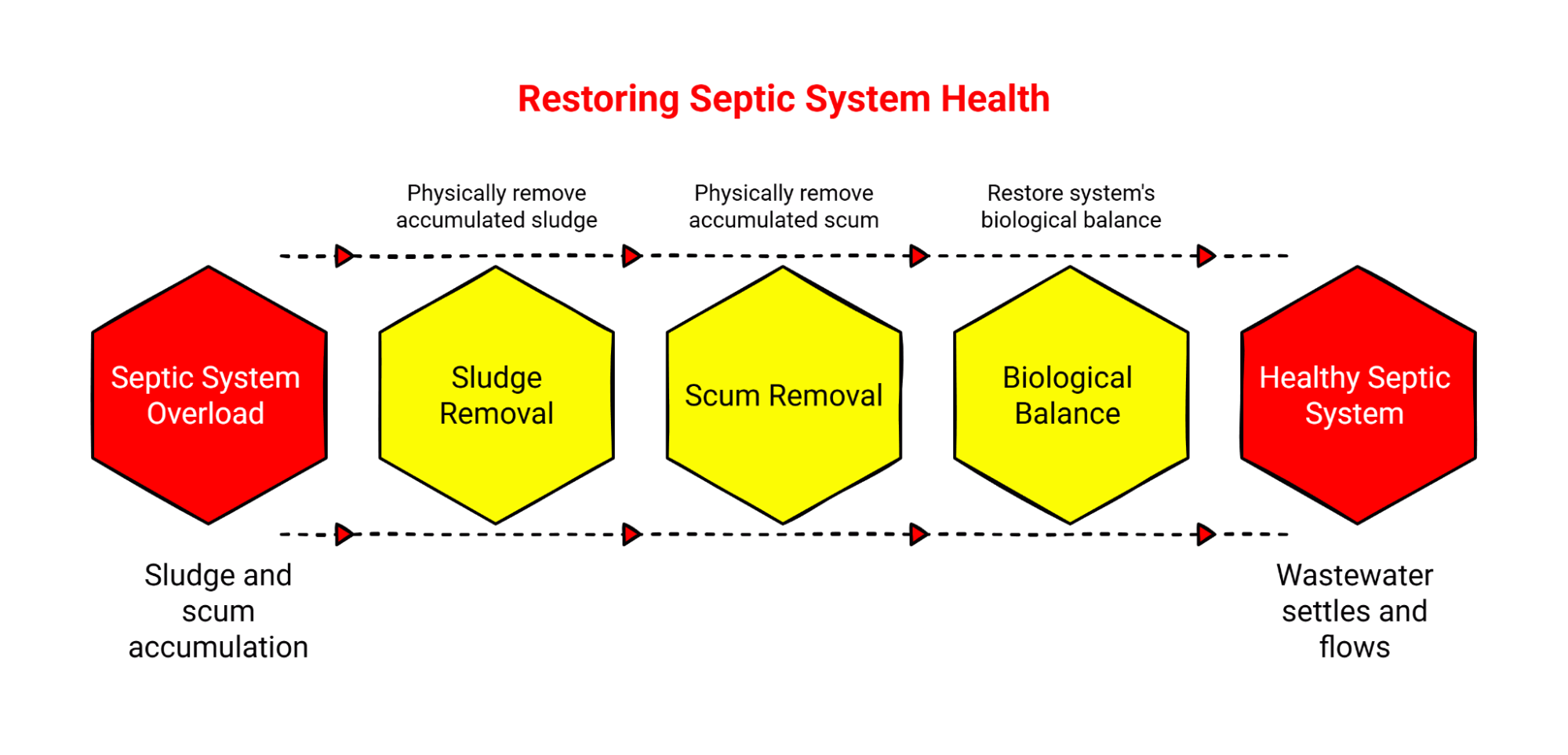
A residential septic tank cleaning—what we call the “Home Health Reset”—is the physical removal of accumulated sludge and scum that builds up in your tank over time. Think of it as your home’s plumbing getting a complete refresh, similar to how an oil change keeps your car’s engine running smoothly.

Here’s what actually happens inside your tank: as wastewater flows in from your home, solids settle to the bottom forming sludge, while oils and grease float to the top as scum. The relatively clear water in the middle flows out to your drain field. When sludge levels rise too high, that separation breaks down. The biological balance your system depends on gets disrupted, preventing wastewater from settling and flowing as intended. Solids start flowing where they shouldn’t, your drain field gets clogged, and you end up with the exact problems Sarah’s family faced that Friday evening.

The typical Houston-area household benefits from this reset every two to three years, though your specific timing depends on household size, tank capacity, and water usage patterns. A family of five in a 1,000-gallon tank will need service more frequently than a couple with a 1,500-gallon system. The U.S. Environmental Protection Agency provides comprehensive guidance on maintaining septic systems to prevent costly failures.

The Friday Evening That Changed Everything

Sarah called us at 6:15 PM, describing the symptoms. Our technician asked three quick questions: How long since your last pumping? Any soggy spots in the yard above the tank? Has the gurgling been getting worse or staying the same?

The answers told him what he needed to know. Sarah couldn’t remember the last service—they’d bought the house three years ago and assumed the previous owners had handled it. There was a patch of grass near the back fence that stayed greener than the rest of the lawn, even during dry weeks. And yes, the gurgling had progressed from occasional to constant over the past month.

We scheduled her for first thing Saturday morning. The birthday party was at 2 PM. She had roughly nine hours to get her system working again.

The 45-Minute Process That Saved Their Weekend

Our truck arrived at 7:30 AM. The technician located the tank access covers, performed a safety check for toxic gases, and measured the sludge levels. Sarah’s tank was at 40% capacity—well past the point where problems start.

The pump-out itself is straightforward but thorough. A powerful vacuum hose removes all liquid and solid waste from the tank, including the stubborn sludge that’s compacted at the bottom. The technician then inspected the baffles (the components that prevent solids from flowing to the drain field) and verified that the outlet pipe was clear.

The entire process emphasizes responsible handling and clear communication at every step. We operate in full compliance with Texas environmental standards, ensuring proper containment and disposal at approved facilities.

By 8:15 AM, the tank was empty, clean, and ready to resume its job. The technician walked Sarah through what he’d found, explained the warning signs to watch for in the future, and helped her set up a simple maintenance schedule. No more guessing. No more Friday evening panic.

The morning’s total time investment: 45 minutes. The peace of mind: immeasurable.

Before and After: What Really Changes

Before the Reset After the Reset
Persistent worry about strange smells Fresh air throughout the house
Slow drains creating daily frustration Normal drainage speed restored
Constant monitoring of every flush Confidence in the system’s function
Weekend plans feeling uncertain Weekend proceeding as planned
Stress about potential emergency costs Simple calendar reminder for future service


“My experience with Drane Ranger was a very organized, professional and on time experience. I was kept informed of what was happening and a suggested time of cleaning again. I will use them again and will definitely recommend them to anyone I speak with.” — Harold R.

This isn’t just about fixing a plumbing problem. It’s about reclaiming the assumption that your home’s basic systems will work when you need them to.


The Warning Signs You Shouldn’t Ignore

Flowchart from septic system overload to healthy septic system.

Sarah’s situation didn’t develop overnight. Her septic system had been sending signals for weeks, maybe months. Most homeowners miss these early warnings because they start subtle and escalate gradually.

Watch for these red flags:

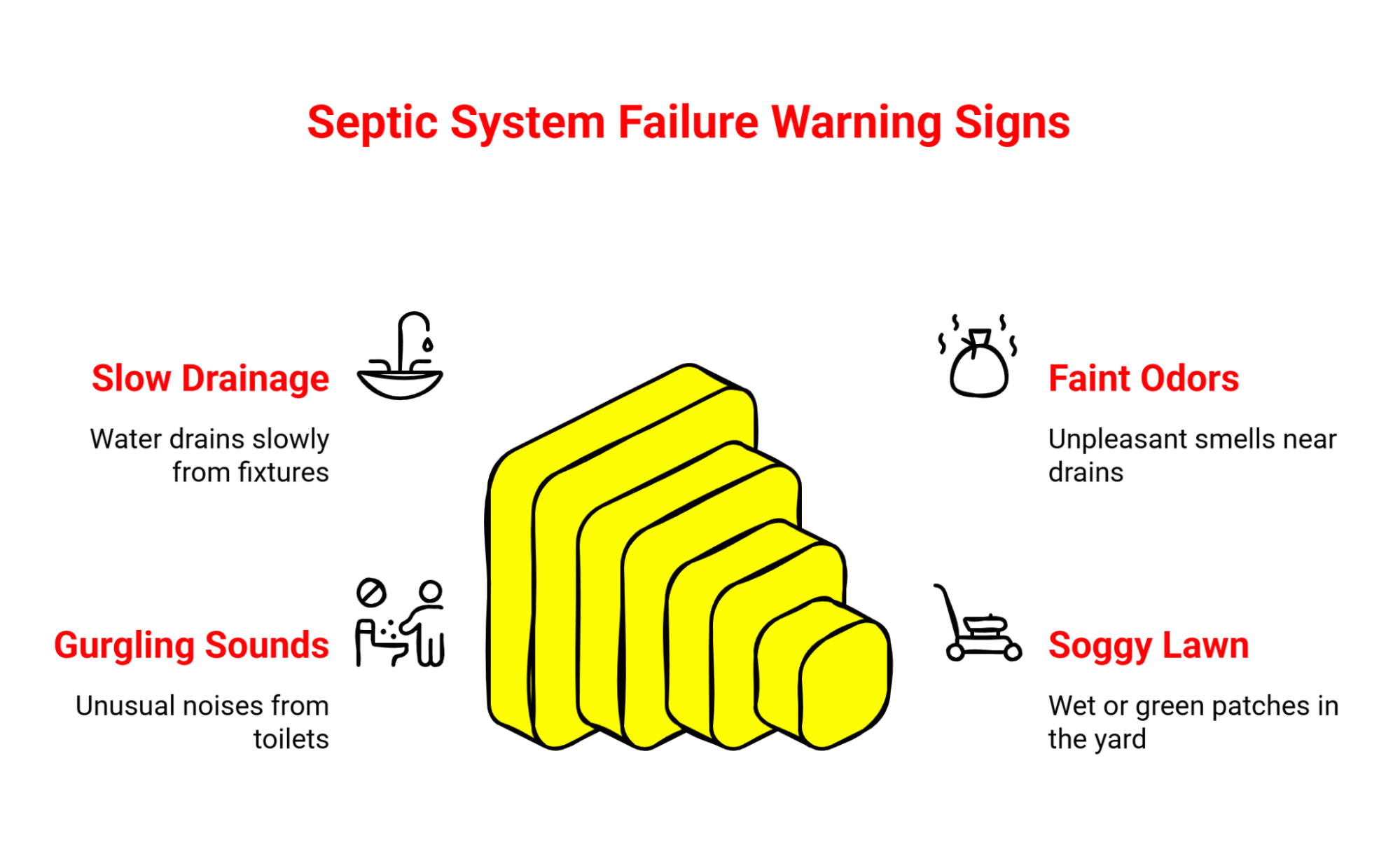
Slow drainage from sinks, tubs, or showers, especially if multiple fixtures are affected at once. When your washing machine drains and your shower backs up, that’s not a coincidence—it’s a capacity issue.

Faint odors near drains or in the yard above your septic system. Fresh sewage has a distinct smell that shouldn’t be present in a properly functioning system. The Centers for Disease Control and Prevention notes that exposure to untreated wastewater poses health risks that proper system maintenance helps prevent.

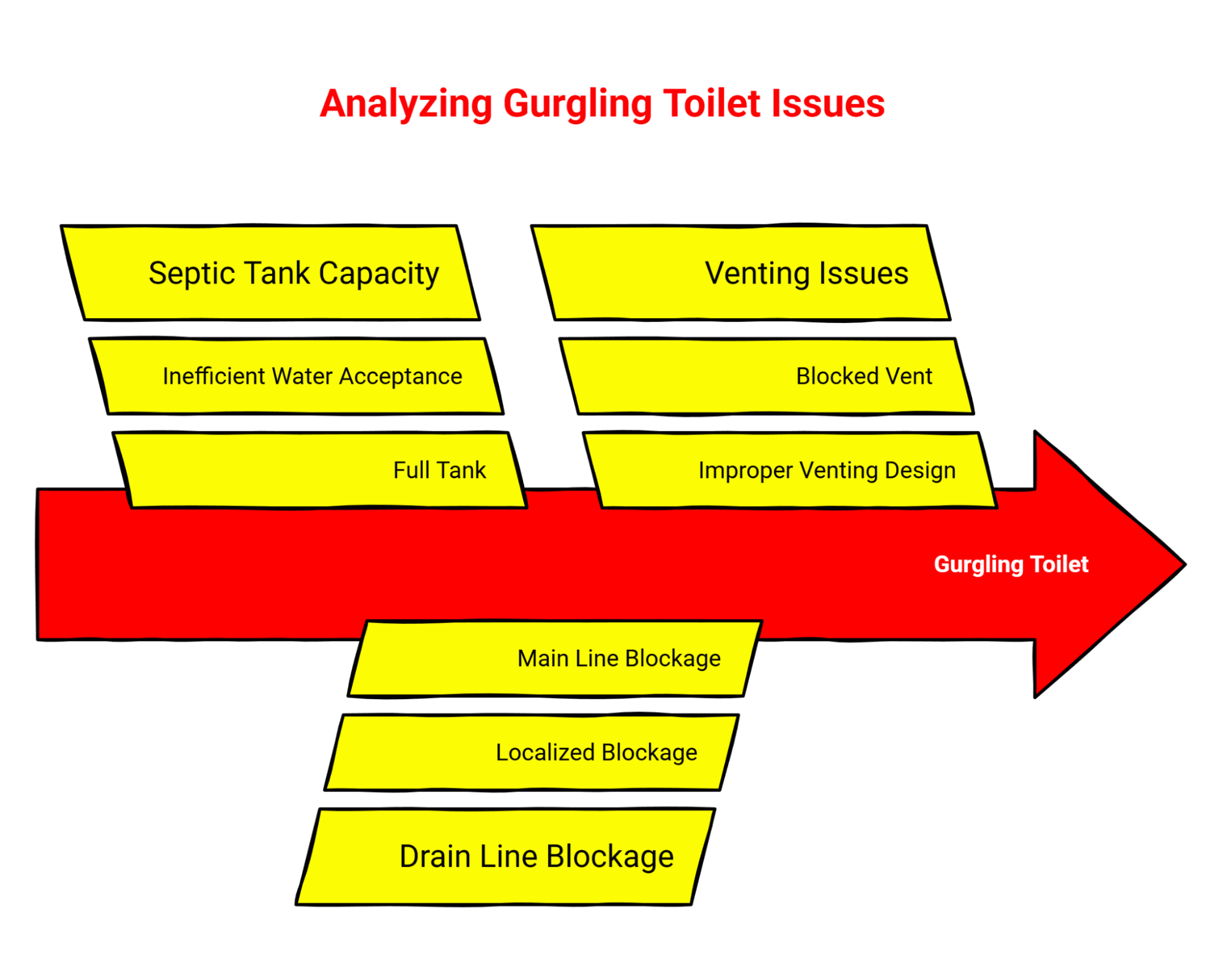
Gurgling sounds from toilets or drains when other fixtures are in use. This happens when air can’t escape normally because the system is too full.

Patches of lawn that stay soggy or unusually green, particularly above where your tank and drain field are located. This suggests wastewater is surfacing instead of being absorbed properly.

The Environmental Protection Agency emphasizes that addressing these signs promptly prevents the more serious problems that lead to complete system failure. The difference between a routine service call and an emergency replacement can be thousands of dollars.

If you’re seeing any combination of these symptoms, don’t wait for them to worsen. A quick inspection can confirm whether you need service now or if you have a few months before your next scheduled cleaning.

Why Houston-Area Systems Need Consistent Attention

The Greater Houston climate creates specific challenges for septic systems. High water tables, clay-heavy soils in many areas, and our region’s intense rain events all affect how efficiently your drain field processes wastewater.

Since 1985, we’ve served homeowners throughout Houston, Alvin, Pearland, Sugar Land, and Texas City—essentially a 100-mile radius from our location on India Street. That three-decade perspective has taught us that systems in our area perform best with regular attention rather than reactive emergency calls.

We handle every aspect of the process according to local and state regulations, including those set by the Texas Commission on Environmental Quality, from proper waste removal to environmentally responsible disposal at approved facilities. Your home’s wastewater doesn’t just disappear—it goes through a careful treatment process that protects our local water sources and ecosystems.

“He has done all my septic work and is the best!” — John S.

Your Simple Next Steps

If you’re experiencing any of the warning signs we’ve described, your best move is a quick phone consultation. Call us at 281-489-1765 to describe what you’re noticing. We can often tell you over the phone whether you need immediate service or if you have time to schedule at your convenience.

For homes that haven’t had service in the past two to three years, now is the time to get ahead of potential problems. You don’t want to discover a capacity issue on a holiday weekend or right before houseguests arrive.

Ready to schedule your Home Health Reset? Contact us today or call 281-489-1765. We’ll get you on the calendar, explain exactly what to expect, and give you back the confidence that your home’s most essential system is working the way it should.

For more detailed information about septic tank services and maintenance schedules specific to our area, explore our Houston septic tank cleaning guide or learn about our comprehensive approach to septic system care in Alvin and surrounding areas.


Frequently Asked Questions

How often should I schedule a Home Health Reset?

Most Houston-area homes benefit from service every two to three years. The exact timing depends on your household size, tank capacity, and water usage. A family of five will need more frequent service than a retired couple. We’ll help you determine the right schedule for your specific situation.

What are the first signs I shouldn’t ignore?

Slow drains, faint sewage odors, gurgling sounds from toilets, and soggy or unusually green patches of grass above your septic system. Any combination of these symptoms means your system needs attention soon.

How long does a service visit take?

Most residential cleanouts take 45 minutes to an hour, depending on tank size, access conditions, and how much accumulated material needs removal. We’ll give you a time estimate when you schedule.

Do you serve my neighborhood?

We cover Houston and the surrounding areas within roughly 100 miles, including Alvin, Pearland, Sugar Land, Texas City, League City, Manvel, Rosharon, Angleton, and Friendswood. If you’re unsure whether we serve your location, just give us a call.

Additional Resources

For homeowners seeking more information about septic system care and maintenance:


Our Editorial Process

All content undergoes multi-stage review including technical accuracy verification against TCEQ model standards, local regulation compliance checking, and practical application testing. We distinguish between verified regulatory requirements and generally accepted industry practices to help operators understand certainty levels.


About the Drane Ranger Insights Team

The Drane Ranger Insights Team is our dedicated engine for synthesizing complex topics into clear, helpful guides. While our content is thoroughly reviewed for clarity and accuracy, it is for informational purposes and should not replace professional advice.
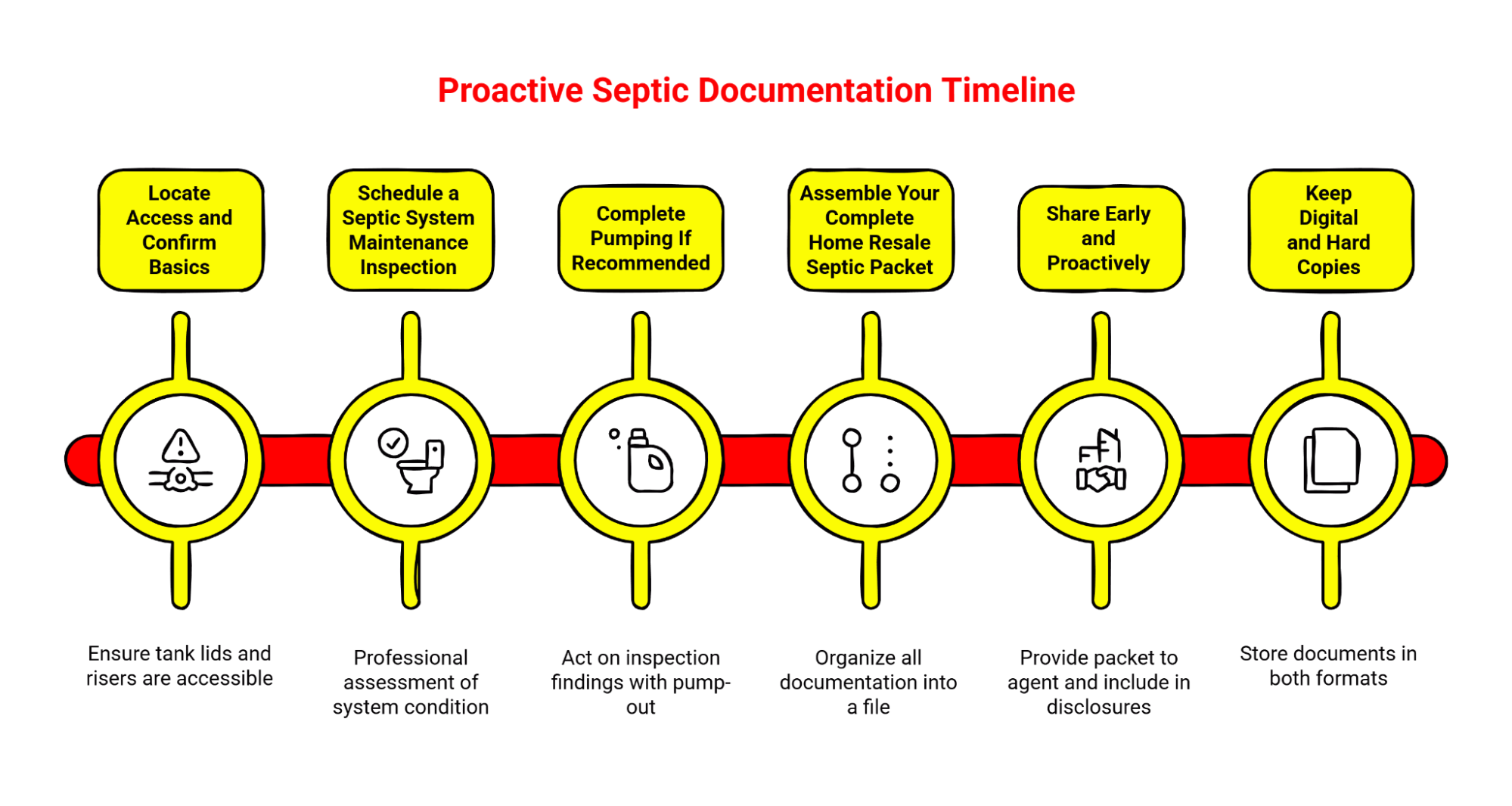
Disclaimer: This guide is intended as a comprehensive starting point. For decisions specific to your unique situation, we always recommend consulting a qualified professional.

The “Toilet Gurgle” Alert: When to Call for Emergency Pumping

📌 Key Takeaways

A toilet gurgle isn’t background noise—it’s your septic system’s auditory alarm signaling that wastewater flow is restricted and capacity is compromised.

  • The Gurgle Decodes System Stress: When air is forced back through your toilet bowl, it means wastewater can’t exit properly due to a full tank, blocked line, or venting issue.
  • Three Zones Define Response Speed: Green symptoms (isolated gurgle, normal drains) mean schedule routine service; Yellow (multiple fixtures, faint odors) means call within 48 hours; Red (backup, strong odors, soggy ground) demands immediate emergency pumping.
  • Emergency Pumping Functions as First Response: This service stops active backups, restores tank capacity, and prevents sewage from entering living spaces—it’s crisis stabilization, not just maintenance.
  • Houston’s Clay Soil Shortens Safe Intervals: Poor drain field absorption in the region’s clay-rich soil puts extra stress on septic systems, typically requiring pumping every 2-3 years instead of the 3-5 year schedule common elsewhere.
  • Proactive Cleanouts Transform Risk Into Reliability: Routine pumping every 2-3 years catches problems before symptoms appear, protects property value, and eliminates the health risks and expense of emergency backups.

React to the warning, not the disaster—speed determines whether you face a service call or a sewage cleanup.

Homeowners with residential septic systems in Greater Houston and Alvin will find a practical decision framework here, preparing them for the detailed severity assessment and emergency response guidance that follows.

That unmistakable sound from the bathroom—a low gurgle echoing from the toilet bowl when no one has flushed—stops homeowners in their tracks. It’s the kind of noise that makes you pause mid-conversation, wondering if you really just heard what you think you heard.

When a toilet gurgles, it’s doing more than making an unsettling noise. It’s delivering an auditory warning that something in your septic system needs immediate attention. Think of it as your plumbing clearing its throat, trying to tell you that wastewater isn’t flowing the way it should. For homeowners in Greater Houston and Alvin relying on septic systems, understanding what this sound means—and knowing when it signals an emergency—can be the difference between a quick professional visit and a sewage backup that turns your weekend into a nightmare.

This guide will walk you through exactly what causes toilet gurgling, provide a simple severity scale to assess your situation, and give you the confidence to know when it’s time to contact a professional or call 281-489-1765.


What Your Toilet’s Gurgling Is Really Telling You

Fishbone chart outlining reasons a toilet gurgles.

A gurgling toilet is signaling that air is trapped somewhere in your plumbing system and wastewater flow is being restricted. This happens for three primary reasons: your septic tank has reached capacity and can no longer accept water efficiently, a drain line has become blocked, or there’s a venting issue preventing air from escaping properly as water drains.

When wastewater tries to flow into an already-full tank, it creates back-pressure that forces air bubbles up through the nearest fixture—often your toilet. The gurgling sound is literally trapped air being pushed back into your home instead of venting safely outside. The EPA provides detailed information on how residential septic systems work and why proper flow is critical to system health.

Here’s where the situation gets more concerning. If just one toilet in your home gurgles occasionally, it might indicate a localized drain issue. However, when multiple fixtures start gurgling—especially when you run water in the sink or flush a toilet elsewhere in the house—it strongly suggests your septic tank is full or a main line is blocked. This escalates the situation from “keep an eye on it” to “call a professional soon.”

If you’re experiencing gurgling right now, take these immediate safety steps while you assess the severity:

  • Reduce non-essential water use until you determine the cause
  • Keep children and pets away from any soggy areas of ground near your septic tank or drain field
  • Do not attempt to open the tank yourself, add chemical treatments, or use drain snakes on septic system lines

The “Noise Severity Scale”: When a Gurgle Becomes an Emergency

Not every gurgle demands immediate action, but some combinations of symptoms absolutely do. Use this severity scale to quickly assess your situation:


Severity Signs You’ll Notice What’s Likely Happening How Urgent What to Do
Green Zone Occasional gurgle from one fixture; normal flushing; no odors; drains working at regular speed Tank approaching capacity or minor venting irregularity Low Schedule routine tank cleanout if you haven’t had one in 2-3 years; monitor for changes
Yellow Zone Multiple fixtures gurgling; faint sewage odors near drains; some drains noticeably slower than usual Tank is full or nearing capacity; possible partial blockage in main line Medium Contact a septic professional within 24-48 hours for evaluation and pumping
Red Zone Gurgling with actual wastewater backup; strong sewage odors throughout home; visible wastewater pooling near tank; toilets won’t flush or water rises in bowl Septic tank completely full or major blockage preventing drainage Critical Call for emergency pumping immediately: 281-489-1765


The Houston area’s clay-rich soil reduces how well drain fields can absorb water, which puts extra stress on the entire septic system and often shortens the typical pumping interval to every two to three years rather than the three-to-five-year schedule common in other regions.

If you’re in the Red Zone or concerned about potential health risks from sewage exposure, the CDC provides guidance on wastewater safety that every homeowner should know.

Ready to get help? Start your service today or call 281-489-1765.


When to Call for Emergency Pumping vs. When to Schedule Routine Service

Diagram explaining when to call for emergency septic pumping or routine service.

Understanding the distinction between an emergency and routine maintenance helps homeowners respond appropriately without unnecessary panic—or dangerous delays.

Call for emergency septic pumping when you observe any of these conditions: wastewater backing up into toilets, sinks, or showers; strong sewage odors inside the home; soggy or unusually lush green areas of grass above or near your septic tank or drain field; or the combination of gurgling sounds with visible wastewater or complete drainage failure.

Schedule routine septic service when you notice isolated gurgling without other symptoms, it’s been 2-3 years since your last tank cleanout, or you’re experiencing minor changes in drainage speed across multiple fixtures. In Greater Houston and Alvin, where many homes sit on septic systems, professional septic companies like Drane Ranger recommend proactive scheduling based on household size and tank capacity rather than waiting for warning signs.

Here’s the important part: if you’re uncertain which category your situation falls into, it’s always safer to call and have a professional assess it. A false alarm costs far less than dealing with sewage backup cleanup, potential health risks, and damage to your home’s flooring and walls.

Texas homeowners who want to understand state-specific requirements for septic system maintenance and permitting can reference the Texas Commission on Environmental Quality’s resources on on-site sewage facilities.


What Happens During Emergency Pumping (Step-by-Step “First Responder” Visit)

Many homeowners hesitate to call for emergency service because they don’t know what to expect. Understanding the process helps reduce anxiety during an already stressful situation.

When emergency septic pumping technicians arrive, they first assess the immediate risk and establish safety protocols. This includes locating your tank’s access points—most residential septic tanks in the Houston area have one or two concrete or plastic lids that need to be uncovered. The technician will ask when you last noticed symptoms and whether you’ve continued using water, as this information helps them gauge how critical the situation is.

The actual pumping process uses a vacuum truck equipped with a large hose. The technician inserts this hose into the tank through the access opening and removes the accumulated solids and liquids until the tank’s capacity is restored. This typically takes 30 to 45 minutes for a standard residential tank. While pumping, experienced technicians observe the tank’s condition, checking for structural issues, proper baffles, and whether the drain field is accepting water appropriately.

After pumping, the technician provides clear findings in plain language: whether the tank showed signs of damage, how full it was, and their recommendation for follow-up. If the tank was extremely full but structurally sound, they’ll often recommend scheduling routine maintenance inspections every 2-3 years to prevent future emergencies. If they observed concerning issues—cracks, failed baffles, or drain field saturation—they’ll explain what needs attention and connect you with the right resources.

For a full overview of all septic services available to Houston-area homeowners, visit the Drane Ranger septic services page.


How to Prevent the Next Gurgle: Routine Tank Cleanouts and Inspections

The most effective way to avoid septic emergencies is shifting from reactive crisis management to proactive maintenance. Think of routine septic tank cleanouts as a “home health reset” for your property’s waste management system.

Most residential septic tanks in the Greater Houston and Alvin area require pumping every 2-3 years, though this varies based on tank size, household size, and water usage patterns. A family of four with a 1,000-gallon tank, for example, typically needs service closer to the two-year mark. Waiting until symptoms appear—gurgling, odors, slow drains—means the tank is already working beyond its designed capacity, putting stress on the entire system.

Regular maintenance inspections go beyond simple pumping. Professional technicians examine the tank’s structural integrity, verify that inlet and outlet baffles are functioning correctly, and assess whether the drain field is accepting water as it should. These inspections catch small problems—a deteriorating baffle, early signs of drain field saturation—before they become expensive emergencies. For homeowners planning to sell their property, having documented septic maintenance records adds value and provides buyers with confidence that the system has been properly cared for.

The investment in routine service is modest compared to emergency repairs. More importantly, it protects your family from the health risks and significant inconvenience of a sewage backup inside your home.


What Local Homeowners Are Saying About Fast Septic Help

When septic emergencies strike, homeowners need responsive professionals who arrive quickly and solve the problem right the first time. Harold R. describes his experience with Drane Ranger: “My experience with Drane Ranger was a very organized, professional and on time experience. I was kept informed of what was happening and a suggested time of cleaning again. I will use them again and will definitely recommend them to anyone I speak with.”

For long-term septic care, John S. offers straightforward praise: “He has done all my septic work and is the best!”

Professional septic service should be transparent, punctual, and thorough. Whether handling an emergency pumping situation or routine maintenance, experienced providers take the time to explain what they’re doing and why it matters for your home’s long-term health.

Learn more about the Drane Ranger team and their commitment to the Greater Houston community.


Don’t Ignore What Your Plumbing Is Trying to Tell You

A gurgling toilet isn’t just an annoying sound—it’s your septic system’s early warning system doing exactly what it should. By using the severity scale outlined above, you can quickly assess whether your situation requires immediate emergency pumping or can wait for scheduled service.

The difference between a minor inconvenience and a major crisis often comes down to how quickly homeowners respond to these early warning signs. When multiple fixtures gurgle, when you detect sewage odors, or when you see any wastewater backup, that’s your clear signal to contact Drane Ranger immediately at 281-489-1765.

Beyond handling the immediate emergency, consider this a turning point toward proactive septic maintenance. Regular tank cleanouts every 2-3 years and periodic inspections transform your septic system from a potential liability into a reliable component of your home’s infrastructure—one that protects your property value, your family’s health, and your peace of mind.

Take action now:

  • Use the Noise Severity Scale above to check your situation’s urgency
  • Bookmark this guide for the next time your plumbing sounds off
  • Share this resource with neighbors who rely on septic systems


Our Editorial Process

All content undergoes multi-stage review including technical accuracy verification against TCEQ model standards, local regulation compliance checking, and practical application testing. We distinguish between verified regulatory requirements and generally accepted industry practices to help operators understand certainty levels.


About the Drane Ranger Insights Team

The Drane Ranger Insights Team is our dedicated engine for synthesizing complex topics into clear, helpful guides. While our content is thoroughly reviewed for clarity and accuracy, it is for informational purposes and should not replace professional advice. For specific concerns about your septic system, contact our team directly at 281-489-1765 or visit our website to learn more about our comprehensive septic services throughout the Greater Houston area.

Additional resources:

Home Septic Pumping in Houston: The Complete “System Reset” Guide

📌 Key Takeaways

Your septic system gives clear warnings before it fails—learning to read them saves thousands in emergency repairs.

  • Four Red Flags Demand Action: Sewage backups, persistent odors, slow drains with gurgling sounds, or mushy lawn patches all signal that your tank has reached critical capacity and needs immediate professional attention.
  • The Two-Year Rule Protects Your Investment: Houston-area homes typically need septic pumping every 2-3 years, though garbage disposals, household size, and water usage can shorten that window significantly.
  • “Cleaning” Beats “Pumping” Every Time: True septic tank cleaning removes the compacted sludge at the tank bottom that causes most failures—basic pumping only removes liquids and leaves the real problem behind.
  • Early Action Prevents Five-Figure Disasters: Catching saturation signs early through professional cleaning costs hundreds, while ignoring them and replacing a damaged drain field costs several thousand dollars.
  • Documentation Builds Resale Value: Maintaining service records, inspection reports, and tank location maps proves to buyers that your system has received proper care and functions correctly.

Vigilance plus routine maintenance equals a protected home and preserved property value.

Houston-area homeowners with septic systems will find practical guidance here, preparing them for the detailed maintenance overview that follows.

The toilet gurgles. Again.

You pause mid-flush, listening to that slow, uncertain drain. Later that afternoon, stepping into the backyard after a bone-dry week, you catch it—a faint smell you can’t quite place but definitely shouldn’t be there. Something’s not right, though you’re not entirely sure what or how worried you should be.

For homeowners with septic systems in the Houston area, these quiet warning signs often signal bigger problems developing beneath your property. Your septic tank functions as your home’s hidden immune system, silently processing waste and protecting both your family’s health and your property value. When it stops working properly, small inconveniences can escalate into expensive emergencies.

Here’s what you’ll know in the next seven minutes: whether you need service now, how often Houston homes should schedule pumping, exactly what we do on-site, and the easiest way to book with a local team that’s done this since 1985. You’ll finish with the clarity and confidence to protect your home’s most critical hidden system.


Quick Reference: Do You Need Service Now?

Use this 90-second diagnostic checklist. If you notice any of these signs, call for professional service today:

Septic Health Interval Calculator

Recommended pumping schedule based on household size and tank capacity:

Household Size Tank Size (Gallons) Recommended Interval
1-2 people 750-900 Every 3 years
1-2 people 1,000-1,250 Every 3-4 years
3-4 people 750-900 Every 2 years
3-4 people 1,000-1,250 Every 2-3 years
5-6 people 1,000-1,250 Every 1-2 years
5-6 people 1,500+ Every 2-3 years


Houston homes commonly schedule every 2–3 years. Call sooner if you notice any warning signs below.

Immediate Warning Signs Checklist

  • ☐ Sewage backup or overflow: Wastewater backing up into your home or pooling on your property means your tank has reached critical capacity

  • ☐ Persistent foul odors: Strange smells around your yard or from drains indicate waste isn’t being contained properly

  • ☐ Slow drains or gurgling sounds: Sluggish kitchen sinks, gurgling toilets, or slow-emptying washing machines signal a tank nearing capacity

  • ☐ Soggy lawn or unusually green patch: Mushy, waterlogged areas or suspiciously lush grass suggest your tank is leaking or overflowing

Need urgent service? Call 281-489-1765 for same-day appointments when available.


Do You Need Service Now? (90-Second Diagnostic)

Diagram showing key indicators of septic system issues.

Let’s address the most pressing question first. Run through this checklist—if any apply to your situation, professional service should happen soon.

Sewage backup or overflow represents the most serious warning sign. If wastewater is backing up through drains or toilets, or you see pooling sewage anywhere on your property, this qualifies as an emergency. Your tank has reached absolute capacity. Continuing to use your plumbing will only compound the problem and potentially force contaminated water into your home.

Persistent foul odors around your yard, near the tank location, or emanating from household drains all indicate your system is struggling to contain and process waste properly. These smells signal that gases or liquids are escaping where they shouldn’t. The problem will intensify without intervention.

Slow drains or gurgling sounds serve as your system’s early distress signals. When your kitchen sink drains sluggishly, your toilet makes unusual gurgling noises, or your washing machine takes noticeably longer to empty, these symptoms tell you the tank is filling beyond its safe working capacity. The system is running out of room to handle incoming wastewater.

A soggy lawn or unusually green patch indicates particularly serious trouble. If you notice a mushy, waterlogged area in your yard—especially near the drain field—or if one section of grass suddenly grows greener and lusher than surrounding areas, your tank may be leaking or overflowing. This means untreated wastewater is saturating your soil, creating both health hazards and potential drain field damage.

Why these signs demand immediate attention: Each symptom indicates that accumulated solids in your tank have reached critical levels. Without professional removal, you risk permanent damage to your drain field—a repair that can cost several thousand dollars. You also risk contaminating your property and creating serious health hazards for your family and neighbors.

If you’re experiencing any of these warning signs right now, call 281-489-1765. We often maintain same-day appointment availability for urgent situations throughout the Houston area.


How Often Should Houston Homes Pump a Septic Tank?

The standard recommendation is every 2–3 years for most residential properties in the Houston area. This isn’t an arbitrary interval—it’s based on how quickly solid waste accumulates in a typical household tank under normal use conditions. Your specific situation may require more frequent attention, however, depending on several factors.

Several variables influence how often your particular system needs service. Garbage disposal use significantly increases the solid load entering your tank, potentially cutting your safe interval in half. Running food waste through a disposal sends organic material directly into the septic system, where it must be broken down or removed.

Household size changes also affect your maintenance schedule. If your family has grown, or if you’re hosting long-term guests, your system processes more waste than it was originally designed to handle. More occupants means more wastewater, faster accumulation, and shorter intervals between necessary service calls.

Water softener discharge from older systems that drain into the septic tank can disrupt the bacterial balance your system depends on and reduce overall efficiency. Similarly, frequent large loads of laundry introduce extra water and lint into the system, filling the tank faster than typical use patterns would suggest.

For Houston homes specifically, our humid climate and seasonal rainfall patterns can affect drain field performance. Properties that experience poor natural drainage or yards that stay wet longer after storms may need more frequent professional attention to prevent system strain.

The factors table above provides general guidance, but always schedule service immediately if you notice any of the warning signs mentioned earlier—odors, slow drains, gurgling sounds, or soggy areas in your lawn—regardless of when you last had your tank serviced. For additional guidance on septic system maintenance best practices, the U.S. Environmental Protection Agency provides comprehensive homeowner resources on proper care and maintenance nationwide.


What We Actually Do During a “System Reset” (On-Site Process)

Residential Septic Tank Cleaning represents the physical removal of accumulated solids and often compacted sludge to restore safe function. It’s the practical “system reset” that prevents failure. Many homeowners use the terms “pumping” and “cleaning” interchangeably, but there’s an important distinction. True septic tank cleaning goes beyond simply removing liquids—it’s a complete restoration that removes all accumulated material, including the compacted sludge that settles at the bottom of your tank over time.

Here’s exactly what happens when our team arrives at your property.

Access and safety assessment comes first. We locate your tank’s access lid, which is often buried under a few inches of soil or grass, and carefully remove it. Before starting any work, our technician inspects the current levels and overall condition to determine the best approach for your specific situation.

Complete removal of liquids and solids follows. Using our vacuum truck, we remove all liquid waste from the tank. Then comes the critical step that defines true cleaning—we thoroughly extract the compacted sludge and solid waste that has settled at the tank’s bottom. This sludge causes most system failures. Leaving it behind means you’re only buying a few months before problems return.

Hydro-jetting when needed addresses heavily compacted buildup. For tanks that haven’t been serviced in many years or have particularly stubborn accumulation, we may use high-pressure water jetting to break up sludge adhered to the tank walls. This ensures we’re starting with a truly clean slate.

Component inspection happens while your tank is empty. We inspect critical elements including the inlet and outlet baffles or tees, which prevent solids from escaping into your drain field. We also examine the tank walls for cracks and assess overall structural integrity. These components act as your system’s gatekeepers—even a clean tank won’t function properly if they’re damaged.

Compliance and documentation ensures proper waste handling. We transport all removed material to approved treatment facilities according to Houston-area regulations. You receive complete documentation of the service, including the date, observations about your system’s condition, and our recommendations for your next service interval. This paperwork proves valuable for your records and becomes essential if you sell your home.

Site restoration completes the process. We replace the access lid securely and restore your yard to its original condition, leaving your property exactly as we found it—but with the peace of mind that your system is reset and protected.

This comprehensive process earns the name “system reset.” You’re not just removing today’s waste; you’re restoring your septic system’s full capacity and extending its working life by years.


Preventing the “Silent Failure” (Soggy Yard & Odors)

One of the most dangerous aspects of septic problems is how quietly they develop. Unlike a burst pipe that announces itself immediately, septic system failures often give subtle warnings that homeowners can easily dismiss until they become impossible to ignore.

Understanding why drain fields saturate helps explain the urgency. When your septic tank fills beyond its safe capacity, solid waste starts escaping into your drain field—the underground area where treated wastewater should filter safely into the soil. These solids clog the soil’s natural pores, preventing proper drainage. The result? Wastewater has nowhere to go but up, creating those telltale soggy patches and unmistakable septic odors.

Early sensory cues you shouldn’t ignore:

A section of your lawn that stays damp even during extended dry spells signals potential problems. Grass that suddenly grows faster and greener in one specific area indicates waste acting as fertilizer where it shouldn’t be. A faint odor that you notice when the wind shifts or after sunset suggests gases escaping from your system. Puddling water that doesn’t correlate with recent rain or irrigation patterns points to subsurface saturation.

These serve as your system’s early warning signals. The moment you notice them, you’re looking at a problem actively getting worse. The saturated soil needs time to recover, and the only way to stop further damage is professional tank cleaning and reset. Understanding proper septic system hygiene, as outlined by the Centers for Disease Control and Prevention, helps protect both your family’s health and your community’s groundwater.

Disclaimer: This guide is intended as a comprehensive starting point. For decisions specific to your unique situation, we always recommend consulting a qualified professional.


Our Editorial Process

All content undergoes multi-stage review including technical accuracy verification against TCEQ model standards, local regulation compliance checking, and practical application testing. We distinguish between verified regulatory requirements and generally accepted industry practices to help operators understand certainty levels.


About the Drane Ranger Insights Team

The Drane Ranger Insights Team is our dedicated engine for synthesizing complex topics into clear, helpful guides. While our content is thoroughly reviewed for clarity and accuracy, it is for informational purposes and should not replace professional advice.
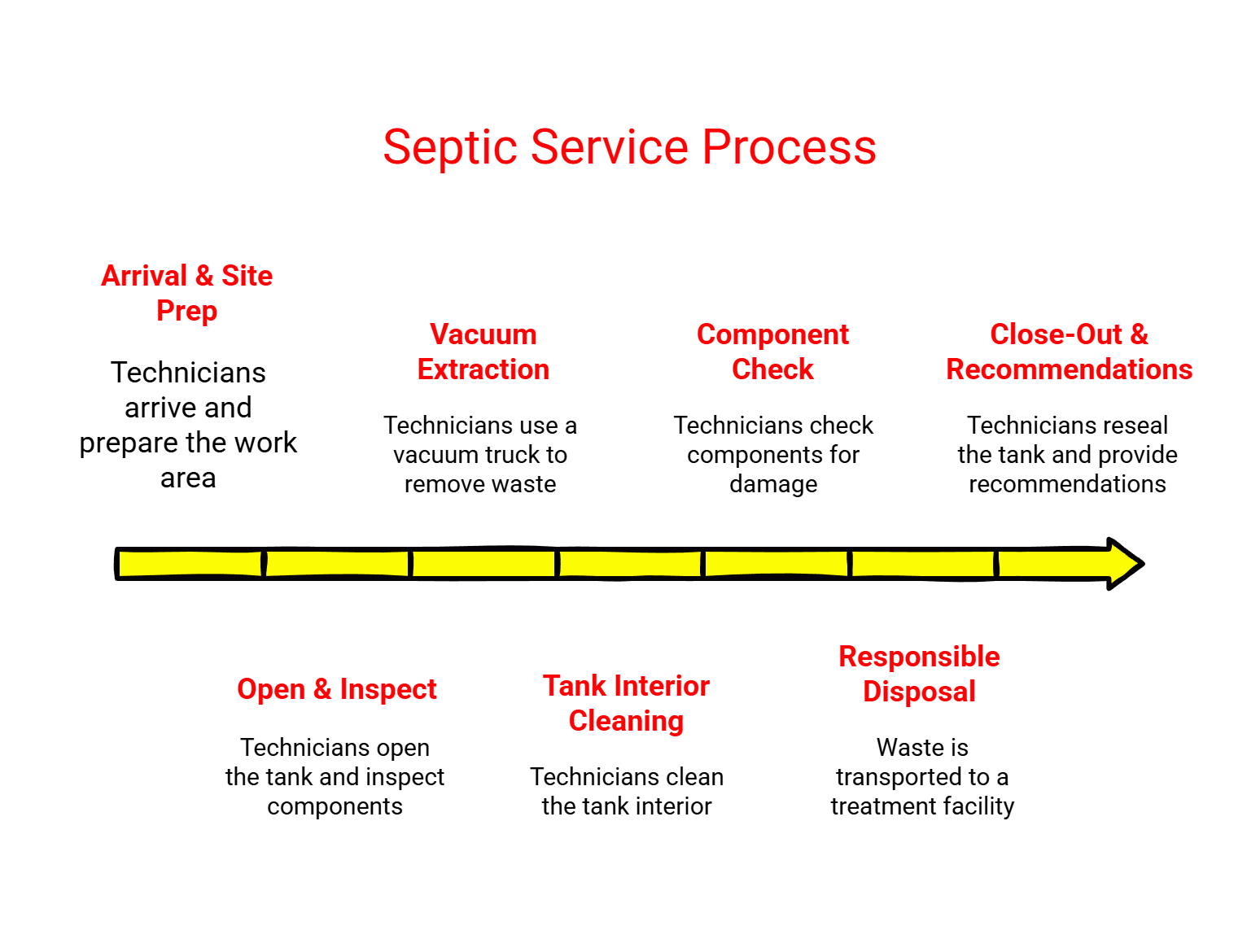
 

How to Document and Track Septic Service for Future Home Sales

Key Takeaways:

  • Essential Documentation: Keep pumping records, professional inspection reports, and permits for any septic work. These records demonstrate proper system maintenance and care to potential buyers and their inspectors during property transactions.
  • Strategic Organization: Create both digital and physical filing systems with chronological organization. Scan paper documents for backup copies and maintain clear file names that include dates and service providers for easy retrieval.
  • Service Provider Partnerships: Request detailed documentation from septic professionals and maintain their contact information. Review service records while providers are available to ask questions and ensure you receive complete information.
  • Transaction Preparation: Organized septic records can prevent delays during home sales and build buyer confidence. Missing documentation may raise concerns that complicate property transfers when buyers are evaluating major home systems.
  • Proactive Record-Keeping: Start your documentation system with your next septic service appointment rather than waiting until you’re ready to sell. Complete records serve as valuable assets that support your property investment regardless of timing.

This comprehensive approach to septic documentation transforms routine maintenance into strategic property management that protects your investment and ensures smoother future transactions.

Your septic system works quietly underground. But those maintenance records? They speak volumes when it’s time to sell.

Here’s what happens to too many Houston-area homeowners: They’re ready to put their house on the market, excited about the next chapter. Then the buyer’s inspector starts asking questions. “Can you show me the septic maintenance records?”

Suddenly, that excitement turns to panic. Where are those records? Did the previous owner keep them? Was that pumping receipt from 2019 or 2020?

The truth is, incomplete septic documentation creates unnecessary headaches during home sales. Buyers want proof the system’s been properly maintained. Their inspectors expect it. Yet most homeowners have no clue what records to keep or how to organize them effectively.

You don’t have to be one of those homeowners scrambling through boxes of old receipts.

This guide shows you exactly how to create and maintain septic records that protect your property value. More importantly, it ensures smoother transactions when you’re ready to sell.


Understanding Septic Documentation Requirements

Essential Records Every Homeowner Needs

Detailed septic documentation shows system care, builds buyer trust, and prevents issues during property sales.

Think of septic documentation like your car’s service history. Would you buy a used car without maintenance records? Probably not.

Pumping Records: These are your bread-and-butter documents. Every time someone pumps your tank, you get a receipt. Date, company name, basic service details. Some companies go further – they’ll note the tank’s condition, any concerns they spotted, recommendations for future service.

Keep every single one.

Inspection Reports: Professional inspections reveal your system’s health. Think of them as check-ups for your septic system. These reports become incredibly valuable during property transactions when buyers want to know what they’re getting into.

Permit Documentation: Any permits for installation, repairs, or modifications. These prove work was done legally, with proper oversight.

Why does this matter? Because when a potential buyer’s inspector starts digging into your property’s history, complete records demonstrate responsible ownership. Missing documentation raises red flags.

+——————————————————————————————————-+

💡 Quick Takeaways

  • Service History: Every pumping receipt tells part of your system’s story
  • System Health: Professional inspections provide detailed condition assessments
  • Legal Compliance: Permits prove work met local requirements

+——————————————————————————————————-+


Record-Keeping for Property Transfers

Property transactions involve lots of questions. About the roof, the foundation, the HVAC system. And yes, about the septic system.

Having organized records changes everything. Instead of saying “I think we had it pumped two years ago,” you can hand over a complete file. Dates, companies, services performed, observations noted.

Complete documentation builds buyer confidence. It shows you’ve taken care of the property. Missing records? They create doubt.

Here’s the thing about preparation – it’s never urgent until it suddenly is. The time to organize your septic records isn’t when you’re preparing to sell. It’s now, while you’re living in the home and can establish good systems.


Creating Your Septic Record-Keeping System

Organizing Maintenance Documentation

Digital Organization: Create a folder on your computer labeled “Septic Records” or “Home – Septic System.” Scan every paper document. Use clear file names with dates and service providers.

Example: “2024-03-15_ABC_Septic_Tank_Pumping.pdf”

Physical Document Storage: Keep paper originals in a labeled file folder. Store it with your other important home documents – insurance papers, warranty information, property records.

Some homeowners keep copies in a separate location. Smart move.

Timeline Organization: Arrange everything chronologically. This approach helps you spot maintenance patterns, identify service gaps, and demonstrate consistent care to potential buyers.

The beauty of chronological organization? It tells a story. Your system’s story.

+——————————————————————————————————-+

💡 Quick Takeaways

  • Backup Strategy: Digital copies protect against document loss
  • Accessible Storage: Physical files stay with important home documents
  • Pattern Recognition: Date-based organization reveals maintenance consistency

+——————————————————————————————————-+


Storage Considerations

Documents disappear. Floods happen. Fires occur. Backup copies protect against Murphy’s Law.

Digital storage works well – if you maintain it consistently. Many homeowners start with good intentions. They scan the first few documents, create organized folders. Then life gets busy. New receipts pile up on the kitchen counter. The system breaks down.

Consistency matters more than perfection.

Consider telling family members where you keep septic documentation. Sounds obvious, but you’d be surprised how often important records become inaccessible precisely when they’re needed most.


Working with Service Providers for Proper Documentation

Request detailed septic service records—complete documentation adds value and supports future maintenance.

What to Request from Septic Tank Pumping Professionals

Not all service companies provide the same level of documentation. Some hand you a basic receipt. Others provide detailed reports with observations, recommendations, even photos.

Service Documentation: At minimum, you should receive the pumping date, company information, and confirmation of work completed. Better companies include tank condition notes, recommendations for future service, and contact information for follow-up questions.

Service Provider Information: Keep their contact details as part of your records. Future homeowners might want to know who’s serviced the system. Continuity of service providers can actually add value – it shows you’ve built relationships with reliable septic tank pumping professionals.


Ensuring Complete Service Records

Building relationships with service providers benefits everyone. Companies that work regularly in residential markets often understand homeowner documentation needs better than others.

After each service visit, review what you received. Did you get everything you need? Ask questions while the technician is still there. Much easier than calling later with questions about work completed weeks ago.

Some service providers offer digital record-keeping. They’ll email receipts, store service history in their systems, even send reminders for future maintenance. Take advantage of these services when available.

+——————————————————————————————————-+

💡 Quick Takeaways

  • Documentation Standards: Request detailed service records, not just basic receipts
  • Provider Relationships: Maintain contact information for service continuity
  • Immediate Review: Check documentation while technicians are available for questions

+——————————————————————————————————-+


Conclusion

Organized septic documentation transforms from a mundane task into a valuable asset supporting your property investment.

Complete records demonstrate responsible homeownership. They prevent transaction complications. They build buyer confidence. Most importantly, they give you peace of mind knowing you’re prepared for whatever comes next.

The organizational system you create today serves you whether you sell next year or next decade.

Why not start with your next septic service appointment?


Frequently Asked Questions


Q: What septic records do I need to keep for a home sale?

A: Pumping documentation, professional inspection reports, and permits related to septic work cover the basics. Specific requirements vary by location and transaction, so consulting with local real estate professionals about typical expectations makes sense.


Q: How long should I keep septic maintenance records?

A: Many homeowners keep records for as long as they own the property. Retention periods depend on your specific situation and local practices. Local professionals can provide guidance about appropriate timeframes for your area.


Ensure Smooth Home Sales with Expert Septic Pumping and Clear Documentation

Proper septic tank pumping is essential to prolong the life of your system, prevent costly repairs, and protect your property value. At DraneRanger, we bring over a decade of experience serving Houston and surrounding areas with reliable, thorough septic tank cleaning and maintenance designed to keep your system running smoothly and efficiently.

Don’t wait until selling your home to start organizing your septic records—partner with a trusted provider who delivers detailed service documentation every time.

Ready to protect your investment and simplify future transactions?

Call DraneRanger at (281) 489-1765 today to schedule your septic tank pumping or maintenance service. Our team is here to ensure your system’s health and provide you with the complete, organized records you need for peace of mind.

Want to learn more about how proper septic care safeguards your home? Feel free to explore our range of wastewater management services and tips across Houston, Pearland, Alvin, and Sugar Land.