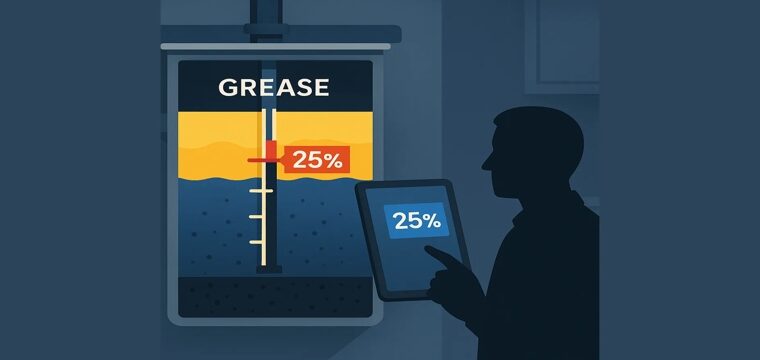
The 25% Rule Explained: When to Schedule Your Pump-Out to Stay Compliant

📌 Key Takeaways

Houston’s grease trap compliance hinges on one measurable threshold: when floating grease plus settled solids reach 25% of your trap’s liquid depth, schedule service immediately—regardless of the calendar.

  • Core Sampling Reveals What Visual Checks Miss: Bottom sludge accumulates invisibly beneath a seemingly clean surface, making core sampling through the sample well the only reliable measurement method inspectors accept.
  • The 25% Rule Overrides the 90-Day Clock: High-volume kitchens often hit the 25% threshold in six to eight weeks, triggering mandatory service even when the quarterly deadline hasn’t arrived—compliance follows accumulation, not the calendar.
  • Manifests Prove Legal Disposal, Not Just Payment: A signed waste manifest creates a chain-of-custody record that protects restaurants from liability if haulers dump illegally, making it the critical compliance document inspectors require.
  • Measurement Drives Predictable Scheduling: Taking core samples every two to three weeks reveals each kitchen’s actual accumulation rate, enabling operators to pre-book service before hitting the 25% trigger rather than reacting to odors or backups.
  • The Three-Step Compliance Loop Prevents Violations: Measure with core sampling, schedule proactively based on trend data, and maintain organized manifests—this systematic approach keeps Houston restaurant kitchens audit-ready and operations running smoothly.

Measure before you’re mandated, schedule before you’re late, document before you’re inspected.

Houston restaurant owners, general managers, and facilities managers will find this framework here, preparing them for the detailed measurement and scheduling guidance that follows.

The 25% rule defines when Houston restaurants must clean their grease traps: when the combined depth of floating grease and settled solids reaches approximately one-quarter of the trap’s total liquid depth. Think of it like an oil-change indicator—hit the line, you service now.

Picture this scenario. It’s Friday lunch rush, and a city inspector walks into your kitchen. They ask to see your most recent core sample reading. You check your log. The measurement shows 28%.

That simple number tells the inspector everything they need to know—and it determines whether you’re compliant or facing a violation. Schedule your pump-out before reaching 25% or by the quarterly mandate, whichever comes first.


What is Houston’s 25% Rule?

What is the 25% rule for grease traps?

The 25% rule is the operational threshold that triggers mandatory grease trap cleaning in Houston. It measures total accumulation—both the floating grease cap at the top of your trap and the settled solids at the bottom—as a percentage of the trap’s liquid depth.Âą

When these two layers combined equal roughly one-quarter of the total depth, the trap has reached its functional limit. At this point, the trap can no longer effectively separate fats, oils, and grease (FOG) from wastewater.

This isn’t an arbitrary number. The 25% threshold represents the point where trap efficiency degrades significantly, increasing the risk of FOG entering the municipal sewer system.Âą City ordinances in Houston recognize this as the functional compliance trigger, meaning you must schedule service when you hit or exceed this accumulation level.

Treat 25% as your “service-now” line. Waiting until you’re well past this threshold—or worse, waiting until you smell problems—puts your business at risk of violations, backups, and costly emergency service calls.


25% vs. 90 Days—Which Comes First?

Houston restaurants face two overlapping requirements: the 25% accumulation threshold and the quarterly (90-day) cleaning mandate. You must clean at whichever trigger comes first.Âą

For many operations, especially high-volume kitchens, the 25% threshold arrives well before 90 days have elapsed. A busy restaurant producing significant grease loads might hit 25% in just six to eight weeks. When this happens, the clock doesn’t matter—the accumulation level takes priority.

The quarterly mandate serves as a backstop. Even if your trap measures below 25% at the three-month mark, city regulations for traps within Houston limits still require cleaning.Âą This ensures that lower-volume operations maintain regular service intervals and proper trap function.

Understanding which trigger applies to your specific operation requires measurement and tracking. High-volume kitchens need shorter service intervals; lower-volume operations may run closer to the quarterly schedule. The key is measuring regularly to know where you stand and adjusting your maintenance calendar accordingly.


How Inspectors Measure It (and How You Should Too)

How do inspectors measure the 25% rule—do visual checks count?

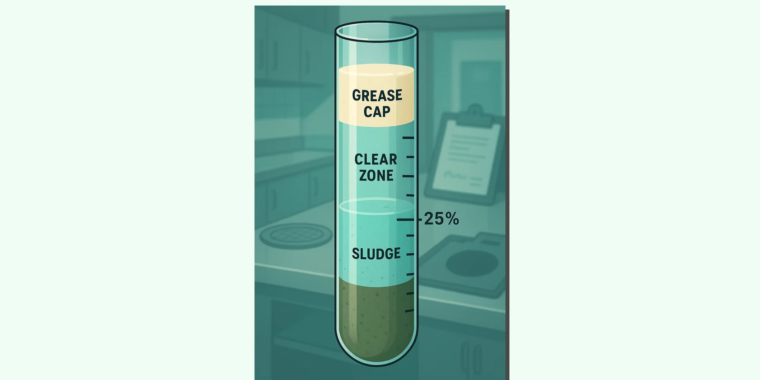
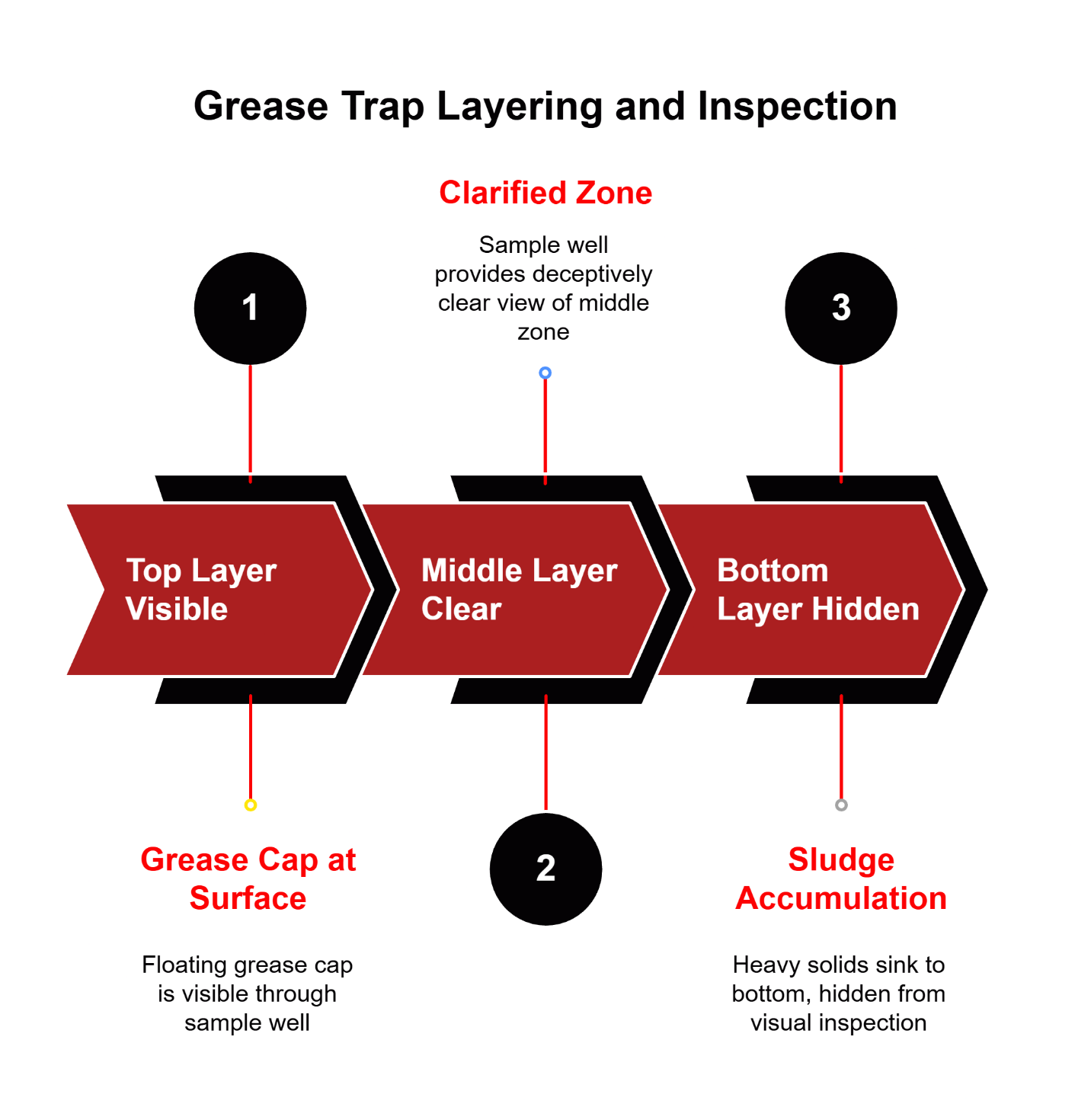
Inspectors don’t rely on visual surface checks. They use core sampling through your trap’s sample well to get an accurate cross-section of all three layers: the grease cap, the clear water zone, and the settled solids at the bottom.

A visual check from the top only shows you the grease cap—and even that measurement is unreliable without proper tools. The real problem lies beneath the surface. Settled solids accumulate at the trap bottom, invisible to anyone just lifting the lid for a quick look. These solids count toward your 25% total, and inspectors know that surface appearances miss this critical layer. Visual checks alone cannot prevent the sewer blockages and overflows that FOG regulations are designed to stop.

Core sampling provides a complete vertical profile. The sampler—commonly called a sludge judge—captures material from top to bottom in a single pull. This allows for precise measurement of both the floating grease thickness and the depth of bottom sludge.

Your measurement protocol should match the inspector’s method. Use a core sampler designed for grease traps, accessed through your trap’s sample well. Record the top grease layer thickness, the clear water zone depth, and the bottom solids depth. Calculate these measurements against your trap’s total liquid depth to determine your accumulation percentage.

Visual checks fail inspections. Core sampling passes them. Make the investment in the right tool and the right technique.


Step-by-Step: Take a Core Sample in 5 Minutes
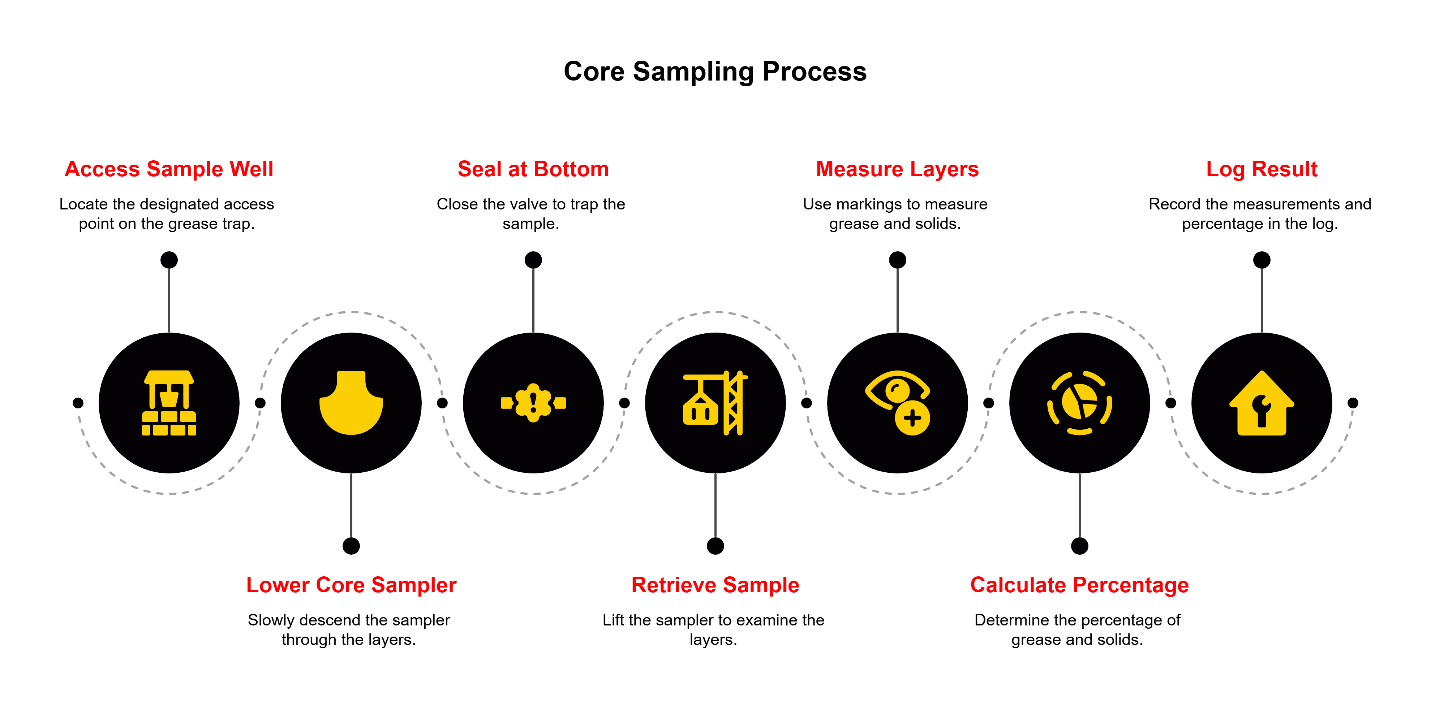
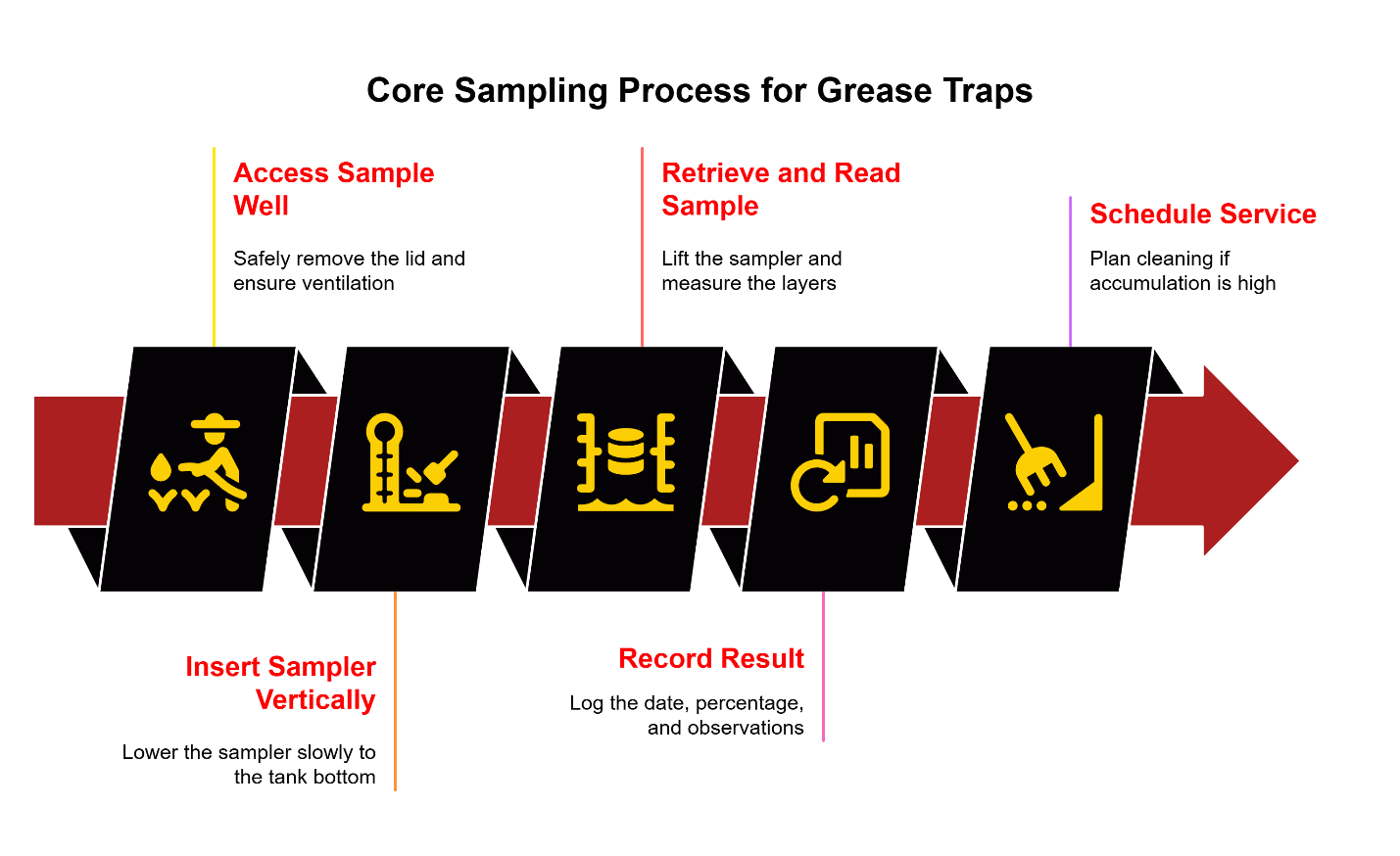
Core sampling process infographic showing steps to access sample well, lower and seal core sampler, retrieve sample, measure layers, calculate grease and solids percentage, and log results.


Does floating grease count toward the 25% rule?

Yes. Both floating grease and settled solids count toward your 25% total.Âą Here’s how to measure both layers accurately:

Access your sample well. Most grease traps have a dedicated sample well or measurement port. Locate this access point—it’s typically marked and provides a clear vertical path to the trap bottom.

Lower your core sampler slowly. A sludge judge or similar core sampling tool should descend through all three layers without disturbing them. Keep the bottom valve closed during descent to prevent water from entering the tube prematurely.

Reach the trap bottom, then seal. When you feel the sampler touch bottom, close the bottom valve to trap the vertical sample inside the tube. This captures a complete cross-section from top to bottom.

Retrieve and read the layers. Lift the sampler straight up and examine the captured sample. You’ll see three distinct zones: grease at the top (often yellowish or tan), clear water in the middle, and dark settled solids at the bottom.

Measure and calculate. Use the graduated markings on your sampler to measure:

  • Top grease layer depth
  • Bottom solids layer depth
  • Total liquid depth (grease + clear water + solids)

Add the grease and solids measurements, then divide by total depth and multiply by 100 for your percentage. If grease is 2 inches, solids are 3 inches, and total depth is 20 inches: (2 + 3) Ă· 20 = 0.25, or 25%.

Log the result immediately. Record the date, time, all three measurements, and the calculated percentage in your maintenance log. This documentation proves you’re monitoring compliance between service visits.

Assign this task to a designated kitchen manager or facilities lead. Taking a reading once every two to three weeks gives you advance warning before you hit the 25% threshold.


Scheduling Logic: Turn Readings into a Maintenance Calendar

Raw measurements mean nothing without a maintenance plan. Use your readings to establish a service cadence that prevents you from ever reaching the 25% trigger unexpectedly.

Start with a 90-day baseline if you’re new to systematic tracking. Schedule your first professional cleaning, then begin taking core samples every two weeks. Track the accumulation rate over the first three months. This data reveals how quickly your specific operation approaches the 25% threshold.

High-volume kitchens often discover they need service every six to eight weeks. Lower-volume operations might find they run comfortably at 75 or 85 days. The measurement trend tells you what your kitchen actually needs—not what a generic schedule suggests.

Once you know your accumulation rate, schedule the next service appointment before you project hitting 25%. Build in a safety margin. If your readings suggest you’ll reach 25% at week 10, book service for week 8 or 9. This buffer accounts for unexpected volume spikes during busy seasons or special events.

Pre-booking service creates schedule certainty. This quiet protection—operating like an invisible shield between your kitchen and expensive sewer problems—means you avoid last-minute emergency calls, and your service provider can plan routes more efficiently. Many operators find that turning measurements into a reliable schedule reduces both stress and cost over time.


Compliance Paperwork: The Manifest Is Your Proof

Cleaning your grease trap removes the waste. The manifest proves you disposed of it legally.

A waste manifest is a legal tracking document that follows your grease trap waste from your property to its final disposal site. It identifies the waste generator—your restaurant—along with the hauler, the transport vehicle, and the receiving facility.¹ All parties sign the manifest, creating a chain-of-custody record.

For Houston restaurant operators, this document serves two critical functions. First, it demonstrates compliance with city FOG (fats, oils, and grease) ordinances that require proper waste disposal. Second, it protects you if there’s ever a question about where your waste ended up. If a hauler dumps illegally, the signed manifest proves you fulfilled your legal responsibility by hiring a registered service provider.

After every pump-out, file the signed manifest in a dedicated Compliance Binder. Organize manifests chronologically with the most recent on top. Keep this binder readily accessible for inspector visits. Regulatory guidance recommends retaining manifests for at least five years to cover typical audit windows.Âą

Missing manifests raise red flags during inspections. An inspector sees a clean trap but no paperwork trail and must assume non-compliance. That gap can trigger fines even if you’ve been cleaning on schedule. The cleaning proves operational maintenance; the manifest proves legal compliance.

“Organized, professional and on time… suggested time of cleaning again,” one Houston-area operator noted after establishing a consistent manifesting routine with a reliable service provider. That level of systematic documentation turns a potential compliance vulnerability into a strength.


Common Pitfalls That Trigger Fines
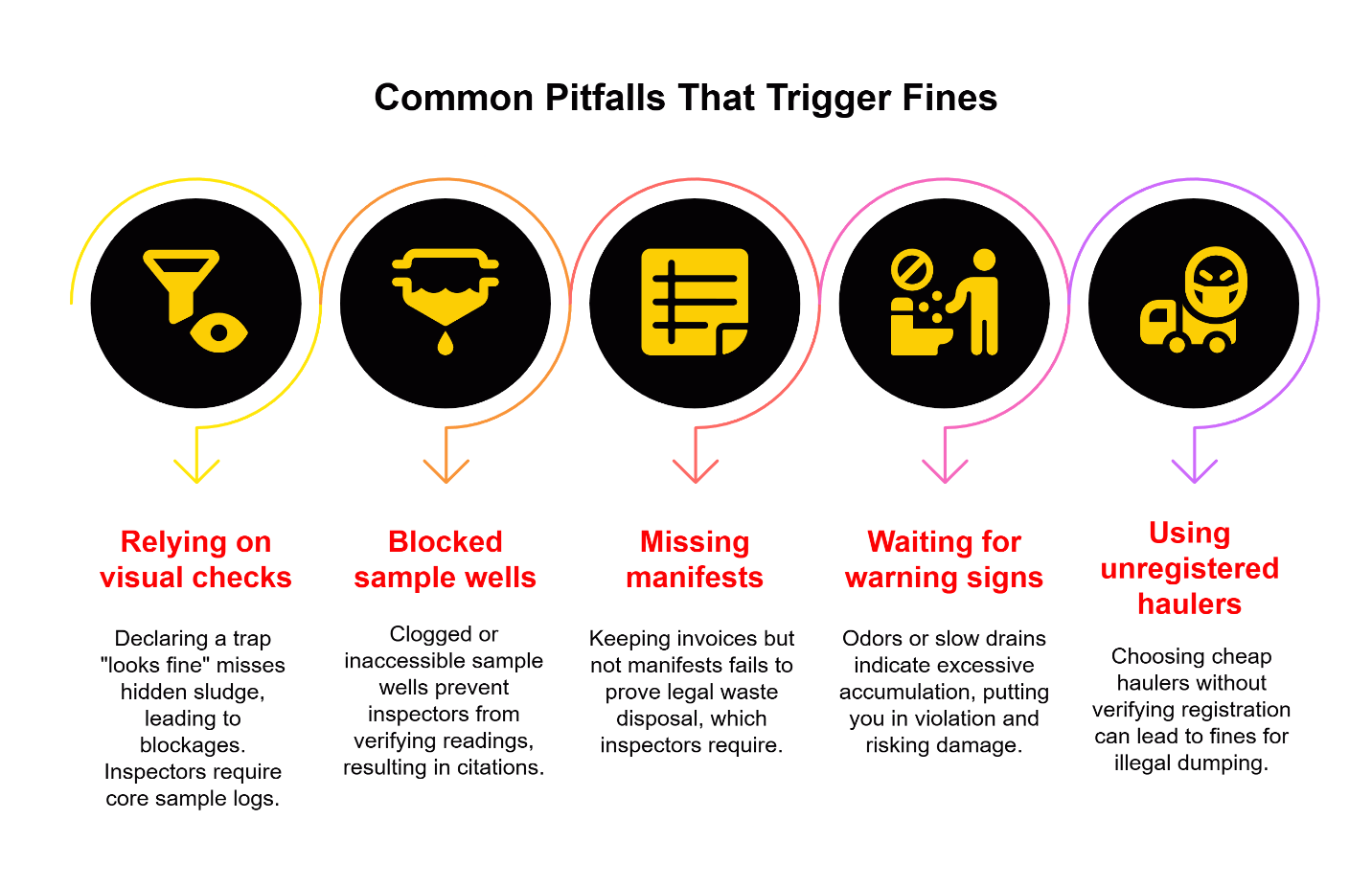
Infographic showing common pitfalls that trigger grease trap fines, including relying on visual checks, blocked sample wells, missing manifests, waiting for warning signs, and using unregistered haulers.


Relying on visual checks only. Walking past the trap, lifting the lid, and declaring it “looks fine” misses the bottom sludge layer completely. This hidden accumulation contributes directly to the sewer blockages and sanitary sewer overflows (SSOs) that FOG regulations aim to prevent. Inspectors know this. They’ll ask for your core sample log, and if you don’t have one, the visual assessment means nothing.

Blocked or inaccessible sample wells. Sample wells can become clogged with grease or covered by equipment over time. If an inspector can’t access your sample well to verify your readings, they may cite you for non-compliance regardless of when you last cleaned the trap.

Missing or incomplete manifests. Some operators keep invoices but not manifests, not realizing these are different documents. An invoice shows you paid for a service; a manifest proves legal waste disposal.Âą Inspectors require manifests.

Waiting for warning signs. Bad odors, slow drains, or visible backups mean you’re well past 25%—possibly at 40% or 50% accumulation. By the time you smell a problem, you’re already in violation and facing potential backup damage.

Using unregistered or non-compliant haulers. Some operators choose the cheapest service without verifying the hauler is properly registered and insured. When these haulers skip manifesting or dump illegally, you can still be on the hook as the generator—the legal term for the restaurant that produced the waste.Âą As one satisfied customer shared: “Drain Ranger is very professional and reliable. Basically they can take care of all your grease drain needs.” That reliability includes proper manifesting and disposal—protections worth far more than the small premium over cut-rate alternatives.

These pitfalls share a common thread: reactive rather than proactive management. Houston’s 25% rule exists to prevent problems, not document them after they occur. Everything else is noise.


Frequently Asked Questions

What exactly counts toward the 25%?

Both floating grease and settled solids count toward total accumulation. The clear water zone in the middle does not count—only the material at the top and bottom of the trap.¹

Do I pump at 25% or every 90 days?

You must clean at whichever trigger comes first. If you reach 25% accumulation at week 7, you clean at week 7. If you’re still below 25% at day 90, the quarterly mandate requires service anyway.Âą

How do I measure it?

Use a core sampler (sludge judge) accessed through your trap’s sample well. The sampler captures a vertical cross-section showing all three layers. Measure the grease cap depth, the bottom solids depth, and the total liquid depth, then calculate the percentage.

Is a clean-looking surface OK?

No. Surface appearance reveals nothing about bottom sludge accumulation. Inspectors require core sampling data, not visual assessments, because visual checks consistently underestimate total accumulation and cannot prevent sewer blockages.

What paperwork do I keep?

Keep signed waste manifests from every pump-out. Organize them chronologically in a dedicated compliance binder. Maintain these records for at least five years for audit readiness.


Measure, Don’t Guess: Book Before You Hit 25%

The 25% rule transforms grease trap maintenance from guesswork into a measurable process. Floating grease plus settled solids equal your total accumulation. When that total reaches one-quarter of your trap’s liquid depth, schedule service immediately.Âą

Core sampling through your sample well provides the accurate measurement inspectors require. Visual checks miss the bottom layer where significant solids accumulate. Take readings every two to three weeks, log the results, and track your accumulation trend over time.

This measurement-based approach reveals your kitchen’s actual service interval—whether that’s every six weeks for high-volume operations or closer to the 90-day maximum for lower-volume establishments. Use this data to pre-book maintenance appointments before you hit the threshold, not after.

The documentation loop completes the compliance picture. Measurement identifies when to clean. Professional service removes the waste. A signed manifest proves legal disposal.¹ Together, these three elements—measure, schedule, manifest—create an audit-ready compliance system that protects your business.

“He has done all my septic work and is the best!” one long-term customer shared. That expertise extends to helping Houston restaurant operators establish systematic maintenance programs built on measurement data, not reactive crisis management.

Understanding what to expect from a professional grease trap cleaning helps operators recognize quality service. Avoiding common FOG violation myths prevents costly mistakes that trigger fines despite good intentions.

The math is simple: measure regularly, schedule proactively, and maintain complete documentation. That systematic approach keeps Houston restaurant kitchens compliant, inspectors satisfied, and operations running smoothly.

Call Drane Ranger to set your maintenance schedule and establish a measurement-based compliance program tailored to your kitchen’s actual service needs, or contact us to request a 25% reading and service quote.

References

  1. Texas Commission on Environmental Quality (TCEQ). FOG control and interceptor maintenance guidance. Sample ordinance provisions covering 25% accumulation standards, quarterly cleaning requirements, and recordkeeping expectations for waste generators.

About the Drane Ranger Insights Team

The Drane Ranger Insights Team is our dedicated engine for synthesizing complex topics into clear, helpful guides. While our content is thoroughly reviewed for clarity and accuracy, it is for informational purposes and should not replace professional advice.

The ‘Sample Well’ Myth: Why Visual Checks Fail to Detect Sludge

📌 Key Takeaways

A clear sample well can hide compliance violations that trigger fines, shutdowns, and emergency pump-outs during your busiest service hours.

  • Surface Clarity Hides Bottom Risk: The sample well shows only the top layer while heavy sludge accumulates invisibly at the tank bottom, often pushing total accumulation past the 25% threshold.
  • Inspectors Measure, Not Eyeball: Core sampling captures the full vertical column of grease cap plus settled solids, providing the accurate percentage calculation that determines compliance.
  • Dual Requirements Drive Service Timing: Houston mandates pump-out at 25% accumulation OR every 90 days, whichever comes first—meaning high-volume kitchens may need service before the calendar triggers it.
  • Cleaning Without Manifests Means Incomplete Compliance: Signed waste manifests proving legal disposal must be retained for five years and produced on demand during inspections.
  • Measured Compliance Replaces Guesswork: Monthly core sampling with documented results transforms reactive crisis management into predictable, scheduled maintenance that keeps operations running smoothly.

Measured beats guessed. Houston restaurant operators and facilities managers will find a practical compliance framework here, preparing them for the detailed implementation guidance that follows.

Friday night. The dinner rush is building momentum, and everything seems fine. You check the sample well—it looks clear. No visible grease floating on top, no obvious warning signs. But then the drains start backing up. Odors rise from the floor sinks. And when the city inspector arrives for a surprise visit, you discover your trap is well past the 25% threshold.

A clear sample well doesn’t guarantee compliance. It only shows what’s happening at the surface while potentially hiding several inches of settled sludge at the bottom of your tank.

What is a sample well? It’s the access point on top of your grease trap that allows you to visually inspect the contents. Think of it as a small window into a much larger system—you can see the top layer, but everything below remains hidden.

Here’s the reality: Judging trap compliance by looking at the sample well is like checking your fryer oil by examining only the top inch. The surface might look golden and clean, but the burnt solids and breakdown products settle to the bottom where you can’t see them.

Picture this common scenario: It’s Friday evening, your dining room is packed, and everything appears to be running smoothly. The sample well you checked this morning looked perfectly clear. But as the night progresses, your dish pit slows down. Water pools around the three-compartment sink. A faint odor begins to drift from the floor drains. Your staff mentions it, but you’re in the middle of service. Then an inspector walks through the door for a routine check. Within minutes, they’re measuring your trap with a core sampler—and the reading shows 32% accumulation. You’re facing a violation notice and an immediate order to pump out, all while your sample well still looks relatively clear from above.

The practical solution: Adopt the inspector’s standard. Use core sampling to measure the full vertical column of your trap contents, capturing both the floating grease cap and the settled solids layer. Schedule regular grease trap cleaning in Houston based on actual measurements, not guesswork. This shift from visual checks to measured compliance transforms uncertainty into predictable, documented maintenance.


What a Sample Well Really Shows (and Hides)

Grease trap layering and inspection diagram showing visible top grease cap, clear middle clarified zone, and hidden bottom sludge accumulation.


A sample well provides access to the trap’s surface layer. When you lift the lid and look down, you’re seeing the top 2-4 inches of a tank that might be 18-24 inches deep. This limited view reveals the floating grease cap—if one has formed—but tells you nothing about the sludge accumulating below.

The physics of grease trap operation work against visual inspection. Lighter materials—fats, oils, and grease—float to the top, where they’re visible through the sample well. Heavier solids, including food particles, sediment, and degraded organic matter, sink to the bottom and remain completely hidden from view. Between these two layers sits the clarified middle zone where your sample well provides its deceptively clear view.

This layered separation is exactly what the trap is designed to create. But it also creates a dangerous illusion. The visible surface layer might represent only 5-10% greasy appearance, while the bottom sludge layer has accumulated to the point where the combined total exceeds 25% of the wetted depth. The trap can be approaching or exceeding the compliance threshold while the sample well looks perfectly acceptable. Restaurant managers who rely on visual checks alone often discover they’re out of compliance only when an inspector arrives with proper measuring equipment.


Visual Checks vs. Core Sampling (Inspector’s Standard)

Visual checks are incomplete. They capture a single snapshot of the surface without revealing the total accumulation that determines compliance. Core sampling, by contrast, extracts a vertical column of the trap’s contents from top to bottom, providing an accurate percentage of total FOG (fats, oils, grease) and settled solids.

Inspectors don’t guess. They use a core sampler—sometimes called a “sludge judge”—to measure compliance. This simple tool consists of a clear tube with a check valve at the bottom. When inserted through the sample well and pushed to the tank floor, it captures a representative sample of everything: the floating grease, the middle liquid layer, and the bottom sludge. The inspector then calculates what percentage of the trap is occupied by waste versus liquid capacity. FOG inspection programs rely on these core samplers as standard equipment for determining compliance.

Step-by-Step: How to Take a Core Sample

Training your management team to measure like an inspector transforms compliance from reactive to proactive. The process is straightforward:

Core sampling process for grease traps illustrated through steps: access sample well, insert sampler, retrieve and measure layers, record results, and schedule service.


  1. Access the sample well safely. Remove the lid and ensure proper ventilation. Never lean directly over an open trap.
  2. Insert the sampler vertically. Lower the core sampler tube slowly through the sample well opening until it reaches the tank bottom. Keep it as vertical as possible to capture an accurate column.
  3. Retrieve and read the total percentage. Lift the sampler out carefully. You’ll see distinct layers: grease cap on top, clear zone in the middle, and dark sludge at the bottom. Measure the combined height of the grease cap plus the sludge layer, then divide by the total sample height to get your accumulation percentage.
  4. Record the result. Log the date, percentage, and any observations (odors, drain performance issues) in your maintenance binder.
  5. Schedule service before you hit 25%. If your reading shows 20% or higher, it’s time to schedule a commercial grease trap cleaning. Don’t wait until you’re already in violation.

The 25% Rule: The Real Compliance Trigger

Houston’s grease trap regulations operate on a dual-requirement system that protects both your business and the city’s infrastructure. Texas model standards require complete evacuation at 25% of wetted height, measured as the vertical distance from the outlet pipe to the trap bottom. This 25% accumulation threshold represents the mandatory maximum—your trap must be pumped when the combined grease cap and settled solids reach this level, regardless of how much time has passed.

The second requirement establishes the mandatory minimum frequency: grease interceptors must be fully evacuated at least every 90 days, even if measurements show accumulation below 25%. This means whichever limit is reached first triggers the need for service. A high-volume kitchen might hit 25% accumulation in 60 days and need early service, while a slower operation still cannot exceed the 90-day maximum interval regardless of measured percentage.

Understanding what counts toward the 25% calculation is critical. Many restaurant operators mistakenly believe only the floating grease layer matters. In reality, the measurement captures both the grease cap floating on top and the solids layer settled at the bottom. The middle liquid layer does not count toward accumulation, but its depth shrinks as grease and solids increase from both directions. An operator might look at a thin grease layer and assume compliance, while several inches of hidden sludge push the total well past the threshold.

The 25% trigger exists for operational and environmental reasons. Once a trap exceeds this level, its efficiency drops dramatically. FOG begins passing through to the sewer system, increasing the risk of blockages both in your building’s private lines and in the city’s public infrastructure. This is why violations carry serious consequences: fines, mandatory immediate pump-out, and potential closure orders for repeat offenders.

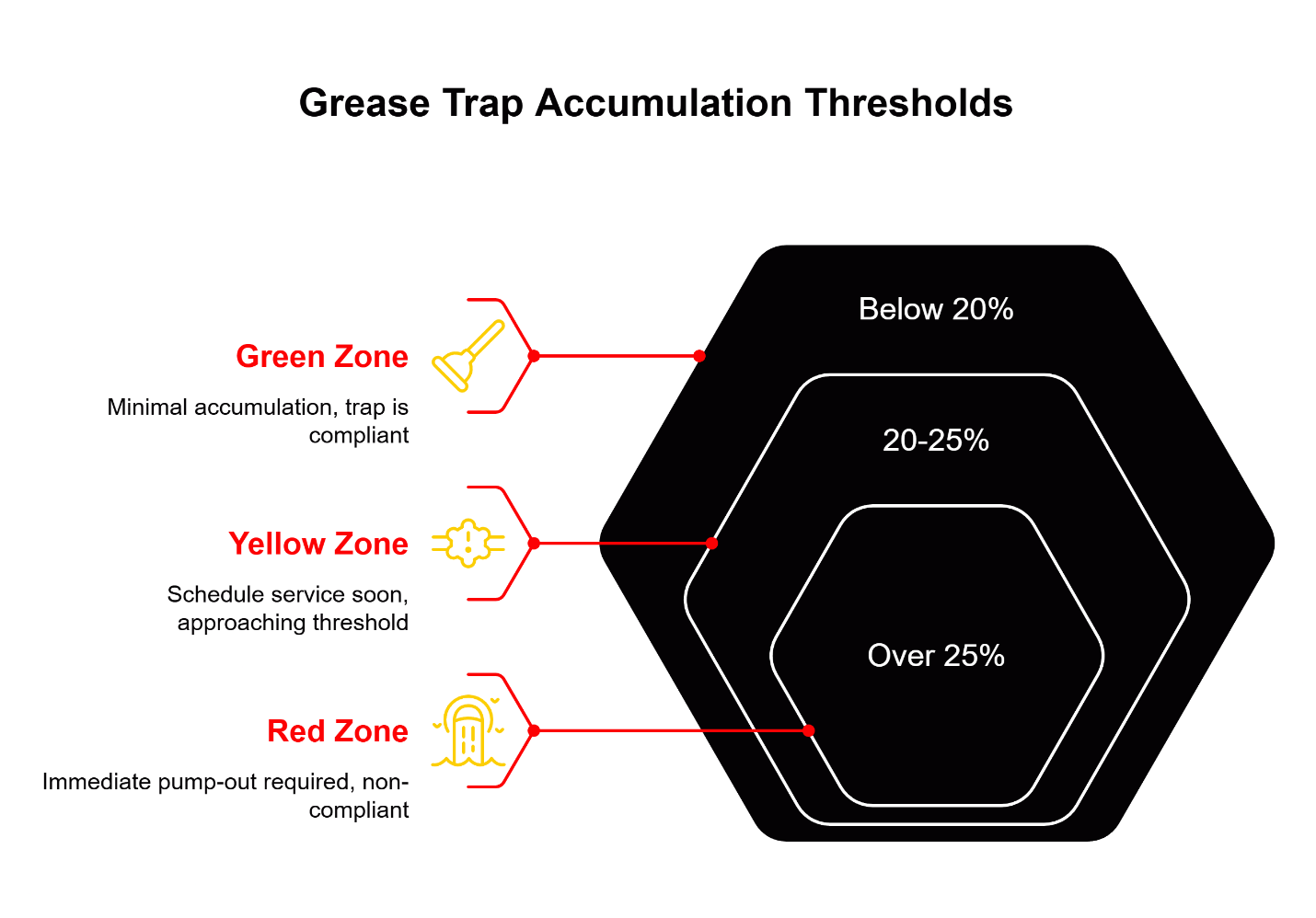
Think of accumulation in three operational zones:

0-20% accumulation: System operating within normal range. Continue monitoring with regular core sampling.

20-25% accumulation: Time to schedule cleaning. This buffer prevents violations if business volume spikes unexpectedly before your next check.

25%+ accumulation: The trap is overdue. Risk of enforcement action increases, and efficiency has already declined.

For most food service operations with typical volume in Houston, these dual requirements converge naturally. The standard quarterly service schedule aligns with both the 90-day mandatory minimum and the typical accumulation pattern that reaches 20-25% within that timeframe. However, schedule alone isn’t enough—you need to verify with actual measurements. A high-volume location might need service every 60 days when hitting 25% accumulation early, while a slower operation must still service at 90 days even if measurements show lower percentages.


Why “Clear Today” Can Be a Fine Tomorrow

Grease trap accumulation isn’t linear or predictable based solely on calendar intervals. Flow patterns, menu changes, staff turnover, and seasonal business fluctuations all affect how quickly your trap fills. What looked acceptable during a slow Tuesday lunch shift can reach violation levels by Friday dinner service.

The “clear sample well” illusion becomes particularly dangerous during busy periods. As your kitchen output increases, both grease and solids accumulate faster. The floating grease layer might not appear dramatically different from day to day, but the bottom sludge layer—invisible from your sample well vantage point—builds steadily. By the time you notice operational symptoms like slow drains or odors, you’re often already past the compliance threshold.

Consider the operational costs of waiting too long. Emergency pump-outs during business hours disrupt service. Violations trigger fines that far exceed the cost of preventive maintenance. Sewage backups can force temporary closure while you address both the trap and any damage to your building’s plumbing system.

“Drain Ranger is very professional and reliable. Basically they can take care of all your grease drain needs.” — Shelley M.


Proof Matters: Cleaning + Manifesting = Total Compliance

Pumping out your grease trap removes the waste, but documentation proves legal disposal. Inspectors don’t just want to see that your trap is clean—they need evidence that the waste was handled according to environmental regulations.

This is where manifesting becomes essential. A waste manifest is a multi-part form that tracks your grease trap waste from pickup through final disposal. The hauler provides a signed copy showing the date of service, the amount of waste removed, and confirmation of disposal at an approved facility. Keep these manifests in an accessible binder at your location.

Houston restaurant operators should retain manifests for at least five years, reflecting the city’s commitment to comprehensive FOG compliance documentation. During inspections, being able to immediately produce service records demonstrates professional management and often influences how inspectors approach borderline situations.

Pairing measurement with documentation creates a complete compliance system. You measure to know when service is needed, you schedule before violations occur, and you retain manifests to prove every load was disposed of legally. This three-part approach—measure, service, document—transforms compliance from a reactive scramble into a predictable operational routine.

“My experience with Drane Ranger was a very organized, professional and on time experience. I was kept informed of what was happening and a suggested time of cleaning again. I will use them again and will definitely recommend them to anyone I speak with.” — Harold R.


What Houston Restaurants Should Do Now

Move from visual guessing to measured compliance with this four-point checklist:

Train managers on core sampling. Designate at least two people on your team who know how to take a proper core sample. Schedule monthly measurements and record every result in your compliance binder.

Establish your trigger point. Once your measurements consistently show 20% accumulation, schedule service. This buffer prevents violations if business volume spikes unexpectedly before your next scheduled cleaning.

Set up recurring service with dual-requirement awareness. For most locations within Houston city limits, quarterly service satisfies both the 90-day mandatory minimum and typical accumulation patterns. Work with a registered hauler who provides detailed manifests for every pump-out and understands that service timing must respond to whichever requirement is reached first.

Keep your compliance binder current and accessible. Store manifests, measurement logs, and service invoices together in one location. Remember that Houston requires five-year manifest retention. When an inspector arrives, you should be able to produce complete documentation within minutes.

Ready to move beyond guesswork? Schedule inspector-grade sampling and cleaning with a registered Houston hauler or call 281-489-1765 (Mon-Fri, 9am-6pm) to set up quarterly service with full manifesting.


Frequently Asked Questions

Is a clear sample well proof my trap is compliant?

No. Visual checks miss the bottom sludge layer. Only core sampling reveals total accumulation including both the grease cap and settled solids.

What exactly counts toward the 25% rule?

Both the floating grease cap and the settled solids layer at the tank bottom. Together, these cannot exceed 25% of the trap’s wetted height—the vertical distance from the outlet pipe to the trap bottom.

How often should I pump my grease trap?

Houston requires service based on whichever limit is reached first: 25% accumulation or 90 days, whichever comes sooner. Most food service operations with typical volume hit both thresholds around the same quarterly timeframe, but high-volume locations may need more frequent service based on measured accumulation.

Do I need paperwork after cleaning?

Yes. Keep signed waste manifests that prove legal disposal. Store these in an accessible compliance binder for inspections and retain them for at least five years—Houston’s requirement that exceeds the three-year federal standard.

Disclaimer: This article provides general educational information about grease trap compliance practices in Houston. Requirements may vary based on your specific location, trap size, and operation type. Always consult current municipal codes and work with registered waste haulers to ensure full compliance with local regulations.

About the Drane Ranger Insights Team

The Drane Ranger Insights Team synthesizes complex compliance topics into clear, actionable guidance for Houston-area food service operators. While our content is thoroughly reviewed for clarity and accuracy, it is for informational purposes and should not replace consultation with qualified professionals. Drane Ranger serves all zip codes within a 100-mile radius of Houston with grease trap cleaning, maintenance services, and full compliance documentation.

Further Reading:

How to Prepare Your Kitchen for a City of Houston Grease Trap Inspection

📌 Key Takeaways

Inspection anxiety disappears when documentation, access, and staff training become routine habits instead of last-minute scrambles.

  • Your Binder Is Your First Line of Defense: A single, organized folder containing your FOG permit, five years of signed manifests, and service records turns a potential violation into a fifteen-minute formality.
  • The 25% Rule Isn’t Negotiable: Houston requires cleaning whenever grease and solids reach 25% of your trap’s wetted height or every 90 days minimum—whichever comes first.
  • Monthly Measurements Prevent Emergency Pump-Outs: Recording grease depth, solids depth, and total wetted height once a month lets you schedule service at 20% instead of scrambling at 25%.
  • Staff Coordination Beats Individual Knowledge: When every shift lead knows their role—who grabs the binder, who opens the sample well, who manages safety—inspections become predictable instead of chaotic.
  • Licensed Haulers Protect Your Business: A properly credentialed hauler who pumps fully, provides complete manifests, and disposes at approved facilities eliminates liability that cheap service creates.

Prepared operations pass quietly. Unprepared ones scramble, fail, and pay.

Houston restaurant owners, general managers, and facilities managers will find the complete compliance framework here, preparing them for the detailed checklist and regulatory guidance that follows.

The lunch rush just ended. You’re restocking the line when an inspector walks through the door with a clipboard. Your heart rate spikes—but it doesn’t have to.

A Houston FOG (Fats, Oils, and Grease) inspection verifies that you’re cleaning your grease trap on schedule, staying under the 25% accumulation threshold, and maintaining proper documentation. Think of it as your kitchen’s registration check combined with a maintenance audit. If your car needs current tags and service records, your grease interceptor needs a valid permit and signed manifests showing where your waste actually went.

Here’s what a prepared operator looks like: The inspector arrives unannounced during dinner prep. Your general manager calmly walks to the office, pulls out a labeled binder, unlocks the sample well in under two minutes, and provides every document requested. The inspection wraps up in fifteen minutes with zero violations.

This checklist aligns with City of Houston Code Chapter 47, specifically sections §47-512 and §47-513,[1][2] so you can pass that inspection without the panic.


Your Pre-Inspection Document Binder

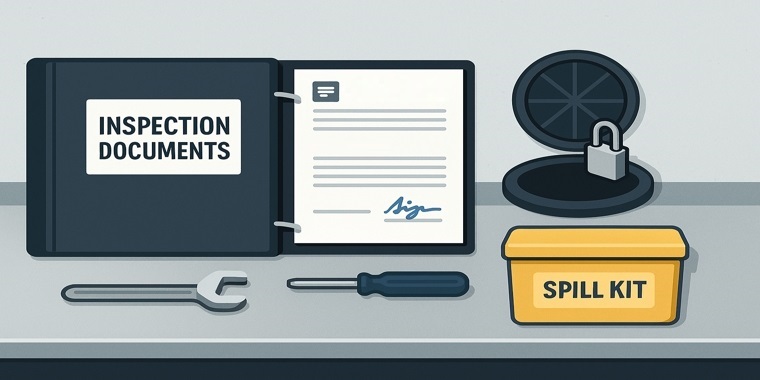
Keep these items together in a dedicated binder or clearly labeled folder that’s always on-site: your current FOG permit, signed waste manifests covering the past five years, any Notice of Waiver documentation if you’ve applied for adjusted cleaning intervals, and service invoices from your hauler.[1][3]

Set up a simple index tab system—Permits / Manifests / Waivers / Previous Inspections. Train your shift managers to locate any document in under sixty seconds. When your hauler completes a pump-out, that manifest goes straight into the binder before the end of business that day. This isn’t busywork. Houston Health Department inspectors can request records spanning years, and gaps in your documentation raise immediate red flags.[3]

If you use professional grease trap cleaning services like Drane Ranger, you’ll receive a signed manifest after every service that documents the volume removed, the disposal site, and the hauler’s credentials.


Make the Sample Well and Interceptor Accessible

Inspectors need quick, safe access to your sample well and interceptor for visual inspection and measurement. Keep lids clear of equipment, supplies, and debris. The area should allow safe opening without moving heavy items or creating a safety hazard.[4]

Tape a laminated “Open/Close” standard operating procedure directly at the well location. Stage the basic tools nearby—typically a specialized key or wrench for your specific lid type. Add a small spill kit within ten feet. These steps show operational readiness and prevent the awkward scramble when someone needs to open your interceptor under time pressure.


The 25% Rule and Cleaning Cadence

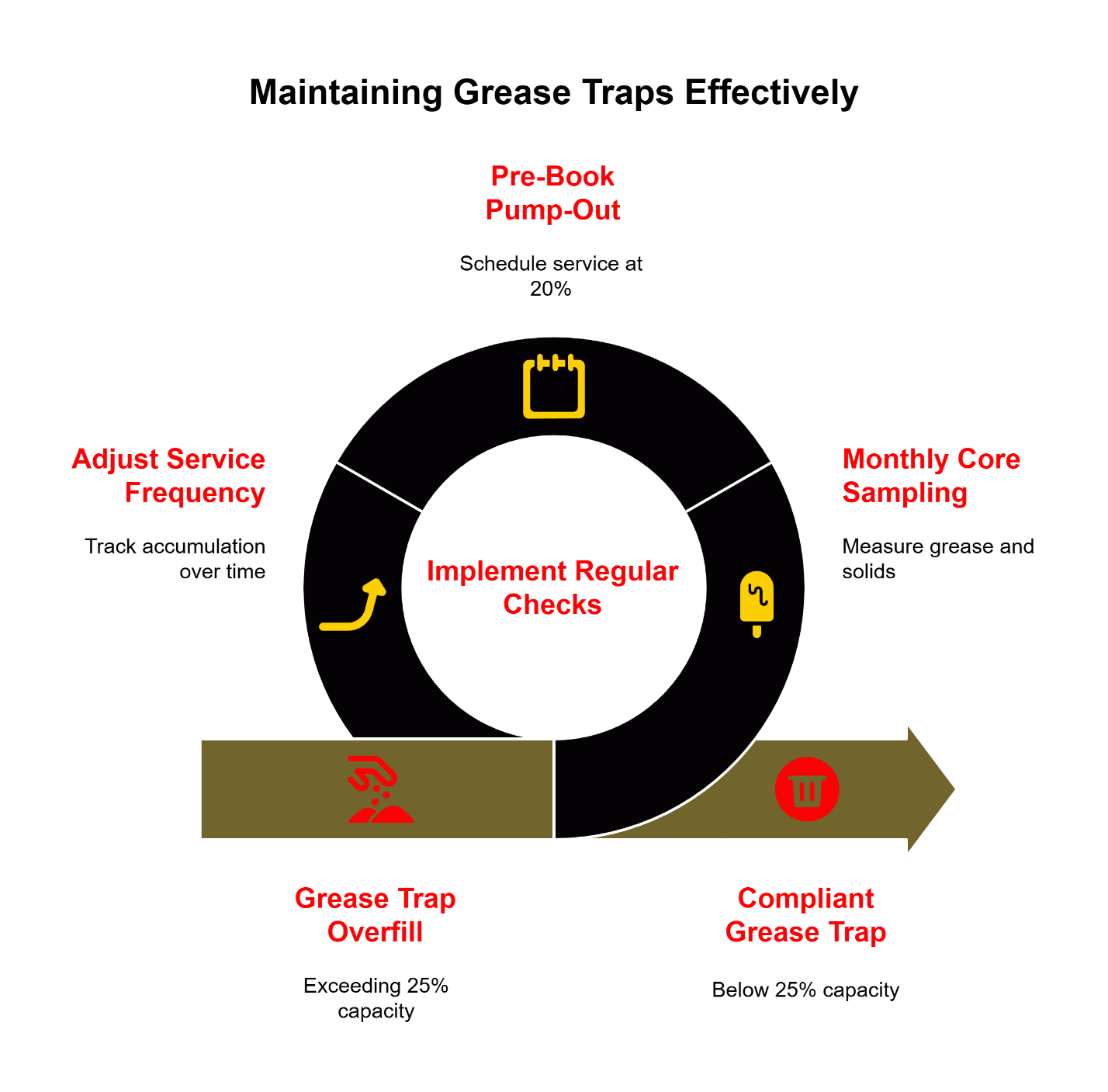
Infographic showing steps for maintaining grease traps effectively, from regular checks and monthly core sampling to avoiding overfill and staying under 25% capacity.

Houston requires you to clean your grease trap whenever the combined depth of floating grease and settled solids reaches 25% of the wetted height inside the interceptor, or at minimum every 90 days—whichever comes first.[1][5] This isn’t a suggestion. It’s enforceable code designed to prevent line blockages and protect the city’s wastewater infrastructure.

Most operators benefit from adding a simple monthly core sample check to their routine. Use a dipstick or core sampler to measure accumulation, recording the date, grease layer depth, solids depth, and total wetted height in a simple log. If a measurement hits around 20%, pre-book your pump-out service immediately. Waiting until you’re at or over 25% puts you in violation territory, and it only takes one delayed service call to fail an inspection.

High-volume kitchens and operations with heavy frying schedules often need service every 60 days or less. Track your accumulation pattern over three months. If you’re consistently approaching 25% before the 90-day mark, it’s time to adjust your service frequency.[5]


Staff Briefing Before the Visit

Your staff doesn’t need to become FOG regulation experts, but shift leads should be able to answer four basic questions: where does kitchen wastewater go, who hauled it last, when was the last pump-out, and where is the documentation binder located.[1][3]

Run a five-minute pre-shift huddle. Assign clear roles: one person retrieves the binder, another handles sample well access, a third manages safety and keeps the area clear during the inspection. Practice this drill once per quarter so it feels routine when an actual inspector arrives. Business continuity during an inspection depends on smooth coordination, not improvisation.


The Houston-Specific Pre-Inspection Checklist

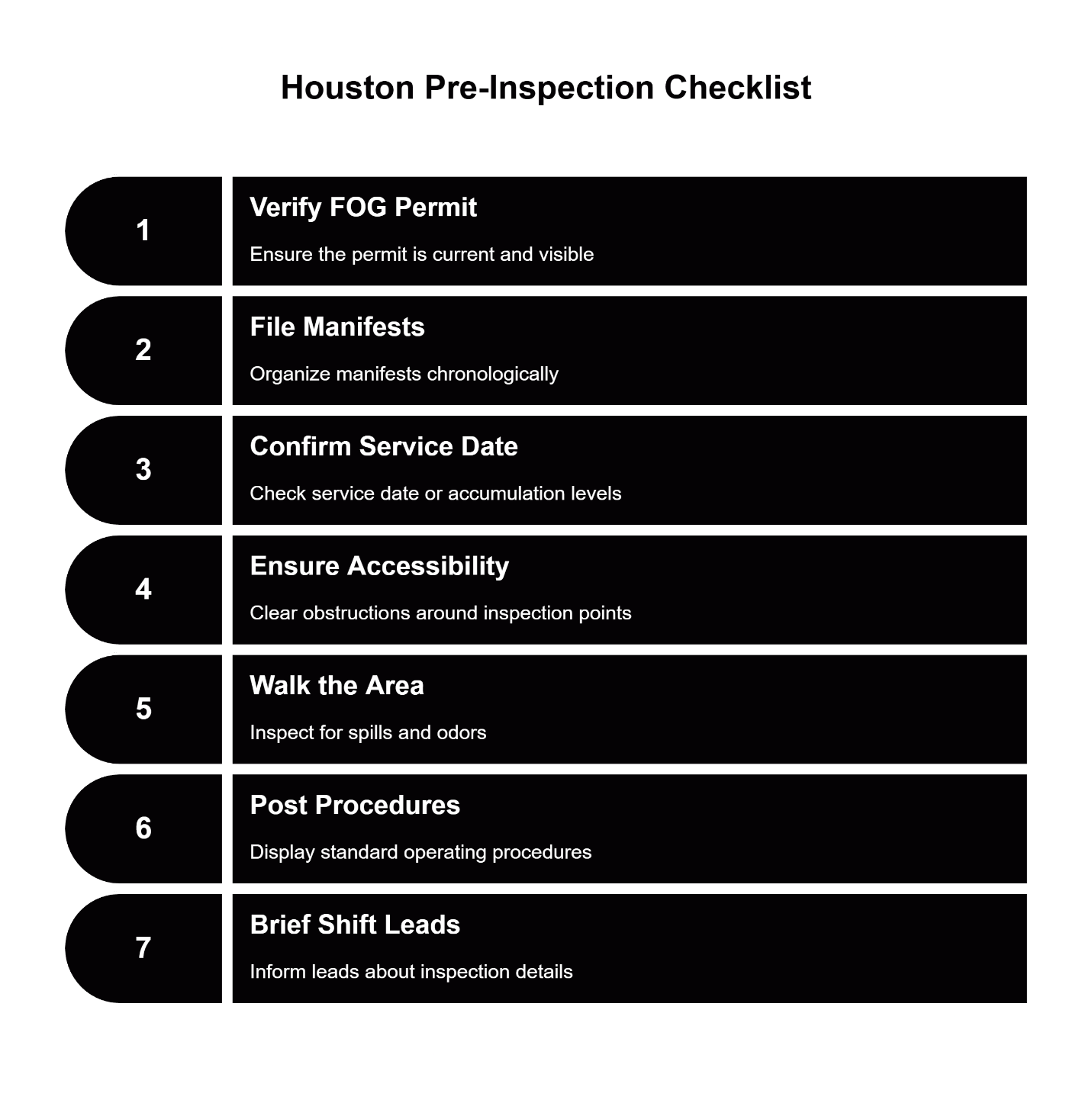
Houston pre-inspection checklist listing seven steps including verifying FOG permit, filing manifests, confirming service date, ensuring accessibility, inspecting the area, posting procedures, and briefing shift leads.


Follow these steps in order before any inspection:

  1. Verify your FOG permit is current and placed at the front of your document binder.[1]
  2. File signed manifests in reverse chronological order covering five full years, checking that each shows hauler information, waste volume, date of service, and the disposal site.[2]
  3. Confirm your last service date was within 90 days or that current accumulation measures below 25%.[1][5]
  4. Ensure sample well and interceptor lids are accessible with no obstructions, and opening tools are staged nearby.[4]
  5. Walk the immediate area—no spills, pooling water, or persistent odors around the trap, dumpster, or rendering bin.[4]
  6. Print and post your standard operating procedures for opening the interceptor, sampling protocol, and emergency contact information.
  7. Brief shift leads on who meets the inspector and where everything is located.

“The best time to prepare for an inspection is yesterday.”


When You’ll Need Service Sooner

Certain operational profiles demand more frequent attention than the 90-day minimum. If you run a high-volume kitchen, do significant frying, or notice recurring odors or slow drainage, your interceptor is telling you it can’t keep pace with your grease load.[5]

Book recurring service intervals through a licensed hauler. Require a signed manifest documenting every pump-out. This creates an audit trail that protects you during inspections and demonstrates your commitment to maintaining compliant operations. For Houston restaurants needing reliable service, grease trap cleaning in Houston through established providers ensures proper manifesting and lawful waste disposal.


What Happens If You Fail

A failed inspection typically results in a notice of violation and a mandatory re-inspection. Missing manifests, expired permits, or accumulation over 25% can trigger extended scrutiny of your entire FOG management program. In serious cases, violations may lead to escalating enforcement actions or referrals to other city departments.[1][2]

If you receive a violation notice, arrange same-day corrective pump-out if needed, provide any missing manifests immediately, and schedule your follow-up cleaning cadence to prevent recurrence. The re-inspection process adds time, stress, and potential city fines to your operation. Most violations are entirely preventable through basic documentation habits and consistent service scheduling.


Common Questions About Houston Grease Trap Inspections

How often must we clean our grease trap?

At minimum every 90 days, or before the combined grease and solids exceed 25% of the wetted height—whichever comes first.[1][5]

What documents must be on-site during an inspection?

Your current FOG permit, five years of signed waste manifests, any approved waivers, and records of previous inspections.[1][2][3]

Will inspectors check the sample well?

Yes. They need safe access for visual inspection and may take measurements there, so keep it accessible and maintain opening tools nearby.[4]


Why Cutting Corners Costs More

Some operators choose the cheapest available hauler without verifying credentials or manifest procedures. This is a false economy. You need a properly licensed hauler who pumps the interceptor fully, provides a complete signed manifest after every service, and disposes of waste at approved facilities. A low bid that skips essential paperwork isn’t a deal—it’s a risk that exposes you to health code violations, city fines, and potential liability if waste isn’t handled correctly.

The other common mistake is waiting for odors before scheduling service. By the time you smell problems, you’re often already flirting with the 25% rule violation or dealing with a backup. Proactive maintenance costs less than emergency pump-outs and prevents the operational disruption of a failed line during service.


Moving Forward

Inspection preparation isn’t complicated—it’s consistent. A well-organized binder, accessible equipment, trained staff, and scheduled service intervals eliminate most violation risks. Houston’s regulations exist to protect the city’s wastewater system and your business continuity.

Drane Ranger has been serving Greater Houston within a 100-mile radius since 1985, providing comprehensive liquid waste management services that include proper manifesting and documentation. As Harold R. noted: “My experience with Drane Ranger was a very organized, professional and on time experience. I was kept informed of what was happening and a suggested time of cleaning again.”

Ready to set up a recurring service schedule that keeps you compliant? Contact Drane Ranger to arrange your next pump-out and establish a maintenance cadence that works for your operation.

References:

[1] City of Houston Code of Ordinances, Chapter 47, Section 47-512 (Grease trap cleaning requirements and inspection authority). Retrieved from library.municode.com

[2] City of Houston Code of Ordinances, Chapter 47, Section 47-513 (Waste manifest retention requirements). Retrieved from library.municode.com

[3] Houston Permitting Center, Waste Generator Requirements (Documentation required during FOG inspections). Retrieved from houstonpermittingcenter.org

[4] Houston Health Department, Waste Generator FAQ (Sample well inspection procedures). Retrieved from houstonhealth.org

[5] Texas Commission on Environmental Quality, FOG Program Guidance (State regulatory context and best practices). Retrieved from tceq.texas.gov

Disclaimer: This article provides general guidance on preparing for Houston grease trap inspections based on current City of Houston regulations. It is for informational purposes and should not replace consultation with qualified professionals regarding your specific operational requirements or compliance obligations.

Our Editorial Process

The Drane Ranger Insights Team is our dedicated engine for synthesizing complex topics into clear, helpful guides. While our content is thoroughly reviewed for clarity and accuracy, it is for informational purposes and should not replace professional advice. For specific questions about your grease trap system, FOG permit requirements, or service scheduling, contact our team directly.
The Real Cost of a Backup: Why Emergency Pumping Costs More Than a Contract

📌 Key Takeaways

A backup doesn’t announce itself with an invoice—it arrives with closed doors, idle staff, and guests walking out.

  • The Real Bill Hides in Downtime: A four-hour shutdown during peak service can cost $2,600 in lost margin before you factor in the emergency pumping premium, overtime, or spoiled inventory.
  • Contracts Cost Less Than Crises: One emergency event—combining service premiums, downtime, refunds, and potential fines—typically exceeds the annual cost of a scheduled maintenance contract designed around your actual kitchen volume.
  • The 25% Threshold Protects Your Operation: When fats, oils, and grease reach a quarter of your trap’s capacity, cleaning becomes necessary to maintain proper function and avoid system failure, regardless of your quarterly baseline.
  • Documentation Keeps Inspectors Satisfied: Manifests, service logs, and waste disposal records produced through scheduled maintenance create the compliance trail that health inspectors expect during unannounced visits.
  • Frequency Should Match Your Reality: High-volume kitchens running fryers all day need more frequent service than the quarterly minimum, with intervals tuned to actual FOG output rather than calendar convenience.

Maintenance is an investment; emergencies are an expense.

Restaurant owners, general managers, and facilities teams overseeing commercial kitchens in Greater Houston will find the operational details here, preparing them for the comprehensive cost analysis and contract evaluation framework that follows.

A grease trap backup happens when your trap exceeds its capacity—fats, oils, and grease accumulate beyond safe levels, causing slow drains, overflows, or complete line blockages. In Houston, city regulations require commercial kitchens to empty traps quarterly at minimum, and cleaning becomes necessary when accumulation reaches 25% of the trap’s total capacity. The EPA has documented how FOG buildup contributes to sewer blockages and system failures. But those thresholds aren’t just regulatory checkboxes. They’re your early warning system.

Think of grease trap maintenance like oil changes for your vehicle. Skip a few, and you might get away with it for a while. Then one day, your engine seizes on the highway. Now you’re paying for a tow truck, a rental car, and a complete engine rebuild—all because a $40 oil change seemed easy to postpone.

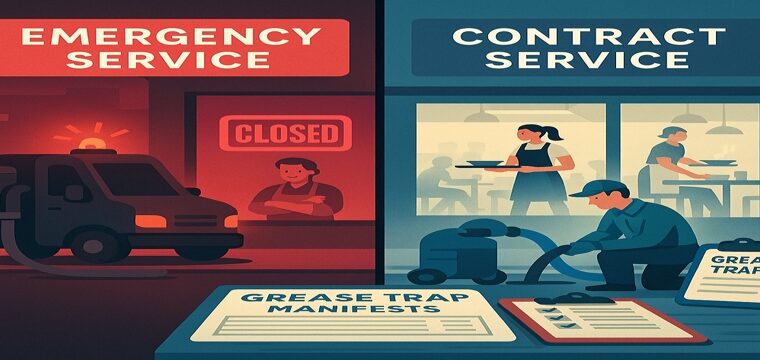
Picture this: Friday night during your dinner rush. The kitchen sinks start draining slower. Then that unmistakable smell hits. A floor drain burps wastewater onto the kitchen floor right in the middle of service. Servers notice. Guests notice. Your line cooks are working around standing water while you’re on the phone desperately searching for someone—anyone—who can pump your trap right now. You watch parties of four walk past your door and choose the restaurant next door instead.

Here’s the practical reality. Sign a commercial grease trap cleaning services contract with scheduled cleanings, and you avoid that emergency entirely. You get predictable costs, priority service, and the documentation inspectors actually want to see.


The Problem You Don’t See: Why Backups Blindside Your Budget

Emergency pumping doesn’t just cost more per service. It triggers a cascade of expenses that most restaurant operators don’t calculate until they’re already paying them. The direct service premium is real—after-hours rates, expedited dispatch, and short-notice availability all command higher prices. But that’s just the beginning.

When you wait for a crisis, multiple costs land at once: emergency call-out premiums, lost revenue during shutdown, staff standing idle on the clock, possible food loss and refunds, and compliance actions if inspectors find you’ve fallen behind on your maintenance cadence.

Watch for these early warning signs before you cross the quarterly threshold or hit that 25% accumulation level: persistent odors near floor drains, slower drainage in prep sinks, gurgling sounds when water flows, or visible grease in unexpected areas. When you spot any of these, you’re already approaching the danger zone.


What Makes Emergency Pumping Expensive

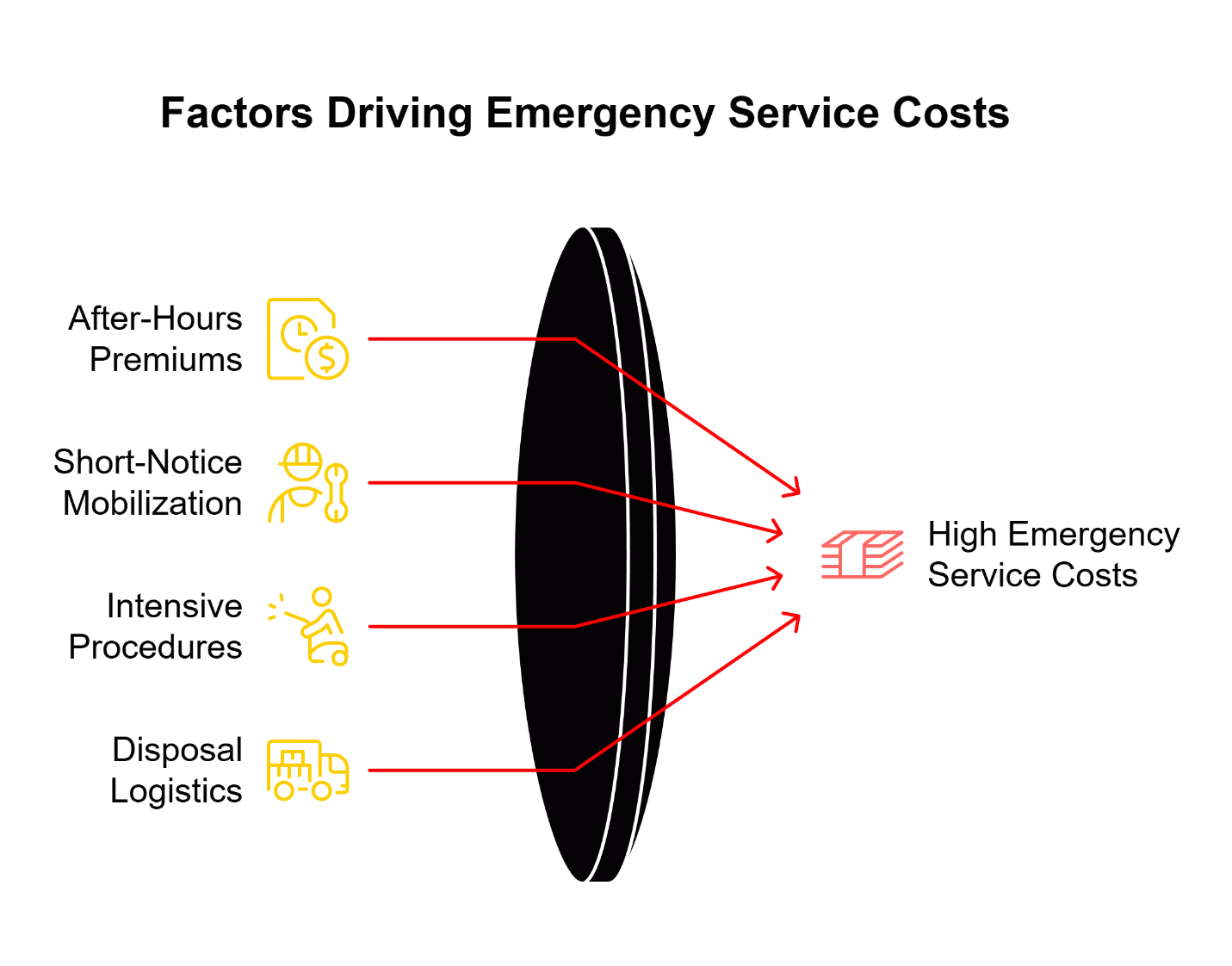
Infographic titled “Factors Driving Emergency Service Costs” showing after-hours premiums, short-notice mobilization, intensive procedures, and disposal logistics with arrows converging toward high emergency service costs.


Several factors drive emergency service costs higher than scheduled maintenance. After-hours and weekend premiums apply when you need service outside normal business hours—which is exactly when most backups force your hand. Short-notice mobilization means your service provider has to rearrange their schedule, potentially pulling technicians from other jobs or calling them in on their day off.

The work itself often requires more intensive procedures. A backup usually means the trap is completely full and the lines may be partially clogged, requiring hydro-jetting to clean surfaces down to bare metal. Scheduled maintenance, by contrast, prevents buildup before it hardens and adheres to trap walls.

Disposal logistics become complicated in emergencies. Texas regulations on municipal liquid waste transport require proper vehicle authorization and manifesting for grease trap waste. With scheduled service, waste manifesting and transportation are planned and streamlined. During an emergency, those same logistics happen under time pressure, and proper documentation—critical for compliance—can become rushed or incomplete.

Reputable providers like Drane Ranger have maintained proper manifesting and legal disposal practices since 1985, ensuring every load is documented regardless of service timing. The City of Houston’s special waste program outlines clear expectations for FOG management that professional haulers must follow. But not every provider maintains those standards when responding to panic calls.


The Hidden, Bigger Bill: Downtime Math

The real expense of a backup isn’t the pump truck—it’s what happens to your operation while you wait for help. Use this formula to calculate your actual exposure:

Lost Sales = (Average tickets per hour Ă— Hours closed or limited) Ă— Gross profit margin

Here’s a concrete example: A restaurant serving 40 tickets per hour at $25 average check, closed for 4 hours during peak service, with a 65% gross margin loses $2,600 in margin alone. That’s before you add labor costs for staff standing idle or working overtime, inventory loss from food that spoiled or had to be discarded, or refunds and comped meals for guests who experienced the problem.

“The most expensive grease trap cleaning is the one you didn’t plan for.”

Now consider the reputation cost. Negative reviews don’t itemize on your P&L, but they compound. One dinner service interrupted by a grease trap emergency can generate social media posts and online reviews that affect your revenue for months. And if a city inspector happens to visit during a backup? Violations, fines, and potential closure orders become part of your emergency total.

In Houston’s commercial restaurant environment, where health department visits can happen without notice, operating with a full or malfunctioning trap carries regulatory risk that extends well beyond cleanup costs. Many busy kitchens with high FOG output need more frequent service than the quarterly minimum to avoid overloading their traps.


Why Contracts Win on Total Cost

Scheduled grease trap cleaning in Houston through a maintenance agreement delivers predictable rates across the year. You know your quarterly costs upfront, which simplifies budgeting and eliminates surprise expenses. More importantly, contract customers receive priority scheduling. When weather events, busy seasons, or unexpected demand spikes create service backlogs, contract customers get handled first.

Service frequency gets aligned to your actual needs—not just the regulatory minimum. Municipal FOG management guidelines describe how the 25% rule works for determining cleaning frequency based on actual trap performance. Busy kitchens with high-volume fryers may need cleaning every six to eight weeks, while slower operations stay compliant with standard quarterly service. A good provider helps you determine the right cadence based on your menu, volume, and trap size.

The documentation benefit alone justifies the contract approach. Each service generates manifests showing proper waste handling, cleaning records that demonstrate compliance, and maintenance logs that inspectors view favorably. When a health inspector asks to see your grease management records, you hand them a complete file instead of scrambling to remember when you last called someone.

As one Houston restaurant manager shared: “My experience with Drane Ranger was a very organized, professional and on time experience. I was kept informed of what was happening and a suggested time of cleaning again. I will use them again and will definitely recommend them to anyone I speak with.” — Harold R.


Simple Scenarios: One Backup vs. One Year on Contract

Consider this cost comparison. Keep in mind these are illustrative examples based on typical industry scenarios—actual costs vary by trap size, location, and specific circumstances. Contact Drane Ranger at 281-489-1765 for a site-specific quote.

Cost Item Single Emergency Backup Annual Contract (4 Services)
Emergency pumping & deep clean $1,400 Included in scheduled visits
After-hours/rush premium $300 $0 (daytime scheduling)
Downtime loss (based on example above) $2,600 $0 (no operational disruption)
Overtime & additional cleanup $400 Minimal
Potential fines/re-inspection costs $500+ Avoided through compliance
Estimated total single-event impact $5,200+ Predictable annual budget

The emergency scenario above doesn’t even account for longer-term revenue impact from negative reviews or customer loss during the shutdown.


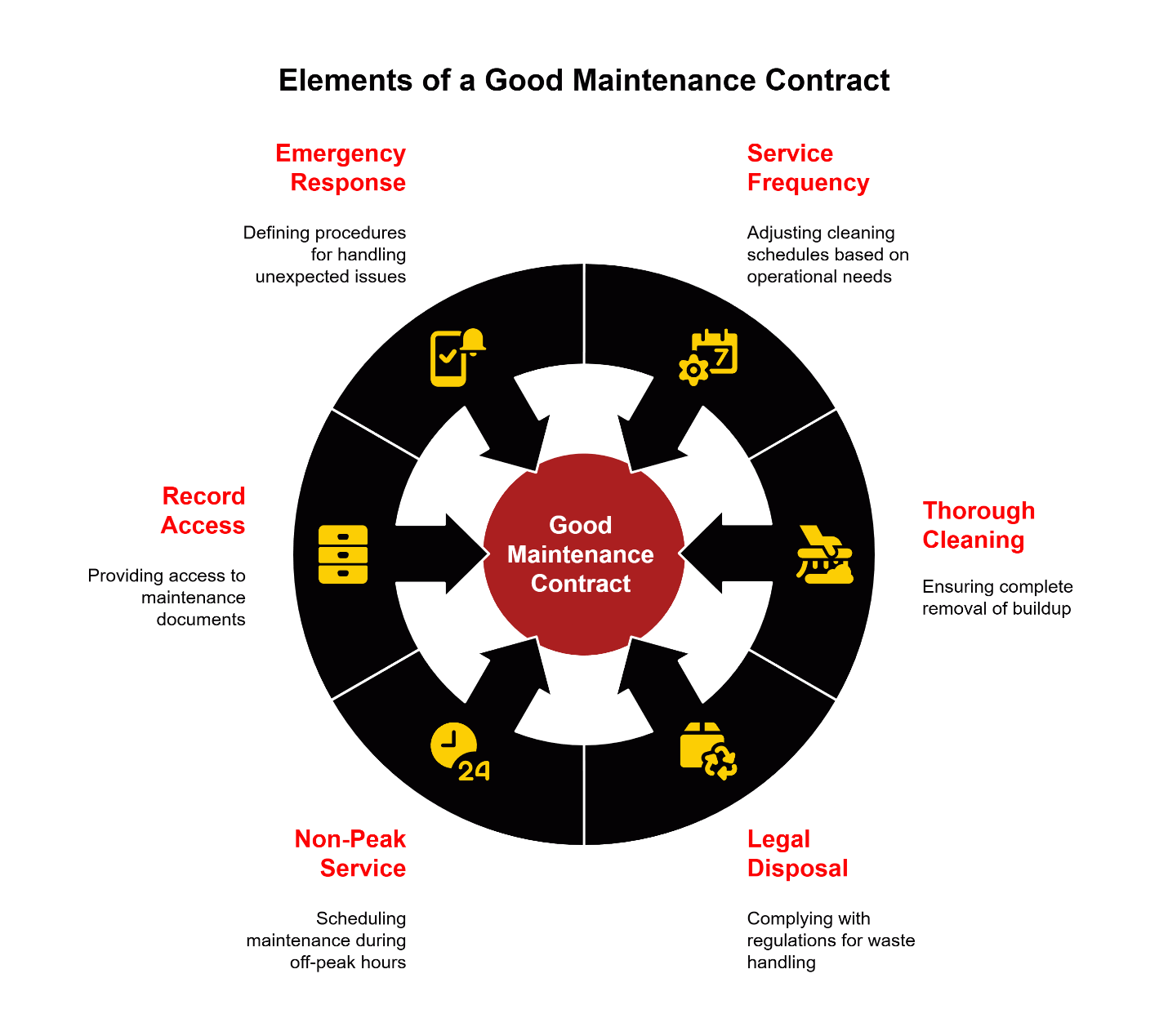
What a Good Contract Includes

Diagram showing core elements of a good maintenance contract, including cleaning, disposal, service frequency, and emergency response.


Look for these elements when evaluating maintenance agreements:

Service frequency tuned to your operation. Cookie-cutter quarterly schedules work for some kitchens, not all. Your contract should specify cleaning intervals based on your trap size, cooking volume, and menu type—aligned with the 25% accumulation threshold that triggers necessary cleaning. Busy kitchens frying food all day need more frequent service than operations with lower grease output.

Thorough cleaning to bare surfaces. The contract should specify complete pump-out and interior cleaning—not just surface removal. This prevents the hardened buildup that causes premature failure and costly deep cleans later, ensuring FOG and solids are removed to restore full working capacity.

Proper manifesting and legal disposal. Every load removed should generate a manifest documenting proper handling and disposal at licensed facilities. This isn’t a luxury—it’s a legal requirement under Texas rules that protects you from liability. Your provider should demonstrate clear compliance with state and local waste transport regulations.

Non-peak service windows. Quality contracts schedule service during your closed hours or slower periods, eliminating operational disruption entirely.

On-site record access. You should receive and retain copies of all service records, manifests, and inspection reports. These documents prove compliance when regulators ask and provide the service history inspectors want to see.

Clear emergency response terms. Even with preventive maintenance, unexpected issues occasionally arise. Your contract should spell out how emergency situations get handled for existing customers.

Drane Ranger has served the Greater Houston area—within approximately 100 miles of our Houston location—since 1985. Our approach focuses on safe, compliant collection and disposal practices, not just getting in and out as quickly as possible.

Request a contract quote to see how these elements apply to your specific operation.


Next Steps

Don’t wait for a backup to force your hand. If you’re stretching beyond quarterly cleaning inside Houston city limits or hitting the 25% accumulation level between visits, you’re likely overdue for a new maintenance schedule.

Call 281-489-1765 Monday through Friday, 9am to 6pm, to discuss your trap size, service frequency, and contract options. Our team will help you determine the right maintenance schedule based on your operation’s specific needs, ensuring you stay ahead of both the quarterly city requirement and the 25% accumulation threshold that triggers necessary cleaning.

Alternatively, visit our contact page to request a contract quote online. We’ll respond within 24 hours with a customized proposal for your location.

Maintenance is an investment. Emergencies are an expense. Choose predictability.

About the Drane Ranger Insights Team

The Drane Ranger Insights Team is our dedicated engine for synthesizing complex topics into clear, helpful guides. While our content is thoroughly reviewed for clarity and accuracy, it is for informational purposes and should not replace professional advice.
Visual Checks vs. Core Sampling: Why Your ‘Clean’ Trap Might Still Fail an Inspection

📌 Key Takeaways

A grease trap that looks clean from the sample well can still fail an inspection if the hidden sludge layer pushes total accumulation over 25%.

  • Surface Checks Hide Compliance Risk: Visual inspection of the sample well only reveals the middle layer, completely missing the floating grease cap and bottom sludge that inspectors measure to determine compliance.
  • The 25% Rule Is Performance-Based: When combined grease and sludge layers reach 25% of liquid depth, the trap’s effective working volume shrinks, allowing FOG to escape downstream—this performance threshold triggers required pump-outs regardless of appearance.
  • Measurement Drives Smart Scheduling: Monthly core sampling with documented percentages enables service timing based on actual accumulation rates rather than arbitrary calendar intervals, preventing both premature pump-outs and costly violations.
  • Manifests Prove Compliance: Cleaning records without signed waste manifests showing disposal facility and date leave restaurants vulnerable to fines during audits, even when traps are currently within limits.
  • Documentation Creates Audit Confidence: A compliance binder combining core sampling logs, manifests, and photos transforms scattered paperwork into organized proof that satisfies Houston pretreatment inspections.

Core sampling turns guesswork into evidence—measure like an inspector, schedule by data, document everything.

Houston restaurant operators managing commercial kitchen compliance will find a practical framework here, preparing them for the step-by-step implementation guidance that follows.

Friday lunch rush. The health inspector walks into your Houston restaurant with a clipboard and a measuring rod. Your kitchen manager assures you the grease trap looks fine—after all, they checked the sample well just last week and the water looked clear. But when the inspector pulls a core sample, the news isn’t good. The combined grease cap and bottom sludge put you over the 25% threshold. You’ve failed, and now you’re facing violations, mandatory pump-outs, and potential fines.

Here’s what happened: Visual checks only show you the surface. A core sample reveals the full story—the floating grease layer at the top and the settled solids at the bottom. Think of it like judging a latte by looking at the foam. You might see beautiful microfoam on top, but you have no idea how much heavy sediment has settled at the bottom of the cup. That hidden layer is exactly what gets restaurant operators into compliance trouble.

Core sampling isn’t just a best practice. It’s the inspector’s standard measurement method, and it’s the only way to know whether your trap is approaching Houston’s 25% accumulation limit (Source: City of Nacogdoches FOG Manual). When you rely on quick glances through the sample well, you’re essentially guessing. The practical application is straightforward: adopt monthly core sampling as part of your maintenance routine, schedule pump-outs when readings approach the threshold, and keep organized manifests that prove both the work and the legal disposal.


The “Eyeball Test” Problem—What Visual Checks Miss

Visual checks give you a false sense of security. When staff members peer into the sample well and see relatively clear water in the middle layer, they assume everything is fine. The problem is that grease floats and solids sink, creating a misleading “clean zone” in the middle that hides the real accumulation happening at both ends of the tank.

The top grease cap can be several inches thick but barely visible from above, especially if recent hot water from dishwashing has temporarily liquefied some of the fats. Meanwhile, the bottom sludge layer—a dense mix of food particles, oils, and settled solids—is completely invisible from a top-down view. This matters because when grease traps become overloaded, they can allow fats, oils, and grease to pass into the public sewer system, contributing to blockages and sanitary sewer overflows that wastewater agencies take very seriously (Source: EPA FOG Program Guidance).

Inspectors know this. That’s why they don’t trust visual assessments, and neither should you. The solution is simple: use a core sampler through the sample well to capture a complete vertical cross-section of your trap’s contents. This inexpensive tool (essentially a clear tube with a check valve) allows you to see and measure total accumulation—top grease plus bottom solids—in one reading. Document each measurement with the date, percentage, and staff initials, then schedule your next service based on those numbers rather than calendar dates alone.


What Inspectors Actually Measure

City inspectors and pretreatment personnel don’t guess. They follow a standardized protocol that involves taking a core sample at the sample well or inlet/outlet baffles, depending on your trap’s design. The measurement captures everything: the thickness of the floating grease layer, the depth of the clear middle zone, and the height of the settled solids at the bottom (Source: Houston Public Works FOG Program).

Here’s what matters for compliance: inspectors assess your trap’s performance by calculating total FOG (fats, oils, grease) accumulation as a percentage of the trap’s working volume. If that combined figure exceeds 25%, your trap has failed its performance standard, regardless of how recently it was cleaned or how clear the middle layer looks.

To mirror this method in your own maintenance checks, lower a core sampler to the tank bottom, capture the full column, then measure and record both the grease cap depth and the sludge depth. Calculate the percentage by adding those two measurements and dividing by total liquid depth. Log this reading in a simple notebook or tracking sheet, and you’ll be able to predict exactly when you need to schedule service—before an inspector shows up and finds you out of compliance.


The 25% Rule—When Your “Clean” Trap Isn’t Compliant

Grease trap accumulation thresholds diagram showing green, yellow and red zones with below 20%, 20–25% and over 25% grease levels and compliance status.


The 25% threshold isn’t arbitrary. It represents the point at which grease traps lose their effectiveness. When the combined thickness of floating grease and settled solids equals or exceeds 25% of the liquid depth, the trap’s effective working volume shrinks. Incoming wastewater has less time for FOG to separate properly, and more grease and solids can escape downstream into the public sewer system—exactly what the regulations are designed to prevent (Source: City of Nacogdoches FOG Manual).

What confuses many operators is that “25% full” doesn’t mean the trap looks obviously dirty. A busy kitchen can hit this threshold in as little as four to six weeks, especially during high-volume periods. The accumulation is happening continuously, but it’s hidden from casual observation. By the time you smell problems or notice slow drainage, you’re likely well past the compliance threshold and dealing with a more urgent—and expensive—situation.

Create a simple visual reference for your team: Green zone (below 20% accumulation), Yellow zone (20-25%, schedule service soon), and Red zone (over 25%, immediate pump-out required). Train kitchen managers to check monthly and to call for grease trap cleaning when readings move into the yellow zone. This proactive approach prevents emergency calls, compliance violations, and the operational disruptions that come with backed-up traps.


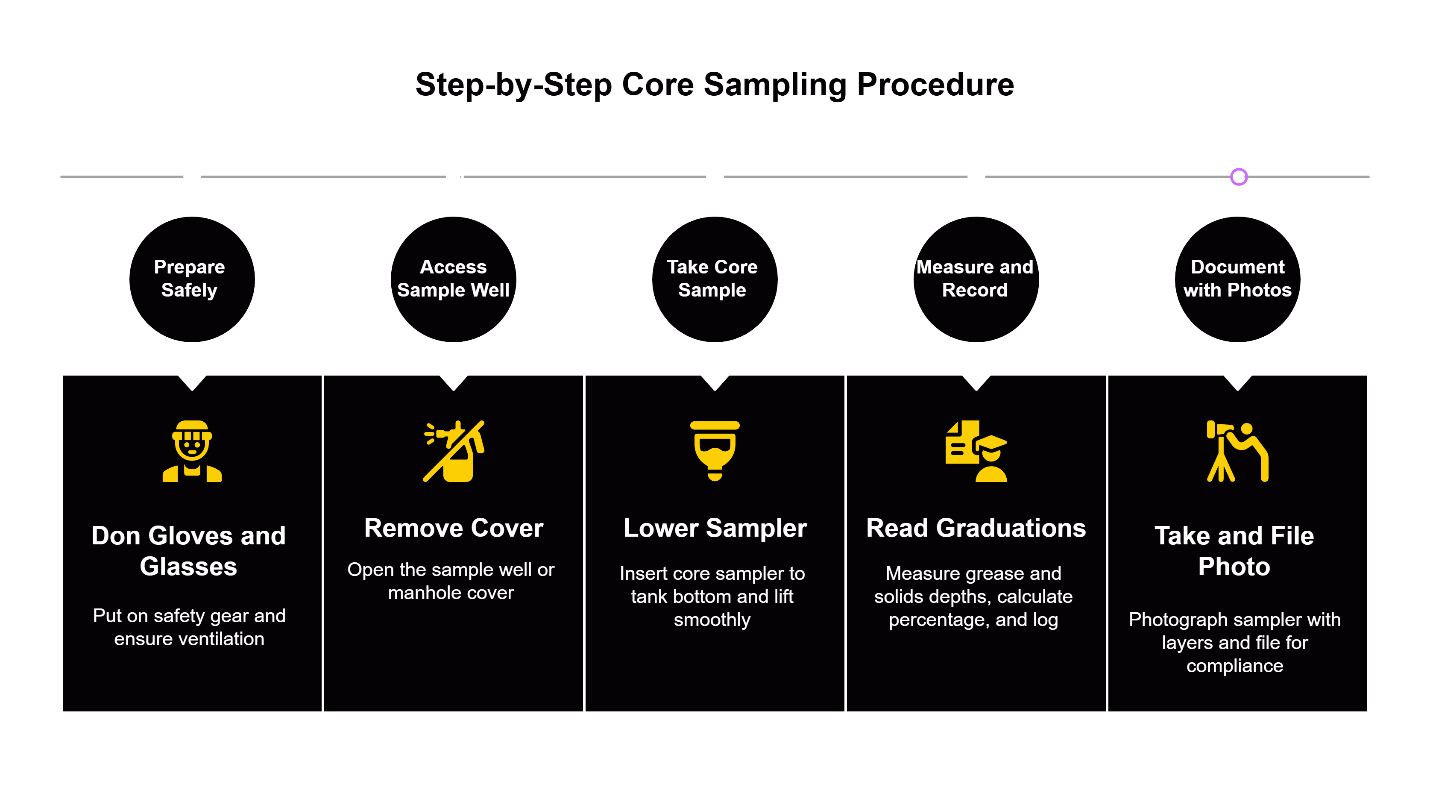
Step-by-Step: How to Take a Core Sample Through the Sample Well

Step-by-step core sampling procedure infographic showing five stages: prepare safely, access sample well, take core sample, measure and record grease and solids, and document with photos for compliance.


Measuring your trap correctly takes about five minutes once you know the process. Here’s the sequence:

  1. Prepare safely. Put on gloves and safety glasses. Ensure adequate ventilation—grease traps produce hydrogen sulfide gas, which is both toxic and flammable. Clear the area of foot traffic and open nearby doors or activate exhaust fans.
  2. Access the sample well. Remove the sample well cover (typically a 4-inch PVC cap on top of the trap). If your trap doesn’t have a dedicated sample well, you’ll need to access through the main manhole, though this is less convenient for routine checks.
  3. Take the sample. Lower your core sampler (a clear graduated cylinder with a bottom check valve) straight down to the tank bottom. Once it touches, lift it smoothly to capture a complete column showing all three layers—grease cap, clear zone, and bottom sludge.
  4. Measure and record. Using the graduations on the sampler, measure the depth of the top grease layer and the bottom solids layer. Add these together, then divide by the total liquid depth to get your percentage. Write this in your log with the date and staff initials.
  5. Document with photos. Take a quick photo of the sampler with visible layers and the measurement. File this in your compliance binder alongside service manifests. If questioned during an audit, this photo proves you were monitoring conditions and taking appropriate action.

Compare today’s reading to your last measurement. If the percentage is climbing faster than expected, shorten your service interval rather than waiting for the next scheduled pump-out.


From Measurement to Paperwork—Passing the Audit

Cleaning your trap is only half of compliance. The other half is proving it happened—and proving the waste was disposed of legally. This is where many operators run into trouble, especially those who choose the cheapest available service to save a few dollars.

Every time your trap is pumped, you should receive a signed waste manifest showing the date, volume removed, hauler information, and most importantly, the disposal facility where the waste was taken. This manifest is your legal proof that FOG waste didn’t end up in a storm drain, vacant lot, or other illegal dumping site. Keep these documents organized in a dedicated compliance binder, along with your core sampling logs and any inspection reports.

Many municipal codes require restaurants to retain these manifests on site and make them available during inspections, often for a minimum of three years (Source: City of Dallas Code of Ordinances). Missing manifests can result in fines even if your trap is currently clean, because you can’t prove past compliance (Source: Municipal FOG Record-Keeping Guidance).

When evaluating grease trap cleaning in Houston, ask specifically about manifesting procedures and whether the company provides copies after every service. The few dollars saved with a bargain hauler aren’t worth the risk of using an unregistered operator who cuts corners on documentation.


Houston Reality Check—Why “Quarterly” Isn’t Always Enough

Within Houston city limits, restaurants are expected to maintain grease traps frequently enough to protect the public sewer system. In practice, quarterly pumping has become a common baseline interval for many facilities, but this is only a starting point. High-volume restaurants, facilities with undersized traps, or operations that use a lot of fryer oil often hit the 25% threshold well before 90 days.

This is why measurement-based scheduling makes more sense than calendar-based service. If your monthly core samples show you’re consistently reaching 20-22% by week eight, shortening your interval to every two months prevents violations and keeps your trap performing as designed. Conversely, lower-volume locations might find they can safely extend to every 14-16 weeks without exceeding the threshold.

Work with a service provider who understands this principle and bases recommendations on your specific accumulation rate rather than pushing everyone onto the same generic schedule. The right approach saves you money over time—you’re not pumping unnecessarily early, but you’re also not risking fines or backups by waiting too long.


Vendor Checklist: “Pit Crew” Criteria for Your Kitchen

Not all grease trap services are equal. When comparing providers, look for these markers of professionalism:

Trained and certified technicians who understand both the mechanical process and the regulatory requirements. The person pumping your trap should be able to explain the 25% rule and show you how to read a core sample.

Punctual and organized service that respects your business hours and cleans up thoroughly. Spills, lingering odors, or equipment left blocking your back door are signs of a careless operation.

Core sampling before and after service on request. Good operators measure before pumping to document your pre-service condition, then again afterward to confirm complete removal.

Manifesting every visit with copies provided automatically. You shouldn’t have to chase down paperwork. Disposal site information should be clearly noted on each manifest.

Proactive schedule management with advance reminders and suggested timing adjustments based on your accumulation trends. This partnership approach helps you stay ahead of compliance issues rather than reacting to emergencies.

Since 1985, our team has focused on delivering this level of service to Houston-area restaurants, backed by Better Business Bureau accreditation and a commitment to thorough documentation. The feedback we consistently hear is appreciation for the organized approach and the advance notice we provide for next cleaning dates.


Frequently Asked Questions

Is a clear sample well good enough to prove compliance?

No. A clear middle layer only shows you what’s happening in one narrow section of the trap. Inspectors require core sampling because it’s the only way to measure total accumulation including the hidden grease cap and bottom sludge.

Do I really have to keep copies of every manifest?

Yes. These documents are your legal proof of proper disposal. Many municipal FOG programs require restaurants to retain manifests and produce them during audits, often for three years or more. Missing paperwork can trigger violations even if your current trap condition is acceptable.

When should I actually call for service?

The safe answer is when your core sample readings approach or reach 20-25% accumulation. Don’t wait for odors or slow drainage—by that point, you’re likely already past the threshold and dealing with a more serious problem that could have been prevented with regular measurement.


Schedule Core Sample-Based Maintenance

Stop guessing and start measuring. Our team provides Houston restaurants with compliant grease trap cleaning backed by proper manifesting after every pump-out. We can set up a measurement-based maintenance schedule that keeps you ahead of the 25% threshold and audit-ready year-round.

Call us at 281-489-1765 (Monday through Friday, 9 AM to 6 PM) to schedule an initial assessment and receive a customized service plan based on your kitchen’s actual accumulation rate.

Visit us: 13911 India St, Houston, TX 77047

For more information about our full range of services, visit our contact page.

About the Drane Ranger Insights Team

The Drane Ranger Insights Team is our dedicated engine for synthesizing complex topics into clear, helpful guides. While our content is thoroughly reviewed for clarity and accuracy, it is for informational purposes and should not replace professional advice.