📌 Key Takeaways
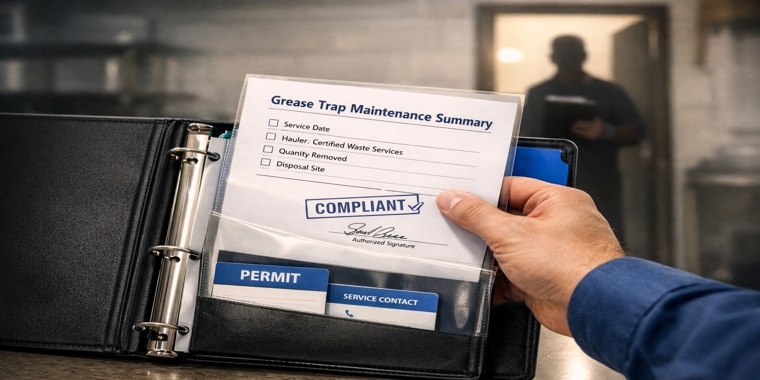
A simple binder system lets you hand inspectors five years of grease trap proof in under sixty seconds.
- Manifests Beat Invoices: An invoice shows you paid for service, but a manifest proves where your grease actually went—and that’s what inspectors want to see.
- Build the Binder in an Hour: A $15 three-ring binder with five year-labeled tabs and a front pocket turns audit panic into calm confidence.
- File the Same Day: When your hauler hands you the paperwork, walk it straight to the binder—don’t set it aside “to file later” or it disappears.
- Missing Records? Act Now: Call your hauler for copies and keep a log showing you tried—inspectors respond better to organized effort than blank stares.
- Front Pocket = Quick Draw: Keep your permit, current year summary, and vendor contact card ready to hand over before anyone starts flipping pages.
A clean trap is only half the job—proof is the other half.
Houston restaurant owners and kitchen managers facing FOG audits will gain a simple, repeatable filing system here, preparing them for the compliance checklists and vendor guidance that follow.
~ ~ ~ ~ ~ ~ ~ ~ ~ ~ ~ ~ ~ ~ ~ ~ ~ ~ ~ ~ ~ ~ ~ ~ ~ ~ ~ ~ ~ ~ ~ ~ ~ ~ ~ ~ ~ ~ ~ ~ ~ ~ ~ ~ ~ ~ ~ ~ ~ ~ ~ ~ ~ ~
The inspector is at the door. Unannounced.
Somewhere in that back office—between the vendor invoices, the health permits, and last month’s inventory sheets—there’s supposed to be five years of grease trap manifests. You think they’re in the filing cabinet. Maybe the desk drawer. Possibly that cardboard box from the last kitchen renovation.
This moment doesn’t have to feel like a fire drill. In under an hour, you can build a system that lets you hand an inspector exactly what they need in sixty seconds flat. No scrambling. No apologies. Just a binder, a confident handoff, and back to running your kitchen.
The Necessity of Documented Compliance
An invoice proves you paid for service. A manifest proves the waste actually went where it was supposed to go. City inspectors don’t care about your accounting records—they care about chain of custody, documented proof that your grease left your trap and arrived at a licensed disposal facility.
Audits often feel sudden because the documentation request is immediate, even when the audit itself wasn’t a surprise. If you operate in the Houston area or within Houston limits under a FOG program, plan your files to maintain at least three years of manifests on-site (five for maximum liability protection), neatly organized and quickly retrievable.
When you have a physical binder organized by year, the inspection dynamic changes completely. Instead of digging through files while an inspector waits, you reach for one binder, flip to the right tab, and demonstrate compliance in seconds. That confidence isn’t just about passing the audit. It’s about protecting your business license and your peace of mind.
For context on maintaining your trap between cleanings, see our Commercial Grease Trap Cleaning services.
What Counts as a “FOG Manifest” (Quick Definition)
A manifest is a chain-of-custody record that documents the removal and handling of grease-related waste from your facility. While an invoice just confirms a transaction happened, a manifest documents the entire journey of your waste—from your trap to the disposal facility. It’s the paper trail that proves you’re not dumping grease into the sewer system.
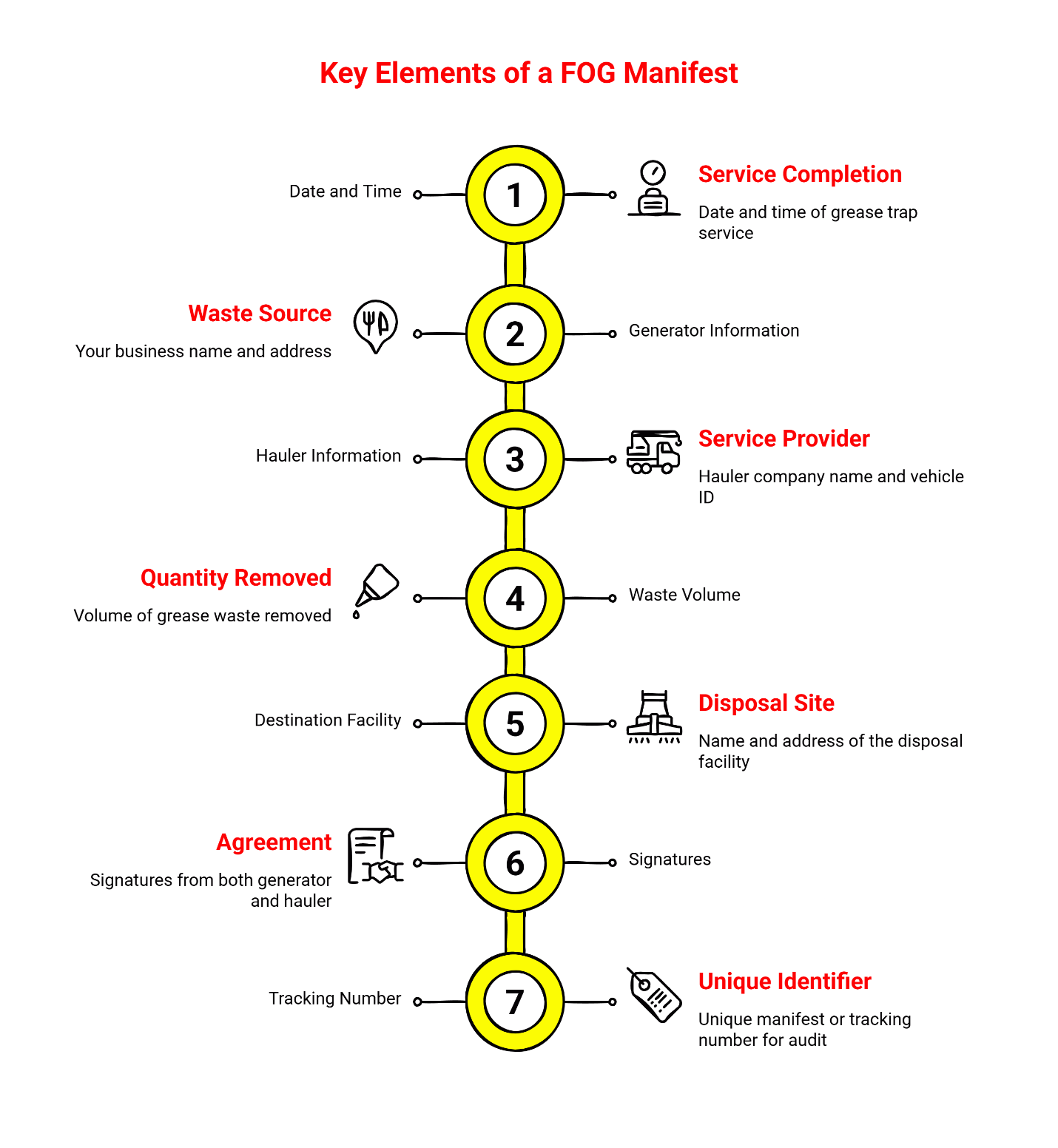
When your hauler hands you paperwork after service, look for these essential elements:
- Your business name and service address
- Date and time of service
- Generator information (you—the waste source)
- Hauler company information and vehicle ID
- Volume of waste removed
- Destination facility name and address
- Signatures from both parties
- A unique manifest or tracking number
If any of these are missing, ask your service provider for complete documentation. A manifest with gaps is a manifest that could cause problems during an audit.
One critical distinction: if what you have is only a bill with pricing and no chain-of-custody details, treat it as a supporting document, not your primary audit proof. Invoices belong in your accounting files. Manifests belong in your compliance binder.
For a deeper dive into the legal distinction between these documents, read Manifesting vs. Invoicing: The Legal Difference for Houston Restaurants.
The Audit-Proof Binder: Supplies List (10 Minutes, One Trip)
You don’t need a fancy filing system. You need one that works when it matters. Here’s your shopping list:
- One 2-inch three-ring binder (3-inch if your service volume is high)
- Five divider tabs with writable labels
- A pack of sheet protectors
- One pocket folder (the kind that snaps into the binder rings)
- A label maker or permanent marker
- Stapler and binder clips
Total investment: around fifteen dollars. Total setup time: less than an hour. The return: years of audit confidence.
Implementing the 5-Year Tab System
Label your five dividers by year, starting with the oldest and ending with the current year. If you’re setting this up in 2026, your tabs read: 2022, 2023, 2024, 2025, 2026.
Within each year’s section, file manifests in reverse chronological order—newest on top. When you flip to 2025, the first document you see should be December’s service, then November’s, and so on. This makes “show me the last service” effortless.
Here’s the filing routine that keeps the system clean:
When your hauler completes service, they hand you the manifest. Don’t set it on the desk “to file later.” That’s how paperwork disappears.
Walk directly to your binder. Slip the manifest into a sheet protector if you want extra durability (grease and paper don’t mix well over five years).
Place it at the front of the current year’s section.
Done. Total time: thirty seconds.
If you have related documents—like a service log note or a repair receipt—staple them to the back of the corresponding manifest. Keep everything together so you’re not hunting through multiple files during an inspection. These attachments can strengthen clarity, but don’t overstuff your binder. The manifest is the proof; supporting docs are optional.
Optional: Create a Year Summary Sheet
At the front of each year’s section, add a single page with your vendor name, service frequency, number of services completed that year, and any known gaps. This summary isn’t required, but it accelerates audits by telling the story fast.
Front Pocket Setup: What to Keep “Inspection Ready”
The pocket folder at the front of your binder is your quick-access zone. When an inspector walks in, you shouldn’t have to flip through anything. Just open the binder, pull from the front pocket, and hand over the essentials.
Keep these items in the front pocket:
Current permit copy. Your grease trap permit should be visible and accessible. Inspectors often ask for it first.
Current year manifest summary. Create a simple one-page list: date of each service, hauler name, and manifest number. This gives the inspector a quick overview without requiring them to flip through every document.
Vendor contact card. Include your service provider’s name, phone number, and after-hours contact. If the inspector has a question you can’t answer, you can call your hauler on the spot.
Think of this as your compliance quick-draw. You’re not searching—you’re presenting.
Digital Backup: Scan Rules That Actually Work
A physical binder should be your primary system for one simple reason: surprise inspections don’t wait for your laptop to boot up, your cloud service to sync, or your password manager to cooperate. But digital backups protect you against fire, flood, and the chaos of a busy kitchen.
Keep your digital system dead simple.
Folder structure: One folder per year. That’s it. Don’t over-engineer this.
FOG Manifests → 2022
FOG Manifests → 2023
FOG Manifests → 2024
FOG Manifests → 2025
FOG Manifests → 2026
Naming convention: Use a format that sorts correctly.
YYYY-MM-DD_VendorName_Manifest#
Example: 2025-09-15_DraneRanger_M4521
Storage: One cloud location (Google Drive, Dropbox, whatever you already use) plus one local backup on a hard drive or USB.
Monthly routine: Set a calendar reminder for the first Monday of each month. Spend ten minutes scanning any unscanned manifests and verifying your files match your physical binder.
The goal isn’t a perfect digital archive. The goal is having a backup you can actually find when you need it.
If You’re Missing Manifests: What to Do Before the Inspector Shows Up
Gaps happen. Paperwork gets lost in kitchen chaos, haulers change, and sometimes five years is a long time to keep track of anything. Here’s how to address missing documentation before it becomes a problem.
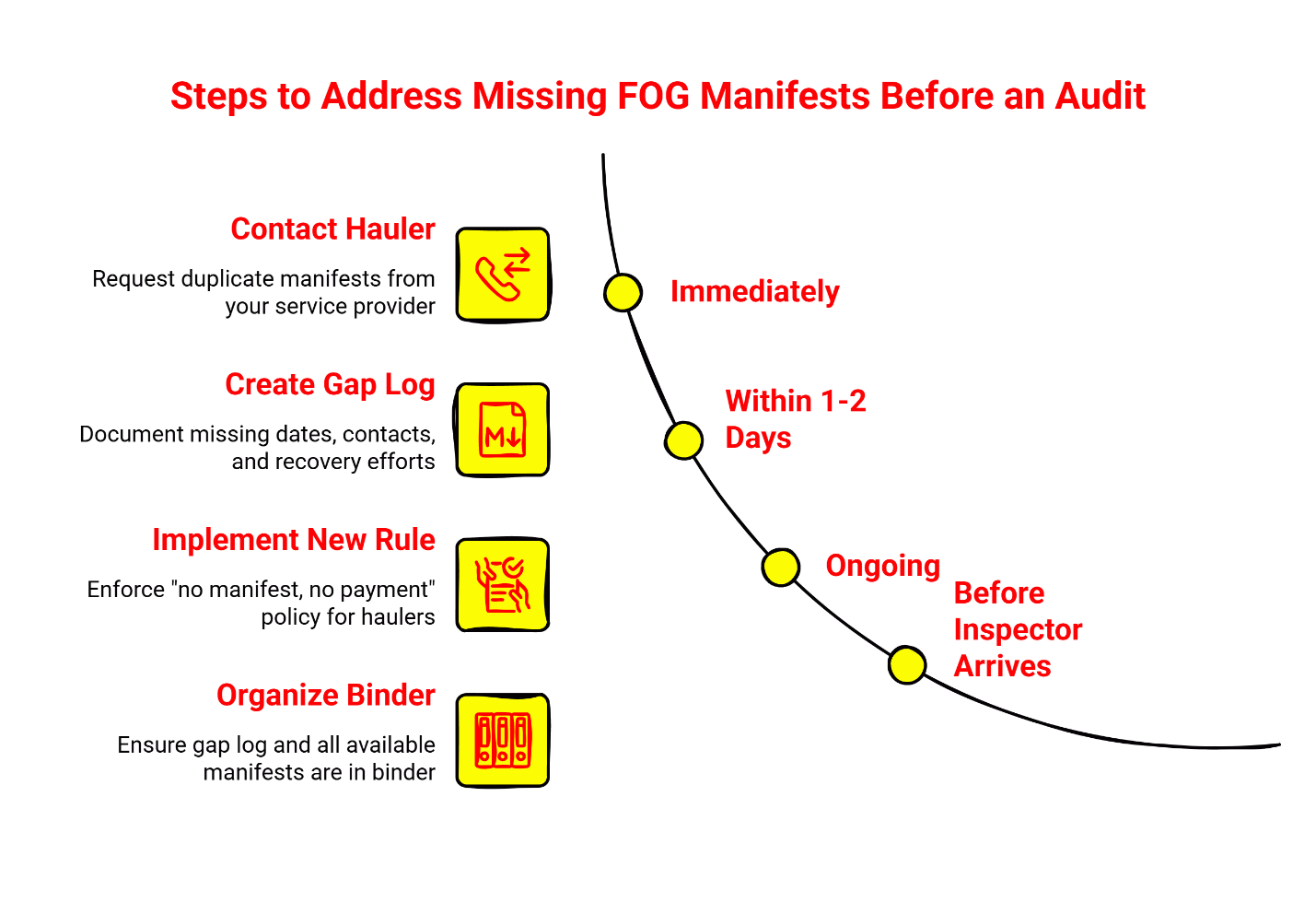
Call your hauler first. Reputable service providers keep records. Contact them and request duplicate manifests for the dates you’re missing. Most can provide copies within a few business days.
Create a gap log. If you can’t recover a manifest, document your effort. Keep this log in the back pocket of your binder and include:
- Missing date(s)
- Who you contacted
- Date you made the request
- Expected delivery date
- Result (received or pending)
This shows an inspector that you’re acting in good faith, not hiding negligence. Inspectors tend to respond better to organized, transparent operators than to “I don’t know.”
Set a new internal rule. Adopt this policy in your operation: no manifest, no payment approval. Make it standard that your bookkeeper or manager doesn’t process a hauler’s invoice until the corresponding manifest is in hand and filed. This single rule closes the paperwork loop permanently.
The worst thing you can do with missing paperwork is nothing. Proactive documentation of your recovery efforts demonstrates responsibility even when records are incomplete.
The One Habit That Keeps the Binder Clean: Filing Day
Assign a Compliance Officer to ensure ownership of the filing process.
Manager files. Whoever receives the manifest from the hauler is responsible for putting it in the binder that same day. Not tomorrow. Not next week. The same day.
Owner or GM verifies quarterly. Once every three months, the owner or general manager flips through the binder to confirm everything is in order. Check that manifests are present for every scheduled service, that the front pocket is current, and that the digital backup matches. This takes five minutes.
Pick a consistent moment tied to your service schedule. If your trap is cleaned on the 15th of each month, the 16th is filing day. No exceptions.
This isn’t about creating more work. It’s about protecting the work you’ve already paid for. You invest in regular Grease Trap Cleaning Houston services to stay compliant. The binder makes sure you can prove it.
When to Call a Professional: Compliance Support and Reliable Documentation
A good grease trap service provider doesn’t just pump your trap and leave. They make compliance easier by providing complete chain-of-custody documentation with every visit, showing up on schedule so you never miss a cleaning window, and answering questions about what inspectors look for.
When evaluating a hauler, ask:
- Will you provide complete chain-of-custody documentation every visit?
- What information is included on your manifests?
- Can you provide duplicate records if I need them?
- How do you handle scheduling to ensure I stay within compliance timelines?
If manifests are routinely missing, inconsistent, or delayed, the problem may not be your binder—it may be your vendor relationship. Cleaning without paperwork still leaves you exposed.
For Houston-area operators concerned about compliance requirements, the City of Houston sets the regulatory framework that drives these documentation needs.
Drane Ranger has served the Greater Houston area since 1985, providing professional grease trap service with the documentation that keeps you audit-ready. As a BBB-accredited business, we’re committed to doing the job right—including the paperwork.
As one customer put it: “My experience with Drane Ranger was a very organized, professional and on time experience. I was kept informed of what was happening and a suggested time of cleaning again.” — Harold R.
Another shared: “Drain Ranger is very professional and reliable. Basically they can take care of all your grease drain needs.” — Shelley M.
Your 5-Year Binder Setup Checklist
Supplies:
- [ ] 2-inch three-ring binder (3-inch for high volume)
- [ ] 5 divider tabs (labeled by year)
- [ ] Sheet protectors
- [ ] Pocket folder for front of binder
- [ ] Label maker or permanent marker
- [ ] Stapler and binder clips
Front Pocket Contents:
- [ ] Current grease trap permit copy
- [ ] Current year manifest summary (one page)
- [ ] Vendor contact card with after-hours number
Tab System:
- [ ] Year 1 (oldest) → Year 5 (current)
- [ ] Manifests filed newest-on-top within each year
- [ ] Optional year summary sheet at front of each section
Back Pocket:
- [ ] Gap log for missing documents
- [ ] Pending document requests
Maintenance:
- [ ] Assign filing day ownership
- [ ] Schedule quarterly verification
- [ ] Set monthly digital backup reminder
A clean trap is only half the job. Proof is the other half. Build your binder this week, and the next time someone knocks on your kitchen door with a clipboard, you’ll be ready.
Start Your Service Today — Call 281-489-1765
Ready to work with a team that handles both the service and the paperwork trail? Contact us today to request your quote.
Disclaimer: This article is for informational purposes only and does not constitute legal advice. Compliance requirements may vary by jurisdiction and are subject to change. Consult with local regulatory authorities or a qualified professional for guidance specific to your situation.