
📌 Key Takeaways
The 90-day grease trap pumping rule is a legal deadline, not a safety plan—busy kitchens often fill up weeks before that date arrives.
- Calendar Compliance Creates False Security: Houston’s 90-day rule sets a minimum standard, not a recommended interval tailored to your kitchen’s actual grease output.
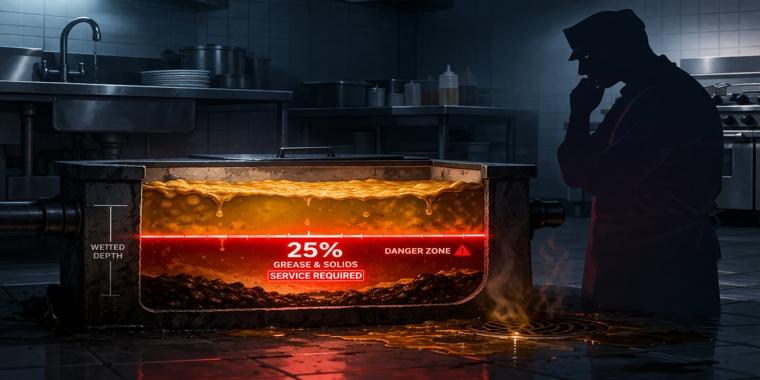
- The 25% Rule Triggers Earlier Service: When grease and solids reach 25% of your trap’s depth, you need pumping—regardless of what the calendar says.
- Surprise Inspections Follow Patterns: City audits respond to sewer blockages, odor complaints, and documentation gaps—not random selection.
- Warning Signs Appear Early: Slow drains, faint odors near floor drains, and grease in unexpected places signal your trap is filling faster than your schedule assumes.
- Volume-Based Scheduling Prevents Problems: Track how quickly warning signs appear after each pump-out, then schedule service before symptoms start—not when the calendar says.
Match your pumping schedule to your kitchen’s output, and inspectors will have nothing to find.
Houston restaurant operators managing high-volume kitchens will gain clarity on avoiding compliance gaps, preparing them for the detailed FOG guidance that follows.
~ ~ ~ ~ ~ ~ ~ ~ ~ ~ ~ ~ ~ ~ ~ ~ ~ ~
You mark the calendar: 87 days since the last pump-out. Three more days. Safe.
That confidence is exactly what gets Houston kitchens blindsided. The 90-day pumping rule feels like a finish line—a date you hit, a box you check, a problem you’ve handled. But for busy restaurants, that calendar-based comfort can be the riskiest habit in the building.
Meeting the legal minimum and being inspection-ready are not the same thing. The city’s 90-day requirement establishes a compliance floor. It doesn’t account for how fast your specific kitchen fills a trap, whether hidden sludge has already crossed the danger threshold, or if your paperwork would survive scrutiny today.
If your kitchen produces FOG faster than the calendar assumes, a 90-day schedule can leave you exposed long before your next appointment arrives.
The 90-Day Rule Is a Minimum, Not a Safety Plan
Section 47-512(b) of the City of Houston Code of Ordinances mandates that grease traps within city limits must generally be fully evacuated at least once every 90 days. While the city does offer a 180-day waiver for qualifying low-volume generators, for the vast majority of commercial kitchens, 90 days is the standard outer boundary—the maximum interval the city will typically tolerate before you’re automatically out of compliance.
But “maximum allowed” is not the same as “recommended” or “safe for your operation.”
Think of it like a vehicle inspection sticker. The expiration date tells you when you’re legally required to act. It doesn’t tell you whether your brakes are already worn thin or your oil is running low. The 90-day rule works the same way. It sets a legal deadline. It says nothing about whether your trap is actually functioning safely between service visits.
The problem intensifies for kitchens with high FOG output. A café doing light prep work and a full-service restaurant running fryers twelve hours a day face completely different accumulation rates. While the ordinance does provide a 180-day waiver for proven low-volume producers, its baseline 90-day mandate lumps most standard and high-volume operations together as if they were identical. Reality doesn’t
When operators confuse the legal minimum with a protective schedule, they create exactly the gap that inspections are designed to catch. For a deeper Houston-specific overview, see commercial grease trap cleaning in Houston.
Why Busy Kitchens Can Become Non-Compliant Long Before Day 90
The 90-day window assumes a certain pace of accumulation. Busy kitchens blow past that assumption constantly.
Houston’s FOG regulations include what’s commonly called the 25% rule: when combined grease and solids reach 25% of your trap’s wetted height, service is required—regardless of how many days have passed since your last pump-out. This threshold exists because a trap filled beyond that point stops functioning properly. FOG escapes into the sewer system, drains slow down, and odors emerge.
The principle holds weight beyond local code. EPA guidance confirms that FOG from food service establishments is a major cause of sewer blockages and that required maintenance frequency depends greatly on how much FOG a facility generates.
For high-volume operations, that 25% mark can arrive in 30 to 60 days. Some kitchens doing heavy frying hit it even sooner. The calendar says you’re fine. The trap says otherwise.
What makes this especially dangerous is that the warning signs aren’t always obvious:
- Slow drains that seem minor during off-hours
- Faint odors near floor drains or the dish pit that come and go
- Water pooling slightly longer than usual after dishwashing cycles
- Grease appearing in unexpected places—around drain covers, near the sample well
These signals often get dismissed as normal kitchen wear. In reality, they’re telling you the trap is working harder than your schedule accounts for.
The trap doesn’t know what day it is. It only knows capacity. When capacity fails before the calendar catches up, you’re operating in a danger zone without realizing it.
For a more technical breakdown, read How often should a commercial grease trap be cleaned in Houston? and The 25% Rule Explained.
Why Unannounced FOG Audits Feel Random but Rarely Are
The inspector arrives on a Tuesday morning. No warning. No appointment. It feels like bad luck—like your number just came up.
It usually isn’t random.
According to the Houston Health Department’s Special Waste Generator program, establishments with interceptors are inspected on a routine basis or in response to complaints. There is no prior notification for these inspections. The city’s enforcement approach responds to system-level signals: reported odors, sewer line blockages in a commercial corridor, permit irregularities, or patterns that suggest FOG discharge problems in a particular area.
The scale of this program is substantial. The Houston Health Department’s Environmental Investigators conduct routine inspections and complaint investigations, maintaining rigorous oversight on thousands of regulated commercial establishments, including restaurants
When multiple restaurants share sewer infrastructure, a spike in FOG levels downstream can trigger increased scrutiny for everyone connected to that line. Your neighbor’s overflow becomes your inspection.
The city also tracks permit renewals, manifest submissions, and service history. Gaps in documentation or overdue filings can flag an establishment for follow-up. EPA guidance reinforces this approach, noting that complaint databases tracking FOG-related blockages can be powerful tools for assessing problems, and that pretreatment programs may target cleaning priorities based on FOG discharges and other root causes. (US EPA)
What feels like a surprise visit is often the result of data the operator never saw.
This reframe matters: the goal isn’t to avoid getting “randomly” caught. The goal is to stay off the city’s radar entirely. Operators who pump proactively, maintain clean sample wells, and keep manifests current give inspectors nothing to find. Those who coast on calendar minimums give inspectors plenty.
The Red Flags That Put Your Kitchen in the Danger Zone
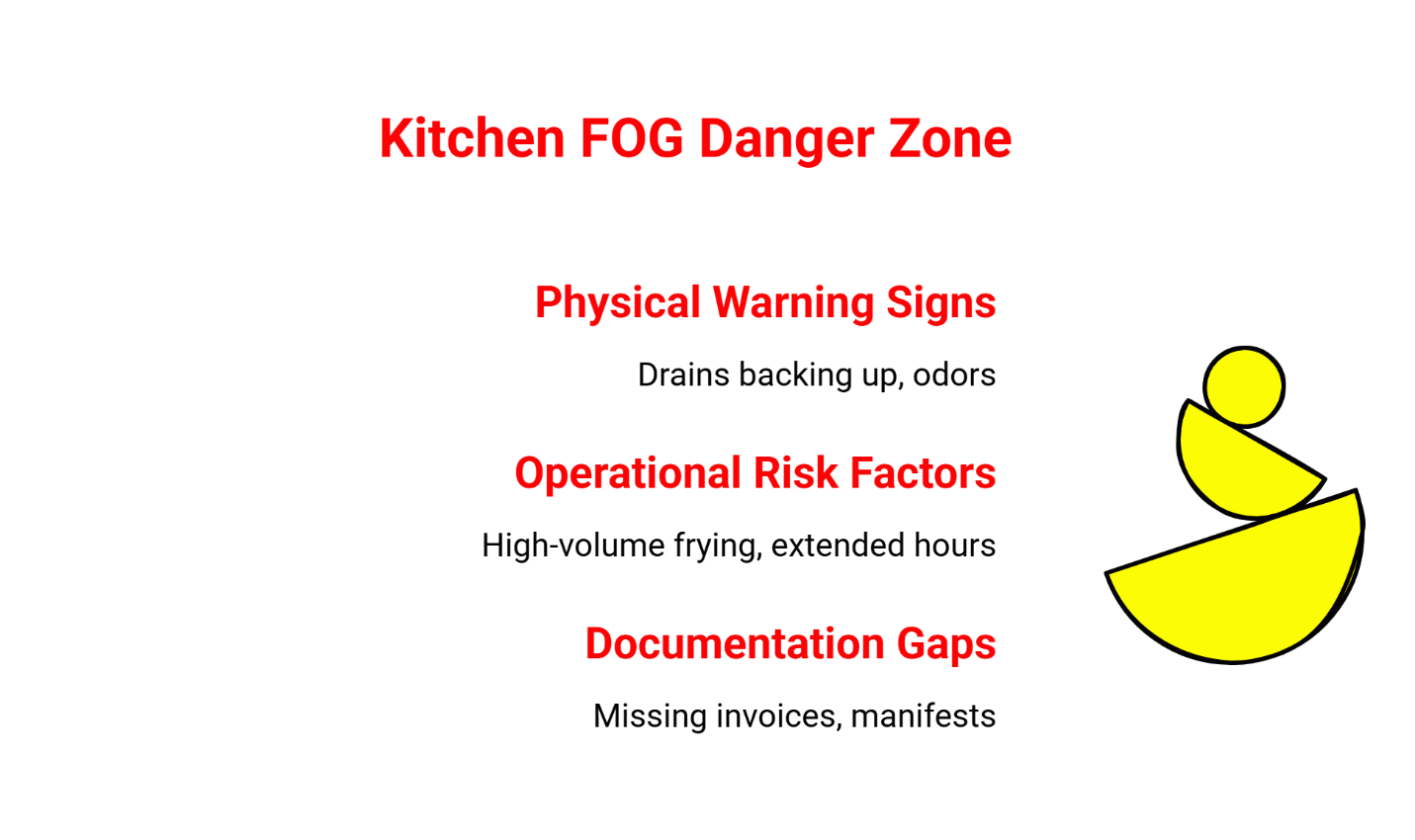
Not every kitchen faces the same risk. Volume, menu type, equipment age, and documentation habits all affect where you fall on the exposure spectrum.
Use this diagnostic to assess your current position:
Physical Warning Signs:
- Drains backing up or slowing before your scheduled service date
- Persistent odors near the grease trap, floor drains, or sample well
- Visible grease film in unexpected locations
- Standing water that takes longer to clear than it used to
Operational Risk Factors:
- High-volume frying or sautéing as a core menu function
- Extended service hours that increase daily FOG output
- Recent menu changes that added grease-heavy items
- A service schedule that hasn’t changed despite business growth
Documentation Gaps:
- Invoices on file but no signed manifests
- Manifests not stored on-site or older than five years discarded
- Uncertainty about whether your hauler is city-permitted
- No record of the last time someone checked the sample well
The Red Flag Matrix:
Think of risk as a simple grid. The vertical axis tracks time since your last pump-out. The horizontal axis tracks your kitchen’s FOG volume.
| Low Volume | High Volume | |
|---|---|---|
| Recent Service (0-30 days) | Low Risk | Watch Closely |
| Mid-Cycle (30-60 days) | Watch Closely | Escalating Exposure |
| Approaching 90 Days (60-90 days) | Escalating Exposure | Danger Zone |
High-volume kitchens enter the danger zone between day 30 and 60—not day 89. If your operation falls into that upper-right quadrant, the 90-day schedule isn’t protecting you. It’s creating a window of vulnerability that grows wider every week.
What a Volume-Based Pumping Schedule Looks Like in Practice
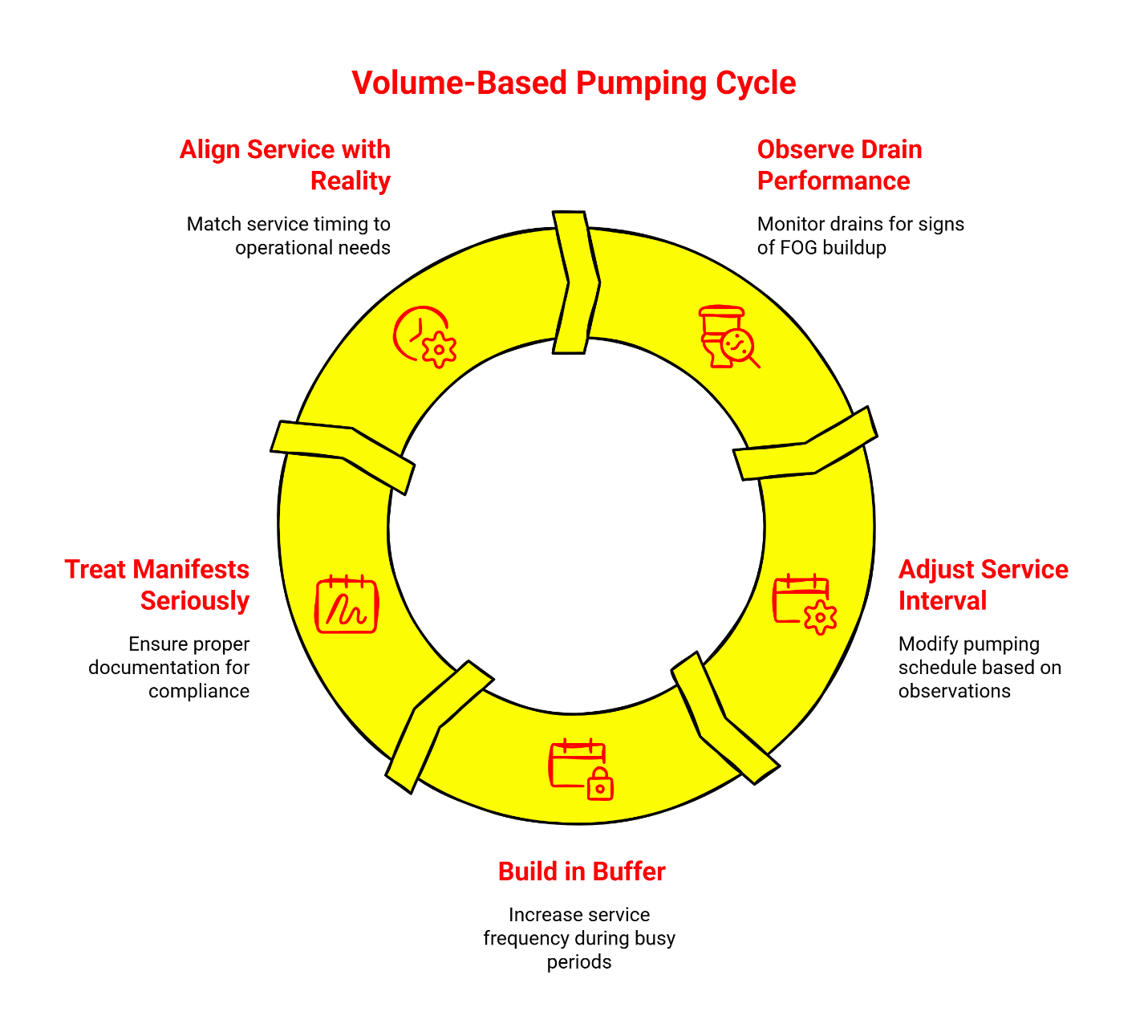
Shifting from calendar thinking to volume thinking doesn’t require complicated calculations. It requires paying attention to your kitchen’s actual output and adjusting service intervals accordingly.
Start with baseline observation. After your next pump-out, note how your drains perform over the following weeks. Track when odors first appear, when draining slows, when anything feels different. These observations tell you how fast your trap fills under normal operating conditions.
Adjust for reality, not convenience. If warning signs appear at day 45, your effective service interval is 45 days—not 90. Scheduling service before symptoms appear keeps you ahead of both the trap’s capacity and the city’s attention.
Build in buffer for busy periods. Holidays, special events, and seasonal menu changes can spike FOG output dramatically. A schedule that works in February may fall short in December. Proactive operators tighten intervals during high-demand periods rather than hoping the usual cadence holds.
Treat manifests as seriously as the pump-out itself. The physical service means nothing without proper documentation. Every evacuation should generate a signed manifest showing the waste was removed by a permitted hauler and transported to an approved facility. These records must be kept on-site for five years. Invoices alone don’t satisfy this requirement—manifests are the legal proof that matters during an inspection.
A volume-based approach isn’t about spending more on service. It’s about aligning service timing with operational reality so you never find yourself explaining why the trap overflowed three weeks before the calendar said it should.
How This Fits into Full Inspection Readiness
Pumping frequency is one piece of a larger system. True inspection readiness requires three things working together:
- Physical maintenance timed to your kitchen’s actual FOG output—not just the legal minimum
- Understanding the 25% threshold and recognizing the warning signs that indicate you’re approaching it
- Documentation discipline that keeps signed manifests organized, accessible, and current for five years
This article addressed the first mental shift: recognizing that calendar compliance creates false security for busy kitchens. But frequency alone won’t save you if your paperwork fails scrutiny or your trap shows 30% accumulation on inspection day.
The operators who avoid surprise audits aren’t lucky. They’ve simply stopped treating the 90-day rule as a safety net—and started treating it as the bare minimum it actually is.
Our Editorial Process
Our expert team uses AI tools to help organize and structure our initial drafts. Every piece is then extensively rewritten, fact-checked, and enriched with first-hand insights and experiences by expert humans on our Insights Team to ensure accuracy and clarity.
By the Drane Ranger Insights Team
The Drane Ranger Insights Team creates plain-English guidance for Houston-area businesses dealing with grease trap compliance, liquid waste handling, and inspection-readiness challenges. The team draws on local service experience, current regulatory references, and operational field realities to make complex wastewater topics easier to act on.