📌 Key Takeaways
Passing a grease trap inspection comes down to three things: a working trap, an accessible sample well, and manifests that prove where your waste went.
- Manifests Beat Invoices: An invoice shows you paid for service, but a manifest proves your waste went to an approved facility—inspectors want the manifest.
- The 25% Rule Overrides Your Calendar: When grease plus settled solids hit 25% of your trap’s depth, you need service immediately—even if 90 days haven’t passed yet.
- Blocked Access Fails You Before Testing Starts: If boxes cover your sample well or the lid won’t open, you’ve failed before the inspector even measures anything.
- High-Volume Kitchens Fill Faster: Busy restaurants running fryers all day often hit the 25% threshold in six to eight weeks, not three months.
- Monthly Walks Prevent Panic: A five-minute checklist once a month catches odors, access problems, and paperwork gaps before an inspector does.
Preparation turns inspections into non-events.
Restaurant managers and kitchen operators in Houston, Pearland, Alvin, and Sugar Land will find a ready-to-use compliance checklist here, preparing them for the detailed walkthrough that follows.
~ ~ ~ ~ ~ ~ ~ ~ ~ ~ ~ ~ ~ ~ ~ ~ ~ ~ ~ ~ ~ ~ ~ ~ ~ ~ ~ ~ ~ ~ ~ ~ ~ ~ ~ ~ ~ ~ ~ ~ ~ ~ ~ ~ ~ ~ ~ ~ ~ ~ ~ ~ ~ ~
The inspector’s clipboard is out. Your line cook just called in sick. And someone is asking where the grease trap manifests are filed.
This is the moment that separates restaurants with compliance systems from restaurants with compliance problems. The difference isn’t luck—it’s preparation.
Whether you operate inside Houston city limits or in surrounding areas like Alvin, Pearland, or Sugar Land, FOG (fats, oils, and grease) compliance follows the same fundamental logic: your trap must function, your sample well must be accessible, and your paperwork must prove where your waste went. Miss any one of these, and a routine check becomes a scramble.
This guide gives you a mock inspection checklist you can walk through today—before an inspector does it for you.
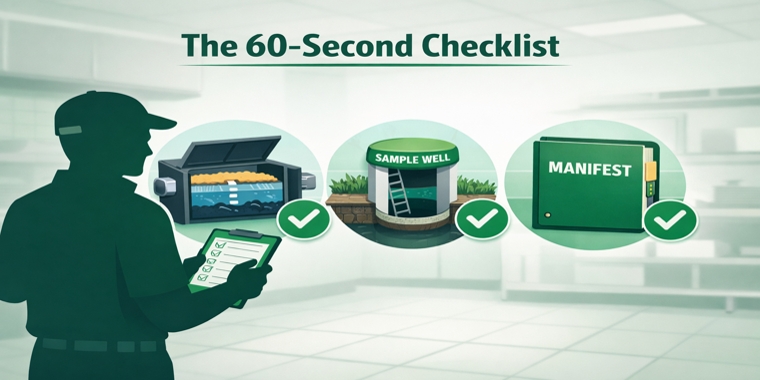
The 60-Second Pre-Check: Three Things Inspectors Look At
Inspectors don’t arrive with hours to spare. They’re looking for red flags, and they know exactly where to find them.
The Trap. Can they access it? Does it smell like failure? Are the internal components—T-pipes, baffles—actually present and intact?
The Sample Well. This is where they’ll pull a sample to measure accumulation. If it’s blocked, buried under storage, or the cover is seized shut, you’ve already failed before the measurement happens.
The Binder. Not your invoices. Your manifests. The documents that prove chain-of-custody—where your grease actually went after it left your kitchen.
If you can’t pass all three in 60 seconds, you’re not ready.
FOG Compliance in Plain English (And Why It’s Not Just ‘Cleaning’)
FOG compliance management is the systematic organization of waste disposal records to meet municipal regulations. But that definition misses the point.
Think of it as the tax return for your waste. Just like the IRS doesn’t care that you meant to file—they want the paper trail—city inspectors don’t care that your trap looks clean. They want documented proof that a licensed hauler removed your FOG and transported it to an approved disposal facility.
Every service visit should produce inspector-ready paperwork. If your provider leaves you with only an invoice, they’ve given you accounting records, not compliance proof. A manifest proves where your waste went—and that distinction matters when someone with a clipboard asks to see your disposal documentation.
Key Terms (60-Second Glossary)
Before you walk the checklist, make sure you’re speaking the same language as inspectors:
FOG – Fats, oils, and grease. The byproducts of commercial cooking that must be captured before entering the sewer system.
Grease trap / interceptor – The device that separates FOG from wastewater. “Trap” and “interceptor” are often used interchangeably, though interceptors are typically larger.
Sample well – The access point where inspectors pull samples to measure grease accumulation levels.
Manifest – The legal document proving chain-of-custody: who removed your waste, when, and where it was disposed. This is your compliance proof.
Invoice – Payment documentation. Proves you paid for service—not that your waste was properly disposed.
25% rule – Per international plumbing standards and City of Houston enforcement, service is required when the total thickness of the floating grease layer (FOG) plus the settled solids layer exceeds 25% of the total liquid depth of the interceptor. If an inspector’s ‘Sludge Judge’ confirms you have hit this threshold, you are legally required to pump immediately, even if your 90-day window hasn’t closed.
Printable Mock Inspection Checklist
Walk your kitchen with this checklist. Any item marked FAIL becomes an action item with a deadline.
- A) Trap – Physical Condition
| Check | Pass | Fail |
|---|---|---|
| Lid clear and reachable; no storage blocking access | ☐ | ☐ |
| No persistent sewer or grease odor near trap | ☐ | ☐ |
| Inlet/outlet T-pipes present and intact | ☐ | ☐ |
| Baffles present and undamaged | ☐ | ☐ |
| No visible cracks, corrosion, or leaks | ☐ | ☐ |
| All bolts and gaskets in place | ☐ | ☐ |
| No slow drains or gurgling sounds | ☐ | ☐ |
| No grease appearing in floor drains or sinks | ☐ | ☐ |
- B) Sample Well – Access
| Check | Pass | Fail |
|---|---|---|
| Location known and clearly labeled | ☐ | ☐ |
| Cover opens safely (no seized bolts) | ☐ | ☐ |
| No slip hazards around access point | ☐ | ☐ |
| Clear path for inspector sampling | ☐ | ☐ |
| No evidence of bypassing or blockage | ☐ | ☐ |
- C) Binder – Paperwork
| Check | Pass | Fail |
|---|---|---|
| Manifests on-site (not just invoices) | ☐ | ☐ |
| Recent service documentation immediately available | ☐ | ☐ |
| Records organized by date/year | ☐ | ☐ |
| Maintenance log shows last service date | ☐ | ☐ |
| Next scheduled service date documented | ☐ | ☐ |
Scoring: All critical items must PASS. Any FAIL on this checklist should trigger a service call immediately. While most minor physical repairs should be addressed within 7–10 days to avoid citations during a follow-up, a failure of the 25% rule or a missing manifest is a ‘Right Now’ priority, as an inspector can issue a Notice of Violation (NOV) on the spot during a surprise visit.
Common Failure Points—And the Fastest Fixes Before an Inspection
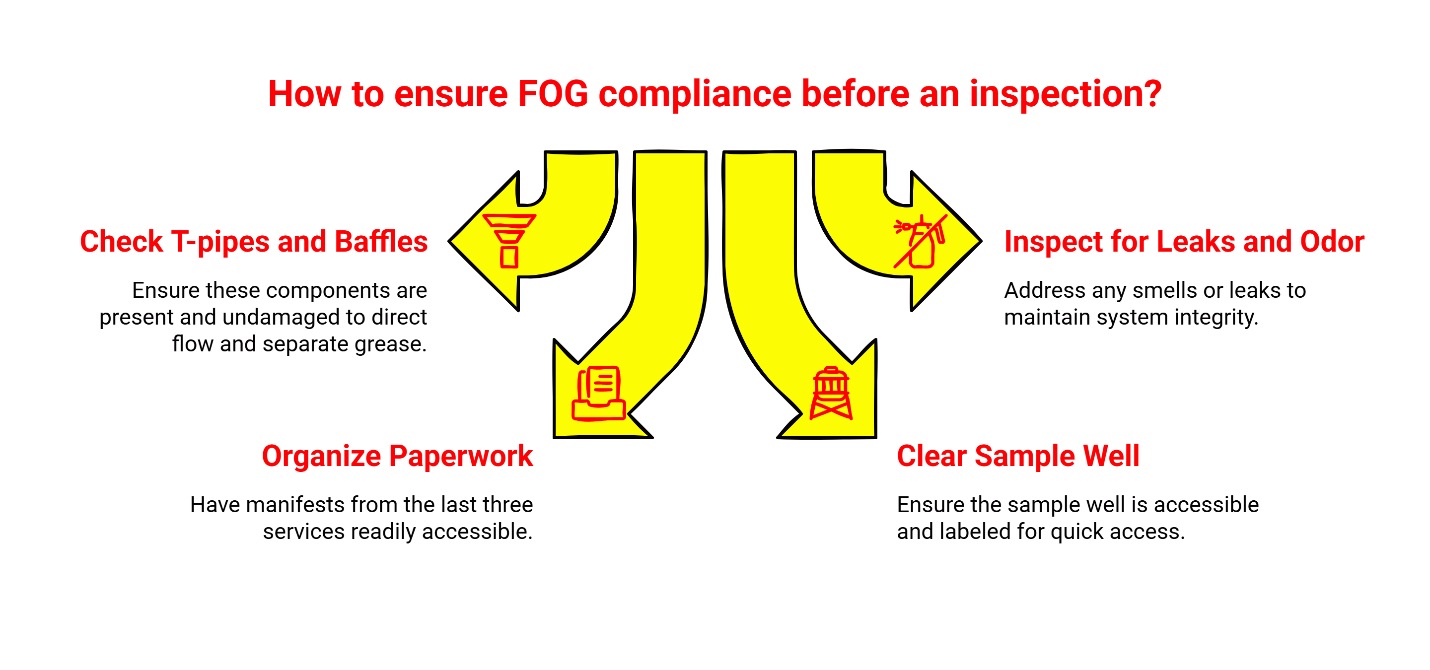
Missing or damaged T-pipes and baffles. These internal components direct flow and separate grease. If they’re gone or broken, your trap isn’t functioning—it’s just a holding tank. This requires professional service, not a DIY fix.
Corrosion, leaks, and odor escape. Persistent smells near your trap signal that the seal has failed somewhere. Grease vapors escaping means the system needs inspection and likely repair.
Paperwork gaps. The most common failure isn’t physical—it’s documentary. Manifests from your last three services should be immediately accessible. If you have to search, you’re not ready.
Blocked or buried sample well. Storage stacked around the access point, a seized cover, or an unlabeled location turns a 30-second sample into a 30-minute problem—and raises questions about what else you might be hiding.
What If the Inspector Shows Up Today?
Picture this: It’s 10:45 AM, fifteen minutes before the lunch rush. An inspector walks in, asks for sample well access, and wants to see your manifest binder. Your sample well has boxes stacked in front of it. Your manifests are “somewhere in the office.” What was a routine check just became a scramble—and that scramble creates the appearance of a problem even if your trap is clean.
Are You Cleaning Often Enough? The 90-Day Max vs. the 25% Reality
Within Houston city limits, the City of Houston Building Code and Chapter 47 of the Code of Ordinances require that grease traps be completely evacuated at least every 90 days, or more frequently if the 25% rule is exceeded. However, it is critical to note that certain jurisdictions within the Greater Houston area or specific high-output permits may mandate a 30-day or 60-day frequency based on the size of the interceptor and the facility’s flow rate. Always verify the specific frequency listed on your City of Houston FOG Permit.
But the 25% rule overrides the calendar. When floating grease plus settled solids reach 25% of your trap’s total liquid depth, service is required immediately—regardless of when your last cleaning occurred.
High-volume kitchens can hit that 25% threshold in six to eight weeks. If you’re running fryers all day, your trap fills faster than a restaurant doing light prep work.
Watch for operational triggers: persistent odors, slow drainage, recurring clogs, or grease showing up in floor drains. These signs often mean you’ve already passed 25%.
Jurisdiction check: If you operate outside Houston city limits—in Alvin, Pearland, Sugar Land, or areas served by MUDs (Municipal Utility Districts)—specific requirements may vary. You can verify city-limit boundaries through the City of Houston official site or contact your local utility district. Use this checklist as a best-practice standard regardless of jurisdiction.
Vendor Readiness: How to Spot a ‘Pump-and-Go’ Provider Before They Cost You
Not all grease trap service is equal. A cheap pump-out that leaves you with only an invoice is selling you liability, not compliance.
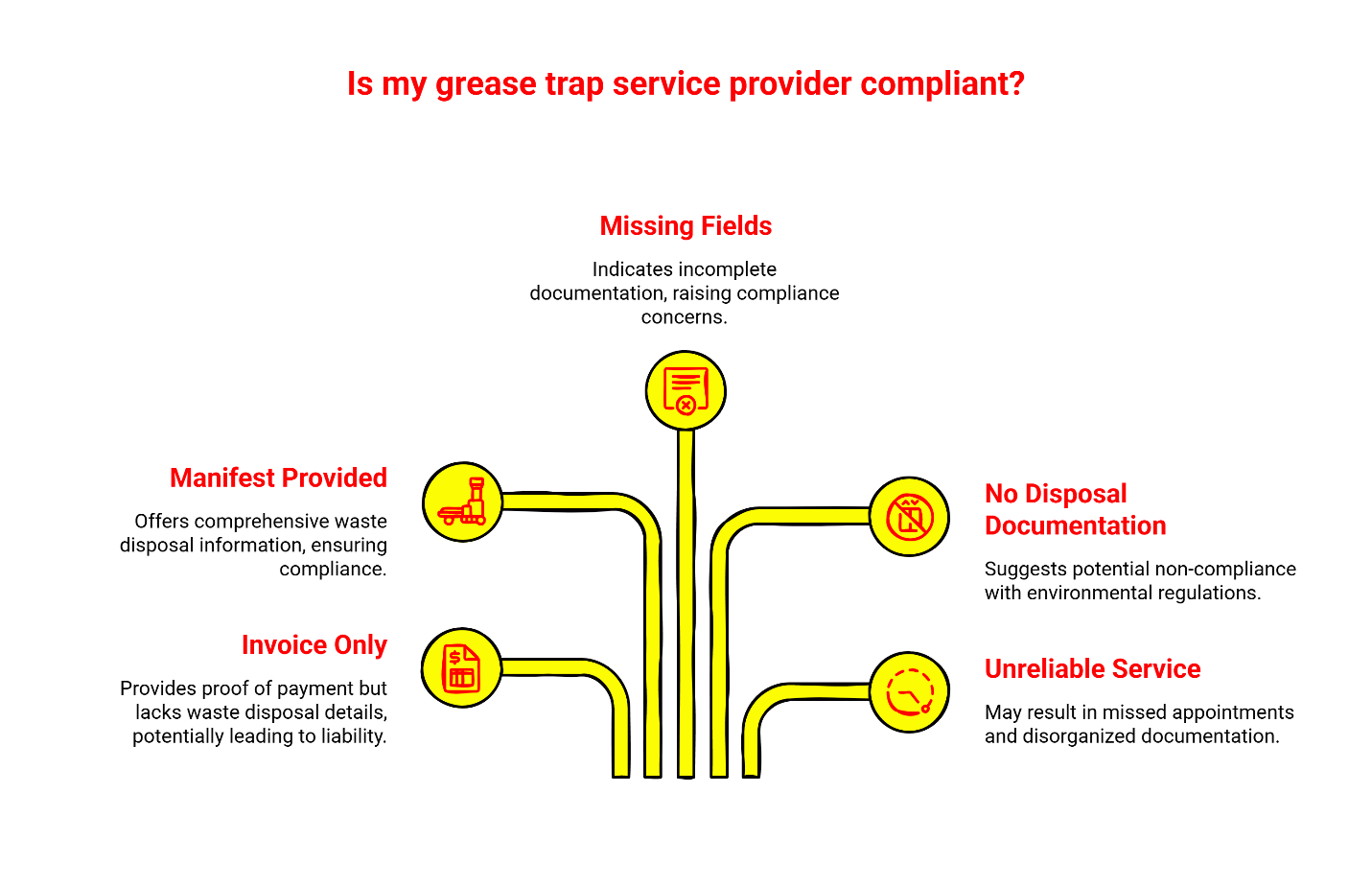
Invoice vs. manifest. An invoice proves you paid. A manifest proves where your waste went—the hauler’s information, the date, the volume, and the approved disposal facility. Inspectors want manifests.
Chain-of-custody fields. Your manifest should show: service date, volume removed, hauler identification, and disposal facility. Missing fields mean missing proof.
Disposal documentation. Ask whether your provider documents transport to approved facilities. Environmentally responsible disposal isn’t just good practice—it’s part of the compliance chain.
Reliability signals. Does your provider offer proactive scheduling? Do they remind you before the 90-day window closes? Do they deliver clean, organized documentation after every visit?
Commercial grease trap cleaning that generates proper manifests turns every service visit into verifiable legal defense.
Set Up ‘Invisible Compliance’: A Simple Routine That Keeps You Inspection-Ready
Compliance shouldn’t require heroic effort. Build a lightweight system that runs in the background.
Monthly: Walk the checklist above. Five minutes. Look for odors, access issues, and paperwork gaps.
Quarterly (minimum): Service on the calendar—scheduled in advance, not scrambled at day 89. If you’re high-volume, you may need service every six to eight weeks.
After every service: File the manifest immediately. Keep it on-site, organized by date. Don’t let paperwork pile up in the office.
The goal is invisible compliance—a system so routine that inspections become non-events. For a more detailed Houston-specific reference, see The Official Houston Restaurant FOG Compliance Checklist.
Common Pitfalls That Fail Inspections
Waiting until day 89. Last-minute scheduling often means delayed service, which means you’re out of compliance when the inspector arrives.
Believing enzymes or hot water count as cleaning. They don’t. Physical removal and documented disposal are the compliance standard. Additives don’t satisfy the 25% rule or produce manifests. Treating “it looks fine” as a substitute for real service isn’t a compliance plan—it’s hope with a receipt.
Keeping invoices but not manifests. Your accountant wants invoices. Inspectors want manifests. Make sure you’re keeping both.
Blocking the sample well. If an inspector can’t access it quickly and safely, you’ve created a problem before the measurement even happens.
When to Call for Help (And What to Ask on the Phone)
If any item on your checklist is a FAIL, schedule service before an inspector finds the same problem.
When you call, ask:
- “Will you provide a manifest with clear chain-of-custody documentation?”
- “Can you set a proactive schedule based on our volume—not just a generic quarterly plan?”
- “Do you service my area, and can you work around our kitchen access windows?”
Drane Ranger serves Alvin, Houston, Pearland, Sugar Land, and the surrounding Greater Houston area. Since 1985, our team has helped commercial kitchens stay compliant with proper documentation and reliable scheduling.
Quick FAQ
What is a “sample well,” in practical terms?
It’s the access point an inspector uses to pull a wastewater sample. If it’s blocked, unsafe, or unknown, you’re vulnerable—even if your trap was serviced recently.
Should we keep invoices, manifests, or both?
Keep both, but treat manifests as the compliance-critical record. Invoices show you paid; manifests show chain-of-custody.
What’s the simplest way to stay inspection-ready year-round?
Monthly checklist walk-through, proactive scheduling, and on-site binder discipline. That combination eliminates surprise inspection panic.
Ready to Close Your Compliance Gaps?
“My experience with Drane Ranger was a very organized, professional and on time experience. I was kept informed of what was happening and a suggested time of cleaning again. I will use them again and will definitely recommend them to anyone I speak with.” — Harold R., Google Reviews
“Drain Ranger is very professional and reliable. Basically they can take care of all your grease drain needs.” — Shelley M., Google Reviews
Contact Drane Ranger to request a quote, or call 281-489-1765 (Mon–Fri, 9am–6pm).
Verify our standing at the Better Business Bureau.
Our Editorial Process:
Our expert team uses AI tools to help organize and structure our initial drafts. Every piece is then extensively rewritten, fact-checked, and enriched with first-hand insights and experiences by expert humans on our Insights Team to ensure accuracy and clarity.
About the Drane Ranger Insights Team:
The Drane Ranger Insights Team is our dedicated engine for synthesizing complex topics into clear, helpful guides. While our content is thoroughly reviewed for clarity and accuracy, it is for informational purposes and should not replace professional advice.