
Five Signs It’s Time for a Routine Tank Cleanout (Before the Smell Starts)

📌 Key Takeaways

Your septic system signals trouble long before it creates a crisis—recognizing these warnings early keeps your home safe and your wallet intact.

  • Odors Are Your First Alert: Faint sewage smells near drains or your yard indicate your tank is approaching capacity or developing a leak—schedule inspection before the problem escalates.
  • Multiple Slow Drains Mean System-Wide Issues: When several fixtures drain sluggishly together, accumulated sludge is restricting flow throughout your entire plumbing system, not just one pipe.
  • Gurgling Toilets Signal Urgent Action Needed: That bubbling sound represents air displacement from a full tank or blockage—this warning appears just before backups occur.
  • Unusually Green Grass Reveals Hidden Problems: A vibrant strip of grass over your tank or drain field during dry weather means nutrient-rich wastewater is reaching the surface due to overfill or system failure.
  • Soggy Yards Demand Immediate Response: Spongy ground or standing water without rain indicates drain field saturation—rope off the area and schedule same-week service to prevent health risks and property damage.

Early detection prevents expensive drain field replacement and protects your family from wastewater exposure.

Houston and Alvin homeowners managing residential septic systems will find actionable warning signs here, preparing them for the detailed maintenance guidance that follows.

A faint odor near your outdoor drain. A toilet that gurgles when you flush. These quiet signals mean your septic system needs attention—and catching them early prevents the messy, expensive problems that come when a tank reaches capacity.

Your septic system works quietly in the background, protecting your property value and family health every day. Think of routine maintenance the same way you think about changing your car’s oil—it’s the simple step that prevents major breakdowns. Miss that maintenance window, and small issues escalate quickly into backups, saturated drain fields, and emergency service calls.

A routine tank cleanout removes the accumulated solids and liquids that naturally build up over time, restoring your system to full capacity. For Houston and Alvin homeowners, recognizing the early warning signs means you can schedule service at your convenience instead of dealing with a crisis.

Here are five concrete indicators that signal it’s time to contact a professional for service.


Don’t wait for a smell—odors mean it’s already late.

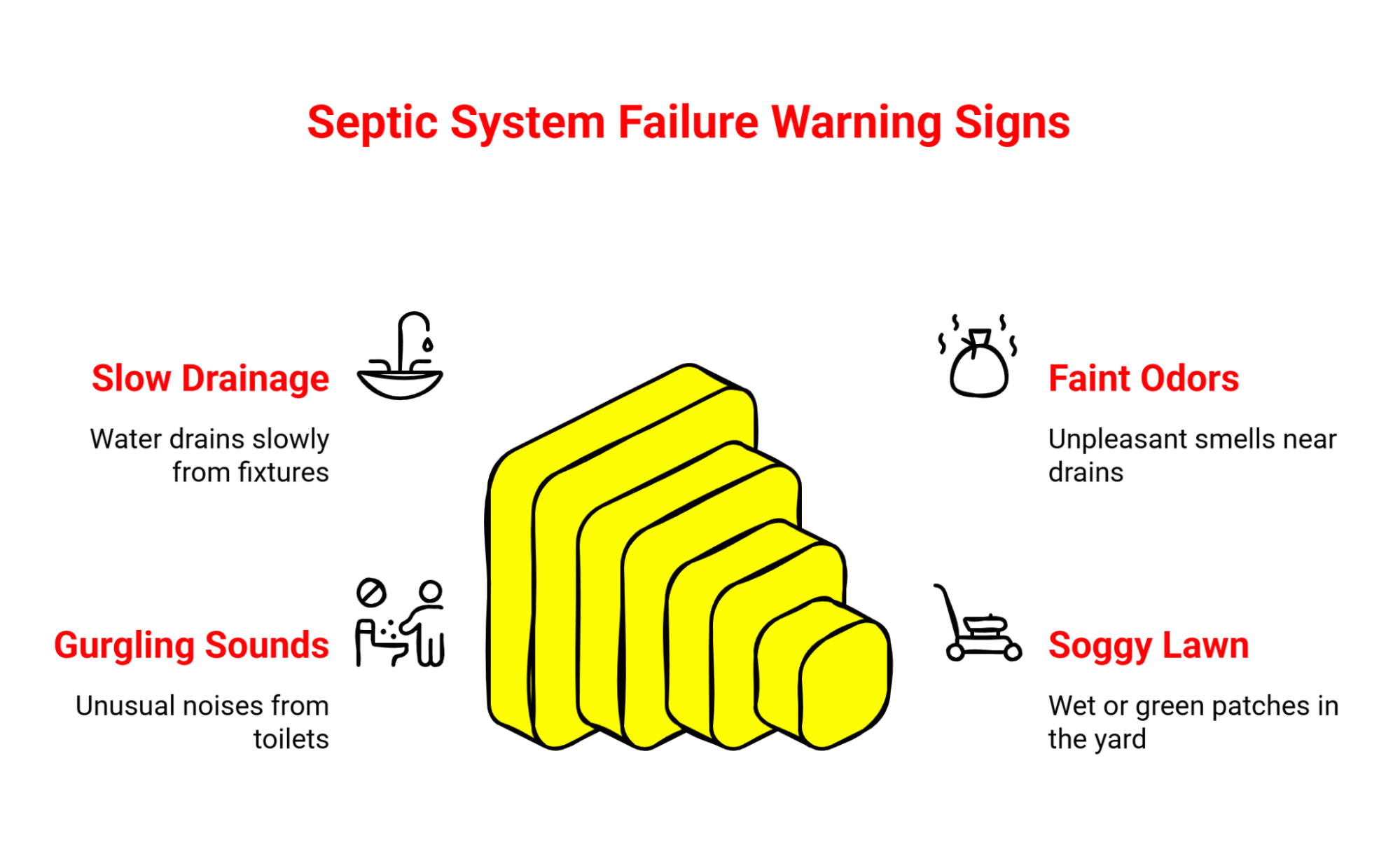
The Fast Checklist: Are You Seeing Any of These 5 Signs?

Sign What It Means Urgency Level Your Next Step
Faint sewage odors indoors or near tank area Tank approaching capacity or small leak present Medium Schedule inspection within 2 weeks
Multiple fixtures draining slowly Sludge restricting wastewater flow Medium Book cleanout to restore capacity
Gurgling sounds from toilet Air displacement indicating blockage or full tank High Call for prompt service
Unusually lush grass over tank or drain field Nutrient-rich effluent reaching surface Medium-High Request professional evaluation
Soggy yard without recent rain Drain field saturation or system overflow Urgent Limit access; schedule same-week service

Time-based indicator: If your last pump-out was more than three years ago, schedule proactive service regardless of symptoms. Most residential systems benefit from professional service every two to three years, though the exact interval can vary based on tank size, household usage, and your specific system design.
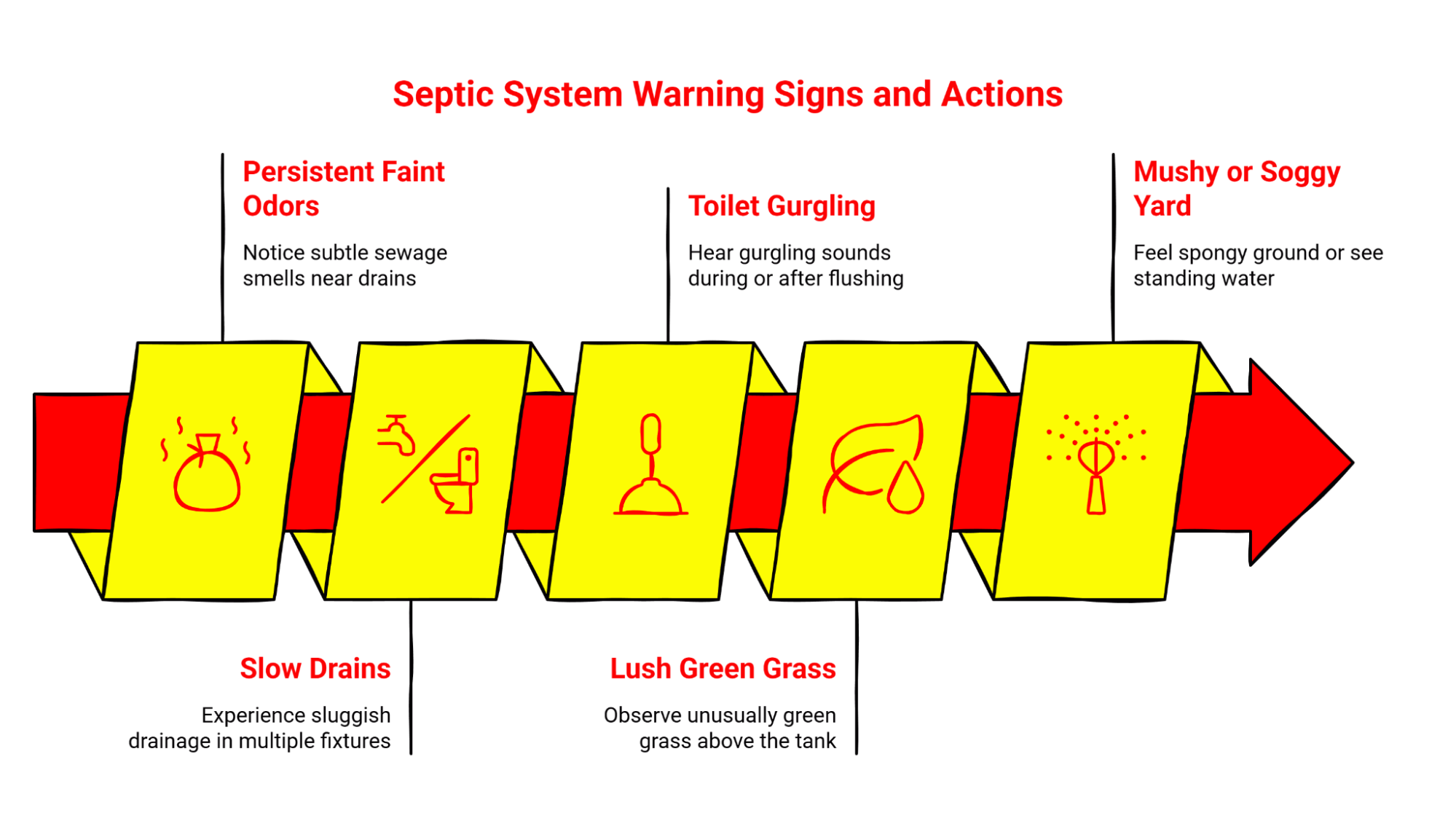
Diagram showing septic system warning signs and actions.

Sign #1: Persistent Faint Odors Near Drains or the Tank Area

That subtle sewage smell you catch occasionally near your outdoor drains or over the area where your tank sits underground is your system’s earliest alarm. When odors become noticeable, the tank may be approaching capacity or a component may be leaking.

Many homeowners dismiss these faint smells, assuming they’ll dissipate. They don’t—they intensify. What starts as an occasional whiff becomes a persistent problem that affects your yard and eventually your home’s interior.

What you should do: Don’t wait for odors to strengthen or spread. Contact Drane Ranger for septic tank service while the issue remains manageable. Early intervention prevents sewage smells from permeating your property.

Sign #2: Slow Drains Across Multiple Fixtures

A single slow-draining sink often indicates a localized clog in that fixture’s trap or drain line. But when your kitchen sink, bathroom shower, and washing machine all drain sluggishly at the same time, you’re looking at a system-wide issue. As sludge accumulates in your septic tank, it reduces the available volume for wastewater.

This symptom tends to worsen gradually. You might not notice it day to day, but compare how quickly water drains now versus six months ago. The difference reveals how much your tank’s capacity has diminished.

What you should do: Schedule a professional cleanout in Houston to remove accumulated solids. Once the tank is pumped, drainage speed typically returns to normal. This isn’t a problem that resolves on its own—it only worsens until the tank is serviced.

Sign #3: Toilet Gurgling During or After Flushes

That distinctive gurgling sound when you flush represents air being displaced by restricted wastewater flow. It signals that your system can’t move water freely anymore, either because the tank is too full or because a blockage has formed. This is more concerning than slow drains because it indicates your system is under stress.

What you should do: Treat gurgling as a high-priority warning. This symptom can lead to sewage backing up into your home. Call for inspection and pump-out service promptly. At Drane Ranger, we understand the urgency of this symptom and prioritize these appointments.

Sign #4: Unusually Lush, Over-Green Grass Above the Tank or Drain Field

If you notice a distinctly greener, more vigorous strip of grass directly over your septic tank or drain field—especially during dry periods—that’s a warning sign worth investigating.

Nutrient-rich effluent may be reaching the surface, essentially fertilizing that specific area. This happens when your tank is overfull and can’t properly contain wastewater, or when your drain field isn’t processing effluent correctly.

What you should do: Request a professional evaluation. This visible symptom indicates your system needs attention before the situation progresses to actual pooling water or soggy ground. Early assessment can determine whether you need pumping, drain field maintenance, or both.

Sign #5: Mushy or Soggy Yard When It Hasn’t Rained

This is the most urgent warning on the list. When your yard feels spongy underfoot or shows standing water near your tank or drain field without recent rainfall, your system is either saturated or actively overflowing. This creates immediate health risks for your family and pets and can damage your landscaping.

The soggy area may appear suddenly after a period of heavy household water use, or it might develop gradually over several days. Either way, it indicates that wastewater isn’t being properly absorbed and processed by your drain field.

What you should do: Rope off the affected area to prevent children and pets from contact with contaminated soil. Then schedule service immediately—ideally within the same week. This situation won’t improve on its own and typically worsens rapidly. At Drane Ranger, we prioritize urgent calls to prevent property damage and protect public health.


Why Early Detection Saves Money and Protects Your Property

Ignoring these warning signs doesn’t make them disappear—it allows problems to worsen. When sludge fills beyond the tank’s effective capacity, wastewater can’t separate properly. Material that should remain in the tank can enter your drain field and affect its function.

A failed drain field requires excavation and replacement—a significant expense compared to routine maintenance. Early pumping helps maintain your drain field’s function and can prevent backups into your home.

For comprehensive information on how septic systems work and maintenance best practices, the U.S. Environmental Protection Agency provides detailed homeowner guidance. Texas residents can also consult the Texas Commission on Environmental Quality for state-specific standards and requirements.

Wastewater issues in your yard pose risks to anyone who comes in contact with the affected area, and backups inside your house may require professional cleanup. These concerns intensify the longer you delay service.


What Happens During a Professional Cleanout
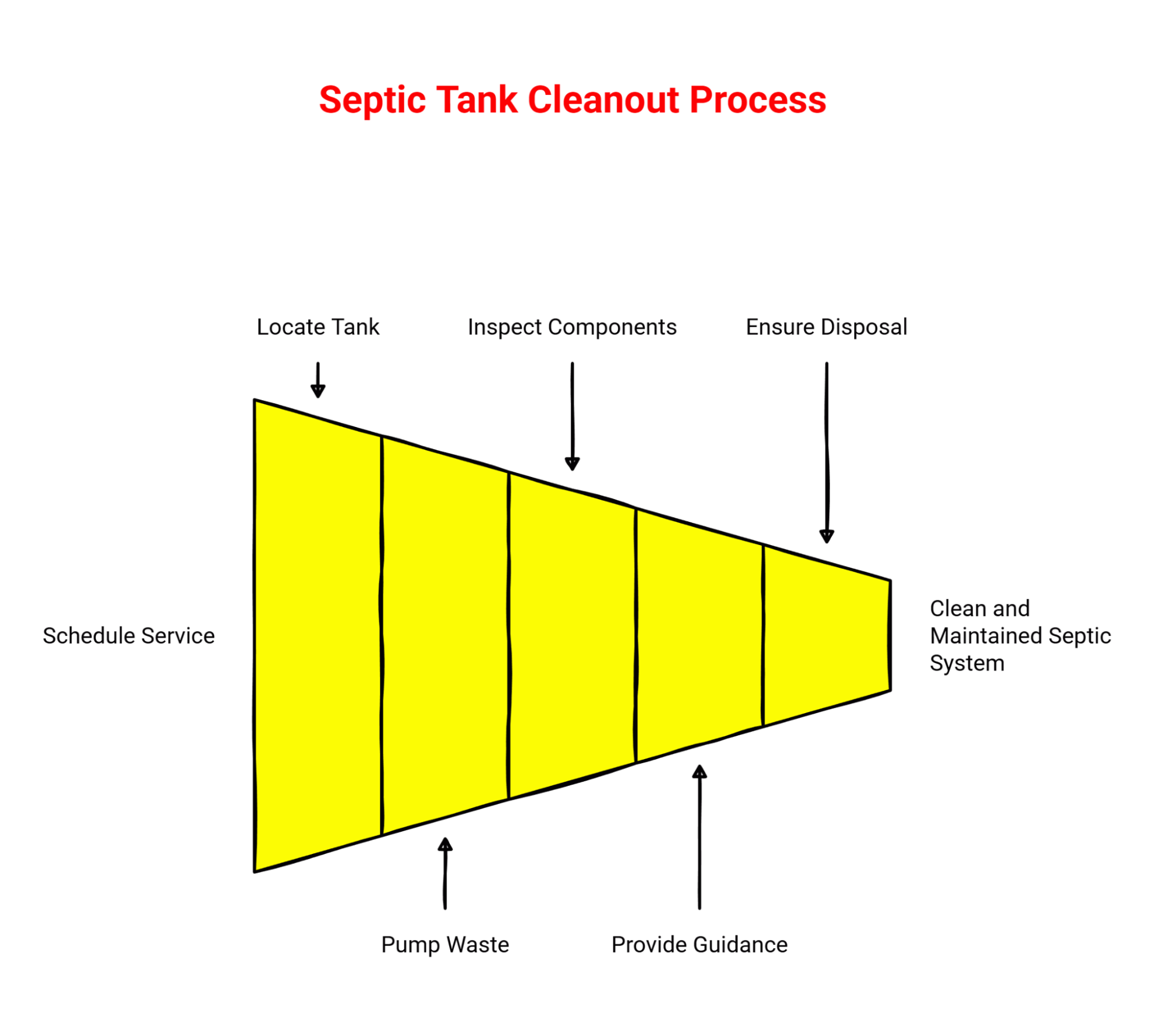
Septic cleanout process from scheduling to disposal.

Understanding the service process helps explain why professional equipment and expertise matter for this maintenance task.

When you schedule service with Drane Ranger in Alvin or the surrounding area, the process includes several key stages:

Locating and accessing the tank. The technician identifies your tank’s location and uncovers the access port. This initial inspection reveals the tank’s condition and confirms its position relative to your home’s plumbing.

Pumping liquids and removing sludge. Using vacuum truck equipment, we remove both the liquid wastewater and the accumulated solid material from the tank. This empties the chamber, resetting it to full capacity.

Inspecting critical components. While the tank is empty, we check baffles, inlet and outlet pipes, and the tank’s structural integrity. This inspection catches small problems before they become serious failures. We look for cracks, corrosion, or component damage that might need repair.

Providing maintenance guidance. Based on your household size, water usage patterns, and what we observed during service, we recommend when you should schedule your next cleanout. This helps you stay ahead of problems rather than reacting to them. Keep in mind that exact service intervals vary by system design and individual usage patterns.

Ensuring proper disposal. All removed waste is transported to approved treatment facilities according to local regulations. This responsible handling protects public health and environmental quality.

Professional service providers have the training, equipment, and disposal permits required to handle septic waste safely.


What Homeowners Are Saying

Houston-area residents who’ve worked with Drane Ranger consistently mention the organization, professionalism, and clear communication they experienced:

“My experience with Drane Ranger was a very organized, professional and on time experience. I was kept informed of what was happening and a suggested time of cleaning again. I will use them again and will definitely recommend them to anyone I speak with.”
— Harold R.

“He has done all my septic work and is the best!”
— John S.

“Drain Ranger is very professional and reliable. Basically they can take care of all your grease drain needs.”
— Shelley M.

These homeowners recognized warning signs early, scheduled proactive service, and maintained their systems in good working order.


Your Next Step

If you’ve noticed any of these five indicators—or if you’ve simply reached the three-year mark since your last service—now is the time to schedule a cleanout. Drane Ranger serves Houston, Alvin, Pearland, Sugar Land, and surrounding communities throughout the Greater Houston area with reliable general wastewater services.

Your septic system protects your home quietly and continuously. Timely maintenance keeps everything functioning properly, helps prevent system failures, and maintains your property’s value and your family’s comfort.

Ready to Schedule Service?

Call 281-489-1765 to start your service today, or use these convenient options:

Helpful Resources


Our Editorial Process

All content undergoes multi-stage review including technical accuracy verification against TCEQ model standards, local regulation compliance checking, and practical application testing. We distinguish between verified regulatory requirements and generally accepted industry practices to help operators understand certainty levels.


About the Drane Ranger Insights Team

The Drane Ranger Insights Team synthesizes complex topics into clear, helpful guides for homeowners. While our content is thoroughly reviewed for clarity and accuracy, it serves informational purposes and should not replace professional advice specific to your property and circumstances.

Disclaimer: This guide provides general information about septic system maintenance. For decisions specific to your property and circumstances, we recommend consulting a qualified septic professional who can assess your individual system.

See How the “Home Health Reset” Saved This Houston Family’s Weekend

📌 Key Takeaways

A septic system running past capacity doesn’t announce itself with alarms—it whispers through slow drains, faint odors, and gurgling toilets before escalating into a weekend-ruining emergency.

  • The “Home Health Reset” Restores Biological Balance: Routine septic tank cleaning physically removes accumulated sludge and scum, allowing the system’s natural bacteria to properly separate solids from wastewater and maintain normal flow to the drain field.
  • Two to Three Years Is the Standard Cadence, Not a Universal Rule: Most Houston-area households benefit from pumping every two to three years, though families of five in smaller tanks need more frequent service than couples with larger systems.
  • Early Warning Signs Prevent Emergency Calls: Slow drainage across multiple fixtures, faint sewage odors near drains or in the yard, toilet gurgling, and soggy or over-green grass patches above the tank all signal capacity issues that worsen without intervention.
  • A Standard Cleanout Takes Under an Hour: The process—locating access points, safety checks, pumping, baffle inspection, and flow verification—typically completes in 45 minutes to an hour, with minimal disruption to the property.
  • Professional Service Includes Compliance and Planning: Responsible providers handle waste according to Texas environmental standards, dispose of it at approved facilities, and help homeowners establish simple maintenance schedules that prevent future panic.

Act before the gurgle becomes a backup—routine care beats emergency response every time.

Houston-area homeowners with septic systems will find a clear framework here, preparing them for the detailed service overview and local guidance that follows.

It was 4:30 on a Friday afternoon in southwest Houston when Sarah first noticed the smell. Nothing dramatic—just a faint, unpleasant odor drifting up from the hallway bathroom. She dismissed it, focusing instead on the weekend ahead: her daughter’s birthday party on Saturday, family coming in from out of town, and a house that needed to look perfect.

By dinner time, the kitchen sink was draining slower than usual. Her husband tried the plunger. No change. Then came the sound no homeowner wants to hear—a low, unsettling gurgle from the toilet down the hall.

That gurgle was their septic system sending a clear message: we’re running out of capacity, and you’re running out of time.


What a “Home Health Reset” Actually Means for Your System

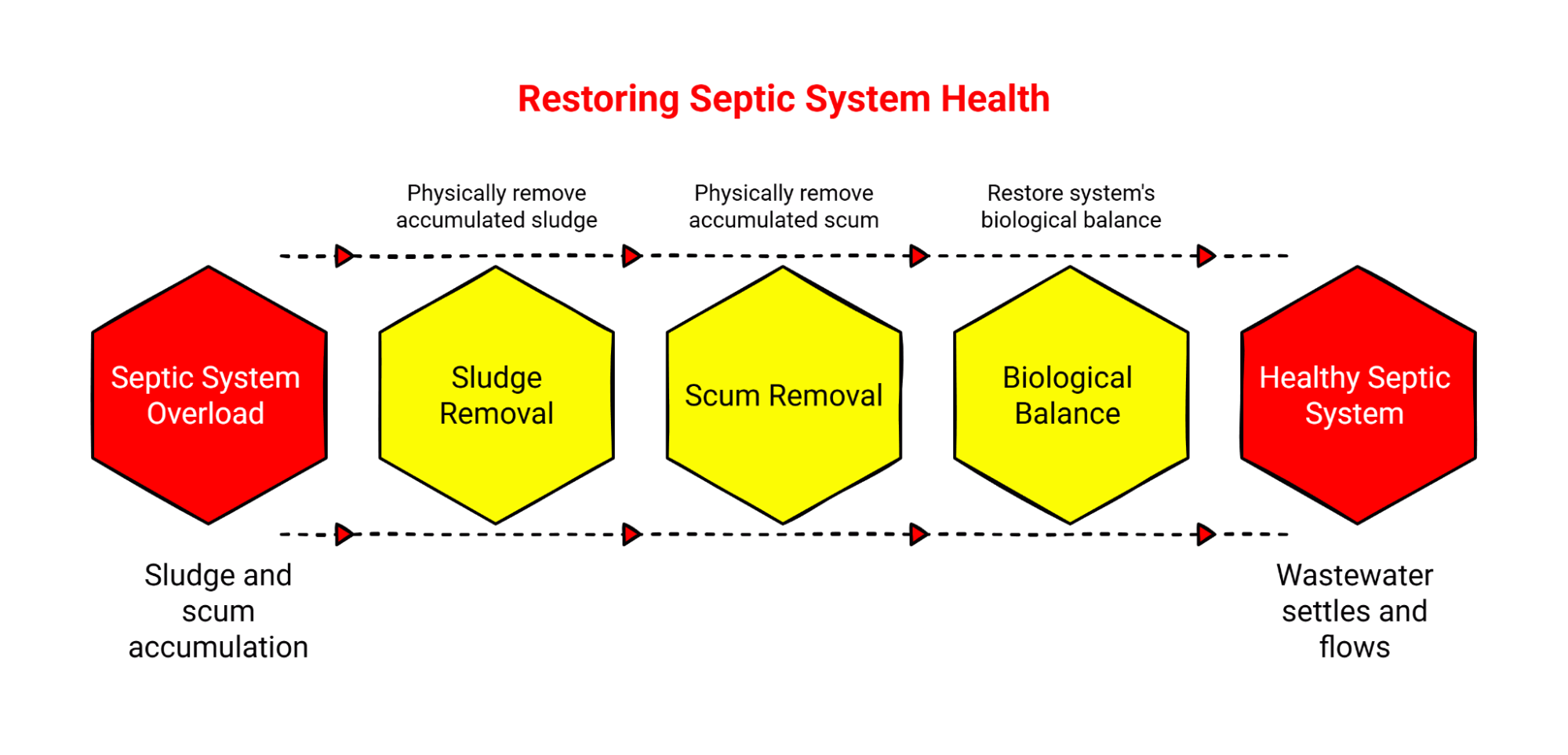
Flowchart from septic system overload to healthy septic system.

A residential septic tank cleaning—what we call the “Home Health Reset”—is the physical removal of accumulated sludge and scum that builds up in your tank over time. Think of it as your home’s plumbing getting a complete refresh, similar to how an oil change keeps your car’s engine running smoothly.

Here’s what actually happens inside your tank: as wastewater flows in from your home, solids settle to the bottom forming sludge, while oils and grease float to the top as scum. The relatively clear water in the middle flows out to your drain field. When sludge levels rise too high, that separation breaks down. The biological balance your system depends on gets disrupted, preventing wastewater from settling and flowing as intended. Solids start flowing where they shouldn’t, your drain field gets clogged, and you end up with the exact problems Sarah’s family faced that Friday evening.

The typical Houston-area household benefits from this reset every two to three years, though your specific timing depends on household size, tank capacity, and water usage patterns. A family of five in a 1,000-gallon tank will need service more frequently than a couple with a 1,500-gallon system. The U.S. Environmental Protection Agency provides comprehensive guidance on maintaining septic systems to prevent costly failures.

The Friday Evening That Changed Everything

Sarah called us at 6:15 PM, describing the symptoms. Our technician asked three quick questions: How long since your last pumping? Any soggy spots in the yard above the tank? Has the gurgling been getting worse or staying the same?

The answers told him what he needed to know. Sarah couldn’t remember the last service—they’d bought the house three years ago and assumed the previous owners had handled it. There was a patch of grass near the back fence that stayed greener than the rest of the lawn, even during dry weeks. And yes, the gurgling had progressed from occasional to constant over the past month.

We scheduled her for first thing Saturday morning. The birthday party was at 2 PM. She had roughly nine hours to get her system working again.

The 45-Minute Process That Saved Their Weekend

Our truck arrived at 7:30 AM. The technician located the tank access covers, performed a safety check for toxic gases, and measured the sludge levels. Sarah’s tank was at 40% capacity—well past the point where problems start.

The pump-out itself is straightforward but thorough. A powerful vacuum hose removes all liquid and solid waste from the tank, including the stubborn sludge that’s compacted at the bottom. The technician then inspected the baffles (the components that prevent solids from flowing to the drain field) and verified that the outlet pipe was clear.

The entire process emphasizes responsible handling and clear communication at every step. We operate in full compliance with Texas environmental standards, ensuring proper containment and disposal at approved facilities.

By 8:15 AM, the tank was empty, clean, and ready to resume its job. The technician walked Sarah through what he’d found, explained the warning signs to watch for in the future, and helped her set up a simple maintenance schedule. No more guessing. No more Friday evening panic.

The morning’s total time investment: 45 minutes. The peace of mind: immeasurable.

Before and After: What Really Changes

Before the Reset After the Reset
Persistent worry about strange smells Fresh air throughout the house
Slow drains creating daily frustration Normal drainage speed restored
Constant monitoring of every flush Confidence in the system’s function
Weekend plans feeling uncertain Weekend proceeding as planned
Stress about potential emergency costs Simple calendar reminder for future service


“My experience with Drane Ranger was a very organized, professional and on time experience. I was kept informed of what was happening and a suggested time of cleaning again. I will use them again and will definitely recommend them to anyone I speak with.” — Harold R.

This isn’t just about fixing a plumbing problem. It’s about reclaiming the assumption that your home’s basic systems will work when you need them to.


The Warning Signs You Shouldn’t Ignore

Flowchart from septic system overload to healthy septic system.

Sarah’s situation didn’t develop overnight. Her septic system had been sending signals for weeks, maybe months. Most homeowners miss these early warnings because they start subtle and escalate gradually.

Watch for these red flags:

Slow drainage from sinks, tubs, or showers, especially if multiple fixtures are affected at once. When your washing machine drains and your shower backs up, that’s not a coincidence—it’s a capacity issue.

Faint odors near drains or in the yard above your septic system. Fresh sewage has a distinct smell that shouldn’t be present in a properly functioning system. The Centers for Disease Control and Prevention notes that exposure to untreated wastewater poses health risks that proper system maintenance helps prevent.

Gurgling sounds from toilets or drains when other fixtures are in use. This happens when air can’t escape normally because the system is too full.

Patches of lawn that stay soggy or unusually green, particularly above where your tank and drain field are located. This suggests wastewater is surfacing instead of being absorbed properly.

The Environmental Protection Agency emphasizes that addressing these signs promptly prevents the more serious problems that lead to complete system failure. The difference between a routine service call and an emergency replacement can be thousands of dollars.

If you’re seeing any combination of these symptoms, don’t wait for them to worsen. A quick inspection can confirm whether you need service now or if you have a few months before your next scheduled cleaning.

Why Houston-Area Systems Need Consistent Attention

The Greater Houston climate creates specific challenges for septic systems. High water tables, clay-heavy soils in many areas, and our region’s intense rain events all affect how efficiently your drain field processes wastewater.

Since 1985, we’ve served homeowners throughout Houston, Alvin, Pearland, Sugar Land, and Texas City—essentially a 100-mile radius from our location on India Street. That three-decade perspective has taught us that systems in our area perform best with regular attention rather than reactive emergency calls.

We handle every aspect of the process according to local and state regulations, including those set by the Texas Commission on Environmental Quality, from proper waste removal to environmentally responsible disposal at approved facilities. Your home’s wastewater doesn’t just disappear—it goes through a careful treatment process that protects our local water sources and ecosystems.

“He has done all my septic work and is the best!” — John S.

Your Simple Next Steps

If you’re experiencing any of the warning signs we’ve described, your best move is a quick phone consultation. Call us at 281-489-1765 to describe what you’re noticing. We can often tell you over the phone whether you need immediate service or if you have time to schedule at your convenience.

For homes that haven’t had service in the past two to three years, now is the time to get ahead of potential problems. You don’t want to discover a capacity issue on a holiday weekend or right before houseguests arrive.

Ready to schedule your Home Health Reset? Contact us today or call 281-489-1765. We’ll get you on the calendar, explain exactly what to expect, and give you back the confidence that your home’s most essential system is working the way it should.

For more detailed information about septic tank services and maintenance schedules specific to our area, explore our Houston septic tank cleaning guide or learn about our comprehensive approach to septic system care in Alvin and surrounding areas.


Frequently Asked Questions

How often should I schedule a Home Health Reset?

Most Houston-area homes benefit from service every two to three years. The exact timing depends on your household size, tank capacity, and water usage. A family of five will need more frequent service than a retired couple. We’ll help you determine the right schedule for your specific situation.

What are the first signs I shouldn’t ignore?

Slow drains, faint sewage odors, gurgling sounds from toilets, and soggy or unusually green patches of grass above your septic system. Any combination of these symptoms means your system needs attention soon.

How long does a service visit take?

Most residential cleanouts take 45 minutes to an hour, depending on tank size, access conditions, and how much accumulated material needs removal. We’ll give you a time estimate when you schedule.

Do you serve my neighborhood?

We cover Houston and the surrounding areas within roughly 100 miles, including Alvin, Pearland, Sugar Land, Texas City, League City, Manvel, Rosharon, Angleton, and Friendswood. If you’re unsure whether we serve your location, just give us a call.

Additional Resources

For homeowners seeking more information about septic system care and maintenance:


Our Editorial Process

All content undergoes multi-stage review including technical accuracy verification against TCEQ model standards, local regulation compliance checking, and practical application testing. We distinguish between verified regulatory requirements and generally accepted industry practices to help operators understand certainty levels.


About the Drane Ranger Insights Team

The Drane Ranger Insights Team is our dedicated engine for synthesizing complex topics into clear, helpful guides. While our content is thoroughly reviewed for clarity and accuracy, it is for informational purposes and should not replace professional advice.

Disclaimer: This guide is intended as a comprehensive starting point. For decisions specific to your unique situation, we always recommend consulting a qualified professional.

The “Toilet Gurgle” Alert: When to Call for Emergency Pumping

📌 Key Takeaways

A toilet gurgle isn’t background noise—it’s your septic system’s auditory alarm signaling that wastewater flow is restricted and capacity is compromised.

  • The Gurgle Decodes System Stress: When air is forced back through your toilet bowl, it means wastewater can’t exit properly due to a full tank, blocked line, or venting issue.
  • Three Zones Define Response Speed: Green symptoms (isolated gurgle, normal drains) mean schedule routine service; Yellow (multiple fixtures, faint odors) means call within 48 hours; Red (backup, strong odors, soggy ground) demands immediate emergency pumping.
  • Emergency Pumping Functions as First Response: This service stops active backups, restores tank capacity, and prevents sewage from entering living spaces—it’s crisis stabilization, not just maintenance.
  • Houston’s Clay Soil Shortens Safe Intervals: Poor drain field absorption in the region’s clay-rich soil puts extra stress on septic systems, typically requiring pumping every 2-3 years instead of the 3-5 year schedule common elsewhere.
  • Proactive Cleanouts Transform Risk Into Reliability: Routine pumping every 2-3 years catches problems before symptoms appear, protects property value, and eliminates the health risks and expense of emergency backups.

React to the warning, not the disaster—speed determines whether you face a service call or a sewage cleanup.

Homeowners with residential septic systems in Greater Houston and Alvin will find a practical decision framework here, preparing them for the detailed severity assessment and emergency response guidance that follows.

That unmistakable sound from the bathroom—a low gurgle echoing from the toilet bowl when no one has flushed—stops homeowners in their tracks. It’s the kind of noise that makes you pause mid-conversation, wondering if you really just heard what you think you heard.

When a toilet gurgles, it’s doing more than making an unsettling noise. It’s delivering an auditory warning that something in your septic system needs immediate attention. Think of it as your plumbing clearing its throat, trying to tell you that wastewater isn’t flowing the way it should. For homeowners in Greater Houston and Alvin relying on septic systems, understanding what this sound means—and knowing when it signals an emergency—can be the difference between a quick professional visit and a sewage backup that turns your weekend into a nightmare.

This guide will walk you through exactly what causes toilet gurgling, provide a simple severity scale to assess your situation, and give you the confidence to know when it’s time to contact a professional or call 281-489-1765.


What Your Toilet’s Gurgling Is Really Telling You

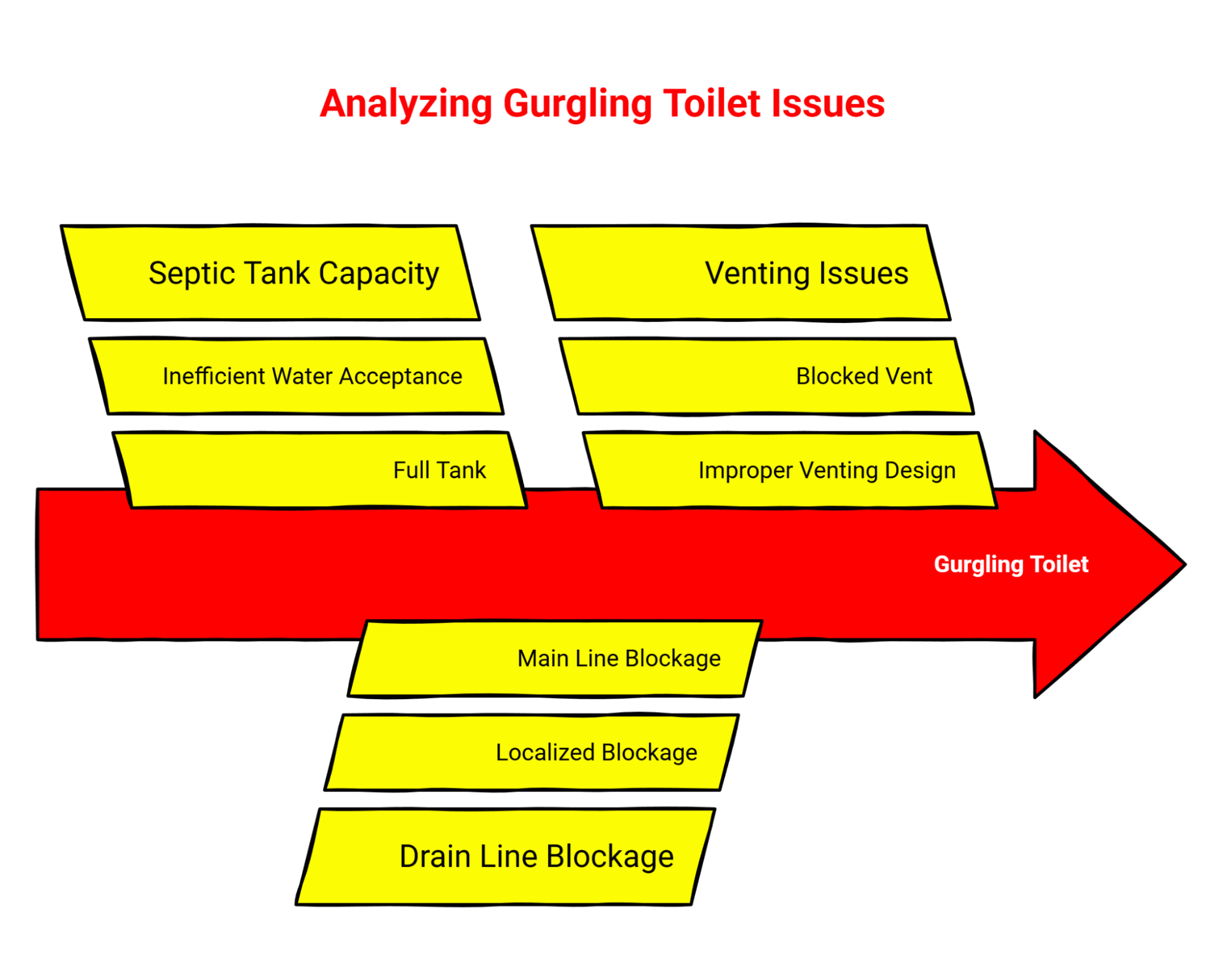
Fishbone chart outlining reasons a toilet gurgles.

A gurgling toilet is signaling that air is trapped somewhere in your plumbing system and wastewater flow is being restricted. This happens for three primary reasons: your septic tank has reached capacity and can no longer accept water efficiently, a drain line has become blocked, or there’s a venting issue preventing air from escaping properly as water drains.

When wastewater tries to flow into an already-full tank, it creates back-pressure that forces air bubbles up through the nearest fixture—often your toilet. The gurgling sound is literally trapped air being pushed back into your home instead of venting safely outside. The EPA provides detailed information on how residential septic systems work and why proper flow is critical to system health.

Here’s where the situation gets more concerning. If just one toilet in your home gurgles occasionally, it might indicate a localized drain issue. However, when multiple fixtures start gurgling—especially when you run water in the sink or flush a toilet elsewhere in the house—it strongly suggests your septic tank is full or a main line is blocked. This escalates the situation from “keep an eye on it” to “call a professional soon.”

If you’re experiencing gurgling right now, take these immediate safety steps while you assess the severity:

  • Reduce non-essential water use until you determine the cause
  • Keep children and pets away from any soggy areas of ground near your septic tank or drain field
  • Do not attempt to open the tank yourself, add chemical treatments, or use drain snakes on septic system lines

The “Noise Severity Scale”: When a Gurgle Becomes an Emergency

Not every gurgle demands immediate action, but some combinations of symptoms absolutely do. Use this severity scale to quickly assess your situation:


Severity Signs You’ll Notice What’s Likely Happening How Urgent What to Do
Green Zone Occasional gurgle from one fixture; normal flushing; no odors; drains working at regular speed Tank approaching capacity or minor venting irregularity Low Schedule routine tank cleanout if you haven’t had one in 2-3 years; monitor for changes
Yellow Zone Multiple fixtures gurgling; faint sewage odors near drains; some drains noticeably slower than usual Tank is full or nearing capacity; possible partial blockage in main line Medium Contact a septic professional within 24-48 hours for evaluation and pumping
Red Zone Gurgling with actual wastewater backup; strong sewage odors throughout home; visible wastewater pooling near tank; toilets won’t flush or water rises in bowl Septic tank completely full or major blockage preventing drainage Critical Call for emergency pumping immediately: 281-489-1765


The Houston area’s clay-rich soil reduces how well drain fields can absorb water, which puts extra stress on the entire septic system and often shortens the typical pumping interval to every two to three years rather than the three-to-five-year schedule common in other regions.

If you’re in the Red Zone or concerned about potential health risks from sewage exposure, the CDC provides guidance on wastewater safety that every homeowner should know.

Ready to get help? Start your service today or call 281-489-1765.


When to Call for Emergency Pumping vs. When to Schedule Routine Service

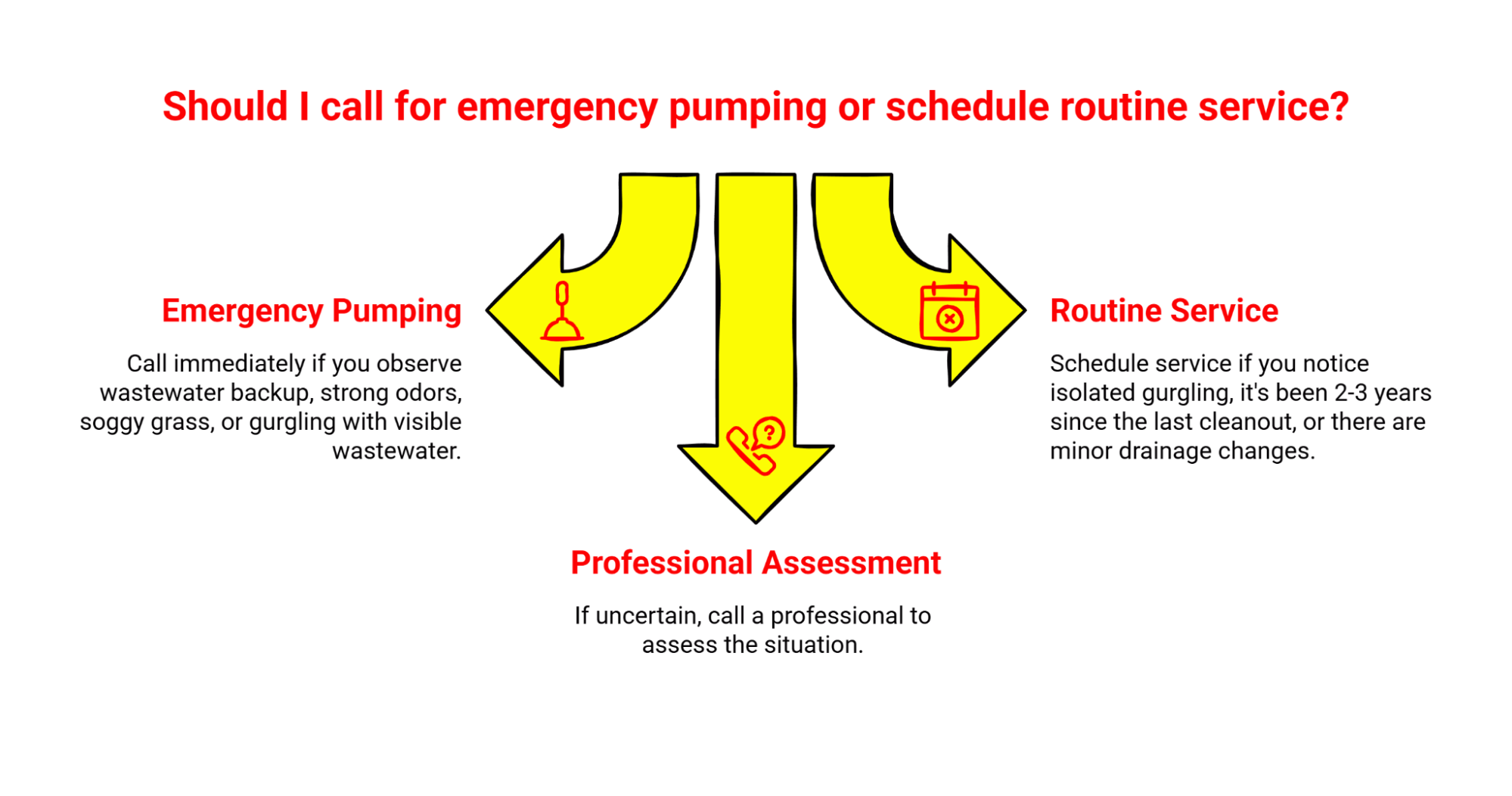
Diagram explaining when to call for emergency septic pumping or routine service.

Understanding the distinction between an emergency and routine maintenance helps homeowners respond appropriately without unnecessary panic—or dangerous delays.

Call for emergency septic pumping when you observe any of these conditions: wastewater backing up into toilets, sinks, or showers; strong sewage odors inside the home; soggy or unusually lush green areas of grass above or near your septic tank or drain field; or the combination of gurgling sounds with visible wastewater or complete drainage failure.

Schedule routine septic service when you notice isolated gurgling without other symptoms, it’s been 2-3 years since your last tank cleanout, or you’re experiencing minor changes in drainage speed across multiple fixtures. In Greater Houston and Alvin, where many homes sit on septic systems, professional septic companies like Drane Ranger recommend proactive scheduling based on household size and tank capacity rather than waiting for warning signs.

Here’s the important part: if you’re uncertain which category your situation falls into, it’s always safer to call and have a professional assess it. A false alarm costs far less than dealing with sewage backup cleanup, potential health risks, and damage to your home’s flooring and walls.

Texas homeowners who want to understand state-specific requirements for septic system maintenance and permitting can reference the Texas Commission on Environmental Quality’s resources on on-site sewage facilities.


What Happens During Emergency Pumping (Step-by-Step “First Responder” Visit)

Many homeowners hesitate to call for emergency service because they don’t know what to expect. Understanding the process helps reduce anxiety during an already stressful situation.

When emergency septic pumping technicians arrive, they first assess the immediate risk and establish safety protocols. This includes locating your tank’s access points—most residential septic tanks in the Houston area have one or two concrete or plastic lids that need to be uncovered. The technician will ask when you last noticed symptoms and whether you’ve continued using water, as this information helps them gauge how critical the situation is.

The actual pumping process uses a vacuum truck equipped with a large hose. The technician inserts this hose into the tank through the access opening and removes the accumulated solids and liquids until the tank’s capacity is restored. This typically takes 30 to 45 minutes for a standard residential tank. While pumping, experienced technicians observe the tank’s condition, checking for structural issues, proper baffles, and whether the drain field is accepting water appropriately.

After pumping, the technician provides clear findings in plain language: whether the tank showed signs of damage, how full it was, and their recommendation for follow-up. If the tank was extremely full but structurally sound, they’ll often recommend scheduling routine maintenance inspections every 2-3 years to prevent future emergencies. If they observed concerning issues—cracks, failed baffles, or drain field saturation—they’ll explain what needs attention and connect you with the right resources.

For a full overview of all septic services available to Houston-area homeowners, visit the Drane Ranger septic services page.


How to Prevent the Next Gurgle: Routine Tank Cleanouts and Inspections

The most effective way to avoid septic emergencies is shifting from reactive crisis management to proactive maintenance. Think of routine septic tank cleanouts as a “home health reset” for your property’s waste management system.

Most residential septic tanks in the Greater Houston and Alvin area require pumping every 2-3 years, though this varies based on tank size, household size, and water usage patterns. A family of four with a 1,000-gallon tank, for example, typically needs service closer to the two-year mark. Waiting until symptoms appear—gurgling, odors, slow drains—means the tank is already working beyond its designed capacity, putting stress on the entire system.

Regular maintenance inspections go beyond simple pumping. Professional technicians examine the tank’s structural integrity, verify that inlet and outlet baffles are functioning correctly, and assess whether the drain field is accepting water as it should. These inspections catch small problems—a deteriorating baffle, early signs of drain field saturation—before they become expensive emergencies. For homeowners planning to sell their property, having documented septic maintenance records adds value and provides buyers with confidence that the system has been properly cared for.

The investment in routine service is modest compared to emergency repairs. More importantly, it protects your family from the health risks and significant inconvenience of a sewage backup inside your home.


What Local Homeowners Are Saying About Fast Septic Help

When septic emergencies strike, homeowners need responsive professionals who arrive quickly and solve the problem right the first time. Harold R. describes his experience with Drane Ranger: “My experience with Drane Ranger was a very organized, professional and on time experience. I was kept informed of what was happening and a suggested time of cleaning again. I will use them again and will definitely recommend them to anyone I speak with.”

For long-term septic care, John S. offers straightforward praise: “He has done all my septic work and is the best!”

Professional septic service should be transparent, punctual, and thorough. Whether handling an emergency pumping situation or routine maintenance, experienced providers take the time to explain what they’re doing and why it matters for your home’s long-term health.

Learn more about the Drane Ranger team and their commitment to the Greater Houston community.


Don’t Ignore What Your Plumbing Is Trying to Tell You

A gurgling toilet isn’t just an annoying sound—it’s your septic system’s early warning system doing exactly what it should. By using the severity scale outlined above, you can quickly assess whether your situation requires immediate emergency pumping or can wait for scheduled service.

The difference between a minor inconvenience and a major crisis often comes down to how quickly homeowners respond to these early warning signs. When multiple fixtures gurgle, when you detect sewage odors, or when you see any wastewater backup, that’s your clear signal to contact Drane Ranger immediately at 281-489-1765.

Beyond handling the immediate emergency, consider this a turning point toward proactive septic maintenance. Regular tank cleanouts every 2-3 years and periodic inspections transform your septic system from a potential liability into a reliable component of your home’s infrastructure—one that protects your property value, your family’s health, and your peace of mind.

Take action now:

  • Use the Noise Severity Scale above to check your situation’s urgency
  • Bookmark this guide for the next time your plumbing sounds off
  • Share this resource with neighbors who rely on septic systems


Our Editorial Process

All content undergoes multi-stage review including technical accuracy verification against TCEQ model standards, local regulation compliance checking, and practical application testing. We distinguish between verified regulatory requirements and generally accepted industry practices to help operators understand certainty levels.


About the Drane Ranger Insights Team

The Drane Ranger Insights Team is our dedicated engine for synthesizing complex topics into clear, helpful guides. While our content is thoroughly reviewed for clarity and accuracy, it is for informational purposes and should not replace professional advice. For specific concerns about your septic system, contact our team directly at 281-489-1765 or visit our website to learn more about our comprehensive septic services throughout the Greater Houston area.

Additional resources:

Home Septic Pumping in Houston: The Complete “System Reset” Guide

📌 Key Takeaways

Your septic system gives clear warnings before it fails—learning to read them saves thousands in emergency repairs.

  • Four Red Flags Demand Action: Sewage backups, persistent odors, slow drains with gurgling sounds, or mushy lawn patches all signal that your tank has reached critical capacity and needs immediate professional attention.
  • The Two-Year Rule Protects Your Investment: Houston-area homes typically need septic pumping every 2-3 years, though garbage disposals, household size, and water usage can shorten that window significantly.
  • “Cleaning” Beats “Pumping” Every Time: True septic tank cleaning removes the compacted sludge at the tank bottom that causes most failures—basic pumping only removes liquids and leaves the real problem behind.
  • Early Action Prevents Five-Figure Disasters: Catching saturation signs early through professional cleaning costs hundreds, while ignoring them and replacing a damaged drain field costs several thousand dollars.
  • Documentation Builds Resale Value: Maintaining service records, inspection reports, and tank location maps proves to buyers that your system has received proper care and functions correctly.

Vigilance plus routine maintenance equals a protected home and preserved property value.

Houston-area homeowners with septic systems will find practical guidance here, preparing them for the detailed maintenance overview that follows.

The toilet gurgles. Again.

You pause mid-flush, listening to that slow, uncertain drain. Later that afternoon, stepping into the backyard after a bone-dry week, you catch it—a faint smell you can’t quite place but definitely shouldn’t be there. Something’s not right, though you’re not entirely sure what or how worried you should be.

For homeowners with septic systems in the Houston area, these quiet warning signs often signal bigger problems developing beneath your property. Your septic tank functions as your home’s hidden immune system, silently processing waste and protecting both your family’s health and your property value. When it stops working properly, small inconveniences can escalate into expensive emergencies.

Here’s what you’ll know in the next seven minutes: whether you need service now, how often Houston homes should schedule pumping, exactly what we do on-site, and the easiest way to book with a local team that’s done this since 1985. You’ll finish with the clarity and confidence to protect your home’s most critical hidden system.


Quick Reference: Do You Need Service Now?

Use this 90-second diagnostic checklist. If you notice any of these signs, call for professional service today:

Septic Health Interval Calculator

Recommended pumping schedule based on household size and tank capacity:

Household Size Tank Size (Gallons) Recommended Interval
1-2 people 750-900 Every 3 years
1-2 people 1,000-1,250 Every 3-4 years
3-4 people 750-900 Every 2 years
3-4 people 1,000-1,250 Every 2-3 years
5-6 people 1,000-1,250 Every 1-2 years
5-6 people 1,500+ Every 2-3 years


Houston homes commonly schedule every 2–3 years. Call sooner if you notice any warning signs below.

Immediate Warning Signs Checklist

  • Sewage backup or overflow: Wastewater backing up into your home or pooling on your property means your tank has reached critical capacity

  • Persistent foul odors: Strange smells around your yard or from drains indicate waste isn’t being contained properly

  • Slow drains or gurgling sounds: Sluggish kitchen sinks, gurgling toilets, or slow-emptying washing machines signal a tank nearing capacity

  • Soggy lawn or unusually green patch: Mushy, waterlogged areas or suspiciously lush grass suggest your tank is leaking or overflowing

Need urgent service? Call 281-489-1765 for same-day appointments when available.


Do You Need Service Now? (90-Second Diagnostic)

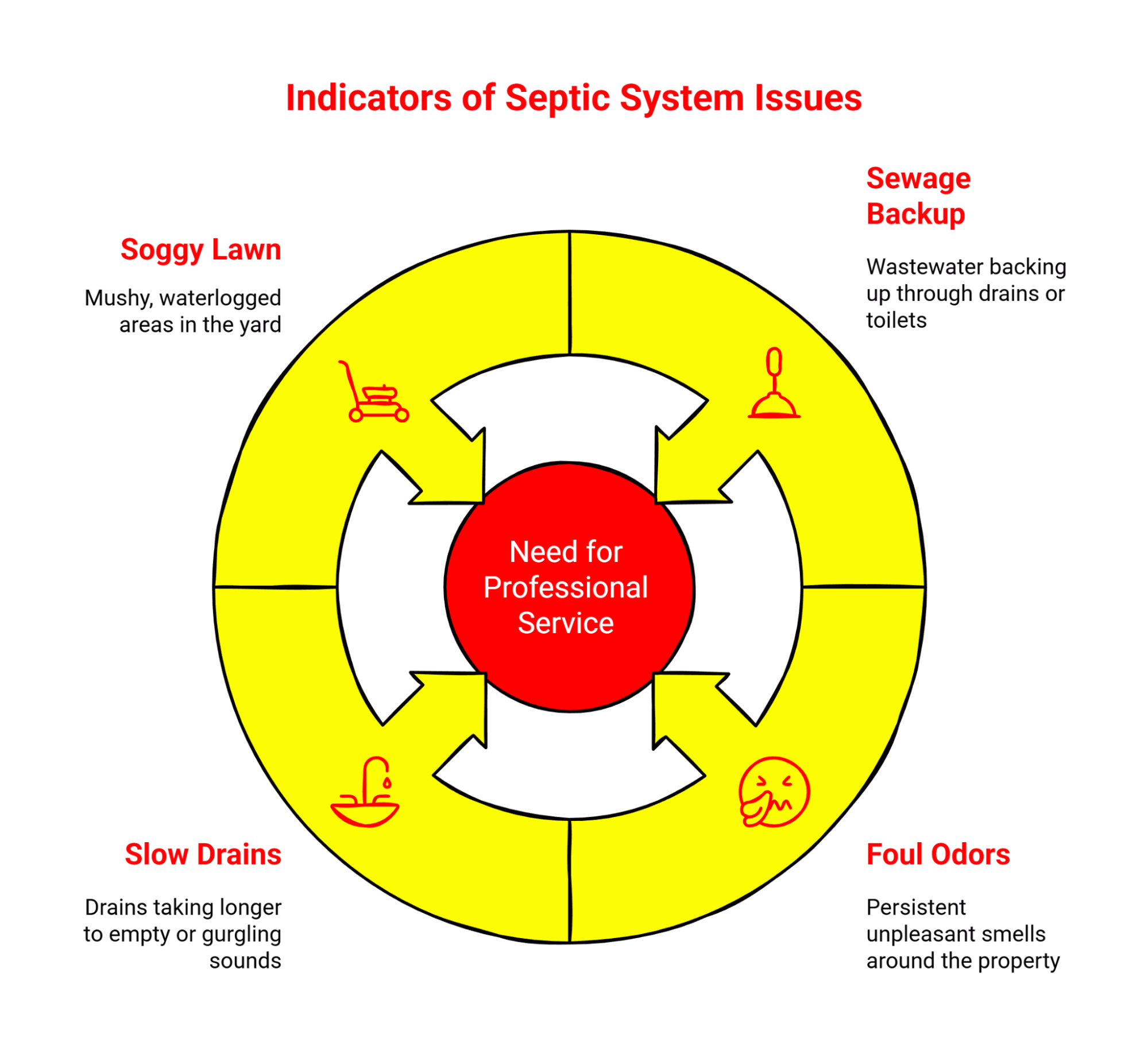
Diagram showing key indicators of septic system issues.

Let’s address the most pressing question first. Run through this checklist—if any apply to your situation, professional service should happen soon.

Sewage backup or overflow represents the most serious warning sign. If wastewater is backing up through drains or toilets, or you see pooling sewage anywhere on your property, this qualifies as an emergency. Your tank has reached absolute capacity. Continuing to use your plumbing will only compound the problem and potentially force contaminated water into your home.

Persistent foul odors around your yard, near the tank location, or emanating from household drains all indicate your system is struggling to contain and process waste properly. These smells signal that gases or liquids are escaping where they shouldn’t. The problem will intensify without intervention.

Slow drains or gurgling sounds serve as your system’s early distress signals. When your kitchen sink drains sluggishly, your toilet makes unusual gurgling noises, or your washing machine takes noticeably longer to empty, these symptoms tell you the tank is filling beyond its safe working capacity. The system is running out of room to handle incoming wastewater.

A soggy lawn or unusually green patch indicates particularly serious trouble. If you notice a mushy, waterlogged area in your yard—especially near the drain field—or if one section of grass suddenly grows greener and lusher than surrounding areas, your tank may be leaking or overflowing. This means untreated wastewater is saturating your soil, creating both health hazards and potential drain field damage.

Why these signs demand immediate attention: Each symptom indicates that accumulated solids in your tank have reached critical levels. Without professional removal, you risk permanent damage to your drain field—a repair that can cost several thousand dollars. You also risk contaminating your property and creating serious health hazards for your family and neighbors.

If you’re experiencing any of these warning signs right now, call 281-489-1765. We often maintain same-day appointment availability for urgent situations throughout the Houston area.


How Often Should Houston Homes Pump a Septic Tank?

The standard recommendation is every 2–3 years for most residential properties in the Houston area. This isn’t an arbitrary interval—it’s based on how quickly solid waste accumulates in a typical household tank under normal use conditions. Your specific situation may require more frequent attention, however, depending on several factors.

Several variables influence how often your particular system needs service. Garbage disposal use significantly increases the solid load entering your tank, potentially cutting your safe interval in half. Running food waste through a disposal sends organic material directly into the septic system, where it must be broken down or removed.

Household size changes also affect your maintenance schedule. If your family has grown, or if you’re hosting long-term guests, your system processes more waste than it was originally designed to handle. More occupants means more wastewater, faster accumulation, and shorter intervals between necessary service calls.

Water softener discharge from older systems that drain into the septic tank can disrupt the bacterial balance your system depends on and reduce overall efficiency. Similarly, frequent large loads of laundry introduce extra water and lint into the system, filling the tank faster than typical use patterns would suggest.

For Houston homes specifically, our humid climate and seasonal rainfall patterns can affect drain field performance. Properties that experience poor natural drainage or yards that stay wet longer after storms may need more frequent professional attention to prevent system strain.

The factors table above provides general guidance, but always schedule service immediately if you notice any of the warning signs mentioned earlier—odors, slow drains, gurgling sounds, or soggy areas in your lawn—regardless of when you last had your tank serviced. For additional guidance on septic system maintenance best practices, the U.S. Environmental Protection Agency provides comprehensive homeowner resources on proper care and maintenance nationwide.


What We Actually Do During a “System Reset” (On-Site Process)

Residential Septic Tank Cleaning represents the physical removal of accumulated solids and often compacted sludge to restore safe function. It’s the practical “system reset” that prevents failure. Many homeowners use the terms “pumping” and “cleaning” interchangeably, but there’s an important distinction. True septic tank cleaning goes beyond simply removing liquids—it’s a complete restoration that removes all accumulated material, including the compacted sludge that settles at the bottom of your tank over time.

Here’s exactly what happens when our team arrives at your property.

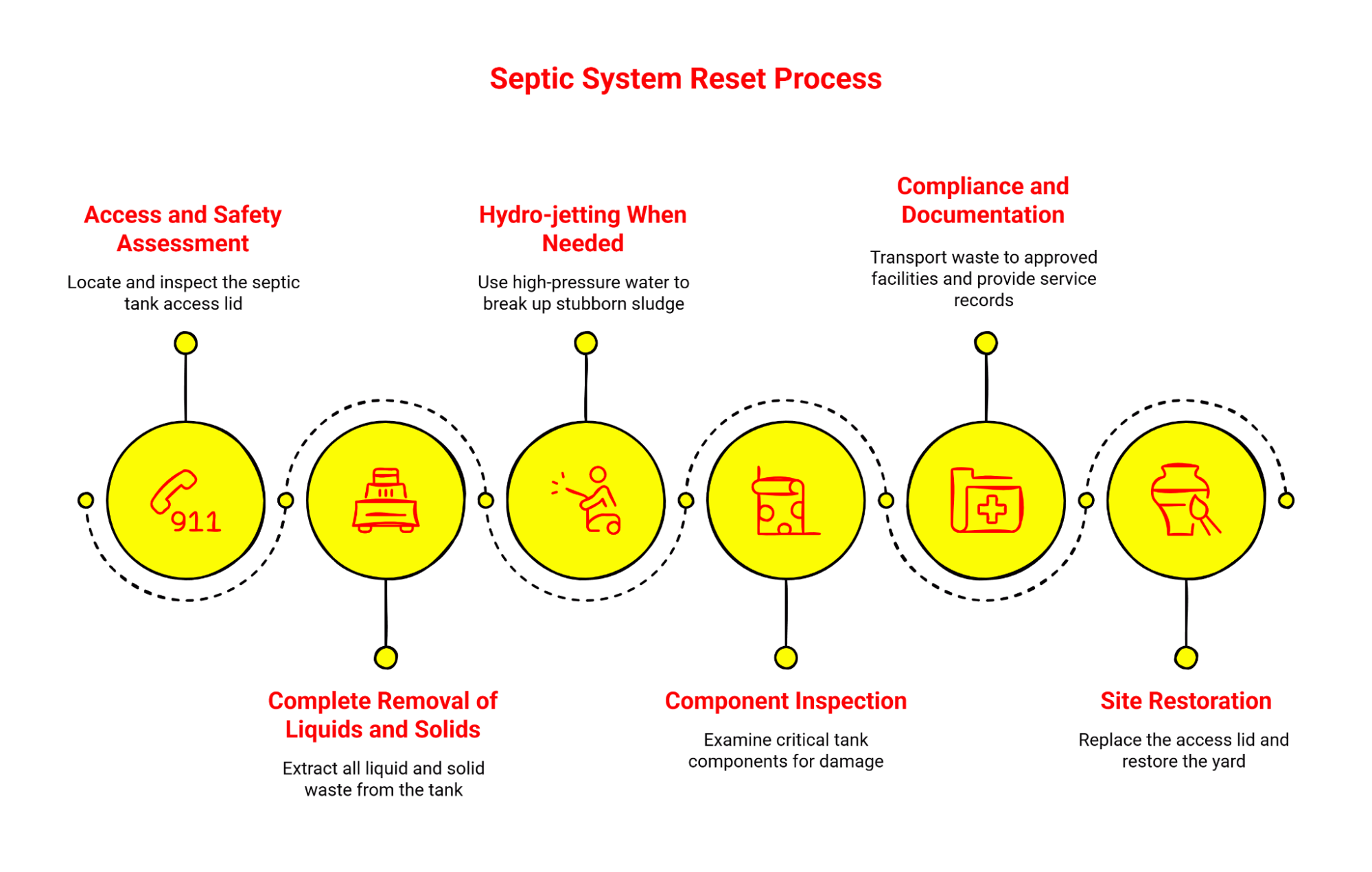
Access and safety assessment comes first. We locate your tank’s access lid, which is often buried under a few inches of soil or grass, and carefully remove it. Before starting any work, our technician inspects the current levels and overall condition to determine the best approach for your specific situation.

Complete removal of liquids and solids follows. Using our vacuum truck, we remove all liquid waste from the tank. Then comes the critical step that defines true cleaning—we thoroughly extract the compacted sludge and solid waste that has settled at the tank’s bottom. This sludge causes most system failures. Leaving it behind means you’re only buying a few months before problems return.

Hydro-jetting when needed addresses heavily compacted buildup. For tanks that haven’t been serviced in many years or have particularly stubborn accumulation, we may use high-pressure water jetting to break up sludge adhered to the tank walls. This ensures we’re starting with a truly clean slate.

Component inspection happens while your tank is empty. We inspect critical elements including the inlet and outlet baffles or tees, which prevent solids from escaping into your drain field. We also examine the tank walls for cracks and assess overall structural integrity. These components act as your system’s gatekeepers—even a clean tank won’t function properly if they’re damaged.

Compliance and documentation ensures proper waste handling. We transport all removed material to approved treatment facilities according to Houston-area regulations. You receive complete documentation of the service, including the date, observations about your system’s condition, and our recommendations for your next service interval. This paperwork proves valuable for your records and becomes essential if you sell your home.

Site restoration completes the process. We replace the access lid securely and restore your yard to its original condition, leaving your property exactly as we found it—but with the peace of mind that your system is reset and protected.

This comprehensive process earns the name “system reset.” You’re not just removing today’s waste; you’re restoring your septic system’s full capacity and extending its working life by years.


Preventing the “Silent Failure” (Soggy Yard & Odors)

One of the most dangerous aspects of septic problems is how quietly they develop. Unlike a burst pipe that announces itself immediately, septic system failures often give subtle warnings that homeowners can easily dismiss until they become impossible to ignore.

Understanding why drain fields saturate helps explain the urgency. When your septic tank fills beyond its safe capacity, solid waste starts escaping into your drain field—the underground area where treated wastewater should filter safely into the soil. These solids clog the soil’s natural pores, preventing proper drainage. The result? Wastewater has nowhere to go but up, creating those telltale soggy patches and unmistakable septic odors.

Early sensory cues you shouldn’t ignore:

A section of your lawn that stays damp even during extended dry spells signals potential problems. Grass that suddenly grows faster and greener in one specific area indicates waste acting as fertilizer where it shouldn’t be. A faint odor that you notice when the wind shifts or after sunset suggests gases escaping from your system. Puddling water that doesn’t correlate with recent rain or irrigation patterns points to subsurface saturation.

These serve as your system’s early warning signals. The moment you notice them, you’re looking at a problem actively getting worse. The saturated soil needs time to recover, and the only way to stop further damage is professional tank cleaning and reset. Understanding proper septic system hygiene, as outlined by the Centers for Disease Control and Prevention, helps protect both your family’s health and your community’s groundwater.

Disclaimer: This guide is intended as a comprehensive starting point. For decisions specific to your unique situation, we always recommend consulting a qualified professional.


Our Editorial Process

All content undergoes multi-stage review including technical accuracy verification against TCEQ model standards, local regulation compliance checking, and practical application testing. We distinguish between verified regulatory requirements and generally accepted industry practices to help operators understand certainty levels.


About the Drane Ranger Insights Team

The Drane Ranger Insights Team is our dedicated engine for synthesizing complex topics into clear, helpful guides. While our content is thoroughly reviewed for clarity and accuracy, it is for informational purposes and should not replace professional advice.


More Than a Dirty Job: Why Grease Trap Service is a Critical Risk Management Function for Houston Restaurants

📌 Key Takeaways:

Your grease trap isn’t just plumbing—it’s a business control that prevents shutdowns, fines, and reputation damage.

Treat the 25% Rule as Your Emergency Brake: When grease accumulation reaches 25% of liquid depth, schedule immediate cleaning regardless of your regular timeline to prevent operational disasters.

Quarterly Baseline, Volume-Based Adjustments: Start with 90-day service intervals as your Houston baseline, then shorten the schedule for high-volume kitchens or heavy frying operations.

Documentation Equals Insurance: Keep every manifest and service log organized in one accessible location—this paperwork transforms surprise inspections from potential disasters into routine check-ins.

Planned Downtime Beats Emergency Chaos: Scheduling service during slow periods costs hundreds; emergency repairs during Friday dinner rush cost thousands in lost revenue, staff overtime, and reputation damage.

Assign Clear Ownership for Bulletproof Execution: Make one team member accountable for calendar management, manifest filing, and condition monitoring—scattered responsibility leads to missed services and avoidable crises.

Simple controls, real protection: quarterly rhythm, 25% trigger, tidy manifests.

For a restaurant, grease trap service isn’t just a cleaning task — it’s a control that keeps you open. By pulling FOG before it hits the sewer, documenting every pump-out, and keeping to a predictable schedule, you prevent the shutdowns, fines, and reputational hits that follow backups or inspections gone wrong. Treat the trap like any other risk-critical asset: maintain it on time and keep your paperwork tidy.


What Is a Grease Trap and Why It Matters in Houston

Think of your grease trap as a silent guardian for your restaurant’s operations.

Picture this: It’s 7 PM on a busy Friday. Your kitchen is running at full capacity, turning out orders for a packed dining room. Suddenly, your floor drains start backing up, filling the kitchen with foul water and grease. The health inspector happens to be dining at the table by the window. Your evening — and potentially your permit — just took a devastating turn.

A grease trap prevents exactly this scenario. It’s a specialized container designed to capture fats, oils, and grease (collectively called FOG) before they enter Houston’s sewer system. The trap works by slowing down wastewater flow, allowing FOG to separate and float to the top while solids settle to the bottom. Clean water flows out through the middle, continuing to the municipal treatment system.

Houston’s food service operations generate substantial FOG loads that can create serious problems when they accumulate in sewer lines. FOG hardens as it cools, creating blockages that cause backups, overflows, and expensive infrastructure damage. For restaurant operators, this translates to immediate business disruption, potential health violations, and cleanup costs that far exceed routine maintenance expenses.

The trap serves as your first line of defense against these operational disasters. When properly maintained, it keeps FOG from reaching public sewers while protecting your kitchen from the backups and odors that occur when drainage systems fail.


The Business Risks of Neglect: Downtime, Fines, and Reputation

Routine grease trap cleaning costs hundreds; neglect risks shutdowns, fines, lost revenue, and reputation damage.

Restaurant operators face a stark choice: pay predictable maintenance costs or absorb unpredictable failure costs.

Routine grease trap cleaning in Houston typically costs a few hundred dollars per service. Emergency repairs, lost revenue from shutdowns, and regulatory penalties can easily reach thousands of dollars for a single incident.

Consider the hidden costs of neglect. When a trap overflows during peak service, the immediate priority becomes damage control rather than serving customers. Staff must redirect their focus from food preparation to cleanup, creating delays that compound throughout the evening. Tables remain empty while the kitchen recovers, directly impacting revenue during your most profitable hours.

Beyond immediate financial impacts, backup incidents damage your reputation with both customers and regulators. Diners who witness a sewage incident rarely return, and negative reviews spread quickly through social media. Health inspectors take violations seriously, potentially triggering follow-up inspections that create ongoing operational stress.

The largest cost driver is often unplanned downtime, not the routine cleaning fee. A well-maintained trap allows you to control when and how service occurs, typically during slower periods when kitchen disruption is minimal. Emergency situations offer no such luxury — they demand immediate attention regardless of business impact.


Houston FOG Requirements in Plain English (Non-Legal Overview)

Houston FOG rules: quarterly service, monitor 25% fill, track logs/manifests, and adjust for high-volume kitchens.

Houston’s FOG management requirements follow patterns common to most major cities, though specific details can vary and change over time.

Risk & Compliance Quick-Check

  • Maintain approximately 90-day service intervals; shorten for high FOG output
  • File manifests and service logs together where staff can access them
  • Train staff to spot odors, slow drains, visible grease, and the 25% threshold

Most Houston food service establishments operate on a quarterly baseline, meaning service occurs roughly every 90 days. High-volume kitchens that generate significant FOG loads may require more frequent attention. The key indicator is accumulation rate — if your trap fills quickly, adjust the schedule accordingly.

The “25% rule” provides a practical trigger for immediate service. When grease accumulation exceeds approximately 25% of the total liquid depth in your trap, schedule cleaning regardless of your regular timeline. This threshold indicates the system is approaching capacity and risks operational problems.

Documentation requirements typically include service manifests that track waste removal and disposal, plus maintenance logs that record service dates and trap conditions. These records demonstrate responsible waste management practices and support your compliance efforts during inspections.

We help restaurant operators stay compliant by providing thorough service and proper documentation. However, specific requirements can change, and this overview shouldn’t replace direct consultation with local authorities or qualified professionals who understand current regulations.


What Reliable Service Looks Like in Houston

Professional grease trap service involves more than simply pumping out accumulated waste.

Complete service includes pump-out of all liquid and accumulated FOG, scrape-down of interior surfaces to remove stuck-on grease, and basic condition assessment to identify potential maintenance needs. The waste must be transported to appropriate disposal facilities that can handle FOG materials properly.

Look for reliability signals when evaluating service providers. Punctual arrival and departure times show respect for your operational schedule. Complete manifests and service logs provide the documentation you need for regulatory compliance. Environmental responsibility in waste handling protects both your business and the community.

Communication matters significantly during service. Professional technicians should explain what they find, alert you to any concerns about trap condition, and provide clear guidance about future service needs. They should work efficiently to minimize kitchen disruption while ensuring thorough cleaning.

The service vehicle and equipment should appear well-maintained and appropriate for the job. Professional providers invest in proper tools because they understand that reliable equipment produces consistent results. This investment typically translates to more predictable service outcomes for their customers.


Build a Risk-Proof Service Schedule

Effective scheduling balances operational needs with regulatory compliance and cost control.

Start with the quarterly baseline that most Houston establishments follow. This provides a foundation that meets typical regulatory expectations while spreading costs predictably across the year. Mark these dates prominently on your operational calendar and assign responsibility to a specific team member.

Adjust frequency based on your kitchen’s FOG output and trap capacity. High-volume operations, establishments with heavy frying operations, or locations with smaller traps may need service every 60-75 days. Monitor accumulation rates during the first few service cycles to identify the optimal interval for your specific situation.

Assign clear ownership of the maintenance schedule. Someone on your team should track service dates, monitor trap condition between cleanings, and coordinate with your service provider. This person should understand warning signs like persistent odors, slow drainage, or visible grease accumulation that might indicate early service needs.

Set calendar reminders well in advance of scheduled service. Planning ahead allows you to coordinate timing with your service provider and ensure staff are prepared for the brief operational disruption. Last-minute scheduling often results in less convenient time slots and higher service costs.

Build relationships with reliable service providers before you need emergency help. Establishing working relationships during routine maintenance makes emergency response more predictable when urgent situations arise.


Documentation That Protects You: Manifests & Logs

Proper documentation serves as your operational insurance policy during inspections and regulatory reviews.

Service manifests track each pump-out, including date, volume removed, disposal destination, and basic trap condition notes. These documents create a paper trail that demonstrates responsible waste management and regular maintenance practices. Keep manifests organized in a labeled binder or digital folder that staff can access quickly.

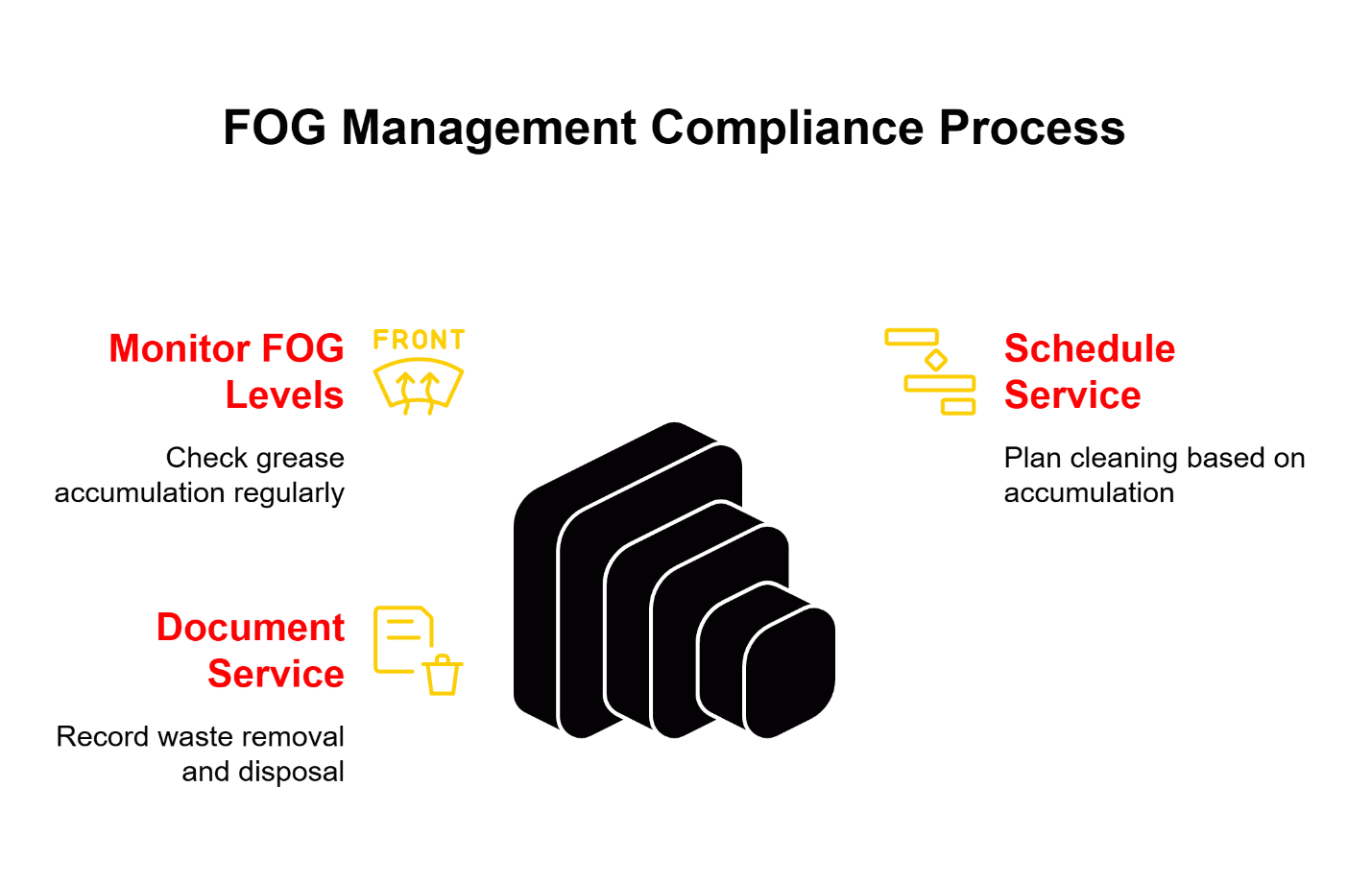
Maintenance logs provide additional detail about trap performance over time. Record service dates, any operational issues between cleanings, and notes about accumulation rates or service provider observations. This information helps you optimize scheduling and identify potential problems before they become emergencies.

Store documentation in an accessible location where multiple team members can retrieve it if needed. During inspections, quick access to organized records demonstrates professionalism and compliance awareness. Consider keeping copies in multiple formats — physical and digital — to protect against loss.

Train key staff members on documentation requirements and storage systems. Multiple people should understand where records are kept and how to interpret basic information. This redundancy ensures someone can always respond to regulatory inquiries even when the primary responsible person isn’t available.

Review documentation periodically to identify patterns or concerns. Increasing service frequency, recurring trap issues, or changes in waste volume can signal operational changes that require attention. Use this information to refine your maintenance approach and prevent future problems.


FAQ

How often should we clean our grease trap? 

Quarterly service provides a common starting point for most Houston restaurants. Increase frequency if your kitchen generates high FOG volumes or if accumulation regularly approaches the 25% threshold between cleanings.

What are signs we’re overdue for service? 

Watch for persistent odors around floor drains, noticeably slow drainage from sinks or floor drains, visible grease accumulation where it shouldn’t appear, or grease layers exceeding 25% of total liquid depth in the trap.

What happens during a professional service call? 

Complete service includes pumping out accumulated liquids and FOG, scraping interior surfaces clean, performing a basic condition check, and providing proper waste transportation and disposal with appropriate manifests.

How long does grease trap service typically take? 

Service duration varies based on trap size, accumulation levels, and access conditions. Most routine cleanings require 30-90 minutes, though heavily loaded traps may take longer. Plan the service window during slower operational periods when possible.

What documentation should we maintain? 

Keep service manifests and maintenance logs together in an organized, accessible format. These records support compliance efforts and provide valuable information for optimizing your maintenance schedule.

What drives service costs? 

Primary cost factors include trap size, accumulation volume, access difficulty, and service frequency. Emergency calls typically cost more than scheduled maintenance. Consistent scheduling often provides better value than reactive service.

Ready to establish a reliable maintenance routine that protects your operations? Get a compliant service plan for your location.


Our Editorial Process

Our expert team uses AI tools to help organize and structure our initial drafts. Every piece is then extensively rewritten, fact-checked, and enriched with first-hand insights and experiences by expert humans on our Insights Team to ensure accuracy and clarity.

About the Drane Ranger Insights Team

The Drane Ranger Insights Team synthesizes complex topics into clear, helpful guides. Our content is reviewed for clarity and accuracy, and is for informational purposes—not legal advice.

When Best Intentions Fail: Three FOG Violation Myths That Can Cost Houston Restaurants

📌 Key Takeaways:

Houston restaurants can avoid costly violations by understanding that compliance isn’t just about calendar dates—it’s about monitoring actual grease levels and maintaining proper documentation.

The 25% Rule Trumps the Calendar: Your grease trap needs service whenever floating grease plus settled solids reach 25% of total liquid capacity, even if it’s only been 30 days since your last pump-out.

Documentation Is Your Defense: Keep five-year records of every trip ticket with transporter registration numbers, waste volumes, and disposal facility details—inspectors will ask for them and missing paperwork triggers violations.

Partial Solutions Create Full Problems: Skimming grease or partial pump-outs don’t reset your compliance clock and can accelerate accumulation patterns that lead to faster violations.

Only Registered Transporters Count: Using an unqualified hauler creates compliance gaps that result in violations even when the physical cleaning was done correctly.

Additives Are Prohibited Shortcuts: Enzyme treatments and grease-eating products that emulsify FOG to pass through your trap violate TCEQ regulations and don’t replace required pump-outs.

Monitor monthly, document everything, and schedule proactively—these three habits prevent surprise violations and keep your kitchen running.

A full grease trap can shut down your kitchen faster than a broken fryer.

Picture this: It’s Friday night, your dining room is packed, and the city inspector walks through your kitchen door. You’ve been diligent about your quarterly pump-outs, kept your receipts organized, and trained your staff on proper grease disposal. You’re confident you’re compliant. Twenty minutes later, you’re staring at a violation notice that could cost thousands in fines and force you to close until corrections are made.

You followed the rules—or so you thought. The reality is that many Houston restaurant operators unknowingly operate under compliance myths that can trigger violations even when they believe they’re doing everything right. These misconceptions about FOG (Fats, Oils, and Grease) regulations don’t stem from negligence but from incomplete understanding of how local enforcement actually works.

Quick Answer: Food-service establishments should fully pump grease traps at least every 90 days—or sooner whenever total grease plus solids reach 25% of the trap’s wetted depth. Each pump-out should be a complete evacuation, performed by a TCEQ-registered transporter, and accompanied by a five-part manifest kept on file for five years.

This guide exposes four persistent myths that trip up well-intentioned restaurant managers and provides the practical knowledge needed to maintain genuine compliance in Houston’s regulatory environment.

In Houston, FOG compliance isn’t just about sticking to a calendar date. The city’s enforcement approach considers both time intervals and actual grease accumulation levels, which means your trap might need attention before your scheduled quarterly service. Understanding the interplay between baseline requirements and threshold-based triggers can help you avoid the surprise violations that catch even careful operators off guard.

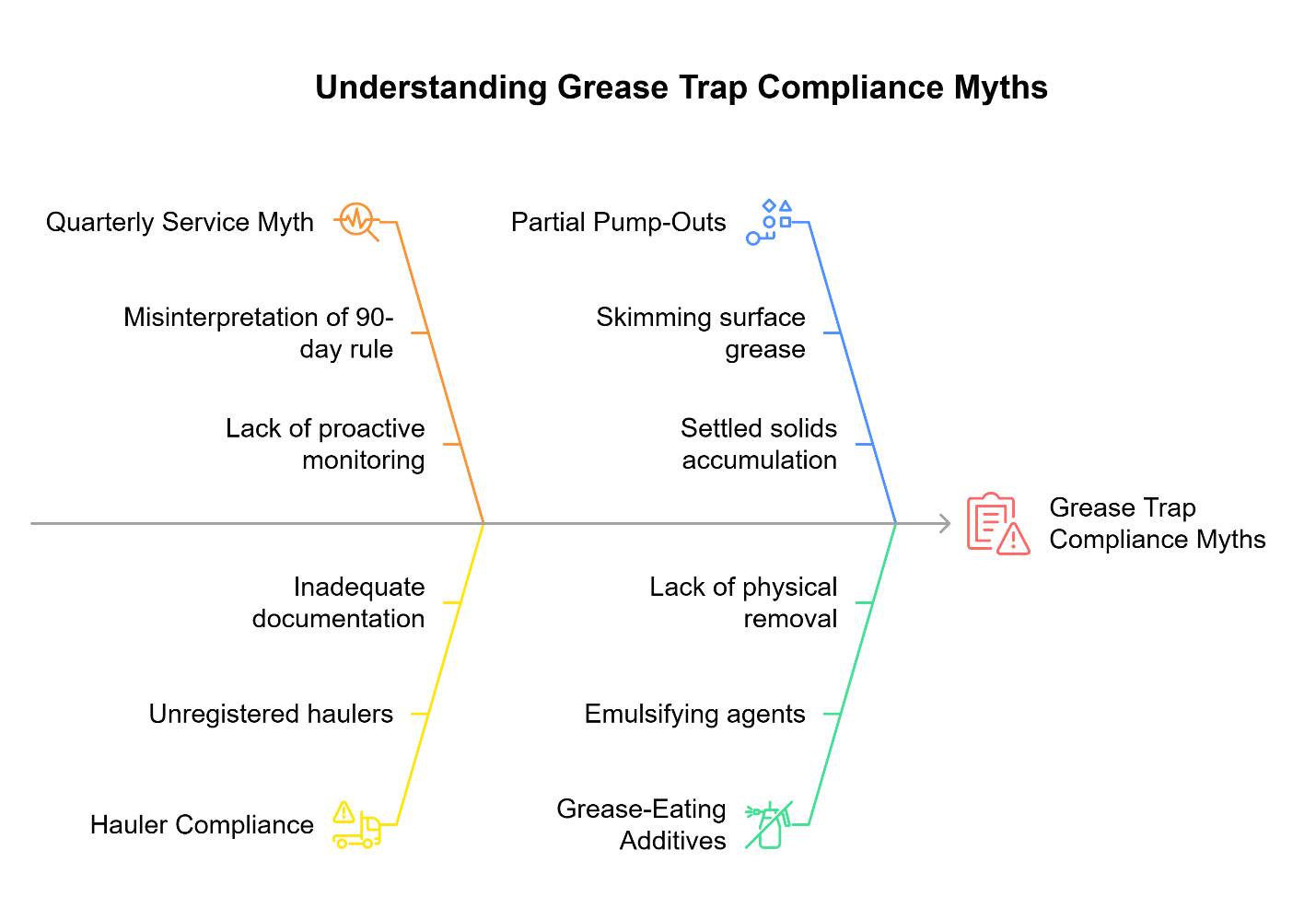
Understanding grease trap compliance myth.

Myth #1: “If We Pump Every 90 Days, We’re Automatically Compliant”

The Reality: Quarterly service establishes your baseline compliance schedule, but the 25% rule requires service whenever the combined depth of floating grease and settled solids reaches 25% or more of the trap’s total liquid capacity.

Houston’s FOG ordinance follows Texas statewide TCEQ model standards that set quarterly cleaning as the minimum standard for commercial grease interceptors. However, this 90-day schedule represents a baseline rather than a guarantee of compliance. The 25% rule requires service whenever the combined depth of floating grease and settled solids reaches 25% or more of the trap’s wetted height.

This threshold-based approach reflects operational reality in busy commercial kitchens. High-volume restaurants can exceed the 25% threshold well before their scheduled quarterly service, particularly during peak seasons or after menu changes that increase grease production.

Why This Creates Risk in Houston: City inspectors measure grease accumulation levels during routine checks, regardless of when your last service occurred. A trap that was pumped 60 days ago but has reached 30% capacity will trigger a violation citation, even though you’re technically “ahead of schedule” on your quarterly maintenance. Local pretreatment programs use these statewide TCEQ standards to protect publicly owned treatment works.

What to Do Instead: Set a standing service cadence and measure grease depth monthly using a sludge judge or coordinate with your service provider. If measurements approach 20%, schedule a pump-out proactively rather than waiting for your calendar date. Document these readings alongside your service records.

Regular grease trap cleaning services in Houston can help establish a monitoring routine that accounts for your kitchen’s specific grease production patterns.

Myth #2: “Any Hauler Can Pump Our Trap—The Manifest Is Optional”

The Reality: Only TCEQ-registered transporters can legally haul grease waste, and proper trip tickets serve as your primary compliance documentation during inspections.

Each pump-out must be accompanied by a manifest or “trip ticket”—a five-part form that records generator details, transporter registration number, waste volumes, receiving facility information, and signatures at each handoff. A copy must be returned to the generator within 15 days and retained for five years.

Not all waste haulers maintain the registration and permits required for grease waste transport. Using an unqualified hauler creates a documentation gap that can result in violations even when the physical cleaning was performed correctly. Additionally, some haulers provide minimal or inadequate trip ticket documentation that doesn’t meet regulatory standards.

Why This Matters for Houston Restaurants: City inspectors routinely request trip ticket copies during compliance checks. Missing or incomplete paperwork often triggers violation notices regardless of your actual cleaning frequency. These documents must show generator information, waste volume, transporter TCEQ registration numbers, disposal facility details, and service dates.

What to Do Instead: Verify that your grease trap service provider maintains current TCEQ registration for waste transport. Keep a binder or organized digital folder with all manifests and disposal receipts, indexed by date and location. Train managers on what fields must be present before accepting a service report. Store these documents in an accessible location where they can be quickly retrieved during inspections.

Myth #3: “Skimming or Partial Pump-Outs Are Fine Between Services”

The Reality: Each service must completely evacuate the trap, with additional truck capacity arranged as needed so the trap is fully emptied within 24 hours if necessary.

Full evacuations prevent residue and backups while supporting operational stability. Complete removal ensures that settled solids and grease layers are entirely extracted, preventing the accumulation patterns that lead to premature capacity issues. TCEQ standards require full evacuation of all contents during each service.

Some operators attempt to extend time between full services by having staff skim surface grease or hiring services to perform partial pump-outs. These approaches fail to address settled solids in the trap bottom and don’t generate the proper documentation that regulatory compliance requires.

Why This Creates Problems: Partial removal doesn’t reset your 25% accumulation measurement. Settled solids remain in the trap, and grease layers rebuild on top of existing residue. This creates accelerated accumulation patterns that can trigger violations sooner than normal operational cycles would suggest. Incomplete pump-outs allow solids to harden, reduce effective volume, and push grease downstream—problems inspectors identify quickly.

What to Do Instead: Use a TCEQ-registered transporter and verify that the service was a full evacuation on the manifest and invoice before signing. Schedule full evacuation services that completely empty your grease trap, and ensure each service includes proper waste transport manifests and disposal documentation.

Myth #4: “Grease-Eating Additives Can Replace Regular Pumping”

The Reality: Introducing surfactants, solvents, or enzymes that emulsify grease so it passes through the trap is prohibited under TCEQ regulations.

TCEQ model standards explicitly prohibit additives that emulsify grease and allow it to pass through the interceptor. Bioremediation products require explicit approval and testing that proves they don’t increase downstream loadings to the treatment facility. These products do not replace the 90-day or 25% pumping requirements.

Some suppliers market enzyme treatments or bacterial additives as alternatives to regular pump-outs. While certain approved biological treatments may help with odor control or minor maintenance between services, no additive can substitute for physical removal of accumulated FOG and solids.

Why This Creates Risk: Using prohibited emulsifying agents can result in violations for improper pretreatment and may damage downstream collection systems. Additionally, operators who rely on additives often skip proper monitoring, leading to trap capacity issues that trigger the 25% rule.

What to Do Instead: Focus on source control methods like scraping plates thoroughly, wiping cookware before washing, and installing drain screens. Confirm proper capture with regular 25% rule checks, and maintain the pumping schedule that matches your actual loading patterns.


How to Self-Check the 25% Rule

Grease trap monitoring process.

This four-step process helps restaurant managers monitor grease accumulation between scheduled services:

  1. Allow Trap to Settle Let the trap rest so grease floats to the surface and solids settle to the bottom. This provides the most accurate measurement of accumulated materials.
  2. Measure Wetted Height Measure the total depth from the tank bottom to the outlet pipe invert. This represents your trap’s total liquid capacity.
  3. Gauge Accumulated Layers Use a sludge judge or coordinate with your service provider to measure the combined thickness of the top grease layer plus bottom settled solids.
  4. Calculate and Act If the combined grease and solids equal or exceed 25% of the wetted height, schedule an immediate full pump-out. Don’t wait for the next calendar date.

For comprehensive compliance guidance, reference our Houston restaurant FOG compliance checklist which covers additional operational considerations.


Frequently Asked Questions

How often should a grease trap be pumped in the Houston area?

At minimum, every 90 days, and sooner if the 25% threshold is reached. Waivers to extend frequency are case-by-case and require defensible data showing consistent compliance with all discharge limits.

What must be on a grease trap trip ticket and how long do I keep it?

Complete trip tickets include generator and transporter information (including the transporter’s TCEQ registration number), type and amount of waste, receiving facility details, dates, signatures, and a consecutive tracking number. One copy returns to the generator within 15 days; retain it for five years.

Can staff skim between services to delay pumping?

Surface skimming doesn’t address settled solids or satisfy full evacuation requirements. This approach can accelerate accumulation patterns and doesn’t generate proper compliance documentation.

Who is allowed to haul my grease waste?

Only a TCEQ-registered transporter can legally haul grease waste. This registration status is defined in the model standards and enforced at the state level.

Resources

For regulatory compliance and additional guidance:

Authority Sources:

Trust Indicators:

About the Drane Ranger Insights Team

Our editorial process combines industry expertise with practical field experience to provide restaurant operators with actionable compliance guidance. Content is reviewed by certified waste management professionals familiar with Houston’s regulatory environment and Texas statewide standards.


Our Editorial Process

All content undergoes multi-stage review including technical accuracy verification against TCEQ model standards, local regulation compliance checking, and practical application testing. We distinguish between verified regulatory requirements and generally accepted industry practices to help operators understand certainty levels.

This content is provided for informational purposes and represents current Texas regulatory standards applicable to establishments in the Houston area. Always follow any site-specific directions on permits or from local pretreatment programs.