📌 Key Takeaways
Houston FOG compliance requires both physical trap cleaning and proper manifest documentation—missing either creates audit exposure.
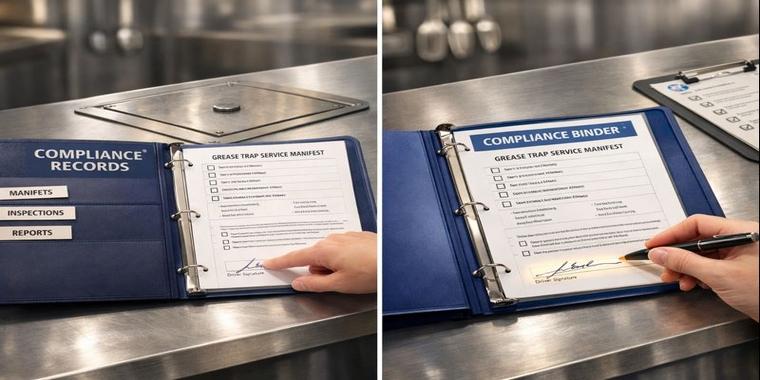
- Manifests Prove Legal Disposal: Invoices show payment; manifests document chain-of-custody from your trap to approved disposal facilities, which inspectors specifically request.
- The 25% Rule Triggers Early Service: When floating grease plus settled solids reach one-quarter of liquid depth, cleaning is required immediately regardless of your 90-day schedule.
- Five-Year Record Retention Required: Houston Health Department mandates keeping signed manifests on-site and accessible for five years—inspectors review multi-year compliance history.
- Verify Before Signing: Check that generator details, transporter permit numbers, vehicle identification, waste quantities, and intended disposal site are complete on every manifest.
- No Manifest, No Payment: Establish a payment rule requiring completed manifests before releasing payment—this protects you and ensures hauler accountability.
Physical cleaning removes the waste, but the manifest proves it was legal.
Houston restaurant owners managing FOG program requirements will find audit-ready systems detailed here, preparing them for the compliance checklist and vendor vetting guide that follows.
The inspector walks in during the lunch rush. Kitchen’s humming, fryers are hot, tickets are flying. Then comes the question that stops everything: “Can I see your grease trap manifests from the last two years?”
The trap itself might be spotless. The real test? Whether the paperwork proves it.
FOG compliance in Houston means two things working together: keeping fats, oils, and grease out of the city’s sewer system, and maintaining documentation that proves your waste was handled legally. Think of it this way—cleaning your grease trap is like getting an oil change for your car. The manifest is the receipt and tracking number that proves the used oil went to a proper facility, not dumped in a ditch somewhere.
This guide breaks down what Houston actually requires, why invoices alone won’t protect you during an audit, and how to build a simple two-part compliance system in about 30 minutes. A scheduled cleaning cadence plus an organized binder. That’s the foundation of audit-ready peace of mind.
FOG Compliance in Houston: What the City Actually Cares About
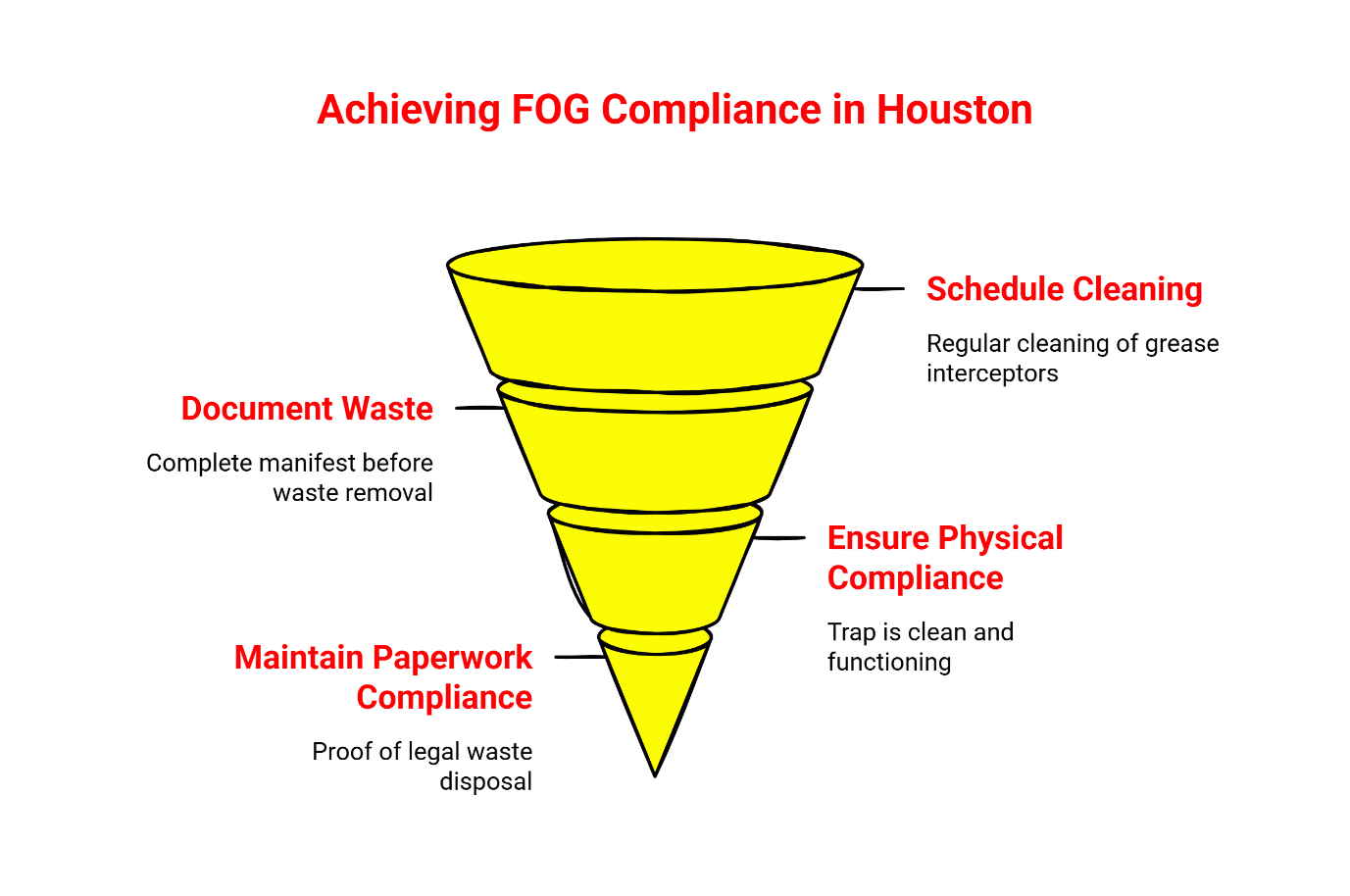
Houston expects your grease interceptor cleaned on schedule and your waste documented with a completed manifest before it leaves your property.
That’s the core of it. But understanding why helps you stay ahead of problems rather than reacting to them.
While the City of Houston enforces a single comprehensive set of regulations, it is helpful to view compliance in two distinct parts. Physical compliance means the trap is actually clean—waste removed, interior surfaces cleared, and the system is functioning. Paperwork compliance means you have the documented proof that a licensed transporter took the waste to an approved disposal facility.[^1]
During inspections, city officials aren’t taking your word for it. They’re looking for patterns and proof. A clean trap today doesn’t tell them anything about last month or six months ago. Manifests do. They create a verifiable history that shows consistent, legal waste handling over time.
Houston’s Special Waste and FOG program exists because grease in the sewer system causes blockages, overflows, and expensive infrastructure damage. The city takes enforcement seriously. Fines exist. Shutdowns happen. But the requirements themselves aren’t complicated once you understand what’s expected.
“Physical cleaning removes the waste, but the manifest proves it was legal.”
Cleaning: The Physical Work That Keeps Your Kitchen Running
A proper grease trap cleaning means full evacuation—removing all the accumulated FOG, food solids, and wastewater from the interceptor. Not skimming the top. Not pumping until it “looks better.” Complete removal down to the tank walls and baffles.
What “Fully Evacuated” Actually Means
“Fully evacuated” means the entire contents are removed—not just what floats at the top. When a job is rushed, the “easy” portion disappears while heavier material stays behind. That leftover material is where problems begin: restricted flow, recurring odor complaints, and higher risk of a failed inspection because the device doesn’t reflect what the paperwork claims.
Houston ordinances and program guidance emphasize that waste removal involves removing the full contents from the site, not partial removal.[^2] This isn’t splitting hairs—it’s the difference between compliance and a violation notice.
The Cleaning Schedule: 90 Days Plus the 25% Trigger
Houston’s baseline requirement is cleaning at least every 90 days (or strictly in accordance with your specific permit conditions).[^2] But there’s an important trigger that can accelerate that schedule: the 25% rule. Under city ordinances, when the combined depth of floating grease and settled solids reaches 25% of the total liquid depth in your trap, service is required immediately regardless of how recently you cleaned. [^2] High-volume kitchens with heavy frying often hit this threshold in six to eight weeks.
A practical way to use the 25% trigger is as a scheduling signal: If your restaurant routinely approaches the trigger before the next planned cleanout, the schedule is too light. If the device stays well below the trigger for long periods, the schedule may be stable—but documentation still needs to be perfect every time.
Waiting until you smell something is already too late. By the time odors reach you, slow drains have likely frustrated your kitchen staff. Odors may have reached the dining room. Worse, you’re potentially out of compliance—and if a backup happens during service, you’re looking at lost revenue, emergency service premiums, and possibly a health department visit.
Signs Your Cleaning Schedule Might Be Too Light
- Drains slow down noticeably before your next scheduled service
- Staff complains about odors near the trap or floor drains
- You’ve had even one backup incident in the past year
- Your service provider mentions the trap was “really full” at pickup
- Odors return quickly after service
- Service calls are reactive (“something is wrong”) rather than planned
The practical move: work with your service provider to establish a frequency based on your actual grease output, not just the minimum requirement.
Manifesting: The Paper Trail That Protects You During an Audit
Here’s where many restaurant owners get tripped up. They have invoices. They paid for service. They assume that’s enough.
It isn’t.
Invoice vs. Manifest: The Distinction That Matters
An invoice proves you paid someone. A manifest proves the waste was legally tracked from your location to an approved disposal site. Those are not interchangeable documents.
- Invoice: “Service was paid for.”
- Manifest: “Waste removal and handling were documented with required details and intended disposal site information.”
Houston requires a completed manifest before waste is removed from your premises—it’s not optional paperwork your hauler fills out later.[^3] During an audit, being able to show a stack of invoices is not the same as producing properly completed manifests.
The manifest creates a chain of custody. It documents what was removed, who removed it, what vehicle carried it, and where it was intended to go. If that waste ends up illegally dumped somewhere, the manifest trail determines liability. Without one, you have no proof your waste was handled properly. During an audit, that’s a problem.
Must-Check Manifest Fields Before You Sign
The generator portion of the manifest must be completed with required information.[^3] Before signing any manifest, take 30 seconds to verify these key fields are completed:
- Generator name
- Generator address (including zip code)
- Generator permit/registration certificate number
- Generator contact telephone number (including cellular if available)
- Holding capacity of your trap or interceptor
- Date the waste was collected
- Transporter company name and permit number
- Vehicle identification (registration, decal, or certificate number plus license plate)
- Vehicle tank capacity
- Operator name and signature
- Transporter mailing address and telephone number
- Type and quantity of waste removed (gallons or pounds)
- Intended disposal site name and address
Your signature confirms the information is accurate. If something’s blank or wrong, ask the driver to correct it before they leave.
How Long to Keep Manifests
Houston Health Department regulations explicitly require keeping manifest copies on-site and available for inspection, with retention for a period of five years strictly mandated.[^4] That sounds like a long time, but inspectors do review multi-year history. A simple “one tab per year” filing system with monthly separators keeps everything accessible without becoming a project.
Cleaning vs. Manifesting: A Side-by-Side Decision Matrix
Understanding how these two requirements differ—and where they overlap—makes compliance much simpler to manage.
| Aspect | Cleaning (Physical Compliance) | Manifesting (Paperwork Compliance) | Total Compliance (Both) |
|---|---|---|---|
| What it is | Physical removal of FOG, solids, and wastewater from the interceptor | Documentation proving waste was tracked to a legal disposal site | Complete fulfillment of Houston’s FOG program requirements |
| What it proves | The trap is currently functional and within capacity | The waste was handled legally with chain-of-custody records | Ongoing, verifiable compliance over time |
| What can fail you | Trap exceeds 25% accumulation; backup or overflow occurs | Missing manifests; incomplete fields; unsigned documents | Either failure creates compliance exposure |
| What to keep on-site | Service receipts (helpful but secondary) | Completed, signed manifests organized by date | Both, in an accessible compliance binder |
| How often it happens | Every 90 days minimum, or when 25% threshold is reached | Every time waste is removed (one manifest per service) | Aligned—each cleaning should generate one manifest |
| Who owns it internally | Facilities manager or designated staff member | Same person; accountability should be centralized | One owner, one system, one binder |
| What your vendor must provide | Full evacuation, not just skimming; clean work area | Completed manifest with all required fields before leaving | Both, every time, without exception |
Common Misconceptions That Create Audit Problems
“We paid the invoice, so we’re covered.” Payment proves a transaction. It doesn’t prove legal disposal. Inspectors ask for manifests, not invoices.
“The trap looked clean when I checked it.” Visual inspections are unreliable. Sludge settles at the bottom where you can’t see it. The 25% rule is measured with a core sample, not a glance through the access port.
“Our hauler handles all the paperwork.” They should—but you’re responsible for verifying and retaining copies. If your hauler disappears or loses records, the compliance burden stays with you as the waste generator.
When an inspector arrives, they typically ask for three things first: your FOG permit or registration, your compliance binder with manifests, and access to the trap itself. Having all three ready transforms an inspection from a stressful surprise into a routine verification.
How to Build a “Total Compliance” System in 30 Minutes
Compliance doesn’t require complex software or dedicated staff. It requires a simple system you actually use.
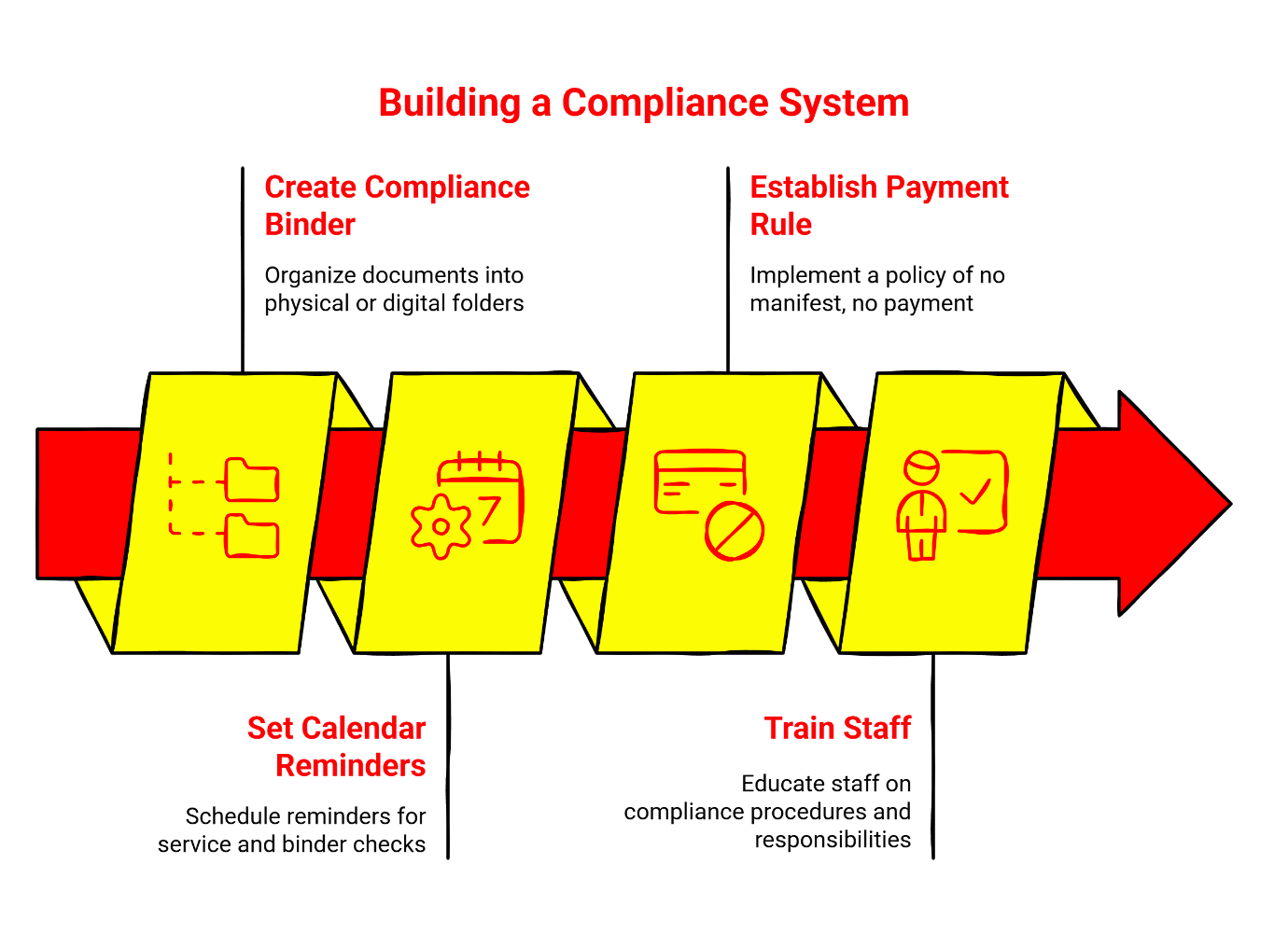
Step One: Create a Compliance Binder
Physical or digital, it needs clear organization. Use tabs or folders for:
- Permits/Registrations – Current FOG permit/registration documentation
- Vendor Credentials – Service agreement with your hauler, transporter permit verification
- Manifests – Current Year – Organized chronologically with monthly separators
- Manifests – Prior Years – One tab per year (minimum five years retained)
- Service Schedule – Calendar printout or cadence notes
- Inspection Notes – Any correspondence with the city or inspection reports
Keep the physical binder in a consistent location that staff knows—near the manager’s station or in the office. If you use digital storage, maintain a printed backup of at least the current year’s manifests on-site for inspector access.
Step Two: Set Calendar Reminders
Set calendar reminders tied to your service cadence. If you’re on a 90-day schedule, set reminders at 75 days to confirm the upcoming appointment and at 85 days as a backup. For higher-frequency service, adjust accordingly. The goal is preventing lapses, not creating busywork.
Also set a “binder check” reminder for confirming manifests were filed after each service.
Step Three: Establish a Payment Rule
This one’s simple but powerful: no manifest, no payment. Make it policy. If the driver can’t provide a completed manifest before leaving, service isn’t complete. This protects you and ensures your hauler maintains proper documentation every time.
Step Four: Train Your Staff
Designate who has authority to sign manifests—this should be limited to management or trained supervisors. Make sure they know:
- Where the compliance binder is stored
- What fields to verify before signing
- What to hand an inspector (binder, permit, and trap access)
- Who to call if questions arise during an inspection
A 15-minute walkthrough with your team covers all of this. Document who was trained and when.
Audit-Ready Binder Checklist
- [ ] Current FOG permit or generator registration on file
- [ ] Transporter permit verification documented
- [ ] Service agreement specifying cleaning frequency
- [ ] Manifests for the current year, signed and complete
- [ ] Manifests for prior years (minimum five years retained)
- [ ] Any city correspondence or inspection reports
Vendor Vetting: How to Avoid the “Cheap Hauler” Compliance Trap
Not all grease trap service providers operate the same way. The cheapest option often cuts corners—on cleaning thoroughness, on proper disposal, on documentation. When those shortcuts create compliance problems, the liability lands on you as the waste generator.
Houston requires transporters hauling special waste to maintain proper permits.[^5] A legitimate hauler will have no problem providing verification. An illegitimate one will make excuses or simply not have it.
Questions to Ask Before Hiring (or Continuing With) a Grease Trap Service Provider
- “Can you provide your current transporter permit number and show me proof of registration?” Keep a copy for your compliance binder.
- “Do you provide a completed manifest with every service visit?” The answer should be an unqualified yes.
- “Where is my waste taken for disposal, and can you document that?” Legitimate haulers use approved facilities and can tell you exactly where your waste goes.
- “Can you resend copies of past manifests if I need them?” Records get lost. A professional operation maintains backups and can provide duplicates when needed.
- “What does ‘fully evacuated’ mean in your company’s process?” Listen for “entire contents,” not “we pump the top.”
Trust Signals That Matter
Reliability signals matter too. Does the company show up on time? Do drivers work cleanly and professionally? Is scheduling organized and predictable? These operational details reflect how the company handles the less visible aspects of their work—like proper disposal and documentation.
Drane Ranger has served Houston-area businesses with grease, grit, and lint trap cleaning since 1985. As Harold R. shared about his experience: “My experience with Drane Ranger was a very organized, professional and on time experience. I was kept informed of what was happening and a suggested time of cleaning again.”
That combination—organized service, clear communication, proactive scheduling—is exactly what audit-ready compliance requires.
Shelley M. adds: “Drane Ranger is very professional and reliable. Basically they can take care of all your grease drain needs.”
The company maintains Better Business Bureau accreditation, providing third-party verification of business practices and complaint resolution.
FAQ: Quick Answers Houston Owners Ask Most
Is an invoice enough for Houston inspections?
No. An invoice proves payment; a manifest proves legal waste handling. Inspectors specifically request manifests because they document the chain of custody from your trap to the disposal facility. Keep both, but understand manifests are the compliance requirement.
How often do I have to clean my grease trap?
Houston requires cleaning at least every 90 days, but the 25% rule can trigger earlier service. When floating grease plus settled solids equal one-quarter of your trap’s liquid depth, cleaning is required regardless of schedule. High-volume kitchens often need service every six to eight weeks.
What is the 25% rule and how is it measured?
The 25% rule means your trap needs cleaning when the combined depth of floating grease and settled sludge reaches 25% of the total liquid depth. Measurement typically involves a core sample that captures material from top to bottom—not a visual check, which only shows the surface. Your service provider should be able to explain what they found and whether you’re approaching the threshold.
How long do I keep manifests?
Houston Health Department guidance recommends retaining manifests for at least five years and keeping them accessible on-site. Inspectors may review multi-year history, so organized long-term storage matters. The “one tab per year” filing approach keeps everything accessible without much effort.
What if I can’t be on-site to sign a manifest?
Designate a trained manager or supervisor with signing authority. This person should understand what fields to verify before signing and where to file the completed manifest. Avoid allowing just anyone on staff to sign—centralized accountability reduces errors and ensures consistency.
Next Step: Get a Compliant Cleaning Schedule (and the Paperwork That Backs It Up)
Compliance doesn’t have to mean constant worry. With the right service partner and a simple organizational system, your trap stays clean, your manifests stay complete, and inspections become routine rather than stressful.
Everything Drane Ranger does is built on a commitment to doing the absolute best job possible—exceeding expectations while ensuring the team is trained, certified, and following all rules and regulations around the industry.
Ready to confirm your current schedule is audit-ready? Have questions about what your binder should include?
Start Your Service Today — Call 281-489-1765 | Request Your Quote | Contact us today
For more information about grease trap cleaning in Houston and surrounding areas, explore our service pages or reach out directly.
Drane Ranger — Satisfying the customers Since 1985.
13911 India St, Houston, TX 77047 | 281-489-1765 | rwoods3719@aol.com | Mon-Fri, 9am until 6pm
Disclaimer: Educational content only; not legal advice. Readers should consult the City of Houston, Houston Health Department, or legal counsel for definitive compliance guidance.
This article was prepared by the Drane Ranger Insights Team and reviewed for clarity and practical accuracy. Regulations can change and enforcement can vary by circumstance. For definitive compliance requirements for your facility, consult the City of Houston/Houston Health Department guidance and/or qualified counsel.
About the Drane Ranger Insights Team
The Drane Ranger Insights Team is our dedicated engine for synthesizing complex topics into clear, helpful guides. While our content is thoroughly reviewed for clarity and accuracy, it is for informational purposes and should not replace professional advice.
[^1]: City of Houston Code of Ordinances, §47-502 through §47-510: Documentation Requirements
[^2]: City of Houston Code of Ordinances, §47-512: Cleaning and Maintenance Requirements
[^3]: City of Houston Code of Ordinances, §47-502: Manifest Requirements
[^4]: Houston Health Department: Waste Generator FAQ
[^5]: Houston Permitting Center: Transporter Permit (HHD1019)