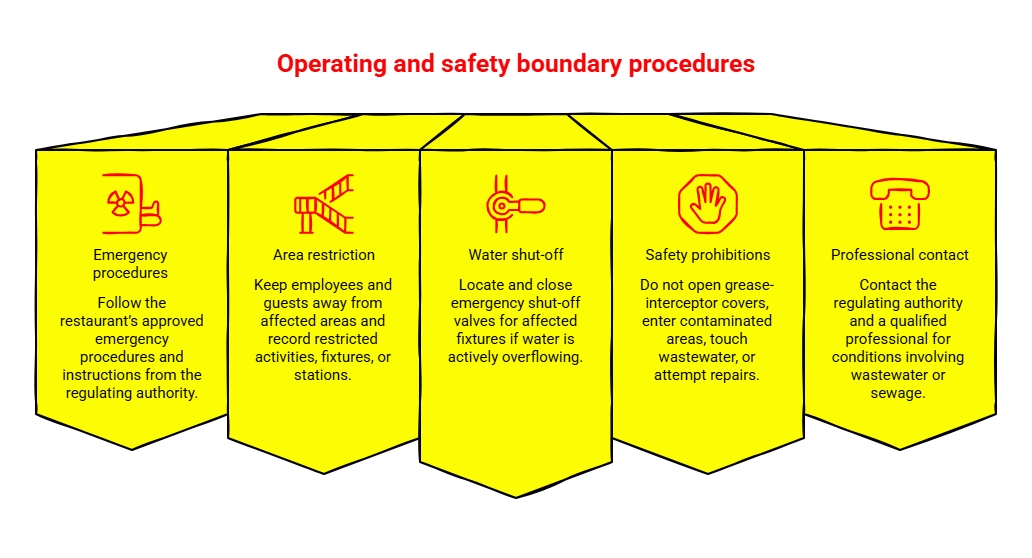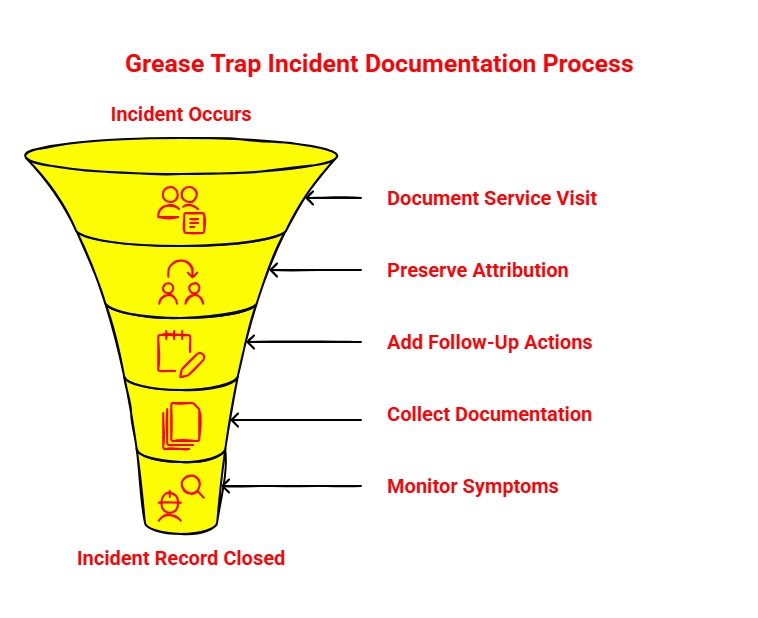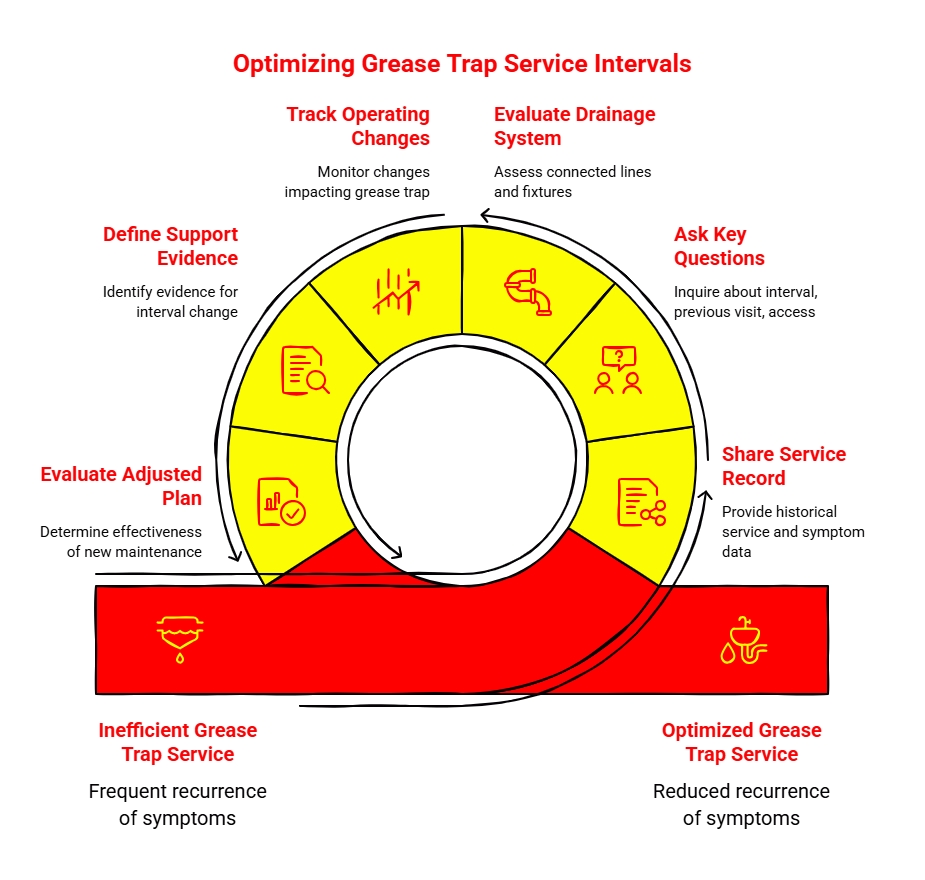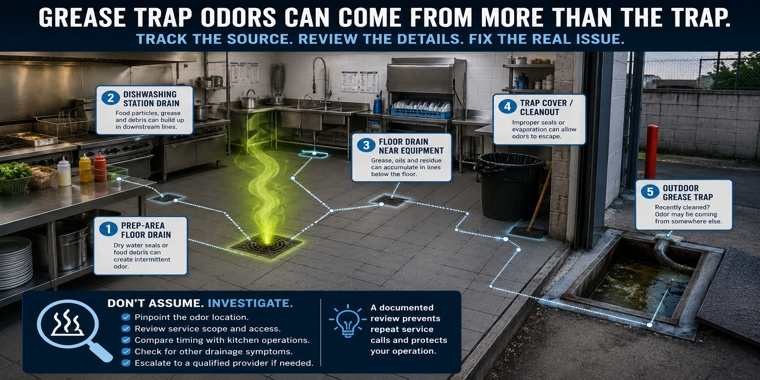
The Risk of Non-Compliance: What Happens When Your Waste Transport Documentation Fails

📌 Key Takeaways

Waste transport records protect a Houston kitchen only when they prove where the grease waste went.

  • Manifests Beat Invoices: An invoice shows payment, but a manifest helps prove what happened to the waste.
  • Gaps Create Risk: Missing signatures, lost forms, or weak filing can turn routine inspections into stressful scrambles.
  • Keep Records Onsite: Houston guidance says manifest copies must stay onsite for at least five years.
  • Assign One Owner: One person should check every manifest right after each grease trap service.
  • Verify Your Provider: A permitted waste transport partner helps protect your records, service schedule, and inspection readiness.

Proof beats promises when inspectors ask where your waste went.

Houston restaurant managers and food service operators will gain a clearer way to check their records, preparing them for the detailed overview that follows.

~ ~ ~ ~ ~ ~ ~ ~ ~ ~ ~ ~ ~ ~ ~ ~ ~ ~

The rumor hits hard.

A Houston restaurant manager hears that another operator was cited after an inspection. The lunch rush is starting, the prep table is crowded, and the grease trap file is sitting in a cabinet behind the office door.

We paid the vendor. We should be fine.

Then the real question lands: can you prove where the waste went?

For a Houston commercial kitchen, waste transport documentation is not just a back-office file. It is the proof chain that shows when the interceptor was cleaned, who handled the waste, and whether the restaurant can answer a FOG-related review with confidence.


Start With the File: Can You Prove Where Your Waste Went?

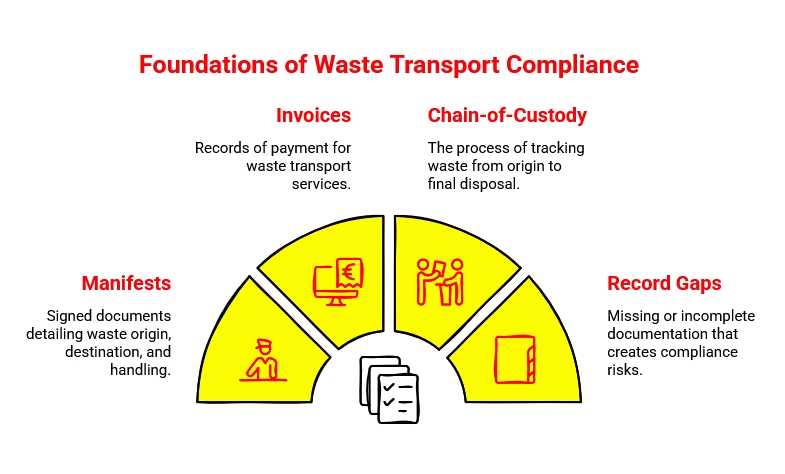
Infographic explaining waste transport compliance basics, including manifests, invoices, chain of custody, and record gaps that can create compliance risks.

Before thinking about fines, start with the file.

If an inspector asked for proof today, would your manager produce a signed manifest or a paid invoice? That distinction matters. An invoice shows that money changed hands. A manifest helps show what happened to the waste.

This is where exposure starts. A chef-driven café may have regular service and still have weak documentation. A fast-casual kitchen may keep invoices in email while signed manifests sit in a binder no one can find. A kitchen manager leaves, the binder moves, and the maintenance reminder disappears from the calendar.

That is not rare. It is how ordinary record gaps begin.

For deeper background on the document trail itself, see Drane Ranger’s guide to FOG manifest chain-of-custody requirements.


What Counts as Waste Transport Documentation?

A strong documentation file should do more than show that a pump-out was purchased. It should help answer the practical compliance question: where did the waste go?

The Houston Health Department’s Waste Generator FAQ defines a waste manifest as an official government document completed every time an interceptor is cleaned. The same FAQ says the generator signs the top portion of the manifest and that the white and yellow copies must be retained onsite for at least five years from the clean-out date. Houston Health Department Waste Generator FAQ (Houston Health Department)

Good waste transport documentation may include:

  • Clean-out date
  • Generator signature
  • Transporter identity
  • Evidence that the trap was cleaned
  • Waste quantity or volume details where available
  • Disposal or processing facility information where available
  • Notes about system issues identified during service

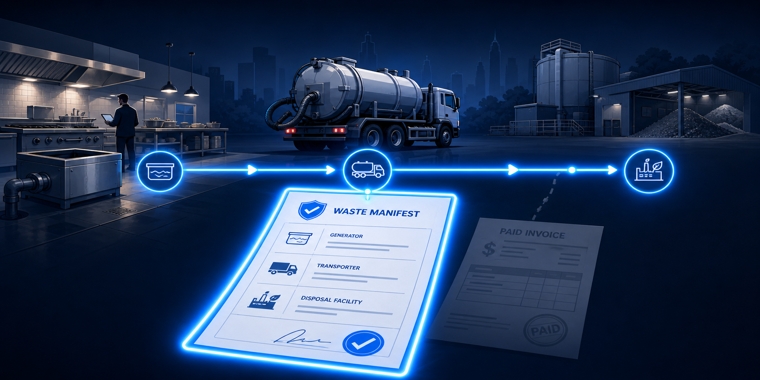
Think of the manifest like a certified passport for wastewater. It follows the waste journey. The invoice is only the receipt for the transaction.

That is why manifesting vs. invoicing deserves its own place in your compliance process. They are connected documents, but they do not do the same job.

Houston’s FOG-Special Waste program tracks waste such as fats, oil, and grease from commercial and residential establishments to help protect the city’s environment from pollutants. Houston Permitting Center Special Waste Program (Houston Permitting Center)


How Documentation Failure Escalates

Documentation failure usually starts small. One missing signature. One misplaced manifest. One invoice mistaken for proof.

Then the request comes.

When your waste transport documentation fails, the problem is not that a form is missing. The problem is that your business cannot prove what happened to its waste.

Here is the practical escalation path:

  1. The file is incomplete.
    The manager finds invoices but cannot find signed manifests.
  2. The record does not answer the compliance question.
    The paperwork may show that service was paid for, but it may not prove how the waste was handled.
  3. The burden shifts back to the operator.
    Staff must reconstruct records under pressure.
  4. The issue becomes operational.
    Managers get pulled away from service. Ownership may need to get involved. Routine work turns into a compliance scramble.
  5. Repeat gaps create a pattern.
    One missing document is a problem. A disorganized system suggests weak control.
  6. The restaurant may face regulatory escalation.
    Depending on the facts and current enforcement language, repeated documentation failures can create serious operational and permit-related consequences.

The real risk is not just a missing form. It is the possibility that repeated documentation failures create permit-level questions about whether the restaurant can keep operating safely and compliantly.

That wording is careful for a reason. Exact fines, closure orders, warning windows, and permit consequences should always be confirmed against current Houston and Texas sources.


The Compliance Exposure Self-Assessment

Complete this self-assessment before your next inspection, ownership meeting, or vendor renewal.

Answer yes or no:

  1. Can you produce signed waste manifests for recent grease trap clean-outs?
  2. Are those records stored onsite and organized by date?
  3. Do the records go back far enough to satisfy the required retention window?
  4. Can your manager explain the difference between an invoice and a manifest?
  5. Can you verify that your provider is permitted to clean interceptors in Houston?
  6. Are physical records backed up digitally?
  7. Is one person responsible for checking the manifest after every service?
  8. Do you review the file before inspections, audits, ownership meetings, or vendor changes?
  9. Can your documentation show where the waste was transported or processed after removal?
  10. If the manager who handled the last pump-out left tomorrow, could another staff member find the manifests without calling the vendor?

Green: Most records are complete, organized, and easy to retrieve. Keep the system active after every service.

Yellow: Some records exist, but gaps could create inspection stress. Rebuild the file before the next review.

Red: The business relies mainly on invoices, missing records, or vendor promises. Treat this as a documentation exposure problem.

Houston Health Department guidance for special waste service companies lists transporter-related documentation such as driver information, financial responsibility, a City of Houston Waste Transportation Permit Bond or pollution liability coverage, and a Texas Commission on Environmental Quality (TCEQ) Sludge Authorization and registration. Houston Health Department Special Waste Service Companies (Houston Health Department)


How to Reduce Exposure Before the Next Inspection

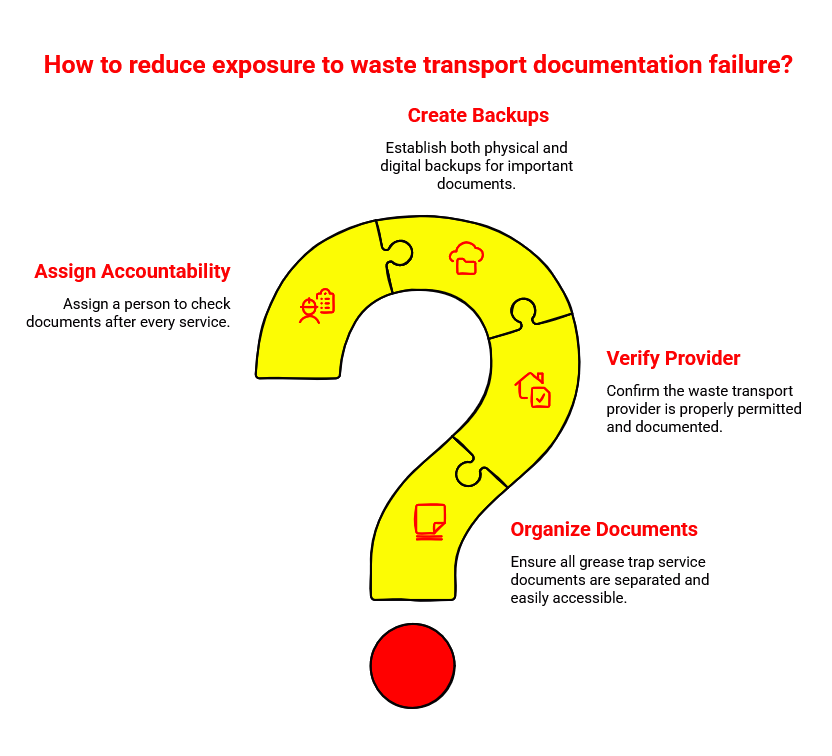
Question mark infographic showing ways to reduce documentation risks, including assigning accountability, creating backups, verifying providers, and organizing grease trap records.

The fix is simple, but it has to be assigned.

Start by pulling every grease trap service document from the required record period. Separate invoices from manifests. Then confirm that each manifest is signed, tied to a clean-out date, and easy to find.

Next, verify that your provider is properly permitted and documented for the work being performed. Create a physical onsite binder and a digital backup. The backup is not a substitute for any required onsite copy, but it gives the manager a second place to look when the cabinet key goes missing.

Assign one accountable person to check the file after every pump-out. Not later. Not at the end of the month. After every service.

For a practical filing process, use Drane Ranger’s resource on how to organize your FOG manifests or compare your current process against a broader FOG compliance checklist.

The goal is not to make compliance feel complicated. The goal is to turn a potentially serious documentation failure into a managed background task.


When to Call a Professional Waste Transport Partner

Call a professional waste transport partner when the self-assessment shows missing manifests, incomplete records, unclear transporter status, or confusion about who checks paperwork after service.

That conversation should not only be about pumping. It should be about documentation confidence.

Drane Ranger Vacuum Services supports Houston-area businesses with liquid waste management, including assessment, removal, transportation to approved processing facilities, proper disposal, and service documentation. For restaurants that need commercial grease trap cleaning in Houston or broader grease, grit, and lint trap service, documentation should be part of the service conversation from the start.

Texas also treats municipal liquid waste processing as a regulated area. TCEQ guidance says facilities accepting municipal liquid waste for processing generally need a permit or registration unless the activity is conducted at a permitted landfill. TCEQ Municipal Liquid Waste Processing (TCEQ)

If your file shows gaps, contact Drane Ranger or call 281-489-1765 to discuss compliant service documentation. Complete the self-assessment first. Then use the results to ask better questions.


FAQs About Failed Waste Transport Documentation

Is an invoice enough to prove grease trap waste was handled properly?

No. An invoice shows payment. A manifest is the document that helps track the waste handling event.

How long should Houston restaurants keep grease trap waste manifests onsite?

The Houston Health Department Waste Generator FAQ says white and yellow manifest copies must be retained onsite for at least five years from the clean-out date. Houston Health Department Waste Generator FAQ (Houston Health Department)

Who is allowed to clean my interceptor or trap?

Houston guidance says interceptors can be cleaned by a waste transporter permitted with the Houston Health Department. Verify that status before relying on the provider.

What should be asked after each service?

Ask for the signed manifest, service date confirmation, waste quantity or volume details where available, disposal or processing facility information where available, and any system issues found during service.

What if records disappeared after a manager left?

Rebuild the file immediately. Contact the provider for missing documents, assign a new record owner, and create both physical and digital backups.

Should manifests be digitized?

Yes. Digital backups help when binders move or staff changes. They should support required onsite retention, not replace it unless current rules clearly allow that.

Regulatory requirements can change. Always confirm current Houston and Texas requirements with the appropriate agency or a qualified compliance professional before relying on a specific deadline, penalty, or filing procedure.

Our expert team uses AI tools to help organize and structure our initial drafts. Every piece is then extensively rewritten, fact-checked, and enriched with first-hand insights and experiences by expert humans on our Insights Team to ensure accuracy and clarity.

Our Editorial Process:

This article was developed from the approved Content Strategy Document, Drane Ranger project files, official Houston and Texas regulatory sources, and documented customer testimonial material. It avoids unsupported service-cost claims, guaranteed inspection outcomes, invented fine timelines, and competitor comparisons.

By Drane Ranger Insights Team

The Drane Ranger Insights Team creates practical wastewater, grease trap, and liquid waste compliance resources for Houston-area businesses. Drawing from Drane Ranger Vacuum Services’ decades of local service experience, the team focuses on clear, useful guidance that helps operators maintain safe, compliant, and reliable facilities.

The Invoice Illusion: Why Your Current Pumper Leaves Your Restaurant Legally Exposed

📌 Key Takeaways

A paid grease trap invoice proves billing, but a manifest helps prove where the waste went.

  • Invoices Are Limited: An invoice may show payment, but it does not prove legal grease waste disposal.
  • Manifests Protect Better: A manifest tracks grease waste from pickup to disposal, giving inspectors a clearer paper trail.
  • Ask For Proof: Restaurants should request permits, manifest copies, and disposal records before renewing with a pumper.
  • Cheap Can Cost More: Low-cost pumping without proper records may leave a restaurant exposed during a FOG audit.
  • Records Need Routine: Keeping clear service paperwork makes inspections easier and reduces last-minute document chasing.

Paid is not the same as protected.

Houston restaurant owners and managers will see why grease trap paperwork matters, preparing them for the detailed overview that follows.

~ ~ ~ ~ ~ ~ ~ ~ ~ ~ ~ ~ ~ ~ ~ ~ ~ ~

The invoice looks safe.

It is sitting in the folder with the paid stamp, the service date, and the vendor name. The kitchen manager can point to it. The bookkeeper can match it to the check. The owner can see the line item on the P&L and think, We paid for this. We’re covered.

That is an easy assumption to make. It is also the assumption that can leave a Houston restaurant legally exposed during a FOG audit if the paperwork stops at “paid” instead of proving where the grease waste went.


Why an Invoice Is Not Enough During a Houston FOG Audit

A grease trap invoice proves that a vendor billed you. A chain-of-custody manifest helps prove where the waste went after it left your restaurant. In a Houston FOG audit, that distinction matters because inspectors may ask for manifest copies and other compliance records, not just receipts.

The Houston Permitting Center identifies restaurants and food dealer establishments with grease traps as special waste generators, and it states that interceptors within incorporated City limits must be fully evacuated at least quarterly, every 90 days, unless an approved waiver applies. (Houston Permitting Center)

That is the first reality check. Houston does not only care whether someone pumped the trap. The inspection process can also ask whether the right records exist.


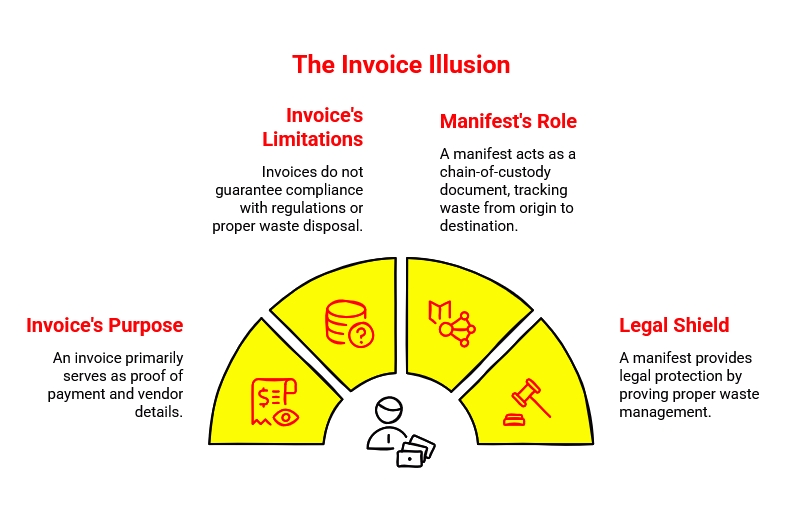
The Invoice Illusion: What a Receipt Actually Proves

Infographic explaining that invoices prove payment and vendor details, while manifests document chain of custody, proper waste disposal, and compliance protection.

An invoice answers one narrow question: Did someone bill you for service?

That matters for bookkeeping. It may show the vendor name, service date, invoice number, and amount charged. It may help prove that your restaurant paid a pumper.

It does not automatically prove that the hauler was properly permitted, that the vehicle was registered where required, that the waste quantity was documented, or that the grease waste reached an approved disposal destination.

A manifest is different. A manifest is like a passport for your wastewater. It tracks the journey from your kitchen to the disposal site. An invoice is only the bill for the trip.

An invoice answers, “Did payment happen?” A manifest answers, “Where did the waste go?”

“A manifest is a legal shield; an invoice is just a bill.”

That line is blunt because the issue is practical. Your paperwork folder can look full and still fail the real inspection question if it contains payment records but not chain-of-custody proof.


The Reality: Inspectors Need Chain-of-Custody Proof

Houston’s inspection guidance says investigators may need to be provided the original Fats, Oils, and Grease permit, yellow and white copies of waste manifests for the past five years, applicable biological pretreatment invoices, waiver notices if applicable, and previous inspection copies. It also notes that investigators may check the trap and sample well. (Houston Permitting Center)

That does not mean every inspection unfolds the same way. Requirements can vary by facility, permit status, and current municipal rules. The safe operating principle is simple: build your records as if someone may ask for the full story.

For a restaurant owner or general manager, the full story has three parts:

  • What was removed
  • Who transported it
  • Where it went

A paid invoice may support the first part loosely. It rarely carries the full chain by itself.

For operators comparing vendors, that difference should change the buying decision. Cheap pumping is not automatically bad. Cheap pumping without documentation is the problem.


Where Liability Can Follow Your Restaurant After Pump-Out

The trap may be outside the kitchen, but the risk still lands inside the business.

Once fats, oils, and grease leave your property, your practical concern is no longer only whether the trap was pumped. It is whether the waste was handled through a documented process that can stand up to questions later.

Houston’s Special Waste Program says the FOG-special waste program tracks fats, oils, and grease waste to help protect the city’s environment from pollutants that may harm individuals and ecosystems. (Houston Consumer) The Houston Permitting Center also states that a transporter permit is required for hauling special waste in City of Houston streets when the waste originates in the city. (Houston Permitting Center)

That is why vague vendor promises are not enough. “We handle all that” may sound reassuring at 7:18 on a busy prep morning. It is less useful when an inspector asks for records.

The safer question is: Can the vendor prove the chain?


Invoice vs. Manifest: The Document Comparison That Changes Everything

Document What It Proves What It Does Not Prove Why It Matters in a FOG Audit
Invoice A vendor billed for service. It does not prove legal chain-of-custody or approved disposal. It may not satisfy documentation needs if manifest records are requested.
Waste Manifest Waste was documented through pickup, transport, and disposal. It does not replace routine cleaning or trap accessibility. It helps prove where the grease waste went.
Transporter Permit / Vehicle Registration The hauler or vehicle is permitted or registered where required. It does not prove your specific load was disposed of unless tied to a manifest. It helps you vet whether the vendor operates within the required system.
Disposal Facility Proof Waste reached an approved destination. It does not prove service quality inside the trap by itself. It completes the chain-of-custody story.

The transporter side matters because Houston separately identifies transporter permits and transporter vehicle registration. The Houston Permitting Center states that waste-transport vehicles or trailers used for waste originating within the city must have the required registration decal or certificate. (Houston Permitting Center)

The broader reason is also well established. TCEQ’s grease-management guidance explains that fats, oils, and grease can contribute to grease-blocked pipes, pump station problems, and wastewater spills. (TCEQ)

That is the public infrastructure reason behind the paperwork. The restaurant-level reason is simpler: documentation protects your ability to prove responsible handling.


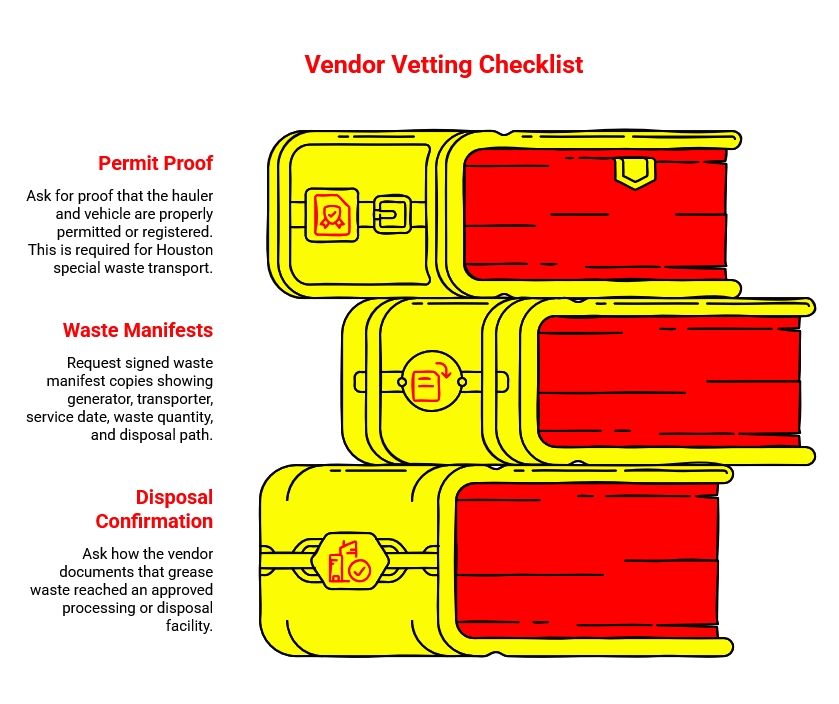
Vendor Vetting Checklist: Three Documents to Demand Before You Renew

Checklist graphic for vetting grease trap vendors, covering permit proof, signed waste manifests, service dates, waste quantities, disposal path, and disposal confirmation.

Before renewing with your current pumper, ask for proof in writing. Keep the request calm and specific.

  • Current permit or registration proof
    Ask whether the hauler and vehicle are properly permitted or registered for Houston special waste transport where required.
  • Signed waste manifest copies
    Ask for manifest records showing the generator, transporter, service date, waste quantity, and disposal path.
  • Disposal facility confirmation
    Ask how the vendor documents that grease waste reached an approved processing or disposal facility.

This is not legal advice. It is practical vendor evaluation. A reliable pumper should be able to explain the paperwork without dodging the question.

For deeper documentation planning, Drane Ranger’s related guide on how to organize your FOG manifests can help turn this checklist into a working recordkeeping habit.


Red Flags Your Current Pumper May Be Creating Exposure

A vendor does not need to look suspicious to create risk. Sometimes the warning signs are ordinary.

Watch for these patterns:

  • They only provide a receipt or invoice.
  • They cannot explain which manifest copies you should keep.
  • They cannot tell you where the waste goes.
  • They avoid questions about permits, vehicle registration, or disposal facilities.
  • They rely on vague promises instead of written proof.
  • They suggest quarterly pumping is always enough, even for high-volume kitchens.

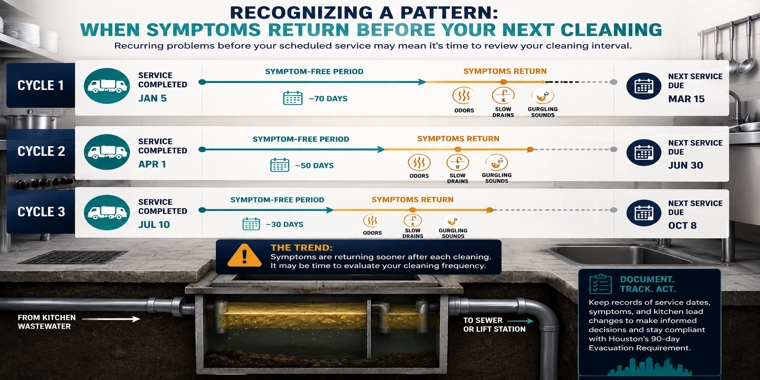
The last point deserves care. Quarterly evacuation is a baseline requirement in Houston unless a waiver applies, but busy operations may need more frequent service based on actual FOG load, trap condition, and operational volume. Drane Ranger’s own service guidance notes that high-volume businesses may require more frequent cleaning than the quarterly minimum, and its Commercial Grease Trap Cleaning work is built around keeping traps clean, documented, and aligned with local requirements.

A good vendor does not reduce everything to the calendar. They look at the operation.


What a Compliant Vendor Relationship Should Feel Like

A compliant vendor relationship should feel boring in the best way.

You should receive clear paperwork after service. You should know what was removed, where it went, and what records belong in your compliance folder. You should not have to chase someone 19 days later for the document an inspector may ask for.

That is where a complete liquid waste provider matters. Drane Ranger positions its work beyond basic pump-outs, with services that include grease trap cleaning, vacuum truck services, lint trap cleaning, liquid waste management, lift station cleaning, septic service, grit traps, wash bays, and non-hazardous wastewater disposal across the Houston area.

The better relationship also includes service history and proactive scheduling. Drane Ranger’s liquid waste management guidance says its professionals assess waste generation rates, recommend service intervals, maintain service history, proactively schedule appointments, and create compliance documentation with service dates, waste quantities, disposal facility information, and system issues identified.

That is the difference between “someone pumped the trap” and “the restaurant has a record it can use.”

As Shelley M. put it: “Drain Ranger is very professional and reliable. Basically they can take care of all your grease drain needs.”


Before You Hire or Renew: Use the Vendor Vetting Checklist

Before you renew, compare your current paperwork against the manifest requirements before your next Houston FOG inspection.

Do not start with price. Start with proof.

Ask your current pumper for transporter documentation, signed manifests, and disposal facility confirmation. If they can provide it clearly, you have a stronger basis for trust. If they cannot, the lower invoice may not be the lower-risk choice.

Restaurants that need Grease Trap Cleaning Houston support can also review Drane Ranger’s Restaurant Grease Trap Cleaning services or contact Drane Ranger after using the checklist. If your current vendor cannot provide compliant documentation, call 281-489-1765 to discuss grease trap service and documentation support.

The goal is not panic. The goal is a folder that makes sense when someone asks for proof.


FAQ

Is a grease trap invoice enough for a Houston FOG audit?

No. An invoice may prove payment, but Houston inspection guidance can require manifest records and other compliance documents. (Houston Permitting Center)

How long should Houston restaurants keep grease trap waste manifests?

Houston inspection guidance says investigators may ask for yellow and white copies of waste manifests for the past five years. (Houston Permitting Center)

How often must a Houston grease interceptor be evacuated?

The Houston Permitting Center states that interceptors within incorporated City limits must be fully evacuated at least quarterly, every 90 days, unless an approved waiver applies. (Houston Permitting Center)

What should a restaurant ask a grease trap pumper before hiring them?

Ask for permit or registration proof, sample manifest documentation, and a clear explanation of where the waste is disposed.

Why does chain-of-custody matter for grease trap waste?

Because the issue is not only whether the trap was pumped. The issue is whether the waste was tracked through transport and disposal.

A clean invoice can close an accounting question. A complete manifest helps close the compliance question. Different documents. Different protection.

Disclaimer

This article is for general informational purposes only and is not legal advice. Grease trap, special waste, and FOG compliance requirements can vary based on location, facility type, permit conditions, and current municipal rules. Restaurant owners and managers should consult the City of Houston, qualified regulatory professionals, or legal counsel for advice about their specific compliance obligations.

Our Editorial Process

Our expert team uses AI tools to help organize and structure our initial drafts. Every piece is then extensively rewritten, fact-checked, and enriched with first-hand insights and experiences by expert humans on our Insights Team to ensure accuracy and clarity.

By Drane Ranger Insights Team

The Drane Ranger Insights Team creates practical guidance for Houston-area businesses that need reliable liquid waste management, grease trap cleaning, septic, lift station, and wastewater compliance support. Drane Ranger Vacuum Services has served the Greater Houston area since 1985, helping customers keep operations running while following applicable waste handling and disposal requirements.
Decoding Houston Chapter 47 Citations: Immediate Actions for Restaurant Owners

📌 Key Takeaways

A Houston Chapter 47 citation becomes manageable when restaurant owners read the notice, fix the problem, and keep proof.

  • Read The Notice: The citation tells you the issue, deadline, inspector, and next step you must follow.
  • Gather Your Records: Your FOG permit, manifests, invoices, and past inspections help show what happened.
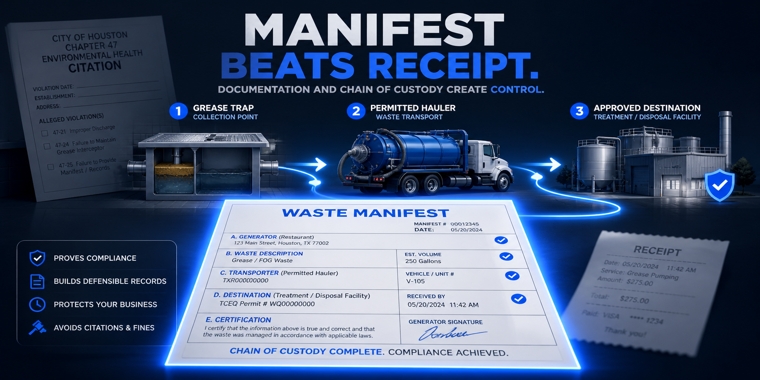
  • Manifest Beats Receipt: A waste manifest proves where grease waste went; a receipt only proves payment.
  • Use Permitted Help: A proper waste transporter can clean the trap and give you the paperwork you need.
  • File Every Proof: Keep the citation, service record, manifest, and submission proof together for future inspections.

Proof turns panic into control.

Houston restaurant owners facing a Chapter 47 citation will get a clear first-response path here, preparing them for the detailed overview that follows.

~ ~ ~ ~ ~ ~ ~ ~ ~ ~ ~ ~ ~ ~ ~ ~ ~ ~

The letter is on your desk.

The printer tray is still warm, the lunch rush is 23 minutes away, and now a Chapter 47 citation is sitting beside the prep list.

Start by slowing the situation down. Do not begin by calling the first person who says they can pump the trap today. Read the citation, pull your FOG paperwork, and make sure any service you schedule gives you the manifest you may need to prove what happened next.

A Houston Chapter 47 citation is not a moment to improvise. It is a moment to document. With the right response, you can move from panic to control: confirm the issue, correct what needs attention, keep proof, and protect the restaurant from avoidable escalation.


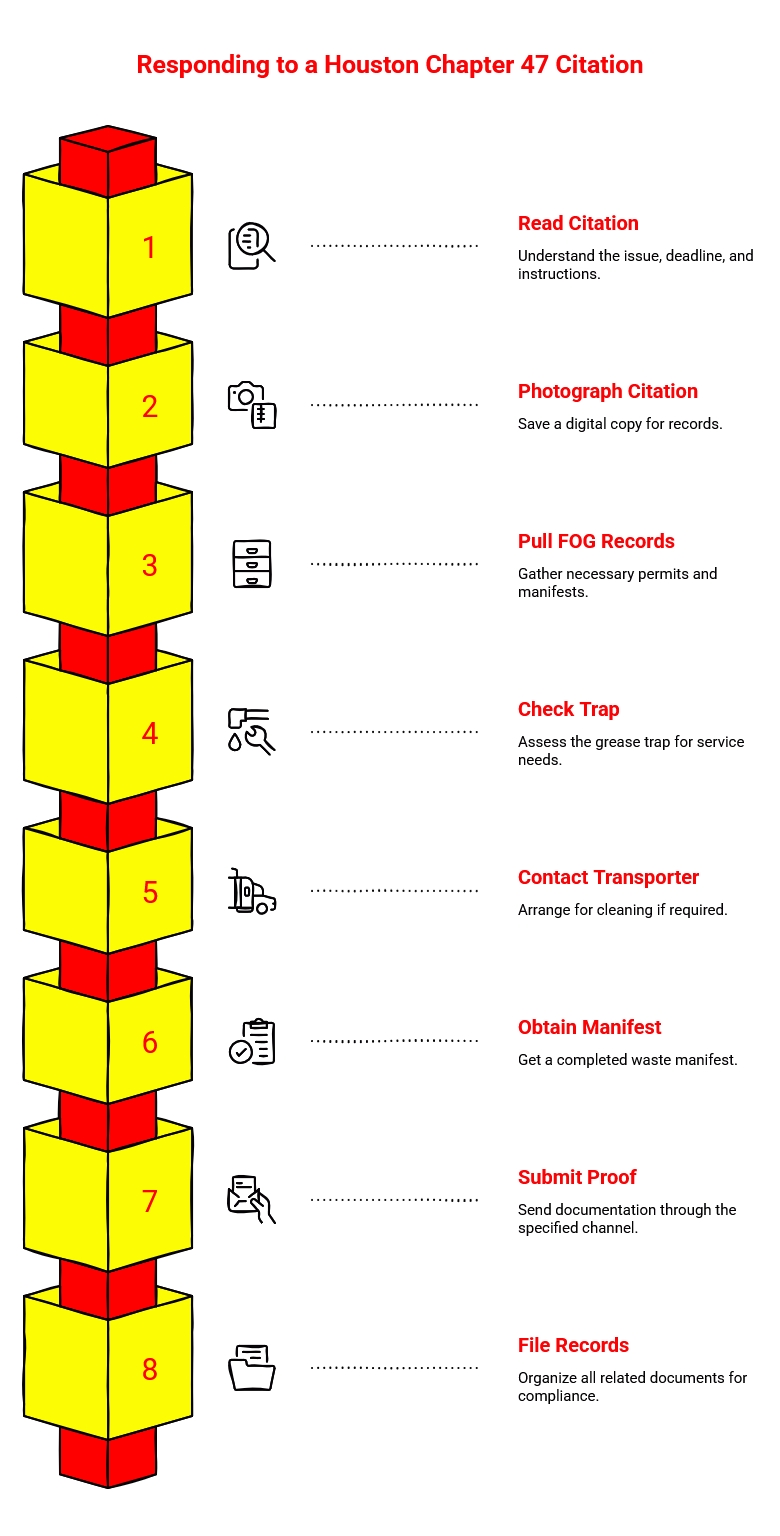
You Opened a Chapter 47 Citation. Do These First.

Step-by-step infographic for handling a Houston Chapter 47 citation, from reading and photographing it to gathering FOG records, checking the trap, obtaining a manifest, submitting proof, and filing records.

After receiving a Houston Chapter 47 citation, read the notice carefully, confirm the issue and deadline, pull your FOG permit and waste manifests, check whether the grease trap or interceptor needs service, contact a permitted waste transporter if cleaning is required, obtain a completed waste manifest, submit proof through the channel named on the citation or by the inspector, and keep the records in your compliance file.

Treat the next few steps like an operating checklist.

  1. Read the citation carefully. Identify the issue, location, deadline, inspector name, and correction instructions.
  2. Photograph or scan the citation. Save a copy before it gets buried under invoices or shift paperwork.
  3. Pull your FOG records. Look for the original FOG permit, recent waste manifests, waivers if applicable, related invoices, and prior inspection records.
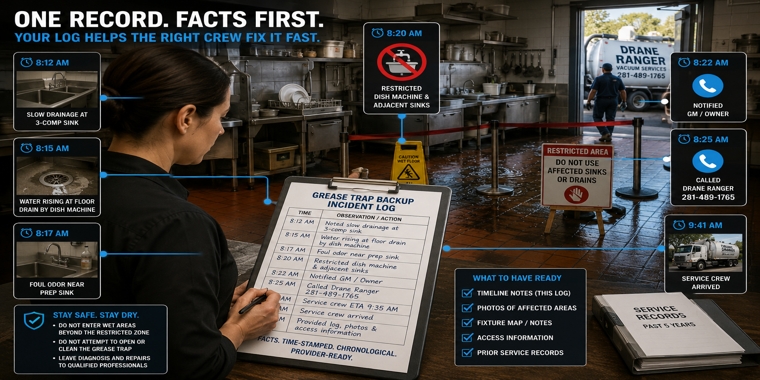
  4. Check the trap or interceptor. Slow kitchen drains, strong odors, visible grease, or backup risk can signal that service is needed.
  5. Contact a permitted waste transporter. If service is required, make sure the provider can produce proper documentation.
  6. Obtain the completed waste manifest. Do not rely on a receipt alone.
  7. Submit proof carefully. Use the channel named on the citation or provided by the inspector.
  8. File everything. Keep the citation, manifest, submission proof, and related records together.

This is your response map. Print it, save it, or hand it to the manager who owns the next step.


What a Houston Chapter 47 Citation Usually Means

Houston Public Works says its Industrial Wastewater Service regulates industrial waste discharged to the sanitary sewer system and administers City of Houston Code of Ordinances Chapter 47, Article V, along with Clean Water Act requirements and related regulations. For a restaurant owner, that usually points to concerns around fats, oils, grease, special waste, interceptor maintenance, discharge, or documentation. Houston Public Works explains this pretreatment authority here. (houstonpublicworks.org)

Plain English: the city is asking you to prove the issue has been corrected and documented.

Do not assume the citation means only one thing. It may involve the physical condition of the grease trap, missing paperwork, transporter documentation, or proof that waste was handled correctly. The safest first move is to follow the notice in front of you. Exact deadlines and penalty exposure can vary by the specific citation, so the citation itself should control your response timing.

Houston’s Special Waste Program also states that the FOG-Special Waste program tracks waste such as fat, oil, and grease from establishments, and that food establishments with grease traps are special waste generators. The Houston Permitting Center describes the Special Waste Program and transporter permit context here. (Houston Permitting Center)

That matters because Chapter 47 compliance is not just about whether the trap was pumped. It is also about whether the waste was tracked properly.


Why the Manifest Matters More Than the Invoice

An invoice shows that a transaction happened. A waste manifest shows that waste was removed and tracked.

That difference is the heart of the problem.

A manifest serves as the legal chain-of-custody document for your grease waste. It shows where the waste went, who handled it, and how the removal was documented. An invoice only shows that money changed hands. It may support your file, but it is not the same as chain-of-custody documentation.

The Houston Health Department’s special waste generator guidance says establishments with interceptors must keep generator and returned generator copies of waste manifests on-site for five years. It also says investigators may ask for the original FOG permit, manifest copies, applicable invoices, waiver notices, and previous inspections during an inspection. Houston Health’s Special Waste Generators page explains these responsibilities. (Houston Consumer)

That is why a fast pump-out is only part of the answer. The paperwork has to hold up after the truck leaves.

A lowest-price, undocumented pump-out can feel tempting when the dining room opens in an hour. The risk is that the immediate mess may be gone, while the compliance problem remains. If the city asks for proof, you need more than a paid bill.


The 24-Hour Response Map for Restaurant Owners

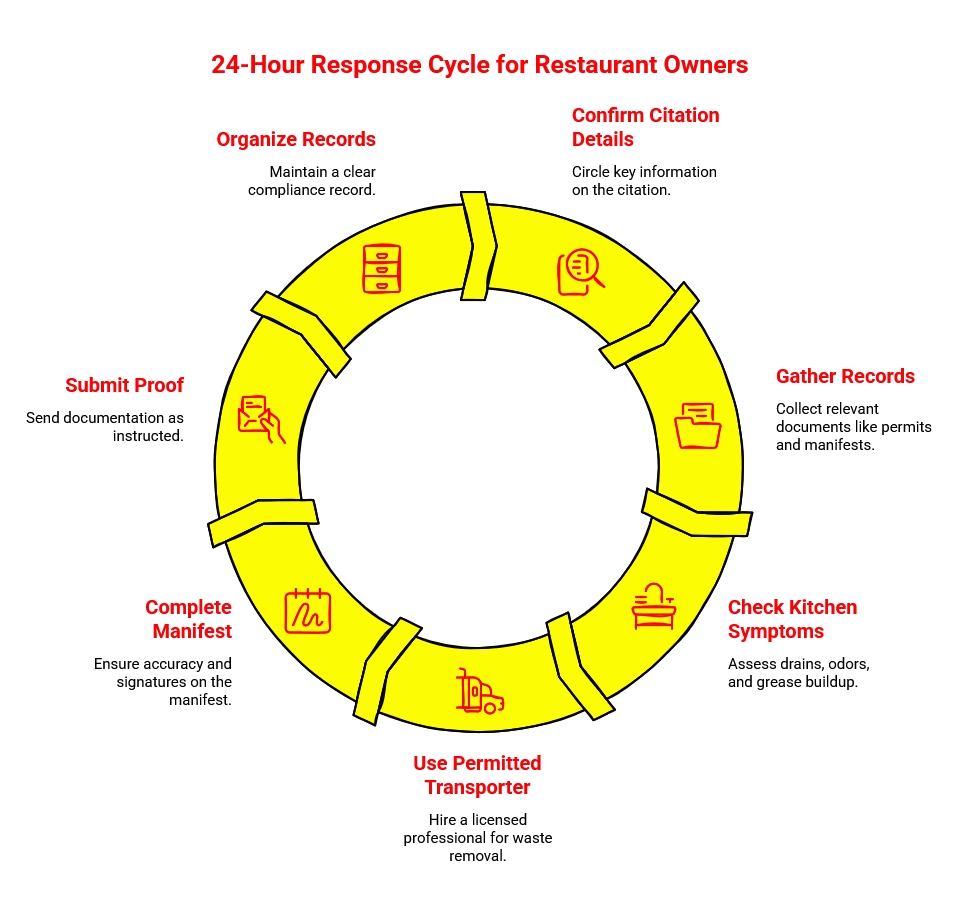
Circular infographic showing a 24-hour citation response cycle, including confirming details, gathering records, checking kitchen symptoms, using a permitted transporter, completing the manifest, submitting proof, and organizing records.

Your goal is not to win an argument on day one. Your goal is to create a clean record of responsible action.

Confirm the citation details first. Circle the issue, deadline, location, and requested correction. If the citation names a city contact or inspector, use that information rather than guessing where to send proof.

Pull your records next. Gather the FOG permit, recent manifests, prior inspection reports, waiver documents if applicable, and related invoices. Keep invoices in the folder, but label them as support documents. Do not treat them as manifest replacements.

Check the trap and kitchen symptoms. Slow drains, odors near the dish area, visible grease, and backup risk deserve attention. If accumulation is part of the issue, keep the explanation brief and use a dedicated resource such as What the 25% Rule Means for Houston Grease Trap Compliance for deeper review.

Use a properly permitted transporter when service is required. The Houston Permitting Center states that hauling special waste in Houston streets requires a transporter permit, and that acting as a transporter without a current valid permit is unlawful unless the person is acting for a valid permit holder. The transporter permit page explains this requirement. (Houston Permitting Center)

Get the manifest completed and signed. Before signing, confirm that the trap was cleaned as required, the capacity is accurate, and the document is complete. Keep your copy where a manager can find it during an inspection.

Submit proof exactly as instructed. Use the channel named on the citation or by the inspector. Then file the citation, service paperwork, manifest, and submission confirmation in the same compliance record.

For longer-term organization, use a recordkeeping resource such as FOG Compliance Checklist: Is Your Kitchen Ready for Inspection? so the next inspection does not become a scavenger hunt.


Common Mistakes That Make the Citation Worse

Most citation mistakes happen under pressure. They are fixable, but only if you catch them quickly.

The first mistake is ignoring the notice. A citation does not improve because the kitchen is busy.

The second is hiring a hauler who cannot support the documentation trail. Speed matters, but documentation matters too.

The third is submitting only a receipt when the issue calls for a manifest or other proof. That can leave the city’s core concern unanswered.

The fourth is waiting until the trap backs up. Slow drains and faint grease odors are not background noise. They are early warnings.

The fifth is mishandling used fryer grease. Houston Health guidance says used fryer grease must be picked up by a private disposal company and should not be poured down drains, grease traps, ditches, or storm drains. (Houston Consumer)

These are practical errors, not character flaws. Restaurant operators are managing staff, prep, vendors, customer service, and inspectors at the same time. The fix is a better system: documented service, clear records, and a provider who understands the compliance side of Grease, Grit & Lint Traps.


What Inspectors May Look For During an Interceptor Inspection

Inspection readiness has two sides.

The first is physical. Investigators may check the trap, sample well, dumpster, rendering oil bin, and surrounding area. The second is administrative. They may need to see the FOG permit, manifest copies, applicable invoices, waivers, and previous inspection copies. Houston Health also states that inspections may occur without prior notification. (Houston Consumer)

That means your compliance file should be boring in the best possible way. The manager should know where it is. The documents should be current. The manifest copies should be easy to match to service dates.

No drama. Just proof.


When to Call for Emergency Grease Trap Help

Call for help when the citation is active and the kitchen symptoms are getting harder to ignore: slow drains, strong odors, visible grease, missing manifests, backup risk, or a prior provider who cannot produce documentation.

Drane Ranger provides grease trap cleaning in Houston and supports Greater Houston-area businesses with liquid waste service. Since 1985, the company has served the Houston area with a focus on customer service, compliant handling, and documented waste removal. Its BBB profile is also available as a trust reference through the provided business assets. The BBB profile for Drane Ranger Vacuum Service is listed here.

For broader context, the Texas Commission on Environmental Quality explains that fats, oils, and grease can contribute to sewer blockages, backups, pump-station repairs, and wastewater spills, which is why grease-management standards focus on proper installation, operation, and pumping practices. TCEQ’s model standards page explains the state-level FOG rationale. (tceq.texas.gov)

If you have an active Chapter 47 citation and need compliant grease trap service with documentation, call Drane Ranger at 281-489-1765. Ask for help understanding what service is needed, what paperwork will be provided, and how to keep the records together for inspection follow-up.

The citation on the desk is not the whole story. The response is.

Read it. Document it. Correct what needs correction. Keep the proof.

That is how a citation becomes a controlled process instead of a business interruption.

Disclaimer: This article is for general informational purposes only and is not legal advice. City requirements, citation procedures, deadlines, and fine amounts can change and may vary based on the specific notice issued to your business. Always read the citation carefully, follow the instructions provided by the City of Houston or the assigned inspector, and consult qualified legal or regulatory counsel when needed.

Our Editorial Process: 

Our expert team uses AI tools to help organize and structure our initial drafts. Every piece is then extensively rewritten, fact-checked, and enriched with first-hand insights and experiences by expert humans on our Insights Team to ensure accuracy and clarity.

By: About the Drane Ranger Insights Team

The Drane Ranger Insights Team is our dedicated engine for synthesizing complex topics into clear, helpful guides. While our content is thoroughly reviewed for clarity and accuracy, it is for informational purposes and should not replace professional advice.