📌 Key Takeaways
A paid grease trap invoice proves billing, but a manifest helps prove where the waste went.
- Invoices Are Limited: An invoice may show payment, but it does not prove legal grease waste disposal.
- Manifests Protect Better: A manifest tracks grease waste from pickup to disposal, giving inspectors a clearer paper trail.
- Ask For Proof: Restaurants should request permits, manifest copies, and disposal records before renewing with a pumper.
- Cheap Can Cost More: Low-cost pumping without proper records may leave a restaurant exposed during a FOG audit.
- Records Need Routine: Keeping clear service paperwork makes inspections easier and reduces last-minute document chasing.
Paid is not the same as protected.
Houston restaurant owners and managers will see why grease trap paperwork matters, preparing them for the detailed overview that follows.
~ ~ ~ ~ ~ ~ ~ ~ ~ ~ ~ ~ ~ ~ ~ ~ ~ ~
The invoice looks safe.
It is sitting in the folder with the paid stamp, the service date, and the vendor name. The kitchen manager can point to it. The bookkeeper can match it to the check. The owner can see the line item on the P&L and think, We paid for this. We’re covered.
That is an easy assumption to make. It is also the assumption that can leave a Houston restaurant legally exposed during a FOG audit if the paperwork stops at “paid” instead of proving where the grease waste went.
Why an Invoice Is Not Enough During a Houston FOG Audit
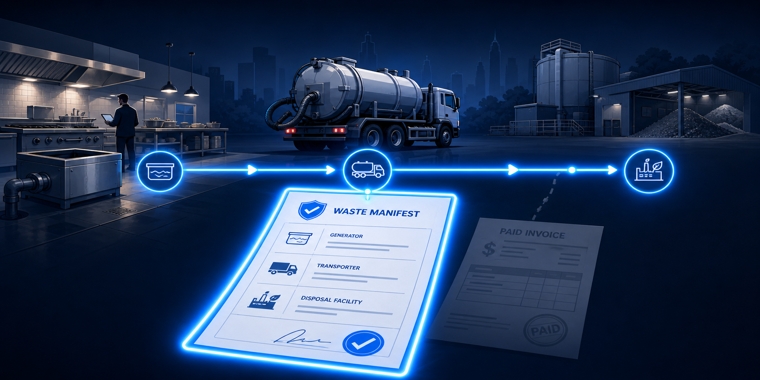
A grease trap invoice proves that a vendor billed you. A chain-of-custody manifest helps prove where the waste went after it left your restaurant. In a Houston FOG audit, that distinction matters because inspectors may ask for manifest copies and other compliance records, not just receipts.
The Houston Permitting Center identifies restaurants and food dealer establishments with grease traps as special waste generators, and it states that interceptors within incorporated City limits must be fully evacuated at least quarterly, every 90 days, unless an approved waiver applies. (Houston Permitting Center)
That is the first reality check. Houston does not only care whether someone pumped the trap. The inspection process can also ask whether the right records exist.
The Invoice Illusion: What a Receipt Actually Proves
An invoice answers one narrow question: Did someone bill you for service?
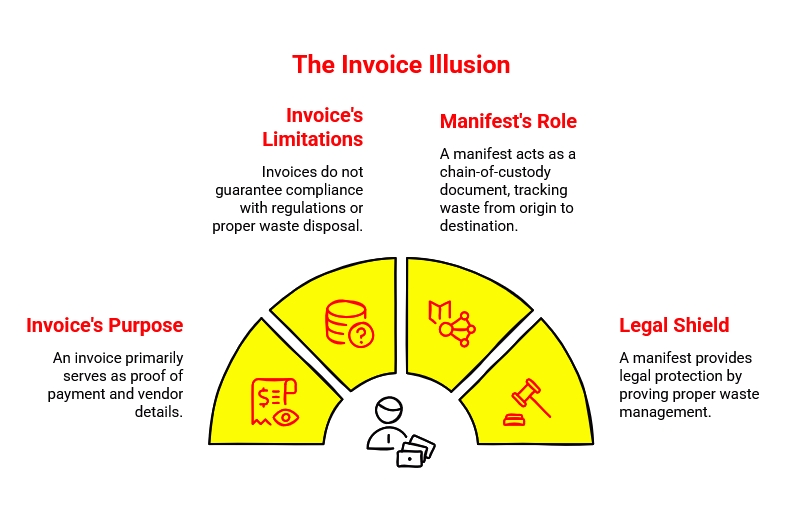
That matters for bookkeeping. It may show the vendor name, service date, invoice number, and amount charged. It may help prove that your restaurant paid a pumper.
It does not automatically prove that the hauler was properly permitted, that the vehicle was registered where required, that the waste quantity was documented, or that the grease waste reached an approved disposal destination.
A manifest is different. A manifest is like a passport for your wastewater. It tracks the journey from your kitchen to the disposal site. An invoice is only the bill for the trip.
An invoice answers, “Did payment happen?” A manifest answers, “Where did the waste go?”
“A manifest is a legal shield; an invoice is just a bill.”
That line is blunt because the issue is practical. Your paperwork folder can look full and still fail the real inspection question if it contains payment records but not chain-of-custody proof.
The Reality: Inspectors Need Chain-of-Custody Proof
Houston’s inspection guidance says investigators may need to be provided the original Fats, Oils, and Grease permit, yellow and white copies of waste manifests for the past five years, applicable biological pretreatment invoices, waiver notices if applicable, and previous inspection copies. It also notes that investigators may check the trap and sample well. (Houston Permitting Center)
That does not mean every inspection unfolds the same way. Requirements can vary by facility, permit status, and current municipal rules. The safe operating principle is simple: build your records as if someone may ask for the full story.
For a restaurant owner or general manager, the full story has three parts:
- What was removed
- Who transported it
- Where it went
A paid invoice may support the first part loosely. It rarely carries the full chain by itself.
For operators comparing vendors, that difference should change the buying decision. Cheap pumping is not automatically bad. Cheap pumping without documentation is the problem.
Where Liability Can Follow Your Restaurant After Pump-Out
The trap may be outside the kitchen, but the risk still lands inside the business.
Once fats, oils, and grease leave your property, your practical concern is no longer only whether the trap was pumped. It is whether the waste was handled through a documented process that can stand up to questions later.
Houston’s Special Waste Program says the FOG-special waste program tracks fats, oils, and grease waste to help protect the city’s environment from pollutants that may harm individuals and ecosystems. (Houston Consumer) The Houston Permitting Center also states that a transporter permit is required for hauling special waste in City of Houston streets when the waste originates in the city. (Houston Permitting Center)
That is why vague vendor promises are not enough. “We handle all that” may sound reassuring at 7:18 on a busy prep morning. It is less useful when an inspector asks for records.
The safer question is: Can the vendor prove the chain?
Invoice vs. Manifest: The Document Comparison That Changes Everything
| Document | What It Proves | What It Does Not Prove | Why It Matters in a FOG Audit |
|---|---|---|---|
| Invoice | A vendor billed for service. | It does not prove legal chain-of-custody or approved disposal. | It may not satisfy documentation needs if manifest records are requested. |
| Waste Manifest | Waste was documented through pickup, transport, and disposal. | It does not replace routine cleaning or trap accessibility. | It helps prove where the grease waste went. |
| Transporter Permit / Vehicle Registration | The hauler or vehicle is permitted or registered where required. | It does not prove your specific load was disposed of unless tied to a manifest. | It helps you vet whether the vendor operates within the required system. |
| Disposal Facility Proof | Waste reached an approved destination. | It does not prove service quality inside the trap by itself. | It completes the chain-of-custody story. |
The transporter side matters because Houston separately identifies transporter permits and transporter vehicle registration. The Houston Permitting Center states that waste-transport vehicles or trailers used for waste originating within the city must have the required registration decal or certificate. (Houston Permitting Center)
The broader reason is also well established. TCEQ’s grease-management guidance explains that fats, oils, and grease can contribute to grease-blocked pipes, pump station problems, and wastewater spills. (TCEQ)
That is the public infrastructure reason behind the paperwork. The restaurant-level reason is simpler: documentation protects your ability to prove responsible handling.
Vendor Vetting Checklist: Three Documents to Demand Before You Renew
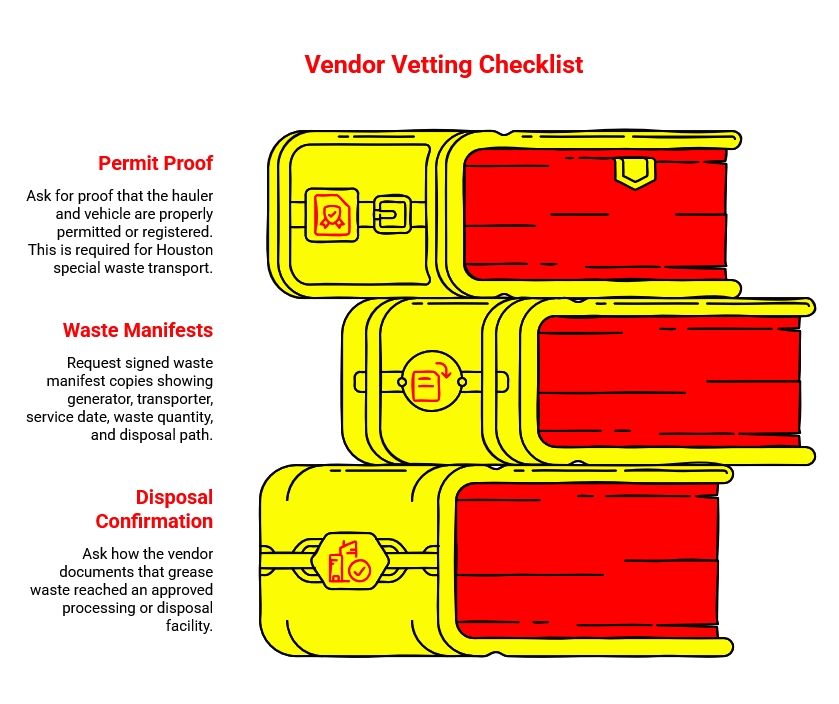
Before renewing with your current pumper, ask for proof in writing. Keep the request calm and specific.
- Current permit or registration proof
Ask whether the hauler and vehicle are properly permitted or registered for Houston special waste transport where required. - Signed waste manifest copies
Ask for manifest records showing the generator, transporter, service date, waste quantity, and disposal path. - Disposal facility confirmation
Ask how the vendor documents that grease waste reached an approved processing or disposal facility.
This is not legal advice. It is practical vendor evaluation. A reliable pumper should be able to explain the paperwork without dodging the question.
For deeper documentation planning, Drane Ranger’s related guide on how to organize your FOG manifests can help turn this checklist into a working recordkeeping habit.
Red Flags Your Current Pumper May Be Creating Exposure
A vendor does not need to look suspicious to create risk. Sometimes the warning signs are ordinary.
Watch for these patterns:
- They only provide a receipt or invoice.
- They cannot explain which manifest copies you should keep.
- They cannot tell you where the waste goes.
- They avoid questions about permits, vehicle registration, or disposal facilities.
- They rely on vague promises instead of written proof.
- They suggest quarterly pumping is always enough, even for high-volume kitchens.
The last point deserves care. Quarterly evacuation is a baseline requirement in Houston unless a waiver applies, but busy operations may need more frequent service based on actual FOG load, trap condition, and operational volume. Drane Ranger’s own service guidance notes that high-volume businesses may require more frequent cleaning than the quarterly minimum, and its Commercial Grease Trap Cleaning work is built around keeping traps clean, documented, and aligned with local requirements.
A good vendor does not reduce everything to the calendar. They look at the operation.
What a Compliant Vendor Relationship Should Feel Like
A compliant vendor relationship should feel boring in the best way.
You should receive clear paperwork after service. You should know what was removed, where it went, and what records belong in your compliance folder. You should not have to chase someone 19 days later for the document an inspector may ask for.
That is where a complete liquid waste provider matters. Drane Ranger positions its work beyond basic pump-outs, with services that include grease trap cleaning, vacuum truck services, lint trap cleaning, liquid waste management, lift station cleaning, septic service, grit traps, wash bays, and non-hazardous wastewater disposal across the Houston area.
The better relationship also includes service history and proactive scheduling. Drane Ranger’s liquid waste management guidance says its professionals assess waste generation rates, recommend service intervals, maintain service history, proactively schedule appointments, and create compliance documentation with service dates, waste quantities, disposal facility information, and system issues identified.
That is the difference between “someone pumped the trap” and “the restaurant has a record it can use.”
As Shelley M. put it: “Drain Ranger is very professional and reliable. Basically they can take care of all your grease drain needs.”
Before You Hire or Renew: Use the Vendor Vetting Checklist
Before you renew, compare your current paperwork against the manifest requirements before your next Houston FOG inspection.
Do not start with price. Start with proof.
Ask your current pumper for transporter documentation, signed manifests, and disposal facility confirmation. If they can provide it clearly, you have a stronger basis for trust. If they cannot, the lower invoice may not be the lower-risk choice.
Restaurants that need Grease Trap Cleaning Houston support can also review Drane Ranger’s Restaurant Grease Trap Cleaning services or contact Drane Ranger after using the checklist. If your current vendor cannot provide compliant documentation, call 281-489-1765 to discuss grease trap service and documentation support.
The goal is not panic. The goal is a folder that makes sense when someone asks for proof.
FAQ
Is a grease trap invoice enough for a Houston FOG audit?
No. An invoice may prove payment, but Houston inspection guidance can require manifest records and other compliance documents. (Houston Permitting Center)
How long should Houston restaurants keep grease trap waste manifests?
Houston inspection guidance says investigators may ask for yellow and white copies of waste manifests for the past five years. (Houston Permitting Center)
How often must a Houston grease interceptor be evacuated?
The Houston Permitting Center states that interceptors within incorporated City limits must be fully evacuated at least quarterly, every 90 days, unless an approved waiver applies. (Houston Permitting Center)
What should a restaurant ask a grease trap pumper before hiring them?
Ask for permit or registration proof, sample manifest documentation, and a clear explanation of where the waste is disposed.
Why does chain-of-custody matter for grease trap waste?
Because the issue is not only whether the trap was pumped. The issue is whether the waste was tracked through transport and disposal.
A clean invoice can close an accounting question. A complete manifest helps close the compliance question. Different documents. Different protection.
Disclaimer
This article is for general informational purposes only and is not legal advice. Grease trap, special waste, and FOG compliance requirements can vary based on location, facility type, permit conditions, and current municipal rules. Restaurant owners and managers should consult the City of Houston, qualified regulatory professionals, or legal counsel for advice about their specific compliance obligations.
Our Editorial Process
Our expert team uses AI tools to help organize and structure our initial drafts. Every piece is then extensively rewritten, fact-checked, and enriched with first-hand insights and experiences by expert humans on our Insights Team to ensure accuracy and clarity.
By Drane Ranger Insights Team
The Drane Ranger Insights Team creates practical guidance for Houston-area businesses that need reliable liquid waste management, grease trap cleaning, septic, lift station, and wastewater compliance support. Drane Ranger Vacuum Services has served the Greater Houston area since 1985, helping customers keep operations running while following applicable waste handling and disposal requirements.