📌 Key Takeaways
Emergency Prevention Through Quarterly Compliance: Houston mandates grease trap cleaning every three months for all food service establishments, but proactive maintenance and proper documentation serve as critical safeguards against catastrophic business disruption, regulatory fines, and reputation damage that can occur from unexpected failures.
The Four-Pillar FOG Compliance Framework: Mastering Houston ordinances, building proactive maintenance schedules, maintaining proper waste manifests, and implementing staff training transforms grease trap management from a source of constant anxiety into a predictable, controlled operational aspect.
Hidden Costs Beyond Regulatory Fines: Grease trap failures create substantial financial impact through emergency closure revenue loss, premium emergency service rates, ongoing staff costs during downtime, and long-term reputation damage amplified by social media—costs that often exceed the investment in preventive maintenance.
Documentation as Legal Protection: A properly completed waste manifest serves as your legal shield during inspections, providing proof of proper disposal procedures and licensed waste management services, often determining the difference between clean inspection reports and costly violations.
Early Warning System Implementation: Training staff to recognize and immediately report warning signs like slow drainage and unusual odors enables prompt professional assessment before minor issues escalate into operational disruptions that could force emergency closures.
This comprehensive framework transforms restaurant FOG management from reactive crisis control into proactive operational excellence, providing the systematic risk management skills essential for multi-unit franchise success and director-level advancement.
The call comes at 2 AM—your restaurant’s grease trap has backed up, flooding the kitchen with wastewater just hours before the morning rush. This nightmare scenario plays out more often than most restaurant managers care to admit, and the consequences go far beyond a messy cleanup.
For Restaurant Operations Managers in Houston’s fast-paced food service industry, grease trap compliance isn’t just another checkbox on the maintenance list. It’s a critical safeguard against catastrophic business disruption, regulatory fines, and reputation damage. The City of Houston mandates quarterly cleaning of all traps within city limits, but many managers discover that staying compliant requires more than just scheduling a cleaning service.
Key Terminology
- FOG (Fats, Oils, Grease): Cooking byproducts that solidify in pipes and traps, causing blockages and compliance issues
- Waste Manifest: Legal documentation proving proper disposal of grease trap waste, required for regulatory compliance
- City Ordinances: Houston’s specific regulations governing commercial grease trap maintenance and cleaning schedules
The real challenge lies in transforming FOG management from a source of constant anxiety into a predictable, controlled aspect of operations. This framework provides exactly that transformation.
The Worry-Free FOG Compliance Framework: Your 4-Pillar Strategy
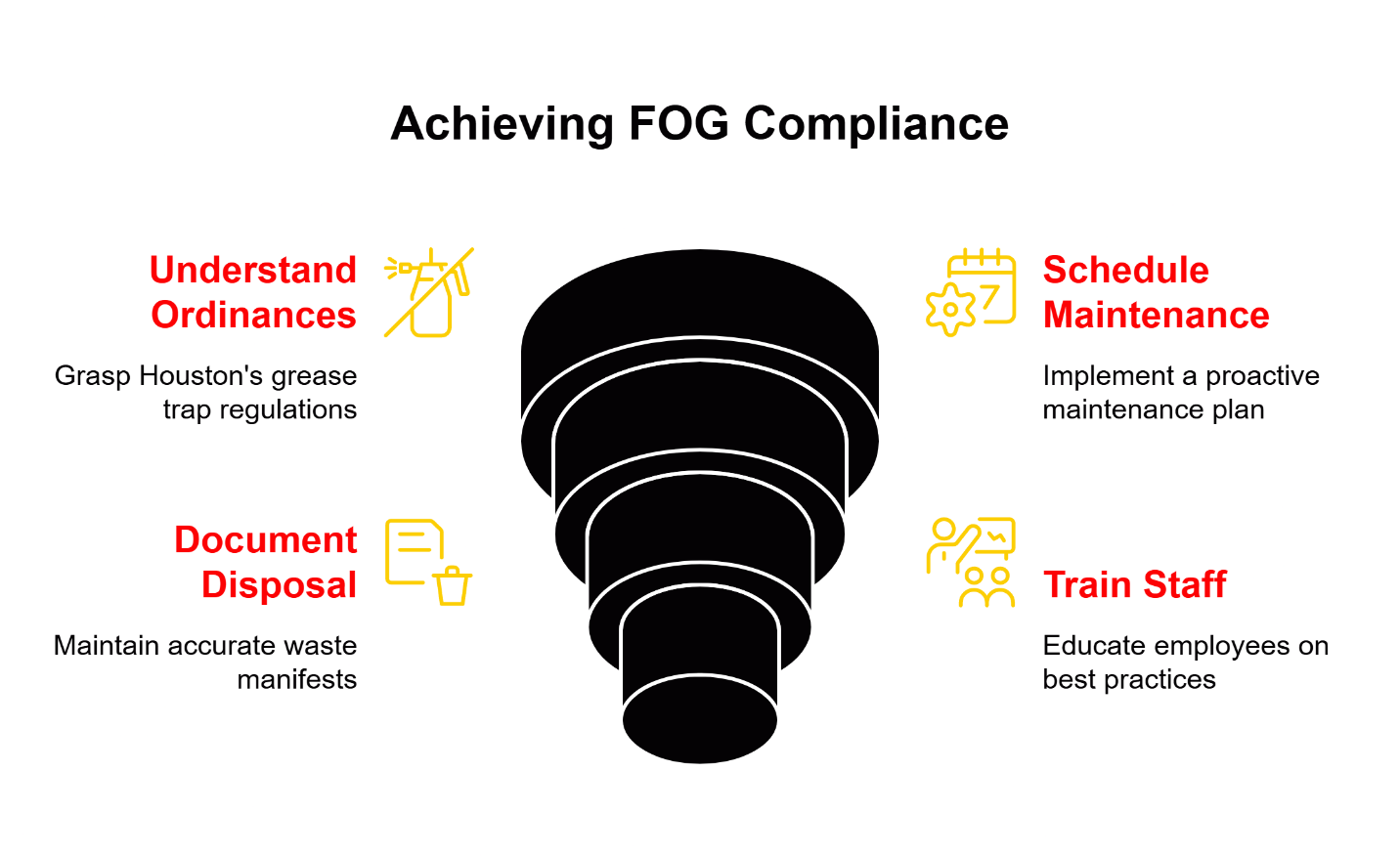
Managing grease trap compliance effectively requires a systematic approach that addresses both immediate operational needs and long-term risk mitigation. The following framework eliminates guesswork and provides clear, actionable steps for maintaining worry-free compliance.
Pillar 1: Mastering the City of Houston Ordinances
Houston’s grease trap regulations are non-negotiable, and ignorance provides no protection against fines. The city requires commercial grease trap cleaning every three months for all food service establishments, but understanding the nuances makes the difference between compliance and costly violations.
Key requirements include maintaining proper documentation, using licensed waste haulers, and following established capacity guidelines before cleaning. The ordinances also specify inspection protocols and penalty structures—knowledge that proves invaluable when health inspectors arrive unannounced.
What many managers overlook is that compliance extends beyond just emptying the trap. Proper grease disposal, accurate record-keeping, and staff training all factor into regulatory compliance.
Pillar 2: Building a Proactive, Scheduled Maintenance Plan
Reactive maintenance is expensive maintenance. A well-structured schedule prevents emergencies while ensuring consistent compliance with Houston’s quarterly requirements.
Effective scheduling considers several factors: restaurant volume, menu grease content, and seasonal variations in business. Higher-volume locations may benefit from more frequent cleanings to prevent overflow situations and maintain optimal trap efficiency.
The maintenance plan should include regular inspections between cleanings, monitoring for warning signs like slow drainage or unusual odors. Early detection helps prevent minor issues from escalating into operational disruptions.
Pillar 3: The Power of Proof: How a Waste Manifest Protects Your Business
Documentation serves as your legal shield during inspections and audits. A properly completed waste manifest provides proof that your establishment followed proper disposal procedures and used licensed waste management services.
The manifest details service dates, waste quantities, disposal methods, and hauler certifications. During surprise inspections, this documentation can mean the difference between a clean report and violations. More importantly, it demonstrates due diligence—a factor that inspectors consider when evaluating overall compliance.
Many restaurants maintain digital copies of all manifests, creating an easily accessible compliance history that streamlines inspections and reduces administrative burden.
Pillar 4: Your First Line of Defense: Internal Best Practices & Staff Training
Employee awareness and proper procedures form the foundation of effective FOG management. Staff training on grease disposal practices, drain maintenance, and early warning sign recognition prevents problems before they require professional intervention.
Simple practices make substantial differences: scraping plates thoroughly before washing, using sink strainers to catch food particles, and properly disposing of cooking oil. These seemingly minor habits significantly extend trap life and reduce cleaning frequency requirements.
Regular staff meetings should include FOG management updates, emphasizing how proper practices protect everyone’s job security by preventing shutdowns and maintaining smooth operations.
Business Impact: The True Cost of a Grease Trap Failure
Restaurant owners and franchise operators often view grease trap maintenance as a necessary expense rather than a strategic investment. This perspective changes dramatically when examining the complete cost structure of trap failures.
Regulatory fines represent only one component of the total financial impact. Hidden beneath these obvious penalties lie additional costs that can significantly affect a restaurant’s profitability.
Beyond the Fine: Calculating Restaurant Downtime and Reputation Damage
When grease traps fail during operating hours, the immediate response typically involves emergency closure until the situation resolves. Even a single day of closure in a busy restaurant represents substantial lost revenue, while emergency cleaning services typically charge premium rates above standard maintenance pricing.
Staff costs continue during closures, creating additional financial strain. Employees still require payment despite generating no revenue, and overtime costs can mount as teams work extended hours to restore normal operations.
Customer relationships suffer lasting damage from unexpected closures (or worse, from operating with visible plumbing issues). Social media amplifies negative experiences, and rebuilding reputation requires significant time and marketing investment.
Averting a Crisis: How Proactive Maintenance Justifies Its Cost
Preventive maintenance costs are typically more economical than crisis management expenses. Regular quarterly cleaning provides predictable budget planning and operational stability compared to unpredictable emergency interventions.
Myth: Preventative grease trap maintenance is an unnecessary operational cost.
Fact: Regular maintenance is a high-ROI investment that prevents catastrophic costs from emergency services, fines, and lost revenue, ensuring predictable operational expenses.
The cost-benefit analysis becomes even more compelling when factoring in reduced insurance claims, improved health inspection scores, and enhanced operational reputation with regulatory agencies.
Common Pitfalls to Avoid When Managing FOG Compliance
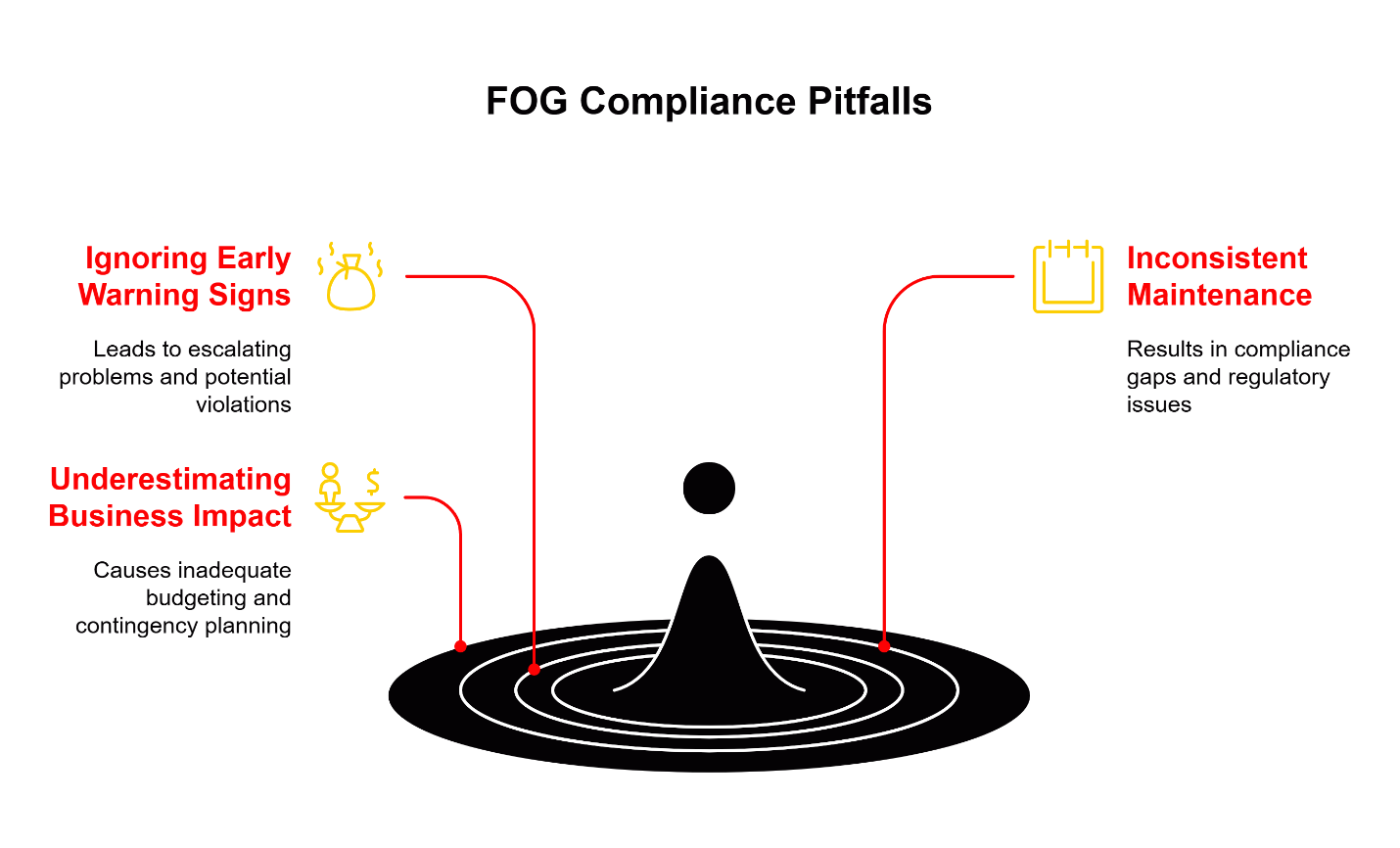
Even well-intentioned restaurant managers can inadvertently create compliance risks through common oversights. Understanding these pitfalls helps develop more robust management practices.
Pitfall #1: Ignoring Early Warning Signs Like Slow Drains and Foul Odors
Grease traps provide clear signals when approaching capacity or experiencing problems. Slow drainage indicates accumulating waste that restricts water flow, while persistent odors suggest bacterial growth or improper ventilation. Managers who dismiss these signs as minor inconveniences often face larger problems later.
The solution involves training staff to recognize and report warning signs immediately, enabling prompt professional assessment before problems escalate.
Pitfall #2: Failing to Maintain a Rigorous Cleaning and Documentation Schedule
Inconsistent maintenance schedules create compliance gaps that regulators notice during inspections. Missing documentation or delayed cleanings can trigger violations, regardless of actual trap condition.
Successful operations maintain detailed cleaning logs, schedule services well in advance of deadlines, and keep backup documentation both digitally and physically.
Pitfall #3: Underestimating the Total Business Impact of a Backup
Many managers focus solely on cleaning costs while overlooking the broader business implications of trap failures. This narrow perspective leads to inadequate budgeting and insufficient contingency planning.
Comprehensive impact assessment includes direct costs (cleaning, fines), indirect costs (lost revenue, overtime), and long-term costs (reputation damage, potential insurance impacts). This complete picture justifies proper maintenance investment and supports budget approval discussions with ownership.
What If…? Planning for a Surprise Health Inspection During a Lunch Rush
The scenario every restaurant manager dreads: health inspectors arrive during peak service hours, demanding immediate access to grease trap areas and compliance documentation. This situation tests both your compliance status and crisis management skills.
Preparation makes this scenario manageable rather than catastrophic. Maintain current documentation in easily accessible locations, ensure staff know inspection protocols, and keep trap areas clean and accessible at all times.
If inspection reveals compliance issues, remain calm and cooperative while documenting all interactions. Quick corrective action and transparent communication often help minimize penalties and demonstrate good faith compliance efforts.
A Question You Should Be Asking
Beyond just cleaning the trap, what documentation is legally required to prove compliance to a health inspector?
This question matters because many restaurants assume that simply having the trap cleaned satisfies all requirements. However, without proper documentation, you may still face penalties even with a recently cleaned trap.
A completed and signed waste manifest is your legal proof of compliance. It details the service performed, the date, and the licensed disposal of the waste. Without it, you may still be liable for violations even if the trap was cleaned.
Conclusion: From Compliance Anxiety to Operational Confidence
The transformation from reactive crisis management to proactive compliance control doesn’t happen overnight, but the Worry-Free FOG Compliance Framework provides the roadmap for this essential shift. By implementing systematic approaches to regulation mastery, maintenance scheduling, documentation, and staff training, restaurant managers can eliminate FOG-related anxiety from their daily operations.
This framework transforms grease trap management from an unpredictable source of stress into a controlled, predictable aspect of restaurant operations. The result is operational confidence that allows managers to focus on core business activities rather than constantly worrying about compliance failures.
For Restaurant Operations Managers advancing toward Director-level roles or multi-unit franchise ownership, mastering this framework establishes the operational excellence and risk management skills essential for larger-scale success. The systematic approach to compliance and documentation developed here becomes invaluable when managing multiple locations and ensuring consistent standards across expanded operations.
Contact us today to implement your customized FOG compliance framework and transform your restaurant’s liquid waste management from a source of stress into a competitive advantage.
By the DraneRanger.com Insights Team
The DraneRanger.com Insights Team is our dedicated engine for synthesizing complex topics into clear, helpful guides. While our content is thoroughly reviewed for clarity and accuracy, it is for informational purposes and should not replace professional advice.