📌 Key Takeaways
Houston restaurant operators protect their businesses from fines and shutdowns by treating grease trap maintenance as compliance security, not just waste removal.
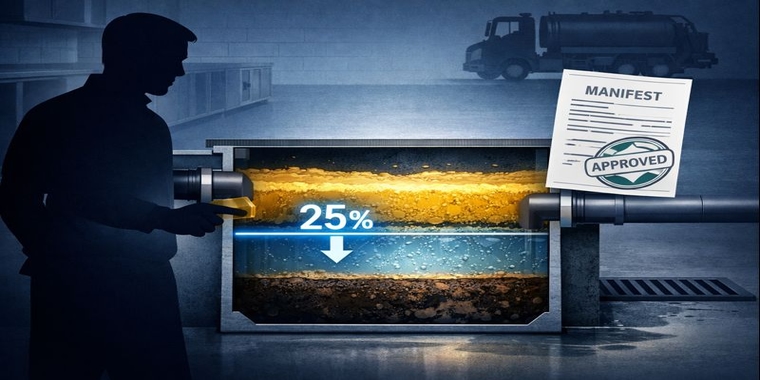
- The 25% Rule Triggers Service: When floating grease and settled solids reach 25% of the trap’s wetted height, pumping is required regardless of drainage performance.
- Manifests Prove Compliance, Not Invoices: Inspectors require legal tracking documents showing waste custody from your property to approved disposal facilities.
- Generator Liability Stays With You: Your restaurant remains legally responsible for improper waste disposal even when staff or vendors perform the work.
- Frequency Depends on Volume: Busy kitchens often need service every 30-60 days, well before the 90-day minimum standard many operators assume is sufficient.
- Violations Stack Per Offense: Civil and criminal penalties can reach $2,000 per day per violation, with permit suspension exposure for serious infractions.
Cheap service creates expensive liability when documentation gaps expose your business to enforcement actions.
Restaurant owners, general managers, and kitchen operators in the Houston area will gain actionable compliance strategies here, preparing them for the detailed implementation guidance that follows.
The lunch rush just ended. Your kitchen is running smoothly, drains are flowing, and everything seems fine. But beneath that apparent normalcy, a compliance problem might be building—one that could cost your Houston restaurant thousands of dollars in fines and even lead to permit suspension.
Restaurant operators in the Houston area avoid fines and shutdown risk by following grease trap compliance basics and using documented professional cleaning with proper manifests and disposal records. The reality is that bad grease trap advice—the kind of “wisdom” passed around in industry circles—leads to non-compliance, backups and odors, and enforcement exposure that can threaten your entire operation.
Why Grease Trap Myths Turn Into Real Enforcement Risk
A grease trap is a plumbing device designed to intercept fats, oils, and grease (FOG) before they enter the municipal sewer system. When FOG accumulates in sewer lines, it creates blockages that affect entire neighborhoods. That’s why the City of Houston enforces strict regulations under Chapter 47 of the municipal code.
The stakes are higher than most operators realize. Compliance failure carries two distinct types of losses. First, there’s the financial impact: violations can result in civil and criminal penalties of up to $2,000 per day per offense, along with potential permit suspension. Second, there’s operational disruption. Backups force you to close your kitchen for emergency cleaning. Persistent odors drive customers away. Shutdown orders mean zero revenue while your fixed costs continue.
Think of proper grease trap maintenance as your Compliance Shield. When you follow the rules, you protect your business from enforcement actions while keeping your kitchen running smoothly. The alternative—cutting corners with cheap service or following bad advice—creates expensive liability that far outweighs any short-term savings.
Here’s the truth that every restaurant owner needs to understand: Cheap service is expensive liability. A service provider who charges $50 less but doesn’t provide proper documentation or legal disposal puts your entire operation at risk. A single day of enforcement fines eliminates years of those small savings.
Myth #1: “If It Drains, It’s Fine”
Many operators believe that as long as water flows down the drain, their grease trap is working properly. This assumption is dangerously wrong. By the time drainage slows noticeably, your trap is already severely compromised and likely in violation of local requirements.
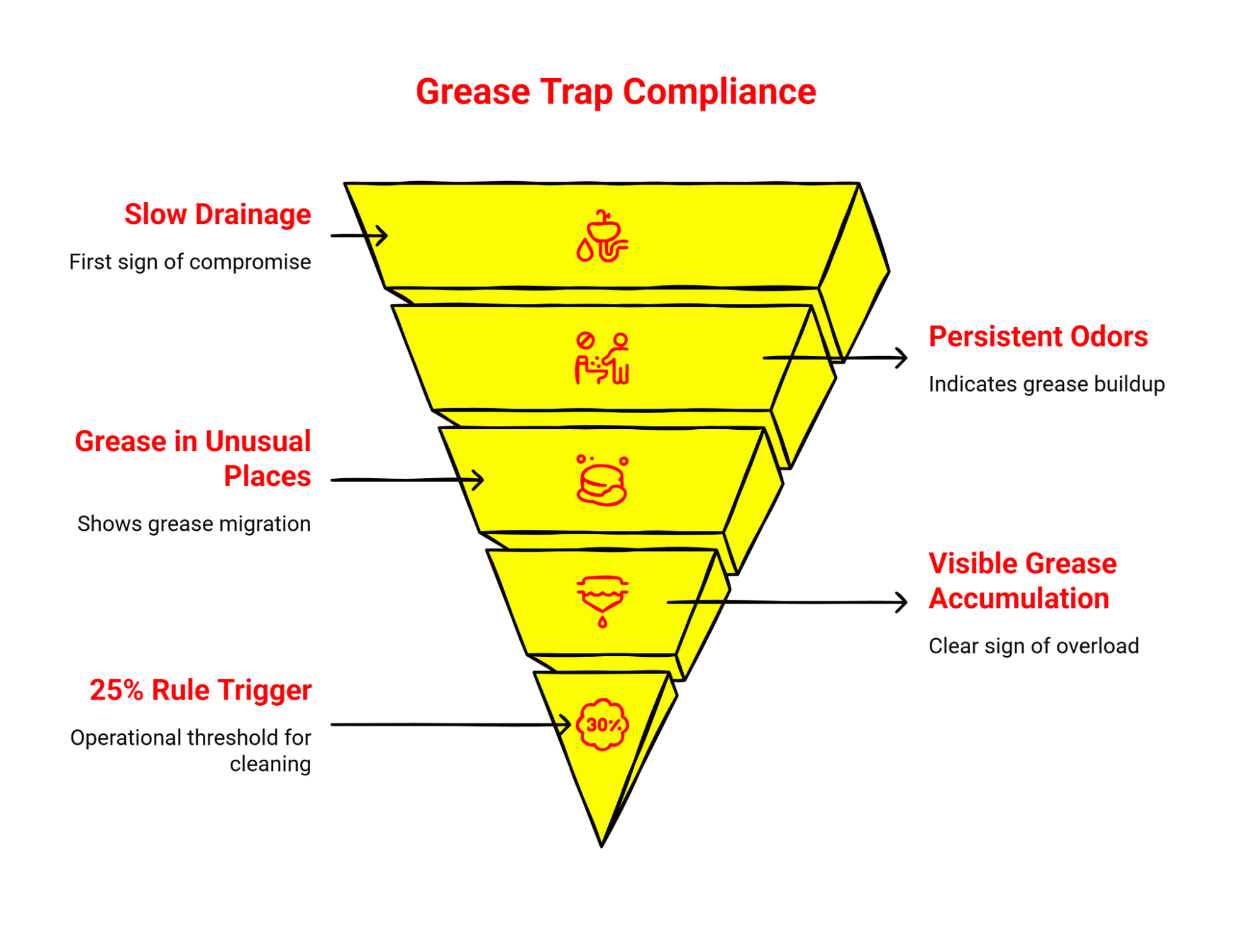
Watch for these early warning signs that indicate your trap needs attention:
- Slow drainage in kitchen sinks, especially the three-compartment wash station
- Persistent unpleasant odors near floor drains or the trap location
- Grease appearing in unusual places like mop sinks or floor drains
- Visible grease accumulation floating on top of the trap’s water level
The City of Houston uses what’s commonly called the 25% rule as an operational trigger. When the combined layer of floating grease and settled solids reaches 25% of the trap’s wetted height (liquid depth), the trap requires pumping regardless of how well water appears to drain. Busy kitchens often reach this threshold well before the 90-day minimum standard that many operators rely on.
Professional service providers measure accumulation levels during each visit. If your current vendor isn’t checking and documenting these levels, you’re operating without critical compliance information.
Read: Grease Trap Cleaning in Houston (signs you need service + 25% rule)
Myth #2: “Additives and Enzymes Replace Clean-Outs”
Walk into any restaurant supply store and you’ll find shelves stocked with enzyme treatments and chemical additives promising to “eliminate” grease problems. These products claim to break down FOG and keep your lines clear. The marketing sounds convincing, but the chemistry doesn’t support the promise.
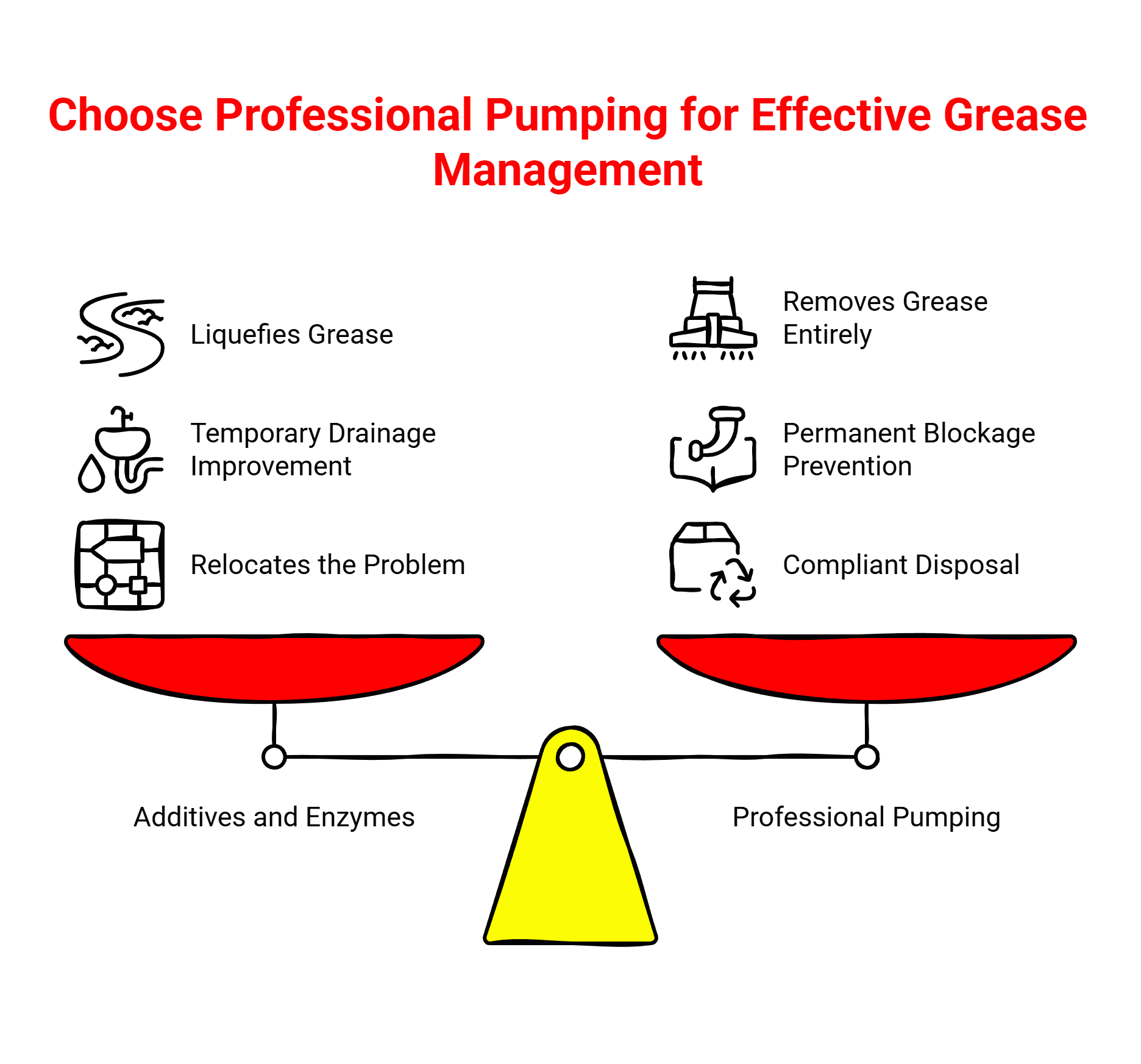
Here’s what actually happens. Enzymes and chemicals can liquefy grease, breaking it into smaller particles. This might improve drainage temporarily. However, liquefied grease is still grease. It doesn’t disappear—it moves downstream. When it cools in your pipes or the municipal sewer lines, it solidifies again, often creating blockages in locations that are more difficult and expensive to access.
The Texas Commission on Environmental Quality regulates waste handling at the state level, and local jurisdictions enforce additional requirements. These regulations exist because proper grease management requires physical removal and compliant disposal, not chemical conversion that simply relocates the problem.
Physical removal through professional pumping accomplishes what additives cannot. It extracts the FOG from your system entirely, transports it to approved processing facilities, and provides documentation proving compliant disposal. Busy kitchens typically need service every 60 to 90 days, though high-volume operations may require more frequent attention based on actual accumulation rates.
Explore: Grease, Grit & Lint Traps (service overview)
Myth #3: “My Staff Can Handle It Themselves”
Labor costs are a significant concern for every restaurant, so the idea of having kitchen staff handle grease trap cleaning seems like a practical way to save money. Several problems make this approach far more costly than it appears.
Start with the safety and containment issues. Grease traps are confined spaces containing bacteria-laden wastewater. Staff without proper training and equipment risk exposure to harmful pathogens and create containment problems during the pumping process. The mess alone can disrupt operations for hours.
The bigger risk is regulatory. When your staff removes grease trap waste, your restaurant becomes responsible for its disposal. Improper disposal creates legal liability, and that liability stays with your business as the waste generator, not with the employee who performed the work. If waste ends up in storm drains, dumpsters, or other unauthorized locations, your restaurant faces the fines and potential permit actions.
Professional service provides more than just labor. Licensed haulers have proper equipment, training, and disposal agreements with approved facilities. They create manifests—legal documents that track waste from your property to its final destination. These manifests prove compliant disposal during inspections and protect your business if any questions arise about waste handling.
For urgent response when backups or odors disrupt operations, see our Emergency Services.
Myth #4: “An Invoice Proves Compliance”
When inspectors arrive at your restaurant to verify FOG compliance, many operators confidently present their service invoices as proof of proper maintenance. Unfortunately, an invoice only proves that you paid someone for a service. It doesn’t prove what happened to your waste or whether disposal met legal requirements.
The distinction matters. An invoice is a financial record showing a transaction occurred. A manifest is a legal document tracking waste custody through multiple parties—from your property to the hauler’s truck to the processing facility. Manifests include key compliance data: waste volume, generator information, hauler credentials, disposal facility details, and required signatures at each transfer point.
During enforcement inspections, regulators want to see manifest documentation going back months or even years. They need to verify that your waste consistently reached approved facilities. Missing manifests create compliance gaps that can result in violations even if you’ve been paying for regular service.
Create a simple compliance filing system. Keep manifests organized by date in a dedicated binder. Retention requirements vary by jurisdiction, so verify the specific period required in your area—many environmental records must be kept for several years. Include your service schedule and any inspection reports. This administrative discipline takes minimal time but provides maximum protection during audits.
Professional service companies provide manifests automatically with each pump-out. If your current vendor only gives you invoices, that’s a significant warning sign about their compliance practices.
Myth #5: “Once a Year Is Sufficient”
Perhaps the most dangerous myth is the belief that grease traps only need annual service. This misconception comes from misunderstanding how accumulation rates work. Trap capacity, kitchen volume, and food preparation methods all influence how quickly FOG builds up.
A small café with limited fryer use has very different needs than a high-volume restaurant with extensive fried food preparation. A kitchen that primarily serves grilled items produces less grease than one focused on fried foods. The frequency that worked for your previous location might be completely inadequate for your current operation.
Houston regulations require cleaning at least every 90 days for most commercial food service establishments, but this represents a minimum standard, not a universal recommendation. Many busy kitchens need service every 30 to 45 days to stay ahead of accumulation and maintain proper function.
Consider the three tiers of financial risk when evaluating service frequency:
- Small tier: Emergency call-outs and unscheduled cleanings cost more than preventive service. Rush service during business hours disrupts operations and typically carries premium pricing.
- Medium tier: Kitchen downtime from backups represents lost revenue. A backed-up kitchen can’t serve customers. The cost of lost covers, staff standing idle, and customers turned away often exceeds several months of preventive maintenance.
- Large tier: Enforcement exposure carries the highest price. Violations can result in civil and criminal penalties of up to $2,000 per day per offense. A compliance failure during an inspection can erase years of savings from cutting corners on service frequency.
The smart approach: base your service schedule on actual trap monitoring, not calendar assumptions. Work with your service provider to check accumulation levels and adjust frequency as needed.
Myth vs. Reality: The Compliance Truth
| The Myth | The Reality |
| “If it drains, it’s fine” | Drainage is a late-stage indicator. The 25% accumulation rule (based on wetted height) triggers service requirements before drainage problems appear. |
| “Additives replace pumping” | Chemicals relocate grease; they don’t remove it. Only physical extraction and proper disposal satisfy legal requirements. |
| “Staff can DIY it” | Generator liability stays with your restaurant for disposal violations, even when staff perform the work. |
| “Invoices prove compliance” | Manifests—not invoices—document legal disposal and satisfy inspector requirements during audits. |
| “Once a year is enough” | Frequency depends on volume. Busy kitchens often need service every 30-60 days, not annually. |
| The Fine | Violations can result in civil and criminal penalties of up to $2,000 per day per offense plus permit suspension exposure. |
Start Your Service Today – Call 281-489-1765
What to Do Next: A Simple Compliance Routine You Can Start Today
Building a compliance routine doesn’t require complex systems or significant time investment. Focus on these fundamental practices:
Watch for warning signs. Train your kitchen manager to recognize slow drainage, persistent odors, and visible grease accumulation. These indicators should trigger immediate service calls rather than “wait and see” responses.
Schedule before problems appear. Don’t wait for backups or inspector notices. Establish a preventive service schedule based on your actual kitchen volume and food preparation methods. Most busy operations need service every 60 to 90 days.
Keep organized records. Store all manifests, service reports, and inspection documentation in a dedicated compliance file. Organize by date and verify retention requirements for your jurisdiction. When inspectors arrive, you’ll have everything they need immediately available.
Use compliant disposal. Work only with licensed haulers who provide proper manifest documentation and use approved disposal facilities. Verify their credentials through the Better Business Bureau or similar services.
Plan for minimal disruption. Quality service providers work with your schedule to minimize kitchen impact. After-hours or slow-period service keeps your operation running smoothly while maintaining compliance.
The reality is simple: proper grease trap compliance protects your business from enforcement risk while keeping your kitchen operational. It’s not about finding the cheapest service—it’s about finding reliable, documented, professional maintenance that gives you the Compliance Shield your restaurant needs.
Satisfying the customers Since 1985. For Houston-area restaurant operators ready to establish a worry-free compliance routine, Drane Ranger provides the professional service and documentation your business requires. Our team understands local regulations and works within your schedule to deliver reliable maintenance without disruption.
“Drain Ranger is very professional and reliable. Basically they can take care of all your grease drain needs.” ~ Shelley M.
Start Your Service Today – Call 281-489-1765
You can also contact us for scheduling or visit our location on Google Maps to see our service area and customer reviews.
Disclaimer: This article is for informational purposes only and does not constitute legal advice. Local requirements may vary by jurisdiction and can change over time. For official requirements, consult the relevant regulatory authority and your compliance advisor.
Our Editorial Process:
Our expert team uses AI tools to help organize and structure our insights, but every piece of content is carefully reviewed and refined by expert humans on our Insights Team to ensure accuracy and clarity.
By: Drane Ranger Insights Team
Drane Ranger Vacuum Services helps Houston-area businesses stay compliant and running smoothly with professional grease trap and liquid waste management services. For service scheduling, call 281-489-1765 or visit https://draneranger.com/contact-us/.