
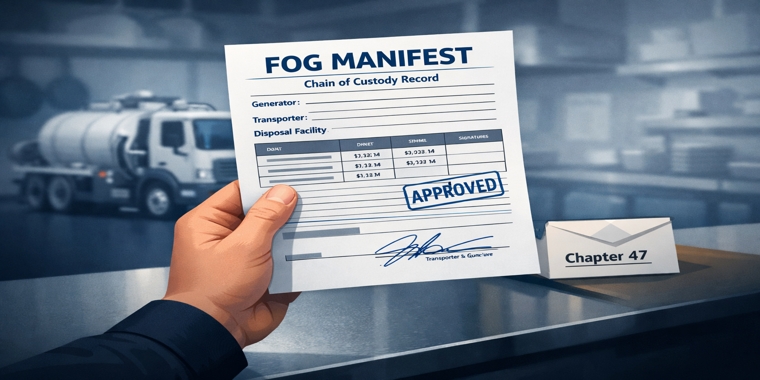
📌 Key Takeaways
A Chapter 47 warning is a chance to fix the problem—not a fine or shutdown order—if you act fast and show the right paperwork.
- Read the Notice Carefully First: Check the deadline, violation type, and who to contact before you do anything else.
- Manifests Beat Invoices: The city needs proof of where your waste went, not just proof you paid—receipts alone won’t close the case.
- Act Within Days, Not Weeks: Most warnings give 7–14 days to respond, so schedule service and gather documents immediately.
- Keep Records Ready On-Site: A simple binder with three to five years of manifests saves hours of stress during surprise inspections.
- Consistent Service Prevents Repeat Warnings: Regular scheduling and proper documentation stop citations before they start.
Respond fast, document properly, and warnings close without lasting consequences.
Houston restaurant owners, kitchen managers, and commercial facility operators facing FOG compliance questions will find clear action steps here, preparing them for the detailed walkthrough that follows.
~ ~ ~ ~ ~ ~ ~ ~ ~ ~ ~ ~ ~ ~ ~ ~ ~ ~ ~ ~ ~ ~ ~ ~ ~ ~ ~ ~ ~ ~ ~ ~ ~ ~ ~ ~ ~ ~ ~ ~ ~ ~ ~ ~ ~ ~ ~ ~ ~ ~ ~ ~ ~ ~
The envelope sits on the counter. “Chapter 47.” Your stomach drops.
Take a breath. A warning citation is not a fine, and it is not a shutdown order. It is a correctable notice—a signal from the city that something needs attention. Most operators who respond quickly and with the right paperwork clear these citations without lasting consequences.
This guide walks you through exactly what to do, step by step. The information here is educational and should not replace advice from a qualified professional familiar with your specific situation.
First, Confirm What the Citation Is Actually For
Before you do anything else, read the notice carefully. You need to know precisely what the city is asking you to correct.
Look for these details on the paper:
- The date the citation was issued and any deadline for response
- The location and device referenced (your grease trap or interceptor)
- The specific violation (overdue service, missing records, trap condition)
- How to respond (contact name, department, submission method)
A warning citation typically provides a specific ‘grace period’—often 7 to 14 days—to correct the issue before penalties begin. However, the City of Houston Code of Ordinances specifies that for certain violations, if the Director determines a hazard exists, compliance may be required immediately or within 24 hours. (City of Houston Code of Ordinances § 47-513; 47-515). This timeline strictly starts from the date of issuance or service, not when the notice is discovered. If the notice references City of Houston Chapter 47, the ordinance points at wastewater protection and FOG control—so your response should focus on correction plus chain-of-custody proof.
Common Reasons Operators Get Flagged
Most Chapter 47 warnings come down to a few recurring issues:
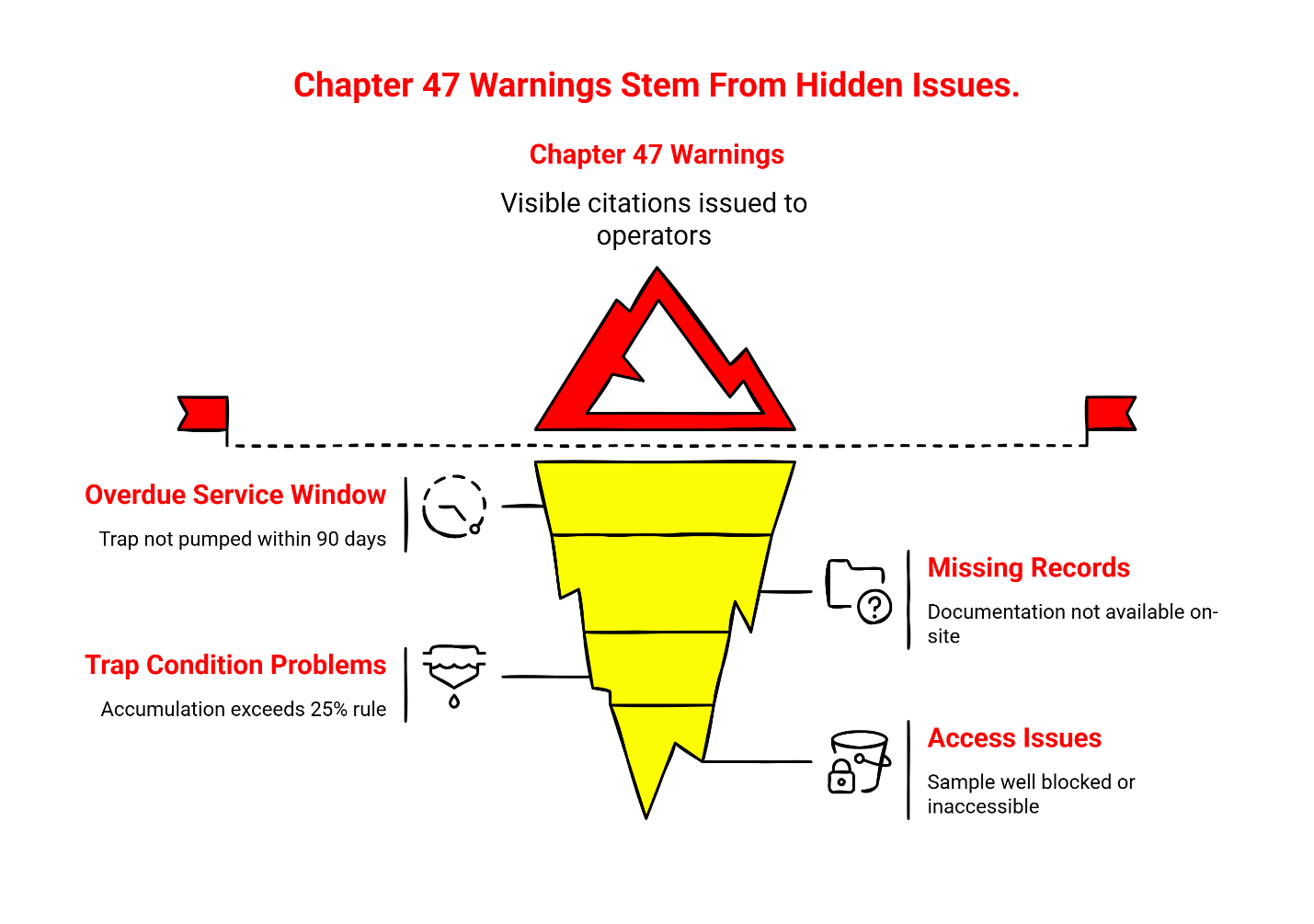
- Overdue service window. The trap was not pumped within the required 90-day cycle.
- Missing or insufficient records. The inspector asked for documentation and it was not available on-site.
- Trap condition problems. Accumulation exceeded the ‘25% Rule’—a national standard where the combined sediment and FOG layers must not exceed 25% of the total liquid depth of the interceptor. (TCEQ § 312.145; EPA Office of Water, 832-F-03-010). If your device is over this limit, it is considered ‘not in good working order’ under City Code.
- Access issues. The sample well was blocked or inaccessible during inspection.
Knowing which category your citation falls into helps you target your response.
Three Steps to Clear Your Citation
A warning is an opportunity. Ignore it, and it becomes a fine.
Here is the fastest path to resolution:
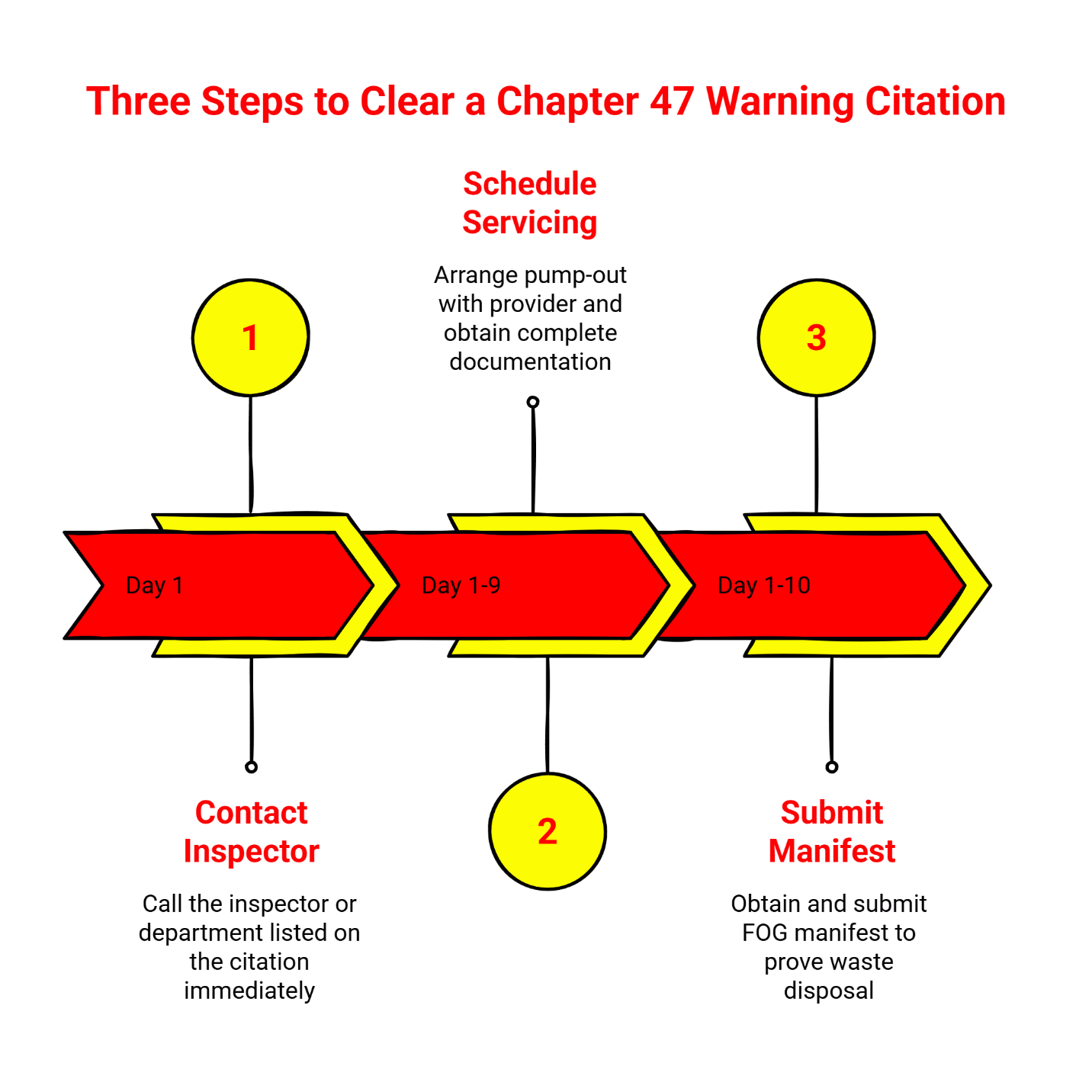
Step 1: Contact the inspector or department listed on the citation. Do not wait. A quick, professional call demonstrates immediate compliance intent and clarifies the specific path to case closure.
Step 2: Schedule compliant servicing immediately. Arrange a pump-out with a provider who delivers complete documentation. Do not wait until day nine of a ten-day window. In Houston, interceptors are generally expected to be fully evacuated on a defined cadence—often quarterly or every 90 days unless a waiver applies. Predictable service beats emergency scrambling every time.
Step 3: Obtain and submit your manifest. This is the critical piece. Your FOG manifest proves where the waste went and creates the chain of custody the city requires.
Quick-reference flow: Receive warning → Confirm details → Arrange service → Obtain FOG manifest → Submit proof → File records
What “Good” Looks Like Under Pressure
Consider a restaurant GM who opens a Chapter 47 warning citation on Monday morning. The correction window is tight, and a busy weekend is already booked. The only paperwork on-site is a receipt—no FOG manifest—so the first email to the inspector gets a “need the manifest” reply.
The GM schedules a prompt pump-out, assembles a one-page packet, and submits the manifest the same day. The result: the issue becomes a documented correction.
The Manifest vs. Invoice Distinction
A manifest proves where your waste actually went. An invoice proves you paid for service. The city requires the manifest.
Think of it this way: FOG compliance management is the tax return for your waste. Your invoice is for your accountant; your manifest is for the inspector.
City inspectors in the Houston area require manifests showing the complete chain of custody—who pumped the trap, how much was removed, and which licensed facility received it. A credit card receipt or service invoice does not satisfy this requirement, no matter how detailed.
When you work with a compliant grease trap service, you should receive a signed manifest for every visit. If you have been getting only invoices, that gap in your documentation may be exactly why you received this citation.
What Proof to Gather Before You Respond
Assemble a clean, inspection-proof packet before contacting the inspector. Having everything organized sets the right tone and speeds up resolution.
Collect:
- The manifest from your most recent service (and any disposal confirmation fields the city expects)
- Service dates for the past 12 months
- Any permit or registration documents the city requires for your establishment
- Photos showing the corrected condition (optional, but can help demonstrate compliance)
A one-page cover note works well: state your business name, the citation reference number, what was corrected, and when. Attach supporting documents behind it. This approach signals that you run a tight operation.
As one Drane Ranger customer described it: “My experience with Drane Ranger was a very organized, professional and on time experience. I was kept informed of what was happening and a suggested time of cleaning again.” — Harold R.
If You Cannot Find Your Paperwork
Missing records do not have to derail your response. Here is how to recover:
Gather what you do have. Even partial documentation—receipts, emails, calendar entries—helps establish your service history.
Contact your service provider. Request copies of past manifests. A reliable provider keeps these records and can supply duplicates. Specifically ask for the FOG manifest, not just billing documents.
Start a dedicated on-site binder immediately. Going forward, keep manifests, permits, and inspection records in one accessible location. When the next inspector arrives, you want everything within arm’s reach. For a complete system, see this guide on organizing your documentation for audits.
Prevent the Next Citation
Once you clear this warning, the goal is to never see another one. That comes down to two habits:
Scheduling discipline. Do not push your service window to day 89 of 90. Build in a buffer. When service happens predictably, you are never scrambling to correct an overdue citation.
Record retention. Keep manifests on-site and organized. While some general business records are kept longer, the City of Houston specifically requires that ‘The generator shall maintain a copy of the manifest for a period of three years‘ from the date of service. (City of Houston Code of Ordinances § 47-512(a)). However, maintaining five years of records is considered a Best Management Practice (BMP) to align with certain state or federal audit cycles. A simple binder system—tabs by date, most recent in front—takes five minutes to set up and saves hours of stress during an inspection.
The operators who pass audits consistently are not lucky. They chose providers who treat documentation as part of the service, not an afterthought.
FOG control matters beyond any single city’s requirements. EPA and Texas Commission on Environmental Quality guidance explains the operational impact of fats, oils, and grease on collection systems—which is why best management practices are emphasized across jurisdictions.
When a Warning Escalates
Most warnings resolve cleanly when handled promptly. But some signs indicate a situation needs closer attention:
- Repeat notices for the same issue
- Unresolved violations past the deadline
- Operational symptoms like persistent backups, slow drains, or foul odors
If any of these apply, act quickly. The cost of correction is almost always less than the cost of escalation. Understanding your full FOG compliance obligations helps you stay ahead of problems before they compound. You may also benefit from reviewing inspection prep basics to strengthen your readiness.
Frequently Asked Questions
Is a warning the same as a fine?
No. A warning is a correctable notice. You typically have around 10 days to fix the issue before fines begin. Respond promptly and the warning closes without penalty.
What if my last provider only gave me receipts?
Receipts and invoices do not satisfy the city’s documentation requirements. You need manifests showing chain of custody. Contact your provider and request copies, or consider switching to one who provides complete documentation.
How long should I keep these records?
The city requires a minimum of three years of manifest retention. Keep them organized and accessible on-site.
What if I’m outside Houston but got Houston-style paperwork requests?
Surrounding jurisdictions often follow similar FOG enforcement standards. The principles are the same: document your service, retain your manifests, and respond to notices promptly. Confirm directly with the listed department what documentation closes your specific case.
Official Resources
For verification and additional guidance, these sources provide authoritative information:
- City of Houston – Code of Ordinances
- Houston Permitting Center – Generator Responsibilities (Section 47-512)
- TCEQ – Model Standards for Grease Management
- EPA – Controlling Fats, Oils, and Grease (Pretreatment Fact Sheet)
- BBB Listing – Drane Ranger Vacuum Service
Moving Forward With Confidence
A Chapter 47 warning feels alarming in the moment. But for operators who respond correctly—confirm the issue, correct it fast, and prove it with proper documentation—these citations close without lasting impact.
The pattern that protects you is simple: consistent scheduling and systematic record retention. When your next inspection comes, you will not be scrambling. You will hand over a clean binder and get back to running your kitchen.
For more guidance on staying audit-ready, explore our guides on FOG compliance and grease trap maintenance.
Disclaimer: This content is for informational purposes only and does not constitute legal or regulatory advice. Requirements vary by jurisdiction and may change. Consult with a qualified professional or your local regulatory authority for guidance specific to your situation.
About the Drane Ranger Insights Team
The Drane Ranger Insights Team is our dedicated engine for synthesizing complex topics into clear, helpful guides. While our content is thoroughly reviewed for clarity and accuracy, it is for informational purposes and should not replace professional advice.