
📌 Key Takeaways
Waste transport records protect a Houston kitchen only when they prove where the grease waste went.
- Manifests Beat Invoices: An invoice shows payment, but a manifest helps prove what happened to the waste.
- Gaps Create Risk: Missing signatures, lost forms, or weak filing can turn routine inspections into stressful scrambles.
- Keep Records Onsite: Houston guidance says manifest copies must stay onsite for at least five years.
- Assign One Owner: One person should check every manifest right after each grease trap service.
- Verify Your Provider: A permitted waste transport partner helps protect your records, service schedule, and inspection readiness.
Proof beats promises when inspectors ask where your waste went.
Houston restaurant managers and food service operators will gain a clearer way to check their records, preparing them for the detailed overview that follows.
~ ~ ~ ~ ~ ~ ~ ~ ~ ~ ~ ~ ~ ~ ~ ~ ~ ~
The rumor hits hard.
A Houston restaurant manager hears that another operator was cited after an inspection. The lunch rush is starting, the prep table is crowded, and the grease trap file is sitting in a cabinet behind the office door.
We paid the vendor. We should be fine.
Then the real question lands: can you prove where the waste went?
For a Houston commercial kitchen, waste transport documentation is not just a back-office file. It is the proof chain that shows when the interceptor was cleaned, who handled the waste, and whether the restaurant can answer a FOG-related review with confidence.
Start With the File: Can You Prove Where Your Waste Went?
Before thinking about fines, start with the file.
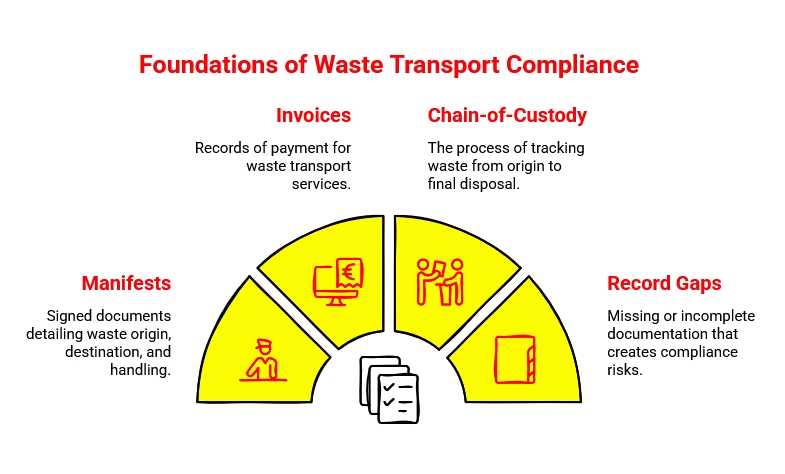
If an inspector asked for proof today, would your manager produce a signed manifest or a paid invoice? That distinction matters. An invoice shows that money changed hands. A manifest helps show what happened to the waste.
This is where exposure starts. A chef-driven café may have regular service and still have weak documentation. A fast-casual kitchen may keep invoices in email while signed manifests sit in a binder no one can find. A kitchen manager leaves, the binder moves, and the maintenance reminder disappears from the calendar.
That is not rare. It is how ordinary record gaps begin.
For deeper background on the document trail itself, see Drane Ranger’s guide to FOG manifest chain-of-custody requirements.
What Counts as Waste Transport Documentation?
A strong documentation file should do more than show that a pump-out was purchased. It should help answer the practical compliance question: where did the waste go?
The Houston Health Department’s Waste Generator FAQ defines a waste manifest as an official government document completed every time an interceptor is cleaned. The same FAQ says the generator signs the top portion of the manifest and that the white and yellow copies must be retained onsite for at least five years from the clean-out date. Houston Health Department Waste Generator FAQ (Houston Health Department)
Good waste transport documentation may include:
- Clean-out date
- Generator signature
- Transporter identity
- Evidence that the trap was cleaned
- Waste quantity or volume details where available
- Disposal or processing facility information where available
- Notes about system issues identified during service
Think of the manifest like a certified passport for wastewater. It follows the waste journey. The invoice is only the receipt for the transaction.
That is why manifesting vs. invoicing deserves its own place in your compliance process. They are connected documents, but they do not do the same job.
Houston’s FOG-Special Waste program tracks waste such as fats, oil, and grease from commercial and residential establishments to help protect the city’s environment from pollutants. Houston Permitting Center Special Waste Program (Houston Permitting Center)
How Documentation Failure Escalates
Documentation failure usually starts small. One missing signature. One misplaced manifest. One invoice mistaken for proof.
Then the request comes.
When your waste transport documentation fails, the problem is not that a form is missing. The problem is that your business cannot prove what happened to its waste.
Here is the practical escalation path:
- The file is incomplete.
The manager finds invoices but cannot find signed manifests. - The record does not answer the compliance question.
The paperwork may show that service was paid for, but it may not prove how the waste was handled. - The burden shifts back to the operator.
Staff must reconstruct records under pressure. - The issue becomes operational.
Managers get pulled away from service. Ownership may need to get involved. Routine work turns into a compliance scramble. - Repeat gaps create a pattern.
One missing document is a problem. A disorganized system suggests weak control. - The restaurant may face regulatory escalation.
Depending on the facts and current enforcement language, repeated documentation failures can create serious operational and permit-related consequences.
The real risk is not just a missing form. It is the possibility that repeated documentation failures create permit-level questions about whether the restaurant can keep operating safely and compliantly.
That wording is careful for a reason. Exact fines, closure orders, warning windows, and permit consequences should always be confirmed against current Houston and Texas sources.
The Compliance Exposure Self-Assessment
Complete this self-assessment before your next inspection, ownership meeting, or vendor renewal.
Answer yes or no:
- Can you produce signed waste manifests for recent grease trap clean-outs?
- Are those records stored onsite and organized by date?
- Do the records go back far enough to satisfy the required retention window?
- Can your manager explain the difference between an invoice and a manifest?
- Can you verify that your provider is permitted to clean interceptors in Houston?
- Are physical records backed up digitally?
- Is one person responsible for checking the manifest after every service?
- Do you review the file before inspections, audits, ownership meetings, or vendor changes?
- Can your documentation show where the waste was transported or processed after removal?
- If the manager who handled the last pump-out left tomorrow, could another staff member find the manifests without calling the vendor?
Green: Most records are complete, organized, and easy to retrieve. Keep the system active after every service.
Yellow: Some records exist, but gaps could create inspection stress. Rebuild the file before the next review.
Red: The business relies mainly on invoices, missing records, or vendor promises. Treat this as a documentation exposure problem.
Houston Health Department guidance for special waste service companies lists transporter-related documentation such as driver information, financial responsibility, a City of Houston Waste Transportation Permit Bond or pollution liability coverage, and a Texas Commission on Environmental Quality (TCEQ) Sludge Authorization and registration. Houston Health Department Special Waste Service Companies (Houston Health Department)
How to Reduce Exposure Before the Next Inspection
The fix is simple, but it has to be assigned.
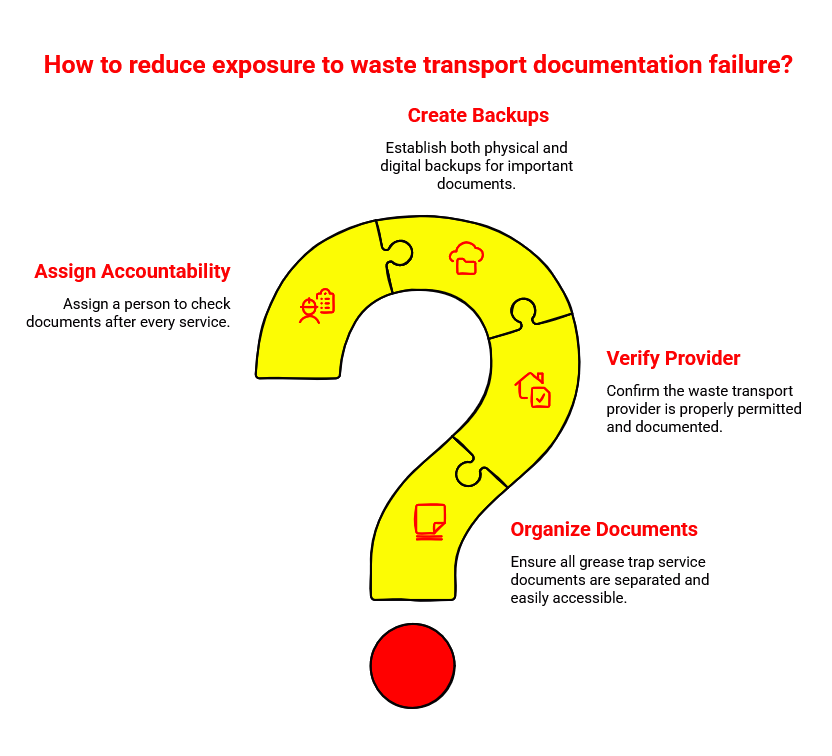
Start by pulling every grease trap service document from the required record period. Separate invoices from manifests. Then confirm that each manifest is signed, tied to a clean-out date, and easy to find.
Next, verify that your provider is properly permitted and documented for the work being performed. Create a physical onsite binder and a digital backup. The backup is not a substitute for any required onsite copy, but it gives the manager a second place to look when the cabinet key goes missing.
Assign one accountable person to check the file after every pump-out. Not later. Not at the end of the month. After every service.
For a practical filing process, use Drane Ranger’s resource on how to organize your FOG manifests or compare your current process against a broader FOG compliance checklist.
The goal is not to make compliance feel complicated. The goal is to turn a potentially serious documentation failure into a managed background task.
When to Call a Professional Waste Transport Partner
Call a professional waste transport partner when the self-assessment shows missing manifests, incomplete records, unclear transporter status, or confusion about who checks paperwork after service.
That conversation should not only be about pumping. It should be about documentation confidence.
Drane Ranger Vacuum Services supports Houston-area businesses with liquid waste management, including assessment, removal, transportation to approved processing facilities, proper disposal, and service documentation. For restaurants that need commercial grease trap cleaning in Houston or broader grease, grit, and lint trap service, documentation should be part of the service conversation from the start.
Texas also treats municipal liquid waste processing as a regulated area. TCEQ guidance says facilities accepting municipal liquid waste for processing generally need a permit or registration unless the activity is conducted at a permitted landfill. TCEQ Municipal Liquid Waste Processing (TCEQ)
If your file shows gaps, contact Drane Ranger or call 281-489-1765 to discuss compliant service documentation. Complete the self-assessment first. Then use the results to ask better questions.
FAQs About Failed Waste Transport Documentation
Is an invoice enough to prove grease trap waste was handled properly?
No. An invoice shows payment. A manifest is the document that helps track the waste handling event.
How long should Houston restaurants keep grease trap waste manifests onsite?
The Houston Health Department Waste Generator FAQ says white and yellow manifest copies must be retained onsite for at least five years from the clean-out date. Houston Health Department Waste Generator FAQ (Houston Health Department)
Who is allowed to clean my interceptor or trap?
Houston guidance says interceptors can be cleaned by a waste transporter permitted with the Houston Health Department. Verify that status before relying on the provider.
What should be asked after each service?
Ask for the signed manifest, service date confirmation, waste quantity or volume details where available, disposal or processing facility information where available, and any system issues found during service.
What if records disappeared after a manager left?
Rebuild the file immediately. Contact the provider for missing documents, assign a new record owner, and create both physical and digital backups.
Should manifests be digitized?
Yes. Digital backups help when binders move or staff changes. They should support required onsite retention, not replace it unless current rules clearly allow that.
Regulatory requirements can change. Always confirm current Houston and Texas requirements with the appropriate agency or a qualified compliance professional before relying on a specific deadline, penalty, or filing procedure.
Our expert team uses AI tools to help organize and structure our initial drafts. Every piece is then extensively rewritten, fact-checked, and enriched with first-hand insights and experiences by expert humans on our Insights Team to ensure accuracy and clarity.
Our Editorial Process:
This article was developed from the approved Content Strategy Document, Drane Ranger project files, official Houston and Texas regulatory sources, and documented customer testimonial material. It avoids unsupported service-cost claims, guaranteed inspection outcomes, invented fine timelines, and competitor comparisons.
By Drane Ranger Insights Team
The Drane Ranger Insights Team creates practical wastewater, grease trap, and liquid waste compliance resources for Houston-area businesses. Drawing from Drane Ranger Vacuum Services’ decades of local service experience, the team focuses on clear, useful guidance that helps operators maintain safe, compliant, and reliable facilities.