Septic System Maintenance Inspections: A Diagnostic Framework for Homeowners

📌 Key Takeaways

Septic failures develop silently underground for months before surfacing as expensive emergencies in your yard or home. 

Diagnostic Visibility Prevents Reactive Panic: Professional inspections reveal hidden problems like cracked baffles, tank leaks, and root intrusion before they trigger backups or drain field failures. 

Real Estate Transactions Demand Documentation: A current inspection report removes buyer uncertainty, speeds closing, and either confirms system health or reveals issues while you still have time to address them. 

Surface Observation Misses Critical Failures: Walking your yard and checking for odors only detects problems after they’ve already compromised your system—internal component damage remains invisible without professional evaluation.

The 25% Rule Guides Pumping Timing: EPA guidelines recommend pumping when solids reach roughly one-quarter of your tank’s volume, but household size and usage patterns determine your actual schedule. 

Inspection Differs from Routine Pumping: A comprehensive diagnostic assessment includes systematic component evaluation, structural checks, and detailed documentation—not just the quick visual check during a standard pump-out. 

Proactive inspection transforms expensive unknowns into manageable maintenance decisions. Houston-area homeowners managing septic systems will find clarity here, preparing them for the detailed diagnostic framework that follows.

The smell hits you first—faint but unmistakable, drifting from somewhere near the back corner of your yard. You stand at the kitchen window, coffee in hand, wondering if you’re imagining it. Then you notice the grass: a patch near the drain field that’s greener, almost unnaturally lush, compared to the rest of your lawn. Your stomach tightens. Something’s wrong, but you have no idea what’s happening beneath your feet.

You’re facing what thousands of Houston-area homeowners deal with every year—the anxiety of not knowing the true condition of your septic system. Unlike the plumbing inside your house, where a leak announces itself immediately, your underground wastewater infrastructure can fail silently for months before you notice. By then, what could have been a minor repair has become an expensive emergency.

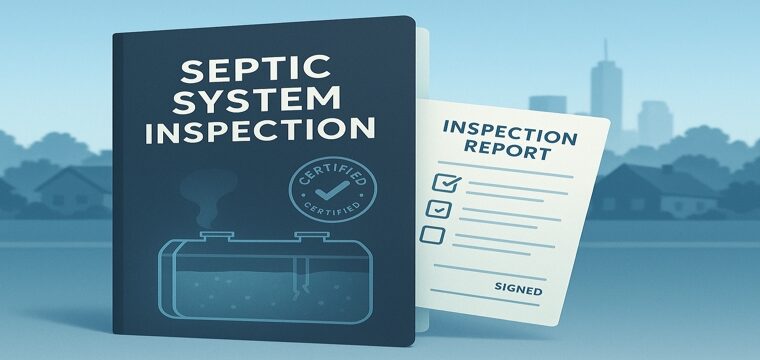
A Septic System Maintenance Inspection is a diagnostic assessment of the tank and components to verify function. It’s like a ‘Check Engine’ diagnostic for your yard. Imagine the confidence of handing a potential buyer a certified report saying your septic system is in perfect health. Schedule this before listing your home or if you suspect a problem but don’t see sewage yet.

An inspection turns unknowns into facts—and facts into confident decisions.


Why Your Septic System’s Hidden Nature Creates Real Risk

Your septic system is your home’s hidden immune system. Just as your body processes waste through organs you can’t see, your property relies on underground tanks and pipes to safely manage every gallon of wastewater from your showers, toilets, and washing machines. When this system works properly, it’s invisible. When it fails, the consequences range from unpleasant to catastrophic.

The challenge is visibility. You can’t simply lift a lid and see whether everything’s functioning correctly. Solid waste accumulates at the bottom of the tank as sludge, while oils and grease float to the top as scum. Between these layers, clarified water flows out to your drain field. Over time, baffles can crack, tees can corrode, and the biological balance inside the tank can shift. None of these problems announce themselves until the day your toilet won’t flush or sewage backs up into your home.

This is where a professional septic system maintenance inspection becomes essential. A comprehensive inspection is the only way to definitively assess the health of your underground infrastructure. While you might walk your yard looking for wet spots or follow your nose toward strange odors, these surface indicators only tell you something has already gone wrong. An inspection reveals what’s happening before it becomes an emergency, helping prevent silent failures like leaks or baffle damage before they cause a backup.


What Happens During a Professional Septic Inspection
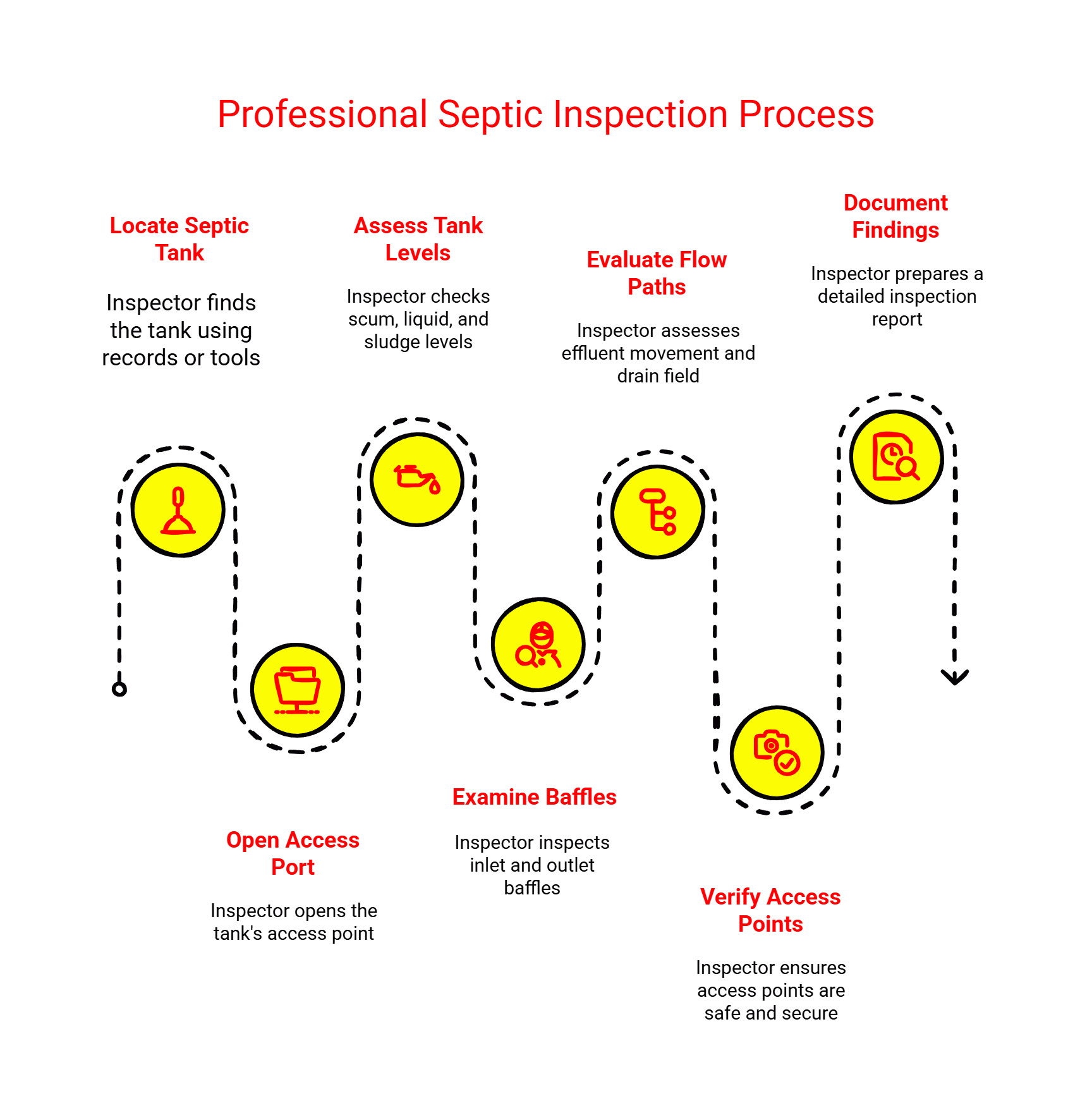
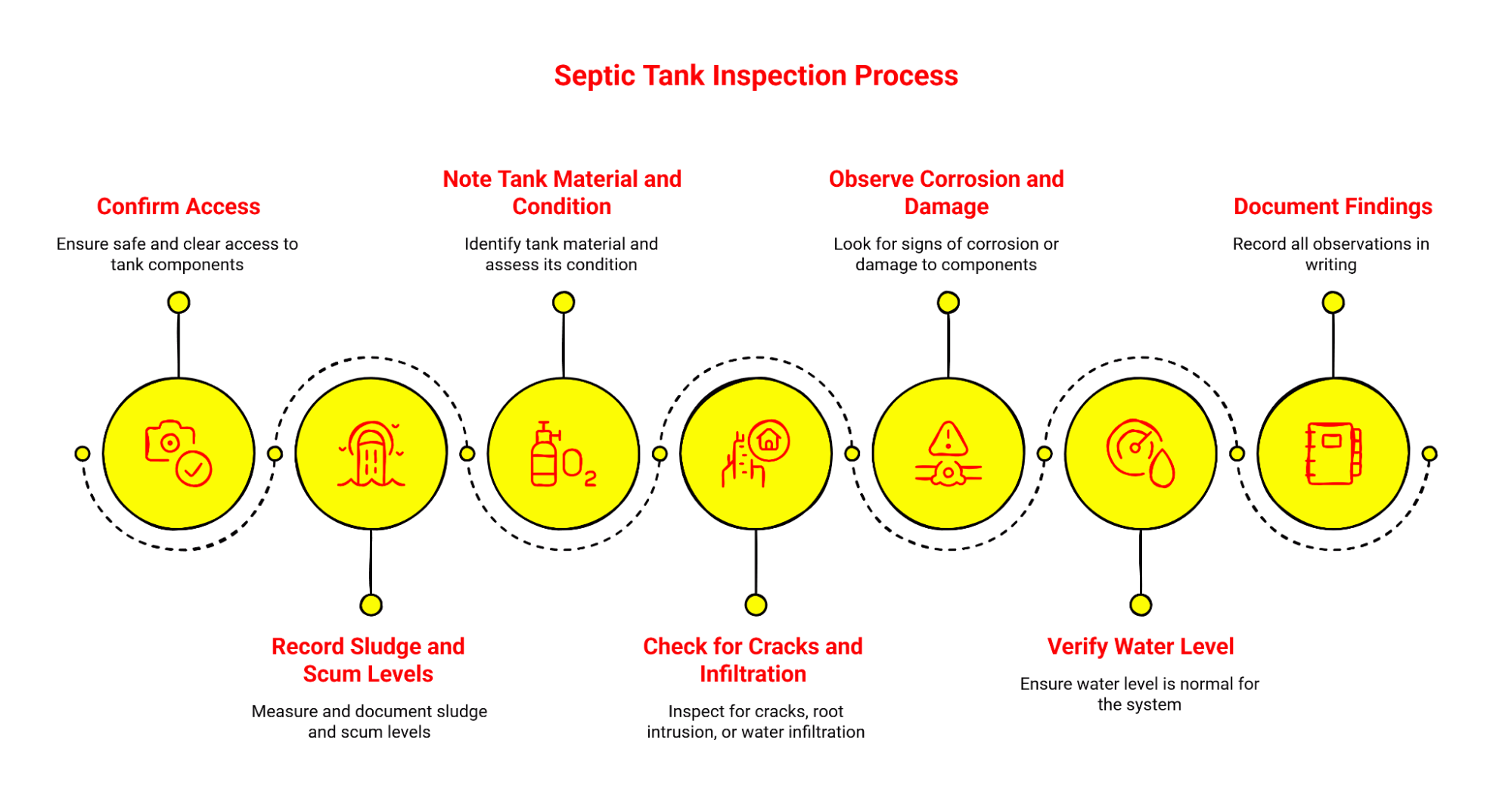
Infographic of the professional septic inspection process from locating the tank to documenting findings.

Think of a septic inspection as a complete physical exam for your wastewater system. A qualified technician will systematically evaluate every component to build a complete picture of your system’s condition.

The process starts at the tank itself. The inspector locates your septic tank—not always as straightforward as it sounds, especially in older properties where records are incomplete—and opens the access port. They assess the relative levels of scum, clarified liquid, and sludge to determine whether pumping is needed and help establish a maintenance cadence appropriate for your household.

But the inspection goes beyond just checking levels. The technician examines the inlet and outlet baffles or tees—critical components that control water flow and prevent solids from escaping into your drain field. These parts are particularly vulnerable to damage because they’re constantly exposed to corrosive wastewater. According to guidance from the EPA’s Septic Smart program, your tank typically needs pumping when solids occupy about 25% of its volume.

Next comes an evaluation of flow paths and the drain field. While the inspector can’t see the perforated pipes buried in trenches beneath your yard, they can assess whether effluent is moving as designed, check for unusual wet spots that may indicate problems, and look for signs that wastewater is reaching the surface. The inspector also verifies that access points are safe and secure—lids and risers should be intact to prevent accidental entry into this confined space.

The final component is documentation. A thorough inspection produces a written report detailing the findings, including tank capacity, measured levels, the condition of all components, and specific recommendations for maintenance or repairs. This report becomes your system’s health record and can provide the documentation often requested during real estate transactions.

For homeowners planning routine maintenance after diagnostics, understanding how inspections connect to septic tank cleaning services helps establish a complete care strategy.


The Silent Failures an Inspection Catches Early

Routine inspections can detect problems developing quietly underground—issues you’d never notice until they trigger an expensive crisis. These hidden problems typically develop gradually, giving you no warning until they reach a critical point.

Consider baffle failure. The inlet baffle prevents turbulence from disturbing the settled solids when wastewater enters the tank. The outlet baffle acts as a final barrier, keeping solids from flowing into your drain field. When these components deteriorate—often from age or chemical exposure—solid waste starts escaping the tank. This material can clog the pipes in your drain field, creating a cascade of problems. You might notice your drains running slower than usual, or develop a persistent sewage odor outside. By the time these symptoms appear, your drain field may already be compromised, requiring extensive and expensive repairs.

Tank cracks present another insidious threat. A small crack in the tank wall allows groundwater to seep in, diluting the tank’s contents and disrupting the biological processes that break down waste. Conversely, the crack can allow untreated wastewater to leak into the surrounding soil, creating health hazards and environmental contamination. An inspection reveals these structural issues while they’re still manageable.

Tree root intrusion often surprises homeowners. Roots naturally grow toward water sources, and your septic system provides both water and nutrients. They can penetrate tank seams or invade the pipes leading to your drain field. Once inside, they create obstructions and accelerate system deterioration. An experienced inspector knows the warning signs—unusual tree growth patterns near your system, unexplained lush vegetation, or changes in ground elevation—that suggest root problems developing underground.

Self-Inspection vs. Professional Inspection: Making the Right Choice

Homeowners often wonder whether they can assess their septic system themselves or need to hire a professional. This comparison helps clarify what each approach can accomplish:

Decision Point What You Can Check at Home What Professional Inspection Provides
What You Learn Surface cues only—odors near access points, unusually wet areas, or changes in vegetation Diagnostic visibility into tank levels, baffle condition, structural integrity, and overall system function
Tools & Access Basic observation from ground level with no tank entry required Trained technician with proper equipment, safe access protocols, and specialized measurement tools
Safety Risk Low when observing from surface only; never remove lids or enter confined spaces Managed by trained personnel who follow established safety protocols for confined space entry
Detecting Hidden Failures High risk of missing internal problems like leaks, component damage, or developing clogs Systematic evaluation designed to catch issues before they cause symptoms
Documentation Personal observations with no formal record Written report suitable for real estate transactions, insurance purposes, or establishing service history
Best Use Quick monitoring between professional inspections; noticing surface warning signs after storms or heavy use Selling a home, establishing a maintenance schedule, investigating persistent symptoms, or confirming system health
What You Get A sense that something might be developing Actionable findings with clear next steps and documented system status


The most effective approach combines regular homeowner monitoring with periodic professional inspections. You watch for warning signs between evaluations, creating continuous awareness of your system’s performance. When symptoms appear or when your inspection schedule arrives, professional assessment provides the thorough evaluation and documentation you need for informed decision-making.

When Inspections Become Essential: Real Estate Transactions

For real estate transactions, a professional inspection provides the critical documentation needed to close the deal. In many Texas counties, septic system inspections have become standard practice during home sales. Some mortgage lenders require them. Even when not mandated, smart buyers request them to protect their investment.

The inspection serves multiple purposes in a real estate context. For sellers, a passing inspection report removes a major contingency and demonstrates responsible property maintenance. It answers the buyer’s most pressing question: “Am I about to inherit a $15,000 septic system replacement?” For buyers, the inspection provides negotiating leverage if issues are found, and peace of mind if the system checks out.

The timing matters. Schedule your inspection after you’ve accepted an offer but before the option period expires. This gives you time to address any problems the inspection reveals. If the inspector recommends pumping or minor repairs, completing this work before closing shows good faith and can speed up the transaction.

Different counties and municipalities may have varying requirements for what constitutes an acceptable inspection. Some require inspections by licensed professionals; others accept reports from qualified pumping contractors. Working with a local service familiar with your area’s specific requirements prevents delays during closing.


Common Real Estate Questions for Texas Homeowners

Septic Inspection Requirements for Selling House Texas

Requirements can vary by county or city across Texas. A professional maintenance inspection and recent service documentation are commonly requested in real estate transactions, but the specific paperwork or timing may differ based on local jurisdiction. The practical approach is to secure a current inspection report and keep pump-out records organized well before listing your property. Local rules and required forms can change, so confirming current expectations with your real estate agent or title company helps prevent surprises during closing.

Documents Needed for Septic Sale Houston

Expect requests for inspection findings, service history, and any available system details such as tank location and known components. Real estate teams in the Houston area typically prefer clear, dated paperwork from a qualified provider. Having organized records—including previous pump-out dates, any repairs performed, and the most recent inspection report—makes the transaction smoother for all parties. Document formats and specific title requirements may vary between transactions.

Transferring Septic Permit Alvin TX

Permit transfer rules can differ by jurisdiction and may involve county offices in Brazoria County. A professional inspection report showing current system status can make conversations with local authorities simpler during the transfer process. The specific steps, required forms, and processing times may change, so confirming current procedures with the appropriate local office ensures compliance with the most up-to-date requirements.


Deep Dive: Understanding Diagnostic Visibility

Critical Importance
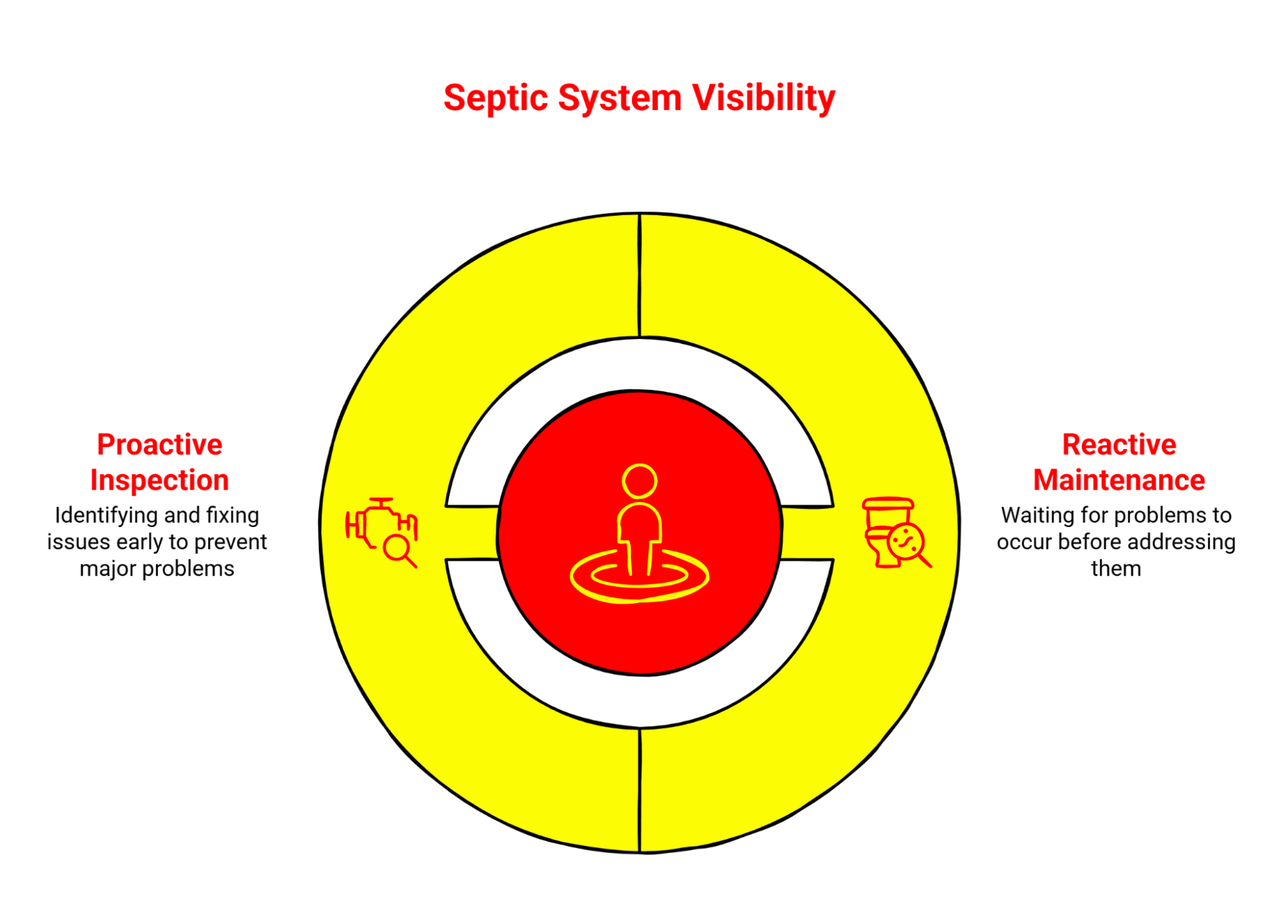
Infographic comparing proactive septic inspections with reactive maintenance.

Diagnostic visibility—knowing what you cannot see—represents the fundamental value of a septic inspection. Your underground wastewater system operates continuously, processing hundreds of gallons daily, yet remains completely hidden from view. This invisibility creates a dangerous knowledge gap.

Without visibility, you’re forced into reactive maintenance. You wait for symptoms to appear, and symptoms only appear when something has already failed. The toilet that suddenly won’t flush. The yard that becomes a swamp after rain. The smell that makes your outdoor space unusable. Each of these symptoms indicates that your system crossed from “working” to “broken” days or weeks earlier, but you had no way to know.

An inspection transforms this dynamic. It provides a snapshot of your system’s current condition, revealing problems at the earliest stage when they’re least expensive to fix. A cracked baffle discovered during an inspection might cost $300 to replace. That same baffle, left to fail completely, can lead to drain field contamination requiring thousands of dollars in repairs. The inspection creates visibility, and visibility enables proactive protection.

Common Misconceptions

Many homeowners believe they can assess their septic system’s health through simple observation. They walk their property, look for wet areas, and check for odors. While these surface checks have value, they don’t provide diagnostic visibility.

The first misconception is that a lack of symptoms means a healthy system. Your septic tank could be significantly full of sludge, your baffles could be deteriorating, and tree roots could be invading your drain field pipes—all while your toilets flush normally and your yard looks fine. Problems develop gradually, often taking months or years to manifest as symptoms you can detect.

Another common misunderstanding involves pumping frequency. Some homeowners follow rigid schedules—”pump every three years”—without considering their actual usage or system condition. While regular pumping is essential, the right schedule varies. A household of two adults uses a 1,000-gallon tank very differently than a family of six. An inspection measures your actual accumulation rate, allowing you to optimize your pumping schedule rather than guessing.

The third misconception is that all septic inspections are the same. A comprehensive diagnostic inspection differs significantly from the basic check that occurs during routine pumping. When a technician pumps your tank, they may glance at the components and mention if something looks obviously wrong. A true inspection involves systematic evaluation of every component, specific measurements, and detailed documentation. Understanding this difference helps you request the right service for your needs.

Real-World Implications

The difference between surface knowledge and diagnostic visibility plays out clearly in real-world scenarios. Consider a homeowner planning to sell their property. Without an inspection, they list the house confident that everything works fine. During the buyer’s due diligence, an inspection reveals a cracked tank wall and failed baffles. The seller now faces rushed repairs during the option period, or a price reduction that far exceeds what the repairs would have cost if addressed earlier.

Contrast this with a homeowner who schedules inspections every three years as part of regular maintenance. One inspection reveals early signs of baffle deterioration—not yet critical, but worth monitoring. The next inspection, eighteen months later, shows the deterioration has progressed to where replacement makes sense. The repair is scheduled during a convenient time and completed before any system compromise occurs. The total cost is lower, the stress is minimal, and the system’s overall lifespan is extended.

In emergency situations, the value of diagnostic visibility becomes even clearer. A sudden backup forces you to call for emergency service on a weekend. The technician pumps the tank to relieve the immediate problem, but without a proper inspection, you don’t know why the backup happened. Was it simple neglect—the tank was just too full? Was it a mechanical failure? Is your drain field compromised? You’ve paid for emergency service but still lack the information needed to prevent recurrence. An inspection would have either prevented the emergency entirely or, at minimum, provided the diagnostic information needed to fix the underlying cause.

Separating Myth from Reality

Myth: “If drains are working fine, the system is fine.”

Reality: Early failures often don’t show up at faucets or toilets. A quick visual check can be helpful for catching obvious surface problems, but internal component failures, structural issues, and developing clogs remain invisible until they trigger symptoms. A structured maintenance inspection produces diagnostic visibility that surface observation cannot provide.

Myth: “All vacuum or inspection services are interchangeable.”

Reality: Providers differ significantly in their processes, safety protocols, thoroughness of evaluation, and quality of reporting. Transparency in process and pricing matters when selecting a service provider. Understanding what’s included in an inspection—versus a basic pump-out—helps ensure you’re getting the diagnostic information you need.

Safety and Professional Standards

Septic systems involve biological hazards and confined spaces. Safe access, correct evaluation procedures, and proper handling are essential for protecting both the inspector and the property. Professional maintenance inspections are performed with safety protocols that minimize risk, produce clear findings, and support the decisions homeowners make next—like scheduling septic tank cleaning services at appropriate intervals or addressing component repairs before they escalate.

For homeowners who also manage other waste systems on their property, understanding the full range of maintenance services—including grease trap, grit trap, and lint trap services—helps develop a comprehensive property care strategy.

Your Path to Peace of Mind

Remember that faint smell, the too-green grass, the worry about what’s happening underground? That anxiety doesn’t have to be your reality. A septic system maintenance inspection transforms unknowns into knowns, giving you either confirmation that everything’s working properly or early warning of problems while they’re still manageable.

The inspection isn’t just about the technical details—sludge levels, baffle condition, drain field performance. It’s about restoring the sense of security that comes from knowing your home’s essential systems are functioning properly. It’s about protecting your property value and your family’s health. It’s about avoiding the panic of a weekend sewage backup that ruins your plans and empties your wallet.

Whether you’re preparing to sell your home in Houston or Alvin, responding to warning signs, or simply taking a proactive approach to home maintenance, a professional inspection provides the clarity and confidence you need. After diagnostics, many homeowners establish a routine maintenance plan to keep their system functioning reliably for years to come.

As one Houston-area customer shared: “My experience with Drane Ranger was a very organized, professional and on time experience. I was kept informed of what was happening and a suggested time of cleaning again. I will use them again and will definitely recommend them to anyone I speak with.” — Harold R.

Customers consistently note that the team is professional and reliable, as Shelley M. from the Houston area observed: “Drain Ranger is very professional and reliable. Basically they can take care of all your grease drain needs.”

Proactive protection beats reactive panic. Every time.

Contact us today to schedule your septic system inspection and gain the peace of mind that comes from truly knowing your system’s condition. For additional context about our commitment to quality service, you can review our Better Business Bureau profile.

Disclaimer: This article provides general information about septic system maintenance inspections for educational purposes. Individual circumstances vary significantly based on factors like location, usage patterns, and specific system requirements. For personalized guidance tailored to your property’s needs, it is recommended to consult with a qualified professional.


Our Editorial Process

Our expert team uses AI tools to help organize and structure our initial drafts. Every piece is then extensively rewritten, fact-checked, and enriched with first-hand insights and experiences by expert humans on our Insights Team to ensure accuracy and clarity.


About the Drane Ranger Insights Team

The Drane Ranger Insights Team is our dedicated engine for synthesizing complex topics into clear, helpful guides. While our content is thoroughly reviewed for clarity and accuracy, it is for informational purposes and should not replace professional advice.
Cleaning vs. Inspection: A Quick Comparison Chart for Septic System Homeowners

📌 Key Takeaways

Confusion about septic services leads to expensive mistakes, but understanding the difference between cleaning and inspection transforms homeowners from reactive to protected.

  • Pumping Removes, Inspection Reveals: Cleaning physically extracts accumulated waste to restore tank capacity, while inspection diagnostically assesses component health and system integrity—one resets function, the other verifies it.
  • Timing Follows Purpose: Schedule cleaning every 2-3 years or when the tank reaches capacity; schedule inspection before real estate transactions, after unexplained symptoms, or to establish maintenance baselines.
  • Bundling Delivers Certainty: Combining both services in a single visit provides capacity restoration and health verification simultaneously, eliminating the anxiety of unknown system conditions.
  • Prevention Costs Less Than Crisis: Routine maintenance prevents the $15,000-$30,000 drain field replacement that results from neglect, while emergency backup cleanup adds immediate expense to long-term damage.
  • Documentation Protects Value: Professional inspection reports serve as real estate certification, streamlining property transactions and demonstrating responsible ownership to potential buyers.

Know the difference, schedule strategically, protect your investment—that’s the path from system vulnerability to home security.

Suburban homeowners with septic systems will gain clarity here, preparing them for the comprehensive comparison and practical guidance that follows.

You’ve noticed slow drains in your home. Maybe there’s a faint odor near your yard that wasn’t there before. Or perhaps you’re simply wondering when the last time your septic tank was serviced. These moments of uncertainty are common for homeowners with septic systems, and they often lead to the same critical question: Do I need my tank pumped, or should I schedule an inspection?

The answer isn’t always straightforward because these two services serve fundamentally different purposes. Understanding the distinction between cleaning and inspection is essential for protecting your home’s value and ensuring your family’s health and comfort.

A Septic System Maintenance Inspection is a diagnostic assessment of the tank and components to verify function. It’s like a ‘Check Engine’ diagnostic for your yard. Imagine the confidence of handing a potential buyer a certified report saying your septic system is in perfect health. Schedule this before listing your home or if you suspect a problem but don’t see sewage yet.


What Are the Key Differences Between a Cleaning and an Inspection?

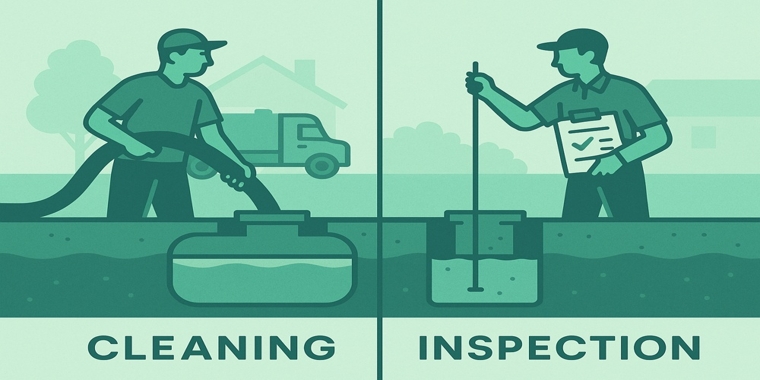
Residential septic tank cleaning is the physical removal of solid waste and wastewater to restore your system’s capacity. An inspection, by contrast, is a diagnostic assessment that reveals the overall health of your tank and its components. Pumping removes the waste; inspection reveals the health.

Think of cleaning as similar to an oil change for your home’s plumbing system. Skip it, and the entire system can seize up, leading to backups and contamination. The technician arrives with a vacuum truck, locates your tank’s access point, and uses specialized equipment to extract the accumulated sludge and liquid waste. This process typically takes one to two hours and immediately restores your tank’s working capacity.

An inspection involves a trained technician examining your tank’s structural integrity, checking sludge and scum levels with a measuring tool called a sludge judge for tank level assessment, and verifying that critical components like baffles and tees are functioning correctly through baffle and tee inspection. The inspector looks for cracks, leaks, or signs of system failure that aren’t visible from above ground. This service provides documentation of your system’s condition, which becomes invaluable during real estate transactions or when planning maintenance schedules.

The two services work hand in hand. Residential septic tank cleaning is used with septic system maintenance inspections because they complement each other perfectly. A thorough inspection often reveals that cleaning is needed, while a cleaning visit provides the opportunity to assess the tank’s condition from the inside. Many homeowners in Houston and surrounding areas like Alvin find that scheduling both services together provides the most complete picture of their system’s health.


When Do I Need a Cleaning vs. an Inspection?

You need septic tank cleaning every two to three years under normal household conditions, or sooner if your tank reaches capacity. An inspection becomes necessary before selling your home, if you notice warning signs like slow drains or odors, or when you want to establish a baseline for a newly purchased property.

Several factors influence how often you should schedule a cleaning. Household size matters significantly. A family of five generates more wastewater than a couple, which means the tank fills faster. Similarly, if you have a garbage disposal, use a water softener, or frequently do large loads of laundry, your tank accumulates solids more quickly.

The size of your tank also plays a role. A 1,000-gallon tank serving a four-person household typically needs pumping every two to three years. However, these are guidelines, not absolutes. The only way to know your tank’s actual condition is through regular monitoring.

Warning signs that demand immediate attention include:

  • Toilets or drains that empty slowly throughout your home
  • Gurgling sounds coming from your plumbing
  • Sewage odors near the tank or drain field
  • Unusually lush, green grass over the drain field
  • Standing water or soggy ground near the septic system

If you experience any of these symptoms, contact Drane Ranger for an assessment. These signs often indicate your tank is full or that a component has failed.

For inspections, timing depends on your specific situation. Schedule one before listing your home for sale, as many buyers require real estate septic certification. If you’ve just purchased a property with a septic system, an inspection establishes a baseline and reveals any hidden issues the previous owner may have neglected. After severe weather events or if you’ve experienced any plumbing problems, an inspection can catch damage before it becomes a crisis.

Septic system maintenance inspections prevent the silent failure that homeowners dread most—the odor and soggy yard that appear without warning. By checking levels and critical components during an inspection, technicians spot developing issues like leaks or damaged fittings before they escalate into overflows or drain field damage. This preventive approach saves thousands of dollars in emergency repairs.

Comparison Chart: Cleaning vs. Inspection at a Glance

This comparison matrix helps you evaluate which service addresses your immediate need and understand how both contribute to long-term system health.


Aspect Septic Tank Cleaning Septic System Inspection
Primary Goal Remove accumulated solid waste and restore tank capacity Assess system health and identify potential problems
What’s Involved Physical pumping of sludge and wastewater from the tank Tank level assessment, baffle and tee inspection, structural examination
Typical Outcome Empty tank ready to process new waste efficiently Documented system health check with maintenance recommendations
Recommended Frequency Every 2-3 years for average household Before home sale, after purchase, or when problems appear
Average Duration 1-2 hours onsite 30 minutes to 1 hour onsite
Primary Benefit Prevents backups and system failure Early detection of issues and real estate septic certification
Equipment Used Vacuum truck with large-capacity tank Sludge judge, flashlight, camera equipment
Cost Consideration Varies by tank size and accessibility Generally less expensive than cleaning


Understanding these differences allows you to make informed decisions about your system’s care. When you know what each service accomplishes, you can schedule them strategically to maximize protection while managing your maintenance budget effectively.

Septic system maintenance inspections also solve the compliance and sale hurdle that can derail real estate transactions. Clear documentation of system condition builds buyer confidence and streamlines the closing process, avoiding delays caused by unknowns buried underground.

The Overlap: Why Bundling Both Services Provides Peace of Mind

A comprehensive septic service visit combines inspection and cleaning into a single appointment, providing maximum value and complete system insight. When a technician arrives to pump your tank, they have the unique opportunity to visually inspect the tank’s interior once it’s empty, checking for cracks, deterioration, or other structural issues that would be impossible to assess when the tank is full.

This combined approach offers several practical advantages. You only need to schedule one service call, which saves time and minimizes disruption to your day. The technician can provide accurate measurements of sludge accumulation before pumping, which helps establish your ideal pumping frequency. After cleaning, they can inspect baffles, tees, and the tank’s structural integrity with full visibility.

Many professional services, including septic tank cleaning services offered throughout the Greater Houston area, include a basic inspection as part of the standard pumping visit. This practice ensures nothing gets overlooked and provides you with a complete picture of your system’s status.

The inspection component also helps prevent the “silent failure” scenario, where small leaks or component damage gradually worsen without obvious symptoms. By the time you notice soggy grass or foul odors, the problem may require expensive drain field repairs. Regular inspections catch these issues when they’re still manageable and affordable to fix.

For homeowners planning to sell, this bundled approach streamlines the pre-listing process. You’ll have both the pumping receipt and the inspection report that potential buyers or their inspectors will request. This documentation demonstrates responsible ownership and can prevent negotiations from stalling over septic concerns.


Getting Started: Your 5-Step Quick Path

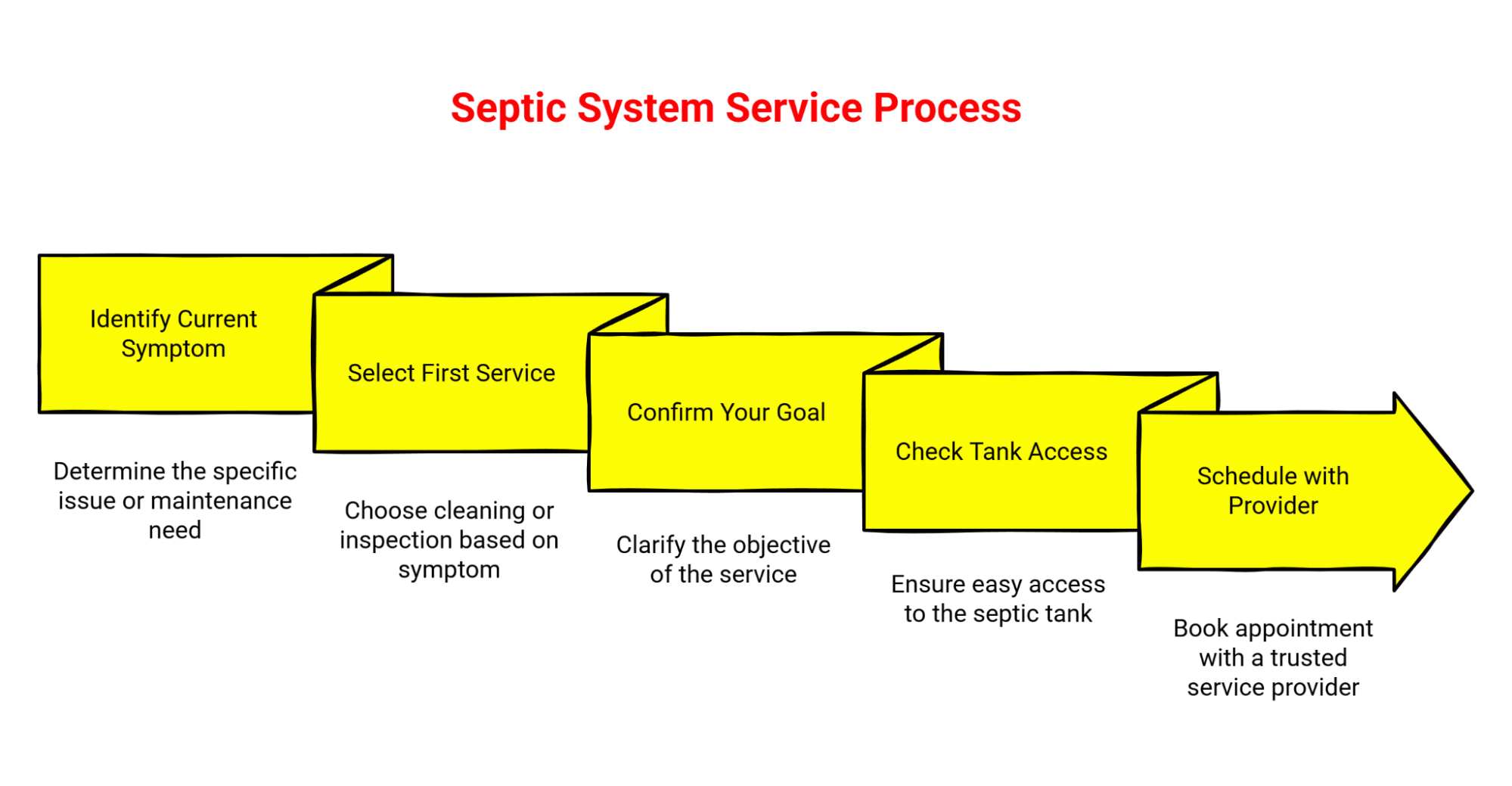
Infographic illustrating the septic system service process from identifying symptoms to scheduling with a provider.

The fastest way to move from confusion to action is matching your current situation to the right first step. Follow this straightforward sequence:

Step 1: Identify Your Current Symptom Are you experiencing slow drains, odors, gurgling sounds, soggy yard areas, or are you simply overdue for service? Name the specific concern or note that routine maintenance is due.

Step 2: Select Your First Service Choose cleaning if your tank is overdue or showing signs of being full. Choose inspection if you have symptoms without a clear cause, need documentation for a real estate transaction, or want to verify system health after a long period without service.

Step 3: Confirm Your Goal Clarify whether you need to reset capacity (cleaning) or verify health and obtain documentation (inspection). This helps the service provider prepare the right equipment and approach.

Step 4: Check Tank Access Locate your tank’s access lids or risers. If they’re buried, note this for the service provider so they can bring excavation tools. Clear access saves time and reduces service costs.

Step 5: Schedule with a Trusted Local Provider Book your appointment with a licensed, compliant company that serves your area. For Houston and Alvin residents, Drane Ranger’s septic services provide comprehensive cleaning and inspection options.

This simple process transforms uncertainty into a concrete action plan, moving you from anxiety about your system to confidence in its care.

What If I Only Choose One?

Choosing only cleaning without inspection means you restore capacity but remain unaware of potential structural problems, damaged baffles, or developing leaks that could cause system failure. Choosing only inspection without cleaning leaves you with knowledge about your tank’s condition but doesn’t address the fundamental problem of waste accumulation that leads to backups.

If your tank is overdue for pumping, prioritize cleaning first. The immediate risk of backup outweighs the diagnostic value of an inspection. However, schedule an inspection within the next six months to verify that the cleaning resolved all issues and to establish your optimal maintenance interval.

If you’re experiencing symptoms but your last cleaning was recent, start with an inspection. This diagnostic approach identifies the root cause without the expense of unnecessary pumping. The inspection results will guide whether cleaning is needed immediately or can wait.

The most reliable long-term strategy is maintaining both services on a regular schedule. Think of it as a complete health maintenance program for your home’s waste management system.


Risk Mitigation Guide: 5 Common Risks and Solutions

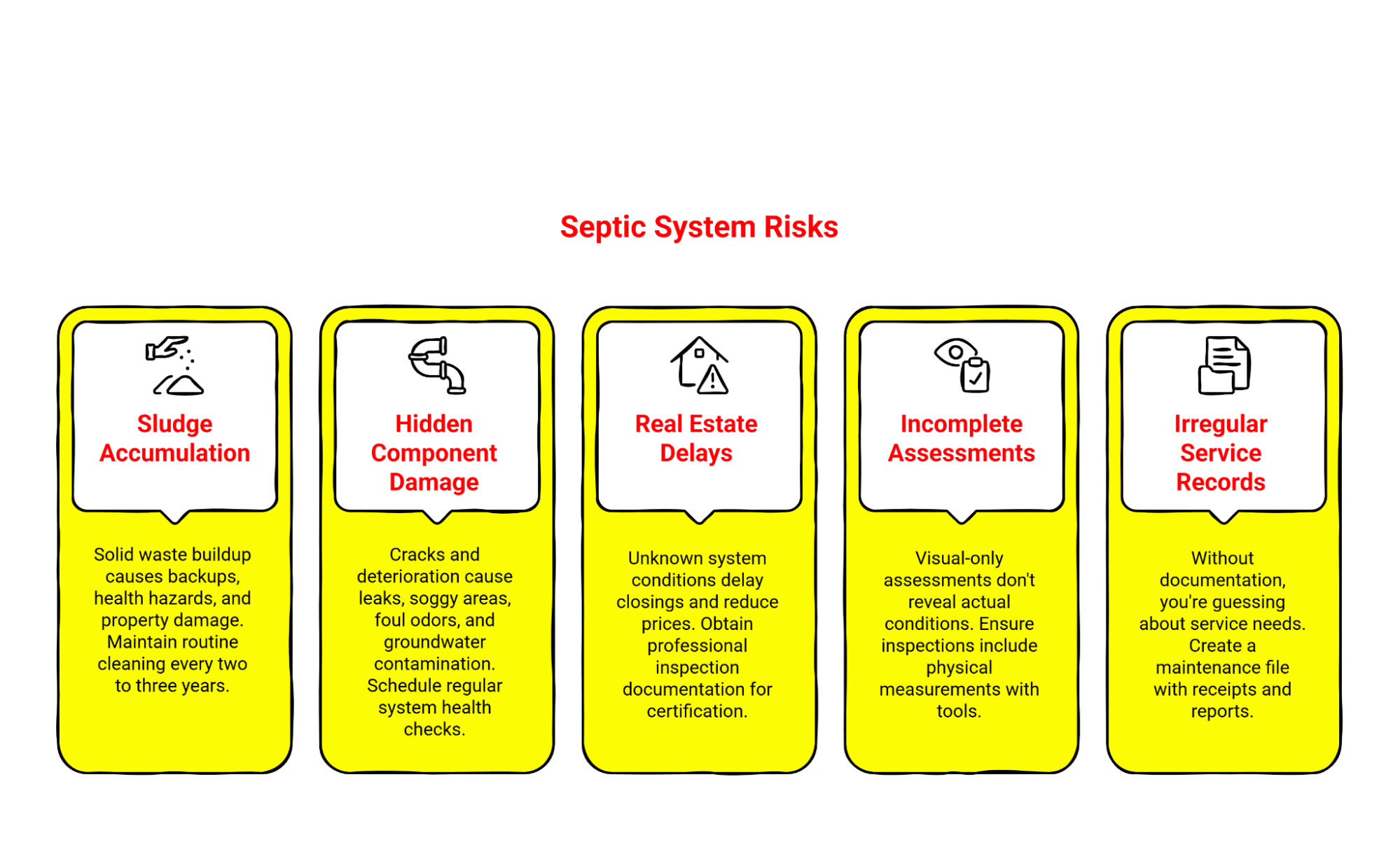
Infographic showing common septic system risks including sludge buildup, component damage, real estate delays, incomplete assessments, and irregular service records.

Understanding the specific risks your septic system faces helps you develop a practical protection plan.

Risk 1: Sludge Accumulation Leading to Backups

When solid waste builds up beyond safe levels, it has nowhere to go but backward through your plumbing. This creates health hazards, property damage, and emergency service costs that far exceed routine maintenance expenses.

Mitigation: Maintain a routine cleaning interval based on your household size and usage patterns. For most homes, this means scheduling service every two to three years. Keep a maintenance log with service dates and set calendar reminders well before your next due date.

Risk 2: Hidden Component Damage Causing Silent Leaks

Cracks in the tank, damaged baffles, or deteriorated tees allow untreated sewage to leak into the surrounding soil. These problems develop gradually and remain invisible until they cause soggy areas, foul odors, or contaminated groundwater.

Mitigation: Schedule regular system health checks that include thorough tank level assessment and baffle and tee inspection. A qualified inspector examines components that you can’t see from the surface, catching problems while they’re still inexpensive to repair.

Risk 3: Real Estate Transaction Delays

Buyers increasingly require septic system documentation before closing. Unknown system conditions create negotiation obstacles, delay closings, or result in price reductions that exceed the cost of proper maintenance.

Mitigation: Obtain professional inspection documentation that serves as real estate septic certification. Schedule this service at least 30 days before listing your property. The resulting report demonstrates system integrity and eliminates buyer concerns.

Risk 4: Incomplete Visual-Only Assessments

Looking into a tank from the surface reveals almost nothing about actual conditions. Sludge depth, scum thickness, and component integrity require proper measurement tools and technical expertise to evaluate accurately.

Mitigation: Ensure any inspection you schedule includes physical measurements using appropriate tools, not just a visual glance. Ask the inspector to document sludge and scum levels in inches and to test baffle function. Written reports with specific measurements provide actionable information.

Risk 5: Irregular Service Records Creating Maintenance Confusion

Without clear documentation of past service dates, tank measurements, and findings, you’re guessing about when service is actually needed. This leads to either premature pumping that wastes money or delayed pumping that risks system failure.

Mitigation: Create a simple maintenance file for your septic system. Save all service receipts, inspection reports, and pumping records. Note the dates and key findings. Use this information to establish your optimal service interval based on actual tank conditions rather than generic guidelines.

Pre-Service Checklist

Use this practical checklist to prepare for your service appointment and ensure nothing gets overlooked:

  • Current symptom or concern identified (slow drains, odor, gurgling, soggy yard, overdue maintenance)
  • Decision made: cleaning to reset capacity or inspection to verify health
  • Tank location identified and access points located
  • Previous service records gathered (dates and any notes from past visits)
  • Preferred appointment date and time selected
  • Questions prepared for the technician
  • Plan established for completing the paired service (schedule inspection after cleaning, or vice versa)
  • Licensed, local provider confirmed

Having these items ready before you call streamlines the scheduling process and helps the service provider prepare appropriately for your specific needs.


Common Pitfalls to Avoid When Scheduling Your Service

Pitfall 1: Assuming a Visual Inspection Is Enough

Many homeowners believe they can assess their system by lifting the tank lid and looking inside. However, accurate measurement requires inserting a measuring tool to the tank’s bottom to check sludge depth and scum thickness. The Environmental Protection Agency recommends pumping when the bottom of the scum layer is within six inches of the outlet tee, or when the top of the sludge layer is within 12 inches of the outlet. You can’t judge these measurements by looking at the surface.

Additionally, critical components like baffles, tees, and the tank’s structural integrity require professional expertise to evaluate properly. A trained inspector knows what to look for and can spot early warning signs that an untrained eye would miss.

Pitfall 2: Postponing Cleaning Until a Problem Occurs

The most expensive approach to septic maintenance is waiting until you experience backups, odors, or system failure. Emergency service calls cost significantly more than scheduled maintenance, and the damage from a backup often requires additional repairs and cleaning.

Septic systems don’t provide clear warnings before they fail. By the time you notice symptoms, the tank is already overfull and may have damaged the drain field. This reactive approach transforms an affordable, routine service into an expensive crisis.

Pitfall 3: Choosing a Provider Based Only on Price

The lowest price often comes with compromises. Some companies offer cut-rate pricing but skip important steps like proper waste disposal or thorough tank cleaning. They may pump out only the liquid layer, leaving solids behind that continue to reduce your tank’s capacity.

Proper disposal matters significantly. Licensed professionals transport waste to approved treatment facilities where it’s processed according to environmental regulations. Unlicensed operators may dump waste illegally, which creates environmental hazards and can result in fines for the property owner if authorities trace the waste back to your address.

Pitfall 4: Neglecting to Locate or Uncover Access Points

Many older septic tanks have buried access lids, which adds time and cost to service calls. Technicians may charge extra to dig out access points, and the excavation process can damage landscaping. In some cases, difficult access prevents thorough pumping because the technician can’t reach all compartments of the tank.

Consider installing risers that bring access points to ground level. This one-time investment makes all future service visits faster and less expensive while eliminating the risk of damaging your yard during excavation.

Pitfall 5: Ignoring the Drain Field

Your septic tank is only part of the system. The drain field performs the crucial function of filtering and dispersing treated wastewater into the soil. Many homeowners focus exclusively on tank maintenance while neglecting the drain field, which can lead to system failure even if the tank itself is properly maintained.

Never park vehicles or place structures over the drain field. Keep trees and shrubs at least 10 feet from drain field lines. Divert roof gutters and surface water away from the drain field area. These simple practices protect your system’s most expensive component from premature failure.

Trust & Local Resources

When evaluating service providers, independent third-party directories help verify local presence and business reputation. These resources provide unbiased information about companies serving the Houston area:

These directory listings provide additional context about service providers in your area and support informed decision-making.

Resources

Taking Control of Your Home’s Hidden System

Your septic system represents a significant investment in your property’s functionality and value. Unlike the visible systems in your home that remind you when they need attention, your septic system operates silently underground, providing reliable service until the day it doesn’t.

The difference between a properly maintained system and a neglected one often comes down to a simple decision: choosing proactive care over reactive panic. Regular cleaning removes the waste that inevitably accumulates. Periodic inspections catch the small problems before they become expensive disasters. Together, these services form your defense against system failure.

Homeowners throughout Houston and Alvin who maintain their systems on schedule enjoy the peace of mind that comes from knowing their homes are protected. They don’t worry about embarrassing backups during family gatherings or scramble to find emergency service on weekends. They have documentation ready when it’s time to sell, and they avoid the $15,000 to $30,000 cost of drain field replacement that results from neglect.

You now understand the distinct roles that cleaning and inspection play in system health. You know when to schedule each service and what risks you face by postponing maintenance. Most importantly, you recognize that these aren’t just chores to check off a list—they’re investments in your home’s sanitation, your family’s health, and your property’s long-term value.

For comprehensive service in the Houston area, explore septic tank cleaning services or learn about service options in Alvin and surrounding communities. Ready to schedule? Contact us today or call 281-489-1765 to speak with our team about establishing a maintenance plan tailored to your household’s specific needs.

Disclaimer: This content is for informational purposes only and should not replace professional advice. Septic system requirements vary by location, soil conditions, and local regulations. Always consult with licensed professionals for services specific to your property.


Our Editorial Process

Our expert team uses AI tools to help organize and structure our initial drafts. Every piece is then extensively rewritten, fact-checked, and enriched with first-hand insights and experiences by expert humans on our Insights Team to ensure accuracy and clarity.


About the Drane Ranger Insights Team

The Drane Ranger Insights Team is our dedicated engine for synthesizing complex topics into clear, helpful guides. While our content is thoroughly reviewed for clarity and accuracy, it is for informational purposes and should not replace professional advice.
Why Routine Tank Cleanout Is the Best Preventative Maintenance

📌 Key Takeaways

A septic system that’s maintained on schedule protects both your property value and your family’s health from a crisis that could cost tens of thousands of dollars to resolve.

  • Routine Cleanout Costs a Fraction of Replacement: A $300-$700 pump-out every 2-3 years prevents the $12,000-$30,000 disaster of full system replacement.
  • Sludge Migration Destroys Drain Fields: When solid waste escapes an overfull tank, it permanently clogs the drain field’s soil pores, forcing expensive excavation and reconstruction.
  • Documentation Preserves Home Sale Value: Maintenance records showing regular cleanouts eliminate buyer concerns and prevent last-minute negotiation credits that erase seller equity.
  • Additives Cannot Replace Physical Removal: Chemical or biological additives fail to remove accumulated sludge—only professional pumping with a vacuum truck physically clears the tank.
  • Neglect Cuts System Lifespan in Half: Properly maintained systems last 20-30 years, while neglected ones fail in just 10-25 years, typically requiring complete replacement rather than repair.

Scheduled maintenance transforms underground anxiety into documented confidence. Suburban homeowners with septic systems will find the practical cost comparisons and action steps here, preparing them for the detailed guidance that follows.

Routine tank cleanout prevents sewage backups, drain field damage, and costly system replacement by removing accumulated sludge every 2-3 years. It’s the single most cost-effective step to protect your home’s value and your family’s health from septic system failure.

The smell hit you first. That faint sewage odor drifting up from the yard. Then you noticed the soggy patch of grass near the back corner of your property, growing greener and wetter by the day. Now you’re standing at your kitchen sink, watching the water drain slower than it should, and a knot of anxiety is forming in your stomach.

You’re not alone in this worry. Homeowners with septic systems face a constant, low-level concern about what’s happening underground—a system they can’t see, doing work they’d rather not think about. The fear of a sudden, expensive failure is real. But here’s the truth that can shift that anxiety into confidence: a routine tank cleanout is not just another home maintenance task you can put off. It’s the single most effective and affordable defense against the catastrophic failure you’re worried about.

A Septic System Maintenance Inspection is a diagnostic assessment of the tank and components to verify function. It’s like a ‘Check Engine’ diagnostic for your yard. Imagine the confidence of handing a potential buyer a certified report saying your septic system is in perfect health. Schedule this before listing your home or if you suspect a problem but don’t see sewage yet.


The True Cost of Waiting: Maintenance vs. Replacement

Let’s talk about money, because that’s often what keeps homeowners from scheduling service. A routine tank cleanout typically costs between $300 and $700 in the Houston area. It’s a straightforward service: a professional pumps out the accumulated solid waste and wastewater, restoring your tank’s capacity to function properly.

Compare that to what happens when you skip this maintenance. A full septic system replacement—including a new tank, drain field, and installation—can easily run between $12,000 and $30,000. That’s not a repair bill. That’s a financial disaster that could have been prevented.

Here’s the comparison laid out clearly:

Cost of Maintenance vs. Repair

Service Type Typical Houston-Area Cost* What It Covers Frequency What You Avoid
Routine Tank Cleanout $300 – $700 Removing solids and scum to restore capacity Every 2-3 years System failure, emergency response, drain field damage
Emergency Backup Response $800 – $2,500+ Urgent pump-out plus basic cleanup Unplanned crisis Health hazards, water damage, property contamination
Drain Field Rehabilitation $6,000 – $20,000+ Restoring or replacing clogged field When neglect causes failure Complete yard excavation, extended downtime
Full System Replacement $12,000 – $30,000+ New tank and drain field installation When system fails completely Major capital expense, total property disruption


Illustrative estimates for budgeting purposes; actual costs vary by tank size, site conditions, and specific requirements.

A routine tank cleanout costs a fraction of a system replacement. The math is simple, but the peace of mind is priceless. When you invest in regular maintenance, you’re not just clearing out sludge—you’re protecting your home’s value and your family’s health from a problem that grows silently until it becomes a crisis.

The hidden cost most homeowners don’t consider is drain field failure. Your septic tank is only part of the system. The drain field—that network of perforated pipes buried in your yard—is where treated wastewater disperses into the soil. When solid waste escapes from an overfull tank, it clogs these pipes. Once your drain field fails, repair costs skyrocket because the entire area must be excavated and rebuilt.


How a Routine Tank Cleanout Protects Your Drain Field and Property Value

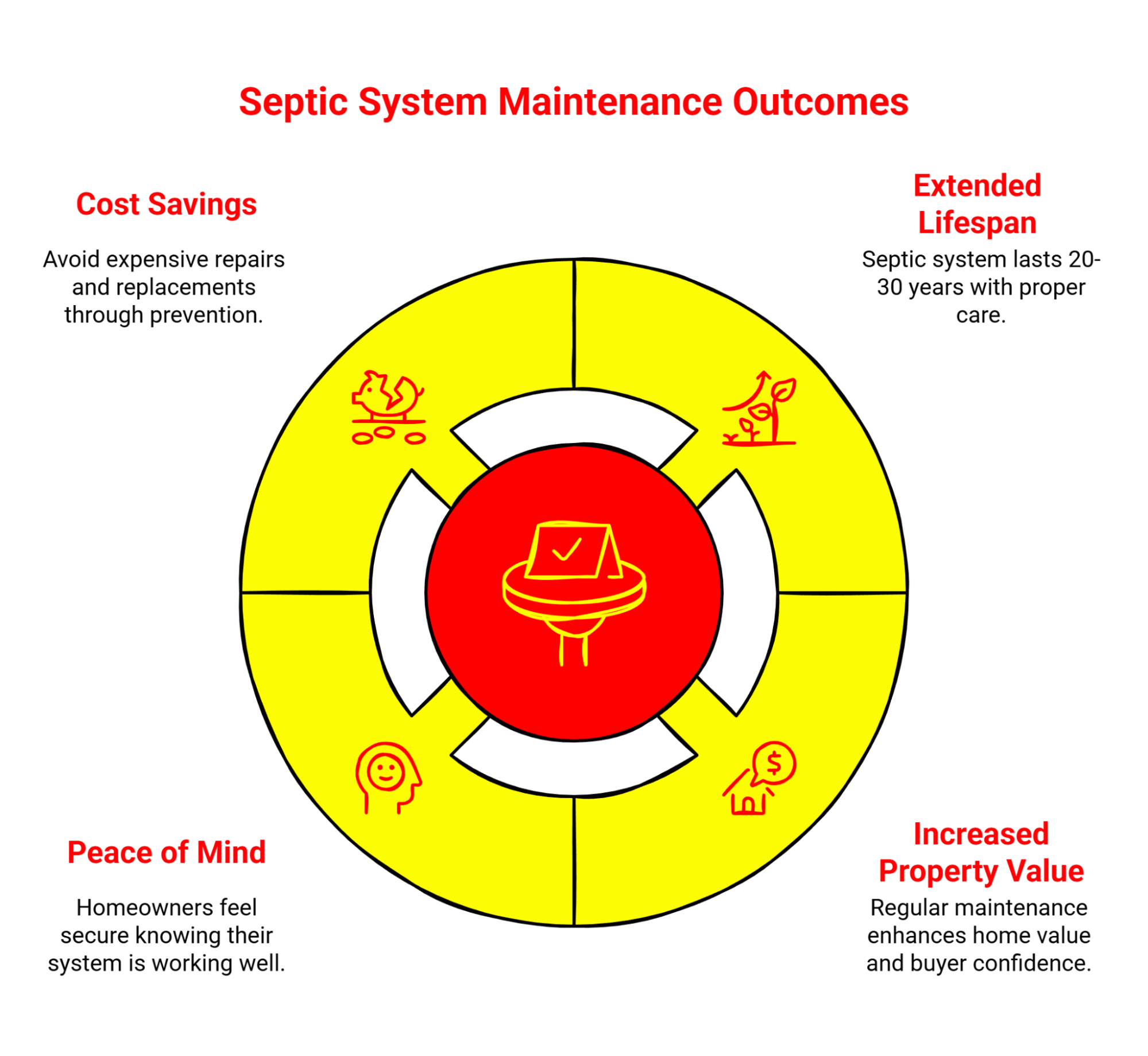
Infographic showing key septic system maintenance outcomes including cost savings, extended lifespan, peace of mind, and increased property value.

Your septic tank works through a simple but critical process. Wastewater enters the tank, where solid waste settles to the bottom as sludge while lighter materials float to the top as scum. The relatively clear water in the middle layer flows out to your drain field. This system works perfectly—until the sludge layer grows too thick.

Regular pumping prevents the sludge layer from escaping into the drain field. When you schedule septic tank cleaning services every two to three years, professionals physically remove that accumulated solid waste before it reaches critical levels. Think of it as an oil change for your home’s plumbing system. Skip it, and the entire engine seizes up.

The sludge doesn’t just disappear or break down completely on its own, despite what some additive products might claim. Over time, it builds up and reduces your tank’s effective capacity. A tank that should hold 1,000 gallons might only have 400 gallons of working space when it’s half full of sludge. At that point, solid particles start flowing out with the liquid, heading straight for your drain field where they create blockages that can’t be easily fixed.

When properly maintained, a septic system can last 20 to 30 years. When neglected, that lifespan drops to just 10 to 25 years, with failures often requiring complete replacement rather than simple repairs. The difference comes down to whether sludge stays in the tank where it belongs or migrates to the drain field where it causes permanent damage.

What does this mean for your property value? Documented maintenance increases home value and buyer confidence. When you’re ready to sell your home, potential buyers will ask about the septic system. Having maintenance records showing regular cleanouts tells them this is a well-cared-for property. It removes a major negotiating point and can prevent deals from falling through during the inspection period.

One homeowner we work with learned this the hard way. After years of putting off maintenance, he listed his home for sale. During the buyer’s inspection, the septic system showed signs of stress. The buyer requested a $15,000 credit to cover potential replacement costs, effectively wiping out much of the seller’s profit. A few hundred dollars spent on routine maintenance would have preserved that equity.

Beyond the financial protection, there’s something deeply reassuring about knowing your system is working properly. That’s the transformation we see repeatedly: homeowners move from that nagging worry about hidden problems to genuine confidence in their home’s essential systems. It’s the peace of mind that comes from a clean bill of health inspection and a freshly emptied tank.


Getting Started: A 5-Minute Setup

Infographic outlining five steps to ensure septic system health, including pump date check, signs review, info gathering, inspection, and reminders.

As you plan your home maintenance for the season, set aside just five minutes to get your septic system on the right track:

  1. Check your last pump date. If it’s been two to three years or you can’t remember, you’re in the maintenance window.
  2. Look for warning signs. Slow drains, gurgling toilets, or wet spots in the yard signal it’s time to act now.
  3. Gather essential information. Note your tank size if known, locate your tank lid or riser, and ensure yard access is clear.
  4. Request an inspection and scheduling. An inspection confirms current levels, then you can complete a cleanout if needed.
  5. Set your next reminder. Ask for a recommended return date so you never have to guess when service is due again.

That’s it. Five minutes of planning protects years of investment.


Key Features for Immediate Value

When you schedule routine tank cleanout, here’s the immediate value you gain:

  • Capacity reset: Pumping restores your tank’s working volume so fixtures drain quickly and odors disappear.
  • Drain field protection: Keeping sludge contained in the tank keeps your drain field breathing and functioning properly.
  • Documentation for resale: Simple service records create a paper trail that improves buyer confidence during home sales.
  • Transparent planning: An inspection aligns your pumping schedule with actual tank levels, eliminating guesswork and unnecessary worry.

As one homeowner told us: “My experience with Drane Ranger was a very organized, professional and on time experience. I was kept informed of what was happening and a suggested time of cleaning again. I will use them again and will definitely recommend them to anyone I speak with.”

Being kept informed during service and getting a clear recommended return date reduces stress. That reliability and straightforward communication are hallmarks of effective septic tank cleaning services and a calmer home maintenance routine.

Time-Saving Checklist

Before your scheduled service, take these quick steps to ensure a smooth, efficient visit:

  • Note your last pump date and current symptoms to share with the technician.
  • Make sure the tank lid or riser is accessible and clear of debris or landscaping.
  • Keep pets secured indoors and ensure clear vehicle access for the vacuum truck.
  • Run a quick water-use check—consider staggering laundry or dishwashing cycles on service day.
  • Plan for a brief post-service walkthrough to review findings and discuss your next maintenance date.

These simple preparations save time and help you get the most value from every service visit.


A Question You Should Be Asking: When Should I Stop Using Septic Additives?

The answer is simple: right now. The septic additive industry has created a persistent myth that you can maintain your system by pouring chemicals or biological agents down your drains. These products promise to break down sludge, eliminate odors, or boost bacterial action in your tank.

Here’s what actually happens. Additives cannot physically remove the solid waste that accumulates in your tank. At best, they’re unnecessary because a healthy septic system already contains the bacteria it needs to function. At worst, some additives can actually harm your system by killing beneficial bacteria or causing solids to stay suspended in the water, which then flow into your drain field.

The only proven method for maintaining a septic system is professional pumping. A vacuum truck removes the physical material that’s built up over years. No chemical can replicate this process. We’ve seen homeowners who religiously used additives for a decade, believing they were protecting their investment, only to discover during an emergency call that their tank was completely full and their drain field was failing.

This connects directly to one of the core principles of proper septic maintenance: transparency over shortcuts. The DIY approach to hazardous biological waste doesn’t just fail to work—it can accelerate the very problems you’re trying to prevent while giving you false confidence that you’re taking care of the issue.

If you’ve been using additives, there’s no harm done as long as you also schedule regular professional cleanouts. But don’t let the monthly cost of additives fool you into thinking you can skip the real maintenance your system needs.

Local Trust & Verification

When you’re researching septic service providers in Houston, these independent resources can help you verify credentials and read unfiltered customer experiences:

These third-party listings provide the transparency that helps you make an informed decision about who you trust with your home’s essential systems.


The Peace of Mind That Comes From a Clean System

Remember that anxiety we talked about at the beginning? The worry about unknown problems lurking underground, the fear of a sudden expensive disaster? That doesn’t have to be your reality.

When you invest in routine tank cleanouts, you’re making a choice that transforms how you experience your home. Instead of hoping everything is fine, you know it is. Instead of wondering if this will be the year your system fails, you have documentation proving it’s functioning properly. Instead of facing a potential five-figure emergency, you’ve spent a few hundred dollars to prevent it entirely.

The money you save compounds over time. Every three years of maintained service adds value that a single major repair would instantly erase. But beyond the financial logic, there’s something more fundamental at stake. Your septic system is your home’s hidden immune system. When it’s healthy and functioning, your entire property maintains the dignity and sanitation that makes a house truly livable.

Proactive protection beats reactive panic every single time. The homeowners who sleep soundest aren’t the ones who hope their system will last another year. They’re the ones who scheduled their maintenance, received their service, and know with certainty that their home’s essential functions are protected.

Request your quote today and move from worry to confidence. Or if you prefer to speak with someone directly, you can contact us today or call 281-489-1765 to schedule your routine tank cleanout.

Your future self—and your bank account—will thank you for making this decision now, before it becomes an emergency.

Disclaimer: This article provides general information about Septic System Maintenance for educational purposes. Individual circumstances vary significantly based on factors like cost-effectiveness, risk of failure, and long-term performance. For personalized guidance tailored to your property’s maintenance and budget needs, it is recommended to consult with a qualified professional.


Our Editorial Process

Our expert team uses AI tools to help organize and structure our initial drafts. Every piece is then extensively rewritten, fact-checked, and enriched with first-hand insights and experiences by expert humans on our Insights Team to ensure accuracy and clarity.


About the Drane Ranger Insights Team

The Drane Ranger Insights Team is our dedicated engine for synthesizing complex topics into clear, helpful guides. While our content is thoroughly reviewed for clarity and accuracy, it is for informational purposes and should not replace professional advice.

A Septic System Maintenance Inspection Checklist for Peace of Mind

📌 Key Takeaways

Your septic system works silently underground, but uncertainty about its condition can create constant worry—especially when you notice slow drains or unexplained odors.

  • Visibility Eliminates Anxiety: A professional inspection transforms hidden threats into documented facts, replacing guesswork with clear measurements of sludge levels, structural integrity, and component function.
  • Checklists Ensure Thoroughness: Using a verification checklist during the inspection guarantees your provider checks all three essentials—tank levels, baffles and tees, and flow patterns—without cutting corners.
  • Documentation Builds Value: Written inspection reports create a reliable maintenance history that protects your property value, supports confident home sales, and guides smart decisions about when cleaning or repairs are genuinely needed.
  • Early Detection Prevents Disaster: Catching a damaged baffle early costs around $300; waiting until the drain field fails can mean a $10,000 replacement—inspections make small problems visible before they become expensive emergencies.
  • Control Replaces Worry: Moving from “I hope it’s fine” to “Here’s what we know” gives you command over your home’s most critical waste system and the peace of mind that comes with documented proof of proper care.

Prepared inspection = protected investment and genuine peace of mind.

Suburban homeowners with septic systems will gain confidence here, preparing them for the detailed inspection checklist that follows.

Picture this: You’re sitting in your living room on a quiet Saturday morning when you catch a faint whiff of something unpleasant. You walk outside and notice a soggy patch in your yard that wasn’t there yesterday. Your stomach tightens. Is this the beginning of a septic emergency, or just a minor issue? The not-knowing—that low-level anxiety about what’s happening underground—can be as stressful as the problem itself.

You want the confidence that comes from knowing your system is working properly. You want to protect your home’s value and your family’s health without constantly worrying about invisible problems lurking beneath your lawn. The good news? A thorough septic system maintenance inspection gives you exactly that peace of mind, and a simple checklist ensures you’re getting the quality service you’re paying for.

Key Terminology

  • Septic Tank: A buried container that separates solids (sludge and scum) from wastewater before it flows to the drain field.
  • Baffles/Tees: Internal components at the inlet and outlet that control flow and prevent solids from escaping the tank.
  • Drain Field: The soil area that absorbs and naturally treats the liquid wastewater after it leaves the tank.

A Septic System Maintenance Inspection is a diagnostic assessment of the tank and components to verify function. It’s like a ‘Check Engine’ diagnostic for your yard. Imagine the confidence of handing a potential buyer a certified report saying your septic system is in perfect health. Schedule this before listing your home or if you suspect a problem but don’t see sewage yet.


What A Comprehensive Septic System Inspection Covers

A proper septic system maintenance inspection goes far beyond just checking the tank level. When a qualified professional arrives at your property, they’re evaluating the entire hidden system that keeps your home functioning safely. The inspection covers three critical areas: measuring sludge and scum accumulation to determine if pumping is needed, examining the structural integrity of the tank itself for cracks or deterioration, and verifying that essential components like baffles and inlet/outlet tees are intact and functioning correctly.

Think of your septic system as your home’s hidden immune system. Just as you wouldn’t skip regular health checkups, your septic system needs periodic diagnostics to catch small issues before they become expensive disasters. The tank sits quietly underground, processing all the wastewater from your sinks, toilets, and showers. Over time, solid waste accumulates as sludge on the bottom while lighter materials form a scum layer on top. Between these layers, relatively clear water flows out to your drain field.

When the sludge layer gets too thick, it reduces the tank’s capacity and can lead to solids escaping into your drain field—a problem that can cost thousands to repair. Similarly, damaged baffles or broken inlet tees allow untreated sewage to bypass the settling process entirely. These are the silent failures that an inspection reveals before they escalate into emergencies. In practice, the inspection serves as the verification step that determines whether Septic Tank Cleaning services are needed and why.


A Homeowner’s Inspection Companion: Your Peace of Mind Checklist

Using a checklist during your scheduled inspection ensures your service provider isn’t cutting corners. This tool transforms you from a passive observer into an informed participant who can verify that every critical step is completed. Regular verified inspections build a documented “health history” for your home’s plumbing system, which becomes invaluable when selling your property or troubleshooting future issues.

Phase 1: Tank Levels and Structural Integrity

Infographic outlining the septic tank inspection process with steps from confirming access to documenting findings.

  • Confirm safe, clear access to the tank lid(s) and riser(s)
  • Record sludge and scum levels with a measuring tool
  • Note tank material (concrete, fiberglass, or other) and visible condition
  • Check for cracks, root intrusion, or groundwater infiltration at seams
  • Observe any signs of corrosion or compromised lids, risers, and gaskets
  • Verify water level is normal for the system at rest (not abnormally high or low)
  • Document findings in writing; request photos if the provider offers them

The inspector should use a specialized tool called a sludge judge to measure the depth of the sludge layer at the tank bottom and the scum layer at the top. You should see them record these measurements—typically, pumping is recommended when the bottom of the scum layer is within six inches of the outlet pipe, or when the top of the sludge layer is within 12 inches of the outlet.

Phase 2: Baffles, Tees, and Flow Verification

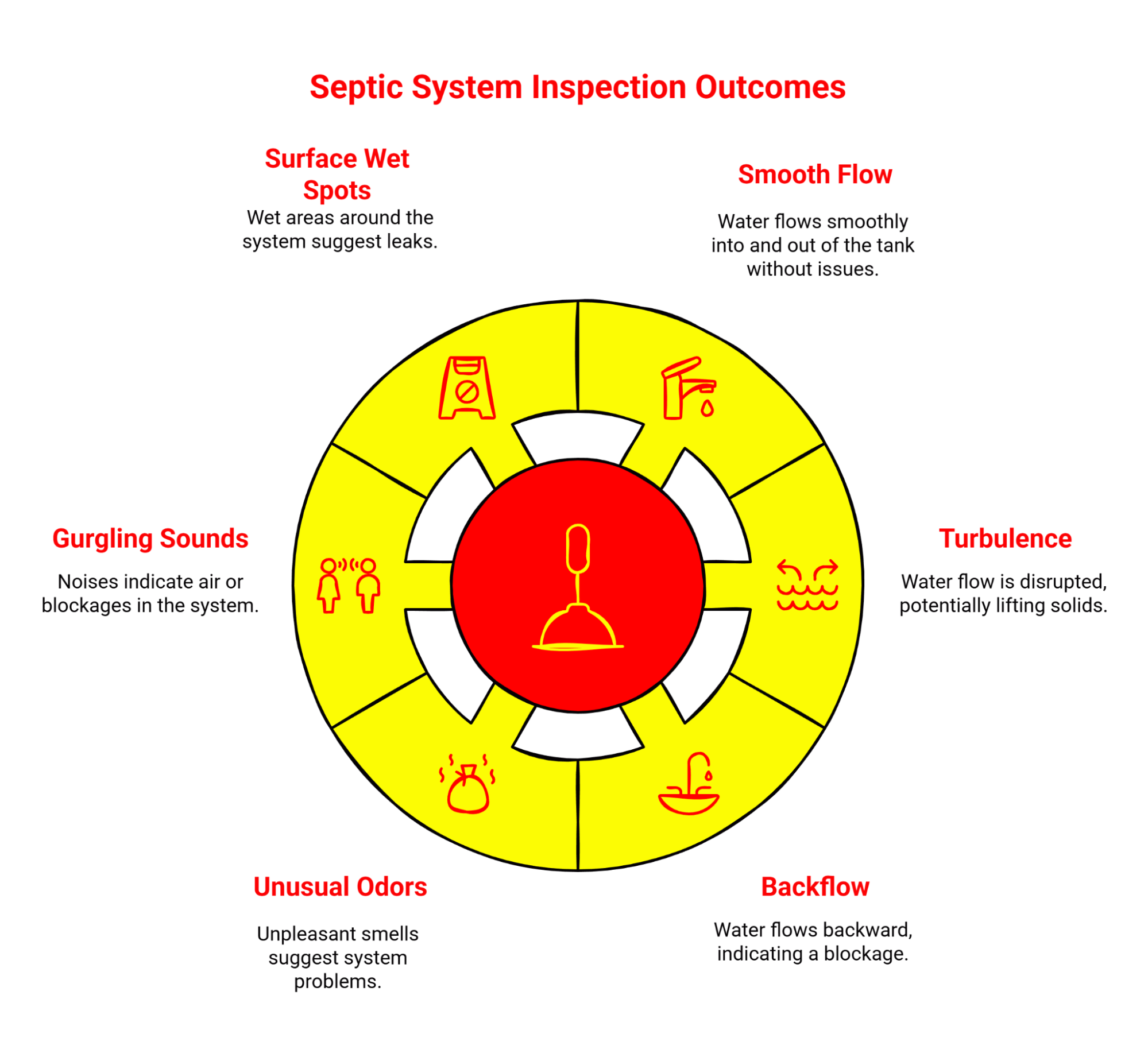
Infographic showing septic system inspection outcomes such as wet spots, smooth flow, gurgling sounds, turbulence, odors, and backflow.

  • Inspect inlet baffle or tee: present, intact, and correctly positioned
  • Inspect outlet baffle or tee (and effluent filter, if present): intact, seated, and not allowing solids to pass
  • Run household water briefly (a sink works well) to confirm smooth flow into the tank
  • Watch for turbulence that lifts solids or backflow that suggests a blockage
  • If safe and applicable, confirm that effluent exits the tank as expected
  • Note unusual odors, gurgling sounds, or surface wet spots around the system area
  • Record any recommendations such as cleaning a filter or scheduling a pump-out

The inlet baffle or tee directs incoming wastewater downward into the tank, while the outlet baffle or tee only allows liquid from the clear zone to exit toward the drain field. These components are critical, yet they’re often neglected because they’re out of sight. A thorough inspector will verify that both devices are present, properly positioned, and structurally sound. Deteriorated baffles can break off and either clog the outlet pipe or allow solids to escape.

Phase 3: The Critical Documentation Check

  • Receive a written report summarizing levels, structural notes, and baffle/tee condition
  • Ensure the report lists recommended next steps (if any) with clear reasoning
  • File the report with home records to build a maintenance health history—valuable for future service and home sale conversations
  • Confirm date, technician name, and provider contact details for traceability

The report should clearly state whether pumping is currently needed, estimate when the next inspection or pumping will be required based on your household size and usage patterns, and note any repairs or concerns that need attention. Some inspectors also take photos or videos of the tank interior, which can be incredibly valuable for your records.

How to Use This Checklist During Service:

  1. Keep the list visible and follow along as each step is performed
  2. Ask for plain-language explanations if any terms are unclear
  3. Before the provider leaves, confirm all checklist items are addressed and documented

Remember, this checklist is for oversight and verification. The actual inspection work involves hazardous biological waste and should only be performed by trained professionals with proper safety equipment.


Deep Dive: Understanding Diagnostic Visibility (Knowing the Unknown)

The concept of diagnostic visibility is central to why these inspections matter so much. Your septic system operates completely underground, processing waste around the clock without any visible indication of its condition. Unlike a leaky faucet or a running toilet, septic problems often remain hidden until they reach crisis levels.

Critical Importance

This invisibility creates a unique challenge for homeowners. By the time you notice foul odors, soggy areas in your yard, or slow drains, the problem has usually been developing for months or even years. Early-stage issues—like a slightly damaged baffle or a tank that’s approaching capacity—give no outward signs at all. Diagnostic visibility means getting clear evidence about what’s happening inside a buried system so your decisions are based on facts, not fear. This reduces emergency callouts, protects property value, and supports healthier home sanitation.

Common Misconceptions

Many homeowners mistakenly believe that if everything seems fine, the system must be working properly. This assumption can be costly. A tank can be 80% full of sludge and still appear to function normally for a while, but you’re living on borrowed time. Similarly, a cracked tank might not show any obvious symptoms until groundwater infiltration causes the drain field to become saturated and fail.

Other misconceptions include thinking a quick glance at the lid is enough—surface checks miss damaged baffles and abnormal tank levels—and assuming all providers inspect the same way. Methods and thoroughness vary significantly, which is precisely why using a checklist ensures the core steps aren’t skipped.

Real-World Implications

The practical difference between superficial awareness and deep diagnostic visibility is substantial. A homeowner who simply waits for problems to appear might face a $10,000 drain field replacement. A homeowner who maintains regular inspection records catches issues early—perhaps a $300 baffle repair or a timely $400 pumping that prevents system failure. The inspection transforms uncertainty into actionable knowledge, giving you control over your home’s most critical waste management system and creating a documented health history that clarifies when cleaning or follow-up service is genuinely necessary.


What If…? Planning for A Critical System Issue Is Overlooked During a Real Estate Transaction

It’s a legitimate concern: what if you’re buying or selling a home and an inspection misses a significant problem? This scenario happens more often than most people realize, especially when inspections are rushed or incomplete during the hectic process of closing a real estate deal.

A Calm Three-Step Plan:

  1. Validate the facts quickly: If you’re buying, arrange a maintenance inspection promptly and request a written summary of levels, structural condition, and baffle/tee status. If you’re selling, schedule this well before listing.
  2. Mitigate identified issues: If problems are found, obtain a clear, written service recommendation (such as cleaning or component repair) with straightforward reasoning. Having documentation shows responsible maintenance.
  3. Document everything thoroughly: Keep all reports together in your home records. They demonstrate good faith and can reassure buyers with objective evidence of system health, or help you establish a baseline if you’re the new owner.

Should a problem be discovered after closing, your documentation becomes crucial. If you have inspection records showing the system was properly maintained, you’re in a much stronger position. Conversely, if you’re the buyer and no inspection was done, you’ll need to establish a baseline immediately after purchase so you can track the system’s condition going forward and avoid surprises.

Your Peace of Mind Is Secured

You started with that uncomfortable uncertainty—the anxiety of not knowing what’s happening beneath your lawn, the concern that a hidden problem might be developing. Now you have something tangible: a clear understanding of what a quality inspection looks like and a practical checklist to ensure you receive the thorough service your home deserves.

Regular verified inspections transform your septic system from a source of worry into a managed asset. Each documented inspection builds your home’s health history, proving to yourself, to potential buyers, and to your peace of mind that you’ve protected your property and your family. The confidence that comes from knowing your system’s true condition—from making the invisible visible—is worth far more than the modest cost of the inspection itself.

Disclaimer: This article provides general information about septic system maintenance inspections for educational purposes. Individual circumstances vary significantly based on factors like the system’s age, local soil conditions, and household usage. For personalized guidance tailored to your home’s sanitation needs, it is recommended to consult with a qualified professional.


Our Editorial Process

Our expert team uses AI tools to help organize and structure our initial drafts. Every piece is then extensively rewritten, fact-checked, and enriched with first-hand insights and experiences by expert humans on our Insights Team to ensure accuracy and clarity.


About the Drane Ranger Insights Team

The Drane Ranger Insights Team is our dedicated engine for synthesizing complex topics into clear, helpful guides. While our content is thoroughly reviewed for clarity and accuracy, it is for informational purposes and should not replace professional advice.
Five Signs It’s Time for a Routine Tank Cleanout (Before the Smell Starts)

📌 Key Takeaways

Your septic system signals trouble long before it creates a crisis—recognizing these warnings early keeps your home safe and your wallet intact.

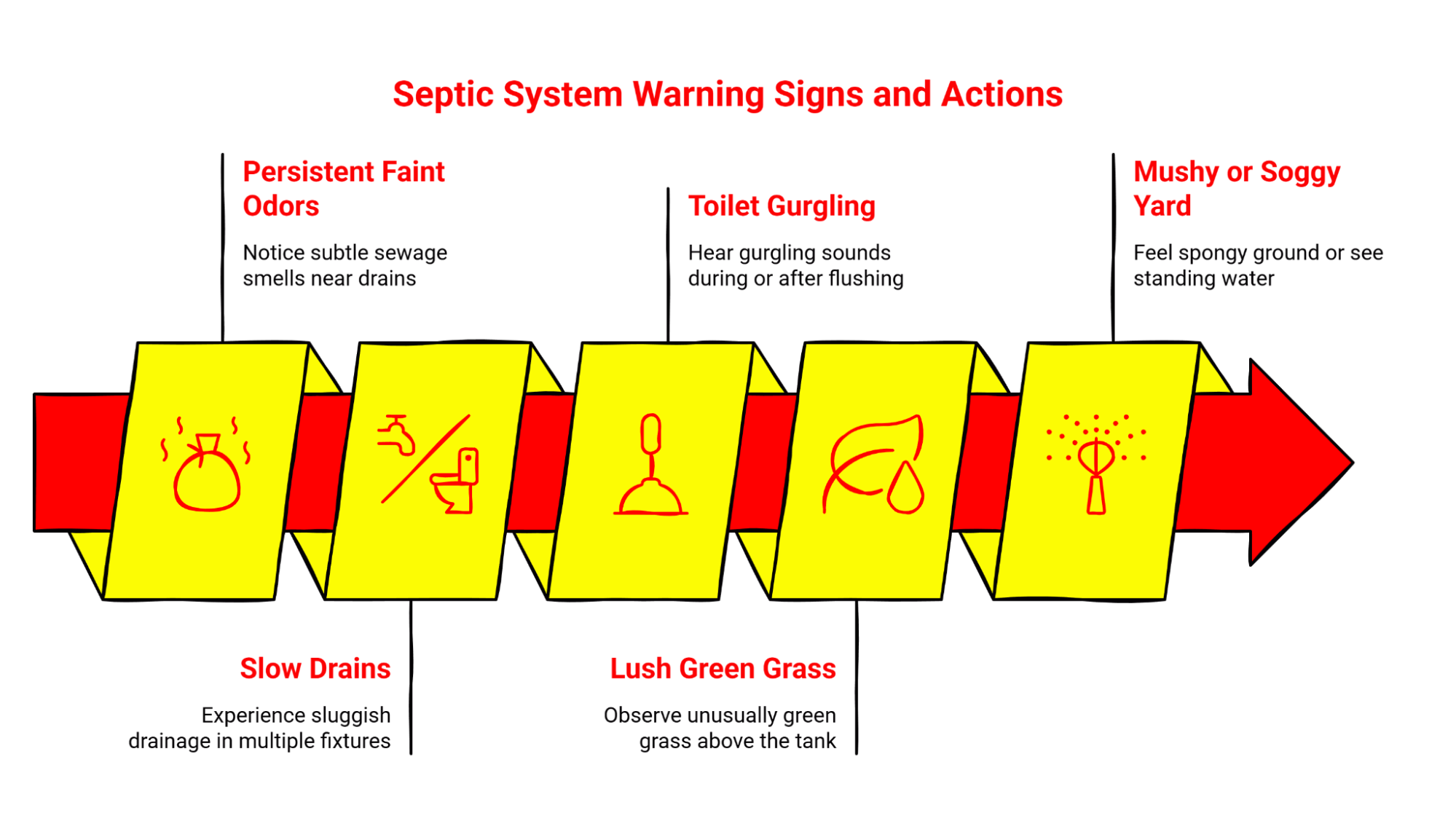
  • Odors Are Your First Alert: Faint sewage smells near drains or your yard indicate your tank is approaching capacity or developing a leak—schedule inspection before the problem escalates.
  • Multiple Slow Drains Mean System-Wide Issues: When several fixtures drain sluggishly together, accumulated sludge is restricting flow throughout your entire plumbing system, not just one pipe.
  • Gurgling Toilets Signal Urgent Action Needed: That bubbling sound represents air displacement from a full tank or blockage—this warning appears just before backups occur.
  • Unusually Green Grass Reveals Hidden Problems: A vibrant strip of grass over your tank or drain field during dry weather means nutrient-rich wastewater is reaching the surface due to overfill or system failure.
  • Soggy Yards Demand Immediate Response: Spongy ground or standing water without rain indicates drain field saturation—rope off the area and schedule same-week service to prevent health risks and property damage.

Early detection prevents expensive drain field replacement and protects your family from wastewater exposure.

Houston and Alvin homeowners managing residential septic systems will find actionable warning signs here, preparing them for the detailed maintenance guidance that follows.

A faint odor near your outdoor drain. A toilet that gurgles when you flush. These quiet signals mean your septic system needs attention—and catching them early prevents the messy, expensive problems that come when a tank reaches capacity.

Your septic system works quietly in the background, protecting your property value and family health every day. Think of routine maintenance the same way you think about changing your car’s oil—it’s the simple step that prevents major breakdowns. Miss that maintenance window, and small issues escalate quickly into backups, saturated drain fields, and emergency service calls.

A routine tank cleanout removes the accumulated solids and liquids that naturally build up over time, restoring your system to full capacity. For Houston and Alvin homeowners, recognizing the early warning signs means you can schedule service at your convenience instead of dealing with a crisis.

Here are five concrete indicators that signal it’s time to contact a professional for service.


Don’t wait for a smell—odors mean it’s already late.

The Fast Checklist: Are You Seeing Any of These 5 Signs?

Sign What It Means Urgency Level Your Next Step
Faint sewage odors indoors or near tank area Tank approaching capacity or small leak present Medium Schedule inspection within 2 weeks
Multiple fixtures draining slowly Sludge restricting wastewater flow Medium Book cleanout to restore capacity
Gurgling sounds from toilet Air displacement indicating blockage or full tank High Call for prompt service
Unusually lush grass over tank or drain field Nutrient-rich effluent reaching surface Medium-High Request professional evaluation
Soggy yard without recent rain Drain field saturation or system overflow Urgent Limit access; schedule same-week service

Time-based indicator: If your last pump-out was more than three years ago, schedule proactive service regardless of symptoms. Most residential systems benefit from professional service every two to three years, though the exact interval can vary based on tank size, household usage, and your specific system design.

Diagram showing septic system warning signs and actions.

Sign #1: Persistent Faint Odors Near Drains or the Tank Area

That subtle sewage smell you catch occasionally near your outdoor drains or over the area where your tank sits underground is your system’s earliest alarm. When odors become noticeable, the tank may be approaching capacity or a component may be leaking.

Many homeowners dismiss these faint smells, assuming they’ll dissipate. They don’t—they intensify. What starts as an occasional whiff becomes a persistent problem that affects your yard and eventually your home’s interior.

What you should do: Don’t wait for odors to strengthen or spread. Contact Drane Ranger for septic tank service while the issue remains manageable. Early intervention prevents sewage smells from permeating your property.

Sign #2: Slow Drains Across Multiple Fixtures

A single slow-draining sink often indicates a localized clog in that fixture’s trap or drain line. But when your kitchen sink, bathroom shower, and washing machine all drain sluggishly at the same time, you’re looking at a system-wide issue. As sludge accumulates in your septic tank, it reduces the available volume for wastewater.

This symptom tends to worsen gradually. You might not notice it day to day, but compare how quickly water drains now versus six months ago. The difference reveals how much your tank’s capacity has diminished.

What you should do: Schedule a professional cleanout in Houston to remove accumulated solids. Once the tank is pumped, drainage speed typically returns to normal. This isn’t a problem that resolves on its own—it only worsens until the tank is serviced.

Sign #3: Toilet Gurgling During or After Flushes

That distinctive gurgling sound when you flush represents air being displaced by restricted wastewater flow. It signals that your system can’t move water freely anymore, either because the tank is too full or because a blockage has formed. This is more concerning than slow drains because it indicates your system is under stress.

What you should do: Treat gurgling as a high-priority warning. This symptom can lead to sewage backing up into your home. Call for inspection and pump-out service promptly. At Drane Ranger, we understand the urgency of this symptom and prioritize these appointments.

Sign #4: Unusually Lush, Over-Green Grass Above the Tank or Drain Field

If you notice a distinctly greener, more vigorous strip of grass directly over your septic tank or drain field—especially during dry periods—that’s a warning sign worth investigating.

Nutrient-rich effluent may be reaching the surface, essentially fertilizing that specific area. This happens when your tank is overfull and can’t properly contain wastewater, or when your drain field isn’t processing effluent correctly.

What you should do: Request a professional evaluation. This visible symptom indicates your system needs attention before the situation progresses to actual pooling water or soggy ground. Early assessment can determine whether you need pumping, drain field maintenance, or both.

Sign #5: Mushy or Soggy Yard When It Hasn’t Rained

This is the most urgent warning on the list. When your yard feels spongy underfoot or shows standing water near your tank or drain field without recent rainfall, your system is either saturated or actively overflowing. This creates immediate health risks for your family and pets and can damage your landscaping.

The soggy area may appear suddenly after a period of heavy household water use, or it might develop gradually over several days. Either way, it indicates that wastewater isn’t being properly absorbed and processed by your drain field.

What you should do: Rope off the affected area to prevent children and pets from contact with contaminated soil. Then schedule service immediately—ideally within the same week. This situation won’t improve on its own and typically worsens rapidly. At Drane Ranger, we prioritize urgent calls to prevent property damage and protect public health.


Why Early Detection Saves Money and Protects Your Property

Ignoring these warning signs doesn’t make them disappear—it allows problems to worsen. When sludge fills beyond the tank’s effective capacity, wastewater can’t separate properly. Material that should remain in the tank can enter your drain field and affect its function.

A failed drain field requires excavation and replacement—a significant expense compared to routine maintenance. Early pumping helps maintain your drain field’s function and can prevent backups into your home.

For comprehensive information on how septic systems work and maintenance best practices, the U.S. Environmental Protection Agency provides detailed homeowner guidance. Texas residents can also consult the Texas Commission on Environmental Quality for state-specific standards and requirements.

Wastewater issues in your yard pose risks to anyone who comes in contact with the affected area, and backups inside your house may require professional cleanup. These concerns intensify the longer you delay service.


What Happens During a Professional Cleanout

Septic cleanout process from scheduling to disposal.

Understanding the service process helps explain why professional equipment and expertise matter for this maintenance task.

When you schedule service with Drane Ranger in Alvin or the surrounding area, the process includes several key stages:

Locating and accessing the tank. The technician identifies your tank’s location and uncovers the access port. This initial inspection reveals the tank’s condition and confirms its position relative to your home’s plumbing.

Pumping liquids and removing sludge. Using vacuum truck equipment, we remove both the liquid wastewater and the accumulated solid material from the tank. This empties the chamber, resetting it to full capacity.

Inspecting critical components. While the tank is empty, we check baffles, inlet and outlet pipes, and the tank’s structural integrity. This inspection catches small problems before they become serious failures. We look for cracks, corrosion, or component damage that might need repair.

Providing maintenance guidance. Based on your household size, water usage patterns, and what we observed during service, we recommend when you should schedule your next cleanout. This helps you stay ahead of problems rather than reacting to them. Keep in mind that exact service intervals vary by system design and individual usage patterns.

Ensuring proper disposal. All removed waste is transported to approved treatment facilities according to local regulations. This responsible handling protects public health and environmental quality.

Professional service providers have the training, equipment, and disposal permits required to handle septic waste safely.


What Homeowners Are Saying

Houston-area residents who’ve worked with Drane Ranger consistently mention the organization, professionalism, and clear communication they experienced:

“My experience with Drane Ranger was a very organized, professional and on time experience. I was kept informed of what was happening and a suggested time of cleaning again. I will use them again and will definitely recommend them to anyone I speak with.”
— Harold R.

“He has done all my septic work and is the best!”
— John S.

“Drain Ranger is very professional and reliable. Basically they can take care of all your grease drain needs.”
— Shelley M.

These homeowners recognized warning signs early, scheduled proactive service, and maintained their systems in good working order.


Your Next Step

If you’ve noticed any of these five indicators—or if you’ve simply reached the three-year mark since your last service—now is the time to schedule a cleanout. Drane Ranger serves Houston, Alvin, Pearland, Sugar Land, and surrounding communities throughout the Greater Houston area with reliable general wastewater services.

Your septic system protects your home quietly and continuously. Timely maintenance keeps everything functioning properly, helps prevent system failures, and maintains your property’s value and your family’s comfort.

Ready to Schedule Service?

Call 281-489-1765 to start your service today, or use these convenient options:

Helpful Resources


Our Editorial Process

All content undergoes multi-stage review including technical accuracy verification against TCEQ model standards, local regulation compliance checking, and practical application testing. We distinguish between verified regulatory requirements and generally accepted industry practices to help operators understand certainty levels.


About the Drane Ranger Insights Team

The Drane Ranger Insights Team synthesizes complex topics into clear, helpful guides for homeowners. While our content is thoroughly reviewed for clarity and accuracy, it serves informational purposes and should not replace professional advice specific to your property and circumstances.

Disclaimer: This guide provides general information about septic system maintenance. For decisions specific to your property and circumstances, we recommend consulting a qualified septic professional who can assess your individual system.

How to Extend the Life of Your Septic System with Regular Cleaning

Key Takeaways:

  • Investment Protection: Your septic system represents a $20,000 backyard investment that regular professional cleaning protects from costly emergency repairs and premature replacement.
  • Houston-Specific Challenges: Clay soil conditions and high humidity in Houston create unique pressures on septic systems, requiring more attention than areas with better-draining soil.
  • Preventive Maintenance Schedule: Most Houston homes need professional cleaning every few years, with larger families or garbage disposal users requiring more frequent service to prevent solid waste buildup.
  • Early Problem Detection: Professional cleaning includes system inspection that identifies minor issues like cracks or root infiltration before they become major repair problems.
  • Warning Signs to Watch: Slow-draining fixtures, sewage odors, wet spots over drain fields, and fixture backups indicate immediate cleaning needs regardless of your regular schedule.

Regular septic maintenance transforms from an expense into smart investment protection, helping Houston homeowners avoid emergency situations while extending system life and supporting property values.

Your septic system? It’s a massive investment.

Most Houston homeowners have no clue how fast neglected maintenance spirals into financial disaster. One day everything’s fine. The next, you’re staring at a repair bill that makes your mortgage payment look reasonable.

The reality hits families like a freight train when emergency septic repairs become unavoidable. What’s worse? Discovering that simple preventive cleaning could have prevented the entire mess. For homeowners already juggling mortgage payments, kids’ activities, and rising grocery costs, these surprise expenses create genuine panic.

Here’s what this guide reveals: how regular professional septic tank cleaning protects your substantial home investment, prevents those nightmare scenarios, and extends your system’s operational life significantly. You’ll discover the cleaning benefits that actually matter to Houston families, timing that makes financial sense, and practical guidance for choosing local professionals who won’t leave you hanging.


Understanding Your Septic System’s Cleaning Needs
Routine septic maintenance and mindful daily habits prevent costly failures and protect your drain field.

Picture your septic tank as a giant settling chamber. Every single day, it’s collecting waste.

Every toilet flush, every shower, every load of laundry—all of it contributes organic material that naturally separates inside your tank. The heavy stuff sinks to the bottom, creating a sludge layer that grows thicker over time. Meanwhile, lighter materials float upward, forming a scum layer on the surface.

Regular maintenance prevents most septic system problems. But here’s the thing many homeowners miss entirely: your septic tank fills with solids whether you’re paying attention or not.

Houston’s soil conditions complicate matters. Clay soil, which covers large portions of our area, absorbs wastewater incredibly slowly compared to sandy soil. When those heavy rainfall seasons hit—and they will—saturated soil struggles under the additional load from your drain field. If your tank hasn’t been properly maintained? Problems multiply fast.

Our warm, humid climate supports bacterial activity year-round. That sounds good, right? The beneficial bacteria do break down waste effectively. But they can’t eliminate everything. Accumulated solids will eventually require professional removal. No exceptions.

[ILLUSTRATIVE EXAMPLE]

Consider a typical Houston family of four generating substantial daily wastewater through normal activities. Over three years, even with optimal bacterial activity, solid waste accumulates to levels requiring professional intervention. Without cleaning, this family faces significantly increased risk of drain field damage and potential system backup into their home.

[END EXAMPLE]

Regular cleaning prevents the buildup that causes real problems. When solids aren’t removed on schedule, they eventually flow into your drain field. This affects the soil’s filtering capacity. And once that happens? You’re looking at expensive repairs.


Protecting Your System Through Daily Habits

Beyond professional cleaning, your daily choices dramatically impact system health.

What goes down your drains matters more than most people realize. Every single item affects how often your tank needs professional attention.

Never flush items that don’t break down naturally. Wipes labeled “flushable”? They’re not. Feminine hygiene products, cigarette butts, medications—all of these accumulate and mess with your system’s bacterial balance. They create additional solid waste that accelerates tank filling.

Kitchen habits? Critical.

Grease and cooking oils solidify in your septic tank, contributing to scum layer buildup. They can clog pipes. Pour cooking grease into containers for trash disposal instead of washing it down the drain. Always.

Harsh chemicals create bigger problems than most homeowners understand. Antibacterial soaps, bleach-based cleaners, drain cleaners—they disrupt the beneficial bacteria your system desperately needs. When these bacteria populations decline, waste breakdown slows significantly. Cleaning becomes necessary more frequently.

Small changes in daily routines extend the time between professional cleanings while keeping your system running smoothly.

+——————————————————————————————————-+

đź’ˇ Quick Takeaways

  • Preventive Value: Regular cleaning prevents solid waste buildup that causes septic problems
  • Cost Management: Preventive cleaning typically costs less than emergency repairs over time
  • Early Detection: Inspection during cleaning identifies minor issues before major failures

+——————————————————————————————————-+


The Professional Cleaning Process and System Benefits
Professional septic cleaning removes waste and detects issues early—protecting your system and property.

Professional septic tank cleaning involves pumping accumulated solids and liquids from your tank. Then comes inspection for potential issues.

Qualified technicians arrive with specialized trucks equipped with powerful vacuum systems. They remove all contents safely and efficiently. But the real value goes beyond waste removal.

During cleaning, professionals examine your tank’s condition thoroughly. They check for cracks, damaged baffles, structural concerns that could become expensive problems. This inspection component provides tremendous value. Small problems identified early often prevent major system failures later.

The process varies based on tank size and current conditions. Technicians access your tank through inspection ports, pump out all contents, and clean the interior. They’ll inspect inlet and outlet pipes for proper function too.

[ILLUSTRATIVE EXAMPLE]

A Houston homeowner scheduling regular cleaning discovers during routine inspection that tree roots have begun infiltrating their drain field pipes. Addressing this early typically costs a fraction of waiting until major system problems develop, potentially saving thousands in repair costs.

[END EXAMPLE]

Benefits extend far beyond waste removal. Professional cleaning identifies minor issues before they become major repair problems. This protects your investment in ways that aren’t immediately visible. Homeowners following preventive cleaning schedules experience fewer emergency repairs compared to those who wait for problems to develop.

Environmental protection represents another significant benefit. Proper maintenance helps protect local groundwater resources and prevents potential contamination issues that could affect your neighborhood.


Selecting Qualified Houston Professionals

Choosing septic cleaning services requires careful attention to credentials.

Verify that professionals hold current Texas licensing and certifications. Licensed septic contractors demonstrate knowledge of local regulations and proper handling procedures. This protects both your system and the environment.

Look for contractors carrying appropriate insurance coverage. Always request written estimates before work begins. Reputable professionals explain their process clearly, answer questions about your specific system, and provide maintenance recommendations based on your household’s actual usage patterns.


Timing Your Septic Cleaning for Maximum System Life

Most Houston residential septic systems benefit from professional cleaning every few years. But timing depends on household size and water usage patterns.

Families with higher water usage need more frequent cleaning. Garbage disposal use accelerates the timeline too.

Several warning signs indicate immediate cleaning needs, regardless of your normal schedule:

Slow-draining fixtures throughout your home often signal approaching tank capacity. Don’t ignore this.

Sewage odors around your tank or drain field area require immediate professional attention. No exceptions.

Wet spots or unusually green grass over your drain field during dry periods suggest system problems. Water backing up into fixtures represents an emergency requiring immediate professional response.

Local soil conditions affect maintenance timing significantly. Areas with clay soil, which absorbs water slowly, might require closer attention to prevent system overload during heavy rainfall periods.

Proper timing can dramatically extend septic system operational life through preventive maintenance. Systems maintained on regular cleaning schedules often last significantly longer than neglected systems.

[ILLUSTRATIVE EXAMPLE]

A Houston family tracking their septic maintenance discovers that regular cleaning, combined with water conservation practices, helps their system function reliably for over two decades. Their neighbors, who delayed cleaning for extended periods, faced complete system replacement at considerable expense—often exceeding $15,000 for a full replacement.

[END EXAMPLE]

The investment perspective matters enormously for Houston homeowners protecting property values. Regular maintenance records demonstrate proper care to potential buyers, supporting home value during resale.

+——————————————————————————————————-+

đź’ˇ Quick Takeaways

  • Standard Schedule: Most Houston homes benefit from cleaning every few years based on household size
  • Warning Signs: Slow drains, odors, and wet spots indicate immediate cleaning needs
  • Life Extension: Proper timing can significantly extend system operational life

+——————————————————————————————————-+


Taking Action to Protect Your Investment

Regular professional septic tank cleaning transforms from expense into investment protection when you consider the alternatives.

Comparing regular maintenance costs against emergency repair scenarios reveals the financial wisdom of preventive care. Emergency repairs often cost three to five times more than scheduled maintenance.

Houston homeowners benefit enormously from establishing relationships with qualified local septic professionals before emergencies arise. Professional cleaning protects your septic system investment while providing genuine peace of mind about system reliability.

The path forward? Contact local Houston septic professionals for system evaluation and establish your personalized cleaning schedule. Your family’s comfort and your home’s value depend on this critical maintenance decision.

Remember that septic system needs vary by individual property and usage patterns. Professional assessment determines the optimal maintenance schedule for your specific situation, helping ensure maximum system protection and longevity.

Your septic system represents one of your home’s most critical components. Protect it accordingly.


Frequently Asked Questions


Q: How often should Houston homeowners have their septic tank cleaned?

A: Most Houston residential systems benefit from cleaning every few years, though household size and water usage significantly affect this timeline. Larger families or homes with garbage disposals may need more frequent service due to increased solid waste generation.


Q: What happens if I skip regular septic tank cleaning?

A: Skipping cleaning allows solid waste buildup that may eventually affect drain fields, potentially causing expensive damage. Systems without regular maintenance face higher failure rates and typically require replacement sooner than properly maintained systems.


Frequently Unasked Questions


Q: How do local soil conditions affect my septic cleaning schedule?

A: Clay soil, common throughout Houston, absorbs wastewater much more slowly compared to sandy soil, creating additional pressure on septic systems. This reduced drainage capacity may require closer attention to prevent system overload during heavy rainfall periods.


Q: What septic cleaning records should I keep for my home’s resale value?

A: Maintain receipts and service records showing regular professional cleaning and any repairs performed. These documents demonstrate proper maintenance to potential buyers and support your home’s value by proving system care and remaining functionality.


Protect Your Houston Home Investment with Expert Septic Tank Cleaning

Regular septic tank cleaning is the smartest way to safeguard your home from costly repairs, extend the life of your system, and maintain peace of mind. At Drane Ranger, we bring over a decade of experience serving Houston and surrounding communities with reliable, professional septic cleaning that keeps your system running smoothly and protects your family’s comfort.

Ready to prevent emergencies before they happen? Call Drane Ranger at 281-489-1765 now to schedule your septic tank cleaning with trusted local experts who understand Houston’s unique soil and climate challenges.

Want to learn more about how proper septic maintenance can save you thousands over time? Feel free to browse our website for detailed information on our full range of liquid waste removal services tailored to residential and commercial needs. Your septic system deserves quality care — let Drane Ranger help you protect it today.