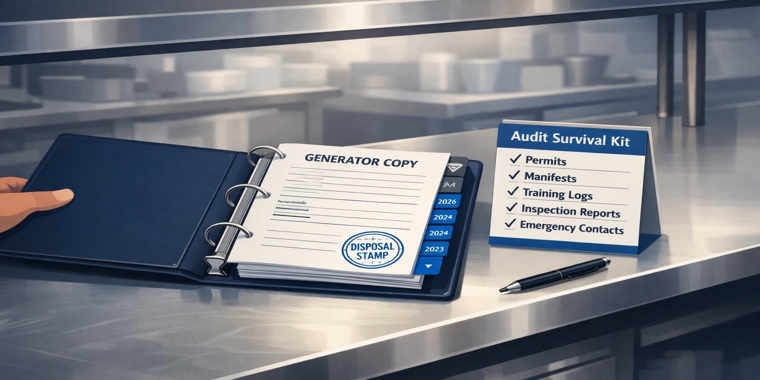
Surviving a City of Houston FOG Audit: A Restaurant Owner’s Guide to Manifests and Compliance

📌 Key Takeaways

A clean grease trap means nothing without five years of signed manifests proving where the waste actually went.

  • Manifests Beat Invoices: An invoice shows you paid for service, but only a manifest proves the waste reached an approved disposal site—and that’s what inspectors require.
  • Keep Five Years On-Site: Houston inspectors can show up unannounced and ask for manifests going back five years, so keep a tabbed binder ready to hand over in under two minutes.
  • Run Monthly Self-Checks: Verify your permit is current, count your manifests for gaps, and confirm your trap is accessible before an inspector discovers problems for you.
  • Your Hauler Creates Your Liability: If your vendor can’t provide proper manifests with disposal facility stamps, their cheap price is actually creating legal exposure for your restaurant.
  • Fines Stack Up Fast: Citations range from $250 to $2,000 per violation, and missing paperwork counts as a violation even if your trap is spotless.

Your manifests are the tax return for your waste—keep them organized or pay the price.

Houston restaurant owners and managers handling FOG compliance will find a complete audit preparation system here, guiding them into the detailed documentation steps that follow.

~ ~ ~ ~ ~ ~ ~ ~ ~ ~ ~ ~ ~ ~ ~ ~ ~ ~ ~ ~ ~ ~ ~ ~ ~ ~ ~ ~ ~ ~ ~ ~ ~ ~ ~ ~ ~ ~ ~ ~ ~ ~ ~ ~ ~ ~ ~ ~ ~ ~ ~ ~ ~ ~

The inspector’s clipboard appears during lunch rush. No warning. No appointment.

You’re wiping down the pass, calling orders, juggling a vendor delivery at the back door—and now someone in a city polo is asking for five years of paperwork. 

That moment of uncertainty is exactly what separates restaurants that pass FOG audits from those that receive citations. And here’s what most owners discover too late: a clean grease trap is only half the job. Without a clean, complete paper trail of manifests, you’re exposed to audit failure, fines ranging from $250 to $2,000 per violation, and potential business disruption.

Think of your manifests like the tax return for your waste. When the city audits, these documents prove compliance—not just that you paid someone, but that the waste actually went where it was supposed to go. This guide will show you exactly what inspectors look for, which documents you need on hand, and how to build a simple filing system that turns every pump-out into a legal defense file.


What a City of Houston FOG Audit Really Checks

A FOG audit verifies two things: your paper trail and your site readiness. Inspectors verify that fats, oils, and grease (FOG) from your kitchen are not entering the sewer system and causing blockages that affect the entire city infrastructure.

For the paper trail, inspectors need proof that your grease trap has been properly cleaned and that the waste was disposed of legally. This means manifests—not just invoices—going back five years. They’ll also check your current FOG permit and any maintenance logs you keep.

For site readiness, they’ll physically inspect your grease trap and sample well to ensure your discharge meets city parameters. They’ll check that access points are clear, lids are reachable, and nothing is blocking the trap. Your dumpster area and rendering oil bin get checked too.

All establishments with interceptors will be inspected on a routine basis or if a complaint is reported, with no advance notification. This means you need to be audit-ready at all times—not just when you think someone might show up.

The stakes are real. Non-compliance with Chapter 47 can lead to a Notice of Violation or citation for each offense committed. Citation fines range from $250 to $2,000 per violation. Beyond fines, repeated violations can escalate to administrative orders, and in severe cases, water service termination.


Step 1: Confirm You’re Under City of Houston Chapter 47

Before you build your compliance system, verify whose rules apply to your restaurant. City of Houston regulations under Chapter 47 apply to establishments within the incorporated city limits. If you’re in a suburban area served by a Municipal Utility District (MUD) or another jurisdiction, different rules may apply.

Here’s how to verify your jurisdiction quickly:

Check your utility bills. If your water bill comes from the City of Houston, you’re almost certainly under Chapter 47 jurisdiction.

Review your lease or property documents. Commercial leases typically specify the jurisdiction. Your landlord should be able to confirm whether the property falls within Houston city limits.

Look at previous inspection notices. If you’ve had a FOG inspection before, the paperwork will identify which agency conducted it.

Call the Houston Public Works FOG Program directly. They can confirm whether your address falls under their jurisdiction. The program office is located at the Houston Permitting Center at 1002 Washington Ave, Houston, TX 77002.

If you’re outside Houston city limits, contact your local utility district or health department to understand which regulations apply. The requirements may be similar, but the specific documentation and permit processes can differ.

This guide focuses specifically on City of Houston requirements. If you determine you’re under a different jurisdiction, verify their specific rules before building your compliance system.


The Audit Survival Kit: What Inspectors Ask to See

When an inspector arrives, they need specific documents immediately available. Not “somewhere in the office.” Not “I can email those to you later.” Right now, in their hands.

Here’s your Audit Survival Kit—the exact packet you should keep assembled and accessible at all times:
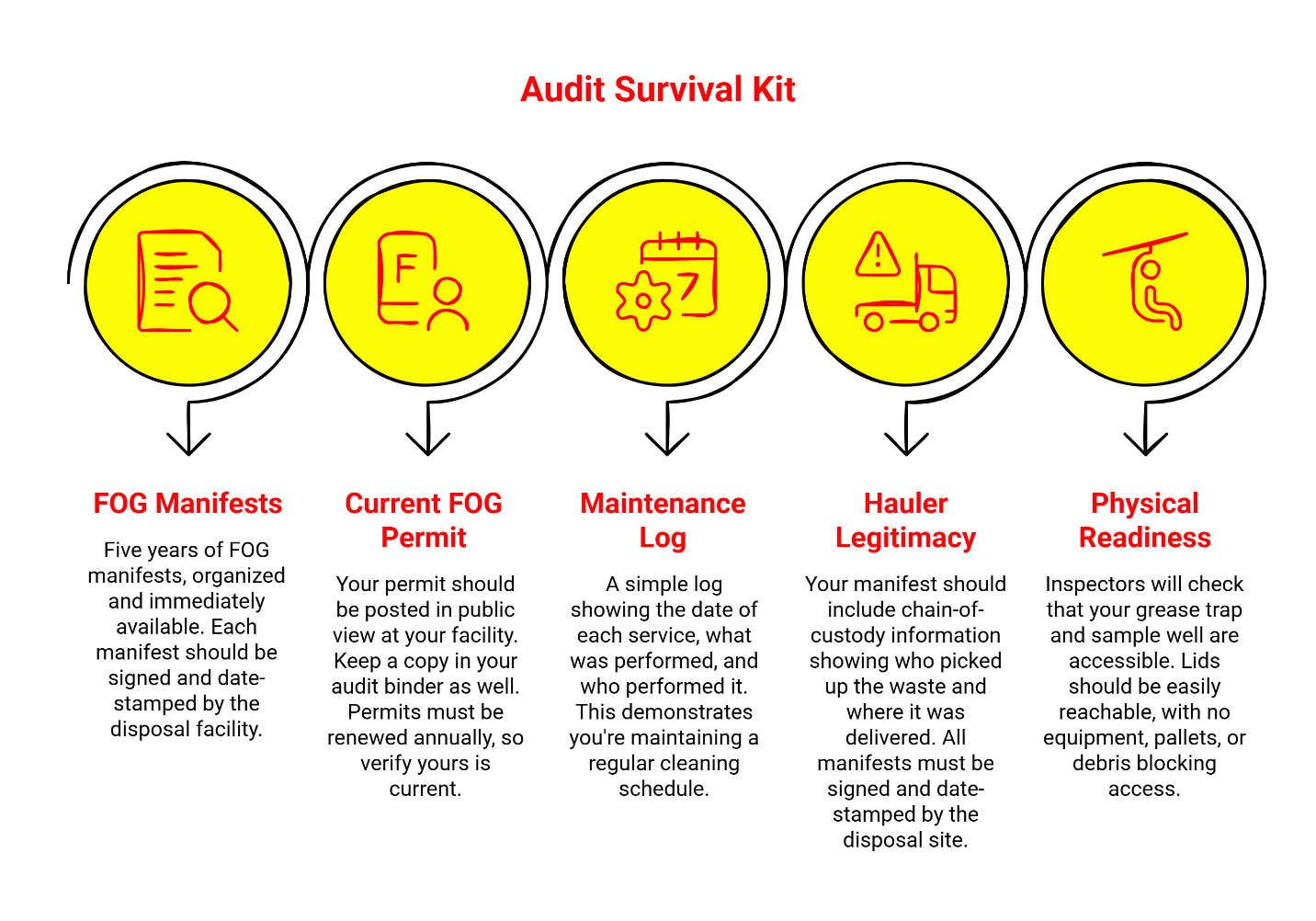
5-point FOG audit survival kit for Houston restaurants - manifests, permits, maintenance logs, hauler chain-of-custody, and physical readiness checklist.

Five Years of FOG Manifests (Organized and Immediately Available)

During an inspection, the investigator will need the following documents: Original Fats, Oils, and Grease permit, plus yellow and white copies of waste manifests for the past five years.

Organize these by year with the most recent on top. Each manifest should be signed and date-stamped by the disposal facility. Gaps in your manifest history raise immediate red flags.

Current FOG Permit or Registration

Your permit should be posted in public view at your facility. Keep a copy in your audit binder as well. Permits must be renewed annually, so verify yours is current.

Maintenance Log and Service Schedule

A simple log showing the date of each service, what was performed, and who performed it. This demonstrates you’re maintaining a regular cleaning schedule—not just cleaning when problems arise.

Proof Your Hauler Is Legitimate

Your manifest should include chain-of-custody information showing who picked up the waste and where it was delivered. All manifests must be signed and date-stamped by the disposal site. If your vendor only provides receipts without this disposal verification, that’s a compliance gap.

Physical Readiness Verification

While not a document, inspectors will check that your grease trap and sample well are accessible. Lids should be easily reachable, with no equipment, pallets, or debris blocking access.

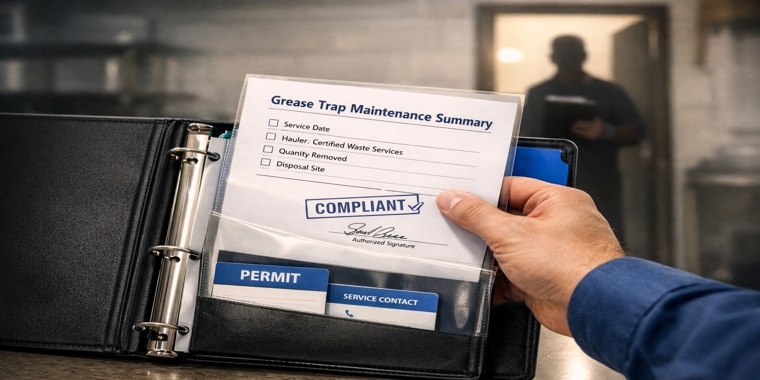
Organizational Standard: Create a simple tabbed binder. First tab: current permit. Second tab: current year manifests. Subsequent tabs: previous years going back five years. Final tab: maintenance log. When an inspector arrives, you hand them the binder. Done.


Invoices Aren’t Manifests: The #1 Paperwork Mistake That Fails Audits

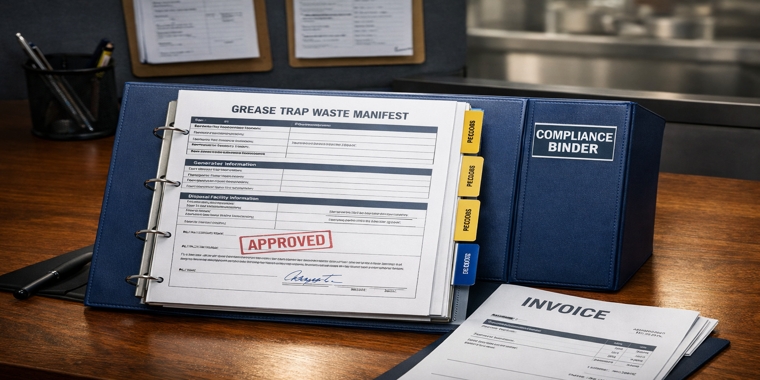
An invoice proves you paid for service. A manifest proves the waste was removed and legally disposed of at an approved facility. These are fundamentally different documents—and inspectors require manifests, not invoices, for compliance verification.

Here’s why this matters: without a manifest, there’s no chain-of-custody documentation. The city has no way to verify that the grease from your trap actually went to an approved disposal site rather than being dumped illegally. Under Houston’s regulations, you—the restaurant owner—bear responsibility for proper disposal even though a third party hauled it away.

The distinction is simple but critical: an invoice without a manifest is liability, not compliance.

What a Compliant Manifest Should Include

Inspectors look for specific fields that establish chain of custody. While exact formats may vary, a proper City of Houston manifest typically includes:

  • Generator information: Your restaurant name, address, and permit number
  • Transporter information: The hauling company’s name, permit number, vehicle ID, and driver signature
  • Waste details: Type of waste, volume removed, date and time of service
  • Disposal facility information: Name and address of the receiving facility
  • Disposal verification: Signature and date stamp from the disposal facility confirming receipt

The disposal facility stamp is critical. It closes the chain of custody by confirming the waste actually arrived where it was supposed to go.

Why “Pump-and-Run” Vendors Create Liability

Some vendors charge less because they skip the documentation. They pump your trap, hand you a receipt, and leave. You’ve paid for service—but you have no proof of legal disposal.

If that waste gets dumped illegally, the liability traces back to your restaurant. The city doesn’t care that you thought you hired a legitimate company. Without proper manifests, you can’t prove compliance.

For more detail on this critical distinction, see our guide on manifest vs. invoice differences.

If you’re currently only receiving invoices from your grease trap vendor, fix it now. Call and specifically request City of Houston-approved manifests with every service. If they can’t provide them, find a vendor who can.


Build a “No-Panic” Filing System

The goal is simple: when an inspector arrives, you spend less than two minutes retrieving every document they need. No digging through boxes. No “let me check the back office.” No calling your accountant.

The Physical Binder System

Get a 3-inch binder with tabbed dividers. Label the tabs:

  1. Current Permit – Your valid FOG permit, visible immediately when opening the binder
  2. 2026 – Current year manifests, newest on top
  3. 2025 – Previous year
  4. 2024 – Continue back five years
  5. 2023
  6. 2022
  7. 2021
  8. Maintenance Log – Running log of all service dates and notes

Store this binder somewhere accessible to managers—not locked in a filing cabinet that only you have the key to. If an inspector arrives while you’re off-site, your team needs to produce these documents.

The 10-Minute After-Service Routine

Every time your grease trap gets serviced, complete these steps before the driver leaves:
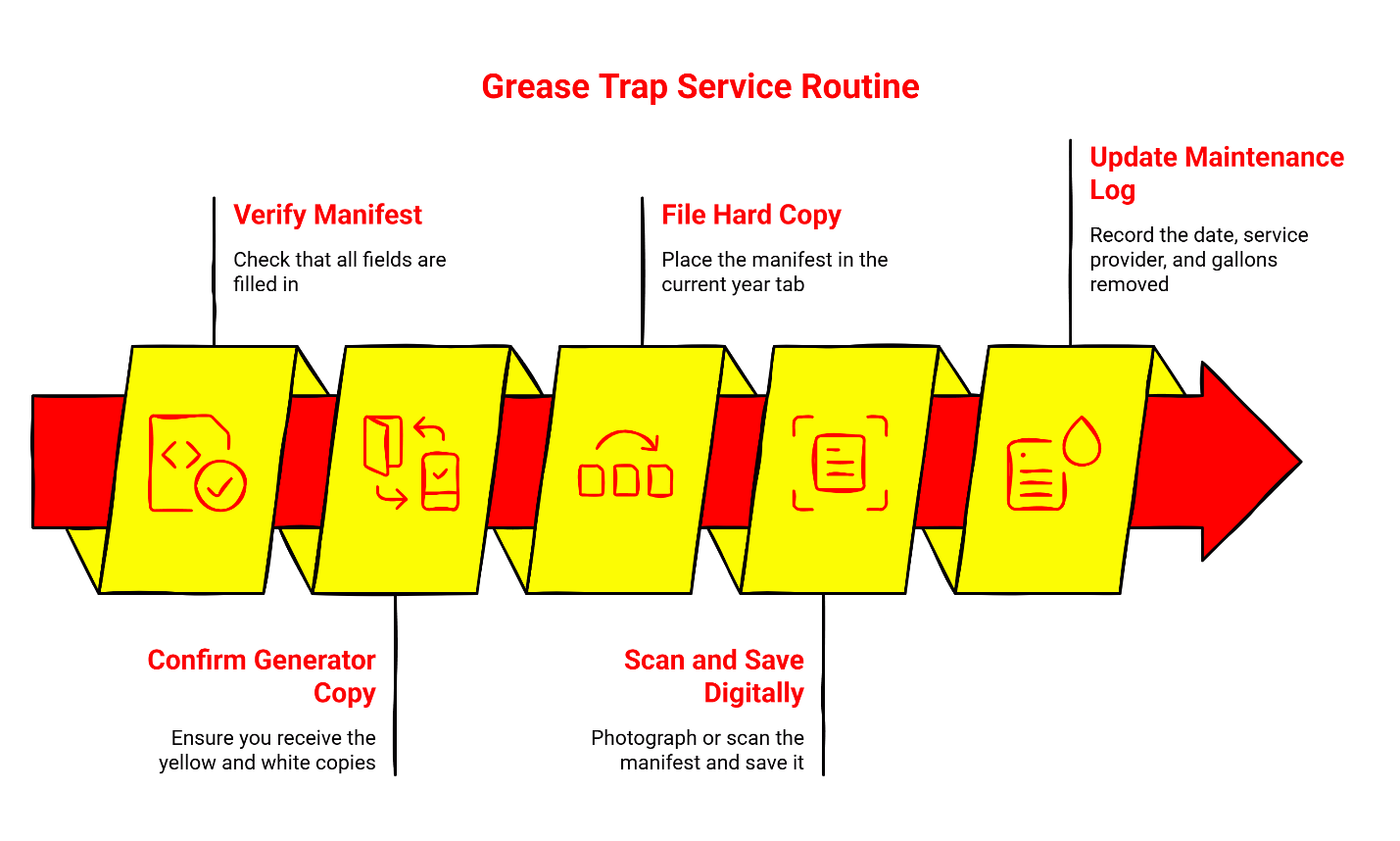
5-step grease trap service routine for Houston restaurants - manifest verification, document filing, digital backup, and maintenance log update.

Step 1: Verify the manifest is complete. Check that all fields are filled in—your info, the transporter’s info, waste volume, and date. Don’t let the driver leave without completing the form.

Step 2: Confirm the generator copy is yours to keep. You should receive the yellow and white copies. The driver keeps other copies.

Step 3: File the hard copy immediately. Walk it to your binder and put it in the current year tab. This takes 30 seconds and prevents the “I’ll file it later” trap that leads to lost documents.

Step 4: Scan and save digitally. Use your phone to photograph or scan the manifest. Save it to a shared folder your team can access. Name the file using the format: [YYYY-MM-DD][Provider][Volume]_manifest.pdf

Step 5: Update your maintenance log. Note the date, service provider, and gallons removed. This takes one minute and creates a running record.

Filing the hard copy immediately ensures document integrity for the five-year retention window.

Digital Backup Best Practices

Physical copies are required for inspection, but digital backups protect you if documents are lost, damaged, or destroyed. Keep copies in cloud storage (Google Drive, Dropbox, or similar) with access shared among key managers—owner and GM at minimum. This also helps if you need to retrieve older records that might be stored off-site.

For more on building a bulletproof documentation system, see How to Organize Your Grease Trap Documentation to Survive a City Audit.


A 15-Minute Pre-Audit Self-Check

Don’t wait for an inspector to discover problems. Run this quick check once a month—pick a consistent day, like the first Monday—and you’ll catch issues before they become violations.

Monthly Documentation Review

Open your compliance binder and verify:

  • Is your permit current and clearly visible in the first tab?
  • Do you have a manifest for the most recent service?
  • Are there any gaps in the last 12 months? (You should have at least four manifests if you’re on a quarterly schedule)
  • Is each manifest signed and stamped by the disposal facility?

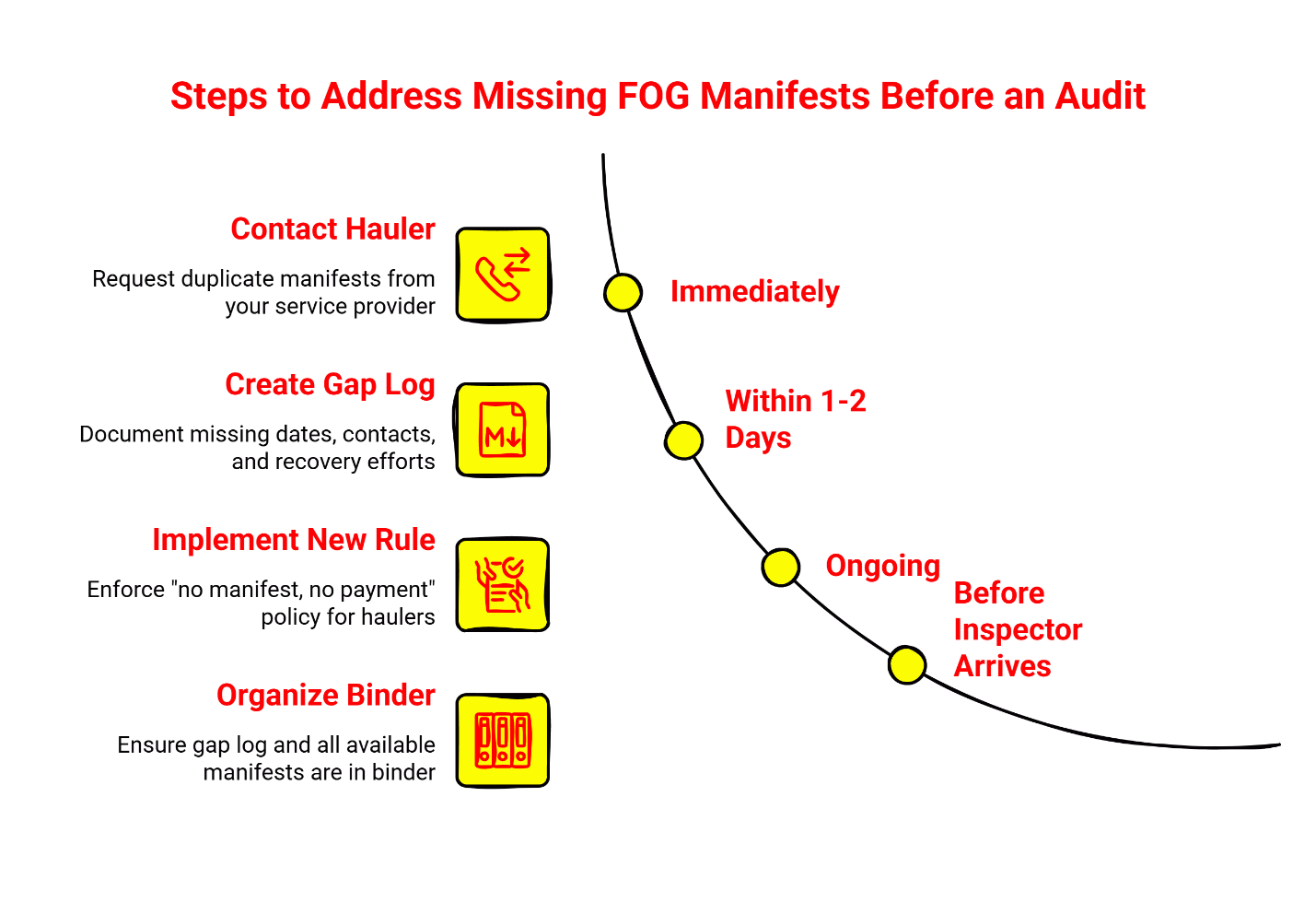
If you find gaps, flag them immediately and contact your service provider for duplicate copies.

Schedule Verification (3 minutes)

Check the date of your last service against your cleaning schedule. Section 47-512(b) of the City of Houston Code of Ordinances mandates that every interceptor located within the incorporated City limits must be fully evacuated at least on a quarterly basis (every 90 days) unless a Notice of Waiver application is submitted and approved.

Count the days since your last pump-out. If you’re approaching 90 days, schedule service now—don’t wait until you’re overdue.

Also check the 25% rule: if grease accumulation reaches 25% of the trap’s wetted height before your scheduled cleaning, you need service sooner regardless of timing.

Physical Access Check (7 minutes)

Walk out to your grease trap and verify:

  • Can you reach the lid without moving equipment, pallets, or stored materials?
  • Is the sample well accessible for inspection?
  • Is the area around the trap reasonably clean and maintained?
  • Are there any visible signs of overflow or damage?

Inspectors won’t wait while you move a dumpster or clear a path. Access must be immediate.

For a complete walkthrough of what to expect, see How to Prepare Your Kitchen for a City of Houston Grease Trap Inspection.


If You’re Missing Records or Received a Warning: A Fast Recovery Plan

Discovering gaps in your documentation is stressful. Receiving a citation is worse. But both situations are recoverable if you act quickly and systematically.

Request Duplicate Manifests Immediately

Your service provider and the disposal facility both keep copies of manifests. Contact them and request duplicates for any missing dates. Be specific about which service dates you need documentation for.

Most reputable vendors maintain records and can provide copies within a few business days. If your vendor can’t produce documentation for services they claim to have performed, that’s a significant red flag about their legitimacy.

Book Service Now If You’re Overdue

If you’re past your 90-day window, schedule service immediately. Don’t wait another week hoping the inspector doesn’t show up. Get current, get the manifest, and file it.

If you’re dealing with an active backup risk or an urgent compliance situation, use emergency grease trap service rather than hoping the problem stays quiet.

Create a Gap Summary (Without Inventing Data)

For periods where you genuinely cannot locate documentation—perhaps you changed vendors, or records were lost in a move—create a written summary explaining the gap. Note:

  • The time period affected
  • What efforts you made to locate the records
  • What corrective actions you’ve taken

This doesn’t make the gap disappear, but it demonstrates good faith effort to maintain compliance. Inspectors have discretion, and documented efforts to correct problems are viewed more favorably than denial or indifference.

Responding to a Citation

If you’ve received a Notice of Violation or citation, don’t ignore it. Review the specific violations cited, gather any documentation that supports your compliance, and respond within the timeframe specified. Consider consulting with an attorney if violations are severe or you disagree with the findings.

For guidance on handling emergency situations that could lead to violations, see When a Backup Threatens Your Business: A Houston Restaurant’s Emergency Response Plan for Grease Trap Failures.


How to Choose a Vendor Who Keeps You Audit-Proof

Your grease trap service provider is a compliance partner, not just a pump truck. The right vendor makes audits simple. The wrong one creates liability.

Questions to Ask Before You Hire

“Do you provide City of Houston-approved manifests with every service?”

The answer must be yes, without hesitation. If they offer “receipts” or “service tickets” instead, keep looking.

“Does your manifest include disposal facility verification?”

You need that stamp proving where the waste went. Incomplete manifests don’t satisfy city requirements.

“Will you help me obtain duplicate records if I lose a manifest?”

Things happen. A vendor who maintains good records and will assist with replacements is valuable.

“Do you offer proactive scheduling reminders?”

The best vendors track your 90-day cycle and contact you before you’re due, not after you’ve missed the deadline.

Red Flags to Watch For

  • Only provides receipts or invoices, not proper manifests
  • Vague about where waste is disposed
  • Inconsistent or incomplete paperwork from service to service
  • No permit decals visible on their vehicles
  • Significantly cheaper than other vendors (they may be cutting corners on disposal)


Why Proactive Scheduling Beats Emergency Scrambling

Vendors who remind you when service is due help you stay ahead of compliance deadlines. This is far better than realizing you’re overdue when an inspector arrives or when your trap backs up during dinner service.

“My experience with Drane Ranger was a very organized, professional and on time experience. I was kept informed of what was happening and a suggested time of cleaning again. I will use them again and will definitely recommend them to anyone I speak with.” — Harold R.

A vendor who communicates clearly and keeps you on schedule is protecting your business, not just pumping your trap. Since 1985, Drane Ranger has focused on customer service and outstanding work—trained, certified, and committed to obeying the rules and regulations around the industry. As an accredited member of the Better Business Bureau, Drane Ranger is committed to providing the best experience for every client.

For grease trap cleaning and compliant waste removal in the Houston area, look for these qualities in any provider you consider. You can also review The Official Houston Restaurant FOG Compliance Checklist to ensure your overall compliance program is complete.


Frequently Asked Questions

How long do I need to keep grease trap manifests in Houston?

Five years, with documents available on-site for inspection. Both your copy (generator copy) and any returned copies should be kept. Digital backups are smart but don’t replace the requirement for physical copies during an inspection.

What’s the difference between a grease trap invoice and a manifest?

An invoice proves you paid for service. A manifest proves the waste was removed and legally disposed of at an approved facility, with chain-of-custody documentation including transporter information and disposal facility verification. Inspectors require manifests—invoices alone don’t demonstrate compliance.

What happens if I can’t find my manifests during an inspection?

You may receive a Notice of Violation or citation. Fines can range from $250 to $2,000 per violation under Chapter 47. If you discover missing manifests before an inspection, immediately contact your service provider and disposal facility to request duplicates.

Do I need the paperwork on-site, or is digital storage enough?

Physical copies must be available on-site during an inspection. Digital storage is excellent for backup purposes but doesn’t satisfy the requirement to produce documents when an inspector requests them. Keep a compliance binder at your restaurant.

What does an inspector usually look for first?

Inspectors typically ask for your FOG permit and recent manifests first. They verify your permit is current and that you have documentation showing regular cleaning on the required schedule. They’ll also physically check your trap and sample well.

Can my vendor provide duplicate manifests if I lost mine?

Yes, reputable vendors maintain service records and can provide duplicate manifests. The disposal facility also keeps copies. Contact both if you need to reconstruct missing documentation. If your vendor can’t produce records for services they performed, consider that a serious warning sign.

What should I do the day I receive a warning or citation?

Don’t ignore it. Review the specific violations cited, gather any supporting documentation you have, and respond within the required timeframe. If you’re overdue for service, schedule it immediately. Document your corrective actions in writing. For significant violations, consulting with an attorney may be appropriate.


Turn Every Pump-Out Into a Legal Defense File

The inspector’s clipboard doesn’t have to trigger panic. When your manifests are organized, your permit is current, and your trap is accessible, an audit becomes a five-minute verification—not a crisis.

The system is straightforward: keep five years of manifests in a tabbed binder, run a monthly self-check, and work with a vendor who provides complete documentation every time. That’s it. No complex software, no expensive consultants, no stress.

Remember the core principle: your manifests are the tax return for your waste. They prove compliance when the city asks. Without them, you’re exposed—regardless of how clean your trap actually is.

If you’re not currently receiving proper manifests, or if you have gaps in your documentation, address it now. Don’t wait for an inspection to reveal the problem.

“Drain Ranger is very professional and reliable. Basically they can take care of all your grease drain needs.” — Shelley M.

For grease trap cleaning in Houston with complete, audit-ready documentation, contact Drane Ranger at 281-489-1765. We’ve been helping Houston-area restaurants stay compliant since 1985—trained, certified, and committed to doing the job right.

Start Your Service Today: Call 281-489-1765 | Mon-Fri, 9am-6pm

Request a Free Compliance Assessment: Contact Us

Disclaimer: This content is for informational purposes only and does not constitute legal advice. Regulations and enforcement practices can change. Always confirm current requirements with the applicable City of Houston ordinance language and/or the inspecting authority.

Our Editorial Process:

The Drane Ranger Insights Team turns compliance-heavy topics into practical, plain-English guides. We draft using publicly available regulatory guidance and real-world field experience, then review for clarity and operational usefulness so restaurant operators can act immediately.

By: The Drane Ranger Insights Team

Drane Ranger Vacuum Service — Satisfying customers since 1985. BBB Accredited Member.
Commercial Grease Trap Cleaning in Houston: The Complete Compliance Guide for Restaurants

📌 Key Takeaways

A clean grease trap, proper paperwork, and a service schedule that matches your kitchen’s actual grease output keep Houston restaurants compliant and open.

  • Manifests Beat Invoices: An invoice proves you paid for service, but inspectors want manifests that show where your grease actually went—keep both.
  • The 25% Rule Overrides the Calendar: If grease and solids hit 25% of your trap’s depth, you need service now—even if your last cleaning was three weeks ago.
  • Busy Kitchens Need Monthly Service: High-volume frying operations often fill traps before the 90-day deadline, making monthly cleanings the safer choice.
  • Organize Before You Need It: A simple binder with manifests filed by date turns surprise inspections into quick, stress-free paperwork checks.
  • Warning Signs Mean Your Schedule Is Wrong: Slow drains, bad smells, and “racing the deadline” every cycle signal your trap fills faster than your current service allows.

Match your cleaning schedule to your grease output, not just the legal minimum.

Houston restaurant owners and managers will find a clear compliance roadmap here, preparing them for the detailed scheduling and documentation strategies that follow.

~ ~ ~ ~ ~ ~ ~ ~ ~ ~ ~ ~ ~ ~ ~ ~ ~ ~ ~ ~ ~ ~ ~ ~ ~ ~ ~ ~ ~ ~ ~ ~ ~ ~ ~ ~ ~ ~ ~ ~ ~ ~ ~ ~ ~ ~ ~ ~ ~ ~ ~ ~ ~ ~

The faint sulfur smell hits at 10:47 AM. Prep is half-done. The lunch rush starts in an hour.

You trace it to the floor drain near the fryer station. The water isn’t backing up yet, but it’s pooling longer than it should. Your grease trap was serviced… when, exactly? You dig through the office for paperwork. There’s an invoice from three months ago. Maybe four.

Is that enough if someone shows up asking questions?

That quiet panic is familiar to restaurant operators across Houston. The grease trap sits out of sight, doing its job, until it doesn’t. And when it fails, it fails during your busiest hours—bringing odors, backups, and the risk of a citation you didn’t see coming.

Commercial grease trap cleaning in Houston means more than pumping out waste. It’s the combination of proper service timing, complete FOG removal, and the right documentation that keeps your kitchen running and your business protected. A properly calibrated service schedule eliminates compliance friction, keeping your kitchen open and fully operational.

This guide breaks down exactly what Houston expects from restaurant operators, how to set a cleaning schedule that reflects your actual FOG output, alongside a documentation protocol that easily satisfies municipal audits.


What “Commercial Grease Trap Cleaning” Actually Means in Houston

Every commercial kitchen that cooks generates fats, oils, and grease—FOG, in industry shorthand. Left unchecked, FOG solidifies in pipes, clogs municipal sewer lines, and creates expensive problems for the entire system. That’s why grease traps exist: they intercept FOG before it leaves your building.

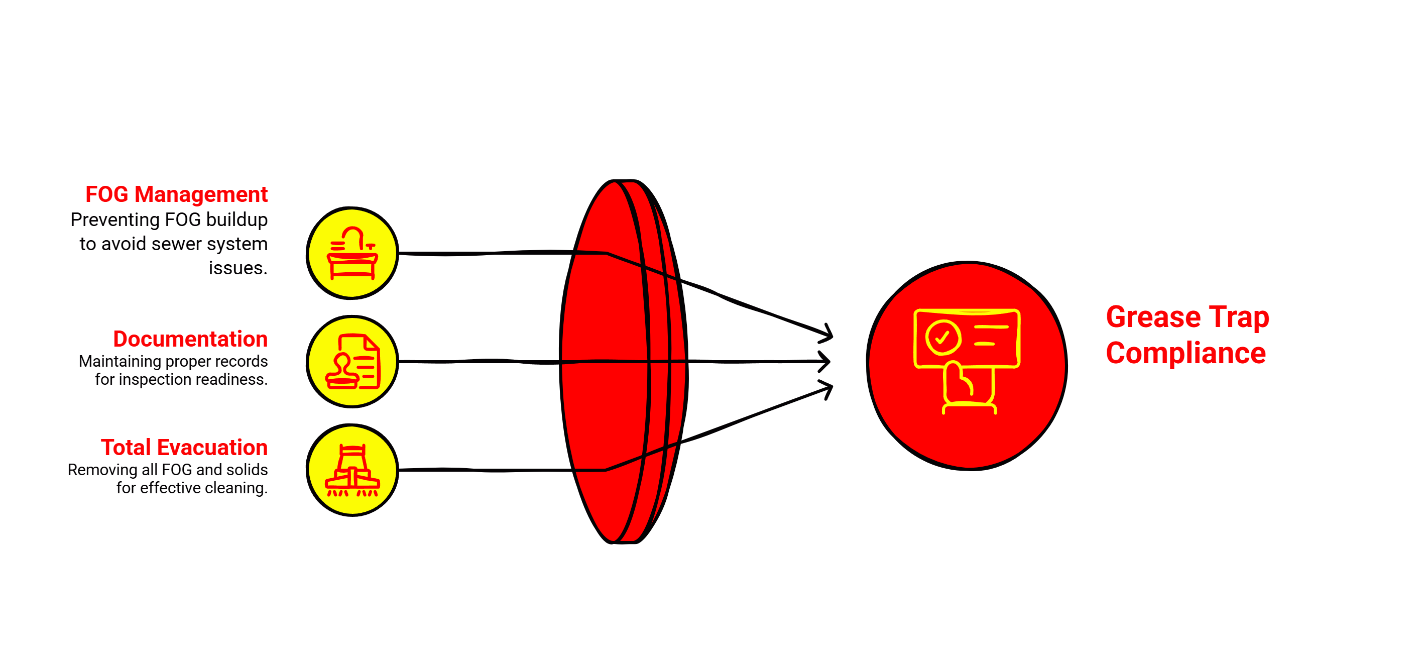
Three pillars of Houston grease trap compliance diagram - FOG management to prevent sewer buildup, proper documentation for inspection readiness, and total evacuation of FOG and solids for effective cleaning.

Think of the grease trap as your kitchen’s kidneys. It filters what flows through, separating waste that shouldn’t enter the sewer system. Like kidneys, it needs regular maintenance to keep working.

In Houston, compliance isn’t just about getting the trap pumped. The city treats documentation as part of the requirement. A service visit without proper paperwork still leaves you exposed during an inspection. The proof matters as much as the pump-out.

What separates professional commercial grease trap cleaning from a quick pump-and-go? Total evacuation. This means removing all accumulated FOG and settled solids—not skimming the top layer and calling it done. Complete removal is what restores drain flow, eliminates odors at the source, and resets your trap to handle another cycle of kitchen operations.


Houston Compliance Expectations Restaurants Should Understand

Houston enforces specific requirements for commercial grease traps. Understanding these rules prevents surprises during inspections.

The Core Compliance Rules:

Requirement What It Means for Your Restaurant
Quarterly Cleaning (90-Day Maximum) Traps within Houston city limits must generally be emptied at least every 90 days. For the vast majority of restaurants, this is a strict ceiling, not a recommendation. However, low-volume kitchens can apply for a formal Notice of Waiver (NOW) from the city to safely extend this cleaning interval up to an absolute maximum of 180 days.
25% Accumulation Trigger If grease and solids reach 25% of your trap’s total liquid depth, service is required immediately—even if you cleaned it last month.
Record Retention Keep documentation on-site and organized. Inspectors can request records going back five years.


The 90-day rule establishes the outer boundary. Treat it as the maximum window, not the target date. Here’s what catches operators off guard: the 25% threshold can override the calendar. High-volume kitchens—especially those doing heavy frying—can hit that accumulation level well before day 90.

The Invoice vs. Manifest Distinction

This is where many restaurant operators get burned. They pay for service, file the invoice, and assume they’re covered. They’re not.

Document What It Proves Compliance Value
Invoice You paid for a service Financial record only
Manifest FOG was legally transported and disposed of at an approved facility Compliance proof


An invoice records a financial transaction, whereas a manifest tracks the legal disposal path. During an audit, inspectors want the manifest. The invoice alone doesn’t prove your FOG reached a legal disposal site.

When the crinkle of that carbon-copy manifest paper gets handed over after service, that’s the confirmation that matters. Keep it.


How Often Should Restaurants Schedule Grease Trap Cleaning?

Quarterly service satisfies the legal minimum. But the legal minimum isn’t always the operational reality.

Quarterly Baseline vs. High-Volume Reality

Start with quarterly as your baseline. Then ask: does my kitchen’s FOG output actually fit that schedule?

Restaurants doing heavy frying, high-volume cooking, or operating extended hours often generate enough grease to fill traps faster than the 90-day window allows. Waiting until day 89 becomes a gamble. If you hit 25% accumulation at day 60, you’re already out of compliance—and probably dealing with odors or slow drains.

A Practical Scheduling Framework

Use this as a quick classifier:

Quarterly (baseline)

  • Lower to moderate volume kitchens
  • No recurring odors
  • No pattern of slow drains or recurring clogs
  • You’re not “racing the deadline” every cycle

Monthly (common for high-FOG kitchens)

  • High volume frying, heavy grease load
  • Odors show up before day 90
  • Drains slow down in predictable cycles
  • You’ve had “almost a backup” moments

Every 30–60 days (often the real-world cadence for some operations)

  • You hit the 25% threshold quickly
  • You’ve had an overflow or backup history
  • Your trap size is small relative to output

Warning Signs Your Schedule Is Too Slow

Your kitchen tells you when the current schedule isn’t working. Watch for these signals:

  • Slow drainage in kitchen sinks and floor drains
  • Persistent odors near the trap or in the kitchen
  • Visible grease appearing in unusual places like floor drains or sink basins
  • Recurring clogs despite recent service
  • Day-89 scheduling habit—consistently pushing service to the last possible day

Any of these signals suggests your trap is reaching capacity before your scheduled service. The fix isn’t waiting longer; it’s adjusting frequency to match your actual volume.

Protecting Service Hours with Proactive Scheduling

Grease trap emergencies don’t respect your reservation book. Backups and overflows happen during peak hours because that’s when you’re generating the most FOG.

Proactive scheduling—setting recurring service that stays ahead of accumulation—prevents the scramble of emergency calls during Friday dinner rush. A reliable provider like Drane Ranger can maintain your service history and proactively schedule appointments, eliminating the burden of tracking deadlines yourself.

Being courteous and mindful of your customers and your business means scheduling service during off-peak windows, completing work efficiently, and leaving your kitchen ready to operate.


Grease Trap Types You’ll See in Houston Restaurants

Not all grease traps work the same way, and the type you have affects how service gets planned.

Indoor Hydro-Mechanical Units

These smaller units typically sit under sinks or in equipment areas inside your kitchen. They’re more accessible but also require more frequent attention due to their limited capacity.

Planning considerations:

  • Easier access means faster service visits
  • Smaller capacity may require more frequent cleaning
  • Service can happen during slower kitchen hours without major disruption

Outdoor Gravity Interceptors

These larger underground units handle higher volumes and serve the entire kitchen’s drainage. They’re common in larger restaurants or buildings with multiple food service tenants.

Planning considerations:

  • Require vacuum truck access to the exterior
  • Larger capacity may allow longer intervals between service
  • Service scheduling needs to account for parking and access logistics

Whichever type your restaurant uses, the principle stays the same: a predictable service routine prevents the emergency moments that shut down operations.


Documentation That Keeps You Audit-Ready

Good paperwork turns inspections into non-events. Poor paperwork turns routine visits into compliance nightmares.

What Your Documentation Should Accomplish

The goal is simple: prove that your FOG was removed on schedule and disposed of legally. Effective documentation captures:

  • Service dates (when the work happened)
  • Waste quantities (how much was removed)
  • Disposal facility information (where it went)
  • System issues identified (any problems the technician noted)

This creates the chain of custody that satisfies inspectors. Your provider should deliver this information on every visit.

A Simple On-Site Organization System

You don’t need sophisticated software. A basic binder system works:

The Compliance Binder Setup:

  1. Front section: Current permit, contact information for your service provider, and the most recent manifest
  2. Tabbed sections by year: All manifests filed chronologically
  3. Quick-access rule: Newest documents always go in front

Keep this binder in the manager’s office or wherever compliance documents live. When an inspector asks for records, you hand them a binder—not a frantic search through desk drawers.

Digital Backup Habit

Paper gets lost. Coffee gets spilled. Create a simple digital backup:

  • Scan or photograph each manifest immediately after service
  • Save files with a consistent naming format
  • Store in a cloud folder accessible from your phone

If the physical binder disappears, your digital backup keeps you covered.

The 30-Second Retrieval Test

Here’s the test that matters: Could your shift lead produce your latest paperwork in 30 seconds?

If not, fix the system—not because it’s “nice to have,” but because surprise inspections reward speed and organization.

When Paperwork Goes Missing

If you discover gaps in your records, contact your service provider. Reputable companies like Drane Ranger maintain service histories and can help you reconstruct documentation. The goal is rebuilding a complete chain-of-custody file before you need it—not scrambling during an inspection.


What Happens When Compliance Slips

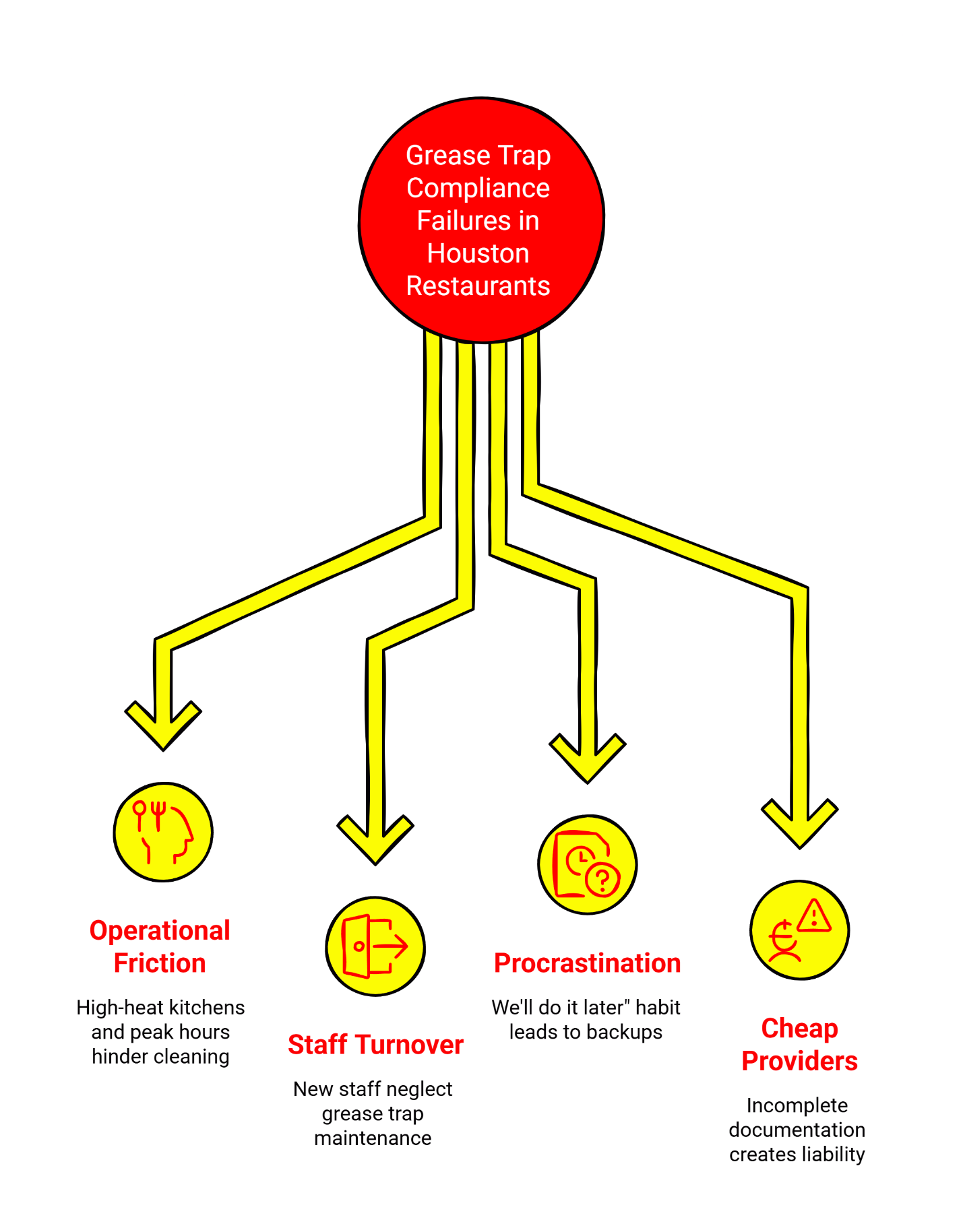
Operators don’t get into trouble because they don’t care. They get into trouble because operational friction piles up—high-heat kitchens, cramped access, peak-hour pressure, staff turnover, and the easy habit of “we’ll do it later.”

Understanding consequences isn’t about fear. It’s about seeing why the system matters.

Diagram of 4 root causes behind Houston restaurant grease trap compliance failures including staff turnover, procrastination, and cheap service providers.

Operational Consequences

Grease trap failures hit your business directly:

  • Backups during service force you to close sections of the kitchen or the entire restaurant
  • Odors drive customers away and create staff complaints
  • Emergency service calls cost more than scheduled maintenance and happen at the worst times
  • Equipment damage from backed-up grease can mean expensive repairs

Slow drainage and visible grease in unusual places often precede a full backup. These warning signs during a busy lunch rush mean you’re one heavy cooking day away from a shutdown.

Compliance Consequences

Houston takes FOG violations seriously:

  • Citations come with fines that escalate with repeat offenses
  • Permit risk threatens your ability to operate
  • Audit failures create a compliance record that follows your business

The cheapest pump-and-go provider becomes expensive if they leave you without proper documentation. Liability for improper disposal stays with the generator—that’s you.

If you’re already facing a crisis, emergency services can help address immediate problems before they escalate further.

The “Cheap Provider” Risk

Some operators choose the lowest-cost service assuming all grease trap cleaning is the same. It’s not.

A provider who pumps without delivering proper manifests leaves you holding liability. If that FOG doesn’t reach a legal disposal facility, you have no proof of compliance. The savings disappear when citations arrive.

A reliable provider—like those serving Houston since 1985—delivers both the service and the documentation that protects your business. Better Business Bureau accreditation and proper licensing matter when your compliance is on the line.


A Compliance Plan You Can Start This Week

Convert everything above into action with this simple checklist:

Choose Your Cadence

  • Start with quarterly as baseline
  • Move to monthly if you see warning signs (odors, slow drains, day-89 habit)
  • Consider every 30-60 days if you hit the 25% threshold quickly
  • Match frequency to your kitchen’s actual FOG volume

Assign Ownership

  • Designate who schedules service (GM or owner, typically)
  • Designate who files paperwork (can be same person or kitchen manager)
  • Make sure backup coverage exists for vacations

Create Your Compliance Binder

  • Set up the physical binder with current year tab
  • Establish the digital backup folder with consistent naming (YYYY-MM-DD_Location_GreaseTrap)
  • File any existing manifests you can locate

Confirm Provider Process

  • Ask: “Do you provide manifests showing disposal facility?”
  • Ask: “Do you maintain service history for my account?”
  • Ask: “Can you set up proactive scheduling?”

Set the First Reminder

  • Schedule your next service before the 90-day deadline
  • Set a calendar reminder for 2 weeks before service date
  • Review after 3 cycles and adjust frequency if needed

Establish a 25% Capacity Protocol:

Mandate visual or dipstick inspections to trigger immediate service when FOG levels reach 25% of total liquid depth.


Frequently Asked Questions

How often should a commercial grease trap be cleaned in Houston?

Houston requires cleaning at minimum every 90 days for traps within city limits. This is a maximum interval, not a recommendation. High-FOG kitchens—those doing heavy frying or extended hours—often need service every 30-60 days to prevent hitting the 25% accumulation threshold before the quarterly deadline. Watch for warning signs like odors and slow drains to determine if your schedule matches your volume.

What’s the difference between a grease trap invoice and a manifest?

An invoice proves you paid for service. A manifest proves your FOG was legally transported and disposed of at an approved facility. During a city audit, inspectors want manifests because they show chain of custody—where the waste actually went. An invoice alone doesn’t demonstrate compliance with disposal requirements.

How long should restaurants keep grease trap cleaning records in Houston?

Maintain organized records on-site for five years to satisfy audit requirements. Keep both physical copies in a compliance binder and digital backups. The goal is producing documentation quickly when inspectors ask—delays and disorganization create problems even when your service was compliant.

What are the warning signs my grease trap service schedule is too slow?

Watch for slow drainage in kitchen sinks, persistent odors near the trap, visible grease appearing in floor drains, recurring clogs despite recent service, and a habit of scheduling on day 89 of the 90-day window. Any of these signals suggests accumulation is outpacing your current schedule.

Do different grease trap types change compliance planning?

Yes. Indoor hydro-mechanical units have smaller capacity and may need more frequent service, but they’re easier to access during business hours. Outdoor gravity interceptors handle larger volumes and may allow longer intervals, but require planning for vacuum truck access. Both types follow the same compliance rules—the difference is in scheduling logistics and service frequency.

Invisible compliance isn’t about doing more. It’s about having a system that handles itself.

The restaurant operators who never worry about grease trap citations share a simple approach: they set a service schedule that matches their kitchen’s reality, they keep manifests organized and accessible, and they work with a provider who delivers both complete service and proper documentation.

That’s the transformation—from the quiet panic of uncertain compliance to the confidence of knowing your trap is clean, your drains flow freely, your kitchen smells right, and your paperwork is ready whenever someone asks.

Want a simple schedule that matches your kitchen’s volume and keeps the paperwork trail clean? Call Drane Ranger at 281-489-1765 and ask about recurring service. Satisfying customers since 1985, they serve restaurants throughout the Greater Houston area—including Pearland, Alvin, Sugar Land, and surrounding communities.

Ready to set it up? Contact Drane Ranger today for a free, no-obligation compliance assessment.

Disclaimer: This guide provides general information about commercial grease trap compliance in Houston and is intended for educational purposes. Specific requirements may vary, and operators should verify current regulations with the City of Houston or consult with a compliance professional for their particular situation.

Our Editorial Process:

The Drane Ranger Insights Team researches, drafts, and reviews every piece to ensure it’s clear, accurate, and genuinely useful. We prioritize practical guidance, plain language, and real-world service experience. Content is reviewed for clarity and updated as needed.

About the Drane Ranger Insights Team:

The Drane Ranger Insights Team is our dedicated engine for synthesizing complex topics into clear, helpful guides. While our content is thoroughly reviewed for clarity and accuracy, it is for informational purposes and should not replace professional advice.

FOG Compliance Checklist: Is Your Kitchen Ready for Inspection?

📌 Key Takeaways

Passing a grease trap inspection comes down to three things: a working trap, an accessible sample well, and manifests that prove where your waste went.

  • Manifests Beat Invoices: An invoice shows you paid for service, but a manifest proves your waste went to an approved facility—inspectors want the manifest.
  • The 25% Rule Overrides Your Calendar: When grease plus settled solids hit 25% of your trap’s depth, you need service immediately—even if 90 days haven’t passed yet.
  • Blocked Access Fails You Before Testing Starts: If boxes cover your sample well or the lid won’t open, you’ve failed before the inspector even measures anything.
  • High-Volume Kitchens Fill Faster: Busy restaurants running fryers all day often hit the 25% threshold in six to eight weeks, not three months.
  • Monthly Walks Prevent Panic: A five-minute checklist once a month catches odors, access problems, and paperwork gaps before an inspector does.

Preparation turns inspections into non-events.

Restaurant managers and kitchen operators in Houston, Pearland, Alvin, and Sugar Land will find a ready-to-use compliance checklist here, preparing them for the detailed walkthrough that follows.

~ ~ ~ ~ ~ ~ ~ ~ ~ ~ ~ ~ ~ ~ ~ ~ ~ ~ ~ ~ ~ ~ ~ ~ ~ ~ ~ ~ ~ ~ ~ ~ ~ ~ ~ ~ ~ ~ ~ ~ ~ ~ ~ ~ ~ ~ ~ ~ ~ ~ ~ ~ ~ ~

The inspector’s clipboard is out. Your line cook just called in sick. And someone is asking where the grease trap manifests are filed.

This is the moment that separates restaurants with compliance systems from restaurants with compliance problems. The difference isn’t luck—it’s preparation.

Whether you operate inside Houston city limits or in surrounding areas like Alvin, Pearland, or Sugar Land, FOG (fats, oils, and grease) compliance follows the same fundamental logic: your trap must function, your sample well must be accessible, and your paperwork must prove where your waste went. Miss any one of these, and a routine check becomes a scramble.

This guide gives you a mock inspection checklist you can walk through today—before an inspector does it for you.


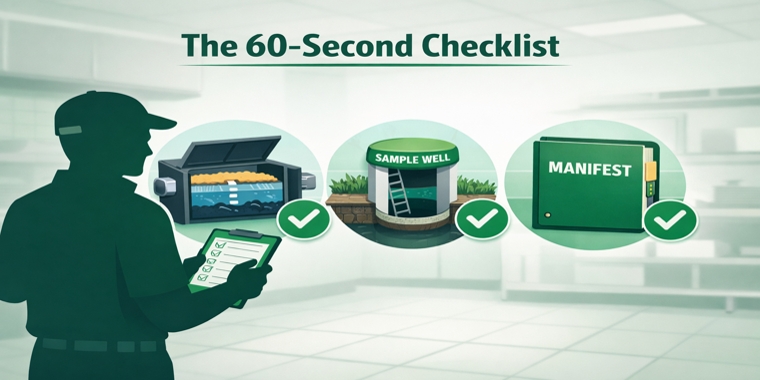
The 60-Second Pre-Check: Three Things Inspectors Look At

Inspectors don’t arrive with hours to spare. They’re looking for red flags, and they know exactly where to find them.

The Trap. Can they access it? Does it smell like failure? Are the internal components—T-pipes, baffles—actually present and intact?

The Sample Well. This is where they’ll pull a sample to measure accumulation. If it’s blocked, buried under storage, or the cover is seized shut, you’ve already failed before the measurement happens.

The Binder. Not your invoices. Your manifests. The documents that prove chain-of-custody—where your grease actually went after it left your kitchen.

If you can’t pass all three in 60 seconds, you’re not ready.


FOG Compliance in Plain English (And Why It’s Not Just ‘Cleaning’)

FOG compliance management is the systematic organization of waste disposal records to meet municipal regulations. But that definition misses the point.

Think of it as the tax return for your waste. Just like the IRS doesn’t care that you meant to file—they want the paper trail—city inspectors don’t care that your trap looks clean. They want documented proof that a licensed hauler removed your FOG and transported it to an approved disposal facility.

Every service visit should produce inspector-ready paperwork. If your provider leaves you with only an invoice, they’ve given you accounting records, not compliance proof. A manifest proves where your waste went—and that distinction matters when someone with a clipboard asks to see your disposal documentation.

Key Terms (60-Second Glossary)

Before you walk the checklist, make sure you’re speaking the same language as inspectors:

FOG – Fats, oils, and grease. The byproducts of commercial cooking that must be captured before entering the sewer system.

Grease trap / interceptor – The device that separates FOG from wastewater. “Trap” and “interceptor” are often used interchangeably, though interceptors are typically larger.

Sample well – The access point where inspectors pull samples to measure grease accumulation levels.

Manifest – The legal document proving chain-of-custody: who removed your waste, when, and where it was disposed. This is your compliance proof.

Invoice – Payment documentation. Proves you paid for service—not that your waste was properly disposed.

25% rule – Per international plumbing standards and City of Houston enforcement, service is required when the total thickness of the floating grease layer (FOG) plus the settled solids layer exceeds 25% of the total liquid depth of the interceptor. If an inspector’s ‘Sludge Judge’ confirms you have hit this threshold, you are legally required to pump immediately, even if your 90-day window hasn’t closed.


Printable Mock Inspection Checklist

Walk your kitchen with this checklist. Any item marked FAIL becomes an action item with a deadline.

  1. A) Trap – Physical Condition
Check Pass Fail
Lid clear and reachable; no storage blocking access
No persistent sewer or grease odor near trap
Inlet/outlet T-pipes present and intact
Baffles present and undamaged
No visible cracks, corrosion, or leaks
All bolts and gaskets in place
No slow drains or gurgling sounds
No grease appearing in floor drains or sinks


  1. B) Sample Well – Access
Check Pass Fail
Location known and clearly labeled
Cover opens safely (no seized bolts)
No slip hazards around access point
Clear path for inspector sampling
No evidence of bypassing or blockage


  1. C) Binder – Paperwork
Check Pass Fail
Manifests on-site (not just invoices)
Recent service documentation immediately available
Records organized by date/year
Maintenance log shows last service date
Next scheduled service date documented


Scoring: All critical items must PASS. Any FAIL on this checklist should trigger a service call immediately. While most minor physical repairs should be addressed within 7–10 days to avoid citations during a follow-up, a failure of the 25% rule or a missing manifest is a ‘Right Now’ priority, as an inspector can issue a Notice of Violation (NOV) on the spot during a surprise visit.


Common Failure Points—And the Fastest Fixes Before an Inspection

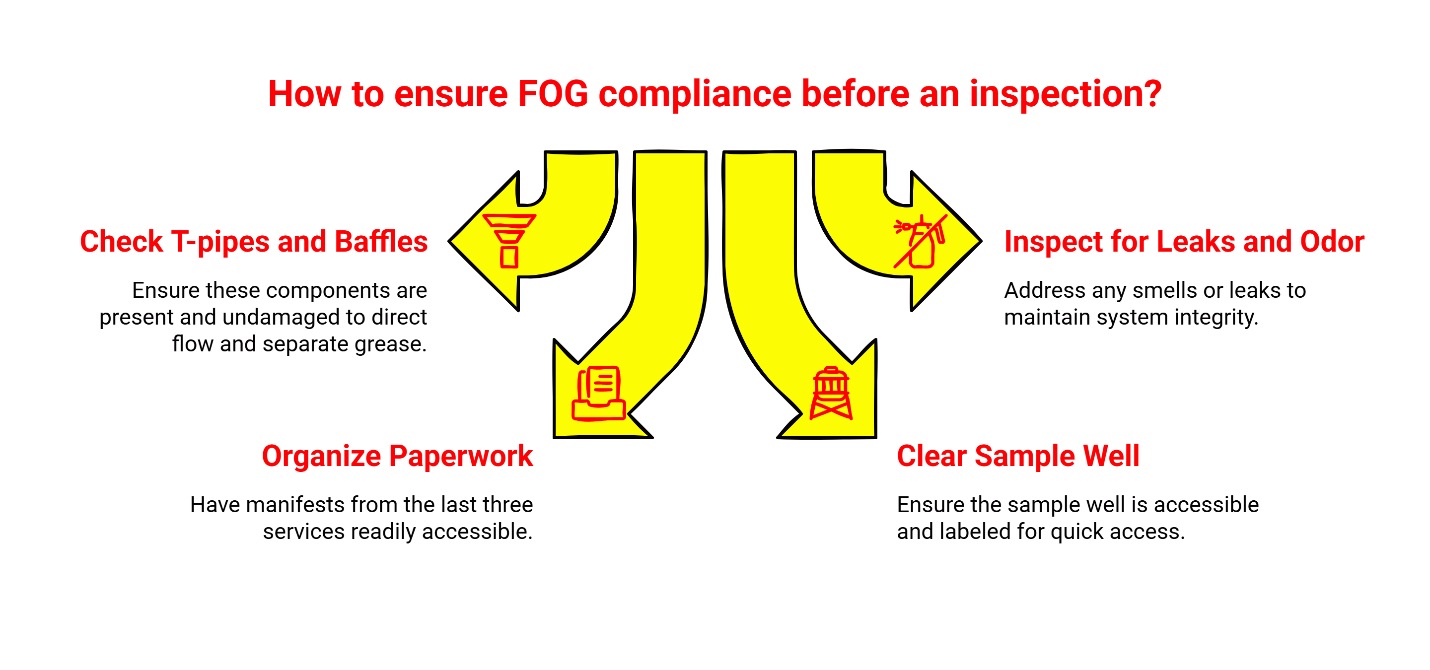
How to ensure FOG compliance before a Houston grease trap inspection - 4-step checklist covering T-pipes and baffles, organizing manifests paperwork, inspecting for leaks and odor, and clearing sample well access.

Missing or damaged T-pipes and baffles. These internal components direct flow and separate grease. If they’re gone or broken, your trap isn’t functioning—it’s just a holding tank. This requires professional service, not a DIY fix.

Corrosion, leaks, and odor escape. Persistent smells near your trap signal that the seal has failed somewhere. Grease vapors escaping means the system needs inspection and likely repair.

Paperwork gaps. The most common failure isn’t physical—it’s documentary. Manifests from your last three services should be immediately accessible. If you have to search, you’re not ready.

Blocked or buried sample well. Storage stacked around the access point, a seized cover, or an unlabeled location turns a 30-second sample into a 30-minute problem—and raises questions about what else you might be hiding.


What If the Inspector Shows Up Today?

Picture this: It’s 10:45 AM, fifteen minutes before the lunch rush. An inspector walks in, asks for sample well access, and wants to see your manifest binder. Your sample well has boxes stacked in front of it. Your manifests are “somewhere in the office.” What was a routine check just became a scramble—and that scramble creates the appearance of a problem even if your trap is clean.


Are You Cleaning Often Enough? The 90-Day Max vs. the 25% Reality

Within Houston city limits, the City of Houston Building Code and Chapter 47 of the Code of Ordinances require that grease traps be completely evacuated at least every 90 days, or more frequently if the 25% rule is exceeded. However, it is critical to note that certain jurisdictions within the Greater Houston area or specific high-output permits may mandate a 30-day or 60-day frequency based on the size of the interceptor and the facility’s flow rate. Always verify the specific frequency listed on your City of Houston FOG Permit.

But the 25% rule overrides the calendar. When floating grease plus settled solids reach 25% of your trap’s total liquid depth, service is required immediately—regardless of when your last cleaning occurred.

High-volume kitchens can hit that 25% threshold in six to eight weeks. If you’re running fryers all day, your trap fills faster than a restaurant doing light prep work.

Watch for operational triggers: persistent odors, slow drainage, recurring clogs, or grease showing up in floor drains. These signs often mean you’ve already passed 25%.

Jurisdiction check: If you operate outside Houston city limits—in Alvin, Pearland, Sugar Land, or areas served by MUDs (Municipal Utility Districts)—specific requirements may vary. You can verify city-limit boundaries through the City of Houston official site or contact your local utility district. Use this checklist as a best-practice standard regardless of jurisdiction.


Vendor Readiness: How to Spot a ‘Pump-and-Go’ Provider Before They Cost You

Not all grease trap service is equal. A cheap pump-out that leaves you with only an invoice is selling you liability, not compliance.

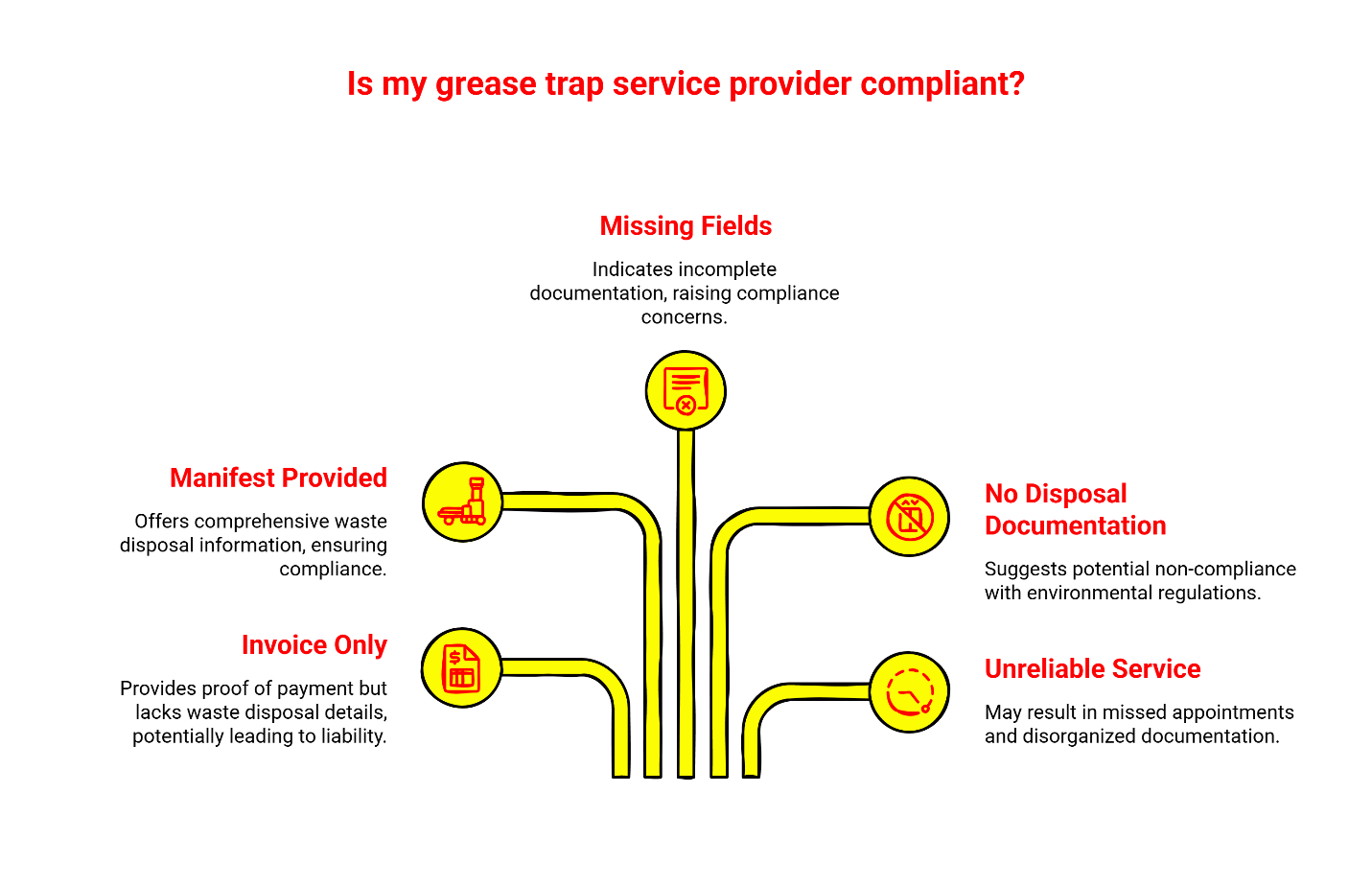
5 signs your Houston grease trap service provider may not be FOG compliant - manifest, documentation, and reliability red flags.

Invoice vs. manifest. An invoice proves you paid. A manifest proves where your waste went—the hauler’s information, the date, the volume, and the approved disposal facility. Inspectors want manifests.

Chain-of-custody fields. Your manifest should show: service date, volume removed, hauler identification, and disposal facility. Missing fields mean missing proof.

Disposal documentation. Ask whether your provider documents transport to approved facilities. Environmentally responsible disposal isn’t just good practice—it’s part of the compliance chain.

Reliability signals. Does your provider offer proactive scheduling? Do they remind you before the 90-day window closes? Do they deliver clean, organized documentation after every visit?

Commercial grease trap cleaning that generates proper manifests turns every service visit into verifiable legal defense.


Set Up ‘Invisible Compliance’: A Simple Routine That Keeps You Inspection-Ready

Compliance shouldn’t require heroic effort. Build a lightweight system that runs in the background.

Monthly: Walk the checklist above. Five minutes. Look for odors, access issues, and paperwork gaps.

Quarterly (minimum): Service on the calendar—scheduled in advance, not scrambled at day 89. If you’re high-volume, you may need service every six to eight weeks.

After every service: File the manifest immediately. Keep it on-site, organized by date. Don’t let paperwork pile up in the office.

The goal is invisible compliance—a system so routine that inspections become non-events. For a more detailed Houston-specific reference, see The Official Houston Restaurant FOG Compliance Checklist.


Common Pitfalls That Fail Inspections

Waiting until day 89. Last-minute scheduling often means delayed service, which means you’re out of compliance when the inspector arrives.

Believing enzymes or hot water count as cleaning. They don’t. Physical removal and documented disposal are the compliance standard. Additives don’t satisfy the 25% rule or produce manifests. Treating “it looks fine” as a substitute for real service isn’t a compliance plan—it’s hope with a receipt.

Keeping invoices but not manifests. Your accountant wants invoices. Inspectors want manifests. Make sure you’re keeping both.

Blocking the sample well. If an inspector can’t access it quickly and safely, you’ve created a problem before the measurement even happens.


When to Call for Help (And What to Ask on the Phone)

If any item on your checklist is a FAIL, schedule service before an inspector finds the same problem.

When you call, ask:

  1. “Will you provide a manifest with clear chain-of-custody documentation?”
  2. “Can you set a proactive schedule based on our volume—not just a generic quarterly plan?”
  3. “Do you service my area, and can you work around our kitchen access windows?”

Drane Ranger serves Alvin, Houston, Pearland, Sugar Land, and the surrounding Greater Houston area. Since 1985, our team has helped commercial kitchens stay compliant with proper documentation and reliable scheduling.


Quick FAQ

What is a “sample well,” in practical terms?

It’s the access point an inspector uses to pull a wastewater sample. If it’s blocked, unsafe, or unknown, you’re vulnerable—even if your trap was serviced recently.

Should we keep invoices, manifests, or both?

Keep both, but treat manifests as the compliance-critical record. Invoices show you paid; manifests show chain-of-custody.

What’s the simplest way to stay inspection-ready year-round?

Monthly checklist walk-through, proactive scheduling, and on-site binder discipline. That combination eliminates surprise inspection panic.


Ready to Close Your Compliance Gaps?

“My experience with Drane Ranger was a very organized, professional and on time experience. I was kept informed of what was happening and a suggested time of cleaning again. I will use them again and will definitely recommend them to anyone I speak with.” — Harold R., Google Reviews

“Drain Ranger is very professional and reliable. Basically they can take care of all your grease drain needs.” — Shelley M., Google Reviews

Contact Drane Ranger to request a quote, or call 281-489-1765 (Mon–Fri, 9am–6pm).

Verify our standing at the Better Business Bureau.

Our Editorial Process:

Our expert team uses AI tools to help organize and structure our initial drafts. Every piece is then extensively rewritten, fact-checked, and enriched with first-hand insights and experiences by expert humans on our Insights Team to ensure accuracy and clarity.

About the Drane Ranger Insights Team:

The Drane Ranger Insights Team is our dedicated engine for synthesizing complex topics into clear, helpful guides. While our content is thoroughly reviewed for clarity and accuracy, it is for informational purposes and should not replace professional advice.

What to Do If You Receive a Chapter 47 Warning Citation

📌 Key Takeaways

A Chapter 47 warning is a chance to fix the problem—not a fine or shutdown order—if you act fast and show the right paperwork.

  • Read the Notice Carefully First: Check the deadline, violation type, and who to contact before you do anything else.
  • Manifests Beat Invoices: The city needs proof of where your waste went, not just proof you paid—receipts alone won’t close the case.
  • Act Within Days, Not Weeks: Most warnings give 7–14 days to respond, so schedule service and gather documents immediately.
  • Keep Records Ready On-Site: A simple binder with three to five years of manifests saves hours of stress during surprise inspections.
  • Consistent Service Prevents Repeat Warnings: Regular scheduling and proper documentation stop citations before they start.

Respond fast, document properly, and warnings close without lasting consequences.

Houston restaurant owners, kitchen managers, and commercial facility operators facing FOG compliance questions will find clear action steps here, preparing them for the detailed walkthrough that follows. 

~ ~ ~ ~ ~ ~ ~ ~ ~ ~ ~ ~ ~ ~ ~ ~ ~ ~ ~ ~ ~ ~ ~ ~ ~ ~ ~ ~ ~ ~ ~ ~ ~ ~ ~ ~ ~ ~ ~ ~ ~ ~ ~ ~ ~ ~ ~ ~ ~ ~ ~ ~ ~ ~

The envelope sits on the counter. “Chapter 47.” Your stomach drops.

Take a breath. A warning citation is not a fine, and it is not a shutdown order. It is a correctable notice—a signal from the city that something needs attention. Most operators who respond quickly and with the right paperwork clear these citations without lasting consequences.

This guide walks you through exactly what to do, step by step. The information here is educational and should not replace advice from a qualified professional familiar with your specific situation.


First, Confirm What the Citation Is Actually For

Before you do anything else, read the notice carefully. You need to know precisely what the city is asking you to correct.

Look for these details on the paper:

  • The date the citation was issued and any deadline for response
  • The location and device referenced (your grease trap or interceptor)
  • The specific violation (overdue service, missing records, trap condition)
  • How to respond (contact name, department, submission method)

A warning citation typically provides a specific ‘grace period’—often 7 to 14 days—to correct the issue before penalties begin. However, the City of Houston Code of Ordinances specifies that for certain violations, if the Director determines a hazard exists, compliance may be required immediately or within 24 hours. (City of Houston Code of Ordinances § 47-513; 47-515). This timeline strictly starts from the date of issuance or service, not when the notice is discovered. If the notice references City of Houston Chapter 47, the ordinance points at wastewater protection and FOG control—so your response should focus on correction plus chain-of-custody proof.


Common Reasons Operators Get Flagged

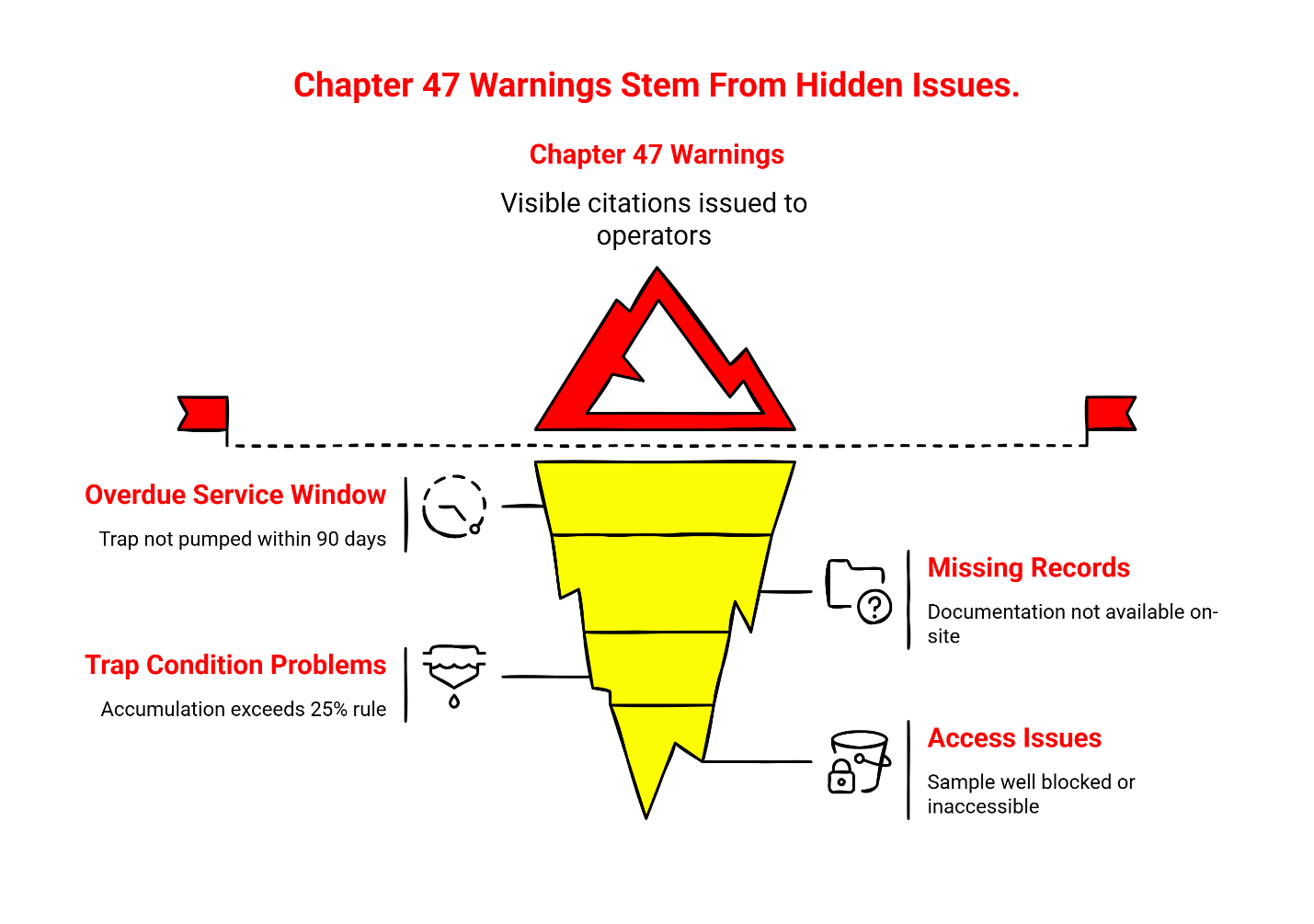
Most Chapter 47 warnings come down to a few recurring issues:

Chapter 47 FOG compliance warnings iceberg diagram showing 4 hidden causes of Houston grease trap citations - overdue service window, trap condition problems, missing records, and blocked sample well access.

  • Overdue service window. The trap was not pumped within the required 90-day cycle.
  • Missing or insufficient records. The inspector asked for documentation and it was not available on-site.
  • Trap condition problems. Accumulation exceeded the ‘25% Rule’—a national standard where the combined sediment and FOG layers must not exceed 25% of the total liquid depth of the interceptor. (TCEQ § 312.145; EPA Office of Water, 832-F-03-010). If your device is over this limit, it is considered ‘not in good working order’ under City Code.
  • Access issues. The sample well was blocked or inaccessible during inspection.

Knowing which category your citation falls into helps you target your response.


Three Steps to Clear Your Citation

A warning is an opportunity. Ignore it, and it becomes a fine.

Here is the fastest path to resolution:

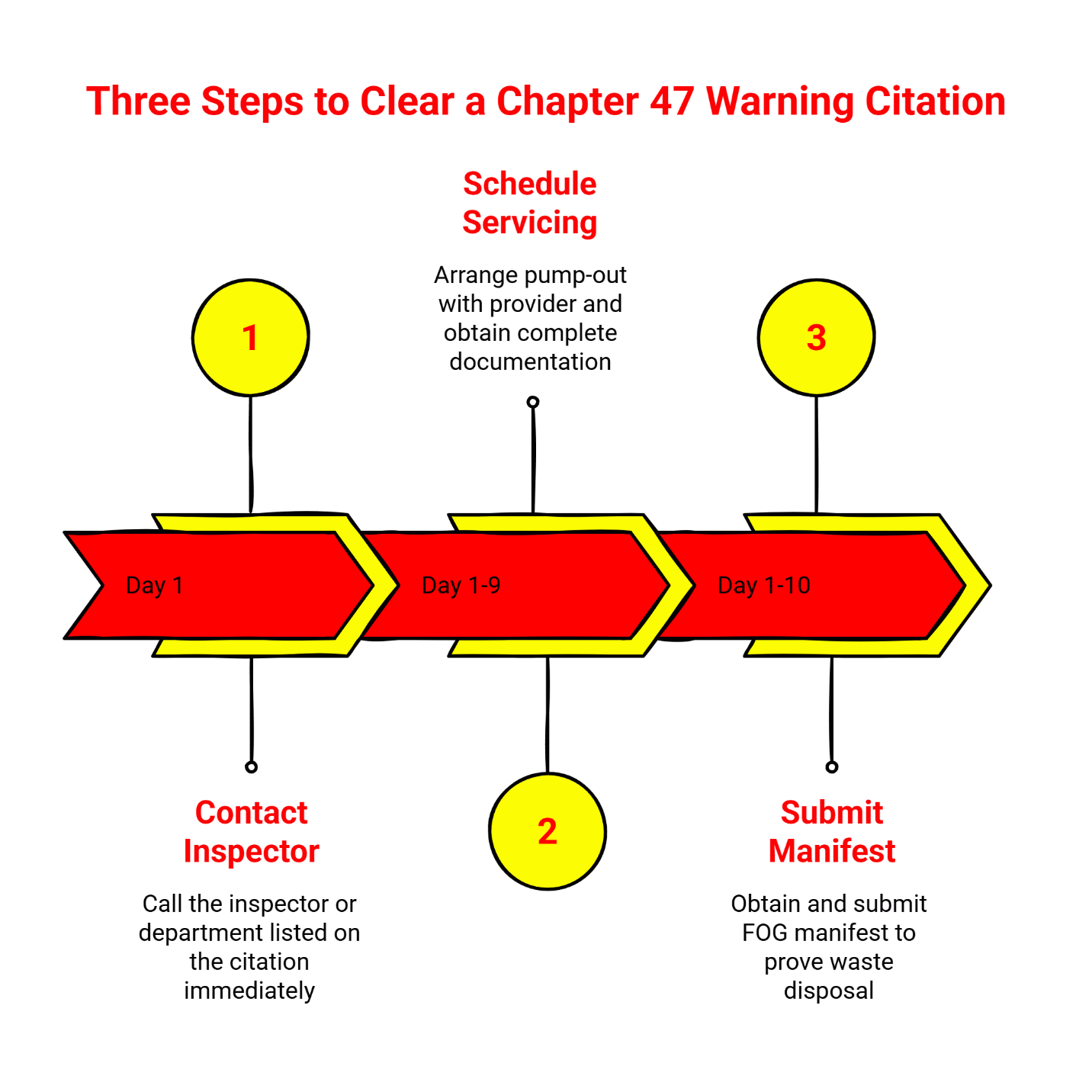
Three steps to clear a Chapter 47 FOG warning citation in Houston - contact inspector on Day 1, schedule grease trap pump-out by Day 9, and submit FOG manifest to prove waste disposal by Day 10.

Step 1: Contact the inspector or department listed on the citation. Do not wait. A quick, professional call demonstrates immediate compliance intent and clarifies the specific path to case closure.

Step 2: Schedule compliant servicing immediately. Arrange a pump-out with a provider who delivers complete documentation. Do not wait until day nine of a ten-day window. In Houston, interceptors are generally expected to be fully evacuated on a defined cadence—often quarterly or every 90 days unless a waiver applies. Predictable service beats emergency scrambling every time.

Step 3: Obtain and submit your manifest. This is the critical piece. Your FOG manifest proves where the waste went and creates the chain of custody the city requires.

Quick-reference flow: Receive warning → Confirm details → Arrange service → Obtain FOG manifest → Submit proof → File records


What “Good” Looks Like Under Pressure

Consider a restaurant GM who opens a Chapter 47 warning citation on Monday morning. The correction window is tight, and a busy weekend is already booked. The only paperwork on-site is a receipt—no FOG manifest—so the first email to the inspector gets a “need the manifest” reply.

The GM schedules a prompt pump-out, assembles a one-page packet, and submits the manifest the same day. The result: the issue becomes a documented correction.


The Manifest vs. Invoice Distinction

A manifest proves where your waste actually went. An invoice proves you paid for service. The city requires the manifest.

Think of it this way: FOG compliance management is the tax return for your waste. Your invoice is for your accountant; your manifest is for the inspector.

City inspectors in the Houston area require manifests showing the complete chain of custody—who pumped the trap, how much was removed, and which licensed facility received it. A credit card receipt or service invoice does not satisfy this requirement, no matter how detailed.

When you work with a compliant grease trap service, you should receive a signed manifest for every visit. If you have been getting only invoices, that gap in your documentation may be exactly why you received this citation.


What Proof to Gather Before You Respond

Assemble a clean, inspection-proof packet before contacting the inspector. Having everything organized sets the right tone and speeds up resolution.

Collect:

  • The manifest from your most recent service (and any disposal confirmation fields the city expects)
  • Service dates for the past 12 months
  • Any permit or registration documents the city requires for your establishment
  • Photos showing the corrected condition (optional, but can help demonstrate compliance)

A one-page cover note works well: state your business name, the citation reference number, what was corrected, and when. Attach supporting documents behind it. This approach signals that you run a tight operation.

As one Drane Ranger customer described it: “My experience with Drane Ranger was a very organized, professional and on time experience. I was kept informed of what was happening and a suggested time of cleaning again.” — Harold R.


If You Cannot Find Your Paperwork

Missing records do not have to derail your response. Here is how to recover:

Gather what you do have. Even partial documentation—receipts, emails, calendar entries—helps establish your service history.

Contact your service provider. Request copies of past manifests. A reliable provider keeps these records and can supply duplicates. Specifically ask for the FOG manifest, not just billing documents.

Start a dedicated on-site binder immediately. Going forward, keep manifests, permits, and inspection records in one accessible location. When the next inspector arrives, you want everything within arm’s reach. For a complete system, see this guide on organizing your documentation for audits.


Prevent the Next Citation

Once you clear this warning, the goal is to never see another one. That comes down to two habits:

Scheduling discipline. Do not push your service window to day 89 of 90. Build in a buffer. When service happens predictably, you are never scrambling to correct an overdue citation.

Record retention. Keep manifests on-site and organized. While some general business records are kept longer, the City of Houston specifically requires that ‘The generator shall maintain a copy of the manifest for a period of three years‘ from the date of service. (City of Houston Code of Ordinances § 47-512(a)). However, maintaining five years of records is considered a Best Management Practice (BMP) to align with certain state or federal audit cycles. A simple binder system—tabs by date, most recent in front—takes five minutes to set up and saves hours of stress during an inspection.

The operators who pass audits consistently are not lucky. They chose providers who treat documentation as part of the service, not an afterthought.

FOG control matters beyond any single city’s requirements. EPA and Texas Commission on Environmental Quality guidance explains the operational impact of fats, oils, and grease on collection systems—which is why best management practices are emphasized across jurisdictions.


When a Warning Escalates

Most warnings resolve cleanly when handled promptly. But some signs indicate a situation needs closer attention:

  • Repeat notices for the same issue
  • Unresolved violations past the deadline
  • Operational symptoms like persistent backups, slow drains, or foul odors

If any of these apply, act quickly. The cost of correction is almost always less than the cost of escalation. Understanding your full FOG compliance obligations helps you stay ahead of problems before they compound. You may also benefit from reviewing inspection prep basics to strengthen your readiness.


Frequently Asked Questions

Is a warning the same as a fine?

No. A warning is a correctable notice. You typically have around 10 days to fix the issue before fines begin. Respond promptly and the warning closes without penalty.

What if my last provider only gave me receipts?

Receipts and invoices do not satisfy the city’s documentation requirements. You need manifests showing chain of custody. Contact your provider and request copies, or consider switching to one who provides complete documentation.

How long should I keep these records?

The city requires a minimum of three years of manifest retention. Keep them organized and accessible on-site.

What if I’m outside Houston but got Houston-style paperwork requests?

Surrounding jurisdictions often follow similar FOG enforcement standards. The principles are the same: document your service, retain your manifests, and respond to notices promptly. Confirm directly with the listed department what documentation closes your specific case.

Official Resources

For verification and additional guidance, these sources provide authoritative information:


Moving Forward With Confidence

A Chapter 47 warning feels alarming in the moment. But for operators who respond correctly—confirm the issue, correct it fast, and prove it with proper documentation—these citations close without lasting impact.

The pattern that protects you is simple: consistent scheduling and systematic record retention. When your next inspection comes, you will not be scrambling. You will hand over a clean binder and get back to running your kitchen.

For more guidance on staying audit-ready, explore our guides on FOG compliance and grease trap maintenance.

Disclaimer: This content is for informational purposes only and does not constitute legal or regulatory advice. Requirements vary by jurisdiction and may change. Consult with a qualified professional or your local regulatory authority for guidance specific to your situation.

About the Drane Ranger Insights Team

The Drane Ranger Insights Team is our dedicated engine for synthesizing complex topics into clear, helpful guides. While our content is thoroughly reviewed for clarity and accuracy, it is for informational purposes and should not replace professional advice.

How to Organize Your FOG Manifests for a 5-Year Audit

📌 Key Takeaways

A simple binder system lets you hand inspectors five years of grease trap proof in under sixty seconds.

  • Manifests Beat Invoices: An invoice shows you paid for service, but a manifest proves where your grease actually went—and that’s what inspectors want to see.
  • Build the Binder in an Hour: A $15 three-ring binder with five year-labeled tabs and a front pocket turns audit panic into calm confidence.
  • File the Same Day: When your hauler hands you the paperwork, walk it straight to the binder—don’t set it aside “to file later” or it disappears.
  • Missing Records? Act Now: Call your hauler for copies and keep a log showing you tried—inspectors respond better to organized effort than blank stares.
  • Front Pocket = Quick Draw: Keep your permit, current year summary, and vendor contact card ready to hand over before anyone starts flipping pages.

A clean trap is only half the job—proof is the other half.

Houston restaurant owners and kitchen managers facing FOG audits will gain a simple, repeatable filing system here, preparing them for the compliance checklists and vendor guidance that follow.

~ ~ ~ ~ ~ ~ ~ ~ ~ ~ ~ ~ ~ ~ ~ ~ ~ ~ ~ ~ ~ ~ ~ ~ ~ ~ ~ ~ ~ ~ ~ ~ ~ ~ ~ ~ ~ ~ ~ ~ ~ ~ ~ ~ ~ ~ ~ ~ ~ ~ ~ ~ ~ ~

The inspector is at the door. Unannounced.

Somewhere in that back office—between the vendor invoices, the health permits, and last month’s inventory sheets—there’s supposed to be five years of grease trap manifests. You think they’re in the filing cabinet. Maybe the desk drawer. Possibly that cardboard box from the last kitchen renovation.

This moment doesn’t have to feel like a fire drill. In under an hour, you can build a system that lets you hand an inspector exactly what they need in sixty seconds flat. No scrambling. No apologies. Just a binder, a confident handoff, and back to running your kitchen.


The Necessity of Documented Compliance

An invoice proves you paid for service. A manifest proves the waste actually went where it was supposed to go. City inspectors don’t care about your accounting records—they care about chain of custody, documented proof that your grease left your trap and arrived at a licensed disposal facility.

Audits often feel sudden because the documentation request is immediate, even when the audit itself wasn’t a surprise. If you operate in the Houston area or within Houston limits under a FOG program, plan your files to maintain at least three years of manifests on-site (five for maximum liability protection), neatly organized and quickly retrievable.

When you have a physical binder organized by year, the inspection dynamic changes completely. Instead of digging through files while an inspector waits, you reach for one binder, flip to the right tab, and demonstrate compliance in seconds. That confidence isn’t just about passing the audit. It’s about protecting your business license and your peace of mind.

For context on maintaining your trap between cleanings, see our Commercial Grease Trap Cleaning services.


What Counts as a “FOG Manifest” (Quick Definition)

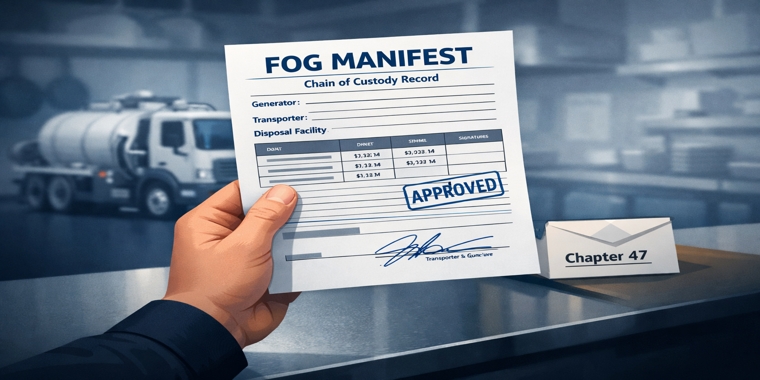
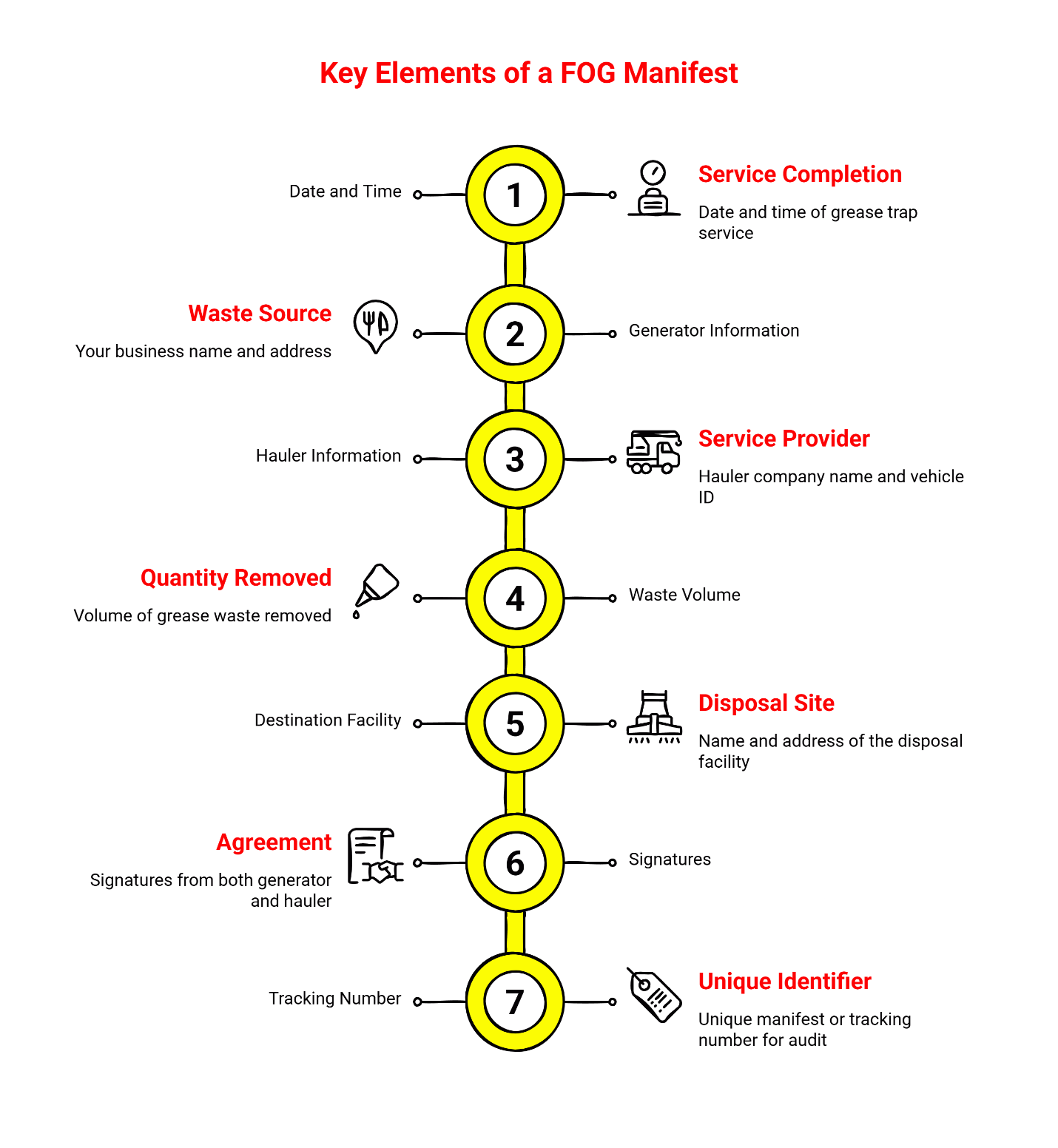
A manifest is a chain-of-custody record that documents the removal and handling of grease-related waste from your facility. While an invoice just confirms a transaction happened, a manifest documents the entire journey of your waste—from your trap to the disposal facility. It’s the paper trail that proves you’re not dumping grease into the sewer system.

Key elements of a FOG grease trap manifest for Houston restaurant compliance - 7 required fields including service date, generator info, hauler details, waste volume, disposal facility, signatures, and tracking number.

When your hauler hands you paperwork after service, look for these essential elements:

  • Your business name and service address
  • Date and time of service
  • Generator information (you—the waste source)
  • Hauler company information and vehicle ID
  • Volume of waste removed
  • Destination facility name and address
  • Signatures from both parties
  • A unique manifest or tracking number

If any of these are missing, ask your service provider for complete documentation. A manifest with gaps is a manifest that could cause problems during an audit.

One critical distinction: if what you have is only a bill with pricing and no chain-of-custody details, treat it as a supporting document, not your primary audit proof. Invoices belong in your accounting files. Manifests belong in your compliance binder.

For a deeper dive into the legal distinction between these documents, read Manifesting vs. Invoicing: The Legal Difference for Houston Restaurants.


The Audit-Proof Binder: Supplies List (10 Minutes, One Trip)

You don’t need a fancy filing system. You need one that works when it matters. Here’s your shopping list:

  • One 2-inch three-ring binder (3-inch if your service volume is high)
  • Five divider tabs with writable labels
  • A pack of sheet protectors
  • One pocket folder (the kind that snaps into the binder rings)
  • A label maker or permanent marker
  • Stapler and binder clips

Total investment: around fifteen dollars. Total setup time: less than an hour. The return: years of audit confidence.


Implementing the 5-Year Tab System

Label your five dividers by year, starting with the oldest and ending with the current year. If you’re setting this up in 2026, your tabs read: 2022, 2023, 2024, 2025, 2026.

Within each year’s section, file manifests in reverse chronological order—newest on top. When you flip to 2025, the first document you see should be December’s service, then November’s, and so on. This makes “show me the last service” effortless.

Here’s the filing routine that keeps the system clean:

When your hauler completes service, they hand you the manifest. Don’t set it on the desk “to file later.” That’s how paperwork disappears.

Walk directly to your binder. Slip the manifest into a sheet protector if you want extra durability (grease and paper don’t mix well over five years).

Place it at the front of the current year’s section.

Done. Total time: thirty seconds.

If you have related documents—like a service log note or a repair receipt—staple them to the back of the corresponding manifest. Keep everything together so you’re not hunting through multiple files during an inspection. These attachments can strengthen clarity, but don’t overstuff your binder. The manifest is the proof; supporting docs are optional.

Optional: Create a Year Summary Sheet

At the front of each year’s section, add a single page with your vendor name, service frequency, number of services completed that year, and any known gaps. This summary isn’t required, but it accelerates audits by telling the story fast.


Front Pocket Setup: What to Keep “Inspection Ready”

The pocket folder at the front of your binder is your quick-access zone. When an inspector walks in, you shouldn’t have to flip through anything. Just open the binder, pull from the front pocket, and hand over the essentials.

Keep these items in the front pocket:

Current permit copy. Your grease trap permit should be visible and accessible. Inspectors often ask for it first.

Current year manifest summary. Create a simple one-page list: date of each service, hauler name, and manifest number. This gives the inspector a quick overview without requiring them to flip through every document.

Vendor contact card. Include your service provider’s name, phone number, and after-hours contact. If the inspector has a question you can’t answer, you can call your hauler on the spot.

Think of this as your compliance quick-draw. You’re not searching—you’re presenting.


Digital Backup: Scan Rules That Actually Work

A physical binder should be your primary system for one simple reason: surprise inspections don’t wait for your laptop to boot up, your cloud service to sync, or your password manager to cooperate. But digital backups protect you against fire, flood, and the chaos of a busy kitchen.

Keep your digital system dead simple.

Folder structure: One folder per year. That’s it. Don’t over-engineer this.

FOG Manifests → 2022

FOG Manifests → 2023

FOG Manifests → 2024

FOG Manifests → 2025

FOG Manifests → 2026

Naming convention: Use a format that sorts correctly.

YYYY-MM-DD_VendorName_Manifest#

Example: 2025-09-15_DraneRanger_M4521

Storage: One cloud location (Google Drive, Dropbox, whatever you already use) plus one local backup on a hard drive or USB.

Monthly routine: Set a calendar reminder for the first Monday of each month. Spend ten minutes scanning any unscanned manifests and verifying your files match your physical binder. 

The goal isn’t a perfect digital archive. The goal is having a backup you can actually find when you need it.


If You’re Missing Manifests: What to Do Before the Inspector Shows Up

Gaps happen. Paperwork gets lost in kitchen chaos, haulers change, and sometimes five years is a long time to keep track of anything. Here’s how to address missing documentation before it becomes a problem.

Steps to address missing FOG manifests before a Houston grease trap audit - 4-step timeline including contacting hauler, creating gap log, implementing no manifest no payment policy, and organizing compliance binder.

Call your hauler first. Reputable service providers keep records. Contact them and request duplicate manifests for the dates you’re missing. Most can provide copies within a few business days.

Create a gap log. If you can’t recover a manifest, document your effort. Keep this log in the back pocket of your binder and include:

  • Missing date(s)
  • Who you contacted
  • Date you made the request
  • Expected delivery date
  • Result (received or pending)

This shows an inspector that you’re acting in good faith, not hiding negligence. Inspectors tend to respond better to organized, transparent operators than to “I don’t know.”

Set a new internal rule. Adopt this policy in your operation: no manifest, no payment approval. Make it standard that your bookkeeper or manager doesn’t process a hauler’s invoice until the corresponding manifest is in hand and filed. This single rule closes the paperwork loop permanently.

The worst thing you can do with missing paperwork is nothing. Proactive documentation of your recovery efforts demonstrates responsibility even when records are incomplete.


The One Habit That Keeps the Binder Clean: Filing Day

Assign a Compliance Officer to ensure ownership of the filing process.

Manager files. Whoever receives the manifest from the hauler is responsible for putting it in the binder that same day. Not tomorrow. Not next week. The same day.

Owner or GM verifies quarterly. Once every three months, the owner or general manager flips through the binder to confirm everything is in order. Check that manifests are present for every scheduled service, that the front pocket is current, and that the digital backup matches. This takes five minutes.

Pick a consistent moment tied to your service schedule. If your trap is cleaned on the 15th of each month, the 16th is filing day. No exceptions.

This isn’t about creating more work. It’s about protecting the work you’ve already paid for. You invest in regular Grease Trap Cleaning Houston services to stay compliant. The binder makes sure you can prove it.


When to Call a Professional: Compliance Support and Reliable Documentation

A good grease trap service provider doesn’t just pump your trap and leave. They make compliance easier by providing complete chain-of-custody documentation with every visit, showing up on schedule so you never miss a cleaning window, and answering questions about what inspectors look for.

When evaluating a hauler, ask:

  • Will you provide complete chain-of-custody documentation every visit?
  • What information is included on your manifests?
  • Can you provide duplicate records if I need them?
  • How do you handle scheduling to ensure I stay within compliance timelines?

If manifests are routinely missing, inconsistent, or delayed, the problem may not be your binder—it may be your vendor relationship. Cleaning without paperwork still leaves you exposed.

For Houston-area operators concerned about compliance requirements, the City of Houston sets the regulatory framework that drives these documentation needs.

Drane Ranger has served the Greater Houston area since 1985, providing professional grease trap service with the documentation that keeps you audit-ready. As a BBB-accredited business, we’re committed to doing the job right—including the paperwork.

As one customer put it: “My experience with Drane Ranger was a very organized, professional and on time experience. I was kept informed of what was happening and a suggested time of cleaning again.” — Harold R.

Another shared: “Drain Ranger is very professional and reliable. Basically they can take care of all your grease drain needs.” — Shelley M.


Your 5-Year Binder Setup Checklist

Supplies:

  • [ ] 2-inch three-ring binder (3-inch for high volume)
  • [ ] 5 divider tabs (labeled by year)
  • [ ] Sheet protectors
  • [ ] Pocket folder for front of binder
  • [ ] Label maker or permanent marker
  • [ ] Stapler and binder clips

Front Pocket Contents:

  • [ ] Current grease trap permit copy
  • [ ] Current year manifest summary (one page)
  • [ ] Vendor contact card with after-hours number

Tab System:

  • [ ] Year 1 (oldest) → Year 5 (current)
  • [ ] Manifests filed newest-on-top within each year
  • [ ] Optional year summary sheet at front of each section

Back Pocket:

  • [ ] Gap log for missing documents
  • [ ] Pending document requests

Maintenance:

  • [ ] Assign filing day ownership
  • [ ] Schedule quarterly verification
  • [ ] Set monthly digital backup reminder

A clean trap is only half the job. Proof is the other half. Build your binder this week, and the next time someone knocks on your kitchen door with a clipboard, you’ll be ready.

Start Your Service Today — Call 281-489-1765

Ready to work with a team that handles both the service and the paperwork trail? Contact us today to request your quote.

Disclaimer: This article is for informational purposes only and does not constitute legal advice. Compliance requirements may vary by jurisdiction and are subject to change. Consult with local regulatory authorities or a qualified professional for guidance specific to your situation.