📌 Key Takeaways
A 90-day grease trap schedule helps, but real inspection readiness depends on clean access, records, and daily warning signs.
- Calendar Is Not Proof: Treat 90 days as a baseline, not proof your grease trap is ready today.
- Check The System: Watch slow drains, odors, blocked access, and grease before small problems disrupt kitchen service.
- Keep Records Ready: Store permits, manifests, invoices, and past inspection records where managers can find them fast.
- Use Real Volume: Match service timing to kitchen load, busy periods, menu changes, and actual trap condition.
- Own The Process: Assign one person and a backup to manage records, checks, and follow-up actions.
Prepared records and clean access beat calendar confidence.
Houston-area restaurant owners, general managers, and kitchen managers can use this framework before the full inspection-readiness guide.
~ ~ ~ ~ ~ ~ ~ ~ ~ ~ ~ ~ ~ ~ ~ ~ ~ ~
The calendar is not your shield.
The sink gurgles during prep, the dish area smells faintly sour, and the manager’s office has a binder that nobody has opened since the last pump-out. We pumped this quarter. Are we actually ready?
You are not wrong to ask. For Houston-area restaurant owners, general managers, and kitchen managers, a 90-day pump-out schedule can feel like proof that the grease trap is handled. It is only a starting point. True compliance means your kitchen can show physical readiness, documentation readiness, and a service rhythm that reflects actual grease and solids buildup.
A 90-day pump-out schedule is not the same thing as inspection readiness. For Houston restaurant operators, readiness means the grease trap is accessible, the sample well is clean, warning signs are being monitored, and the required paperwork is ready before an inspector asks for it.
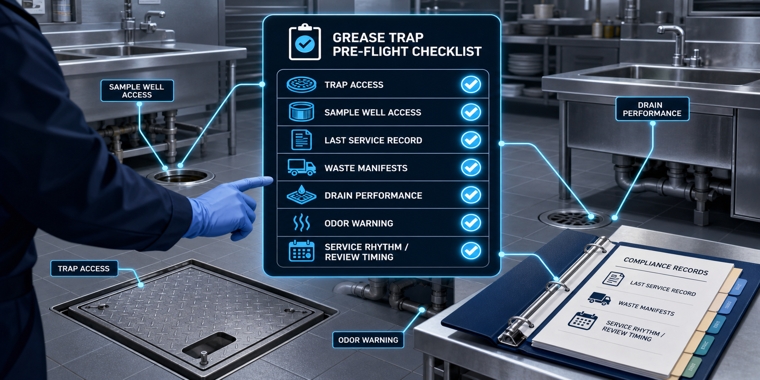
Inspection readiness is the systematic preparation, documentation, and maintenance process required to pass municipal fats, oils, and grease audits without avoidable disruption. It works like a pre-flight checklist for the kitchen’s wastewater system before regulators arrive. The goal is simple: when an inspector shows up, the manager can show clean access, organized records, and a service rhythm based on actual risk rather than hope.
Houston’s rules make the baseline clear. The Houston Health Department states that every interceptor inside incorporated city limits must be fully evacuated at least quarterly, or every 90 days, unless an approved waiver applies. The same guidance tells generators to inspect and verify the trap is clean before signing the manifest, keep the sample well clean, retain generator copies, and keep manifest records onsite for five years. It also says inspections may happen without notification. (Houston Consumer)
That is the part the myth misses.
The inspection does not measure your calendar; it checks the condition of the system and the paperwork in front of the inspector.
Start Here: The 7-Point Grease Trap Inspection Readiness Check
Before definitions, start with the check that matters.
| Readiness check | Green | Watch | Action |
|---|---|---|---|
| Trap access | Clear and reachable | Blocked by storage or equipment | Clear the area before service or inspection |
| Sample well | Clean and accessible | Hard to locate or partially blocked | Confirm access and condition |
| Last pump-out date | Known and documented | Known only by memory | Locate the service record |
| Waste manifests | Organized and onsite | Scattered or incomplete | Collect yellow and white copies where required |
| Drain performance | Normal flow | Slow prep, dish, or floor drains | Review trap condition before waiting |
| Odor control | No persistent grease-trap odor | Recurring odor near trap or prep area | Treat as a warning sign |
| Service rhythm | Based on volume and condition | Based only on calendar habit | Reassess after busy periods |
This check helps you separate perceived compliance from true compliance. Perceived compliance says, “We paid for pumping.” True compliance says, “We can prove our trap, sample well, service records, and operating habits are ready today.”
Add one more practical safeguard: assign one staff member to own manifest collection and record storage. Staff turnover can create a real paperwork gap. If only one former manager knew where the records lived, the restaurant may be exposed even after the physical cleaning was done.
Houston Permitting Center lists the inspection documents investigators may need, including the original Fats, Oils and Grease permit, yellow and white copies of waste manifests for the past five years, applicable invoices, notices of waiver if applicable, and copies of previous inspections. It also notes that investigators may check the trap and sample well. (Houston Permitting Center)
The 90-Day Pumping Myth: Why the Calendar Alone Does Not Protect a Busy Kitchen
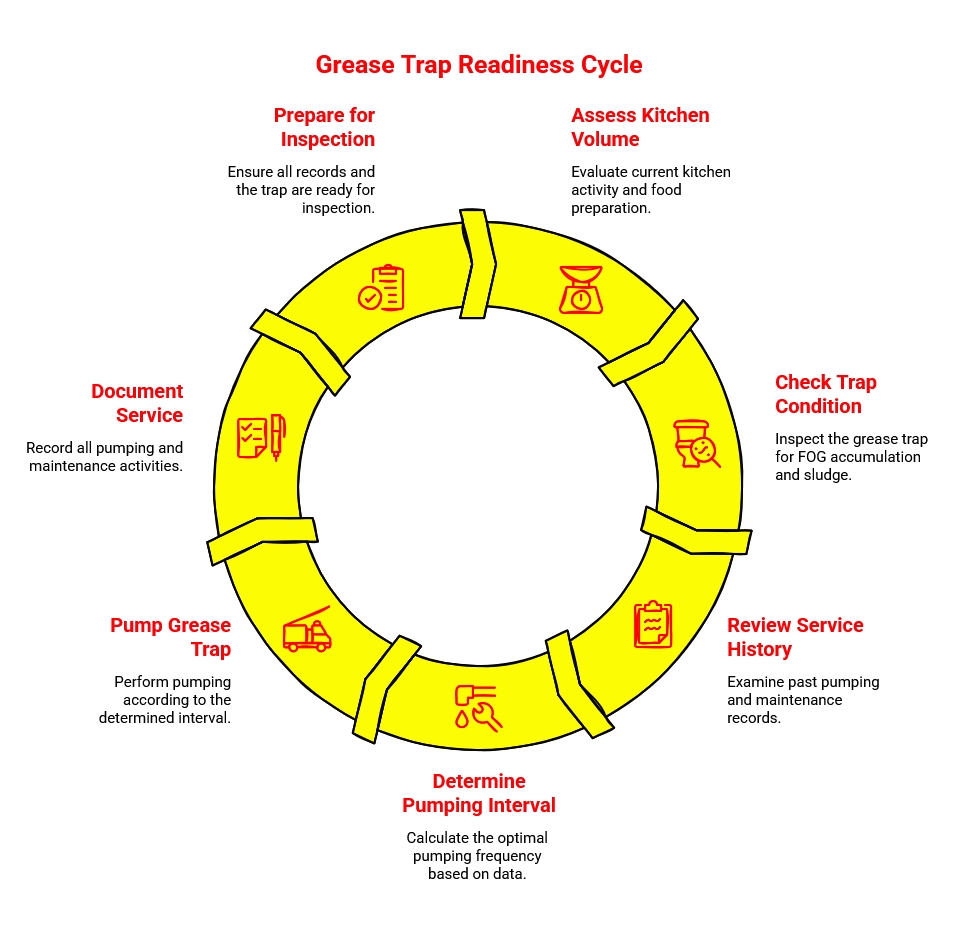
The 90-day rule is a baseline. It is not a guarantee.
A café with steady light volume and a chef-driven restaurant with weekend rushes do not produce the same fats, oils, grease, and solids load. Their calendars may look identical. Their traps may not.
The calendar can tell you when the last pump-out happened. It cannot tell you whether the trap is inspection-ready today.
That distinction matters because kitchen volume changes. A long catering weekend, a holiday surge, a menu shift toward fried foods, or a stretch of unusually heavy service can all increase the load going into the interceptor. Those are general operational principles, not a claim that every restaurant needs the same shorter schedule. The right interval depends on actual use, trap condition, and documented service history.
This is where the old habit becomes risky. A restaurant may keep pumping every quarter because that schedule has not caused a visible failure yet. That does not prove the rhythm is safe. It may only mean the warning signs have not become obvious.
The better question is not, “Are we on the 90-day schedule?”
The better question is, “Could we show that the trap, sample well, and records are ready if the city walked in today?”
For deeper support on inspection preparation, Drane Ranger’s internal article on How to Prepare Your Kitchen for a City of Houston Grease Trap Inspection can serve as a companion resource. This page stays focused on the broader readiness model.
The 25% Rule Reality: Floating Grease Plus Settled Sludge
A grease trap does not fail only because of the grease you can see.
FOG can float near the top. Sludge and solids can settle at the bottom. The usable water capacity sits between those layers, and that middle space is what keeps wastewater moving properly through the system. When buildup reduces that working space, the kitchen may be closer to trouble than the surface view suggests.
That is why visual confidence can mislead a busy kitchen. A quick look may catch floating grease, but it can miss settled sludge. By the time slow drains or odors become obvious, the trap may already deserve attention.
For Houston operators, Drane Ranger’s own grease trap guidance lists warning signs such as slow kitchen sink drainage, persistent odors near the grease trap, visible grease in unusual places, and grease accumulation exceeding 25% of total liquid depth.
The practical takeaway is simple. Do not wait for the trap to announce the problem through a backup, a smell near the prep area, or a sink that refuses to drain during lunch service.
If you want the deeper spoke topic, use the internal explanation of the 25% rule for Houston grease trap compliance. For this hub, the main point is readiness: floating grease and settled sludge both matter.
What Inspectors Need to See: Physical Access, Sample Wells, Permits, and Manifest Records
Inspection readiness has two sides.
Physical readiness is what the investigator or service provider can access and observe. That includes the grease trap, sample well, drain behavior, odor conditions, surrounding area, and practical access to the system.
Paperwork readiness is what the manager can produce without panic. That includes permits, waste manifests, applicable invoices, waiver documents if any apply, and prior inspection records.
Houston Permitting Center states that restaurant or food-dealer establishments with a grease trap are special waste generators. It also says a Fats, Oils and Grease permit is valid for one year from the food dealer permit issue date and must be renewed annually. (Houston Permitting Center)
During inspection, Houston Permitting Center lists the following document categories:
| Document or item | Why it matters |
|---|---|
| Original Fats, Oils and Grease permit | Shows permit status and site compliance paperwork |
| Yellow and white waste manifest copies | Supports waste handling and clean-out history |
| Applicable invoices | May support service history, but do not replace manifests |
| Notice of waiver, if applicable | Shows approved exception status |
| Previous inspection copies | Helps show prior compliance history and follow-up |
This is where many restaurants discover the gap. The trap may have been pumped, but the paperwork is in an email inbox, a former manager’s drawer, or a file cabinet that nobody checks until the inspector is already waiting.
A good readiness habit is boring by design. Keep the records where the current manager can find them. Maintain a backup. Confirm that the service documentation includes the service date, waste quantity, disposal facility information, and system issues identified where that information is available. Drane Ranger’s liquid waste management page describes professional service as covering the lifecycle from assessment and removal through proper disposal and documentation.
Boring systems protect restaurants.
Invoices vs. Manifests: Why Paperwork Can Make or Break Readiness
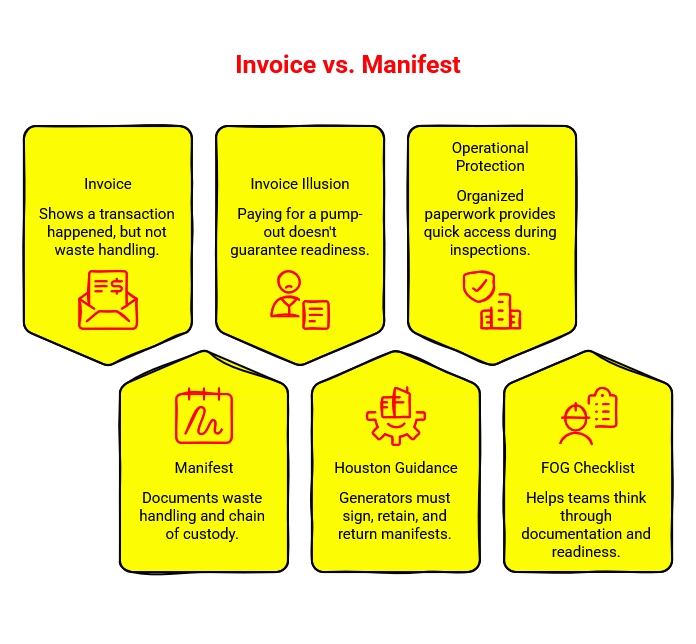
An invoice may show that a transaction happened.
A manifest helps document the handling of waste and the chain of custody. Those are not the same thing.
This is the invoice illusion: a restaurant assumes that because it paid for a pump-out, it can prove inspection readiness. Payment is not the whole record. The manager still needs the right manifest copies, organized records, and a clear process for keeping those documents onsite.
Houston Health Department guidance tells generators to sign the generator portion of the manifest, retain the generator copy, and return the generator copy from the transporter within 15 days of pump-out. It also says generator and returned generator copies of waste manifests should be kept onsite for five years. (Houston Consumer)
That requirement turns paperwork into operational protection. The manager who can open a binder or digital folder in 17 seconds has a different day than the manager who starts searching old emails while the inspector waits.
For a nearby supporting topic, the internal FOG compliance checklist can help teams think through documentation and readiness habits without turning every shift lead into a compliance specialist.
A Houston Kitchen’s Risk Signals: When to Pump Before the 90-Day Mark
A grease trap usually sends signals before it creates a full disruption.
Slow drainage in kitchen sinks is one. Persistent unpleasant odors near the grease trap are another. Visible grease in unusual places, such as sinks or floor drains, also deserves attention. So does any uncertainty about the last pump-out date or where the manifest records are stored.
These signs do not automatically prove a violation. They do tell you the system deserves attention before you assume the next scheduled date is safe.
High-volume service periods deserve the same caution. A restaurant that runs a heavy weekend, adds fried menu items, or handles a seasonal spike may produce more FOG than its usual rhythm reflects. That does not create a universal rule for shorter intervals. It creates a reason to review the trap’s actual condition.
Poorly managed grease traps can lead to unwanted odors and costly sewage backups, according to Drane Ranger’s grease, grit, and lint trap service page. The same project source states that Drane Ranger disposes of waste safely and uses an environmentally responsible system for liquid waste removal that complies with local regulations.
The point is not fear. The point is timing.
A manager who catches the pattern early can schedule service, gather records, and keep the kitchen running. A manager who waits for the drain to stop has fewer choices.
Build a Volume-Based Readiness Rhythm Instead of a Date-Based Habit
A date-based habit asks one question: “When is the next pump-out?”
A volume-based readiness rhythm asks better questions:
| Readiness habit | What to track |
|---|---|
| Service history | Last pump-out date, manifest return, and next scheduled review |
| Kitchen symptoms | Slow drains, odors, visible grease, staff complaints |
| Trap condition | FOG and solids accumulation, access, sample well condition |
| Documentation | Permit, manifests, invoices, prior inspection copies |
| Operational changes | Busy weekends, menu changes, catering spikes, seasonal volume |
This does not require a complicated system. A simple log can work. The value comes from consistency.
At the end of each high-volume period, assign a manager to check three things: drain behavior, odors, and records. If the sink has slowed, the prep area smells off, or the manifest binder is incomplete, do not wait for the calendar to rescue the kitchen.
Professional assessment can help determine whether the kitchen’s service interval matches actual FOG load. Drane Ranger’s project materials describe customized liquid waste solutions and note that the company works with clients rather than forcing package deals that do not fit the operation.
That matters for independent restaurants. A small café, a high-volume hotel kitchen, and a fast-casual fry-heavy concept should not assume the same maintenance rhythm simply because the baseline rule uses the same number.
FOG Audit Pre-Flight Checklist
Use this as a practical self-check before the next inspection, after unusually heavy service, or whenever slow drains, odors, or missing paperwork create doubt.
| Readiness area | Pass | Watch | Fail | Action needed |
|---|---|---|---|---|
| Trap access | Clear path and access | Access partially blocked | Access unknown or blocked | Clear storage and confirm reachability |
| Sample well access | Clean and accessible | Hard to locate | Blocked or neglected | Confirm condition before inspection |
| Drain behavior | Normal flow | Occasional slow drains | Repeated slow drains | Review trap condition and service timing |
| Odor presence | No persistent odor | Intermittent odor | Recurring odor near trap or prep area | Treat as warning sign |
| Last service date | Date documented | Date known by memory | Date unknown | Locate record or call provider |
| Manifest copy | Onsite and organized | Partial record | Missing record | Rebuild file and request copies where possible |
| Permit availability | Easy to locate | Not posted or hard to find | Missing or expired | Confirm current requirement with official source |
| Staff ownership | Named person owns records | Informal ownership | Nobody owns records | Assign one manager and a backup |
| Documentation details | Service date, quantity, disposal facility, and issues recorded where available | Some details missing | No usable documentation | Improve provider and record process |
| Provider readiness | Supports scheduling, disposal, and documentation | Unclear process | Only invoice provided | Ask what records and disposal documentation are supplied |
| Next review date | Scheduled after busy periods | Calendar only | No review rhythm | Add a review after high-volume service |
If most rows are green, keep monitoring and keep the records organized.
If several rows are in watch status, schedule a review before the next high-volume period.
If any row is in fail status, especially missing manifests, blocked access, repeated slow drains, or persistent odors, treat the issue as active. Do not wait for the next 90-day date to make the decision for you.
How Drane Ranger Helps Houston Restaurants Stay Inspection-Ready
Drane Ranger is not a law firm and does not provide legal advice. Its role is practical: help Houston-area businesses manage liquid waste needs professionally, with service, disposal, and documentation support.
Drane Ranger has served Houston-area customers since 1985, and the company’s project materials emphasize customer service, outstanding work, trained and certified staff, and rule-following. The company also describes services across the Greater Houston area, including grease trap, grit trap, lint trap, lift station, septic, vacuum truck, liquid waste management, and non-hazardous wastewater disposal services.
For restaurant operators, the most relevant service path is commercial grease trap cleaning in Houston and related grease, grit and lint trap services. Those services fit the practical readiness cycle: assess the need, remove accumulated waste, support responsible disposal, and maintain documentation that helps the business track service history.
The trust signal should stay in its lane. Drane Ranger’s BBB accreditation may support company credibility, but it is not regulatory proof and should not be treated as inspection authority. The regulatory facts belong to the City of Houston, Houston Health Department, Houston Permitting Center, Houston Public Works, and TCEQ.
Customer proof can still be useful when it stays modest. As Shelley M. wrote in a Google review: “Drain Ranger is very professional and reliable. Basically they can take care of all your grease drain needs.”
Use the checklist first. If it reveals odors, slow drains, missing manifests, blocked access, or schedule uncertainty, contact Drane Ranger for help reviewing your grease trap cleaning needs. For active issues, call 281-489-1765.
Why FOG Readiness Is Bigger Than One Kitchen
FOG management is not only a restaurant paperwork issue. It also affects the public wastewater system.
Houston Public Works states that 70% of sewer overflows in Houston are caused by clogs from fats, oils, and grease poured down drains and wipes flushed down toilets. The same page says sewer overflows can cost thousands of dollars to repair, harm health, and pollute the environment. (houstonpublicworks.org)
TCEQ also frames grease management as a broader sewer-system issue. Its model standards page explains that model grease-management standards help municipal governments reduce FOG in sewer systems, and it lists benefits such as reduced sewer backups into homes and businesses and reduced risk of contamination from sewer overflows. (tceq.texas.gov)
For a restaurant manager, that broader context points back to one practical habit: do not treat the grease trap as a hidden box behind the kitchen. Treat it as part of the operation.
You track inventory because running out of food disrupts service. You track labor because staffing gaps hurt the guest experience. Grease trap readiness deserves the same operational respect.
Quiet systems are still systems.
FAQ: Commercial Grease Trap Inspection Readiness
Is every 90 days enough for a commercial grease trap?
No. Every 90 days is the baseline evacuation requirement for interceptors located inside incorporated Houston city limits unless an approved waiver applies. A busy kitchen may need closer monitoring based on volume, trap condition, odors, slow drains, and documentation status. The safer operational habit is to treat 90 days as the minimum baseline, not as automatic proof of readiness. (Houston Consumer)
What should a Houston restaurant have ready for a FOG inspection?
Houston Permitting Center lists the original Fats, Oils and Grease permit, yellow and white waste manifest copies for the past five years, applicable invoices, waiver notices if applicable, and prior inspection copies. Investigators may also check the trap and sample well. (Houston Permitting Center)
What is the difference between an invoice and a manifest?
An invoice generally shows that a service transaction occurred. A manifest helps document waste handling and chain-of-custody. For inspection readiness, the manifest is the stronger compliance record. Keep it organized and onsite according to the applicable Houston guidance.
What warning signs mean a grease trap may need cleaning before the next scheduled service?
Slow kitchen sink drainage, persistent odors near the grease trap, visible grease in unusual places, and uncertainty about records are practical warning signs. Grease accumulation exceeding 25% of total liquid depth is also identified in Drane Ranger’s Houston grease trap guidance as a sign that cleaning may be needed.
Why does sample well access matter?
The sample well is part of the inspection picture. Houston official guidance says investigators may check the trap and sample well to ensure discharge is consistent with mandated parameters. If the sample well is blocked, neglected, or hard to access, the restaurant’s readiness breaks down before the paperwork can help. (Houston Permitting Center)
What should a manager do if records are missing?
Start by rebuilding the record trail. Look for manifests, prior inspection copies, service invoices, emails from the transporter, and any returned generator copies. Then assign one current manager and one backup to own record storage. For current regulatory expectations, confirm details with the City of Houston or a qualified compliance professional.
Ready Means Proved, Not Assumed
Back in the manager’s office, the binder should not be a mystery.
The sample well should not be a guess. The last pump-out should not depend on someone’s memory. The next service date should not be chosen only because the calendar repeated an old habit.
That is the shift from perceived compliance to true compliance.
Perceived compliance says, “We pumped every 90 days.” True compliance says, “The trap is accessible, the sample well is ready, the records are onsite, and the service rhythm reflects how this kitchen actually operates.”
Stop letting the calendar do the whole job. Build the proof. Keep it ready. Protect the kitchen.
Disclaimer: This article is for general informational purposes only and is not legal advice. Houston FOG rules, permit requirements, and enforcement practices can change. Restaurant owners and managers should confirm current requirements with the City of Houston, Houston Health Department, or a qualified compliance professional.
Our Editorial Process:
This article was developed from the approved Content Strategy Document, Drane Ranger project files, official Houston and Texas regulatory sources, and documented customer testimonial material. It avoids unsupported service-cost claims, guaranteed inspection outcomes, invented fine timelines, and competitor comparisons.
By: Drane Ranger Editorial Team
Drane Ranger Vacuum Services has provided liquid waste management solutions for Houston-area businesses since 1985, including grease trap, grit trap, lint trap, lift station, septic, and vacuum truck services.