📌 Key Takeaways:
Professional grease trap cleaning delivers compliance confidence, operational efficiency, and cost control through a systematic five-step process that transforms uncertainty into predictable restaurant management.
Complete Interior Cleaning Extends Service Intervals: Scraping walls, baffles, and lids to bare surfaces prevents rapid re-accumulation that pump-only services leave behind, reducing the frequency of required cleanings and associated costs.
The 25% Rule Drives Smart Scheduling: Monitoring combined FOG and solids levels at approximately 25% of liquid capacity provides an objective threshold for cleaning decisions, replacing guesswork with data-driven maintenance planning.
Compliance Documentation Protects Operations: Service manifests with hauler permits, volumes removed, and observed conditions create inspector-ready records that support regulatory compliance and prevent costly violations or shutdowns.
Houston’s 90-Day Baseline Requires Kitchen-Specific Adjustment: High-volume operations and fried food establishments typically need 30-60 day intervals regardless of baseline schedules, making operational loading more important than arbitrary timelines.
Pre-Service Preparation Minimizes Disruption: Clear access routes, staff notifications, and having previous manifests ready reduces service time and protects front-of-house operations during cleaning.
Smart scheduling plus thorough cleaning equals predictable compliance and uninterrupted service.
No surprises. No mess. No headaches.
Here’s a clear, Houston-specific walkthrough of a professional grease trap service—from arrival to documentation—so operations stay compliant and kitchens stay moving.
A professional grease trap cleaning for Houston restaurants typically follows five steps: arrival and site check, complete pump-out, full interior clean to bare surfaces, a compliance review with an inspector-ready manifest, and scheduling based on a 90-day baseline adjusted by the “25% rule.” This sequence minimizes downtime and supports city inspections.
At-a-Glance: What “Professional Grease Trap Cleaning” Covers in Houston
The Goal: Compliance, Hygiene, Uptime
Professional service aims to prevent backups and odors while keeping documentation inspection-ready. In Houston, food service establishments are expected to manage fats, oils, and grease (FOG) responsibly and maintain records for inspectors. The city’s Special Waste (FOG) program provides specific guidance for compliance requirements.
Grease trap cleaning in Houston requires adherence to these regulatory standards while maintaining operational efficiency during service hours.
What “Pump-Only” Misses vs. Full Interior Clean
Pump-only work removes fluids and floating FOG but often leaves deposits on walls, baffles, and the lid. A professional cleaning includes scraping and washing interior surfaces to bare material, then proper reseal—restoring trap efficiency and helping deter rapid re-accumulation.
This thorough approach extends service intervals and prevents the rapid FOG buildup that can lead to compliance issues. For broader interceptor systems across kitchens, review the scope of our grease, grit & lint trap services.
Step 1 — Pre-Service Arrival: Safety, Site Check & Access

Confirm Trap/Interceptor Location & Access Route
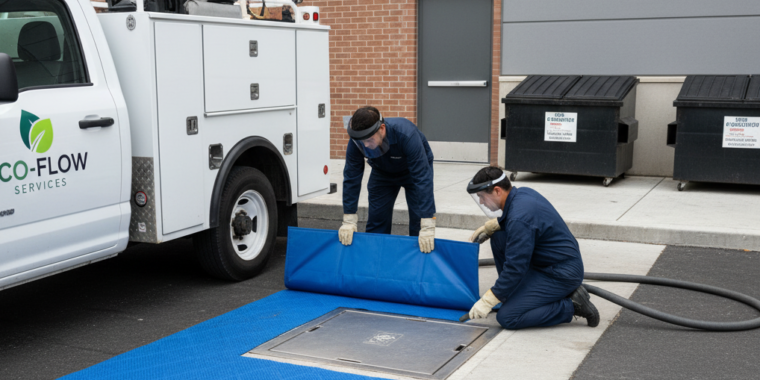
The crew confirms the exact trap or interceptor location (indoor or outdoor), measures hose runs from parking, and clears a safe path that avoids customer areas where possible. This planning phase reduces service time and prevents operational disruptions.
Odor Mitigation and Ventilation Considerations
Temporary ventilation is arranged and lids are opened carefully to control odors. This helps keep front-of-house experiences steady during operations, particularly important for restaurants serving customers throughout the day.
Protective Floor-Covering and Splash Control
Absorbent pads and splash guards protect floors and surrounding equipment to avoid slips and cross-contamination concerns. Professional crews carry appropriate materials to maintain sanitary conditions throughout the process.
Why it matters: A controlled setup shortens the service window and protects staff, guests, and equipment.
Step 2 — Pump-Out: Evacuating the Trap/Interceptor
Removing FOG, Solids, and Greywater
Technicians evacuate the full contents—floating grease, settled solids, and water—so the trap can be cleaned properly. Complete evacuation provides access to interior surfaces for the thorough cleaning that follows.
Why Complete Evacuation Matters
Partial pump-outs leave behind sludge on the bottom and grease films on the sides. Those residues reduce capacity and can increase odors or blockages sooner than expected. This incomplete approach often leads to more frequent service calls and potential compliance issues.
Waste Handling and Transport Basics
Captured materials are transported off-site for proper processing in accordance with pretreatment and local program guidance. Professional services maintain appropriate permits and follow established protocols. For a general, nationally recognized overview, see the EPA Pretreatment Program FOG fact sheet.
Why it matters: A complete, well-managed pump-out prepares the trap for a true interior clean and supports compliant disposal.
Step 3 — Interior Clean: Scrape, Wash & Reset to Bare Surfaces

Scraping Walls, Baffles, and Lid
All interior surfaces—including baffles and underside of the lid—are scraped to remove hardened FOG and solids. This is a key difference between “pump-only” and professional service that directly affects trap performance and service intervals.
Rinse/Wash to Restore Efficiency
Surfaces are rinsed or lightly washed (as site-appropriate) to remove residual film so the trap functions at designed capacity. This restoration to near-original condition helps optimize FOG separation efficiency.
Reassembly and Proper Reseal
Baffles and lids are reinstalled and resealed to prevent leaks and limit odor migration. Proper reassembly ensures the trap operates as designed and maintains sanitary conditions around the service area.
Why it matters: Cleaning to bare surfaces slows re-accumulation and can extend the time before the next service—without risking compliance.
If your operation has multiple collection points, see how the broader grease, grit & lint trap services fit into a full-kitchen plan. When you’re ready, request your quote for scheduling options.
Step 4 — Compliance Check & Documentation
Visual Check of Components & Sample Well
Technicians verify baffle placement, seals, and lid condition. If present, the sample well—a small access point downstream of the trap used by inspectors to take effluent samples—is also checked for accessibility and condition.
Service Manifest/Receipt for Inspectors
You receive a manifest or detailed service receipt containing key fields such as date/time, volumes removed, hauler information, and any observed issues. This supports review by city health/environmental staff and aligns with Houston Health Department requirements for waste generator documentation.
Recording Grease and Solids Levels (25% Rule Context)
Many jurisdictions consider a combined FOG and solids load near 25% of liquid capacity the threshold for cleaning, a widely cited operational benchmark reflected in the TCEQ Model Standards for Grease Management. Actual schedules vary by kitchen loading, menu, and volume.
Post-Service Records (save these):
- Manifest with date, permit/hauler details, and volumes removed
- Observed FOG/solids percentage (for trend tracking)
- Next recommended service window (30/60/90-day based on need)
Why it matters: Clean documentation reduces inspection friction and helps you plan service before capacity becomes a problem.
Step 5 — Post-Service Recommendations & Scheduling
Houston-Baseline Cadence vs. Operational Reality
A 90-day baseline is a common planning marker in Houston; however, cadence should be adjusted to stay below the approximately 25% load level and reflect real-world production. This aligns with generally accepted FOG control practices supported by TCEQ guidance and local program expectations.
Signs You May Need 30/60-Day Service
Faster re-accumulation, recurring odors, slower drains, or records showing load creeping toward the 25% threshold are practical triggers to shorten intervals. High-volume operations or those serving primarily fried foods often require more frequent service regardless of baseline schedules.
Next Appointment + Contact for Changes
Set the next date while the team is on site, and keep the manifest on file. For changes, reach out via grease trap cleaning in Houston or contact us directly.
Why it matters: Right-sized scheduling prevents disruptions, supports compliance, and avoids emergency calls.
Ready to schedule? Start Your Service Today – Call 281-489-1765 or Request Your Quote.
Your Pre-Visit Checklist (Print-Friendly)
- Ensure clear access from parking to trap location
- Secure pets/public access in service path
- Confirm working lights and ventilation near trap
- Have last service manifest available
- Notify staff of brief equipment/area access
FAQs
How often should I clean my grease trap in Houston?
Many establishments plan around a 90-day baseline. The more reliable method is to prevent exceeding approximately 25% combined FOG/solids, adjusting for menu and volume. This benchmark aligns with the TCEQ Model Standards and local program expectations.
How long does professional cleaning take?
Service time varies by trap size, access, and buildup. Professional crews plan windows that minimize disruption and coordinate with kitchen operations. Larger outdoor interceptors or difficult access may take longer.
Do I need to shut down during cleaning?
Downtime is minimized. The team coordinates access and safety so production can resume quickly. Some brief area restrictions are typical during lid removal and pump-out for safety and odor control.
Will there be odors?
Short-term odors can occur during lid opening and pump-out. Professionals mitigate this with ventilation and controlled handling to keep front-of-house impacts low. A thorough interior clean and proper reseal help reduce lingering smells.
Do I get documentation for inspectors?
Professional services provide a service manifest/receipt with key details to support compliance checks. This documentation includes dates, volumes, hauler permits, and disposal information required by Houston regulations.
For reputation assurance, view the BBB – Drane Ranger Vacuum Service profile.
Our Editorial Process
We review every service article against current City of Houston and Texas state guidance and cite authoritative sources. Pages are periodically updated for accuracy and clarity.
Author Byline & Bio
Written by the Drane Ranger Editorial Team. Since 1985, we’ve helped Houston-area businesses stay clean, compliant, and running smoothly.