📌 Key Takeaways
A clean grease trap, proper paperwork, and a service schedule that matches your kitchen’s actual grease output keep Houston restaurants compliant and open.
- Manifests Beat Invoices: An invoice proves you paid for service, but inspectors want manifests that show where your grease actually went—keep both.
- The 25% Rule Overrides the Calendar: If grease and solids hit 25% of your trap’s depth, you need service now—even if your last cleaning was three weeks ago.
- Busy Kitchens Need Monthly Service: High-volume frying operations often fill traps before the 90-day deadline, making monthly cleanings the safer choice.
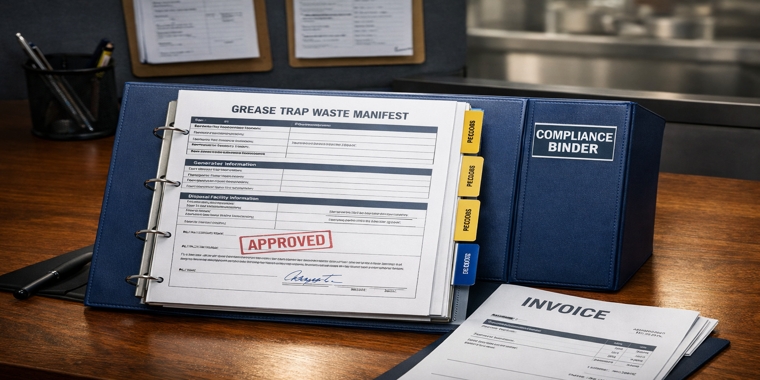
- Organize Before You Need It: A simple binder with manifests filed by date turns surprise inspections into quick, stress-free paperwork checks.
- Warning Signs Mean Your Schedule Is Wrong: Slow drains, bad smells, and “racing the deadline” every cycle signal your trap fills faster than your current service allows.
Match your cleaning schedule to your grease output, not just the legal minimum.
Houston restaurant owners and managers will find a clear compliance roadmap here, preparing them for the detailed scheduling and documentation strategies that follow.
~ ~ ~ ~ ~ ~ ~ ~ ~ ~ ~ ~ ~ ~ ~ ~ ~ ~ ~ ~ ~ ~ ~ ~ ~ ~ ~ ~ ~ ~ ~ ~ ~ ~ ~ ~ ~ ~ ~ ~ ~ ~ ~ ~ ~ ~ ~ ~ ~ ~ ~ ~ ~ ~
The faint sulfur smell hits at 10:47 AM. Prep is half-done. The lunch rush starts in an hour.
You trace it to the floor drain near the fryer station. The water isn’t backing up yet, but it’s pooling longer than it should. Your grease trap was serviced… when, exactly? You dig through the office for paperwork. There’s an invoice from three months ago. Maybe four.
Is that enough if someone shows up asking questions?
That quiet panic is familiar to restaurant operators across Houston. The grease trap sits out of sight, doing its job, until it doesn’t. And when it fails, it fails during your busiest hours—bringing odors, backups, and the risk of a citation you didn’t see coming.
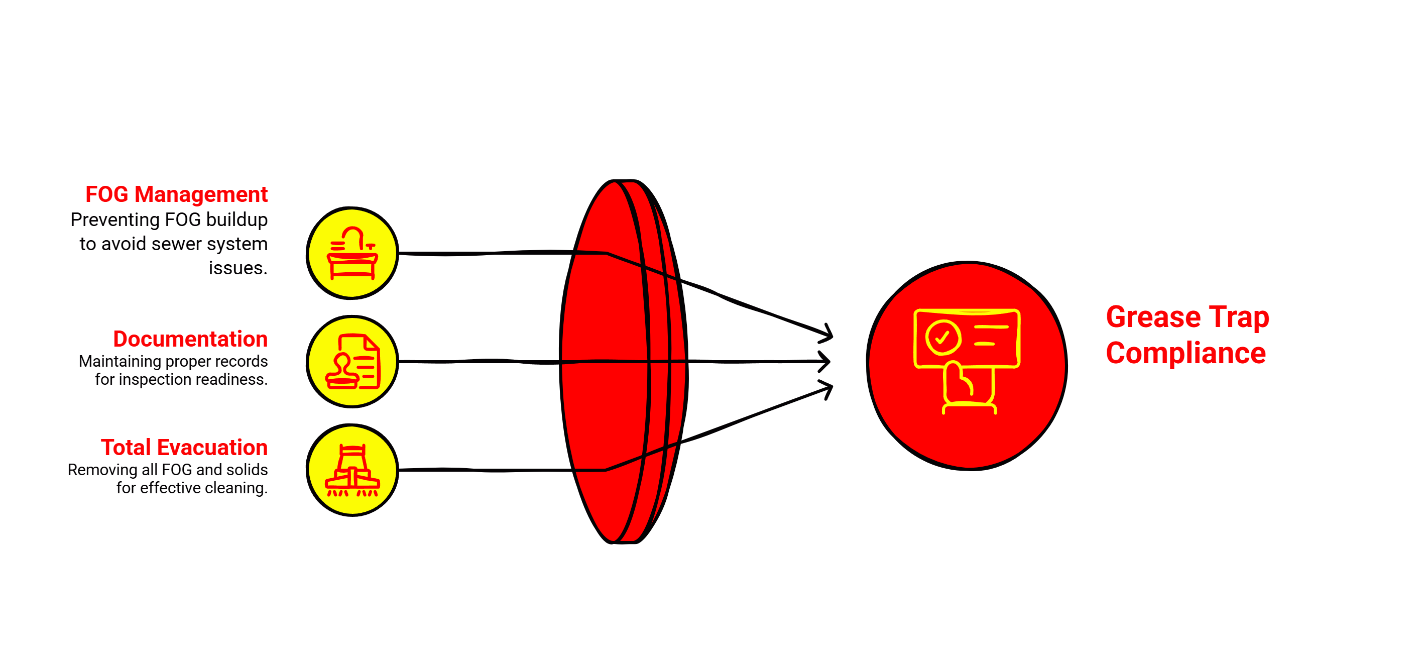
Commercial grease trap cleaning in Houston means more than pumping out waste. It’s the combination of proper service timing, complete FOG removal, and the right documentation that keeps your kitchen running and your business protected. A properly calibrated service schedule eliminates compliance friction, keeping your kitchen open and fully operational.
This guide breaks down exactly what Houston expects from restaurant operators, how to set a cleaning schedule that reflects your actual FOG output, alongside a documentation protocol that easily satisfies municipal audits.
What “Commercial Grease Trap Cleaning” Actually Means in Houston
Every commercial kitchen that cooks generates fats, oils, and grease—FOG, in industry shorthand. Left unchecked, FOG solidifies in pipes, clogs municipal sewer lines, and creates expensive problems for the entire system. That’s why grease traps exist: they intercept FOG before it leaves your building.
Think of the grease trap as your kitchen’s kidneys. It filters what flows through, separating waste that shouldn’t enter the sewer system. Like kidneys, it needs regular maintenance to keep working.
In Houston, compliance isn’t just about getting the trap pumped. The city treats documentation as part of the requirement. A service visit without proper paperwork still leaves you exposed during an inspection. The proof matters as much as the pump-out.
What separates professional commercial grease trap cleaning from a quick pump-and-go? Total evacuation. This means removing all accumulated FOG and settled solids—not skimming the top layer and calling it done. Complete removal is what restores drain flow, eliminates odors at the source, and resets your trap to handle another cycle of kitchen operations.
Houston Compliance Expectations Restaurants Should Understand
Houston enforces specific requirements for commercial grease traps. Understanding these rules prevents surprises during inspections.
The Core Compliance Rules:
| Requirement | What It Means for Your Restaurant |
|---|---|
| Quarterly Cleaning (90-Day Maximum) | Traps within Houston city limits must generally be emptied at least every 90 days. For the vast majority of restaurants, this is a strict ceiling, not a recommendation. However, low-volume kitchens can apply for a formal Notice of Waiver (NOW) from the city to safely extend this cleaning interval up to an absolute maximum of 180 days. |
| 25% Accumulation Trigger | If grease and solids reach 25% of your trap’s total liquid depth, service is required immediately—even if you cleaned it last month. |
| Record Retention | Keep documentation on-site and organized. Inspectors can request records going back five years. |
The 90-day rule establishes the outer boundary. Treat it as the maximum window, not the target date. Here’s what catches operators off guard: the 25% threshold can override the calendar. High-volume kitchens—especially those doing heavy frying—can hit that accumulation level well before day 90.
The Invoice vs. Manifest Distinction
This is where many restaurant operators get burned. They pay for service, file the invoice, and assume they’re covered. They’re not.
| Document | What It Proves | Compliance Value |
|---|---|---|
| Invoice | You paid for a service | Financial record only |
| Manifest | FOG was legally transported and disposed of at an approved facility | Compliance proof |
An invoice records a financial transaction, whereas a manifest tracks the legal disposal path. During an audit, inspectors want the manifest. The invoice alone doesn’t prove your FOG reached a legal disposal site.
When the crinkle of that carbon-copy manifest paper gets handed over after service, that’s the confirmation that matters. Keep it.
How Often Should Restaurants Schedule Grease Trap Cleaning?
Quarterly service satisfies the legal minimum. But the legal minimum isn’t always the operational reality.
Quarterly Baseline vs. High-Volume Reality
Start with quarterly as your baseline. Then ask: does my kitchen’s FOG output actually fit that schedule?
Restaurants doing heavy frying, high-volume cooking, or operating extended hours often generate enough grease to fill traps faster than the 90-day window allows. Waiting until day 89 becomes a gamble. If you hit 25% accumulation at day 60, you’re already out of compliance—and probably dealing with odors or slow drains.
A Practical Scheduling Framework
Use this as a quick classifier:
Quarterly (baseline)
- Lower to moderate volume kitchens
- No recurring odors
- No pattern of slow drains or recurring clogs
- You’re not “racing the deadline” every cycle
Monthly (common for high-FOG kitchens)
- High volume frying, heavy grease load
- Odors show up before day 90
- Drains slow down in predictable cycles
- You’ve had “almost a backup” moments
Every 30–60 days (often the real-world cadence for some operations)
- You hit the 25% threshold quickly
- You’ve had an overflow or backup history
- Your trap size is small relative to output
Warning Signs Your Schedule Is Too Slow
Your kitchen tells you when the current schedule isn’t working. Watch for these signals:
- Slow drainage in kitchen sinks and floor drains
- Persistent odors near the trap or in the kitchen
- Visible grease appearing in unusual places like floor drains or sink basins
- Recurring clogs despite recent service
- Day-89 scheduling habit—consistently pushing service to the last possible day
Any of these signals suggests your trap is reaching capacity before your scheduled service. The fix isn’t waiting longer; it’s adjusting frequency to match your actual volume.
Protecting Service Hours with Proactive Scheduling
Grease trap emergencies don’t respect your reservation book. Backups and overflows happen during peak hours because that’s when you’re generating the most FOG.
Proactive scheduling—setting recurring service that stays ahead of accumulation—prevents the scramble of emergency calls during Friday dinner rush. A reliable provider like Drane Ranger can maintain your service history and proactively schedule appointments, eliminating the burden of tracking deadlines yourself.
Being courteous and mindful of your customers and your business means scheduling service during off-peak windows, completing work efficiently, and leaving your kitchen ready to operate.
Grease Trap Types You’ll See in Houston Restaurants
Not all grease traps work the same way, and the type you have affects how service gets planned.
Indoor Hydro-Mechanical Units
These smaller units typically sit under sinks or in equipment areas inside your kitchen. They’re more accessible but also require more frequent attention due to their limited capacity.
Planning considerations:
- Easier access means faster service visits
- Smaller capacity may require more frequent cleaning
- Service can happen during slower kitchen hours without major disruption
Outdoor Gravity Interceptors
These larger underground units handle higher volumes and serve the entire kitchen’s drainage. They’re common in larger restaurants or buildings with multiple food service tenants.
Planning considerations:
- Require vacuum truck access to the exterior
- Larger capacity may allow longer intervals between service
- Service scheduling needs to account for parking and access logistics
Whichever type your restaurant uses, the principle stays the same: a predictable service routine prevents the emergency moments that shut down operations.
Documentation That Keeps You Audit-Ready
Good paperwork turns inspections into non-events. Poor paperwork turns routine visits into compliance nightmares.
What Your Documentation Should Accomplish
The goal is simple: prove that your FOG was removed on schedule and disposed of legally. Effective documentation captures:
- Service dates (when the work happened)
- Waste quantities (how much was removed)
- Disposal facility information (where it went)
- System issues identified (any problems the technician noted)
This creates the chain of custody that satisfies inspectors. Your provider should deliver this information on every visit.
A Simple On-Site Organization System
You don’t need sophisticated software. A basic binder system works:
The Compliance Binder Setup:
- Front section: Current permit, contact information for your service provider, and the most recent manifest
- Tabbed sections by year: All manifests filed chronologically
- Quick-access rule: Newest documents always go in front
Keep this binder in the manager’s office or wherever compliance documents live. When an inspector asks for records, you hand them a binder—not a frantic search through desk drawers.
Digital Backup Habit
Paper gets lost. Coffee gets spilled. Create a simple digital backup:
- Scan or photograph each manifest immediately after service
- Save files with a consistent naming format
- Store in a cloud folder accessible from your phone
If the physical binder disappears, your digital backup keeps you covered.
The 30-Second Retrieval Test
Here’s the test that matters: Could your shift lead produce your latest paperwork in 30 seconds?
If not, fix the system—not because it’s “nice to have,” but because surprise inspections reward speed and organization.
When Paperwork Goes Missing
If you discover gaps in your records, contact your service provider. Reputable companies like Drane Ranger maintain service histories and can help you reconstruct documentation. The goal is rebuilding a complete chain-of-custody file before you need it—not scrambling during an inspection.
What Happens When Compliance Slips
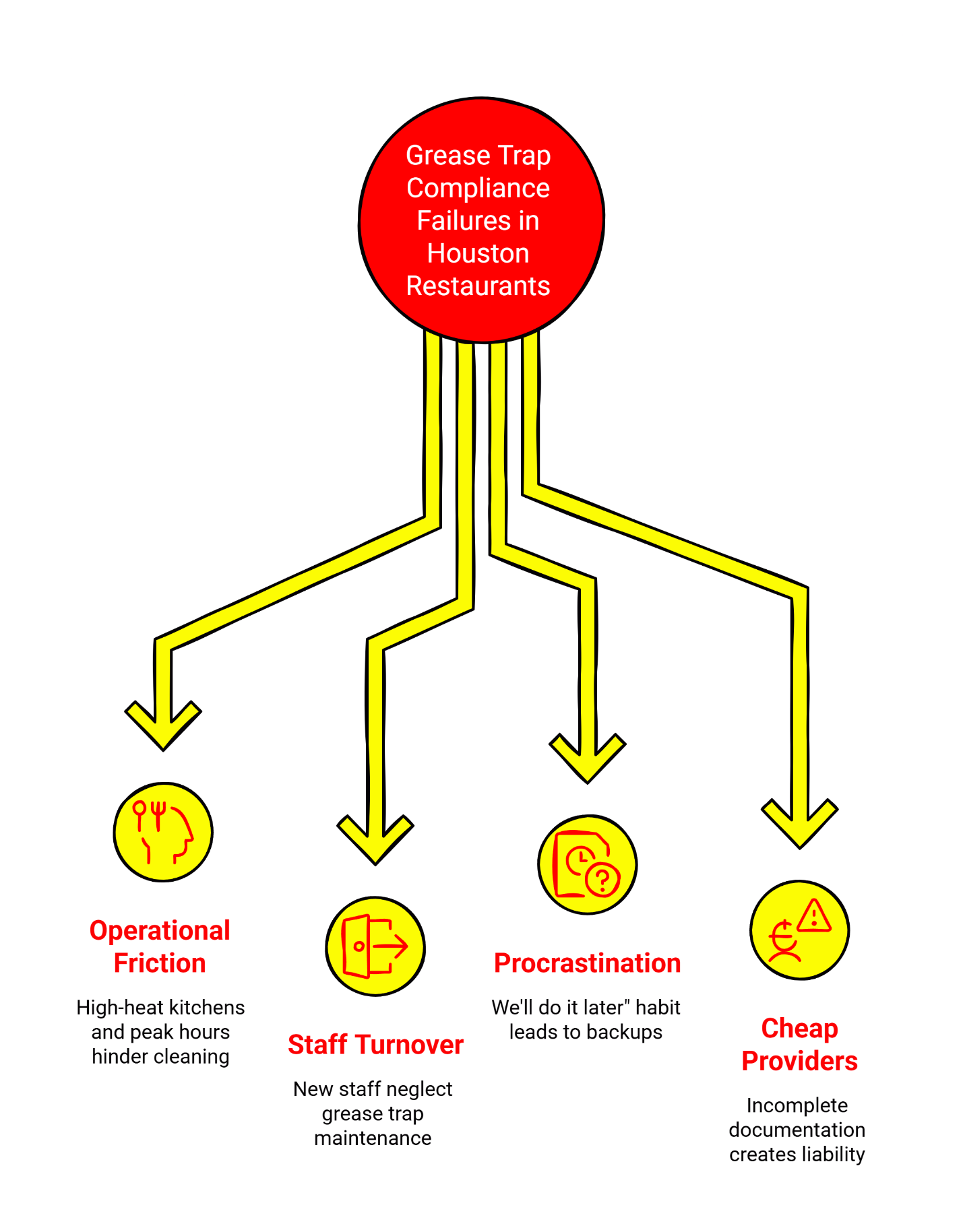
Operators don’t get into trouble because they don’t care. They get into trouble because operational friction piles up—high-heat kitchens, cramped access, peak-hour pressure, staff turnover, and the easy habit of “we’ll do it later.”
Understanding consequences isn’t about fear. It’s about seeing why the system matters.
Operational Consequences
Grease trap failures hit your business directly:
- Backups during service force you to close sections of the kitchen or the entire restaurant
- Odors drive customers away and create staff complaints
- Emergency service calls cost more than scheduled maintenance and happen at the worst times
- Equipment damage from backed-up grease can mean expensive repairs
Slow drainage and visible grease in unusual places often precede a full backup. These warning signs during a busy lunch rush mean you’re one heavy cooking day away from a shutdown.
Compliance Consequences
Houston takes FOG violations seriously:
- Citations come with fines that escalate with repeat offenses
- Permit risk threatens your ability to operate
- Audit failures create a compliance record that follows your business
The cheapest pump-and-go provider becomes expensive if they leave you without proper documentation. Liability for improper disposal stays with the generator—that’s you.
If you’re already facing a crisis, emergency services can help address immediate problems before they escalate further.
The “Cheap Provider” Risk
Some operators choose the lowest-cost service assuming all grease trap cleaning is the same. It’s not.
A provider who pumps without delivering proper manifests leaves you holding liability. If that FOG doesn’t reach a legal disposal facility, you have no proof of compliance. The savings disappear when citations arrive.
A reliable provider—like those serving Houston since 1985—delivers both the service and the documentation that protects your business. Better Business Bureau accreditation and proper licensing matter when your compliance is on the line.
A Compliance Plan You Can Start This Week
Convert everything above into action with this simple checklist:
☐ Choose Your Cadence
- Start with quarterly as baseline
- Move to monthly if you see warning signs (odors, slow drains, day-89 habit)
- Consider every 30-60 days if you hit the 25% threshold quickly
- Match frequency to your kitchen’s actual FOG volume
☐ Assign Ownership
- Designate who schedules service (GM or owner, typically)
- Designate who files paperwork (can be same person or kitchen manager)
- Make sure backup coverage exists for vacations
☐ Create Your Compliance Binder
- Set up the physical binder with current year tab
- Establish the digital backup folder with consistent naming (YYYY-MM-DD_Location_GreaseTrap)
- File any existing manifests you can locate
☐ Confirm Provider Process
- Ask: “Do you provide manifests showing disposal facility?”
- Ask: “Do you maintain service history for my account?”
- Ask: “Can you set up proactive scheduling?”
☐ Set the First Reminder
- Schedule your next service before the 90-day deadline
- Set a calendar reminder for 2 weeks before service date
- Review after 3 cycles and adjust frequency if needed
☐ Establish a 25% Capacity Protocol:
Mandate visual or dipstick inspections to trigger immediate service when FOG levels reach 25% of total liquid depth.
Frequently Asked Questions
How often should a commercial grease trap be cleaned in Houston?
Houston requires cleaning at minimum every 90 days for traps within city limits. This is a maximum interval, not a recommendation. High-FOG kitchens—those doing heavy frying or extended hours—often need service every 30-60 days to prevent hitting the 25% accumulation threshold before the quarterly deadline. Watch for warning signs like odors and slow drains to determine if your schedule matches your volume.
What’s the difference between a grease trap invoice and a manifest?
An invoice proves you paid for service. A manifest proves your FOG was legally transported and disposed of at an approved facility. During a city audit, inspectors want manifests because they show chain of custody—where the waste actually went. An invoice alone doesn’t demonstrate compliance with disposal requirements.
How long should restaurants keep grease trap cleaning records in Houston?
Maintain organized records on-site for five years to satisfy audit requirements. Keep both physical copies in a compliance binder and digital backups. The goal is producing documentation quickly when inspectors ask—delays and disorganization create problems even when your service was compliant.
What are the warning signs my grease trap service schedule is too slow?
Watch for slow drainage in kitchen sinks, persistent odors near the trap, visible grease appearing in floor drains, recurring clogs despite recent service, and a habit of scheduling on day 89 of the 90-day window. Any of these signals suggests accumulation is outpacing your current schedule.
Do different grease trap types change compliance planning?
Yes. Indoor hydro-mechanical units have smaller capacity and may need more frequent service, but they’re easier to access during business hours. Outdoor gravity interceptors handle larger volumes and may allow longer intervals, but require planning for vacuum truck access. Both types follow the same compliance rules—the difference is in scheduling logistics and service frequency.
Invisible compliance isn’t about doing more. It’s about having a system that handles itself.
The restaurant operators who never worry about grease trap citations share a simple approach: they set a service schedule that matches their kitchen’s reality, they keep manifests organized and accessible, and they work with a provider who delivers both complete service and proper documentation.
That’s the transformation—from the quiet panic of uncertain compliance to the confidence of knowing your trap is clean, your drains flow freely, your kitchen smells right, and your paperwork is ready whenever someone asks.
Want a simple schedule that matches your kitchen’s volume and keeps the paperwork trail clean? Call Drane Ranger at 281-489-1765 and ask about recurring service. Satisfying customers since 1985, they serve restaurants throughout the Greater Houston area—including Pearland, Alvin, Sugar Land, and surrounding communities.
Ready to set it up? Contact Drane Ranger today for a free, no-obligation compliance assessment.
Disclaimer: This guide provides general information about commercial grease trap compliance in Houston and is intended for educational purposes. Specific requirements may vary, and operators should verify current regulations with the City of Houston or consult with a compliance professional for their particular situation.
Our Editorial Process:
The Drane Ranger Insights Team researches, drafts, and reviews every piece to ensure it’s clear, accurate, and genuinely useful. We prioritize practical guidance, plain language, and real-world service experience. Content is reviewed for clarity and updated as needed.
About the Drane Ranger Insights Team:
The Drane Ranger Insights Team is our dedicated engine for synthesizing complex topics into clear, helpful guides. While our content is thoroughly reviewed for clarity and accuracy, it is for informational purposes and should not replace professional advice.