📌 Key Takeaways
A five-year FOG manifest log protects restaurants by keeping signed waste records ready before inspectors ask.
- Build Two Copies: Keep one physical binder and one digital folder so records survive spills, loss, and turnover.
- File Manifests First: Invoices prove payment, but signed manifests help prove where grease trap waste went.
- Use Clear Sections: Sort current records, past years, permits, vendor details, and missing documents in separate places.
- Scan Every Service: File the signed manifest the same day service happens, before paperwork gets lost.
- Assign Backup Ownership: One manager and one backup should know where records live and how to fix gaps.
Simple systems beat frantic searches when inspectors ask for proof.
Restaurant owners and kitchen managers will gain a cleaner way to manage FOG records, preparing them for the detailed overview that follows.
~ ~ ~ ~ ~ ~ ~ ~ ~ ~ ~ ~ ~ ~ ~ ~ ~ ~
The binder is missing.
A stained folder sits behind old invoices, service receipts, and a stack of papers from the last manager who “knew where everything was.” You start sorting by date, then by vendor, then by whatever looks official. The uncomfortable thought lands fast: Could we actually produce five years of signed manifests if an inspector asked today?
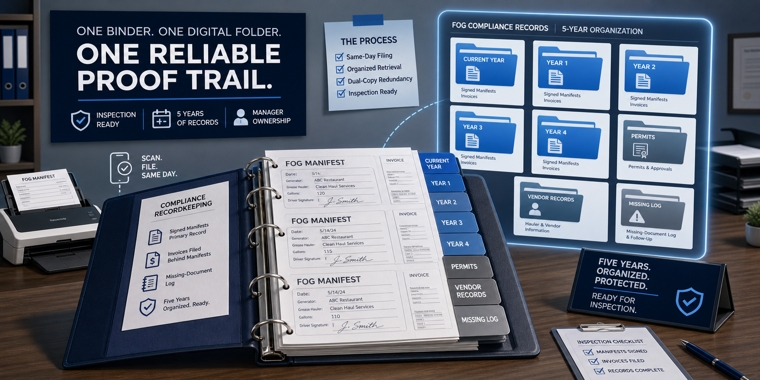
You don’t need a complicated document system. You need one physical binder, one matching digital folder, and a routine simple enough that the next manager can keep it alive. A manifest log is your proof trail, not just your filing system. It is the practical storage layer for long-term FOG chain-of-custody compliance.
Invoices matter for your accounting records. Manifests matter for your inspection records. Keep both, but do not confuse one for the other.
Start With the FOG Binder Blueprint
Set up the binder first.
A physical binder gives the kitchen manager or GM something fast to open during an inspection. The digital copy protects the business when paper gets stained, misplaced, or buried during an office cleanup.
Five years of manifests should be organized before inspection day, not rebuilt while an inspector is waiting.
Use this structure:
| Binder / Folder Section | What Goes Inside | Why It Matters |
|---|---|---|
| Current Year | Newest manifests, sorted newest first | Fast retrieval during inspection |
| Prior Years 1–4 | Manifests sorted by year and month | Supports the 5-year record window |
| Permit & Inspection Records | FOG permit, prior inspection forms, waiver if applicable | Keeps related inspection documents together |
| Vendor Records | Provider contact, service schedule, duplicate-record process | Helps new managers know who to call |
| Missing Document Log | Missing manifests, dates requested, vendor follow-up | Prevents silent gaps from staying hidden |
Keep the binder in an office or manager area, not beside a mop sink, prep table, or grease-heavy workspace. Use plastic sleeves for current-year manifests. Put a one-page “How to Use This Binder” sheet at the front.
A manifest log is not a pile of paperwork. It is the proof trail that shows where your kitchen’s waste went.
Mirror the Binder With a Digital Folder System
The digital folder is not optional backup clutter. It is your safeguard against real kitchen-office failure.
Paper gets moved. Managers change jobs. A service receipt can sit in an apron pocket for 2 days before anyone notices. A quick scan or phone photo after service can prevent a small paperwork gap from becoming a frantic search later.
Use the same structure online that you use in the binder:
FOG-Manifests / 2026 / 2026-03-12_Drane-Ranger_Manifest.pdf
Keep it simple. A shared drive or existing business folder is enough if the owner, GM, kitchen manager, and backup manager can access it.
Use this division of roles:
- Physical binder: Best for fast onsite inspection response.
- Digital folder: Best for redundancy after spills, misplaced documents, turnover, or office cleanup.
- Manager handoff sheet: Best for continuity when the kitchen manager or GM changes.
- Provider follow-up log: Best for tracking missing copies before they become audit-day gaps.
Make scanning part of the service-day closing routine. When the grease trap is serviced, the signed manifest gets filed twice: once in the binder and once in the digital folder. No waiting for “later.” Later is when paperwork disappears.
What Every Manifest Entry Needs to Prove
A waste manifest is the official record that follows grease trap waste from your kitchen to its next destination. It is not the same thing as an invoice.
The Houston Health Department Waste Generator FAQ describes waste manifests as inspection documents and notes that inspectors may arrive without prior notification. The same FAQ references that commercial waste manifests—typically retained as authorized physical copies or verifiable digital records—must be kept for the past 5 years as records establishments with interceptors may need to provide..
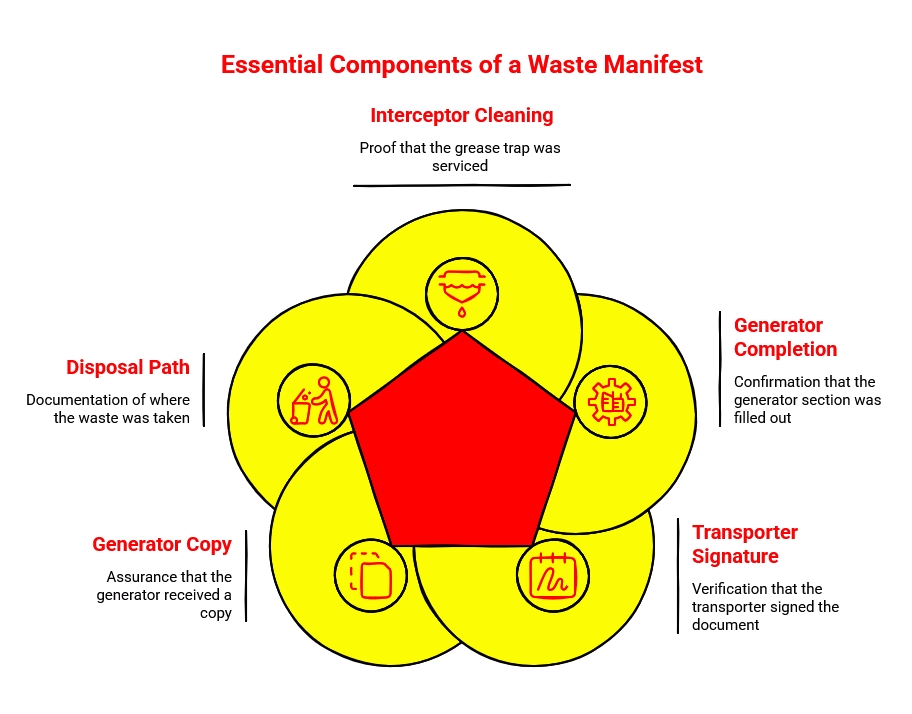
A complete manifest record should help show:
- the interceptor was cleaned;
- the generator portion was completed;
- the transporter signed the document;
- the generator received a copy;
- the disposal path was recorded.
Houston’s municipal code governing commercial waste transporters generally addresses manifest completion details, including generator, transporter, and disposal-site information. Kitchen managers do not need to memorize the specific ordinance numbers, but they do need a system that keeps the relevant paperwork together. For the exact current legal text, use the City’s searchable Code of Ordinances portal to review the most up-to-date liquid waste regulations.
Why Invoices Belong Behind Manifests, Not Instead of Them
Here is the common trap.
Myth: “We paid for service, so the invoice proves we are covered.”
Reality: An invoice shows a transaction. A manifest supports the chain-of-custody record.
That difference matters. Your invoice may show that a vendor charged the restaurant for service. Your manifest helps show what happened to the FOG waste after removal.
File invoices behind the matching manifest. Do not file invoices as the main proof. This keeps accounting records and compliance records connected without treating them as interchangeable.
For a broader look at inspection readiness beyond the manifest log, Drane Ranger’s complete compliance guide for restaurants can help connect documentation habits with maintenance planning.
Build a Manager Handoff Routine That Survives Turnover
A five-year log fails when only one person understands it.
The fix is simple: assign one primary owner and one backup owner. Add the binder review to new manager onboarding. Give the owner or GM access to the digital folder. Review the log monthly or after every service visit.
Use this recovery checklist after each service:
- Confirm the latest service date is filed.
- Confirm the manifest copy is scanned.
- Confirm the invoice, if present, is filed behind the manifest.
- Confirm any missing document is logged.
- Confirm the backup manager knows where records are stored.
Put this handoff note at the front of the binder:
“This binder lives in the manager office. Digital copies are stored in the shared FOG-Manifests folder. If a manifest is missing, write the service date in the Missing Document Log, contact the grease trap provider, request a duplicate copy, and file the recovered document in both places.”
That one paragraph can save the next manager from guessing.
When to Ask Your Grease Trap Provider for Duplicate Records
Your provider should make documentation easier to manage, not harder to chase.
When evaluating commercial grease trap cleaning in Houston, ask practical questions:
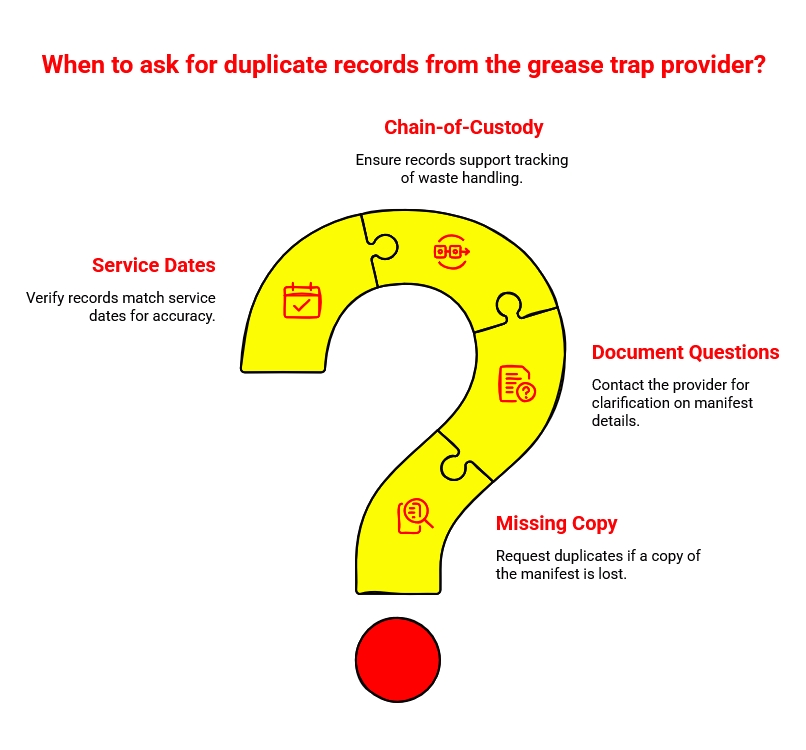
- Do you leave signed manifests after each service?
- Can you help recover duplicate records if a copy is missing?
- Who should the manager contact for document questions?
- Do the records include details that support chain-of-custody tracking?
- Can service records be matched clearly to service dates?
These questions are not a sales exercise. They are provider accountability. A kitchen manager needs a visible way to confirm that the right documentation is left after each service.
Drane Ranger provides grease, grit, and lint trap services in the Houston area, and its broader site messaging emphasizes customer service, compliance, and practical liquid waste support. That context is useful, but no provider relationship replaces your own internal log.
FAQs About 5-Year FOG Manifest Logs
How long should Houston restaurants keep FOG manifests?
Houston inspection guidance references waste manifests for the past 5 years among records establishments with interceptors may need to provide. Because requirements can change, confirm current expectations with the Houston Health Department or the Houston Permitting Center.
Are grease trap invoices enough for a FOG audit?
No. An invoice is not the same as a chain-of-custody manifest. Keep invoices as supporting business records behind the matching manifest.
Where should a kitchen keep the manifest binder?
Keep it in an accessible office or manager area, protected from grease, water, and daily kitchen traffic. The goal is fast retrieval without exposing the binder to normal kitchen damage.
Who should own the manifest log?
Assign one primary manager and one backup manager. The owner or GM should also have access to the digital folder.
What should happen if a manifest is missing?
Log the missing service date, contact the provider, request a duplicate, and add the recovered copy to both the binder and digital folder. Do not leave the gap undocumented.
Should digital copies be kept too?
Yes. A dual physical-digital system protects the restaurant from spills, misplaced pages, office cleanouts, and staff turnover.
How does a manifest log fit into overall grease trap inspection readiness?
The manifest log is the documentation layer of inspection readiness. It does not replace physical maintenance, scheduled cleaning, or proper disposal, but it helps prove that records are organized when requested. For inspection-day preparation, Drane Ranger’s guide on surviving a City of Houston FOG audit is a useful next read.
Keep the System Simple Enough to Maintain
A 5-year manifest log does not need fancy software. It needs consistency.
One binder. One matching digital folder. One primary owner. One backup owner. One habit after every service.
That is how a messy back-office pile becomes an inspection-ready proof trail. Not perfect. Reliable.
Use the FOG Binder Blueprint to organize your last five years of manifests before your next inspection. If records are missing or your provider is not leaving signed manifests, contact Drane Ranger through the Contact Us page or call 281-489-1765.
Disclaimer: This article is for general educational purposes only and is not legal advice. Houston FOG and special waste requirements can change, and enforcement details may vary by facility. Confirm current requirements with the City of Houston, the Houston Health Department, or a qualified compliance professional.
Our Editorial Process:
Our expert team uses AI tools to help organize and structure our initial drafts. Every piece is then extensively rewritten, fact-checked, and enriched with first-hand insights and experiences by expert humans on our Insights Team to ensure accuracy and clarity.
By: About the Drane Ranger Insights Team
The Drane Ranger Insights Team is our dedicated engine for synthesizing complex topics into clear, helpful guides. While our content is thoroughly reviewed for clarity and accuracy, it is for informational purposes and should not replace professional advice.