Understanding the Difference Between a Grease Trap and a Grit Trap

📌 Key Takeaways

Grease traps capture floating FOG from kitchens; grit traps capture sinking sediment from wash bays—mixing them up causes backups, compliance violations, and costly downtime.

  • Function Determines Location: Grease traps sit near kitchen drains to catch fats and oils, while grit traps install at wash bays to capture sand and heavy solids before they damage pipes.
  • The 25% Rule Governs Timing: Houston requires cleaning when FOG or sediment reaches 25% of trap depth, not just at the 90-day administrative deadline—high-volume sites often hit this threshold in 45–60 days.
  • Manifests Prove Compliance: Invoices show payment; manifests document what was removed, where it went, and who disposed of it—regulators require the latter during inspections, not the former.
  • Multi-Use Properties Need Both: Facilities combining food service with vehicle washing require separate grease and grit trap systems, each with independent service schedules and distinct documentation requirements.
  • Professional Service Means Total Evacuation: Complete trap service removes all material and cleans hardened deposits on walls and baffles, not just surface skimming—partial removal accelerates the next fill cycle.

Documentation isn’t paperwork; it’s license protection.

Commercial kitchen operators, car wash managers, and multi-use facility owners will gain clarity on compliance requirements here, preparing them for the identification checklist and service scheduling guidance that follows.

The equipment room hums. Water flows. Everything seems fine—until it isn’t.

A backed-up drain during lunch rush. Foul odors creeping into the dining area. A car wash bay flooded with standing water. These aren’t random equipment failures. They’re the predictable result of treating two completely different wastewater systems as if they were the same thing.

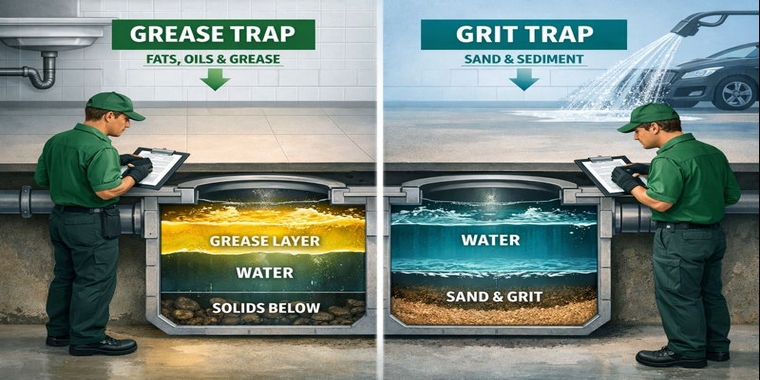
A grease trap separates fats, oils, and grease from kitchen wastewater before they solidify in sewer lines. A grit trap captures sand, dirt, and sediment from wash water before these abrasive materials damage pipes and pumps. The distinction matters because the wrong maintenance approach leads to backups, odors, downtime, and compliance violations.

If you operate a commercial kitchen, you need grease trap cleaning in Houston. If you run a car wash or vehicle maintenance facility, you need grit trap cleaning in Houston. Properties with both operations require both services on separate schedules with different documentation requirements.


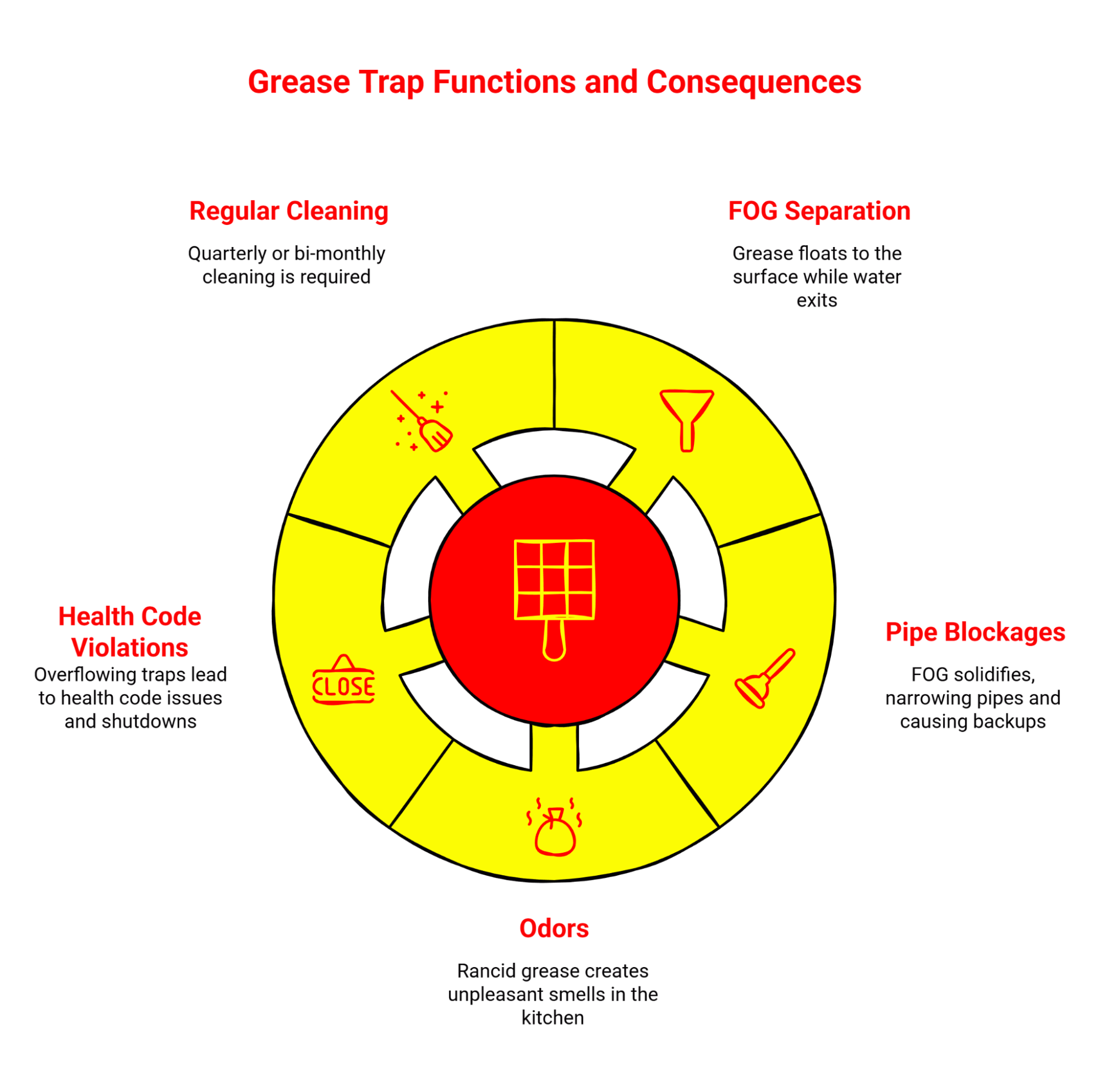
Grease Traps: Capturing FOG Before It HardensCircular diagram showing grease trap's central FOG separation function surrounded by five consequences of neglect: pipe blockages, odors, health code violations, and the need for regular cleaning.
Kitchen wastewater carries fats, oils, and grease—commonly called FOG in the industry. This material floats on water and remains liquid when warm. As it cools while traveling through plumbing, it solidifies and adheres to pipe walls. Without intervention, FOG accumulation narrows pipes, restricts flow, and eventually creates complete blockages.

A grease trap provides that intervention by slowing wastewater flow and allowing FOG to separate and float to the surface while cleaner water exits through a submerged outlet. The trap holds the separated grease until professional removal.

Commercial kitchens typically use one of two configurations. Under-sink grease traps, typically rated for 20 to 50 pounds (approximately 10 to 25 gallons) flow capacity, serve smaller operations like cafes or food trucks. These compact units install directly under three-compartment sinks to manage lower volumes. Larger restaurants and institutional kitchens use outdoor interceptors—tanks holding 500 to 2,000 gallons or more—buried outside the building and connected to multiple kitchen drains.

When a grease trap approaches capacity, the first symptom is usually slow drainage. Water pools in sinks and takes noticeably longer to clear. The next stage brings odors—the distinctive smell of rancid grease that spreads through the kitchen and potentially into customer areas. If the situation continues without service, the trap overflows and forces wastewater back into the operation, creating a health code violation and forcing immediate shutdown.

Houston regulations commonly require quarterly grease trap cleaning for commercial food service operations. High-volume kitchens often need service every 60 days based on their FOG production rates.


Grit Traps: Stopping Solids That Sink
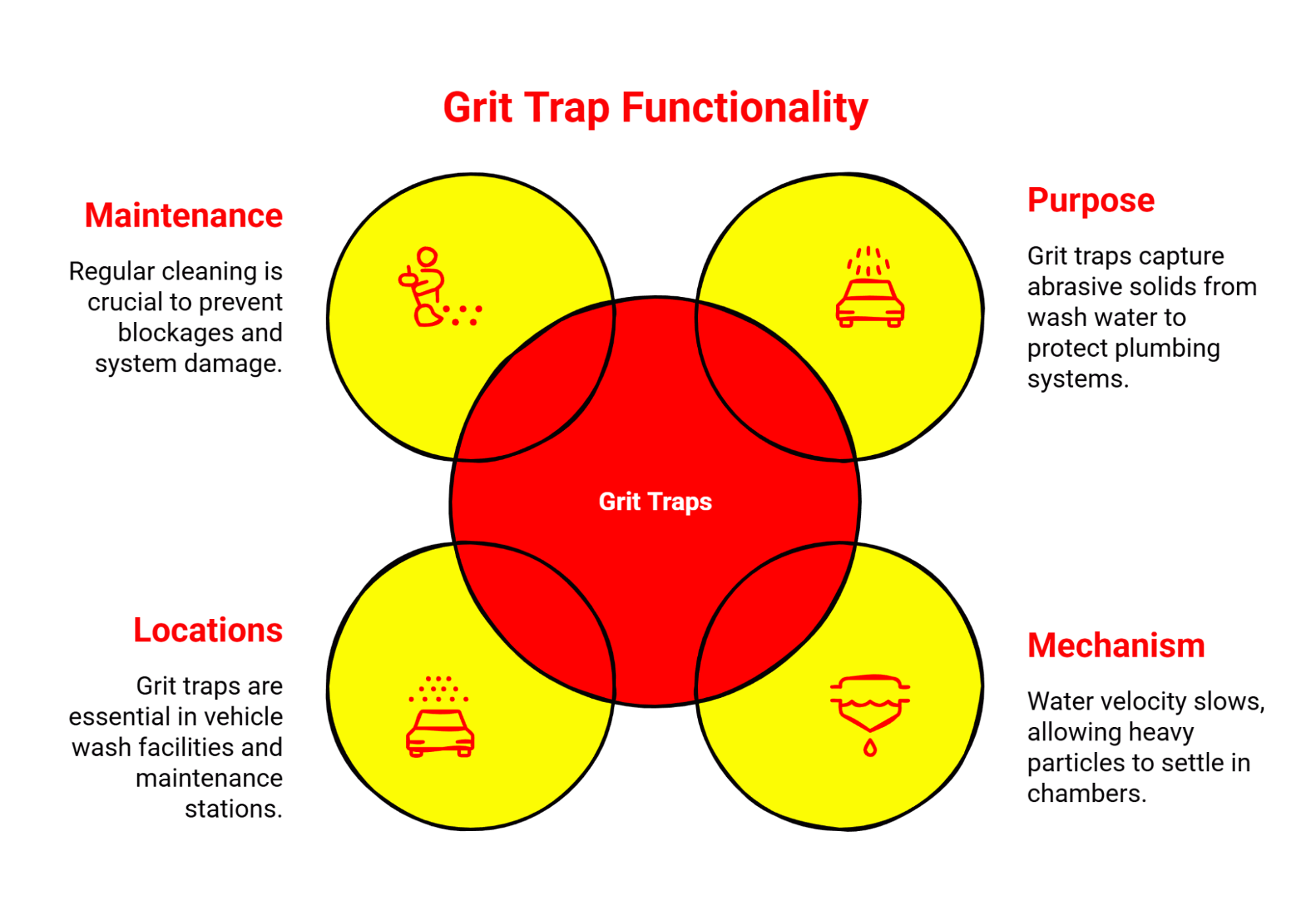
Venn diagram showing four aspects of grit trap functionality: purpose, mechanism, locations, and maintenance, with central red circle labeled 'Grit Traps' and four overlapping yellow circles.

While grease floats, grit sinks. This fundamental difference shapes everything about how grit traps function and why they appear in different locations than grease traps.

Vehicle washing generates water loaded with sand, dirt, mud, and other heavy particles. These materials are abrasive. When they flow through plumbing systems, they scour pipe interiors, clog valves, and damage pump impellers. A grit trap captures these solids by providing a chamber where water velocity slows enough for heavy particles to settle to the bottom.

Car washes, vehicle dealerships with wash operations, fleet maintenance facilities, and equipment cleaning stations all rely on grit traps. The typical installation places the trap between the wash area and the connection to the municipal sewer system.

Standard grit traps typically utilize a two-chamber design, though configurations can vary based on facility age and specific discharge permits. In the two-chamber setup, water enters the first chamber, where heavy solids settle. A crossover pipe near the top allows cleaner water to flow into the second chamber for additional settling before exiting through the outgoing pipe. This design provides two opportunities to capture solids before they reach downstream systems.

Houston’s landscape and climate can contribute to faster grit accumulation than operators might expect if they’ve worked in other regions. The sandy soil common in the area means vehicles often carry more grit into wash bays. While city regulations typically mandate quarterly service at minimum, many high-volume locations schedule cleaning every 60 days or more frequently to prevent system strain.

Visual inspection reveals grit trap problems. Unequal water levels between the two chambers indicate a clogged crossover pipe. If both chambers show rising water that won’t drain, the outgoing pipe likely has a blockage. When you can see the bottom of the trap filling with accumulated sand and sediment, service is overdue.

Side-by-Side Comparison

System Captures Source Common Locations Warning Signs Service Frequency Required Documentation
Grease Trap Fats, oils, grease (FOG) Kitchen sinks, dishwashers, prep stations Restaurants, cafeterias, hotel kitchens, food service operations Slow drains, rancid odors, visible grease accumulation, wastewater backups Every 60–90 days; Houston typically requires quarterly minimum for commercial kitchens Signed manifests showing removal date, volume, disposal location, and hauler information
Grit Trap Sand, dirt, sediment, heavy solids Vehicle wash water, equipment cleaning runoff Car washes, dealerships, fleet yards, wash bays Unequal chamber water levels, clogged crossover or outgoing pipes, visible sediment accumulation Every 60–90 days; Houston typically requires quarterly minimum; high-volume sites often need more frequent service Service records, disposal receipts, maintenance logs documenting cleanout dates and findings


How to Identify Your System

Location provides the first clue. Grease traps sit near kitchen operations—often in a utility room accessible from the kitchen, or in the case of under-sink units, directly beneath the dishwashing area. Grit traps are located near wash bays, typically in an outdoor access pit or underground chamber adjacent to vehicle washing operations.

Use this quick identification checklist:

  • Trace the source: Kitchen fixtures and floor drains point to grease trap systems. Wash bay drains and equipment rinse stations point to grit traps.
  • Check what accumulates: A thick floating layer suggests FOG. Heavy sediment at the bottom indicates sand and grit.
  • Watch the symptoms: Grease issues typically present as foul odors and slow drainage at kitchen fixtures. Grit issues often show as rising water levels, unequal chamber levels, or restricted flow.
  • Confirm the footprint: Smaller units are usually near fixtures. Larger interceptors are typically exterior or in-ground installations.
  • Consider operations: Properties running both food service and vehicle wash operations may have both systems.
  • Review maintenance records: Consistent documentation helps verify which systems are present and when they were last serviced.

The two-system reality: Multi-use properties present a common source of confusion. A truck stop with both a restaurant and a vehicle wash needs both types of traps. An RV park with food service and a dump station may need both systems. A marina with a restaurant and a boat wash faces the same requirement. Each system operates independently, requires different service schedules, and produces different documentation for compliance purposes.

Assuming one service provider can handle both with a single appointment, or that quarterly service for the grease trap also covers the grit trap, creates compliance gaps that lead to failures and violations.


Common Mistakes That Create Predictable Failures

Treating additives as removal

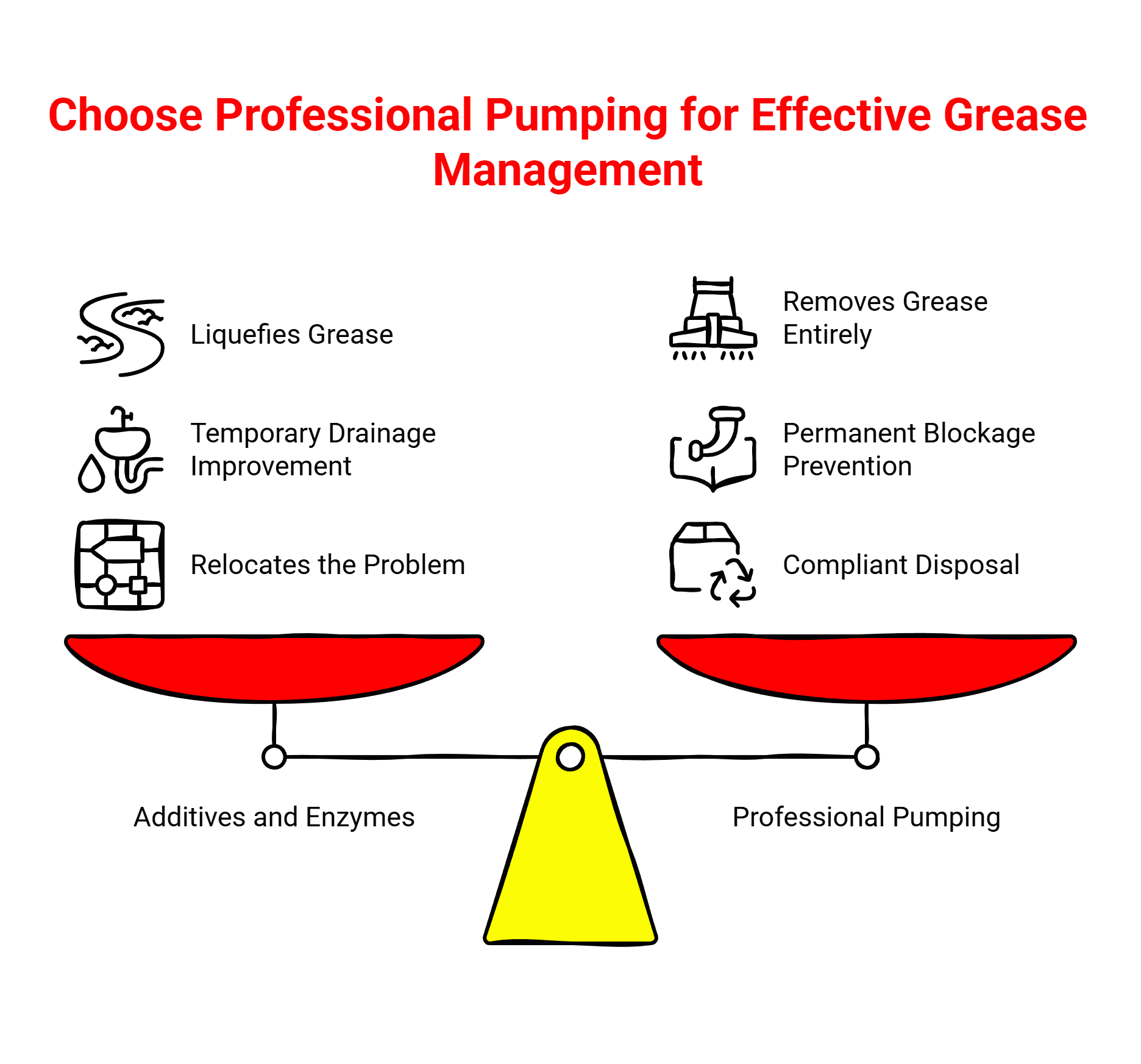
Enzyme treatments, bacterial additives, and hot water flushes can temporarily improve drainage by liquefying FOG or breaking down organic matter. These products don’t remove material from the trap. They move it downstream, where it cools, solidifies, and creates problems in municipal sewer lines or at your property’s connection point.

The same logic applies to grit traps. High-pressure jetting might temporarily clear a clogged pipe, but if the sediment remains in the trap, it will clog again quickly. Professional service physically removes the accumulated material, resetting the trap’s capacity to its original design specification.

Waiting until the deadline

While Houston regulations often adhere to a strict “25% Rule” (cleaning required when FOG/solids reach 25% of wetted depth), the 90-day mark is generally the absolute administrative maximum for permit compliance. Booking service on day 88 or 89 creates unnecessary risk. If the service provider is fully scheduled, if weather delays the appointment, or if the trap requires more extensive cleaning than anticipated, the work may not be completed before the mandated window closes.

Operators should ideally schedule service between day 60 and day 75, or immediately upon reaching the 25% capacity threshold. This buffer ensures compliance even when unexpected complications arise. For high-volume operations, monthly or bi-monthly service eliminates the stress of deadline management entirely.

Confusing invoices with compliance proof

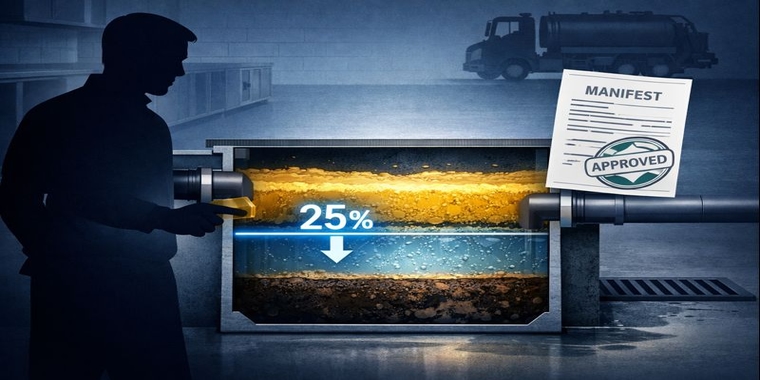
An invoice documents that payment was made for a service. A manifest documents what was removed, how much was collected, where it was transported, and who received it at the disposal facility. During inspections, regulators require manifests. They need proof that waste was handled legally and disposed of at an approved facility.

“It’s not just paper; it’s your license,” explains one Houston operator with two decades of experience managing commercial kitchen compliance. “You pay us to ensure the inspector walks away happy.”

Keep signed manifests on-site for five years minimum. Store them in a dedicated binder organized by date. When an inspector arrives, you should be able to produce complete documentation within minutes. This isn’t administrative overhead—it’s risk management that protects your operating license.

What Professional Service Delivers

Complete grease trap service begins with total evacuation. The service truck’s vacuum system removes all liquid and semi-solid material from the trap, including the layer of FOG floating on top and the accumulated sludge at the bottom. Partial removal—skimming the top layer or pumping only the liquid—leaves material that reduces effective capacity and accelerates the next fill cycle.

After evacuation, professional service includes cleaning the trap’s interior surfaces. Grease hardens on walls, baffles, and the interior of pipes. This stuck-on material narrows the trap’s effective volume and creates persistent odor problems. High-pressure water, appropriate cleaning agents, or manual scraping removes these deposits.

Grit trap service follows a similar pattern. After removing liquid and loose sediment, technicians address compacted material at the bottom of chambers. Sand and dirt compact over time, forming a solid layer that’s difficult to remove with vacuum equipment alone. This material must be broken up and extracted to restore the trap’s full settling capacity.

Responsible disposal completes professional service. Grease trap waste goes to facilities equipped to process FOG and organic material. Grit trap waste goes to facilities that can separate and process sediment. The manifest documenting this disposal provides proof that waste reached an approved destination through a legal chain of custody.

Scheduling matters for business continuity. Professional providers work during off-peak hours to minimize disruption. For restaurants, this typically means early morning before opening or late at night after closing. For car washes, service happens during slower weekday periods or after hours when the facility is closed.

“Drain Ranger is very professional and reliable. Basically they can take care of all your grease drain needs.” — Shelley M.

Understanding that grease and grit require different approaches is the foundation of effective trap maintenance. For comprehensive service covering both systems, explore our Grease Grit & Lint Traps offerings.


Expert Corner: Compliance Documentation and Inspection Readiness

Houston’s trap cleaning requirements tie directly to documentation outcomes. During inspections, regulators verify not only that traps are clean and functional, but that operators maintain proper records demonstrating consistent compliance over time.

The City of Houston provides guidance on cooking oil and grease management that reinforces the connection between proper disposal practices and regulatory compliance. This documentation serves multiple functions: it proves the cleaning schedule is being executed, demonstrates that the waste stream is being handled responsibly, and provides a paper trail that satisfies inspection requirements.

Inspection readiness improves dramatically when records are easy to retrieve and consistent over time. Operators who can immediately produce organized manifests showing service dates, volumes removed, and disposal facility information face significantly less scrutiny during audits than those who scramble to locate scattered paperwork or rely on invoices alone.

Professional service providers understand this documentation requirement and build it into their standard process. The manifest becomes part of the service deliverable, not an afterthought. This approach transforms trap maintenance from a necessary expense into what one industry veteran calls “business continuity insurance and a compliance shield.”

Requirements can vary by jurisdiction, permit status, and waste stream characteristics. Some operations may need additional documentation depending on their specific circumstances. Consulting with both service providers and local regulatory authorities helps ensure all documentation bases are covered.

When to Schedule Service

Don’t wait for complete system failure. These signs indicate it’s time to call for assessment:

Persistent odors near the trap location or at fixtures connected to it suggest the trap has reached or exceeded capacity. For grease traps, this manifests as rancid, fatty smells. For grit traps, the odor is typically less pronounced but may have a septic or stagnant water quality.

Slow drainage at connected fixtures means flow is restricted somewhere in the system. In kitchens, sinks take noticeably longer to empty. In wash bays, water pools on the floor rather than draining promptly.

Visible problems demand immediate attention. Grease appearing in floor drains or around the trap access point signals overflow risk. In grit traps, visibly rising water levels that don’t equalize between chambers indicate internal blockages.

System alarms on automated monitoring equipment activate when water reaches predetermined levels. These alarms exist to provide advance warning before backups occur. Respond to them promptly rather than silencing them and continuing operations.

Calendar-based scheduling provides the most reliable compliance management. Rather than reacting to symptoms, establish a maintenance plan that schedules service before problems develop. For quarterly requirements, schedule service every 60–75 days. For high-volume operations, monthly service eliminates stress and ensures continuous compliance.

Contact us at 281-489-1765 to schedule an assessment, arrange service, or establish a maintenance plan that matches your operational volume and compliance requirements.


Frequently Asked Questions

Can one facility need both systems?

Yes. Properties that combine food service with vehicle or equipment washing require both grease traps and grit traps. Each system serves its specific wastewater source and cannot substitute for the other. Common examples include truck stops with restaurants and fuel islands, RV parks with food service and dump stations, marinas with dining facilities and boat wash operations, and multi-tenant commercial buildings with both restaurant and automotive tenants. Each system needs independent service scheduling and separate compliance documentation.

What determines how often service is needed?

Houston regulations typically establish a 90-day maximum between services. Actual frequency depends on operational volume. A high-volume restaurant kitchen producing substantial FOG may need service every 45–60 days to prevent capacity issues. A car wash processing hundreds of vehicles daily will accumulate grit faster than a low-volume facility. The best approach combines calendar-based scheduling with capacity monitoring to ensure service occurs before problems develop.

What happens if a trap goes too long without service?

Grease traps that exceed capacity allow FOG to pass through to sewer lines, where it cools and creates blockages. This can cause backups throughout the facility, force wastewater into customer areas, trigger health code violations, and result in citations or operating permit suspension. Grit traps that fill beyond capacity allow sediment to flow downstream, damaging pumps, clogging pipes, and potentially backing up into wash bays. Both scenarios require emergency service, which costs significantly more than scheduled maintenance and often forces temporary operation shutdown.

Is documentation really necessary?

Yes. Houston requires documentation proving that trap waste was collected and disposed of properly. During inspections, regulators verify that facilities maintain manifests showing service dates, volumes removed, disposal locations, and hauler information. Invoices alone don’t satisfy this requirement because they only prove payment occurred, not that waste reached an approved disposal facility. Missing or incomplete documentation can result in citations regardless of whether the trap itself is clean and functional.

How can multi-use facilities avoid confusion?

Create separate maintenance schedules and documentation systems for each trap type. Label traps clearly at their access points—”Grease Trap – Kitchen Drains” and “Grit Trap – Wash Bay” eliminate ambiguity. Work with service providers who understand both systems and can coordinate scheduling efficiently. Maintain separate binders for grease trap manifests and grit trap service records. During inspections, this organization demonstrates that management understands the distinction and maintains each system appropriately.

What should be included in a maintenance plan?

A comprehensive maintenance plan specifies service frequency based on your operational volume, identifies which fixtures drain to which traps, establishes documentation protocols for manifests and service records, includes contact information for emergency service, and sets reminders for scheduling before compliance deadlines expire. The plan should be documented, shared with relevant staff members, and reviewed annually to ensure it remains appropriate as operational volumes change.

For additional trust verification, Drane Ranger maintains accreditation with the Better Business Bureau, demonstrating our commitment to professional service standards and customer satisfaction.

Disclaimer: This article provides general information about grease trap and grit trap systems for educational purposes. It does not constitute professional advice, regulatory interpretation, or specific guidance for your facility’s unique circumstances. Always consult with licensed service providers and local regulatory authorities regarding requirements specific to your operation and location.

Our Editorial Process

Our expert team uses AI tools to help organize and structure our initial drafts. Every piece is then extensively rewritten, fact-checked, and enriched with first-hand insights and experiences by expert humans on our Insights Team to ensure accuracy and clarity.

About the Drane Ranger Insights Team

The Drane Ranger Insights Team is our dedicated engine for synthesizing complex topics into clear, helpful guides. While our content is thoroughly reviewed for clarity and accuracy, it is for informational purposes and should not replace professional advice.
What Happens During a Grease Trap Overflow (and How to Prevent It)

📌 Key Takeaways

Grease trap overflows disrupt operations and create compliance exposure, but a proactive maintenance system with proper documentation prevents repeat shutdowns.

  • Symptom Stacks Signal Trouble Early: Persistent odors followed by slow drains indicate the trap is approaching capacity and needs service before backup occurs.
  • Red Flags Require Immediate Action: Active floor overflow, water backing into prep sinks, or rapidly rising drains with strong odors demand stopping nonessential water use and calling emergency service immediately.
  • Quarterly Schedules Often Fall Short: High-volume kitchens with fryers and griddles typically require service every six to eight weeks rather than the ninety-day regulatory minimum.
  • Manifests Prove Compliance, Invoices Do Not: Inspectors require signed manifests showing waste custody and disposal facility stamps, not just payment receipts, to verify legal disposal.
  • Prevention Costs Less Than Crisis: Systematic maintenance with audit-grade documentation prevents emergency service premiums, lost revenue during closure, and potential health code violations.

Invisible compliance means scheduled service that never disrupts the kitchen.

Independent restaurant operators and foodservice managers controlling maintenance decisions will gain immediate crisis response protocols and prevention frameworks, preparing them for the detailed implementation guidance that follows.

The dinner rush hits at 7:15 PM on a Friday. The kitchen is running at full capacity when the dishwasher calls out—water is backing up near the three-compartment sink. Within minutes, that unmistakable rancid odor reaches the dining room. Two customers at table seven exchange glances and ask for their check.

An overflow doesn’t announce itself politely. It arrives during your busiest shift, threatens to shut down operations, and leaves you facing health code violations alongside an expensive cleanup. This guide provides immediate containment steps for active overflows and a prevention system that eliminates repeat incidents.


What a Grease Trap Overflow Actually Is

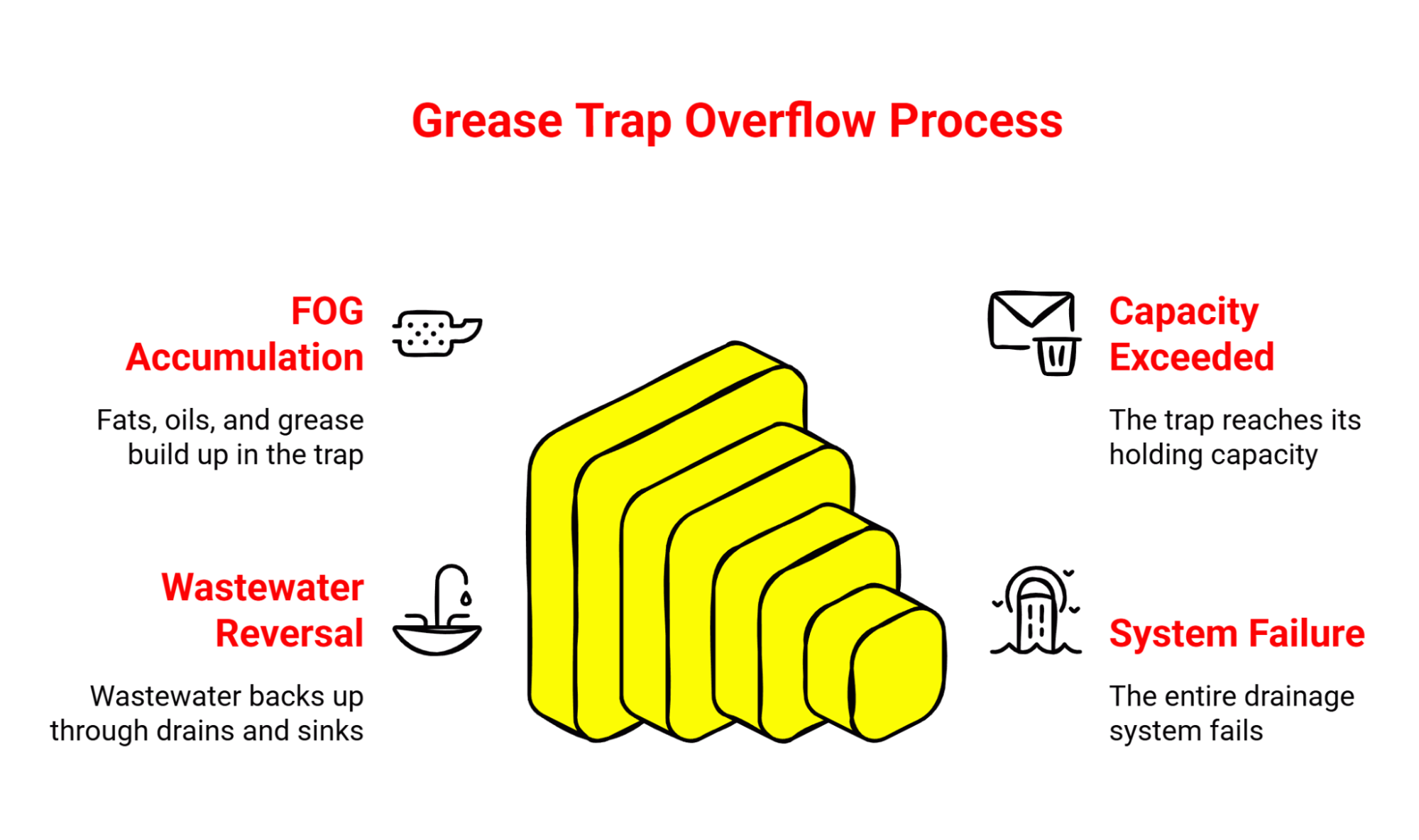
Four-stage cascade diagram showing grease trap overflow progression: FOG accumulation, capacity exceeded, wastewater reversal, and system failure represented by descending yellow blocks.

When accumulated fats, oils, and grease exceed a trap’s holding capacity, wastewater reverses course. Instead of flowing toward the municipal sewer system, it backs up through floor drains, prep sinks, and dishwashing stations. The trap functions as a filtration system—separating FOG from wastewater before discharge. Once that filter reaches capacity, the entire drainage system fails.

Consider a typical lunch service ending at a high-volume restaurant. Dishwashers scrape plates while prep cooks rinse cutting boards. All that water carries grease, food particles, and detergent toward a trap that has been 75% full since Tuesday morning. The system cannot process another gallon. Greasy water bubbles up through the floor drain, creating both a slip hazard and a contamination risk that forces immediate operational changes.

The trap itself performs a simple but essential function—it captures FOG before it enters public sewers, where it would congeal and create blockages affecting entire neighborhoods. For broader context on how FOG contributes to sanitary sewer overflows, the EPA’s FAQ on sanitary sewer systems explains the municipal infrastructure impacts. Professional commercial grease trap cleaning maintains this protective barrier on a schedule that matches each kitchen’s actual waste output.

The Backup Sequence

The physics of an overflow follow a predictable pattern. As FOG accumulates, usable capacity shrinks. Eventually, incoming wastewater has nowhere to go except backward through the path of least resistance.

Persistent rancid odors appear first, lingering near floor drains even after standard cleaning. Drainage slows next—sinks take longer to empty, and water pools where it previously flowed freely. These symptoms indicate the trap is approaching its limit. During peak water use—dinner rush, heavy dishwashing—the system reaches a breaking point. Heavy dishwashing during dinner service or back-to-back prep shifts generate more wastewater than the restricted trap can handle. Water backs up through floor drains, often carrying grease that spreads across kitchen floors.

This symptom progression—odor leading to slow drains, then backup, then overflow—tends to escalate fastest during high-volume periods because kitchens generate maximum FOG waste exactly when water flow peaks. A trap at 70% capacity on Monday morning can overflow by Friday evening’s rush.


When to Stop Operations: Severity Assessment

Understanding which situations require immediate action versus scheduled service helps operators make sound decisions under pressure.

RED—Stop Nonessential Water Use and Call Immediately

Active overflow on floors creates immediate slip and sanitation risks. Water backing up into sinks used for food prep or dishwashing compromises food safety. Rapidly rising floor drain water accompanied by strong odors signals system failure requiring emergency response.

YELLOW—Reduce Load and Schedule Urgent Service

Multiple drains slowing simultaneously indicates system-wide restriction. Intermittent gurgling or “burping” at floor drains suggests the trap is nearing capacity. Odors returning quickly after cleanup mean the underlying problem remains unresolved. These conditions warrant same-day service when possible.

GREEN—Schedule Service and Monitor

A single fixture draining slowly without odor or visible pooling may indicate a localized issue rather than trap failure. Absence of repeated symptoms or overflow suggests standard maintenance timing is appropriate.

This framework provides general operational guidance. Severity thresholds and reporting requirements vary by jurisdiction and individual facility risk profiles.


Immediate Containment Actions

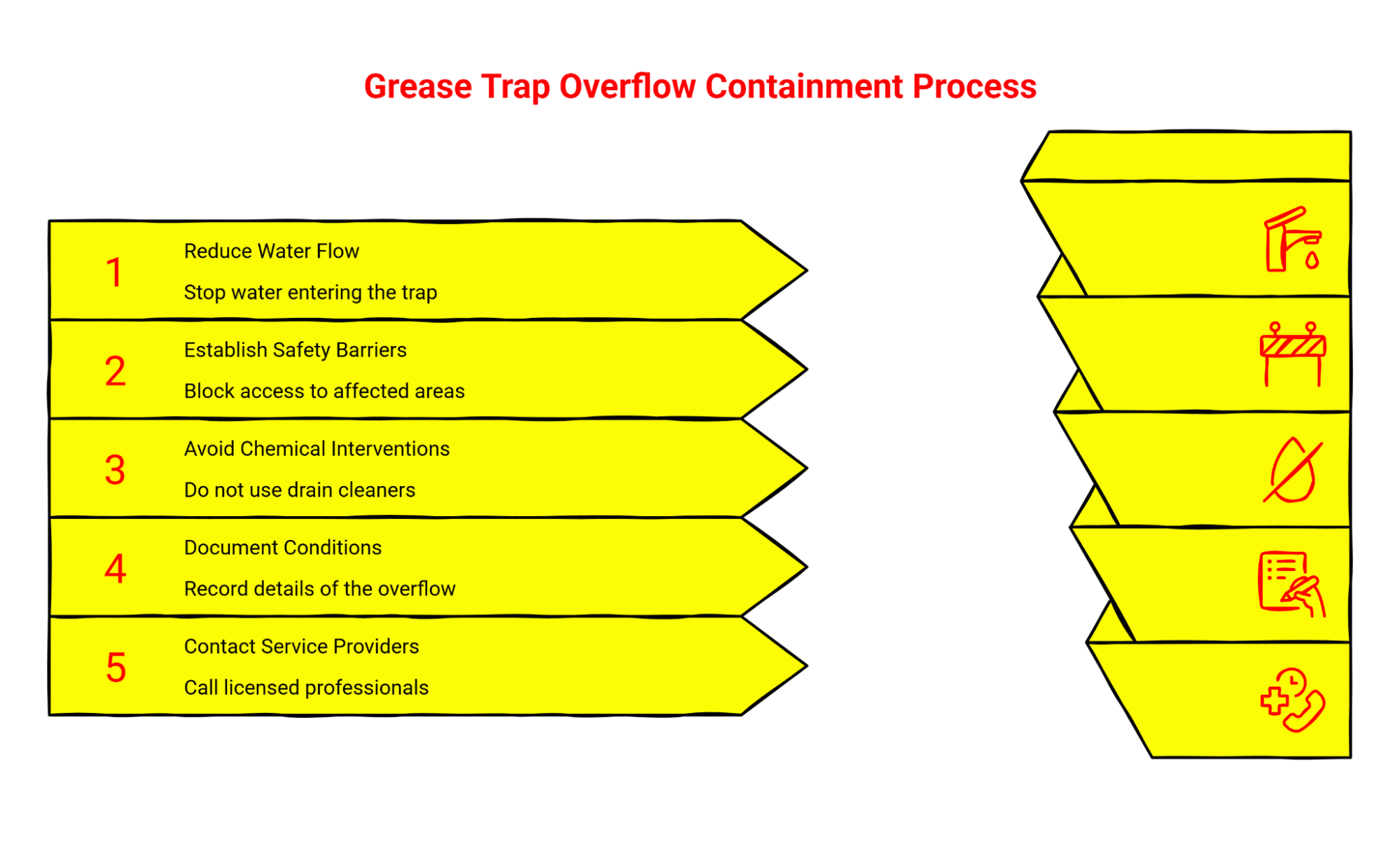
Five-step emergency response process for grease trap overflow: reduce water flow, establish safety barriers, avoid chemical interventions, document conditions, and contact service providers.

Active backups require swift containment rather than attempted repairs. Professional resolution is necessary, but immediate steps minimize damage and protect both staff and customers.

Reduce water flow immediately. Stop dishwashing operations and shut off any equipment sending water toward affected drains. Additional water worsens the backup because the trap cannot accept more volume.

Establish safety barriers. Grease-contaminated wastewater creates slip hazards and introduces bacteria into work areas. Block access to affected zones and direct staff away from pooling water. If backup occurs near food preparation stations, cease using those areas until professional cleaning is complete.

Avoid chemical interventions. Drain cleaners cannot dissolve a trap filled with solidified grease. Introducing harsh chemicals or extremely hot water may damage trap components including baffles and seals. These products also create hazardous fumes when they react with standing wastewater.

Document conditions thoroughly. Record the time backup occurred, specific locations affected, observed symptoms, and severity. Note the most recent service date and provider if known. Photograph the situation if doing so is safe. This documentation supports your service provider’s diagnostic process and provides evidence for compliance records if inspectors inquire about maintenance gaps.

Contact licensed service providers. Overflow resolution requires vacuum truck capacity and proper waste disposal handling. For facilities operating inside Houston city limits, verify that your provider maintains registration with the city and can supply required manifesting documentation. Drane Ranger serves the Alvin area and surrounding communities with emergency response capabilities—call 281-489-1765.


Why Traps Reach Capacity

Overflows stem from predictable causes that facility managers can recognize and address before crises develop.

Inadequate service frequency tops the list. Many operations follow quarterly schedules because local regulations set 90-day intervals as minimums, not recommendations. Kitchens operating deep fryers, griddles, or high-turnover frying stations often generate FOG faster than quarterly service can accommodate. The trap fills between scheduled visits, leaving diminishing capacity that eventually proves insufficient.

Incomplete evacuation during previous service creates similar problems. Some providers extract only surface grease, leaving settled solids at the trap’s bottom. This approach provides short-term relief but fails to restore full capacity. Within weeks, symptoms return as FOG continues accumulating in an already-compromised trap. The sample well myth explains why visual inspection alone fails to detect this hidden accumulation.

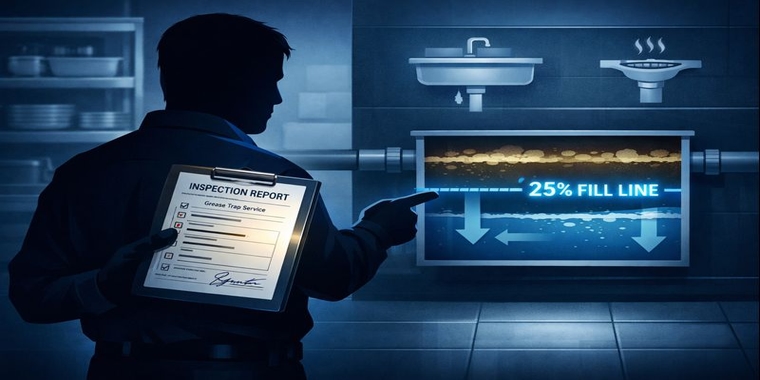
Industry guidance establishes the 25% threshold as a critical decision point. When the combined depth of floating grease and settled solids reaches one quarter of the trap’s total liquid capacity, evacuation becomes necessary. Waiting for odors or slow drains means the threshold has passed and overflow risk escalates with each service day that follows. For detailed explanation of how this threshold applies in practice, see the 25% rule guide.

Downstream restrictions occasionally cause backups even when the trap itself maintains adequate capacity. Hardened grease in outlet lines creates partial blockages that prevent proper drainage. Damaged baffles allow FOG to pass through prematurely, defeating the trap’s separation function. These conditions require inspection and repair alongside standard pumping. Understanding why visual checks alone can miss these problems helps explain the value of thorough professional service.


Building a Prevention System

Repeat overflows indicate reactive maintenance patterns need replacement with proactive scheduling and documentation systems. The shift from crisis management to systematic compliance transforms trap service from an operational liability into background reliability—what operators call “invisible compliance.”

Match service frequency to actual volume. Track symptom appearance between scheduled services. Odors or slow drainage consistently emerging at week seven of a 90-day cycle signals inadequate frequency. The adjustment point is straightforward—when problems appear before the next scheduled service, increase frequency. Many high-volume facilities operate on six- to eight-week cycles rather than quarterly intervals. This adjustment prevents capacity issues before they develop into operational disruptions.

Integrate compliance documentation with every service visit. Every pump-out should generate records proving proper disposal through licensed facilities. This documentation functions as legal protection during inspections and audits. The distinction between invoices and manifests matters significantly here. An invoice confirms payment for service. A manifest tracks waste from your facility through transportation to an approved disposal location, including hauler registration information and facility verification stamps. Inspectors require manifests as proof of legal disposal, not invoices. Understanding the legal difference between manifesting and invoicing clarifies why proper documentation matters.

For operators managing extensive documentation requirements, systematic organization prevents inspection failures. Maintaining five years of signed manifests with disposal facility stamps, organized chronologically, transforms potential audit stress into straightforward verification. The investment in proper record-keeping provides protection worth far more than the administrative effort required. A complete guide to organizing grease trap documentation for city audits offers practical implementation steps.

For federal context on how FOG management programs are structured nationwide, the EPA’s Report to Congress on the Impacts and Control of CSOs and SSOs provides a comprehensive overview of permits, outreach, and enforcement approaches across jurisdictions.

Schedule services during operational low points. Proactive maintenance occurs on calendars rather than after crises force action. Services scheduled during slow periods minimize disruption while maintaining compliance. When trap maintenance operates as background reliability rather than emergency response, compliance stops generating stress and starts supporting smooth operations.

Prevention Checklist

Crisis Response (Part A)

Follow the immediate containment actions outlined above when facing active overflow.

Long-Term Prevention (Part B)

  1. Schedule service at frequency that prevents odor and slow-drain recurrence
  2. Standardize service expectations: complete evacuation plus site-ready documentation
  3. Track each service event in single organized system (digital or physical)
  4. Require consistent records showing service date, volume notes, and provider identifiers
  5. Review warning signs weekly: odor presence, drainage speed, peak-time performance
  6. Train staff on early warning signals and proper escalation procedures
  7. Escalate frequency when warning signs return before next planned visit
  8. Store documentation for retention period applicable in operating jurisdiction

Staff Response Protocol

Kitchen staff benefit from clear protocols for recognizing and escalating grease trap problems before they reach crisis level.

When floor drains back up or grease odors appear, staff should reduce water load immediately by pausing dish and mop sink operations as directed by management. Report the situation to the manager on duty, noting time and specific fixtures affected. Isolate hazards including wet floors and potential contamination zones. Do not attempt chemical fixes—focus on containment and proper escalation. Prepare a brief summary for the service provider covering symptoms observed, timeline of events, and any operational constraints affecting service timing.

This protocol empowers front-line staff to take appropriate immediate action while ensuring management receives timely notification for professional service arrangement.

Target Audience Alignment

This prevention approach serves independent restaurants, single-location foodservice operations, and commercial kitchens throughout Alvin and surrounding communities—facilities where owners, general managers, or operations managers control maintenance decisions directly and require audit-ready compliance systems.

The guidance provided addresses facilities outside Houston’s municipal boundaries. Operations inside Houston city limits must follow specific local FOG regulations including quarterly trap cleaning requirements and registered hauler mandates. The Houston Health Department’s Special Waste Permits page provides jurisdiction-specific requirements. For current enforcement details, consult municipal authorities or environmental compliance advisors familiar with your location. Additional context on Houston-specific requirements appears in the comprehensive FOG compliance guide.

This system does not address needs of multi-site corporate chains with centralized facilities management or residential properties equipped with small passive traps designed for minimal FOG generation.

The Hidden Cost of “Cheap” Service

Price comparison often reveals the lowest bid includes the narrowest scope. Budget providers extract visible surface grease, bypass settled solids, and deliver invoices without compliance documentation. This approach leaves traps with diminished capacity and operators without proof of legal disposal.

Vulnerability emerges when inspectors arrive requesting manifests that document proper waste handling. The cheap service suddenly becomes expensive liability because records cannot prove compliance. When traps overflow months early because settled solids remained, operators pay for emergency service, revenue loss during mandatory closure, and potential health code violations. Understanding the real cost of backup emergencies versus contracted maintenance clarifies the financial risk.

Audit-grade documentation and thorough service execution cost slightly more per visit but dramatically reduce exposure. The difference represents insurance against operational crises that cost multiples of service fees. Proper manifesting, complete evacuation including settled solids, and inspection of trap components and outlet lines provide protection worth far more than marginal price differences.

Harold R. described his experience: “My experience with Drane Ranger was a very organized, professional and on time experience. I was kept informed of what was happening and a suggested time of cleaning again. I will use them again and will definitely recommend them to anyone I speak with.”


Common Questions About Overflows and Prevention

What signals indicate an overflow is approaching?

Persistent rancid odors near floor drains or dishwashing areas provide the earliest warning, appearing even after thorough cleaning. Slower drainage follows—sinks empty gradually, and water pools longer than usual. The combination of both symptoms indicates capacity is nearly exhausted and service should occur before backup develops.

Should operations continue if drains are backing up?

When wastewater actively backs up into food preparation areas or creates floor pooling near cooking stations, affected operations must stop immediately. Contaminated water in prep zones creates health code violations and contamination risks that prevent safe food handling. Contain the affected area, document conditions, and arrange emergency service before resuming operations in those zones.

What causes most restaurant grease trap overflows?

Accumulation exceeding capacity because service intervals don’t match actual FOG output accounts for most failures. Kitchens running quarterly schedules often require more frequent service when they operate heavy FOG-generating equipment. Inadequate evacuation leaving settled solids behind and downstream line blockages preventing proper flow contribute as secondary causes.

How frequently should commercial traps receive service?

Kitchen volume determines optimal frequency. Jurisdictions often establish quarterly minimums, but operations with fryers, griddles, or heavy dishwashing commonly require service every six to eight weeks. The decision trigger is straightforward—when odors or slow drains appear consistently before scheduled service dates, increase frequency. The 25% accumulation threshold provides another clear indicator: when floating grease and settled solids combined reach 25% of trap depth, schedule evacuation regardless of time elapsed since the previous service.

What documentation proves compliance during inspections?

Signed manifests showing disposal facility verification stamps, service dates, waste volumes removed, and registered hauler information provide required proof. Store manifests alongside invoices but understand the distinction—invoices document financial transactions while manifests document waste custody from facility through approved disposal. Maintain service logs noting dates, providers, and trap conditions observed. Keep five years of records on-site for inspection access. This documentation package demonstrates compliance and helps evaluate whether current service frequency matches operational needs.

What information helps expedite emergency service calls?

Provide facility address, trap size if known, most recent service date, and current symptoms. For facilities operating under specific municipal FOG regulations, mention jurisdiction to confirm provider registration. Ask whether standard service includes manifest documentation and outlet line inspection. For routine scheduling rather than emergencies, offer preferred service windows that minimize operational disruption.


Next Steps

Shifting from reactive crisis management to scheduled compliance protects operations, simplifies regulatory requirements, and eliminates expensive emergency service calls. The investment in systematic maintenance costs less than a single overflow incident when accounting for emergency service premiums, lost revenue during closure, cleanup expenses, and potential violation penalties.

Professional Service Available Now

Drane Ranger serves Alvin and surrounding communities with reliable grease trap service backed by proper documentation. Whether addressing active emergencies or establishing prevention schedules, the team delivers expertise and compliance support that keeps kitchens operational.

Contact Drane Ranger
13911 India St, Houston, TX 77047
Phone: 281-489-1765
Hours: Monday–Friday, 9 AM–6 PM
Email: rwoods3719@aol.com
Response within 24 hours

Request service information or call directly to schedule.

Disclaimer: This article provides general educational information about grease trap overflows and maintenance. Requirements vary by jurisdiction, trap specifications, waste generation volume, and local enforcement practices. Consult qualified professionals and applicable authorities for guidance specific to your facility’s compliance needs.

By: The Drane Ranger Team

Since 1985, Drane Ranger has delivered professional liquid waste management throughout the Greater Houston area, specializing in grease trap service, septic systems, and FOG compliance support.

Hydro-Jetting vs. Standard Pumping: Which Do You Need?

📌 Key Takeaways

Standard pumping empties the grease trap, while hydro-jetting scours hardened buildup from pipe walls to restore flow capacity.

  • Pumping Maintains, Jetting Restores: Standard pumping removes FOG from the trap but cannot reach hardened deposits stuck inside plumbing lines.
  • Symptoms Signal Line Restrictions: Recurring slow drains, persistent odors, or backups shortly after pumping indicate buildup that jetting addresses.
  • Validate With Specific Questions: Ask which line needs cleaning, what problem jetting solves, and request itemized scope before approving service.
  • Frequency Follows FOG Volume: Heavy-frying kitchens often add periodic jetting as preventive maintenance, while lighter operations jet only when symptoms appear.
  • Houston’s 25% Rule Triggers Service: Combined floating grease and settled solids exceeding 25% of liquid depth requires immediate cleaning regardless of schedule.

Pumping maintains compliance; jetting fixes what pumping cannot reach.

Houston restaurant operators navigating recurring drainage issues will gain diagnostic clarity here, preparing them for the validation questions that follow.

The vendor hands you a carbon-copy manifest. The job’s done. Then adds: “We recommend hydro-jetting next time.”

You’re left wondering: is this legitimate maintenance or an upsell? When you’re already paying for grease trap cleaning, how do you know if you actually need the more expensive option?

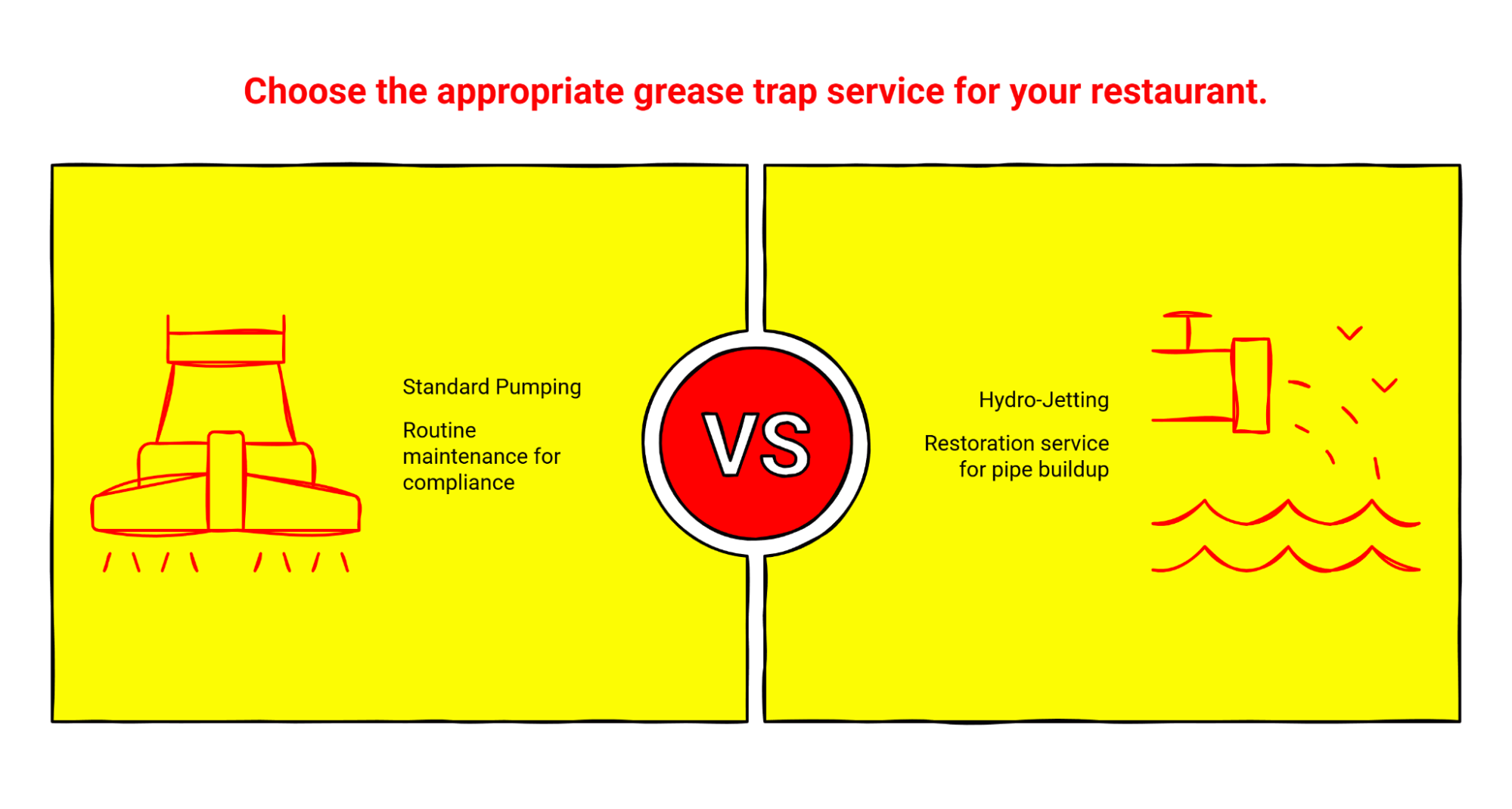
Here’s the practical difference: Standard pumping removes FOG waste from the grease trap but not hardened line buildup. Hydro-jetting scours grease-coated pipes to restore diameter and flow. One maintains the trap; the other restores the entire system.


Pumping empties the tank. Jetting clears the arteries.

This guide gives you a side-by-side comparison, a quick checklist of symptoms, and validation questions so you can approve the right service with confidence.

Comparison diagram showing standard pumping for routine compliance maintenance versus hydro-jetting for restoration service when pipes have buildup.

What Standard Pumping Does (and What It Doesn’t)

Standard pumping is the evacuation service most Houston restaurants schedule quarterly to stay compliant. A vacuum truck removes the accumulated fats, oils, and grease from inside your grease trap or interceptor, along with settled solids at the bottom.

The trap itself serves a critical function: it intercepts FOG before it enters the sewer system. When it fills beyond capacity, problems announce themselves quickly—often at the worst possible moment. Picture this: 10:30 AM in the prep kitchen, a faint sulfur odor rising from the floor drain just before the lunch rush begins. That smell signals your system is approaching failure.

Professional grease trap cleaning involves inserting hoses into the trap’s access points, pumping out the contents, and disposing of the waste at an approved facility. The service creates the manifest documentation required for FOG compliance in Houston.

What pumping doesn’t do: it doesn’t remove hardened buildup that has already attached to the interior walls of your plumbing lines. Once FOG waste hardens inside the pipes—whether connecting the kitchen to the trap or leading away from it—standard pumping can’t reach it. The trap might be empty, but the lines remain partially obstructed.

Think of it this way: pumping cleans the collection point but doesn’t address what’s already stuck in the plumbing.

What Hydro-Jetting Is and Why Vendors Recommend It

Hydro-jetting uses high-pressure water—typically between 3,000 and 4,000 PSI—to scour the interior surfaces of grease lines. The pressurized stream breaks apart calcified grease deposits and flushes them out of the system, restoring the pipe to closer to its original diameter.

Technicians insert a specialized nozzle into the grease line, usually through a cleanout access point. The nozzle sprays water in multiple directions as it travels through the pipe, scouring buildup from the walls. The dislodged material flows back to the trap, where it’s then pumped out.

Common targets for jetting include the lateral lines connecting kitchen drains to the trap, the inlet piping leading into the trap, and the outlet piping carrying filtered water away from it.

This is a restoration service, not routine maintenance. Vendors recommend it when they observe restricted flow, when you’re experiencing recurring symptoms despite regular pumping, or when a camera inspection reveals significant buildup inside the lines.

Pumping vs. Hydro-Jetting: Side-by-Side Comparison

Service Aspect Standard Pumping Hydro-Jetting
Purpose Evacuate FOG and solids from the trap Scour hardened buildup from pipe walls
Best For Routine compliance and prevention Restoring flow when lines are restricted
Typical Frequency At least every 90 days (Houston minimum), or sooner if the 25% rule is reached As needed based on symptoms; possibly annual for high-FOG kitchens
Disruption/Time 30-60 minutes, minimal kitchen impact 1-3 hours depending on scope; some drain access needed
Relative Cost Standard service rate Higher due to equipment, labor, and scope
Outcome Empty trap, compliance documentation Restored pipe diameter and improved drainage


The cost difference reflects the additional scope. Jetting typically runs higher than pumping because it involves specialized equipment and more time on task. Cost drivers include the length of line being cleaned, the severity of buildup, access complexity, and whether the work targets one segment or requires multiple runs through different sections.

Note that Houston regulations (Chapter 47, Article XI, Section 47-741) require grease trap cleaning whenever the combined depth of floating grease and settled solids exceeds 25% of the total liquid depth in the trap, even if this occurs before the 90-day interval. High-volume kitchens may reach this threshold sooner and need more frequent service.


Signs You Likely Need Hydro-Jetting

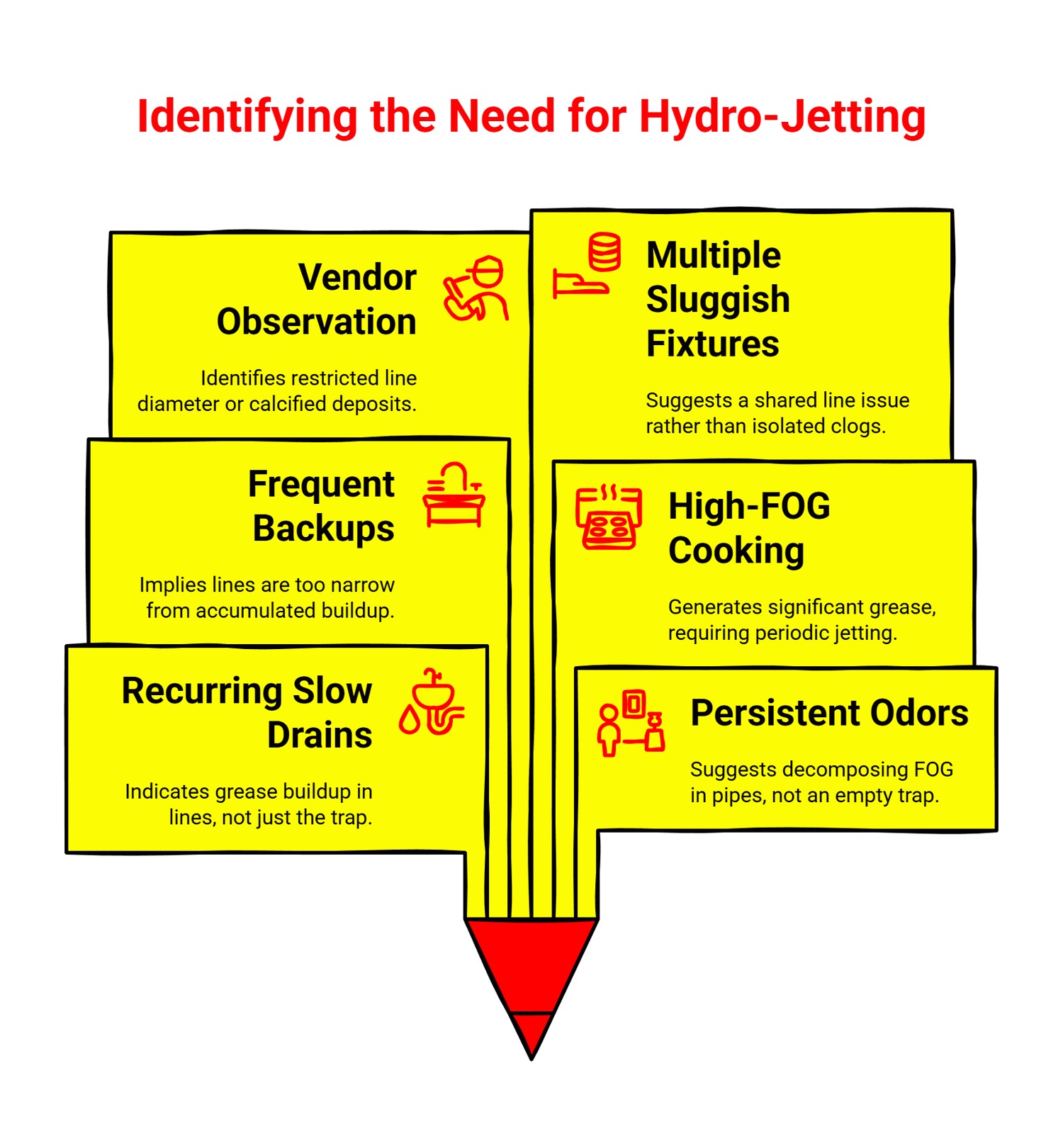
Funnel diagram showing six indicators that restaurant drain lines need hydro-jetting: vendor observation, frequent backups, recurring slow drains, multiple sluggish fixtures, high-FOG cooking, and persistent odors.

Not every restaurant needs jetting, but recurring slow drains and odors indicate buildup in grease lines that pumping alone may not fix. Watch for these specific symptoms:

  • Recurring slow drains even after recent pumping. If sinks are draining sluggishly within days or weeks of a pump-out, the obstruction is likely in the lines, not in the trap itself.
  • Persistent odors returning quickly. When foul smells reappear shortly after cleaning, grease buildup in the lines is often the culprit. The trap is empty, but decomposing FOG remains stuck in the pipes.
  • Backups between scheduled cleanings. If you’re experiencing overflows or backups before the 90-day mark, your system can’t handle your current FOG load. This often means the lines are too narrow from accumulated buildup.
  • High-FOG cooking profile and heavy volume. Operations running fryers, cooking burgers, or serving fried chicken generate significant grease. High-FOG, high-volume kitchens benefit from periodic jetting to prevent backups between cleanings.
  • Vendor observation of hardened or calcified grease. If your service technician reports seeing restricted line diameter or calcified deposits during inspection, they’re identifying a problem pumping can’t solve.
  • Multiple fixtures draining sluggishly. When several sinks or drains show slow flow simultaneously, it suggests a shared line issue rather than isolated clogs.

These aren’t guarantees you need jetting, but they’re legitimate triggers for the conversation. For additional diagnostic perspective, see five signs your grease trap service isn’t doing the job right. Compare the symptom severity to your service history before approving the work.

When Standard Pumping Is Usually Enough

Many Houston restaurants operate successfully with pumping alone. If you’re not experiencing symptoms and your schedule is consistent, you’re likely in good shape.

Standard pumping is usually sufficient when FOG volumes are moderate, the trap is staying within acceptable thresholds, and you’re primarily focused on maintaining compliance and preventing emergencies rather than addressing active problems.

Restaurants with lower grease output—those without heavy frying operations—often maintain clear lines with quarterly pumping and good kitchen practices like scraping plates and using drain screens.


Houston vs. Suburban MUDs, and Indoor vs. Outdoor Traps: Two Pivots That Change the Decision

Two decision variables affect how you evaluate service recommendations.

Pivot 1: City of Houston vs. Suburban MUD Jurisdictions

Houston enforcement tends to be stricter than some suburban Municipal Utility District contexts, with particular emphasis on manifest documentation rather than invoice-only recordkeeping. For official city information, reference the City of Houston official site.

The practical implication: when operating within stricter jurisdictions, documentation becomes risk control—more like insurance than admin. That tactile crinkle of the carbon-copy manifest paper being handed over by the driver isn’t just proof of service; it’s a chain-of-custody artifact that can reduce audit anxiety.

Pivot 2: Indoor Hydro-Mechanical vs. Outdoor Gravity Interceptors

Trap type affects frequency and disruption patterns. Indoor hydro-mechanical traps are typically smaller and can reach problematic conditions faster under heavy grease load. Outdoor gravity interceptors are typically larger and may tolerate volume differently, but when line restrictions occur, the disruption can still be significant.

Practical takeaway: smaller indoor units and heavy-volume kitchens often experience earlier symptom-based escalation. That doesn’t automatically mean “jet every visit.” It means symptom tracking matters more, and restoration work should be tied to evidence of restricted flow.

How to Validate a Jetting Recommendation (and Avoid Unnecessary Upsells)

When a vendor recommends jetting, you have every right to ask clarifying questions. Legitimate service providers expect this and will give you specific answers.

Ask what problem jetting is solving. Request the specific symptom (slow drains, odors, backups) and the location (which line is restricted). Vague recommendations like “it’s due” or “it’s good preventive maintenance” aren’t sufficient justification for the added expense.

Ask for a before-and-after description. A professional technician should be able to explain what they expect to find and what the result should look like. Some companies use camera inspections to show the buildup before jetting and verify the results after. If camera evidence is available, request to see it.

Confirm the scope of work. Get clarity on which lines will be jetted, how far the technician will run the equipment, expected duration, and the cleanup plan. An itemized quote should specify these details.

Compare the recommendation to your symptom severity and service history. If you’ve had no drainage issues and your last three cleanings went smoothly, aggressive jetting recommendations deserve scrutiny. Conversely, if you’ve had two backups in six months, jetting is likely warranted.

For complex situations or if you’re uncertain, consider getting a second opinion from another qualified service provider in the Houston area. A legitimate company focused on commercial grease trap maintenance will base recommendations on observable conditions, not sales targets.

Hydro-Jetting vs. a Drain Snake: What’s the Difference?

A common comparison question involves the difference between hydro-jetting and using a drain snake or auger.

A snake or auger is designed to mechanically pierce or retrieve a localized blockage—essentially punching a hole to restore immediate drainage. Hydro-jetting uses scouring pressure to emulsify and flush buildup from the pipe walls, addressing widespread grease coating that narrows the entire line diameter.

Practical takeaway: if symptoms are recurring and “cleared” only temporarily with snaking, jetting may be proposed because it targets the underlying buildup rather than only breaking through a single point of resistance.

How Often Do Restaurants Need Jetting?

There’s no universal answer because it depends entirely on your FOG volume and symptom history. Heavy-volume kitchens with significant frying operations often add jetting to their annual maintenance plan as preventive care, while lighter-volume operations may go years between jetting services.

The tipping point is symptom-driven. When slow drains, persistent odors, or backups appear despite regular pumping, you’ve moved from “compliance minimum” to “failure prevention” territory. At that stage, jetting becomes necessary to restore system capacity.

Some operations implement annual or semi-annual jetting as standard practice once they understand their usage patterns. Others jet only when symptoms appear. Both approaches can be valid depending on your kitchen’s specific profile and risk tolerance.

Visualizing the Difference: Before and After Jetting

Understanding what jetting accomplishes is easier when you visualize the pipe interior.

Before jetting: Water flows through a narrowed “ring” where grease buildup has coated the pipe walls, leaving only a small center channel for drainage. The trap may be freshly pumped, but flow remains restricted.

After jetting: Water flows through a wider, cleaner interior diameter. The high-pressure water has scoured away the coating, restoring the line closer to its original capacity.

The exact appearance varies by pipe material, grease load, and how long buildup has been accumulating, but the principle remains: jetting restores the space that hardened grease has stolen from the system.


Frequently Asked Questions

What is hydro-jetting?

Hydro-jetting is a cleaning method that uses high-pressure water (typically 3,000-4,000 PSI) to scour grease and buildup from inside pipes, restoring flow.

Does pumping clean the pipes?

Pumping removes waste from the trap, but it typically does not remove hardened buildup inside plumbing lines. When symptoms persist after pumping, line restoration may be needed.

How do I know if I’m being upsold on jetting?

Ask what symptom jetting solves, what line will be cleaned, and request an itemized scope with a clear before/after explanation. Legitimate recommendations tie the service to observable problems.

How often should a restaurant hydro-jet?

It depends on grease volume and symptoms. Heavy-FOG kitchens often add periodic jetting as preventive maintenance; lighter kitchens may need it less frequently. Let symptoms guide the decision.


Next Steps: Choose the Right Service Level and Keep Compliance Invisible

The decision comes down to current symptoms and operational priorities. Use this simple flow:

  • No symptoms, regular schedule working well → Continue with standard quarterly pumping
  • Occasional slow drains or mild odors → Monitor closely; consider scheduling jetting if symptoms worsen
  • Recurring problems after pump-outs → Schedule jetting to restore line capacity
  • High-FOG kitchen with frequent issues → Implement periodic jetting as preventive maintenance

The goal is invisible compliance—systems that work so reliably you never think about them during service. Whether that requires pumping alone or periodic jetting depends on your specific operation, but you now have the criteria to make an informed decision.

For service in the Houston area, explore our grease trap cleaning services or contact us to schedule service. If you’re experiencing urgent symptoms like backups or persistent drainage issues, our emergency services team can respond quickly to restore your system.

For additional trust and credibility verification, review our Better Business Bureau profile.

Disclaimer: This article is for informational purposes and should not replace professional advice. Grease trap maintenance requirements can vary based on local regulations, facility type, and operational factors. Always consult with qualified service professionals for recommendations specific to your situation.

Our Editorial Process

Our expert team uses AI tools to help organize and structure our initial drafts. Every piece is then extensively rewritten, fact-checked, and enriched with first-hand insights and experiences by expert humans on our Insights Team to ensure accuracy and clarity.

About the Drane Ranger Insights Team

The Drane Ranger Insights Team is our dedicated engine for synthesizing complex topics into clear, helpful guides. While our content is thoroughly reviewed for clarity and accuracy, it is for informational purposes and should not replace professional advice.
How Often Should a Commercial Grease Trap Be Cleaned in Houston?

📌 Key Takeaways

Houston requires grease trap service every 90 days maximum, but most commercial kitchens need more frequent cleaning based on the 25% accumulation rule.

  • 90 Days Is Your Compliance Ceiling: Houston city code mandates quarterly evacuation as the maximum interval—waiting beyond this violates the baseline requirement.
  • The 25% Rule Overrides the Calendar: Service is required when grease and solids reach 25% of trap depth, which often happens before 90 days in busy kitchens.
  • Kitchen Volume Dictates Real Frequency: High-FOG menus, extended hours, and shared plumbing accelerate accumulation, requiring service every 30-60 days for many operations.
  • Documentation Protects Against Violations: Inspector-ready records with service dates, quantities removed, and disposal confirmation prevent citations even when you’re maintaining proper schedules.
  • Waiting for Odors Costs More: Smell signals severe overload—by then, you’re risking backups during service hours and emergency calls at premium rates.

Prevention through consistent scheduling beats reactive emergency service every time.

Houston restaurant owners and foodservice managers will gain clear compliance guidance here, preparing them for the frequency calculator and scheduling framework that follows.

In Houston, most commercial kitchens should plan on grease trap cleaning at least every 90 days—and many need more frequent service based on kitchen volume and the 25% accumulation rule.

This isn’t just about compliance. It’s about keeping your kitchen operational, avoiding backups during your dinner rush, and preventing the kind of odor that sends customers straight to your competitors.


The Houston Baseline: The 90-Day (Quarterly) Standard

The City of Houston Code of Ordinances requires grease interceptors and holding tanks to be fully evacuated at least once every 90 days (quarterly), unless a waiver is approved. The code also requires more frequent evacuation under certain conditions. (Houston Health Department)

This quarterly maximum is your compliance ceiling—the longest you should ever wait between cleanings. If a kitchen runs to day 110, the schedule isn’t “a little late”—it’s beyond the stated baseline. (Municode Library)

This 90-day standard applies to commercial kitchens within Houston city limits, though surrounding jurisdictions may have different requirements. For an overview of what a full visit should include, see commercial grease trap cleaning.


Why Many Kitchens Need More Than the Minimum

The 25% Rule (The Real Trigger)

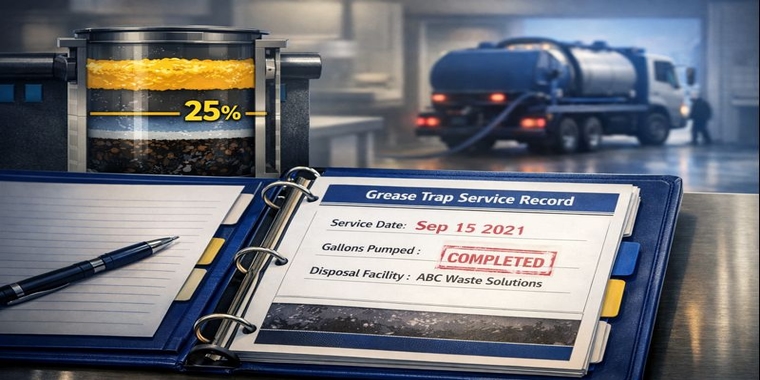
Service is required when grease and solids accumulation reaches 25% of your trap’s total liquid depth, regardless of when your last cleaning occurred. This threshold includes both the floating grease layer on top and the settled solids at the bottom. When these combined accumulations hit one quarter of your trap’s depth, it’s time for service—even if you cleaned it six weeks ago.

This 25% trigger is the standard benchmark for grease interceptors in Texas, derived from the state’s environmental model codes. (TCEQ) A grease trap works because it has room to separate wastewater from grease and solids. When grease and sludge take up roughly a quarter of the working volume, the unit starts losing separation efficiency, and the odds of downstream problems rise.

What’s certain versus what varies:

  • Certain: The 25% threshold is the commonly stated trigger in FOG guidance documents and municipal programs.
  • Variable: How quickly you reach 25% depends on your menu, volume, hours, and kitchen practices.

For high-volume kitchens, this means the 90-day compliance window becomes irrelevant. You’ll hit the 25% mark much sooner, and waiting for the calendar will guarantee problems.


Operational Factors That Shorten the Interval

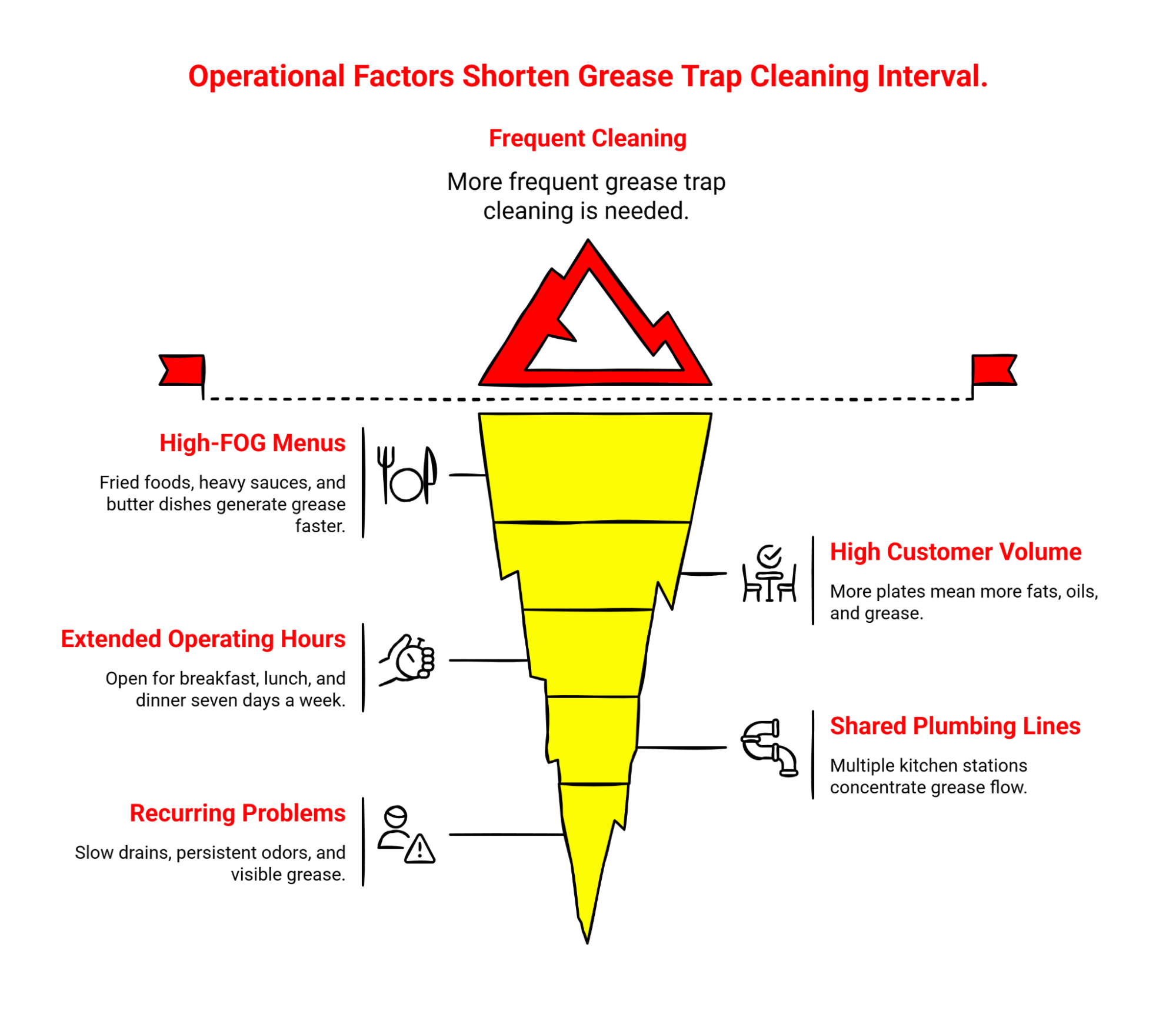
Funnel diagram showing six operational factors that require more frequent grease trap cleaning: high-FOG menus, extended operating hours, recurring problems, high customer volume, shared plumbing lines, with warning indicator at top.

Several kitchen characteristics push you toward more frequent cleaning. High-FOG menus featuring fried foods, heavy sauces, and butter-based dishes generate grease faster than lighter cooking styles. A fryer-heavy operation will fill a trap much faster than a restaurant focused on grilled proteins.

High customer volume means more plates going out, which translates directly to more fats, oils, and grease going down your drains. Extended operating hours compound the volume issue—if you’re open for breakfast, lunch, and dinner seven days a week, your trap is working considerably harder than a dinner-only operation.

Shared plumbing lines connecting multiple kitchen stations can concentrate grease flow into your trap, accelerating accumulation beyond what a single prep area would generate. This is particularly common in larger kitchens or facilities with multiple tenants.

Recurring problems like slow drains, persistent odors, or visible grease where it shouldn’t be are clear signals your current schedule isn’t frequent enough. These aren’t isolated incidents—they’re your trap telling you it’s overwhelmed.

For broader context on why FOG control matters to plumbing and sewer systems, the U.S. EPA provides comprehensive guidance on food-service grease management. (US EPA)

Grease Trap Cleaning Frequency Calculator

Use this table as your starting point, then adjust based on the warning signs below:

Kitchen Volume Signal Example Operation Suggested Starting Interval Why
Low Light cooking / limited fry Up to 90 days (max) Slower FOG accumulation
Medium Standard single-location restaurant 60–90 days Often reaches 25% before 90 days
High High-volume fryer-heavy kitchen 30–60 days Faster grease/solids buildup
Very High Extended hours / heavy throughput 30–45 days 25% threshold hits quickly


Compliance guardrail: The 90-day maximum is your legal baseline in Houston city limits. (Houston Health Department)

Operational override: If your trap reaches the 25% threshold sooner, schedule service sooner. The kitchen’s actual production sets the pace, not just the calendar.

Not sure if you’re on the right interval? Schedule a quick compliance assessment. Call 281-489-1765 to have your trap evaluated and get a customized schedule recommendation based on your actual kitchen volume.

Since 1985, Drane Ranger has served the Greater Houston area with a reputation built on reliable scheduling and documentation.

Signs You’re Past Due (Don’t Wait for an Emergency)

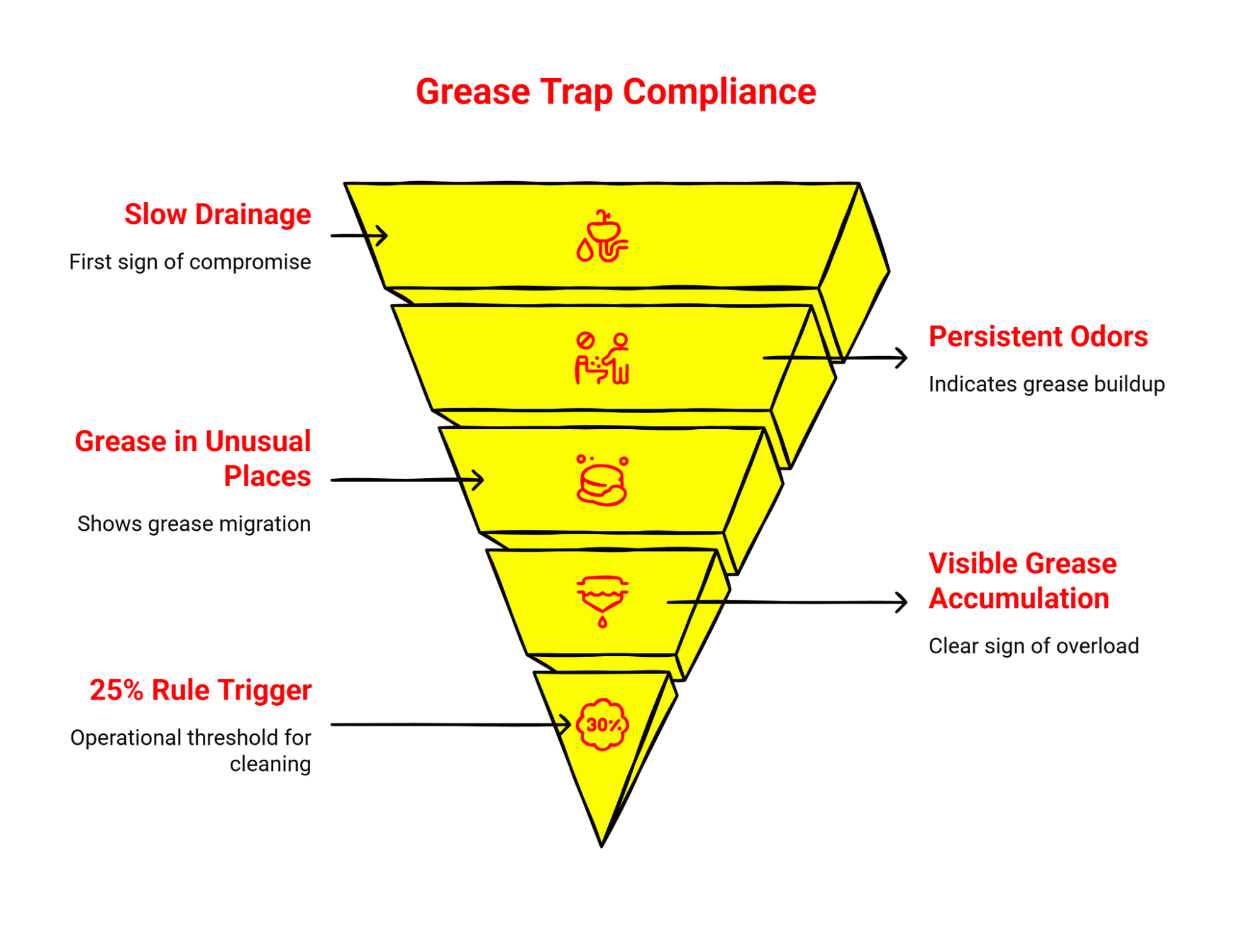
Watch for these warning signals that your cleaning interval is too long:

  • Slow drainage in kitchen sinks often indicates that grease buildup is restricting water flow through your lines
  • Persistent unpleasant odors near the trap indicate decomposing organic matter and excessive accumulation
  • Visible grease in unusual places like floor drains or appearing where it shouldn’t be shows your trap is overflowing its boundaries
  • Grease accumulation exceeding 25% of total liquid depth requires immediate service regardless of your last cleaning date

These aren’t problems you want to discover during your Saturday dinner rush. By the time you smell it, your customers already have too.

Local service context is available at grease trap cleaning in Houston.


What Professional Cleaning Should Include (So You Stay Inspector-Ready)

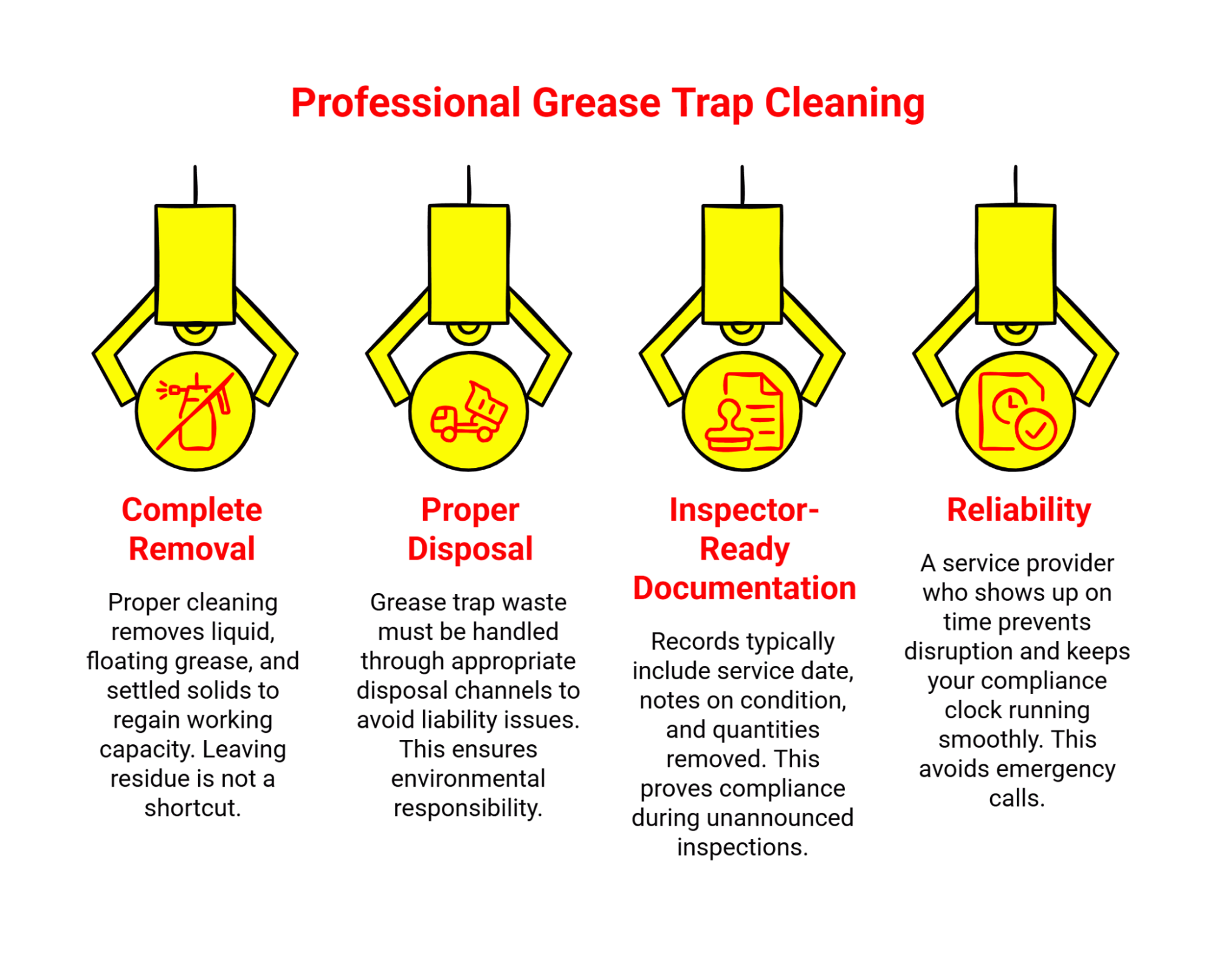
Four-pillar diagram showing professional grease trap cleaning components: complete removal, proper disposal, inspector-ready documentation, and reliability with vacuum truck icons.

Not all grease trap cleaning is created equal. This isn’t about waste removal—it’s about risk management and compliance protection. A service visit should protect two things at once: flow and documentation.

Complete removal, not residue left behind. A proper cleaning removes liquid, floating grease, and settled solids so the unit regains working capacity. Leaving “a little behind” is not a harmless shortcut—capacity is exactly what prevents backups.

Proper transportation and disposal. Grease trap waste must be handled through appropriate disposal channels. This isn’t just about environmental responsibility—improper disposal can create liability issues for your operation.

Inspector-ready documentation. Records typically include service date, notes on condition, and quantities removed. When an inspector shows up unannounced, you need records proving you’ve maintained compliance. Missing documentation can result in violations even if you’ve been cleaning regularly, and those records must show both the service performed and proper disposal.

Reliability that respects your operational needs. A service provider who shows up on time and doesn’t miss appointments prevents the disruption that comes from emergency calls and keeps your compliance clock running smoothly.

The cheapest option isn’t cheap if you end up paying for emergency service, lost revenue from downtime, or fines from a failed inspection. Professional grease trap cleaning service protects your operation by treating maintenance as operational continuity insurance—keeping the kitchen running, preventing customer-facing issues, and reducing regulatory exposure.

“Drane Ranger is very professional and reliable. Basically they can take care of all your grease drain needs.” — Shelley M.

Setting Up a Schedule That Doesn’t Disrupt the Kitchen

The best grease trap cleaning is the one that happens without disrupting service. A workable maintenance plan should feel predictable and low-friction:

Start with the Houston ceiling. Default to quarterly service at minimum—that’s the verified baseline. (Municode Library)

Pick an initial interval using the calculator table. Choose from the 30, 45, 60, or 90-day starting points based on your kitchen volume signal.

Confirm with early checks. If odors or slow drainage appear before your next scheduled visit, shorten the interval rather than waiting for the calendar.

Lock a recurring cadence. Schedule service during off-peak hours—most restaurants benefit from late-night or early-morning service when the kitchen isn’t in full production. Consistent timing keeps you ahead of problems.

File documentation in one place. Maintain a simple log of service dates, accumulation levels noted by your technician, and any observations about your trap’s condition. Keep records organized so they’re available when needed, not when remembered.

For sites that benefit from heavy-duty removal capabilities or have additional liquid waste management needs, see vacuum truck services Houston TX.

Resources

For deeper guidance on grease trap compliance and maintenance:


Frequently Asked Questions

Is grease trap cleaning required every 90 days in Houston?

Within Houston city limits, the City of Houston code requires grease interceptors and holding tanks to be evacuated at least once every 90 days (quarterly), with more frequent evacuation required under certain conditions. (Houston Health Department) Outside city limits, requirements can vary by local jurisdiction. Many kitchens need more frequent service based on the 25% accumulation rule, but you should never exceed 90 days between cleanings within Houston city limits.

What is the 25% rule for grease traps?

The 25% rule is a widely used maintenance trigger: when floating grease plus settled solids reaches about 25% of the trap’s effective depth or capacity, cleaning is due to restore separation performance and reduce backup risk. (TCEQ) This threshold can occur well before 90 days in high-volume kitchens. When you hit 25%, you must clean regardless of your calendar schedule.

Can I wait until the trap smells before cleaning it?

No. Odor is a late-stage warning sign indicating your trap is severely overloaded and may already be operating with reduced capacity. By the time you smell it, customers likely smell it too, and you’re already past the point where you should have scheduled service. Waiting for odor guarantees you’re operating in reactive mode rather than maintaining proper compliance and operational continuity.

Does grease trap size change how often it needs cleaning?

Trap size affects capacity, but volume and menu composition drive accumulation rate. A larger trap holds more, but a high-volume kitchen with a large trap may still hit the 25% threshold as quickly as a smaller operation with a smaller trap. Size is one factor in the equation, not the determining factor. Your menu’s FOG content and customer volume matter more than trap dimensions alone.

What happens if I skip grease trap service?

Skipping service leads to backups during service hours, persistent odors that affect the dining experience, potential health code violations during inspections, and the need for emergency service at premium rates. At the extreme, backups can disrupt service and create a shutdown-risk scenario if plumbing fails during operating hours. The operational disruption and compliance risk far exceed the cost of maintaining your schedule.

What records should I keep after service?

Maintain documentation of service dates, the volume of grease and solids removed, observations about trap condition, and confirmation of proper disposal. Keep these records organized and readily accessible. When an inspector requests proof of compliance, you need to produce documentation immediately. Many operators keep a simple binder with signed service receipts and disposal manifests organized by date.

How quickly can Drane Ranger respond if we’re backing up?

We understand that grease trap emergencies don’t follow a schedule. While we always recommend staying ahead of problems through regular maintenance, our team prioritizes emergency calls and works to minimize your downtime when urgent situations arise. The fastest resolution, however, is always prevention through consistent scheduling that keeps you ahead of the 25% threshold.

Get Started with Reliable Grease Trap Maintenance

Your grease trap schedule isn’t just about compliance—it’s about protecting your operation from preventable disruptions that cost you revenue and reputation.

Since 1985, Drane Ranger has helped Houston restaurants maintain reliable grease trap service with consistent scheduling, complete documentation, and proper disposal. We understand that your kitchen can’t afford downtime, which is why our service is designed to be thorough, reliable, and invisible to your operations.

“My experience with Drane Ranger was a very organized, professional and on time experience. I was kept informed of what was happening and a suggested time of cleaning again. I will use them again and will definitely recommend them to anyone I speak with.” — Harold R.

Call 281-489-1765 to set up a quarterly maintenance plan or schedule a compliance assessment. We serve Houston and the surrounding areas with the reliable, documented service you need to stay operational and inspector-ready.

Disclaimer: This article provides general guidance on grease trap cleaning requirements in Houston. Local codes and enforcement practices may vary by jurisdiction. For specific compliance requirements, consult your local health department or municipal authorities.

By: The Drane Ranger Team

Drane Ranger has served the Greater Houston Area since 1985, providing reliable liquid waste management services including grease trap cleaning, lift station maintenance, and septic tank service. Our commitment is to help businesses stay compliant while maintaining smooth operations through dependable, documented service.

5 Common Grease Trap Myths That Cause City Fines

📌 Key Takeaways

Houston restaurant operators protect their businesses from fines and shutdowns by treating grease trap maintenance as compliance security, not just waste removal.

  • The 25% Rule Triggers Service: When floating grease and settled solids reach 25% of the trap’s wetted height, pumping is required regardless of drainage performance.
  • Manifests Prove Compliance, Not Invoices: Inspectors require legal tracking documents showing waste custody from your property to approved disposal facilities.
  • Generator Liability Stays With You: Your restaurant remains legally responsible for improper waste disposal even when staff or vendors perform the work.
  • Frequency Depends on Volume: Busy kitchens often need service every 30-60 days, well before the 90-day minimum standard many operators assume is sufficient.
  • Violations Stack Per Offense: Civil and criminal penalties can reach $2,000 per day per violation, with permit suspension exposure for serious infractions.

Cheap service creates expensive liability when documentation gaps expose your business to enforcement actions.

Restaurant owners, general managers, and kitchen operators in the Houston area will gain actionable compliance strategies here, preparing them for the detailed implementation guidance that follows.

The lunch rush just ended. Your kitchen is running smoothly, drains are flowing, and everything seems fine. But beneath that apparent normalcy, a compliance problem might be building—one that could cost your Houston restaurant thousands of dollars in fines and even lead to permit suspension.

Restaurant operators in the Houston area avoid fines and shutdown risk by following grease trap compliance basics and using documented professional cleaning with proper manifests and disposal records. The reality is that bad grease trap advice—the kind of “wisdom” passed around in industry circles—leads to non-compliance, backups and odors, and enforcement exposure that can threaten your entire operation.


Why Grease Trap Myths Turn Into Real Enforcement Risk

A grease trap is a plumbing device designed to intercept fats, oils, and grease (FOG) before they enter the municipal sewer system. When FOG accumulates in sewer lines, it creates blockages that affect entire neighborhoods. That’s why the City of Houston enforces strict regulations under Chapter 47 of the municipal code.

The stakes are higher than most operators realize. Compliance failure carries two distinct types of losses. First, there’s the financial impact: violations can result in civil and criminal penalties of up to $2,000 per day per offense, along with potential permit suspension. Second, there’s operational disruption. Backups force you to close your kitchen for emergency cleaning. Persistent odors drive customers away. Shutdown orders mean zero revenue while your fixed costs continue.

Think of proper grease trap maintenance as your Compliance Shield. When you follow the rules, you protect your business from enforcement actions while keeping your kitchen running smoothly. The alternative—cutting corners with cheap service or following bad advice—creates expensive liability that far outweighs any short-term savings.

Here’s the truth that every restaurant owner needs to understand: Cheap service is expensive liability. A service provider who charges $50 less but doesn’t provide proper documentation or legal disposal puts your entire operation at risk. A single day of enforcement fines eliminates years of those small savings.


Myth #1: “If It Drains, It’s Fine”

Grease trap compliance funnel diagram showing five warning signs from early to critical: slow drainage, persistent odors, grease in unusual places, visible grease accumulation, and 25% rule trigger point.

Many operators believe that as long as water flows down the drain, their grease trap is working properly. This assumption is dangerously wrong. By the time drainage slows noticeably, your trap is already severely compromised and likely in violation of local requirements.

Watch for these early warning signs that indicate your trap needs attention:

  • Slow drainage in kitchen sinks, especially the three-compartment wash station
  • Persistent unpleasant odors near floor drains or the trap location
  • Grease appearing in unusual places like mop sinks or floor drains
  • Visible grease accumulation floating on top of the trap’s water level

The City of Houston uses what’s commonly called the 25% rule as an operational trigger. When the combined layer of floating grease and settled solids reaches 25% of the trap’s wetted height (liquid depth), the trap requires pumping regardless of how well water appears to drain. Busy kitchens often reach this threshold well before the 90-day minimum standard that many operators rely on.

Professional service providers measure accumulation levels during each visit. If your current vendor isn’t checking and documenting these levels, you’re operating without critical compliance information.

Read: Grease Trap Cleaning in Houston (signs you need service + 25% rule)


Myth #2: “Additives and Enzymes Replace Clean-Outs”

Balance scale comparison diagram showing additives and enzymes versus professional pumping for grease trap management, with three drawbacks on the left and three benefits on the right.

Walk into any restaurant supply store and you’ll find shelves stocked with enzyme treatments and chemical additives promising to “eliminate” grease problems. These products claim to break down FOG and keep your lines clear. The marketing sounds convincing, but the chemistry doesn’t support the promise.

Here’s what actually happens. Enzymes and chemicals can liquefy grease, breaking it into smaller particles. This might improve drainage temporarily. However, liquefied grease is still grease. It doesn’t disappear—it moves downstream. When it cools in your pipes or the municipal sewer lines, it solidifies again, often creating blockages in locations that are more difficult and expensive to access.

The Texas Commission on Environmental Quality regulates waste handling at the state level, and local jurisdictions enforce additional requirements. These regulations exist because proper grease management requires physical removal and compliant disposal, not chemical conversion that simply relocates the problem.

Physical removal through professional pumping accomplishes what additives cannot. It extracts the FOG from your system entirely, transports it to approved processing facilities, and provides documentation proving compliant disposal. Busy kitchens typically need service every 60 to 90 days, though high-volume operations may require more frequent attention based on actual accumulation rates.

Explore: Grease, Grit & Lint Traps (service overview)


Myth #3: “My Staff Can Handle It Themselves”

Labor costs are a significant concern for every restaurant, so the idea of having kitchen staff handle grease trap cleaning seems like a practical way to save money. Several problems make this approach far more costly than it appears.

Start with the safety and containment issues. Grease traps are confined spaces containing bacteria-laden wastewater. Staff without proper training and equipment risk exposure to harmful pathogens and create containment problems during the pumping process. The mess alone can disrupt operations for hours.

The bigger risk is regulatory. When your staff removes grease trap waste, your restaurant becomes responsible for its disposal. Improper disposal creates legal liability, and that liability stays with your business as the waste generator, not with the employee who performed the work. If waste ends up in storm drains, dumpsters, or other unauthorized locations, your restaurant faces the fines and potential permit actions.

Professional service provides more than just labor. Licensed haulers have proper equipment, training, and disposal agreements with approved facilities. They create manifests—legal documents that track waste from your property to its final destination. These manifests prove compliant disposal during inspections and protect your business if any questions arise about waste handling.

For urgent response when backups or odors disrupt operations, see our Emergency Services.


Myth #4: “An Invoice Proves Compliance”

When inspectors arrive at your restaurant to verify FOG compliance, many operators confidently present their service invoices as proof of proper maintenance. Unfortunately, an invoice only proves that you paid someone for a service. It doesn’t prove what happened to your waste or whether disposal met legal requirements.

The distinction matters. An invoice is a financial record showing a transaction occurred. A manifest is a legal document tracking waste custody through multiple parties—from your property to the hauler’s truck to the processing facility. Manifests include key compliance data: waste volume, generator information, hauler credentials, disposal facility details, and required signatures at each transfer point.

During enforcement inspections, regulators want to see manifest documentation going back months or even years. They need to verify that your waste consistently reached approved facilities. Missing manifests create compliance gaps that can result in violations even if you’ve been paying for regular service.

Create a simple compliance filing system. Keep manifests organized by date in a dedicated binder. Retention requirements vary by jurisdiction, so verify the specific period required in your area—many environmental records must be kept for several years. Include your service schedule and any inspection reports. This administrative discipline takes minimal time but provides maximum protection during audits.

Professional service companies provide manifests automatically with each pump-out. If your current vendor only gives you invoices, that’s a significant warning sign about their compliance practices.


Myth #5: “Once a Year Is Sufficient”

Perhaps the most dangerous myth is the belief that grease traps only need annual service. This misconception comes from misunderstanding how accumulation rates work. Trap capacity, kitchen volume, and food preparation methods all influence how quickly FOG builds up.

A small café with limited fryer use has very different needs than a high-volume restaurant with extensive fried food preparation. A kitchen that primarily serves grilled items produces less grease than one focused on fried foods. The frequency that worked for your previous location might be completely inadequate for your current operation.

Houston regulations require cleaning at least every 90 days for most commercial food service establishments, but this represents a minimum standard, not a universal recommendation. Many busy kitchens need service every 30 to 45 days to stay ahead of accumulation and maintain proper function.

Consider the three tiers of financial risk when evaluating service frequency:

  1. Small tier: Emergency call-outs and unscheduled cleanings cost more than preventive service. Rush service during business hours disrupts operations and typically carries premium pricing.
  2. Medium tier: Kitchen downtime from backups represents lost revenue. A backed-up kitchen can’t serve customers. The cost of lost covers, staff standing idle, and customers turned away often exceeds several months of preventive maintenance.
  3. Large tier: Enforcement exposure carries the highest price. Violations can result in civil and criminal penalties of up to $2,000 per day per offense. A compliance failure during an inspection can erase years of savings from cutting corners on service frequency.

The smart approach: base your service schedule on actual trap monitoring, not calendar assumptions. Work with your service provider to check accumulation levels and adjust frequency as needed.

Myth vs. Reality: The Compliance Truth

The Myth The Reality
“If it drains, it’s fine” Drainage is a late-stage indicator. The 25% accumulation rule (based on wetted height) triggers service requirements before drainage problems appear.
“Additives replace pumping” Chemicals relocate grease; they don’t remove it. Only physical extraction and proper disposal satisfy legal requirements.
“Staff can DIY it” Generator liability stays with your restaurant for disposal violations, even when staff perform the work.
“Invoices prove compliance” Manifests—not invoices—document legal disposal and satisfy inspector requirements during audits.
“Once a year is enough” Frequency depends on volume. Busy kitchens often need service every 30-60 days, not annually.
The Fine Violations can result in civil and criminal penalties of up to $2,000 per day per offense plus permit suspension exposure.


Start Your Service Today – Call 281-489-1765


What to Do Next: A Simple Compliance Routine You Can Start Today

Building a compliance routine doesn’t require complex systems or significant time investment. Focus on these fundamental practices:

Watch for warning signs. Train your kitchen manager to recognize slow drainage, persistent odors, and visible grease accumulation. These indicators should trigger immediate service calls rather than “wait and see” responses.

Schedule before problems appear. Don’t wait for backups or inspector notices. Establish a preventive service schedule based on your actual kitchen volume and food preparation methods. Most busy operations need service every 60 to 90 days.

Keep organized records. Store all manifests, service reports, and inspection documentation in a dedicated compliance file. Organize by date and verify retention requirements for your jurisdiction. When inspectors arrive, you’ll have everything they need immediately available.

Use compliant disposal. Work only with licensed haulers who provide proper manifest documentation and use approved disposal facilities. Verify their credentials through the Better Business Bureau or similar services.

Plan for minimal disruption. Quality service providers work with your schedule to minimize kitchen impact. After-hours or slow-period service keeps your operation running smoothly while maintaining compliance.

The reality is simple: proper grease trap compliance protects your business from enforcement risk while keeping your kitchen operational. It’s not about finding the cheapest service—it’s about finding reliable, documented, professional maintenance that gives you the Compliance Shield your restaurant needs.

Satisfying the customers Since 1985. For Houston-area restaurant operators ready to establish a worry-free compliance routine, Drane Ranger provides the professional service and documentation your business requires. Our team understands local regulations and works within your schedule to deliver reliable maintenance without disruption.

“Drain Ranger is very professional and reliable. Basically they can take care of all your grease drain needs.” ~ Shelley M.

Start Your Service Today – Call 281-489-1765

You can also contact us for scheduling or visit our location on Google Maps to see our service area and customer reviews.

Disclaimer: This article is for informational purposes only and does not constitute legal advice. Local requirements may vary by jurisdiction and can change over time. For official requirements, consult the relevant regulatory authority and your compliance advisor.

Our Editorial Process:

Our expert team uses AI tools to help organize and structure our insights, but every piece of content is carefully reviewed and refined by expert humans on our Insights Team to ensure accuracy and clarity.

By: Drane Ranger Insights Team

Drane Ranger Vacuum Services helps Houston-area businesses stay compliant and running smoothly with professional grease trap and liquid waste management services. For service scheduling, call 281-489-1765 or visit https://draneranger.com/contact-us/.