📌 Key Takeaways
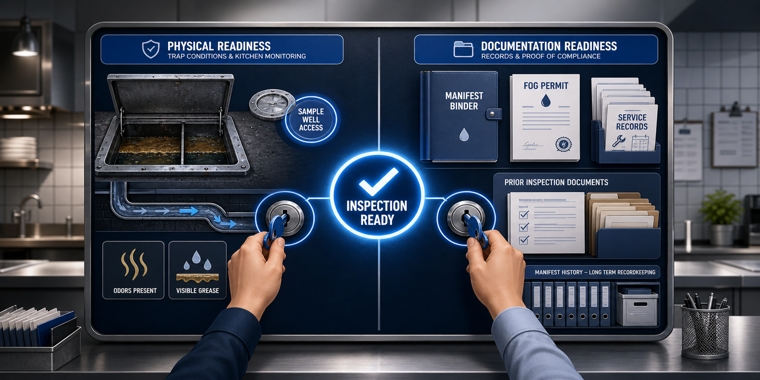
Grease trap inspection readiness means the trap condition and paperwork must prove the same story.
- Proof Beats Memory: “They were just here” is not enough without service records and manifest paperwork.
- Readiness Takes Two: Kitchen managers watch drains and odors while owners control permits, manifests, and records.
- Warning Signs Matter: Slow drains, foul odors, visible grease, or blocked access should trigger action before inspection day.
- Records Protect You: A complete file helps show when service happened and where the waste went.
- Schedules Need Judgment: Quarterly service may not fit busy kitchens that show problems before 90 days.
Pumping plus proof keeps inspections calmer.
Houston-area restaurant owners, GMs, and kitchen managers will align daily operations with inspection records, preparing them for the checklist that follows.
~ ~ ~ ~ ~ ~ ~ ~ ~ ~ ~ ~ ~ ~ ~ ~ ~ ~
Readiness fails in the handoff.
The clipboard is on the prep table. The drain near the dish area is moving slowly. Someone remembers a service visit, but nobody is sure where the manifest went.
That is the moment when grease trap inspection readiness becomes more than a kitchen task. It becomes a shared responsibility between the person watching the operation every day and the person who owns the records, permits, vendor relationship, and business risk. Who has the proof? That question needs an answer before an inspector asks it.
Use this grease trap inspection readiness checklist as a practical alignment tool. Print it, review it with the kitchen manager and owner or GM, and sign it before the next inspection window.
Executive Summary: Shared Liability Before the Inspector Arrives
A Houston-area restaurant is not inspection-ready just because the grease trap was pumped. It is ready when the physical condition of the trap and the paperwork trail both support the same story.
Kitchen managers usually see the first warning signs: slow drains, foul odors, blocked access, visible grease, or staff confusion about when to escalate. Owners and GMs usually control the FOG permit, manifests, service records, previous inspection copies, vendor contacts, and renewal calendar. This checklist is for both roles because an inspection does not separate “kitchen side” from “paperwork side” when the business is exposed.
Print the checklist, review it together, assign each item, and sign it after both sides confirm their responsibilities.
The Two Sides of Grease Trap Inspection Readiness
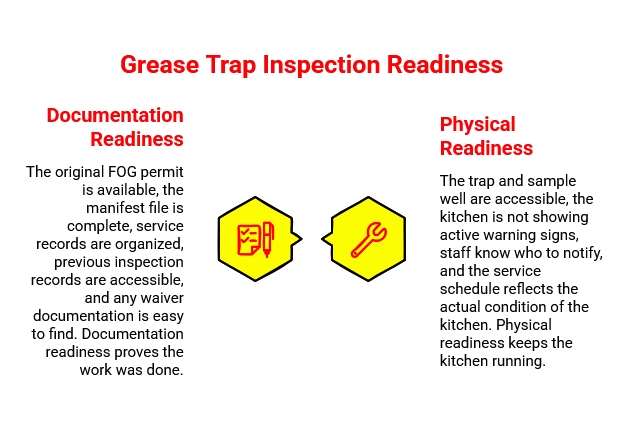
Grease trap inspection readiness has two parts.
The first is physical readiness. That means the trap and sample well are accessible, the kitchen is not showing active warning signs, staff know who to notify, and the service schedule reflects the actual condition of the kitchen. Physical readiness keeps the kitchen running.
The second is documentation readiness. That means the original FOG permit is available, the manifest file is complete, service records are organized, previous inspection records are accessible, and any waiver documentation is easy to find. Documentation readiness proves the work was done.
For Houston context, the Houston Permitting Center identifies restaurant or food dealer establishments with grease traps as special waste generators. Under local municipal guidelines, interceptors inside incorporated City of Houston limits must be fully evacuated at least quarterly, or every 90 days, unless an approved waiver applies.
That 90-day rule should not be treated as a guarantee that every kitchen can wait 90 days. High-volume kitchens often need monthly service, and service is required when FOG reaches 25% accumulation. This is where kitchen judgment matters. A busy line, a heavy fryer program, or repeated slow drains may point to a service need before the calendar says “quarterly.”
There is also a public infrastructure reason to take FOG seriously. Houston Public Works states that 70% of sewer overflows in Houston are caused by clogs from fats, oils, grease, and wipes. (houstonpublicworks.org) The FOG-Special Waste Program tracks fats, oils, and grease to help protect the city environment from pollutants. (Houston Permitting Center)
The practical point is simple: the kitchen protects the operation, and the records protect the proof.
Kitchen Manager Responsibilities: Physical Readiness Checklist
The kitchen manager owns what can be seen, smelled, heard, and reported during service. This does not mean the kitchen manager owns every legal or vendor decision. It means the person closest to the equipment must catch the operational signals early.
Use this checklist during a pre-shift walkthrough or weekly manager review.
| Physical readiness item | What the kitchen manager confirms | When to escalate |
|---|---|---|
| Trap access | Grease trap access is not blocked by storage, equipment, mats, or boxes. | Access is blocked or staff cannot locate the trap. |
| Sample well access | The sample well can be reached and is not covered or obstructed. | The sample well cannot be accessed quickly. |
| Slow drains | Sinks and floor drains are moving normally. | Slow drainage appears near prep, dish, or floor drains. |
| Odors | No persistent foul odors are present near prep, dish, trap, or drain areas. | Odors return after cleaning or worsen during service. |
| Visible grease | No grease appears in floor drains, sinks, or unusual locations. | Grease shows up where staff should not see it. |
| Last service date | The latest pump-out date is known and matches the service file. | Staff remember a visit, but no one can confirm the date. |
| Staff escalation | Staff know who to notify when warning signs appear. | Staff mention problems informally but no one logs them. |
| Service documentation | Any service visit generated paperwork, not just verbal confirmation. | A provider came out, but no document is available. |
A common failure point is the casual phrase, “They were just here.” That may be true, but it is not enough for inspection readiness. The kitchen manager should confirm that the visit produced documentation and that the owner or GM filed it.
For more operational warning signs, Drane Ranger’s grease trap cleaning in Houston resource covers slow drainage, odors, visible grease, and 25% accumulation as service triggers.
Owner Responsibilities: Manifest and Legal Oversight Checklist
The owner or GM owns the proof system. That includes permits, manifests, inspection files, vendor information, renewal reminders, and backup records.
This work is not “just paperwork.” It is the chain of custody that shows what happened to the waste after it left the kitchen.
During an inspection, official Houston documentation may require the original Fats, Oils, and Grease permit, yellow and white copies of waste manifests for the past five years, applicable biological pretreatment invoices, waiver documentation if applicable, and copies of previous inspections. (houstonhealth.org) The City’s Code of Ordinances page is the official lookup path for Chapter 47 and City Code references. (houstontx.gov)
Use this owner-side checklist before assuming the restaurant is ready.
| Documentation item | What the owner or GM confirms | Why it matters |
|---|---|---|
| FOG permit | Original FOG permit is visible or on site. | Confirms the permit is not missing from the inspection file. |
| Manifest file | Yellow and white manifest copies are available for the past five years. | Shows chain-of-custody history. |
| Service records | Pump-out records are organized by date. | Prevents scrambling during a review. |
| Previous inspections | Prior inspection copies are stored with the compliance file. | Helps the team understand past issues. |
| Waiver documentation | Any applicable waiver is present and current. | Avoids relying on verbal memory. |
| Vendor contact | Service provider contact details are current. | Makes escalation faster. |
| Renewal owner | One person owns the FOG permit renewal calendar. | Prevents missed renewal responsibility. |
| Backup location | A second person knows where records are stored. | Protects the business if one manager is absent. |
An invoice can show that money changed hands. A manifest helps show the waste was handled through the proper custody process. That difference is the core of grease trap compliance for a restaurant team.
For deeper documentation planning, use Drane Ranger’s FOG manifest readiness resource alongside this checklist.
The Alignment Meeting: What Both Roles Must Confirm Together
Separate checklists help, but the real protection comes from the meeting where both roles compare answers.
This should be a short working meeting, not a long compliance lecture. Put the current service records, the manifest binder, the inspection file, and the kitchen manager’s warning-sign notes on one table. Then walk through three questions.
| Question | Kitchen Manager owns | Owner/GM owns | Shared decision |
|---|---|---|---|
| Is the trap physically serviceable today? | Observes drains, odors, access, visible grease, and sample well conditions. | Approves service escalation if risk signs appear. | Call the provider if risk signs are active. |
| Are records inspection-ready? | Confirms the latest visit occurred and staff remember the service event. | Confirms the manifest is filed and records are complete. | Fill any missing documentation gap before the inspection window. |
| Is the next service date appropriate? | Reports kitchen volume and recurring warning signs. | Approves the schedule and vendor communication. | Move from calendar-only service to condition-aware service when needed. |
This meeting solves the hidden problem. Owners want to delegate without losing oversight. Kitchen managers want clear authority to escalate before a backup, odor issue, or audit problem becomes urgent.
Think of it as a two-key control system. Operations turns one key by confirming the physical condition of the trap. Ownership turns the other by confirming the permit, manifests, and records. Inspection readiness works when both keys turn together.
For a broader operational reference, pair this checklist with Drane Ranger’s FOG compliance checklist and commercial grease trap cleaning compliance guide.
Printable Dual-Responsibility Checklist
Executive summary for the printed copy: Grease trap inspection readiness is shared. The kitchen manager confirms physical readiness. The owner or GM confirms documentation readiness. Both roles should review, sign, and file this checklist before the next inspection window.
Status key: Ready / Needs Action / Escalate Today
| Checklist item | Kitchen Manager | Owner/GM | Service Provider Verification | Date checked | Status | Next action |
|---|---|---|---|---|---|---|
| FOG permit posted and current | Confirm visible location | Confirm permit file | Not applicable | |||
| Five years of manifests available | Confirm latest visit occurred | Confirm yellow and white copies are filed | Confirm manifest details if needed | |||
| Last pump-out date verified | Confirm staff awareness | Confirm record date | Confirm service history | |||
| Trap/sample well accessible | Confirm access path | Approve corrective action if blocked | Confirm access at service | |||
| No active slow drains | Check sinks and floor drains | Approve escalation if recurring | Inspect if service is requested | |||
| No persistent foul odors | Check prep, dish, and trap areas | Approve escalation if unresolved | Inspect and document findings | |||
| No visible grease in unusual places | Check drains and nearby surfaces | Approve service if present | Verify removal/service need | |||
| Next service date scheduled | Report volume and warning signs | Confirm schedule and budget | Confirm appointment window | |||
| Escalation contact confirmed | Confirm staff know who to tell | Confirm vendor contact is current | Confirm emergency/service contact |
Next Scheduled Service Date: ______________________
Manifest Binder Location: ______________________
Emergency / Service Contact: ______________________
Kitchen Manager Signature: ______________________
Owner/GM Signature: ______________________
Date Completed: ______________________
This checklist is designed to look and function like an operations board: clear, high contrast, minimal decoration, and credible enough to keep in a compliance binder or manager office.
When to Escalate to a Professional Grease Trap Service
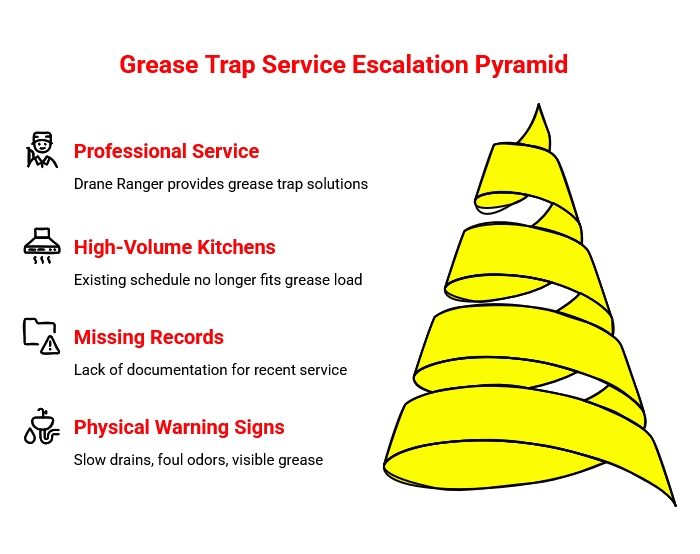
Call a professional when the checklist shows physical warning signs. Slow drains, foul odors, visible grease, inaccessible trap areas, and uncertainty about the last pump-out date are practical escalation triggers. Waiting for the default quarterly date may not be appropriate when the kitchen is already showing signs of strain.
Call a professional when records are missing and the team cannot prove recent service. A restaurant may have paid an invoice, but inspection readiness depends on organized documentation and manifest control. True readiness is not just pumping. It is pumping plus proof.
Call a professional when the restaurant is high-volume and the existing schedule no longer fits the kitchen. High-volume kitchens often require monthly service. That frequency may vary by operation, but the principle is stable: the service interval should reflect actual grease load, warning signs, and documentation needs.
Drane Ranger provides Grease, Grit & Lint Traps service, compliance documentation support, responsible disposal, reliable service, and service interval guidance for Houston-area businesses. The company has served Houston-area customers since 1985 and operates across the Greater Houston area within a 100-mile radius from its location.
As Shelley M. shared, “Drain Ranger is very professional and reliable. Basically they can take care of all your grease drain needs.”
When the checklist shows a gap, close it before the inspection does. Request your quote or contact Drane Ranger to schedule service support.
Start Your Service Today – Call 281-489-1765
Frequently Asked Questions
What documents should a Houston restaurant have ready for a grease trap inspection?
A Houston restaurant should be prepared to show the original FOG permit, manifest copies, service records, previous inspection copies, and waiver documentation if applicable. Official inspection documentation requirements may vary by situation, so confirm current requirements through the Houston Permitting Center and City of Houston sources.
Who should own grease trap compliance: the kitchen manager or the owner?
Both roles own part of the system. The kitchen manager owns physical readiness signals, such as access, odors, slow drains, visible grease, and staff escalation. The owner or GM owns documentation readiness, including permits, manifests, service records, vendor contacts, and renewal accountability.
Is an invoice enough proof of grease trap service?
An invoice is useful, but it should not be treated as a substitute for manifest documentation. The brief’s central compliance point is “manifests over invoices.” Manifests help show chain of custody for the waste, while invoices mainly show a business transaction.
How often should a grease trap be cleaned in Houston?
The Houston Permitting Center states that interceptors within incorporated City of Houston limits must be fully evacuated at least quarterly, or every 90 days, unless an approved waiver applies. High-volume kitchens may need more frequent service, and service is required when FOG reaches 25% accumulation.
When should a restaurant call a grease trap service provider before an inspection?
Call when the checklist shows physical warning signs, missing documentation, unclear service history, blocked access, or a service interval that no longer matches kitchen volume. The earlier the team closes the gap, the less pressure there is during an inspection.
Our Editorial Process
Publication Hold: Approved Drane Ranger editorial process copy was not found in the provided corpus. Insert the client-approved editorial process text here before publication. Do not publish invented editorial-process language as if it were brand-approved.
About the Drane Ranger Insights Team
The Drane Ranger Insights Team creates practical wastewater and grease trap compliance resources for Houston-area businesses. Final publication should be reviewed by a qualified Drane Ranger representative for service accuracy and current local compliance details.