The 25% Rule Explained: When to Schedule Your Pump-Out to Stay Compliant

📌 Key Takeaways

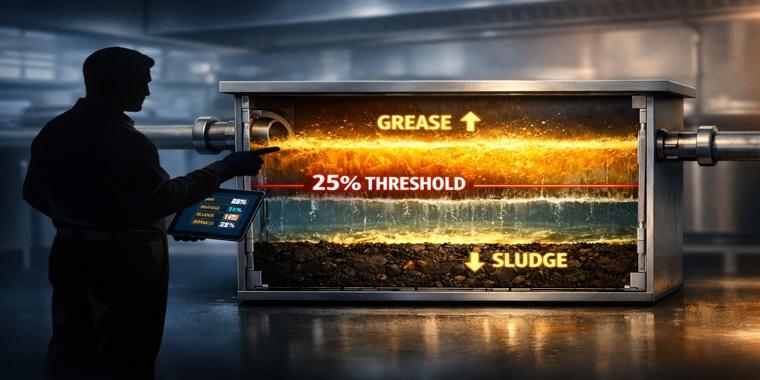
Houston’s grease trap compliance hinges on one measurable threshold: when floating grease plus settled solids reach 25% of your trap’s liquid depth, schedule service immediately—regardless of the calendar.

  • Core Sampling Reveals What Visual Checks Miss: Bottom sludge accumulates invisibly beneath a seemingly clean surface, making core sampling through the sample well the only reliable measurement method inspectors accept.
  • The 25% Rule Overrides the 90-Day Clock: High-volume kitchens often hit the 25% threshold in six to eight weeks, triggering mandatory service even when the quarterly deadline hasn’t arrived—compliance follows accumulation, not the calendar.
  • Manifests Prove Legal Disposal, Not Just Payment: A signed waste manifest creates a chain-of-custody record that protects restaurants from liability if haulers dump illegally, making it the critical compliance document inspectors require.
  • Measurement Drives Predictable Scheduling: Taking core samples every two to three weeks reveals each kitchen’s actual accumulation rate, enabling operators to pre-book service before hitting the 25% trigger rather than reacting to odors or backups.
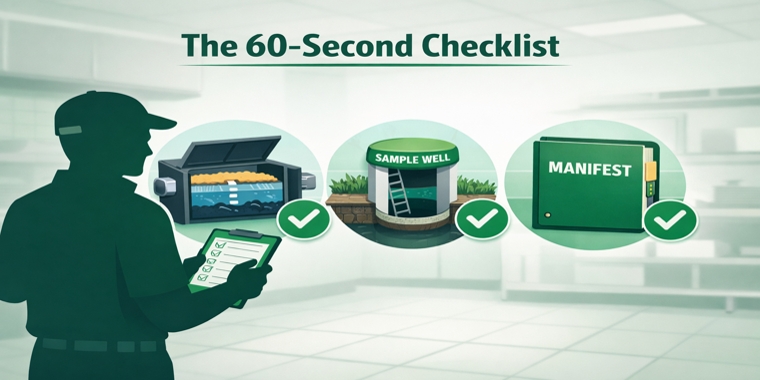
  • The Three-Step Compliance Loop Prevents Violations: Measure with core sampling, schedule proactively based on trend data, and maintain organized manifests—this systematic approach keeps Houston restaurant kitchens audit-ready and operations running smoothly.

Measure before you’re mandated, schedule before you’re late, document before you’re inspected.

Houston restaurant owners, general managers, and facilities managers will find this framework here, preparing them for the detailed measurement and scheduling guidance that follows.

The 25% rule defines when Houston restaurants must clean their grease traps: when the combined depth of floating grease and settled solids reaches approximately one-quarter of the trap’s total liquid depth. Think of it like an oil-change indicator—hit the line, you service now.

Picture this scenario. It’s Friday lunch rush, and a city inspector walks into your kitchen. They ask to see your most recent core sample reading. You check your log. The measurement shows 28%.

That simple number tells the inspector everything they need to know—and it determines whether you’re compliant or facing a violation. Schedule your pump-out before reaching 25% or by the quarterly mandate, whichever comes first.


What is Houston’s 25% Rule?

What is the 25% rule for grease traps?

The 25% rule is the operational threshold that triggers mandatory grease trap cleaning in Houston. It measures total accumulation—both the floating grease cap at the top of your trap and the settled solids at the bottom—as a percentage of the trap’s liquid depth.š

When these two layers combined equal roughly one-quarter of the total depth, the trap has reached its functional limit. At this point, the trap can no longer effectively separate fats, oils, and grease (FOG) from wastewater.

This isn’t an arbitrary number. The 25% threshold represents the point where trap efficiency degrades significantly, increasing the risk of FOG entering the municipal sewer system.š City ordinances in Houston recognize this as the functional compliance trigger, meaning you must schedule service when you hit or exceed this accumulation level.

Treat 25% as your “service-now” line. Waiting until you’re well past this threshold—or worse, waiting until you smell problems—puts your business at risk of violations, backups, and costly emergency service calls.


25% vs. 90 Days—Which Comes First?

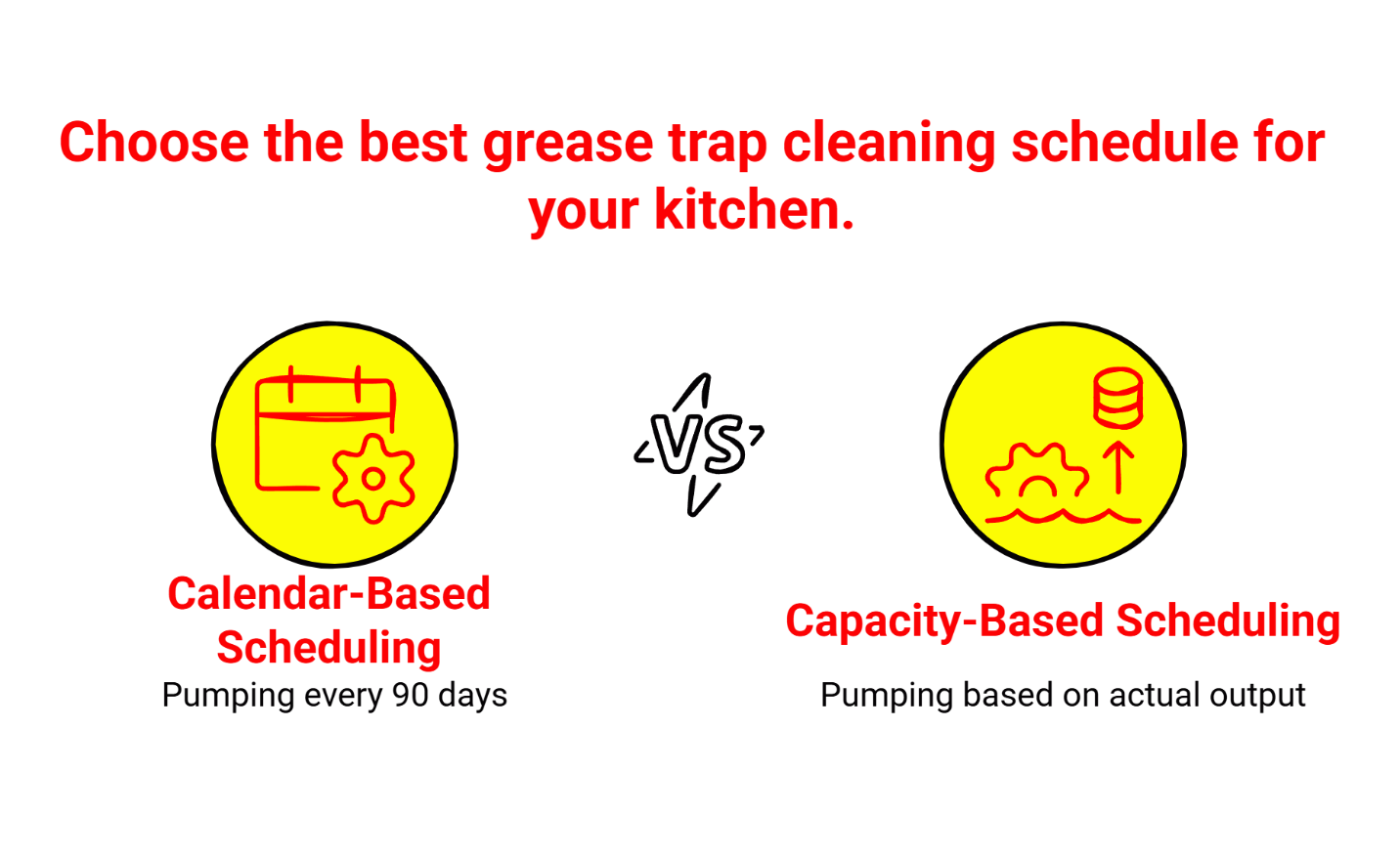
Houston restaurants face two overlapping requirements: the 25% accumulation threshold and the quarterly (90-day) cleaning mandate. You must clean at whichever trigger comes first.š

For many operations, especially high-volume kitchens, the 25% threshold arrives well before 90 days have elapsed. A busy restaurant producing significant grease loads might hit 25% in just six to eight weeks. When this happens, the clock doesn’t matter—the accumulation level takes priority.

The quarterly mandate serves as a backstop. Even if your trap measures below 25% at the three-month mark, city regulations for traps within Houston limits still require cleaning.š This ensures that lower-volume operations maintain regular service intervals and proper trap function.

Understanding which trigger applies to your specific operation requires measurement and tracking. High-volume kitchens need shorter service intervals; lower-volume operations may run closer to the quarterly schedule. The key is measuring regularly to know where you stand and adjusting your maintenance calendar accordingly.


How Inspectors Measure It (and How You Should Too)

How do inspectors measure the 25% rule—do visual checks count?

Inspectors don’t rely on visual surface checks. They use core sampling through your trap’s sample well to get an accurate cross-section of all three layers: the grease cap, the clear water zone, and the settled solids at the bottom.

A visual check from the top only shows you the grease cap—and even that measurement is unreliable without proper tools. The real problem lies beneath the surface. Settled solids accumulate at the trap bottom, invisible to anyone just lifting the lid for a quick look. These solids count toward your 25% total, and inspectors know that surface appearances miss this critical layer. Visual checks alone cannot prevent the sewer blockages and overflows that FOG regulations are designed to stop.

Core sampling provides a complete vertical profile. The sampler—commonly called a sludge judge—captures material from top to bottom in a single pull. This allows for precise measurement of both the floating grease thickness and the depth of bottom sludge.

Your measurement protocol should match the inspector’s method. Use a core sampler designed for grease traps, accessed through your trap’s sample well. Record the top grease layer thickness, the clear water zone depth, and the bottom solids depth. Calculate these measurements against your trap’s total liquid depth to determine your accumulation percentage.

Visual checks fail inspections. Core sampling passes them. Make the investment in the right tool and the right technique.


Step-by-Step: Take a Core Sample in 5 Minutes

Core sampling process infographic showing steps to access sample well, lower and seal core sampler, retrieve sample, measure layers, calculate grease and solids percentage, and log results.


Does floating grease count toward the 25% rule?

Yes. Both floating grease and settled solids count toward your 25% total.š Here’s how to measure both layers accurately:

Access your sample well. Most grease traps have a dedicated sample well or measurement port. Locate this access point—it’s typically marked and provides a clear vertical path to the trap bottom.

Lower your core sampler slowly. A sludge judge or similar core sampling tool should descend through all three layers without disturbing them. Keep the bottom valve closed during descent to prevent water from entering the tube prematurely.

Reach the trap bottom, then seal. When you feel the sampler touch bottom, close the bottom valve to trap the vertical sample inside the tube. This captures a complete cross-section from top to bottom.

Retrieve and read the layers. Lift the sampler straight up and examine the captured sample. You’ll see three distinct zones: grease at the top (often yellowish or tan), clear water in the middle, and dark settled solids at the bottom.

Measure and calculate. Use the graduated markings on your sampler to measure:

  • Top grease layer depth
  • Bottom solids layer depth
  • Total liquid depth (grease + clear water + solids)

Add the grease and solids measurements, then divide by total depth and multiply by 100 for your percentage. If grease is 2 inches, solids are 3 inches, and total depth is 20 inches: (2 + 3) á 20 = 0.25, or 25%.

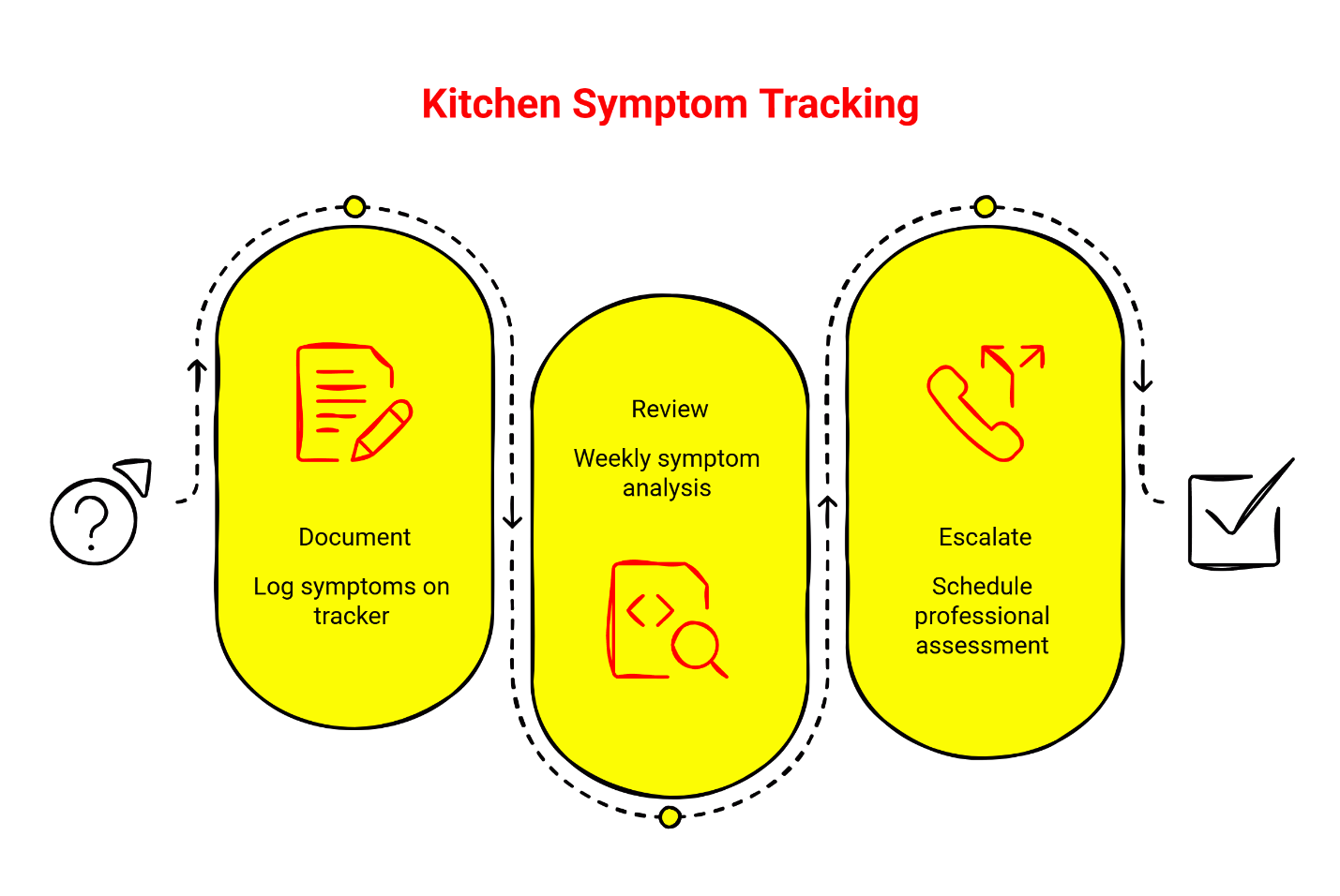
Log the result immediately. Record the date, time, all three measurements, and the calculated percentage in your maintenance log. This documentation proves you’re monitoring compliance between service visits.

Assign this task to a designated kitchen manager or facilities lead. Taking a reading once every two to three weeks gives you advance warning before you hit the 25% threshold.


Scheduling Logic: Turn Readings into a Maintenance Calendar

Raw measurements mean nothing without a maintenance plan. Use your readings to establish a service cadence that prevents you from ever reaching the 25% trigger unexpectedly.

Start with a 90-day baseline if you’re new to systematic tracking. Schedule your first professional cleaning, then begin taking core samples every two weeks. Track the accumulation rate over the first three months. This data reveals how quickly your specific operation approaches the 25% threshold.

High-volume kitchens often discover they need service every six to eight weeks. Lower-volume operations might find they run comfortably at 75 or 85 days. The measurement trend tells you what your kitchen actually needs—not what a generic schedule suggests.

Once you know your accumulation rate, schedule the next service appointment before you project hitting 25%. Build in a safety margin. If your readings suggest you’ll reach 25% at week 10, book service for week 8 or 9. This buffer accounts for unexpected volume spikes during busy seasons or special events.

Pre-booking service creates schedule certainty. This quiet protection—operating like an invisible shield between your kitchen and expensive sewer problems—means you avoid last-minute emergency calls, and your service provider can plan routes more efficiently. Many operators find that turning measurements into a reliable schedule reduces both stress and cost over time.


Compliance Paperwork: The Manifest Is Your Proof

Cleaning your grease trap removes the waste. The manifest proves you disposed of it legally.

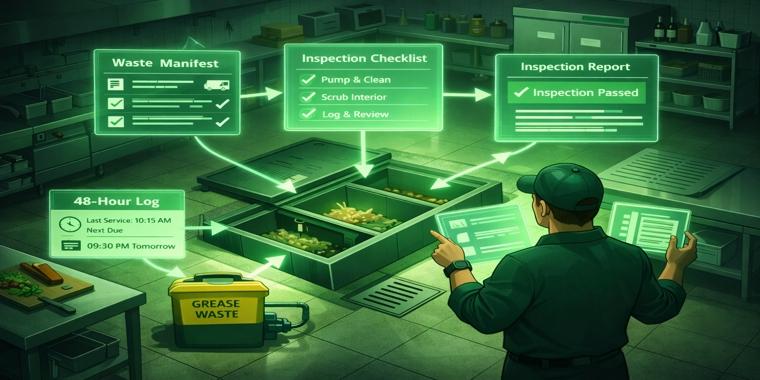
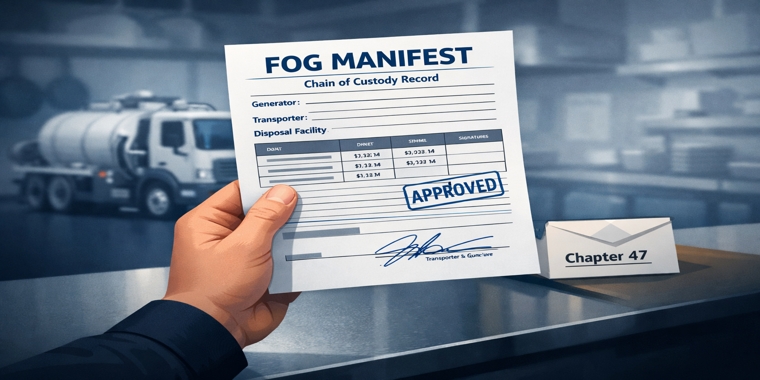
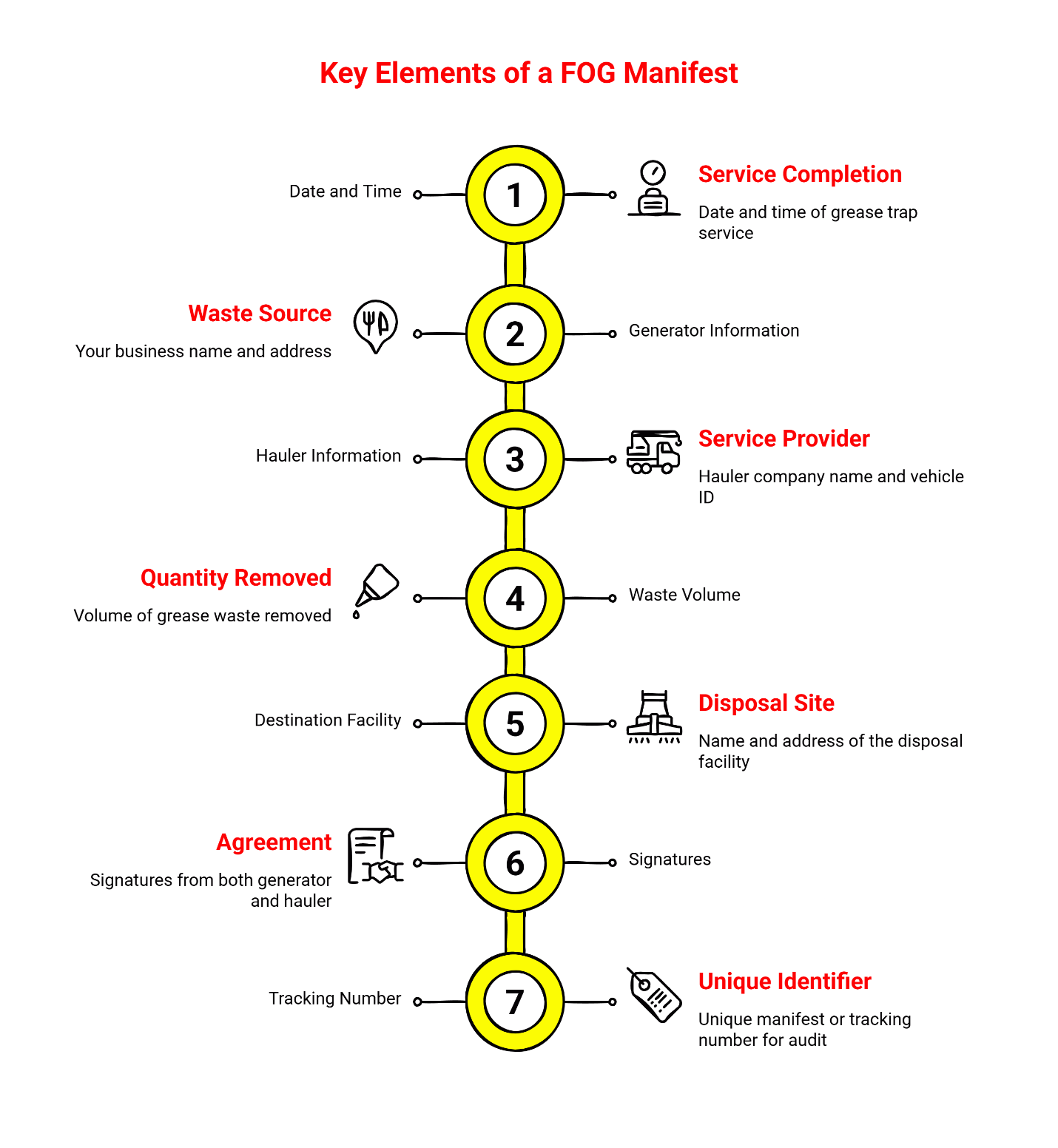
A waste manifest is a legal tracking document that follows your grease trap waste from your property to its final disposal site. It identifies the waste generator—your restaurant—along with the hauler, the transport vehicle, and the receiving facility.¹ All parties sign the manifest, creating a chain-of-custody record.

For Houston restaurant operators, this document serves two critical functions. First, it demonstrates compliance with city FOG (fats, oils, and grease) ordinances that require proper waste disposal. Second, it protects you if there’s ever a question about where your waste ended up. If a hauler dumps illegally, the signed manifest proves you fulfilled your legal responsibility by hiring a registered service provider.

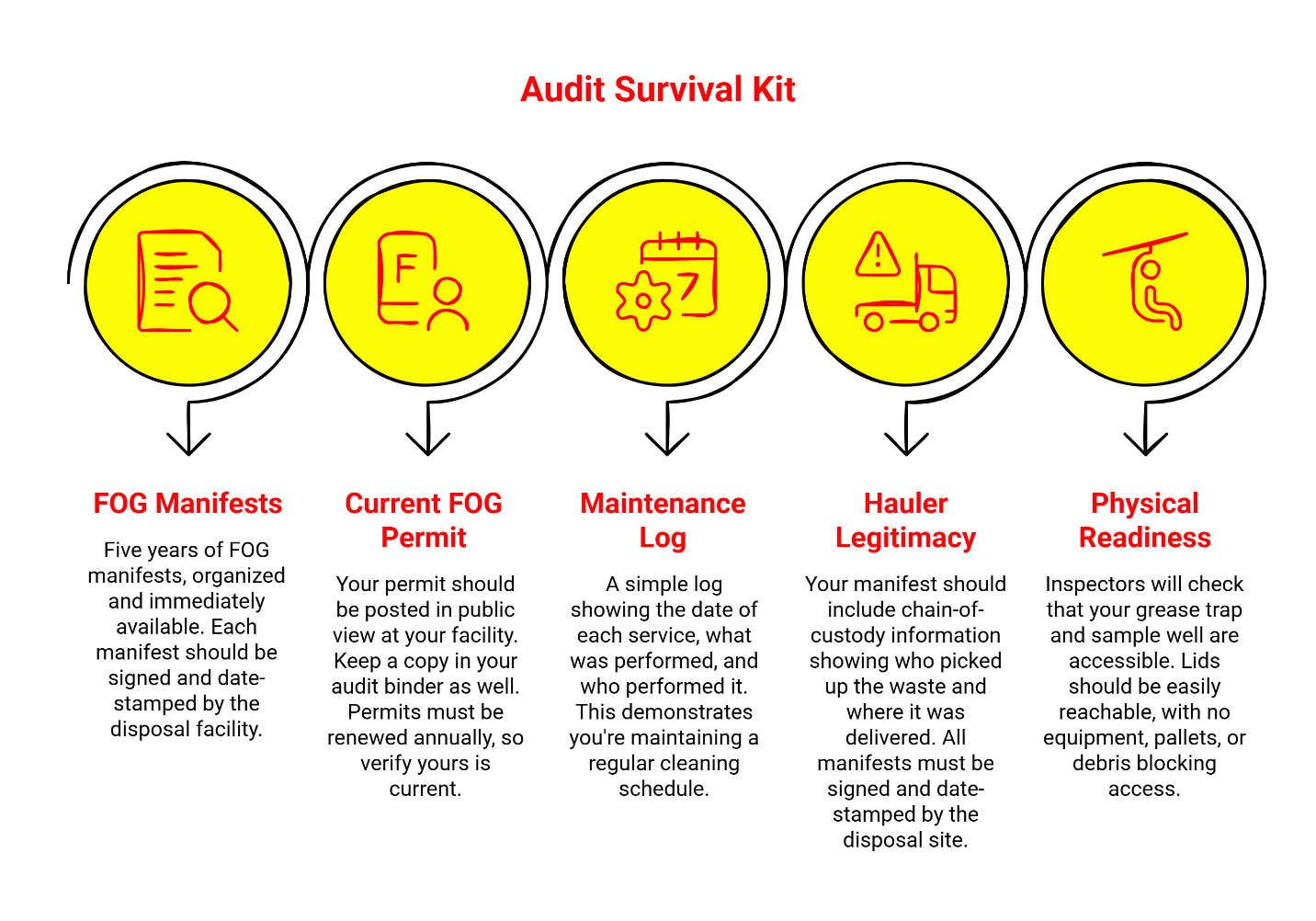
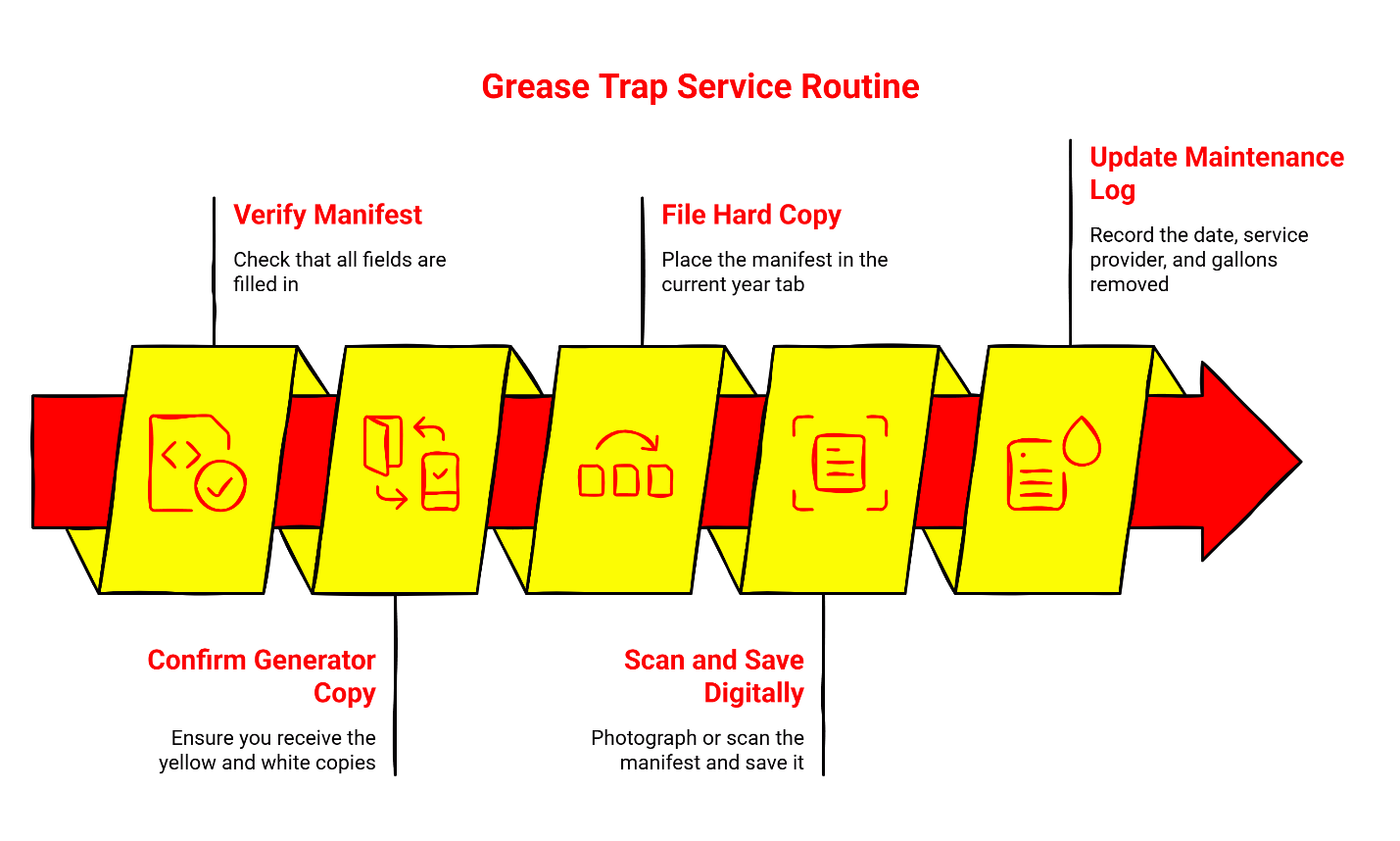
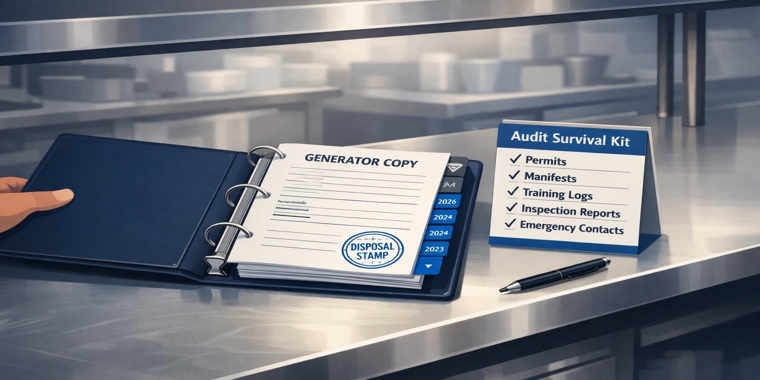
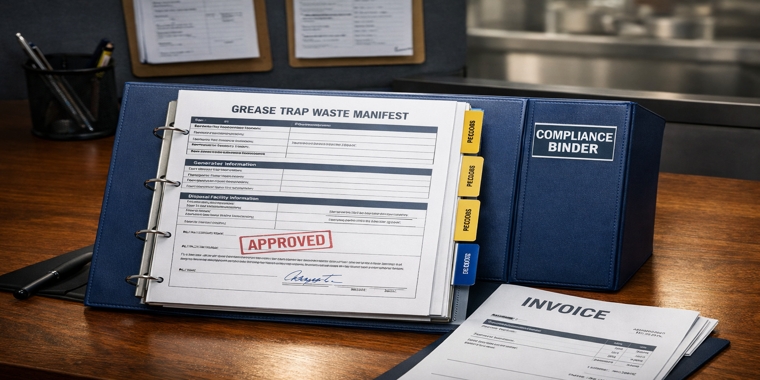
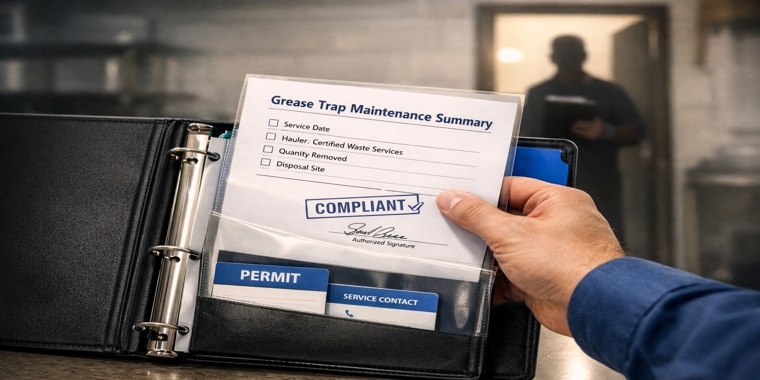
After every pump-out, file the signed manifest in a dedicated Compliance Binder. Organize manifests chronologically with the most recent on top. Keep this binder readily accessible for inspector visits. Regulatory guidance recommends retaining manifests for at least five years to cover typical audit windows.š

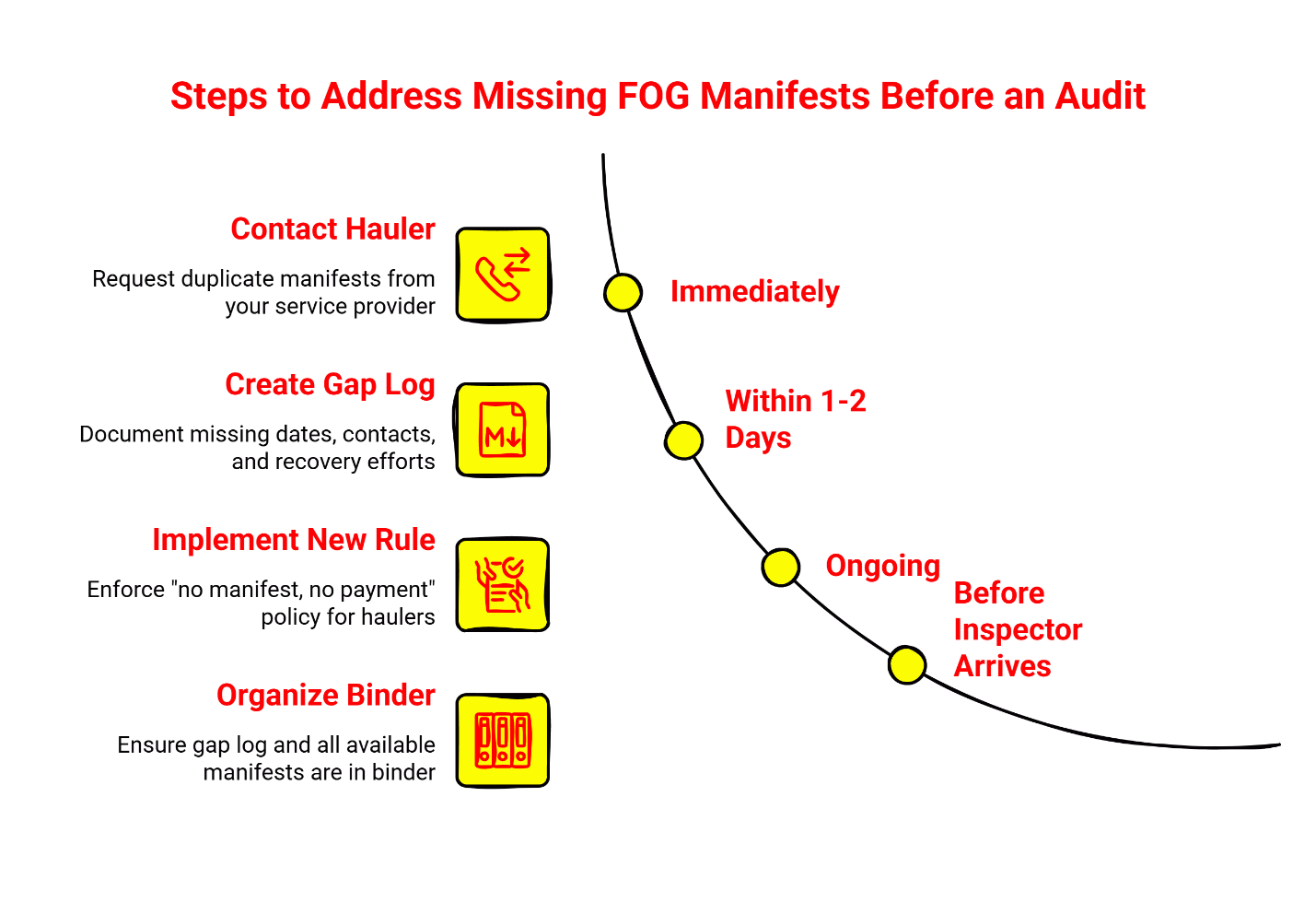
Missing manifests raise red flags during inspections. An inspector sees a clean trap but no paperwork trail and must assume non-compliance. That gap can trigger fines even if you’ve been cleaning on schedule. The cleaning proves operational maintenance; the manifest proves legal compliance.

“Organized, professional and on time… suggested time of cleaning again,” one Houston-area operator noted after establishing a consistent manifesting routine with a reliable service provider. That level of systematic documentation turns a potential compliance vulnerability into a strength.


Common Pitfalls That Trigger Fines

Infographic showing common pitfalls that trigger grease trap fines, including relying on visual checks, blocked sample wells, missing manifests, waiting for warning signs, and using unregistered haulers.


Relying on visual checks only. Walking past the trap, lifting the lid, and declaring it “looks fine” misses the bottom sludge layer completely. This hidden accumulation contributes directly to the sewer blockages and sanitary sewer overflows (SSOs) that FOG regulations aim to prevent. Inspectors know this. They’ll ask for your core sample log, and if you don’t have one, the visual assessment means nothing.

Blocked or inaccessible sample wells. Sample wells can become clogged with grease or covered by equipment over time. If an inspector can’t access your sample well to verify your readings, they may cite you for non-compliance regardless of when you last cleaned the trap.

Missing or incomplete manifests. Some operators keep invoices but not manifests, not realizing these are different documents. An invoice shows you paid for a service; a manifest proves legal waste disposal.š Inspectors require manifests.

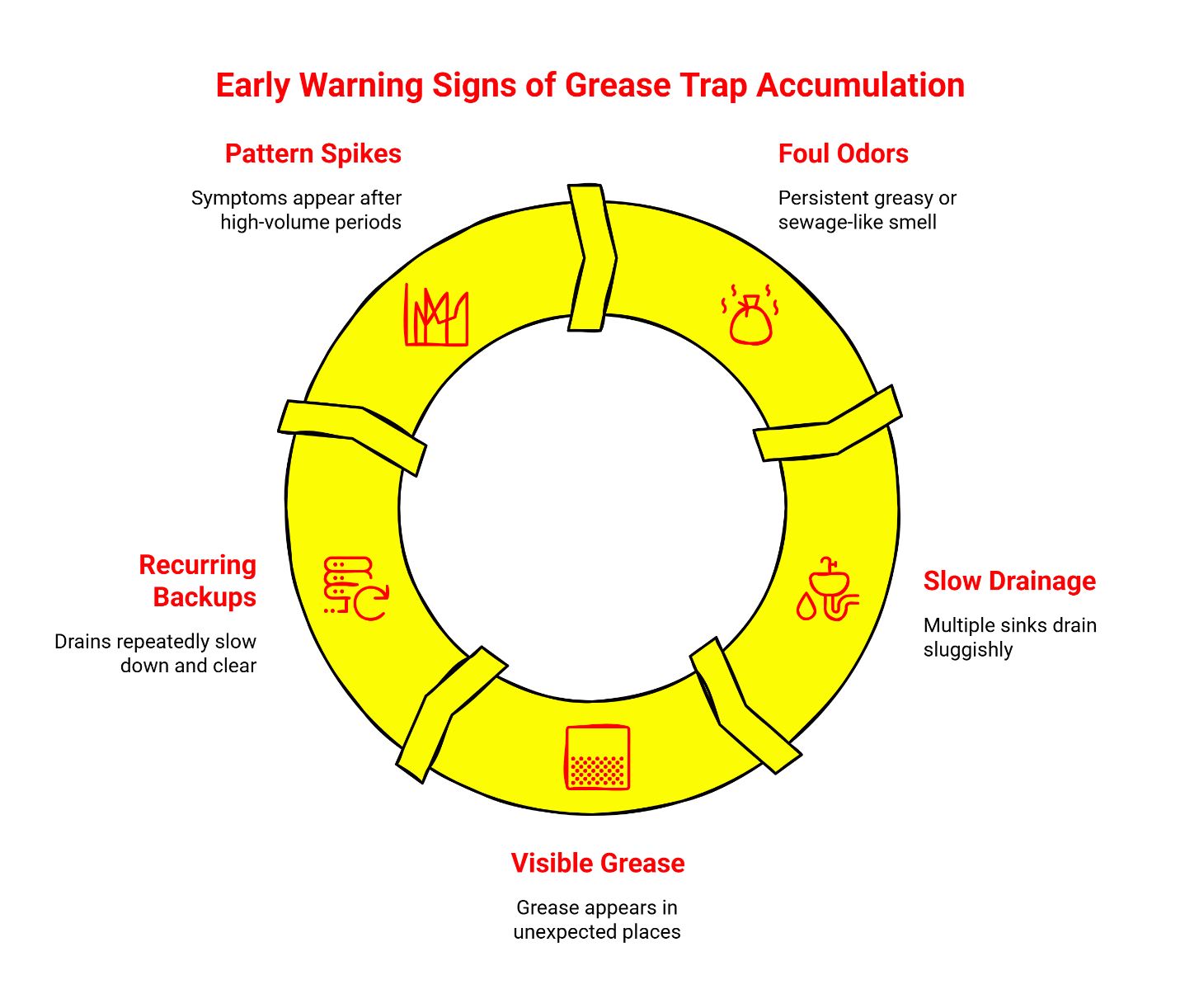
Waiting for warning signs. Bad odors, slow drains, or visible backups mean you’re well past 25%—possibly at 40% or 50% accumulation. By the time you smell a problem, you’re already in violation and facing potential backup damage.

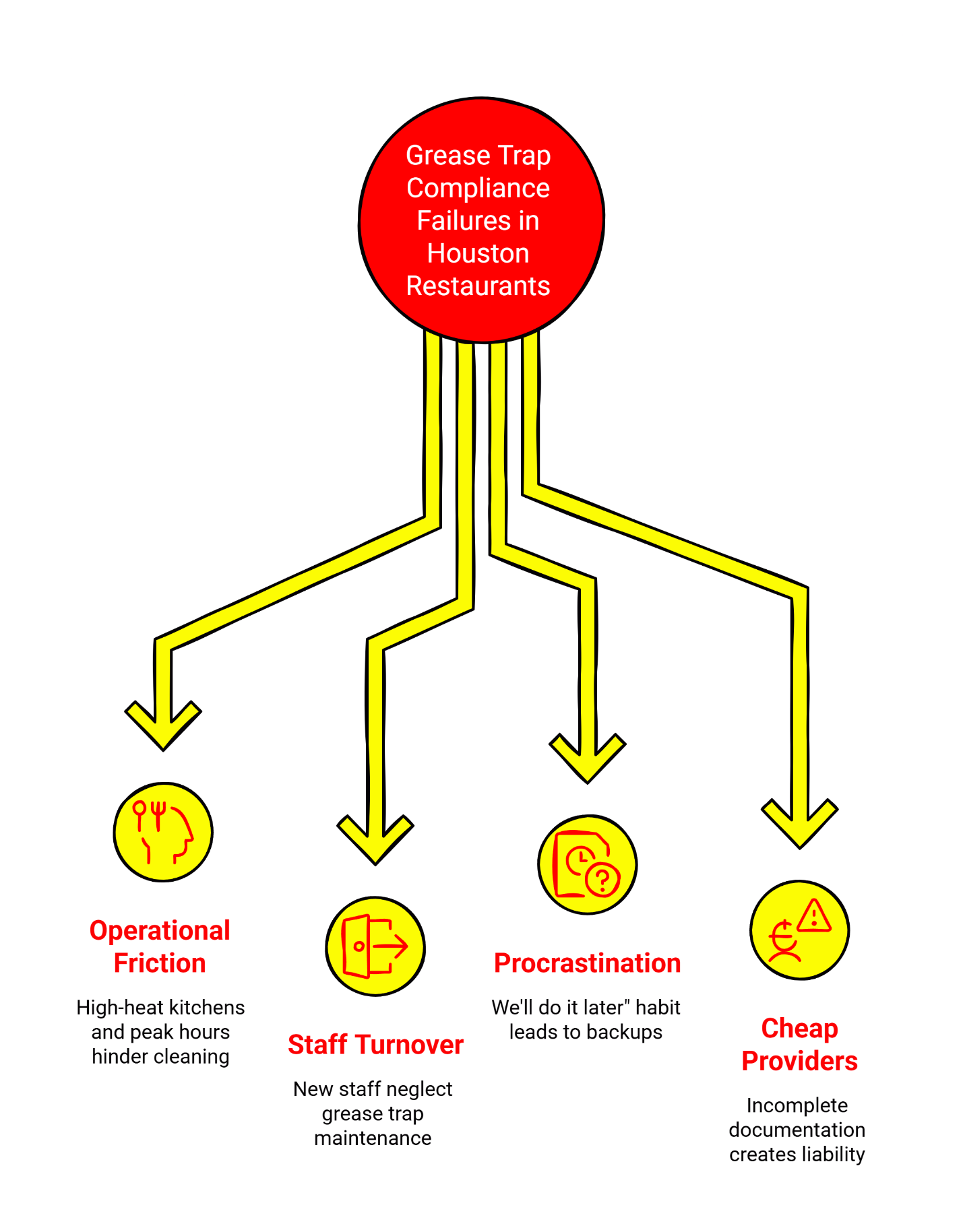
Using unregistered or non-compliant haulers. Some operators choose the cheapest service without verifying the hauler is properly registered and insured. When these haulers skip manifesting or dump illegally, you can still be on the hook as the generator—the legal term for the restaurant that produced the waste.š As one satisfied customer shared: “Drain Ranger is very professional and reliable. Basically they can take care of all your grease drain needs.” That reliability includes proper manifesting and disposal—protections worth far more than the small premium over cut-rate alternatives.

These pitfalls share a common thread: reactive rather than proactive management. Houston’s 25% rule exists to prevent problems, not document them after they occur. Everything else is noise.


Frequently Asked Questions

What exactly counts toward the 25%?

Both floating grease and settled solids count toward total accumulation. The clear water zone in the middle does not count—only the material at the top and bottom of the trap.¹

Do I pump at 25% or every 90 days?

You must clean at whichever trigger comes first. If you reach 25% accumulation at week 7, you clean at week 7. If you’re still below 25% at day 90, the quarterly mandate requires service anyway.š

How do I measure it?

Use a core sampler (sludge judge) accessed through your trap’s sample well. The sampler captures a vertical cross-section showing all three layers. Measure the grease cap depth, the bottom solids depth, and the total liquid depth, then calculate the percentage.

Is a clean-looking surface OK?

No. Surface appearance reveals nothing about bottom sludge accumulation. Inspectors require core sampling data, not visual assessments, because visual checks consistently underestimate total accumulation and cannot prevent sewer blockages.

What paperwork do I keep?

Keep signed waste manifests from every pump-out. Organize them chronologically in a dedicated compliance binder. Maintain these records for at least five years for audit readiness.


Measure, Don’t Guess: Book Before You Hit 25%

The 25% rule transforms grease trap maintenance from guesswork into a measurable process. Floating grease plus settled solids equal your total accumulation. When that total reaches one-quarter of your trap’s liquid depth, schedule service immediately.š

Core sampling through your sample well provides the accurate measurement inspectors require. Visual checks miss the bottom layer where significant solids accumulate. Take readings every two to three weeks, log the results, and track your accumulation trend over time.

This measurement-based approach reveals your kitchen’s actual service interval—whether that’s every six weeks for high-volume operations or closer to the 90-day maximum for lower-volume establishments. Use this data to pre-book maintenance appointments before you hit the threshold, not after.

The documentation loop completes the compliance picture. Measurement identifies when to clean. Professional service removes the waste. A signed manifest proves legal disposal.¹ Together, these three elements—measure, schedule, manifest—create an audit-ready compliance system that protects your business.

“He has done all my septic work and is the best!” one long-term customer shared. That expertise extends to helping Houston restaurant operators establish systematic maintenance programs built on measurement data, not reactive crisis management.

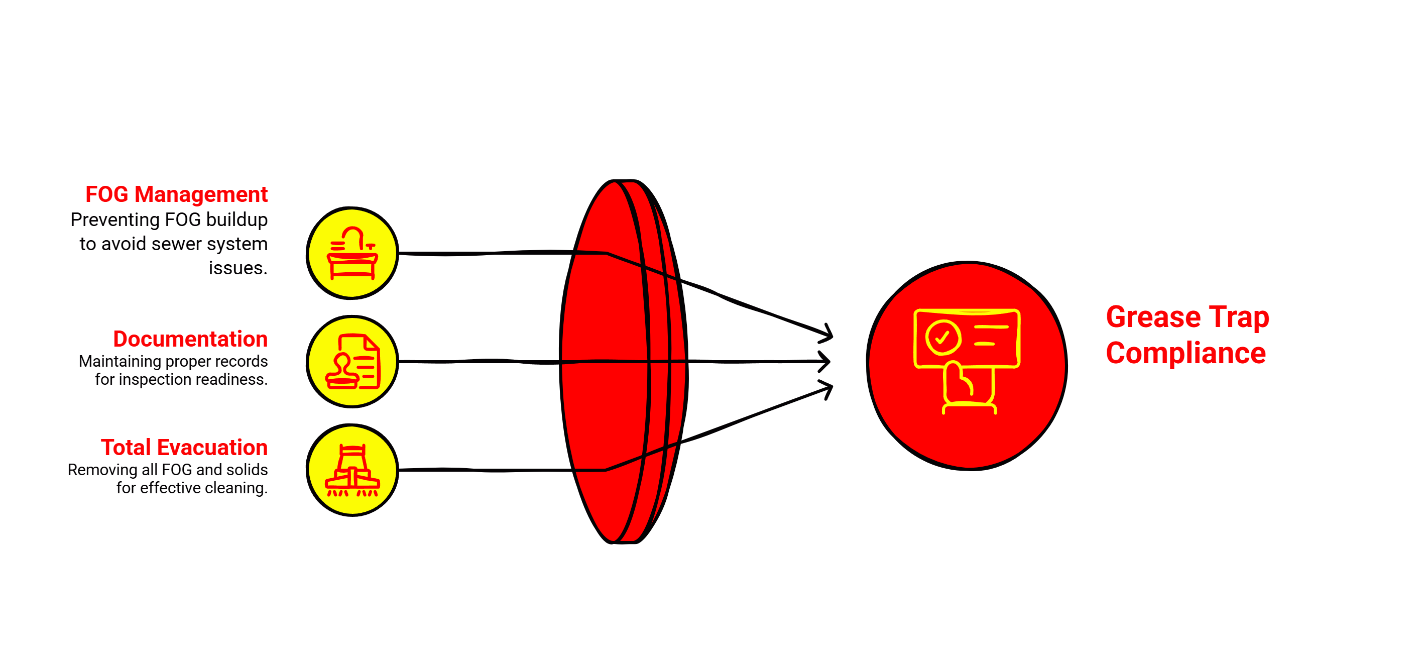
Understanding what to expect from a professional grease trap cleaning helps operators recognize quality service. Avoiding common FOG violation myths prevents costly mistakes that trigger fines despite good intentions.

The math is simple: measure regularly, schedule proactively, and maintain complete documentation. That systematic approach keeps Houston restaurant kitchens compliant, inspectors satisfied, and operations running smoothly.

Call Drane Ranger to set your maintenance schedule and establish a measurement-based compliance program tailored to your kitchen’s actual service needs, or contact us to request a 25% reading and service quote.

References

  1. Texas Commission on Environmental Quality (TCEQ). FOG control and interceptor maintenance guidance. Sample ordinance provisions covering 25% accumulation standards, quarterly cleaning requirements, and recordkeeping expectations for waste generators.

About the Drane Ranger Insights Team

The Drane Ranger Insights Team is our dedicated engine for synthesizing complex topics into clear, helpful guides. While our content is thoroughly reviewed for clarity and accuracy, it is for informational purposes and should not replace professional advice.

The ‘Sample Well’ Myth: Why Visual Checks Fail to Detect Sludge

📌 Key Takeaways

A clear sample well can hide compliance violations that trigger fines, shutdowns, and emergency pump-outs during your busiest service hours.

  • Surface Clarity Hides Bottom Risk: The sample well shows only the top layer while heavy sludge accumulates invisibly at the tank bottom, often pushing total accumulation past the 25% threshold.
  • Inspectors Measure, Not Eyeball: Core sampling captures the full vertical column of grease cap plus settled solids, providing the accurate percentage calculation that determines compliance.
  • Dual Requirements Drive Service Timing: Houston mandates pump-out at 25% accumulation OR every 90 days, whichever comes first—meaning high-volume kitchens may need service before the calendar triggers it.
  • Cleaning Without Manifests Means Incomplete Compliance: Signed waste manifests proving legal disposal must be retained for five years and produced on demand during inspections.
  • Measured Compliance Replaces Guesswork: Monthly core sampling with documented results transforms reactive crisis management into predictable, scheduled maintenance that keeps operations running smoothly.

Measured beats guessed. Houston restaurant operators and facilities managers will find a practical compliance framework here, preparing them for the detailed implementation guidance that follows.

Friday night. The dinner rush is building momentum, and everything seems fine. You check the sample well—it looks clear. No visible grease floating on top, no obvious warning signs. But then the drains start backing up. Odors rise from the floor sinks. And when the city inspector arrives for a surprise visit, you discover your trap is well past the 25% threshold.

A clear sample well doesn’t guarantee compliance. It only shows what’s happening at the surface while potentially hiding several inches of settled sludge at the bottom of your tank.

What is a sample well? It’s the access point on top of your grease trap that allows you to visually inspect the contents. Think of it as a small window into a much larger system—you can see the top layer, but everything below remains hidden.

Here’s the reality: Judging trap compliance by looking at the sample well is like checking your fryer oil by examining only the top inch. The surface might look golden and clean, but the burnt solids and breakdown products settle to the bottom where you can’t see them.

Picture this common scenario: It’s Friday evening, your dining room is packed, and everything appears to be running smoothly. The sample well you checked this morning looked perfectly clear. But as the night progresses, your dish pit slows down. Water pools around the three-compartment sink. A faint odor begins to drift from the floor drains. Your staff mentions it, but you’re in the middle of service. Then an inspector walks through the door for a routine check. Within minutes, they’re measuring your trap with a core sampler—and the reading shows 32% accumulation. You’re facing a violation notice and an immediate order to pump out, all while your sample well still looks relatively clear from above.

The practical solution: Adopt the inspector’s standard. Use core sampling to measure the full vertical column of your trap contents, capturing both the floating grease cap and the settled solids layer. Schedule regular grease trap cleaning in Houston based on actual measurements, not guesswork. This shift from visual checks to measured compliance transforms uncertainty into predictable, documented maintenance.


What a Sample Well Really Shows (and Hides)

Grease trap layering and inspection diagram showing visible top grease cap, clear middle clarified zone, and hidden bottom sludge accumulation.


A sample well provides access to the trap’s surface layer. When you lift the lid and look down, you’re seeing the top 2-4 inches of a tank that might be 18-24 inches deep. This limited view reveals the floating grease cap—if one has formed—but tells you nothing about the sludge accumulating below.

The physics of grease trap operation work against visual inspection. Lighter materials—fats, oils, and grease—float to the top, where they’re visible through the sample well. Heavier solids, including food particles, sediment, and degraded organic matter, sink to the bottom and remain completely hidden from view. Between these two layers sits the clarified middle zone where your sample well provides its deceptively clear view.

This layered separation is exactly what the trap is designed to create. But it also creates a dangerous illusion. The visible surface layer might represent only 5-10% greasy appearance, while the bottom sludge layer has accumulated to the point where the combined total exceeds 25% of the wetted depth. The trap can be approaching or exceeding the compliance threshold while the sample well looks perfectly acceptable. Restaurant managers who rely on visual checks alone often discover they’re out of compliance only when an inspector arrives with proper measuring equipment.


Visual Checks vs. Core Sampling (Inspector’s Standard)

Visual checks are incomplete. They capture a single snapshot of the surface without revealing the total accumulation that determines compliance. Core sampling, by contrast, extracts a vertical column of the trap’s contents from top to bottom, providing an accurate percentage of total FOG (fats, oils, grease) and settled solids.

Inspectors don’t guess. They use a core sampler—sometimes called a “sludge judge”—to measure compliance. This simple tool consists of a clear tube with a check valve at the bottom. When inserted through the sample well and pushed to the tank floor, it captures a representative sample of everything: the floating grease, the middle liquid layer, and the bottom sludge. The inspector then calculates what percentage of the trap is occupied by waste versus liquid capacity. FOG inspection programs rely on these core samplers as standard equipment for determining compliance.

Step-by-Step: How to Take a Core Sample

Training your management team to measure like an inspector transforms compliance from reactive to proactive. The process is straightforward:

Core sampling process for grease traps illustrated through steps: access sample well, insert sampler, retrieve and measure layers, record results, and schedule service.


  1. Access the sample well safely. Remove the lid and ensure proper ventilation. Never lean directly over an open trap.
  2. Insert the sampler vertically. Lower the core sampler tube slowly through the sample well opening until it reaches the tank bottom. Keep it as vertical as possible to capture an accurate column.
  3. Retrieve and read the total percentage. Lift the sampler out carefully. You’ll see distinct layers: grease cap on top, clear zone in the middle, and dark sludge at the bottom. Measure the combined height of the grease cap plus the sludge layer, then divide by the total sample height to get your accumulation percentage.
  4. Record the result. Log the date, percentage, and any observations (odors, drain performance issues) in your maintenance binder.
  5. Schedule service before you hit 25%. If your reading shows 20% or higher, it’s time to schedule a commercial grease trap cleaning. Don’t wait until you’re already in violation.

The 25% Rule: The Real Compliance Trigger

Houston’s grease trap regulations operate on a dual-requirement system that protects both your business and the city’s infrastructure. Texas model standards require complete evacuation at 25% of wetted height, measured as the vertical distance from the outlet pipe to the trap bottom. This 25% accumulation threshold represents the mandatory maximum—your trap must be pumped when the combined grease cap and settled solids reach this level, regardless of how much time has passed.

The second requirement establishes the mandatory minimum frequency: grease interceptors must be fully evacuated at least every 90 days, even if measurements show accumulation below 25%. This means whichever limit is reached first triggers the need for service. A high-volume kitchen might hit 25% accumulation in 60 days and need early service, while a slower operation still cannot exceed the 90-day maximum interval regardless of measured percentage.

Understanding what counts toward the 25% calculation is critical. Many restaurant operators mistakenly believe only the floating grease layer matters. In reality, the measurement captures both the grease cap floating on top and the solids layer settled at the bottom. The middle liquid layer does not count toward accumulation, but its depth shrinks as grease and solids increase from both directions. An operator might look at a thin grease layer and assume compliance, while several inches of hidden sludge push the total well past the threshold.

The 25% trigger exists for operational and environmental reasons. Once a trap exceeds this level, its efficiency drops dramatically. FOG begins passing through to the sewer system, increasing the risk of blockages both in your building’s private lines and in the city’s public infrastructure. This is why violations carry serious consequences: fines, mandatory immediate pump-out, and potential closure orders for repeat offenders.

Think of accumulation in three operational zones:

0-20% accumulation: System operating within normal range. Continue monitoring with regular core sampling.

20-25% accumulation: Time to schedule cleaning. This buffer prevents violations if business volume spikes unexpectedly before your next check.

25%+ accumulation: The trap is overdue. Risk of enforcement action increases, and efficiency has already declined.

For most food service operations with typical volume in Houston, these dual requirements converge naturally. The standard quarterly service schedule aligns with both the 90-day mandatory minimum and the typical accumulation pattern that reaches 20-25% within that timeframe. However, schedule alone isn’t enough—you need to verify with actual measurements. A high-volume location might need service every 60 days when hitting 25% accumulation early, while a slower operation must still service at 90 days even if measurements show lower percentages.


Why “Clear Today” Can Be a Fine Tomorrow

Grease trap accumulation isn’t linear or predictable based solely on calendar intervals. Flow patterns, menu changes, staff turnover, and seasonal business fluctuations all affect how quickly your trap fills. What looked acceptable during a slow Tuesday lunch shift can reach violation levels by Friday dinner service.

The “clear sample well” illusion becomes particularly dangerous during busy periods. As your kitchen output increases, both grease and solids accumulate faster. The floating grease layer might not appear dramatically different from day to day, but the bottom sludge layer—invisible from your sample well vantage point—builds steadily. By the time you notice operational symptoms like slow drains or odors, you’re often already past the compliance threshold.

Consider the operational costs of waiting too long. Emergency pump-outs during business hours disrupt service. Violations trigger fines that far exceed the cost of preventive maintenance. Sewage backups can force temporary closure while you address both the trap and any damage to your building’s plumbing system.

“Drain Ranger is very professional and reliable. Basically they can take care of all your grease drain needs.” — Shelley M.


Proof Matters: Cleaning + Manifesting = Total Compliance

Pumping out your grease trap removes the waste, but documentation proves legal disposal. Inspectors don’t just want to see that your trap is clean—they need evidence that the waste was handled according to environmental regulations.

This is where manifesting becomes essential. A waste manifest is a multi-part form that tracks your grease trap waste from pickup through final disposal. The hauler provides a signed copy showing the date of service, the amount of waste removed, and confirmation of disposal at an approved facility. Keep these manifests in an accessible binder at your location.

Houston restaurant operators should retain manifests for at least five years, reflecting the city’s commitment to comprehensive FOG compliance documentation. During inspections, being able to immediately produce service records demonstrates professional management and often influences how inspectors approach borderline situations.

Pairing measurement with documentation creates a complete compliance system. You measure to know when service is needed, you schedule before violations occur, and you retain manifests to prove every load was disposed of legally. This three-part approach—measure, service, document—transforms compliance from a reactive scramble into a predictable operational routine.

“My experience with Drane Ranger was a very organized, professional and on time experience. I was kept informed of what was happening and a suggested time of cleaning again. I will use them again and will definitely recommend them to anyone I speak with.” — Harold R.


What Houston Restaurants Should Do Now

Move from visual guessing to measured compliance with this four-point checklist:

Train managers on core sampling. Designate at least two people on your team who know how to take a proper core sample. Schedule monthly measurements and record every result in your compliance binder.

Establish your trigger point. Once your measurements consistently show 20% accumulation, schedule service. This buffer prevents violations if business volume spikes unexpectedly before your next scheduled cleaning.

Set up recurring service with dual-requirement awareness. For most locations within Houston city limits, quarterly service satisfies both the 90-day mandatory minimum and typical accumulation patterns. Work with a registered hauler who provides detailed manifests for every pump-out and understands that service timing must respond to whichever requirement is reached first.

Keep your compliance binder current and accessible. Store manifests, measurement logs, and service invoices together in one location. Remember that Houston requires five-year manifest retention. When an inspector arrives, you should be able to produce complete documentation within minutes.

Ready to move beyond guesswork? Schedule inspector-grade sampling and cleaning with a registered Houston hauler or call 281-489-1765 (Mon-Fri, 9am-6pm) to set up quarterly service with full manifesting.


Frequently Asked Questions

Is a clear sample well proof my trap is compliant?

No. Visual checks miss the bottom sludge layer. Only core sampling reveals total accumulation including both the grease cap and settled solids.

What exactly counts toward the 25% rule?

Both the floating grease cap and the settled solids layer at the tank bottom. Together, these cannot exceed 25% of the trap’s wetted height—the vertical distance from the outlet pipe to the trap bottom.

How often should I pump my grease trap?

Houston requires service based on whichever limit is reached first: 25% accumulation or 90 days, whichever comes sooner. Most food service operations with typical volume hit both thresholds around the same quarterly timeframe, but high-volume locations may need more frequent service based on measured accumulation.

Do I need paperwork after cleaning?

Yes. Keep signed waste manifests that prove legal disposal. Store these in an accessible compliance binder for inspections and retain them for at least five years—Houston’s requirement that exceeds the three-year federal standard.

Disclaimer: This article provides general educational information about grease trap compliance practices in Houston. Requirements may vary based on your specific location, trap size, and operation type. Always consult current municipal codes and work with registered waste haulers to ensure full compliance with local regulations.

About the Drane Ranger Insights Team

The Drane Ranger Insights Team synthesizes complex compliance topics into clear, actionable guidance for Houston-area food service operators. While our content is thoroughly reviewed for clarity and accuracy, it is for informational purposes and should not replace consultation with qualified professionals. Drane Ranger serves all zip codes within a 100-mile radius of Houston with grease trap cleaning, maintenance services, and full compliance documentation.

Further Reading:

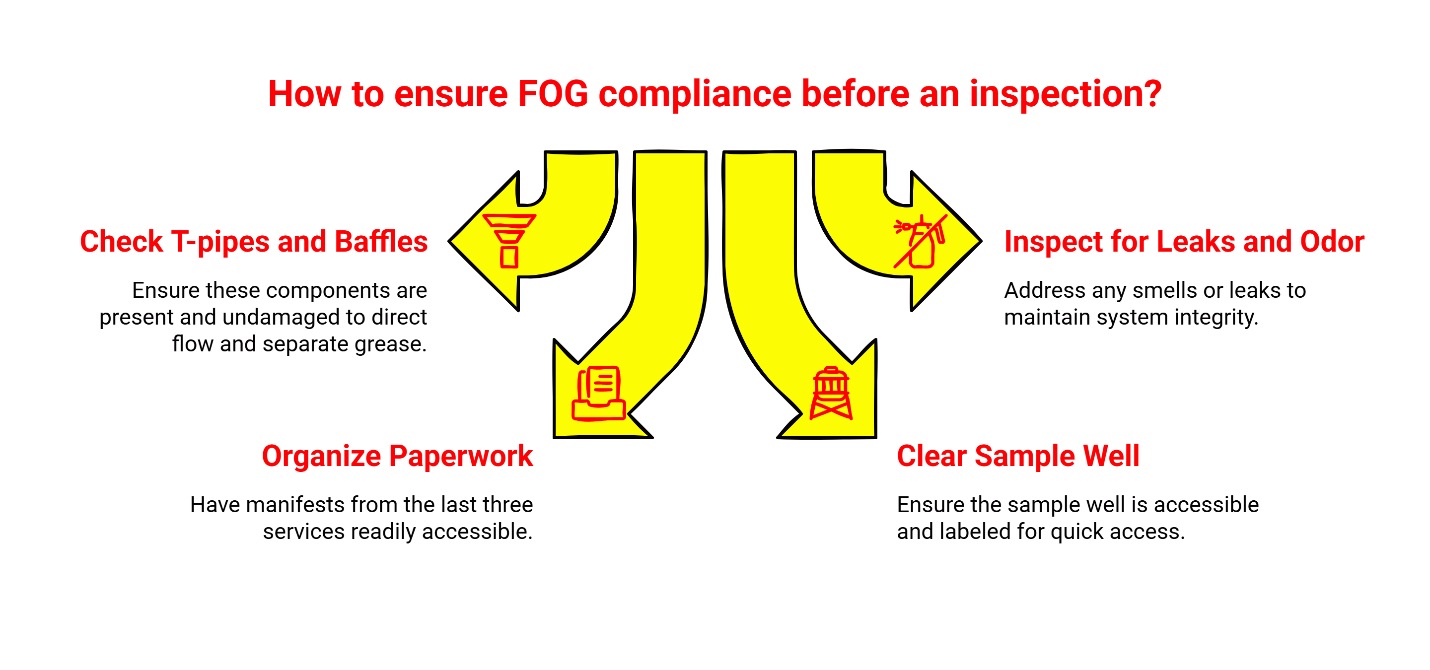
How to Prepare Your Kitchen for a City of Houston Grease Trap Inspection

📌 Key Takeaways

Inspection anxiety disappears when documentation, access, and staff training become routine habits instead of last-minute scrambles.

  • Your Binder Is Your First Line of Defense: A single, organized folder containing your FOG permit, five years of signed manifests, and service records turns a potential violation into a fifteen-minute formality.
  • The 25% Rule Isn’t Negotiable: Houston requires cleaning whenever grease and solids reach 25% of your trap’s wetted height or every 90 days minimum—whichever comes first.
  • Monthly Measurements Prevent Emergency Pump-Outs: Recording grease depth, solids depth, and total wetted height once a month lets you schedule service at 20% instead of scrambling at 25%.
  • Staff Coordination Beats Individual Knowledge: When every shift lead knows their role—who grabs the binder, who opens the sample well, who manages safety—inspections become predictable instead of chaotic.
  • Licensed Haulers Protect Your Business: A properly credentialed hauler who pumps fully, provides complete manifests, and disposes at approved facilities eliminates liability that cheap service creates.

Prepared operations pass quietly. Unprepared ones scramble, fail, and pay.

Houston restaurant owners, general managers, and facilities managers will find the complete compliance framework here, preparing them for the detailed checklist and regulatory guidance that follows.

The lunch rush just ended. You’re restocking the line when an inspector walks through the door with a clipboard. Your heart rate spikes—but it doesn’t have to.

A Houston FOG (Fats, Oils, and Grease) inspection verifies that you’re cleaning your grease trap on schedule, staying under the 25% accumulation threshold, and maintaining proper documentation. Think of it as your kitchen’s registration check combined with a maintenance audit. If your car needs current tags and service records, your grease interceptor needs a valid permit and signed manifests showing where your waste actually went.

Here’s what a prepared operator looks like: The inspector arrives unannounced during dinner prep. Your general manager calmly walks to the office, pulls out a labeled binder, unlocks the sample well in under two minutes, and provides every document requested. The inspection wraps up in fifteen minutes with zero violations.

This checklist aligns with City of Houston Code Chapter 47, specifically sections §47-512 and §47-513,[1][2] so you can pass that inspection without the panic.


Your Pre-Inspection Document Binder

Keep these items together in a dedicated binder or clearly labeled folder that’s always on-site: your current FOG permit, signed waste manifests covering the past five years, any Notice of Waiver documentation if you’ve applied for adjusted cleaning intervals, and service invoices from your hauler.[1][3]

Set up a simple index tab system—Permits / Manifests / Waivers / Previous Inspections. Train your shift managers to locate any document in under sixty seconds. When your hauler completes a pump-out, that manifest goes straight into the binder before the end of business that day. This isn’t busywork. Houston Health Department inspectors can request records spanning years, and gaps in your documentation raise immediate red flags.[3]

If you use professional grease trap cleaning services like Drane Ranger, you’ll receive a signed manifest after every service that documents the volume removed, the disposal site, and the hauler’s credentials.


Make the Sample Well and Interceptor Accessible

Inspectors need quick, safe access to your sample well and interceptor for visual inspection and measurement. Keep lids clear of equipment, supplies, and debris. The area should allow safe opening without moving heavy items or creating a safety hazard.[4]

Tape a laminated “Open/Close” standard operating procedure directly at the well location. Stage the basic tools nearby—typically a specialized key or wrench for your specific lid type. Add a small spill kit within ten feet. These steps show operational readiness and prevent the awkward scramble when someone needs to open your interceptor under time pressure.


The 25% Rule and Cleaning Cadence

Infographic showing steps for maintaining grease traps effectively, from regular checks and monthly core sampling to avoiding overfill and staying under 25% capacity.

Houston requires you to clean your grease trap whenever the combined depth of floating grease and settled solids reaches 25% of the wetted height inside the interceptor, or at minimum every 90 days—whichever comes first.[1][5] This isn’t a suggestion. It’s enforceable code designed to prevent line blockages and protect the city’s wastewater infrastructure.

Most operators benefit from adding a simple monthly core sample check to their routine. Use a dipstick or core sampler to measure accumulation, recording the date, grease layer depth, solids depth, and total wetted height in a simple log. If a measurement hits around 20%, pre-book your pump-out service immediately. Waiting until you’re at or over 25% puts you in violation territory, and it only takes one delayed service call to fail an inspection.

High-volume kitchens and operations with heavy frying schedules often need service every 60 days or less. Track your accumulation pattern over three months. If you’re consistently approaching 25% before the 90-day mark, it’s time to adjust your service frequency.[5]


Staff Briefing Before the Visit

Your staff doesn’t need to become FOG regulation experts, but shift leads should be able to answer four basic questions: where does kitchen wastewater go, who hauled it last, when was the last pump-out, and where is the documentation binder located.[1][3]

Run a five-minute pre-shift huddle. Assign clear roles: one person retrieves the binder, another handles sample well access, a third manages safety and keeps the area clear during the inspection. Practice this drill once per quarter so it feels routine when an actual inspector arrives. Business continuity during an inspection depends on smooth coordination, not improvisation.


The Houston-Specific Pre-Inspection Checklist

Houston pre-inspection checklist listing seven steps including verifying FOG permit, filing manifests, confirming service date, ensuring accessibility, inspecting the area, posting procedures, and briefing shift leads.


Follow these steps in order before any inspection:

  1. Verify your FOG permit is current and placed at the front of your document binder.[1]
  2. File signed manifests in reverse chronological order covering five full years, checking that each shows hauler information, waste volume, date of service, and the disposal site.[2]
  3. Confirm your last service date was within 90 days or that current accumulation measures below 25%.[1][5]
  4. Ensure sample well and interceptor lids are accessible with no obstructions, and opening tools are staged nearby.[4]
  5. Walk the immediate area—no spills, pooling water, or persistent odors around the trap, dumpster, or rendering bin.[4]
  6. Print and post your standard operating procedures for opening the interceptor, sampling protocol, and emergency contact information.
  7. Brief shift leads on who meets the inspector and where everything is located.

“The best time to prepare for an inspection is yesterday.”


When You’ll Need Service Sooner

Certain operational profiles demand more frequent attention than the 90-day minimum. If you run a high-volume kitchen, do significant frying, or notice recurring odors or slow drainage, your interceptor is telling you it can’t keep pace with your grease load.[5]

Book recurring service intervals through a licensed hauler. Require a signed manifest documenting every pump-out. This creates an audit trail that protects you during inspections and demonstrates your commitment to maintaining compliant operations. For Houston restaurants needing reliable service, grease trap cleaning in Houston through established providers ensures proper manifesting and lawful waste disposal.


What Happens If You Fail

A failed inspection typically results in a notice of violation and a mandatory re-inspection. Missing manifests, expired permits, or accumulation over 25% can trigger extended scrutiny of your entire FOG management program. In serious cases, violations may lead to escalating enforcement actions or referrals to other city departments.[1][2]

If you receive a violation notice, arrange same-day corrective pump-out if needed, provide any missing manifests immediately, and schedule your follow-up cleaning cadence to prevent recurrence. The re-inspection process adds time, stress, and potential city fines to your operation. Most violations are entirely preventable through basic documentation habits and consistent service scheduling.


Common Questions About Houston Grease Trap Inspections

How often must we clean our grease trap?

At minimum every 90 days, or before the combined grease and solids exceed 25% of the wetted height—whichever comes first.[1][5]

What documents must be on-site during an inspection?

Your current FOG permit, five years of signed waste manifests, any approved waivers, and records of previous inspections.[1][2][3]

Will inspectors check the sample well?

Yes. They need safe access for visual inspection and may take measurements there, so keep it accessible and maintain opening tools nearby.[4]


Why Cutting Corners Costs More

Some operators choose the cheapest available hauler without verifying credentials or manifest procedures. This is a false economy. You need a properly licensed hauler who pumps the interceptor fully, provides a complete signed manifest after every service, and disposes of waste at approved facilities. A low bid that skips essential paperwork isn’t a deal—it’s a risk that exposes you to health code violations, city fines, and potential liability if waste isn’t handled correctly.

The other common mistake is waiting for odors before scheduling service. By the time you smell problems, you’re often already flirting with the 25% rule violation or dealing with a backup. Proactive maintenance costs less than emergency pump-outs and prevents the operational disruption of a failed line during service.


Moving Forward

Inspection preparation isn’t complicated—it’s consistent. A well-organized binder, accessible equipment, trained staff, and scheduled service intervals eliminate most violation risks. Houston’s regulations exist to protect the city’s wastewater system and your business continuity.

Drane Ranger has been serving Greater Houston within a 100-mile radius since 1985, providing comprehensive liquid waste management services that include proper manifesting and documentation. As Harold R. noted: “My experience with Drane Ranger was a very organized, professional and on time experience. I was kept informed of what was happening and a suggested time of cleaning again.”

Ready to set up a recurring service schedule that keeps you compliant? Contact Drane Ranger to arrange your next pump-out and establish a maintenance cadence that works for your operation.

References:

[1] City of Houston Code of Ordinances, Chapter 47, Section 47-512 (Grease trap cleaning requirements and inspection authority). Retrieved from library.municode.com

[2] City of Houston Code of Ordinances, Chapter 47, Section 47-513 (Waste manifest retention requirements). Retrieved from library.municode.com

[3] Houston Permitting Center, Waste Generator Requirements (Documentation required during FOG inspections). Retrieved from houstonpermittingcenter.org

[4] Houston Health Department, Waste Generator FAQ (Sample well inspection procedures). Retrieved from houstonhealth.org

[5] Texas Commission on Environmental Quality, FOG Program Guidance (State regulatory context and best practices). Retrieved from tceq.texas.gov

Disclaimer: This article provides general guidance on preparing for Houston grease trap inspections based on current City of Houston regulations. It is for informational purposes and should not replace consultation with qualified professionals regarding your specific operational requirements or compliance obligations.

Our Editorial Process

The Drane Ranger Insights Team is our dedicated engine for synthesizing complex topics into clear, helpful guides. While our content is thoroughly reviewed for clarity and accuracy, it is for informational purposes and should not replace professional advice. For specific questions about your grease trap system, FOG permit requirements, or service scheduling, contact our team directly.

The Real Cost of a Backup: Why Emergency Pumping Costs More Than a Contract

📌 Key Takeaways

A backup doesn’t announce itself with an invoice—it arrives with closed doors, idle staff, and guests walking out.

  • The Real Bill Hides in Downtime: A four-hour shutdown during peak service can cost $2,600 in lost margin before you factor in the emergency pumping premium, overtime, or spoiled inventory.
  • Contracts Cost Less Than Crises: One emergency event—combining service premiums, downtime, refunds, and potential fines—typically exceeds the annual cost of a scheduled maintenance contract designed around your actual kitchen volume.
  • The 25% Threshold Protects Your Operation: When fats, oils, and grease reach a quarter of your trap’s capacity, cleaning becomes necessary to maintain proper function and avoid system failure, regardless of your quarterly baseline.
  • Documentation Keeps Inspectors Satisfied: Manifests, service logs, and waste disposal records produced through scheduled maintenance create the compliance trail that health inspectors expect during unannounced visits.
  • Frequency Should Match Your Reality: High-volume kitchens running fryers all day need more frequent service than the quarterly minimum, with intervals tuned to actual FOG output rather than calendar convenience.

Maintenance is an investment; emergencies are an expense.

Restaurant owners, general managers, and facilities teams overseeing commercial kitchens in Greater Houston will find the operational details here, preparing them for the comprehensive cost analysis and contract evaluation framework that follows.

A grease trap backup happens when your trap exceeds its capacity—fats, oils, and grease accumulate beyond safe levels, causing slow drains, overflows, or complete line blockages. In Houston, city regulations require commercial kitchens to empty traps quarterly at minimum, and cleaning becomes necessary when accumulation reaches 25% of the trap’s total capacity. The EPA has documented how FOG buildup contributes to sewer blockages and system failures. But those thresholds aren’t just regulatory checkboxes. They’re your early warning system.

Think of grease trap maintenance like oil changes for your vehicle. Skip a few, and you might get away with it for a while. Then one day, your engine seizes on the highway. Now you’re paying for a tow truck, a rental car, and a complete engine rebuild—all because a $40 oil change seemed easy to postpone.

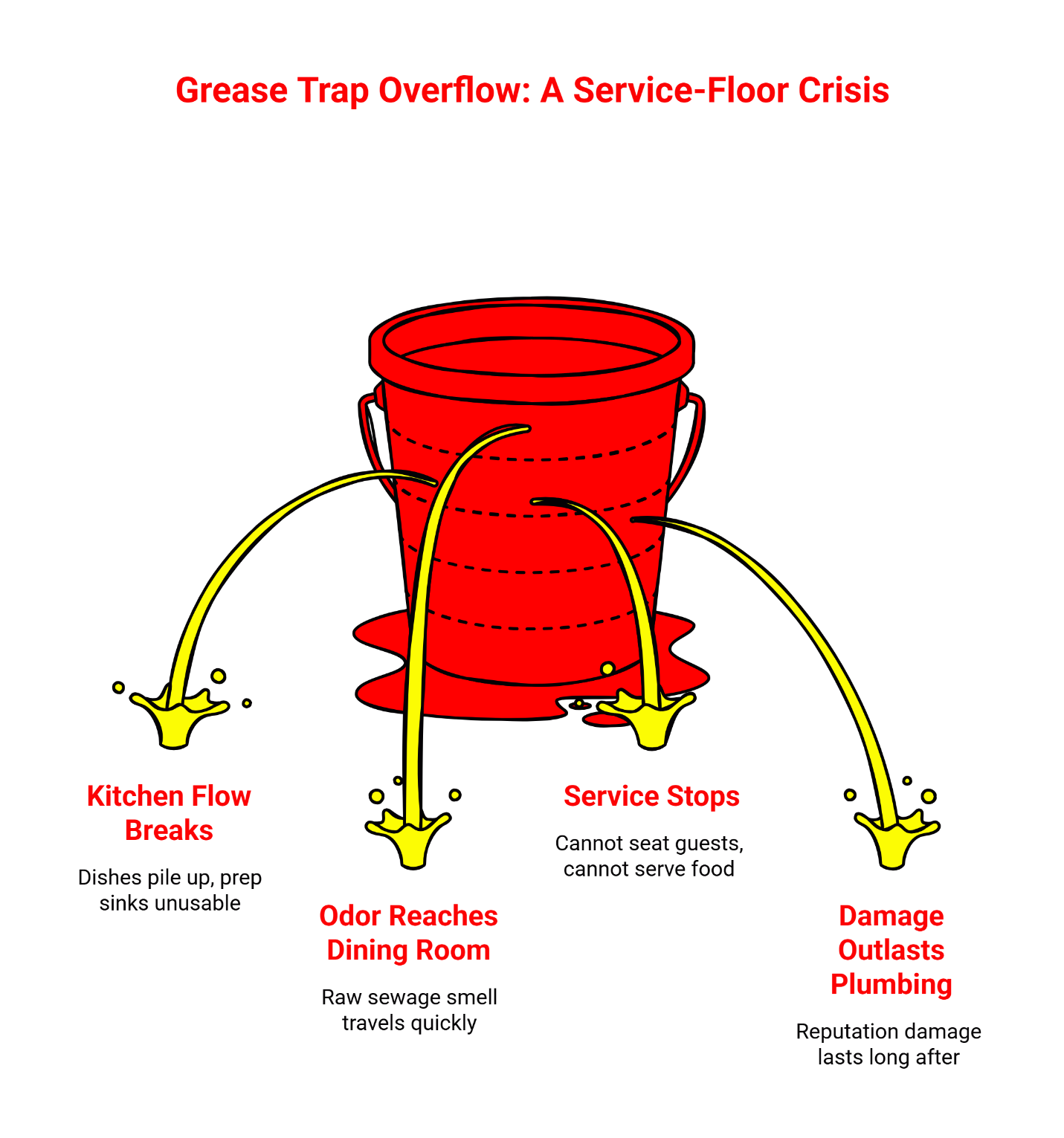
Picture this: Friday night during your dinner rush. The kitchen sinks start draining slower. Then that unmistakable smell hits. A floor drain burps wastewater onto the kitchen floor right in the middle of service. Servers notice. Guests notice. Your line cooks are working around standing water while you’re on the phone desperately searching for someone—anyone—who can pump your trap right now. You watch parties of four walk past your door and choose the restaurant next door instead.

Here’s the practical reality. Sign a commercial grease trap cleaning services contract with scheduled cleanings, and you avoid that emergency entirely. You get predictable costs, priority service, and the documentation inspectors actually want to see.


The Problem You Don’t See: Why Backups Blindside Your Budget

Emergency pumping doesn’t just cost more per service. It triggers a cascade of expenses that most restaurant operators don’t calculate until they’re already paying them. The direct service premium is real—after-hours rates, expedited dispatch, and short-notice availability all command higher prices. But that’s just the beginning.

When you wait for a crisis, multiple costs land at once: emergency call-out premiums, lost revenue during shutdown, staff standing idle on the clock, possible food loss and refunds, and compliance actions if inspectors find you’ve fallen behind on your maintenance cadence.

Watch for these early warning signs before you cross the quarterly threshold or hit that 25% accumulation level: persistent odors near floor drains, slower drainage in prep sinks, gurgling sounds when water flows, or visible grease in unexpected areas. When you spot any of these, you’re already approaching the danger zone.


What Makes Emergency Pumping Expensive

Infographic titled “Factors Driving Emergency Service Costs” showing after-hours premiums, short-notice mobilization, intensive procedures, and disposal logistics with arrows converging toward high emergency service costs.


Several factors drive emergency service costs higher than scheduled maintenance. After-hours and weekend premiums apply when you need service outside normal business hours—which is exactly when most backups force your hand. Short-notice mobilization means your service provider has to rearrange their schedule, potentially pulling technicians from other jobs or calling them in on their day off.

The work itself often requires more intensive procedures. A backup usually means the trap is completely full and the lines may be partially clogged, requiring hydro-jetting to clean surfaces down to bare metal. Scheduled maintenance, by contrast, prevents buildup before it hardens and adheres to trap walls.

Disposal logistics become complicated in emergencies. Texas regulations on municipal liquid waste transport require proper vehicle authorization and manifesting for grease trap waste. With scheduled service, waste manifesting and transportation are planned and streamlined. During an emergency, those same logistics happen under time pressure, and proper documentation—critical for compliance—can become rushed or incomplete.

Reputable providers like Drane Ranger have maintained proper manifesting and legal disposal practices since 1985, ensuring every load is documented regardless of service timing. The City of Houston’s special waste program outlines clear expectations for FOG management that professional haulers must follow. But not every provider maintains those standards when responding to panic calls.


The Hidden, Bigger Bill: Downtime Math

The real expense of a backup isn’t the pump truck—it’s what happens to your operation while you wait for help. Use this formula to calculate your actual exposure:

Lost Sales = (Average tickets per hour × Hours closed or limited) × Gross profit margin

Here’s a concrete example: A restaurant serving 40 tickets per hour at $25 average check, closed for 4 hours during peak service, with a 65% gross margin loses $2,600 in margin alone. That’s before you add labor costs for staff standing idle or working overtime, inventory loss from food that spoiled or had to be discarded, or refunds and comped meals for guests who experienced the problem.

“The most expensive grease trap cleaning is the one you didn’t plan for.”

Now consider the reputation cost. Negative reviews don’t itemize on your P&L, but they compound. One dinner service interrupted by a grease trap emergency can generate social media posts and online reviews that affect your revenue for months. And if a city inspector happens to visit during a backup? Violations, fines, and potential closure orders become part of your emergency total.

In Houston’s commercial restaurant environment, where health department visits can happen without notice, operating with a full or malfunctioning trap carries regulatory risk that extends well beyond cleanup costs. Many busy kitchens with high FOG output need more frequent service than the quarterly minimum to avoid overloading their traps.


Why Contracts Win on Total Cost

Scheduled grease trap cleaning in Houston through a maintenance agreement delivers predictable rates across the year. You know your quarterly costs upfront, which simplifies budgeting and eliminates surprise expenses. More importantly, contract customers receive priority scheduling. When weather events, busy seasons, or unexpected demand spikes create service backlogs, contract customers get handled first.

Service frequency gets aligned to your actual needs—not just the regulatory minimum. Municipal FOG management guidelines describe how the 25% rule works for determining cleaning frequency based on actual trap performance. Busy kitchens with high-volume fryers may need cleaning every six to eight weeks, while slower operations stay compliant with standard quarterly service. A good provider helps you determine the right cadence based on your menu, volume, and trap size.

The documentation benefit alone justifies the contract approach. Each service generates manifests showing proper waste handling, cleaning records that demonstrate compliance, and maintenance logs that inspectors view favorably. When a health inspector asks to see your grease management records, you hand them a complete file instead of scrambling to remember when you last called someone.

As one Houston restaurant manager shared: “My experience with Drane Ranger was a very organized, professional and on time experience. I was kept informed of what was happening and a suggested time of cleaning again. I will use them again and will definitely recommend them to anyone I speak with.” — Harold R.


Simple Scenarios: One Backup vs. One Year on Contract

Consider this cost comparison. Keep in mind these are illustrative examples based on typical industry scenarios—actual costs vary by trap size, location, and specific circumstances. Contact Drane Ranger at 281-489-1765 for a site-specific quote.

Cost Item Single Emergency Backup Annual Contract (4 Services)
Emergency pumping & deep clean $1,400 Included in scheduled visits
After-hours/rush premium $300 $0 (daytime scheduling)
Downtime loss (based on example above) $2,600 $0 (no operational disruption)
Overtime & additional cleanup $400 Minimal
Potential fines/re-inspection costs $500+ Avoided through compliance
Estimated total single-event impact $5,200+ Predictable annual budget

The emergency scenario above doesn’t even account for longer-term revenue impact from negative reviews or customer loss during the shutdown.


What a Good Contract Includes

Diagram showing core elements of a good maintenance contract, including cleaning, disposal, service frequency, and emergency response.


Look for these elements when evaluating maintenance agreements:

Service frequency tuned to your operation. Cookie-cutter quarterly schedules work for some kitchens, not all. Your contract should specify cleaning intervals based on your trap size, cooking volume, and menu type—aligned with the 25% accumulation threshold that triggers necessary cleaning. Busy kitchens frying food all day need more frequent service than operations with lower grease output.

Thorough cleaning to bare surfaces. The contract should specify complete pump-out and interior cleaning—not just surface removal. This prevents the hardened buildup that causes premature failure and costly deep cleans later, ensuring FOG and solids are removed to restore full working capacity.

Proper manifesting and legal disposal. Every load removed should generate a manifest documenting proper handling and disposal at licensed facilities. This isn’t a luxury—it’s a legal requirement under Texas rules that protects you from liability. Your provider should demonstrate clear compliance with state and local waste transport regulations.

Non-peak service windows. Quality contracts schedule service during your closed hours or slower periods, eliminating operational disruption entirely.

On-site record access. You should receive and retain copies of all service records, manifests, and inspection reports. These documents prove compliance when regulators ask and provide the service history inspectors want to see.

Clear emergency response terms. Even with preventive maintenance, unexpected issues occasionally arise. Your contract should spell out how emergency situations get handled for existing customers.

Drane Ranger has served the Greater Houston area—within approximately 100 miles of our Houston location—since 1985. Our approach focuses on safe, compliant collection and disposal practices, not just getting in and out as quickly as possible.

Request a contract quote to see how these elements apply to your specific operation.


Next Steps

Don’t wait for a backup to force your hand. If you’re stretching beyond quarterly cleaning inside Houston city limits or hitting the 25% accumulation level between visits, you’re likely overdue for a new maintenance schedule.

Call 281-489-1765 Monday through Friday, 9am to 6pm, to discuss your trap size, service frequency, and contract options. Our team will help you determine the right maintenance schedule based on your operation’s specific needs, ensuring you stay ahead of both the quarterly city requirement and the 25% accumulation threshold that triggers necessary cleaning.

Alternatively, visit our contact page to request a contract quote online. We’ll respond within 24 hours with a customized proposal for your location.

Maintenance is an investment. Emergencies are an expense. Choose predictability.

About the Drane Ranger Insights Team

The Drane Ranger Insights Team is our dedicated engine for synthesizing complex topics into clear, helpful guides. While our content is thoroughly reviewed for clarity and accuracy, it is for informational purposes and should not replace professional advice.

Visual Checks vs. Core Sampling: Why Your ‘Clean’ Trap Might Still Fail an Inspection

📌 Key Takeaways

A grease trap that looks clean from the sample well can still fail an inspection if the hidden sludge layer pushes total accumulation over 25%.

  • Surface Checks Hide Compliance Risk: Visual inspection of the sample well only reveals the middle layer, completely missing the floating grease cap and bottom sludge that inspectors measure to determine compliance.
  • The 25% Rule Is Performance-Based: When combined grease and sludge layers reach 25% of liquid depth, the trap’s effective working volume shrinks, allowing FOG to escape downstream—this performance threshold triggers required pump-outs regardless of appearance.
  • Measurement Drives Smart Scheduling: Monthly core sampling with documented percentages enables service timing based on actual accumulation rates rather than arbitrary calendar intervals, preventing both premature pump-outs and costly violations.
  • Manifests Prove Compliance: Cleaning records without signed waste manifests showing disposal facility and date leave restaurants vulnerable to fines during audits, even when traps are currently within limits.
  • Documentation Creates Audit Confidence: A compliance binder combining core sampling logs, manifests, and photos transforms scattered paperwork into organized proof that satisfies Houston pretreatment inspections.

Core sampling turns guesswork into evidence—measure like an inspector, schedule by data, document everything.

Houston restaurant operators managing commercial kitchen compliance will find a practical framework here, preparing them for the step-by-step implementation guidance that follows.

Friday lunch rush. The health inspector walks into your Houston restaurant with a clipboard and a measuring rod. Your kitchen manager assures you the grease trap looks fine—after all, they checked the sample well just last week and the water looked clear. But when the inspector pulls a core sample, the news isn’t good. The combined grease cap and bottom sludge put you over the 25% threshold. You’ve failed, and now you’re facing violations, mandatory pump-outs, and potential fines.

Here’s what happened: Visual checks only show you the surface. A core sample reveals the full story—the floating grease layer at the top and the settled solids at the bottom. Think of it like judging a latte by looking at the foam. You might see beautiful microfoam on top, but you have no idea how much heavy sediment has settled at the bottom of the cup. That hidden layer is exactly what gets restaurant operators into compliance trouble.

Core sampling isn’t just a best practice. It’s the inspector’s standard measurement method, and it’s the only way to know whether your trap is approaching Houston’s 25% accumulation limit (Source: City of Nacogdoches FOG Manual). When you rely on quick glances through the sample well, you’re essentially guessing. The practical application is straightforward: adopt monthly core sampling as part of your maintenance routine, schedule pump-outs when readings approach the threshold, and keep organized manifests that prove both the work and the legal disposal.


The “Eyeball Test” Problem—What Visual Checks Miss

Visual checks give you a false sense of security. When staff members peer into the sample well and see relatively clear water in the middle layer, they assume everything is fine. The problem is that grease floats and solids sink, creating a misleading “clean zone” in the middle that hides the real accumulation happening at both ends of the tank.

The top grease cap can be several inches thick but barely visible from above, especially if recent hot water from dishwashing has temporarily liquefied some of the fats. Meanwhile, the bottom sludge layer—a dense mix of food particles, oils, and settled solids—is completely invisible from a top-down view. This matters because when grease traps become overloaded, they can allow fats, oils, and grease to pass into the public sewer system, contributing to blockages and sanitary sewer overflows that wastewater agencies take very seriously (Source: EPA FOG Program Guidance).

Inspectors know this. That’s why they don’t trust visual assessments, and neither should you. The solution is simple: use a core sampler through the sample well to capture a complete vertical cross-section of your trap’s contents. This inexpensive tool (essentially a clear tube with a check valve) allows you to see and measure total accumulation—top grease plus bottom solids—in one reading. Document each measurement with the date, percentage, and staff initials, then schedule your next service based on those numbers rather than calendar dates alone.


What Inspectors Actually Measure

City inspectors and pretreatment personnel don’t guess. They follow a standardized protocol that involves taking a core sample at the sample well or inlet/outlet baffles, depending on your trap’s design. The measurement captures everything: the thickness of the floating grease layer, the depth of the clear middle zone, and the height of the settled solids at the bottom (Source: Houston Public Works FOG Program).

Here’s what matters for compliance: inspectors assess your trap’s performance by calculating total FOG (fats, oils, grease) accumulation as a percentage of the trap’s working volume. If that combined figure exceeds 25%, your trap has failed its performance standard, regardless of how recently it was cleaned or how clear the middle layer looks.

To mirror this method in your own maintenance checks, lower a core sampler to the tank bottom, capture the full column, then measure and record both the grease cap depth and the sludge depth. Calculate the percentage by adding those two measurements and dividing by total liquid depth. Log this reading in a simple notebook or tracking sheet, and you’ll be able to predict exactly when you need to schedule service—before an inspector shows up and finds you out of compliance.


The 25% Rule—When Your “Clean” Trap Isn’t Compliant

Grease trap accumulation thresholds diagram showing green, yellow and red zones with below 20%, 20–25% and over 25% grease levels and compliance status.


The 25% threshold isn’t arbitrary. It represents the point at which grease traps lose their effectiveness. When the combined thickness of floating grease and settled solids equals or exceeds 25% of the liquid depth, the trap’s effective working volume shrinks. Incoming wastewater has less time for FOG to separate properly, and more grease and solids can escape downstream into the public sewer system—exactly what the regulations are designed to prevent (Source: City of Nacogdoches FOG Manual).

What confuses many operators is that “25% full” doesn’t mean the trap looks obviously dirty. A busy kitchen can hit this threshold in as little as four to six weeks, especially during high-volume periods. The accumulation is happening continuously, but it’s hidden from casual observation. By the time you smell problems or notice slow drainage, you’re likely well past the compliance threshold and dealing with a more urgent—and expensive—situation.

Create a simple visual reference for your team: Green zone (below 20% accumulation), Yellow zone (20-25%, schedule service soon), and Red zone (over 25%, immediate pump-out required). Train kitchen managers to check monthly and to call for grease trap cleaning when readings move into the yellow zone. This proactive approach prevents emergency calls, compliance violations, and the operational disruptions that come with backed-up traps.


Step-by-Step: How to Take a Core Sample Through the Sample Well

Step-by-step core sampling procedure infographic showing five stages: prepare safely, access sample well, take core sample, measure and record grease and solids, and document with photos for compliance.


Measuring your trap correctly takes about five minutes once you know the process. Here’s the sequence:

  1. Prepare safely. Put on gloves and safety glasses. Ensure adequate ventilation—grease traps produce hydrogen sulfide gas, which is both toxic and flammable. Clear the area of foot traffic and open nearby doors or activate exhaust fans.
  2. Access the sample well. Remove the sample well cover (typically a 4-inch PVC cap on top of the trap). If your trap doesn’t have a dedicated sample well, you’ll need to access through the main manhole, though this is less convenient for routine checks.
  3. Take the sample. Lower your core sampler (a clear graduated cylinder with a bottom check valve) straight down to the tank bottom. Once it touches, lift it smoothly to capture a complete column showing all three layers—grease cap, clear zone, and bottom sludge.
  4. Measure and record. Using the graduations on the sampler, measure the depth of the top grease layer and the bottom solids layer. Add these together, then divide by the total liquid depth to get your percentage. Write this in your log with the date and staff initials.
  5. Document with photos. Take a quick photo of the sampler with visible layers and the measurement. File this in your compliance binder alongside service manifests. If questioned during an audit, this photo proves you were monitoring conditions and taking appropriate action.

Compare today’s reading to your last measurement. If the percentage is climbing faster than expected, shorten your service interval rather than waiting for the next scheduled pump-out.


From Measurement to Paperwork—Passing the Audit

Cleaning your trap is only half of compliance. The other half is proving it happened—and proving the waste was disposed of legally. This is where many operators run into trouble, especially those who choose the cheapest available service to save a few dollars.

Every time your trap is pumped, you should receive a signed waste manifest showing the date, volume removed, hauler information, and most importantly, the disposal facility where the waste was taken. This manifest is your legal proof that FOG waste didn’t end up in a storm drain, vacant lot, or other illegal dumping site. Keep these documents organized in a dedicated compliance binder, along with your core sampling logs and any inspection reports.

Many municipal codes require restaurants to retain these manifests on site and make them available during inspections, often for a minimum of three years (Source: City of Dallas Code of Ordinances). Missing manifests can result in fines even if your trap is currently clean, because you can’t prove past compliance (Source: Municipal FOG Record-Keeping Guidance).

When evaluating grease trap cleaning in Houston, ask specifically about manifesting procedures and whether the company provides copies after every service. The few dollars saved with a bargain hauler aren’t worth the risk of using an unregistered operator who cuts corners on documentation.


Houston Reality Check—Why “Quarterly” Isn’t Always Enough

Within Houston city limits, restaurants are expected to maintain grease traps frequently enough to protect the public sewer system. In practice, quarterly pumping has become a common baseline interval for many facilities, but this is only a starting point. High-volume restaurants, facilities with undersized traps, or operations that use a lot of fryer oil often hit the 25% threshold well before 90 days.

This is why measurement-based scheduling makes more sense than calendar-based service. If your monthly core samples show you’re consistently reaching 20-22% by week eight, shortening your interval to every two months prevents violations and keeps your trap performing as designed. Conversely, lower-volume locations might find they can safely extend to every 14-16 weeks without exceeding the threshold.

Work with a service provider who understands this principle and bases recommendations on your specific accumulation rate rather than pushing everyone onto the same generic schedule. The right approach saves you money over time—you’re not pumping unnecessarily early, but you’re also not risking fines or backups by waiting too long.


Vendor Checklist: “Pit Crew” Criteria for Your Kitchen

Not all grease trap services are equal. When comparing providers, look for these markers of professionalism:

Trained and certified technicians who understand both the mechanical process and the regulatory requirements. The person pumping your trap should be able to explain the 25% rule and show you how to read a core sample.

Punctual and organized service that respects your business hours and cleans up thoroughly. Spills, lingering odors, or equipment left blocking your back door are signs of a careless operation.

Core sampling before and after service on request. Good operators measure before pumping to document your pre-service condition, then again afterward to confirm complete removal.

Manifesting every visit with copies provided automatically. You shouldn’t have to chase down paperwork. Disposal site information should be clearly noted on each manifest.

Proactive schedule management with advance reminders and suggested timing adjustments based on your accumulation trends. This partnership approach helps you stay ahead of compliance issues rather than reacting to emergencies.

Since 1985, our team has focused on delivering this level of service to Houston-area restaurants, backed by Better Business Bureau accreditation and a commitment to thorough documentation. The feedback we consistently hear is appreciation for the organized approach and the advance notice we provide for next cleaning dates.


Frequently Asked Questions

Is a clear sample well good enough to prove compliance?

No. A clear middle layer only shows you what’s happening in one narrow section of the trap. Inspectors require core sampling because it’s the only way to measure total accumulation including the hidden grease cap and bottom sludge.

Do I really have to keep copies of every manifest?

Yes. These documents are your legal proof of proper disposal. Many municipal FOG programs require restaurants to retain manifests and produce them during audits, often for three years or more. Missing paperwork can trigger violations even if your current trap condition is acceptable.

When should I actually call for service?

The safe answer is when your core sample readings approach or reach 20-25% accumulation. Don’t wait for odors or slow drainage—by that point, you’re likely already past the threshold and dealing with a more serious problem that could have been prevented with regular measurement.


Schedule Core Sample-Based Maintenance

Stop guessing and start measuring. Our team provides Houston restaurants with compliant grease trap cleaning backed by proper manifesting after every pump-out. We can set up a measurement-based maintenance schedule that keeps you ahead of the 25% threshold and audit-ready year-round.

Call us at 281-489-1765 (Monday through Friday, 9 AM to 6 PM) to schedule an initial assessment and receive a customized service plan based on your kitchen’s actual accumulation rate.

Visit us: 13911 India St, Houston, TX 77047

For more information about our full range of services, visit our contact page.

About the Drane Ranger Insights Team

The Drane Ranger Insights Team is our dedicated engine for synthesizing complex topics into clear, helpful guides. While our content is thoroughly reviewed for clarity and accuracy, it is for informational purposes and should not replace professional advice.

Septic System Maintenance Inspections: A Diagnostic Framework for Homeowners

📌 Key Takeaways

Septic failures develop silently underground for months before surfacing as expensive emergencies in your yard or home. 

Diagnostic Visibility Prevents Reactive Panic: Professional inspections reveal hidden problems like cracked baffles, tank leaks, and root intrusion before they trigger backups or drain field failures. 

Real Estate Transactions Demand Documentation: A current inspection report removes buyer uncertainty, speeds closing, and either confirms system health or reveals issues while you still have time to address them. 

Surface Observation Misses Critical Failures: Walking your yard and checking for odors only detects problems after they’ve already compromised your system—internal component damage remains invisible without professional evaluation.

The 25% Rule Guides Pumping Timing: EPA guidelines recommend pumping when solids reach roughly one-quarter of your tank’s volume, but household size and usage patterns determine your actual schedule. 

Inspection Differs from Routine Pumping: A comprehensive diagnostic assessment includes systematic component evaluation, structural checks, and detailed documentation—not just the quick visual check during a standard pump-out. 

Proactive inspection transforms expensive unknowns into manageable maintenance decisions. Houston-area homeowners managing septic systems will find clarity here, preparing them for the detailed diagnostic framework that follows.

The smell hits you first—faint but unmistakable, drifting from somewhere near the back corner of your yard. You stand at the kitchen window, coffee in hand, wondering if you’re imagining it. Then you notice the grass: a patch near the drain field that’s greener, almost unnaturally lush, compared to the rest of your lawn. Your stomach tightens. Something’s wrong, but you have no idea what’s happening beneath your feet.

You’re facing what thousands of Houston-area homeowners deal with every year—the anxiety of not knowing the true condition of your septic system. Unlike the plumbing inside your house, where a leak announces itself immediately, your underground wastewater infrastructure can fail silently for months before you notice. By then, what could have been a minor repair has become an expensive emergency.

A Septic System Maintenance Inspection is a diagnostic assessment of the tank and components to verify function. It’s like a ‘Check Engine’ diagnostic for your yard. Imagine the confidence of handing a potential buyer a certified report saying your septic system is in perfect health. Schedule this before listing your home or if you suspect a problem but don’t see sewage yet.

An inspection turns unknowns into facts—and facts into confident decisions.


Why Your Septic System’s Hidden Nature Creates Real Risk

Your septic system is your home’s hidden immune system. Just as your body processes waste through organs you can’t see, your property relies on underground tanks and pipes to safely manage every gallon of wastewater from your showers, toilets, and washing machines. When this system works properly, it’s invisible. When it fails, the consequences range from unpleasant to catastrophic.

The challenge is visibility. You can’t simply lift a lid and see whether everything’s functioning correctly. Solid waste accumulates at the bottom of the tank as sludge, while oils and grease float to the top as scum. Between these layers, clarified water flows out to your drain field. Over time, baffles can crack, tees can corrode, and the biological balance inside the tank can shift. None of these problems announce themselves until the day your toilet won’t flush or sewage backs up into your home.

This is where a professional septic system maintenance inspection becomes essential. A comprehensive inspection is the only way to definitively assess the health of your underground infrastructure. While you might walk your yard looking for wet spots or follow your nose toward strange odors, these surface indicators only tell you something has already gone wrong. An inspection reveals what’s happening before it becomes an emergency, helping prevent silent failures like leaks or baffle damage before they cause a backup.


What Happens During a Professional Septic Inspection

Infographic of the professional septic inspection process from locating the tank to documenting findings.

Think of a septic inspection as a complete physical exam for your wastewater system. A qualified technician will systematically evaluate every component to build a complete picture of your system’s condition.

The process starts at the tank itself. The inspector locates your septic tank—not always as straightforward as it sounds, especially in older properties where records are incomplete—and opens the access port. They assess the relative levels of scum, clarified liquid, and sludge to determine whether pumping is needed and help establish a maintenance cadence appropriate for your household.

But the inspection goes beyond just checking levels. The technician examines the inlet and outlet baffles or tees—critical components that control water flow and prevent solids from escaping into your drain field. These parts are particularly vulnerable to damage because they’re constantly exposed to corrosive wastewater. According to guidance from the EPA’s Septic Smart program, your tank typically needs pumping when solids occupy about 25% of its volume.

Next comes an evaluation of flow paths and the drain field. While the inspector can’t see the perforated pipes buried in trenches beneath your yard, they can assess whether effluent is moving as designed, check for unusual wet spots that may indicate problems, and look for signs that wastewater is reaching the surface. The inspector also verifies that access points are safe and secure—lids and risers should be intact to prevent accidental entry into this confined space.

The final component is documentation. A thorough inspection produces a written report detailing the findings, including tank capacity, measured levels, the condition of all components, and specific recommendations for maintenance or repairs. This report becomes your system’s health record and can provide the documentation often requested during real estate transactions.

For homeowners planning routine maintenance after diagnostics, understanding how inspections connect to septic tank cleaning services helps establish a complete care strategy.


The Silent Failures an Inspection Catches Early

Routine inspections can detect problems developing quietly underground—issues you’d never notice until they trigger an expensive crisis. These hidden problems typically develop gradually, giving you no warning until they reach a critical point.

Consider baffle failure. The inlet baffle prevents turbulence from disturbing the settled solids when wastewater enters the tank. The outlet baffle acts as a final barrier, keeping solids from flowing into your drain field. When these components deteriorate—often from age or chemical exposure—solid waste starts escaping the tank. This material can clog the pipes in your drain field, creating a cascade of problems. You might notice your drains running slower than usual, or develop a persistent sewage odor outside. By the time these symptoms appear, your drain field may already be compromised, requiring extensive and expensive repairs.

Tank cracks present another insidious threat. A small crack in the tank wall allows groundwater to seep in, diluting the tank’s contents and disrupting the biological processes that break down waste. Conversely, the crack can allow untreated wastewater to leak into the surrounding soil, creating health hazards and environmental contamination. An inspection reveals these structural issues while they’re still manageable.

Tree root intrusion often surprises homeowners. Roots naturally grow toward water sources, and your septic system provides both water and nutrients. They can penetrate tank seams or invade the pipes leading to your drain field. Once inside, they create obstructions and accelerate system deterioration. An experienced inspector knows the warning signs—unusual tree growth patterns near your system, unexplained lush vegetation, or changes in ground elevation—that suggest root problems developing underground.

Self-Inspection vs. Professional Inspection: Making the Right Choice

Homeowners often wonder whether they can assess their septic system themselves or need to hire a professional. This comparison helps clarify what each approach can accomplish:

Decision Point What You Can Check at Home What Professional Inspection Provides
What You Learn Surface cues only—odors near access points, unusually wet areas, or changes in vegetation Diagnostic visibility into tank levels, baffle condition, structural integrity, and overall system function
Tools & Access Basic observation from ground level with no tank entry required Trained technician with proper equipment, safe access protocols, and specialized measurement tools
Safety Risk Low when observing from surface only; never remove lids or enter confined spaces Managed by trained personnel who follow established safety protocols for confined space entry
Detecting Hidden Failures High risk of missing internal problems like leaks, component damage, or developing clogs Systematic evaluation designed to catch issues before they cause symptoms
Documentation Personal observations with no formal record Written report suitable for real estate transactions, insurance purposes, or establishing service history
Best Use Quick monitoring between professional inspections; noticing surface warning signs after storms or heavy use Selling a home, establishing a maintenance schedule, investigating persistent symptoms, or confirming system health
What You Get A sense that something might be developing Actionable findings with clear next steps and documented system status


The most effective approach combines regular homeowner monitoring with periodic professional inspections. You watch for warning signs between evaluations, creating continuous awareness of your system’s performance. When symptoms appear or when your inspection schedule arrives, professional assessment provides the thorough evaluation and documentation you need for informed decision-making.

When Inspections Become Essential: Real Estate Transactions

For real estate transactions, a professional inspection provides the critical documentation needed to close the deal. In many Texas counties, septic system inspections have become standard practice during home sales. Some mortgage lenders require them. Even when not mandated, smart buyers request them to protect their investment.

The inspection serves multiple purposes in a real estate context. For sellers, a passing inspection report removes a major contingency and demonstrates responsible property maintenance. It answers the buyer’s most pressing question: “Am I about to inherit a $15,000 septic system replacement?” For buyers, the inspection provides negotiating leverage if issues are found, and peace of mind if the system checks out.

The timing matters. Schedule your inspection after you’ve accepted an offer but before the option period expires. This gives you time to address any problems the inspection reveals. If the inspector recommends pumping or minor repairs, completing this work before closing shows good faith and can speed up the transaction.

Different counties and municipalities may have varying requirements for what constitutes an acceptable inspection. Some require inspections by licensed professionals; others accept reports from qualified pumping contractors. Working with a local service familiar with your area’s specific requirements prevents delays during closing.


Common Real Estate Questions for Texas Homeowners

Septic Inspection Requirements for Selling House Texas

Requirements can vary by county or city across Texas. A professional maintenance inspection and recent service documentation are commonly requested in real estate transactions, but the specific paperwork or timing may differ based on local jurisdiction. The practical approach is to secure a current inspection report and keep pump-out records organized well before listing your property. Local rules and required forms can change, so confirming current expectations with your real estate agent or title company helps prevent surprises during closing.

Documents Needed for Septic Sale Houston

Expect requests for inspection findings, service history, and any available system details such as tank location and known components. Real estate teams in the Houston area typically prefer clear, dated paperwork from a qualified provider. Having organized records—including previous pump-out dates, any repairs performed, and the most recent inspection report—makes the transaction smoother for all parties. Document formats and specific title requirements may vary between transactions.

Transferring Septic Permit Alvin TX

Permit transfer rules can differ by jurisdiction and may involve county offices in Brazoria County. A professional inspection report showing current system status can make conversations with local authorities simpler during the transfer process. The specific steps, required forms, and processing times may change, so confirming current procedures with the appropriate local office ensures compliance with the most up-to-date requirements.


Deep Dive: Understanding Diagnostic Visibility

Critical Importance

Infographic comparing proactive septic inspections with reactive maintenance.

Diagnostic visibility—knowing what you cannot see—represents the fundamental value of a septic inspection. Your underground wastewater system operates continuously, processing hundreds of gallons daily, yet remains completely hidden from view. This invisibility creates a dangerous knowledge gap.

Without visibility, you’re forced into reactive maintenance. You wait for symptoms to appear, and symptoms only appear when something has already failed. The toilet that suddenly won’t flush. The yard that becomes a swamp after rain. The smell that makes your outdoor space unusable. Each of these symptoms indicates that your system crossed from “working” to “broken” days or weeks earlier, but you had no way to know.

An inspection transforms this dynamic. It provides a snapshot of your system’s current condition, revealing problems at the earliest stage when they’re least expensive to fix. A cracked baffle discovered during an inspection might cost $300 to replace. That same baffle, left to fail completely, can lead to drain field contamination requiring thousands of dollars in repairs. The inspection creates visibility, and visibility enables proactive protection.

Common Misconceptions

Many homeowners believe they can assess their septic system’s health through simple observation. They walk their property, look for wet areas, and check for odors. While these surface checks have value, they don’t provide diagnostic visibility.

The first misconception is that a lack of symptoms means a healthy system. Your septic tank could be significantly full of sludge, your baffles could be deteriorating, and tree roots could be invading your drain field pipes—all while your toilets flush normally and your yard looks fine. Problems develop gradually, often taking months or years to manifest as symptoms you can detect.

Another common misunderstanding involves pumping frequency. Some homeowners follow rigid schedules—”pump every three years”—without considering their actual usage or system condition. While regular pumping is essential, the right schedule varies. A household of two adults uses a 1,000-gallon tank very differently than a family of six. An inspection measures your actual accumulation rate, allowing you to optimize your pumping schedule rather than guessing.

The third misconception is that all septic inspections are the same. A comprehensive diagnostic inspection differs significantly from the basic check that occurs during routine pumping. When a technician pumps your tank, they may glance at the components and mention if something looks obviously wrong. A true inspection involves systematic evaluation of every component, specific measurements, and detailed documentation. Understanding this difference helps you request the right service for your needs.

Real-World Implications

The difference between surface knowledge and diagnostic visibility plays out clearly in real-world scenarios. Consider a homeowner planning to sell their property. Without an inspection, they list the house confident that everything works fine. During the buyer’s due diligence, an inspection reveals a cracked tank wall and failed baffles. The seller now faces rushed repairs during the option period, or a price reduction that far exceeds what the repairs would have cost if addressed earlier.

Contrast this with a homeowner who schedules inspections every three years as part of regular maintenance. One inspection reveals early signs of baffle deterioration—not yet critical, but worth monitoring. The next inspection, eighteen months later, shows the deterioration has progressed to where replacement makes sense. The repair is scheduled during a convenient time and completed before any system compromise occurs. The total cost is lower, the stress is minimal, and the system’s overall lifespan is extended.

In emergency situations, the value of diagnostic visibility becomes even clearer. A sudden backup forces you to call for emergency service on a weekend. The technician pumps the tank to relieve the immediate problem, but without a proper inspection, you don’t know why the backup happened. Was it simple neglect—the tank was just too full? Was it a mechanical failure? Is your drain field compromised? You’ve paid for emergency service but still lack the information needed to prevent recurrence. An inspection would have either prevented the emergency entirely or, at minimum, provided the diagnostic information needed to fix the underlying cause.

Separating Myth from Reality

Myth: “If drains are working fine, the system is fine.”

Reality: Early failures often don’t show up at faucets or toilets. A quick visual check can be helpful for catching obvious surface problems, but internal component failures, structural issues, and developing clogs remain invisible until they trigger symptoms. A structured maintenance inspection produces diagnostic visibility that surface observation cannot provide.

Myth: “All vacuum or inspection services are interchangeable.”

Reality: Providers differ significantly in their processes, safety protocols, thoroughness of evaluation, and quality of reporting. Transparency in process and pricing matters when selecting a service provider. Understanding what’s included in an inspection—versus a basic pump-out—helps ensure you’re getting the diagnostic information you need.

Safety and Professional Standards

Septic systems involve biological hazards and confined spaces. Safe access, correct evaluation procedures, and proper handling are essential for protecting both the inspector and the property. Professional maintenance inspections are performed with safety protocols that minimize risk, produce clear findings, and support the decisions homeowners make next—like scheduling septic tank cleaning services at appropriate intervals or addressing component repairs before they escalate.

For homeowners who also manage other waste systems on their property, understanding the full range of maintenance services—including grease trap, grit trap, and lint trap services—helps develop a comprehensive property care strategy.

Your Path to Peace of Mind

Remember that faint smell, the too-green grass, the worry about what’s happening underground? That anxiety doesn’t have to be your reality. A septic system maintenance inspection transforms unknowns into knowns, giving you either confirmation that everything’s working properly or early warning of problems while they’re still manageable.

The inspection isn’t just about the technical details—sludge levels, baffle condition, drain field performance. It’s about restoring the sense of security that comes from knowing your home’s essential systems are functioning properly. It’s about protecting your property value and your family’s health. It’s about avoiding the panic of a weekend sewage backup that ruins your plans and empties your wallet.

Whether you’re preparing to sell your home in Houston or Alvin, responding to warning signs, or simply taking a proactive approach to home maintenance, a professional inspection provides the clarity and confidence you need. After diagnostics, many homeowners establish a routine maintenance plan to keep their system functioning reliably for years to come.

As one Houston-area customer shared: “My experience with Drane Ranger was a very organized, professional and on time experience. I was kept informed of what was happening and a suggested time of cleaning again. I will use them again and will definitely recommend them to anyone I speak with.” — Harold R.

Customers consistently note that the team is professional and reliable, as Shelley M. from the Houston area observed: “Drain Ranger is very professional and reliable. Basically they can take care of all your grease drain needs.”

Proactive protection beats reactive panic. Every time.

Contact us today to schedule your septic system inspection and gain the peace of mind that comes from truly knowing your system’s condition. For additional context about our commitment to quality service, you can review our Better Business Bureau profile.

Disclaimer: This article provides general information about septic system maintenance inspections for educational purposes. Individual circumstances vary significantly based on factors like location, usage patterns, and specific system requirements. For personalized guidance tailored to your property’s needs, it is recommended to consult with a qualified professional.


Our Editorial Process

Our expert team uses AI tools to help organize and structure our initial drafts. Every piece is then extensively rewritten, fact-checked, and enriched with first-hand insights and experiences by expert humans on our Insights Team to ensure accuracy and clarity.


About the Drane Ranger Insights Team

The Drane Ranger Insights Team is our dedicated engine for synthesizing complex topics into clear, helpful guides. While our content is thoroughly reviewed for clarity and accuracy, it is for informational purposes and should not replace professional advice.

Cleaning vs. Inspection: A Quick Comparison Chart for Septic System Homeowners

📌 Key Takeaways

Confusion about septic services leads to expensive mistakes, but understanding the difference between cleaning and inspection transforms homeowners from reactive to protected.

  • Pumping Removes, Inspection Reveals: Cleaning physically extracts accumulated waste to restore tank capacity, while inspection diagnostically assesses component health and system integrity—one resets function, the other verifies it.
  • Timing Follows Purpose: Schedule cleaning every 2-3 years or when the tank reaches capacity; schedule inspection before real estate transactions, after unexplained symptoms, or to establish maintenance baselines.
  • Bundling Delivers Certainty: Combining both services in a single visit provides capacity restoration and health verification simultaneously, eliminating the anxiety of unknown system conditions.
  • Prevention Costs Less Than Crisis: Routine maintenance prevents the $15,000-$30,000 drain field replacement that results from neglect, while emergency backup cleanup adds immediate expense to long-term damage.
  • Documentation Protects Value: Professional inspection reports serve as real estate certification, streamlining property transactions and demonstrating responsible ownership to potential buyers.

Know the difference, schedule strategically, protect your investment—that’s the path from system vulnerability to home security.

Suburban homeowners with septic systems will gain clarity here, preparing them for the comprehensive comparison and practical guidance that follows.

You’ve noticed slow drains in your home. Maybe there’s a faint odor near your yard that wasn’t there before. Or perhaps you’re simply wondering when the last time your septic tank was serviced. These moments of uncertainty are common for homeowners with septic systems, and they often lead to the same critical question: Do I need my tank pumped, or should I schedule an inspection?

The answer isn’t always straightforward because these two services serve fundamentally different purposes. Understanding the distinction between cleaning and inspection is essential for protecting your home’s value and ensuring your family’s health and comfort.

A Septic System Maintenance Inspection is a diagnostic assessment of the tank and components to verify function. It’s like a ‘Check Engine’ diagnostic for your yard. Imagine the confidence of handing a potential buyer a certified report saying your septic system is in perfect health. Schedule this before listing your home or if you suspect a problem but don’t see sewage yet.


What Are the Key Differences Between a Cleaning and an Inspection?

Residential septic tank cleaning is the physical removal of solid waste and wastewater to restore your system’s capacity. An inspection, by contrast, is a diagnostic assessment that reveals the overall health of your tank and its components. Pumping removes the waste; inspection reveals the health.

Think of cleaning as similar to an oil change for your home’s plumbing system. Skip it, and the entire system can seize up, leading to backups and contamination. The technician arrives with a vacuum truck, locates your tank’s access point, and uses specialized equipment to extract the accumulated sludge and liquid waste. This process typically takes one to two hours and immediately restores your tank’s working capacity.

An inspection involves a trained technician examining your tank’s structural integrity, checking sludge and scum levels with a measuring tool called a sludge judge for tank level assessment, and verifying that critical components like baffles and tees are functioning correctly through baffle and tee inspection. The inspector looks for cracks, leaks, or signs of system failure that aren’t visible from above ground. This service provides documentation of your system’s condition, which becomes invaluable during real estate transactions or when planning maintenance schedules.

The two services work hand in hand. Residential septic tank cleaning is used with septic system maintenance inspections because they complement each other perfectly. A thorough inspection often reveals that cleaning is needed, while a cleaning visit provides the opportunity to assess the tank’s condition from the inside. Many homeowners in Houston and surrounding areas like Alvin find that scheduling both services together provides the most complete picture of their system’s health.


When Do I Need a Cleaning vs. an Inspection?

You need septic tank cleaning every two to three years under normal household conditions, or sooner if your tank reaches capacity. An inspection becomes necessary before selling your home, if you notice warning signs like slow drains or odors, or when you want to establish a baseline for a newly purchased property.

Several factors influence how often you should schedule a cleaning. Household size matters significantly. A family of five generates more wastewater than a couple, which means the tank fills faster. Similarly, if you have a garbage disposal, use a water softener, or frequently do large loads of laundry, your tank accumulates solids more quickly.

The size of your tank also plays a role. A 1,000-gallon tank serving a four-person household typically needs pumping every two to three years. However, these are guidelines, not absolutes. The only way to know your tank’s actual condition is through regular monitoring.

Warning signs that demand immediate attention include:

  • Toilets or drains that empty slowly throughout your home
  • Gurgling sounds coming from your plumbing
  • Sewage odors near the tank or drain field
  • Unusually lush, green grass over the drain field
  • Standing water or soggy ground near the septic system

If you experience any of these symptoms, contact Drane Ranger for an assessment. These signs often indicate your tank is full or that a component has failed.

For inspections, timing depends on your specific situation. Schedule one before listing your home for sale, as many buyers require real estate septic certification. If you’ve just purchased a property with a septic system, an inspection establishes a baseline and reveals any hidden issues the previous owner may have neglected. After severe weather events or if you’ve experienced any plumbing problems, an inspection can catch damage before it becomes a crisis.

Septic system maintenance inspections prevent the silent failure that homeowners dread most—the odor and soggy yard that appear without warning. By checking levels and critical components during an inspection, technicians spot developing issues like leaks or damaged fittings before they escalate into overflows or drain field damage. This preventive approach saves thousands of dollars in emergency repairs.

Comparison Chart: Cleaning vs. Inspection at a Glance

This comparison matrix helps you evaluate which service addresses your immediate need and understand how both contribute to long-term system health.


Aspect Septic Tank Cleaning Septic System Inspection
Primary Goal Remove accumulated solid waste and restore tank capacity Assess system health and identify potential problems
What’s Involved Physical pumping of sludge and wastewater from the tank Tank level assessment, baffle and tee inspection, structural examination
Typical Outcome Empty tank ready to process new waste efficiently Documented system health check with maintenance recommendations
Recommended Frequency Every 2-3 years for average household Before home sale, after purchase, or when problems appear
Average Duration 1-2 hours onsite 30 minutes to 1 hour onsite
Primary Benefit Prevents backups and system failure Early detection of issues and real estate septic certification
Equipment Used Vacuum truck with large-capacity tank Sludge judge, flashlight, camera equipment
Cost Consideration Varies by tank size and accessibility Generally less expensive than cleaning


Understanding these differences allows you to make informed decisions about your system’s care. When you know what each service accomplishes, you can schedule them strategically to maximize protection while managing your maintenance budget effectively.

Septic system maintenance inspections also solve the compliance and sale hurdle that can derail real estate transactions. Clear documentation of system condition builds buyer confidence and streamlines the closing process, avoiding delays caused by unknowns buried underground.

The Overlap: Why Bundling Both Services Provides Peace of Mind

A comprehensive septic service visit combines inspection and cleaning into a single appointment, providing maximum value and complete system insight. When a technician arrives to pump your tank, they have the unique opportunity to visually inspect the tank’s interior once it’s empty, checking for cracks, deterioration, or other structural issues that would be impossible to assess when the tank is full.

This combined approach offers several practical advantages. You only need to schedule one service call, which saves time and minimizes disruption to your day. The technician can provide accurate measurements of sludge accumulation before pumping, which helps establish your ideal pumping frequency. After cleaning, they can inspect baffles, tees, and the tank’s structural integrity with full visibility.

Many professional services, including septic tank cleaning services offered throughout the Greater Houston area, include a basic inspection as part of the standard pumping visit. This practice ensures nothing gets overlooked and provides you with a complete picture of your system’s status.

The inspection component also helps prevent the “silent failure” scenario, where small leaks or component damage gradually worsen without obvious symptoms. By the time you notice soggy grass or foul odors, the problem may require expensive drain field repairs. Regular inspections catch these issues when they’re still manageable and affordable to fix.

For homeowners planning to sell, this bundled approach streamlines the pre-listing process. You’ll have both the pumping receipt and the inspection report that potential buyers or their inspectors will request. This documentation demonstrates responsible ownership and can prevent negotiations from stalling over septic concerns.


Getting Started: Your 5-Step Quick Path

Infographic illustrating the septic system service process from identifying symptoms to scheduling with a provider.

The fastest way to move from confusion to action is matching your current situation to the right first step. Follow this straightforward sequence:

Step 1: Identify Your Current Symptom Are you experiencing slow drains, odors, gurgling sounds, soggy yard areas, or are you simply overdue for service? Name the specific concern or note that routine maintenance is due.

Step 2: Select Your First Service Choose cleaning if your tank is overdue or showing signs of being full. Choose inspection if you have symptoms without a clear cause, need documentation for a real estate transaction, or want to verify system health after a long period without service.

Step 3: Confirm Your Goal Clarify whether you need to reset capacity (cleaning) or verify health and obtain documentation (inspection). This helps the service provider prepare the right equipment and approach.

Step 4: Check Tank Access Locate your tank’s access lids or risers. If they’re buried, note this for the service provider so they can bring excavation tools. Clear access saves time and reduces service costs.

Step 5: Schedule with a Trusted Local Provider Book your appointment with a licensed, compliant company that serves your area. For Houston and Alvin residents, Drane Ranger’s septic services provide comprehensive cleaning and inspection options.

This simple process transforms uncertainty into a concrete action plan, moving you from anxiety about your system to confidence in its care.

What If I Only Choose One?

Choosing only cleaning without inspection means you restore capacity but remain unaware of potential structural problems, damaged baffles, or developing leaks that could cause system failure. Choosing only inspection without cleaning leaves you with knowledge about your tank’s condition but doesn’t address the fundamental problem of waste accumulation that leads to backups.

If your tank is overdue for pumping, prioritize cleaning first. The immediate risk of backup outweighs the diagnostic value of an inspection. However, schedule an inspection within the next six months to verify that the cleaning resolved all issues and to establish your optimal maintenance interval.

If you’re experiencing symptoms but your last cleaning was recent, start with an inspection. This diagnostic approach identifies the root cause without the expense of unnecessary pumping. The inspection results will guide whether cleaning is needed immediately or can wait.

The most reliable long-term strategy is maintaining both services on a regular schedule. Think of it as a complete health maintenance program for your home’s waste management system.


Risk Mitigation Guide: 5 Common Risks and Solutions

Infographic showing common septic system risks including sludge buildup, component damage, real estate delays, incomplete assessments, and irregular service records.

Understanding the specific risks your septic system faces helps you develop a practical protection plan.

Risk 1: Sludge Accumulation Leading to Backups

When solid waste builds up beyond safe levels, it has nowhere to go but backward through your plumbing. This creates health hazards, property damage, and emergency service costs that far exceed routine maintenance expenses.

Mitigation: Maintain a routine cleaning interval based on your household size and usage patterns. For most homes, this means scheduling service every two to three years. Keep a maintenance log with service dates and set calendar reminders well before your next due date.

Risk 2: Hidden Component Damage Causing Silent Leaks

Cracks in the tank, damaged baffles, or deteriorated tees allow untreated sewage to leak into the surrounding soil. These problems develop gradually and remain invisible until they cause soggy areas, foul odors, or contaminated groundwater.

Mitigation: Schedule regular system health checks that include thorough tank level assessment and baffle and tee inspection. A qualified inspector examines components that you can’t see from the surface, catching problems while they’re still inexpensive to repair.

Risk 3: Real Estate Transaction Delays

Buyers increasingly require septic system documentation before closing. Unknown system conditions create negotiation obstacles, delay closings, or result in price reductions that exceed the cost of proper maintenance.

Mitigation: Obtain professional inspection documentation that serves as real estate septic certification. Schedule this service at least 30 days before listing your property. The resulting report demonstrates system integrity and eliminates buyer concerns.

Risk 4: Incomplete Visual-Only Assessments

Looking into a tank from the surface reveals almost nothing about actual conditions. Sludge depth, scum thickness, and component integrity require proper measurement tools and technical expertise to evaluate accurately.

Mitigation: Ensure any inspection you schedule includes physical measurements using appropriate tools, not just a visual glance. Ask the inspector to document sludge and scum levels in inches and to test baffle function. Written reports with specific measurements provide actionable information.

Risk 5: Irregular Service Records Creating Maintenance Confusion

Without clear documentation of past service dates, tank measurements, and findings, you’re guessing about when service is actually needed. This leads to either premature pumping that wastes money or delayed pumping that risks system failure.

Mitigation: Create a simple maintenance file for your septic system. Save all service receipts, inspection reports, and pumping records. Note the dates and key findings. Use this information to establish your optimal service interval based on actual tank conditions rather than generic guidelines.

Pre-Service Checklist

Use this practical checklist to prepare for your service appointment and ensure nothing gets overlooked:

  • Current symptom or concern identified (slow drains, odor, gurgling, soggy yard, overdue maintenance)
  • Decision made: cleaning to reset capacity or inspection to verify health
  • Tank location identified and access points located
  • Previous service records gathered (dates and any notes from past visits)
  • Preferred appointment date and time selected
  • Questions prepared for the technician
  • Plan established for completing the paired service (schedule inspection after cleaning, or vice versa)
  • Licensed, local provider confirmed

Having these items ready before you call streamlines the scheduling process and helps the service provider prepare appropriately for your specific needs.


Common Pitfalls to Avoid When Scheduling Your Service

Pitfall 1: Assuming a Visual Inspection Is Enough

Many homeowners believe they can assess their system by lifting the tank lid and looking inside. However, accurate measurement requires inserting a measuring tool to the tank’s bottom to check sludge depth and scum thickness. The Environmental Protection Agency recommends pumping when the bottom of the scum layer is within six inches of the outlet tee, or when the top of the sludge layer is within 12 inches of the outlet. You can’t judge these measurements by looking at the surface.

Additionally, critical components like baffles, tees, and the tank’s structural integrity require professional expertise to evaluate properly. A trained inspector knows what to look for and can spot early warning signs that an untrained eye would miss.

Pitfall 2: Postponing Cleaning Until a Problem Occurs

The most expensive approach to septic maintenance is waiting until you experience backups, odors, or system failure. Emergency service calls cost significantly more than scheduled maintenance, and the damage from a backup often requires additional repairs and cleaning.

Septic systems don’t provide clear warnings before they fail. By the time you notice symptoms, the tank is already overfull and may have damaged the drain field. This reactive approach transforms an affordable, routine service into an expensive crisis.

Pitfall 3: Choosing a Provider Based Only on Price

The lowest price often comes with compromises. Some companies offer cut-rate pricing but skip important steps like proper waste disposal or thorough tank cleaning. They may pump out only the liquid layer, leaving solids behind that continue to reduce your tank’s capacity.

Proper disposal matters significantly. Licensed professionals transport waste to approved treatment facilities where it’s processed according to environmental regulations. Unlicensed operators may dump waste illegally, which creates environmental hazards and can result in fines for the property owner if authorities trace the waste back to your address.

Pitfall 4: Neglecting to Locate or Uncover Access Points

Many older septic tanks have buried access lids, which adds time and cost to service calls. Technicians may charge extra to dig out access points, and the excavation process can damage landscaping. In some cases, difficult access prevents thorough pumping because the technician can’t reach all compartments of the tank.

Consider installing risers that bring access points to ground level. This one-time investment makes all future service visits faster and less expensive while eliminating the risk of damaging your yard during excavation.

Pitfall 5: Ignoring the Drain Field

Your septic tank is only part of the system. The drain field performs the crucial function of filtering and dispersing treated wastewater into the soil. Many homeowners focus exclusively on tank maintenance while neglecting the drain field, which can lead to system failure even if the tank itself is properly maintained.

Never park vehicles or place structures over the drain field. Keep trees and shrubs at least 10 feet from drain field lines. Divert roof gutters and surface water away from the drain field area. These simple practices protect your system’s most expensive component from premature failure.

Trust & Local Resources

When evaluating service providers, independent third-party directories help verify local presence and business reputation. These resources provide unbiased information about companies serving the Houston area:

These directory listings provide additional context about service providers in your area and support informed decision-making.

Resources

Taking Control of Your Home’s Hidden System

Your septic system represents a significant investment in your property’s functionality and value. Unlike the visible systems in your home that remind you when they need attention, your septic system operates silently underground, providing reliable service until the day it doesn’t.

The difference between a properly maintained system and a neglected one often comes down to a simple decision: choosing proactive care over reactive panic. Regular cleaning removes the waste that inevitably accumulates. Periodic inspections catch the small problems before they become expensive disasters. Together, these services form your defense against system failure.

Homeowners throughout Houston and Alvin who maintain their systems on schedule enjoy the peace of mind that comes from knowing their homes are protected. They don’t worry about embarrassing backups during family gatherings or scramble to find emergency service on weekends. They have documentation ready when it’s time to sell, and they avoid the $15,000 to $30,000 cost of drain field replacement that results from neglect.

You now understand the distinct roles that cleaning and inspection play in system health. You know when to schedule each service and what risks you face by postponing maintenance. Most importantly, you recognize that these aren’t just chores to check off a list—they’re investments in your home’s sanitation, your family’s health, and your property’s long-term value.

For comprehensive service in the Houston area, explore septic tank cleaning services or learn about service options in Alvin and surrounding communities. Ready to schedule? Contact us today or call 281-489-1765 to speak with our team about establishing a maintenance plan tailored to your household’s specific needs.

Disclaimer: This content is for informational purposes only and should not replace professional advice. Septic system requirements vary by location, soil conditions, and local regulations. Always consult with licensed professionals for services specific to your property.


Our Editorial Process

Our expert team uses AI tools to help organize and structure our initial drafts. Every piece is then extensively rewritten, fact-checked, and enriched with first-hand insights and experiences by expert humans on our Insights Team to ensure accuracy and clarity.


About the Drane Ranger Insights Team

The Drane Ranger Insights Team is our dedicated engine for synthesizing complex topics into clear, helpful guides. While our content is thoroughly reviewed for clarity and accuracy, it is for informational purposes and should not replace professional advice.

Why Routine Tank Cleanout Is the Best Preventative Maintenance

📌 Key Takeaways

A septic system that’s maintained on schedule protects both your property value and your family’s health from a crisis that could cost tens of thousands of dollars to resolve.

  • Routine Cleanout Costs a Fraction of Replacement: A $300-$700 pump-out every 2-3 years prevents the $12,000-$30,000 disaster of full system replacement.
  • Sludge Migration Destroys Drain Fields: When solid waste escapes an overfull tank, it permanently clogs the drain field’s soil pores, forcing expensive excavation and reconstruction.
  • Documentation Preserves Home Sale Value: Maintenance records showing regular cleanouts eliminate buyer concerns and prevent last-minute negotiation credits that erase seller equity.
  • Additives Cannot Replace Physical Removal: Chemical or biological additives fail to remove accumulated sludge—only professional pumping with a vacuum truck physically clears the tank.
  • Neglect Cuts System Lifespan in Half: Properly maintained systems last 20-30 years, while neglected ones fail in just 10-25 years, typically requiring complete replacement rather than repair.

Scheduled maintenance transforms underground anxiety into documented confidence. Suburban homeowners with septic systems will find the practical cost comparisons and action steps here, preparing them for the detailed guidance that follows.

Routine tank cleanout prevents sewage backups, drain field damage, and costly system replacement by removing accumulated sludge every 2-3 years. It’s the single most cost-effective step to protect your home’s value and your family’s health from septic system failure.

The smell hit you first. That faint sewage odor drifting up from the yard. Then you noticed the soggy patch of grass near the back corner of your property, growing greener and wetter by the day. Now you’re standing at your kitchen sink, watching the water drain slower than it should, and a knot of anxiety is forming in your stomach.

You’re not alone in this worry. Homeowners with septic systems face a constant, low-level concern about what’s happening underground—a system they can’t see, doing work they’d rather not think about. The fear of a sudden, expensive failure is real. But here’s the truth that can shift that anxiety into confidence: a routine tank cleanout is not just another home maintenance task you can put off. It’s the single most effective and affordable defense against the catastrophic failure you’re worried about.

A Septic System Maintenance Inspection is a diagnostic assessment of the tank and components to verify function. It’s like a ‘Check Engine’ diagnostic for your yard. Imagine the confidence of handing a potential buyer a certified report saying your septic system is in perfect health. Schedule this before listing your home or if you suspect a problem but don’t see sewage yet.


The True Cost of Waiting: Maintenance vs. Replacement

Let’s talk about money, because that’s often what keeps homeowners from scheduling service. A routine tank cleanout typically costs between $300 and $700 in the Houston area. It’s a straightforward service: a professional pumps out the accumulated solid waste and wastewater, restoring your tank’s capacity to function properly.

Compare that to what happens when you skip this maintenance. A full septic system replacement—including a new tank, drain field, and installation—can easily run between $12,000 and $30,000. That’s not a repair bill. That’s a financial disaster that could have been prevented.

Here’s the comparison laid out clearly:

Cost of Maintenance vs. Repair

Service Type Typical Houston-Area Cost* What It Covers Frequency What You Avoid
Routine Tank Cleanout $300 – $700 Removing solids and scum to restore capacity Every 2-3 years System failure, emergency response, drain field damage
Emergency Backup Response $800 – $2,500+ Urgent pump-out plus basic cleanup Unplanned crisis Health hazards, water damage, property contamination
Drain Field Rehabilitation $6,000 – $20,000+ Restoring or replacing clogged field When neglect causes failure Complete yard excavation, extended downtime
Full System Replacement $12,000 – $30,000+ New tank and drain field installation When system fails completely Major capital expense, total property disruption


Illustrative estimates for budgeting purposes; actual costs vary by tank size, site conditions, and specific requirements.

A routine tank cleanout costs a fraction of a system replacement. The math is simple, but the peace of mind is priceless. When you invest in regular maintenance, you’re not just clearing out sludge—you’re protecting your home’s value and your family’s health from a problem that grows silently until it becomes a crisis.

The hidden cost most homeowners don’t consider is drain field failure. Your septic tank is only part of the system. The drain field—that network of perforated pipes buried in your yard—is where treated wastewater disperses into the soil. When solid waste escapes from an overfull tank, it clogs these pipes. Once your drain field fails, repair costs skyrocket because the entire area must be excavated and rebuilt.


How a Routine Tank Cleanout Protects Your Drain Field and Property Value

Infographic showing key septic system maintenance outcomes including cost savings, extended lifespan, peace of mind, and increased property value.

Your septic tank works through a simple but critical process. Wastewater enters the tank, where solid waste settles to the bottom as sludge while lighter materials float to the top as scum. The relatively clear water in the middle layer flows out to your drain field. This system works perfectly—until the sludge layer grows too thick.

Regular pumping prevents the sludge layer from escaping into the drain field. When you schedule septic tank cleaning services every two to three years, professionals physically remove that accumulated solid waste before it reaches critical levels. Think of it as an oil change for your home’s plumbing system. Skip it, and the entire engine seizes up.

The sludge doesn’t just disappear or break down completely on its own, despite what some additive products might claim. Over time, it builds up and reduces your tank’s effective capacity. A tank that should hold 1,000 gallons might only have 400 gallons of working space when it’s half full of sludge. At that point, solid particles start flowing out with the liquid, heading straight for your drain field where they create blockages that can’t be easily fixed.

When properly maintained, a septic system can last 20 to 30 years. When neglected, that lifespan drops to just 10 to 25 years, with failures often requiring complete replacement rather than simple repairs. The difference comes down to whether sludge stays in the tank where it belongs or migrates to the drain field where it causes permanent damage.

What does this mean for your property value? Documented maintenance increases home value and buyer confidence. When you’re ready to sell your home, potential buyers will ask about the septic system. Having maintenance records showing regular cleanouts tells them this is a well-cared-for property. It removes a major negotiating point and can prevent deals from falling through during the inspection period.

One homeowner we work with learned this the hard way. After years of putting off maintenance, he listed his home for sale. During the buyer’s inspection, the septic system showed signs of stress. The buyer requested a $15,000 credit to cover potential replacement costs, effectively wiping out much of the seller’s profit. A few hundred dollars spent on routine maintenance would have preserved that equity.

Beyond the financial protection, there’s something deeply reassuring about knowing your system is working properly. That’s the transformation we see repeatedly: homeowners move from that nagging worry about hidden problems to genuine confidence in their home’s essential systems. It’s the peace of mind that comes from a clean bill of health inspection and a freshly emptied tank.


Getting Started: A 5-Minute Setup

Infographic outlining five steps to ensure septic system health, including pump date check, signs review, info gathering, inspection, and reminders.

As you plan your home maintenance for the season, set aside just five minutes to get your septic system on the right track:

  1. Check your last pump date. If it’s been two to three years or you can’t remember, you’re in the maintenance window.
  2. Look for warning signs. Slow drains, gurgling toilets, or wet spots in the yard signal it’s time to act now.
  3. Gather essential information. Note your tank size if known, locate your tank lid or riser, and ensure yard access is clear.
  4. Request an inspection and scheduling. An inspection confirms current levels, then you can complete a cleanout if needed.
  5. Set your next reminder. Ask for a recommended return date so you never have to guess when service is due again.

That’s it. Five minutes of planning protects years of investment.


Key Features for Immediate Value

When you schedule routine tank cleanout, here’s the immediate value you gain:

  • Capacity reset: Pumping restores your tank’s working volume so fixtures drain quickly and odors disappear.
  • Drain field protection: Keeping sludge contained in the tank keeps your drain field breathing and functioning properly.
  • Documentation for resale: Simple service records create a paper trail that improves buyer confidence during home sales.
  • Transparent planning: An inspection aligns your pumping schedule with actual tank levels, eliminating guesswork and unnecessary worry.

As one homeowner told us: “My experience with Drane Ranger was a very organized, professional and on time experience. I was kept informed of what was happening and a suggested time of cleaning again. I will use them again and will definitely recommend them to anyone I speak with.”

Being kept informed during service and getting a clear recommended return date reduces stress. That reliability and straightforward communication are hallmarks of effective septic tank cleaning services and a calmer home maintenance routine.

Time-Saving Checklist

Before your scheduled service, take these quick steps to ensure a smooth, efficient visit:

  • Note your last pump date and current symptoms to share with the technician.
  • Make sure the tank lid or riser is accessible and clear of debris or landscaping.
  • Keep pets secured indoors and ensure clear vehicle access for the vacuum truck.
  • Run a quick water-use check—consider staggering laundry or dishwashing cycles on service day.
  • Plan for a brief post-service walkthrough to review findings and discuss your next maintenance date.

These simple preparations save time and help you get the most value from every service visit.


A Question You Should Be Asking: When Should I Stop Using Septic Additives?

The answer is simple: right now. The septic additive industry has created a persistent myth that you can maintain your system by pouring chemicals or biological agents down your drains. These products promise to break down sludge, eliminate odors, or boost bacterial action in your tank.

Here’s what actually happens. Additives cannot physically remove the solid waste that accumulates in your tank. At best, they’re unnecessary because a healthy septic system already contains the bacteria it needs to function. At worst, some additives can actually harm your system by killing beneficial bacteria or causing solids to stay suspended in the water, which then flow into your drain field.

The only proven method for maintaining a septic system is professional pumping. A vacuum truck removes the physical material that’s built up over years. No chemical can replicate this process. We’ve seen homeowners who religiously used additives for a decade, believing they were protecting their investment, only to discover during an emergency call that their tank was completely full and their drain field was failing.

This connects directly to one of the core principles of proper septic maintenance: transparency over shortcuts. The DIY approach to hazardous biological waste doesn’t just fail to work—it can accelerate the very problems you’re trying to prevent while giving you false confidence that you’re taking care of the issue.

If you’ve been using additives, there’s no harm done as long as you also schedule regular professional cleanouts. But don’t let the monthly cost of additives fool you into thinking you can skip the real maintenance your system needs.

Local Trust & Verification

When you’re researching septic service providers in Houston, these independent resources can help you verify credentials and read unfiltered customer experiences:

These third-party listings provide the transparency that helps you make an informed decision about who you trust with your home’s essential systems.


The Peace of Mind That Comes From a Clean System

Remember that anxiety we talked about at the beginning? The worry about unknown problems lurking underground, the fear of a sudden expensive disaster? That doesn’t have to be your reality.

When you invest in routine tank cleanouts, you’re making a choice that transforms how you experience your home. Instead of hoping everything is fine, you know it is. Instead of wondering if this will be the year your system fails, you have documentation proving it’s functioning properly. Instead of facing a potential five-figure emergency, you’ve spent a few hundred dollars to prevent it entirely.

The money you save compounds over time. Every three years of maintained service adds value that a single major repair would instantly erase. But beyond the financial logic, there’s something more fundamental at stake. Your septic system is your home’s hidden immune system. When it’s healthy and functioning, your entire property maintains the dignity and sanitation that makes a house truly livable.

Proactive protection beats reactive panic every single time. The homeowners who sleep soundest aren’t the ones who hope their system will last another year. They’re the ones who scheduled their maintenance, received their service, and know with certainty that their home’s essential functions are protected.

Request your quote today and move from worry to confidence. Or if you prefer to speak with someone directly, you can contact us today or call 281-489-1765 to schedule your routine tank cleanout.

Your future self—and your bank account—will thank you for making this decision now, before it becomes an emergency.

Disclaimer: This article provides general information about Septic System Maintenance for educational purposes. Individual circumstances vary significantly based on factors like cost-effectiveness, risk of failure, and long-term performance. For personalized guidance tailored to your property’s maintenance and budget needs, it is recommended to consult with a qualified professional.


Our Editorial Process

Our expert team uses AI tools to help organize and structure our initial drafts. Every piece is then extensively rewritten, fact-checked, and enriched with first-hand insights and experiences by expert humans on our Insights Team to ensure accuracy and clarity.


About the Drane Ranger Insights Team

The Drane Ranger Insights Team is our dedicated engine for synthesizing complex topics into clear, helpful guides. While our content is thoroughly reviewed for clarity and accuracy, it is for informational purposes and should not replace professional advice.

A Septic System Maintenance Inspection Checklist for Peace of Mind

📌 Key Takeaways

Your septic system works silently underground, but uncertainty about its condition can create constant worry—especially when you notice slow drains or unexplained odors.

  • Visibility Eliminates Anxiety: A professional inspection transforms hidden threats into documented facts, replacing guesswork with clear measurements of sludge levels, structural integrity, and component function.
  • Checklists Ensure Thoroughness: Using a verification checklist during the inspection guarantees your provider checks all three essentials—tank levels, baffles and tees, and flow patterns—without cutting corners.
  • Documentation Builds Value: Written inspection reports create a reliable maintenance history that protects your property value, supports confident home sales, and guides smart decisions about when cleaning or repairs are genuinely needed.
  • Early Detection Prevents Disaster: Catching a damaged baffle early costs around $300; waiting until the drain field fails can mean a $10,000 replacement—inspections make small problems visible before they become expensive emergencies.
  • Control Replaces Worry: Moving from “I hope it’s fine” to “Here’s what we know” gives you command over your home’s most critical waste system and the peace of mind that comes with documented proof of proper care.

Prepared inspection = protected investment and genuine peace of mind.

Suburban homeowners with septic systems will gain confidence here, preparing them for the detailed inspection checklist that follows.

Picture this: You’re sitting in your living room on a quiet Saturday morning when you catch a faint whiff of something unpleasant. You walk outside and notice a soggy patch in your yard that wasn’t there yesterday. Your stomach tightens. Is this the beginning of a septic emergency, or just a minor issue? The not-knowing—that low-level anxiety about what’s happening underground—can be as stressful as the problem itself.

You want the confidence that comes from knowing your system is working properly. You want to protect your home’s value and your family’s health without constantly worrying about invisible problems lurking beneath your lawn. The good news? A thorough septic system maintenance inspection gives you exactly that peace of mind, and a simple checklist ensures you’re getting the quality service you’re paying for.

Key Terminology

  • Septic Tank: A buried container that separates solids (sludge and scum) from wastewater before it flows to the drain field.
  • Baffles/Tees: Internal components at the inlet and outlet that control flow and prevent solids from escaping the tank.
  • Drain Field: The soil area that absorbs and naturally treats the liquid wastewater after it leaves the tank.

A Septic System Maintenance Inspection is a diagnostic assessment of the tank and components to verify function. It’s like a ‘Check Engine’ diagnostic for your yard. Imagine the confidence of handing a potential buyer a certified report saying your septic system is in perfect health. Schedule this before listing your home or if you suspect a problem but don’t see sewage yet.


What A Comprehensive Septic System Inspection Covers

A proper septic system maintenance inspection goes far beyond just checking the tank level. When a qualified professional arrives at your property, they’re evaluating the entire hidden system that keeps your home functioning safely. The inspection covers three critical areas: measuring sludge and scum accumulation to determine if pumping is needed, examining the structural integrity of the tank itself for cracks or deterioration, and verifying that essential components like baffles and inlet/outlet tees are intact and functioning correctly.

Think of your septic system as your home’s hidden immune system. Just as you wouldn’t skip regular health checkups, your septic system needs periodic diagnostics to catch small issues before they become expensive disasters. The tank sits quietly underground, processing all the wastewater from your sinks, toilets, and showers. Over time, solid waste accumulates as sludge on the bottom while lighter materials form a scum layer on top. Between these layers, relatively clear water flows out to your drain field.

When the sludge layer gets too thick, it reduces the tank’s capacity and can lead to solids escaping into your drain field—a problem that can cost thousands to repair. Similarly, damaged baffles or broken inlet tees allow untreated sewage to bypass the settling process entirely. These are the silent failures that an inspection reveals before they escalate into emergencies. In practice, the inspection serves as the verification step that determines whether Septic Tank Cleaning services are needed and why.


A Homeowner’s Inspection Companion: Your Peace of Mind Checklist

Using a checklist during your scheduled inspection ensures your service provider isn’t cutting corners. This tool transforms you from a passive observer into an informed participant who can verify that every critical step is completed. Regular verified inspections build a documented “health history” for your home’s plumbing system, which becomes invaluable when selling your property or troubleshooting future issues.

Phase 1: Tank Levels and Structural Integrity

Infographic outlining the septic tank inspection process with steps from confirming access to documenting findings.

  • Confirm safe, clear access to the tank lid(s) and riser(s)
  • Record sludge and scum levels with a measuring tool
  • Note tank material (concrete, fiberglass, or other) and visible condition
  • Check for cracks, root intrusion, or groundwater infiltration at seams
  • Observe any signs of corrosion or compromised lids, risers, and gaskets
  • Verify water level is normal for the system at rest (not abnormally high or low)
  • Document findings in writing; request photos if the provider offers them

The inspector should use a specialized tool called a sludge judge to measure the depth of the sludge layer at the tank bottom and the scum layer at the top. You should see them record these measurements—typically, pumping is recommended when the bottom of the scum layer is within six inches of the outlet pipe, or when the top of the sludge layer is within 12 inches of the outlet.

Phase 2: Baffles, Tees, and Flow Verification

Infographic showing septic system inspection outcomes such as wet spots, smooth flow, gurgling sounds, turbulence, odors, and backflow.

  • Inspect inlet baffle or tee: present, intact, and correctly positioned
  • Inspect outlet baffle or tee (and effluent filter, if present): intact, seated, and not allowing solids to pass
  • Run household water briefly (a sink works well) to confirm smooth flow into the tank
  • Watch for turbulence that lifts solids or backflow that suggests a blockage
  • If safe and applicable, confirm that effluent exits the tank as expected
  • Note unusual odors, gurgling sounds, or surface wet spots around the system area
  • Record any recommendations such as cleaning a filter or scheduling a pump-out

The inlet baffle or tee directs incoming wastewater downward into the tank, while the outlet baffle or tee only allows liquid from the clear zone to exit toward the drain field. These components are critical, yet they’re often neglected because they’re out of sight. A thorough inspector will verify that both devices are present, properly positioned, and structurally sound. Deteriorated baffles can break off and either clog the outlet pipe or allow solids to escape.

Phase 3: The Critical Documentation Check

  • Receive a written report summarizing levels, structural notes, and baffle/tee condition
  • Ensure the report lists recommended next steps (if any) with clear reasoning
  • File the report with home records to build a maintenance health history—valuable for future service and home sale conversations
  • Confirm date, technician name, and provider contact details for traceability

The report should clearly state whether pumping is currently needed, estimate when the next inspection or pumping will be required based on your household size and usage patterns, and note any repairs or concerns that need attention. Some inspectors also take photos or videos of the tank interior, which can be incredibly valuable for your records.

How to Use This Checklist During Service:

  1. Keep the list visible and follow along as each step is performed
  2. Ask for plain-language explanations if any terms are unclear
  3. Before the provider leaves, confirm all checklist items are addressed and documented

Remember, this checklist is for oversight and verification. The actual inspection work involves hazardous biological waste and should only be performed by trained professionals with proper safety equipment.


Deep Dive: Understanding Diagnostic Visibility (Knowing the Unknown)

The concept of diagnostic visibility is central to why these inspections matter so much. Your septic system operates completely underground, processing waste around the clock without any visible indication of its condition. Unlike a leaky faucet or a running toilet, septic problems often remain hidden until they reach crisis levels.

Critical Importance

This invisibility creates a unique challenge for homeowners. By the time you notice foul odors, soggy areas in your yard, or slow drains, the problem has usually been developing for months or even years. Early-stage issues—like a slightly damaged baffle or a tank that’s approaching capacity—give no outward signs at all. Diagnostic visibility means getting clear evidence about what’s happening inside a buried system so your decisions are based on facts, not fear. This reduces emergency callouts, protects property value, and supports healthier home sanitation.

Common Misconceptions

Many homeowners mistakenly believe that if everything seems fine, the system must be working properly. This assumption can be costly. A tank can be 80% full of sludge and still appear to function normally for a while, but you’re living on borrowed time. Similarly, a cracked tank might not show any obvious symptoms until groundwater infiltration causes the drain field to become saturated and fail.

Other misconceptions include thinking a quick glance at the lid is enough—surface checks miss damaged baffles and abnormal tank levels—and assuming all providers inspect the same way. Methods and thoroughness vary significantly, which is precisely why using a checklist ensures the core steps aren’t skipped.

Real-World Implications

The practical difference between superficial awareness and deep diagnostic visibility is substantial. A homeowner who simply waits for problems to appear might face a $10,000 drain field replacement. A homeowner who maintains regular inspection records catches issues early—perhaps a $300 baffle repair or a timely $400 pumping that prevents system failure. The inspection transforms uncertainty into actionable knowledge, giving you control over your home’s most critical waste management system and creating a documented health history that clarifies when cleaning or follow-up service is genuinely necessary.


What If…? Planning for A Critical System Issue Is Overlooked During a Real Estate Transaction

It’s a legitimate concern: what if you’re buying or selling a home and an inspection misses a significant problem? This scenario happens more often than most people realize, especially when inspections are rushed or incomplete during the hectic process of closing a real estate deal.

A Calm Three-Step Plan:

  1. Validate the facts quickly: If you’re buying, arrange a maintenance inspection promptly and request a written summary of levels, structural condition, and baffle/tee status. If you’re selling, schedule this well before listing.
  2. Mitigate identified issues: If problems are found, obtain a clear, written service recommendation (such as cleaning or component repair) with straightforward reasoning. Having documentation shows responsible maintenance.
  3. Document everything thoroughly: Keep all reports together in your home records. They demonstrate good faith and can reassure buyers with objective evidence of system health, or help you establish a baseline if you’re the new owner.

Should a problem be discovered after closing, your documentation becomes crucial. If you have inspection records showing the system was properly maintained, you’re in a much stronger position. Conversely, if you’re the buyer and no inspection was done, you’ll need to establish a baseline immediately after purchase so you can track the system’s condition going forward and avoid surprises.

Your Peace of Mind Is Secured

You started with that uncomfortable uncertainty—the anxiety of not knowing what’s happening beneath your lawn, the concern that a hidden problem might be developing. Now you have something tangible: a clear understanding of what a quality inspection looks like and a practical checklist to ensure you receive the thorough service your home deserves.

Regular verified inspections transform your septic system from a source of worry into a managed asset. Each documented inspection builds your home’s health history, proving to yourself, to potential buyers, and to your peace of mind that you’ve protected your property and your family. The confidence that comes from knowing your system’s true condition—from making the invisible visible—is worth far more than the modest cost of the inspection itself.

Disclaimer: This article provides general information about septic system maintenance inspections for educational purposes. Individual circumstances vary significantly based on factors like the system’s age, local soil conditions, and household usage. For personalized guidance tailored to your home’s sanitation needs, it is recommended to consult with a qualified professional.


Our Editorial Process

Our expert team uses AI tools to help organize and structure our initial drafts. Every piece is then extensively rewritten, fact-checked, and enriched with first-hand insights and experiences by expert humans on our Insights Team to ensure accuracy and clarity.


About the Drane Ranger Insights Team

The Drane Ranger Insights Team is our dedicated engine for synthesizing complex topics into clear, helpful guides. While our content is thoroughly reviewed for clarity and accuracy, it is for informational purposes and should not replace professional advice.

Documenting Septic Service for Home Resale: A Seller’s Guide

📌 Key Takeaways

Missing septic documentation can transform a smooth home sale into a stalled negotiation with price reductions, delayed closings, or lost buyers.

  • Documentation Equals Negotiation Power: Complete septic records shift you from defensive seller to confident homeowner, eliminating buyer leverage before it starts.
  • The Pre-Listing Inspection Advantage: Scheduling a professional assessment before listing gives you control over the timeline, budget, and narrative—avoiding rushed repairs under transaction pressure.
  • The Home Resale Septic Packet Wins Sales: A organized file containing inspection reports, pumping records, system specifications, and provider contacts answers buyer questions immediately and speeds transactions.
  • Proactive Transparency Beats Reactive Disclosure: Including maintenance recommendations and clear system history demonstrates honest stewardship that buyers value more than claims of perfection.
  • Lender Requirements Follow Appraiser Flags: While not automatic, financing conditions often arise when appraisers note system concerns—making documentation your insurance against late-stage complications.

Prepared sellers close faster with fewer concessions and stronger buyer confidence.

Houston-area homeowners selling properties with septic systems will find essential guidance here, preparing them for the detailed documentation process that follows.

The “For Sale” sign is up. Showings are scheduled. Then a potential buyer’s inspector asks the question that makes your stomach drop: “When was the septic system last serviced, and do you have documentation?”

For homeowners in Houston and surrounding areas like Alvin, this moment can determine whether your closing proceeds smoothly or stalls indefinitely. A septic system represents one of your property’s most critical—yet often overlooked—infrastructure components. When you’re preparing to sell, the difference between a confident answer and an awkward silence can cost you thousands of dollars or derail your sale entirely.

A Septic System Maintenance Inspection is a diagnostic assessment of the tank and components to verify function. It’s like a ‘Check Engine’ diagnostic for your yard. Imagine the confidence of handing a potential buyer a certified report saying your septic system is in perfect health. Schedule this before listing your home or if you suspect a problem but don’t see sewage yet.


Why Documentation Is Your Most Important Home Sale Negotiation Tool

Your septic system operates silently beneath your property, breaking down waste and protecting your family’s health. Because it’s hidden underground, most homeowners adopt an “out of sight, out of mind” mentality. This approach works fine—until you try to sell your home.

Proper documentation of septic system maintenance inspections has become a non-negotiable requirement for many home sales. Lenders may demand proof that this essential system functions correctly before approving mortgages, particularly if the appraiser notes any concerns during the property evaluation. Title companies will verify that no recorded liens or violations exist related to septic system failures. Buyers want peace of mind that they’re not purchasing a property with a ticking time bomb buried in the backyard.

The documentation serves multiple critical functions. It proves responsible homeownership. It provides a clear maintenance history. Most importantly, it transforms an invisible system into a tangible asset with documented value.

Think of your septic documentation the same way you’d think about service records for a vehicle. A car with complete maintenance records commands a higher price and sells faster than an identical car with no history. Your home’s waste management system deserves the same treatment. When you can demonstrate consistent, professional maintenance, you’re not just meeting a requirement—you’re building buyer confidence from the first showing.

The Seller’s Nightmare: How Missing Paperwork Can Kill Your Closing

Consider what happens when you can’t produce maintenance records. The buyer’s agent raises concerns. Their inspector notes the unknown condition in the report. Suddenly, your perfectly functional home has developed a perceived problem.

A lack of records can spook buyers or trigger financing issues, delaying the sale. In the best case, the buyer requests a professional inspection before proceeding, pushing your closing date back by weeks. In worse scenarios, they demand a significant price reduction to account for the “risk.” The worst outcome? They walk away entirely, concerned about inheriting an expensive problem.

The anxiety of not knowing the system’s condition creates legitimate fear. Septic system failures don’t announce themselves gradually. A homeowner might experience slow drains for weeks, then wake up to sewage backing up into their home. Repair costs can be substantial, particularly if the drain field requires replacement. No buyer wants to assume that risk based solely on a seller’s verbal assurance that “everything seems fine.”

Lenders view undocumented septic systems as potential red flags. If the appraiser notes concerns during the property evaluation—such as standing water near the drain field, unusual odors, or evidence of system distress—lenders may request a professional inspection and proof of proper function before approving the loan. If your buyer needs financing and you can’t produce inspection records when concerns arise, the approval process can stall or require additional conditions. Your perfect buyer, with their perfect offer, faces unexpected obstacles because of missing paperwork.

The timeline matters too. If you wait until a buyer requests documentation to schedule an inspection, you’ve lost control of the process. Should the inspector discover issues—a tank that’s too full, a damaged baffle, or early signs of drain field saturation—you’ll face those repairs under pressure, likely paying premium rates for rush service. Worse, you’ll need to disclose these newly discovered problems to future buyers even if your current deal falls through.


The Home Resale Septic Packet: What to Gather Before You List

Proactively scheduling an inspection and gathering records turns a potential liability into a selling point. Here’s exactly what belongs in your documentation packet:

Essential Documentation Checklist:

Infographic of key septic system documentation components.

☐ Most Recent Inspection Report (ideally within the past year) showing tank levels, structural condition, and component function

☐ Pumping Service Records for at least the past five years, including dates and service provider details (typically every 2–3 years depending on household usage)

☐ System Details and Specifications including tank size, location map or description, access points/risers, and system age if known

☐ Original System Installation Permit (if available) showing the system design and approval

☐ Any Repair or Upgrade Records with contractor information and work completed

☐ Warranty Documentation for any system components replaced within their coverage period

☐ Provider Contact Information for verification or follow-up questions

Start by contacting Drane Ranger or your regular service provider to request copies of all past service records. Professional companies maintain detailed records of every visit, including tank measurements, waste removed, and observations about system health.

If you’ve lived in the home for years without service, schedule an inspection immediately. This proactive step accomplishes two critical goals. First, it gives you an accurate picture of the system’s condition. Second, it starts creating the documentation trail that buyers and lenders require. The inspection process is straightforward and costs far less than what you’d lose negotiating from a position of uncertainty.

For older homes where original permits may be difficult to locate, contact your local health department. Most jurisdictions maintain records of septic system permits going back decades. While retrieving these documents requires some effort, they provide valuable proof of proper installation and system specifications.

Organize these documents in a clear folder or binder. During showings, mention the packet’s existence. When buyers express interest, provide copies immediately. This transparency demonstrates responsible homeownership and differentiates your property from others where the septic system remains a question mark.

For additional guidance on maintaining proper records, see our detailed article: How to Document and Track Septic Service for Future Home Sales.


A Step-by-Step Guide to Proactive Septic Documentation


Infographic showing a proactive septic documentation timeline with steps from locating access to keeping digital copies.

Follow this process to create a clean, buyer-ready file:

Step 1: Locate Access and Confirm Basics

Ensure tank lids and risers are accessible. Note the tank size and approximate age if known. This preparation makes the inspection process smoother and demonstrates proactive maintenance.

Step 2: Schedule a Septic System Maintenance Inspection

This professional assessment is the cornerstone of your documentation file. A current inspection validates that you’ve been a responsible homeowner who maintains critical infrastructure properly.

Step 3: Complete Pumping If Recommended

If inspection findings suggest it’s needed—or if you’re due based on your maintenance history—complete a pump-out and keep the receipt. This shows you’ve acted on professional recommendations.

Step 4: Assemble Your Complete Home Resale Septic Packet

Combine the inspection report, recent pumping records, service notes, system details, and provider contact information into a single, organized file.

Step 5: Share Early and Proactively

Provide the packet to your listing agent, include highlights in disclosures, and make it available during showings. Don’t wait for buyers to ask.

Step 6: Keep Digital and Hard Copies

Store PDFs for quick emailing and keep a printed set for open houses and inspections. Having both formats ensures you can respond immediately to any request.

Understanding the Risks and Your Protection Plan

Risk in the Sale Process Practical Mitigation
Buyer confidence drops due to limited records Present a fresh inspection report up front and attach the packet to disclosures
Lender or underwriter requests proof late in the process Keep digital copies ready to send same-day; include provider contact information
Delayed service availability during option period Book the inspection before listing to avoid last-minute scheduling conflicts
Confusion about system location during buyer inspection Include a simple location sketch or description in your packet
Negotiation leverage shifts to the buyer Use proactive documentation to frame the home as responsibly maintained, reducing concessions


Turning a Liability Into a Selling Point: How Proactive Inspection Wins Buyers

The transformation happens when you shift from defensive to confident. Instead of hoping buyers don’t ask difficult questions, you lead with proof of excellent maintenance.

Professional inspections validate that your system operates correctly. The report details tank capacity, measures current sludge and scum levels, verifies that baffles and tees function properly, and confirms the drain field shows no signs of failure. When you hand this report to a potential buyer, you’re providing peace of mind.

Frame your documentation as evidence of responsible property stewardship. You’ve protected your investment. You’ve ensured your family’s health and safety. You’ve maintained your home’s infrastructure with the same care you’ve given to its visible features. This narrative resonates with buyers who want assurance they’re purchasing from someone who took homeownership seriously.

The documentation also speeds transactions. When buyers know the septic system’s condition upfront, they face one less unknown during their due diligence period. Their inspector will likely still examine the system, but they’re verifying your documentation rather than investigating a mystery. This reduces the chance of surprising discoveries that derail negotiations.

Some sellers even include maintenance recommendations in their packet. If the inspection shows the tank is at fifty percent capacity and the service provider suggests pumping within the next year, include that guidance. This transparency demonstrates honesty and helps buyers plan their first year’s maintenance. Rather than viewing it as a defect, they appreciate the clear roadmap.

Consider the competitive advantage. In neighborhoods where multiple similar homes are for sale, documentation sets your property apart. When a buyer compares two nearly identical houses—one with complete septic records and one without—the choice becomes obvious. The documented property represents less risk, fewer potential surprises, and evidence of careful ownership.

The investment in a pre-listing inspection protects against potential losses during negotiations. It shifts you from hoping nothing goes wrong to knowing exactly what buyers will discover. That certainty is invaluable during negotiations.

For Houston area homeowners, proper septic system maintenance isn’t just about passing inspection. It’s about demonstrating that you understand how responsible waste management protects property values and community health. When you present comprehensive documentation, you’re signaling that you’re the type of owner who maintains infrastructure responsibly.

Drane Ranger has served the Houston area since 1985, providing professional septic services with a commitment to transparency and customer care. You can verify our credentials through our Better Business Bureau profile or find us on Google Maps.

Your home sale shouldn’t hinge on a buried system that works perfectly but lacks proof. Take control of the narrative. Schedule your inspection, gather your records, and transform your septic system from a potential obstacle into a documented asset. The buyer who ultimately purchases your home will thank you for the clarity. More importantly, you’ll thank yourself when closing proceeds without septic-related delays or last-minute negotiations.

Resources

Ready to Get Started?

Don’t let missing documentation become a closing-day crisis. Contact us today to schedule a comprehensive septic system inspection and start building the documentation packet that will set your home sale up for success. You can also reach us directly at 281-489-1765 to start your service today.

Disclaimer: This article provides general information about documenting septic service for home resale for educational purposes. Individual circumstances vary significantly based on factors like regulatory requirements, specific inspection procedures, and property age. For personalized guidance tailored to your home sale documentation needs, it is recommended to consult with a qualified professional.


Our Editorial Process

Our expert team uses AI tools to help organize and structure our initial drafts. Every piece is then extensively rewritten, fact-checked, and enriched with first-hand insights and experiences by expert humans on our Insights Team to ensure accuracy and clarity.


Author Byline & Bio

The Drane Ranger Insights Team is our dedicated engine for synthesizing complex topics into clear, helpful guides. While our content is thoroughly reviewed for clarity and accuracy, it is for informational purposes and should not replace professional advice.