
📌 Key Takeaways
Grease trap invoices show payment; signed manifests show where the waste went.
- Manifests Prove Custody: A signed manifest tracks grease waste from your trap to its disposal location.
- Invoices Are Not Enough: An invoice helps accounting, but it does not prove proper waste handling.
- Keep Five Years: Houston operators should keep yellow and white manifest copies for the past 5 years.
- Check Vendors Carefully: A reliable provider should explain permits, signatures, copies, disposal steps, and duplicate records.
- Build Simple Files: A clear binder and digital backup help managers answer inspection questions fast.
Paperwork should prove more than payment; it should prove the waste path.
Houston restaurant owners and general managers will understand what inspection-ready records need to show, preparing them for the detailed overview that follows.
~ ~ ~ ~ ~ ~ ~ ~ ~ ~ ~ ~ ~ ~ ~ ~ ~ ~
The binder looks complete.
The laminated tab says “grease trap,” the invoices are clipped together, and the kitchen still smells faintly like last night’s fryer oil.
Then an inspector asks for your FOG waste manifests. Not invoices. Not receipts. Manifests. Wait — aren’t those the same thing?
A grease trap invoice proves that a vendor billed you for service. A FOG waste manifest is different: it documents the removal, handling, transport, and disposal path of the waste. During a Houston FOG inspection, restaurant operators should be ready to show signed manifest copies, not just payment receipts.
That distinction matters because FOG Manifest Chain-of-Custody Requirements are about proof. An invoice answers one question: “Did you pay?” A manifest answers the question that matters during a compliance review: “Where did the waste go?”
You are not careless because you kept invoices. You kept the paperwork most vendors send first. The next step is making sure those invoices sit beside the document that actually protects your compliance position.
Invoices are not protection by themselves.
The Quick Answer: An Invoice Proves Payment, Not Compliance
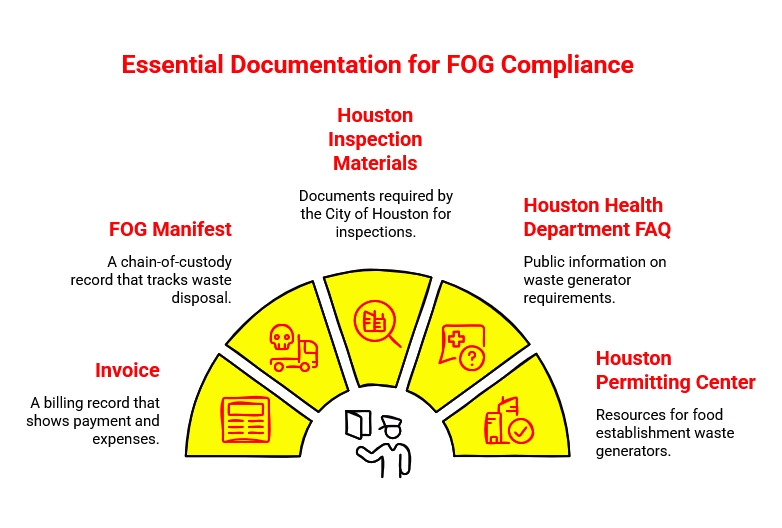
An invoice is a billing record. It shows who charged you, what service was billed, and how much you owed or paid.
A FOG waste manifest is a chain-of-custody record. It follows fats, oils, and grease from your interceptor or grease trap through removal, transport, and disposal.
Keep both. Use each one for the right purpose.
An invoice helps your bookkeeper reconcile expenses. A signed manifest helps show that waste was removed and handled through a documented disposal path. That is the practical difference restaurant owners and general managers need to understand before a City of Houston inspection.
Houston’s own inspection materials identify the documents an investigator may need to see, including the original Fats, Oils, and Grease permit and yellow and white copies of waste manifests for the past 5 years. The Houston Health Department FAQ also lists invoices from a permitted biological pretreatment company only “if applicable,” which shows why invoices should not be treated as a substitute for manifests. You can review those public requirements in the Houston Health Department waste generator FAQ and the Houston Permitting Center food establishment generator page.
This is not about creating more paperwork for its own sake. It is about keeping the right proof close enough to reach when someone asks for it.
What a FOG Manifest Is and Why Houston Inspectors Ask for It
A waste manifest is the official record of a grease interceptor cleaning event. Houston Health describes it as an official government document completed every time the interceptor is cleaned.
That definition is important. A manifest is not just a vendor note. It is the document that connects your business, the waste transporter, the service event, and the disposal path.
Think of it like a certified passport for wastewater. It tracks the journey from your kitchen’s grease trap to the approved destination. Used once, that analogy makes the point: the manifest travels with the waste story.
A properly completed manifest should help answer practical questions such as:
- What business generated the waste?
- When was the trap or interceptor cleaned?
- What trap or interceptor was serviced?
- Who transported the waste?
- Where was the waste taken?
- Who signed for the service?
- Which copies must be retained on site?
The signature matters because the generator portion connects the restaurant to the service record. Houston Health materials explain that the generator signs the top portion of the manifest and attests that the entire contents of the trap were removed. For a restaurant owner, that means the signature is not a casual scribble. It is part of the compliance record.
The inspector is not simply asking whether a truck arrived. The inspector is checking whether the waste was removed, documented, and handled through the proper chain of custody.
That is a different standard.
Manifest vs. Invoice: The Paperwork Difference That Can Decide an Audit
While billing records satisfy your accountant, chain-of-custody documentation satisfies the city investigator.
That sentence should sit at the front of your grease trap folder. It keeps the paperwork clear.
| Paperwork question | Invoice | FOG waste manifest |
|---|---|---|
| Does it prove you paid? | Yes | Not primarily |
| Does it prove the trap was cleaned? | Maybe, but only as a service claim | Yes, when completed properly |
| Does it show chain of custody? | No | Yes |
| Does it identify the waste transporter? | Usually not enough | Yes, if properly completed |
| Does it show the disposal path? | Usually no | Yes |
| Does it support Houston inspection readiness? | Not by itself | Yes, when signed and retained |
| Should you keep it? | Yes, for accounting | Yes, for compliance proof |
| Is it enough by itself? | No | It is the key compliance record |
The point is not that invoices are worthless. They are useful business documents.
The risk comes from saving the wrong proof for the wrong purpose. A restaurant can have a neat stack of invoices and still have a weak compliance file if the signed manifests are missing.
Good for bookkeeping is not the same as good for inspection.
The City of Houston’s FOG program exists because fats, oils, and grease can affect wastewater systems. The Houston Permitting Center states that the FOG-Special Waste program tracks fat, oil, and grease waste from commercial and residential establishments to help protect the city’s environment from pollutants. The EPA’s National Pretreatment Program materials also explain the broader wastewater reason for controlling FOG discharges from food service establishments. For broader context, see the Houston Special Waste Program and the EPA fact sheet on controlling fats, oils, and grease discharges from food service establishments.
That is why a manifest matters. It connects your kitchen’s waste to the larger disposal system.
The 5-Year Manifest Log: What Needs to Be Ready Before an Inspection
A strong manifest system does not need to be fancy. It needs to be complete, current, and easy to open under pressure.
Houston inspection materials call for yellow and white copies of waste manifests for the past 5 years. They also identify other documents that may be needed, such as the original FOG permit, applicable invoices, waivers if applicable, and previous inspection copies.
For a busy restaurant, the simplest setup is usually a physical binder plus a digital backup folder. The binder helps during an on-site visit. The digital folder protects you when a paper copy gets splashed, misplaced, or filed in the wrong drawer.
A practical 5-year manifest log can be organized like this:
- Current-year manifests
- Prior-year manifests
- Older records within the 5-year lookback
- FOG permit and related documents
- Previous inspection copies
- Vendor contact information
- Duplicate manifest requests or missing-record notes
Do not turn this into a museum archive. The goal is fast retrieval.
If an inspector asks for records, the manager on duty should not have to call the owner, search three office drawers, and scroll through old email threads while the lunch rush starts. The folder should answer the question before the kitchen loses its rhythm.
If you already have a filing system but it feels messy, start with the current year. Then work backward. You do not need to fix 5 years of records in one sitting to make progress today.
For a more detailed filing workflow, use Drane Ranger’s guide on how to organize your FOG manifests.
The Chain-of-Custody Failure Point: Where Cheap Pump-Outs Leave Restaurants Exposed
The weak point usually appears when someone asks a very simple question.
Where did the waste go?
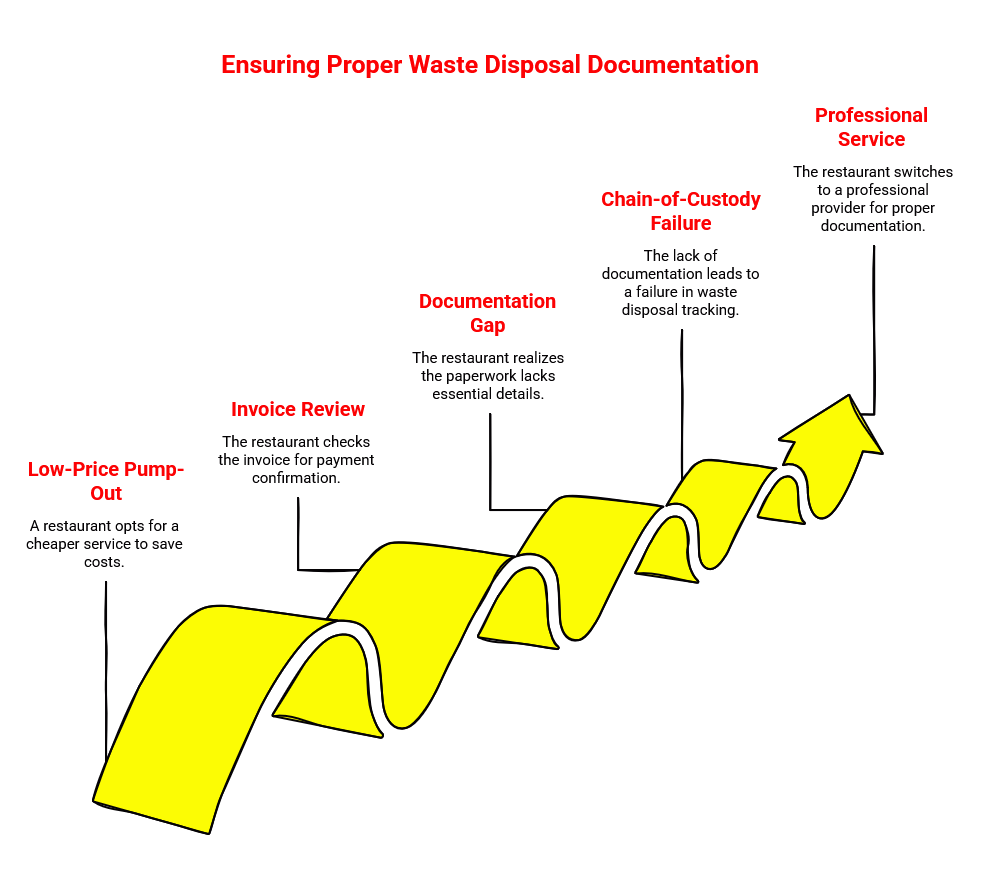
A low-price pump-out may look fine on the calendar. The invoice may look fine in the accounting folder. The trap may even seem fine for a while.
The problem begins when the record does not show the chain of custody. If the paperwork does not identify the transporter, service event, waste destination, and required signatures, the restaurant has a documentation gap.
That does not mean every low-cost vendor is cutting corners. It means you should judge the service by both the pump-out and the paperwork.
A responsible provider should be able to explain how manifests are completed, who signs them, what copies you receive, and how duplicate records can be retrieved. That is basic vendor accountability.
Professional service records may also include service dates, waste quantities, disposal facility information, and system issues identified during service. Those details help managers understand what happened, not just what was billed.
This is where documentation becomes practical. A hotel kitchen, a neighborhood restaurant, and a high-volume catering operation all have different daily pressures. The shared need is the same: when waste leaves the site, the record should make that movement clear.
No mystery trail. No vague receipt. No guessing later.
How to Check Your Current Paperwork in Under 15 Minutes
The first step is not panic. The first step is sorting what you already have.
Set aside 15 minutes during off-peak hours to audit your physical binders and digital drives.
Then separate the paperwork into two piles: invoices and manifests.
Check the most recent clean-out first. Look for the service date, business information, trap or interceptor cleaned, transporter details, signature, and disposal-path information. If you only see a receipt or generic invoice, flag it.
A fast paperwork check should answer these questions:
- Do you have a signed manifest for the last grease trap service?
- Does the record identify the transporter?
- Does it show where the waste was taken?
- Are yellow and white manifest copies retained where your team can find them?
- Do your records extend across the required 5-year period?
- Are there missing dates between service events?
- Can the manager on duty find the FOG permit and previous inspection copies?
This quick review will not solve every filing issue. It will show whether your current system is inspection-ready or only accounting-ready.
If several records are missing, contact your provider and ask for duplicates. If the provider cannot explain the manifest process, treat that as a service-quality warning.
You can also use the FOG audit checklist as a practical next step.
What to Ask Your Grease Trap Provider Before the Next Pump-Out
The best time to clarify paperwork is before the next service visit. Once the truck leaves, missing details become harder to fix.
Ask direct questions. A professional provider should not be bothered by them.
Use this list before your next pump-out:
- Are you permitted with the Houston Health Department to clean interceptors?
- Will the service include the required manifest copies after every cleaning?
- Who signs the manifest on-site?
- Where is the waste taken after removal?
- Can you provide duplicate records if my kitchen loses its copy?
- Do you help maintain service intervals based on actual trap conditions, not only calendar reminders?
Houston Health’s public FAQ states that interceptors can be cleaned only by a waste transporter permitted with the Houston Health Department. It also describes permitted vehicle identification, including decals and permit numbers.
That makes the vendor question simple. Do not ask only, “How much is the pump-out?” Ask, “What proof will you leave behind?”
Price matters. So does documentation.
If your provider handles commercial grease trap cleaning in Houston, the service relationship should make compliance easier to manage. It should not leave your team chasing paperwork after every visit.
When Invoices Still Matter
Invoices still belong in your records.
They help with bookkeeping, vendor payment history, expense tracking, internal approvals, and reconciling service frequency. If your accounting team needs to confirm that a service was billed in March, the invoice is the right place to look.
The mistake is using the invoice for a job it was not built to do.
A payment record does not automatically prove waste custody. It lacks the legally mandated fields for transporter identification, authorized disposal destination, and the generator’s attesting signature.
The right question is not “invoice or manifest?” The right answer is “both, filed for the right reason.”
Keep invoices with your financial records. Keep manifests in your inspection-ready FOG file. If your team prefers one combined binder, use separate tabs so the purpose stays clear.
Bookkeeping in one place. Compliance proof in another.
Build an Inspector-Ready Manifest System
Invoices support accounting; manifests support compliance.
Start today with the last service record. Find it, open it, and decide what it actually proves.
If it is only an invoice, ask for the signed manifest. If it is a manifest, check whether the required fields are complete and whether the copy is stored where a manager can reach it quickly.
A simple system works better than a perfect system that no one uses. Put the current year in front. Keep older records behind it. Scan copies into a folder named by year. Make sure the manager on duty knows where the binder sits.
If your manifest log is missing records or your current provider is not supplying proper documentation, talk with a Houston grease trap service provider that treats documentation as part of the job. Drane Ranger supports restaurants and commercial kitchens through Grease Trap Cleaning Houston and broader Grease, Grit & Lint Traps services.
Drane Ranger Vacuum Services has served the Greater Houston area since 1985. The company’s service approach emphasizes customer service, proper disposal, flexible scheduling, and compliance with applicable rules and regulations. Customers have also described Drane Ranger as professional, reliable, organized, and on time.
That kind of service matters most when the paperwork has to hold up after the truck leaves.
Frequently Asked Questions
Is a grease trap invoice enough for Houston FOG compliance?
No. A grease trap invoice is useful for accounting, but it is not the same as a FOG waste manifest. Houston inspection materials identify waste manifests as part of the records investigators may need to review.
What is a FOG waste manifest?
A FOG waste manifest is an official record completed when a grease interceptor is cleaned. It documents the generator, service event, waste transporter, and disposal path. In plain terms, it is the chain-of-custody record for grease trap waste.
How long should Houston restaurants keep grease trap manifests?
Houston inspection materials call for yellow and white copies of waste manifests for the past 5 years. Restaurant operators should confirm current requirements with the City of Houston or Houston Health Department because local procedures can change.
What documents should be ready for a Houston FOG inspection?
Beyond the required 5-year manifest log, investigators typically review the original Fats, Oils, and Grease permit, any applicable biological pretreatment invoices, active waivers, and forms from previous visits. The sample well, grease trap, dumpster, rendering oil bin, and surrounding area may also be checked during inspection.
Who is allowed to clean a grease trap in Houston?
Houston Health materials state that interceptors can be cleaned only by a waste transporter permitted with the Houston Health Department. Before your next pump-out, ask your provider to confirm permitting and explain how manifests are completed.
Should you keep invoices if you already have manifests?
Yes. Invoices support bookkeeping, vendor payment history, and expense records. Manifests support compliance proof. Keep both, but do not treat them as interchangeable.
What should you do if old manifests are missing?
Start with your most recent service records and work backward. Ask your provider for duplicate copies where available. If you cannot recover older records, document the gap and improve the system going forward. For regulatory questions, confirm the best next step with the City of Houston, Houston Health Department, or a qualified compliance professional.
Closing Thought
A grease trap file should do more than show that money changed hands. It should show where the waste went.
That is the shift from invoice thinking to manifest thinking. It gives the owner, the general manager, and the kitchen manager the same clear answer when inspection pressure arrives.
Not panic. Proof.
If your grease trap paperwork is missing manifests, review your latest service record today. For help with Houston grease trap service and documentation-focused support, contact Drane Ranger at 281-489-1765 or visit the contact page.
Disclaimer: This article is for general informational purposes only and is not legal advice. Houston FOG requirements, inspection practices, and municipal procedures may change. Restaurant owners and managers should confirm current requirements with the City of Houston, Houston Health Department, or a qualified compliance professional.
Our Editorial Process:
Our content is developed from Drane Ranger’s field experience in liquid waste management, current service-area knowledge, and publicly available regulatory sources. For compliance-related articles, we prioritize official municipal and agency references, practical operator guidance, and plain-English explanations that help Houston-area businesses understand what to check, what to document, and when to seek professional service.
By: Drane Ranger Vacuum Services Editorial Team
Drane Ranger Vacuum Services provides liquid waste management solutions for Houston-area businesses and property owners, including grease trap cleaning, grit trap cleaning, lint trap cleaning, septic services, lift station work, and vacuum truck services. Since 1985, Drane Ranger has focused on customer service, outstanding work, and helping clients stay aligned with applicable liquid waste rules and regulations.