📌 Key Takeaways
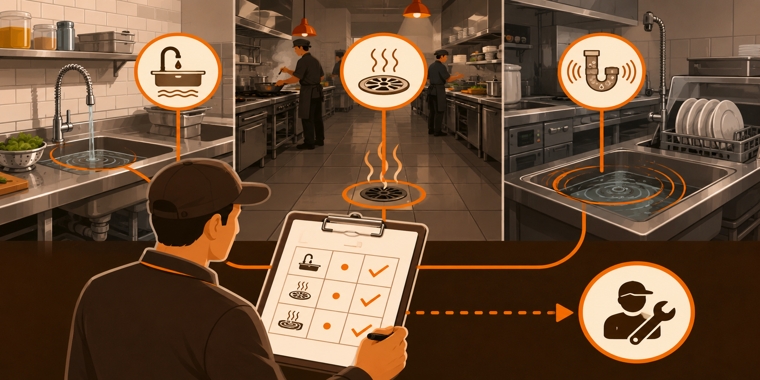
The guide recommends tracking recurring drainage patterns and escalating worsening conditions before they become an active backup or overflow.
- Patterns Beat Guesswork: A single slow drain, odor, or gurgle does not confirm a grease-trap problem.
- Backups Need Urgent Action: The guide recommends restricting access and contacting qualified professionals when wastewater actively backs up or overflows.
- Log the Full Context: Record the location, timing, affected fixtures, operating conditions, and whether the symptom returns or spreads.
- Busy Periods Reveal Risk: Repeated symptoms during prep, dishwashing peaks, or meal service justify earlier professional evaluation.
- Quarterly Service Sets Baseline: Houston requires interceptor evacuation at least quarterly, every 90 days, but that schedule does not diagnose new symptoms.
Patterns warn sooner than isolated symptoms.
Houston restaurant managers will spot rising risk sooner by using the observe, log, and escalate steps below.
~ ~ ~ ~ ~ ~ ~ ~ ~ ~ ~ ~ ~ ~ ~ ~ ~ ~
A prep sink drains slowly in the morning. During dinner service, an odor returns near a floor drain, and the dish area begins to gurgle. None of those observations proves that the grease trap is responsible. Taken together, however, they may form a pattern that deserves professional attention.
Houston restaurant managers are not expected to diagnose wastewater equipment. The practical task is to determine whether a symptom is isolated or whether it is recurring, spreading, intensifying during high-volume periods, or progressing toward a backup.
The most useful response is to observe the symptom, record its operating context, and escalate according to its scope and severity. That approach gives ownership and service providers better information without asking kitchen staff to identify the failed component.
One Warning Sign Is Not a Diagnosis
Grease traps, also called grease interceptors, capture fats, oils, and grease from wastewater before the wastewater enters the local sewer system. The U.S. Environmental Protection Agency’s food-service FOG fact sheet explains that food preparation generates this material and that onsite interceptors are used to collect it.
That function does not mean every drainage symptom begins at the trap.
A slow sink may involve the fixture or a connected line. An odor may have several possible sources. Gurgling can occur under changing drainage conditions, but the sound alone does not identify the cause. Managers should treat these as observations rather than conclusions.
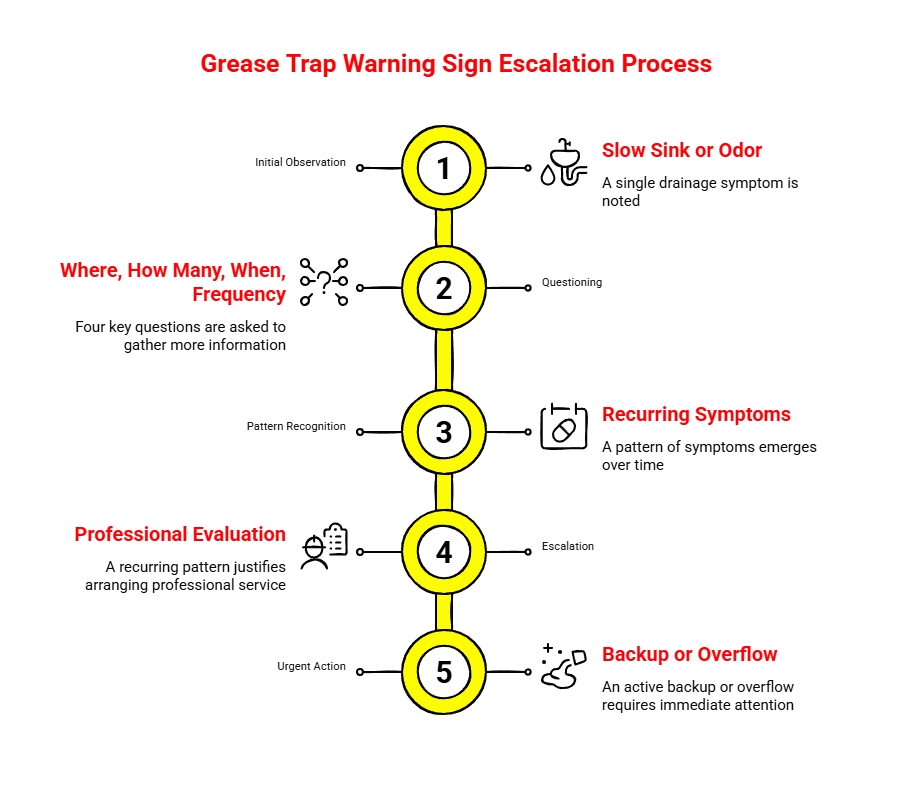
Four questions make the observation more useful:
- Where did it happen?
- How many fixtures were affected?
- Under what operating conditions did it occur?
- Is it becoming more frequent, widespread, or severe?
One event is inconclusive. A recurring pattern provides a stronger reason to arrange professional evaluation.
Use an Observe–Log–Escalate Warning-Pattern Matrix
This matrix is a management tool, not a technical diagnostic standard.
| Observation | Lower-Concern Pattern | Escalation Pattern | Recommended Next Step |
|---|---|---|---|
| Slow drainage | One fixture, brief, and not recurring | Several fixtures, recurring, or worse under operating load | Document the pattern and arrange evaluation |
| Odor | Brief, isolated, and linked to an identifiable non-system source | Returns in the same drain zone or begins appearing elsewhere | Record location and timing, then escalate |
| Gurgling | One isolated occurrence | Repeats with slow drainage, odors, or several affected fixtures | Report the combined pattern without naming a cause |
| High-volume change | No repeatable difference during busy periods | Symptoms appear predictably during prep, dishwashing peaks, or meal service | Schedule professional assessment |
| Visible grease or wastewater | None | Appears at a sink, floor drain, access area, or other unusual location | Seek prompt professional help |
| Backup or overflow | None | Wastewater is actively backing up or overflowing | Restrict access and contact qualified professionals |
Immediately after an event, record:
- Date and time
- Exact fixture or location
- Symptom observed
- Operating condition at the time
- Duration and whether the symptom returned
- Last known professional service date, when available
The service date is useful context, but it does not diagnose a new problem. A recently serviced interceptor does not rule out a fixture obstruction, connected-line issue, operating change, or another condition requiring assessment.
Staff should not open, enter, probe, or measure grease-control equipment to complete the log. OSHA identifies grease traps as potential fall and confined-space hazards and warns against unauthorized entry. The log should contain only observations made during normal kitchen operations. Keep this operational log in the same binder as your waste manifests. The Houston Health Department requires special waste generators to keep generator and returned copies of waste manifests onsite for five years, and keeping maintenance logs together ensures total compliance readiness during unannounced inspections. See the OSHA Grease Trap Hazards bulletin for workplace-safety context.
Patterns That Make Professional Evaluation More Justified
The Same Odor Returns in the Same Area
A brief odor provides limited information. Recurrence is more useful.
Record the exact sink, drain, floor area, dish station, or interceptor-access zone where the odor was noticed. Add the operating context: before opening, during prep, after cleaning, during intensive dishwashing, or near the end of service.
Location does not establish the source. It does help a qualified provider understand where to begin evaluating the reported condition.
Odor masking can make the pattern harder to track. Before changing the normal cleaning process or using deodorizing products, record when and where the odor appeared. The purpose is not to preserve an unpleasant condition; it is to avoid losing useful information.
Slow Drainage Spreads Beyond One Fixture
One slow prep sink may remain a fixture-level issue. Concern increases when another sink, floor drain, or connected fixture slows during the same shift or under similar operating conditions.
A multi-fixture pattern does not prove that the grease trap is full or failing. It does show that the problem may not be limited to one drain opening.
Record whether the fixtures slowed simultaneously, whether normal flow returned after service volume decreased, and whether the same sequence appeared on another day. That history helps distinguish an isolated interruption from a broader recurring condition.
Gurgling Appears With Other Symptoms
An isolated gurgle is non-specific. Repeated gurgling becomes more actionable when it occurs alongside slow drainage, returning odor, or disruption across several fixtures.
Note which fixture made the sound and what else was operating at the time. For example, record whether the dish machine was discharging, multiple sinks were in use, or another drain was slowing.
Do not report that “the grease trap is gurgling” unless that has been established by a qualified professional. Report what staff actually observed: the location, timing, related fixtures, and accompanying symptoms.
Symptoms Intensify During High-Volume Periods
Symptoms that appear predictably during prep, dishwashing peaks, or meal rushes provide useful operational context. They do not, by themselves, prove inadequate interceptor capacity or establish a required service interval.
The key distinction is repeatability.
For example, a dish sink might slow once on Tuesday, then slow again on Friday while a nearby floor-drain odor returns and another fixture gurgles. The sequence justifies earlier evaluation because the issue has recurred, spread, and become linked to operating conditions.
When to Observe, Schedule, Escalate Promptly, or Act Urgently
Observe and Record
Continued observation may be reasonable when an event is mild, isolated, limited to one fixture, and has not returned. There should be no visible wastewater, spreading odor, or meaningful operational disruption.
No universal waiting period applies. The next decision depends on whether the symptom reappears or changes.
Schedule Professional Evaluation
Arrange an evaluation when:
- The same symptom returns.
- The same location is repeatedly affected.
- The issue follows a recognizable operating pattern.
- The symptom appears before the next planned service date.
- Temporary improvement is followed by recurrence.
A service calendar should not override current operating evidence.
Escalate Promptly
Earlier attention is justified when several fixtures are affected, symptoms worsen across shifts, or staff repeatedly clear or mask the same issue.
A combination of slow drainage, returning odor, and repeated gurgling is more useful than any symptom considered alone. Visible grease or wastewater in an unusual drainage area also moves the condition beyond routine monitoring.
Treat Active Backup or Overflow as Urgent
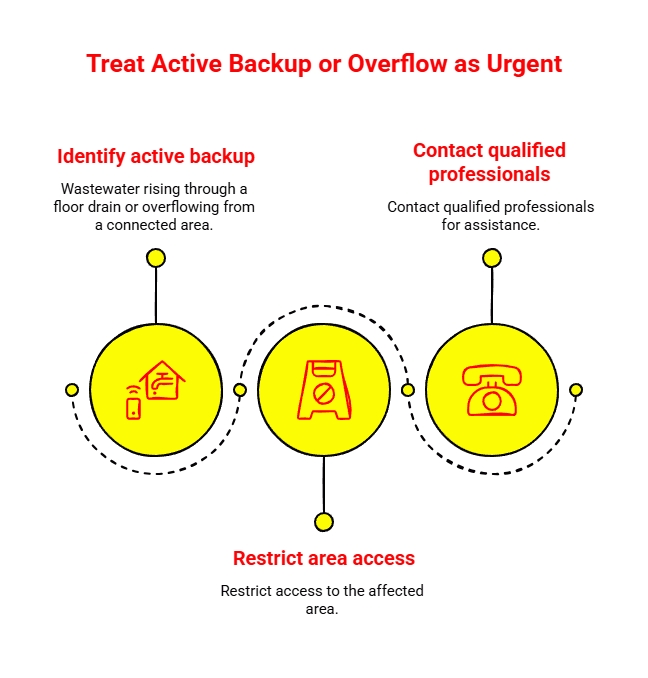
Wastewater rising through a floor drain or overflowing from a connected area should not be treated as another symptom to watch.
Restrict access to the affected area and contact qualified professionals. Do not ask restaurant employees to investigate inside the interceptor or attempt technical cleanup beyond their training and established workplace procedures.
For additional operational context, review what happens during a grease trap overflow. While this guide provides helpful operational context, it does not imply that every backup originates at the grease trap.
Houston’s Quarterly Requirement Is a Baseline, Not a Diagnosis
The Houston Health Department’s Special Waste Generators page states that a restaurant or food dealer with a grease trap is a special-waste generator. It also states that every interceptor within incorporated Houston city limits must be fully evacuated at least quarterly—every 90 days—unless a Notice of Waiver application is submitted and approved.
That is a verified municipal maintenance requirement. It is not a diagnostic waiting period.
Managers should not assume that quarterly evacuation:
- Explains the source of a new symptom
- Guarantees that a backup cannot occur
- Means worsening conditions should be ignored until the next scheduled visit
- Establishes the ideal operating interval for every kitchen
Actual service needs can vary with the property, equipment, kitchen activity, and confirmed system condition. Managers reviewing the broader scheduling question can read about how often a commercial grease trap should be cleaned in Houston, while confirming current compliance questions directly with the City of Houston.
What to Tell a Qualified Service Provider
A useful service request describes the observed pattern without announcing a diagnosis.
Provide:
- The exact fixtures and areas affected
- When the issue began
- Whether it is intermittent or constant
- Whether it returns during specific shifts or operating periods
- Whether several fixtures are involved
- Whether odor, gurgling, and slow drainage occur together
- Whether visible grease, wastewater rise, backup, or overflow is present
- The last known professional service date
- Whether a licensed plumber has already evaluated a fixture or drain-line concern
- Any access or scheduling limitations
For example:
“The dish sink slowed during two dinner shifts. On the second shift, an odor returned near the floor drain, and another fixture gurgled while the dish area was busy.”
That description communicates sequence, scope, and operating context. It does not claim that the interceptor is the confirmed cause.
Record the affected fixtures, timing, recurrence, operating conditions, and last service date before contacting a qualified provider.
Frequently Asked Questions
Can One Slow Kitchen Drain Mean the Grease Trap Needs Cleaning?
It may be related, but one slow fixture does not identify the cause. Record where and when it happened. Evaluation becomes more justified if the symptom returns, spreads to other fixtures, worsens under operating load, or appears with odor, gurgling, visible grease, or wastewater movement.
Why Do Restaurant Drains Sometimes Gurgle During Busy Periods?
Gurgling can occur under changing drainage conditions, but the sound is not specific enough to diagnose a grease-trap problem. Record the affected fixture, what equipment was operating, and whether slow drainage or odor appeared at the same time. Repeated combinations are more useful than the sound alone.
Should a Houston Restaurant Wait Until Its Next Quarterly Service?
Not when symptoms are recurring, spreading, or becoming more severe. Houston’s quarterly evacuation requirement is a maintenance baseline, not an instruction to delay evaluation. Current kitchen conditions should guide the operational response, while the City of Houston should remain the source for compliance questions.
Should a Restaurant Call a Plumber or a Grease-Trap Service Provider?
The appropriate provider depends on the confirmed source. A fixture or drain-line problem may require a licensed plumber, while interceptor cleaning requires a qualified grease-trap service provider. When the cause is unclear, describe the full symptom pattern and ask the professionals involved how the assessment should be coordinated.
Recognize the Pattern Before It Becomes a Backup
One slow drain, odor, or gurgle is not a diagnosis. Recurrence, spread, operating context, and increasing severity make the situation more actionable.
A clear incident log allows restaurant managers to move beyond vague reports, explain the issue to ownership, and give qualified professionals better information. Active backup or overflow belongs in an urgent category rather than routine observation.
If the symptoms are recurring, spreading, or becoming more disruptive, review Drane Ranger’s grease trap cleaning service for Houston restaurants.
Disclaimer: This article is for general informational purposes only and does not constitute compliance, safety, plumbing, technical, or professional advice. Conditions and requirements may vary by property, system, and jurisdiction. Confirm important decisions with the appropriate qualified service provider, licensed professional, or local authority.
Our Editorial Process
Our expert team uses AI tools to help organize and structure our initial drafts. Every piece is then extensively rewritten, fact-checked, and enriched with first-hand insights and experiences by expert humans on our Insights Team to ensure accuracy and clarity.
By Drane Ranger Insights Team
The Drane Ranger Insights Team creates practical guidance for Houston-area businesses that need reliable liquid waste management, grease trap cleaning, septic, lift station, and wastewater compliance support. Drane Ranger Vacuum Services has served the Greater Houston area since 1985, helping customers keep operations running while following applicable waste handling and disposal requirements.