When Kitchen Volume Changes, Revisit the Restaurant Maintenance Budget

📌 Key Takeaways

Review a restaurant’s grease trap maintenance budget when kitchen operations materially change, using service records and documented provider guidance before revising the annual allocation.

  • Extra Visits Increase Annual Costs: A higher annual visit count can increase cleaning expenditure even when the provider’s confirmed price per visit remains unchanged.
  • Service Records Test Budget Assumptions: Comparing planned and completed visits, service notes, and invoices helps distinguish recurring frequency changes from differences in scope or charges.
  • Symptoms Require Professional Evaluation: Repeated slow drainage or odors warrant assessment, but these symptoms alone do not establish that the grease trap is full.
  • Provider Advice Does Not Replace Requirements: Site-specific cleaning recommendations inform maintenance planning, while applicable local requirements remain a separate compliance baseline that operators need to confirm.
  • Documented Decisions Support Future Reviews: A dated record of evidence, recommendations, approval, and the next review trigger helps subsequent managers reconstruct the maintenance budget decision.

For restaurant managers and owners preparing the next budget sign-off, unresolved service assumptions identify where further assessment is needed before approving a revised recurring allocation.

A useful maintenance allocation connects expected visits and known charges to documented kitchen conditions.

~ ~ ~ ~ ~ ~ ~ ~ ~ ~ ~ ~ ~ ~ ~ ~ ~ ~

At 8:15 a.m., a restaurant manager compares an annual budget worksheet with the latest grease trap service records. The printer hums, and a familiar question arises: Does this allocation still describe the kitchen? This is an illustrative scene, but the decision is practical. Review a restaurant’s grease trap maintenance budget when operating conditions materially differ from those used to set the original cleaning allowance. Compare current activity, planned and completed visits, and documented service advice before changing the annual number. A busier kitchen warrants investigation, not an automatic increase.


Why Kitchen Volume Is a Maintenance-Budget Trigger

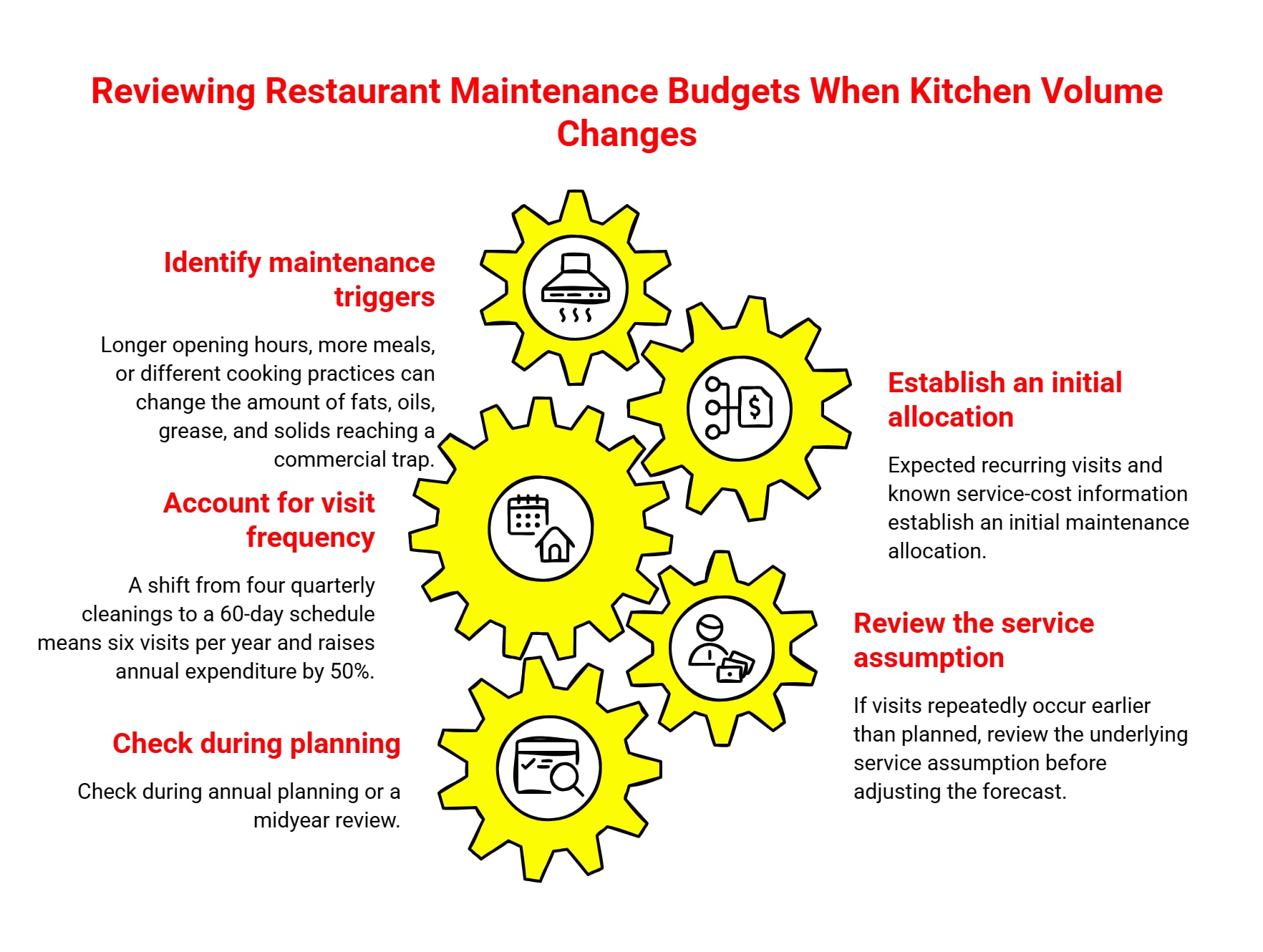
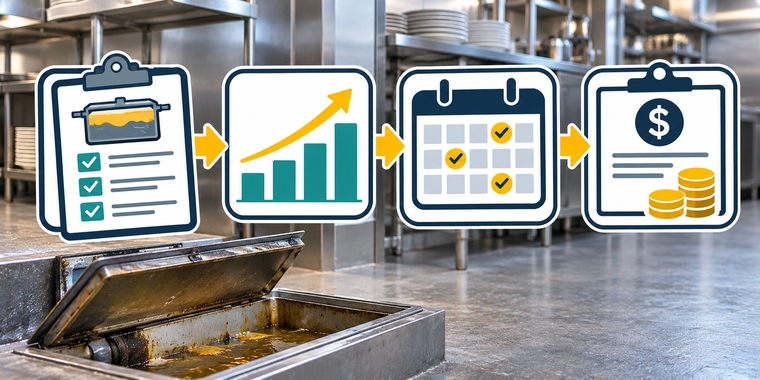
Infographic showing how changing kitchen volume can affect grease trap maintenance budgets through service triggers, visit frequency, allocation, and planning reviews.

Last year’s maintenance allocation is a starting point, not a permanent operating rule. Longer opening hours, more meals, or different cooking practices can change the amount of fats, oils, grease, and solids reaching a commercial trap. The U.S. Environmental Protection Agency explains that grease-control maintenance frequency depends on FOG generation and operating practices. Actual conditions matter more than an assumed universal interval.

Cost planning for grease trap cleaning in annual restaurant maintenance budgets starts with two inputs: the expected number of recurring visits and known service-cost information. Together, they establish an initial maintenance allocation. A quotation prices its stated scope; it does not establish the annual visit count.

The overlooked source of budget variance is sometimes visit frequency, not a higher price per visit. For example, if extended weekend hours push a kitchen from four quarterly cleanings onto a 60-day schedule (six visits per year), total annual cleaning expenditure rises by 50%—two extra visits—even when the provider’s per-visit rate never changes. In budget terms, a line item planned at four times your confirmed per-visit rate becomes six times that rate—a 50% overrun driven entirely by pumping cadence rather than a price increase. If visits repeatedly occur earlier than planned, review the underlying service assumption before adjusting the forecast. Check during annual planning or a midyear review.


What Operating Changes Deserve a Review?

Compare today’s kitchen with its operating pattern when the current budget was approved. Capture observable changes rather than relying on an impression that business feels busier.

  • Meal periods consistently serve more customers or require higher production.
  • Opening hours, kitchen shifts, catering work, or preparation schedules have expanded.
  • Menu revisions or cooking methods have changed grease-producing activity.
  • Seasonal demand has persisted beyond its originally expected period.
  • Slow drainage or odors repeatedly appear before scheduled cleaning.
  • The provider has suggested a different next-service date on more than one occasion.

Record when each change began and whether it is temporary or sustained. Symptoms warrant professional evaluation; slow drains or odors alone do not establish that the trap is full. In commercial kitchens, technicians commonly apply the 25% rule—checking whether combined floating fats, oils, and grease (FOG) and settled solids reach 25% of the trap’s total liquid depth, which triggers service even before a 90-day municipal interval expires.

For operational context, see when busier service calls for revisiting a cleaning arrangement. The budget question remains whether the assumed visit count still holds.


Check the Records Before You Change the Number

Set the budget worksheet beside the cleaning history. Identify the original planned interval and visit count, then check what actually happened. Compare scheduled dates with completed visits, especially extra appointments or visits brought forward. This establishes whether the difference is recurring or isolated.

Next, review service notes, recommendations for the next cleaning, and any documented accumulation or system issues. Drane Ranger describes service records that include dates, waste quantities, disposal-facility information, and identified issues. Those records can support a review, although individual documents may contain different details. Recurring symptoms can be assessed alongside signs that an existing cleaning schedule may be too infrequent.

Finally, compare invoices and known quotations with the original allocation. Separate a changed visit count from changes in service scope, access, or quoted charges. The annual restaurant grease trap budgeting framework explains initial planning; this review tests its inputs.

Three outcomes are possible. The original assumption remains supported, the evidence is insufficient and needs professional review, or the documented service needs justify a revised interval. Do not treat an unverified assumption as a confirmed service requirement.


Change-Trigger Review Matrix

Use this matrix during a management review. Each row identifies an observation to investigate, not a predetermined cleaning requirement.

Observed change Evidence to inspect Responsible role Question for the provider
Kitchen volume is materially higher than when the budget was set Recent service dates, operating schedule, service notes General manager Does current activity change the recommended interval for this site?
Service has repeatedly been needed earlier than expected Completed service history and recurrence pattern General manager and owner What site conditions appear to shorten the interval?
Operating hours or production patterns changed Current and prior operating schedules General manager Should the maintenance assumption be reassessed?
Annual expenditure is above plan Budget-to-actual records and visit count Owner or finance-aware operator Is the difference due to frequency, scope, access, or another documented factor?
Provider guidance has changed Previous and current service recommendations Owner and general manager Which site conditions or records support the new recommendation?

The general manager checks operating evidence. Ownership or finance checks the forecast and approves any revised recurring allocation. Both need a dated record of the reason for the decision.


Questions to Ask the Grease Trap Service Provider

Bring the service history and a concise description of the operational changes. Ask for the site evidence behind any proposed adjustment.

  1. Does current kitchen activity change the interval recommended for this location?
  2. Which operating conditions, accumulation observations, or service records support that recommendation?
  3. What records should management retain for the next budget review?
  4. Could access, service scope, waste conditions, or scheduling affect future quotations?
  5. What change should trigger reassessment before the next annual budget cycle?

Drane Ranger describes restaurant grease trap cleaning and recurring arrangements tailored to the site, rather than an identical schedule for every customer. In supplied feedback, customer Harold R. described clear communication and receiving a suggested time for the next cleaning. That feedback establishes neither savings nor a universal frequency.

Operators in Houston and Alvin should check the requirements governing their particular site. The City of Houston’s Special Waste program materials establish a mandatory minimum compliance baseline for Houston sites (such as full evacuation at least every 90 days under City Code Section 47-512(b), unless a waiver applies, and adherence to the 25% accumulation threshold), not a one-size-fits-all operating interval for every kitchen or jurisdiction. Confirm current obligations with the appropriate authority; provider recommendations do not replace them.


Document the Revised Maintenance Assumption

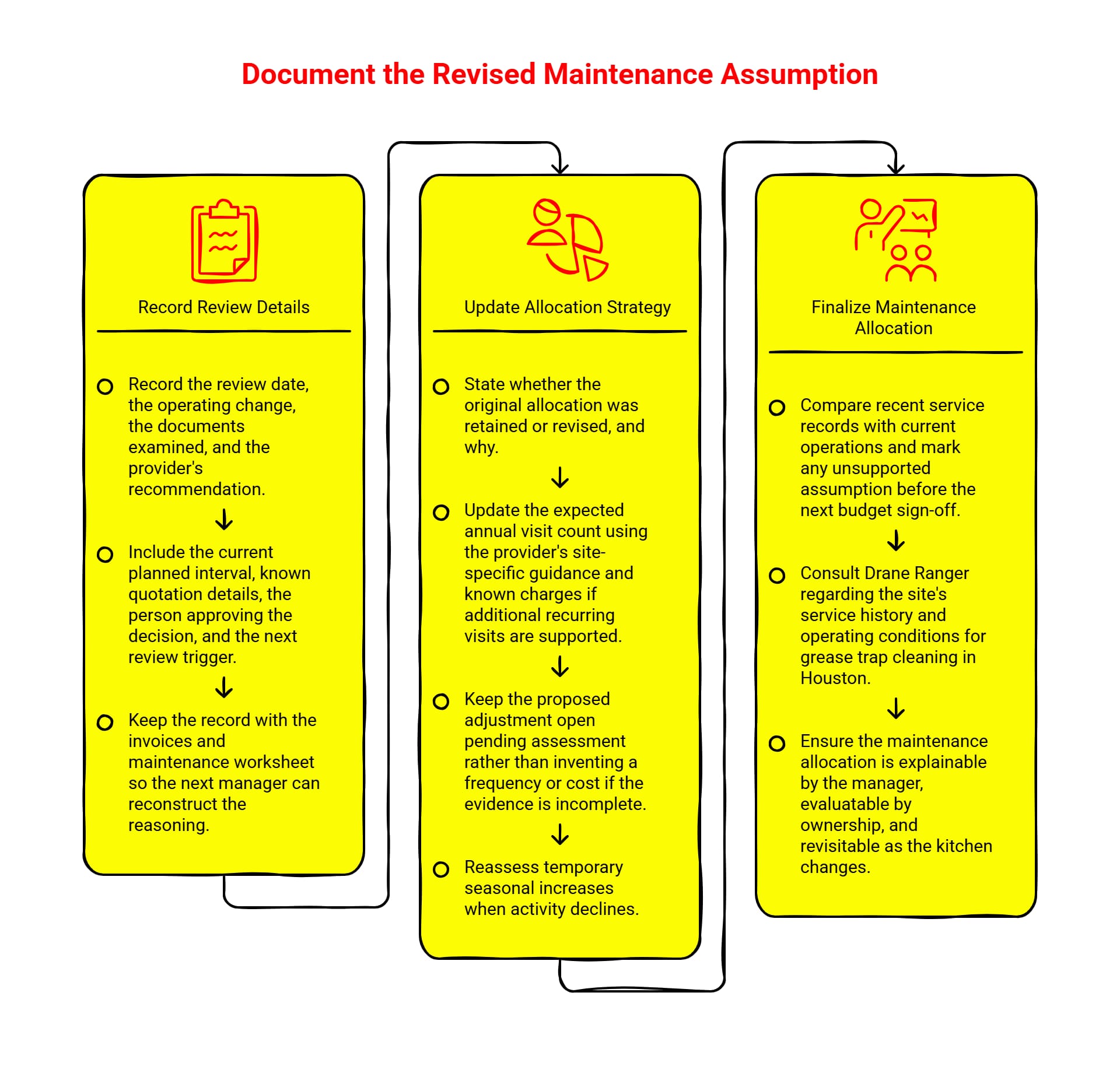
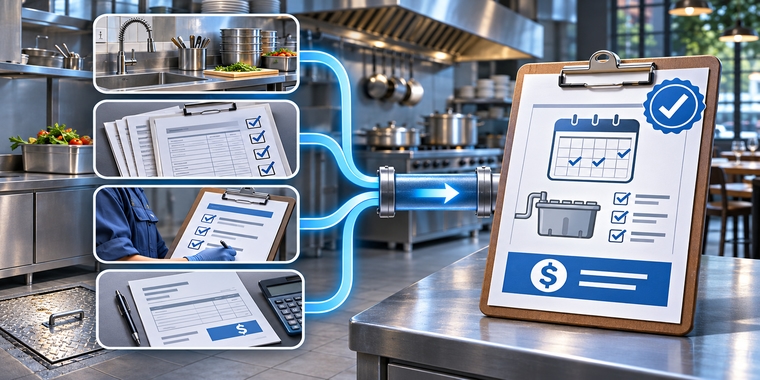
Infographic showing how to document, update, and finalize a revised grease trap maintenance allocation using service records, provider guidance, and current operating conditions.

Record the review date, the operating change, the documents examined, and the provider’s recommendation. Include the current planned interval, known quotation details, the person approving the decision, and the next review trigger. Keep the record with the invoices and maintenance worksheet so the next manager can reconstruct the reasoning.

State whether the original allocation was retained or revised, and why. If additional recurring visits are supported, update the expected annual visit count using the provider’s site-specific guidance and known charges. If the evidence is incomplete, keep the proposed adjustment open pending assessment rather than inventing a frequency or cost. Reassess temporary seasonal increases when activity declines.

Before the next budget sign-off, compare recent service records with current operations and mark any unsupported assumption. For grease trap cleaning in Houston, Drane Ranger can discuss the site’s service history and operating conditions. The useful outcome is not simply a new number. It is a maintenance allocation the manager can explain, ownership can evaluate, and the restaurant can revisit as its kitchen changes.


Our Editorial Process

Our expert team uses AI tools to help organize and structure our initial drafts. Every piece is then extensively rewritten, fact-checked, and enriched with first-hand insights and experiences by expert humans on our Insights Team to ensure accuracy and clarity.


About the Drane Ranger Insights Team

The Drane Ranger Insights Team is our dedicated engine for synthesizing complex topics into clear, helpful guides. While our content is thoroughly reviewed for clarity and accuracy, it is for informational purposes and should not replace professional advice.

Plan Annual Grease Trap Service Visits From Existing Cleaning Records

📌 Key Takeaways

Annual grease trap service plans should begin with completed cleaning records, documented conditions, and provider recommendations, then account for current kitchen activity.

  • Service Reports Establish Completed Work: Service reports document completed cleaning and observed conditions, while invoices confirm billing and charges for the recorded service scope.
  • Extra Visits Need Context: An additional cleaning during unusually heavy kitchen activity belongs in the next forecast only after reviewing whether those conditions may recur.
  • Forecasts Remain Provisional: Management’s estimated visits remain separate from completed dates and documented provider recommendations, with missing evidence or conflicting information clearly flagged.
  • Requirements Differ From Recommendations: Local requirements establish obligations for the restaurant’s address, while provider recommendations inform maintenance planning based on documented site conditions.
  • Comparable Charges Inform Budgets: Counting proposed visits within the budget period and using charges for comparable work creates a planning allocation, not a promised price.

For Houston restaurant managers, reviewing completed cleanings against the remaining forecast during the year helps explain additional visits and document reasons for budget changes.

A defensible annual plan preserves the evidence, uncertainty, and reasoning behind each projected visit.

~ ~ ~ ~ ~ ~ ~ ~ ~ ~ ~ ~ ~ ~ ~ ~ ~ ~

At 8:15 AM, a Houston restaurant manager is revisiting the annual maintenance worksheet. The printer hums beside a stack of cleaning invoices. Last year’s budget allowed for fewer grease trap visits than the restaurant actually received. Which number belongs in the next plan?

This is an illustrative situation, not a customer case. The answer begins with completed service records, not an arbitrary annual visit count. Existing cleaning dates, documented conditions, and provider recommendations give management a starting point for forecasting future visits. Test those facts against current kitchen activity.


Start With the Cleaning Records You Already Have

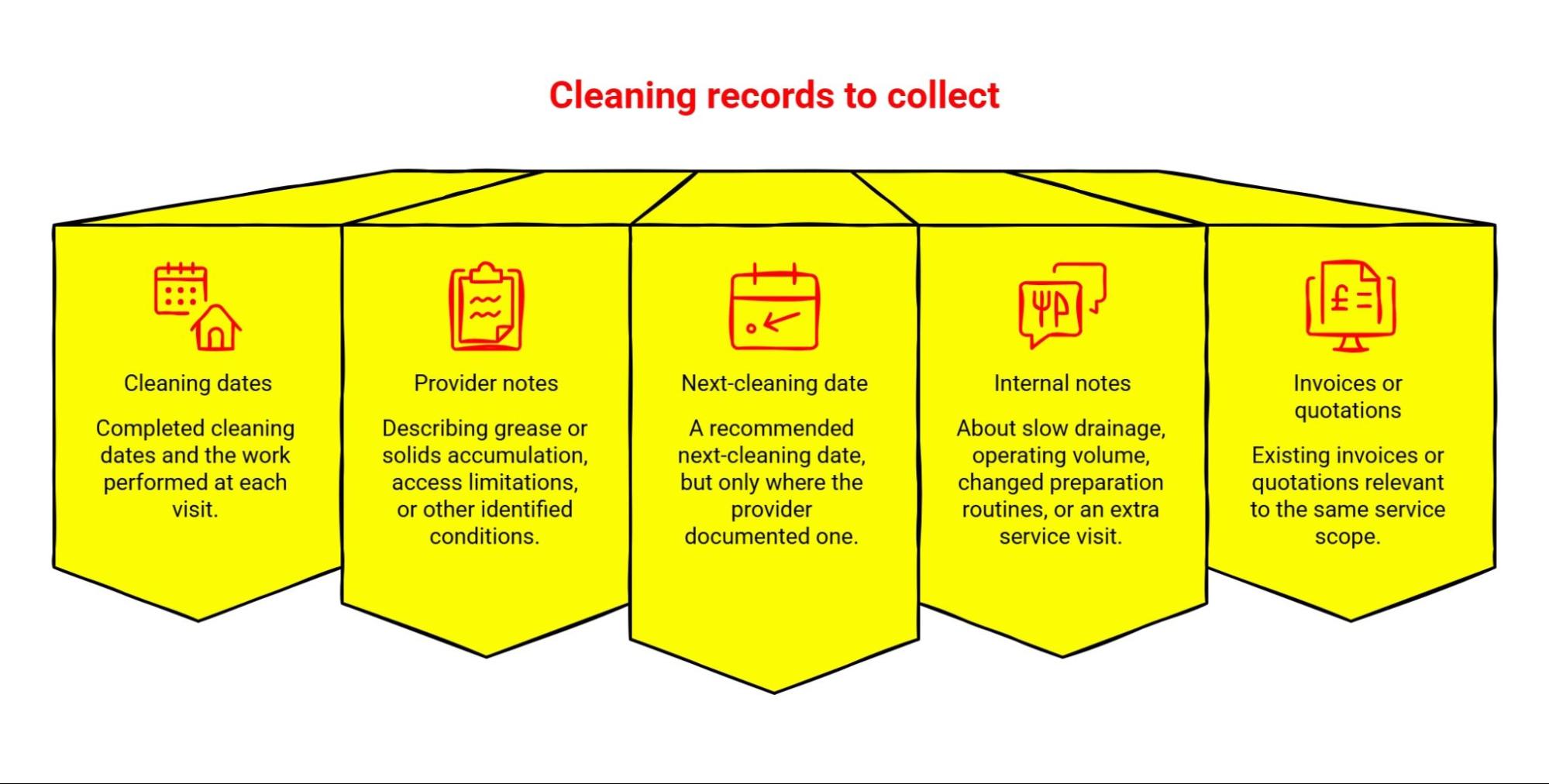
Infographic listing grease trap cleaning records to collect, including service dates, provider notes, next-cleaning dates, internal notes, and invoices or quotations.

Gather the most recent complete service cycle, then include earlier records if they explain unusual visits or recurring issues. Use a service report to establish what was completed; use an invoice to confirm billing and charges. Keep the two distinct.

Collect these records together:

  • Completed cleaning dates and the work performed at each visit.
  • Provider notes describing grease or solids accumulation, access limitations, or other identified conditions.
  • A recommended next-cleaning date, but only where the provider documented one.
  • Internal notes about slow drainage, operating volume, changed preparation routines, or an extra service visit.
  • Existing invoices or quotations relevant to the same service scope.

Drane Ranger describes maintaining service histories and recording service dates, waste quantities, disposal facility information, and identified system issues. Enter those details only when the records contain them. Waste-disposal documentation remains separate from the restaurant’s planning worksheet.

If a problem visit produced unclear paperwork, the Grease Trap Service Records After a Problem Visit: A Houston Restaurant Manager’s Review Checklist helps identify what to clarify before relying on that record.


Build One Annual Service Visit Log

Place completed visits in chronological order. Keep factual history, professional advice, and management’s future estimates in separate fields. An estimate is not an appointment.

Completed visit date Observed conditions Provider notes Recommended next date Operating context Estimated future visit Assumption status
2026-03-14 (Illustrative example) 20% FOG cap, 10% settled solids (30% total); heavy baffle buildup Trap over 25% threshold; recommend shortening cycle from 90 to 60 days 2026-05-13 Added weekend brunch service in Feb; fryer volume up ~25% 2026-05-12 (and every 60 days thereafter: 6 visits/yr) Review needed — confirm whether brunch fryer load remains permanent before locking 60-day budget

Completed visit date, observed conditions, and provider notes document what is known. Recommended next date records advice actually given by the provider. Estimated future visit is management’s provisional entry, not a scheduled appointment. Operating context explains whether kitchen activity was normal or materially different.

Use supported when the estimate has relevant history and consistent provider guidance. Use uncertain when dates or notes are missing. Use review needed when changed conditions or conflicting information make the assumption unreliable. Record the reason for that status beside the log, and never fill an evidence gap with a guessed fact.

As each visit occurs, preserve the original forecast and add the completed date to the history. This leaves a visible trail of what management expected and what happened.


Turn the History Into a Provisional Visit Forecast

Read the log as a sequence, not merely a total. Check the spacing between completed visits. Then review the condition reported at each visit and any recommendation made for the next one. Was work performed as expected, brought forward, or added for a separate concern?

Suppose, in a hypothetical restaurant, the service history shows routine visits plus an extra cleaning during unusually heavy kitchen activity. Copying the total number of visits into the next year’s budget would overlook why the additional work occurred. Ignoring the extra visit would overlook it as well. The useful question is whether the operating conditions that prompted it are likely to recur.

Translate the reviewed pattern into proposed future visits, marking each as an estimate. When records conflict, note what needs clarification before committing to a date. A single completed visit cannot establish a reliable recurring interval.

Before calculating future intervals from your log, establish two practical guardrails: your local statutory minimum and the 25% rule. Within City of Houston limits, commercial grease traps must be pumped at least every 90 days regardless of fill level, while wastewater standards call for service whenever combined floating fats, oils, and grease (FOG) and settled solids reach 25% of the unit’s total liquid depth. If historical service reports show accumulation consistently reaching 25% before the 90-day mark—which often happens every 30 to 60 days in busy kitchens—confirm a shorter interval with your provider; if accumulation stays well below 25%, your applicable municipal requirement still sets the longest interval you can legally budget. 

For the financial allocation, count the proposed visits within the budget period. Relate that count to documented charges or an existing provider quotation for a comparable service scope. If charges varied because work or access requirements differed, keep that uncertainty visible instead of treating one invoice as a universal per-visit rate. The resulting allocation is a planning assumption, not a promised service price.


Adjust the Forecast When Restaurant Conditions Have Changed

Historical spacing is only useful while the conditions behind it remain relevant. The U.S. Environmental Protection Agency explains that maintenance frequency depends heavily on the amount of fats, oils, and grease generated and the establishment’s management practices.

Look for material changes in meals served, food preparation, dishwashing activity, or recorded grease and solids accumulation. Also review trap characteristics, access conditions, and changes in the work included in service visits. These variables deserve attention because they can affect how a provider interprets the earlier history.

A recurring slow drain or odor is a reason to document the symptom and seek an appropriate evaluation. It does not prove that the cleaning interval is wrong or that an earlier service was inadequate. The guidance on recognizing when a grease trap cleaning schedule may be too infrequent explains how to examine recurring patterns.

When restaurant activity has shifted, a review of the cleaning arrangement during busier service can help organize the operational changes for a provider discussion. Do not assign a new service interval from a change in activity alone.


Check the Forecast Against Provider Guidance and Current Requirements

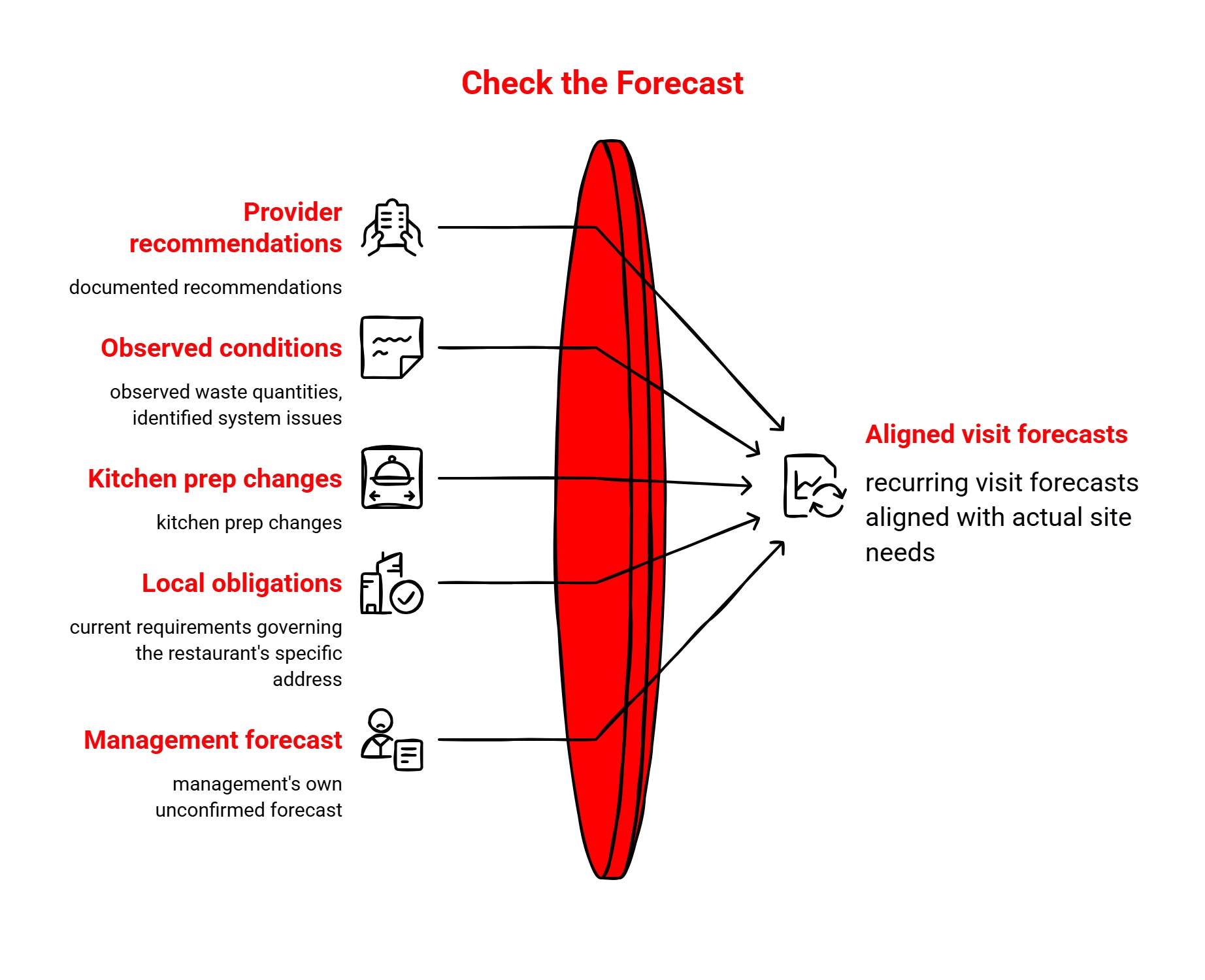
Infographic showing factors for reviewing grease trap service forecasts, including provider recommendations, site conditions, kitchen changes, local obligations, and management estimates.

Review provisional dates with the provider’s documented recommendations. Where a recommendation differs from the historical pattern, ask which observed condition or site requirement explains it. Preserve the answer in the log rather than silently changing the forecast.

Across Greater Houston kitchens served by Drane Ranger, budgeting misses commonly happen when managers count routine quarterly pump-outs from accounting invoices without checking service records for observed waste quantities, identified system issues, or separate visits for hydro-jetting and urgent emergency response. Comparing technician observations on accumulation and system condition against kitchen prep changes helps keep recurring visit forecasts aligned with actual site needs.

Local obligations need a separate check. The City of Houston identifies grease trap inspections within its food-service business requirements. Confirm the current requirements governing the restaurant’s specific address with the appropriate authority. An operation in Alvin should not assume that every Houston municipal provision applies to it.

A regulatory requirement establishes an obligation. A site-specific provider recommendation informs maintenance planning. Neither should be mistaken for management’s own unconfirmed forecast.


Review the Visit Plan During the Year Instead of Freezing It

Treat the annual forecast like a kitchen staffing plan: it allocates resources for expected work, but actual demand may require adjustment. After each completed cleaning, update the history, check the remaining estimated visits, and record any reason for changing them.

At each actual-versus-budget review, identify additional visits and what explains the difference. Retain the earlier estimate so ownership can understand the variance without reconstructing decisions from memory.

A defensible maintenance allocation does not depend on predicting every visit perfectly. It depends on showing the evidence behind each assumption, the uncertainty still unresolved, and the circumstances that justify an update.

Explore our guides for related service timing advice. Read the grease trap service-record review checklist to make sure the information you are using for next year’s plan is complete.


Our Editorial Process

Our expert team uses AI tools to help organize and structure our initial drafts. Every piece is then extensively rewritten, fact-checked, and enriched with first-hand insights and experiences by expert humans on our Insights Team to ensure accuracy and clarity.


About the Drane Ranger Insights Team

The Drane Ranger Insights Team is our dedicated engine for synthesizing complex topics into clear, helpful guides. While our content is thoroughly reviewed for clarity and accuracy, it is for informational purposes and should not replace professional advice.

Why Last Year’s Grease Trap Budget May Miss This Year’s Cleaning Visits

📌 Key Takeaways

Last year’s grease trap budget may miss this year’s cleaning visits because current kitchen conditions, documented service history, and provider recommendations can change the expected frequency.

  • Spending Does Not Establish Frequency: Previous expenditure may reflect missed, postponed, or additional cleanings, so approved allocations, actual spending, and completed visits provide different planning information.
  • Kitchen Changes Warrant Review: Longer hours, greater meal production, or different preparation practices may change accumulation, but increased activity does not automatically require more cleaning visits.
  • Service Records Support Visit Forecasts: Completed service dates, recorded waste quantities, system findings, and provider recommendations help establish whether previous cleaning assumptions remain supported.
  • Symptoms Do Not Confirm Fullness: Recurring slow drains or odors warrant attention, but neither independently establishes that the grease trap is full or another pump-out is necessary.
  • Verified Inputs Support Budget Calculations: Confirmed expected visits multiplied by the verified quoted cost per visit establish planned recurring cleaning expenditure, with other documented maintenance costs calculated separately.

For restaurant owners, general managers, and finance teams, recording completed visits, actual charges, unexpected expenses, and operational interruptions provides evidence for the next budget review.

A defensible allocation connects documented cleaning needs with verified costs and clearly identified uncertainties.

~ ~ ~ ~ ~ ~ ~ ~ ~ ~ ~ ~ ~ ~ ~ ~ ~ ~

Consider an illustrative budget review at a Houston restaurant. A manager opens last year’s maintenance worksheet beside a stack of grease trap service records. The kitchen now handles a different workload, and the completed cleaning dates do not match the original plan.

Does last year’s budget still reflect what the kitchen needs?

Last year’s grease trap budget may miss this year’s cleaning visits because expected service frequency depends on operating conditions, not historical spending alone. Changes in kitchen activity, grease accumulation, completed visits, or provider recommendations can affect the forecast. Use previous records as the baseline, compare them with current conditions, and confirm uncertain assumptions before approving the new allocation.


Myth: Last Year’s Number Is the Safest Starting Budget

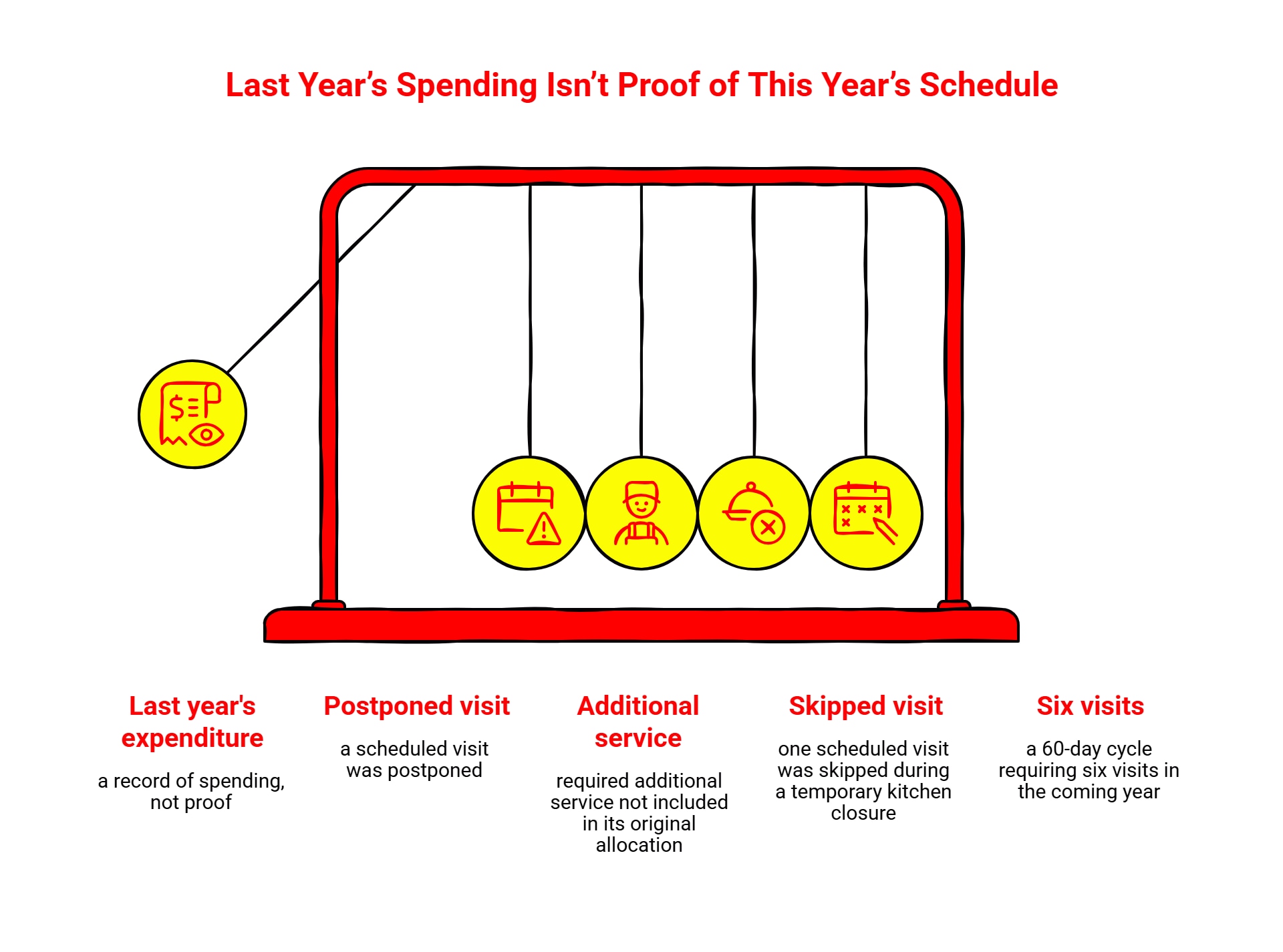
Infographic showing why last year’s grease trap spending may not predict this year’s schedule due to postponed, added, or skipped service visits.

Reusing an approved maintenance allocation seems sensible. The amount is familiar, previous invoices are available, and management can avoid rebuilding another budget line.

However, last year’s expenditure is a record of spending, not proof that the same cleaning schedule remains appropriate.

A restaurant may have spent less than planned because a scheduled visit was postponed. Another may have required additional service that was not included in its original allocation. Neither outcome establishes the correct frequency for the coming year.

For example, a Houston restaurant that budgeted for four quarterly pump-outs might finish the year under budget if one scheduled visit was skipped during a temporary kitchen closure—even though adding a high-volume weekend brunch service actually pushed accumulation onto a 60-day cycle requiring six visits in the coming year. 

Start by comparing three documented figures: the approved allocation, actual expenditure, and completed cleaning visits. Identify any difference between the plan and what occurred.

For broader financial planning, Drane Ranger’s guide on how to budget for grease trap cleaning in your annual restaurant maintenance plan explains how recurring cleaning fits into maintenance expenditure.


Reality: The Visit Assumptions Behind the Budget Can Change

Restaurant operating volume influences the waste entering a grease trap. Longer operating hours, greater meal production, or different food preparation practices may change grease and solids accumulation.

The U.S. Environmental Protection Agency explains that grease interceptor maintenance frequency depends substantially on the amount of fats, oils, and grease a facility generates and its waste-management practices.

In practice, many municipal standards—including the City of Houston’s 25% rule—require pumping a grease trap once combined floating fats, oils, and grease (FOG) and settled solids reach 25% of the unit’s total liquid depth, regardless of how many weeks have passed since the last service. 

This means a change in restaurant activity deserves investigation, not an automatic increase in cleaning visits.

For example, a restaurant introducing another preparation shift may create a different wastewater pattern. This is an illustrative operational change, not evidence that every expanded kitchen requires more frequent pumping.

The correct planning relationship is:

Current kitchen conditions → Appropriate cleaning requirements → Expected service visits → Annual maintenance allocation

The first comparison establishes whether the old cleaning assumption remains credible. Provider observations and applicable requirements help determine the appropriate interval.

Restaurants experiencing operational changes can also review when busier service warrants reconsidering an existing grease trap cleaning arrangement.


Compare Last Year’s Service Record With This Year’s Kitchen

Begin with completed service records rather than estimated cleaning dates.

Check the service date, recorded waste quantities, identified system issues, and any recommendation about the next cleaning. Where available, compare disposal documentation and upcoming appointment information.

A cleaning invoice establishes a financial transaction. Supporting service and disposal records provide additional information about the work performed and waste handling.

Next, ask the general manager whether operating hours, preparation methods, or kitchen throughput have changed. Record recurring drainage or odor concerns without assuming they prove the grease trap is full.

For unclear service history, use Drane Ranger’s grease trap service records review checklist.

The goal is to establish which previous assumptions remain supported and which need confirmation.


Use the Past-vs.-Current Cleaning Visit Worksheet

Use documented information wherever available. Enter Confirm for an unverified date, cost, cleaning interval, or provider recommendation. The final column should identify the action needed before the budget is approved.

Review item Last year Current year or condition Evidence / planning action
Cleaning visits Record dates and completed visit count Record completed and expected visits Compare actual visits with the plan
Kitchen activity Document previous operating pattern Record changes in hours, production, or preparation Confirm material changes
Grease and solids Enter documented service observations Enter current findings or Confirm Ask provider whether timing should change
Provider recommendation Record previous cleaning advice Record current recommendation or Confirm Verify proposed interval
Recurring symptoms Record documented drainage or odor concerns Note current symptoms and recurrence Request evaluation where appropriate
Missing records Identify unavailable documents Record outstanding information Obtain missing evidence
Visit forecast Record previous planned frequency Enter proposed frequency or Confirm Verify assumptions with provider
Service cost Record documented charges Enter current quotation or Confirm Use verified prices
Budget comparison Record approved allocation and actual spending Record proposed allocation Explain the difference
Planning implication Note previous assumptions State what remains valid or has changed Record required approval or confirmation

Complete the worksheet separately for each restaurant location when operating conditions differ.


Four Signs the Old Planning Assumption Deserves Another Look

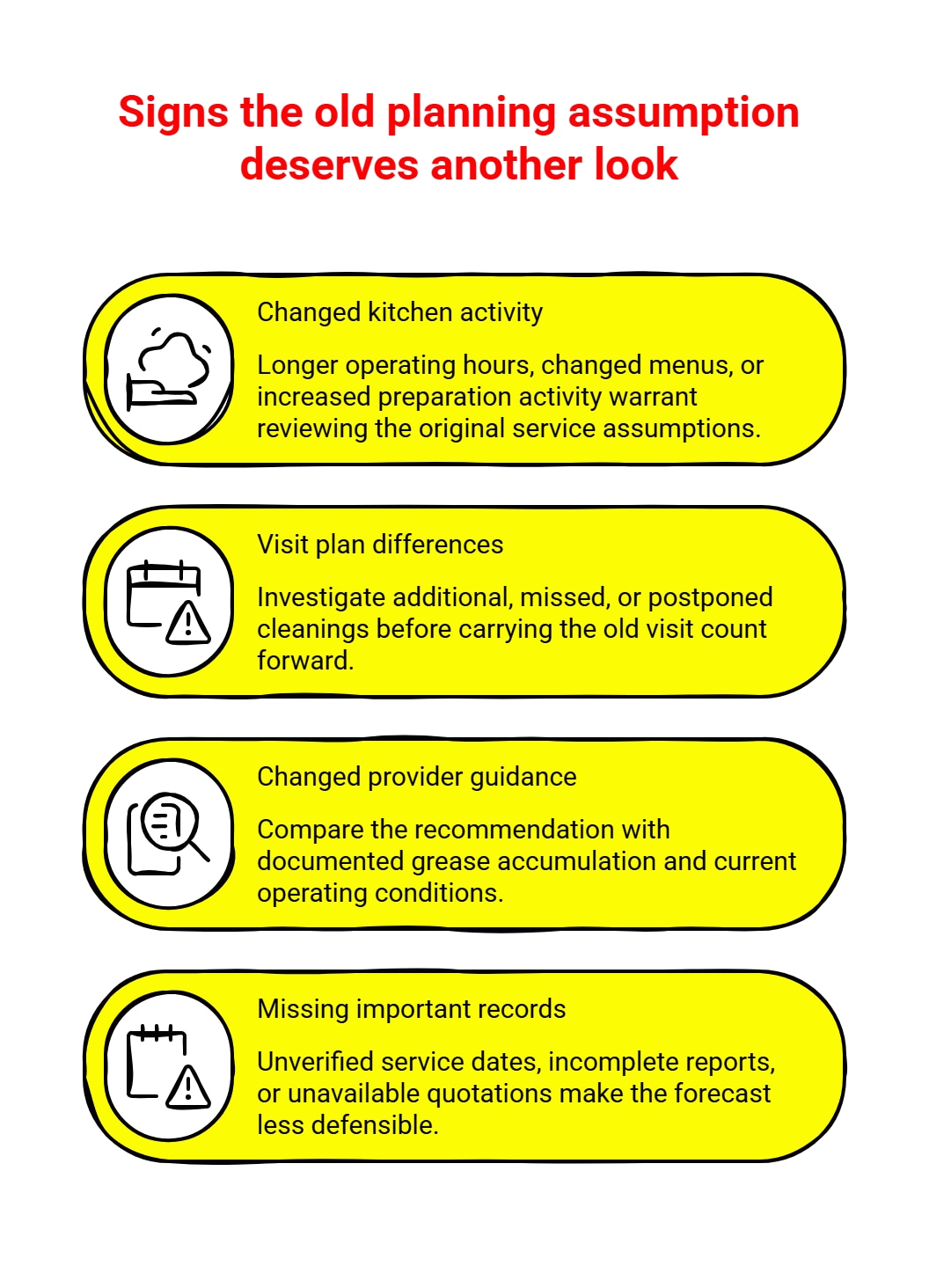
Infographic showing four reasons to revisit grease trap service planning: changed kitchen activity, visit differences, updated provider guidance, and missing records.

  1. Kitchen activity has changed. Longer operating hours, changed menus, or increased preparation activity warrant reviewing the original service assumptions.
  2. Completed visits differed from the plan. Investigate additional, missed, or postponed cleanings before carrying the old visit count forward.
  3. Provider guidance has changed. Compare the recommendation with documented grease accumulation and current operating conditions.
  4. Important records are missing. Unverified service dates, incomplete reports, or unavailable quotations make the forecast less defensible.

Recurring slow drains or odors also deserve attention, but they do not independently establish that another pump-out is necessary. Review the warning signs of an insufficient cleaning schedule before drawing conclusions.


What Not to Put Into the New Budget Without Evidence

Avoid invented service prices, assumed savings, universal cleaning intervals, unsupported penalties, or promises that an additional cleaning prevents every backup.

Build the preliminary annual cleaning allocation using:

Confirmed expected visits Ă— Verified quoted cost per visit = Planned recurring cleaning expenditure

Include other documented maintenance costs separately. Where service scopes or prices differ, calculate each category using its own verified inputs.

Applicable regulatory requirements must also be distinguished from operational recommendations. The Houston Health Department’s special waste guidance addresses requirements within incorporated city limits. Harris County’s water services guidance distinguishes county responsibilities from those of public sewer system operators.

Confirm which authority applies to the restaurant before using a required interval in the forecast.

A Better Budget Question

Instead of asking, “What did the restaurant spend last year?” ask:

What cleaning frequency do current operating conditions, documented service history, and verified provider guidance support?

Owners need an allocation they can defend. General managers need service timing that accommodates kitchen operations. Finance teams need a forecast they can compare against actual expenditure.

After each cleaning, record whether the planned visit occurred, its actual charge, any unexpected service expense, and any related operational interruption. Review these findings during the next budget cycle.

Reuse the Evidence, Not the Assumption

Last year’s grease trap allocation remains a useful financial reference. Its underlying visit assumptions deserve review before being carried forward.

Start with the service records, complete the worksheet, and resolve entries marked Confirm. Where the evidence remains incomplete, discuss the relevant operating conditions and service recommendations with a qualified commercial provider.

A defensible annual grease trap maintenance budget begins with verified cleaning needs rather than an unchanged historical figure.


Our Editorial Process

Our expert team uses AI tools to help organize and structure our initial drafts. Every piece is then extensively rewritten, fact-checked, and enriched with first-hand insights and experiences by expert humans on our Insights Team to ensure accuracy and clarity. Each guide is reviewed against real-world commercial kitchen and liquid waste management practices informed by Drane Ranger’s trained, licensed, and certified team serving the Greater Houston area since 1985.


About the Drane Ranger Insights Team

The Drane Ranger Insights Team is our dedicated engine for synthesizing complex topics into clear, helpful guides. While our content is thoroughly reviewed for clarity and accuracy, it is for informational purposes and should not replace professional advice.

Stop Guessing the Annual Grease Trap Budget: Plan Visits Around Kitchen Needs

📌 Key Takeaways

A reliable annual grease trap budget begins with a supported visit forecast, confirmed service costs, and documented assumptions that remain open to review.

  • Kitchen Conditions Determine Frequency: Cleaning intervals depend on grease accumulation, kitchen activity, and system characteristics, alongside applicable requirements and documented provider recommendations.
  • Historical Records Establish Baselines: Completed service records distinguish routine visits from unplanned work, helping managers assess whether previous cleaning patterns still reflect current operations.
  • Service Scope Shapes Costs: Annual estimates combine expected visits with confirmed pricing for comparable work, accounting separately for documented variable charges or additional services.
  • Drainage Symptoms Require Evaluation: Odors, gurgling, and slow drainage can indicate wastewater problems, but these symptoms alone do not establish that a trap is full.
  • Operating Changes Warrant Review: Changes in food production, operating hours, menus, or service recommendations may justify reassessing the remaining visit forecast and maintenance allocation.

For restaurant owners, general managers, and finance-aware operators, comparing completed visits and invoices with the forecast provides a basis for investigating differences and updating future allocations.

An explainable maintenance budget connects the kitchen’s service needs with evidence that ownership can review.

~ ~ ~ ~ ~ ~ ~ ~ ~ ~ ~ ~ ~ ~ ~ ~ ~ ~

At 8:15 a.m., a restaurant manager reviews the annual maintenance budget. The printer hums beside a stack of grease trap cleaning invoices. The approved allocation looks familiar, but the service records reveal something unexpected: the kitchen needed more cleaning visits than the original budget anticipated.

The numbers worked last year. Why did the cleaning expenses change?

This scenario highlights a common budgeting trap for restaurant operators. An annual grease trap budget can look reasonable while relying on outdated assumptions about how frequently the kitchen requires service.

A reliable annual grease trap cleaning budget starts with the number of service visits the restaurant expects to need. Management should review historical cleaning records, assess current kitchen conditions, confirm appropriate service intervals and costs with the provider, and document the resulting allocation. The budget should then be reviewed when operating conditions change.

Annual grease trap budgeting comes down to four steps: estimating visit counts, allocating funds, tracking invoices, and adjusting when kitchen output shifts.

Think of it like preparing an annual staffing schedule. Before calculating labor expenses, a manager estimates the number of shifts the restaurant will need. Grease trap budgeting follows the same principle, except the units being forecast are maintenance visits.

With a documented cleaning forecast and known service costs, the manager can explain the proposed expenditure during an annual ownership review. More importantly, the restaurant has a basis for adjusting its maintenance plan as operating demands change.


Why a Fixed Annual Grease Trap Budget Can Fall Out of Sync With Kitchen Needs
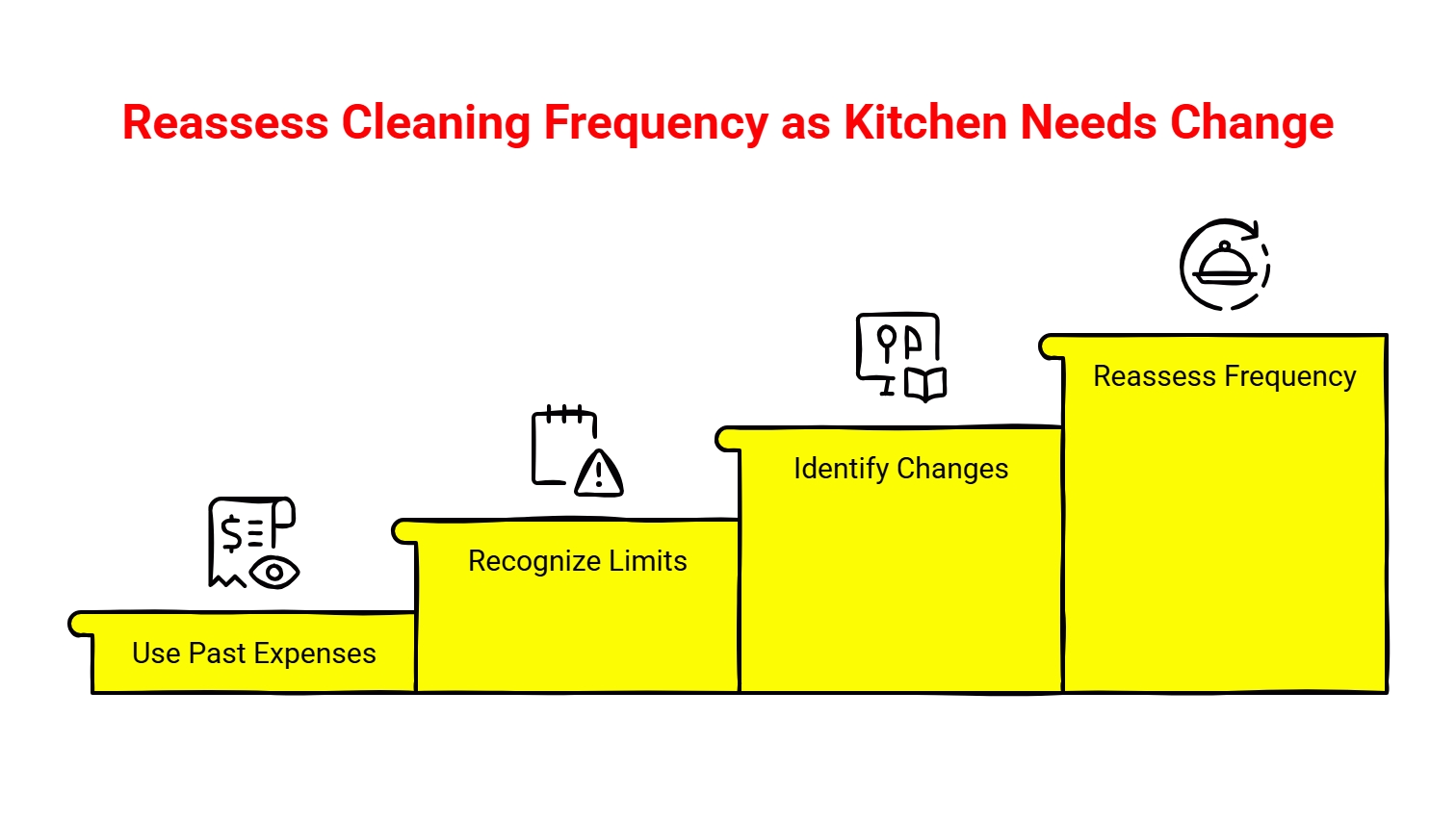
Step diagram showing how restaurants can reassess grease trap cleaning frequency by reviewing past expenses, recognizing limits, identifying changes, and adjusting service.

Many restaurants use the previous year’s expenses to prepare the next annual maintenance budget. This provides a practical starting point because historical invoices reflect actual spending.

However, previous expenditure does not necessarily represent future cleaning requirements.

A restaurant may extend its operating hours, introduce new menu items, expand catering operations, or increase kitchen production. These changes can affect the quantity of fats, oils, grease, and solids entering its wastewater system.

When kitchen activity changes, the cleaning frequency that previously worked may require reassessment.


The Problem With An Unchanged Cleaning Assumption

Consider a Houston casual-dining restaurant that built its maintenance budget around a steady lunch-and-dinner schedule.

The restaurant later expands dinner service. Food preparation increases, dishwashing activity intensifies, and the manager begins noticing recurring drainage concerns before scheduled cleaning visits.

The annual budget still reflects the previous service arrangement.

The difference between planned and actual cleaning requirements creates a budgeting problem. Additional maintenance expenses may need approval even though management already allocated money for recurring service.

This does not automatically mean the restaurant needs more frequent cleaning. The operating changes and drainage symptoms require evaluation before the schedule can be adjusted responsibly.

The lesson is that an inherited cleaning interval needs supporting evidence.


Why Minimum Service Intervals Do Not Tell The Whole Story

Regulatory requirements and operational cleaning needs serve different purposes.

Applicable regulations establish minimum obligations. Operational planning considers whether the restaurant’s actual grease accumulation and system conditions require more frequent attention.

Guidance from City of Houston Public Works on protecting wastewater systems and the Houston Health Department’s commercial grease trap regulations under Chapter 47, Article XI of the Houston Code of Ordinances provide official references for local grease management requirements. Under Houston’s commercial grease trap framework, food service establishments are generally required to have traps emptied at least every 90 days—or sooner if accumulation reaches the 25% threshold, unless a documented city variance applies—and must retain signed waste-hauler FOG manifests on-site for five years rather than relying solely on billing invoices during inspections. Restaurants should confirm which current requirements apply to their specific location and equipment.

Compliance with an applicable minimum interval does not establish that the same schedule will satisfy every kitchen’s operating needs.

A maintenance budget should therefore reflect both applicable requirements and documented, site-specific service recommendations.


The Real Budget Variable Is the Number of Cleaning Visits the Kitchen Needs

The relationship between cleaning frequency and annual maintenance expenditure is straightforward.

Grease trap cleaning frequency determines how many recurring service visits must be included in the annual maintenance budget.

Establishing that frequency requires examining the restaurant’s operating conditions.

Restaurant operating volume

Food preparation, cooking methods, and dishwashing practices influence the waste entering a commercial kitchen’s wastewater system.

An increase in restaurant activity may increase grease output, but the effect depends on what changes within the kitchen.

For example, adding a catering operation that prepares grease-intensive foods may affect the trap differently from increasing sales of products that generate relatively little grease.

Managers should examine meaningful operational changes instead of assuming that higher revenue automatically requires additional cleaning visits.

The Texas Commission on Environmental Quality’s guidance on reducing fats, oils, and grease in commercial kitchens provides practical context for understanding grease management in food service operations.

Grease and solids accumulation

Grease trap cleaning frequency should also reflect the accumulation of material within the system.

The amount of grease and settled solids collected between visits provides useful information about whether an existing schedule remains appropriate. 

Under widely applied wastewater standards—including Houston’s 25% rule—a grease trap requires service once the combined layer of floating fats, oils, and grease (FOG) and settled solids reaches 25% of the unit’s total liquid depth. Beyond that threshold, the trap loses separation efficiency and risks discharging grease into municipal sewer lines, which is why high-volume kitchens often reach capacity within 30 to 60 days rather than lasting a full quarter. 

A restaurant whose trap accumulates substantial material before the next scheduled appointment may need its cleaning frequency reassessed.

However, accumulation should be evaluated using actual service observations and appropriate professional guidance.

Odors, gurgling, or slow drainage can indicate a wastewater problem. They do not independently prove that the grease trap is full.

At 6:45 p.m., in another illustrative restaurant scenario, dishwashers are running while a manager notices unusually slow drainage.

The immediate responsibility is to document the condition and arrange an appropriate evaluation. Waiting for the next scheduled cleaning without investigating the issue may leave an active operational problem unresolved.

For a more detailed explanation of service timing, review how often a commercial grease trap should be cleaned in Houston.

Trap characteristics and access conditions

Grease traps vary in size, configuration, condition, and accessibility.

These characteristics can influence service requirements, including how equipment is accessed and what work is necessary during a cleaning visit.

System capacity and location also explain why two kitchens with similar menus can have very different visit math: a smaller-capacity indoor unit typically reaches the 25% accumulation threshold faster—often requiring service every 30 to 60 days in busy kitchens—whereas a larger outdoor grease trap holds greater waste volume and may run closer to a 90-day cycle while requiring more vacuum truck extraction and disposal capacity per visit. 

A restaurant that modifies its wastewater system or changes access arrangements should confirm whether the original service scope remains appropriate.

Do not automatically assign additional costs to these changes. Ask the provider to explain whether they affect the cleaning arrangement or quotation.

Provider-defined service scope

The scope of a grease trap cleaning visit matters because a quoted price must correspond to identifiable work.

Management should confirm which traps are included, what services are covered, and how additional work is handled.

Drane Ranger describes its commercial grease trap cleaning services as suitable for businesses with recurring liquid waste management needs.

Its published information also explains that recurring service intervals are developed around waste volume, system type, and operating requirements.

This supports an important budgeting principle: service arrangements should reflect actual site conditions rather than relying exclusively on a uniform schedule.


Why Last Year’s Grease Trap Service Pattern Is Only a Starting Point

Historical cleaning records establish what happened during the previous planning period.

They can show when service was performed, what work was completed, and how much the restaurant spent.

They cannot independently establish whether the same pattern will remain appropriate.

Last year’s service history is evidence. It is not a permanent cleaning schedule.

A useful review begins by distinguishing completed scheduled visits from additional service requests.

For example, suppose a restaurant’s service log shows that an extra cleaning occurred after an unusual period of kitchen activity.

The manager should determine whether that operating change was temporary or represents the restaurant’s current workload.

If the increase in production is permanent, the cleaning schedule deserves reassessment. If the event was isolated, automatically adding another recurring visit may create an unsupported budget assumption.

The reason behind the additional work matters as much as the fact that it occurred.

What service records can establish

Available records may include:

  • Service dates and intervals between visits.
  • Recorded waste quantities and identified system issues.
  • Disposal-facility information and service documentation.
  • Provider recommendations about subsequent maintenance.
  • Invoices showing the cost and scope of completed work.

Drane Ranger states that its service documentation includes service dates, waste quantities, disposal information, and identified system issues. Its published information also describes maintaining customer service histories and scheduling upcoming appointments.

The completeness of individual records can vary. Missing information should be identified rather than reconstructed through guesswork.

Service documentation also serves different purposes. Invoices support expenditure analysis, while waste transport records document aspects of waste handling and disposal. Neither document alone establishes that the restaurant’s cleaning frequency is appropriate.

An attributed customer testimonial from Harold R. describes being informed during a Drane Ranger service visit and receiving guidance about the next cleaning time.

That feedback illustrates the value of clear communication about future service. It does not demonstrate a particular financial saving or establish the appropriate schedule for another restaurant.


How to Build an Annual Grease Trap Visit Forecast From Existing Records

The goal is to convert historical service information into a documented forecast that reflects current kitchen conditions.

The following process establishes a practical sequence for restaurant owners, general managers, and finance-aware operators.

  1. Review prior service visits

Collect records for completed grease trap cleaning visits during the previous planning period.

Arrange them chronologically and distinguish routine appointments from unplanned work.

Check the records against invoices so the service history reflects completed activities rather than appointments that were merely scheduled.

  1. Compare historical visits with current kitchen activity

Review changes in operating hours, meal preparation, menu composition, and production volume.

Identify changes that occurred after the original service schedule was established.

Record the relevant operating conditions without automatically assigning additional cleaning visits.

  1. Examine provider notes and recommendations

Review service reports for observations about grease accumulation, equipment condition, and recommended cleaning intervals.

Compare the provider’s recommendations with the actual service pattern.

Where records are incomplete, identify the missing information.

  1. Identify site and service scope changes

Check whether equipment, access conditions, or cleaning requirements have changed.

Confirm whether the historical service arrangement covers the same work expected during the next planning period.

An unchanged visit count does not guarantee an unchanged scope of service.

  1. Confirm unresolved information with the provider

Ask the provider to review relevant operating changes and available cleaning records.

Confirm the recommended frequency, service scope, and current applicable charges.

Document the response so the forecast does not depend on an unverified verbal assumption.

  1. Estimate the expected annual cleaning visits

Use the supported service interval to identify the visits expected during the upcoming budget year.

Count the planned appointments within that period.

Where the recommended frequency has not been confirmed, record the provisional visit count as an assumption rather than presenting it as a verified requirement.

  1. Apply documented service costs

Calculate the expected recurring expense using confirmed quotations or approved service arrangements.

Check whether additional work, variable charges, or separate service categories require distinct calculations.

Do not substitute historical prices for current quotations without confirming their continued applicability.

  1. Document the allocation assumptions

Record the expected visit count, the evidence supporting it, the pricing basis, and the unresolved questions.

Assign responsibility for obtaining any outstanding confirmation.

The record should allow another manager or owner to understand how the annual allocation was established.

  1. Revisit the forecast when operating conditions change

Compare actual completed visits with the approved schedule throughout the year.

Review meaningful differences in service frequency, scope, or expenditure.

Adjust the remaining forecast when documented conditions support a change.


Service-Record Review Checklist for Annual Grease Trap Budgeting

Annual Grease Trap Budget Record Review

Use this checklist before approving the annual grease trap maintenance allocation. Each item should be supported by available documentation or identified for further confirmation.

  • List every documented grease trap cleaning visit from the prior planning period.
  • Record the interval between completed visits.
  • Note provider recommendations about the next cleaning date.
  • Compare prior restaurant activity with current operating volume.
  • Identify changes in kitchen throughput or grease-producing activity.
  • Document recurring drainage, odor, backup, or accumulation concerns that affected service timing.
  • Confirm changes to trap characteristics, access conditions, or service scope.
  • Review available waste quantities, disposal details, and identified system issues.
  • Separate scheduled visits from unplanned work and record the reasons for additional service.
  • Compare actual visits and expenses with the previous forecast.
  • Distinguish documented provider-quoted costs from unverified assumptions.
  • Identify missing service records, unclear invoices, and questions requiring provider confirmation.
  • Establish the expected annual visit count and record the supporting assumptions.
  • Assign responsibility for unresolved questions and establish a point for reviewing the budget again.

A completed review should identify the restaurant’s documented service history, the basis for its annual visit forecast, and the information that remains uncertain.

For restaurants operating several locations, complete the assessment separately for each kitchen before consolidating the maintenance budget.


Turn the Visit Forecast Into a Reviewable Maintenance Allocation
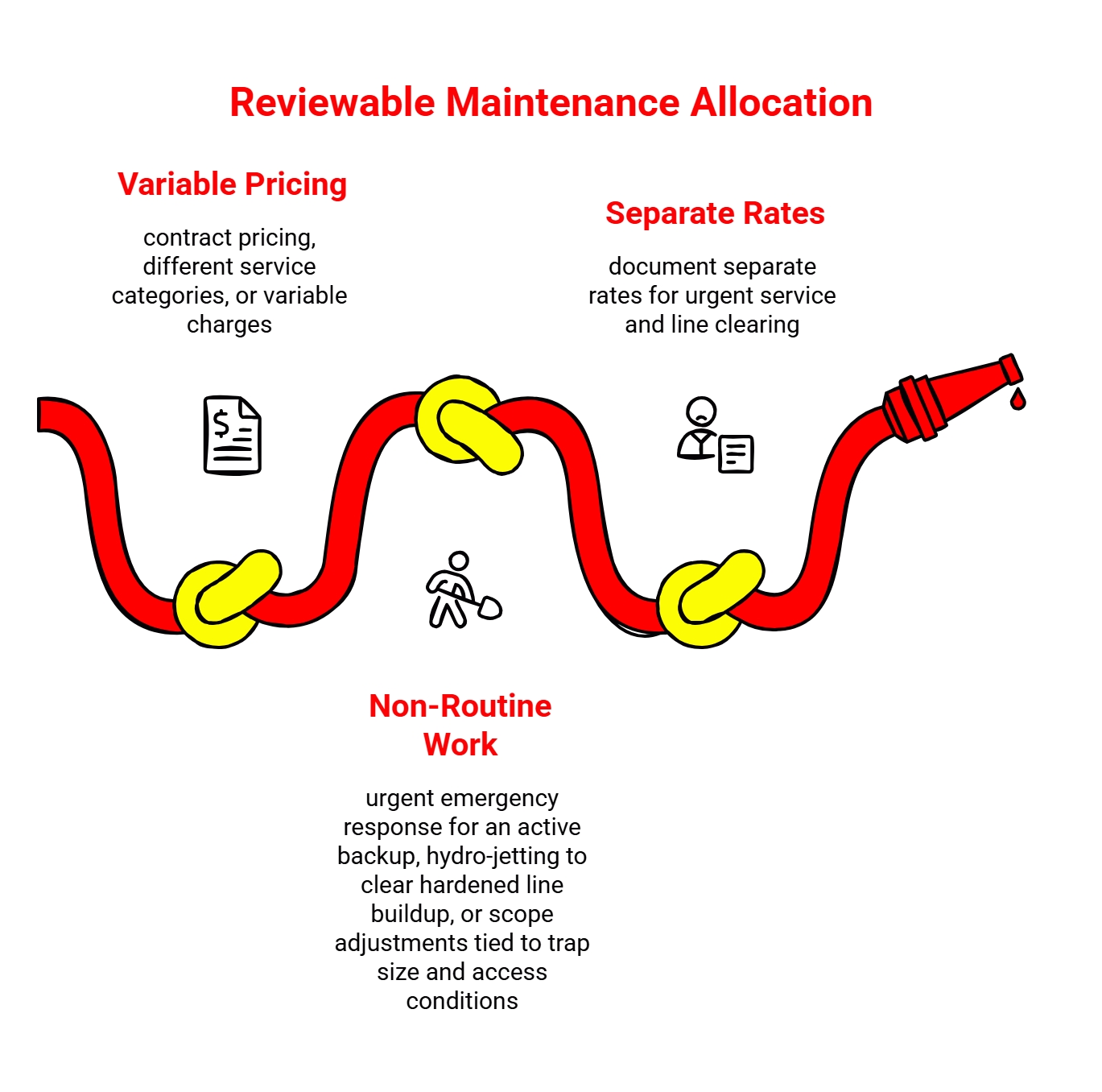
Infographic showing maintenance cost categories for grease trap service, including variable pricing, non-routine work, and separate rates for urgent or line-clearing services.

Once management has established the expected number of cleaning visits, the next task is converting that forecast into an annual operating expense.

For comparable visits with a confirmed cost per service, the basic planning relationship is:

Annual Allocation = Expected Visits Ă— Documented Cost per Visit

This formula is a budgeting framework, not a guarantee of final expenditure.

If the provider uses contract pricing, different service categories, or variable charges, the calculation should reflect those documented arrangements instead.

In practice, total annual spend often diverges from a base per-visit quote when non-routine work enters the picture—such as urgent emergency response for an active backup, hydro-jetting to clear hardened line buildup, or scope adjustments tied to trap size and access conditions. Rather than padding the worksheet with an arbitrary percentage, managers should ask their provider to document separate rates for urgent service and line clearing alongside the recurring pump-out quote.


Why The Lowest Individual Service Price May Not Produce The Lowest Annual Cost

A lower per-visit charge does not establish the total annual expenditure.

The restaurant must also know how many visits it reasonably expects to require and what each quoted service includes.

Two providers may quote different amounts because the scope of work differs. Alternatively, the same provider may charge differently for work outside an approved recurring arrangement.

Comparing individual prices without understanding those differences can produce an unreliable annual estimate.

A sound financial comparison therefore considers the expected visit count, documented service scope, and applicable pricing together.

Make the allocation defensible to ownership

A concise budget record should show how management reached its recommendation.

Planning component Evidence needed
Historical baseline Completed visits and recorded expenditure
Current operating conditions Documented changes in kitchen activity and system condition
Expected annual visits Supported service schedule and provider recommendations
Cost basis Current quotations or approved service arrangements
Outstanding questions Unverified assumptions and responsible person
Future review Date or operational event prompting reassessment

This record distinguishes three levels of certainty.

Verified information includes completed service dates, recorded invoices, and documented provider recommendations. These establish what occurred and what has been communicated.

Planning assumptions include the expected number of future cleaning visits. They represent management’s forecast based on the available evidence.

Site-specific uncertainties include unresolved questions about future grease accumulation, changes to service scope, and charges not covered by an existing quotation. These require confirmation rather than unsupported estimates.

This distinction helps owners evaluate the proposed maintenance allocation without confusing historical facts with future expectations.

For general managers, the same record supports service coordination and operational accountability. Finance-aware operators can use it to compare forecast expenditure with actual expenses and investigate meaningful variances.

The objective is a budget that can be explained and updated.


When Restaurant Operations Change, Review the Grease Trap Budget Again

An annual grease trap maintenance budget should remain responsive to changes in restaurant operations.

Approval at the beginning of the year does not mean the underlying service assumptions should remain unchanged.

Review changes in kitchen volume

When food production, operating hours, or menu composition changes materially, compare the new conditions with those used to establish the existing service schedule.

The change may justify discussing cleaning frequency with the provider.

The appropriate adjustment depends on actual operating conditions and the system’s maintenance needs.

Investigate recurring operational symptoms

Recurring odors, drainage restrictions, or backup concerns should prompt an appropriate assessment.

These symptoms can have different causes. They should not automatically be attributed to an overdue grease trap cleaning.

Record what occurred, when it appeared, and whether the pattern has repeated since the previous service.

Use the findings to decide whether the cleaning schedule needs reassessment or whether another issue requires attention.

Reassess provider recommendations and service scope

A change in the recommended cleaning interval can affect the remaining annual visit forecast.

Similarly, altered access conditions or additional required work may affect the cost basis.

Confirm those changes before updating the budget.

Compare forecast expenditure with actual results

During a budget review, compare planned service visits with completed visits and approved expenditure with invoiced amounts.

Investigate the reasons for significant differences.

If additional visits are consistently required, determine whether the original frequency assumption needs revision.

If fewer visits occurred than planned, establish whether the difference reflects changing operating conditions, missed appointments, or another documented reason.

An annual maintenance allocation is more useful when management treats these differences as information for future planning.


A Better Annual Grease Trap Budget Is One You Can Explain

Return to the restaurant manager reviewing the budget worksheet beside the printer.

The original problem was not simply that expenses exceeded expectations. The restaurant had relied on a cleaning assumption that no longer adequately explained its maintenance requirements.

A documented approach changes that conversation.

Management can identify where the expected visit count came from, which operating conditions informed it, what service costs are confirmed, and which assumptions require further review.

That creates a stronger basis for discussing annual maintenance expenditure with ownership while maintaining attention to kitchen operations.

Before carrying the same allocation into another year, review recent cleaning records, compare actual visits with planned service, and assess whether current restaurant activity still supports the existing schedule.

For additional information about coordinating service intervals, review Houston restaurant grease trap maintenance schedules.

When site-specific frequency, service scope, or pricing remains uncertain, discuss the restaurant’s operating conditions and service history with Drane Ranger’s Houston grease trap cleaning team.

A defensible annual grease trap budget begins with the kitchen’s maintenance requirements, uses documented evidence to establish expected visits, and remains open to adjustment when conditions change.

Plan the visits around the kitchen’s needs. Build the budget around the evidence.


Our Editorial Process

This educational content is based on documented business information, generally established grease trap maintenance principles, and clearly identified illustrative scenarios. Site-specific cleaning recommendations, current regulatory requirements, and service quotations should be independently confirmed before operational or financial decisions are finalized.


About the Drane Ranger Insights Team

The Drane Ranger Insights Team develops practical educational information about grease trap cleaning, liquid waste management, and maintenance planning for Houston-area businesses.

This content is intended for general informational purposes. It does not replace professional evaluation of an individual restaurant’s wastewater system, applicable regulatory requirements, or documented service arrangements.