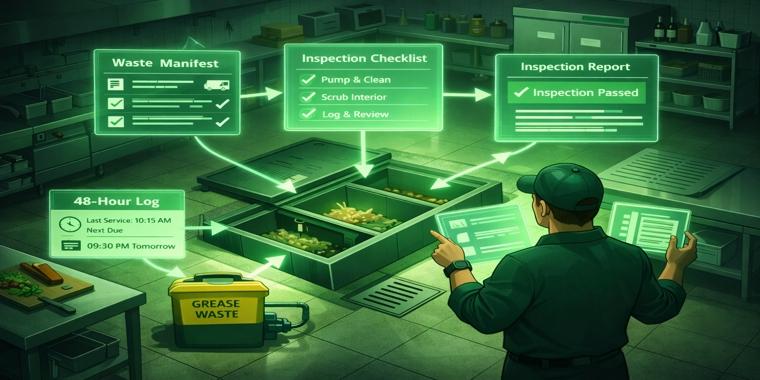
How to Organize Your Grease Trap Documentation to Survive a City Audit

📌 Key Takeaways

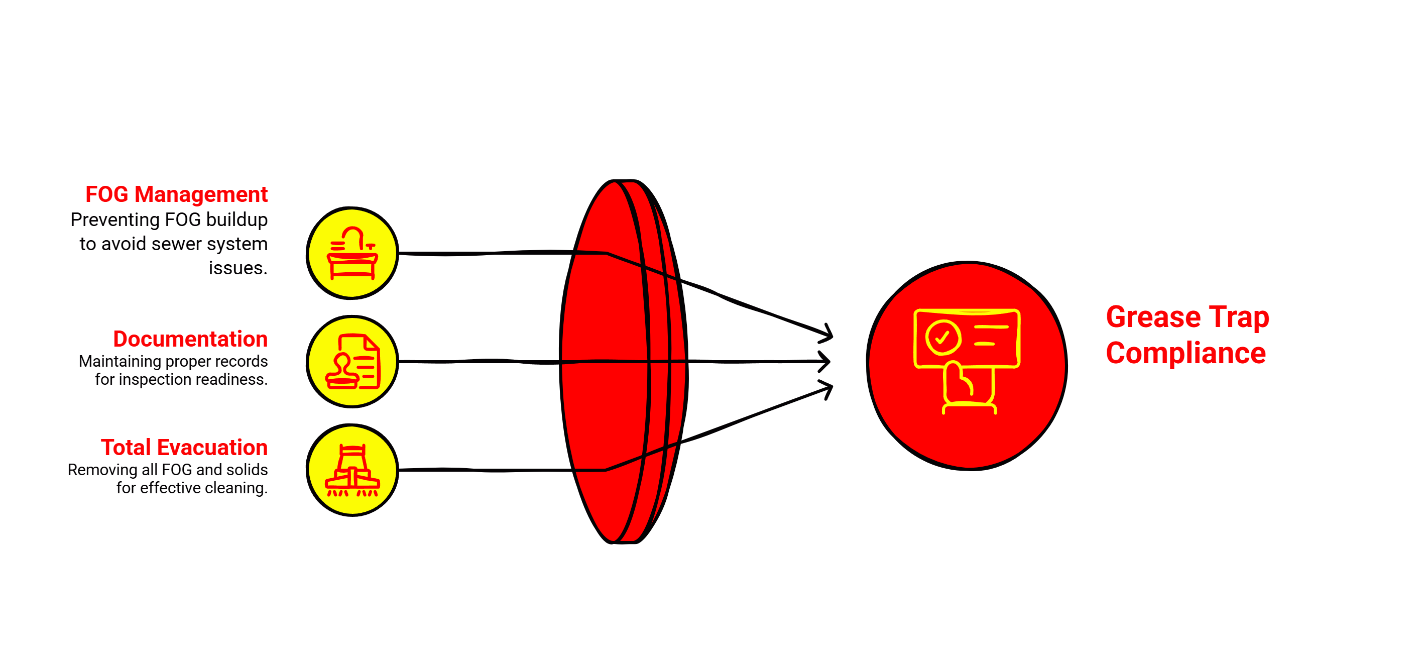
Organized grease trap documentation transforms Houston city audits from stressful scrambles into quick verifications.

  • Manifests Prove Legal Disposal: Invoices show payment, but only signed manifests with disposal facility stamps prove your waste was disposed of legally.
  • Five-Year Retention Required: Houston inspectors may request grease trap manifests going back five years during routine or complaint-driven inspections without advance notice.
  • Reverse Chronological Filing Wins: Filing newest manifests first lets inspectors verify your 90-day service compliance pattern in seconds, not minutes.
  • Digital Backups Prevent Disasters: Scanning manifests within 24 hours using consistent naming conventions ensures one lost binder doesn’t expose you to citations.
  • Invalid Manifests Invite Scrutiny: Missing driver signatures, generator signatures, or disposal facility stamps make manifests worthless and trigger deeper investigations.

Complete documentation = operational confidence during unannounced inspections.

Houston restaurant managers and owners responsible for FOG compliance will gain a clear action plan here, preparing them for the detailed binder setup checklist that follows.

The inspector’s clipboard is out. Your manager is stalling. And you realize—nobody knows where the manifests are filed.

This scenario plays out across Houston restaurants more often than it should. In a city with strict environmental regulations, operational negligence is a choice that leads to inevitable disruption. Grease trap documentation is the audit trail—manifests, permits, and inspection records—that proves your fats, oils, and grease (FOG) waste was removed and disposed of legally. Think of it like your tax receipts: if you can’t show them when asked, it doesn’t matter what you actually paid.

Here’s what that looks like in practice. It’s Friday during dinner rush when a health inspector arrives and asks for your last five years of manifests. Your host scrambles to find a manager. The manager searches three different filing cabinets and a desk drawer. Twenty minutes later, you’re still producing random invoices while the inspector waits—and grows increasingly interested in what else might be wrong.

The good news? You can put a simple binder and digital folder system in place today so inspections become a streamlined verification instead of a 45-minute ordeal.


What a Houston City Audit Usually Means (And Why It’s Stressful)

You may be inspected without warning, and the stress comes from two places: not knowing when an inspection will happen, and not being certain you can find everything when it does.

In Houston, you may be inspected routinely or after a complaint, and you can be expected to produce your FOG permit and historical manifests on request—often without prior notice.[^1] Inspections can happen any day your business is open, and the inspector has the authority to request specific documents immediately.

If your manager can’t produce those documents quickly and completely, the inspector has reason to look deeper. What started as a routine compliance check becomes a more thorough investigation of your entire grease trap management system.

Your binder is your first line of defense. A well-organized compliance binder demonstrates operational competence before the inspector asks a single question. It shows you take your environmental responsibilities seriously, and it transforms a potentially adversarial encounter into a quick verification.

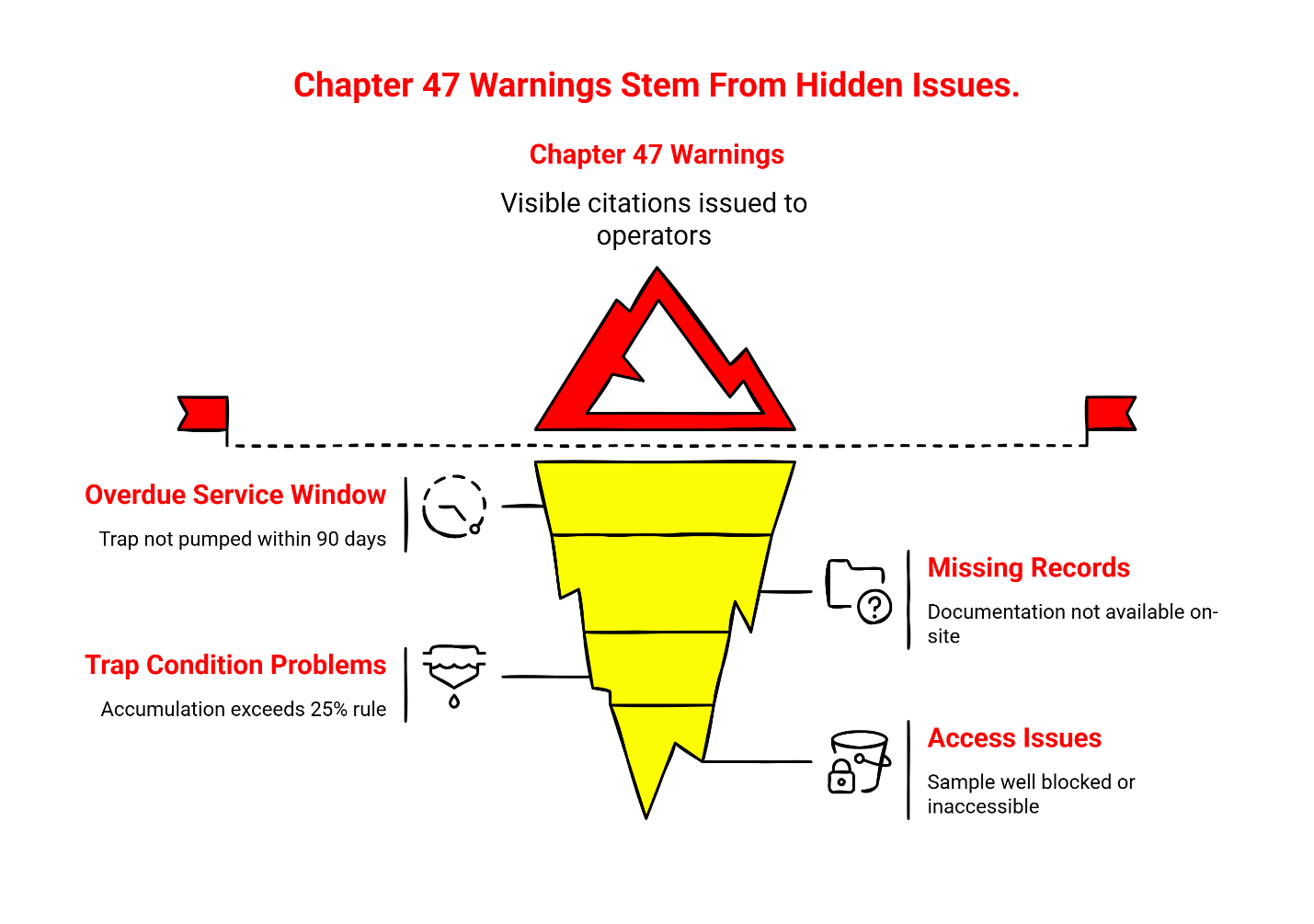
Most audit failures aren’t cleaning failures—they’re documentation failures. Your trap might be pumped on schedule, but if you can’t prove it with proper manifests, you’re exposed to citations and follow-up inspections.


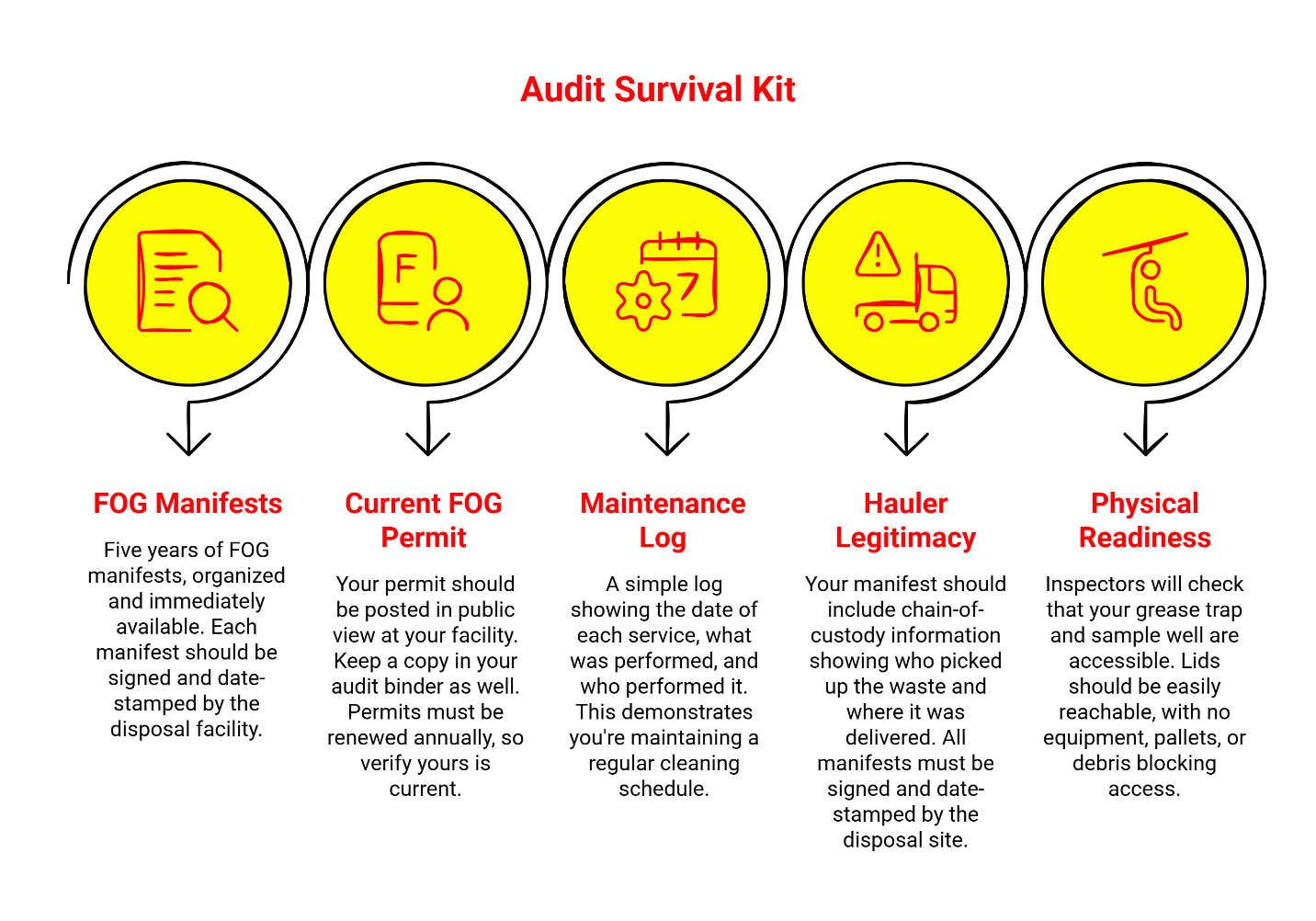
The Exact Documents to Keep in Your Binder (Houston Checklist)

Houston inspectors typically request these specific documents during an inspection:[^1]

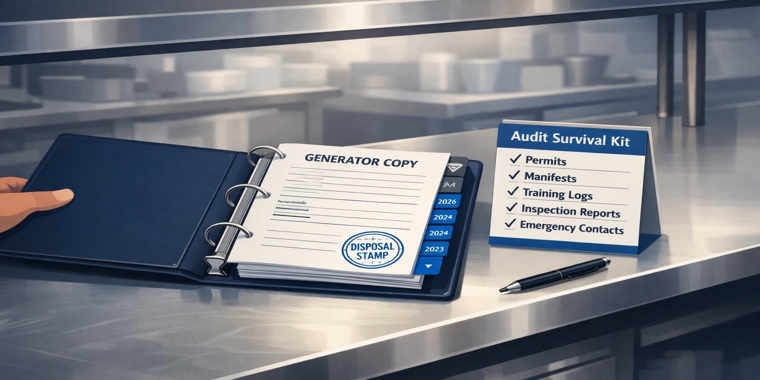
  • Current FOG permit (both the copy posted in your facility and a binder copy with renewal date noted)
  • Waste manifests for the past 5 years (both the initial generator copy and the final return copy received from your hauler)
  • Notice of Waiver (if you’ve been granted any exceptions to standard requirements)
  • Copies of previous inspections (including any follow-up documentation)
  • Authorization letter for any biological additives (Note: Use of enzymes or bacteria requires specific City approval per Sec. 47-748; do not file invoices for unpermitted additives)

File every copy you receive from your grease trap service provider. Don’t assume the office copy or the email confirmation is sufficient. The inspector wants to see the physical manifest with the required signatures and stamps, which we’ll cover in detail below.

Keep these documents organized by type and date. When an inspector asks to see “manifests from 2022,” you should be able to hand them a complete set within seconds, not start searching through mixed piles of papers.


The Audit-Ready Binder Setup (10 Minutes, No Fancy Tools)

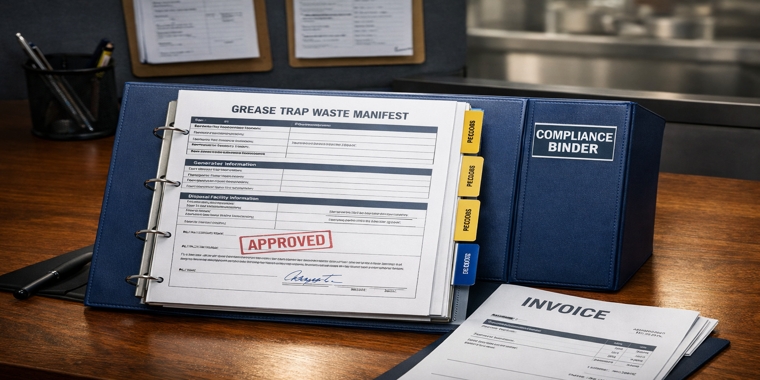
Use a single three-ring binder with clear tab dividers. Label the spine clearly: FOG / Grease Trap Compliance Binder (Houston). This becomes your single source of truth for all compliance documentation.

Set up six tabs in this exact order:

Audit-ready binder setup with six sections: FOG permit, waivers, manifests, invoices, inspection reports, and vendor credentials.

Tab 1: Current FOG Permit

File both the posted copy and your renewal notice here. Note the expiration date prominently on the tab itself so you never miss a renewal deadline.

Tab 2: Waivers / Exceptions

If you’ve been granted any waivers or exceptions to standard requirements, file them here with clear dates showing when they were approved and when they expire.

Tab 3: Waste Manifests (5 years, reverse chronological)

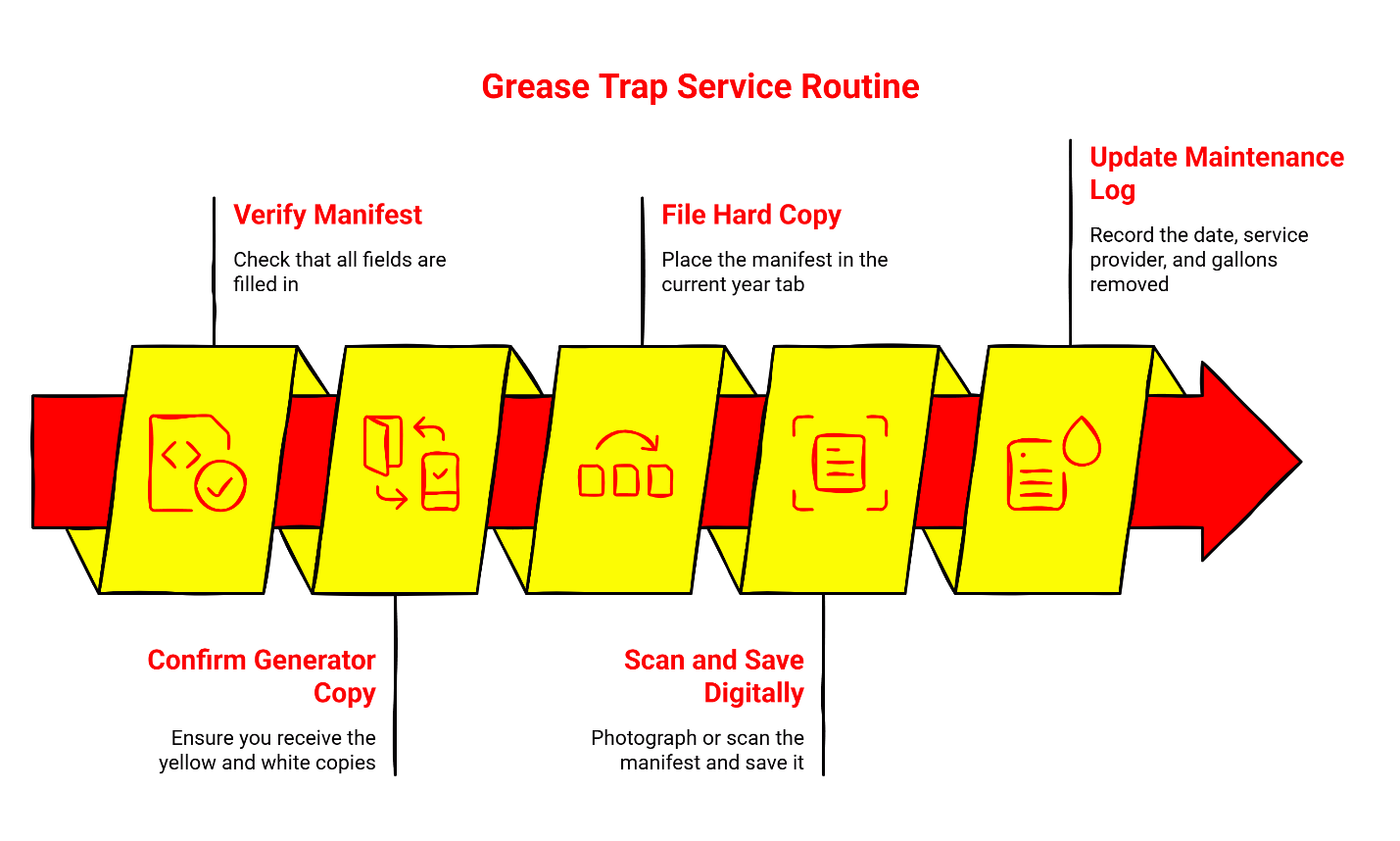
This is your most important section. File the newest manifest first—this reverse chronological order lets you answer “When was your last pump-out?” in five seconds. When you receive a new manifest, punch holes and place it at the front of this section. Staple any related invoice or service report behind each manifest (invoice supports, manifest protects).

Tab 4: Invoices / Service Reports

Supporting documentation goes here, but remember: this tab supplements Tab 3, it doesn’t replace it. Manifests are legal proof of disposal; invoices are merely proof of payment.

Tab 5: Inspection Reports / Follow-Ups

Every time you’re inspected, file the report here along with any corrective action documentation or follow-up correspondence.

Tab 6: Vendor Credentials + Contacts

Keep a copy of your service provider’s current permits, registration documents, and emergency contact information. If something goes wrong at 2 AM, you need this information immediately accessible.

A messy file cabinet is a red flag to an inspector. A clean, organized binder sends the opposite message: this operation takes compliance seriously.


The Manifest Checklist That Actually Protects You

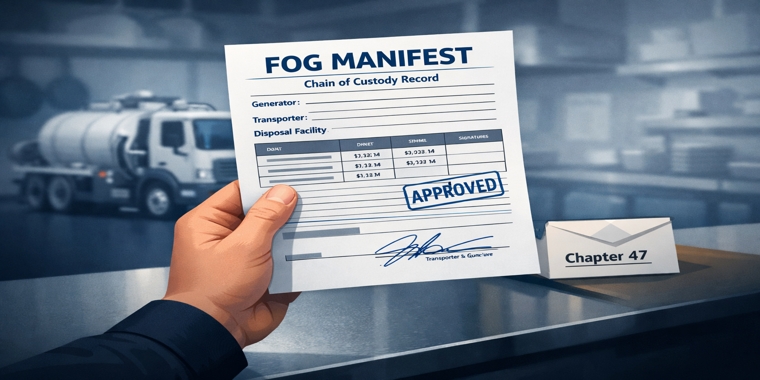
An invoice proves payment. A manifest proves legal disposal. These are not the same document.

Not all manifests are created equal. A valid manifest must meet specific requirements to serve as legal proof of disposal.[^2] Here’s what you need to verify every time your hauler provides paperwork:

Confirm the manifest is present, not just an invoice. Many restaurant owners discover too late that they’ve been filing invoices for years while the actual manifests went missing. An invoice proves payment. A manifest proves legal disposal.

Confirm it is signed by the driver and your representative before the truck leaves. Both signatures must be present for the manifest to be valid. If your manager wasn’t on site during service, establish a clear protocol for after-hours authorization. Some operators designate backup signers or implement a call-back verification system.

Confirm it is signed and date-stamped by the disposal site. The manifest should show where the waste actually went and when it arrived. This disposal facility information completes the chain of custody that protects you during an audit.

Confirm the paperwork matches your business name, address, and service date. Transposed numbers or wrong addresses can invalidate a manifest. Check these details before your hauler leaves, not weeks later when you’re preparing for an inspection.

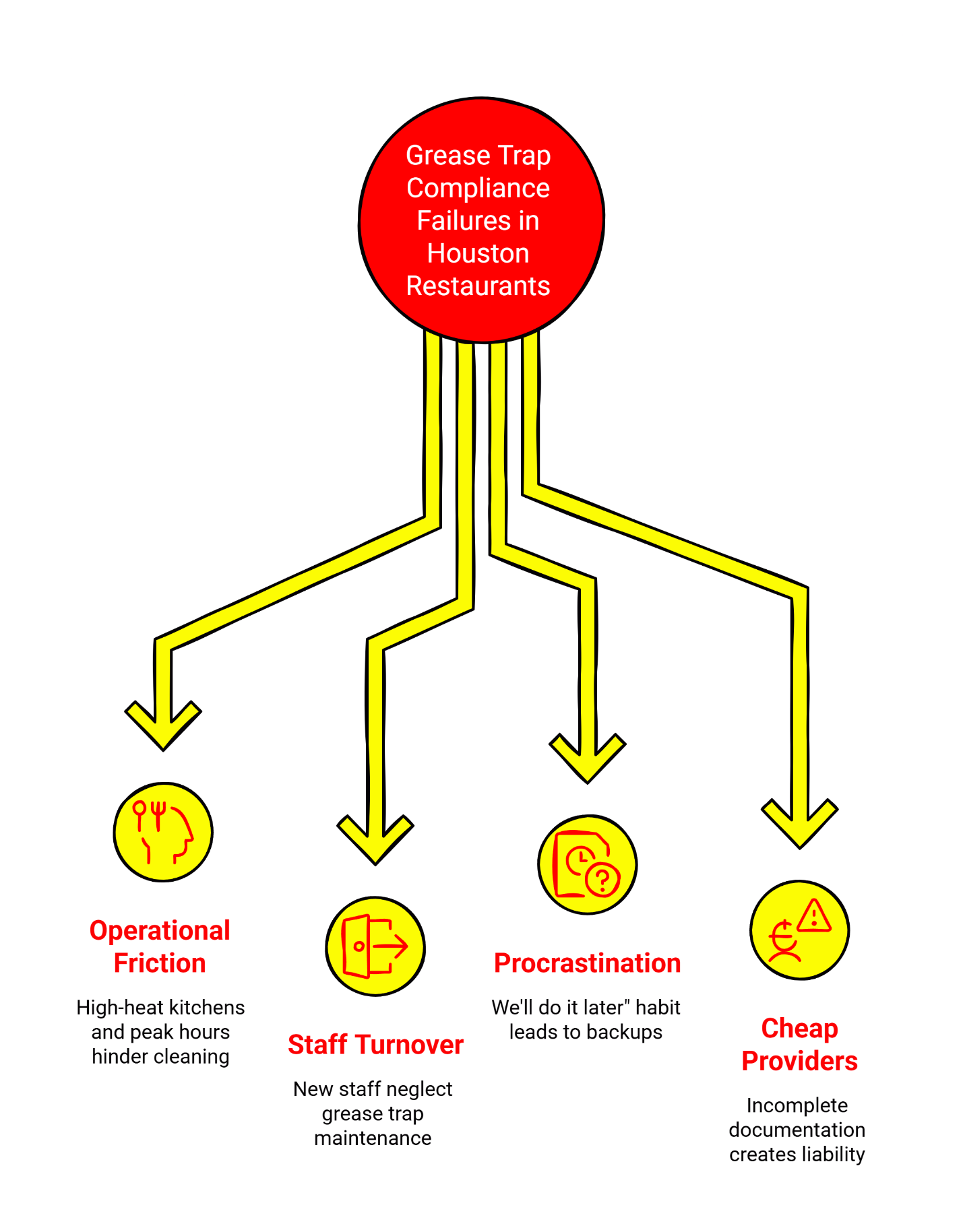
Confirm it uses the appropriate paperwork for city-regulated waste. For waste originating within Houston city limits, Houston requires use of a City of Houston manifest with proper signatures at pickup and disposal.[^2] Your hauler should be registered with the appropriate authorities. Using an unpermitted “cheap hauler” doesn’t just risk fines—it transfers liability for improper disposal directly to you as the waste generator.[^4]

These checks take less than two minutes but they’re the difference between audit-ready documentation and worthless paperwork.


Organize by Date, Not by Vendor (How to Prove Consistency)

Inspectors think in timelines—so your binder should too. When an inspector asks “When was your last pump-out?” or “Show me your service history for the past year,” they’re evaluating whether you’re maintaining the required frequency.

Houston requires that grease interceptors be fully evacuated at least quarterly (every 90 days) unless a waiver has been approved.[^3] Filing manifests in reverse chronological order (newest first) lets you demonstrate compliance instantly. The inspector can flip through your Tab 3 and see at a glance that services occurred on March 15, December 10, September 8, and June 5—a clear pattern of consistent compliance.

If you file by vendor instead, you fragment your timeline. The inspector has to hunt through multiple sections to reconstruct your service history, which wastes time and creates opportunities for them to notice other issues while searching.

Reverse chronological filing also helps you catch problems before the inspector does. When you file your newest manifest, you immediately see how long it’s been since the previous service. If you notice you’re approaching the 90-day mark, you can schedule proactively instead of waiting for the calendar reminder or, worse, discovering you’re overdue when the inspector arrives.

For detailed guidance on scheduling and the 25% rule that can require more frequent service, see our article on when to schedule your pump-out to stay compliant.


Add a Digital Backup (So One Lost Binder Doesn’t Sink You)

Physical binders can be damaged, lost, or incomplete. A digital backup system ensures you’re never completely exposed, even if your paper records disappear.

Set up a shared drive folder structure like this:

/FOG-Compliance/01-Permit

/FOG-Compliance/02-Waivers

/FOG-Compliance/03-Manifests/2025

/FOG-Compliance/03-Manifests/2024

/FOG-Compliance/04-Invoices-Service-Reports/2025

/FOG-Compliance/05-Inspections

Scan each manifest immediately after service using a consistent file naming convention: YYYY-MM-DD_VENDORNAME_TRAPLOCATION_MANIFEST#.pdf

For example: 2024-12-15_DraneRanger_MainKitchen_Manifest8472.pdf

This naming system lets you find any document instantly, even years later. When an inspector asks for December 2022 manifests, you can pull them from your digital folder in seconds as a backup while presenting your physical binder.

Set folder permissions carefully. Assign one editor (typically the facilities manager or owner) and multiple viewers (managers who might need to access documents during an inspection). This prevents accidental deletions while ensuring accessibility.

Update your digital backup within 24 hours of each service. The worst time to discover your scanning protocol isn’t working is during an inspection when you realize your physical binder is incomplete.


Red Flags That Trigger Extra Scrutiny

Certain documentation problems don’t just fail to protect you—they actively invite deeper investigation. Inspectors are trained to recognize these warning signs:

Red flags for scrutiny: missing manifest, missing information, overdue service, unsigned manifest, and invalid vendor.

Invoice provided but no manifest. This is the single most common documentation failure. Many restaurant operators believe an invoice proves compliance, but it only proves payment. Without the manifest, you have no proof of legal disposal.

Unsigned manifest. If either the driver signature, your representative’s signature, or the disposal site stamp is missing, the manifest is incomplete. Some operators try to add signatures after the fact, but handwritten additions that don’t match the original ink or pen are obvious red flags.

Missing disposal site information. The manifest must show exactly where the waste was taken and provide enough detail for the city to verify proper disposal. Vague descriptions or missing facility information suggest the waste might not have been disposed of legally.

Vendor cannot show current permitting or registration. If your hauler can’t produce current credentials, any manifests they’ve provided may be invalid. The city requires that transporters maintain proper permits and use authorized manifests for waste originating within Houston city limits.[^2]

Overdue service cadence with no waiver on file. If your manifests show intervals longer than 90 days and you don’t have an approved waiver, you’re operating outside the baseline requirement. The inspector will want to know why.

Understanding why visual checks fail to detect sludge buildup can help you avoid one of the most common reasons restaurants fall out of compliance between scheduled services.


Vendor Questions That Prevent Paperwork Disasters

Not all grease trap service providers deliver audit-ready documentation. Before you sign a service contract, ask these five questions and verify the answers:

  1. “Will you provide a City of Houston manifest with every service?” The answer must be yes, with no exceptions. Some haulers only provide invoices unless you specifically request manifests.
  2. “Will the manifest be signed by your driver and our manager before leaving the site?” Both signatures should be obtained before the truck departs. Manifests signed later or off-site raise validity questions.
  3. “Will the disposal site stamp and sign the manifest before returning it to us?” The completed manifest with disposal facility verification should be returned to you, not kept only by the hauler.
  4. “Are you currently permitted and registered to transport special waste in Houston?” Ask to see current documentation. Texas regulations require proper registration,[^4] and using an unpermitted hauler can make you liable for their disposal practices.
  5. “If you come after hours and no one is here to sign, what’s your authorization process?” Some restaurants receive overnight or early-morning service when managers aren’t present. Houston guidance addresses servicing a generator with no representative on-site through an after-hours authorization process.[^2] Establish a clear protocol for these situations in advance.

These questions aren’t confrontational—they’re standard due diligence. A professional service provider will answer all five confidently and provide written confirmation of their policies. Hesitation or vague answers should prompt you to keep looking.

Since 1985, Drane Ranger has been providing grease trap cleaning services in Houston with complete, audit-ready documentation on every service. We understand that manifests aren’t paperwork—they’re protection.


Audit-Ready Binder Checklist

Use this checklist to verify your binder is inspection-ready:

Permit & Waivers

  • [ ] Current FOG permit filed in Tab 1 (with renewal date noted)
  • [ ] Permit posted copy clearly visible in facility
  • [ ] Notice of Waiver filed in Tab 2 (if applicable)

Manifests (Past 5 Years)

  • [ ] All manifests present and filed reverse chronologically
  • [ ] Each manifest signed by driver
  • [ ] Each manifest signed by your representative
  • [ ] Each manifest stamped and signed by disposal facility
  • [ ] Each manifest shows correct business name and address
  • [ ] Service intervals meet 90-day requirement (or waiver on file)

Supporting Documentation

  • [ ] Invoices/service reports filed in Tab 4
  • [ ] Previous inspection reports filed in Tab 5
  • [ ] Vendor credentials and contacts filed in Tab 6

Digital Backup

  • [ ] All manifests scanned and filed with consistent naming
  • [ ] Folder permissions set (one editor, multiple viewers)
  • [ ] Backup updated within 24 hours of each service
  • [ ] Last backup verification date: ___________

Review this checklist quarterly, ideally the week after your scheduled grease trap service. Regular verification means you’re always inspection-ready, not just scrambling when you hear the inspector is in your area.


Clean Isn’t Compliant Until It’s Documented

Many restaurant operators focus entirely on the physical cleaning—making sure the trap is pumped on time and the kitchen stays backup-free. That’s important, but it’s only half the equation. Houston’s environmental regulations require proof of legal disposal, not just proof that the grease disappeared from your property.

Cleaning removes waste. Manifests prove legal disposal. You need both to stay compliant and protected during inspections.


The Cheapest Pump-Out Can Be the Most Expensive

Price shopping for grease trap service makes sense—until it doesn’t. Some haulers offer dramatically lower prices by cutting corners on disposal and documentation. They might not use proper manifests, they might not be fully permitted, or they might take shortcuts that transfer liability directly to you.

When an inspector discovers improper disposal practices, they don’t just cite the hauler. As the waste generator, you’re responsible for ensuring your waste reaches an authorized disposal facility. Your real purchase isn’t just a pump-out—it’s audit-proof documentation that protects you if questions arise years later.

For a complete breakdown of how emergency situations compare to scheduled service, review why emergency pumping costs more than a contract.


Frequently Asked Questions

How long should we keep grease trap manifests in Houston?

Keep manifests for the past five years. Houston inspectors may request documentation going back this far during routine or complaint-driven inspections.[^1] Houston’s Code of Ordinances also addresses retaining the generator return copy for a five-year period and making it available upon request.[^5] While some operators keep records even longer, five years is the documented retention period you should plan for unless your specific permit states otherwise.

Is an invoice enough for a City of Houston audit?

No. An invoice proves payment, but a manifest proves legal disposal. These are distinct documents that serve different legal purposes. Many documentation failures occur when operators file only invoices, believing they’re protected, only to discover during an inspection that they have no proof their waste was disposed of legally. Always ensure you receive and file the complete manifest with all required signatures.

What makes a manifest invalid?

A manifest becomes invalid or weak protection if it’s missing critical elements: driver signature, generator representative signature, disposal facility stamp and signature, or proper business identifying information. Manifests with obvious after-the-fact additions or corrections may also raise questions. The manifest must create a complete chain of custody from your property to the authorized disposal facility.

What if the manager wasn’t on site to sign the manifest?

Establish a clear after-hours authorization protocol with your service provider before this situation occurs. Houston guidance addresses after-hours scenarios when there is no representative on-site to sign.[^2] Some restaurants designate backup signers who can be present during off-hours service. Others implement a verification call system where the driver contacts a manager by phone to confirm service and obtain verbal authorization, followed by signature upon the manager’s next shift. Document whatever protocol you choose and ensure your hauler understands and follows it consistently.

How often can an inspection happen—will we be notified?

Inspections in Houston may occur routinely or based on complaints, and you should not expect advance notification.[^1] The city’s program allows inspectors to verify compliance at any time during normal business hours. This means your documentation system needs to be inspection-ready every day, not just when you think an inspection might be coming. The best preparation is consistent compliance, not scrambling before anticipated visits.


From Inspection Anxiety to Audit Confidence

The scenario we opened with—the inspector waiting while you search for manifests—doesn’t have to be your reality. A simple binder system, consistent filing practices, and reliable documentation from your service provider transform inspections from panic-inducing events into routine verifications.

Your audit-ready system isn’t just about avoiding fines. It’s about operational peace of mind. When you know your documentation is complete and accessible, you can focus on running your restaurant instead of worrying about compliance gaps. That confidence extends to your managers, who can handle inspections professionally even when you’re not on site.

The restaurants that weather inspections successfully aren’t necessarily the ones with the newest equipment or the most expensive service contracts. They’re the ones with organized systems and reliable partners who deliver what they promise: complete, valid documentation on every service.

Want a vendor who hands you audit-ready paperwork every time? Call 281-489-1765 or request your quote. Drane Ranger has been serving Houston restaurants since 1985 with prompt, reliable service and documentation you can count on during inspections.

Our commitment is simple: thorough cleaning that meets Houston’s requirements, eco-friendly waste disposal practices, and the manifests that prove it—every single time. We serve the Greater Houston area, including Harris County, Fort Bend County, Montgomery County, Brazoria County, and Galveston County.

For more detailed information on preparing your kitchen for inspections or to learn about our full range of grease, grit, and lint trap services, visit our website or contact us during business hours (Monday through Friday, 9 AM until 6 PM) at 13911 India St, Houston, TX 77047.

Start Your Service Today – Call 281-489-1765

Disclaimer: This guide is for informational purposes and does not replace professional legal, environmental, or plumbing advice. Always follow your permit conditions and consult the City of Houston or your licensed service provider for requirements specific to your site.

Our Editorial Process

Our expert team uses AI tools to help organize and structure our content. However, every article is thoroughly reviewed by expert humans on our Insights Team to ensure accuracy and clarity.

About the Drane Ranger Insights Team

The Drane Ranger Insights Team is our dedicated engine for synthesizing complex topics into clear, helpful guides. While our content is thoroughly reviewed for clarity and accuracy, it is for informational purposes and should not replace professional advice.

[^1]: Houston Permitting Center – Generator Registration at Food Establishment (HHD1017) https://www.houstonpermittingcenter.org/hhd1017

[^2]: Houston Health Department – Transporter Fact Sheet (PDF) https://www.houstonconsumer.org/media/11571/download?attachment=

[^3]: Houston Health Department – 2025 FOG Guide (PDF) https://www.houstonhealth.org/media/11616/download?attachment=

[^4]: TCEQ – Transporting Waste in Texas (Regulatory Guidance RG-86, PDF) https://www.tceq.texas.gov/downloads/permitting/waste-registration/pub/rg-086.pdf

[^5]: City of Houston Code of Ordinances (Municode) – Chapter 47 https://library.municode.com/tx/houston/codes/code_of_ordinances?nodeId=COOR_CH47WASE_ARTXITRTRCEWA_DIV9GETRDIWA_SD3TRDU

Manifesting vs. Invoicing: The Legal Difference for Houston Restaurants

📌 Key Takeaways

An invoice proves you paid someone to pump your grease trap—a manifest proves where that waste legally went and protects you during inspections.

  • Manifests Document Chain of Custody: Manifests track who generated the waste, who transported it, and which authorized facility received it—creating the legal audit trail inspectors verify.
  • Invoices Don’t Satisfy Houston Inspectors: Payment records show charges but can’t prove legal disposal, hauler licensing, or destination facility—the three elements compliance audits require.
  • Generator Liability Extends Beyond Pump-Out: Even after the truck leaves, you remain responsible if waste reaches illegal dumps; manifests establish your due diligence.
  • Complete Manifests Include Six Critical Fields: Verify pickup date, your business name, hauler registration details, waste type/volume, disposal facility destination, and required signatures before approving payment.
  • Documentation-First Payment Prevents Gaps: Implement the rule that no completed manifest means no payment authorization—this single checkpoint eliminates most compliance failures.

Missing manifests = invisible compliance gaps that surface during audits.

Restaurant operators managing grease trap compliance in Houston will gain immediate clarity on the documentation requirements that protect their business, preparing them for the practical implementation guidance that follows.

Grease Trap Compliance & Manifesting is the systematic documentation and reporting of liquid waste disposal to regulatory bodies, proving that waste was handled and disposed of legally. It’s like the receipt and tracking number for your taxes—it’s your only proof that you did everything right when the auditor comes knocking. Picture the relief of handing a health inspector a perfectly organized binder of waste manifests, silencing any questions about your operations immediately. To ensure this protection, you must ensure your service provider offers full electronic or physical manifesting with every pump-out.

Yet most restaurant owners don’t realize there’s a difference between the two documents they receive after a grease trap pump-out. An invoice proves you paid for the service. A manifest—sometimes called a trip ticket—proves where that waste actually went. That distinction becomes critical the moment a health inspector asks to see your records.

Think of it this way: the invoice is your credit card receipt, but the manifest is the shipping label plus delivery confirmation. One shows money changed hands. The other documents the complete chain of custody from your kitchen to an approved disposal facility. When an inspector arrives, they’re not trying to verify you spent money. They’re confirming your grease trap services followed proper waste handling protocols—and only a completed manifest can prove that.

Before you pay any hauler, require a completed manifest and file it in one accessible place. Your compliance binder becomes your invisible shield.


The 30-Second Answer: An Invoice Proves You Paid—A Manifest Proves Where the Waste Went

An invoice is a billing document. It itemizes charges, shows your payment, and helps with bookkeeping. A manifest is a legal tracking document that records who generated the waste, who transported it, and which facility received it for processing.

Here’s the practical difference: if your kitchen backs up and you call for emergency service, you’ll get an invoice showing you paid $450 for the pump-out. That’s proof of payment, nothing more. The manifest—which should accompany every service—includes your business name as the generator, the hauler’s registration details, the waste type and volume, and most importantly, the destination facility where your FOG (fats, oils, and grease) was legally disposed of.

Inspectors care about destinations. They need verification that waste reached an approved facility rather than an illegal dump site or storm drain. Clean is not compliant until it’s documented.


Why This Matters in Houston: The City Cares About Disposal, Not Just Pump-Out

Houston takes grease trap compliance seriously because improper disposal threatens public infrastructure and water quality. The city’s FOG program exists to prevent sewer backups and protect treatment facilities from damage caused by accumulated grease.

During routine inspections, health officials verify your maintenance schedule and check your documentation.² They’re confirming a complete chain of custody—that your waste was pumped, transported by a registered hauler, and delivered to a facility authorized to process it. An invoice doesn’t answer those questions.

This matters because liability doesn’t end when the truck leaves your property. If your hauler disposes of waste illegally, regulatory agencies can trace it back to your business as the generator.

A grease trap can run “fine” until it doesn’t—then the call becomes urgent, the paperwork becomes messy, and the site team scrambles. A predictable schedule and a consistent documentation workflow reduce that risk, especially when responsibility is shared across owners, general managers, and facilities leads.

For comprehensive information about liquid waste compliance solutions for the Houston area, restaurant operators should understand both the maintenance and documentation requirements that protect their business.


Invoice vs. Manifest: The Side-by-Side Comparison You Can Hand Your GM

Aspect Invoice Manifest / Trip Ticket
What It Proves Payment was made for service Legal transport and disposal occurred
Key Fields Included Service date, charges, payment terms, vendor contact Generator info (your business), hauler/transporter info (including registration/ID numbers), waste type/volume, disposal facility, signatures
What It Doesn’t Prove Where waste went or who handled it How much you paid (separate billing)
What Inspectors Verify Not typically requested during compliance audits Chain of custody and destination facility
What To Do If You Only Have This Request manifests immediately; don’t assume invoice = compliance File chronologically; keep accessible for inspections

This comparison reveals why paying the bill doesn’t keep you out of court; the manifest does.


What a Compliant Manifest Should Include (Check This Before You Pay)

Manifest requirements for grease trap service: pickup date, business info, hauler details, waste information, disposal destination, and signatures.

Before you approve payment for any grease trap service, verify the manifest contains these essential fields:

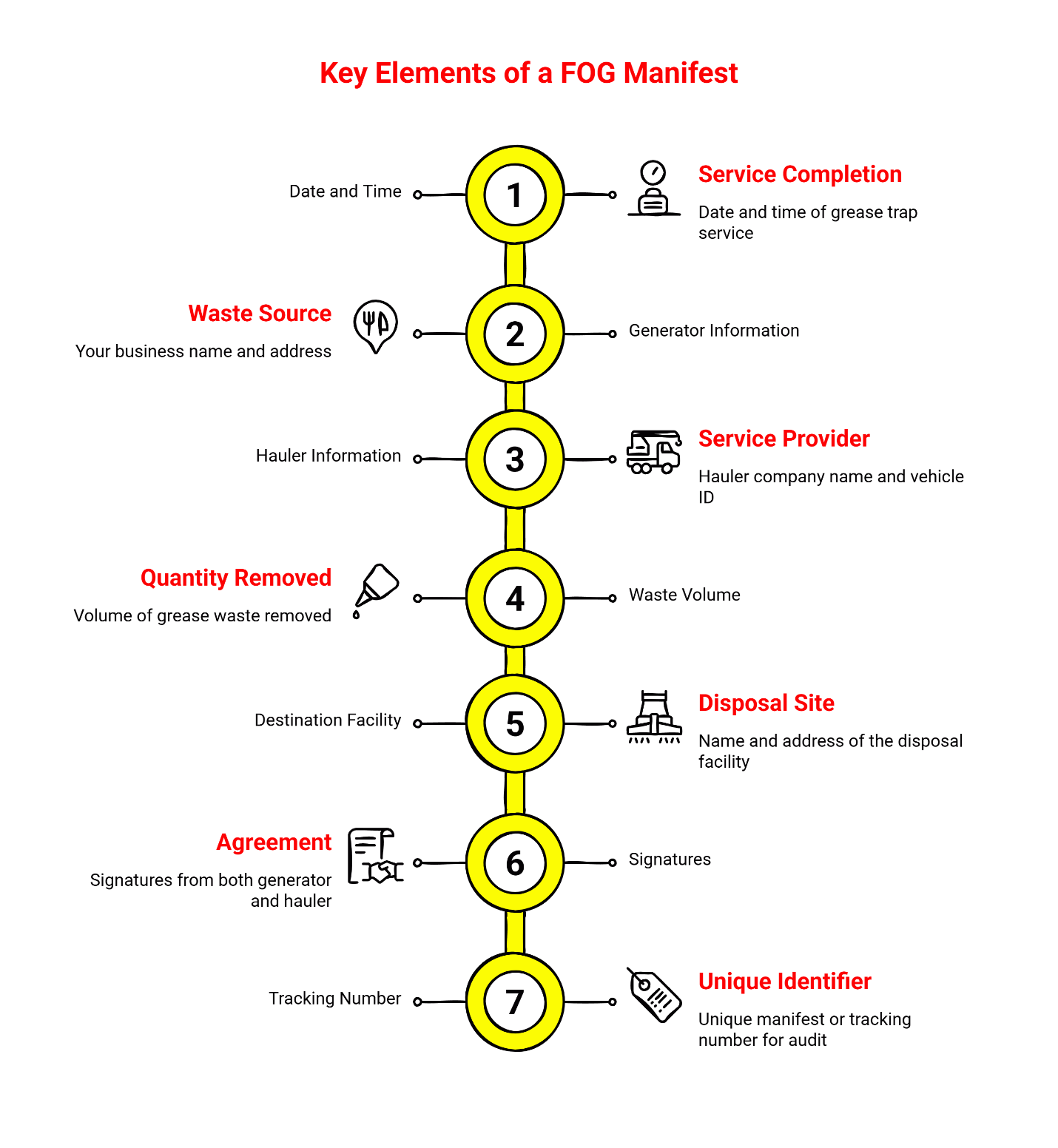
Pickup date and time – Establishes when service occurred and helps verify quarterly compliance schedules.

Your business name and address (the generator) – Confirms the waste originated from your facility.

Hauler/transporter details – Should include company name, contact information, and any registration or ID fields (such as TCEQ registration number) proving they’re authorized to transport grease trap waste.³

Waste type and volume – Typically listed as “FOG” or “grease trap waste” with gallons pumped. This creates a disposal record matched to your trap capacity.

Disposal facility destination – The most critical field. This facility name and address prove legal disposal at an authorized location.

Signatures and verification – Both the hauler and a representative from your business should sign, creating legal accountability. Some manifests also include receiving facility confirmation.

If the disposal facility field is blank or lists only a generic “approved facility” without specifics, pause payment and request clarification. That’s your audit trail, and vague entries offer no protection during an inspection.


Common Traps: 5 Reasons Invoices Fail Audits

Common grease trap compliance traps: invoice misinterpretation, hauler reliance, reactive cleaning, recordkeeping issues, and photo misuse.

“I have an invoice, so I’m covered.” The invoice proves you paid someone to pump your trap. It doesn’t prove that person was licensed, that the waste went to a legal facility, or that the service even occurred. Inspectors dismiss invoices as compliance proof.

“The hauler said they filed it with the city.” Even if your hauler submits manifests to regulatory agencies, you’re still required to maintain your own copies. The generator—that’s you—bears ultimate responsibility for documentation.

“We only clean when it smells or backs up.” Relying on reactive service typically violates Houston’s standard quarterly cleaning requirement for commercial grease traps. Unless you have an approved waiver, waiting for problems means you’re likely already out of compliance. Missing manifests from skipped quarters create documentation gaps that inspectors flag immediately.

“I can’t find last quarter’s paperwork.” Disorganized recordkeeping is the fastest way to fail an inspection. When you can’t produce manifests on request, inspectors assume non-compliance even if service occurred.

“A photo of the truck is enough.” Photos prove a vehicle visited your property. They don’t prove legal disposal, proper licensing, or waste destination—the three things inspectors actually care about.

For restaurant managers unfamiliar with Houston’s requirements, our plain-English guide to the Houston FOG ordinance breaks down the compliance framework in operationally practical terms.


A Simple System That Works: The Compliance Binder (Or Shared Folder) in 15 Minutes

Set up a physical three-ring binder or shared digital folder dedicated solely to grease trap compliance. This becomes your single source of truth during inspections.

Create four tabs or folders: Five-Year Manifest Archive, Current Year Manifests, Service Invoices (for accounting), Equipment Information, and Vendor Contacts. File each completed manifest chronologically in the Current Year tab immediately after service. (Note: Houston requires keeping 5 years of manifests on-site). Don’t mix manifests with invoices—keep proof of legal disposal separate and prominent.

Assign ownership to your general manager or facilities lead. Make it their responsibility to verify the hauler provides a completed manifest before releasing payment. This one accountability checkpoint prevents documentation gaps.

Store the binder on-site in a location your opening manager knows about—typically the manager’s office or a locked file cabinet near your grease trap access point. Keep a digital backup in cloud storage so you can retrieve copies if the physical binder is misplaced or damaged.

Important note on retention: Documentation retention requirements can vary by program and jurisdiction. Consult current City of Houston[¹] and Texas guidance[³] and confirm current expectations through official sources to ensure you’re meeting applicable retention periods.

When inspectors arrive, you hand them the binder within 60 seconds. That’s the operational standard that prevents compliance anxiety.


Vendor Checklist: What to Ask Your Grease Trap Hauler

Before signing any service agreement, ask these questions. The answers reveal whether a hauler prioritizes documentation or cuts corners:

“Will you provide a completed manifest with every pump-out?” The only acceptable answer is yes, with either electronic delivery or a physical copy left on-site immediately after service.

“Which disposal facility do you use?” They should name a specific facility by name and location. Vague responses like “an approved site” or “multiple locations depending on the day” suggest inconsistent practices.

“Can you re-send manifests if we need copies for an audit?” Professional haulers maintain organized records and can quickly provide duplicate manifests. Reluctance or confusion about this request is a red flag.

“Who signs the manifest and when?” Both the hauler and your representative should sign before the truck leaves. If they say manifests are “completed later” or “filed from the office,” you’re relying on paperwork that may never materialize.

“What’s your TCEQ registration number?” Licensed haulers can provide this immediately. If they hesitate or claim it’s “not required for this type of work,” walk away.

Red flags include vague answers about where waste goes, inconsistent paperwork formats, or claims that manifests “aren’t necessary.” These warning signs indicate a hauler who may expose your business to compliance risk.

Understanding these vendor selection criteria helps prevent the FOG violation myths that can cost Houston restaurants thousands in fines and operational disruptions.


If You Only Have Invoices Right Now: What to Do Next

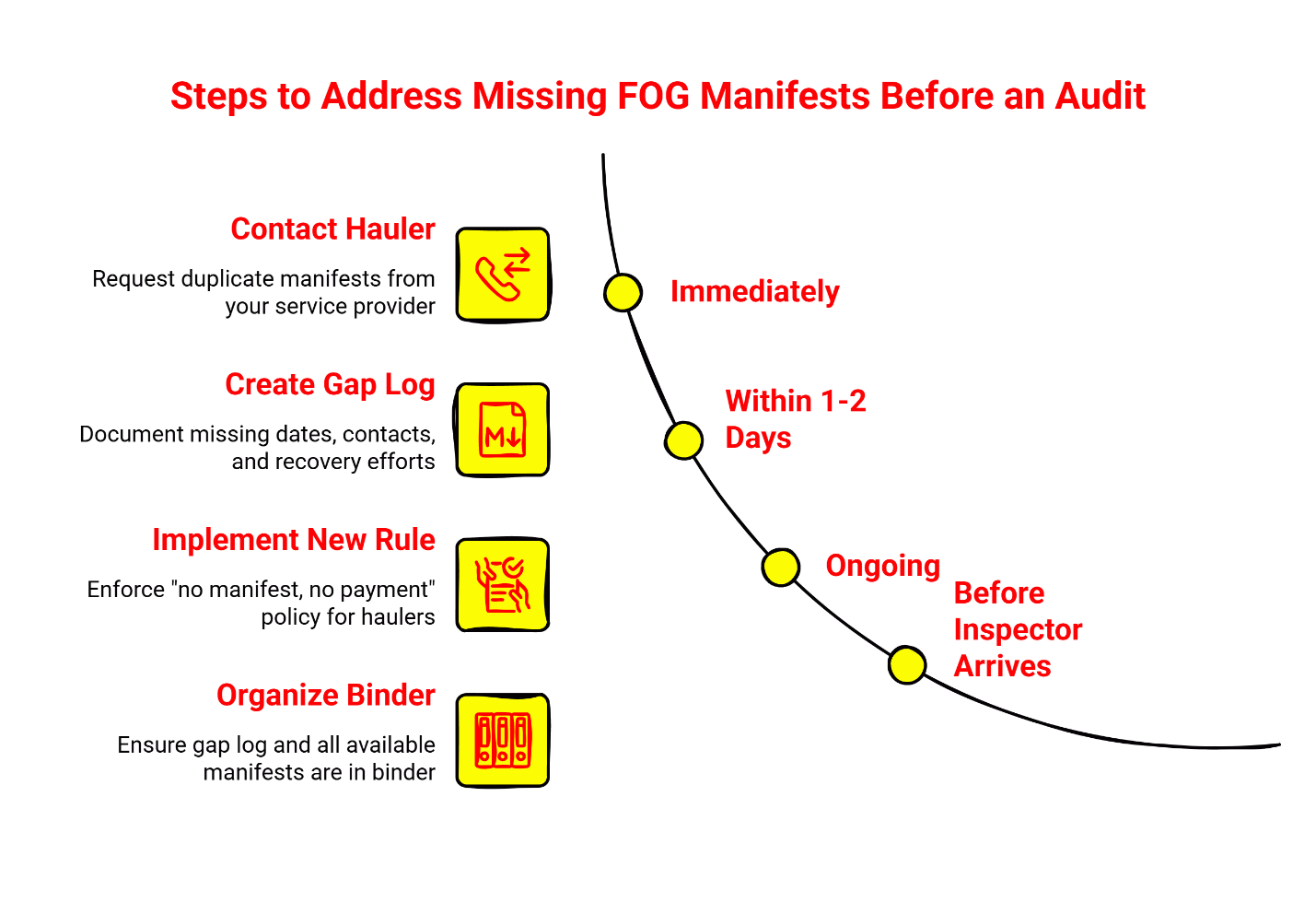
Don’t panic, but do act quickly. Contact your current hauler immediately and request copies of all manifests for the past year. Explain you need them for compliance documentation. If they can provide them, file them properly and continue forward with a documentation-first approach.

If your hauler can’t produce manifests—or never created them—you have a serious problem. Switch to a documentation-forward provider immediately. The cost difference between a proper service and a cheap pump-out is negligible compared to the fines and legal exposure from missing manifests.

Going forward, implement the payment-after-manifest rule: no completed manifest, no payment authorization. This policy change protects you and signals to haulers that you take compliance seriously.

Schedule your next service with a provider who understands that proper commercial grease trap cleaning in Houston includes documentation as part of the service, not an optional add-on.


Frequently Asked Questions

Is a grease trap invoice enough for a City of Houston inspection?

No. Invoices prove payment but don’t document legal disposal. Inspectors require manifests showing chain of custody and destination facility. Use official guidance for current expectations.²

What is a grease trap manifest (or trip ticket)?

A manifest is a legal tracking document that records who generated the waste, who transported it, and which authorized facility received it for disposal. It creates an audit trail proving compliance with waste handling regulations.³

Who keeps the manifest—the restaurant or the hauler?

Both. The hauler maintains copies for their records and regulatory reporting. You, as the generator, are legally required to maintain your own copies for inspection purposes. The operationally safe approach is to keep a retrievable copy in an on-site binder or shared folder so it can be produced quickly when requested.²

Where should I store manifests so a manager can find them fast?

Keep them in a dedicated compliance binder stored on-site in a consistent location—typically the manager’s office or near your equipment access point. Your opening manager should know exactly where it is.

How long should I keep manifests?

Retention expectations can vary by jurisdiction and regulatory program. Confirm current requirements using official City of Houston[¹] and Texas guidance[³] and keep records according to those requirements.

For restaurant operators ready to implement a documentation-first maintenance program, contact Drane Ranger at 281-489-1765 (Monday through Friday, 9am until 6pm) or email rwoods3719@aol.com. Serving Houston since 1985, we provide the systematic compliance documentation that turns anxiety into peace of mind.

You can also reach us through our contact page.

References

[¹] City of Houston (official site): https://www.houstontx.gov/

[²] Houston Health Department – Waste Generator Documentation: https://www.houstonhealth.org/media/271/download

[³] Texas Commission on Environmental Quality – Grease Trap Waste Guidance (RG-389): https://www.tceq.texas.gov/downloads/assistance/publications/rg-389.pdf/@@download/file/rg-389.pdf

[⁴] Better Business Bureau Profile (Drane Ranger): https://www.bbb.org/us/tx/houston/profile/septic-tank-cleaning/drane-ranger-vacuum-service-0915-31003989

Disclaimer: This article is for informational purposes only and does not constitute legal advice. For guidance specific to your restaurant, consult applicable City of Houston requirements and qualified professionals on your obligations.

Our Editorial Process

Our expert team uses AI tools to help organize and structure our research, but every article is ultimately reviewed and refined by subject matter experts and experienced humans on our Insights Team to ensure accuracy and clarity.

About the Drane Ranger Insights Team

The Drane Ranger Insights Team is our dedicated engine for synthesizing complex topics into clear, helpful guides. While our content is thoroughly reviewed for clarity and accuracy, it is for informational purposes and should not replace professional advice.

The Houston Restaurant Owner’s Guide to FOG Compliance: Cleaning vs. Manifesting

📌 Key Takeaways

Houston FOG compliance requires both physical trap cleaning and proper manifest documentation—missing either creates audit exposure.

  • Manifests Prove Legal Disposal: Invoices show payment; manifests document chain-of-custody from your trap to approved disposal facilities, which inspectors specifically request.
  • The 25% Rule Triggers Early Service: When floating grease plus settled solids reach one-quarter of liquid depth, cleaning is required immediately regardless of your 90-day schedule.
  • Five-Year Record Retention Required: Houston Health Department mandates keeping signed manifests on-site and accessible for five years—inspectors review multi-year compliance history.
  • Verify Before Signing: Check that generator details, transporter permit numbers, vehicle identification, waste quantities, and intended disposal site are complete on every manifest.
  • No Manifest, No Payment: Establish a payment rule requiring completed manifests before releasing payment—this protects you and ensures hauler accountability.

Physical cleaning removes the waste, but the manifest proves it was legal.

Houston restaurant owners managing FOG program requirements will find audit-ready systems detailed here, preparing them for the compliance checklist and vendor vetting guide that follows.

The inspector walks in during the lunch rush. Kitchen’s humming, fryers are hot, tickets are flying. Then comes the question that stops everything: “Can I see your grease trap manifests from the last two years?”

The trap itself might be spotless. The real test? Whether the paperwork proves it.

FOG compliance in Houston means two things working together: keeping fats, oils, and grease out of the city’s sewer system, and maintaining documentation that proves your waste was handled legally. Think of it this way—cleaning your grease trap is like getting an oil change for your car. The manifest is the receipt and tracking number that proves the used oil went to a proper facility, not dumped in a ditch somewhere.

This guide breaks down what Houston actually requires, why invoices alone won’t protect you during an audit, and how to build a simple two-part compliance system in about 30 minutes. A scheduled cleaning cadence plus an organized binder. That’s the foundation of audit-ready peace of mind.


FOG Compliance in Houston: What the City Actually Cares About

Achieving FOG compliance in Houston: four-step funnel showing schedule cleaning, document waste, ensure physical compliance, and maintain paperwork.

Houston expects your grease interceptor cleaned on schedule and your waste documented with a completed manifest before it leaves your property.

That’s the core of it. But understanding why helps you stay ahead of problems rather than reacting to them.

While the City of Houston enforces a single comprehensive set of regulations, it is helpful to view compliance in two distinct parts. Physical compliance means the trap is actually clean—waste removed, interior surfaces cleared, and the system is functioning. Paperwork compliance means you have the documented proof that a licensed transporter took the waste to an approved disposal facility.[^1]

During inspections, city officials aren’t taking your word for it. They’re looking for patterns and proof. A clean trap today doesn’t tell them anything about last month or six months ago. Manifests do. They create a verifiable history that shows consistent, legal waste handling over time.

Houston’s Special Waste and FOG program exists because grease in the sewer system causes blockages, overflows, and expensive infrastructure damage. The city takes enforcement seriously. Fines exist. Shutdowns happen. But the requirements themselves aren’t complicated once you understand what’s expected.

“Physical cleaning removes the waste, but the manifest proves it was legal.”


Cleaning: The Physical Work That Keeps Your Kitchen Running

A proper grease trap cleaning means full evacuation—removing all the accumulated FOG, food solids, and wastewater from the interceptor. Not skimming the top. Not pumping until it “looks better.” Complete removal down to the tank walls and baffles.

What “Fully Evacuated” Actually Means

“Fully evacuated” means the entire contents are removed—not just what floats at the top. When a job is rushed, the “easy” portion disappears while heavier material stays behind. That leftover material is where problems begin: restricted flow, recurring odor complaints, and higher risk of a failed inspection because the device doesn’t reflect what the paperwork claims.

Houston ordinances and program guidance emphasize that waste removal involves removing the full contents from the site, not partial removal.[^2] This isn’t splitting hairs—it’s the difference between compliance and a violation notice.

The Cleaning Schedule: 90 Days Plus the 25% Trigger

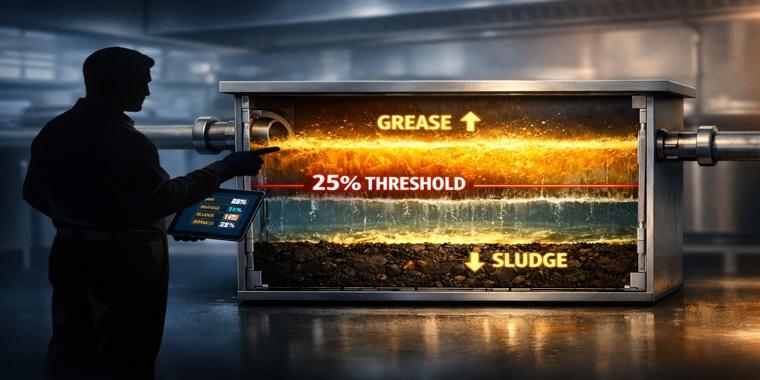
Houston’s baseline requirement is cleaning at least every 90 days (or strictly in accordance with your specific permit conditions).[^2] But there’s an important trigger that can accelerate that schedule: the 25% rule. Under city ordinances, when the combined depth of floating grease and settled solids reaches 25% of the total liquid depth in your trap, service is required immediately regardless of how recently you cleaned. [^2] High-volume kitchens with heavy frying often hit this threshold in six to eight weeks.

A practical way to use the 25% trigger is as a scheduling signal: If your restaurant routinely approaches the trigger before the next planned cleanout, the schedule is too light. If the device stays well below the trigger for long periods, the schedule may be stable—but documentation still needs to be perfect every time.

Waiting until you smell something is already too late. By the time odors reach you, slow drains have likely frustrated your kitchen staff. Odors may have reached the dining room. Worse, you’re potentially out of compliance—and if a backup happens during service, you’re looking at lost revenue, emergency service premiums, and possibly a health department visit.

Signs Your Cleaning Schedule Might Be Too Light

  • Drains slow down noticeably before your next scheduled service
  • Staff complains about odors near the trap or floor drains
  • You’ve had even one backup incident in the past year
  • Your service provider mentions the trap was “really full” at pickup
  • Odors return quickly after service
  • Service calls are reactive (“something is wrong”) rather than planned

The practical move: work with your service provider to establish a frequency based on your actual grease output, not just the minimum requirement.


Manifesting: The Paper Trail That Protects You During an Audit

Here’s where many restaurant owners get tripped up. They have invoices. They paid for service. They assume that’s enough.

It isn’t.

Invoice vs. Manifest: The Distinction That Matters

An invoice proves you paid someone. A manifest proves the waste was legally tracked from your location to an approved disposal site. Those are not interchangeable documents.

  • Invoice: “Service was paid for.”
  • Manifest: “Waste removal and handling were documented with required details and intended disposal site information.”

Houston requires a completed manifest before waste is removed from your premises—it’s not optional paperwork your hauler fills out later.[^3] During an audit, being able to show a stack of invoices is not the same as producing properly completed manifests.

The manifest creates a chain of custody. It documents what was removed, who removed it, what vehicle carried it, and where it was intended to go. If that waste ends up illegally dumped somewhere, the manifest trail determines liability. Without one, you have no proof your waste was handled properly. During an audit, that’s a problem.

Must-Check Manifest Fields Before You Sign

The generator portion of the manifest must be completed with required information.[^3] Before signing any manifest, take 30 seconds to verify these key fields are completed:

  • Generator name
  • Generator address (including zip code)
  • Generator permit/registration certificate number
  • Generator contact telephone number (including cellular if available)
  • Holding capacity of your trap or interceptor
  • Date the waste was collected
  • Transporter company name and permit number
  • Vehicle identification (registration, decal, or certificate number plus license plate)
  • Vehicle tank capacity
  • Operator name and signature
  • Transporter mailing address and telephone number
  • Type and quantity of waste removed (gallons or pounds)
  • Intended disposal site name and address

Your signature confirms the information is accurate. If something’s blank or wrong, ask the driver to correct it before they leave.

How Long to Keep Manifests

Houston Health Department regulations explicitly require keeping manifest copies on-site and available for inspection, with retention for a period of five years strictly mandated.[^4] That sounds like a long time, but inspectors do review multi-year history. A simple “one tab per year” filing system with monthly separators keeps everything accessible without becoming a project.


Cleaning vs. Manifesting: A Side-by-Side Decision Matrix

Understanding how these two requirements differ—and where they overlap—makes compliance much simpler to manage.

Aspect Cleaning (Physical Compliance) Manifesting (Paperwork Compliance) Total Compliance (Both)
What it is Physical removal of FOG, solids, and wastewater from the interceptor Documentation proving waste was tracked to a legal disposal site Complete fulfillment of Houston’s FOG program requirements
What it proves The trap is currently functional and within capacity The waste was handled legally with chain-of-custody records Ongoing, verifiable compliance over time
What can fail you Trap exceeds 25% accumulation; backup or overflow occurs Missing manifests; incomplete fields; unsigned documents Either failure creates compliance exposure
What to keep on-site Service receipts (helpful but secondary) Completed, signed manifests organized by date Both, in an accessible compliance binder
How often it happens Every 90 days minimum, or when 25% threshold is reached Every time waste is removed (one manifest per service) Aligned—each cleaning should generate one manifest
Who owns it internally Facilities manager or designated staff member Same person; accountability should be centralized One owner, one system, one binder
What your vendor must provide Full evacuation, not just skimming; clean work area Completed manifest with all required fields before leaving Both, every time, without exception

Common Misconceptions That Create Audit Problems

“We paid the invoice, so we’re covered.” Payment proves a transaction. It doesn’t prove legal disposal. Inspectors ask for manifests, not invoices.

“The trap looked clean when I checked it.” Visual inspections are unreliable. Sludge settles at the bottom where you can’t see it. The 25% rule is measured with a core sample, not a glance through the access port.

“Our hauler handles all the paperwork.” They should—but you’re responsible for verifying and retaining copies. If your hauler disappears or loses records, the compliance burden stays with you as the waste generator.

When an inspector arrives, they typically ask for three things first: your FOG permit or registration, your compliance binder with manifests, and access to the trap itself. Having all three ready transforms an inspection from a stressful surprise into a routine verification.


How to Build a “Total Compliance” System in 30 Minutes

Compliance doesn’t require complex software or dedicated staff. It requires a simple system you actually use.

Building a compliance system: four steps including compliance binder, calendar reminders, payment rule, and staff training.

Step One: Create a Compliance Binder

Physical or digital, it needs clear organization. Use tabs or folders for:

  1. Permits/Registrations – Current FOG permit/registration documentation
  2. Vendor Credentials – Service agreement with your hauler, transporter permit verification
  3. Manifests – Current Year – Organized chronologically with monthly separators
  4. Manifests – Prior Years – One tab per year (minimum five years retained)
  5. Service Schedule – Calendar printout or cadence notes
  6. Inspection Notes – Any correspondence with the city or inspection reports

Keep the physical binder in a consistent location that staff knows—near the manager’s station or in the office. If you use digital storage, maintain a printed backup of at least the current year’s manifests on-site for inspector access.

Step Two: Set Calendar Reminders

Set calendar reminders tied to your service cadence. If you’re on a 90-day schedule, set reminders at 75 days to confirm the upcoming appointment and at 85 days as a backup. For higher-frequency service, adjust accordingly. The goal is preventing lapses, not creating busywork.

Also set a “binder check” reminder for confirming manifests were filed after each service.

Step Three: Establish a Payment Rule

This one’s simple but powerful: no manifest, no payment. Make it policy. If the driver can’t provide a completed manifest before leaving, service isn’t complete. This protects you and ensures your hauler maintains proper documentation every time.

Step Four: Train Your Staff

Designate who has authority to sign manifests—this should be limited to management or trained supervisors. Make sure they know:

  • Where the compliance binder is stored
  • What fields to verify before signing
  • What to hand an inspector (binder, permit, and trap access)
  • Who to call if questions arise during an inspection

A 15-minute walkthrough with your team covers all of this. Document who was trained and when.

Audit-Ready Binder Checklist

  • [ ] Current FOG permit or generator registration on file
  • [ ] Transporter permit verification documented
  • [ ] Service agreement specifying cleaning frequency
  • [ ] Manifests for the current year, signed and complete
  • [ ] Manifests for prior years (minimum five years retained)
  • [ ] Any city correspondence or inspection reports


Vendor Vetting: How to Avoid the “Cheap Hauler” Compliance Trap

Not all grease trap service providers operate the same way. The cheapest option often cuts corners—on cleaning thoroughness, on proper disposal, on documentation. When those shortcuts create compliance problems, the liability lands on you as the waste generator.

Houston requires transporters hauling special waste to maintain proper permits.[^5] A legitimate hauler will have no problem providing verification. An illegitimate one will make excuses or simply not have it.

Questions to Ask Before Hiring (or Continuing With) a Grease Trap Service Provider

  1. “Can you provide your current transporter permit number and show me proof of registration?” Keep a copy for your compliance binder.
  2. “Do you provide a completed manifest with every service visit?” The answer should be an unqualified yes.
  3. “Where is my waste taken for disposal, and can you document that?” Legitimate haulers use approved facilities and can tell you exactly where your waste goes.
  4. “Can you resend copies of past manifests if I need them?” Records get lost. A professional operation maintains backups and can provide duplicates when needed.
  5. “What does ‘fully evacuated’ mean in your company’s process?” Listen for “entire contents,” not “we pump the top.”

Trust Signals That Matter

Reliability signals matter too. Does the company show up on time? Do drivers work cleanly and professionally? Is scheduling organized and predictable? These operational details reflect how the company handles the less visible aspects of their work—like proper disposal and documentation.

Drane Ranger has served Houston-area businesses with grease, grit, and lint trap cleaning since 1985. As Harold R. shared about his experience: “My experience with Drane Ranger was a very organized, professional and on time experience. I was kept informed of what was happening and a suggested time of cleaning again.”

That combination—organized service, clear communication, proactive scheduling—is exactly what audit-ready compliance requires.

Shelley M. adds: “Drane Ranger is very professional and reliable. Basically they can take care of all your grease drain needs.”

The company maintains Better Business Bureau accreditation, providing third-party verification of business practices and complaint resolution.


FAQ: Quick Answers Houston Owners Ask Most

Is an invoice enough for Houston inspections?

No. An invoice proves payment; a manifest proves legal waste handling. Inspectors specifically request manifests because they document the chain of custody from your trap to the disposal facility. Keep both, but understand manifests are the compliance requirement.

How often do I have to clean my grease trap?

Houston requires cleaning at least every 90 days, but the 25% rule can trigger earlier service. When floating grease plus settled solids equal one-quarter of your trap’s liquid depth, cleaning is required regardless of schedule. High-volume kitchens often need service every six to eight weeks.

What is the 25% rule and how is it measured?

The 25% rule means your trap needs cleaning when the combined depth of floating grease and settled sludge reaches 25% of the total liquid depth. Measurement typically involves a core sample that captures material from top to bottom—not a visual check, which only shows the surface. Your service provider should be able to explain what they found and whether you’re approaching the threshold.

How long do I keep manifests?

Houston Health Department guidance recommends retaining manifests for at least five years and keeping them accessible on-site. Inspectors may review multi-year history, so organized long-term storage matters. The “one tab per year” filing approach keeps everything accessible without much effort.

What if I can’t be on-site to sign a manifest?

Designate a trained manager or supervisor with signing authority. This person should understand what fields to verify before signing and where to file the completed manifest. Avoid allowing just anyone on staff to sign—centralized accountability reduces errors and ensures consistency.


Next Step: Get a Compliant Cleaning Schedule (and the Paperwork That Backs It Up)

Compliance doesn’t have to mean constant worry. With the right service partner and a simple organizational system, your trap stays clean, your manifests stay complete, and inspections become routine rather than stressful.

Everything Drane Ranger does is built on a commitment to doing the absolute best job possible—exceeding expectations while ensuring the team is trained, certified, and following all rules and regulations around the industry.

Ready to confirm your current schedule is audit-ready? Have questions about what your binder should include?

Start Your Service Today — Call 281-489-1765 | Request Your Quote | Contact us today

For more information about grease trap cleaning in Houston and surrounding areas, explore our service pages or reach out directly.

Drane Ranger — Satisfying the customers Since 1985.

13911 India St, Houston, TX 77047 | 281-489-1765 | rwoods3719@aol.com | Mon-Fri, 9am until 6pm

Disclaimer: Educational content only; not legal advice. Readers should consult the City of Houston, Houston Health Department, or legal counsel for definitive compliance guidance.

This article was prepared by the Drane Ranger Insights Team and reviewed for clarity and practical accuracy. Regulations can change and enforcement can vary by circumstance. For definitive compliance requirements for your facility, consult the City of Houston/Houston Health Department guidance and/or qualified counsel.

About the Drane Ranger Insights Team

The Drane Ranger Insights Team is our dedicated engine for synthesizing complex topics into clear, helpful guides. While our content is thoroughly reviewed for clarity and accuracy, it is for informational purposes and should not replace professional advice.

[^1]: City of Houston Code of Ordinances, §47-502 through §47-510: Documentation Requirements

[^2]: City of Houston Code of Ordinances, §47-512: Cleaning and Maintenance Requirements

[^3]: City of Houston Code of Ordinances, §47-502: Manifest Requirements

[^4]: Houston Health Department: Waste Generator FAQ

[^5]: Houston Permitting Center: Transporter Permit (HHD1019)

Grease Trap Manifesting 101: The Documentation You Need to Survive a City Audit

📌 Key Takeaways

Grease trap manifests track waste custody from pickup through disposal—invoices alone don’t prove legal compliance.

  • Five-Year Retention Is Mandatory: Houston requires generators to maintain manifests for five years and produce them immediately upon inspector request.
  • Manifests Need Eight Critical Fields: Generator information, service date, waste type, quantity, transporter details, disposal facility, disposal date, and required signatures must all be complete.
  • Verify Haulers Before Hiring: Confirm transporter registration numbers, disposal facility relationships, and immediate manifest delivery before signing any service contract.
  • The Compliance Binder System Works: Organized tabs for permits, chronological manifests, service logs, correspondence, and waivers enable 30-second document retrieval during audits.
  • Missing Manifests Can’t Be Recreated: Contact haulers immediately for copies, document all outreach attempts, and replace vendors who refuse to provide proper documentation.

Incomplete paperwork shifts disposal liability back to you, regardless of what you paid.

Houston restaurant owners navigating FOG regulations will gain audit-proof documentation strategies here, preparing them for the compliance system implementation that follows.

The health inspector walks into your kitchen during Friday dinner rush. She’s polite but direct: “I need to see your grease trap service records for the past five years.” Your manager freezes. The binder is… somewhere. Maybe in the office. Or was it with the old paperwork that got tossed last spring?

This scenario plays out more often than it should, and the consequences go beyond embarrassment. Without proper manifesting documentation, you can’t prove your grease trap waste was disposed of legally—even if you paid someone to haul it away.

Grease trap manifesting is the chain-of-custody paperwork that tracks your liquid waste from pickup through final disposal. It’s not just a maintenance task—it’s a compliance event with documentation that must stand up to regulatory scrutiny. Think of it like a tax receipt during an IRS audit: payment alone doesn’t prove compliance. The manifest shows where the waste went, who handled it, and that it reached an approved disposal facility. In Houston, where commercial kitchens operate under strict FOG (Fats, Oils, and Grease) regulations, this documentation is your primary defense during inspections.

The good news? A simple compliance binder system—combined with vendor verification before you sign any service contract—makes audits routine instead of terrifying. This guide walks you through exactly what Houston requires, what a compliant manifest must include, and how to organize records so you can produce them in under 30 seconds.


What ‘grease trap manifesting’ actually means (and why invoices don’t protect you)

A manifest is a legal document that tracks liquid waste through every stage of handling. It records who generated the waste, who transported it, how much was collected, and where it was ultimately disposed. An invoice, by contrast, simply proves you paid for a service.

Here’s the critical difference:

Document What It Proves Legal Weight in an Audit
Invoice You paid someone to pump your trap Minimal—payment doesn’t prove legal disposal
Manifest Where the waste went and who handled it at each stage Primary compliance documentation required by ordinance

Houston’s municipal code requires generators—that’s you, the restaurant owner—to retain manifests for five years and make them available immediately upon request.[1] The city expects you to have both the initial service copy (signed at pickup) and the final return copy (certifying disposal) organized and accessible on-site.[2] While many haulers use traditional multi-part carbon forms (often white and yellow), digital manifests are increasingly common and equally valid provided they contain all required signatures.

Payment is not proof of disposal. If your hauler took shortcuts or disposed of waste improperly, you remain liable unless you can demonstrate you verified their credentials and retained proper documentation. The manifest creates that paper trail.


When Houston asks for your paperwork: inspections, audits, and spot checks

City health inspectors and FOG program auditors typically request manifests during routine inspections, complaint-driven visits, or when investigating permit renewals. Paperwork is often the first thing requested because it’s the fastest way to assess compliance behavior. The first thing they ask for is your service documentation—not because they doubt you’re getting the work done, but because they need to verify the waste disposal chain.

When you can’t produce manifests quickly, inspectors escalate their scrutiny. What might have been a five-minute records check becomes a detailed facility inspection. Missing documentation signals operational disorganization, which raises questions about other compliance areas.

“Survive” in this context means having an on-site system that any manager can access immediately. The inspector shouldn’t wait while you search through file cabinets or call your vendor hoping they kept copies. Your records should be organized, complete, and ready to review.

For comprehensive guidance on inspection preparation beyond just manifesting, see our article on how to prepare your kitchen for a City of Houston grease trap inspection.


What a compliant manifest must include (field-by-field cheat sheet)

Every manifest must document the complete chain of custody. Missing even one required field can render the document useless during an audit. Here’s what Houston expects to see:

Building a legally sound grease trap manifest with six required elements for Houston FOG compliance documentation.

Must-Have Fields:

  • Generator Information: Your business name, physical address, and contact information exactly as they appear on your city registration
  • Service Date and Time: When the waste was actually collected (not when it was scheduled)
  • Waste Type: Specifically identified as “grease trap waste” or “FOG waste” (generic terms like “liquid waste” don’t satisfy requirements)
  • Quantity: Volume removed, typically measured in gallons
  • Transporter Details: Company name, registration number, permit identifier, and driver signature
  • Disposal Facility: Name and address of the facility that received the waste
  • Disposal Date: When the waste reached its final destination (may differ from pickup date)
  • Required Signatures: Generator representative, transporter, and disposal facility operator where applicable

Common errors that make manifests legally insufficient include missing generator signatures (meaning you never verified the information), incomplete transporter permit numbers (making it impossible to verify registration), and missing disposal facility information (breaking the chain of custody). If the hauler leaves your site without getting your signature, chase them down before the truck pulls away—you can’t fix it after the fact.

Annotated Sample Manifest

[WASTE MANIFEST / TRIP TICKET]


① GENERATOR INFORMATION

   Business: [Your Restaurant Name]

   Address: [Full Street Address, Houston, TX 77XXX]

   Contact: [Phone Number]

   Generator ID: [Your City Registration Number]


② SERVICE DETAILS

   Service Date: 12/15/2025

   Service Time: 10:30 AM

   Waste Type: Grease Trap Waste (FOG)

   Volume Removed: 450 gallons


③ TRANSPORTER INFORMATION

   Company: [Licensed Hauler Name]

   Registration #: [State/City Permit Number]

   Driver Name: [Name]

   Vehicle #: [Truck Identifier]

   Driver Signature: _________________ Date: _______


④ GENERATOR CERTIFICATION

   I certify this waste was generated at the above location

   Generator Signature: _________________ Date: _______

   Print Name: _________________________


⑤ DISPOSAL INFORMATION

   Facility Name: [Approved Disposal Site]

   Facility Address: [Full Address]

   Disposal Date: 12/15/2025

   Facility Rep Signature: _________________ Date: _______


COPIES:

White – Generator (Retain 5 years)

Yellow – Generator (Retain 5 years)

Pink – Transporter

Green – Disposal Facility

What the inspector looks for at a glance:

  • ① Matches your business registration
  • ② Shows service within 90-day requirement
  • ③ Confirms transporter is registered/permitted
  • ④ Proves you verified the information before truck left
  • ⑤ Matches the final ‘Return Copy’ to the initial pickup ticket to prove disposal occurred


Who is responsible for what: generator vs transporter vs disposal site

Responsibility in waste manifesting follows a clear hierarchy, but the generator—your restaurant—cannot outsource legal liability even when you hire professionals to handle the physical work.

Generator Obligations (You):

  • Verify transporter is properly registered before hiring them
  • Sign the manifest only after confirming all fields are complete and accurate
  • Retain copies for the full five-year period
  • Make records available immediately upon regulatory request
  • Report manifest discrepancies or missing return copies

Transporter Obligations:

  • Complete all manifest fields accurately
  • Provide generator copies before leaving the site
  • Deliver waste only to approved disposal facilities
  • Submit required copies to regulatory agencies
  • Return completed manifest showing final disposal

Disposal Site Obligations:

  • Accept waste only with proper manifesting
  • Verify waste matches manifest description
  • Complete their portion of the manifest
  • Process waste according to permit requirements
  • Maintain disposal records

The critical point is this: even though you pay someone else to pump your trap and haul the waste, you remain the responsible party if that waste isn’t handled legally. Hiring a registered transporter and maintaining complete manifests is how you demonstrate due diligence.


How long to keep manifests—and how to store them so you can find them in 30 seconds

Houston requires five-year retention with immediate availability.[3] “Immediate” means the inspector shouldn’t wait while you dig through storage or contact former employees who might remember where old files went. You need an organized, on-site system.

Compliance binder tabs for grease trap documentation: permits, manifests, service schedule, correspondence, and waivers.

The Compliance Binder System provides that organization. Use a three-ring binder with labeled tabs:

Tab 1: Permits & Registrations

  • Your FOG generator permit
  • Current service contract
  • Transporter’s registration certificate (verify annually)
  • Any Notice of Waiver approval if applicable

Tab 2: Manifests (Chronological)

  • Newest manifests first
  • File both the initial pickup ticket and the final return copy together
  • Add new manifests immediately after each service
  • Use sheet protectors to prevent damage

Tab 3: Service Schedule & Log

  • Calendar showing required service dates
  • Log of actual service dates vs. scheduled dates
  • Notes about any missed appointments or rescheduling

Tab 4: Correspondence

  • Emails confirming service completion
  • Any correspondence with the hauler about issues
  • Inspector visit notes and corrective actions

Tab 5: Waivers & Special Approvals

  • Any approved deviations from standard 90-day schedule
  • Documentation supporting waiver applications
  • Renewal dates for time-limited approvals

This binder lives in your office where managers can access it without your presence. When the inspector asks for records, your GM hands them the binder—complete, organized, and demonstrating operational competence.

Many operators also maintain digital backups by scanning manifests monthly and storing them in cloud folders organized by year. This protects against physical damage and makes sharing records with corporate or legal teams straightforward. The physical binder remains your primary system because inspectors expect to review on-site documentation, but digital backups provide insurance against lost or damaged papers.


Audit-Ready Compliance Binder Checklist

Before the truck leaves your property:

  • All manifest fields completed (no blanks)
  • Date and time reflect actual service (not just scheduled time)
  • Quantity matches visual observation (reasonable volume for your trap size)
  • Transporter permit number is present
  • Designated disposal facility is listed (Name/Address)
  • Your signature is on the generator certification line
  • You received your initial ‘Generator’ copy immediately
  • Copies are legible (carbon forms can be faint—verify before driver leaves)

Within 24 hours of service:

  • File initial manifest copy in Tab 2
  • Log service date in Tab 3 schedule tracker
  • Scan manifest for digital backup folder
  • Note next required service date (90 days or per waiver)

Monthly maintenance:

  • Verify all services from past month are documented
  • Check for any missing return copies from multi-part manifests
  • Review upcoming service dates in next 30 days
  • Confirm binder is in designated office location

Annual review:

  • Verify transporter’s registration is still current
  • Confirm disposal facility is still approved/permitted
  • Archive manifests older than 5 years (if any)
  • Review service contract for renewal dates
  • Update emergency contact information

For deeper insight into timing your service to maintain compliance, see The 25% Rule Explained: When to Schedule Your Pump-Out to Stay Compliant.


How to vet a hauler before you hire them (the ‘cheap hauler’ trap)

Price matters in any business decision, but the cheapest hauler often creates the most expensive problems. A low price is not a bargain if documentation is incomplete or disposal cannot be verified. When a hauler fails on documentation or disposal verification, you inherit their liability. The few dollars saved per pump-out become irrelevant when you’re facing fines or explaining incomplete records to an inspector.

Six Questions to Ask Before You Sign:

  1. What is your transporter registration number? Verify this with TCEQ or city records. Unregistered haulers cannot provide legally valid manifests.[4]
  2. Which disposal facility do you use? Call the facility directly to confirm they accept FOG waste and that your prospective hauler is an approved transporter to that site.
  3. Do you provide generator copies before leaving the property? If they mail manifests later or promise to “drop them off next time,” find a different vendor. You need copies immediately.
  4. How do you handle manifest corrections if there’s an error? Professional haulers have a clear process for correcting mistakes. Vague answers suggest operational problems.
  5. Can you provide references from other Houston restaurants? Contact those references and ask specifically about manifesting reliability, not just pumping quality.
  6. What happens if you can’t complete service on the scheduled date? You need advance notice to reschedule and maintain your 90-day compliance window. Haulers who simply skip appointments without communication create compliance gaps.

The “cheap hauler” trap works like this: you hire the lowest bidder, they pump your trap adequately, and you pay the invoice. Months later during an inspection, you discover the manifests are incomplete, the disposal facility is no longer accepting waste, or the hauler’s registration lapsed. You cannot retroactively fix these problems. The inspector doesn’t care that you paid in good faith—you’re still the generator, and you’re still responsible.

For business owners facing this common objection—”You don’t need a premium hauler; just get it pumped for the lowest price”—consider this reality: cheap haulers often fail on manifests or legal disposal verification, which leaves you exposed to fines and operational disruption. The risk isn’t worth the modest savings. Professional commercial grease trap cleaning cost slightly more because they maintain proper registration, use approved disposal facilities, and complete documentation correctly the first time.


Audit survival plan: what to do if you’re missing manifests

Despite best intentions, you might discover during an inspection—or before one—that manifests are missing or incomplete. You cannot retroactively create manifests, but you can demonstrate good faith efforts to correct the situation.

Immediate Actions (Within 24 Hours):

Identify the gap. Review your service log against your manifest files. Note specific dates when service occurred but documentation is missing or incomplete.

Contact your hauler immediately. Request return copies of missing manifests via email (creating a written record of your request). Professional haulers maintain duplicate copies and can provide them within a few business days.

Document your outreach. Save all emails, text messages, or written requests. If the hauler doesn’t respond, follow up in writing every 72 hours. This documentation shows the inspector you took immediate corrective action.

Request transporter and disposal facility information. If manifests cannot be recovered, ask the hauler for written confirmation of their registration number, the disposal facility used, and disposal dates. This partial documentation is better than nothing.

Stop using vendors who won’t provide manifests. If your hauler refuses to provide missing documentation or cannot produce it after reasonable requests, replace them immediately. Continued use of a non-compliant vendor demonstrates knowing negligence.

Establish a new system immediately. Implement the compliance binder system for all future services. Even if historical records remain incomplete, demonstrating a robust current system shows inspectors you’ve addressed the problem.

Consider professional compliance assistance. If gaps are extensive or an inspection is imminent, consult with a compliance professional who can help you document your good faith efforts and develop a remediation plan.

What to tell the inspector: Be direct about the gap and what you’ve done to correct it. Explain when you discovered the problem, what steps you took immediately, and show documentation of your vendor outreach. Inspectors appreciate honesty and visible corrective action far more than excuses or deflection.

Missing manifests from past services cannot be undone, but establishing a reliable system going forward demonstrates operational integrity. Most inspectors will work with businesses that show genuine commitment to compliance—especially when you can prove you’ve replaced non-compliant vendors and implemented better controls.


How Drane Ranger helps you stay audit-ready (without living in paperwork)

Compliance doesn’t require endless administrative work—it requires partnership with a service provider who treats documentation as seriously as pumping. Since 1985, Drane Ranger has served Houston restaurants by delivering both components: thorough cleaning and complete manifesting.

Our approach is straightforward. We maintain all required registrations and use only approved disposal facilities. Before our truck leaves your property, you receive complete manifest copies with every field properly documented. We don’t mail them later or promise to drop them off “next time”—you get them immediately because we understand they’re not optional paperwork but legal requirements.

Regular scheduling eliminates compliance anxiety. We work with you to establish service intervals that meet Houston’s 90-day requirement (or your approved waiver terms if applicable). You’ll receive advance appointment confirmations and service reminders, so you’re never surprised by an approaching deadline. If we need to reschedule, we provide advance notice and prioritize your rescheduled service to maintain your compliance window.

As Shelley M. noted in her Google review: “Drain Ranger is very professional and reliable. Basically they can take care of all your grease drain needs.”

Harold R. added: “My experience with Drane Ranger was a very organized, professional and on time experience. I was kept informed of what was happening and a suggested time of cleaning again. I will use them again and will definitely recommend them to anyone I speak with.”

That organization and communication makes audit preparation automatic instead of stressful. When you know your manifests are complete, filed properly, and backed up by a service provider who maintains proper credentials, inspections become routine business rather than crisis situations.

We’re a Better Business Bureau accredited company because we believe accountability matters.[5] Whether you need help establishing a compliance system for the first time or you’re looking to replace a vendor who hasn’t prioritized documentation, we can help.

Start your service today—call 281-489-1765 or contact us to discuss your specific needs and schedule your first service.


FAQ: grease trap manifests in Houston

Is an invoice enough to prove compliance?

No. An invoice proves you paid for a service, but it doesn’t establish where the waste went or who handled it. Houston’s ordinance specifically requires manifests showing the complete chain of custody from generation through final disposal.

Do I need a manifest every single time my trap is pumped?

Yes. Every service that removes liquid waste requires manifesting documentation. There are no exemptions for small quantities, routine maintenance, or emergency services. Each pump-out must be documented.

How often should my grease trap be evacuated?

Houston requires quarterly cleaning (every 90 days) unless you have an approved waiver.[2] High-volume kitchens may need more frequent service based on accumulation rates. When your trap reaches 25% accumulation of FOG and solids, service is required immediately regardless of the schedule.

What if my vendor won’t give me a manifest or says they “don’t do that”?

Replace them immediately. Any transporter handling grease trap waste in Houston must provide manifests—it’s not optional. Vendors who refuse or claim they don’t need to provide documentation are either unregistered or cutting corners that expose you to liability.

Can I keep digital copies instead of paper?

You can maintain digital backups for your convenience, but Houston requires on-site documentation immediately available upon request. Inspectors may want to see physical copies or at minimum, need you to pull up digital files instantly. The safest approach is maintaining both: a physical compliance binder as your primary system and scanned digital copies as backup.

What should I show an inspector who asks for grease trap records?

Hand them your compliance binder opened to the manifest tab. A compliance-ready packet should include the most recent manifests, your complete set covering the five-year retention window, and any waivers or approvals applicable to your facility’s service interval. The binder should also contain your current service contract and your transporter’s registration information. Don’t make them ask for individual pieces—the complete binder demonstrates you take compliance seriously.

What happens if I discover errors on a manifest after the hauler leaves?

Contact your hauler immediately and request a corrected manifest. Professional transporters maintain duplicate copies and can issue corrections. Document your request in writing. If correction isn’t possible, note the discrepancy in your compliance binder and keep documentation of your attempt to resolve it.

Do manifests need to be on specific forms?

While standard forms exist, Houston doesn’t mandate a specific template. The manifest must contain all required information fields regardless of format. Most professional haulers use standardized multi-part carbon forms that automatically create the required copies for all parties.

Stay ahead of audits with organized compliance

Grease trap manifesting transforms from bureaucratic burden to straightforward routine when you understand what’s required and establish simple systems. The compliance binder, vendor verification before hiring, and immediate manifest filing take minutes per service but eliminate hours of panic during inspections.

Houston’s regulations exist because improper grease disposal damages infrastructure and creates environmental hazards. The manifesting requirement protects both the city and responsible business owners by creating clear accountability. When you can produce five years of complete documentation in 30 seconds, you’re not just surviving audits—you’re demonstrating the operational competence that builds trust with regulators, landlords, and customers.

If you’re ready to establish audit-proof documentation systems, Drane Ranger provides both the service quality and compliance support that Houston restaurants need.

For additional context on common inspection mistakes, see The ‘Sample Well’ Myth: Why Visual Checks Fail to Detect Sludge.

Disclaimer: This content is for informational purposes only and does not replace professional legal or regulatory guidance. For the most current requirements, consult the City of Houston and applicable state agencies.

Our Editorial Process: Our expert team uses AI tools to help organize and structure our research, but every article is carefully reviewed by expert humans on our Insights Team to ensure accuracy and clarity.

About the Drane Ranger Insights Team: The Drane Ranger Insights Team is our dedicated engine for synthesizing complex topics into clear, helpful guides. While our content is thoroughly reviewed for clarity and accuracy, it is for informational purposes and should not replace professional advice.

References

[1] City of Houston Code of Ordinances, §47-512, https://library.municode.com/tx/houston/codes/code_of_ordinances 

[2] Houston Permitting Center, Generator Registration at Food Establishment (HHD1017), https://www.houstonpermittingcenter.org/hhd1017

[3] Houston Health Department, Special Waste Generators (FOG Program), https://www.houstonconsumer.org/services/permits/special-waste-permits/special-waste-generators

[4] Texas Commission on Environmental Quality, Transporting Waste in Texas (RG-86), https://www.tceq.texas.gov/downloads/permitting/waste-registration/pub/rg-086.pdf

[5] Better Business Bureau, Drane Ranger Vacuum Service Profile, https://www.bbb.org/us/tx/houston/profile/septic-tank-cleaning/drane-ranger-vacuum-service-0915-31003989

The Complete Guide to Commercial Grease Trap Maintenance in Houston: Preventing Fines & Backups

📌 Key Takeaways

Houston’s quarterly grease trap cleaning requirement is a compliance system combining scheduled service with inspection-ready documentation that prevents both operational shutdowns and regulatory fines.

  • 90-Day Baseline Plus Measurement Trigger: Houston mandates full trap evacuation every 90 days minimum, but high-volume kitchens must service immediately when floating grease plus settled solids reach 25% of total liquid depth—often within 60 days.
  • Documentation Prevents Citations: Inspectors may arrive unannounced requesting permits and five years of waste manifests; missing paperwork triggers fines even when your physical trap is clean.
  • Complete Service Goes Beyond Pumping: Proper maintenance removes all FOG and sludge, cleans the sample well, inspects baffles, verifies flow, and provides manifests with hauler license numbers and disposal facility documentation.
  • Kitchen SOPs Extend Service Intervals: Pre-scraping plates, using sealed grease containers, maintaining drain baskets, and proper dishwasher loading reduce FOG accumulation between scheduled cleanings.
  • Emergency Thresholds Require Immediate Action: Call your provider immediately when you observe standing water in multiple drains, persistent strong odors, visible backups, or simultaneous slow drainage across different kitchen areas.

Scheduled maintenance plus organized documentation equals operational predictability without emergency shutdowns.

Houston restaurant owners and managers will gain a complete compliance framework here, preparing them for the implementation tools that follow.

Friday night, 7:30 PM. The dining room is full. Then you smell it—that unmistakable sour odor drifting from the kitchen. The dishwasher reports slow drainage. You realize the grease trap is overloaded, and you have no idea when it was last serviced. Worse, you remember seeing a notice about city inspections requiring documentation you’re not sure you have.

Commercial grease trap maintenance in Houston is a compliance system, not a one-time pump-out. It combines regular physical cleaning with inspection-ready documentation that protects your business from both operational disruptions and regulatory penalties. Think of it as an oil change for your restaurant’s plumbing engine—a routine service that prevents catastrophic failures and keeps everything running smoothly. The practical application is straightforward: schedule routine service based on the city’s quarterly baseline, and keep manifests accessible in a compliance binder that any manager can present on demand.


Houston’s Reality: Grease Trap Maintenance Is a Compliance System, Not a One-Time Pump-Out

In Houston, maintenance represents a routine compliance obligation tied to inspections, permits, and documentation—not just a service you call when problems appear. Restaurants with grease traps operate as special waste generators under city regulations, which means your trap falls under specific evacuation and record-keeping requirements that inspectors will verify.[1]

The baseline requirement is clear: grease interceptors within city limits must be fully evacuated at least every 90 days unless you hold an approved waiver.[1] This quarterly standard exists because fats, oils, and grease accumulate predictably in commercial kitchen wastewater, and the city’s sewer infrastructure depends on businesses preventing FOG from entering the municipal system. Your permit is valid for one year and must be renewed annually to maintain compliance.[1]

Treat this like a recurring operating procedure. Put service dates on your calendar the same way you schedule health inspections or equipment maintenance. Create a compliance binder—physical or digital with printed copies—that contains your current permit, waste manifests, and service invoices. Train at least two managers to know where this binder lives and what it contains, because inspections can occur without advance notice.

The city’s enforcement framework includes a measurement threshold often referenced as the “25 percent standard.”[2] When the combined depth of floating grease plus settled solids reaches 25 percent of the trap’s total liquid depth(), service is required regardless of when your last cleaning occurred. This measurement-based trigger means high-volume operations may need service more frequently than the quarterly minimum.


The Two Failures That Get Houston Restaurants Hurt: Backups/Odors and Paperwork Gaps

Physical overfill causes immediate operational disruption, while missing documentation creates compliance exposure that can trigger fines even when your trap is clean. Understanding both failure modes helps you build a defense system that addresses the full risk spectrum.

Grease trap failures diagram showing operational and compliance issues for Houston restaurants.

Operational Failure Mode

When grease accumulates beyond your trap’s capacity, you’ll see the warning signs in your daily operations. Slow drains appear first—the three-compartment sink takes longer to empty, or standing water persists near floor drains. Odors follow, starting as a faint sour smell that intensifies during peak service hours. Eventually, you face backups that force you to stop operations, cancel reservations, and potentially close the kitchen until the problem is resolved. Each hour of downtime represents lost covers and revenue you cannot recover.

The operational costs extend beyond immediate lost business. You may need emergency service at premium rates. Staff morale suffers when they’re working in unsanitary conditions. Customer reviews mention the odor, damaging your reputation in ways that persist long after the trap is cleaned.

Compliance Failure Mode

The documentation side creates a different kind of vulnerability. Inspectors may arrive unannounced and request to see your permit, waste manifests for the past five years, and related documentation that proves proper waste handling.[1] If you cannot produce these records immediately, you face citations regardless of how clean your physical trap appears at that moment.

Poor retention discipline—failing to collect manifests from your hauler, losing invoices, or simply not knowing where documents are stored—creates gaps that inspectors will identify. The trap itself might be spotless, but without the paper trail proving compliant disposal, you have no defense. This documentation must demonstrate that waste was transported by a licensed hauler and disposed of at an approved facility.

Build a two-lane system that addresses both dimensions. Your cleaning schedule ensures physical capacity (Lane 1: service cadence), while your documentation routine ensures audit readiness (Lane 2: documentation discipline). Clean isn’t compliant until it’s documented.


How Often Should You Service a Commercial Grease Trap in Houston?

Start with the 90-day evacuation baseline as your strict minimum frequency, then adjust based on your specific volume, menu composition, and measurement triggers. The law establishes 90 days—not a calendar quarter—as the default maximum interval, but your operational reality may require more frequent service.

Several practical factors influence your actual service needs. Fryer-heavy menus generate substantially more FOG than operations focused on grilling or steaming. High-volume dishwashing with inadequate pre-scraping sends excess grease into your drainage system. The number of seats you serve and your typical service turns per shift directly affect waste generation rates. Seasonal spikes—holiday catering, summer patio service, special events—temporarily increase FOG loads beyond your baseline.

Use the maintenance schedule template below as your starting framework. After the first three service cycles, review the measurements your hauler reports. If your trap consistently reaches 20 percent accumulation within 60 days, move to a bimonthly schedule. Conversely, if measurements show minimal accumulation at 90 days, you may qualify for a waiver that extends your interval—though this requires formal approval and documentation.[1]

Pay attention to operational signals between services. If you notice any slow drainage or faint odors before your scheduled service date, that’s your trap telling you it needs attention sooner. Don’t wait for the calendar; call your provider and adjust your future schedule accordingly.


What “Good Maintenance” Actually Includes (Beyond Pumping)

True maintenance removes all FOG and settled solids, restores full hydraulic function, and leaves your system inspection-ready—including clear access to the sample well for measurement verification. Simply pumping liquid from the trap without addressing the sludge layer or confirming proper flow accomplishes only part of the job.

A complete service should include several key steps. The technician pumps out all liquid waste and sludge from every chamber of your trap. They inspect and clean the sample well, which inspectors may check during audits. They verify that inlet and outlet baffles are intact and functioning properly, since damaged baffles allow FOG to escape into the sewer system. They confirm proper flow by running water through your drain system and observing that the trap fills and discharges correctly.

Before the service truck leaves your property, use this post-service checklist to verify completion:

  • The technician provided you with a trip ticket or manifest that includes the date, volume removed, disposal facility information, and hauler license number
  • The sample well is clean and accessible
  • Water flows freely through your drain system with no backup
  • The technician noted any mechanical issues or damage that requires repair
  • You received guidance on when the next service should occur based on what they observed

The Sample Well Myth

Many operators believe that checking the sample well provides a complete picture of trap condition. A clear-looking sample well can be misleading—grease floats on top and sludge settles at the bottom, potentially creating a deceptively clean-looking middle layer that the sample well reveals. Inspectors may use core sampling techniques that measure the full vertical column of your trap’s contents to determine actual FOG accumulation. This distinction matters because a visual check might suggest you’re compliant when measurement would reveal you’ve exceeded the 25 percent threshold.


Inspection Readiness: What Houston Investigators May Ask to See

Inspections may occur without advance notification, and you must be prepared to present your permit plus supporting documentation immediately. The city’s enforcement approach assumes that proper documentation should be readily available at your facility, not stored offsite or requiring time to locate.

Keep these documents organized and accessible in what many operators call a “Compliance Binder”:

  • Your current grease trap permit showing it’s active and not expired (permits are valid for one year and must be renewed annually[1])
  • Waste manifests covering at least the past five years, organized chronologically so you can quickly find any requested date range[1]
  • Any approved waiver documentation if you operate on an extended service interval
  • Copies of prior inspection reports with any corrective actions noted and resolved
  • Service invoices that correspond to the manifests, proving you paid for legitimate disposal[1]

A practical binder setup that works in real restaurant environments uses this structure: place your current permit and renewal date in the front sleeve where it’s immediately visible. Use tabs to organize manifests by year (Manifests Year 1 through Year 5). Create a separate tab for waivers and any regulatory correspondence. Add another tab for inspection forms and follow-up documentation. Keep a pocket in the back with your current vendor contact card and emergency service number.

Store this binder in a consistent location that multiple managers know about—typically in the manager’s office or a designated document area in the kitchen. When an inspector arrives, any manager on duty should be able to retrieve and present these documents within a few minutes. The inspection may also include physical checks of the trap itself and surrounding waste handling areas, so maintaining both documentation and physical cleanliness protects you from all angles.[1]

Some operators maintain dual systems: a physical binder for immediate access and a digital backup stored in cloud storage. This redundancy ensures you never lose critical compliance records to fire, flood, or simple misplacement.


Vendor Selection in Houston: How to Avoid the “Cheap Hauler” Trap Without Overpaying

Choose vendors who can consistently service on schedule and provide defensible documentation that protects you during inspections. Price matters, but the lowest bid often excludes the compliance protections that prevent far more expensive problems.

Here’s why the cheapest option can create liability. If your hauler doesn’t dispose of waste at approved facilities or fails to provide proper manifests, you remain responsible when inspectors find gaps in your documentation. The money you saved on service costs becomes meaningless when you’re facing fines or forced to reconstruct records you never received. Your vendor’s reliability directly affects your compliance status.

The “call when it smells” approach sounds simpler than scheduling regular service, but smell represents a late-stage warning signal. By the time odors are noticeable, you’re likely already approaching or exceeding the measurement threshold. You’ve also lost the predictability that scheduled maintenance provides—instead of planning for known service dates, you’re reacting to problems that always seem to appear during your busiest periods. Scheduled maintenance prevents these emergencies rather than merely responding to them.

Use this vendor scorecard to evaluate your options:

Licensing and Credentials: Can they show you their waste hauler license and disposal facility certifications? Are they registered with the city as an approved grease trap service provider?

Manifesting Process: Do they provide detailed manifests after every service that include all required information? Can they explain their documentation process clearly?

Disposal Transparency: Will they tell you exactly which facility receives your waste? Can they provide proof of proper disposal if an inspector questions your records?

Scheduling Reliability: Do they offer recurring service contracts with guaranteed windows? What’s their policy if they miss a scheduled appointment?

Emergency Response: If you call with an urgent issue, how quickly can they respond? What are their after-hours or weekend service options?

Communication Standards: Will they notify you in advance of scheduled service? Do they provide measurement data showing accumulation levels?

Training and Certification: Are their technicians trained in proper trap servicing techniques? Do they understand Houston’s specific requirements?

Equipment Quality: Do they maintain modern vacuum trucks capable of complete evacuation? Can they handle the size and type of trap you operate?

Insurance Coverage: Do they carry adequate liability insurance that protects your property during service?

Reference Check: Can they provide references from similar operations in Houston? How long have they been serving the area?

A mid-range provider who consistently delivers clean service with complete documentation represents better value than a discount operation that creates compliance gaps you’ll spend time and money resolving later.


Daily Kitchen Habits That Reduce FOG Load (Commercial SOPs, Not DIY)

Kitchen SOPs to reduce FOG with five best practices: pre-scraping, floor cleaning, grease container, dishwasher pre-rinse, and sink basket.

Staff behaviors significantly influence how much FOG enters your drainage system, which directly affects how quickly your trap fills and how often you need service. Implementing standard operating procedures around waste handling stabilizes your service intervals and reduces the likelihood of operational problems between cleanings.

The Environmental Protection Agency identifies FOG as a leading contributor to sanitary sewer overflows and supports prevention programs at the source.[3] The Texas Commission on Environmental Quality provides model ordinance guidance that establishes best practices for commercial FOG management, emphasizing the importance of kitchen procedures that complement proper trap maintenance.[4]

Establish these SOP rules and assign specific staff members to own training and enforcement:

Pre-scraping requirement: All plates, pots, and pans must be thoroughly scraped into trash or compost bins before washing. Food solids and visible grease should never enter the sink or dishwasher.

Grease container protocol: Designate a sealed container for used cooking oil near fryers and cooking stations. Train staff to cool and pour used oil into this container rather than down any drain. Arrange regular pickup for full containers through your cooking oil recycling vendor.

Sink basket discipline: Install and maintain drain baskets in all three-compartment sinks. Staff must empty these baskets into trash between each load rather than letting solids accumulate and eventually pass through.

Dishwasher pre-rinse standards: Before loading the commercial dishwasher, staff should remove all visible food particles and grease. High-temperature dishwashers can temporarily emulsify FOG, preventing it from separating effectively within the trap and allowing it to pass through to the city sewer. Minimizing grease entry at this stage is critical for both trap efficiency and compliance.

Floor cleaning procedures: When cleaning kitchen floors, avoid washing large amounts of food debris toward floor drains. Sweep or vacuum first, then mop with minimal water. Never pour mop bucket water containing grease or food particles down drains.

Make these expectations part of new employee orientation and include them in regular training refreshers. When managers observe non-compliance, correct it immediately and document the coaching. Staff members who understand why these rules exist—protecting their workplace from shutdowns and maintaining a sanitary environment—become active participants in compliance rather than seeing SOPs as arbitrary restrictions.


The Printable Maintenance Schedule Template

A simple schedule prevents missed service dates and supports audit readiness by creating a single document that tracks your compliance history. Print this template, post it in your manager area, and update it after each service.

Grease Trap Maintenance Schedule

Facility Information

  • Restaurant name: ________________________
  • Trap location/ID: ________________________
  • Trap capacity (gallons): ________________________

Service Schedule

  • Target frequency: Monthly Every 60 days Quarterly Other: _______
  • Last service date: ________________________
  • Next service due: ________________________

Service Provider

  • Vendor company name: ________________________
  • Primary contact: ________________________
  • Phone number: ________________________
  • License number: ________________________

Post-Service Checklist (Complete after each service)

  • Date service performed: ________________________
  • Volume removed (gallons): ________________________
  • Manifest received: Yes No (Manifest number: _______)
  • Disposal facility documented: Yes No
  • Binder updated with new records: Yes No
  • Sample well cleaned and accessible: Yes No
  • Technician noted any issues: Yes No (Details: _______________)

Operational Notes

  • Drain speed between services: Normal Slower than usual Problematic
  • Odors detected: None Occasional Persistent
  • Any backups or overflow: No Yes (Date/location: _______________)
  • Schedule adjustment needed: No Yes (More frequent / Less frequent)

Manager Signature: ________________________ Date: __________

Keep completed schedules in your compliance binder for at least five years to match the city’s record retention requirement.[1] This simple tool transforms abstract compliance obligations into a concrete workflow that any manager can follow.


When to Call for Help Immediately (Emergency Thresholds)

Certain symptoms indicate imminent disruption risk that requires fast action rather than waiting for your next scheduled service. Recognizing these thresholds helps you prevent downtime and protect your operation from forced closures.

Call your service provider immediately if you observe:

  • Standing water in multiple drains that won’t clear even after you stop running water. This suggests your trap has reached capacity and backflow is beginning.
  • Persistent strong odors that intensify throughout the day and don’t dissipate when you improve ventilation. Odor indicates FOG is decomposing in your trap or lines, which means accumulation is significant.
  • Visible grease or sewage backing up into sinks, floor drains, or equipment areas. Once backup begins, you’re hours away from potential health code violations or customer-visible problems.
  • Multiple slow drains simultaneously across different areas of your kitchen. If only one drain is slow, you may have a localized clog, but multiple affected drains suggest your trap is the bottleneck.

While waiting for emergency service, take these protective steps:

  • Protect floor surfaces from potential overflow by placing absorbent materials nearby
  • Stop sending water down affected drains where possible (pause dish station output briefly)
  • Notify your front-of-house manager so they can plan service adjustments if the kitchen’s capacity is reduced
  • Pull your compliance binder and service history to have ready when the technician arrives

Document what you observe with photos and notes—this information helps your provider respond appropriately and may also serve as evidence of your good-faith efforts if any compliance questions arise.

Emergency situations should be rare if you’re maintaining your scheduled service cadence and watching for early warning signs. If you find yourself calling for emergency pump-outs frequently, that’s a clear signal to increase your service frequency.


Building Your Path to Operational Peace of Mind

The transition from reactive “call when it smells” management to proactive compliance delivers three concrete outcomes that directly improve how your restaurant operates day-to-day.

Predictable operations mean you control when service occurs rather than having emergencies dictate your schedule. You can arrange maintenance during slow periods when kitchen disruption matters least. Your staff works in a sanitary environment without odors or drainage problems that make their jobs harder. You avoid the revenue loss and reputation damage that comes from being forced to reduce capacity or close temporarily because of backup issues.

Audit readiness transforms inspections from stressful events into routine interactions. When an inspector arrives, your managers can immediately present organized documentation that proves compliant service and proper disposal. You demonstrate that you take your responsibilities as a special waste generator seriously, which builds credibility with regulators. The time you might have spent scrambling to reconstruct records or explain gaps is instead time you spend running your business.

Reduced backup risk provides the confidence that comes from knowing your drainage system can handle your operational demands. You avoid the 2 AM phone call about sewage in the kitchen. You don’t face the nightmare scenario of having a packed dining room while your kitchen is dealing with an overflow. You protect your investment in equipment, flooring, and facilities from the damage that backups cause.

This isn’t theoretical peace of mind—it’s the practical difference between operating with constant background anxiety about your grease trap and knowing that your system is maintained, documented, and reliable. As one restaurant manager shared after implementing a scheduled maintenance program (operations signal), “My experience with Drane Ranger was a very organized, professional and on time experience. I was kept informed of what was happening and a suggested time of cleaning again. I will use them again and will definitely recommend them to anyone I speak with.”

The path forward is straightforward. Print the maintenance schedule template this week. Contact a qualified service provider who can demonstrate proper licensing and manifesting procedures. Schedule your first service or confirm when your next scheduled service will occur. Create your compliance binder with current documents. Train your team on the kitchen SOPs that reduce FOG load between services.

Houston’s compliance system isn’t designed to trap you—it’s designed to protect the city’s infrastructure while ensuring that businesses maintain sanitary operations. When you work with that system rather than against it, maintenance becomes routine rather than overwhelming.


Start Your Service Today

Drane Ranger has served Houston restaurants and commercial facilities since 1985, providing grease trap cleaning services that keep operations compliant and running smoothly. Our team handles the maintenance while you focus on your business.

Call 281-489-1765 to schedule your service or request a quote. We serve the Greater Houston area and provide the documentation you need to stay audit-ready.

Visit our grease trap cleaning services page to learn more, or contact us with questions about your specific needs. For emergency situations, view our emergency services information.

About the Drane Ranger Insights Team

The Drane Ranger Insights Team is our dedicated engine for synthesizing complex topics into clear, helpful guides. While our content is thoroughly reviewed for clarity and accuracy, it is for informational purposes and should not replace professional advice.

References

[1] City of Houston, Permitting Center. “Grease Interceptor Generator Responsibilities.” Houston Permitting Center. https://www.houstonhealth.org/media/271/download

[2] City of Houston, Code of Ordinances. “Chapter 47 – Utilities, Article VI – Wastewater.” Municode Library. https://library.municode.com/tx/houston/ordinances/code_of_ordinances

[3] U.S. Environmental Protection Agency. “Fats, Oils, and Grease (FOG).” Environmental Protection Agency. https://www.epa.gov/system/files/documents/2023-10/fog-slides.pdf

[4] Texas Commission on Environmental Quality. “Model Standards for Grease Interceptors.” TCEQ. https://www.tceq.texas.gov/assistance/water/wastewater/fog/modelstandards.html

How to Prepare Your Kitchen for a City of Houston Grease Trap Inspection

📌 Key Takeaways

Inspection anxiety disappears when documentation, access, and staff training become routine habits instead of last-minute scrambles.

  • Your Binder Is Your First Line of Defense: A single, organized folder containing your FOG permit, five years of signed manifests, and service records turns a potential violation into a fifteen-minute formality.
  • The 25% Rule Isn’t Negotiable: Houston requires cleaning whenever grease and solids reach 25% of your trap’s wetted height or every 90 days minimum—whichever comes first.
  • Monthly Measurements Prevent Emergency Pump-Outs: Recording grease depth, solids depth, and total wetted height once a month lets you schedule service at 20% instead of scrambling at 25%.
  • Staff Coordination Beats Individual Knowledge: When every shift lead knows their role—who grabs the binder, who opens the sample well, who manages safety—inspections become predictable instead of chaotic.
  • Licensed Haulers Protect Your Business: A properly credentialed hauler who pumps fully, provides complete manifests, and disposes at approved facilities eliminates liability that cheap service creates.

Prepared operations pass quietly. Unprepared ones scramble, fail, and pay.

Houston restaurant owners, general managers, and facilities managers will find the complete compliance framework here, preparing them for the detailed checklist and regulatory guidance that follows.

The lunch rush just ended. You’re restocking the line when an inspector walks through the door with a clipboard. Your heart rate spikes—but it doesn’t have to.

A Houston FOG (Fats, Oils, and Grease) inspection verifies that you’re cleaning your grease trap on schedule, staying under the 25% accumulation threshold, and maintaining proper documentation. Think of it as your kitchen’s registration check combined with a maintenance audit. If your car needs current tags and service records, your grease interceptor needs a valid permit and signed manifests showing where your waste actually went.

Here’s what a prepared operator looks like: The inspector arrives unannounced during dinner prep. Your general manager calmly walks to the office, pulls out a labeled binder, unlocks the sample well in under two minutes, and provides every document requested. The inspection wraps up in fifteen minutes with zero violations.

This checklist aligns with City of Houston Code Chapter 47, specifically sections §47-512 and §47-513,[1][2] so you can pass that inspection without the panic.


Your Pre-Inspection Document Binder

Keep these items together in a dedicated binder or clearly labeled folder that’s always on-site: your current FOG permit, signed waste manifests covering the past five years, any Notice of Waiver documentation if you’ve applied for adjusted cleaning intervals, and service invoices from your hauler.[1][3]

Set up a simple index tab system—Permits / Manifests / Waivers / Previous Inspections. Train your shift managers to locate any document in under sixty seconds. When your hauler completes a pump-out, that manifest goes straight into the binder before the end of business that day. This isn’t busywork. Houston Health Department inspectors can request records spanning years, and gaps in your documentation raise immediate red flags.[3]

If you use professional grease trap cleaning services like Drane Ranger, you’ll receive a signed manifest after every service that documents the volume removed, the disposal site, and the hauler’s credentials.


Make the Sample Well and Interceptor Accessible

Inspectors need quick, safe access to your sample well and interceptor for visual inspection and measurement. Keep lids clear of equipment, supplies, and debris. The area should allow safe opening without moving heavy items or creating a safety hazard.[4]

Tape a laminated “Open/Close” standard operating procedure directly at the well location. Stage the basic tools nearby—typically a specialized key or wrench for your specific lid type. Add a small spill kit within ten feet. These steps show operational readiness and prevent the awkward scramble when someone needs to open your interceptor under time pressure.


The 25% Rule and Cleaning Cadence

Infographic showing steps for maintaining grease traps effectively, from regular checks and monthly core sampling to avoiding overfill and staying under 25% capacity.

Houston requires you to clean your grease trap whenever the combined depth of floating grease and settled solids reaches 25% of the wetted height inside the interceptor, or at minimum every 90 days—whichever comes first.[1][5] This isn’t a suggestion. It’s enforceable code designed to prevent line blockages and protect the city’s wastewater infrastructure.

Most operators benefit from adding a simple monthly core sample check to their routine. Use a dipstick or core sampler to measure accumulation, recording the date, grease layer depth, solids depth, and total wetted height in a simple log. If a measurement hits around 20%, pre-book your pump-out service immediately. Waiting until you’re at or over 25% puts you in violation territory, and it only takes one delayed service call to fail an inspection.

High-volume kitchens and operations with heavy frying schedules often need service every 60 days or less. Track your accumulation pattern over three months. If you’re consistently approaching 25% before the 90-day mark, it’s time to adjust your service frequency.[5]


Staff Briefing Before the Visit

Your staff doesn’t need to become FOG regulation experts, but shift leads should be able to answer four basic questions: where does kitchen wastewater go, who hauled it last, when was the last pump-out, and where is the documentation binder located.[1][3]

Run a five-minute pre-shift huddle. Assign clear roles: one person retrieves the binder, another handles sample well access, a third manages safety and keeps the area clear during the inspection. Practice this drill once per quarter so it feels routine when an actual inspector arrives. Business continuity during an inspection depends on smooth coordination, not improvisation.


The Houston-Specific Pre-Inspection Checklist

Houston pre-inspection checklist listing seven steps including verifying FOG permit, filing manifests, confirming service date, ensuring accessibility, inspecting the area, posting procedures, and briefing shift leads.


Follow these steps in order before any inspection:

  1. Verify your FOG permit is current and placed at the front of your document binder.[1]
  2. File signed manifests in reverse chronological order covering five full years, checking that each shows hauler information, waste volume, date of service, and the disposal site.[2]
  3. Confirm your last service date was within 90 days or that current accumulation measures below 25%.[1][5]
  4. Ensure sample well and interceptor lids are accessible with no obstructions, and opening tools are staged nearby.[4]
  5. Walk the immediate area—no spills, pooling water, or persistent odors around the trap, dumpster, or rendering bin.[4]
  6. Print and post your standard operating procedures for opening the interceptor, sampling protocol, and emergency contact information.
  7. Brief shift leads on who meets the inspector and where everything is located.

“The best time to prepare for an inspection is yesterday.”


When You’ll Need Service Sooner

Certain operational profiles demand more frequent attention than the 90-day minimum. If you run a high-volume kitchen, do significant frying, or notice recurring odors or slow drainage, your interceptor is telling you it can’t keep pace with your grease load.[5]

Book recurring service intervals through a licensed hauler. Require a signed manifest documenting every pump-out. This creates an audit trail that protects you during inspections and demonstrates your commitment to maintaining compliant operations. For Houston restaurants needing reliable service, grease trap cleaning in Houston through established providers ensures proper manifesting and lawful waste disposal.


What Happens If You Fail

A failed inspection typically results in a notice of violation and a mandatory re-inspection. Missing manifests, expired permits, or accumulation over 25% can trigger extended scrutiny of your entire FOG management program. In serious cases, violations may lead to escalating enforcement actions or referrals to other city departments.[1][2]

If you receive a violation notice, arrange same-day corrective pump-out if needed, provide any missing manifests immediately, and schedule your follow-up cleaning cadence to prevent recurrence. The re-inspection process adds time, stress, and potential city fines to your operation. Most violations are entirely preventable through basic documentation habits and consistent service scheduling.


Common Questions About Houston Grease Trap Inspections

How often must we clean our grease trap?

At minimum every 90 days, or before the combined grease and solids exceed 25% of the wetted height—whichever comes first.[1][5]

What documents must be on-site during an inspection?

Your current FOG permit, five years of signed waste manifests, any approved waivers, and records of previous inspections.[1][2][3]

Will inspectors check the sample well?

Yes. They need safe access for visual inspection and may take measurements there, so keep it accessible and maintain opening tools nearby.[4]


Why Cutting Corners Costs More

Some operators choose the cheapest available hauler without verifying credentials or manifest procedures. This is a false economy. You need a properly licensed hauler who pumps the interceptor fully, provides a complete signed manifest after every service, and disposes of waste at approved facilities. A low bid that skips essential paperwork isn’t a deal—it’s a risk that exposes you to health code violations, city fines, and potential liability if waste isn’t handled correctly.

The other common mistake is waiting for odors before scheduling service. By the time you smell problems, you’re often already flirting with the 25% rule violation or dealing with a backup. Proactive maintenance costs less than emergency pump-outs and prevents the operational disruption of a failed line during service.


Moving Forward

Inspection preparation isn’t complicated—it’s consistent. A well-organized binder, accessible equipment, trained staff, and scheduled service intervals eliminate most violation risks. Houston’s regulations exist to protect the city’s wastewater system and your business continuity.

Drane Ranger has been serving Greater Houston within a 100-mile radius since 1985, providing comprehensive liquid waste management services that include proper manifesting and documentation. As Harold R. noted: “My experience with Drane Ranger was a very organized, professional and on time experience. I was kept informed of what was happening and a suggested time of cleaning again.”

Ready to set up a recurring service schedule that keeps you compliant? Contact Drane Ranger to arrange your next pump-out and establish a maintenance cadence that works for your operation.

References:

[1] City of Houston Code of Ordinances, Chapter 47, Section 47-512 (Grease trap cleaning requirements and inspection authority). Retrieved from library.municode.com

[2] City of Houston Code of Ordinances, Chapter 47, Section 47-513 (Waste manifest retention requirements). Retrieved from library.municode.com

[3] Houston Permitting Center, Waste Generator Requirements (Documentation required during FOG inspections). Retrieved from houstonpermittingcenter.org

[4] Houston Health Department, Waste Generator FAQ (Sample well inspection procedures). Retrieved from houstonhealth.org

[5] Texas Commission on Environmental Quality, FOG Program Guidance (State regulatory context and best practices). Retrieved from tceq.texas.gov

Disclaimer: This article provides general guidance on preparing for Houston grease trap inspections based on current City of Houston regulations. It is for informational purposes and should not replace consultation with qualified professionals regarding your specific operational requirements or compliance obligations.

Our Editorial Process

The Drane Ranger Insights Team is our dedicated engine for synthesizing complex topics into clear, helpful guides. While our content is thoroughly reviewed for clarity and accuracy, it is for informational purposes and should not replace professional advice. For specific questions about your grease trap system, FOG permit requirements, or service scheduling, contact our team directly.

Visual Checks vs. Core Sampling: Why Your ‘Clean’ Trap Might Still Fail an Inspection

📌 Key Takeaways

A grease trap that looks clean from the sample well can still fail an inspection if the hidden sludge layer pushes total accumulation over 25%.

  • Surface Checks Hide Compliance Risk: Visual inspection of the sample well only reveals the middle layer, completely missing the floating grease cap and bottom sludge that inspectors measure to determine compliance.
  • The 25% Rule Is Performance-Based: When combined grease and sludge layers reach 25% of liquid depth, the trap’s effective working volume shrinks, allowing FOG to escape downstream—this performance threshold triggers required pump-outs regardless of appearance.
  • Measurement Drives Smart Scheduling: Monthly core sampling with documented percentages enables service timing based on actual accumulation rates rather than arbitrary calendar intervals, preventing both premature pump-outs and costly violations.
  • Manifests Prove Compliance: Cleaning records without signed waste manifests showing disposal facility and date leave restaurants vulnerable to fines during audits, even when traps are currently within limits.
  • Documentation Creates Audit Confidence: A compliance binder combining core sampling logs, manifests, and photos transforms scattered paperwork into organized proof that satisfies Houston pretreatment inspections.

Core sampling turns guesswork into evidence—measure like an inspector, schedule by data, document everything.

Houston restaurant operators managing commercial kitchen compliance will find a practical framework here, preparing them for the step-by-step implementation guidance that follows.

Friday lunch rush. The health inspector walks into your Houston restaurant with a clipboard and a measuring rod. Your kitchen manager assures you the grease trap looks fine—after all, they checked the sample well just last week and the water looked clear. But when the inspector pulls a core sample, the news isn’t good. The combined grease cap and bottom sludge put you over the 25% threshold. You’ve failed, and now you’re facing violations, mandatory pump-outs, and potential fines.

Here’s what happened: Visual checks only show you the surface. A core sample reveals the full story—the floating grease layer at the top and the settled solids at the bottom. Think of it like judging a latte by looking at the foam. You might see beautiful microfoam on top, but you have no idea how much heavy sediment has settled at the bottom of the cup. That hidden layer is exactly what gets restaurant operators into compliance trouble.

Core sampling isn’t just a best practice. It’s the inspector’s standard measurement method, and it’s the only way to know whether your trap is approaching Houston’s 25% accumulation limit (Source: City of Nacogdoches FOG Manual). When you rely on quick glances through the sample well, you’re essentially guessing. The practical application is straightforward: adopt monthly core sampling as part of your maintenance routine, schedule pump-outs when readings approach the threshold, and keep organized manifests that prove both the work and the legal disposal.


The “Eyeball Test” Problem—What Visual Checks Miss

Visual checks give you a false sense of security. When staff members peer into the sample well and see relatively clear water in the middle layer, they assume everything is fine. The problem is that grease floats and solids sink, creating a misleading “clean zone” in the middle that hides the real accumulation happening at both ends of the tank.

The top grease cap can be several inches thick but barely visible from above, especially if recent hot water from dishwashing has temporarily liquefied some of the fats. Meanwhile, the bottom sludge layer—a dense mix of food particles, oils, and settled solids—is completely invisible from a top-down view. This matters because when grease traps become overloaded, they can allow fats, oils, and grease to pass into the public sewer system, contributing to blockages and sanitary sewer overflows that wastewater agencies take very seriously (Source: EPA FOG Program Guidance).

Inspectors know this. That’s why they don’t trust visual assessments, and neither should you. The solution is simple: use a core sampler through the sample well to capture a complete vertical cross-section of your trap’s contents. This inexpensive tool (essentially a clear tube with a check valve) allows you to see and measure total accumulation—top grease plus bottom solids—in one reading. Document each measurement with the date, percentage, and staff initials, then schedule your next service based on those numbers rather than calendar dates alone.


What Inspectors Actually Measure

City inspectors and pretreatment personnel don’t guess. They follow a standardized protocol that involves taking a core sample at the sample well or inlet/outlet baffles, depending on your trap’s design. The measurement captures everything: the thickness of the floating grease layer, the depth of the clear middle zone, and the height of the settled solids at the bottom (Source: Houston Public Works FOG Program).

Here’s what matters for compliance: inspectors assess your trap’s performance by calculating total FOG (fats, oils, grease) accumulation as a percentage of the trap’s working volume. If that combined figure exceeds 25%, your trap has failed its performance standard, regardless of how recently it was cleaned or how clear the middle layer looks.

To mirror this method in your own maintenance checks, lower a core sampler to the tank bottom, capture the full column, then measure and record both the grease cap depth and the sludge depth. Calculate the percentage by adding those two measurements and dividing by total liquid depth. Log this reading in a simple notebook or tracking sheet, and you’ll be able to predict exactly when you need to schedule service—before an inspector shows up and finds you out of compliance.


The 25% Rule—When Your “Clean” Trap Isn’t Compliant

Grease trap accumulation thresholds diagram showing green, yellow and red zones with below 20%, 20–25% and over 25% grease levels and compliance status.


The 25% threshold isn’t arbitrary. It represents the point at which grease traps lose their effectiveness. When the combined thickness of floating grease and settled solids equals or exceeds 25% of the liquid depth, the trap’s effective working volume shrinks. Incoming wastewater has less time for FOG to separate properly, and more grease and solids can escape downstream into the public sewer system—exactly what the regulations are designed to prevent (Source: City of Nacogdoches FOG Manual).

What confuses many operators is that “25% full” doesn’t mean the trap looks obviously dirty. A busy kitchen can hit this threshold in as little as four to six weeks, especially during high-volume periods. The accumulation is happening continuously, but it’s hidden from casual observation. By the time you smell problems or notice slow drainage, you’re likely well past the compliance threshold and dealing with a more urgent—and expensive—situation.

Create a simple visual reference for your team: Green zone (below 20% accumulation), Yellow zone (20-25%, schedule service soon), and Red zone (over 25%, immediate pump-out required). Train kitchen managers to check monthly and to call for grease trap cleaning when readings move into the yellow zone. This proactive approach prevents emergency calls, compliance violations, and the operational disruptions that come with backed-up traps.


Step-by-Step: How to Take a Core Sample Through the Sample Well

Step-by-step core sampling procedure infographic showing five stages: prepare safely, access sample well, take core sample, measure and record grease and solids, and document with photos for compliance.


Measuring your trap correctly takes about five minutes once you know the process. Here’s the sequence:

  1. Prepare safely. Put on gloves and safety glasses. Ensure adequate ventilation—grease traps produce hydrogen sulfide gas, which is both toxic and flammable. Clear the area of foot traffic and open nearby doors or activate exhaust fans.
  2. Access the sample well. Remove the sample well cover (typically a 4-inch PVC cap on top of the trap). If your trap doesn’t have a dedicated sample well, you’ll need to access through the main manhole, though this is less convenient for routine checks.
  3. Take the sample. Lower your core sampler (a clear graduated cylinder with a bottom check valve) straight down to the tank bottom. Once it touches, lift it smoothly to capture a complete column showing all three layers—grease cap, clear zone, and bottom sludge.
  4. Measure and record. Using the graduations on the sampler, measure the depth of the top grease layer and the bottom solids layer. Add these together, then divide by the total liquid depth to get your percentage. Write this in your log with the date and staff initials.
  5. Document with photos. Take a quick photo of the sampler with visible layers and the measurement. File this in your compliance binder alongside service manifests. If questioned during an audit, this photo proves you were monitoring conditions and taking appropriate action.

Compare today’s reading to your last measurement. If the percentage is climbing faster than expected, shorten your service interval rather than waiting for the next scheduled pump-out.


From Measurement to Paperwork—Passing the Audit

Cleaning your trap is only half of compliance. The other half is proving it happened—and proving the waste was disposed of legally. This is where many operators run into trouble, especially those who choose the cheapest available service to save a few dollars.

Every time your trap is pumped, you should receive a signed waste manifest showing the date, volume removed, hauler information, and most importantly, the disposal facility where the waste was taken. This manifest is your legal proof that FOG waste didn’t end up in a storm drain, vacant lot, or other illegal dumping site. Keep these documents organized in a dedicated compliance binder, along with your core sampling logs and any inspection reports.

Many municipal codes require restaurants to retain these manifests on site and make them available during inspections, often for a minimum of three years (Source: City of Dallas Code of Ordinances). Missing manifests can result in fines even if your trap is currently clean, because you can’t prove past compliance (Source: Municipal FOG Record-Keeping Guidance).

When evaluating grease trap cleaning in Houston, ask specifically about manifesting procedures and whether the company provides copies after every service. The few dollars saved with a bargain hauler aren’t worth the risk of using an unregistered operator who cuts corners on documentation.


Houston Reality Check—Why “Quarterly” Isn’t Always Enough

Within Houston city limits, restaurants are expected to maintain grease traps frequently enough to protect the public sewer system. In practice, quarterly pumping has become a common baseline interval for many facilities, but this is only a starting point. High-volume restaurants, facilities with undersized traps, or operations that use a lot of fryer oil often hit the 25% threshold well before 90 days.

This is why measurement-based scheduling makes more sense than calendar-based service. If your monthly core samples show you’re consistently reaching 20-22% by week eight, shortening your interval to every two months prevents violations and keeps your trap performing as designed. Conversely, lower-volume locations might find they can safely extend to every 14-16 weeks without exceeding the threshold.

Work with a service provider who understands this principle and bases recommendations on your specific accumulation rate rather than pushing everyone onto the same generic schedule. The right approach saves you money over time—you’re not pumping unnecessarily early, but you’re also not risking fines or backups by waiting too long.


Vendor Checklist: “Pit Crew” Criteria for Your Kitchen

Not all grease trap services are equal. When comparing providers, look for these markers of professionalism:

Trained and certified technicians who understand both the mechanical process and the regulatory requirements. The person pumping your trap should be able to explain the 25% rule and show you how to read a core sample.

Punctual and organized service that respects your business hours and cleans up thoroughly. Spills, lingering odors, or equipment left blocking your back door are signs of a careless operation.

Core sampling before and after service on request. Good operators measure before pumping to document your pre-service condition, then again afterward to confirm complete removal.

Manifesting every visit with copies provided automatically. You shouldn’t have to chase down paperwork. Disposal site information should be clearly noted on each manifest.

Proactive schedule management with advance reminders and suggested timing adjustments based on your accumulation trends. This partnership approach helps you stay ahead of compliance issues rather than reacting to emergencies.

Since 1985, our team has focused on delivering this level of service to Houston-area restaurants, backed by Better Business Bureau accreditation and a commitment to thorough documentation. The feedback we consistently hear is appreciation for the organized approach and the advance notice we provide for next cleaning dates.


Frequently Asked Questions

Is a clear sample well good enough to prove compliance?

No. A clear middle layer only shows you what’s happening in one narrow section of the trap. Inspectors require core sampling because it’s the only way to measure total accumulation including the hidden grease cap and bottom sludge.

Do I really have to keep copies of every manifest?

Yes. These documents are your legal proof of proper disposal. Many municipal FOG programs require restaurants to retain manifests and produce them during audits, often for three years or more. Missing paperwork can trigger violations even if your current trap condition is acceptable.

When should I actually call for service?

The safe answer is when your core sample readings approach or reach 20-25% accumulation. Don’t wait for odors or slow drainage—by that point, you’re likely already past the threshold and dealing with a more serious problem that could have been prevented with regular measurement.


Schedule Core Sample-Based Maintenance

Stop guessing and start measuring. Our team provides Houston restaurants with compliant grease trap cleaning backed by proper manifesting after every pump-out. We can set up a measurement-based maintenance schedule that keeps you ahead of the 25% threshold and audit-ready year-round.

Call us at 281-489-1765 (Monday through Friday, 9 AM to 6 PM) to schedule an initial assessment and receive a customized service plan based on your kitchen’s actual accumulation rate.

Visit us: 13911 India St, Houston, TX 77047

For more information about our full range of services, visit our contact page.

About the Drane Ranger Insights Team

The Drane Ranger Insights Team is our dedicated engine for synthesizing complex topics into clear, helpful guides. While our content is thoroughly reviewed for clarity and accuracy, it is for informational purposes and should not replace professional advice.

Preventing the Shutdown: A Restaurant Operator’s Guide to Grease Trap Service in Houston

📌 Key Takeaways:

Avoid shutdowns by turning grease trap care into a predictable, documented routine.

Full Clean-Outs, Not Pump-Only: Removing liquids plus scraping/rinsing walls and baffles, followed by a manifest, prevents rapid re-clogs, odors, and surprise downtime.

Cadence You Can Trust: Start around 90 days and tighten for high volume, fry-heavy menus, or small traps to keep flow steady and inspections smooth.

Documentation = Protection: Keep every wastewater manifest on file to prove responsible haul-off and stay inspection-ready.
Choose Providers for Reliability: Demand written scope, full clean-outs, manifests every visit, and off-hours scheduling to avoid hidden costs and mid-service emergencies.

30-Day Plan Locks Habits: Baseline your setup, schedule service, train staff on daily FOG habits, set reminders, and confirm the next date to maintain momentum.

Predictable service + manifests + daily habits = open doors and a calm dinner rush.

When the dinner rush hits and your kitchen drains start backing up, every second counts. The acrid smell of grease mixed with wastewater can clear a dining room faster than a fire alarm. For Houston restaurant operators, this nightmare scenario represents more than just an unpleasant evening—it’s a direct threat to revenue, reputation, and regulatory standing.

Think of your grease trap system like the foundation of your building. Most of the time, it operates invisibly beneath the surface, handling the steady flow of fats, oils, and grease (FOG) that commercial kitchens inevitably produce. When that foundation fails, however, the entire operation comes to a grinding halt. Picture this: it’s 7 PM on a Friday night, your dining room is packed, and suddenly the kitchen sinks won’t drain. Orders back up, customers grow restless, and what should have been your biggest revenue night of the week transforms into a costly emergency.

The solution lies in treating grease trap maintenance not as an afterthought, but as operational insurance. Professional grease trap service transforms this hidden risk into a predictable, manageable aspect of restaurant operations. Rather than waiting for problems to surface during your busiest moments, a structured approach to grease trap maintenance ensures your kitchen runs smoothly when it matters most.


What’s at Stake: Why Grease Trap Service Prevents Shutdowns in Houston

Restaurant shutdowns due to grease trap failures stem from a straightforward but potentially catastrophic process: FOG accumulation that blocks normal wastewater flow and creates backups throughout the kitchen drainage system.


How Backups Begin: FOG Accumulation Explained

The science behind grease trap problems is relatively simple, but the business consequences are severe. As cooking operations produce fats, oils, and grease, these substances flow into the grease trap where they’re designed to separate from wastewater. Over time, however, these materials solidify and accumulate. When the trap reaches capacity, FOG begins flowing into the main drainage system where it cools, hardens, and creates blockages.

The process accelerates during high-volume periods because increased cooking activity produces more FOG faster than the trap can effectively separate it. Many operators discover this timing creates a cruel irony: the busier and more successful the restaurant, the higher the risk of a grease-related shutdown during peak revenue periods.


The Business Math of Downtime: Revenue, Labor, and Reputation

Consider the financial impact of a single evening shutdown during peak dining hours. A typical full-service restaurant averaging $1,000 per hour in revenue during prime time faces immediate losses that extend far beyond the evening’s sales.

Direct Revenue Loss: A four-hour Friday night shutdown equals $4,000 in immediate lost sales. Weekend closures compound this impact because these represent the highest-margin hours of the week.

Labor Costs Continue: Kitchen and service staff still require payment despite the inability to serve customers. Food prep completed before the shutdown often requires disposal, adding waste costs to labor expenses.

Reputation and Customer Relationships: Perhaps most damaging, customers turned away due to operational failures rarely return immediately. Social media amplifies negative experiences, and recovery requires months of consistent positive service to rebuild damaged reputation.

Emergency Service Premiums: Grease trap failures that occur during peak hours require emergency service calls, typically costing 200-300% more than scheduled maintenance visits.


Quick Definition: What Counts as Professional Grease Trap Service

Professional grease trap service encompasses a complete cleaning process that includes pump-out, physical cleaning, and proper documentation—not simply removing accumulated liquids.

The distinction between basic pump-out and comprehensive service determines whether the maintenance actually prevents future problems. A pump-out removes liquid waste but leaves solidified FOG adhering to trap walls and baffles. This residual buildup accelerates reaccumulation, shortening the effective interval between service calls and increasing the likelihood of operational disruptions.


Pump-Out vs. True Clean-Out: Why the Difference Matters

A complete clean-out process involves several critical steps beyond liquid removal. After pumping out accumulated waste, technicians perform a thorough scrape-down of all internal surfaces, removing hardened FOG deposits that standard pumping cannot address. This physical cleaning process followed by a high-pressure rinse ensures the trap returns to optimal operating condition.

The business impact of this distinction becomes apparent over time. Restaurants relying on pump-only service typically require more frequent visits and experience higher rates of emergency calls due to incomplete cleaning. Complete clean-out service, while requiring slightly more time per visit, extends effective intervals between services and significantly reduces emergency situations.


Documentation and Manifests: What They Are and Why They’re Kept

Professional service includes comprehensive documentation through waste manifests—official records tracking the collection, transportation, and disposal of removed waste. These documents serve multiple critical functions for restaurant operations.

Manifests provide concrete evidence of proper waste handling during regulatory inspections. Houston’s FOG compliance requirements include documentation standards, and manifests demonstrate adherence to proper disposal protocols. Additionally, these records help operators track service intervals and identify patterns that might indicate needed adjustments to cleaning frequency.

The documentation process also protects restaurants from liability issues related to waste disposal. Professional service providers handle all regulatory requirements for waste transportation and processing, but manifests provide restaurants with proof that waste left their facility through proper channels.


Houston’s Rulebook in Plain English (Zero Legal Jargon)

Houston requires regular grease trap maintenance and proper documentation as part of the city’s FOG management program, designed to protect the municipal wastewater system from blockages that can cause environmental damage and infrastructure problems.

The basic requirements center on two main principles: regular cleaning intervals and proper record-keeping. While specific requirements can vary based on factors like restaurant size, trap capacity, and operational volume, most establishments follow quarterly cleaning schedules as a baseline. However, restaurants should consult current city guidelines and work with qualified service providers to ensure compliance with all applicable regulations.

Why These Rules Exist: Houston’s FOG ordinance addresses real infrastructure challenges. When grease enters the municipal sewer system, it causes blockages that can result in sewage overflows, environmental contamination, and expensive repairs to public infrastructure. Restaurant compliance helps prevent these community-wide problems while protecting individual businesses from operational disruptions.

Professional service providers help restaurants navigate compliance requirements by maintaining proper manifests, following approved disposal methods, and providing documentation that demonstrates adherence to regulatory standards. This collaborative approach allows restaurant operators to focus on their core business while ensuring regulatory obligations are met through professional expertise.


Set the Right Cadence: Building a Reliable Service Schedule

Most Houston restaurants establish a baseline service interval of approximately 90 days, then adjust this schedule based on operational factors that affect FOG production and accumulation rates.

The 90-day baseline provides a starting point for most operations, but several factors typically require schedule adjustments. High-volume restaurants, establishments with extensive fried food menus, and operations using smaller grease traps often benefit from shorter intervals. Conversely, restaurants with limited frying, smaller daily covers, or larger trap systems might extend intervals slightly while maintaining effective FOG management.

Common Baselines and When to Shorten

Volume Considerations: Restaurants serving more than 200 covers daily typically require more frequent service due to the sheer quantity of FOG production. Peak season operations, such as those in tourist areas, may need temporary schedule adjustments during high-volume periods.

Menu Impact: Establishments specializing in fried foods, particularly those using solid cooking fats, generate FOG that solidifies more quickly in trap systems. These operations often benefit from 60-75 day intervals rather than the standard 90-day baseline.

Trap Size Relationships: Smaller grease traps reach capacity more quickly, requiring more frequent attention. Restaurants with trap systems below 500-gallon capacity typically need service every 60-90 days, while larger systems may effectively operate on 90-120 day intervals.

Volume, Menu, and Trap Size: Three Drivers of Frequency

Restaurant Profile Typical Interval Key Factors
High-volume fried food 60-75 days Daily covers >200, extensive frying
Standard full-service 90 days Mixed menu, moderate frying
Low-volume/limited frying 90-120 days <100 daily covers, minimal fried items


These intervals serve as starting points for service scheduling. Operators should work with their service provider to monitor trap conditions and adjust frequency based on actual accumulation patterns observed during service visits.


Inside the Visit: A 5-Step Service Breakdown

Professional grease trap service ensures safety, cleaning, inspection, and waste disposal for optimal system function.

Professional grease trap service follows a systematic process designed to restore optimal trap function while ensuring safety and regulatory compliance throughout the procedure.

Understanding this process helps restaurant operators prepare effectively and recognize quality service. Each step serves specific purposes in maintaining trap effectiveness and preventing operational disruptions.

Step 1: Arrival and Safety Prep

Professional technicians begin each service call with safety preparation and site assessment. This includes reviewing access routes, confirming the service window doesn’t conflict with peak kitchen operations, and establishing communication with designated restaurant staff.

Safety protocols require proper ventilation of the trap area, as accumulated FOG can produce hazardous gases. Technicians use gas detection equipment and ensure adequate airflow before beginning work. This preparation phase typically requires 10-15 minutes but prevents dangerous conditions during the service process.

Step 2: Complete Pump-Out

The pump-out process removes all liquid waste from the trap system using specialized vacuum equipment. Professional service includes removing waste from all chambers and ensuring complete liquid extraction before proceeding to physical cleaning phases.

During pump-out, technicians assess the quantity and consistency of removed waste. This evaluation helps determine whether the service interval is appropriate for the establishment’s FOG production patterns. Excessive solid accumulation might indicate the need for more frequent service, while minimal buildup could suggest interval extension possibilities.

Step 3: Scrape-Down and Rinse

Physical cleaning removes solidified FOG deposits that pump-out cannot address. Technicians use specialized tools to scrape accumulated grease from trap walls, baffles, and other internal components. This step distinguishes professional service from simple pump-out procedures.

The scrape-down process typically reveals the trap’s actual condition and effectiveness. Heavy buildup on internal surfaces indicates either inadequate service intervals or potential operational changes that increase FOG production. Following physical cleaning, high-pressure rinsing removes loosened debris and restores proper flow patterns through the system.

Step 4: Visual Check and Notes

Comprehensive inspection identifies potential maintenance needs and operational concerns that could affect future trap performance. Technicians examine structural integrity, inlet and outlet conditions, and overall system function.

This inspection phase often identifies minor issues before they become major problems. Damaged baffles, improper water levels, or unusual wear patterns can indicate needed repairs or operational adjustments. Addressing these concerns during routine service prevents emergency failures and extends overall system life.

Step 5: Manifests, Haul-Off, and Disposal

Professional service concludes with proper documentation and waste disposal through approved facilities. Manifests detail the quantity and type of waste removed, transportation information, and final disposal location.

The documentation process provides restaurants with records demonstrating regulatory compliance and proper waste handling. These manifests become part of the restaurant’s compliance file and serve as evidence of appropriate waste management during inspections or audits.

Provider Selection Checklist: How to Avoid Hidden Costs

Selecting a grease trap service provider requires evaluating factors beyond initial pricing to ensure comprehensive service and avoid unexpected expenses that can exceed initial savings.

Many operators focus primarily on service pricing without considering the total cost of ownership, which includes emergency calls, compliance risks, and operational disruptions caused by inadequate service. A structured evaluation process helps identify providers who deliver genuine value through comprehensive service and reliability.

Proof of Proper Disposal and Manifests

Legitimate service providers maintain all required permits and insurance for waste transportation and disposal. They provide detailed manifests after each service visit and can demonstrate relationships with approved disposal facilities.

Operators should verify that potential providers can show current permits, insurance certificates, and waste disposal facility agreements. Providers unable or unwilling to provide this documentation may create compliance risks for restaurants, potentially resulting in regulatory violations and associated penalties.

Scheduling Reliability and After-Hours Options

Consistent service scheduling prevents emergency situations that disrupt operations and cost significantly more than routine maintenance. Reliable providers offer predictable scheduling, advance notification of service visits, and emergency response capabilities for unexpected problems.

After-hours service availability becomes critical when problems occur during peak operating periods. Providers offering 24-hour emergency response help minimize revenue loss from operational disruptions, though emergency rates typically cost 2-3 times standard service pricing.


Transparent Scope: No ‘Pump-Only’ Surprises

Service agreements should clearly specify what’s included in routine visits to avoid disputes and unexpected charges. Comprehensive service includes pump-out, physical cleaning, documentation, and basic system inspection as standard procedure.

Red Flags to Avoid: Providers offering significantly below-market pricing often exclude essential service components, resulting in hidden costs and inadequate cleaning. Common exclusions include physical cleaning, manifest preparation, or disposal fees presented as separate charges after service completion.

Quality Indicators: Professional providers clearly explain their service process, provide written service agreements detailing included work, and maintain consistent pricing without surprise add-ons. They also demonstrate knowledge of local regulations and compliance requirements relevant to restaurant operations.


30-Day Quick-Start Plan for Houston Operators

Effective grease trap management involves a 4-week plan: inspection, service booking, staff training, and scheduling maintenance.

Implementing effective grease trap management requires systematic preparation and team coordination. This structured approach helps restaurants establish reliable maintenance routines while avoiding common implementation mistakes.

The four-week timeline allows gradual implementation without overwhelming daily operations while ensuring all necessary components are properly established before relying on the new maintenance schedule.

Week 1: Baseline Inspection and Manifest File Setup

Begin by documenting current trap conditions and establishing record-keeping systems that will support ongoing compliance and maintenance tracking.

Day 1-2: Locate and photograph your grease trap system, noting trap size, access points, and last service date if available. Create a simple file (physical or digital) for storing service manifests and maintenance records.

Day 3-5: Contact your current service provider (if applicable) to obtain copies of recent manifests and service records. If no recent service has occurred, schedule an immediate baseline service to establish trap condition and appropriate service intervals.

Day 6-7: Research local service providers and request quotes that specify complete service scope, including pump-out, cleaning, and documentation. Compare not just pricing but service components and emergency availability.

Week 2: Book Service and Align Pre-Service Checklist

Establish service relationships and prepare operational procedures that minimize disruption during maintenance visits.

Service Provider Selection: Choose a provider based on comprehensive service offering, manifest provision, and scheduling reliability rather than lowest price alone. Confirm emergency service availability and response times.

Pre-Service Preparation: Develop a simple checklist for service days including access clearance, timing coordination, and staff communication protocols. Designate a point person for service provider coordination to ensure consistent communication.

Week 3: Train Team on Daily FOG Habits

Implement kitchen practices that reduce FOG accumulation and extend service intervals while maintaining food quality and operational efficiency.

Kitchen Staff Training: Review proper disposal procedures for cooking oil, food scraps, and cleaning materials. Emphasize that small daily habits significantly impact trap performance and service frequency requirements.

Practical Measures: Install grease collection containers for used cooking oil, provide scrapers for plate cleaning before washing, and establish protocols for disposing of oil-heavy food waste. These simple measures can extend service intervals and reduce emergency calls.

Week 4: Review Schedule and Phone-Tree for Issues

Finalize ongoing maintenance schedules and establish communication procedures for addressing problems before they become operational emergencies.

Schedule Confirmation: Confirm recurring service appointments with your chosen provider and add these dates to restaurant calendars with prep reminders. Establish procedures for rescheduling service when conflicts arise with special events or peak periods.

Emergency Procedures: Create contact information for after-hours service and establish decision protocols for determining when emergency service is necessary versus manageable until the next scheduled visit.

Pre-Service Kitchen Prep Checklist

Service Day Preparation

  • Clear access path to grease trap location
  • Confirm service timing avoids peak kitchen operations
  • Designate staff member as service provider contact
  • Prepare manifest filing system for new documentation

Provider Selection Mini-Checklist

Essential Service Components

  • Complete pump-out and physical scrape-down included
  • Written manifests provided after each visit
  • Transparent pricing with no hidden disposal fees
  • Emergency service availability with clear rates


FAQ: Straight Answers for Busy Managers

How often should Houston restaurants clean their grease traps?

Most restaurants start with 90-day intervals and adjust based on volume, menu, and trap size. High-volume operations with extensive fried food menus typically require 60-75 day intervals, while smaller operations might extend to 120 days. Your service provider can help determine the optimal frequency based on actual trap conditions observed during visits.

Does cleaning automatically mean compliance?

Regular cleaning is essential for compliance, but restaurants also need proper documentation through manifests and records demonstrating appropriate disposal. Professional service providers help maintain compliance by following proper procedures and providing necessary documentation, but restaurants should understand their role in maintaining records and scheduling appropriate service intervals.

What’s included in a professional service visit?

Complete service includes pump-out of all liquids, physical scraping of solidified deposits, high-pressure rinsing, basic system inspection, and manifest documentation. This comprehensive approach differs from simple pump-out services that may leave residual buildup contributing to faster reaccumulation.

What are signs you need service sooner than scheduled?

Slow drainage throughout the kitchen, persistent odors near the trap area, or visible grease accumulation in sink areas indicate the need for immediate service. Changes in menu offerings, increased customer volume, or extended busy periods may also require temporary schedule adjustments to prevent operational disruptions.

Do you accept hazardous waste or provide drop-off services?

Drane Ranger provides on-site service for non-hazardous wastewater only. We do not accept hazardous materials or provide drop-off facilities. Our grease, grit & lint traps service focuses on scheduled maintenance that keeps restaurant operations running smoothly while ensuring proper waste handling and disposal.

Taking Control of Your Kitchen’s Critical Systems

The difference between reactive and proactive grease trap management often determines whether a restaurant thrives during busy periods or faces costly shutdowns at the worst possible moments. By treating grease trap maintenance as operational insurance rather than deferred expense, Houston restaurant operators transform a hidden risk into a predictable, manageable aspect of successful operations.

Professional service providers like Drane Ranger help restaurant managers focus on what they do best—creating exceptional dining experiences—while ensuring critical infrastructure operates reliably behind the scenes. Our comprehensive approach includes complete cleaning, proper documentation, and ongoing support that helps restaurants maintain compliance and operational stability.

Ready to protect your Houston restaurant from unexpected shutdowns? Contact us today to discuss a maintenance schedule that fits your operation’s specific needs, or call us directly at 281-489-1765 to get started with reliable grease trap service.

Disclaimer This guide is for informational purposes only and does not constitute legal or permit advice. Drane Ranger helps Houston restaurants stay inspection-ready by providing documented, non-hazardous wastewater service.


Our Editorial Process

Every Insights Team article is reviewed for clarity and usefulness to busy operators. We update core guides as standards and best practices evolve.

About the Drane Ranger Insights Team

The Drane Ranger Insights Team is our dedicated engine for synthesizing complex topics into clear, helpful guides. While our content is thoroughly reviewed for clarity and accuracy, it is for informational purposes and should not replace professional advice.

How to Budget for Grease Trap Cleaning in Your Annual Restaurant Maintenance Plan

Key Takeaways:

  • Budget Beyond Basic Service: Grease trap cleaning costs include service frequency, labor complexity, disposal fees, equipment factors, and mandatory documentation requirements – making comprehensive budget planning essential for avoiding cost overruns.
  • Compliance Drives Costs: Regulatory requirements mandate specific cleaning schedules and documentation that aren’t optional budget considerations, with emergency cleaning services costing substantially more than scheduled maintenance when compliance lapses occur.
  • Strategic Budget Framework: Effective budgeting requires baseline service costs plus seasonal adjustments plus meaningful contingency reserves, organized into clear categories that align with organizational accounting practices for management approval.
  • Vendor Relationships Matter: Service reliability and compliance support should weigh heavily in vendor selection, with contract structures balancing cost predictability and operational flexibility while including performance monitoring for long-term cost control.

This comprehensive approach to grease trap maintenance budgeting helps facility managers avoid costly surprises while maintaining regulatory compliance and demonstrating professional competence in maintenance planning.

That single grease trap emergency just cost you several times your annual cleaning budget.

Now you get it. The importance of proper maintenance planning hits differently when you’re explaining budget variances to senior management while dealing with regulatory fines and operational disruptions that could have been avoided.

You’re not just managing costs anymore. You’re protecting your professional reputation.

The real challenge? It’s not simply knowing what grease trap cleaning costs. Anyone can get a quote. The complexity lies in understanding every factor that influences those costs – from shifting regulatory requirements to emergency situations that seem to appear out of nowhere.

This guide walks you through building a comprehensive budget framework that ensures compliance, controls costs, and demonstrates your competence in maintenance planning. We’ll cover the essential cost components you need to account for. The regulatory compliance implications that directly affect your budget. Practical frameworks for creating accurate annual maintenance plans.

By the end, you’ll have the tools to develop vendor relationships that support budget predictability and justify your maintenance expenses to senior management with confidence.


Understanding Grease Trap Cleaning Cost Components
Grease trap cleaning costs vary by size, frequency, labor, disposal, and regulatory documentation needs.

Grease trap cleaning costs extend far beyond that basic service fee on the invoice.

Understanding these components helps you build more accurate budgets. More importantly, it helps you avoid those surprises that can completely derail your financial planning.


Service Frequency Requirements

Different jurisdictions establish grease trap cleaning schedules that vary considerably. Your local health department regulations and environmental requirements drive these decisions. The specific intervals depend on multiple factors.

Facility characteristics matter. Usage patterns matter. Local regulatory frameworks definitely matter.

A busy restaurant kitchen needs more frequent service compared to a corporate cafeteria with lighter usage. But here’s what you need to know: the exact requirements should always be verified with your local health department. Always.

Trap size influences both cleaning frequency and cost considerations in ways that might surprise you. Larger traps cost more per cleaning session, true. But they could potentially allow for longer intervals between services due to their capacity.

Smaller traps? They require more frequent attention but generally involve lower costs per individual service. The relationship between size and frequency varies significantly depending on your specific jurisdiction’s regulations and your facility’s usage patterns.


Labor and Disposal Cost Factors

Labor costs fluctuate based on accessibility and complexity factors. Traps located in hard-to-reach areas command higher rates. Basements. Areas requiring special equipment access. Some facilities require after-hours service to avoid disrupting operations.

That typically adds a substantial premium to standard rates.

Disposal fees constitute a notable portion of total service costs, though the exact proportion varies considerably by region and local market conditions. The waste must be transported to approved facilities. Disposal rates fluctuate based on local regulations, facility capacity, and regional environmental requirements.

These costs can differ substantially depending on your location and the availability of approved disposal facilities in your area. Substantially.

[ILLUSTRATIVE EXAMPLE]

Consider a mid-sized restaurant with a grease trap requiring regular cleaning. The base service might be priced at one rate. But factors like ground-level accessibility (reducing labor time), standard business hours availability, and proximity to disposal facilities all contribute to the final cost structure.

Additional considerations include waste volume variations based on seasonal business fluctuations and menu changes that affect grease production.

[END EXAMPLE]


Equipment and Documentation Factors

Cleaning services may include documentation components for regulatory compliance. The way these costs are structured varies among providers. Some include administrative requirements within their standard pricing. Others itemize these services separately.

This documentation provides essential protection during health department inspections, regardless of how it’s billed.

Equipment factors also influence pricing structures significantly. Vacuum trucks, pumping systems, and specialized cleaning tools all impact service costs. Providers with newer, more efficient equipment may charge premium rates.

But they often complete work faster and with less disruption to your operations. That’s worth considering.

+——————————————————————————————————-+

💡 Quick Takeaways

  • Frequency Variations: Cleaning requirements vary significantly by jurisdiction and should be verified locally
  • Multiple Cost Factors: Accessibility, timing, and disposal considerations impact total expenses beyond basic service rates
  • Documentation Approaches: Compliance support may be bundled or separate, but remains essential for regulatory protection

+——————————————————————————————————-+


Regulatory Compliance and Budget Implications

Compliance represents a fundamental budget consideration that protects your operation from costly violations.

And potential shutdowns.

Understanding how regulatory requirements affect your specific situation helps you plan accurately and avoid emergency expenses that can devastate your budget.


Mandatory Cleaning Requirements and Associated Costs

Health departments establish minimum cleaning requirements that function as legal mandates. With specific financial implications.

These requirements typically consider various factors that may include facility characteristics, usage volume, waste generation patterns, and local environmental conditions. The specific criteria used to determine cleaning frequencies should be confirmed with your local regulatory authority.

These can vary substantially between jurisdictions. Substantially.

Failure to maintain required cleaning schedules results in violations. Fines. In severe cases, temporary closure orders. The costs extend beyond cleaning services to include documentation requirements such as cleaning certificates, waste disposal manifests, and maintenance logs.

These administrative components are essential for demonstrating compliance during inspections. The cost structure may vary among service providers, but the necessity doesn’t.

Emergency cleaning situations arise when regular maintenance schedules are missed or when unexpected issues occur. These emergency services typically cost substantially more than scheduled maintenance.

Making contingency planning essential for accurate budget development.


Documentation and Reporting Considerations

Compliance documentation requires systematic record-keeping that involves varying cost structures depending on your service provider and local requirements.

Digital tracking systems. Certified disposal receipts. Inspection preparation. All contribute to your total compliance expenses.

The specific documentation requirements and associated costs should be verified with both your local health department and potential service providers. Both sources matter.

This documentation serves multiple purposes beyond regulatory compliance. These records help you track performance trends. Identify potential issues before they become emergencies. Provide historical data for budget planning.

When properly maintained, documentation can support more predictive maintenance approaches.

[ILLUSTRATIVE EXAMPLE]

A facility manager discovers during an annual review that their cleaning service hasn’t been providing proper documentation for waste disposal certificates. Retroactively obtaining these certificates involves additional administrative processes. The gap in documentation raises questions during the next health inspection.

This situation demonstrates how inadequate documentation planning can create unexpected budget pressures and compliance risks.

[END EXAMPLE]

Facilities must comply with applicable regulations that may include state requirements, local health department standards, and environmental regulations specific to their region.

The complexity and cost implications of these requirements can vary considerably based on your geographic location and should be researched thoroughly during budget planning.

+——————————————————————————————————-+

💡 Quick Takeaways

  • Local Verification Required: Compliance schedules must be confirmed with your specific regulatory authority
  • Emergency Cost Premium: Missed maintenance typically results in substantially higher costs for urgent services
  • Geographic Variability: Local regulations create specific budget considerations that require area-specific research

+——————————————————————————————————-+


Building Your Annual Maintenance Budget Framework
Build grease trap budgets by factoring regular service, seasonal shifts, cost trends, and emergency reserves.

Creating an accurate grease trap cleaning budget requires a systematic approach. One that accounts for regular maintenance, compliance costs, and contingency planning.

This framework helps you develop credible projections that gain management approval.


Cost Estimation Methodologies

Begin with your baseline service requirements by researching the specific cleaning frequency required in your jurisdiction. Calculate initial annual projections by multiplying your required cleaning frequency by estimated per-service costs obtained from local providers.

However, this represents only the starting point for comprehensive budget planning.

Consider seasonal variations that might affect both service needs and costs. Restaurant operations often experience increased activity during holidays and peak seasons, potentially requiring adjustments to standard cleaning schedules. These seasonal considerations might influence your annual calculations.

The specific impact depends on your local regulations and operational patterns.

Plan for reasonable annual cost increases in multi-year budget development. Service costs typically increase due to various factors including labor, fuel, and disposal fee inflation.

Researching historical cost trends with local providers helps maintain budget accuracy over time. This research pays dividends.


Emergency Reserve Planning and Contingency Development

Emergency situations occur regularly in facility management.

Grease trap failures. Unexpected blockages. Compliance violations requiring immediate attention. These can quickly exceed regular maintenance budgets.

Establishing an appropriate contingency reserve above your regular maintenance costs provides protection against these scenarios. Protection you’ll eventually need.

Contingency planning should account for different types of potential emergencies. Minor issues might require additional cleaning services. Major problems could necessitate equipment repairs or replacements involving coordination with multiple vendors.

[ILLUSTRATIVE EXAMPLE]

A corporate facility with multiple kitchen areas develops a tiered budget approach. Their base budget covers regular cleaning for all locations based on local regulatory requirements.

A secondary tier accounts for high-usage locations that might require additional services during peak periods. The third tier represents their emergency reserve, calculated as a substantial percentage of total regular maintenance costs.

This structure provides flexibility while maintaining cost control across different operational scenarios.

[END EXAMPLE]


Budget Allocation Strategies

Organize your budget into clear categories that align with organizational accounting practices.

Separate regular maintenance costs from compliance-related expenses and emergency reserves. This categorization helps justify expenses to management and provides better cost tracking throughout the year.

Consider whether to spread costs evenly throughout the fiscal year or concentrate them during specific periods based on your organization’s cash flow patterns. Some facilities prefer quarterly payments to service providers. Others opt for annual contracts with monthly billing arrangements.

Document your methodology and assumptions for management review. Clear explanations of how you calculated costs, what factors influenced your projections, and what risks your budget addresses demonstrate professional competence.

And support approval processes.

+——————————————————————————————————-+

💡 Quick Takeaways

  • Research-Based Foundation: Base costs on local provider quotes and jurisdiction-specific requirements plus seasonal considerations
  • Emergency Preparation: Reserve substantial funds above regular costs for unexpected maintenance situations
  • Clear Organization: Separate regular, compliance, and emergency costs for effective management communication

+——————————————————————————————————-+


Vendor Selection and Contract Management for Budget Control

Effective vendor relationships directly impact budget predictability and service quality.

The right partnerships provide cost stability while ensuring reliable compliance support. The wrong ones create expensive headaches.


Evaluation Criteria for Service Providers

When evaluating grease trap cleaning vendors, cost represents an important consideration but shouldn’t be the only factor.

Reliable service prevents emergency situations that can far exceed any savings from choosing the lowest bidder. Look for providers with proper licensing, insurance, and established local presence.

Service capability assessment should include their equipment quality, disposal facility relationships, and documentation systems. Providers with modern equipment often complete work more efficiently, reducing operational disruption.

Those with established disposal partnerships typically offer more predictable pricing for waste management.

Response time for emergency situations represents a critical evaluation factor. Vendors who can provide emergency service within reasonable timeframes help minimize operational disruptions and potential compliance violations.

This capability often justifies premium pricing through risk reduction.


Contract Structuring for Budget Predictability

Fixed-price annual contracts provide budget certainty. They may include higher per-service costs to account for vendor risk.

Variable pricing based on actual service needs offers potential savings but requires more complex budget planning with contingency reserves.

Consider contracts that include service level agreements for response times, documentation requirements, and quality standards. These agreements protect your operations while establishing clear expectations for vendor performance.

Multi-year contracts can provide cost stability through agreed-upon pricing. Ensure they include reasonable escalation clauses that reflect actual cost increases rather than arbitrary percentage increases.

[ILLUSTRATIVE EXAMPLE]

A facility manager negotiates a hybrid contract structure with their grease trap cleaning vendor. The agreement includes fixed pricing for regularly scheduled cleanings, with predetermined rates for additional services that might be needed during peak periods.

Emergency service rates are also established upfront, eliminating pricing surprises during urgent situations. This approach provides budget predictability while maintaining flexibility for operational needs.

[END EXAMPLE]


Performance Monitoring and Cost Control

Establish metrics for tracking vendor performance that align with your budget objectives.

On-time service delivery. Accurate documentation. Consistent pricing. All contribute to effective cost management.

Regular performance reviews help identify issues before they impact your budget or compliance status.

Monitor costs against your budget projections throughout the year. Tracking actual expenses versus planned costs helps you identify trends and adjust future budgets accordingly. This data also supports contract negotiations and vendor management decisions.

Document vendor performance for contract renewal discussions. Detailed records of service quality, cost variations, and compliance support provide objective criteria for evaluating contract terms and vendor relationships.

+——————————————————————————————————-+

💡 Quick Takeaways

  • Comprehensive Evaluation: Consider service reliability and compliance support alongside cost factors
  • Contract Flexibility: Fixed pricing provides budget certainty while hybrid approaches offer operational flexibility
  • Performance Documentation: Track vendor performance systematically for better contract management and cost control

+——————————————————————————————————-+


Implementing Your Grease Trap Cleaning Budget Successfully

Proper grease trap cleaning budgeting requires understanding cost components, regulatory compliance implications, and vendor management strategies.

Your budget should account for regular maintenance based on local requirements. Seasonal variations. Emergency reserves. Documentation needs.

The key to successful implementation lies in systematic planning that addresses both routine operations and unexpected situations. Emergency cleaning services typically cost substantially more than scheduled maintenance.

Making contingency planning essential for budget accuracy.

Remember that regulatory compliance represents a fundamental budget requirement that protects your operation and supports your professional reputation. Proper documentation and systematic record-keeping contribute to long-term cost control while ensuring regulatory compliance.

Effective vendor relationships provide the foundation for budget predictability and service reliability.

Contracts that balance cost control with service quality help maintain operational continuity while supporting your maintenance objectives.


Frequently Asked Questions


Q: How often should commercial grease traps be cleaned to meet regulatory requirements?

A: Cleaning frequency requirements vary significantly by jurisdiction and are typically based on multiple factors including facility characteristics and local health department regulations. Contact your local health department for specific requirements applicable to your facility.


Q: What factors most significantly impact grease trap cleaning costs?

A: Primary cost drivers include trap size, required cleaning frequency, waste disposal requirements, site accessibility, and local service provider rates, though the relative importance of these factors varies by region.


Frequently Unasked Questions


Q: How should emergency grease trap cleaning costs be factored into annual budgets?

A: Emergency services typically cost substantially more than scheduled maintenance, making contingency planning with appropriate reserve funds essential for budget accuracy.


Q: What documentation requirements affect grease trap maintenance budgeting?

A: Compliance documentation, service records, and waste disposal certificates may involve additional costs that should be researched with local providers and regulatory authorities during budget planning.

Disclaimer: This content is for informational purposes only and not intended as business advice. No business relationship is formed through this content. The information provided does not replace professional consultation. Please consult qualified business advisors for guidance specific to your organization’s situation.


Simplify Maintenance and Save with Professional Grease Trap Cleaning

Effective grease trap cleaning is essential to prevent costly emergencies and ensure regulatory compliance—giving you peace of mind and protecting your bottom line. With DraneRanger’s proven expertise and trusted service across Houston and surrounding areas, you can count on consistent, hassle-free maintenance that supports your operational goals.

Ready to take the stress out of grease trap maintenance? Contact us today to learn how our tailored cleaning solutions can help you control costs and stay compliant year-round.

Interested in more ways to optimize your facility’s wastewater management? Browse our website for detailed information on all our services and how they can work for you.