The 5-Minute Paperwork Audit: Checking Your FOG Manifest Readiness

📌 Key Takeaways

A quick grease trap paperwork check helps managers spot missing proof before an inspection creates bigger stress.

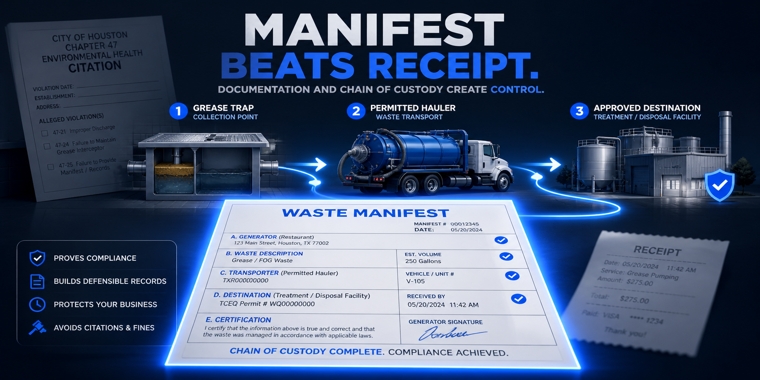
  • Manifests Beat Invoices: An invoice proves payment, but a manifest helps show where the grease waste went.
  • Check Every Pump-Out: Each grease trap service should have a matching manifest, not just a receipt.
  • Missing Details Matter: Blank dates, missing signatures, and unclear disposal records can weaken your paperwork file.
  • Fast Access Helps: A document is not inspection-ready if only one person knows where to find it.
  • Simple Systems Last: A binder, digital backup, and monthly check can keep records easier to manage.

Good paperwork turns inspection panic into a file your manager can open with confidence.

Houston restaurant owners and general managers will gain a simple readiness check here, preparing them for the detailed overview that follows.

~ ~ ~ ~ ~ ~ ~ ~ ~ ~ ~ ~ ~ ~ ~ ~ ~ ~

Open the drawer now.

The grease trap binder is sitting under a stack of vendor invoices, a stained service ticket, and one loose form with a signature you cannot quite read. Then someone says “FOG inspection,” and the question lands fast: Do we actually have the paperwork?

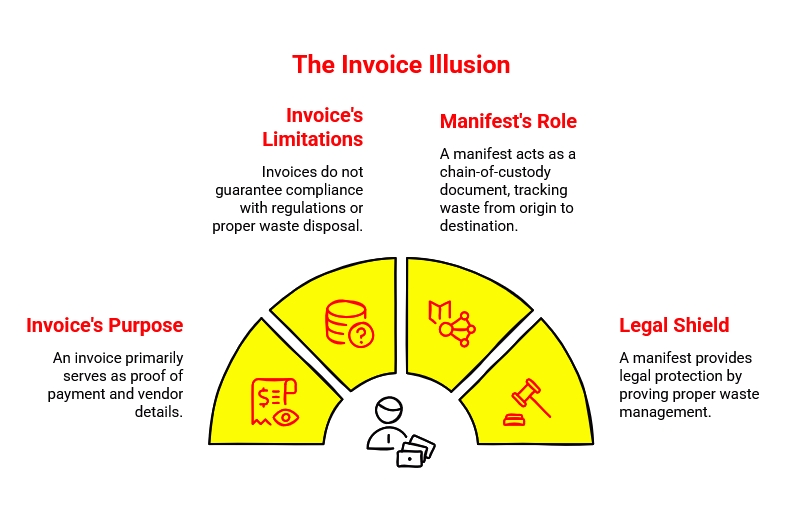
You do not need to solve every compliance issue in the next five minutes. You need to find the obvious red flags. For Houston restaurant owners and general managers, FOG Manifest Readiness starts with one simple distinction: an invoice shows that you paid someone; a manifest helps document where the grease waste went.

Houston sources identify restaurants and food dealer establishments with grease traps as special waste generators, and the Houston Permitting Center states that interceptors in incorporated Houston city limits must generally be fully evacuated at least quarterly, or every 90 days, unless an approved waiver applies. (Houston Permitting Center) The paperwork matters because inspectors may ask for FOG permits, waste manifests, invoices when applicable, waivers when applicable, and previous inspection copies. (Houston Consumer)

Before the paperwork becomes a problem, check it.


Before You Start: Grab the Right Stack of Paper

Pull together the documents you already have. Do not judge the system yet. Just gather the stack.

Start with grease trap service invoices, waste manifests, returned generator copies, FOG permit paperwork, and previous inspection documents if you have them. Check the office drawer, the back-office binder, the email inbox, and any shared digital folder before deciding something is missing.

The first pass is simple: separate proof of payment from proof of disposal. A waste manifest is not just a receipt. The Houston Health Department’s Waste Generator FAQ describes a waste manifest as an official government document completed every time an interceptor is cleaned. (houstonhealth.org)

For a deeper explanation of the broader FOG manifest chain-of-custody requirements, treat that as the next step. Right now, stay with the five-minute check.


The 5-Minute FOG Manifest Readiness Audit

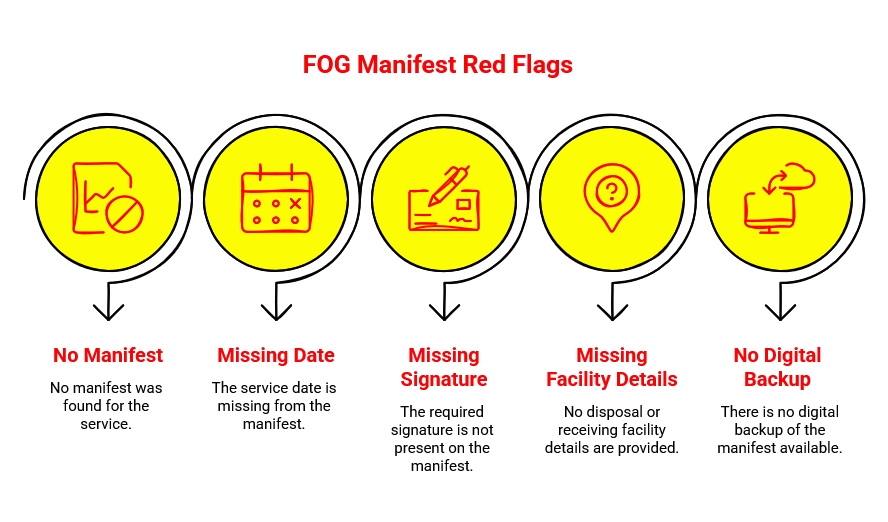
Infographic highlighting FOG manifest red flags, including no manifest, missing service date, missing signature, missing facility details, and no digital backup.

Print this quick scan or copy it into a manager checklist.

  • Red Flag: No manifest found.
  • Red Flag: Missing service date.
  • Red Flag: Missing signature.
  • Red Flag: No disposal or receiving facility details.
  • Red Flag: No digital backup.

Now check the documents one by one.


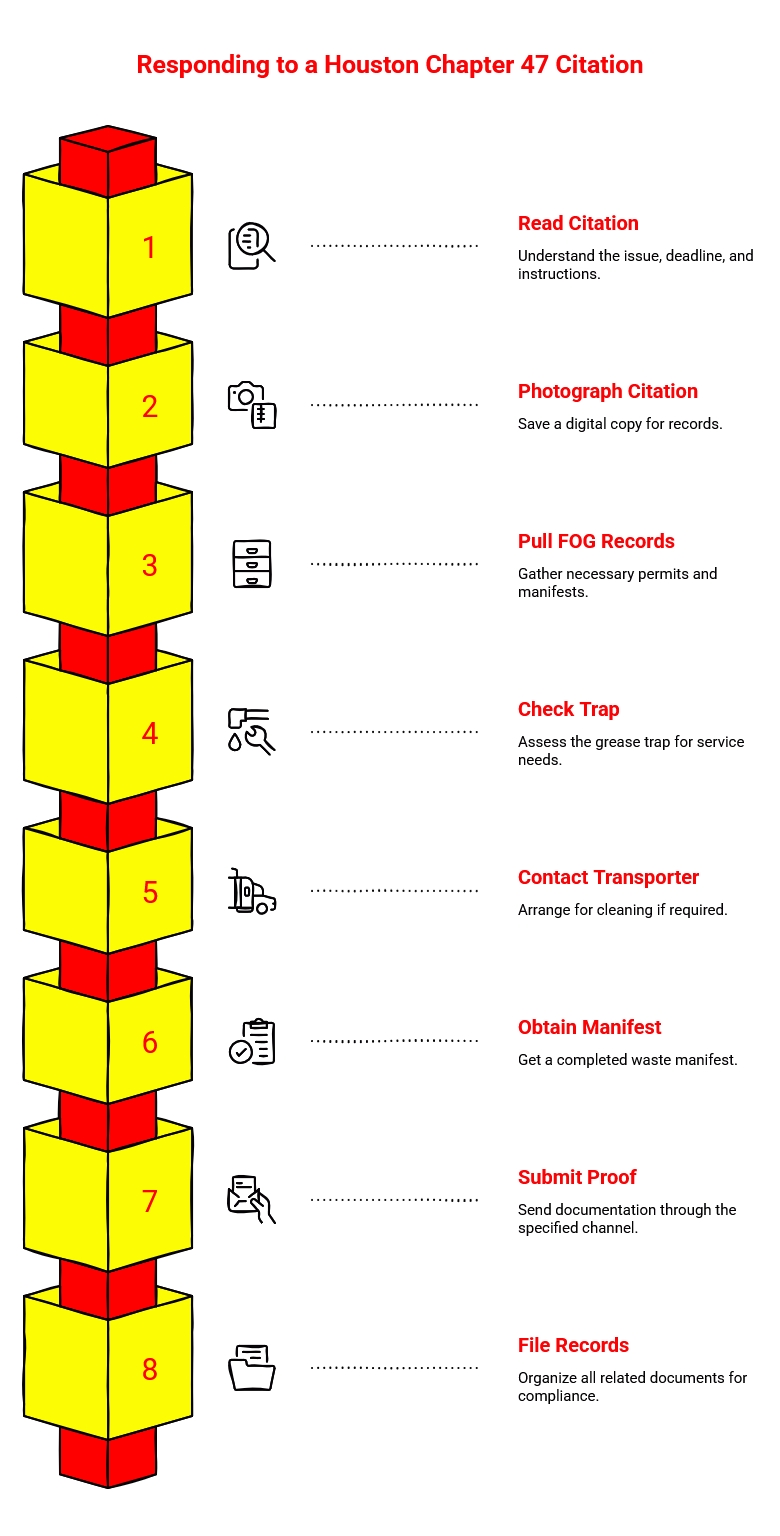
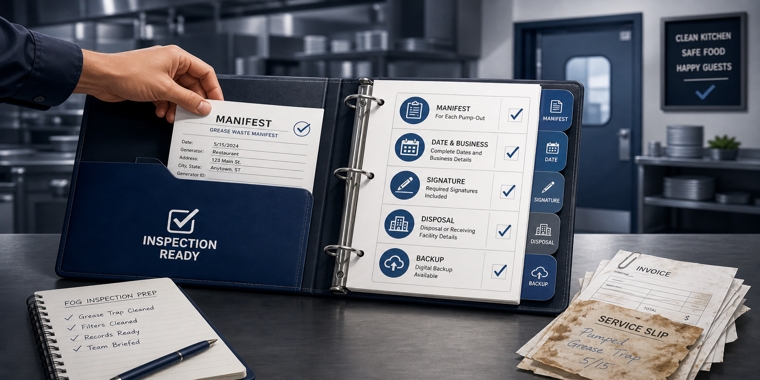
1. Do You Have a Manifest for Each Pump-Out?

Match every grease trap service event to an actual waste manifest. An invoice may show that money changed hands. A manifest documents the waste handling trail.

A useful way to think about it: the manifest works like a certified passport for wastewater. It tracks the journey from the kitchen to the disposal site.

Why it matters: You cannot defend your paperwork position if you do not know what documents you actually have.

Red flag: You have invoices, receipts, or “service completed” slips, but no manifests.

Next action: Ask your vendor for returned generator copies. Then separate invoices from compliance records. If the difference still feels unclear, review manifesting vs. invoicing before your next service visit.


2. Are Dates, Business Details, and Service Details Complete?

Look for the service date, generator information, transporter information, waste type, and amount where available. Manifest formats can vary, but the basic record should tell a clear story.

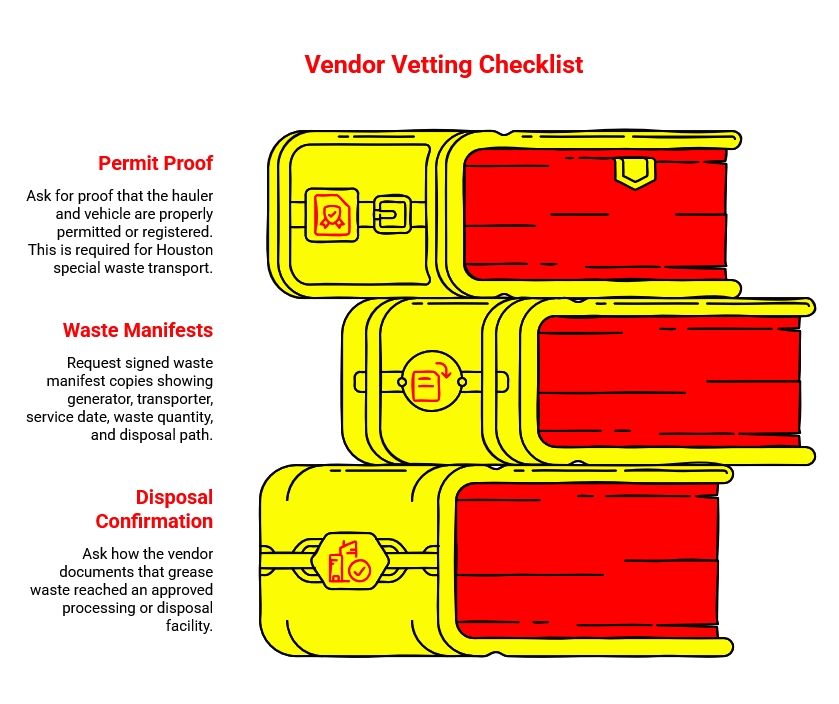
The TCEQ model standards list common manifest information such as transporter details, generator information, collection date, waste type and amount, disposal location, receiving facility identification, received volume, and tracking information. (tceq.texas.gov)

Why it matters: A partly blank form forces the manager to explain what the document should have shown.

Red flag: The form is generic, partly blank, missing the service date, or missing business details.

Next action: Mark incomplete forms and request corrected documentation from the transporter or service provider.


3. Are Required Signatures Present?

A manifest without the right signatures is not a strong confidence-builder. Houston Health’s FAQ says the generator must sign the top portion of the manifest attesting that the entire content of the trap was removed. (houstonhealth.org)

Missing dates, missing signatures, or generic receipts indicate immediate exposure.

That does not mean one missing mark automatically proves a violation. It means the paperwork needs attention before an inspection turns a small gap into a stressful conversation.

Red flag: No generator signature, no transporter signature, or no returned copy.

Next action: Decide who signs manifests after each clean-out. Then decide who files them the same day.


4. Does the Paperwork Show Where the Waste Went?

This is the chain-of-custody idea in plain language. The paperwork should help show that the waste left your kitchen and went to the proper receiving or disposal facility.

A document that only says “grease trap cleaned” does not tell the full story.

Why it matters: FOG Manifest Readiness depends on proof of proper disposal, not just proof that a truck arrived.

Red flag: No disposal facility, receiving facility, deposit location, or returned generator copy appears in the file.

Next action: Ask the hauler what facility received the waste and whether the returned generator copy documents it.

If repeated paperwork gaps show up, it may be time to compare your current process with a documented commercial grease trap cleaning in Houston service approach.


5. Can You Retrieve Copies Quickly?

A document that exists “somewhere” is not ready. During an inspection, the useful file is the one a manager can produce without searching through three desks and an old inbox.

Houston Health Department materials state that yellow and white manifest copies for the past five years may be requested during inspection, and the special waste generator page says generator and returned generator copies should be kept onsite for five years. (Houston Consumer)

Why it matters: A lost physical binder should not create audit panic.

Red flag: Only one employee knows where the manifests are. Or the only copy is a stained binder in the back office.

Next action: Keep a physical binder and a digital backup. As a general recordkeeping principle, redundancy protects the business when staff changes, a shift gets rushed, or a folder gets misplaced.

For a fuller recordkeeping system, use this separate resource on how to organize your FOG manifests for a 5-year audit. Keep today’s task smaller.


What To Do If You Find a Red Flag

If you find… Do this next
Only invoices, no manifests Request proper manifest copies from the vendor.
Missing signatures Confirm who signed, then request corrected or returned copies.
Missing dates Rebuild the service timeline from records.
No disposal or receiving information Ask for the returned generator copy.
No five-year file Start a current binder now and begin backfilling what you can.
A pattern of incomplete paperwork Reconsider whether your current vendor is protecting your compliance position.

Stay calm. Most operators are not paperwork specialists. The useful move is to identify the gap and fix the system before the next inspection or service visit.


Keep the System Simple So It Survives a Busy Kitchen

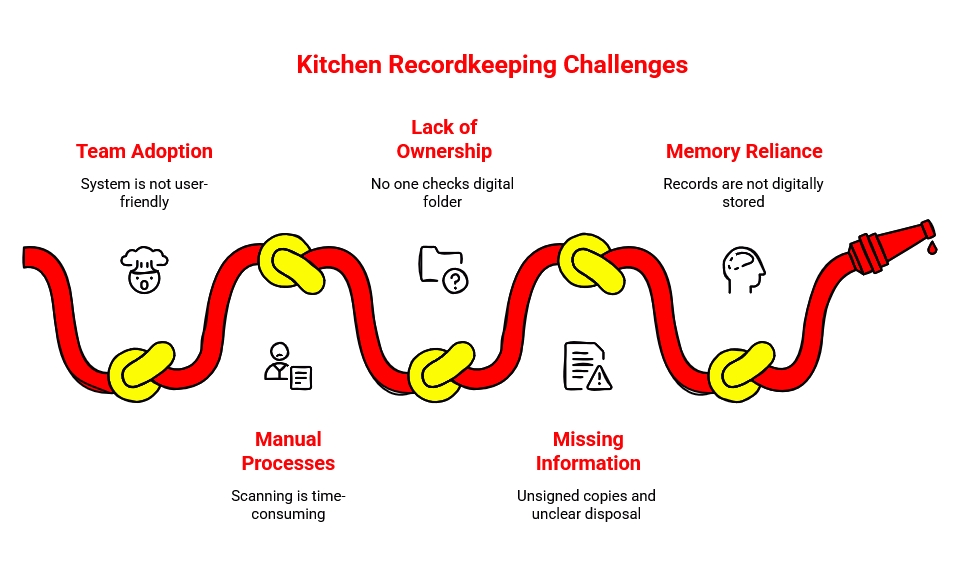
Infographic showing kitchen recordkeeping challenges such as poor team adoption, manual processes, lack of ownership, missing information, and memory reliance.

The best recordkeeping system is the one your team will actually use after a lunch rush.

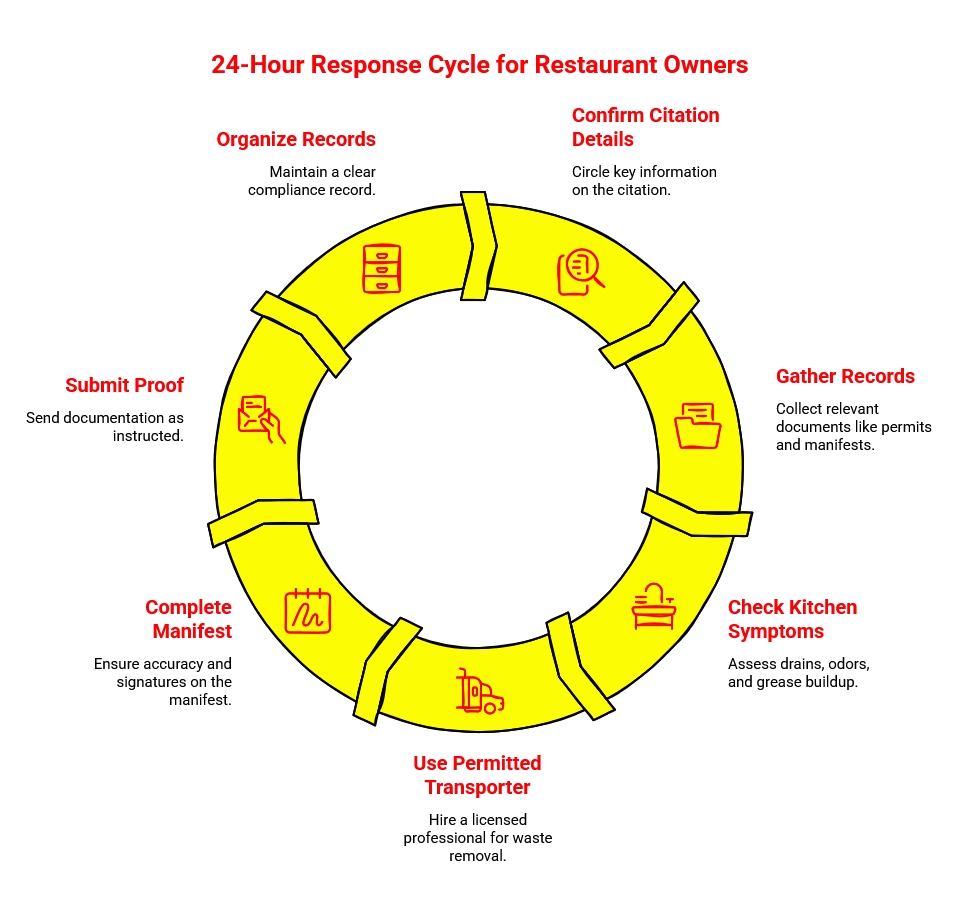
Put the newest manifest at the front of the binder. Scan or photograph each manifest the same day it is received. Use a shared digital folder named by year. Assign one owner or manager to check the folder once a month.

That is enough for a practical first system.

Drane Ranger’s liquid waste compliance content emphasizes the full service cycle: assessment, removal, proper disposal, and documentation. That matters because good service history should not live only in one person’s memory. If your current records show missing manifests, unsigned copies, or unclear disposal information, schedule your next grease trap cleaning in Houston with documentation in mind.


FOG Manifest Readiness FAQs

Is an invoice the same as a FOG manifest?

No. Treat an invoice as proof of payment. Treat a manifest as documentation of waste handling.

How long should Houston restaurants keep grease trap manifests?

Houston Health Department materials state that generator and returned generator copies should be kept onsite for five years, and inspection document lists include yellow and white copies of waste manifests for the past five years. (Houston Consumer)

What should you check first on a manifest?

Check the date, generator details, transporter details, signatures, waste amount or type where listed, and receiving or disposal information.

What if you only have receipts from your pumper?

Treat that as a red flag. Ask for manifest copies, especially returned generator copies. Do not assume the receipt is enough.

Who is allowed to clean your interceptor in Houston?

Houston Health’s FAQ says an interceptor can be cleaned only by a waste transporter permitted with the Houston Health Department. (houstonhealth.org)

When should you call a professional?

Call when documents are missing, incomplete, unsigned, unclear, or no longer match the kitchen’s real service needs. Print the 5-point checklist first. Then review your current FOG manifest file before the next service visit.

If your paperwork is missing dates, signatures, returned copies, or disposal details, contact Drane Ranger or call 281-489-1765 to discuss compliant grease trap service documentation.

The goal is not perfect paperwork theater. The goal is a file your manager can open with confidence.

Disclaimer: This article is for general informational purposes only and is not legal advice. FOG, grease trap, and waste manifest requirements can vary by jurisdiction, business type, permit status, and inspection circumstances. Restaurant owners and managers should verify current requirements with the City of Houston, Houston Health Department, Houston Permitting Center, or a qualified compliance professional.

Our Editorial Process: 

Our content is developed from a documented content strategy, reviewed against available brand materials, and checked against authoritative sources where regulatory or compliance claims are involved. We prioritize practical usefulness, clear explanations, local relevance, and evidence-supported guidance. When a claim depends on municipal rules, official program pages, or technical standards, writers should cite the relevant authority and avoid unsupported conclusions.

By: Drane Ranger Insights Team

Drane Ranger Vacuum Services has served the Greater Houston area since 1985, providing liquid waste management solutions including grease trap cleaning, grit trap cleaning, lint trap cleaning, septic services, lift station maintenance, vacuum truck services, and non-hazardous wastewater disposal support for local businesses and property owners.

A Checklist for Kitchen Managers and Owners: Aligning on Grease Trap Inspection Readiness

📌 Key Takeaways

Grease trap inspection readiness means the trap condition and paperwork must prove the same story.

  • Proof Beats Memory: “They were just here” is not enough without service records and manifest paperwork.
  • Readiness Takes Two: Kitchen managers watch drains and odors while owners control permits, manifests, and records.
  • Warning Signs Matter: Slow drains, foul odors, visible grease, or blocked access should trigger action before inspection day.
  • Records Protect You: A complete file helps show when service happened and where the waste went.
  • Schedules Need Judgment: Quarterly service may not fit busy kitchens that show problems before 90 days.

Pumping plus proof keeps inspections calmer.

Houston-area restaurant owners, GMs, and kitchen managers will align daily operations with inspection records, preparing them for the checklist that follows.

~ ~ ~ ~ ~ ~ ~ ~ ~ ~ ~ ~ ~ ~ ~ ~ ~ ~

Readiness fails in the handoff.

The clipboard is on the prep table. The drain near the dish area is moving slowly. Someone remembers a service visit, but nobody is sure where the manifest went.

That is the moment when grease trap inspection readiness becomes more than a kitchen task. It becomes a shared responsibility between the person watching the operation every day and the person who owns the records, permits, vendor relationship, and business risk. Who has the proof? That question needs an answer before an inspector asks it.

Use this grease trap inspection readiness checklist as a practical alignment tool. Print it, review it with the kitchen manager and owner or GM, and sign it before the next inspection window.


Executive Summary: Shared Liability Before the Inspector Arrives

A Houston-area restaurant is not inspection-ready just because the grease trap was pumped. It is ready when the physical condition of the trap and the paperwork trail both support the same story.

Kitchen managers usually see the first warning signs: slow drains, foul odors, blocked access, visible grease, or staff confusion about when to escalate. Owners and GMs usually control the FOG permit, manifests, service records, previous inspection copies, vendor contacts, and renewal calendar. This checklist is for both roles because an inspection does not separate “kitchen side” from “paperwork side” when the business is exposed.

Print the checklist, review it together, assign each item, and sign it after both sides confirm their responsibilities.


The Two Sides of Grease Trap Inspection Readiness

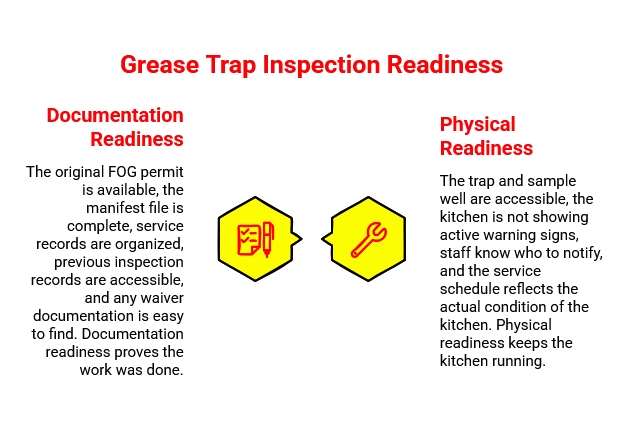
Graphic comparing grease trap documentation readiness and physical readiness, emphasizing organized FOG permits, manifests, service records, access, and warning signs.

Grease trap inspection readiness has two parts.

The first is physical readiness. That means the trap and sample well are accessible, the kitchen is not showing active warning signs, staff know who to notify, and the service schedule reflects the actual condition of the kitchen. Physical readiness keeps the kitchen running.

The second is documentation readiness. That means the original FOG permit is available, the manifest file is complete, service records are organized, previous inspection records are accessible, and any waiver documentation is easy to find. Documentation readiness proves the work was done.

For Houston context, the Houston Permitting Center identifies restaurant or food dealer establishments with grease traps as special waste generators. Under local municipal guidelines, interceptors inside incorporated City of Houston limits must be fully evacuated at least quarterly, or every 90 days, unless an approved waiver applies.

That 90-day rule should not be treated as a guarantee that every kitchen can wait 90 days. High-volume kitchens often need monthly service, and service is required when FOG reaches 25% accumulation. This is where kitchen judgment matters. A busy line, a heavy fryer program, or repeated slow drains may point to a service need before the calendar says “quarterly.”

There is also a public infrastructure reason to take FOG seriously. Houston Public Works states that 70% of sewer overflows in Houston are caused by clogs from fats, oils, grease, and wipes. (houstonpublicworks.org) The FOG-Special Waste Program tracks fats, oils, and grease to help protect the city environment from pollutants. (Houston Permitting Center)

The practical point is simple: the kitchen protects the operation, and the records protect the proof.


Kitchen Manager Responsibilities: Physical Readiness Checklist

The kitchen manager owns what can be seen, smelled, heard, and reported during service. This does not mean the kitchen manager owns every legal or vendor decision. It means the person closest to the equipment must catch the operational signals early.

Use this checklist during a pre-shift walkthrough or weekly manager review.

Physical readiness item What the kitchen manager confirms When to escalate
Trap access Grease trap access is not blocked by storage, equipment, mats, or boxes. Access is blocked or staff cannot locate the trap.
Sample well access The sample well can be reached and is not covered or obstructed. The sample well cannot be accessed quickly.
Slow drains Sinks and floor drains are moving normally. Slow drainage appears near prep, dish, or floor drains.
Odors No persistent foul odors are present near prep, dish, trap, or drain areas. Odors return after cleaning or worsen during service.
Visible grease No grease appears in floor drains, sinks, or unusual locations. Grease shows up where staff should not see it.
Last service date The latest pump-out date is known and matches the service file. Staff remember a visit, but no one can confirm the date.
Staff escalation Staff know who to notify when warning signs appear. Staff mention problems informally but no one logs them.
Service documentation Any service visit generated paperwork, not just verbal confirmation. A provider came out, but no document is available.

A common failure point is the casual phrase, “They were just here.” That may be true, but it is not enough for inspection readiness. The kitchen manager should confirm that the visit produced documentation and that the owner or GM filed it.

For more operational warning signs, Drane Ranger’s grease trap cleaning in Houston resource covers slow drainage, odors, visible grease, and 25% accumulation as service triggers.


Owner Responsibilities: Manifest and Legal Oversight Checklist

The owner or GM owns the proof system. That includes permits, manifests, inspection files, vendor information, renewal reminders, and backup records.

This work is not “just paperwork.” It is the chain of custody that shows what happened to the waste after it left the kitchen.

During an inspection, official Houston documentation may require the original Fats, Oils, and Grease permit, yellow and white copies of waste manifests for the past five years, applicable biological pretreatment invoices, waiver documentation if applicable, and copies of previous inspections. (houstonhealth.org) The City’s Code of Ordinances page is the official lookup path for Chapter 47 and City Code references. (houstontx.gov)

Use this owner-side checklist before assuming the restaurant is ready.

Documentation item What the owner or GM confirms Why it matters
FOG permit Original FOG permit is visible or on site. Confirms the permit is not missing from the inspection file.
Manifest file Yellow and white manifest copies are available for the past five years. Shows chain-of-custody history.
Service records Pump-out records are organized by date. Prevents scrambling during a review.
Previous inspections Prior inspection copies are stored with the compliance file. Helps the team understand past issues.
Waiver documentation Any applicable waiver is present and current. Avoids relying on verbal memory.
Vendor contact Service provider contact details are current. Makes escalation faster.
Renewal owner One person owns the FOG permit renewal calendar. Prevents missed renewal responsibility.
Backup location A second person knows where records are stored. Protects the business if one manager is absent.

An invoice can show that money changed hands. A manifest helps show the waste was handled through the proper custody process. That difference is the core of grease trap compliance for a restaurant team.

For deeper documentation planning, use Drane Ranger’s FOG manifest readiness resource alongside this checklist.


The Alignment Meeting: What Both Roles Must Confirm Together

Separate checklists help, but the real protection comes from the meeting where both roles compare answers.

This should be a short working meeting, not a long compliance lecture. Put the current service records, the manifest binder, the inspection file, and the kitchen manager’s warning-sign notes on one table. Then walk through three questions.

Question Kitchen Manager owns Owner/GM owns Shared decision
Is the trap physically serviceable today? Observes drains, odors, access, visible grease, and sample well conditions. Approves service escalation if risk signs appear. Call the provider if risk signs are active.
Are records inspection-ready? Confirms the latest visit occurred and staff remember the service event. Confirms the manifest is filed and records are complete. Fill any missing documentation gap before the inspection window.
Is the next service date appropriate? Reports kitchen volume and recurring warning signs. Approves the schedule and vendor communication. Move from calendar-only service to condition-aware service when needed.

This meeting solves the hidden problem. Owners want to delegate without losing oversight. Kitchen managers want clear authority to escalate before a backup, odor issue, or audit problem becomes urgent.

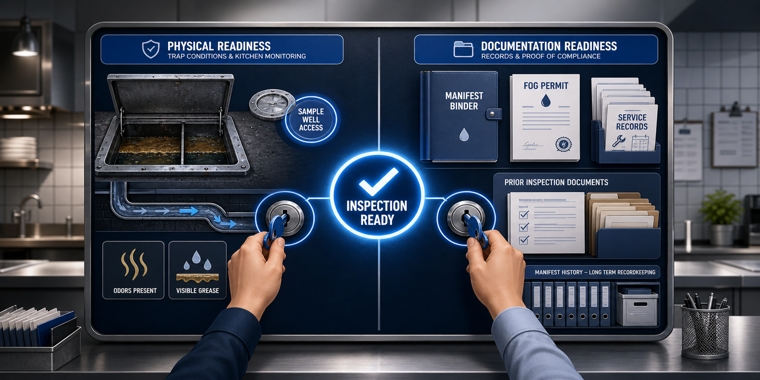
Think of it as a two-key control system. Operations turns one key by confirming the physical condition of the trap. Ownership turns the other by confirming the permit, manifests, and records. Inspection readiness works when both keys turn together.

For a broader operational reference, pair this checklist with Drane Ranger’s FOG compliance checklist and commercial grease trap cleaning compliance guide.


Printable Dual-Responsibility Checklist

Executive summary for the printed copy: Grease trap inspection readiness is shared. The kitchen manager confirms physical readiness. The owner or GM confirms documentation readiness. Both roles should review, sign, and file this checklist before the next inspection window.

Status key: Ready / Needs Action / Escalate Today

Checklist item Kitchen Manager Owner/GM Service Provider Verification Date checked Status Next action
FOG permit posted and current Confirm visible location Confirm permit file Not applicable
Five years of manifests available Confirm latest visit occurred Confirm yellow and white copies are filed Confirm manifest details if needed
Last pump-out date verified Confirm staff awareness Confirm record date Confirm service history
Trap/sample well accessible Confirm access path Approve corrective action if blocked Confirm access at service
No active slow drains Check sinks and floor drains Approve escalation if recurring Inspect if service is requested
No persistent foul odors Check prep, dish, and trap areas Approve escalation if unresolved Inspect and document findings
No visible grease in unusual places Check drains and nearby surfaces Approve service if present Verify removal/service need
Next service date scheduled Report volume and warning signs Confirm schedule and budget Confirm appointment window
Escalation contact confirmed Confirm staff know who to tell Confirm vendor contact is current Confirm emergency/service contact

Next Scheduled Service Date: ______________________

Manifest Binder Location: ______________________

Emergency / Service Contact: ______________________

Kitchen Manager Signature: ______________________

Owner/GM Signature: ______________________

Date Completed: ______________________

This checklist is designed to look and function like an operations board: clear, high contrast, minimal decoration, and credible enough to keep in a compliance binder or manager office.


When to Escalate to a Professional Grease Trap Service

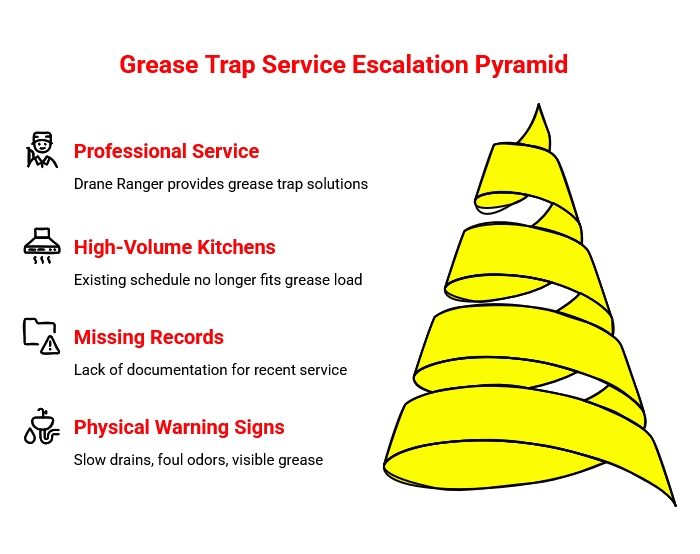
Infographic showing grease trap service escalation from physical warning signs and missing records to high-volume kitchens and professional service.

Call a professional when the checklist shows physical warning signs. Slow drains, foul odors, visible grease, inaccessible trap areas, and uncertainty about the last pump-out date are practical escalation triggers. Waiting for the default quarterly date may not be appropriate when the kitchen is already showing signs of strain.

Call a professional when records are missing and the team cannot prove recent service. A restaurant may have paid an invoice, but inspection readiness depends on organized documentation and manifest control. True readiness is not just pumping. It is pumping plus proof.

Call a professional when the restaurant is high-volume and the existing schedule no longer fits the kitchen. High-volume kitchens often require monthly service. That frequency may vary by operation, but the principle is stable: the service interval should reflect actual grease load, warning signs, and documentation needs.

Drane Ranger provides Grease, Grit & Lint Traps service, compliance documentation support, responsible disposal, reliable service, and service interval guidance for Houston-area businesses. The company has served Houston-area customers since 1985 and operates across the Greater Houston area within a 100-mile radius from its location.

As Shelley M. shared, “Drain Ranger is very professional and reliable. Basically they can take care of all your grease drain needs.”

When the checklist shows a gap, close it before the inspection does. Request your quote or contact Drane Ranger to schedule service support.

Start Your Service Today – Call 281-489-1765


Frequently Asked Questions

What documents should a Houston restaurant have ready for a grease trap inspection?

A Houston restaurant should be prepared to show the original FOG permit, manifest copies, service records, previous inspection copies, and waiver documentation if applicable. Official inspection documentation requirements may vary by situation, so confirm current requirements through the Houston Permitting Center and City of Houston sources.

Who should own grease trap compliance: the kitchen manager or the owner?

Both roles own part of the system. The kitchen manager owns physical readiness signals, such as access, odors, slow drains, visible grease, and staff escalation. The owner or GM owns documentation readiness, including permits, manifests, service records, vendor contacts, and renewal accountability.

Is an invoice enough proof of grease trap service?

An invoice is useful, but it should not be treated as a substitute for manifest documentation. The brief’s central compliance point is “manifests over invoices.” Manifests help show chain of custody for the waste, while invoices mainly show a business transaction.

How often should a grease trap be cleaned in Houston?

The Houston Permitting Center states that interceptors within incorporated City of Houston limits must be fully evacuated at least quarterly, or every 90 days, unless an approved waiver applies. High-volume kitchens may need more frequent service, and service is required when FOG reaches 25% accumulation.

When should a restaurant call a grease trap service provider before an inspection?

Call when the checklist shows physical warning signs, missing documentation, unclear service history, blocked access, or a service interval that no longer matches kitchen volume. The earlier the team closes the gap, the less pressure there is during an inspection.

Our Editorial Process

Publication Hold: Approved Drane Ranger editorial process copy was not found in the provided corpus. Insert the client-approved editorial process text here before publication. Do not publish invented editorial-process language as if it were brand-approved.

About the Drane Ranger Insights Team

The Drane Ranger Insights Team creates practical wastewater and grease trap compliance resources for Houston-area businesses. Final publication should be reviewed by a qualified Drane Ranger representative for service accuracy and current local compliance details.

The 90-Day Pumping Myth: A Complete Framework for Commercial Grease Trap Inspection Readiness

📌 Key Takeaways

A 90-day grease trap schedule helps, but real inspection readiness depends on clean access, records, and daily warning signs.

  • Calendar Is Not Proof: Treat 90 days as a baseline, not proof your grease trap is ready today.
  • Check The System: Watch slow drains, odors, blocked access, and grease before small problems disrupt kitchen service.
  • Keep Records Ready: Store permits, manifests, invoices, and past inspection records where managers can find them fast.
  • Use Real Volume: Match service timing to kitchen load, busy periods, menu changes, and actual trap condition.
  • Own The Process: Assign one person and a backup to manage records, checks, and follow-up actions.

Prepared records and clean access beat calendar confidence.

Houston-area restaurant owners, general managers, and kitchen managers can use this framework before the full inspection-readiness guide.

~ ~ ~ ~ ~ ~ ~ ~ ~ ~ ~ ~ ~ ~ ~ ~ ~ ~

The calendar is not your shield.

The sink gurgles during prep, the dish area smells faintly sour, and the manager’s office has a binder that nobody has opened since the last pump-out. We pumped this quarter. Are we actually ready?

You are not wrong to ask. For Houston-area restaurant owners, general managers, and kitchen managers, a 90-day pump-out schedule can feel like proof that the grease trap is handled. It is only a starting point. True compliance means your kitchen can show physical readiness, documentation readiness, and a service rhythm that reflects actual grease and solids buildup.

A 90-day pump-out schedule is not the same thing as inspection readiness. For Houston restaurant operators, readiness means the grease trap is accessible, the sample well is clean, warning signs are being monitored, and the required paperwork is ready before an inspector asks for it.

Inspection readiness is the systematic preparation, documentation, and maintenance process required to pass municipal fats, oils, and grease audits without avoidable disruption. It works like a pre-flight checklist for the kitchen’s wastewater system before regulators arrive. The goal is simple: when an inspector shows up, the manager can show clean access, organized records, and a service rhythm based on actual risk rather than hope.

Houston’s rules make the baseline clear. The Houston Health Department states that every interceptor inside incorporated city limits must be fully evacuated at least quarterly, or every 90 days, unless an approved waiver applies. The same guidance tells generators to inspect and verify the trap is clean before signing the manifest, keep the sample well clean, retain generator copies, and keep manifest records onsite for five years. It also says inspections may happen without notification. (Houston Consumer)

That is the part the myth misses.

The inspection does not measure your calendar; it checks the condition of the system and the paperwork in front of the inspector.


Start Here: The 7-Point Grease Trap Inspection Readiness Check

Before definitions, start with the check that matters.

Readiness check Green Watch Action
Trap access Clear and reachable Blocked by storage or equipment Clear the area before service or inspection
Sample well Clean and accessible Hard to locate or partially blocked Confirm access and condition
Last pump-out date Known and documented Known only by memory Locate the service record
Waste manifests Organized and onsite Scattered or incomplete Collect yellow and white copies where required
Drain performance Normal flow Slow prep, dish, or floor drains Review trap condition before waiting
Odor control No persistent grease-trap odor Recurring odor near trap or prep area Treat as a warning sign
Service rhythm Based on volume and condition Based only on calendar habit Reassess after busy periods

This check helps you separate perceived compliance from true compliance. Perceived compliance says, “We paid for pumping.” True compliance says, “We can prove our trap, sample well, service records, and operating habits are ready today.”

Add one more practical safeguard: assign one staff member to own manifest collection and record storage. Staff turnover can create a real paperwork gap. If only one former manager knew where the records lived, the restaurant may be exposed even after the physical cleaning was done.

Houston Permitting Center lists the inspection documents investigators may need, including the original Fats, Oils and Grease permit, yellow and white copies of waste manifests for the past five years, applicable invoices, notices of waiver if applicable, and copies of previous inspections. It also notes that investigators may check the trap and sample well. (Houston Permitting Center)


The 90-Day Pumping Myth: Why the Calendar Alone Does Not Protect a Busy Kitchen

Grease Trap Readiness Cycle: Circular checklist showing steps for grease trap readiness, including inspection, service history, pumping intervals, documentation, and records.

The 90-day rule is a baseline. It is not a guarantee.

A cafĂŠ with steady light volume and a chef-driven restaurant with weekend rushes do not produce the same fats, oils, grease, and solids load. Their calendars may look identical. Their traps may not.

The calendar can tell you when the last pump-out happened. It cannot tell you whether the trap is inspection-ready today.

That distinction matters because kitchen volume changes. A long catering weekend, a holiday surge, a menu shift toward fried foods, or a stretch of unusually heavy service can all increase the load going into the interceptor. Those are general operational principles, not a claim that every restaurant needs the same shorter schedule. The right interval depends on actual use, trap condition, and documented service history.

This is where the old habit becomes risky. A restaurant may keep pumping every quarter because that schedule has not caused a visible failure yet. That does not prove the rhythm is safe. It may only mean the warning signs have not become obvious.

The better question is not, “Are we on the 90-day schedule?”

The better question is, “Could we show that the trap, sample well, and records are ready if the city walked in today?”

For deeper support on inspection preparation, Drane Ranger’s internal article on How to Prepare Your Kitchen for a City of Houston Grease Trap Inspection can serve as a companion resource. This page stays focused on the broader readiness model.


The 25% Rule Reality: Floating Grease Plus Settled Sludge

A grease trap does not fail only because of the grease you can see.

FOG can float near the top. Sludge and solids can settle at the bottom. The usable water capacity sits between those layers, and that middle space is what keeps wastewater moving properly through the system. When buildup reduces that working space, the kitchen may be closer to trouble than the surface view suggests.

That is why visual confidence can mislead a busy kitchen. A quick look may catch floating grease, but it can miss settled sludge. By the time slow drains or odors become obvious, the trap may already deserve attention.

For Houston operators, Drane Ranger’s own grease trap guidance lists warning signs such as slow kitchen sink drainage, persistent odors near the grease trap, visible grease in unusual places, and grease accumulation exceeding 25% of total liquid depth.

The practical takeaway is simple. Do not wait for the trap to announce the problem through a backup, a smell near the prep area, or a sink that refuses to drain during lunch service.

If you want the deeper spoke topic, use the internal explanation of the 25% rule for Houston grease trap compliance. For this hub, the main point is readiness: floating grease and settled sludge both matter.


What Inspectors Need to See: Physical Access, Sample Wells, Permits, and Manifest Records

Inspection readiness has two sides.

Physical readiness is what the investigator or service provider can access and observe. That includes the grease trap, sample well, drain behavior, odor conditions, surrounding area, and practical access to the system.

Paperwork readiness is what the manager can produce without panic. That includes permits, waste manifests, applicable invoices, waiver documents if any apply, and prior inspection records.

Houston Permitting Center states that restaurant or food-dealer establishments with a grease trap are special waste generators. It also says a Fats, Oils and Grease permit is valid for one year from the food dealer permit issue date and must be renewed annually. (Houston Permitting Center)

During inspection, Houston Permitting Center lists the following document categories:

Document or item Why it matters
Original Fats, Oils and Grease permit Shows permit status and site compliance paperwork
Yellow and white waste manifest copies Supports waste handling and clean-out history
Applicable invoices May support service history, but do not replace manifests
Notice of waiver, if applicable Shows approved exception status
Previous inspection copies Helps show prior compliance history and follow-up

This is where many restaurants discover the gap. The trap may have been pumped, but the paperwork is in an email inbox, a former manager’s drawer, or a file cabinet that nobody checks until the inspector is already waiting.

A good readiness habit is boring by design. Keep the records where the current manager can find them. Maintain a backup. Confirm that the service documentation includes the service date, waste quantity, disposal facility information, and system issues identified where that information is available. Drane Ranger’s liquid waste management page describes professional service as covering the lifecycle from assessment and removal through proper disposal and documentation.

Boring systems protect restaurants.


Invoices vs. Manifests: Why Paperwork Can Make or Break Readiness

Invoice vs. Manifest: Infographic comparing grease trap invoices and manifests, explaining documentation, Houston guidance, chain of custody, and inspection readiness.

An invoice may show that a transaction happened.

A manifest helps document the handling of waste and the chain of custody. Those are not the same thing.

This is the invoice illusion: a restaurant assumes that because it paid for a pump-out, it can prove inspection readiness. Payment is not the whole record. The manager still needs the right manifest copies, organized records, and a clear process for keeping those documents onsite.

Houston Health Department guidance tells generators to sign the generator portion of the manifest, retain the generator copy, and return the generator copy from the transporter within 15 days of pump-out. It also says generator and returned generator copies of waste manifests should be kept onsite for five years. (Houston Consumer)

That requirement turns paperwork into operational protection. The manager who can open a binder or digital folder in 17 seconds has a different day than the manager who starts searching old emails while the inspector waits.

For a nearby supporting topic, the internal FOG compliance checklist can help teams think through documentation and readiness habits without turning every shift lead into a compliance specialist.


A Houston Kitchen’s Risk Signals: When to Pump Before the 90-Day Mark

A grease trap usually sends signals before it creates a full disruption.

Slow drainage in kitchen sinks is one. Persistent unpleasant odors near the grease trap are another. Visible grease in unusual places, such as sinks or floor drains, also deserves attention. So does any uncertainty about the last pump-out date or where the manifest records are stored.

These signs do not automatically prove a violation. They do tell you the system deserves attention before you assume the next scheduled date is safe.

High-volume service periods deserve the same caution. A restaurant that runs a heavy weekend, adds fried menu items, or handles a seasonal spike may produce more FOG than its usual rhythm reflects. That does not create a universal rule for shorter intervals. It creates a reason to review the trap’s actual condition.

Poorly managed grease traps can lead to unwanted odors and costly sewage backups, according to Drane Ranger’s grease, grit, and lint trap service page. The same project source states that Drane Ranger disposes of waste safely and uses an environmentally responsible system for liquid waste removal that complies with local regulations.

The point is not fear. The point is timing.

A manager who catches the pattern early can schedule service, gather records, and keep the kitchen running. A manager who waits for the drain to stop has fewer choices.


Build a Volume-Based Readiness Rhythm Instead of a Date-Based Habit

A date-based habit asks one question: “When is the next pump-out?”

A volume-based readiness rhythm asks better questions:

Readiness habit What to track
Service history Last pump-out date, manifest return, and next scheduled review
Kitchen symptoms Slow drains, odors, visible grease, staff complaints
Trap condition FOG and solids accumulation, access, sample well condition
Documentation Permit, manifests, invoices, prior inspection copies
Operational changes Busy weekends, menu changes, catering spikes, seasonal volume

This does not require a complicated system. A simple log can work. The value comes from consistency.

At the end of each high-volume period, assign a manager to check three things: drain behavior, odors, and records. If the sink has slowed, the prep area smells off, or the manifest binder is incomplete, do not wait for the calendar to rescue the kitchen.

Professional assessment can help determine whether the kitchen’s service interval matches actual FOG load. Drane Ranger’s project materials describe customized liquid waste solutions and note that the company works with clients rather than forcing package deals that do not fit the operation.

That matters for independent restaurants. A small cafĂŠ, a high-volume hotel kitchen, and a fast-casual fry-heavy concept should not assume the same maintenance rhythm simply because the baseline rule uses the same number.


FOG Audit Pre-Flight Checklist

Use this as a practical self-check before the next inspection, after unusually heavy service, or whenever slow drains, odors, or missing paperwork create doubt.

Readiness area Pass Watch Fail Action needed
Trap access Clear path and access Access partially blocked Access unknown or blocked Clear storage and confirm reachability
Sample well access Clean and accessible Hard to locate Blocked or neglected Confirm condition before inspection
Drain behavior Normal flow Occasional slow drains Repeated slow drains Review trap condition and service timing
Odor presence No persistent odor Intermittent odor Recurring odor near trap or prep area Treat as warning sign
Last service date Date documented Date known by memory Date unknown Locate record or call provider
Manifest copy Onsite and organized Partial record Missing record Rebuild file and request copies where possible
Permit availability Easy to locate Not posted or hard to find Missing or expired Confirm current requirement with official source
Staff ownership Named person owns records Informal ownership Nobody owns records Assign one manager and a backup
Documentation details Service date, quantity, disposal facility, and issues recorded where available Some details missing No usable documentation Improve provider and record process
Provider readiness Supports scheduling, disposal, and documentation Unclear process Only invoice provided Ask what records and disposal documentation are supplied
Next review date Scheduled after busy periods Calendar only No review rhythm Add a review after high-volume service

If most rows are green, keep monitoring and keep the records organized.

If several rows are in watch status, schedule a review before the next high-volume period.

If any row is in fail status, especially missing manifests, blocked access, repeated slow drains, or persistent odors, treat the issue as active. Do not wait for the next 90-day date to make the decision for you.


How Drane Ranger Helps Houston Restaurants Stay Inspection-Ready

Drane Ranger is not a law firm and does not provide legal advice. Its role is practical: help Houston-area businesses manage liquid waste needs professionally, with service, disposal, and documentation support.

Drane Ranger has served Houston-area customers since 1985, and the company’s project materials emphasize customer service, outstanding work, trained and certified staff, and rule-following. The company also describes services across the Greater Houston area, including grease trap, grit trap, lint trap, lift station, septic, vacuum truck, liquid waste management, and non-hazardous wastewater disposal services.

For restaurant operators, the most relevant service path is commercial grease trap cleaning in Houston and related grease, grit and lint trap services. Those services fit the practical readiness cycle: assess the need, remove accumulated waste, support responsible disposal, and maintain documentation that helps the business track service history.

The trust signal should stay in its lane. Drane Ranger’s BBB accreditation may support company credibility, but it is not regulatory proof and should not be treated as inspection authority. The regulatory facts belong to the City of Houston, Houston Health Department, Houston Permitting Center, Houston Public Works, and TCEQ.

Customer proof can still be useful when it stays modest. As Shelley M. wrote in a Google review: “Drain Ranger is very professional and reliable. Basically they can take care of all your grease drain needs.”

Use the checklist first. If it reveals odors, slow drains, missing manifests, blocked access, or schedule uncertainty, contact Drane Ranger for help reviewing your grease trap cleaning needs. For active issues, call 281-489-1765.


Why FOG Readiness Is Bigger Than One Kitchen

FOG management is not only a restaurant paperwork issue. It also affects the public wastewater system.

Houston Public Works states that 70% of sewer overflows in Houston are caused by clogs from fats, oils, and grease poured down drains and wipes flushed down toilets. The same page says sewer overflows can cost thousands of dollars to repair, harm health, and pollute the environment. (houstonpublicworks.org)

TCEQ also frames grease management as a broader sewer-system issue. Its model standards page explains that model grease-management standards help municipal governments reduce FOG in sewer systems, and it lists benefits such as reduced sewer backups into homes and businesses and reduced risk of contamination from sewer overflows. (tceq.texas.gov)

For a restaurant manager, that broader context points back to one practical habit: do not treat the grease trap as a hidden box behind the kitchen. Treat it as part of the operation.

You track inventory because running out of food disrupts service. You track labor because staffing gaps hurt the guest experience. Grease trap readiness deserves the same operational respect.

Quiet systems are still systems.


FAQ: Commercial Grease Trap Inspection Readiness

Is every 90 days enough for a commercial grease trap?

No. Every 90 days is the baseline evacuation requirement for interceptors located inside incorporated Houston city limits unless an approved waiver applies. A busy kitchen may need closer monitoring based on volume, trap condition, odors, slow drains, and documentation status. The safer operational habit is to treat 90 days as the minimum baseline, not as automatic proof of readiness. (Houston Consumer)

What should a Houston restaurant have ready for a FOG inspection?

Houston Permitting Center lists the original Fats, Oils and Grease permit, yellow and white waste manifest copies for the past five years, applicable invoices, waiver notices if applicable, and prior inspection copies. Investigators may also check the trap and sample well. (Houston Permitting Center)

What is the difference between an invoice and a manifest?

An invoice generally shows that a service transaction occurred. A manifest helps document waste handling and chain-of-custody. For inspection readiness, the manifest is the stronger compliance record. Keep it organized and onsite according to the applicable Houston guidance.

What warning signs mean a grease trap may need cleaning before the next scheduled service?

Slow kitchen sink drainage, persistent odors near the grease trap, visible grease in unusual places, and uncertainty about records are practical warning signs. Grease accumulation exceeding 25% of total liquid depth is also identified in Drane Ranger’s Houston grease trap guidance as a sign that cleaning may be needed.

Why does sample well access matter?

The sample well is part of the inspection picture. Houston official guidance says investigators may check the trap and sample well to ensure discharge is consistent with mandated parameters. If the sample well is blocked, neglected, or hard to access, the restaurant’s readiness breaks down before the paperwork can help. (Houston Permitting Center)

What should a manager do if records are missing?

Start by rebuilding the record trail. Look for manifests, prior inspection copies, service invoices, emails from the transporter, and any returned generator copies. Then assign one current manager and one backup to own record storage. For current regulatory expectations, confirm details with the City of Houston or a qualified compliance professional.


Ready Means Proved, Not Assumed

Back in the manager’s office, the binder should not be a mystery.

The sample well should not be a guess. The last pump-out should not depend on someone’s memory. The next service date should not be chosen only because the calendar repeated an old habit.

That is the shift from perceived compliance to true compliance.

Perceived compliance says, “We pumped every 90 days.” True compliance says, “The trap is accessible, the sample well is ready, the records are onsite, and the service rhythm reflects how this kitchen actually operates.”

Stop letting the calendar do the whole job. Build the proof. Keep it ready. Protect the kitchen.

Disclaimer: This article is for general informational purposes only and is not legal advice. Houston FOG rules, permit requirements, and enforcement practices can change. Restaurant owners and managers should confirm current requirements with the City of Houston, Houston Health Department, or a qualified compliance professional.

Our Editorial Process:

This article was developed from the approved Content Strategy Document, Drane Ranger project files, official Houston and Texas regulatory sources, and documented customer testimonial material. It avoids unsupported service-cost claims, guaranteed inspection outcomes, invented fine timelines, and competitor comparisons.

By: Drane Ranger Editorial Team

Drane Ranger Vacuum Services has provided liquid waste management solutions for Houston-area businesses since 1985, including grease trap, grit trap, lint trap, lift station, septic, and vacuum truck services.

The Anatomy of a Shutdown: How Grease Trap Failures Disrupt Friday Dinner Rushes

📌 Key Takeaways

A Friday-night grease trap failure starts long before drains back up—early warning signs are your real shutdown prevention window.

  • Warning Signs Aren’t Noise: Slow drains, faint odors, and grease pooling near floors signal a failure already building, not minor issues to ignore until next week.
  • 90 Days Is a Floor, Not a Shield: Houston’s quarterly cleaning rule sets a minimum, but high-volume kitchens often need service every 30–60 days based on actual grease buildup.
  • The 25% Rule Triggers Immediate Action: When grease and solids hit one-quarter of trap capacity, service is required right away—regardless of when your last cleaning happened.
  • Shutdowns Cascade Fast: Once a trap overflows, dishes pile up, odors reach the dining room, and guests leave—lost covers during that window are gone for good.
  • Reputation Damage Outlasts the Plumber: A single review mentioning sewage smell during dinner can undo months of five-star service long after the drain clears.

Treat warning signs as pre-failure signals, not annoyances—your Friday night depends on it.

Restaurant operators managing high-volume kitchens will find actionable prevention steps here, preparing them for the compliance details that follow.

~ ~ ~ ~ ~ ~ ~ ~ ~ ~ ~ ~ ~ ~ ~ ~ ~ ~

The dining room is packed. Tickets are flying. Your line is moving in sync, and every seat is full.

Then someone whispers three words from the back: “Dish pit’s backing up.”

Within minutes, a sulfur smell creeps toward table six. Within the hour, your kitchen is paralyzed, guests are leaving early, and you are comping meals for people who will remember the smell long after the plumber leaves. This is not a plumbing inconvenience. This is the anatomy of a shutdown—and it starts long before the drain stops moving.


What a healthy Friday dinner rush should feel like

When your grease trap is working, you do not think about it. Dishes clear steadily. The kitchen smells like the food you are serving. Staff stays focused on execution, not emergency management.

That invisible stability is what every restaurant operator counts on during peak hours. The problem is that stability erodes quietly, beneath the surface, until one Friday night it collapses without warning.


The warning signs operators talk themselves out of

Most shutdowns do not begin with a flood. They begin with signals that feel minor when the kitchen is moving fast.

A prep sink that drains slowly seems like a small nuisance—until it backs up entirely during the dinner rush and your dishwasher cannot turn plates fast enough to keep the line supplied. Foul smells near the trap feel like something to address next week—until those odors drift into the dining room mid-service. Grease pooling near floor drains looks manageable—until you realize the system has already crossed a threshold your schedule did not account for.

These are not background noise. They are the early stages of a failure chain already in motion. For a deeper look at how these signals escalate, review the full failure pattern in what happens during a grease trap overflow and compare them with other warning signs of imminent grease trap failure.


The shutdown sequence: when one trap problem becomes a service-floor crisis

Illustration of overflowing red grease trap showing 4 crisis impacts: kitchen flow breaks, odor reaches dining room, service stops, and lasting reputation damage from plumbing failures.

Once a grease trap tips from “nearly full” to “overflow,” the cascade moves quickly. Think of it as a chain reaction: trap overflows, drains back up, odor reaches the dining room, service stops, and the damage spills into reviews and reputation.

Kitchen flow breaks first. When wastewater has nowhere to go, dishes pile up. Prep sinks become unusable. The rhythm your team depends on falls apart. A kitchen line is only as fast as its slowest station—and that station just became a plumbing emergency.

Then the odor reaches the dining room. Grease trap overflow does not smell faint. It smells like raw sewage, and it travels. Guests notice before anyone can mask it. No amount of ventilation fixes what has already started.

Service stops. You cannot seat guests into a dining room that smells. You cannot serve food from a kitchen that cannot clear dishes. The covers lost during the shutdown window are not recoverable. They are simply gone.

A grease trap backup during peak hours causes immediate, unrecoverable operational downtime. You are not just paying for a plumber—you are losing seating, comps, staff momentum, and service continuity.

The damage outlasts the plumbing call. Comped meals and frustrated staff are only the beginning. The guest who experienced that smell will talk about it—at work, at home, and online. A single review mentioning “sewage smell during dinner” can undo months of five-star service. The event ends when the drain clears. The reputation damage does not.


Why this happens earlier than owners expect

The 90-day cleaning minimum is not a safety guarantee for high-volume kitchens. Houston requires grease trap cleaning every 90 days, but that regulation establishes a floor, not a protection plan. High-volume kitchens frequently need service on a 30-to-60-day cycle—sometimes shorter during peak seasons.

The trap does not care about your calendar. It cares about accumulation. When grease and solids reach the 25% capacity threshold, service is required immediately—regardless of whether 90 days have passed. The EPA’s guidance on food-service FOG control reinforces why this matters: accumulated fats, oils, and grease create problems for both your facility and the broader municipal wastewater system.

Busy kitchens hit that threshold faster than operators expect. Relying on quarterly timing as a safety net is how shutdowns happen “out of nowhere.” The math simply does not work for restaurants pushing high volume through their kitchens night after night.

For a deeper local breakdown of service frequency, see how often a commercial grease trap should be cleaned in Houston.


The bridge: what prevents the next Friday-night failure

Diagram showing proactive prevention transforms recurring grease trap failures into a predictable kitchen through addressing slow drains, volume-based intervals, and reliable service partners.

Prevention starts with treating warning signs as pre-failure signals, not annoyances. Slow drains, faint odors, and visible grease should change the schedule immediately—not become something the team works around for one more weekend.

The next step is using a service rhythm based on actual kitchen volume, not wishful default timing. That means establishing a service interval based on your operation’s reality, not hopeful assumptions about making it to the 90-day mark.

A reliable prevention partner makes the process concrete. The right provider assesses your actual waste generation rate, recommends intervals based on your volume, and maintains documentation that satisfies inspectors. Proper service includes records of service dates, waste quantities, disposal-facility information, and any system issues identified during each pump-out. It also means transportation to approved processing facilities and environmentally responsible handling.

As Shelley M. shared: “Drain Ranger is very professional and reliable. Basically they can take care of all your grease drain needs.”

That kind of reliability transforms grease trap cleaning from a recurring crisis into a quiet, predictable part of running a kitchen. For readers comparing provider quality, it helps to review five signs your current grease trap service isn’t doing the job right and the main commercial grease trap cleaning in Houston guide.


When to act immediately

Do not wait for your next scheduled service if you are experiencing any of these conditions:

  • Active odors during service hours
  • Backups or drainage that is getting worse rather than better
  • Visible grease pooling where it should not be
  • Signs that accumulation is outpacing your current schedule

These situations require same-day attention, not a note in next week’s calendar.

The operators who protect their Friday nights are the ones who treat grease trap maintenance as operational insurance—not an afterthought. Walk through the FOG compliance checklist before your next high-volume weekend.

If your kitchen is already showing warning signs, Drane Ranger has served the Greater Houston area since 1985 and keeps emergency response available for immediate-risk situations. The company’s trust record can be verified through its Better Business Bureau profile. Call 281-489-1765 to start your service today.

A Friday-night shutdown feels sudden when viewed from the dining room. From the system side, it usually is not sudden at all. It is a chain—and chains can be broken. The control point is earlier than it looks.

Our Editorial Process: 

Our expert team uses AI tools to help organize and structure our initial drafts. Every piece is then extensively rewritten, fact-checked, and enriched with first-hand insights and experiences by expert humans on our Insights Team to ensure accuracy and clarity.

About the Drane Ranger Insights Team: 

The Drane Ranger Insights Team is our dedicated engine for synthesizing complex topics into clear, helpful guides. While our content is thoroughly reviewed for clarity and accuracy, it is for informational purposes and should not replace professional advice.

Why Relying on the 90-Day Pumping Mandate Guarantees an Unannounced FOG Audit

📌 Key Takeaways

The 90-day grease trap pumping rule is a legal deadline, not a safety plan—busy kitchens often fill up weeks before that date arrives.

  • Calendar Compliance Creates False Security: Houston’s 90-day rule sets a minimum standard, not a recommended interval tailored to your kitchen’s actual grease output.
  • The 25% Rule Triggers Earlier Service: When grease and solids reach 25% of your trap’s depth, you need pumping—regardless of what the calendar says.
  • Surprise Inspections Follow Patterns: City audits respond to sewer blockages, odor complaints, and documentation gaps—not random selection.
  • Warning Signs Appear Early: Slow drains, faint odors near floor drains, and grease in unexpected places signal your trap is filling faster than your schedule assumes.
  • Volume-Based Scheduling Prevents Problems: Track how quickly warning signs appear after each pump-out, then schedule service before symptoms start—not when the calendar says.

Match your pumping schedule to your kitchen’s output, and inspectors will have nothing to find.

Houston restaurant operators managing high-volume kitchens will gain clarity on avoiding compliance gaps, preparing them for the detailed FOG guidance that follows.

~ ~ ~ ~ ~ ~ ~ ~ ~ ~ ~ ~ ~ ~ ~ ~ ~ ~

You mark the calendar: 87 days since the last pump-out. Three more days. Safe.

That confidence is exactly what gets Houston kitchens blindsided. The 90-day pumping rule feels like a finish line—a date you hit, a box you check, a problem you’ve handled. But for busy restaurants, that calendar-based comfort can be the riskiest habit in the building.

Meeting the legal minimum and being inspection-ready are not the same thing. The city’s 90-day requirement establishes a compliance floor. It doesn’t account for how fast your specific kitchen fills a trap, whether hidden sludge has already crossed the danger threshold, or if your paperwork would survive scrutiny today.

If your kitchen produces FOG faster than the calendar assumes, a 90-day schedule can leave you exposed long before your next appointment arrives.


The 90-Day Rule Is a Minimum, Not a Safety Plan

Section 47-512(b) of the City of Houston Code of Ordinances mandates that grease traps within city limits must generally be fully evacuated at least once every 90 days. While the city does offer a 180-day waiver for qualifying low-volume generators, for the vast majority of commercial kitchens, 90 days is the standard outer boundary—the maximum interval the city will typically tolerate before you’re automatically out of compliance.

But “maximum allowed” is not the same as “recommended” or “safe for your operation.”

Think of it like a vehicle inspection sticker. The expiration date tells you when you’re legally required to act. It doesn’t tell you whether your brakes are already worn thin or your oil is running low. The 90-day rule works the same way. It sets a legal deadline. It says nothing about whether your trap is actually functioning safely between service visits.

The problem intensifies for kitchens with high FOG output. A cafĂŠ doing light prep work and a full-service restaurant running fryers twelve hours a day face completely different accumulation rates. While the ordinance does provide a 180-day waiver for proven low-volume producers, its baseline 90-day mandate lumps most standard and high-volume operations together as if they were identical. Reality doesn’t

When operators confuse the legal minimum with a protective schedule, they create exactly the gap that inspections are designed to catch. For a deeper Houston-specific overview, see commercial grease trap cleaning in Houston.


Why Busy Kitchens Can Become Non-Compliant Long Before Day 90

The 90-day window assumes a certain pace of accumulation. Busy kitchens blow past that assumption constantly.

Houston’s FOG regulations include what’s commonly called the 25% rule: when combined grease and solids reach 25% of your trap’s wetted height, service is required—regardless of how many days have passed since your last pump-out. This threshold exists because a trap filled beyond that point stops functioning properly. FOG escapes into the sewer system, drains slow down, and odors emerge.

The principle holds weight beyond local code. EPA guidance confirms that FOG from food service establishments is a major cause of sewer blockages and that required maintenance frequency depends greatly on how much FOG a facility generates.

For high-volume operations, that 25% mark can arrive in 30 to 60 days. Some kitchens doing heavy frying hit it even sooner. The calendar says you’re fine. The trap says otherwise.

What makes this especially dangerous is that the warning signs aren’t always obvious:

  • Slow drains that seem minor during off-hours
  • Faint odors near floor drains or the dish pit that come and go
  • Water pooling slightly longer than usual after dishwashing cycles
  • Grease appearing in unexpected places—around drain covers, near the sample well

These signals often get dismissed as normal kitchen wear. In reality, they’re telling you the trap is working harder than your schedule accounts for.

The trap doesn’t know what day it is. It only knows capacity. When capacity fails before the calendar catches up, you’re operating in a danger zone without realizing it.

For a more technical breakdown, read How often should a commercial grease trap be cleaned in Houston? and The 25% Rule Explained.


Why Unannounced FOG Audits Feel Random but Rarely Are

The inspector arrives on a Tuesday morning. No warning. No appointment. It feels like bad luck—like your number just came up.

It usually isn’t random.

According to the Houston Health Department’s Special Waste Generator program, establishments with interceptors are inspected on a routine basis or in response to complaints. There is no prior notification for these inspections. The city’s enforcement approach responds to system-level signals: reported odors, sewer line blockages in a commercial corridor, permit irregularities, or patterns that suggest FOG discharge problems in a particular area.

The scale of this program is substantial. The Houston Health Department’s Environmental Investigators conduct routine inspections and complaint investigations, maintaining rigorous oversight on thousands of regulated commercial establishments, including restaurants

When multiple restaurants share sewer infrastructure, a spike in FOG levels downstream can trigger increased scrutiny for everyone connected to that line. Your neighbor’s overflow becomes your inspection.

The city also tracks permit renewals, manifest submissions, and service history. Gaps in documentation or overdue filings can flag an establishment for follow-up. EPA guidance reinforces this approach, noting that complaint databases tracking FOG-related blockages can be powerful tools for assessing problems, and that pretreatment programs may target cleaning priorities based on FOG discharges and other root causes. (US EPA)

What feels like a surprise visit is often the result of data the operator never saw.

This reframe matters: the goal isn’t to avoid getting “randomly” caught. The goal is to stay off the city’s radar entirely. Operators who pump proactively, maintain clean sample wells, and keep manifests current give inspectors nothing to find. Those who coast on calendar minimums give inspectors plenty.


The Red Flags That Put Your Kitchen in the Danger Zone

Kitchen FOG danger zone infographic listing 3 risk categories: physical warning signs (drain backups, odors), operational risk factors (high-volume frying), and documentation gaps (missing manifests).

Not every kitchen faces the same risk. Volume, menu type, equipment age, and documentation habits all affect where you fall on the exposure spectrum.

Use this diagnostic to assess your current position:

Physical Warning Signs:

  • Drains backing up or slowing before your scheduled service date
  • Persistent odors near the grease trap, floor drains, or sample well
  • Visible grease film in unexpected locations
  • Standing water that takes longer to clear than it used to

Operational Risk Factors:

  • High-volume frying or sautĂŠing as a core menu function
  • Extended service hours that increase daily FOG output
  • Recent menu changes that added grease-heavy items
  • A service schedule that hasn’t changed despite business growth

Documentation Gaps:

  • Invoices on file but no signed manifests
  • Manifests not stored on-site or older than five years discarded
  • Uncertainty about whether your hauler is city-permitted
  • No record of the last time someone checked the sample well

The Red Flag Matrix:

Think of risk as a simple grid. The vertical axis tracks time since your last pump-out. The horizontal axis tracks your kitchen’s FOG volume.

Low Volume High Volume
Recent Service (0-30 days) Low Risk Watch Closely
Mid-Cycle (30-60 days) Watch Closely Escalating Exposure
Approaching 90 Days (60-90 days) Escalating Exposure Danger Zone

High-volume kitchens enter the danger zone between day 30 and 60—not day 89. If your operation falls into that upper-right quadrant, the 90-day schedule isn’t protecting you. It’s creating a window of vulnerability that grows wider every week.


What a Volume-Based Pumping Schedule Looks Like in Practice

Circular diagram of volume-based grease trap pumping cycle with 5 steps: observe drain performance, adjust service interval, build in buffer, treat manifests seriously, align service with reality.

Shifting from calendar thinking to volume thinking doesn’t require complicated calculations. It requires paying attention to your kitchen’s actual output and adjusting service intervals accordingly.

Start with baseline observation. After your next pump-out, note how your drains perform over the following weeks. Track when odors first appear, when draining slows, when anything feels different. These observations tell you how fast your trap fills under normal operating conditions.

Adjust for reality, not convenience. If warning signs appear at day 45, your effective service interval is 45 days—not 90. Scheduling service before symptoms appear keeps you ahead of both the trap’s capacity and the city’s attention.

Build in buffer for busy periods. Holidays, special events, and seasonal menu changes can spike FOG output dramatically. A schedule that works in February may fall short in December. Proactive operators tighten intervals during high-demand periods rather than hoping the usual cadence holds.

Treat manifests as seriously as the pump-out itself. The physical service means nothing without proper documentation. Every evacuation should generate a signed manifest showing the waste was removed by a permitted hauler and transported to an approved facility. These records must be kept on-site for five years. Invoices alone don’t satisfy this requirement—manifests are the legal proof that matters during an inspection.

A volume-based approach isn’t about spending more on service. It’s about aligning service timing with operational reality so you never find yourself explaining why the trap overflowed three weeks before the calendar said it should.


How This Fits into Full Inspection Readiness

Pumping frequency is one piece of a larger system. True inspection readiness requires three things working together:

  1. Physical maintenance timed to your kitchen’s actual FOG output—not just the legal minimum
  2. Understanding the 25% threshold and recognizing the warning signs that indicate you’re approaching it
  3. Documentation discipline that keeps signed manifests organized, accessible, and current for five years

This article addressed the first mental shift: recognizing that calendar compliance creates false security for busy kitchens. But frequency alone won’t save you if your paperwork fails scrutiny or your trap shows 30% accumulation on inspection day.

The operators who avoid surprise audits aren’t lucky. They’ve simply stopped treating the 90-day rule as a safety net—and started treating it as the bare minimum it actually is.

Our Editorial Process

Our expert team uses AI tools to help organize and structure our initial drafts. Every piece is then extensively rewritten, fact-checked, and enriched with first-hand insights and experiences by expert humans on our Insights Team to ensure accuracy and clarity.

By the Drane Ranger Insights Team

The Drane Ranger Insights Team creates plain-English guidance for Houston-area businesses dealing with grease trap compliance, liquid waste handling, and inspection-readiness challenges. The team draws on local service experience, current regulatory references, and operational field realities to make complex wastewater topics easier to act on.

What the 25% Rule Means for Houston Grease Trap Compliance

📌 Key Takeaways

Houston grease trap compliance depends on what’s actually in your trap—not how long since your last cleaning.

  • The 25% Rule Trumps the Calendar: When floating grease plus settled sludge equals one-quarter of your trap’s depth, you fail inspection—even if you cleaned two weeks ago.
  • What You Can’t See Still Counts: Sample wells only show the surface; heavy sludge sinks to the bottom and builds up invisibly until you’re already over the limit.
  • Busy Kitchens Hit Limits Faster: High-volume restaurants often reach 25% in six to eight weeks, well before the 90-day minimum service deadline arrives.
  • Warning Signs Speak Before Inspectors Do: Slow drains, persistent odors near floor drains, and grease appearing in unexpected places all signal your trap is approaching capacity.
  • Invoices Don’t Prove Compliance: Inspectors want manifests showing where the waste actually went—a payment receipt alone won’t pass a FOG audit.

Measure your actual accumulation rate, not just your calendar.

Houston restaurant owners and kitchen managers will gain clarity on inspection readiness here, preparing them for the compliance documentation details that follow.

~ ~ ~ ~ ~ ~ ~ ~ ~ ~ ~ ~ ~ ~ ~ ~ ~ ~

An inspector just cited the 25% rule. The paperwork looks official, the terminology sounds technical, and suddenly the kitchen feels like hostile territory.

Here’s what that citation actually means: the combined thickness of floating grease at the top and settled sludge at the bottom of the trap has exceeded 25% of the total liquid depth. That single measurement—not the calendar, not the surface appearance—determines whether a Houston kitchen passes or fails a FOG audit.

The 25% rule is the operational trigger that separates perceived compliance from actual compliance for busy kitchens. Understanding this math levels the playing field between operators and inspectors.


Immediate Takeaway: What the 25% Rule Means for Your Kitchen Right Now

Q&A conversation explaining Houston's 25% grease trap rule: inspectors measure combined grease and sludge depth, and high-volume kitchens may hit the limit before the 90-day cleaning deadline.

If an inspector says a trap is over the 25% rule, they mean it contains too much combined grease and sludge—even if the surface does not look full.

The Plain-English Version

The threshold works like this: inspectors measure the floating grease layer at the top, then measure the settled sludge at the bottom. Those two measurements get added together. When that combined number equals or exceeds 25% of the trap’s total liquid depth, the kitchen has crossed the compliance line.

The water in the middle doesn’t count. Only the top and bottom layers matter.

Why This Matters Even If You’re Still Inside 90 Days

Houston’s FOG regulations require grease trap cleaning at least every 90 days. But that’s a minimum schedule, not a guaranteed safe interval. The 25% threshold operates independently—a high-volume kitchen can hit that limit in six weeks.

When inspectors arrive, they don’t ask when the last pump-out happened. They measure what’s in the trap right now. Think of inspection readiness like a pre-flight checklist for the kitchen’s wastewater system: the calendar might say there’s time remaining, but the actual condition determines whether the operation clears for takeoff.


The Exact Definition: How Houston’s 25% Threshold Works

The 25% rule measures floating grease plus settled sludge against total trap depth. Understanding the calculation removes the mystery. The City of Houston’s regulatory framework establishes this threshold, and the math is straightforward once broken down.

What Counts: Floating Grease Plus Settled Sludge

Two materials accumulate in every grease trap:

Floating FOG (fats, oils, and grease): Lighter material that rises to the surface, forming a cap on top of the water.

Settled sludge: Heavier food particles and solids that sink to the bottom over time.

Both layers count toward the 25% limit. This is the detail that catches many operators off guard.

A Simple Formula in Words

Combined accumulation (top FOG + bottom sludge) á Total liquid depth = Compliance percentage

When that percentage hits 25% or higher, the trap fails inspection. The City of Houston code portal provides the regulatory foundation, but the practical reality is simple: keep combined layers below that quarter-mark.


Why Surface Grease Alone Does Not Tell the Full Story

A quick glance through the sample well creates false confidence. The problem is what remains invisible from above.

Why Visual Checks Fail

Sample wells reveal the floating grease layer and the water beneath it. What they don’t show is sludge accumulating at the bottom. That settled material builds silently until the trap is already over threshold.

An operator who peers through the sample well and sees relatively clear water might assume everything is fine. Meanwhile, inches of dense sludge have compacted below, pushing the combined total past 25%. The article on visual checks vs. core sampling explains exactly how this disconnect creates citation risk.

How Hidden Sludge Creates False Confidence

High-volume kitchens generate significant solid waste—food particles, sediment, organic matter that sinks rather than floats. Over weeks of operation, that material accumulates where nobody looks. By the time slow drains or odors appear, the trap may already exceed the threshold.


Why High-Volume Houston Kitchens Hit 25% Before the 90-Day Minimum

The 90-day rule and the 25% rule operate on different timelines. Calendar compliance and capacity compliance are not identical.

The Difference Between Legal Minimum and Practical Safety

High-volume accumulation often outpaces Houston’s baseline 90-day service mandate. The regulation also requires service whenever accumulation hits 25%, whichever comes first.

For a neighborhood breakfast cafĂŠ running light morning service, 90 days might provide adequate margin. For a high-volume steakhouse or busy fast-casual operation running lunch and dinner rushes, that same interval can leave the trap dangerously full by week six. The EPA’s pretreatment guidance on fats, oils, and grease confirms why accumulation rates vary so dramatically between operations.

Common Patterns That Shorten Safe Intervals

Several operational realities accelerate accumulation: heavy frying operations producing substantial daily grease output, high customer volume generating more food waste, extended operating hours multiplying daily load, and menu items with significant fat content contributing more FOG per plate.

A kitchen matching two or more of these patterns should assume the 90-day minimum won’t provide enough margin. The question becomes how quickly the operation actually reaches threshold—not how long the calendar says remains.

Same city. Same rule. Different accumulation rate.


Operational Signs You May Be Near or Over the Limit

Technical math aside, kitchens often signal when traps approach capacity. These warning signs translate threshold calculations into practical awareness.

Slow drains indicate the trap may be restricting flow. Accumulation reduces effective processing capacity, causing drainage problems before complete blockages occur.

Persistent odors near the trap area or floor drains suggest accumulated waste is decomposing faster than removal. A properly maintained trap shouldn’t smell from across the kitchen.

Recurring patterns during busy periods deserve particular attention. If slow drains or odors consistently appear during peak service and recede when volume drops, the trap is likely hitting functional limits under load. That pattern leaves no margin for unannounced inspections.


How the 25% Rule Fits Into Real Inspection Readiness

Understanding the threshold is one component of a larger grease trap compliance protocol. True inspection readiness means systematic preparation—knowing the current trap condition, maintaining proper service intervals, and holding documentation that proves legal chain of custody.

Why Threshold Knowledge Matters for Audits

When inspectors conduct FOG audits, they measure current accumulation, review service history, and examine chain-of-custody documentation. The governing reality is clear: true kitchen compliance is not just paying an invoice for pumping—it’s holding legal manifests and maintaining real inspection readiness.

An operator who understands the 25% math can make informed decisions about service intervals rather than relying on calendar assumptions. The FOG Compliance Checklist walks through the full preparation process.

What to Review Before Inspectors Arrive

Three questions matter most: What’s the approximate accumulation level right now? Is the pumping schedule based on actual capacity or just calendar minimums? Can the operation produce manifests proving proper disposal—not just invoices showing payment?

That last distinction separates compliant operators from those who discover too late that an invoice alone doesn’t prove legal disposal.


When to Shift From Calendar-Based Pumping to Capacity-Based Scheduling

Comparison graphic showing two grease trap cleaning approaches: calendar-based scheduling (pumping every 90 days) versus capacity-based scheduling (pumping based on actual grease output).

The 90-day schedule was never meant as a set-it-and-forget-it solution. It’s a regulatory backstop, not a strategy for busy kitchens.

Why Custom Intervals Matter

Every kitchen operates differently. Treating a chef-driven independent and a high-volume fast-casual chain identically—pumping both every 90 days—means one likely receives service too frequently while the other risks citation. Capacity-based scheduling matches service intervals to actual output, keeping operations safely below threshold without overpaying for unnecessary service.

What to Discuss With Your Service Provider

A compliant service partner can help determine the right interval based on how quickly a specific kitchen reaches 25% given current volume, what frequency provides adequate margin before inspections, and whether seasonal patterns should adjust the schedule.

The complete compliance guide for Houston restaurants provides additional context, and the article on cleaning frequency addresses how to match intervals to kitchen demands.


Frequently Asked Questions About the 25% Rule

What counts toward the 25% rule in a grease trap?

Both the floating grease layer at the top and the settled sludge layer at the bottom count toward the threshold. The water in the middle does not. Inspectors add top and bottom measurements together and compare that total against the trap’s total liquid depth.

Does the 90-day schedule override the 25% threshold?

No. The requirements operate in parallel. Houston mandates service at least every 90 days or when accumulation reaches 25%—whichever happens first. A kitchen hitting 25% in six weeks cannot wait until the 90-day mark.

Can a sample well visual check miss a violation?

Yes. Sample wells show the surface layer and water beneath, but they don’t reveal sludge at the bottom. An operator can see clear water through the sample well while several inches of settled sludge push the combined total past compliance threshold.

How often do high-volume kitchens need service if they hit 25% early?

Many high-volume operations need service every 30 to 60 days to stay safely below threshold. No universal review schedule applies to every kitchen—the specific interval depends on output volume, menu composition, and operating hours. Audit the actual accumulation rate rather than defaulting to the 90-day minimum.


Take the Next Step Toward Compliance Clarity

The 25% rule doesn’t have to feel like a mystery controlled by inspectors. Once the math makes sense, operators can make informed decisions and approach audits with confidence instead of anxiety.

Drane Ranger has served the Greater Houston area since 1985, helping restaurants maintain the kind of inspection readiness that turns surprise audits into routine confirmations. As one operator noted: “Drane Ranger is very professional and reliable. Basically they can take care of all your grease drain needs.” — Shelley M., Google Reviews

If the current pumping schedule is based on calendar assumptions rather than actual kitchen capacity, it may be time to reassess. For operators who want compliance clarity and operational protection—not just another invoice—the next step is straightforward.

Call 281-489-1765 to discuss whether current service intervals match real accumulation patterns, or visit the contact page to request a grease trap compliance assessment. Additional inspection-readiness resources are available through the Grease Grit & Lint Traps service page.

Drane Ranger maintains BBB accreditation and operates as a compliance-focused partner for Houston kitchens that want reliable protection against municipal penalties—not the cheapest undocumented pump-out available.

Our Editorial Process

Our expert team uses AI tools to help organize and structure our initial drafts. Every piece is then extensively rewritten, fact-checked, and enriched with first-hand insights and experiences by expert humans on our Insights Team to ensure accuracy and clarity.

About the Author

The Drane Ranger Insights Team creates plain-English educational content for businesses that need practical liquid waste compliance guidance in the Greater Houston area. The team publishes under Drane Ranger, the operating brand of Drane Ranger Vacuum Services.

Stop Guessing: How to Identify Hidden Grease Trap Accumulation Before an Audit

📌 Key Takeaways

A grease trap that looks clean on top can still fail an inspection because hidden buildup sits at the bottom where you can’t see it.

  • Surface Checks Miss the Real Problem: Grease floats and sludge sinks, so the middle layer looks clear even when total buildup has crossed Houston’s 25% limit.
  • Your Kitchen Sends Warning Signals: Slow drains, bad smells during busy shifts, and grease showing up in strange places all point to hidden accumulation before any visual check would catch it.
  • Track Symptoms Weekly: A simple log of odors, drain speed, and timing helps you spot patterns and call for service before problems become emergencies.
  • Don’t Wait for the Calendar: High-volume kitchens often hit the 25% threshold in six to eight weeks, not the 90-day minimum Houston requires.
  • Professional Assessment Removes the Guesswork: Only a full evaluation measures what’s actually in the trap and tells you when service is truly needed.

Catching hidden buildup early prevents failed inspections, emergency shutdowns, and repair bills that cost far more than routine maintenance.

Houston restaurant operators and kitchen managers will find practical ways to spot trouble before audits or backups force urgent action, preparing them for the detailed guidance that follows.

~ ~ ~ ~ ~ ~ ~ ~ ~ ~ ~ ~ ~ ~ ~ ~ ~ ~

Prep starts. Something smells slightly off—a faint, greasy undertone that wasn’t there last month. The floor drain near the dishwasher is slower than usual. Not clogged, just sluggish. The trap didn’t look terrible the last time anyone checked, so the easy move is to assume it can wait.

That uncertainty is exactly where compliance risk hides.

This guide is for Houston-area restaurant operators who want to stop guessing and start recognizing the warning signs of hidden grease trap accumulation before an audit, a backup, or an embarrassing odor event forces the issue. Not for operators chasing the cheapest invoice or a cosmetic fix—for kitchen managers, GMs, and owner-operators who want real inspection readiness and need a clearer way to read the signals before a small warning becomes a shutdown.


Why a Grease Trap Can Look Fine and Still Fail You

Grease traps work through a simple principle: fats, oils, and grease (FOG) float to the top, while heavier solids sink to the bottom. Clean water flows out through a pipe positioned in the middle layer.

The problem? That middle layer can look deceptively normal even when accumulation has already crossed into dangerous territory.

Grease floats. Sludge sinks. And the sample well or inspection port only shows you what’s happening at the surface. A trap can pass the eyeball test while hidden sludge builds underneath, pushing total accumulation toward the 25% threshold that triggers mandatory service under Houston regulations.

The calendar is a baseline. It is not proof that the trap is fine.


The Early Warning Signs of Hidden Accumulation

Circular diagram showing 5 early warning signs of grease trap accumulation: pattern spikes after high-volume periods, foul odors, slow drainage, visible grease in unexpected places, and recurring backups.

Kitchen managers and operators who pay attention to daily operations often notice accumulation problems before any visual inspection would reveal them. The trap sends signals through the plumbing system long before it overflows.

Foul odors during prep or peak service periods. A persistent greasy or sewage-like smell, especially when the kitchen heats up, often indicates accumulation is affecting the trap’s ability to properly separate and contain FOG.

Slow drainage in kitchen sinks. When multiple sinks drain sluggishly—not just one with a localized clog—the restriction is likely downstream in the trap itself.

Grease appearing where it shouldn’t. Visible grease around floor drains, in mop sink basins, or backing up into unexpected places suggests the trap is approaching capacity.

Recurring “almost-backup” incidents. If drains repeatedly slow down, partially clear, then slow again, the pattern points to accumulation that’s affecting flow without completely blocking it.

Pattern spikes after high-volume periods. Symptoms that consistently appear after busy weekends, catering events, or menu changes involving fried foods indicate the kitchen’s FOG output may be outpacing the trap’s capacity between service visits.

These symptoms are operational diagnostics, not minor annoyances to mask with deodorizers. Each acts as an early warning trigger. Early odor and slow-flow symptom tracking enables timely grease trap assessment—patterns tell a clearer story than a single glance into a trap.

The Texas Commission on Environmental Quality emphasizes active FOG control because fats, oils, and grease create preventable wastewater problems when they build up in the system.


Why Sample Wells and Surface Checks Miss the Real Problem

The standard advice is straightforward: check the sample well, and if it looks clear, the trap is fine. This guidance fails in practice because it assumes accumulation is visible from the top.

Here’s what actually happens inside the trap. Lighter FOG rises and forms a cap at the surface. Heavy food particles, sediment, and solidified grease sink to the bottom as sludge. The middle layer—the only part visible through most sample wells—remains relatively clear even as both the floating cap and the sunken sludge grow.

Houston’s FOG ordinance requirements specify that traps must be serviced when combined accumulation (floating grease plus settled sludge) reaches 25% of the trap’s total liquid depth. A surface glance cannot measure that combined total. Only a proper assessment that accounts for what’s happening at the bottom can determine whether the trap is actually compliant.

This is why visual checks often fail to detect sludge that has already pushed accumulation past the threshold. The middle looks fine. The bottom does not. And the next inspection will measure the whole column, not just the visible layer.


A Simple Symptom Tracker Your Kitchen Can Start Using This Week

Kitchen symptom tracking workflow with 3 steps: Document (log symptoms on tracker), Review (weekly symptom analysis), and Escalate (schedule professional assessment) shown in connected yellow panels.

Moving from guesswork to evidence starts with documentation. A clipboard-ready symptom tracker gives kitchen staff a simple way to log what they notice, when they notice it, and whether the pattern warrants escalation.

The tracker doesn’t need to be complicated. A single sheet with the following fields covers the essentials:

  • Date — When the observation occurred
  • Time/Shift — Morning prep, lunch rush, dinner service, or closing
  • Odor Strength — None, faint, noticeable, or strong
  • Drain Speed Notes — Normal, slightly slow, noticeably slow, or backing up
  • Visible Grease Where It Shouldn’t Be — Yes or no, with location if yes
  • Recent High-Volume Period — Was this observation within 24-48 hours of a busy service window, catering event, or menu heavy on fried items?
  • Manager Initials — Who reviewed the entry
  • Escalate to Vendor? — Yes or no

Post the tracker near the dish station or mop sink where staff already notice drainage issues. Review it weekly. When symptoms cluster or repeat, that’s the signal to stop monitoring and schedule a professional assessment.


When to Stop Monitoring and Call for a Professional Assessment

Monitoring is useful only until delay becomes the bigger risk. At a certain point, the operational signals become clear enough that continued monitoring is just delayed action.

A professional assessment converts uncertainty into proper timing. It measures actual accumulation and operating condition instead of relying on a surface impression or a vague memory of the last service date.


Schedule a professional evaluation when any of these patterns emerge:

Repeated odors across multiple shifts. If the smell keeps coming back despite normal operations, the trap is telling you something that won’t resolve on its own.

Slow drains that return after temporarily clearing. This pattern indicates accumulation is restricting flow, not a simple clog that can be snaked away.

Symptoms appearing well before the quarterly service window. Houston generally requires commercial grease trap cleaning at minimum every 90 days—unless a formal Notice of Waiver has been submitted and approved—but high-volume kitchens often reach the 25% threshold faster. If warning signs appear at week six or eight, the trap needs attention regardless of when the last service occurred.

Consistent post-volume spikes. When symptoms reliably follow busy periods, the kitchen’s FOG output is likely exceeding what the current service schedule can manage.

Professional assessment measures actual accumulation levels, evaluates whether the trap is functioning correctly, and recommends a maintenance rhythm based on the kitchen’s real-world output—not just the calendar minimum.

“Drane Ranger is very professional and reliable. Basically they can take care of all your grease drain needs.” — Shelley M., Google Reviews

For operators who need a local overview of warning signs and service context, grease trap cleaning in Houston offers useful background.


How Hidden Accumulation Turns Into Audit Risk, Odors, and Downtime

The business cost of hidden accumulation extends well beyond the pump-out invoice. When accumulation reaches critical levels undetected, the consequences compound.

Failed inspections and citations. City of Houston FOG inspectors measure total accumulation, not just what’s visible. A trap that “looked fine” last week can fail an unannounced inspection if sludge has been building below the surface. Citations under Chapter 47 come with fines and correction deadlines that disrupt operations.

Emergency service premiums. Scheduled maintenance costs less than emergency pump-outs. When accumulation causes a backup during service hours, the restaurant pays rush fees on top of the cleanup and potential lost revenue from closing the kitchen.

Persistent odor problems. Accumulated FOG doesn’t just create compliance risk—it creates guest-facing problems. Odors that reach the dining room damage reputation in ways that take months to repair.

Equipment strain and plumbing damage. Restricted flow puts stress on connected systems. Over time, hidden accumulation can contribute to pipe damage, equipment failures, and repair costs that dwarf the price of proactive maintenance.

The EPA’s pretreatment guidance explains why unmanaged grease creates broader wastewater problems and why upstream prevention matters in day-to-day operations, not only during inspections. Proper FOG management protects both the business and the municipal infrastructure.


Next Step: Build an Inspection-Ready Maintenance Rhythm

Inspection readiness is not one big move. It is a habit.

The pattern is simple: observe the signals, track them consistently, escalate when the pattern is clear, and stay ready before the trap forces the decision for you.

Start with the symptom tracker this week. Pay attention to what the kitchen is already telling you through drainage behavior, odors, and post-volume patterns. When those signals cluster, escalate to professional assessment rather than waiting for the scheduled service date.

For a structured approach to evaluating your current readiness, the FOG Compliance Checklist walks through the key questions inspectors ask and helps identify gaps before they become citations.

Understanding why surface-level checks miss hidden problems gives kitchen managers the context they need to advocate for service timing based on actual conditions rather than arbitrary schedules.

If your kitchen is already showing repeated odor or slow-drain symptoms, contact Drane Ranger for a professional grease trap evaluation. Since 1985, our trained and certified team has helped Houston-area restaurants build customized maintenance plans that fit their operations—keeping kitchens compliant, protecting against surprise failures, and ensuring the trap never becomes the reason for a shutdown.

A trap that looks fine is not the same thing as a trap that is safe. In a busy kitchen, that difference matters.

Disclaimer: This article is for informational purposes only and does not replace legal, regulatory, or site-specific professional advice. Houston-area requirements and enforcement practices can change, and trap conditions vary by kitchen volume and setup. When in doubt, confirm requirements with the City of Houston and a qualified liquid-waste service provider.

Our Editorial Process: 

Our expert team uses AI tools to help organize and structure initial drafts. Every piece is then extensively rewritten, fact-checked, and enriched with first-hand insights and experience by expert humans on the Insights Team to ensure accuracy and clarity.

About the Drane Ranger Insights Team

The Drane Ranger Insights Team focuses on turning complex wastewater and compliance topics into clear, practical guidance for businesses and property operators. Content is reviewed for clarity and accuracy, but it is informational only and should not replace professional advice.

The First 48 Hours: Setting Up a Grease Trap Compliance Protocol for Your Kitchen

📌 Key Takeaways

Taking over a new kitchen means you own its grease trap compliance—even problems the last manager created.

  • Name One Owner Immediately: Assign a single person responsible for grease trap records, service scheduling, and inspector questions—shared responsibility means no one is accountable.
  • Manifests Prove Compliance, Not Invoices: Payment receipts show you paid someone; manifests show where the waste actually went, which is what Houston inspectors require.
  • Clear the Path to Your Trap: If equipment blocks access to the sample well, you fail the inspection before paperwork questions even start.
  • Quarterly Service Is the Minimum, Not the Goal: High-volume kitchens often hit the 25% grease accumulation limit in 6–8 weeks—adjust your schedule to match actual buildup.
  • Warning Signs Mean Call Now: Slow drains, foul odors, or visible grease signal your current schedule has already failed—don’t wait for the next appointment.

Clear ownership + organized manifests + accessible trap = inspection-ready in 48 hours.

Restaurant managers and kitchen operators inheriting an unfamiliar compliance situation will find a structured action plan here, preparing them for the detailed implementation steps that follow.

~ ~ ~ ~ ~ ~ ~ ~ ~ ~ ~ ~ ~ ~ ~ ~ ~ ~

You just took over a new kitchen. The previous manager left two weeks ago. Somewhere in the back office, there might be service records. Or there might not.

The smell that greeted you this morning was concerning. The floor drain near the dishwasher is sluggish. And you have no idea when the grease trap was last pumped—or whether anyone kept the paperwork.

This is the moment that separates operators who inherit violations from those who get ahead of them. Within 48 hours, you can assign ownership, verify your physical inspection points, lock down your documentation process, and set a service rhythm that actually fits your kitchen’s volume.

Think of this as your pre-flight checklist before the inspector arrives.


What This 48-Hour Protocol Is Designed to Prevent

Kitchens change hands. Managers leave. Paperwork gets shoved into drawers and forgotten. And somewhere in that chaos, compliance gaps form—gaps that become your problem the moment you take the keys.

Here is what this protocol stops before it starts:

Backlogged violations you did not create. The city does not care who was running the kitchen when the trap overflowed or when the manifests went missing. If you are the operator now, you own the problem now.

The “someone must be handling it” trap. In busy kitchens, shared responsibility means no responsibility. If everyone assumes grease trap compliance is someone else’s job, no one is actually doing it.

Inspection failure before the paperwork review even begins. If an inspector cannot physically access your sample well—because equipment is stacked in front of it or the cover is damaged—you can fail before they ask a single question about your records.

Emergency service calls during your busiest hours. Slow drains and foul odors do not schedule themselves around your lunch rush. A protocol catches the warning signs before they become operational disasters.

This is not about paperwork theater. It is about running a kitchen that is genuinely ready when the city shows up.


Hour 0 to 6: Assign One Compliance Owner and Gather Existing Records

Timeline showing 6 steps for grease trap compliance in hours 0-6: assign compliance owner, designate owner, gather records, separate payment proof from disposal proof, create holding folder, halt timeline if needed.

The single most important thing you can do in the first six hours is name one person responsible for grease trap compliance. Not a committee. Not “the kitchen staff.” One human being whose job includes knowing where the manifests are, when the next service is due, and who to call if something goes wrong.

Without this, paperwork dies in ambiguity.

Designate your compliance owner. This is typically the general manager, kitchen manager, or a senior shift lead. The title matters less than the clarity. Everyone in the kitchen should know: if there is a grease trap question, this person has the answer.

Hunt down every existing record. Pull together whatever you can find:

  • Previous pump-out receipts and invoices
  • Signed manifests (these are different from invoices—more on that below)
  • Service contracts or vendor contact information
  • Any inspection notes or citations from the city
  • The original trap installation documents, if they exist

Separate proof of payment from proof of compliant disposal. This distinction matters enormously. An invoice proves you paid someone to pump the trap. A manifest proves where that waste actually went. Houston’s FOG regulations require manifests showing chain of custody—not just invoices. If all you have are payment records, you have a documentation gap.

Create one temporary holding folder. For now, put everything in a single location. You will organize it properly in the next phase. The immediate goal is to stop records from being scattered across filing cabinets, desk drawers, and email inboxes.

If you discover significant gaps during this process—such as a complete lack of manifests or vendor contact information—halt the 48-hour timeline. Unknown service history is an immediate compliance liability that requires scheduling a professional assessment today, not tomorrow.


Hour 6 to 24: Check the Physical Inspection Points in Your Kitchen

Documentation matters. But if an inspector cannot physically reach your trap or open your sample well, you fail before the conversation about paperwork even begins.

Physical accessibility of the sample well is the first operational hurdle.

Locate your grease trap and sample well. In most commercial kitchens, the trap is in or near the floor, often close to the three-compartment sink or dishwashing area. The sample well is the access point inspectors use to check accumulation levels.

Verify an inspector can actually reach it. This sounds obvious, but kitchens have a way of accumulating obstacles. Check for:

  • Equipment, shelving, or storage stacked in front of the access point
  • Floor mats or pallets covering the trap lid
  • Broken, corroded, or missing covers that would prevent safe access
  • Standing water or debris around the access area

Clear every obstruction. If reaching the trap requires moving a prep table and three speed racks, fix that now. Access should be immediate and unobstructed.

Document what you find. Walk through with your phone and note the current state:

  • Are there odors near the trap? How strong?
  • Is drainage slow in any connected fixtures?
  • Do you see grease in places it should not be—floor drains, sink basins, the area around the trap itself?
  • What condition is the cover in?

These observations become your baseline. If you are seeing warning signs already—persistent odors, sluggish drains, visible grease—you may need to accelerate your timeline and schedule service before completing the full 48-hour protocol.

For a broader inspection-readiness walkthrough, review the FOG compliance checklist. The City of Houston’s Special Waste Program is also the right authority to confirm current local requirements.


Hour 24 to 36: Verify Your Service Status and Documentation Process

Diagram for hours 24-36 of grease trap compliance setup with 4 steps: document handoff procedure, define record handoff roles, establish manifest retention location, and confirm last service date.

By now you have a compliance owner, a pile of existing records, and a clear picture of your physical access points. The next twelve hours are about moving from discovery to control.

Confirm your last documented service date. Look at your manifests (not just invoices) and identify when the trap was last pumped. In Houston, grease traps must be completely evacuated at least once every 90 days, or more frequently if the ‘25% Rule’ is triggered. This rule dictates that the total thickness of the floating grease layer plus the settled solids layer cannot exceed 25% of the effective liquid depth of the trap. High-volume kitchens often hit that threshold faster than the calendar suggests.

If you cannot determine when the last service occurred, treat that as a red flag. Unknown service history is a compliance gap.

Establish your manifest retention routine. Signed manifests should be retained on-site for five years to support audit readiness. This is not negotiable. Create a system that will survive staff turnover:

  • Designate a specific physical location for manifest storage (a labeled binder works well)
  • Define who receives the manifest from the service technician
  • Establish who files it and when
  • Consider a backup: photograph each manifest and store it digitally

For a detailed approach to organizing these records, review how to organize your FOG manifests for a 5-year audit.

Decide where records live and who updates them. The compliance owner you named in hour six needs a defined handoff process. When a service technician finishes a pump-out, who takes the manifest? Where does it go? How does the compliance owner confirm it was filed correctly?

Write this down. Post it in the back office. Make it part of the shift checklist. The goal is a process so clear that it survives busy nights, staff changes, and the general chaos of restaurant operations. While the EPA’s National Pretreatment Program sets the federal framework for preventing ‘Pass Through’ or ‘Interference’ in municipal systems, the specific enforcement and permitting in your area are governed by the City of Houston’s Special Waste Office. They manage the permitting of Interceptors and the registration of transporters under the authority of the Texas Commission on Environmental Quality (TCEQ).


Hour 36 to 48: Set the Service Rhythm and Escalation Triggers

The final phase converts your initial audit into an ongoing operating rhythm. Do not assume the previous operator’s schedule was correct.

Evaluate whether quarterly service is actually enough. The 90-day cycle is a regulatory minimum, not a guarantee. Kitchens with high fryer usage, heavy prep volumes, or multiple cooking stations often need more frequent service. Some high-volume operations require monthly pump-outs to stay below the 25% accumulation threshold.

If you do not know your kitchen’s volume patterns yet, start with quarterly and monitor closely. Adjust based on what you observe.

Define your escalation triggers. These are the warning signs that mean “call for service now, do not wait for the scheduled date”:

  • Slow drainage in sinks connected to the trap
  • Persistent foul odors near the trap or in the kitchen generally
  • Visible grease in floor drains, sink basins, or around the trap access
  • Recurring backup issues even after recent service
  • Inaccessible sample well due to damage or obstruction you cannot resolve

When any of these appear, your schedule has already failed. Do not wait. Professional services like Drane Ranger’s grease trap cleaning in Houston can verify whether your current rhythm matches your actual kitchen volume.

For context on what happens when these warning signs go ignored, read what happens during a grease trap overflow and how to prevent it.

Schedule your next service proactively. If you cannot confirm recent service, or if you are seeing warning signs, book an appointment now. Establishing a relationship with a reliable provider—one that delivers signed manifests, not just invoices—is part of the protocol.


Your 48-Hour Implementation Timeline

Use this checklist to track your progress. Each task has an owner, a proof point, and a consequence for skipping it.

Day 1 (Hours 0–24)

  1. Name one compliance owner
  • Owner: General Manager or designated lead
  • Proof: Written assignment communicated to all staff
  • If skipped: No one is accountable; paperwork gets lost in shared responsibility
  1. Locate all existing service records
  • Owner: Compliance owner
  • Proof: Physical folder containing all found documents
  • If skipped: You cannot determine current compliance status or service gaps
  1. Separate manifests from invoices
  • Owner: Compliance owner
  • Proof: Manifests in one stack, invoices in another, gaps flagged
  • If skipped: You may believe you have compliance proof when you only have payment records
  1. Physically locate the trap and sample well
  • Owner: Compliance owner + kitchen lead
  • Proof: Confirmed location, documented with photos
  • If skipped: Inspection failure before paperwork review begins
  1. Clear all access obstructions
  • Owner: Kitchen lead
  • Proof: Inspector can reach the trap immediately without moving equipment
  • If skipped: Automatic inspection failure
  1. Document current condition and warning signs
  • Owner: Compliance owner
  • Proof: Written notes or photos of odors, drainage issues, visible grease
  • If skipped: No baseline for monitoring; warning signs go unnoticed

Day 2 (Hours 24–48)

  1. Confirm last documented service date
  • Owner: Compliance owner
  • Proof: Manifest with date identified; gap flagged if unknown
  • If skipped: Operating blind on compliance status
  1. Establish manifest retention location and process
  • Owner: Compliance owner
  • Proof: Labeled storage location; written handoff procedure
  • If skipped: Manifests disappear during shift changes and turnover
  1. Evaluate service frequency against kitchen volume
  • Owner: Compliance owner + GM
  • Proof: Decision documented: quarterly, monthly, or immediate service needed
  • If skipped: Relying on a schedule that may not match actual accumulation
  1. Define escalation triggers in writing
  • Owner: Compliance owner
  • Proof: Posted list of warning signs that require immediate service
  • If skipped: Warning signs ignored until emergency occurs
  1. Schedule next service appointment
  • Owner: Compliance owner
  • Proof: Confirmed appointment date with compliant provider
  • If skipped: Reactive instead of proactive; higher risk of emergency calls


What to Keep Ready for an Inspection

Once your 48-hour protocol is complete, you should be able to respond to an inspection with confidence. Keep these items accessible:

Signed manifests for at least the past five years. These prove chain of custody—where the waste went after it left your trap. Invoices alone are not sufficient. For context on Houston’s specific requirements, the FOG compliance checklist provides a detailed readiness framework, and surviving a City of Houston FOG audit walks through what inspectors actually look for.

Service dates showing your maintenance rhythm. Inspectors want to see that you are maintaining the trap on an appropriate schedule—every 90 days at minimum, or more frequently if your volume requires it.

Unobstructed access to the sample well. The inspector should be able to walk to the trap, open the cover, and take a sample without delay.

A named compliance owner who can answer questions. If the inspector asks who manages your grease trap compliance, someone should be able to answer immediately.

A documented filing method. Fumbling through drawers looking for manifests signals disorganization. A labeled binder or clearly designated file signals control.

When Your Kitchen Should Skip the Waiting and Call for Service Now

The 48-hour protocol assumes you are starting from a reasonably stable position—uncertain about records, but not actively in crisis. If any of the following are true, stop setting up and get professional help today:

Your drains are already slow. Sluggish drainage in the three-compartment sink, floor drains, or dishwasher connection means accumulation may already be past the 25% threshold. Waiting risks a backup during service.

You smell grease when you open the kitchen. Persistent foul odors are not normal. They indicate the trap is overdue for service or potentially damaged.

You see grease where it should not be. Grease in floor drains, pooling near the trap, or visible in sink basins means the system is not containing FOG properly.

You have no idea when the trap was last serviced. If you cannot find manifests or invoices and the previous operator left no records, assume the worst and verify with a professional assessment.

Your sample well is physically inaccessible. A damaged cover, blocked access point, or obstruction you cannot clear requires professional attention before you can even assess the trap’s condition.

These warning signs mean your current schedule—whatever it was—has already failed. Contact a professional service provider to assess your situation and establish a baseline.

True compliance is not a matter of luck; it is the result of systematic execution. By decisively assigning ownership, verifying physical access, and cementing a reliable maintenance cadence, you neutralize the inherited risks of a new kitchen.

You do not need to become a FOG compliance expert. You need a clear owner, a usable checklist, organized manifests, an accessible sample well, and a service rhythm you can trust.

That is what this protocol delivers. The inspector can arrive tomorrow. You will be ready.

For a deeper understanding of Houston’s commercial grease trap requirements, read the complete compliance guide for restaurants.

Disclaimer: This article is for informational purposes only and is not legal advice. Local grease trap, FOG, and special-waste requirements can change. Always confirm current requirements with the City of Houston and your licensed waste-service provider.

Surviving a City of Houston FOG Audit: A Restaurant Owner’s Guide to Manifests and Compliance

📌 Key Takeaways

A clean grease trap means nothing without five years of signed manifests proving where the waste actually went.

  • Manifests Beat Invoices: An invoice shows you paid for service, but only a manifest proves the waste reached an approved disposal site—and that’s what inspectors require.
  • Keep Five Years On-Site: Houston inspectors can show up unannounced and ask for manifests going back five years, so keep a tabbed binder ready to hand over in under two minutes.
  • Run Monthly Self-Checks: Verify your permit is current, count your manifests for gaps, and confirm your trap is accessible before an inspector discovers problems for you.
  • Your Hauler Creates Your Liability: If your vendor can’t provide proper manifests with disposal facility stamps, their cheap price is actually creating legal exposure for your restaurant.
  • Fines Stack Up Fast: Citations range from $250 to $2,000 per violation, and missing paperwork counts as a violation even if your trap is spotless.

Your manifests are the tax return for your waste—keep them organized or pay the price.

Houston restaurant owners and managers handling FOG compliance will find a complete audit preparation system here, guiding them into the detailed documentation steps that follow.

~ ~ ~ ~ ~ ~ ~ ~ ~ ~ ~ ~ ~ ~ ~ ~ ~ ~ ~ ~ ~ ~ ~ ~ ~ ~ ~ ~ ~ ~ ~ ~ ~ ~ ~ ~ ~ ~ ~ ~ ~ ~ ~ ~ ~ ~ ~ ~ ~ ~ ~ ~ ~ ~

The inspector’s clipboard appears during lunch rush. No warning. No appointment.

You’re wiping down the pass, calling orders, juggling a vendor delivery at the back door—and now someone in a city polo is asking for five years of paperwork. 

That moment of uncertainty is exactly what separates restaurants that pass FOG audits from those that receive citations. And here’s what most owners discover too late: a clean grease trap is only half the job. Without a clean, complete paper trail of manifests, you’re exposed to audit failure, fines ranging from $250 to $2,000 per violation, and potential business disruption.

Think of your manifests like the tax return for your waste. When the city audits, these documents prove compliance—not just that you paid someone, but that the waste actually went where it was supposed to go. This guide will show you exactly what inspectors look for, which documents you need on hand, and how to build a simple filing system that turns every pump-out into a legal defense file.


What a City of Houston FOG Audit Really Checks

A FOG audit verifies two things: your paper trail and your site readiness. Inspectors verify that fats, oils, and grease (FOG) from your kitchen are not entering the sewer system and causing blockages that affect the entire city infrastructure.

For the paper trail, inspectors need proof that your grease trap has been properly cleaned and that the waste was disposed of legally. This means manifests—not just invoices—going back five years. They’ll also check your current FOG permit and any maintenance logs you keep.

For site readiness, they’ll physically inspect your grease trap and sample well to ensure your discharge meets city parameters. They’ll check that access points are clear, lids are reachable, and nothing is blocking the trap. Your dumpster area and rendering oil bin get checked too.

All establishments with interceptors will be inspected on a routine basis or if a complaint is reported, with no advance notification. This means you need to be audit-ready at all times—not just when you think someone might show up.

The stakes are real. Non-compliance with Chapter 47 can lead to a Notice of Violation or citation for each offense committed. Citation fines range from $250 to $2,000 per violation. Beyond fines, repeated violations can escalate to administrative orders, and in severe cases, water service termination.


Step 1: Confirm You’re Under City of Houston Chapter 47

Before you build your compliance system, verify whose rules apply to your restaurant. City of Houston regulations under Chapter 47 apply to establishments within the incorporated city limits. If you’re in a suburban area served by a Municipal Utility District (MUD) or another jurisdiction, different rules may apply.

Here’s how to verify your jurisdiction quickly:

Check your utility bills. If your water bill comes from the City of Houston, you’re almost certainly under Chapter 47 jurisdiction.

Review your lease or property documents. Commercial leases typically specify the jurisdiction. Your landlord should be able to confirm whether the property falls within Houston city limits.

Look at previous inspection notices. If you’ve had a FOG inspection before, the paperwork will identify which agency conducted it.

Call the Houston Public Works FOG Program directly. They can confirm whether your address falls under their jurisdiction. The program office is located at the Houston Permitting Center at 1002 Washington Ave, Houston, TX 77002.

If you’re outside Houston city limits, contact your local utility district or health department to understand which regulations apply. The requirements may be similar, but the specific documentation and permit processes can differ.

This guide focuses specifically on City of Houston requirements. If you determine you’re under a different jurisdiction, verify their specific rules before building your compliance system.


The Audit Survival Kit: What Inspectors Ask to See

When an inspector arrives, they need specific documents immediately available. Not “somewhere in the office.” Not “I can email those to you later.” Right now, in their hands.

Here’s your Audit Survival Kit—the exact packet you should keep assembled and accessible at all times:

5-point FOG audit survival kit for Houston restaurants - manifests, permits, maintenance logs, hauler chain-of-custody, and physical readiness checklist.

Five Years of FOG Manifests (Organized and Immediately Available)

During an inspection, the investigator will need the following documents: Original Fats, Oils, and Grease permit, plus yellow and white copies of waste manifests for the past five years.

Organize these by year with the most recent on top. Each manifest should be signed and date-stamped by the disposal facility. Gaps in your manifest history raise immediate red flags.

Current FOG Permit or Registration

Your permit should be posted in public view at your facility. Keep a copy in your audit binder as well. Permits must be renewed annually, so verify yours is current.

Maintenance Log and Service Schedule

A simple log showing the date of each service, what was performed, and who performed it. This demonstrates you’re maintaining a regular cleaning schedule—not just cleaning when problems arise.

Proof Your Hauler Is Legitimate

Your manifest should include chain-of-custody information showing who picked up the waste and where it was delivered. All manifests must be signed and date-stamped by the disposal site. If your vendor only provides receipts without this disposal verification, that’s a compliance gap.

Physical Readiness Verification

While not a document, inspectors will check that your grease trap and sample well are accessible. Lids should be easily reachable, with no equipment, pallets, or debris blocking access.

Organizational Standard: Create a simple tabbed binder. First tab: current permit. Second tab: current year manifests. Subsequent tabs: previous years going back five years. Final tab: maintenance log. When an inspector arrives, you hand them the binder. Done.


Invoices Aren’t Manifests: The #1 Paperwork Mistake That Fails Audits

An invoice proves you paid for service. A manifest proves the waste was removed and legally disposed of at an approved facility. These are fundamentally different documents—and inspectors require manifests, not invoices, for compliance verification.

Here’s why this matters: without a manifest, there’s no chain-of-custody documentation. The city has no way to verify that the grease from your trap actually went to an approved disposal site rather than being dumped illegally. Under Houston’s regulations, you—the restaurant owner—bear responsibility for proper disposal even though a third party hauled it away.

The distinction is simple but critical: an invoice without a manifest is liability, not compliance.

What a Compliant Manifest Should Include

Inspectors look for specific fields that establish chain of custody. While exact formats may vary, a proper City of Houston manifest typically includes:

  • Generator information: Your restaurant name, address, and permit number
  • Transporter information: The hauling company’s name, permit number, vehicle ID, and driver signature
  • Waste details: Type of waste, volume removed, date and time of service
  • Disposal facility information: Name and address of the receiving facility
  • Disposal verification: Signature and date stamp from the disposal facility confirming receipt

The disposal facility stamp is critical. It closes the chain of custody by confirming the waste actually arrived where it was supposed to go.

Why “Pump-and-Run” Vendors Create Liability

Some vendors charge less because they skip the documentation. They pump your trap, hand you a receipt, and leave. You’ve paid for service—but you have no proof of legal disposal.

If that waste gets dumped illegally, the liability traces back to your restaurant. The city doesn’t care that you thought you hired a legitimate company. Without proper manifests, you can’t prove compliance.

For more detail on this critical distinction, see our guide on manifest vs. invoice differences.

If you’re currently only receiving invoices from your grease trap vendor, fix it now. Call and specifically request City of Houston-approved manifests with every service. If they can’t provide them, find a vendor who can.


Build a “No-Panic” Filing System

The goal is simple: when an inspector arrives, you spend less than two minutes retrieving every document they need. No digging through boxes. No “let me check the back office.” No calling your accountant.

The Physical Binder System

Get a 3-inch binder with tabbed dividers. Label the tabs:

  1. Current Permit – Your valid FOG permit, visible immediately when opening the binder
  2. 2026 – Current year manifests, newest on top
  3. 2025 – Previous year
  4. 2024 – Continue back five years
  5. 2023
  6. 2022
  7. 2021
  8. Maintenance Log – Running log of all service dates and notes

Store this binder somewhere accessible to managers—not locked in a filing cabinet that only you have the key to. If an inspector arrives while you’re off-site, your team needs to produce these documents.

The 10-Minute After-Service Routine

Every time your grease trap gets serviced, complete these steps before the driver leaves:

5-step grease trap service routine for Houston restaurants - manifest verification, document filing, digital backup, and maintenance log update.

Step 1: Verify the manifest is complete. Check that all fields are filled in—your info, the transporter’s info, waste volume, and date. Don’t let the driver leave without completing the form.

Step 2: Confirm the generator copy is yours to keep. You should receive the yellow and white copies. The driver keeps other copies.

Step 3: File the hard copy immediately. Walk it to your binder and put it in the current year tab. This takes 30 seconds and prevents the “I’ll file it later” trap that leads to lost documents.

Step 4: Scan and save digitally. Use your phone to photograph or scan the manifest. Save it to a shared folder your team can access. Name the file using the format: [YYYY-MM-DD][Provider][Volume]_manifest.pdf

Step 5: Update your maintenance log. Note the date, service provider, and gallons removed. This takes one minute and creates a running record.

Filing the hard copy immediately ensures document integrity for the five-year retention window.

Digital Backup Best Practices

Physical copies are required for inspection, but digital backups protect you if documents are lost, damaged, or destroyed. Keep copies in cloud storage (Google Drive, Dropbox, or similar) with access shared among key managers—owner and GM at minimum. This also helps if you need to retrieve older records that might be stored off-site.

For more on building a bulletproof documentation system, see How to Organize Your Grease Trap Documentation to Survive a City Audit.


A 15-Minute Pre-Audit Self-Check

Don’t wait for an inspector to discover problems. Run this quick check once a month—pick a consistent day, like the first Monday—and you’ll catch issues before they become violations.

Monthly Documentation Review

Open your compliance binder and verify:

  • Is your permit current and clearly visible in the first tab?
  • Do you have a manifest for the most recent service?
  • Are there any gaps in the last 12 months? (You should have at least four manifests if you’re on a quarterly schedule)
  • Is each manifest signed and stamped by the disposal facility?

If you find gaps, flag them immediately and contact your service provider for duplicate copies.

Schedule Verification (3 minutes)

Check the date of your last service against your cleaning schedule. Section 47-512(b) of the City of Houston Code of Ordinances mandates that every interceptor located within the incorporated City limits must be fully evacuated at least on a quarterly basis (every 90 days) unless a Notice of Waiver application is submitted and approved.

Count the days since your last pump-out. If you’re approaching 90 days, schedule service now—don’t wait until you’re overdue.

Also check the 25% rule: if grease accumulation reaches 25% of the trap’s wetted height before your scheduled cleaning, you need service sooner regardless of timing.

Physical Access Check (7 minutes)

Walk out to your grease trap and verify:

  • Can you reach the lid without moving equipment, pallets, or stored materials?
  • Is the sample well accessible for inspection?
  • Is the area around the trap reasonably clean and maintained?
  • Are there any visible signs of overflow or damage?

Inspectors won’t wait while you move a dumpster or clear a path. Access must be immediate.

For a complete walkthrough of what to expect, see How to Prepare Your Kitchen for a City of Houston Grease Trap Inspection.


If You’re Missing Records or Received a Warning: A Fast Recovery Plan

Discovering gaps in your documentation is stressful. Receiving a citation is worse. But both situations are recoverable if you act quickly and systematically.

Request Duplicate Manifests Immediately

Your service provider and the disposal facility both keep copies of manifests. Contact them and request duplicates for any missing dates. Be specific about which service dates you need documentation for.

Most reputable vendors maintain records and can provide copies within a few business days. If your vendor can’t produce documentation for services they claim to have performed, that’s a significant red flag about their legitimacy.

Book Service Now If You’re Overdue

If you’re past your 90-day window, schedule service immediately. Don’t wait another week hoping the inspector doesn’t show up. Get current, get the manifest, and file it.

If you’re dealing with an active backup risk or an urgent compliance situation, use emergency grease trap service rather than hoping the problem stays quiet.

Create a Gap Summary (Without Inventing Data)

For periods where you genuinely cannot locate documentation—perhaps you changed vendors, or records were lost in a move—create a written summary explaining the gap. Note:

  • The time period affected
  • What efforts you made to locate the records
  • What corrective actions you’ve taken

This doesn’t make the gap disappear, but it demonstrates good faith effort to maintain compliance. Inspectors have discretion, and documented efforts to correct problems are viewed more favorably than denial or indifference.

Responding to a Citation

If you’ve received a Notice of Violation or citation, don’t ignore it. Review the specific violations cited, gather any documentation that supports your compliance, and respond within the timeframe specified. Consider consulting with an attorney if violations are severe or you disagree with the findings.

For guidance on handling emergency situations that could lead to violations, see When a Backup Threatens Your Business: A Houston Restaurant’s Emergency Response Plan for Grease Trap Failures.


How to Choose a Vendor Who Keeps You Audit-Proof

Your grease trap service provider is a compliance partner, not just a pump truck. The right vendor makes audits simple. The wrong one creates liability.

Questions to Ask Before You Hire

“Do you provide City of Houston-approved manifests with every service?”

The answer must be yes, without hesitation. If they offer “receipts” or “service tickets” instead, keep looking.

“Does your manifest include disposal facility verification?”

You need that stamp proving where the waste went. Incomplete manifests don’t satisfy city requirements.

“Will you help me obtain duplicate records if I lose a manifest?”

Things happen. A vendor who maintains good records and will assist with replacements is valuable.

“Do you offer proactive scheduling reminders?”

The best vendors track your 90-day cycle and contact you before you’re due, not after you’ve missed the deadline.

Red Flags to Watch For

  • Only provides receipts or invoices, not proper manifests
  • Vague about where waste is disposed
  • Inconsistent or incomplete paperwork from service to service
  • No permit decals visible on their vehicles
  • Significantly cheaper than other vendors (they may be cutting corners on disposal)


Why Proactive Scheduling Beats Emergency Scrambling

Vendors who remind you when service is due help you stay ahead of compliance deadlines. This is far better than realizing you’re overdue when an inspector arrives or when your trap backs up during dinner service.

“My experience with Drane Ranger was a very organized, professional and on time experience. I was kept informed of what was happening and a suggested time of cleaning again. I will use them again and will definitely recommend them to anyone I speak with.” — Harold R.

A vendor who communicates clearly and keeps you on schedule is protecting your business, not just pumping your trap. Since 1985, Drane Ranger has focused on customer service and outstanding work—trained, certified, and committed to obeying the rules and regulations around the industry. As an accredited member of the Better Business Bureau, Drane Ranger is committed to providing the best experience for every client.

For grease trap cleaning and compliant waste removal in the Houston area, look for these qualities in any provider you consider. You can also review The Official Houston Restaurant FOG Compliance Checklist to ensure your overall compliance program is complete.


Frequently Asked Questions

How long do I need to keep grease trap manifests in Houston?

Five years, with documents available on-site for inspection. Both your copy (generator copy) and any returned copies should be kept. Digital backups are smart but don’t replace the requirement for physical copies during an inspection.

What’s the difference between a grease trap invoice and a manifest?

An invoice proves you paid for service. A manifest proves the waste was removed and legally disposed of at an approved facility, with chain-of-custody documentation including transporter information and disposal facility verification. Inspectors require manifests—invoices alone don’t demonstrate compliance.

What happens if I can’t find my manifests during an inspection?

You may receive a Notice of Violation or citation. Fines can range from $250 to $2,000 per violation under Chapter 47. If you discover missing manifests before an inspection, immediately contact your service provider and disposal facility to request duplicates.

Do I need the paperwork on-site, or is digital storage enough?

Physical copies must be available on-site during an inspection. Digital storage is excellent for backup purposes but doesn’t satisfy the requirement to produce documents when an inspector requests them. Keep a compliance binder at your restaurant.

What does an inspector usually look for first?

Inspectors typically ask for your FOG permit and recent manifests first. They verify your permit is current and that you have documentation showing regular cleaning on the required schedule. They’ll also physically check your trap and sample well.

Can my vendor provide duplicate manifests if I lost mine?

Yes, reputable vendors maintain service records and can provide duplicate manifests. The disposal facility also keeps copies. Contact both if you need to reconstruct missing documentation. If your vendor can’t produce records for services they performed, consider that a serious warning sign.

What should I do the day I receive a warning or citation?

Don’t ignore it. Review the specific violations cited, gather any supporting documentation you have, and respond within the required timeframe. If you’re overdue for service, schedule it immediately. Document your corrective actions in writing. For significant violations, consulting with an attorney may be appropriate.


Turn Every Pump-Out Into a Legal Defense File

The inspector’s clipboard doesn’t have to trigger panic. When your manifests are organized, your permit is current, and your trap is accessible, an audit becomes a five-minute verification—not a crisis.

The system is straightforward: keep five years of manifests in a tabbed binder, run a monthly self-check, and work with a vendor who provides complete documentation every time. That’s it. No complex software, no expensive consultants, no stress.

Remember the core principle: your manifests are the tax return for your waste. They prove compliance when the city asks. Without them, you’re exposed—regardless of how clean your trap actually is.

If you’re not currently receiving proper manifests, or if you have gaps in your documentation, address it now. Don’t wait for an inspection to reveal the problem.

“Drain Ranger is very professional and reliable. Basically they can take care of all your grease drain needs.” — Shelley M.

For grease trap cleaning in Houston with complete, audit-ready documentation, contact Drane Ranger at 281-489-1765. We’ve been helping Houston-area restaurants stay compliant since 1985—trained, certified, and committed to doing the job right.

Start Your Service Today: Call 281-489-1765 | Mon-Fri, 9am-6pm

Request a Free Compliance Assessment: Contact Us

Disclaimer: This content is for informational purposes only and does not constitute legal advice. Regulations and enforcement practices can change. Always confirm current requirements with the applicable City of Houston ordinance language and/or the inspecting authority.

Our Editorial Process:

The Drane Ranger Insights Team turns compliance-heavy topics into practical, plain-English guides. We draft using publicly available regulatory guidance and real-world field experience, then review for clarity and operational usefulness so restaurant operators can act immediately.

By: The Drane Ranger Insights Team

Drane Ranger Vacuum Service — Satisfying customers since 1985. BBB Accredited Member.

Commercial Grease Trap Cleaning in Houston: The Complete Compliance Guide for Restaurants

📌 Key Takeaways

A clean grease trap, proper paperwork, and a service schedule that matches your kitchen’s actual grease output keep Houston restaurants compliant and open.

  • Manifests Beat Invoices: An invoice proves you paid for service, but inspectors want manifests that show where your grease actually went—keep both.
  • The 25% Rule Overrides the Calendar: If grease and solids hit 25% of your trap’s depth, you need service now—even if your last cleaning was three weeks ago.
  • Busy Kitchens Need Monthly Service: High-volume frying operations often fill traps before the 90-day deadline, making monthly cleanings the safer choice.
  • Organize Before You Need It: A simple binder with manifests filed by date turns surprise inspections into quick, stress-free paperwork checks.
  • Warning Signs Mean Your Schedule Is Wrong: Slow drains, bad smells, and “racing the deadline” every cycle signal your trap fills faster than your current service allows.

Match your cleaning schedule to your grease output, not just the legal minimum.

Houston restaurant owners and managers will find a clear compliance roadmap here, preparing them for the detailed scheduling and documentation strategies that follow.

~ ~ ~ ~ ~ ~ ~ ~ ~ ~ ~ ~ ~ ~ ~ ~ ~ ~ ~ ~ ~ ~ ~ ~ ~ ~ ~ ~ ~ ~ ~ ~ ~ ~ ~ ~ ~ ~ ~ ~ ~ ~ ~ ~ ~ ~ ~ ~ ~ ~ ~ ~ ~ ~

The faint sulfur smell hits at 10:47 AM. Prep is half-done. The lunch rush starts in an hour.

You trace it to the floor drain near the fryer station. The water isn’t backing up yet, but it’s pooling longer than it should. Your grease trap was serviced… when, exactly? You dig through the office for paperwork. There’s an invoice from three months ago. Maybe four.

Is that enough if someone shows up asking questions?

That quiet panic is familiar to restaurant operators across Houston. The grease trap sits out of sight, doing its job, until it doesn’t. And when it fails, it fails during your busiest hours—bringing odors, backups, and the risk of a citation you didn’t see coming.

Commercial grease trap cleaning in Houston means more than pumping out waste. It’s the combination of proper service timing, complete FOG removal, and the right documentation that keeps your kitchen running and your business protected. A properly calibrated service schedule eliminates compliance friction, keeping your kitchen open and fully operational.

This guide breaks down exactly what Houston expects from restaurant operators, how to set a cleaning schedule that reflects your actual FOG output, alongside a documentation protocol that easily satisfies municipal audits.


What “Commercial Grease Trap Cleaning” Actually Means in Houston

Every commercial kitchen that cooks generates fats, oils, and grease—FOG, in industry shorthand. Left unchecked, FOG solidifies in pipes, clogs municipal sewer lines, and creates expensive problems for the entire system. That’s why grease traps exist: they intercept FOG before it leaves your building.

Three pillars of Houston grease trap compliance diagram - FOG management to prevent sewer buildup, proper documentation for inspection readiness, and total evacuation of FOG and solids for effective cleaning.

Think of the grease trap as your kitchen’s kidneys. It filters what flows through, separating waste that shouldn’t enter the sewer system. Like kidneys, it needs regular maintenance to keep working.

In Houston, compliance isn’t just about getting the trap pumped. The city treats documentation as part of the requirement. A service visit without proper paperwork still leaves you exposed during an inspection. The proof matters as much as the pump-out.

What separates professional commercial grease trap cleaning from a quick pump-and-go? Total evacuation. This means removing all accumulated FOG and settled solids—not skimming the top layer and calling it done. Complete removal is what restores drain flow, eliminates odors at the source, and resets your trap to handle another cycle of kitchen operations.


Houston Compliance Expectations Restaurants Should Understand

Houston enforces specific requirements for commercial grease traps. Understanding these rules prevents surprises during inspections.

The Core Compliance Rules:

Requirement What It Means for Your Restaurant
Quarterly Cleaning (90-Day Maximum) Traps within Houston city limits must generally be emptied at least every 90 days. For the vast majority of restaurants, this is a strict ceiling, not a recommendation. However, low-volume kitchens can apply for a formal Notice of Waiver (NOW) from the city to safely extend this cleaning interval up to an absolute maximum of 180 days.
25% Accumulation Trigger If grease and solids reach 25% of your trap’s total liquid depth, service is required immediately—even if you cleaned it last month.
Record Retention Keep documentation on-site and organized. Inspectors can request records going back five years.


The 90-day rule establishes the outer boundary. Treat it as the maximum window, not the target date. Here’s what catches operators off guard: the 25% threshold can override the calendar. High-volume kitchens—especially those doing heavy frying—can hit that accumulation level well before day 90.

The Invoice vs. Manifest Distinction

This is where many restaurant operators get burned. They pay for service, file the invoice, and assume they’re covered. They’re not.

Document What It Proves Compliance Value
Invoice You paid for a service Financial record only
Manifest FOG was legally transported and disposed of at an approved facility Compliance proof


An invoice records a financial transaction, whereas a manifest tracks the legal disposal path. During an audit, inspectors want the manifest. The invoice alone doesn’t prove your FOG reached a legal disposal site.

When the crinkle of that carbon-copy manifest paper gets handed over after service, that’s the confirmation that matters. Keep it.


How Often Should Restaurants Schedule Grease Trap Cleaning?

Quarterly service satisfies the legal minimum. But the legal minimum isn’t always the operational reality.

Quarterly Baseline vs. High-Volume Reality

Start with quarterly as your baseline. Then ask: does my kitchen’s FOG output actually fit that schedule?

Restaurants doing heavy frying, high-volume cooking, or operating extended hours often generate enough grease to fill traps faster than the 90-day window allows. Waiting until day 89 becomes a gamble. If you hit 25% accumulation at day 60, you’re already out of compliance—and probably dealing with odors or slow drains.

A Practical Scheduling Framework

Use this as a quick classifier:

Quarterly (baseline)

  • Lower to moderate volume kitchens
  • No recurring odors
  • No pattern of slow drains or recurring clogs
  • You’re not “racing the deadline” every cycle

Monthly (common for high-FOG kitchens)

  • High volume frying, heavy grease load
  • Odors show up before day 90
  • Drains slow down in predictable cycles
  • You’ve had “almost a backup” moments

Every 30–60 days (often the real-world cadence for some operations)

  • You hit the 25% threshold quickly
  • You’ve had an overflow or backup history
  • Your trap size is small relative to output

Warning Signs Your Schedule Is Too Slow

Your kitchen tells you when the current schedule isn’t working. Watch for these signals:

  • Slow drainage in kitchen sinks and floor drains
  • Persistent odors near the trap or in the kitchen
  • Visible grease appearing in unusual places like floor drains or sink basins
  • Recurring clogs despite recent service
  • Day-89 scheduling habit—consistently pushing service to the last possible day

Any of these signals suggests your trap is reaching capacity before your scheduled service. The fix isn’t waiting longer; it’s adjusting frequency to match your actual volume.

Protecting Service Hours with Proactive Scheduling

Grease trap emergencies don’t respect your reservation book. Backups and overflows happen during peak hours because that’s when you’re generating the most FOG.

Proactive scheduling—setting recurring service that stays ahead of accumulation—prevents the scramble of emergency calls during Friday dinner rush. A reliable provider like Drane Ranger can maintain your service history and proactively schedule appointments, eliminating the burden of tracking deadlines yourself.

Being courteous and mindful of your customers and your business means scheduling service during off-peak windows, completing work efficiently, and leaving your kitchen ready to operate.


Grease Trap Types You’ll See in Houston Restaurants

Not all grease traps work the same way, and the type you have affects how service gets planned.

Indoor Hydro-Mechanical Units

These smaller units typically sit under sinks or in equipment areas inside your kitchen. They’re more accessible but also require more frequent attention due to their limited capacity.

Planning considerations:

  • Easier access means faster service visits
  • Smaller capacity may require more frequent cleaning
  • Service can happen during slower kitchen hours without major disruption

Outdoor Gravity Interceptors

These larger underground units handle higher volumes and serve the entire kitchen’s drainage. They’re common in larger restaurants or buildings with multiple food service tenants.

Planning considerations:

  • Require vacuum truck access to the exterior
  • Larger capacity may allow longer intervals between service
  • Service scheduling needs to account for parking and access logistics

Whichever type your restaurant uses, the principle stays the same: a predictable service routine prevents the emergency moments that shut down operations.


Documentation That Keeps You Audit-Ready

Good paperwork turns inspections into non-events. Poor paperwork turns routine visits into compliance nightmares.

What Your Documentation Should Accomplish

The goal is simple: prove that your FOG was removed on schedule and disposed of legally. Effective documentation captures:

  • Service dates (when the work happened)
  • Waste quantities (how much was removed)
  • Disposal facility information (where it went)
  • System issues identified (any problems the technician noted)

This creates the chain of custody that satisfies inspectors. Your provider should deliver this information on every visit.

A Simple On-Site Organization System

You don’t need sophisticated software. A basic binder system works:

The Compliance Binder Setup:

  1. Front section: Current permit, contact information for your service provider, and the most recent manifest
  2. Tabbed sections by year: All manifests filed chronologically
  3. Quick-access rule: Newest documents always go in front

Keep this binder in the manager’s office or wherever compliance documents live. When an inspector asks for records, you hand them a binder—not a frantic search through desk drawers.

Digital Backup Habit

Paper gets lost. Coffee gets spilled. Create a simple digital backup:

  • Scan or photograph each manifest immediately after service
  • Save files with a consistent naming format
  • Store in a cloud folder accessible from your phone

If the physical binder disappears, your digital backup keeps you covered.

The 30-Second Retrieval Test

Here’s the test that matters: Could your shift lead produce your latest paperwork in 30 seconds?

If not, fix the system—not because it’s “nice to have,” but because surprise inspections reward speed and organization.

When Paperwork Goes Missing

If you discover gaps in your records, contact your service provider. Reputable companies like Drane Ranger maintain service histories and can help you reconstruct documentation. The goal is rebuilding a complete chain-of-custody file before you need it—not scrambling during an inspection.


What Happens When Compliance Slips

Operators don’t get into trouble because they don’t care. They get into trouble because operational friction piles up—high-heat kitchens, cramped access, peak-hour pressure, staff turnover, and the easy habit of “we’ll do it later.”

Understanding consequences isn’t about fear. It’s about seeing why the system matters.

Diagram of 4 root causes behind Houston restaurant grease trap compliance failures including staff turnover, procrastination, and cheap service providers.

Operational Consequences

Grease trap failures hit your business directly:

  • Backups during service force you to close sections of the kitchen or the entire restaurant
  • Odors drive customers away and create staff complaints
  • Emergency service calls cost more than scheduled maintenance and happen at the worst times
  • Equipment damage from backed-up grease can mean expensive repairs

Slow drainage and visible grease in unusual places often precede a full backup. These warning signs during a busy lunch rush mean you’re one heavy cooking day away from a shutdown.

Compliance Consequences

Houston takes FOG violations seriously:

  • Citations come with fines that escalate with repeat offenses
  • Permit risk threatens your ability to operate
  • Audit failures create a compliance record that follows your business

The cheapest pump-and-go provider becomes expensive if they leave you without proper documentation. Liability for improper disposal stays with the generator—that’s you.

If you’re already facing a crisis, emergency services can help address immediate problems before they escalate further.

The “Cheap Provider” Risk

Some operators choose the lowest-cost service assuming all grease trap cleaning is the same. It’s not.

A provider who pumps without delivering proper manifests leaves you holding liability. If that FOG doesn’t reach a legal disposal facility, you have no proof of compliance. The savings disappear when citations arrive.

A reliable provider—like those serving Houston since 1985—delivers both the service and the documentation that protects your business. Better Business Bureau accreditation and proper licensing matter when your compliance is on the line.


A Compliance Plan You Can Start This Week

Convert everything above into action with this simple checklist:

☐ Choose Your Cadence

  • Start with quarterly as baseline
  • Move to monthly if you see warning signs (odors, slow drains, day-89 habit)
  • Consider every 30-60 days if you hit the 25% threshold quickly
  • Match frequency to your kitchen’s actual FOG volume

☐ Assign Ownership

  • Designate who schedules service (GM or owner, typically)
  • Designate who files paperwork (can be same person or kitchen manager)
  • Make sure backup coverage exists for vacations

☐ Create Your Compliance Binder

  • Set up the physical binder with current year tab
  • Establish the digital backup folder with consistent naming (YYYY-MM-DD_Location_GreaseTrap)
  • File any existing manifests you can locate

☐ Confirm Provider Process

  • Ask: “Do you provide manifests showing disposal facility?”
  • Ask: “Do you maintain service history for my account?”
  • Ask: “Can you set up proactive scheduling?”

☐ Set the First Reminder

  • Schedule your next service before the 90-day deadline
  • Set a calendar reminder for 2 weeks before service date
  • Review after 3 cycles and adjust frequency if needed

☐ Establish a 25% Capacity Protocol:

Mandate visual or dipstick inspections to trigger immediate service when FOG levels reach 25% of total liquid depth.


Frequently Asked Questions

How often should a commercial grease trap be cleaned in Houston?

Houston requires cleaning at minimum every 90 days for traps within city limits. This is a maximum interval, not a recommendation. High-FOG kitchens—those doing heavy frying or extended hours—often need service every 30-60 days to prevent hitting the 25% accumulation threshold before the quarterly deadline. Watch for warning signs like odors and slow drains to determine if your schedule matches your volume.

What’s the difference between a grease trap invoice and a manifest?

An invoice proves you paid for service. A manifest proves your FOG was legally transported and disposed of at an approved facility. During a city audit, inspectors want manifests because they show chain of custody—where the waste actually went. An invoice alone doesn’t demonstrate compliance with disposal requirements.

How long should restaurants keep grease trap cleaning records in Houston?

Maintain organized records on-site for five years to satisfy audit requirements. Keep both physical copies in a compliance binder and digital backups. The goal is producing documentation quickly when inspectors ask—delays and disorganization create problems even when your service was compliant.

What are the warning signs my grease trap service schedule is too slow?

Watch for slow drainage in kitchen sinks, persistent odors near the trap, visible grease appearing in floor drains, recurring clogs despite recent service, and a habit of scheduling on day 89 of the 90-day window. Any of these signals suggests accumulation is outpacing your current schedule.

Do different grease trap types change compliance planning?

Yes. Indoor hydro-mechanical units have smaller capacity and may need more frequent service, but they’re easier to access during business hours. Outdoor gravity interceptors handle larger volumes and may allow longer intervals, but require planning for vacuum truck access. Both types follow the same compliance rules—the difference is in scheduling logistics and service frequency.

Invisible compliance isn’t about doing more. It’s about having a system that handles itself.

The restaurant operators who never worry about grease trap citations share a simple approach: they set a service schedule that matches their kitchen’s reality, they keep manifests organized and accessible, and they work with a provider who delivers both complete service and proper documentation.

That’s the transformation—from the quiet panic of uncertain compliance to the confidence of knowing your trap is clean, your drains flow freely, your kitchen smells right, and your paperwork is ready whenever someone asks.

Want a simple schedule that matches your kitchen’s volume and keeps the paperwork trail clean? Call Drane Ranger at 281-489-1765 and ask about recurring service. Satisfying customers since 1985, they serve restaurants throughout the Greater Houston area—including Pearland, Alvin, Sugar Land, and surrounding communities.

Ready to set it up? Contact Drane Ranger today for a free, no-obligation compliance assessment.

Disclaimer: This guide provides general information about commercial grease trap compliance in Houston and is intended for educational purposes. Specific requirements may vary, and operators should verify current regulations with the City of Houston or consult with a compliance professional for their particular situation.

Our Editorial Process:

The Drane Ranger Insights Team researches, drafts, and reviews every piece to ensure it’s clear, accurate, and genuinely useful. We prioritize practical guidance, plain language, and real-world service experience. Content is reviewed for clarity and updated as needed.

About the Drane Ranger Insights Team:

The Drane Ranger Insights Team is our dedicated engine for synthesizing complex topics into clear, helpful guides. While our content is thoroughly reviewed for clarity and accuracy, it is for informational purposes and should not replace professional advice.