📌 Key Takeaways
Restaurant managers should track drainage patterns and escalate recurring, spreading, or worsening problems to qualified professionals.
- Track Patterns, Not Guesses: Record each symptom’s location, timing, duration, spread, and impact instead of naming an unconfirmed cause.
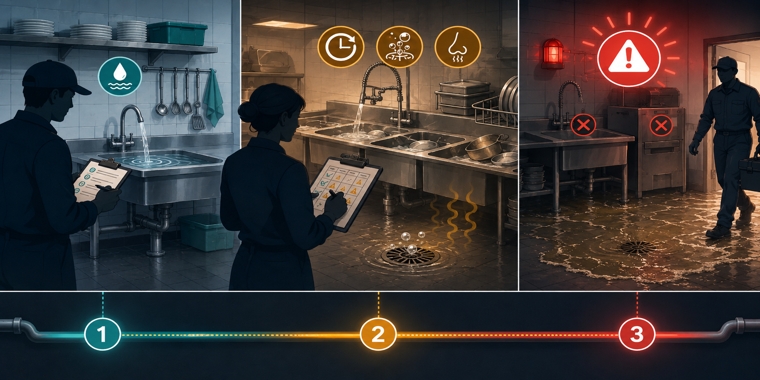
- Use Clear Escalation Points: The author recommends professional evaluation after 48 hours, three high-volume shifts, repeated symptoms, or wider fixture problems.
- Treat Backups As Urgent: The author recommends urgent help for overflows, visible wastewater, unusable drains, or threats to safe kitchen operations.
- Combine Shift Reports: One shared timeline reveals patterns that separate maintenance tickets may hide from managers and service professionals.
- Leave Inspection To Experts: Staff should observe and report problems, while qualified professionals inspect equipment, clear pipes, and handle wastewater.
Clear patterns lead to faster, safer decisions.
Restaurant managers will learn when to monitor, request evaluation, or seek urgent help using the detailed guidance that follows.
~ ~ ~ ~ ~ ~ ~ ~ ~ ~ ~ ~ ~ ~ ~ ~ ~ ~
A prep sink draining slowly once differs from three fixtures backing up during a dinner rush. The first may warrant monitoring. The second calls for prompt evaluation.
Slow drains, gurgling, and recurring odors can accompany grease-management or drainage problems, but the pattern matters more than any single symptom. Restaurant managers should track where the issue occurs, when it returns, how many fixtures are affected, and whether the disruption is spreading or intensifying.
Those observations help managers choose among three actions: monitor the condition, arrange professional evaluation, or treat it as urgent.
Important: Use Symptoms to Guide Escalation, Not Diagnose the Cause
This guide is a management and communication framework. It does not identify the mechanical source of a drainage problem.
Managers should:
- Observe the condition.
- Record specific facts.
- Combine reports across shifts.
- Communicate operational impact.
- Escalate according to recurrence, spread, and severity.
A qualified plumber, grease trap provider, or other appropriate professional should determine the cause through an onsite evaluation.
The Quick Answer: Look for a Pattern
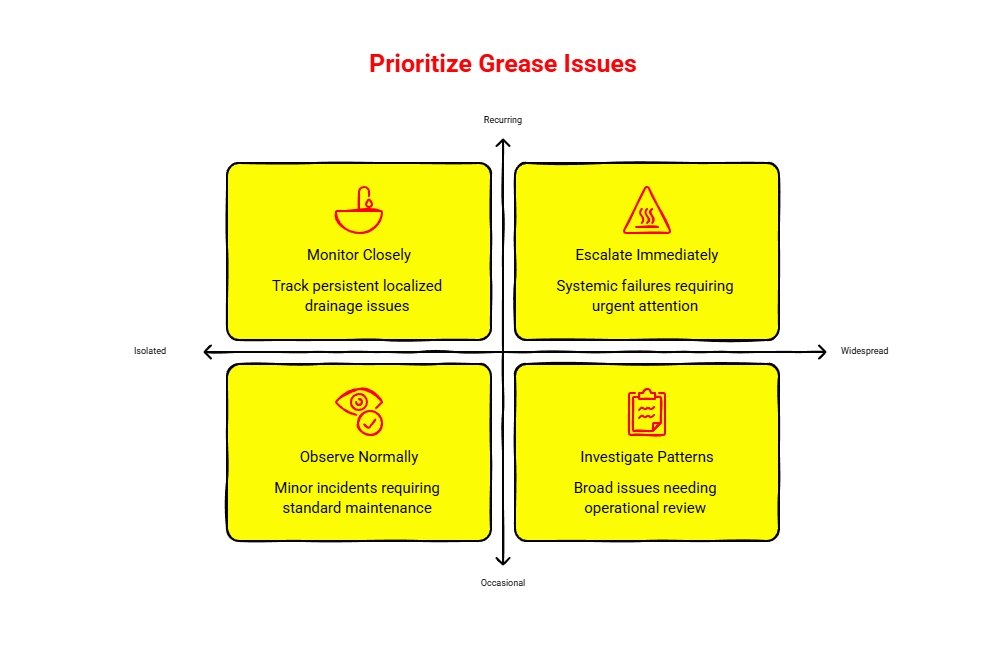
An isolated symptom provides limited information. Recurring or connected symptoms provide a stronger basis for action.
Ask five questions:
- Where did it happen? Identify the fixture or area instead of reporting a general “drain problem.”
- How often has it happened? Separate a one-time event from a condition reported across multiple shifts.
- How many fixtures are involved? Determine whether the problem remains isolated or affects a wider area.
- What was happening in the kitchen? Note whether the symptom appeared during prep, dishwashing, peak service, closing, or a low-volume period.
- Is it progressing? Watch for longer incidents, shorter intervals between incidents, additional fixtures, or greater operational disruption.
A report stating, “The three-compartment sink drained slowly for 15 minutes during dinner service,” is more useful than “The grease trap is clogged.”
What Slow Drains, Gurgling, and Odors Can Tell You
Slow Drainage
A single slow-draining fixture may reflect a temporary or localized condition. Log the fixture, time, duration, and operating activity, then watch for recurrence.
Slow drainage deserves greater attention when it:
- Returns across multiple shifts.
- Affects more than one fixture.
- Lasts longer with each incident.
- Appears consistently during high-volume periods.
- Forces staff to change normal kitchen procedures.
For example, a prep sink that drains slowly once after heavy use may require monitoring. A three-compartment sink that slows during three consecutive dinner shifts presents a recurring operational pattern that should be evaluated.
Gurgling
Record where the sound occurs, what other fixtures were operating, and whether it appeared with slow drainage, water-level changes, or odor.
A gurgle at one fixture once may be monitored. Repeated gurgling from a floor drain while a nearby sink is draining slowly deserves closer attention, particularly when staff report the same sequence across several shifts.
Avoid translating the sound into a technical conclusion. Describe what staff heard and what was happening immediately before and after it.
Recurring Odors
Odor reports should identify both location and timing.
Distinguish among:
- An odor strongest at one drain.
- An odor affecting the dish or prep area.
- An odor near an exterior grease trap or interceptor.
- An odor that appears only during high-volume periods.
- An odor that remains after kitchen activity decreases.
Grease traps and interceptors capture fats, oils, and grease, commonly abbreviated as FOG, from commercial kitchen wastewater. Odors near these systems deserve attention, but the report should still focus on observable details.
Recurring odor becomes more significant when it appears with slow drainage, gurgling, water-level changes, or a developing backup.
The Pattern That Deserves More Attention
Separate observations become more useful when they share a location, timeframe, operating condition, or direction of change.
Consider a restaurant where:
- The dish sink drains slowly during three dinner shifts.
- A nearby floor drain gurgles shortly afterward.
- An odor returns in the same area.
- Symptoms ease after dishwashing volume declines.
Together, those observations justify a coordinated evaluation. The relationship among the symptoms is more useful than three separate maintenance tickets.
Symptoms that disappear after the rush should not be treated as fully resolved when they return under the same operating conditions. Repeated problems during heavy dishwashing may indicate that higher wastewater volume is exposing a developing limitation.
Restaurant Grease Trap Symptom and Escalation Matrix
| Observed Pattern | Operational Interpretation | What to Record | Suggested Action |
|---|---|---|---|
| One mild symptom at one fixture, one time | No clear wider pattern | Fixture, time, duration, and kitchen activity | Log and monitor |
| The same symptom returns at one fixture | Persistent local or connected-system concern | Frequency, shift reports, and operating conditions | Arrange evaluation if it continues |
| Several fixtures show related symptoms | A wider drainage or grease-management issue may be involved | Fixtures, sequence, timing, and operating load | Request professional evaluation |
| Symptoms intensify during high-volume periods | Heavy use may be exposing a developing restriction | Service period, duration, fixtures, and operational impact | Escalate with the documented pattern |
| Active backup, overflow, visible wastewater, or unusable drainage | Immediate operational and potential safety concern | Record essential facts without delaying action | Follow site procedures and seek urgent professional help |
One Fixture Versus Several Fixtures
One affected fixture may point to a localized problem, unusual use, or a condition elsewhere in the connected system. Record the event and watch for recurrence.
Several fixtures changing at approximately the same time require a wider view. Compare conditions at the prep sink, three-compartment sink, floor drains, and other affected kitchen fixtures. Record the order in which symptoms appeared and whether different shifts observed the same sequence.
Do not create separate reports that conceal the relationship among events. A combined report could state:
During dinner service, the three-compartment sink drained slowly for approximately 20 minutes. A nearby floor drain began gurgling shortly afterward, and staff noticed an odor in the dish area. The same sequence was reported during the previous two dinner shifts.
This gives the service professional a clear timeline and helps define the appropriate evaluation scope.
Kitchen staff should not open trap lids, measure grease, add chemicals, snake piping, or attempt wastewater cleanup as part of the observation process.
What to Log Before Escalating
Use one shared record across shifts so recurring events are not treated as unrelated complaints.
Record:
- Date and time
- Shift or operating period
- Fixture or area
- Symptom observed
- Duration
- Number of fixtures involved
- One-time or recurring status
- Low-volume or peak-volume conditions
- Visible wastewater, backup, or overflow
- Last known service date
- Operational impact
- Person notified
- Next action
Location and timing reveal whether reports form a pattern. Duration shows whether the condition is brief or persistent. Operating volume helps identify recurring circumstances, while operational impact establishes priority.
The last service date provides useful context. Include it when briefing the owner, general manager, plumber, or grease trap provider, but keep the report centered on the current symptoms.
Three Escalation Levels
- Log and Monitor
Monitoring may be appropriate when the symptom:
- Is mild.
- Occurs once.
- Remains limited to one fixture.
- Causes no visible wastewater.
- Does not interrupt kitchen operations.
Monitoring means creating a record, not dismissing the event. A report from another shift may turn an isolated observation into a recurring pattern.
If the symptom persists for more than 48 hours, or spans three consecutive high-volume shifts, move from monitoring to arranging a professional evaluation.
Escalate sooner if the condition spreads, becomes more disruptive, or appears with another symptom.
2. Arrange Professional Evaluation
Arrange evaluation when:
- A symptom returns after initial monitoring.
- Several fixtures are involved.
- Slow drainage and odor occur during the same period.
- Problems repeatedly appear during high-volume use.
- Incidents become more frequent or last longer.
- Staff alter normal procedures to keep the kitchen operating.
- The symptom crosses the 48-hour or three-shift monitoring threshold.
Provide the service professional with the combined incident log, the last known service date, and the current operational impact.
3. Treat the Condition as Urgent
Escalate immediately when the restaurant has:
- An active backup or overflow.
- Visible wastewater where it should not be.
- Several unusable fixtures.
- Drainage problems interfering with safe kitchen operation.
- A rapidly worsening condition that threatens continued service.
Follow the restaurant’s established procedures and contact qualified help. Do not delay action to complete a perfect report.
Cleanup, isolation, and employee-safety requirements can vary by situation. Follow applicable site procedures and instructions from the appropriate professionals or authorities.
Houston Service-Schedule Context
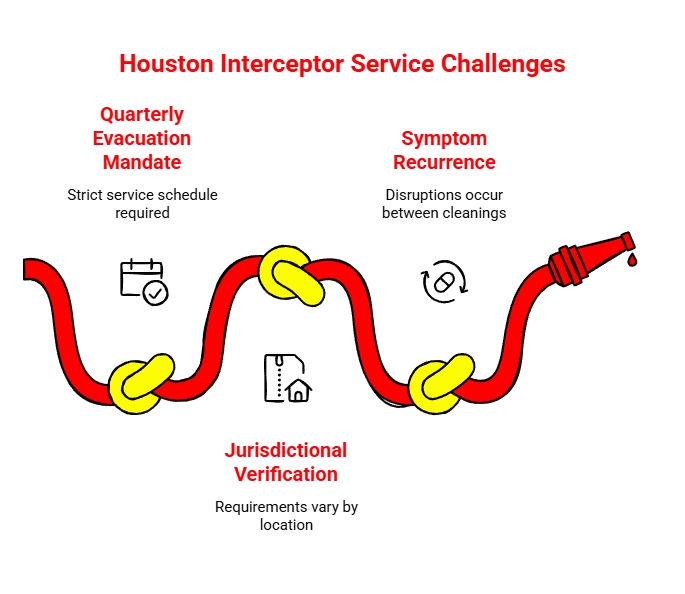
The Houston Permitting Center states that interceptors within incorporated City of Houston limits must be fully evacuated at least quarterly, or every 90 days, unless an approved waiver applies.
Restaurants should verify their jurisdiction and current requirements. A scheduled service interval supports baseline compliance, but it does not replace evaluation when active symptoms appear between service dates.
A restaurant may need attention before its next scheduled cleaning when drainage symptoms recur, spread, or begin disrupting operations.
How to Describe the Problem When You Call
A useful service request presents observable facts in sequence.
Include:
- Restaurant location
- Affected fixtures
- Trap location and type (e.g., indoor under-sink trap vs. outdoor underground interceptor)
- Symptoms observed
- First observed date
- Number of incidents
- Relationship to high-volume periods
- Active-backup or overflow status
- Last known service date
- Current operational impact
A clear report could read:
We have recurring slow drainage at the three-compartment sink and intermittent gurgling at a nearby floor drain. The condition occurred during the last three dinner shifts and improved after dishwashing volume declined. There is no active overflow. Our last documented grease trap service was on [date]. The dish area remains usable, but drainage is slower than normal.
This description gives the provider enough information to determine the next step without relying on assumptions from restaurant staff.
Frequently Asked Questions
Does a Bad Odor Always Mean the Grease Trap Is Full?
No. Record where the odor is strongest, when it appears, how long it lasts, and whether it occurs with drainage changes. A recurring odor combined with slow drainage or gurgling warrants more attention than odor alone.
Why Do Kitchen Drains Slow Down Only During Busy Periods?
High-use periods can expose a drainage limitation that is less noticeable when wastewater volume is lower. Record which fixtures are affected, when the slowdown begins, how long it lasts, and whether the pattern repeats during later rushes.
What Should a Manager Record Before Contacting a Provider?
Provide the fixture or area, symptom, date and time, duration, recurrence, operating conditions, affected fixtures, operational impact, active-backup status, and last known service date. Combine observations from multiple shifts into one timeline.
Should Staff Inspect or Open the Grease Trap?
No. Restaurant staff should focus on observation, documentation, communication, and escalation. Opening equipment, measuring accumulation, clearing piping, adding chemicals, or handling wastewater should be left to qualified personnel following appropriate procedures.
Turn an Unclear Symptom Into a Defensible Next Step
Slow drains, gurgling, and odors become actionable when managers document recurrence, location, spread, operating volume, and progression.
Monitor a mild one-time event. Arrange professional evaluation when the condition lasts longer than 48 hours, spans three consecutive high-volume shifts, returns repeatedly, or affects additional fixtures. Treat backups, overflows, visible wastewater, and unusable drainage as urgent.
A shared incident log helps ownership and service professionals respond to a clear operational pattern rather than incomplete reports or assumptions.
After documenting the condition, review Drane Ranger’s restaurant grease trap cleaning services or contact an appropriate qualified professional to discuss the next step.
Disclaimer: This article provides general informational guidance for restaurant management and communication. It does not constitute technical, safety, compliance, or professional advice. Requirements and appropriate actions may vary by jurisdiction, system design, site conditions, and the nature of the incident. Confirm important decisions with the appropriate qualified professional or authority.
Our Editorial Process:
This article was developed from the approved Content Strategy Document, Drane Ranger project files, official Houston and Texas regulatory sources, and documented customer testimonial material. It avoids unsupported service-cost claims, guaranteed inspection outcomes, invented fine timelines, and competitor comparisons.
By Drane Ranger Insights Team
The Drane Ranger Insights Team creates practical wastewater, grease trap, and liquid waste compliance resources for Houston-area businesses. Drawing from Drane Ranger Vacuum Services’ decades of local service experience, the team focuses on clear, useful guidance that helps operators maintain safe, compliant, and reliable facilities.