📌 Key Takeaways
Several troubled kitchen fixtures call for documented pattern tracking and professional review, not a quick guess about the grease trap.
- Track The Whole Pattern: Record each symptom’s location, timing, recurrence, spread, and operational impact across every shift.
- Escalate Based On Impact: Monitor one isolated event, but schedule an evaluation when symptoms recur, cluster, spread, worsen, or disrupt work.
- Treat Backups As Urgent: Use facility procedures and seek qualified help promptly when wastewater backs up, overflows, or shuts down a station.
- Keep Staff Safe: Staff should log observations and leave covers, chemicals, waste, drain clearing, and repairs to qualified professionals.
- Share Facts With Providers: A shared timeline helps grease trap providers and plumbers assess possible causes without relying on vague reports.
Patterns guide action; single symptoms do not prove causes.
Houston restaurant operators will make faster, safer service decisions using the tracking and response steps that follow below.
~ ~ ~ ~ ~ ~ ~ ~ ~ ~ ~ ~ ~ ~ ~ ~ ~ ~
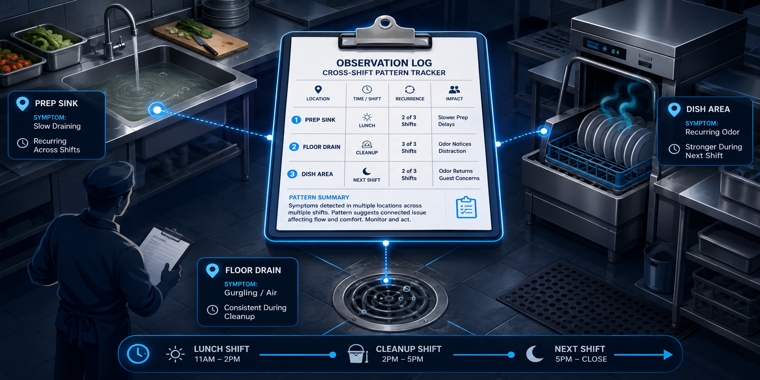
A single slow prep sink can be a localized inconvenience. When the prep sink, floor drain, and dish area begin showing slow drainage, gurgling, or recurring odors during the same operating period, the situation requires a coordinated operational response.
For a Houston restaurant operator, related symptoms across several fixtures deserve coordinated attention. The pattern may involve the grease trap or grease interceptor, but it may also reflect a shared drain line, venting condition, or another plumbing issue. Symptoms alone do not establish the cause.
The practical response is to identify where the changes appear, record when they recur, and note whether they are spreading or disrupting service. That information helps management decide whether to continue monitoring, schedule a professional evaluation, or activate the facility’s urgent-response procedures.
One Fixture Can Be Local; Several Fixtures Create a Pattern
A fixture is an observed kitchen drainage point or connected work area, such as a prep sink, three-compartment sink, hand sink, dishwasher area, or floor drain. One fixture behaving differently once may remain a localized maintenance concern. More than one fixture or work area showing related changes during the same operational period deserves a wider review.
“Several fixtures” is not a rigid number. The useful distinction is whether the report stays confined to one location or appears across separate stations. A hand sink that drains slowly once during cleanup, then returns to normal while every other fixture operates normally, may stay in the monitor-and-document category. A prep sink that slows during lunch, a floor drain that gurgles during cleanup, and an odor that returns near the dish area the next evening form a more meaningful pattern.
The observations do not need to occur at the exact same minute. Restaurant managers often receive reports from different employees and shifts. Overlapping timing, repeated symptoms, and spread to additional work areas can matter more than perfect simultaneity.
Different fixtures may show different changes. Record that distribution without using it to guess where a restriction is located.
While a multi-fixture pattern justifies professional evaluation, site conditions and system designs vary—meaning other plumbing or drainage causes remain possible.
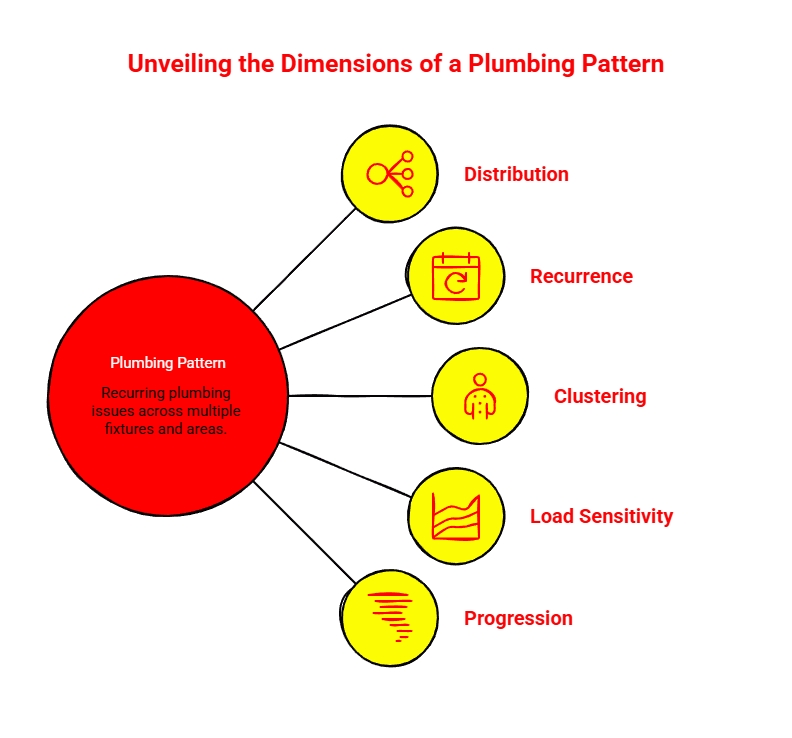
The Five Characteristics That Make the Pattern Worth Escalating
- Distribution
List every affected fixture and area. Reports from separate stations provide a broader operational picture than repeated complaints about one sink.
Location shows spread; it does not map the plumbing system or identify the source.
- Recurrence
Intermittent symptoms still belong in the record. An odor that disappears after cleanup and returns during the next shift has not necessarily resolved. The same applies to slow drainage that improves overnight but reappears during a similar service period.
Record whether the symptom has happened before, how often it returns, and whether the intervals between reports appear to be shortening.
- Clustering
Look for several symptom types occurring within the same general period. Slow drainage, gurgling, and odor reported during one shift or across consecutive operating periods may warrant more attention than unrelated incidents spread over several weeks.
- Load Sensitivity
Note whether symptoms become more noticeable during prep, peak service, cleanup, or another period of higher water use. That timing can help a qualified provider understand the operating conditions under which the issue appears.
- Progression
A pattern becomes harder to dismiss when it lasts longer, returns more often, reaches additional areas, or creates greater disruption. Progression may also appear when localized work improves one fixture but related symptoms continue elsewhere.
Document what changed after any service or maintenance visit. A partial improvement is useful information, but it should not be treated as proof of what caused the wider pattern.
Multi-Fixture Symptom Pattern Log
Use one shared log across shifts. Staff should record normal operational observations rather than technical conclusions.
| Field | What Staff Should Record |
|---|---|
| Date and approximate time | When the symptom was noticed |
| Fixture or area | Prep sink, three-compartment sink, floor drain, dishwasher area, or another location |
| Symptom | Slow drainage, gurgling, recurring odor, standing water, or backup |
| Operating condition | Prep, normal service, peak service, cleanup, or overnight |
| Duration | Brief, intermittent, or persistent |
| Other fixtures affected | Other locations showing changes during the same period |
| Change since last report | Same, more frequent, spreading, or more disruptive |
| Operational impact | None, workaround required, station slowed, or use stopped |
| Action taken | Logged, manager notified, provider contacted, or facility protocol activated |
The log’s purpose is to track distribution, timing, recurrence, progression, and operational effect so management can spot emerging patterns.
Build a Timeline Across Shifts, Not a Collection of Anecdotes
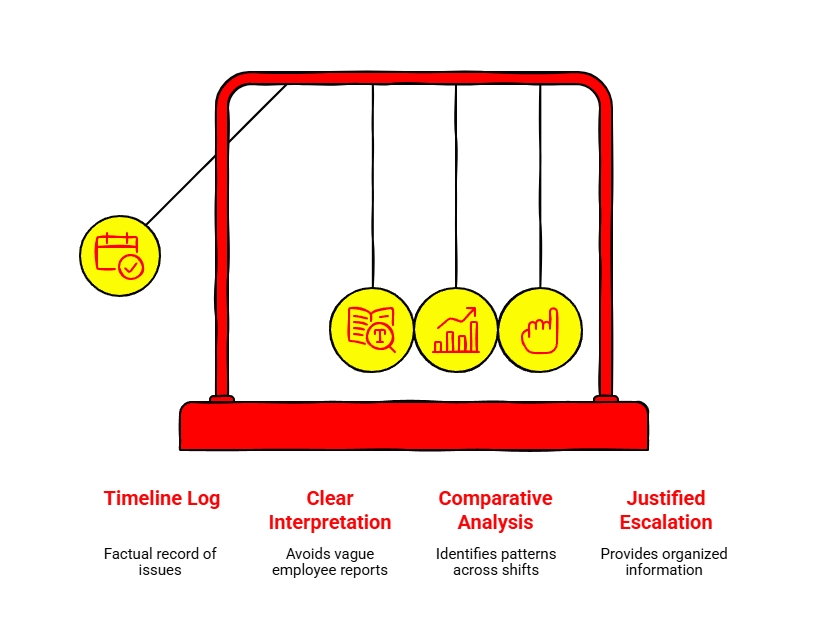
Statements such as “the drains are bad again” leave too much open to interpretation. A shared timeline gives management and the service provider a factual record.
Use one central log and assign one manager to consolidate reports. Ask employees to name the fixture, symptom, approximate time, duration, and kitchen activity. They should also note whether another area changed during the same period and whether the issue affected normal work.
Keep the language observational. “The dish-area floor drain gurgled during cleanup” is more useful than “the grease trap is clogged.” The first statement records something witnessed; the second makes a technical conclusion that has not been established.
Compare reports from prep, service, cleanup, and overnight periods. If localized plumbing work was completed, record the date, the fixture involved, and what changed afterward. A recent grease trap service visit should also appear in the timeline, but the service date alone does not confirm or rule out the current cause.
For example, a prep sink may drain slowly during lunch, a floor drain may gurgle during cleanup, and an odor may return in both areas the next evening. This illustrative cluster does not prove grease trap failure. It gives the manager organized information that may justify escalation.
Staff should not remove interceptor covers, measure contents, handle waste, apply chemicals or biological additives, clear lines, or disassemble plumbing. Instruct staff not to pour boiling water down slow drains in an attempt to clear them, as this only pushes melted grease further down the line where it solidifies and worsens the blockage. Inspection and technical work belong to qualified professionals.
Monitor, Schedule an Evaluation, or Treat It as Urgent?
Use the pattern and its effect on operations—not a fixed number of hours or days—to choose the management response.
| Level | Pattern | Recommended Management Response |
|---|---|---|
| Monitor and document | One brief, isolated symptom with no recurrence, spread, or operational effect | Record the event and watch for repetition or changes elsewhere |
| Schedule professional evaluation | Multiple fixtures are affected; symptoms recur, cluster, spread, worsen, or disrupt work without an active backup | Consolidate the log and contact a qualified grease trap service provider or commercial plumber |
| Urgent professional response | Active backup or overflow, wastewater entering a work area, or conditions requiring affected fixtures or stations to stop operating | Follow the facility’s established safety and operational protocols and seek qualified professional assistance promptly |
The urgent category describes the condition in the kitchen, not its cause. An active backup may involve the grease interceptor or another part of the drainage system. Do not ask staff to clean, contain, inspect, or repair the condition unless they are following an approved facility procedure developed for that situation.
Drane Ranger’s article on what happens during a grease trap overflow may provide additional operational context, but site-specific safety decisions should come from facility procedures and qualified professionals.
For local compliance context, the Houston Permitting Center currently states that interceptors within incorporated city limits must be fully evacuated at least quarterly, or every 90 days, unless an approved waiver applies. However, operators must also monitor FOG accumulation to comply with the 25% rule, which requires service whenever floating grease and settled solids reach one-quarter of the trap’s total liquid depth—meaning high-volume kitchens often require service well before the 90-day maximum.. Review the official Houston generator-registration guidance for current details. Always retain the official waste manifest provided after service, as city health and public works inspectors will request it to verify your compliance with this 90-day rule.
The U.S. Environmental Protection Agency also provides broader information about fats, oils, and grease management in wastewater systems. Wastewater guidance commonly shortens fats, oils, and grease to FOG.
What to Tell the Service Provider
Have the following information ready for the provider:
- Property type and kitchen operating schedule
- Affected fixtures and work areas
- Date the first symptom was observed
- Whether symptoms occur together or during overlapping periods
- Frequency and recurrence across shifts
- Changes during higher-volume kitchen use
- Standing water, backup, or overflow conditions
- Operational effects and fixtures taken out of use
- Date and type of recent service, if known
- Localized plumbing work already performed
- Access constraints and preferred low-disruption service windows
A grease trap provider can evaluate interceptor-service needs, while a commercial plumber may need to assess drain lines, venting, or other plumbing conditions. Depending on the site and symptoms, one provider may recommend involving the other.
Review Drane Ranger’s commercial grease trap cleaning overview for service context. When contacting any provider, share the completed symptom log rather than relying on a general statement that the kitchen drains are slow.
Frequently Asked Questions
Do Several Slow Drains Mean the Grease Trap Is Full?
No. Several affected fixtures may point to a shared drainage or grease-management issue, but the pattern does not establish the cause or reveal the interceptor’s condition. Record the affected locations, timing, recurrence, and progression. Persistent or widening symptoms may justify professional evaluation.
Is Gurgling a Grease Trap Warning Sign?
Gurgling is an observation worth documenting, particularly when it appears with slow drainage or recurring odors in more than one area. It can occur for different reasons, depending on the system. Treat it as part of the overall pattern rather than proof that the grease trap is responsible.
What If Symptoms Appear Only During the Dinner Rush?
Record that timing. A pattern that becomes more noticeable during higher kitchen water use gives a provider useful operating context, but it does not diagnose the system. Note which fixtures are affected, how long the changes last, whether they recur, and whether normal work is disrupted.
Does a Recent Pump-Out Rule Out a Current Problem?
No. A recent service date is relevant background, not a diagnosis of present conditions. Tell the provider what work was performed, when it occurred, and whether the current symptoms began before or after the visit. Avoid assuming either that the interceptor is responsible or that it cannot be involved.
Turn Observations Into a Defensible Next Step
The strongest management signal is not one odor, one gurgle, or one slow sink. It is the distribution, recurrence, timing, progression, and operational effect of several observations considered together.
Documenting that pattern helps a manager move beyond vague staff reports without attempting a technical diagnosis. Monitor isolated events, arrange an evaluation when symptoms recur or spread, and use established facility procedures when an active backup or overflow affects the work area.
Review Drane Ranger’s Houston grease trap cleaning information to understand the professional service option. When symptoms are recurring, widening, or disrupting operations, share the completed log with a qualified provider.
Disclaimer: This article is for general informational purposes only and does not constitute compliance, safety, technical, plumbing, or professional advice. Grease trap and drainage conditions vary by facility, system design, use, and jurisdiction. Confirm important decisions with the appropriate qualified service provider, plumber, authority, or technical professional.
Our Editorial Process
Our expert team uses AI tools to help organize and structure our initial drafts. Every piece is then extensively rewritten, fact-checked, and enriched with first-hand insights and experiences by expert humans on our Insights Team to ensure accuracy and clarity.
By Drane Ranger Insights Team
The Drane Ranger Insights Team creates practical guidance for Houston-area businesses that need reliable liquid waste management, grease trap cleaning, septic, lift station, and wastewater compliance support. Drane Ranger Vacuum Services has served the Greater Houston area since 1985, helping customers keep operations running while following applicable waste handling and disposal requirements.