
📌 Key Takeaways
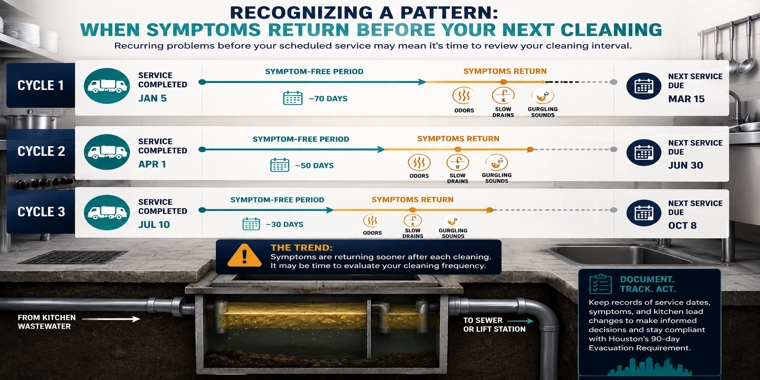
Review your cleaning schedule when the same symptoms return before service and match changes in kitchen load.
- Track Repeat Patterns: Record when and where symptoms return across several service cycles, since one isolated event proves little.
- Compare Kitchen Load: Longer hours, busier shifts, and more grease-producing work may cause the restaurant to outgrow its current schedule.
- Check Other Causes: Confirm the service scope, access, connected drains, and equipment condition before blaming cleaning frequency.
- Keep Clear Records: Service dates, symptom logs, fixture locations, and operating changes give providers stronger evidence to assess.
- Verify Local Rules: Houston requires full evacuation at least every 90 days without a waiver, but managers should confirm current rules.
Patterns reveal when the schedule no longer fits.
Houston restaurant managers will prepare for a focused provider discussion using the evidence checks and schedule questions that follow.
~ ~ ~ ~ ~ ~ ~ ~ ~ ~ ~ ~ ~ ~ ~ ~ ~ ~
The grease trap was cleaned, the service record was filed, and the kitchen returned to normal—until the odor, slow drainage, or gurgling came back before the next planned visit.
For a Houston restaurant manager, that recurrence can create a reasonable question about whether the grease trap cleaning schedule still matches the operation. The strongest reason to review a schedule is not one isolated symptom. It is a repeatable relationship between service timing, returning symptoms, and the restaurant’s actual kitchen load.
That relationship is evidence for a professional discussion, not proof that cleaning frequency is the only cause. Service scope, access limitations, connected drainage, and equipment conditions may also need evaluation. Current Houston requirements should be verified separately through official City sources. The City of Houston Code of Ordinances mandates that grease traps be fully evacuated at least every 90 days unless a waiver is approved. However, that 90-day baseline should not be assumed to be the only factor, because regulatory compliance and site-specific schedule fit are related but distinct questions.
The Short Answer: Look for a Repeatable Mismatch Between Timing and Load
A service interval is the planned period between professional cleaning visits. It may warrant review when operating evidence repeatedly shows that the restaurant’s needs are outpacing the schedule.
A stronger reason to ask for a review exists when:
- Similar symptoms return before the next planned visit.
- The symptom-free window becomes shorter across service cycles.
- Recurrence follows higher-volume periods or increased production.
- The same pattern appears during more than one cycle.
- The schedule was established before material operating changes.
The symptom-free window is the period between service and the first documented return of a concern. No universal number of days makes that window acceptable or unacceptable. Its value comes from comparison.
The U.S. Environmental Protection Agency notes that maintenance frequency depends greatly on the amount of fats, oils, and grease a facility generates and the best management practices it uses. Fats, oils, and grease are commonly abbreviated as FOG.
Start With the Symptom-Return Timeline
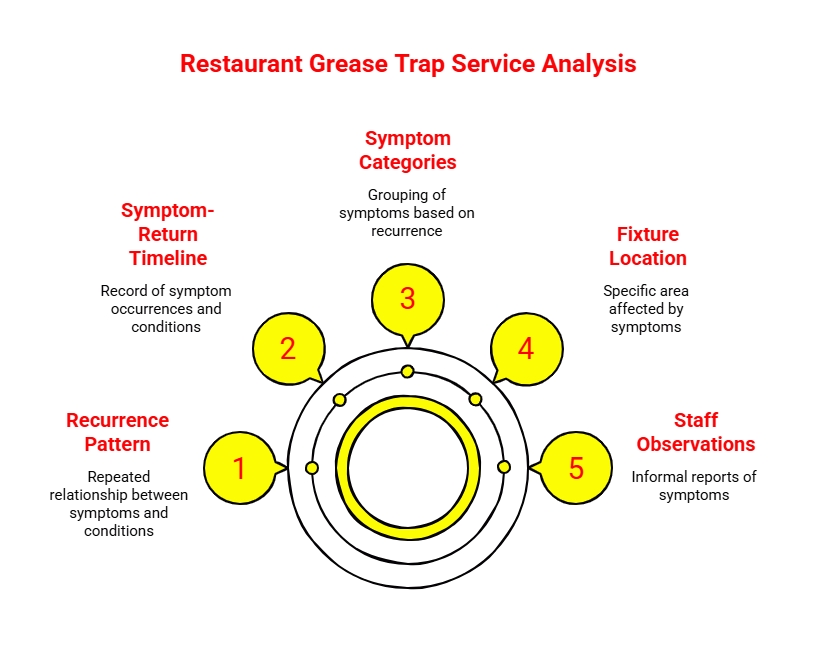
A general report such as “the drains are slow again” gives management little to compare. A symptom-return timeline turns informal observations into operational evidence.
Record the last service date and the first time each symptom reappeared. For each occurrence, note the affected fixture or area, the time and shift, whether the kitchen was in a peak production period, and whether the condition repeated.
Separate the observations into useful categories:
- Immediate recurrence after service
- Gradual recurrence over the service cycle
- Recurrence near the next planned visit
- An isolated event that did not repeat
A recurrence pattern is a repeated relationship between symptom timing, location, and operating conditions across service cycles. It may create a stronger reason to investigate the schedule, but it does not diagnose the cause.
Consider a manager comparing two recent service cycles. In both cycles, similar slow-drain reports appeared after unusually busy production periods and before the next planned visit. That pattern is more useful than one undocumented complaint because it gives the provider a sequence to evaluate.
Fixture location also matters as an observation. A concern isolated to one sink presents different evidence from symptoms reported across several connected fixtures. The difference may help guide professional evaluation, but it should not be used to diagnose the system remotely.
Staff often address a developing issue during a busy shift without documenting it. Ask shift leaders to record the first recurrence rather than waiting for a complete disruption. An active overflow or backup warrants prompt professional attention; management should not use a scheduling framework as a substitute for onsite help.
Compare the Pattern With the Restaurant’s Actual Kitchen Load
Actual kitchen load is the site-specific combination of operating volume, FOG-generating activity, production patterns, and kitchen management practices. It is broader than seating capacity or the number of days since service.
Start with one question: What changed after the current interval was established?
Relevant changes may include longer operating hours, higher cover counts, new menu items, increased frying or food preparation, weekend catering, expanded delivery production, seasonal peaks, or less consistent FOG-management practices.
For instance, new kitchen staff might begin scraping plates directly into the sink instead of the trash, rapidly accelerating FOG buildup.
Management does not need to calculate an exact FOG volume to identify a material operating change. The goal is to document how the current operation differs from the conditions under which the schedule was set.
For example, imagine a Houston restaurant that expands its evening hours and adds weekend catering. If similar slow-drain symptoms begin returning before the next planned visit across multiple service cycles—and service records show no access limitations—the increased load is likely outpacing the maintenance schedule. While not definitive proof, this combination creates a strong operational reason to review the interval.
his is why regulatory bodies emphasize internal procedures alongside professional service. The Texas Commission on Environmental Quality advises that commercial-kitchen best management practices can affect how often grease traps or interceptors require pumping and cleaning.
Use the equipment term that matches the restaurant’s system. A grease trap and a grease interceptor should not automatically be treated as interchangeable.
Rule Out the Main Look-Alikes Before Blaming Frequency
A repeated pattern may support a schedule review, but several other factors can resemble a frequency problem. The safest approach is to compare evidence rather than select a cause too early.
Review the Previous Service Scope
Service scope means the work intended and documented during a visit, including what was accessible, completed, observed, or recommended for follow-up.
A paid invoice confirms that a transaction occurred. It may not explain whether “pump-out,” “cleaning,” and “inspection” referred to the same activities or whether all intended access points were available.
Consider another hypothetical situation. An invoice states “pump-out,” but the manager cannot determine what was cleaned, inspected, or accessible. Symptoms return, and staff assume the calendar is the problem.
Before proposing a shorter interval, the manager reviews the service record and asks the provider to clarify the visit. That clarification may be necessary to interpret the recurrence fairly. It should not be framed as an accusation that required work was omitted.
Reviewing what a professional grease trap cleaning visit should include can help management organize these service-scope questions.
Ask Whether Access Affected the Visit
Access limitations can vary between visits. Equipment, stored materials, traffic, scheduling restrictions, or site layout may affect what the provider can reach or observe.
Review the records and ask:
- Was access different from earlier visits?
- Were all intended access points available?
- Did the provider document a limitation?
- Was follow-up work recommended?
Restricted access should remain a possibility to investigate until the provider confirms whether it mattered.
Consider Connected Drainage or Equipment Issues
Suppose one sink remains slow shortly after service, no material operating change occurred, and other fixtures appear normal. That observation does not prove that the schedule is adequate or inadequate. It suggests that another cause should also be evaluated.
A qualified provider or plumber may need to assess whether the concern involves a connected line, fixture, or another system component. More frequent grease trap cleaning will not necessarily resolve an unrelated condition.
| Evidence supporting a schedule review | Evidence suggesting broader evaluation |
|---|---|
| Similar symptoms recur before planned service across multiple cycles | The event is isolated and does not repeat |
| The symptom-free window is becoming shorter | Only one fixture remains affected |
| Recurrence follows a documented increase in operating load | No material operating change is documented |
| Service scope and access are clearly recorded | Scope or access information remains unclear |
The comparison does not determine the cause. It identifies which questions deserve professional attention.
Build a Schedule-Fit Evidence Record
A shared record reduces reliance on memory and helps management explain the issue to ownership, staff, and the provider. Assign one person to maintain it when several employees or vendors share responsibility.
Complete the matrix after each service or recurrence. Attach relevant service records, include unusual production events, and compare patterns before proposing a schedule change.
| Evidence to Record | What to Compare | What It May Suggest | Question for the Provider |
|---|---|---|---|
| Last service date | Date symptoms returned | Length of the symptom-free window | Is this recurrence window consistent with the site’s current load? |
| Symptom and location | Same or different fixtures | Repeated versus isolated pattern | Does the location suggest that the trap, a connected line, or another component needs evaluation? |
| Operating changes | Previous versus current hours, covers, menu, or production | Possible load change | Has the service interval kept pace with this change? |
| Service scope | Work documented in the service record | Whether scope requires clarification | What was completed, observed, and accessible during the visit? |
| Access notes | Normal versus restricted access | Possible service limitation | Did access affect what could be serviced or evaluated? |
| Prior incidents | Pattern across service cycles | Stronger or weaker reason for review | Should the interval be reviewed, or should another cause be investigated first? |
Use this matrix as an internal tracking tool to identify operational patterns, rather than a definitive calculator for your maintenance schedule.
Questions to Bring to the Service Provider
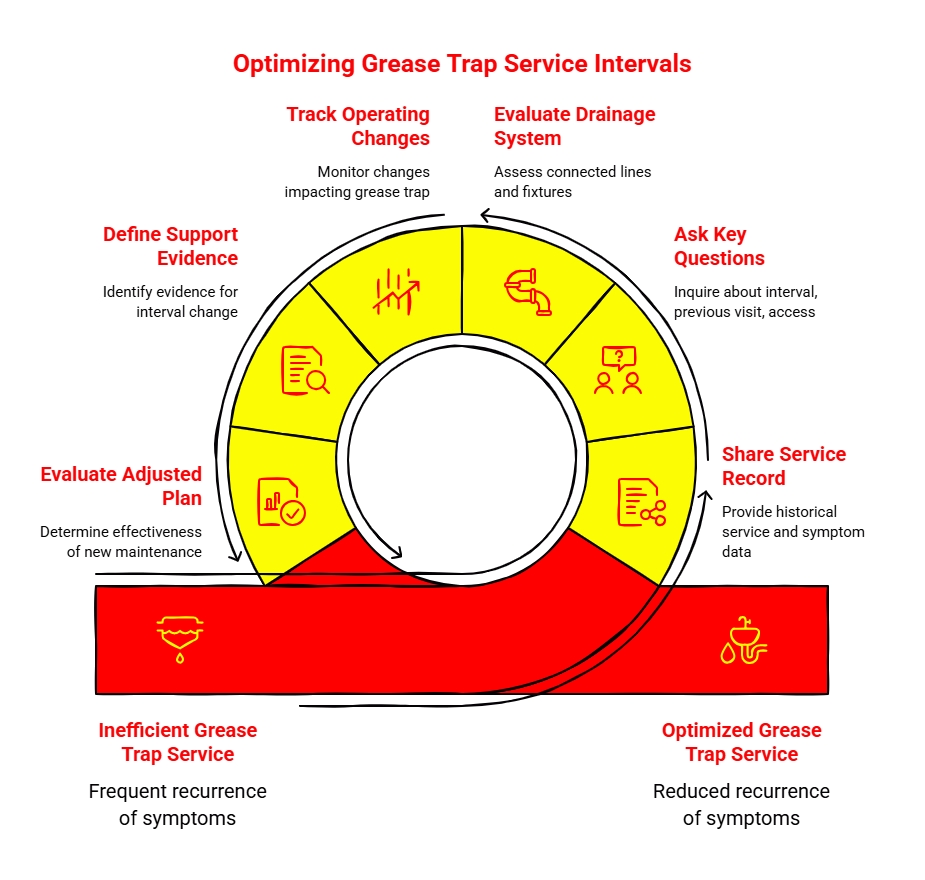
Share the record before asking for a conclusion. A collaborative discussion is more useful than telling the provider that the restaurant simply needs more frequent service.
Ask:
- Based on our service and symptom dates, does the present interval appear to match our current operating load?
- Did the previous visit reveal conditions that may help explain the recurrence?
- Was access sufficient to complete the intended service scope?
- Do the affected fixtures suggest that another part of the drainage system also needs evaluation?
- Which operating changes should management continue tracking?
- What evidence would support changing the interval?
- How should we evaluate whether an adjusted maintenance plan is working?
The provider may need an onsite evaluation before recommending a change. Management should also ask who is responsible for evaluating connected lines, fixtures, or other components when several vendors are involved.
Reviewing available commercial grease trap cleaning information can help prepare for that discussion, but service-page content should not be treated as proof of causation or current local law.
Frequently Asked Questions
How soon after cleaning is “too soon” for symptoms to return?
There is no universal symptom-return period that proves a schedule is too infrequent. Compare the return point across service cycles, the fixtures involved, and any operating changes. A repeatable pattern provides useful evidence for the provider.
Does a recurring odor mean the grease trap was not cleaned properly?
Not necessarily. Recurring odor may warrant professional evaluation, but recurrence alone does not establish whether the cause involves service scope, frequency, access, connected drainage, or another condition.
What records should a restaurant collect before discussing cleaning frequency?
Collect service dates, service-scope records, symptom dates and locations, affected fixtures, operating-volume changes, unusual production events, access notes, and prior incident history. Consistent records are more useful than staff recollections gathered after a larger disruption.
Use the Pattern to Guide the Next Conversation
A grease trap cleaning schedule may be too infrequent when recurrence timing, actual kitchen load, and service history form a consistent pattern. That evidence creates a reason to review the interval; it does not replace onsite evaluation or rule out another cause.
Bring your service dates, symptom log, and operating changes to the discussion. Contact Drane Ranger to ask whether your current grease trap cleaning schedule reflects your restaurant’s actual load or whether another issue should be evaluated.
Disclaimer: This article is for general informational purposes only and does not constitute compliance, safety, technical, or professional advice. Requirements, risks, and best practices may vary by context, jurisdiction, system, provider, or use case. Confirm important decisions with the appropriate qualified professional, authority, or technical expert.
Our Editorial Process:
This article was developed from the approved Content Strategy Document, Drane Ranger project files, official Houston and Texas regulatory sources, and documented customer testimonial material. It avoids unsupported service-cost claims, guaranteed inspection outcomes, invented fine timelines, and competitor comparisons.
By Drane Ranger Insights Team
The Drane Ranger Insights Team creates practical wastewater, grease trap, and liquid waste compliance resources for Houston-area businesses. Drawing from Drane Ranger Vacuum Services’ decades of local service experience, the team focuses on clear, useful guidance that helps operators maintain safe, compliant, and reliable facilities.