

📌 Key Takeaways
Review a restaurant’s grease trap maintenance budget when kitchen operations materially change, using service records and documented provider guidance before revising the annual allocation.
- Extra Visits Increase Annual Costs: A higher annual visit count can increase cleaning expenditure even when the provider’s confirmed price per visit remains unchanged.
- Service Records Test Budget Assumptions: Comparing planned and completed visits, service notes, and invoices helps distinguish recurring frequency changes from differences in scope or charges.
- Symptoms Require Professional Evaluation: Repeated slow drainage or odors warrant assessment, but these symptoms alone do not establish that the grease trap is full.
- Provider Advice Does Not Replace Requirements: Site-specific cleaning recommendations inform maintenance planning, while applicable local requirements remain a separate compliance baseline that operators need to confirm.
- Documented Decisions Support Future Reviews: A dated record of evidence, recommendations, approval, and the next review trigger helps subsequent managers reconstruct the maintenance budget decision.
For restaurant managers and owners preparing the next budget sign-off, unresolved service assumptions identify where further assessment is needed before approving a revised recurring allocation.
A useful maintenance allocation connects expected visits and known charges to documented kitchen conditions.
~ ~ ~ ~ ~ ~ ~ ~ ~ ~ ~ ~ ~ ~ ~ ~ ~ ~
At 8:15 a.m., a restaurant manager compares an annual budget worksheet with the latest grease trap service records. The printer hums, and a familiar question arises: Does this allocation still describe the kitchen? This is an illustrative scene, but the decision is practical. Review a restaurant’s grease trap maintenance budget when operating conditions materially differ from those used to set the original cleaning allowance. Compare current activity, planned and completed visits, and documented service advice before changing the annual number. A busier kitchen warrants investigation, not an automatic increase.
Why Kitchen Volume Is a Maintenance-Budget Trigger
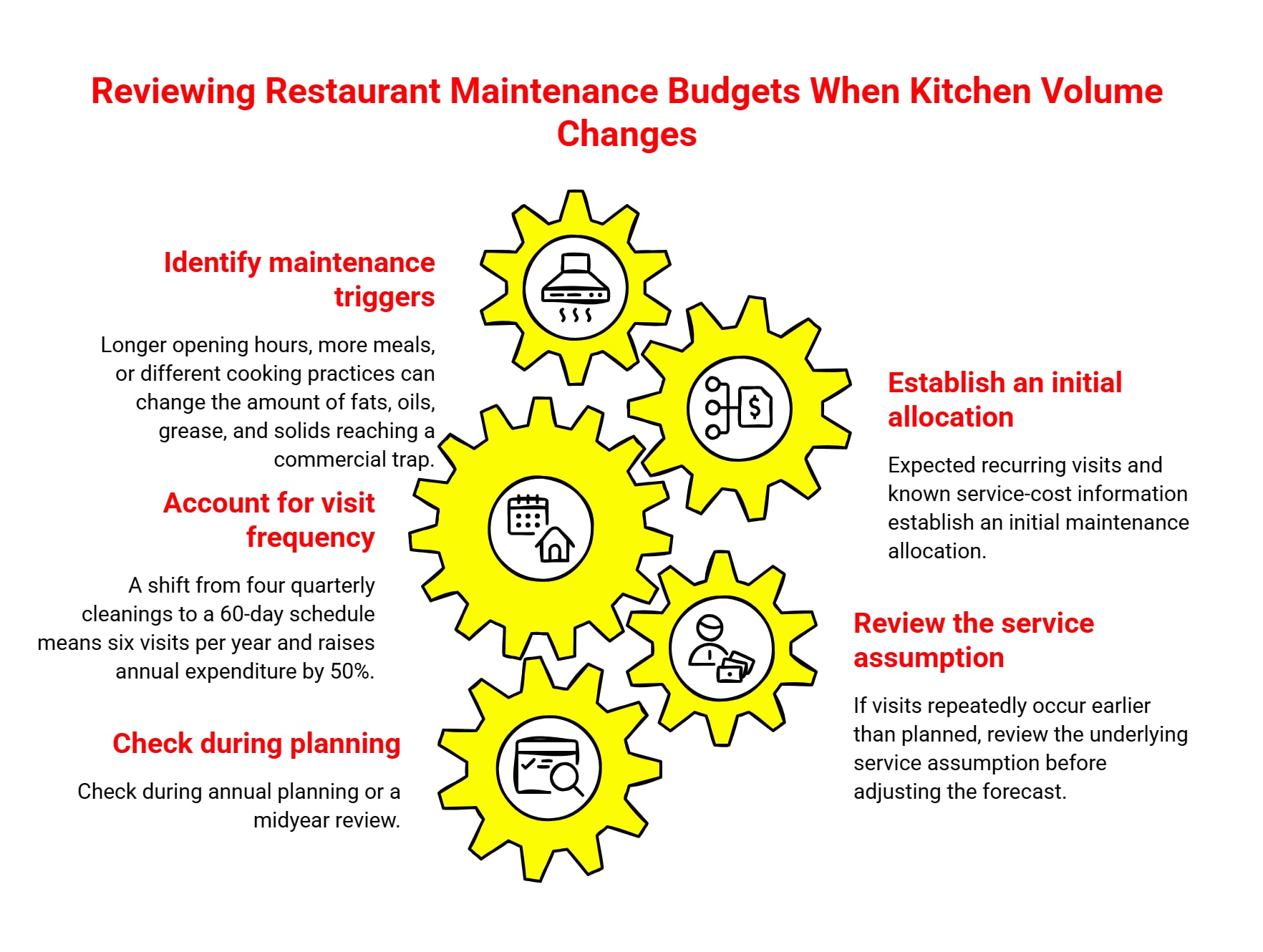
Last year’s maintenance allocation is a starting point, not a permanent operating rule. Longer opening hours, more meals, or different cooking practices can change the amount of fats, oils, grease, and solids reaching a commercial trap. The U.S. Environmental Protection Agency explains that grease-control maintenance frequency depends on FOG generation and operating practices. Actual conditions matter more than an assumed universal interval.
Cost planning for grease trap cleaning in annual restaurant maintenance budgets starts with two inputs: the expected number of recurring visits and known service-cost information. Together, they establish an initial maintenance allocation. A quotation prices its stated scope; it does not establish the annual visit count.
The overlooked source of budget variance is sometimes visit frequency, not a higher price per visit. For example, if extended weekend hours push a kitchen from four quarterly cleanings onto a 60-day schedule (six visits per year), total annual cleaning expenditure rises by 50%—two extra visits—even when the provider’s per-visit rate never changes. In budget terms, a line item planned at four times your confirmed per-visit rate becomes six times that rate—a 50% overrun driven entirely by pumping cadence rather than a price increase. If visits repeatedly occur earlier than planned, review the underlying service assumption before adjusting the forecast. Check during annual planning or a midyear review.
What Operating Changes Deserve a Review?
Compare today’s kitchen with its operating pattern when the current budget was approved. Capture observable changes rather than relying on an impression that business feels busier.
- Meal periods consistently serve more customers or require higher production.
- Opening hours, kitchen shifts, catering work, or preparation schedules have expanded.
- Menu revisions or cooking methods have changed grease-producing activity.
- Seasonal demand has persisted beyond its originally expected period.
- Slow drainage or odors repeatedly appear before scheduled cleaning.
- The provider has suggested a different next-service date on more than one occasion.
Record when each change began and whether it is temporary or sustained. Symptoms warrant professional evaluation; slow drains or odors alone do not establish that the trap is full. In commercial kitchens, technicians commonly apply the 25% rule—checking whether combined floating fats, oils, and grease (FOG) and settled solids reach 25% of the trap’s total liquid depth, which triggers service even before a 90-day municipal interval expires.
For operational context, see when busier service calls for revisiting a cleaning arrangement. The budget question remains whether the assumed visit count still holds.
Check the Records Before You Change the Number
Set the budget worksheet beside the cleaning history. Identify the original planned interval and visit count, then check what actually happened. Compare scheduled dates with completed visits, especially extra appointments or visits brought forward. This establishes whether the difference is recurring or isolated.
Next, review service notes, recommendations for the next cleaning, and any documented accumulation or system issues. Drane Ranger describes service records that include dates, waste quantities, disposal-facility information, and identified issues. Those records can support a review, although individual documents may contain different details. Recurring symptoms can be assessed alongside signs that an existing cleaning schedule may be too infrequent.
Finally, compare invoices and known quotations with the original allocation. Separate a changed visit count from changes in service scope, access, or quoted charges. The annual restaurant grease trap budgeting framework explains initial planning; this review tests its inputs.
Three outcomes are possible. The original assumption remains supported, the evidence is insufficient and needs professional review, or the documented service needs justify a revised interval. Do not treat an unverified assumption as a confirmed service requirement.
Change-Trigger Review Matrix
Use this matrix during a management review. Each row identifies an observation to investigate, not a predetermined cleaning requirement.
| Observed change | Evidence to inspect | Responsible role | Question for the provider |
| Kitchen volume is materially higher than when the budget was set | Recent service dates, operating schedule, service notes | General manager | Does current activity change the recommended interval for this site? |
| Service has repeatedly been needed earlier than expected | Completed service history and recurrence pattern | General manager and owner | What site conditions appear to shorten the interval? |
| Operating hours or production patterns changed | Current and prior operating schedules | General manager | Should the maintenance assumption be reassessed? |
| Annual expenditure is above plan | Budget-to-actual records and visit count | Owner or finance-aware operator | Is the difference due to frequency, scope, access, or another documented factor? |
| Provider guidance has changed | Previous and current service recommendations | Owner and general manager | Which site conditions or records support the new recommendation? |
The general manager checks operating evidence. Ownership or finance checks the forecast and approves any revised recurring allocation. Both need a dated record of the reason for the decision.
Questions to Ask the Grease Trap Service Provider
Bring the service history and a concise description of the operational changes. Ask for the site evidence behind any proposed adjustment.
- Does current kitchen activity change the interval recommended for this location?
- Which operating conditions, accumulation observations, or service records support that recommendation?
- What records should management retain for the next budget review?
- Could access, service scope, waste conditions, or scheduling affect future quotations?
- What change should trigger reassessment before the next annual budget cycle?
Drane Ranger describes restaurant grease trap cleaning and recurring arrangements tailored to the site, rather than an identical schedule for every customer. In supplied feedback, customer Harold R. described clear communication and receiving a suggested time for the next cleaning. That feedback establishes neither savings nor a universal frequency.
Operators in Houston and Alvin should check the requirements governing their particular site. The City of Houston’s Special Waste program materials establish a mandatory minimum compliance baseline for Houston sites (such as full evacuation at least every 90 days under City Code Section 47-512(b), unless a waiver applies, and adherence to the 25% accumulation threshold), not a one-size-fits-all operating interval for every kitchen or jurisdiction. Confirm current obligations with the appropriate authority; provider recommendations do not replace them.
Document the Revised Maintenance Assumption
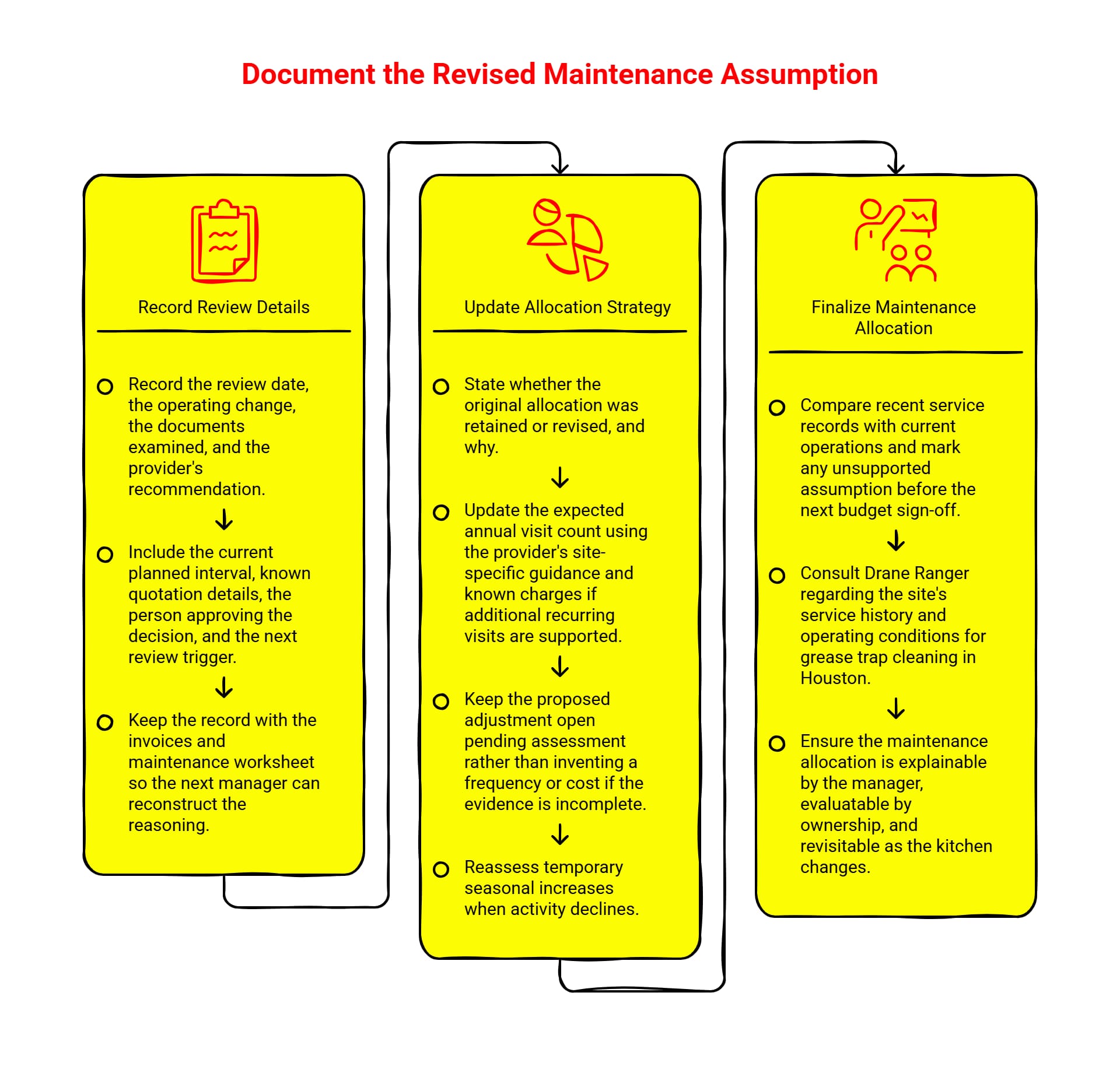
Record the review date, the operating change, the documents examined, and the provider’s recommendation. Include the current planned interval, known quotation details, the person approving the decision, and the next review trigger. Keep the record with the invoices and maintenance worksheet so the next manager can reconstruct the reasoning.
State whether the original allocation was retained or revised, and why. If additional recurring visits are supported, update the expected annual visit count using the provider’s site-specific guidance and known charges. If the evidence is incomplete, keep the proposed adjustment open pending assessment rather than inventing a frequency or cost. Reassess temporary seasonal increases when activity declines.
Before the next budget sign-off, compare recent service records with current operations and mark any unsupported assumption. For grease trap cleaning in Houston, Drane Ranger can discuss the site’s service history and operating conditions. The useful outcome is not simply a new number. It is a maintenance allocation the manager can explain, ownership can evaluate, and the restaurant can revisit as its kitchen changes.
Our Editorial Process
Our expert team uses AI tools to help organize and structure our initial drafts. Every piece is then extensively rewritten, fact-checked, and enriched with first-hand insights and experiences by expert humans on our Insights Team to ensure accuracy and clarity.
About the Drane Ranger Insights Team
The Drane Ranger Insights Team is our dedicated engine for synthesizing complex topics into clear, helpful guides. While our content is thoroughly reviewed for clarity and accuracy, it is for informational purposes and should not replace professional advice.