Why Houston Restaurants Should Review Cleaning Frequency Against Kitchen Activity

📌 Key Takeaways

Restaurant grease trap cleaning frequency deserves review when current kitchen activity no longer matches the conditions behind the existing schedule, but changes alone do not establish a new interval.

  • Kitchen Changes Warrant Review: Changes in menus, preparation methods, meal volume, or operating hours provide context for reassessment without independently proving that earlier cleaning is necessary.
  • Accumulation Notes Clarify Service Records: Total evacuated volume alone does not establish cleaning frequency; technician notes on accumulation depth and trap condition help explain changing conditions.
  • Recurring Symptoms Support Evaluation: Repeated slow drains, odors, or unusual conditions support professional evaluation, but their varying causes prevent an automatic diagnosis of interceptor problems.
  • Municipal Requirements Remain Separate: Applicable requirements depend on the property’s jurisdiction, and provider recommendations do not replace municipal obligations or establish that previous service met every requirement.
  • Actual Visits Inform Maintenance Planning: Comparing completed visits with the assumed service pattern helps owners and finance-aware operators assess whether annual maintenance allocations reflect actual cleaning activity.

For Houston restaurant managers, dated kitchen logs, service records, and documented observations provide a clearer basis for discussing whether the current interval remains appropriate.

A supported cleaning schedule connects operating conditions, recorded findings, and applicable requirements rather than relying on calendar tradition alone.

~ ~ ~ ~ ~ ~ ~ ~ ~ ~ ~ ~ ~ ~ ~ ~ ~ ~

At 8:15 a.m., a Houston restaurant manager checks cleaning dates against an annual maintenance worksheet. The printer hums while the manager notices that several visits occurred earlier than planned. This is an illustrative example.

Restaurant grease trap cleaning frequency deserves review when current kitchen activity no longer matches the assumptions behind its schedule. Menu changes, accumulation, and service records help managers decide when to seek professional reassessment; none independently establishes a new interval.


Why Kitchen Activity Can Change the Usefulness of an Existing Cleaning Interval

The interval between professional grease trap cleaning visits is shaped by applicable requirements and actual accumulation or operating conditions. For a restaurant manager, that interval also determines how many maintenance visits must be anticipated. A busier kitchen may therefore need a different service pattern than the one assumed when the current schedule was established. Compare service history and operating conditions before using the interval as the basis for future maintenance planning.

A grease trap or interceptor collects fats, oils, grease, and settled solids from kitchen wastewater. Calendar dates alone cannot show how much has accumulated. A schedule established under an earlier menu and workload may deserve review even when every booked visit occurred.

Under City of Houston Code of Ordinances Chapter 47, Article XI (Sec. 47-512), interceptors within incorporated city limits must be fully evacuated at least every 90 days, or sooner if floating grease and settled solids reach 25% of the trap’s wetted depth, unless the facility holds an approved Notice of Waiver from the Houston Health Department. Confirm applicable requirements and exceptions for the property; a restaurant in Alvin should not assume Houston city rules govern its address.

The regulatory baseline addresses legal duties. An operating schedule reflects actual conditions and professional findings. Meeting the calendar baseline does not establish that accumulation remained low.


What Restaurant Managers Should Compare Against the Current Schedule

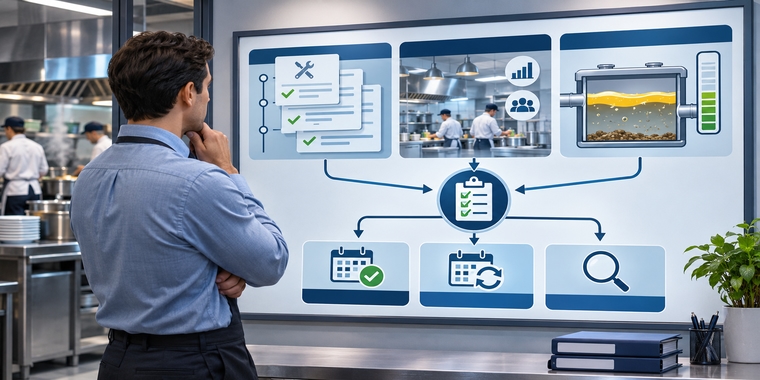
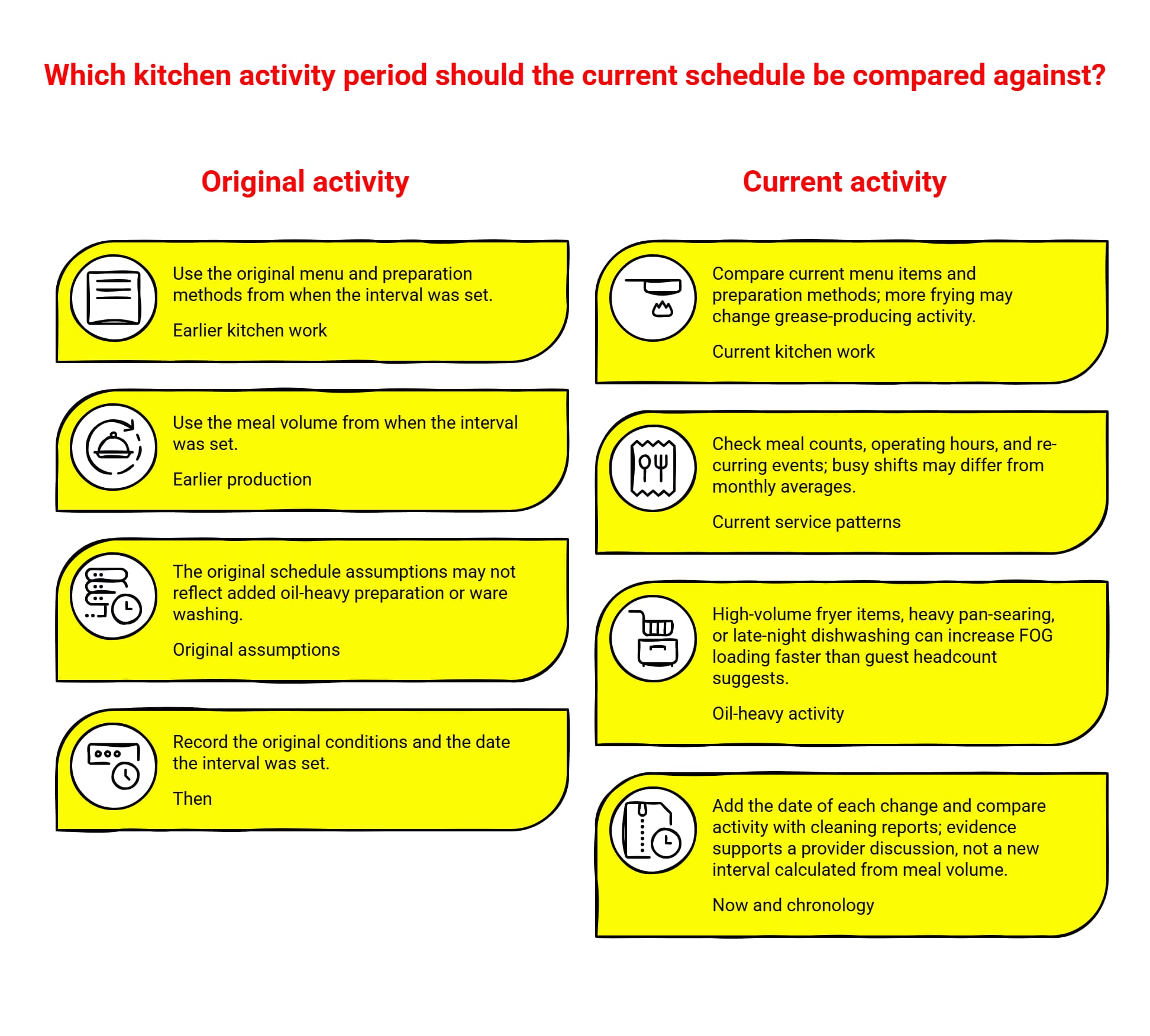
Infographic comparing original and current kitchen activity, including menu, meal volume, preparation methods, operating hours, oil-heavy work, and documented changes.

Start with the kitchen’s work, not the next appointment. Compare current menu items, preparation methods, and production volume with conditions when the interval was set. More frying may change grease-producing activity, but it does not prove earlier cleaning is necessary. Adding high-volume fryer items, heavy pan-searing, or late-night dishwashing shifts can increase fats, oils, and grease (FOG) loading far faster than overall guest headcount suggests, because interceptor buildup tracks oil-heavy prep and ware washing discharge rather than dining-room traffic alone. Check changes in meal counts, operating hours, and recurring events.

Check changes in meal counts, operating hours, and recurring events. A consistently busy shift may tell a different story from a monthly average. Reduced activity also deserves documentation, not an automatic extension.

For example, a general manager finds that an added evening service is missing from the assumptions behind the current schedule. The manager compares the change date with cleaning reports and finds one visit was moved forward. That evidence supports a provider discussion, not a new interval calculated from meal volume.

For owners and finance-aware operators, the same review tests whether the annual maintenance allocation reflects actual visits rather than an inherited assumption. It does not predict an expense.

In practice, management can create a simple then-and-now comparison: original menu and meal volume on one side, current kitchen activity on the other. Add the date of each change rather than relying on memory. That chronology gives a provider a better starting point than saying the restaurant simply feels busier.


How to Review Service Records Without Guessing at a New Interval

Compare recent completed service dates with booked dates. Note gaps, moved appointments, and reasons for early visits. A missed booking differs from additional cleaning prompted by observed conditions.

Drane Ranger describes service records containing dates, waste quantities, disposal-facility information, and identified system issues. It retains service histories and plans recurring visits around volume, system type, and operating needs. 

Service dates establish timing; waste quantities describe removal; system-issue notes flag observations. No individual field determines frequency. When reviewing past FOG manifests and service records, compare the total evacuated volume against technician notes on accumulation depth and trap condition rather than treating every pump-out as identical. Because Houston requires complete evacuation of the interceptor’s contents on every visit, total pumped gallonage usually stays consistent—but if core-sampling notes repeatedly show floating grease and settled solids approaching the 25% wetted-depth threshold before the 90-day mark, or flag grease carryover near the outlet baffle, that physical trend indicates kitchen output is outpacing the current schedule. Clarify cleaning scope, access limitations, and the reasoning behind the next-service recommendation.

A next-service recommendation is a planning judgment, not proof that the previous visit met every requirement. Keep the provider’s recorded observation separate from the manager’s interpretation. If an older report lacks a reason for an early cleaning, mark that reason as unknown rather than inventing one. A short note naming the shift, fixture, and date can make later follow-up more precise.

Date and locate slow drains, odors, or unusual conditions between visits. Their causes vary; repeated symptoms support evaluation, not an automatic interceptor diagnosis. Learn more about whether a restaurant cleaning schedule may be too infrequent.

Before scheduling a review call with your provider, pull your recent kitchen logs, service records, and FOG manifests into the worksheet below so you can separate verified records from unconfirmed assumptions.


Restaurant Activity Checklist

Does Your Cleaning Interval Still Match Kitchen Activity?

Use this review with kitchen logs and service paperwork. Date each entry and mark it verified record or assumption to confirm. Leave requirements and recommendations blank until checked.

What changed? What to check in your records
Menu or food preparation: ______ Menu change date; notes on grease-producing processes: ______
Meals prepared or customers served: ______ Shift or sales-volume records and comparison period: ______
Opening hours or recurring busy periods: ______ Staffing and operating logs; event dates: ______
Last several cleanings: ______ Scheduled versus completed service dates: ______
Unplanned or moved-forward visits: ______ Reason recorded; provider’s service notes: ______
Trap or drain observations: ______ Dates, locations, recurrence, and any documented findings: ______
Next-service advice: ______ Provider’s written recommendation and supporting explanation: ______
Requirements for this address: ______ Applicable authority or official guidance confirmed: ______


This is an evidence log, not a frequency calculator or compliance determination. For changed volume, read about revisiting a cleaning arrangement after busier service.

When to Discuss the Interval With a Service Provider

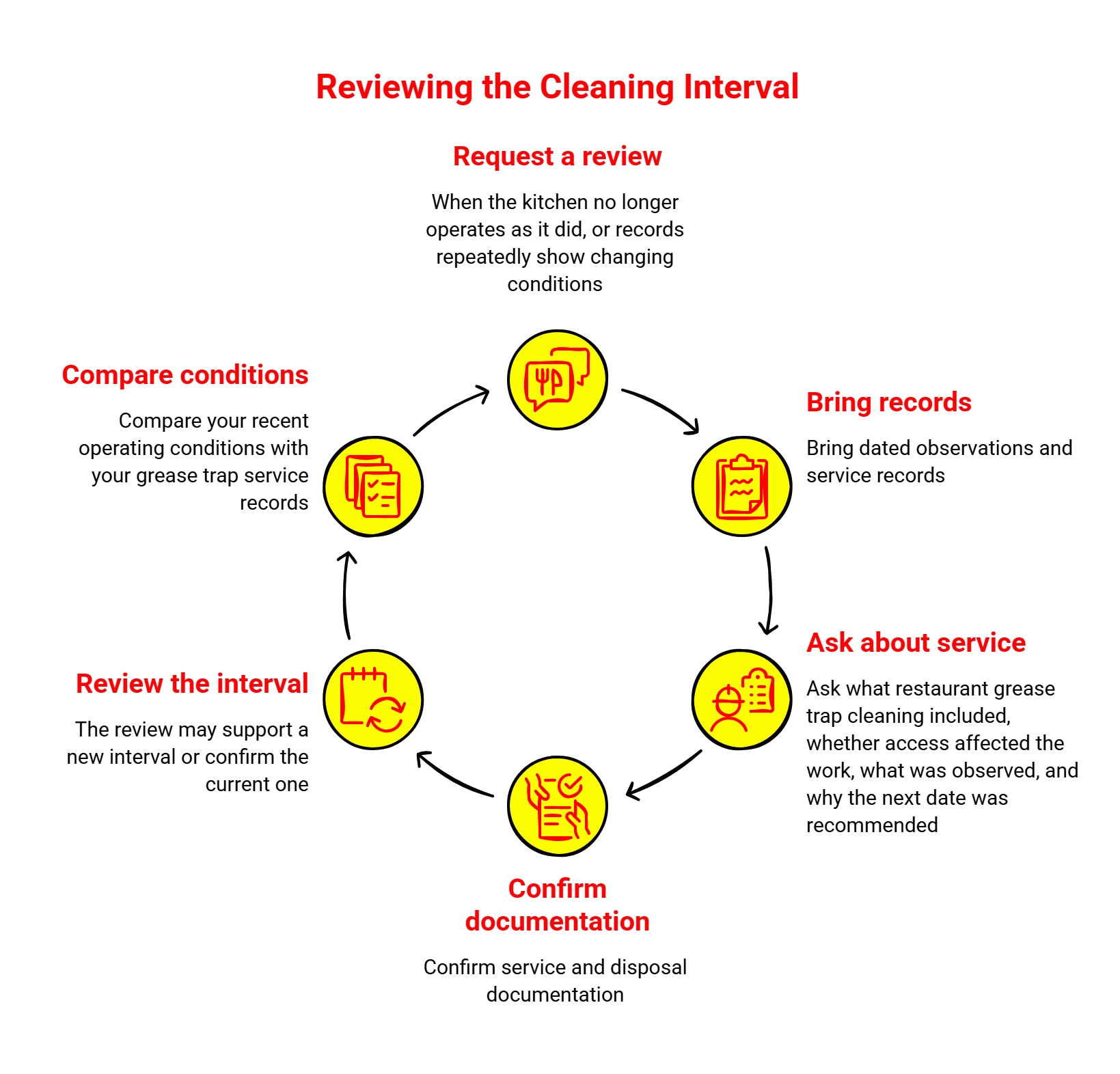
Infographic showing how to review a grease trap cleaning interval using current operating conditions, dated service records, provider input, documentation, and schedule comparison.

Request a review when the kitchen no longer operates as it did when the interval was set, or when records repeatedly show changing conditions before planned visits. An isolated odor or busy shift proves little. An active wastewater problem deserves prompt evaluation rather than waiting for routine cleaning.

Bring dated observations and service records. Ask what restaurant grease trap cleaning included, whether access affected the work, what was observed, and why the next date was recommended. Confirm service and disposal documentation. Provider guidance does not replace municipal requirements.

The review may support a new interval or confirm the current one. The owner gains a defensible assumption; the general manager, a clearer handoff; and the finance-aware operator, a comparison between planned and actual visits.

Back at the Houston manager’s worksheet, the next cleaning date now has supporting records, not just tradition. Before changing the schedule, compare your recent operating conditions with your grease trap service records. For further guidance, read Drane Ranger’s Houston grease trap cleaning guidance.


Our Editorial Process

Our expert team uses AI tools to help organize and structure our initial drafts. Every piece is then extensively rewritten, fact-checked, and enriched with first-hand insights and experiences by expert humans on our Insights Team to ensure accuracy and clarity.


About the Drane Ranger Insights Team

The Drane Ranger Insights Team is our dedicated engine for synthesizing complex topics into clear, helpful guides. While our content is thoroughly reviewed for clarity and accuracy, it is for informational purposes and should not replace professional advice.

A Fixed Grease Trap Cleaning Schedule May Miss a Busy Kitchen’s Needs

📌 Key Takeaways

A fixed grease trap cleaning schedule may become outdated when kitchen activity, grease accumulation, or operating conditions change, making periodic review necessary.

  • Kitchen Changes Warrant Review: Increased operating volume or changed food preparation can affect wastewater conditions, but neither automatically establishes how much sooner cleaning is needed.
  • Service Records Explain Early Visits: Documented reasons for earlier cleanings help distinguish administrative scheduling changes from recurring maintenance concerns that may justify reassessing the established interval.
  • Symptoms Do Not Confirm Causes: Slow drainage and recurring odors may warrant professional evaluation because neither observation, by itself, proves that the grease trap is full.
  • Compliance Does Not Establish Suitability: Meeting an applicable regulatory baseline does not establish that the cleaning interval adequately addresses the kitchen’s actual grease and solids accumulation.
  • Confirmed Needs Guide Budgeting: Annual maintenance allocations should reflect documented service requirements, while additional visits require explanation before management assumes a permanently higher cleaning frequency.

For restaurant managers, a provider’s documented assessment can clarify whether the next step is retaining the schedule, revising it, or investigating another issue.

A cleaning calendar provides predictability; documented operating evidence supports the decision to keep or change it.

~ ~ ~ ~ ~ ~ ~ ~ ~ ~ ~ ~ ~ ~ ~ ~ ~ ~

At 8:15 AM, a Houston restaurant manager reviews the annual maintenance worksheet. The grease trap cleaning appointments are already on the calendar. Yet the latest service records show that cleaning visits have occurred earlier than expected.

The schedule has not changed. So why does it no longer seem to fit?

This illustrative situation highlights a common maintenance planning challenge. Restaurant operations can change while an established service schedule remains untouched.

A fixed grease trap cleaning schedule can become outdated when kitchen activity, grease accumulation, or operating conditions change. Restaurant managers should periodically review service records, current kitchen activity, and recurring maintenance observations. A qualified provider can then help determine whether the existing interval remains appropriate for the site.

The goal is not to abandon scheduled cleaning. It is to ensure that the schedule continues to reflect the conditions it was designed to manage.


A Cleaning Schedule Can Stay Fixed While the Kitchen Changes
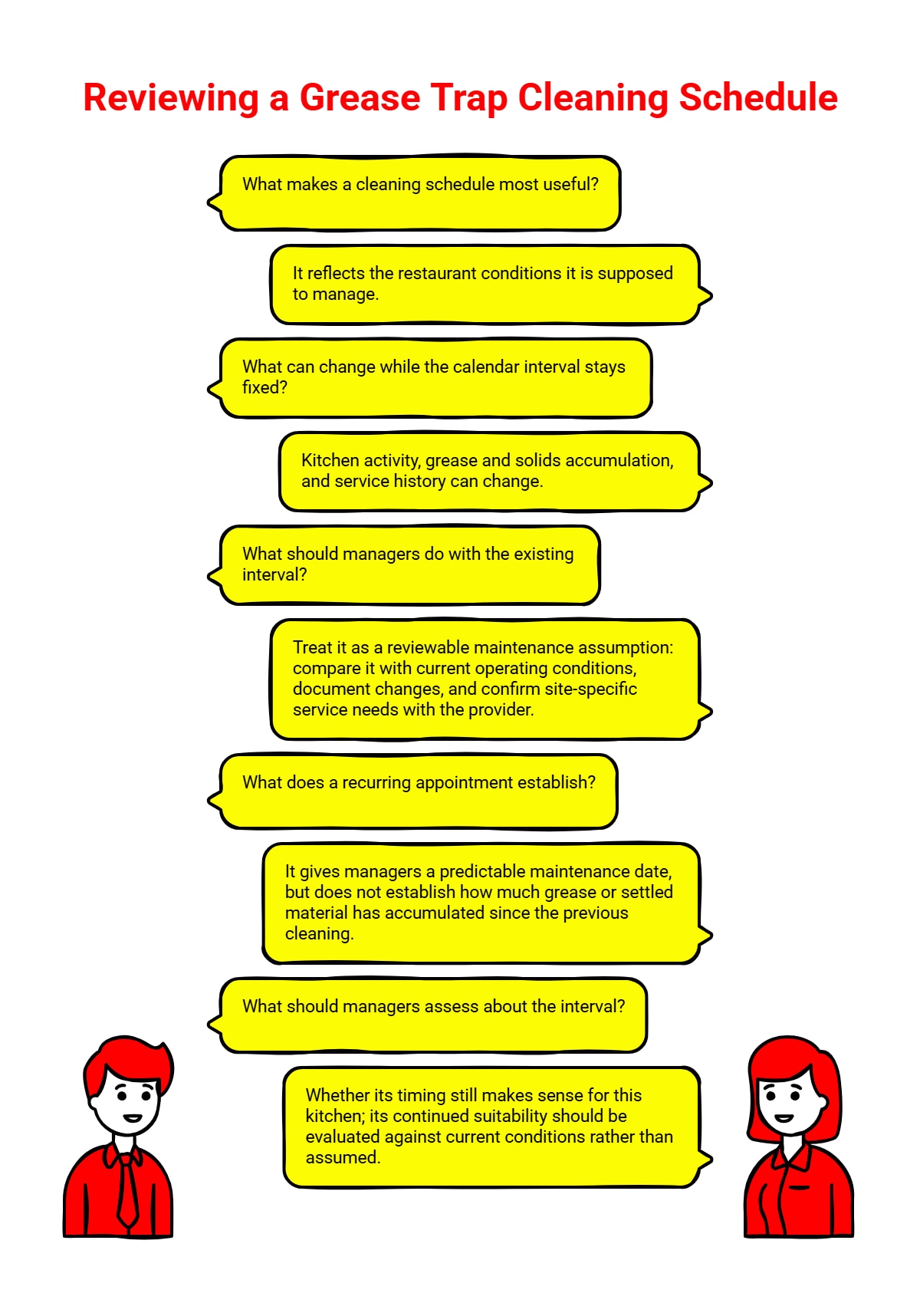
Q&A infographic explaining how to review a grease trap cleaning schedule by comparing fixed intervals with current kitchen activity, accumulation, service history, and site needs.

A grease trap cleaning schedule is most useful when it reflects the restaurant conditions it is supposed to manage. Kitchen activity, grease and solids accumulation, and service history can change while a calendar interval remains fixed. Restaurant managers should therefore treat the existing interval as a reviewable maintenance assumption: compare it with current operating conditions, document what has changed, and confirm site-specific service needs with the provider rather than assuming one schedule fits every kitchen.

A recurring appointment gives managers a predictable maintenance date. It does not establish how much grease or settled material has accumulated since the previous cleaning.

That distinction matters because grease trap cleaning frequency is influenced by conditions inside the restaurant, not simply the passage of time.

Consider two operating periods at the same restaurant. During the earlier period, kitchen activity follows a relatively consistent pattern. Management establishes a recurring cleaning arrangement based on the service requirements identified at that time.

Later, the restaurant becomes busier or changes its food preparation activities. The cleaning appointments remain unchanged because the existing arrangement is familiar and convenient.

The original interval may still be suitable. However, its continued suitability should be evaluated against the restaurant’s current conditions rather than assumed.

A maintenance calendar answers one question: When is the next cleaning planned?

A service-frequency review answers another: Does that timing still make sense for this kitchen?

Both questions deserve attention. The first supports scheduling consistency. The second helps management assess whether that consistency remains operationally appropriate.


What Can Change Between Grease Trap Cleanings?

Restaurant Grease Trap Cleaning Frequency depends on several connected factors. Understanding these relationships helps managers identify when an established interval deserves another look.

Restaurant operating volume and kitchen activity

A restaurant’s operating volume can change without any adjustment to its maintenance calendar.

A busier kitchen may prepare more food, wash more equipment, or operate for longer periods. Changes in menu preparation and kitchen routines may also affect the materials entering the wastewater system.

These developments can alter the operating conditions under which the original service interval was established.

However, an increase in restaurant activity does not automatically establish how much sooner the trap should be cleaned. The effect depends on the kitchen’s wastewater characteristics, the grease trap system, and the findings from previous service visits.

In busy Houston kitchens, for example, adding late-night service hours or increasing fryer turnover can push FOG and settled solids to the 25% threshold in six to eight weeks rather than a full 90-day quarter—even while surface drain flow inside the kitchen still appears normal. 

Management should document meaningful changes in activity and discuss them with the service provider.

For example, a manager who notices that the restaurant has become consistently busier should compare the current operating pattern with the period when the cleaning arrangement was established.

The question is whether the earlier service recommendation still reflects the operation as it functions today.

Drane Ranger’s related discussion of revisiting grease trap cleaning arrangements when restaurant activity changes provides additional context for that comparison.

Grease and solids accumulation

Grease traps are designed to retain fats, oils, and grease, commonly called FOG, before kitchen wastewater enters the downstream drainage system.

They also collect settled solids that require removal during professional service.

Accumulation occurs over time, but the amount and rate of buildup can differ between commercial kitchens. Even the same restaurant may experience changing accumulation conditions as its activities evolve.

Across commercial wastewater standards and municipal FOG codes, the “25% rule” serves as a standard operational benchmark: once combined floating grease and settled solids reach 25% of the trap’s total liquid depth, separation efficiency drops sharply and the unit requires pumping. 

The Texas Commission on Environmental Quality’s commercial-kitchen FOG guidance explains why managing fats, oils, and grease is part of responsible wastewater operations. The agency also identifies kitchen practices that can help reduce FOG-related problems.

This reinforces an important distinction: a calendar records elapsed time, while service findings provide information about actual operating conditions.

A cleaning date alone cannot establish whether accumulation has remained consistent.

Managers should ask their provider what was observed during previous visits and whether those findings support the current interval.


Recurring Drainage And Odor Observations

Kitchen operating problems may also provide reasons to review a service arrangement.

Relevant observations include:

  • Drainage becoming noticeably slower during normal kitchen operations.
  • Unpleasant odors recurring around affected drains or the grease trap area.
  • Similar complaints appearing before successive scheduled visits.
  • Wastewater-related concerns requiring additional professional attention.

These observations should not be treated as automatic proof that the grease trap is full.

A slow drain may involve a restriction elsewhere in the plumbing system. Odors can also have causes unrelated to the trap’s accumulation level.

The practical response is to record the observation, identify where it occurred, and note whether it has happened before.

For an illustrative example, imagine a restaurant manager noticing slow drainage during evening service. The next scheduled cleaning is still some distance away, but the manager remembers a similar problem during an earlier operating period.

Rather than immediately assuming that the service interval is inadequate, the manager checks the previous service notes and asks for professional evaluation.

That approach preserves the distinction between an observed symptom and a confirmed cause.


Previous Service Findings

Service history provides another important source of information.

A previous visit may have revealed conditions that affect future maintenance planning. The provider may also have recommended an earlier follow-up or identified an issue requiring separate attention.

Such findings deserve review before the next cleaning date is simply carried forward.

Drane Ranger describes recurring service planning as being based on site volume, system type, and operating needs. Its commercial grease trap cleaning services include the removal of accumulated waste from commercial kitchen systems.

The broader principle is straightforward: service recommendations should reflect the specific system and its operating conditions.


Why a Familiar Cleaning Interval Can Become an Outdated Assumption

Most restaurant managers have good reasons for maintaining an established service schedule.

Recurring appointments simplify coordination. Staff members know when service is expected. Maintenance expenses can be incorporated into operating plans, and management avoids reconsidering the arrangement before every visit.

These are practical advantages.

The problem begins when the schedule continues unchanged even though the conditions supporting it have materially shifted.

A restaurant may retain an interval because it was previously recommended, because the current arrangement has been convenient, or because no formal process exists for reviewing it.

None of these reasons establishes that the interval remains suitable.


The Difference Between An Established Interval And A Validated Interval

An established interval is the schedule currently being followed.

A validated interval is one that has been reviewed against relevant operating information and applicable requirements.

The distinction becomes clearer when management asks what evidence supports the current arrangement.

If recent service records show consistent findings and the restaurant’s operating conditions remain comparable, those observations may support retaining the interval.

If the records repeatedly show earlier-than-planned visits or materially changing conditions, the existing schedule deserves reconsideration.

Neither outcome should be assumed without reviewing the evidence.

The goal is not to make every cleaning appointment subject to a lengthy analysis. It is to recognize meaningful changes that justify reassessing the schedule.


Why The Distinction Matters Operationally

An interval that no longer reflects current service needs can create uncertainty about when maintenance should occur.

Managers may find themselves coordinating unplanned visits, responding to recurring concerns, or explaining differences between expected and actual maintenance activity.

Those situations can complicate staffing arrangements and maintenance budgeting.

They do not necessarily mean that the original schedule was unreasonable. They indicate that the available information needs to be reviewed.

A good schedule is not necessarily a permanent schedule. It is one that remains supported by current operating evidence.


Use Service Records Before Deciding to Change the Interval

When a cleaning arrangement appears unsuitable, changing the calendar immediately may seem like the simplest response.

However, choosing another interval without reviewing the available information can replace one uncertain assumption with another.

Service records provide a more disciplined starting point.


Compare Planned Service Dates With Actual Visits

Begin by reviewing the most recent completed cleanings.

Identify when each visit was scheduled and when it actually occurred. If a cleaning happened earlier than planned, determine why.

An additional visit might have been requested because of a reported drainage problem, a provider observation, or another operational concern.

The reason matters.

A visit brought forward for administrative convenience does not carry the same meaning as one prompted by recurring wastewater-related symptoms.

Management should avoid treating every schedule change as evidence that the grease trap requires more frequent cleaning.


Review What The Provider Documented

The date of service is useful, but it is not the whole record.

Relevant documentation may include the work performed, waste quantities where available, observations about trap conditions, issues identified, and recommendations for subsequent service.

Drane Ranger’s first-party service information describes records containing service dates, waste quantities, disposal facility information, and identified system issues.

These records support the broader maintenance review by giving management a documented account of previous service activity.

For example, a provider’s recommendation to reassess the next cleaning date is more useful when the record also explains what prompted that recommendation.

Without the explanation, a future manager may struggle to understand why the schedule was changed.


Separate Evidence From Assumptions

This is an important discipline when evaluating restaurant maintenance decisions.

Documented fact: A previous cleaning occurred before the planned service date, and the reason was recorded.

Unconfirmed assumption: The restaurant requires a permanently shorter cleaning interval because that visit occurred early.

The first statement describes an event. The second draws a conclusion that requires further evaluation.

Likewise, a recurring odor is an observation. It is not, by itself, proof of excessive grease accumulation.

Managers should make these distinctions visible when reviewing the maintenance history.

The result is a clearer conversation with the provider and a stronger basis for deciding what should happen next.


Connect Service History With Operational Changes

Service records become more useful when they are compared with kitchen activity during the same period.

A manager should identify whether meaningful operational changes occurred before the service pattern changed.

For instance, a restaurant may have expanded its food production activity around the same time that additional cleaning visits began occurring.

That timing provides a reason to investigate the relationship. It does not prove that the operational change caused the additional service requirement.

The provider should evaluate the relevant site conditions before drawing a conclusion.


Service-Frequency Review Checklist for Restaurant Managers

Use this checklist when reviewing an established grease trap cleaning schedule. It is designed to separate observable facts from assumptions that require professional confirmation.

Restaurant activity and operating conditions

  • Has restaurant operating volume materially changed since the current interval was established?
  • Have food preparation or kitchen operating patterns changed?
  • Have drainage, odor, or other wastewater-related concerns appeared before scheduled cleaning?
  • Are recurring observations documented with their dates and locations?

Cleaning and service history

  • Are the dates of recent grease trap cleaning visits available?
  • Did any cleaning occur earlier than originally planned?
  • Is the reason for each additional or early visit documented?
  • Do previous records describe recurring findings or changes in trap conditions?
  • Has the provider documented a recommended date or interval for future service?

Current maintenance assumptions

  • Can management explain why the current service interval was established?
  • Does the explanation reflect recent operating information?
  • Are the service scope and relevant site conditions documented?
  • Have applicable regulatory requirements been distinguished from operational recommendations?

Provider confirmation

  • Has the provider reviewed the relevant service history and operating changes?
  • Has the provider explained what supports retaining or reassessing the existing interval?
  • Are unresolved questions and the next recommended action documented?

How to use the findings: If the available evidence continues to support the current schedule, document why it is being retained. If operating conditions or service findings have changed, request a professional reassessment. If the records point to an unresolved drainage problem, seek evaluation of the cause rather than assuming a schedule adjustment will resolve it.

The checklist should produce a documented maintenance decision, not simply another appointment date.


What to Confirm With the Grease Trap Service Provider

A service-frequency discussion is most productive when management provides relevant records and asks questions that relate directly to the restaurant’s operating conditions.

The following questions help distinguish a routine appointment recommendation from a site-specific maintenance assessment.


What Operating Conditions Support The Recommended Interval?

Ask which characteristics of the restaurant and its wastewater system the provider considers relevant.

These may include operating volume, waste generation, grease trap characteristics, and previous service findings.

The provider should be able to explain the basis for the recommendation without suggesting that every restaurant requires the same cleaning frequency.


What Did The Previous Cleaning Reveal?

Request clarification about the observations made during the last service visit.

Were there findings that affect the next planned cleaning? Did the provider identify any unresolved issues? Does the recent history support the established schedule?

This discussion helps connect the next appointment to documented conditions.


Do Recurring Symptoms Indicate A Timing Problem Or Another Issue?

Share the restaurant’s recorded drainage and odor observations.

Ask whether the pattern supports reviewing the cleaning frequency or investigating another possible cause.

The distinction matters because additional grease trap cleaning is not a substitute for evaluating unrelated plumbing problems.


Have Site Conditions Or Service Requirements Changed?

Confirm whether the current cleaning arrangement adequately reflects the work required at the location.

Relevant considerations include service access, cleaning scope, operating conditions, and any recommendations recorded during earlier visits.

These factors should be discussed before management changes the arrangement.


Which Statements Are Regulatory Requirements?

Ask the provider to distinguish applicable legal obligations from site-specific maintenance recommendations.

Request the relevant official source when a particular cleaning deadline or operating threshold is described as mandatory.

This keeps regulatory compliance and operational judgment connected without treating them as interchangeable.


What Information Should Be Recorded After The Next Visit?

Agree on what the service documentation should capture.

A useful record identifies the work performed, relevant observations, unresolved issues, and the suggested next-service timing.

It should also make clear who is responsible for reviewing any outstanding concern.

This level of communication supports continuity when responsibility moves between restaurant managers or shifts.


Houston Grease Trap Requirements and Site-Specific Cleaning Needs

Houston restaurant operators must consider applicable wastewater requirements alongside the operating needs of their particular kitchen.

The two considerations are related, but they serve different purposes.

Regulatory requirements establish obligations that a facility must satisfy. Operational maintenance planning determines whether the established service arrangement adequately reflects the restaurant’s conditions.

The Houston Health Department’s special waste generator guidance identifies responsibilities relevant to restaurants and establishments with grease interceptors, including permitting and waste-manifest recordkeeping. It also directs operators to the City’s Chapter 47 requirements, which establish a baseline cleaning interval of at least every 90 days (unless an approved waiver applies) and restrict floating grease, oil, and settled solids to no more than 25 percent of the interceptor’s wetted height. Those requirements should be checked against the current official ordinance and any provisions applicable to the particular facility.

Those requirements should be checked against the current official ordinance and any provisions applicable to the particular facility. 

Meeting a regulatory baseline does not eliminate the need to evaluate actual grease and solids accumulation. Some kitchens may need professional attention before the 90-day mark or the next planned appointment because their operating conditions have changed.

State waste-management requirements are also relevant. The Texas Commission on Environmental Quality’s guidance for municipal liquid waste generators explains the responsibilities associated with transporting and disposing of waste, including grease trap waste.

TCEQ guidance addresses waste handling and transportation. It does not replace the need to establish an appropriate cleaning arrangement for the individual restaurant.

For businesses in Houston or nearby Alvin, the applicable municipal requirements should be confirmed for the actual facility location. A restaurant should not assume that every local jurisdiction applies identical rules.

The practical objective is to maintain a schedule that satisfies applicable obligations while responding appropriately to documented site conditions.


Cleaning Frequency Also Affects Annual Restaurant Maintenance Planning
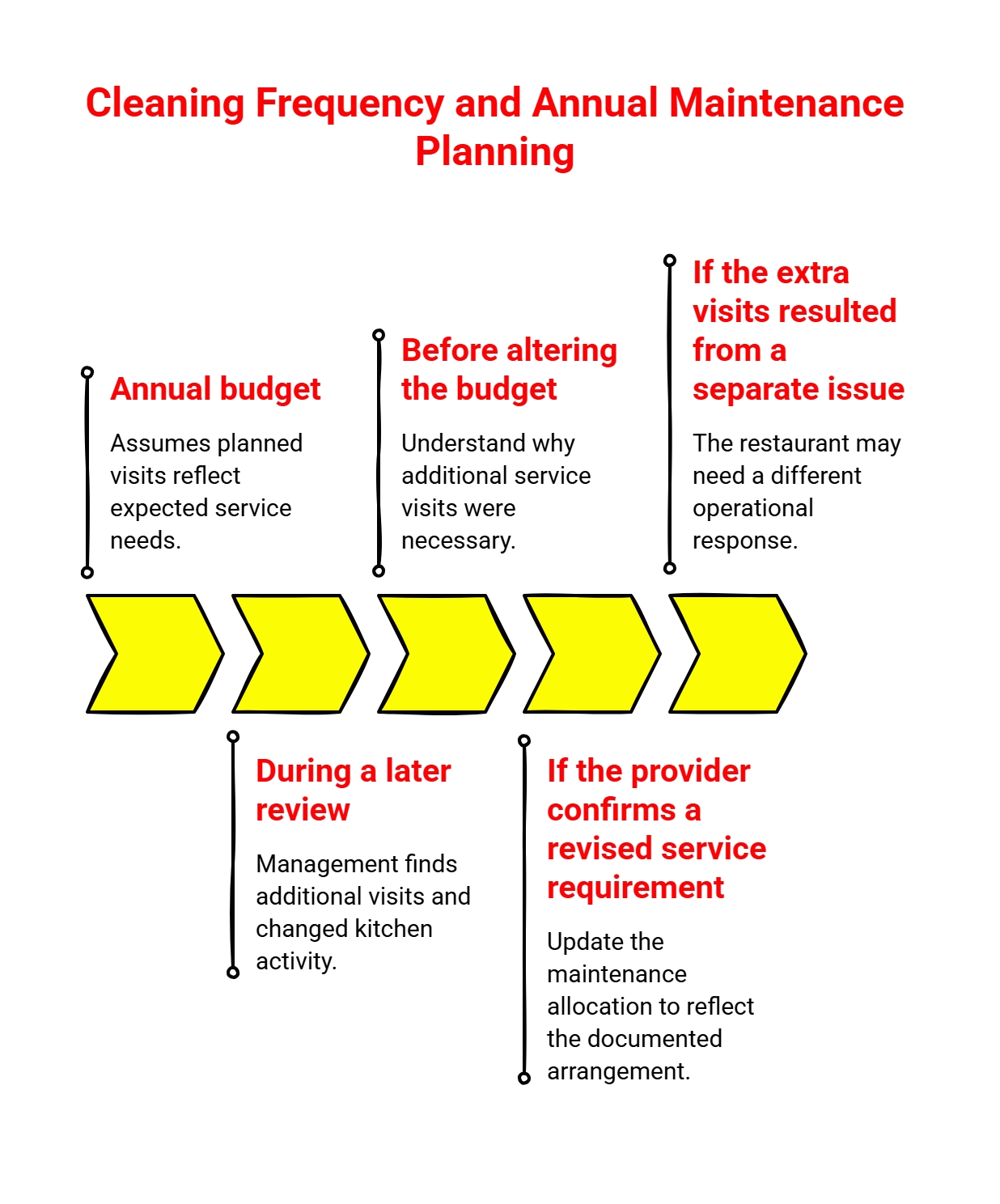
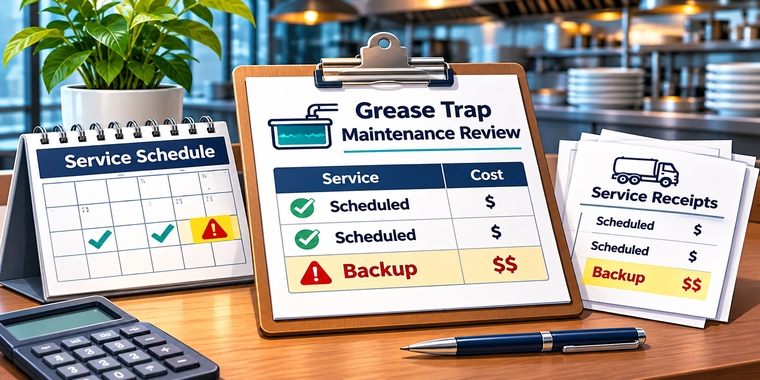
Infographic showing how annual grease trap maintenance planning should review extra visits, changed kitchen activity, provider requirements, and separate operational issues.

Grease trap cleaning is a recurring operational responsibility. Its expected frequency therefore contributes to the restaurant’s annual maintenance allocation.

An annual budget built around an established cleaning schedule assumes that the planned number of visits reasonably reflects expected service needs.

If that assumption changes, the financial plan may need review.

For example, consider an illustrative restaurant whose maintenance worksheet reflects its existing recurring arrangement. During a later review, management finds that additional service visits have occurred and that kitchen activity has changed.

The appropriate response is to understand why those visits were necessary before altering the budget.

If the provider confirms a revised service requirement, management can update the maintenance allocation to reflect the documented arrangement.

If the extra visits resulted from a separate issue, the restaurant may need a different operational response.

This distinction prevents maintenance planning from becoming an exercise in adjusting numbers without examining their underlying causes.


Why The Lowest Individual Service Expense Is Not The Only Consideration

The financial value of a maintenance arrangement cannot be assessed solely from the price of one cleaning visit.

Restaurant operators also need to consider the service scope, the frequency of recurring visits, documentation, and how the arrangement fits normal operations.

An apparently inexpensive individual visit does not establish that the overall service arrangement is appropriate.

Likewise, more frequent cleaning does not automatically guarantee lower annual maintenance expenditure or eliminate the possibility of unexpected repairs.

The financially responsible approach is to establish the service requirements first, then plan the corresponding maintenance allocation.

For further guidance, Drane Ranger’s annual restaurant grease trap maintenance budgeting guide explains how recurring cleaning fits into broader maintenance planning.


Build a Reviewable Cleaning Schedule Instead of Relying on Calendar Dates Alone

A well-managed grease trap cleaning schedule provides predictability while remaining responsive to meaningful changes in restaurant operations.

That requires more than recording the next appointment.

After a completed service visit, management should preserve the relevant documentation and note the provider’s next recommended timing.

When restaurant activity changes, those records should be compared with current operating conditions. Recurring symptoms or earlier-than-planned visits deserve attention, particularly when they indicate that the original maintenance assumptions may no longer apply.

The review does not always need to result in a new cleaning interval.

Sometimes the evidence supports keeping the existing arrangement. In other cases, the provider may recommend a different schedule or further evaluation of the wastewater system.

What matters is that the decision has a documented basis.

Restaurant managers should be able to answer three practical questions:

  1. What operating conditions support the current cleaning schedule?
  2. What do recent service records and observations reveal?
  3. What has the provider confirmed about the next appropriate action?

When those answers are available, maintenance planning becomes more transparent and easier to explain to ownership, staff, and future managers.

For site-specific information about professional service, Drane Ranger provides grease trap cleaning in Houston for commercial kitchens and other applicable facilities.

The most useful immediate action is to compare recent service records with current kitchen activity. Identify what has changed, what the records establish, and what still requires professional confirmation.

The calendar establishes the maintenance plan. Current operating evidence determines whether that plan still fits the kitchen.

Disclaimer: Grease trap maintenance requirements vary according to applicable regulations, system characteristics, and operating conditions. This content is intended for general educational purposes and does not replace current official regulatory guidance or site-specific professional advice. Confirm legal obligations with the relevant authority and discuss cleaning frequency with a qualified service provider.


Our Editorial Process

Our expert team uses AI tools to help organize and structure our initial drafts. Every piece is then extensively rewritten, fact-checked, and enriched with first-hand insights and experiences by expert humans on our Insights Team to ensure accuracy and clarity.


About the Drane Ranger Insights Team

The Drane Ranger Insights Team is our dedicated engine for synthesizing complex topics into clear, helpful guides. While our content is thoroughly reviewed for clarity and accuracy, it is for informational purposes and should not replace professional advice.
Unexpected Backups Can Disrupt a Restaurant Maintenance Budget

📌 Key Takeaways

An unexpected grease trap backup warrants a maintenance budget review, but recurring spending should change only when service evidence supports it.

  • Backups Do Not Establish Causes: An unscheduled service call does not prove inadequate cleaning; accumulated grease, connected piping, or another drainage problem may be involved.
  • Kitchen Changes Can Affect Frequency: Increased meal volume, revised menus, preparation changes, or expanded operating hours may alter grease accumulation and warrant reviewing the cleaning interval.
  • Service Records Support Schedule Reviews: Planned visits, completed work, waste quantities, provider findings, and unresolved issues help establish whether the existing schedule still fits kitchen conditions.
  • Repairs Differ From Recurring Cleaning: An isolated pipe defect may require a repair, while documented grease accumulation may support additional scheduled cleaning in the recurring budget.
  • Houston Sets Minimum Cleaning Requirements: Houston requires interceptor cleaning at least every 90 days unless the city approves a formal waiver for up to 180 days.

For Houston restaurant managers preparing the next annual allocation, confirmed service scope, access requirements, and provider quotations support estimates grounded in documented operating needs.

A defensible maintenance budget accounts for expected visits, traceable expenses, and unresolved system concerns.

~ ~ ~ ~ ~ ~ ~ ~ ~ ~ ~ ~ ~ ~ ~ ~ ~ ~

The maintenance budget looked predictable.

A Houston restaurant manager has scheduled grease trap cleanings in the annual worksheet. Then water gathers beside a kitchen floor drain during service. Staff redirect work, a provider is contacted, and another entry appears in the maintenance log. Did the budget reflect the kitchen we actually operate?

You cannot identify the cause of a backup from the incident alone. It may involve accumulated grease, connected piping, or another drainage problem. The interruption still warrants examining the cleaning pattern behind your annual allocation. Cost planning means estimating visits, recording known costs, and reviewing assumptions as conditions change. It resembles a staffing schedule, except the planned units are service visits instead of employee shifts.


How an Unexpected Grease Trap Backup Can Disrupt a Restaurant Maintenance Plan

An unexpected backup introduces work that may not appear in the routine maintenance calendar. The manager must document affected areas, coordinate an appropriate professional response, communicate any operating restrictions, and track whether cleanup or follow-up is needed. These effects are observable before the cause is established.

Protect the affected area and arrange professional attention first. Later, establish what work was performed, whether the problem was resolved, and who owns outstanding actions. The restaurant grease trap backup first-response checklist addresses the immediate operational decisions in more detail.

An unscheduled visit does not prove routine cleaning was insufficient, but it deserves a documented review.


Why Restaurant Operating Conditions Can Make a Planned Cleaning Interval Outdated

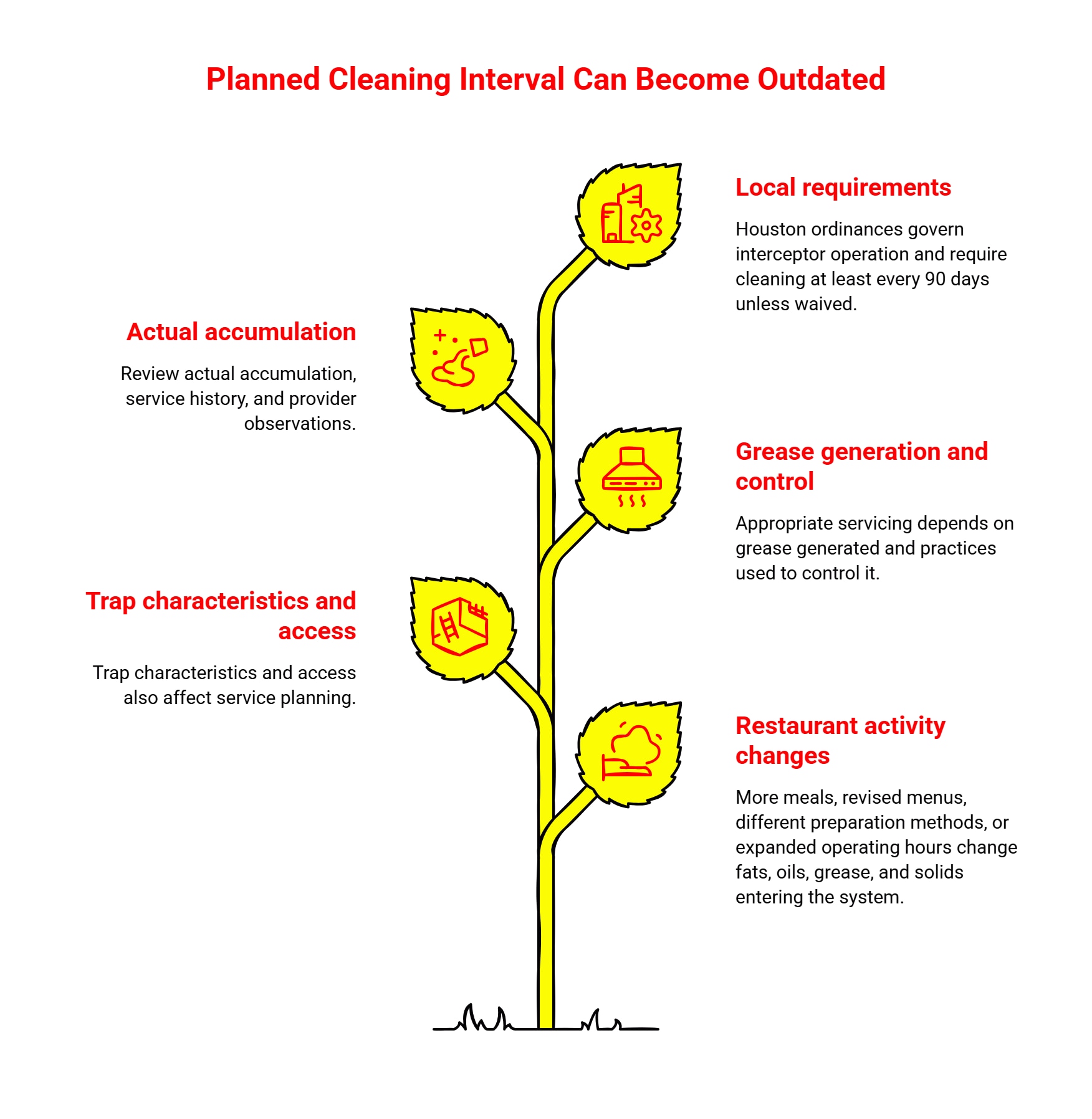
Infographic showing why grease trap cleaning intervals may need review based on local requirements, actual accumulation, trap access, grease generation, and restaurant activity changes.

Restaurant activity can change suitable grease trap cleaning frequency. More meals, revised menus, different preparation methods, or expanded operating hours may change the quantity of fats, oils, grease, and solids entering the system. Trap characteristics and access also affect service planning.

The EPA explains that appropriate interceptor servicing depends substantially on the grease a food service establishment generates and the practices used to control it. It does not prescribe an interval for any particular restaurant. Review actual accumulation, service history, and provider observations.

Recurring maintenance can reduce exposure to grease-related disruption and compliance expense, but cannot prevent every drainage failure. Houston restaurants must also distinguish maintenance recommendations from applicable local requirements. The City of Houston’s Chapter 47, Article XI ordinances govern interceptor operation, complete evacuation, manifesting, and waste handling—including a baseline requirement to clean interceptors at least every 90 days unless the city approves a formal waiver for up to 180 days. Confirm current municipal rules and permit conditions before extending or altering a service arrangement.


How Service Records Reveal Whether the Maintenance Budget Still Fits the Kitchen

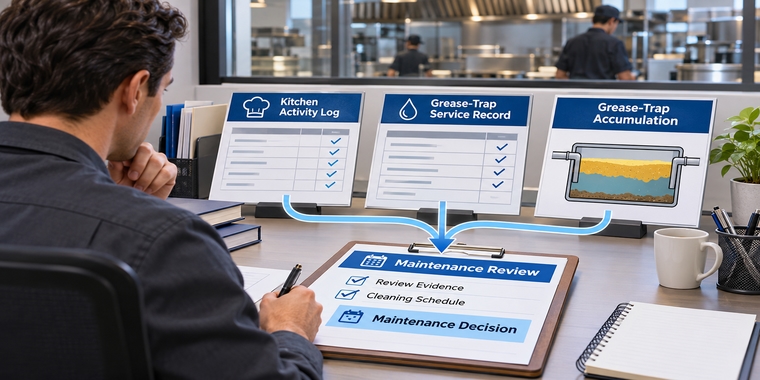
A useful comparison begins with three sets of evidence: last year’s planned service visits, visits actually completed, and the current kitchen’s operating conditions. Mark appointments that occurred early, late, or outside the expected sequence. Identify recurring symptoms and changes in volume or grease output.

Then review the provider’s documentation. Drane Ranger’s stated service records include service dates, waste quantities, disposal facility information, and identified system issues. Distinguish completed cleaning from unresolved system concerns. Record the recommended next-service date and its basis.

Suppose a manager finds an early cleaning followed by a problem call. That pattern deserves investigation, not an automatic increase in scheduled pumping. Compare actual accumulation and provider findings with the original assumptions.

Use the guidance on how to review whether a grease trap cleaning schedule is too infrequent to assess recurring patterns. For the documentation itself, consult grease trap service records after a problem visit.


How Restaurant Managers Can Review a Backup Without Inventing an Emergency Cost

Document what happened before estimating its budget effect. Confirm the incident time, the affected work areas, service requested, completed work, actual invoices, and outstanding repairs. Keep suspected causes separate from the provider’s findings. Slow drains or odors are reasons to investigate, not proof that a trap was full.

A restaurant can record a real interruption without claiming that every backup has a standard price or that a changed cleaning schedule guarantees savings. If an expense has not been invoiced or otherwise documented, do not insert an illustrative dollar amount into the forecast as though it were an established cost.

An unrelated pipe defect may require repair rather than additional trap cleaning. A documented pattern of accumulation before scheduled visits points toward a different conversation with the provider. For example, suppose a Houston kitchen budgets for four quarterly pump-outs under the City of Houston’s 90-day baseline, but logs two unscheduled service calls in a single quarter. Before revising next year’s recurring cleaning allocation to six visits, check the provider’s service records and FOG manifests: if one call stemmed from an isolated downstream line blockage and the other followed a fried-menu expansion that pushed the trap past Houston’s 25% accumulation threshold early, only the menu-driven grease increase justifies shortening the recurring cleaning interval—while the line repair belongs in one-time plumbing maintenance. Keeping that distinction clear on the annual worksheet prevents double-counting: instead of adding both emergency invoices into next year’s recurring baseline, you assign the one-time hydro-jetting or line-clearing invoice to non-recurring repairs and adjust the recurring maintenance line solely by the two additional scheduled pump-outs confirmed by your provider’s quote.


Operational Interruption Planning Checklist for Restaurant Grease Trap Problems

After the immediate situation is addressed, use this checklist to create a consistent record for operations and budget planning.

  • Capture the event. Note when and where the problem appeared, which activities were affected, and whether it is now contained or unresolved. Separate observations from suspected causes.
  • Retrieve the latest service record. Check the date, completed scope, quantities, disposal details, identified issues, recommended next visit, and open follow-up items.
  • Compare the schedule. Mark whether the latest visit was earlier, later, or outside the pattern assumed in the maintenance budget.
  • Record operational coordination. Note work restrictions, cleanup, provider contact, management communication, and actual documented expenses without assigning invented losses.
  • Escalate and assign ownership. Inform the owner, general manager, or finance-aware operator when the event affects the plan. Name the person responsible for each unresolved action.
  • Review kitchen changes. Compare current meal volume, preparation practices, operating hours, and grease output with the conditions used to establish the interval.
  • Confirm provider findings. Ask what caused the problem, what work was completed, whether another defect remains, and whether site evidence supports revising the service arrangement.
  • Update the planning record. If evidence supports a change, document the reason, proposed visit pattern, known costs, responsible approver, and date for the next review.


When an Unexpected Backup Should Trigger a Maintenance Budget Review

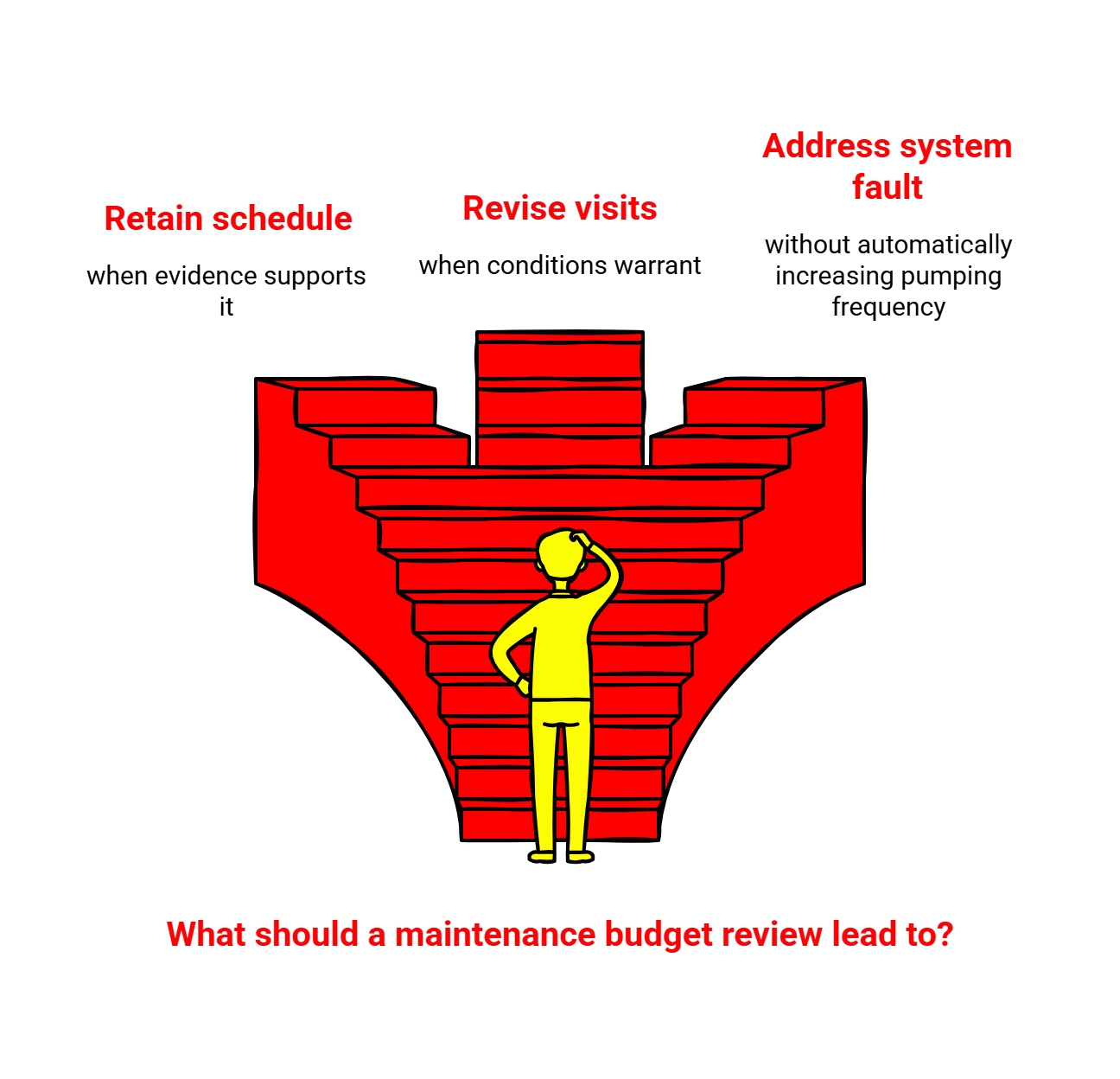
Infographic showing maintenance review outcomes: retain the schedule when evidence supports it, revise visits when needed, or address system faults without automatically increasing pumping.

Review the annual allocation when completed visits repeatedly differ from the plan, kitchen activity changes materially, symptoms return before scheduled service, or provider findings suggest a different interval. An isolated event may justify investigation without changing recurring expenditure.

For a defensible decision, compare last year’s planned visits and maintenance allocation with actual visits and invoices. Then assess the visits now expected. Confirm the service scope, access requirements, and provider quotation before estimating a revised annual allocation. Separate documented amounts from assumptions. A lower price per visit is not meaningful if it describes a different service scope or an unsuitable cleaning arrangement.

Three outcomes are possible: retain the schedule when evidence supports it, revise planned visits when conditions warrant, or address a separate system fault without automatically increasing pumping frequency. For Houston operators, the City of Houston’s special-waste generator guidance also explains why service and waste-disposal documentation matters. Regulatory obligations should be confirmed independently of a restaurant’s budgeting preferences.


How Better Maintenance Records Support the Next Restaurant Budget Review

A defensible budget matches the service log. Expected visits are recorded, actual expenses are traceable, changed kitchen conditions are visible, and unresolved issues have an owner. That supports adjustments without treating every interruption as inadequate cleaning.

Return to the annual worksheet with the incident record beside it. Review recent visits against current kitchen activity, then use Drane Ranger’s resource on annual grease trap maintenance budgeting to place the findings in the wider maintenance plan. The useful outcome is not a larger budget by default. It is an allocation supported by evidence.

Explore Drane Ranger’s related maintenance guidance for additional planning context.

Field & Compliance Review: Grounded in Drane Ranger’s Greater Houston liquid waste and commercial grease trap service standards—supporting local kitchens with vacuum truck extraction, FOG manifest documentation, and City of Houston Chapter 47 compliance since 1985.


Our Editorial Process

Our expert team uses AI tools to help organize and structure our initial drafts. Every piece is then extensively rewritten, fact-checked, and enriched with first-hand insights and experiences by expert humans on our Insights Team to ensure accuracy and clarity.


About the Drane Ranger Insights Team

The Drane Ranger Insights Team is our dedicated engine for synthesizing complex topics into clear, helpful guides. While our content is thoroughly reviewed for clarity and accuracy, it is for informational purposes and should not replace professional advice.
When Kitchen Volume Changes, Revisit the Restaurant Maintenance Budget

📌 Key Takeaways

Review a restaurant’s grease trap maintenance budget when kitchen operations materially change, using service records and documented provider guidance before revising the annual allocation.

  • Extra Visits Increase Annual Costs: A higher annual visit count can increase cleaning expenditure even when the provider’s confirmed price per visit remains unchanged.
  • Service Records Test Budget Assumptions: Comparing planned and completed visits, service notes, and invoices helps distinguish recurring frequency changes from differences in scope or charges.
  • Symptoms Require Professional Evaluation: Repeated slow drainage or odors warrant assessment, but these symptoms alone do not establish that the grease trap is full.
  • Provider Advice Does Not Replace Requirements: Site-specific cleaning recommendations inform maintenance planning, while applicable local requirements remain a separate compliance baseline that operators need to confirm.
  • Documented Decisions Support Future Reviews: A dated record of evidence, recommendations, approval, and the next review trigger helps subsequent managers reconstruct the maintenance budget decision.

For restaurant managers and owners preparing the next budget sign-off, unresolved service assumptions identify where further assessment is needed before approving a revised recurring allocation.

A useful maintenance allocation connects expected visits and known charges to documented kitchen conditions.

~ ~ ~ ~ ~ ~ ~ ~ ~ ~ ~ ~ ~ ~ ~ ~ ~ ~

At 8:15 a.m., a restaurant manager compares an annual budget worksheet with the latest grease trap service records. The printer hums, and a familiar question arises: Does this allocation still describe the kitchen? This is an illustrative scene, but the decision is practical. Review a restaurant’s grease trap maintenance budget when operating conditions materially differ from those used to set the original cleaning allowance. Compare current activity, planned and completed visits, and documented service advice before changing the annual number. A busier kitchen warrants investigation, not an automatic increase.


Why Kitchen Volume Is a Maintenance-Budget Trigger

Infographic showing how changing kitchen volume can affect grease trap maintenance budgets through service triggers, visit frequency, allocation, and planning reviews.

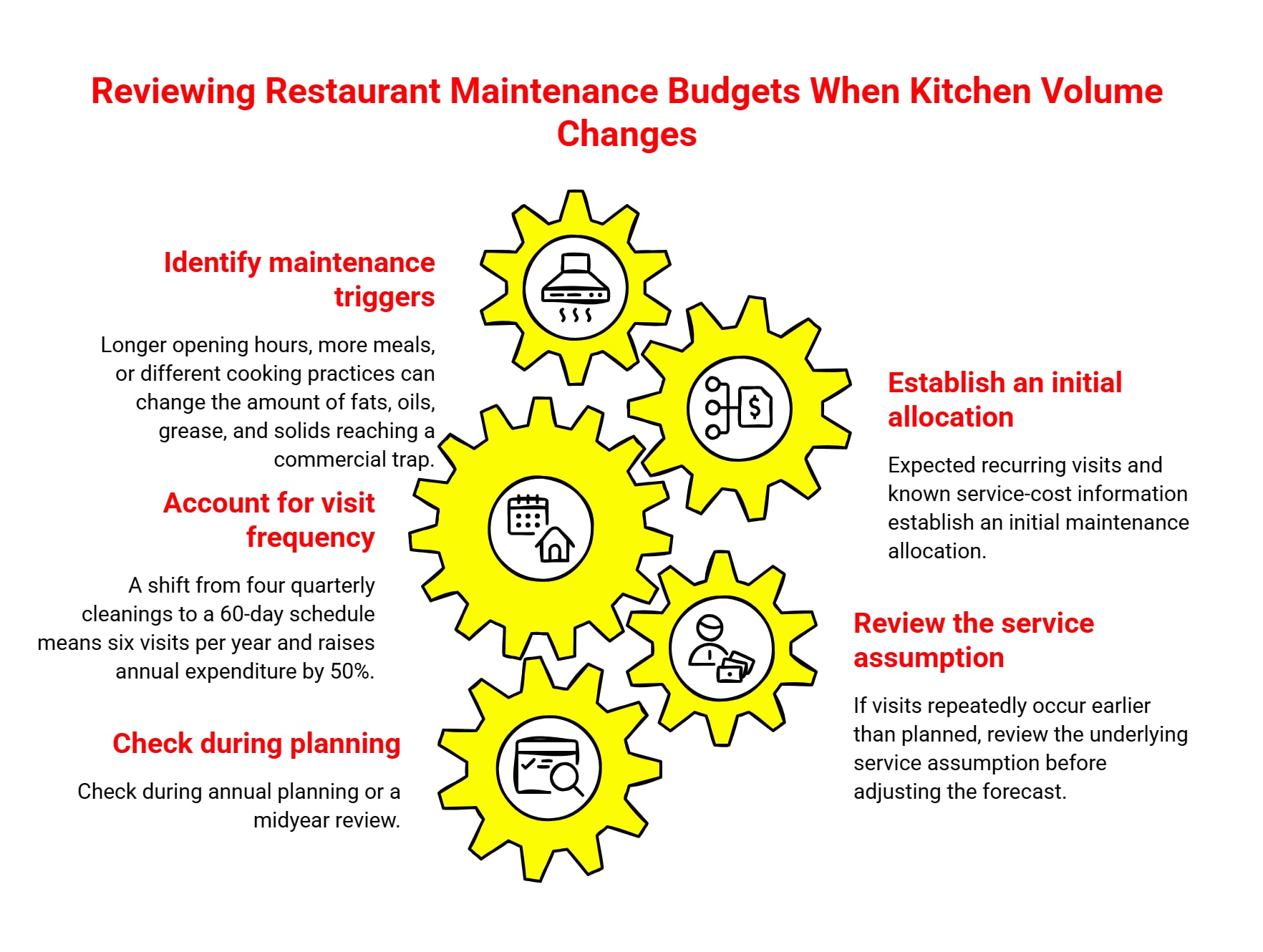
Last year’s maintenance allocation is a starting point, not a permanent operating rule. Longer opening hours, more meals, or different cooking practices can change the amount of fats, oils, grease, and solids reaching a commercial trap. The U.S. Environmental Protection Agency explains that grease-control maintenance frequency depends on FOG generation and operating practices. Actual conditions matter more than an assumed universal interval.

Cost planning for grease trap cleaning in annual restaurant maintenance budgets starts with two inputs: the expected number of recurring visits and known service-cost information. Together, they establish an initial maintenance allocation. A quotation prices its stated scope; it does not establish the annual visit count.

The overlooked source of budget variance is sometimes visit frequency, not a higher price per visit. For example, if extended weekend hours push a kitchen from four quarterly cleanings onto a 60-day schedule (six visits per year), total annual cleaning expenditure rises by 50%—two extra visits—even when the provider’s per-visit rate never changes. In budget terms, a line item planned at four times your confirmed per-visit rate becomes six times that rate—a 50% overrun driven entirely by pumping cadence rather than a price increase. If visits repeatedly occur earlier than planned, review the underlying service assumption before adjusting the forecast. Check during annual planning or a midyear review.


What Operating Changes Deserve a Review?

Compare today’s kitchen with its operating pattern when the current budget was approved. Capture observable changes rather than relying on an impression that business feels busier.

  • Meal periods consistently serve more customers or require higher production.
  • Opening hours, kitchen shifts, catering work, or preparation schedules have expanded.
  • Menu revisions or cooking methods have changed grease-producing activity.
  • Seasonal demand has persisted beyond its originally expected period.
  • Slow drainage or odors repeatedly appear before scheduled cleaning.
  • The provider has suggested a different next-service date on more than one occasion.

Record when each change began and whether it is temporary or sustained. Symptoms warrant professional evaluation; slow drains or odors alone do not establish that the trap is full. In commercial kitchens, technicians commonly apply the 25% rule—checking whether combined floating fats, oils, and grease (FOG) and settled solids reach 25% of the trap’s total liquid depth, which triggers service even before a 90-day municipal interval expires.

For operational context, see when busier service calls for revisiting a cleaning arrangement. The budget question remains whether the assumed visit count still holds.


Check the Records Before You Change the Number

Set the budget worksheet beside the cleaning history. Identify the original planned interval and visit count, then check what actually happened. Compare scheduled dates with completed visits, especially extra appointments or visits brought forward. This establishes whether the difference is recurring or isolated.

Next, review service notes, recommendations for the next cleaning, and any documented accumulation or system issues. Drane Ranger describes service records that include dates, waste quantities, disposal-facility information, and identified issues. Those records can support a review, although individual documents may contain different details. Recurring symptoms can be assessed alongside signs that an existing cleaning schedule may be too infrequent.

Finally, compare invoices and known quotations with the original allocation. Separate a changed visit count from changes in service scope, access, or quoted charges. The annual restaurant grease trap budgeting framework explains initial planning; this review tests its inputs.

Three outcomes are possible. The original assumption remains supported, the evidence is insufficient and needs professional review, or the documented service needs justify a revised interval. Do not treat an unverified assumption as a confirmed service requirement.


Change-Trigger Review Matrix

Use this matrix during a management review. Each row identifies an observation to investigate, not a predetermined cleaning requirement.

Observed change Evidence to inspect Responsible role Question for the provider
Kitchen volume is materially higher than when the budget was set Recent service dates, operating schedule, service notes General manager Does current activity change the recommended interval for this site?
Service has repeatedly been needed earlier than expected Completed service history and recurrence pattern General manager and owner What site conditions appear to shorten the interval?
Operating hours or production patterns changed Current and prior operating schedules General manager Should the maintenance assumption be reassessed?
Annual expenditure is above plan Budget-to-actual records and visit count Owner or finance-aware operator Is the difference due to frequency, scope, access, or another documented factor?
Provider guidance has changed Previous and current service recommendations Owner and general manager Which site conditions or records support the new recommendation?

The general manager checks operating evidence. Ownership or finance checks the forecast and approves any revised recurring allocation. Both need a dated record of the reason for the decision.


Questions to Ask the Grease Trap Service Provider

Bring the service history and a concise description of the operational changes. Ask for the site evidence behind any proposed adjustment.

  1. Does current kitchen activity change the interval recommended for this location?
  2. Which operating conditions, accumulation observations, or service records support that recommendation?
  3. What records should management retain for the next budget review?
  4. Could access, service scope, waste conditions, or scheduling affect future quotations?
  5. What change should trigger reassessment before the next annual budget cycle?

Drane Ranger describes restaurant grease trap cleaning and recurring arrangements tailored to the site, rather than an identical schedule for every customer. In supplied feedback, customer Harold R. described clear communication and receiving a suggested time for the next cleaning. That feedback establishes neither savings nor a universal frequency.

Operators in Houston and Alvin should check the requirements governing their particular site. The City of Houston’s Special Waste program materials establish a mandatory minimum compliance baseline for Houston sites (such as full evacuation at least every 90 days under City Code Section 47-512(b), unless a waiver applies, and adherence to the 25% accumulation threshold), not a one-size-fits-all operating interval for every kitchen or jurisdiction. Confirm current obligations with the appropriate authority; provider recommendations do not replace them.


Document the Revised Maintenance Assumption

Infographic showing how to document, update, and finalize a revised grease trap maintenance allocation using service records, provider guidance, and current operating conditions.

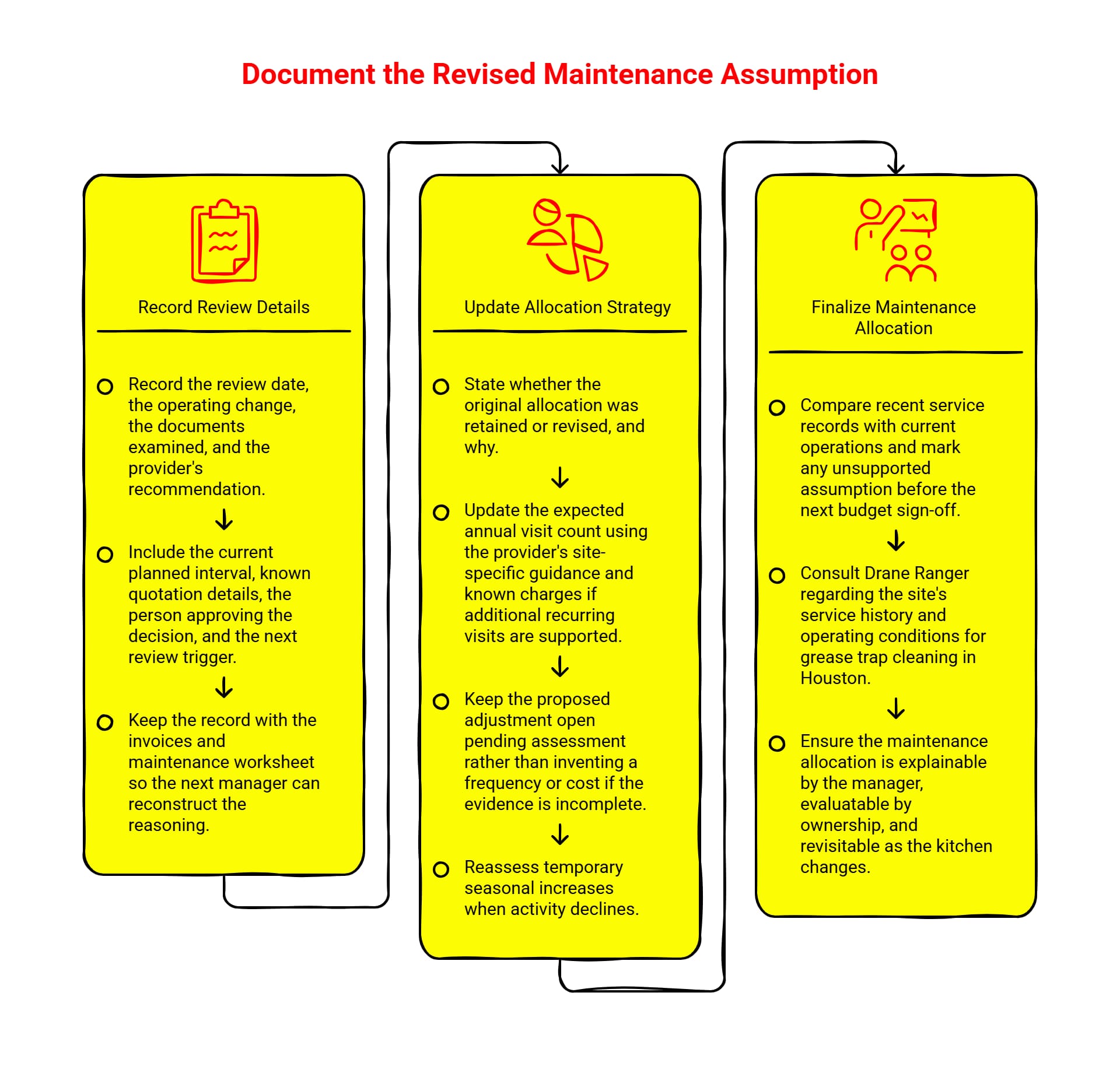
Record the review date, the operating change, the documents examined, and the provider’s recommendation. Include the current planned interval, known quotation details, the person approving the decision, and the next review trigger. Keep the record with the invoices and maintenance worksheet so the next manager can reconstruct the reasoning.

State whether the original allocation was retained or revised, and why. If additional recurring visits are supported, update the expected annual visit count using the provider’s site-specific guidance and known charges. If the evidence is incomplete, keep the proposed adjustment open pending assessment rather than inventing a frequency or cost. Reassess temporary seasonal increases when activity declines.

Before the next budget sign-off, compare recent service records with current operations and mark any unsupported assumption. For grease trap cleaning in Houston, Drane Ranger can discuss the site’s service history and operating conditions. The useful outcome is not simply a new number. It is a maintenance allocation the manager can explain, ownership can evaluate, and the restaurant can revisit as its kitchen changes.


Our Editorial Process

Our expert team uses AI tools to help organize and structure our initial drafts. Every piece is then extensively rewritten, fact-checked, and enriched with first-hand insights and experiences by expert humans on our Insights Team to ensure accuracy and clarity.


About the Drane Ranger Insights Team

The Drane Ranger Insights Team is our dedicated engine for synthesizing complex topics into clear, helpful guides. While our content is thoroughly reviewed for clarity and accuracy, it is for informational purposes and should not replace professional advice.
Busier Restaurant Service in Houston: When to Revisit Your Grease Trap Cleaning Arrangement

📌 Key Takeaways

Houston restaurants should revisit grease-trap arrangements when operations change, using current operating facts instead of guessing at a new schedule.

  • Review Changed Operations: Longer hours, heavier cleanup, new preparation patterns, or increased workload can justify reviewing the existing arrangement.
  • Compare Then And Now: Document how current operations differ from conditions when the cleaning arrangement was originally established.
  • Let Providers Assess Fit: Management supplies operating facts, while a qualified provider determines whether the existing arrangement still fits.
  • Separate Compliance From Fit: Houston requirements set a regulatory baseline, while site-specific service decisions depend on current conditions and service history.

Changed operations deserve review, not automatic schedule changes.

Houston restaurant owners and managers will get a clearer framework for comparing operations and preparing the provider discussion below.

~ ~ ~ ~ ~ ~ ~ ~ ~ ~ ~ ~ ~ ~ ~ ~ ~ ~

Your restaurant may not operate the way it did when its current grease trap cleaning arrangement was established. Hours may be longer, service periods may have changed, food preparation may look different, or dishwashing and closing cleanup may be more active. The grease-trap cleaning arrangement on file, however, may still reflect the operation that existed before any of those changes happened.

Changed operations do not automatically prove the current arrangement is wrong, and they certainly do not point to a specific new cleaning interval. What they do justify is a structured review: comparing the conditions under which the arrangement was established with the way the restaurant actually operates today, then discussing the difference with a qualified service provider.


Why Changed Operations Are a Reason to Revisit the Arrangement

Diagram showing how changing restaurant operations can make a grease trap service plan outdated, prompting proactive review, professional assessment, and schedule adjustments.

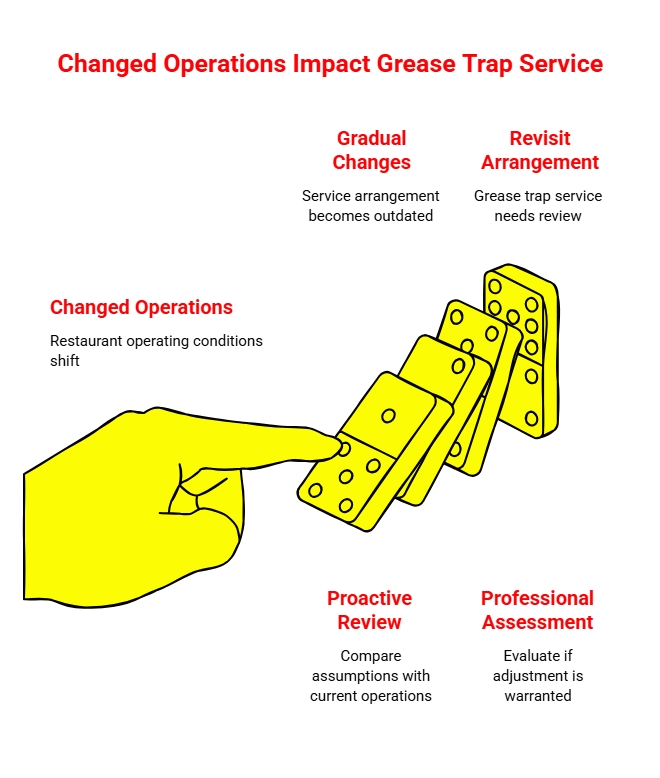
A grease-trap cleaning arrangement is not a permanent fixture. It reflects a set of assumptions about how the restaurant operates: the hours it keeps, the volume of food it prepares, the amount of dishwashing and end-of-shift cleanup it generates, and the overall pace of service. When any of those assumptions shift, the arrangement built around them deserves a second look.

That second look is a review, not a verdict. Recognizing that operating conditions have changed does not mean the current service schedule must change. It means the basis behind the schedule should be reexamined with someone qualified to evaluate whether the fit still holds.

Jumping directly from “we’re busier” to “we need more frequent service” skips the professional assessment that makes the decision useful. A provider who understands your site, your service history, and your current operations can evaluate whether an adjustment is warranted. Management’s role is to supply the operating context that makes that evaluation possible.

Restaurants do not stay static, and the changes that matter most often arrive gradually. A later service period may arrive one season, expanded prep the next, and heavier closing activity a few months later. Because the changes arrive separately, the service arrangement can become “the way we’ve always done it” even though the operating context around it has shifted meaningfully. 

A review can also be useful when nothing has backed up. Waiting for a failure is not necessary before comparing an older maintenance assumption with current operations. If several operational changes accumulated over time, reviewing them together can reveal how different today’s restaurant is from the one that originally set the service routine.


Four Operating Changes Worth Bringing to Your Service Provider

“We’re busier” is a starting point, not an instruction a service provider can act on. The categories below help translate that general observation into specific, documentable information.

Operating Hours or Service Periods Changed

If the restaurant added a meal period, extended closing time, shifted to later service, or began operating on days it previously stayed dark, the total window of active kitchen use differs from when the arrangement was established. Record what changed, approximately when the new pattern started, and whether it became a lasting change.

Consider a hypothetical example: a restaurant that added a late-night service window and now closes two hours later than it did when the current arrangement was set. The owner does not need to calculate what that means for the trap. The useful step is to document the shift and bring it to the provider as operating context.

Dishwashing and Cleanup Activity Changed

End-of-service and closing cleanup often expand alongside longer or busier shifts. If dishwashing runs later, runs more frequently, or handles a noticeably higher volume than before, that shift in activity is worth communicating to a provider as part of the operating picture. This is especially easy to overlook when the change happened gradually: an extra hour of dish-pit activity per night may not feel dramatic in the moment, but over weeks it represents a meaningfully different cleanup pattern.

Ask the managers and staff who see those routines directly whether activity expanded, shifted to different times, or became more sustained. Describe the change in ordinary terms. Do not try to convert extra wash activity into a grease-volume estimate or a predicted service interval.

Food-Preparation Patterns Changed

A restaurant that moved more prep in-house, changed its cooking methods, or expanded its menu may generate a different kitchen-waste profile than it did under its previous model. The specific effect on grease-trap accumulation depends on site conditions a provider can assess. Management’s job is to describe what changed, not to calculate the result, because fats, oils, and grease (FOG) behave differently depending on preparation methods, volume, and equipment.

Overall Restaurant Workload Changed

Sometimes the change is not a single category but a cumulative shift in pace. More covers per shift, faster table turns, or a generally heavier workload all contribute to the operating picture. You do not need proprietary sales data or exact customer counts. A clear statement that overall volume increased noticeably starting around a particular month, or that weekend service now runs consistently heavier than it did a year ago, gives a provider useful context. The more specifically you can describe the direction, timing, and scale of change, the more useful the conversation becomes.

One common assumption worth checking: “The provider should already know we’re busier.” In practice, your provider sees the trap on scheduled visits but may not have visibility into how your kitchen’s operating pattern has shifted between those visits. Bringing that context forward leads to a more productive review.


Use a Then-vs.-Now Review Before You Discuss Changes

Before contacting your service provider, compare the operating conditions under which the current arrangement was established with the way the restaurant actually operates today. The review below organizes the comparison into six areas. Fill in whatever you can reasonably recall or document; exact measurements are not required. If you need to verify past service dates, pull the waste manifests your restaurant is required to keep on file for five years under Houston regulations.

Review Area Earlier Operating Pattern Current Operating Pattern What to Tell the Provider
Operating hours and service periods Hours and meal periods when the arrangement was set Current hours and service periods What changed, when it changed, and whether it is now routine
Dishwashing and cleanup activity Prior volume and timing Current volume and timing Whether activity expanded or shifted, and approximately when
Preparation patterns Prep practices under the earlier model Current prep practices Material changes in how food is prepared and when they started
Overall service and workload pattern General pace when the arrangement began Current pace Direction, timing, and approximate scale of the change
Existing service arrangement and history Original arrangement details and any available service dates Current arrangement Whether the arrangement predates the operating changes; include service dates if available
Recurring observations (if any) Any prior patterns noticed Current patterns, if different Describe observations only; let the provider interpret them

Completing this review gives the provider a concrete starting point rather than a vague report that the restaurant got busier. It also helps you clarify whether the changes are significant enough to warrant a conversation at all. Unless management communicates those operating changes directly, the provider may not have the history needed for a useful comparison.

The fact that an arrangement has been in place for years does not, by itself, confirm it still fits. Longevity shows consistency, not accuracy. If the restaurant’s operating conditions have changed meaningfully since the arrangement was established, that history is worth reviewing regardless of how long the current schedule has run without a visible problem.

If your concern is specifically that recurring symptoms return before the next service, see how to tell whether your restaurant’s grease-trap cleaning schedule is too infrequent. Use that as a separate follow-up question rather than treating the worksheet itself as a diagnosis.


What the Professional Review Should Help Clarify

Infographic showing how documentation, professional review, and site-specific assessment work together to optimize grease trap service for changing operating conditions.

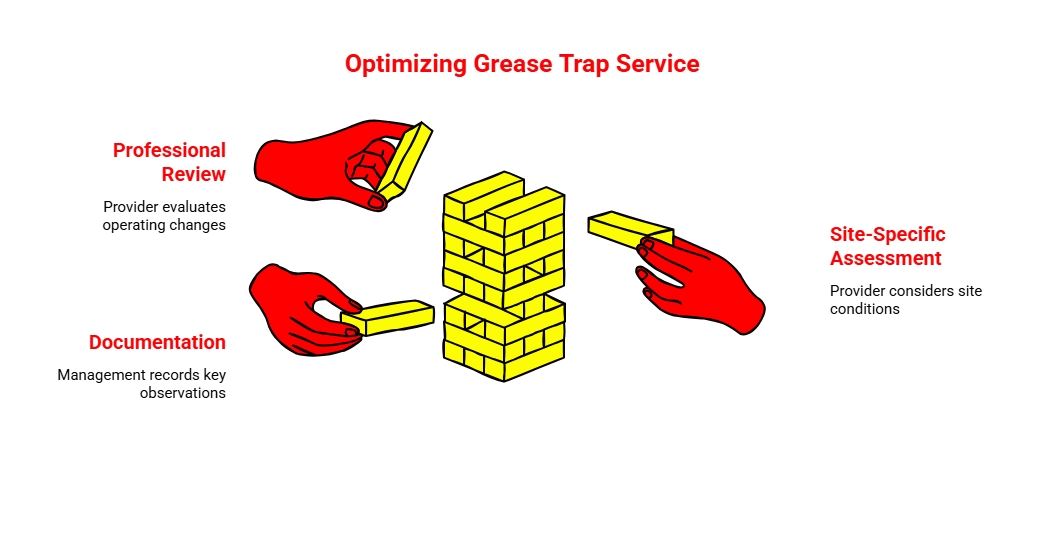
The completed then-vs.-now review is information for your provider, not a self-diagnosis. A qualified service professional can evaluate questions management should not try to answer independently:

  • Which of the documented operating changes are actually relevant to this restaurant’s grease-trap performance?
  • Does the service history suggest the current arrangement should be reconsidered, or does it still appear to fit?
  • What site-specific conditions does the provider weigh when recommending a service arrangement?
  • Is any change to the arrangement warranted, or does the current approach remain appropriate?
  • If recurring observations (slow drainage, intermittent odors, or other patterns) are present, are those a separate troubleshooting concern rather than simply a scheduling issue?
  • What documentation should management keep going forward so the next review has a useful baseline?

Imagine a hypothetical restaurant that shifted much of its prep work in-house over the past year while keeping the same cleaning arrangement. The owner may not know whether the change is technically significant. That uncertainty is exactly what the provider review is for: the owner supplies the operating facts, and the provider evaluates whether the arrangement still fits. Ask how the current service history fits into that assessment, what site-specific conditions matter, and what management should continue recording. That creates a better baseline for the next review instead of relying on memory alone.

If slow drains, odors, or other warning patterns are already recurring, describe what staff are observing rather than concluding that the schedule is wrong. The separate guide on grease-trap warning signs to escalate covers that troubleshooting handoff.

Drane Ranger provides commercial grease trap cleaning in the Houston area and works with restaurants on recurring maintenance arrangements. If your restaurant’s operating conditions have changed, bringing a completed then-vs.-now review to a provider conversation is a practical way to start.


Keep Houston Compliance Requirements Separate From the Service-Fit Question

Houston’s regulatory framework provides an important baseline, but it does not answer the question at the center of this decision.

Houston Code of Ordinances §47-512(b) requires that every interceptor within city limits be fully evacuated at least once every 90 days. The code also identifies conditions that require more frequent evacuation, including when 25% or more of the interceptor’s wetted height contains floating materials, sediment, oils, or greases (§47-512(b)). A Notice of Waiver mechanism exists for generators that meet specific criteria, though the waiver still requires full evacuation, cleaning, inspection, and maintenance at least every 180 days.

These requirements set a regulatory floor, not a formula for converting changed hours, preparation patterns, or workload into a specific recommended service interval. That determination requires professional evaluation of site-specific conditions, service history, and current operations.

Compliance Baseline Site-Specific Service Recommendation
Comes from applicable City of Houston requirements (Code §47-512) Comes from professional evaluation of the particular site
Includes regulatory timing, conditions, and waiver provisions Considers current operating conditions, site factors, and service history
Applies uniformly to interceptors within city limits Reflects your restaurant’s individual operating conditions
Does not convert longer hours or higher workload into a custom interval Addresses whether the restaurant’s existing arrangement still fits
Regulatory obligation Professional maintenance recommendation

Meeting the regulatory requirement and having an arrangement that fits your current operations are related but separate questions. The first is a compliance obligation; the second is a professional service-fit decision shaped by how your restaurant actually operates today. Verify current requirements and use a qualified provider for site-specific recommendations.


Frequently Asked Questions

What changes should I tell my grease-trap service provider about?

Focus on the categories that describe how the restaurant operates differently now: changes in operating hours or service periods, shifts in dishwashing and cleanup activity, different food-preparation patterns, and the overall direction of workload changes. Note approximately when each change took effect and whether the current arrangement predates those changes. If you have noticed recurring observations (drainage patterns, odors, or other shifts), describe them without diagnosing their cause. Service dates and other available history can also provide useful context. You can also read more about how to tell whether your restaurant’s cleaning schedule is too infrequent for additional context.

Does Houston’s 90-day requirement tell me what my restaurant’s ideal cleaning arrangement should be?

Not by itself. Houston Code §47-512 establishes a default evacuation requirement and specifies conditions that can require more frequent evacuation, including the 25% accumulation threshold and a Notice of Waiver process. Those provisions set a regulatory baseline rather than a site-specific maintenance recommendation. Whether your restaurant’s particular operating conditions call for a different arrangement is a professional assessment question, not one the regulatory schedule answers on its own. Verify the current code when making compliance decisions.


Bring a Clear Operating Record to the Review

Your kitchen’s evolution provides the context a professional needs to optimize maintenance. Instead of guessing at a new interval, use the then-vs.-now checklist to document how daily routines have shifted. This ensures any updates to your service contract are based on measurable data rather than assumptions carried over from an outdated model. The conversation will be more productive, and the outcome will reflect your restaurant’s current reality rather than a set of assumptions carried over from an earlier operating model.

You can learn more about commercial grease-trap cleaning from Drane Ranger if you are ready to start that conversation.

Disclaimer: This article is for general informational purposes only and does not constitute compliance, safety, technical, or professional advice. Requirements, risks, and best practices may vary by context, jurisdiction, system, provider, or use case. Confirm important decisions with the appropriate qualified professional, authority, or technical expert.


Our Editorial Process

Our expert team uses AI tools to help organize and structure our initial drafts. Every piece is then extensively rewritten, fact-checked, and enriched with first-hand insights and experiences by expert humans on our Insights Team to ensure accuracy and clarity.


By Drane Ranger Insights Team

The Drane Ranger Insights Team creates practical guidance for Houston-area businesses that need reliable liquid waste management, grease trap cleaning, septic, lift station, and wastewater compliance support. Drane Ranger Vacuum Services has served the Greater Houston area since 1985, helping customers keep operations running while following applicable waste handling and disposal requirements.