
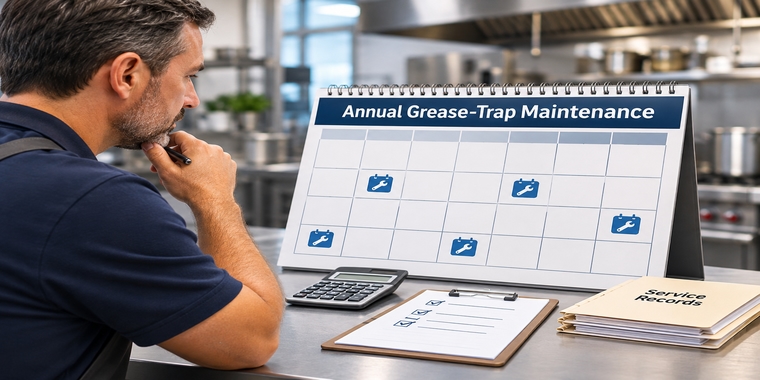
📌 Key Takeaways
One fixed grease trap cleaning interval can distort a restaurant’s annual maintenance budget when recorded service and changing kitchen conditions no longer support the forecast.
- Visit Counts Drive Annual Costs: Expected cleaning visits and quoted service charges determine recurring allocations, while additional work requires separate consideration within the actual scope.
- Requirements Differ From Recommendations: Legal cleaning requirements, provider recommendations, and budgeted intervals serve different purposes and should remain distinct when evaluating expected service needs.
- Kitchen Changes Warrant Review: Changes in meal volume, menu preparation, grease handling, and equipment conditions can warrant reassessment using documented findings and provider guidance.
- Symptoms Do Not Establish Causes: Slow drainage and odors warrant investigation but do not prove that a grease trap is full or a provider has failed.
- Invoices And Manifests Differ: Invoices document service charges, while waste manifests document collection, transport, and disposal, making both relevant to a restaurant’s maintenance records.
For restaurant managers finalizing annual allocations, missing records, revised quotations, or material spending differences identify assumptions that need further review.
A defensible maintenance budget ties its service forecast to evidence that management can explain and revisit.
~ ~ ~ ~ ~ ~ ~ ~ ~ ~ ~ ~ ~ ~ ~ ~ ~ ~
A restaurant manager opens the annual maintenance worksheet beside a humming office printer. The calendar shows evenly spaced grease trap cleanings, yet the service folder contains visits that were never included in the forecast. Why doesn’t the budget match the records?
This illustrative situation reveals a budgeting problem. One interval can distort the annual allocation when kitchen conditions change. The answer is not automatically more cleaning. It is to test the interval against recorded service, present operating conditions, and qualified provider guidance.
Start With the Budget Assumption You Are Already Using
Cost planning for grease trap cleaning means estimating, allocating, tracking, and reviewing recurring service expenses across the restaurant’s budget year. The key starting point is the interval used to forecast the number of visits.
Find that interval, then compare implied visits with completed service dates. Mark the original interval as a documented recommendation, a regulatory requirement, or simply an assumption carried forward from a previous year. The distinction matters.
Think of an annual staffing plan. The cost of one shift cannot establish the annual staffing expense without knowing how many shifts are needed. Grease trap cleaning visits work the same way. The annual restaurant maintenance budgeting guide provides broader context; the immediate task here is to verify the visit-count assumption.
Myth: One Cleaning Interval Gives You a Reliable Annual Number
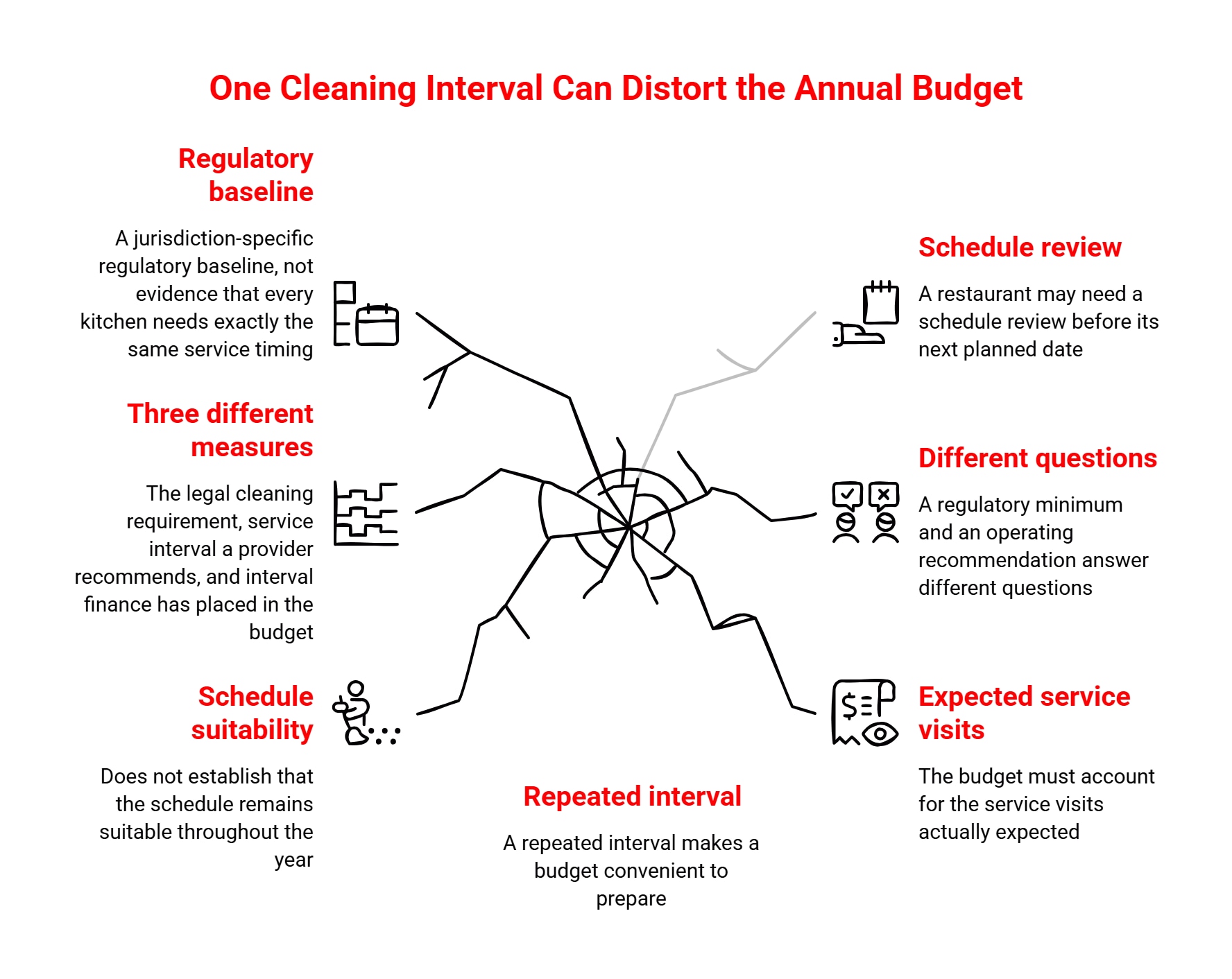
A repeated interval makes a budget convenient to prepare. It does not establish that the schedule remains suitable throughout the year.
Three different measures matter: the legal cleaning requirement, the service interval a provider recommends for the site, and the interval finance has placed in the budget. Within incorporated Houston, the Houston Health Department’s special-waste guidance states that interceptors must be fully evacuated at least every 90 days unless an approved waiver applies. This is a jurisdiction-specific regulatory baseline, not evidence that every kitchen needs exactly the same service timing.
A restaurant may need a schedule review before its next planned date. A regulatory minimum and an operating recommendation answer different questions, while the budget must account for the service visits actually expected.
Reality: Restaurant Conditions Can Change the Service Interval
Grease and settled solids accumulate as a kitchen operates. Meal volume, menu preparation, and grease-handling practices affect buildup. Trap design, capacity, access, and previous service findings also influence a provider’s assessment. For instance, a compact indoor under-sink grease trap has far less holding capacity and reaches Houston’s 25% FOG-and-settled-solids threshold much faster during a menu expansion than a large outdoor in-ground interceptor, even when kitchen staff follow strict scraping and strainer practices—a difference that core sampling and past manifest volume logs quickly reveal.
The U.S. Environmental Protection Agency’s FOG guidance explains that maintenance frequency depends substantially on the fats, oils, and grease generated and the practices used to control them. That supports a site-specific review rather than a universal frequency recommendation.
For example, a kitchen may add a busy meal period after its annual budget is approved. That change warrants comparison with subsequent service findings, not an unsupported assumption that an extra cleaning is necessary. Review the signs that a cleaning schedule may be too infrequent alongside actual records. Slow drainage and odors are observations to investigate, not proof that the trap is full or that a cleaning provider has failed.
How an Incorrect Interval Distorts the Annual Maintenance Budget
The number of expected visits drives the recurring service allocation. As a general budgeting principle, multiply a documented visit forecast by the applicable quoted service charge, then account separately for additional work identified in the actual scope. Do not fill gaps with assumed prices.
The important tipping point occurs when completed service history or a new provider assessment no longer supports the original visit forecast. At that point, the manager should revise the remaining-year forecast and explain why the allocation changed. Otherwise, a budget may appear accurate on paper while omitting work the site is expected to need. For example, if an annual maintenance plan only budgets for the City of Houston’s baseline quarterly minimum (four visits per year), but higher fryer output or extended kitchen hours push accumulation to the 25% threshold every six to eight weeks, the site actually requires six to eight scheduled pump-outs—doubling routine service volume before accounting for emergency backup premiums or Chapter 47 non-compliance penalties.
Different stakeholders need different evidence. Owners need a reason for changing the allocation. General managers need dated operating observations and service findings. Finance-aware operators need a comparison of planned visits, completed visits, quoted charges, and actual invoices. A low price per visit alone cannot establish the lowest annual expenditure when service scope and visit count differ.
Run an Interval-Assumption Audit Before Finalizing the Budget
Use one audit for each restaurant. Record confirmed facts separately from assumptions, and leave any provider recommendation blank until it is received. The worksheet is a management planning exercise, not a compliance certificate, diagnosis, official Drane Ranger product, or service quotation.
| Review field | What manager records | Purpose |
| Current assumed interval | Interval used in the existing budget | Identify the baseline assumption |
| Prior service dates | Dates of completed cleaning visits | Compare planned and actual visits |
| Operational change | Changes in volume or kitchen activity | Identify a reason to review timing |
| Grease or solids observations | Documented provider findings only | Establish an operational basis |
| Warning signs | Dated odors, drainage issues, or backups | Identify patterns for assessment |
| Provider notes | Completed scope, issues, and next-service advice | Preserve site-specific guidance |
| Current budget assumption | Verified quotation, invoices, and expected visits | Distinguish costs from estimates |
| Open questions | Missing records or facts awaiting confirmation | Keep uncertainty visible |
| Actual provider recommendation | Leave blank until documented and dated | Avoid inventing a service interval |
Service records may identify the date, waste quantity, disposal facility, and identified issues. Drane Ranger describes retaining service histories and planning recurring visits around volume and system needs in its service information. Invoices document charges; waste manifests document collection, transport, and disposal. Keep both where applicable, rather than treating payment evidence as proof of waste disposal.
After completing the table, compare budgeted and actual expenditure. Missing records, recurring symptoms, access changes, a revised quote, or material variance should trigger a review of assumptions, not an automatic extra cleaning.
What Restaurant Managers Should Ask the Service Provider
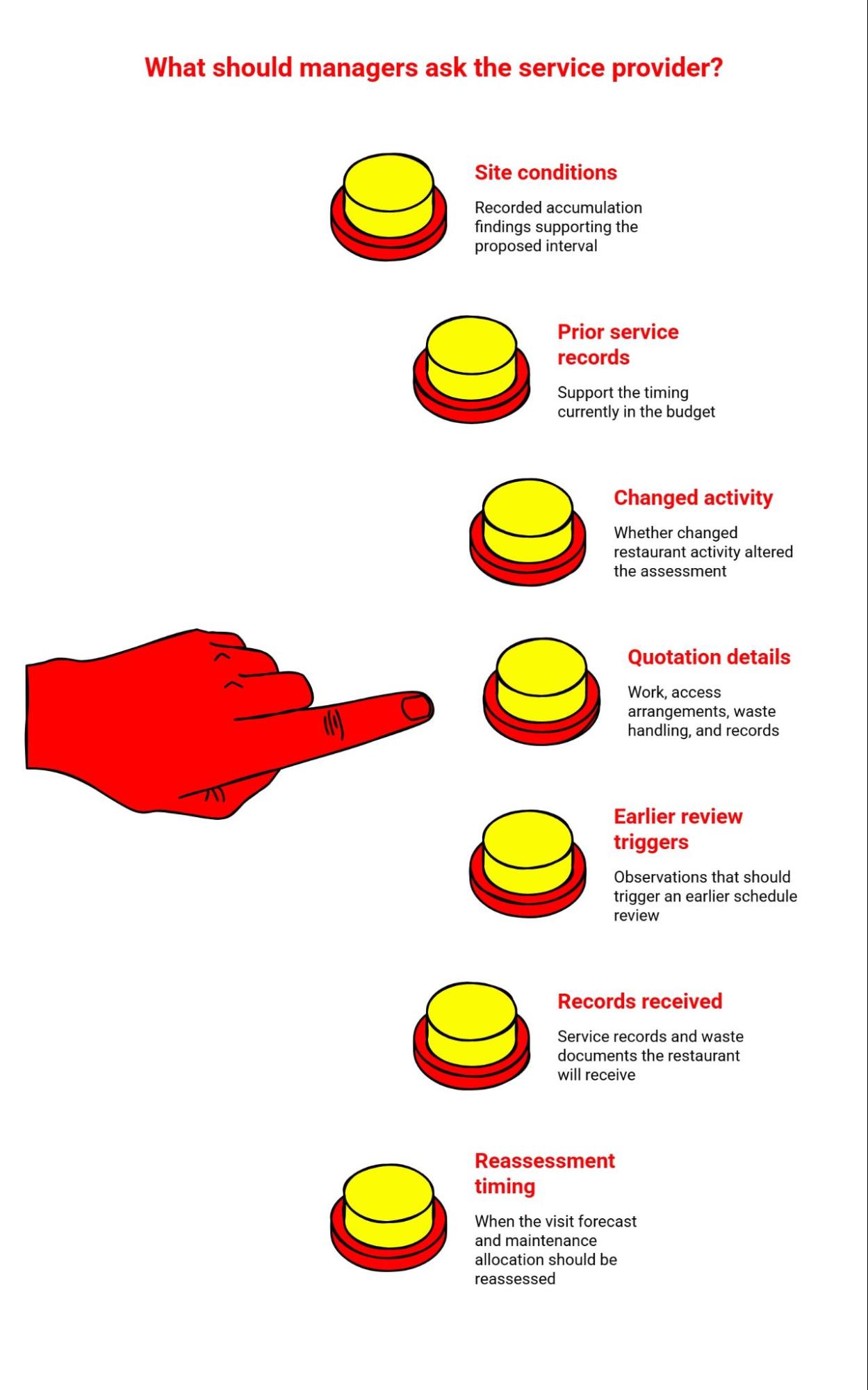
Bring the audit, recent service dates, and any documented operating changes to the discussion. Ask questions that establish a traceable recommendation:
- Which site conditions and recorded accumulation findings support the proposed interval?
- Do prior service records support the timing currently in the budget?
- Has changed restaurant activity altered the assessment?
- What work, access arrangements, waste handling, and records are included in the quotation?
- What observations should trigger an earlier schedule review?
- Which service records and waste documents will the restaurant receive?
- When should the visit forecast and maintenance allocation be reassessed?
Record the response and its date. Houston-area operators can use restaurant grease trap cleaning service information to understand the service category before discussing their site’s needs.
Treat the Interval as a Reviewable Budget Assumption
An annual budget becomes more defensible when its expected visit count is tied to current conditions, prior cleaning records, and an actual provider assessment. The calendar remains useful, but it should not replace operational evidence.
Start by comparing last year’s completed services with the interval in the current worksheet. If the records no longer support that interval, seek updated site guidance and a documented quotation before revising the remaining-year allocation. Review the assumption again when operating volume, service scope, or actual expenses materially change.
A reliable maintenance budget is not built around one permanent date pattern. It is built around a service forecast that management can explain and revisit.
Disclaimer: This information is intended for restaurant maintenance planning, not as a legal determination or site-specific service recommendation. Applicable rules and appropriate cleaning intervals depend on the location, equipment, and operating conditions. Confirm current requirements and professional guidance before changing a cleaning schedule.
Our Editorial Process
This content is based on cited public-authority guidance, Drane Ranger’s published service information, and general budgeting principles. Site-specific recommendations and final publication details require review by qualified personnel.
By: Drane Ranger Insights Team
Drane Ranger is a Houston-area liquid waste management and vacuum truck services company whose published materials describe commercial grease trap cleaning, service records, and recurring maintenance planning.