📌 Key Takeaways
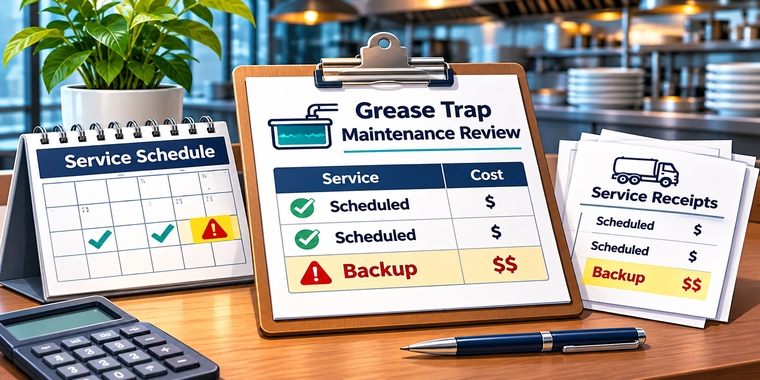
An unexpected grease trap backup warrants a maintenance budget review, but recurring spending should change only when service evidence supports it.
- Backups Do Not Establish Causes: An unscheduled service call does not prove inadequate cleaning; accumulated grease, connected piping, or another drainage problem may be involved.
- Kitchen Changes Can Affect Frequency: Increased meal volume, revised menus, preparation changes, or expanded operating hours may alter grease accumulation and warrant reviewing the cleaning interval.
- Service Records Support Schedule Reviews: Planned visits, completed work, waste quantities, provider findings, and unresolved issues help establish whether the existing schedule still fits kitchen conditions.
- Repairs Differ From Recurring Cleaning: An isolated pipe defect may require a repair, while documented grease accumulation may support additional scheduled cleaning in the recurring budget.
- Houston Sets Minimum Cleaning Requirements: Houston requires interceptor cleaning at least every 90 days unless the city approves a formal waiver for up to 180 days.
For Houston restaurant managers preparing the next annual allocation, confirmed service scope, access requirements, and provider quotations support estimates grounded in documented operating needs.
A defensible maintenance budget accounts for expected visits, traceable expenses, and unresolved system concerns.
~ ~ ~ ~ ~ ~ ~ ~ ~ ~ ~ ~ ~ ~ ~ ~ ~ ~
The maintenance budget looked predictable.
A Houston restaurant manager has scheduled grease trap cleanings in the annual worksheet. Then water gathers beside a kitchen floor drain during service. Staff redirect work, a provider is contacted, and another entry appears in the maintenance log. Did the budget reflect the kitchen we actually operate?
You cannot identify the cause of a backup from the incident alone. It may involve accumulated grease, connected piping, or another drainage problem. The interruption still warrants examining the cleaning pattern behind your annual allocation. Cost planning means estimating visits, recording known costs, and reviewing assumptions as conditions change. It resembles a staffing schedule, except the planned units are service visits instead of employee shifts.
How an Unexpected Grease Trap Backup Can Disrupt a Restaurant Maintenance Plan
An unexpected backup introduces work that may not appear in the routine maintenance calendar. The manager must document affected areas, coordinate an appropriate professional response, communicate any operating restrictions, and track whether cleanup or follow-up is needed. These effects are observable before the cause is established.
Protect the affected area and arrange professional attention first. Later, establish what work was performed, whether the problem was resolved, and who owns outstanding actions. The restaurant grease trap backup first-response checklist addresses the immediate operational decisions in more detail.
An unscheduled visit does not prove routine cleaning was insufficient, but it deserves a documented review.
Why Restaurant Operating Conditions Can Make a Planned Cleaning Interval Outdated
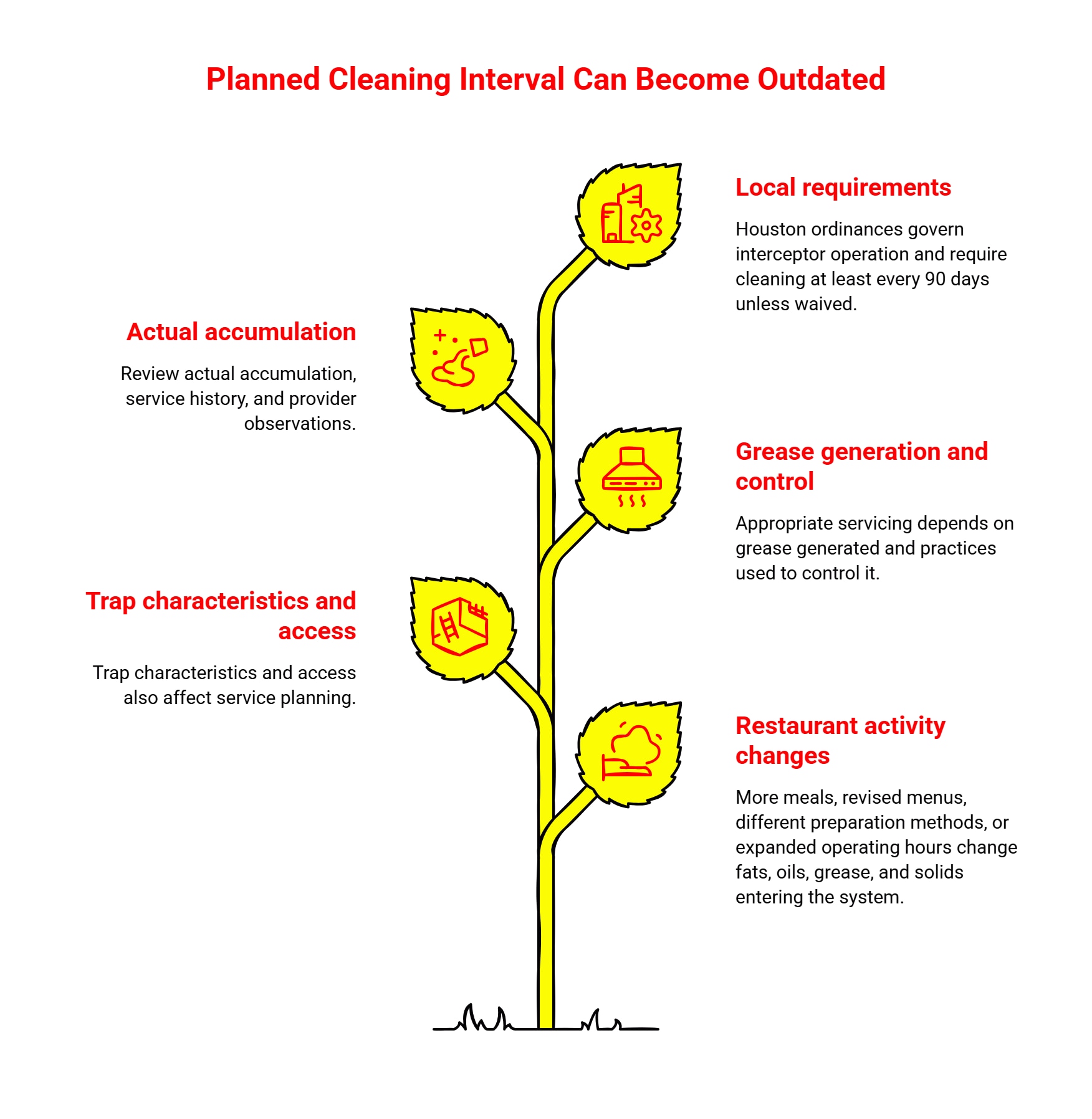
Restaurant activity can change suitable grease trap cleaning frequency. More meals, revised menus, different preparation methods, or expanded operating hours may change the quantity of fats, oils, grease, and solids entering the system. Trap characteristics and access also affect service planning.
The EPA explains that appropriate interceptor servicing depends substantially on the grease a food service establishment generates and the practices used to control it. It does not prescribe an interval for any particular restaurant. Review actual accumulation, service history, and provider observations.
Recurring maintenance can reduce exposure to grease-related disruption and compliance expense, but cannot prevent every drainage failure. Houston restaurants must also distinguish maintenance recommendations from applicable local requirements. The City of Houston’s Chapter 47, Article XI ordinances govern interceptor operation, complete evacuation, manifesting, and waste handling—including a baseline requirement to clean interceptors at least every 90 days unless the city approves a formal waiver for up to 180 days. Confirm current municipal rules and permit conditions before extending or altering a service arrangement.
How Service Records Reveal Whether the Maintenance Budget Still Fits the Kitchen
A useful comparison begins with three sets of evidence: last year’s planned service visits, visits actually completed, and the current kitchen’s operating conditions. Mark appointments that occurred early, late, or outside the expected sequence. Identify recurring symptoms and changes in volume or grease output.
Then review the provider’s documentation. Drane Ranger’s stated service records include service dates, waste quantities, disposal facility information, and identified system issues. Distinguish completed cleaning from unresolved system concerns. Record the recommended next-service date and its basis.
Suppose a manager finds an early cleaning followed by a problem call. That pattern deserves investigation, not an automatic increase in scheduled pumping. Compare actual accumulation and provider findings with the original assumptions.
Use the guidance on how to review whether a grease trap cleaning schedule is too infrequent to assess recurring patterns. For the documentation itself, consult grease trap service records after a problem visit.
How Restaurant Managers Can Review a Backup Without Inventing an Emergency Cost
Document what happened before estimating its budget effect. Confirm the incident time, the affected work areas, service requested, completed work, actual invoices, and outstanding repairs. Keep suspected causes separate from the provider’s findings. Slow drains or odors are reasons to investigate, not proof that a trap was full.
A restaurant can record a real interruption without claiming that every backup has a standard price or that a changed cleaning schedule guarantees savings. If an expense has not been invoiced or otherwise documented, do not insert an illustrative dollar amount into the forecast as though it were an established cost.
An unrelated pipe defect may require repair rather than additional trap cleaning. A documented pattern of accumulation before scheduled visits points toward a different conversation with the provider. For example, suppose a Houston kitchen budgets for four quarterly pump-outs under the City of Houston’s 90-day baseline, but logs two unscheduled service calls in a single quarter. Before revising next year’s recurring cleaning allocation to six visits, check the provider’s service records and FOG manifests: if one call stemmed from an isolated downstream line blockage and the other followed a fried-menu expansion that pushed the trap past Houston’s 25% accumulation threshold early, only the menu-driven grease increase justifies shortening the recurring cleaning interval—while the line repair belongs in one-time plumbing maintenance. Keeping that distinction clear on the annual worksheet prevents double-counting: instead of adding both emergency invoices into next year’s recurring baseline, you assign the one-time hydro-jetting or line-clearing invoice to non-recurring repairs and adjust the recurring maintenance line solely by the two additional scheduled pump-outs confirmed by your provider’s quote.
Operational Interruption Planning Checklist for Restaurant Grease Trap Problems
After the immediate situation is addressed, use this checklist to create a consistent record for operations and budget planning.
- Capture the event. Note when and where the problem appeared, which activities were affected, and whether it is now contained or unresolved. Separate observations from suspected causes.
- Retrieve the latest service record. Check the date, completed scope, quantities, disposal details, identified issues, recommended next visit, and open follow-up items.
- Compare the schedule. Mark whether the latest visit was earlier, later, or outside the pattern assumed in the maintenance budget.
- Record operational coordination. Note work restrictions, cleanup, provider contact, management communication, and actual documented expenses without assigning invented losses.
- Escalate and assign ownership. Inform the owner, general manager, or finance-aware operator when the event affects the plan. Name the person responsible for each unresolved action.
- Review kitchen changes. Compare current meal volume, preparation practices, operating hours, and grease output with the conditions used to establish the interval.
- Confirm provider findings. Ask what caused the problem, what work was completed, whether another defect remains, and whether site evidence supports revising the service arrangement.
- Update the planning record. If evidence supports a change, document the reason, proposed visit pattern, known costs, responsible approver, and date for the next review.
When an Unexpected Backup Should Trigger a Maintenance Budget Review
Review the annual allocation when completed visits repeatedly differ from the plan, kitchen activity changes materially, symptoms return before scheduled service, or provider findings suggest a different interval. An isolated event may justify investigation without changing recurring expenditure.
For a defensible decision, compare last year’s planned visits and maintenance allocation with actual visits and invoices. Then assess the visits now expected. Confirm the service scope, access requirements, and provider quotation before estimating a revised annual allocation. Separate documented amounts from assumptions. A lower price per visit is not meaningful if it describes a different service scope or an unsuitable cleaning arrangement.
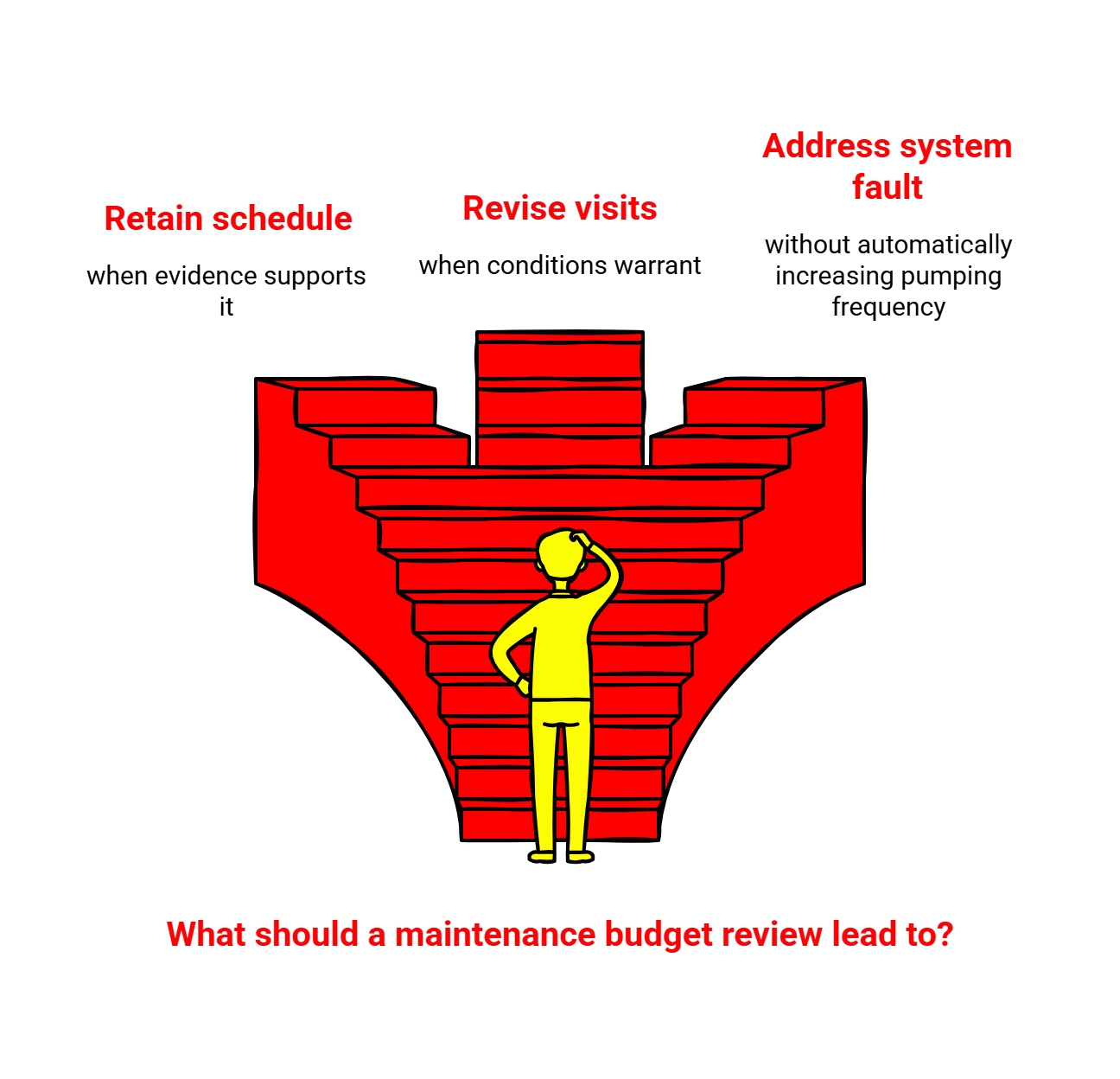
Three outcomes are possible: retain the schedule when evidence supports it, revise planned visits when conditions warrant, or address a separate system fault without automatically increasing pumping frequency. For Houston operators, the City of Houston’s special-waste generator guidance also explains why service and waste-disposal documentation matters. Regulatory obligations should be confirmed independently of a restaurant’s budgeting preferences.
How Better Maintenance Records Support the Next Restaurant Budget Review
A defensible budget matches the service log. Expected visits are recorded, actual expenses are traceable, changed kitchen conditions are visible, and unresolved issues have an owner. That supports adjustments without treating every interruption as inadequate cleaning.
Return to the annual worksheet with the incident record beside it. Review recent visits against current kitchen activity, then use Drane Ranger’s resource on annual grease trap maintenance budgeting to place the findings in the wider maintenance plan. The useful outcome is not a larger budget by default. It is an allocation supported by evidence.
Explore Drane Ranger’s related maintenance guidance for additional planning context.
Field & Compliance Review: Grounded in Drane Ranger’s Greater Houston liquid waste and commercial grease trap service standards—supporting local kitchens with vacuum truck extraction, FOG manifest documentation, and City of Houston Chapter 47 compliance since 1985.
Our Editorial Process
Our expert team uses AI tools to help organize and structure our initial drafts. Every piece is then extensively rewritten, fact-checked, and enriched with first-hand insights and experiences by expert humans on our Insights Team to ensure accuracy and clarity.
About the Drane Ranger Insights Team
The Drane Ranger Insights Team is our dedicated engine for synthesizing complex topics into clear, helpful guides. While our content is thoroughly reviewed for clarity and accuracy, it is for informational purposes and should not replace professional advice.