
Busier Restaurant Service in Houston: When to Revisit Your Grease Trap Cleaning Arrangement

📌 Key Takeaways

Houston restaurants should revisit grease-trap arrangements when operations change, using current operating facts instead of guessing at a new schedule.

  • Review Changed Operations: Longer hours, heavier cleanup, new preparation patterns, or increased workload can justify reviewing the existing arrangement.
  • Compare Then And Now: Document how current operations differ from conditions when the cleaning arrangement was originally established.
  • Let Providers Assess Fit: Management supplies operating facts, while a qualified provider determines whether the existing arrangement still fits.
  • Separate Compliance From Fit: Houston requirements set a regulatory baseline, while site-specific service decisions depend on current conditions and service history.

Changed operations deserve review, not automatic schedule changes.

Houston restaurant owners and managers will get a clearer framework for comparing operations and preparing the provider discussion below.

~ ~ ~ ~ ~ ~ ~ ~ ~ ~ ~ ~ ~ ~ ~ ~ ~ ~

Your restaurant may not operate the way it did when its current grease trap cleaning arrangement was established. Hours may be longer, service periods may have changed, food preparation may look different, or dishwashing and closing cleanup may be more active. The grease-trap cleaning arrangement on file, however, may still reflect the operation that existed before any of those changes happened.

Changed operations do not automatically prove the current arrangement is wrong, and they certainly do not point to a specific new cleaning interval. What they do justify is a structured review: comparing the conditions under which the arrangement was established with the way the restaurant actually operates today, then discussing the difference with a qualified service provider.


Why Changed Operations Are a Reason to Revisit the Arrangement
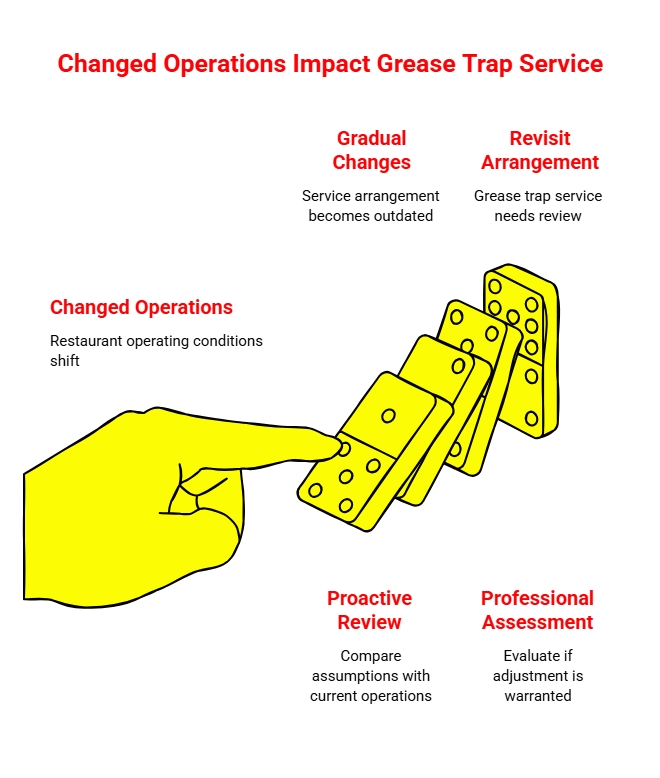
Diagram showing how changing restaurant operations can make a grease trap service plan outdated, prompting proactive review, professional assessment, and schedule adjustments.

A grease-trap cleaning arrangement is not a permanent fixture. It reflects a set of assumptions about how the restaurant operates: the hours it keeps, the volume of food it prepares, the amount of dishwashing and end-of-shift cleanup it generates, and the overall pace of service. When any of those assumptions shift, the arrangement built around them deserves a second look.

That second look is a review, not a verdict. Recognizing that operating conditions have changed does not mean the current service schedule must change. It means the basis behind the schedule should be reexamined with someone qualified to evaluate whether the fit still holds.

Jumping directly from “we’re busier” to “we need more frequent service” skips the professional assessment that makes the decision useful. A provider who understands your site, your service history, and your current operations can evaluate whether an adjustment is warranted. Management’s role is to supply the operating context that makes that evaluation possible.

Restaurants do not stay static, and the changes that matter most often arrive gradually. A later service period may arrive one season, expanded prep the next, and heavier closing activity a few months later. Because the changes arrive separately, the service arrangement can become “the way we’ve always done it” even though the operating context around it has shifted meaningfully. 

A review can also be useful when nothing has backed up. Waiting for a failure is not necessary before comparing an older maintenance assumption with current operations. If several operational changes accumulated over time, reviewing them together can reveal how different today’s restaurant is from the one that originally set the service routine.


Four Operating Changes Worth Bringing to Your Service Provider

“We’re busier” is a starting point, not an instruction a service provider can act on. The categories below help translate that general observation into specific, documentable information.

Operating Hours or Service Periods Changed

If the restaurant added a meal period, extended closing time, shifted to later service, or began operating on days it previously stayed dark, the total window of active kitchen use differs from when the arrangement was established. Record what changed, approximately when the new pattern started, and whether it became a lasting change.

Consider a hypothetical example: a restaurant that added a late-night service window and now closes two hours later than it did when the current arrangement was set. The owner does not need to calculate what that means for the trap. The useful step is to document the shift and bring it to the provider as operating context.

Dishwashing and Cleanup Activity Changed

End-of-service and closing cleanup often expand alongside longer or busier shifts. If dishwashing runs later, runs more frequently, or handles a noticeably higher volume than before, that shift in activity is worth communicating to a provider as part of the operating picture. This is especially easy to overlook when the change happened gradually: an extra hour of dish-pit activity per night may not feel dramatic in the moment, but over weeks it represents a meaningfully different cleanup pattern.

Ask the managers and staff who see those routines directly whether activity expanded, shifted to different times, or became more sustained. Describe the change in ordinary terms. Do not try to convert extra wash activity into a grease-volume estimate or a predicted service interval.

Food-Preparation Patterns Changed

A restaurant that moved more prep in-house, changed its cooking methods, or expanded its menu may generate a different kitchen-waste profile than it did under its previous model. The specific effect on grease-trap accumulation depends on site conditions a provider can assess. Management’s job is to describe what changed, not to calculate the result, because fats, oils, and grease (FOG) behave differently depending on preparation methods, volume, and equipment.

Overall Restaurant Workload Changed

Sometimes the change is not a single category but a cumulative shift in pace. More covers per shift, faster table turns, or a generally heavier workload all contribute to the operating picture. You do not need proprietary sales data or exact customer counts. A clear statement that overall volume increased noticeably starting around a particular month, or that weekend service now runs consistently heavier than it did a year ago, gives a provider useful context. The more specifically you can describe the direction, timing, and scale of change, the more useful the conversation becomes.

One common assumption worth checking: “The provider should already know we’re busier.” In practice, your provider sees the trap on scheduled visits but may not have visibility into how your kitchen’s operating pattern has shifted between those visits. Bringing that context forward leads to a more productive review.


Use a Then-vs.-Now Review Before You Discuss Changes

Before contacting your service provider, compare the operating conditions under which the current arrangement was established with the way the restaurant actually operates today. The review below organizes the comparison into six areas. Fill in whatever you can reasonably recall or document; exact measurements are not required. If you need to verify past service dates, pull the waste manifests your restaurant is required to keep on file for five years under Houston regulations.

Review Area Earlier Operating Pattern Current Operating Pattern What to Tell the Provider
Operating hours and service periods Hours and meal periods when the arrangement was set Current hours and service periods What changed, when it changed, and whether it is now routine
Dishwashing and cleanup activity Prior volume and timing Current volume and timing Whether activity expanded or shifted, and approximately when
Preparation patterns Prep practices under the earlier model Current prep practices Material changes in how food is prepared and when they started
Overall service and workload pattern General pace when the arrangement began Current pace Direction, timing, and approximate scale of the change
Existing service arrangement and history Original arrangement details and any available service dates Current arrangement Whether the arrangement predates the operating changes; include service dates if available
Recurring observations (if any) Any prior patterns noticed Current patterns, if different Describe observations only; let the provider interpret them

Completing this review gives the provider a concrete starting point rather than a vague report that the restaurant got busier. It also helps you clarify whether the changes are significant enough to warrant a conversation at all. Unless management communicates those operating changes directly, the provider may not have the history needed for a useful comparison.

The fact that an arrangement has been in place for years does not, by itself, confirm it still fits. Longevity shows consistency, not accuracy. If the restaurant’s operating conditions have changed meaningfully since the arrangement was established, that history is worth reviewing regardless of how long the current schedule has run without a visible problem.

If your concern is specifically that recurring symptoms return before the next service, see how to tell whether your restaurant’s grease-trap cleaning schedule is too infrequent. Use that as a separate follow-up question rather than treating the worksheet itself as a diagnosis.


What the Professional Review Should Help Clarify
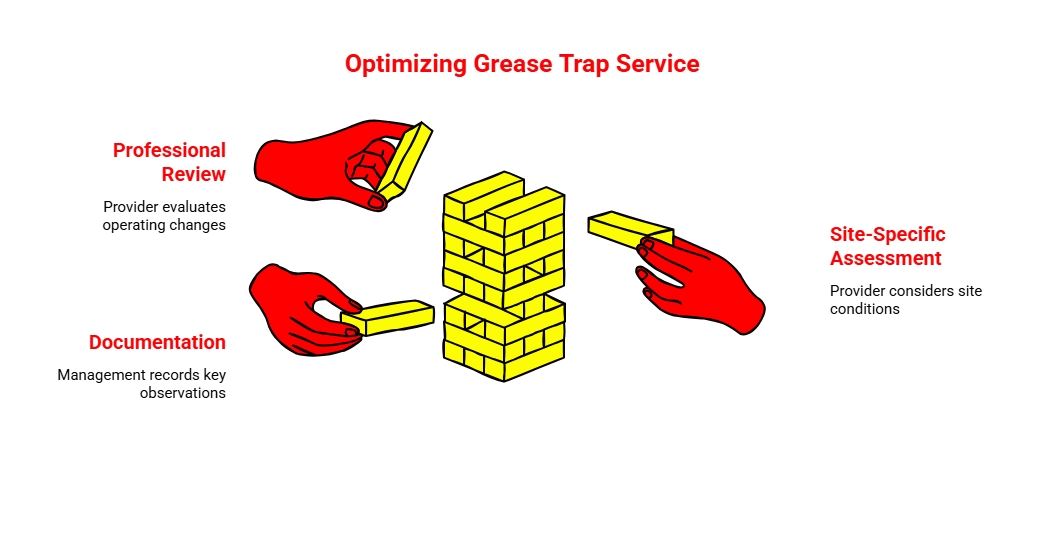
Infographic showing how documentation, professional review, and site-specific assessment work together to optimize grease trap service for changing operating conditions.

The completed then-vs.-now review is information for your provider, not a self-diagnosis. A qualified service professional can evaluate questions management should not try to answer independently:

  • Which of the documented operating changes are actually relevant to this restaurant’s grease-trap performance?
  • Does the service history suggest the current arrangement should be reconsidered, or does it still appear to fit?
  • What site-specific conditions does the provider weigh when recommending a service arrangement?
  • Is any change to the arrangement warranted, or does the current approach remain appropriate?
  • If recurring observations (slow drainage, intermittent odors, or other patterns) are present, are those a separate troubleshooting concern rather than simply a scheduling issue?
  • What documentation should management keep going forward so the next review has a useful baseline?

Imagine a hypothetical restaurant that shifted much of its prep work in-house over the past year while keeping the same cleaning arrangement. The owner may not know whether the change is technically significant. That uncertainty is exactly what the provider review is for: the owner supplies the operating facts, and the provider evaluates whether the arrangement still fits. Ask how the current service history fits into that assessment, what site-specific conditions matter, and what management should continue recording. That creates a better baseline for the next review instead of relying on memory alone.

If slow drains, odors, or other warning patterns are already recurring, describe what staff are observing rather than concluding that the schedule is wrong. The separate guide on grease-trap warning signs to escalate covers that troubleshooting handoff.

Drane Ranger provides commercial grease trap cleaning in the Houston area and works with restaurants on recurring maintenance arrangements. If your restaurant’s operating conditions have changed, bringing a completed then-vs.-now review to a provider conversation is a practical way to start.


Keep Houston Compliance Requirements Separate From the Service-Fit Question

Houston’s regulatory framework provides an important baseline, but it does not answer the question at the center of this decision.

Houston Code of Ordinances §47-512(b) requires that every interceptor within city limits be fully evacuated at least once every 90 days. The code also identifies conditions that require more frequent evacuation, including when 25% or more of the interceptor’s wetted height contains floating materials, sediment, oils, or greases (§47-512(b)). A Notice of Waiver mechanism exists for generators that meet specific criteria, though the waiver still requires full evacuation, cleaning, inspection, and maintenance at least every 180 days.

These requirements set a regulatory floor, not a formula for converting changed hours, preparation patterns, or workload into a specific recommended service interval. That determination requires professional evaluation of site-specific conditions, service history, and current operations.

Compliance Baseline Site-Specific Service Recommendation
Comes from applicable City of Houston requirements (Code §47-512) Comes from professional evaluation of the particular site
Includes regulatory timing, conditions, and waiver provisions Considers current operating conditions, site factors, and service history
Applies uniformly to interceptors within city limits Reflects your restaurant’s individual operating conditions
Does not convert longer hours or higher workload into a custom interval Addresses whether the restaurant’s existing arrangement still fits
Regulatory obligation Professional maintenance recommendation

Meeting the regulatory requirement and having an arrangement that fits your current operations are related but separate questions. The first is a compliance obligation; the second is a professional service-fit decision shaped by how your restaurant actually operates today. Verify current requirements and use a qualified provider for site-specific recommendations.


Frequently Asked Questions

What changes should I tell my grease-trap service provider about?

Focus on the categories that describe how the restaurant operates differently now: changes in operating hours or service periods, shifts in dishwashing and cleanup activity, different food-preparation patterns, and the overall direction of workload changes. Note approximately when each change took effect and whether the current arrangement predates those changes. If you have noticed recurring observations (drainage patterns, odors, or other shifts), describe them without diagnosing their cause. Service dates and other available history can also provide useful context. You can also read more about how to tell whether your restaurant’s cleaning schedule is too infrequent for additional context.

Does Houston’s 90-day requirement tell me what my restaurant’s ideal cleaning arrangement should be?

Not by itself. Houston Code §47-512 establishes a default evacuation requirement and specifies conditions that can require more frequent evacuation, including the 25% accumulation threshold and a Notice of Waiver process. Those provisions set a regulatory baseline rather than a site-specific maintenance recommendation. Whether your restaurant’s particular operating conditions call for a different arrangement is a professional assessment question, not one the regulatory schedule answers on its own. Verify the current code when making compliance decisions.


Bring a Clear Operating Record to the Review

Your kitchen’s evolution provides the context a professional needs to optimize maintenance. Instead of guessing at a new interval, use the then-vs.-now checklist to document how daily routines have shifted. This ensures any updates to your service contract are based on measurable data rather than assumptions carried over from an outdated model. The conversation will be more productive, and the outcome will reflect your restaurant’s current reality rather than a set of assumptions carried over from an earlier operating model.

You can learn more about commercial grease-trap cleaning from Drane Ranger if you are ready to start that conversation.

Disclaimer: This article is for general informational purposes only and does not constitute compliance, safety, technical, or professional advice. Requirements, risks, and best practices may vary by context, jurisdiction, system, provider, or use case. Confirm important decisions with the appropriate qualified professional, authority, or technical expert.


Our Editorial Process

Our expert team uses AI tools to help organize and structure our initial drafts. Every piece is then extensively rewritten, fact-checked, and enriched with first-hand insights and experiences by expert humans on our Insights Team to ensure accuracy and clarity.


By Drane Ranger Insights Team

The Drane Ranger Insights Team creates practical guidance for Houston-area businesses that need reliable liquid waste management, grease trap cleaning, septic, lift station, and wastewater compliance support. Drane Ranger Vacuum Services has served the Greater Houston area since 1985, helping customers keep operations running while following applicable waste handling and disposal requirements.
Grease Trap Cleaning Across a Shift Change: Handoff Questions for Houston Restaurant Managers

📌 Key Takeaways

A useful shift handoff preserves the provider’s exact status, instructions, open issues, closeout details, and next responsibility.

  • Pass Along Exact Status: State what the provider confirmed as complete, and keep any remaining work or follow-up clearly open.
  • Separate Facts From Guesses: Keep provider findings, staff observations, and unanswered questions distinct so the next manager does not inherit a diagnosis.
  • Preserve Provider Instructions: Record restrictions or follow-up conditions as given, including timing, instead of creating a staff-made rule.
  • Close Out Clearly: Houston guidance says the restaurant representative should verify the trap is empty before signing the final waste manifest.
  • Name the Next Step: If anything remains unclear, identify the missing fact, the responsible person, and the provider contact path.

Accurate handoffs prevent assumptions from becoming operational facts.

Houston restaurant managers can keep shift changes clear and useful by applying the six handoff questions explained below.

~ ~ ~ ~ ~ ~ ~ ~ ~ ~ ~ ~ ~ ~ ~ ~ ~ ~

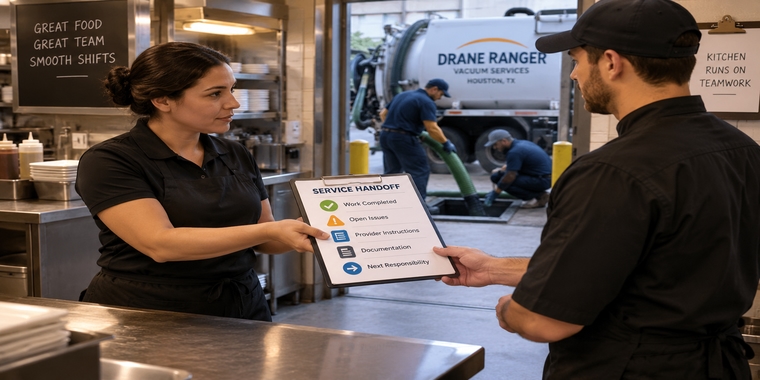
The grease trap cleaning provider is finishing while dinner service continues, and the manager who spoke with the crew is about to leave. In a Houston restaurant, that timing creates a simple operational problem: the incoming manager may inherit responsibility without hearing the provider’s explanation firsthand.

“They cleaned it” is not enough of a handoff. It does not tell the next manager whether the visit is fully complete, what the provider confirmed was done, whether an instruction still applies, or whether something remains open.

A useful shift handoff does not require technical expertise or a long report. It requires six clear answers that preserve the provider’s actual message, identify anything unresolved, and tell the next manager what happens next.


The Six Questions to Hand Off Before the Manager Changes

Handoff question What to capture What not to assume
1. Is the cleaning complete, still underway, or waiting on follow-up? State the provider’s current service status clearly, including whether someone still needs to receive the final closeout. Do not use “done” if part of the visit or a provider follow-up remains open.
2. What did the provider say was completed during this visit? Record the work the provider specifically confirmed as complete. Do not expand completion of the cleaning scope into “everything is fixed.”
3. Did the provider give any operating restriction or temporary instruction? Preserve the instruction as closely as possible to the provider’s wording, including any time or condition they supplied. Do not invent a standard wait time, restart rule, or restriction.
4. Did the provider identify any unresolved finding or separate issue? Note what the provider reported and whether follow-up is needed outside the completed cleaning scope. Do not turn a staff observation into a diagnosis of a clog, pipe problem, or trap defect.
5. Is any provider follow-up, document, or manager action still outstanding? Identify what remains open, who owns the next step, and whether the service closeout was completed. Do not assume another manager or employee handled it unless that status is known.
6. If something is unclear or the symptom returns, who should the incoming manager contact? Record the provider contact path or the restaurant’s established service escalation path. Do not fill a missing technical answer with a guess.

Consider printing these six questions to keep in the manager’s logbook, or adding them as a required text field in your digital shift-communication tool. The six answers can fit into a short verbal handoff or shift note. The goal is not to create another administrative system. It is to make the next manager operationally informed.

If several employees heard different parts of the conversation, do not combine their recollections into a new technical conclusion. Identify what the provider actually communicated, what staff directly observed, and what still needs clarification.

The same rule applies when the provider uses unfamiliar terminology. Record the term accurately and ask what it means rather than replacing it with a staff interpretation.

If no restriction was given, “No operating restriction was communicated” is more accurate than “everything is safe.” If follow-up remains open, say so directly: “The provider said the cleaning itself is complete, but a follow-up conversation is still needed.”

For broader context on what occurs during professional service, see what to expect from professional grease trap cleaning.


Separate “Service Finished” From “Every Problem Resolved”

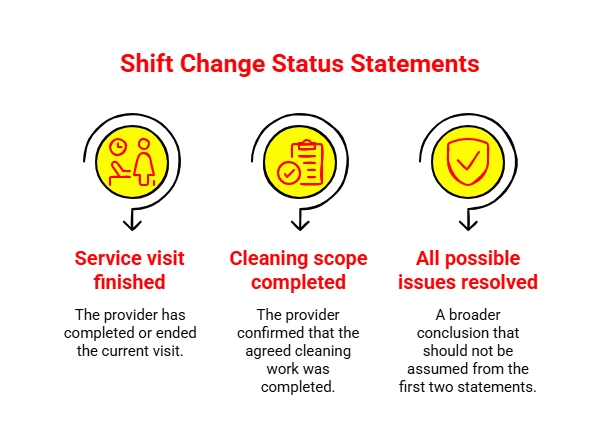
Infographic distinguishing three grease trap status statements: service visit finished, cleaning scope completed, and the broader claim that all possible issues are resolved.

Three statements can sound similar during a rushed shift change, but they communicate different things:

Service visit finished: The provider has completed or ended the current visit.

Cleaning scope completed: The provider confirmed that the agreed cleaning work was completed.

All possible issues resolved: A broader conclusion that should not be assumed from the first two statements.

A manager should hand off the provider’s actual status rather than strengthen it as the message passes from person to person.

If the provider says the cleaning is complete but identifies a separate concern or asks the restaurant to watch for a recurring symptom, both pieces of information belong in the handoff. If the provider mentions no unresolved condition, say that no unresolved condition was communicated. That is different from asserting that no other risk exists.

This distinction also answers a common question: if the truck has left, does that mean everything must be resolved? No automatic conclusion should be drawn from the crew’s departure alone. The useful information is what the provider confirmed about the scope, status, and any next step.

A clear handoff preserves continuity. It does not, by itself, prevent a future backup or guarantee that every drainage issue has been eliminated.

If symptoms recur after the visit, the incoming manager can use warning signs that need follow-up after cleaning for broader context rather than trying to diagnose the cause during the handoff.


Hand Off the Provider’s Exact Instruction, Not a Staff Interpretation

The details most likely to become distorted are the ones delivered verbally while the restaurant is busy.

Keep three categories separate. A provider finding is a condition, recommendation, restriction, or service conclusion communicated by the professional provider. A manager observation is something restaurant staff directly noticed, such as slow drainage returning. An unanswered question is a point that still requires clarification.

Those categories should not be blended. A manager can report that drainage remains slow. Unless a qualified provider identified the cause, the manager should not turn that observation into a statement that a particular pipe, trap component, or other part has failed.

Operating instructions require the same discipline. If the provider gives a temporary restriction or a condition for follow-up, record their exact wording and timing. If part of the instruction is unclear, contact the provider instead of creating a substitute rule.

Consider this hypothetical handoff:

Provider statement: “We completed the pump-out, but call us if the slow drainage continues.”

Poor handoff: “Everything is fixed.”

Better handoff: “Cleaning is complete. The provider said to call if slow drainage continues.”

That better version communicates the completed scope and the follow-up condition without adding a diagnosis.

If multiple employees heard different portions of the discussion, identify who spoke directly with the provider whenever possible. Where accounts conflict, treat the difference as something to clarify rather than selecting whichever explanation sounds most plausible.

There is no reason to invent a universal post-cleaning wait time or operating restriction. Pass along only the instruction actually given for that service visit.


Close Out the Visit Without Turning the Handoff Into a Paperwork Project

The incoming manager needs to know whether the service closeout was handled, but the shift handoff does not need to become a complete compliance procedure.

Houston Health Department identifies the restaurant itself as a special waste generator, with owners or managers acting as its authorized representative. In plain language for this handoff, ‘generator’ refers to the restaurant side of the regulated waste transaction when the manifest and generator responsibilities are being discussed. The city requires the designated restaurant representative to visually confirm the unit is completely evacuated before authorizing and signing the final waste manifest.

This creates two practical handoff questions: was the closeout paperwork completed, and who handled it?

If the outgoing manager completed that step, the incoming manager should know it. If another employee is waiting to receive the provider’s final documentation or status, name that person. If nobody can confirm whether the closeout occurred, leave it as an open item instead of assuming it was handled because the provider left.

Why is a handoff still useful when an invoice or other service document exists? Because the incoming manager may also need information that was communicated during the visit, such as an operating instruction, an unresolved provider finding, or who owns the next follow-up. The shift note preserves that operational context without trying to replace the restaurant’s formal records.

Keep the compliance discussion narrow. Requirements that matter to a specific situation should be confirmed through current Houston Health Department guidance or the appropriate authority. The handoff itself should communicate status, not become a legal interpretation of Houston requirements.


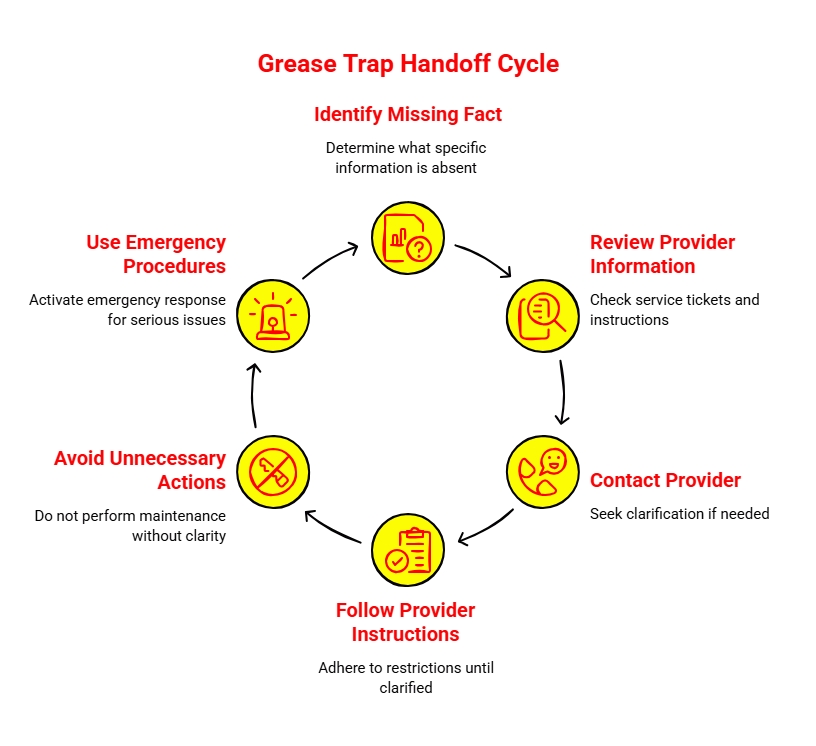
What the Incoming Manager Should Do When the Handoff Is Incomplete

Cycle diagram showing how to handle missing grease trap information by reviewing provider records, seeking clarification, following instructions, avoiding unsafe actions, and using emergency procedures.

An incomplete handoff should lead to one question first: what specific fact is missing?

It may be the completion status, an operating instruction, an unresolved provider finding, a documentation step, or the person responsible for follow-up. Naming the missing fact prevents a vague “we don’t know what happened” situation from becoming an improvised technical conclusion.

Check the provider’s written information from the current visit if it is available. A service ticket or written instruction may answer the question directly. If it does not, contact the provider and ask for clarification.

If a clearly communicated provider restriction is still in effect, continue following that instruction until the provider or other appropriate qualified source clarifies or supersedes it. Do not invent a replacement instruction because the original wording is inconvenient or incomplete.

Could the incoming manager simply call the provider every time? Yes, when clarification is necessary. A basic handoff is still worthwhile because it preserves information that was already communicated, identifies the exact question that remains open, and reduces the chance that the next conversation starts without context.

Do not respond to a missing handoff by opening, probing, pumping, clearing, repairing, or attempting to diagnose the grease trap. If there is a serious active backup or overflow, move out of routine handoff mode and use the restaurant’s established emergency or professional service-response process.


Frequently Asked Questions

What should an outgoing manager tell the next manager after grease trap cleaning?

Transfer six things: the service status, what the provider said was completed, any provider-defined operating restriction, any unresolved finding, outstanding follow-up or manager action, and the contact path if clarification is needed. Keep provider statements separate from restaurant staff observations.

Does completed grease trap cleaning mean a backup problem is fully resolved?

Not automatically. Completion establishes the status of the cleaning scope. A separate issue may still require follow-up if the provider identifies one or if a symptom recurs. The handoff should report what the provider confirmed without turning service completion into a broader guarantee.

What if the manager’s shift ends before the cleaning crew leaves?

Assign someone to receive the provider’s final status, instructions, unresolved findings, and closeout information. The outgoing manager should tell the incoming manager who has that responsibility so the final update has a clear path back to management.

Is there a Houston-specific closeout step after grease trap cleaning?

Yes. Houston Health Department guidance instructs generators to inspect and verify that the trap is clean and completely empty before signing the manifest and to sign the generator portion. Restaurant managers should use current official Houston guidance when a specific compliance requirement matters to their situation.


Make the Handoff Specific Enough to Use

A strong grease trap service handoff does not require technical expertise. It requires an accurate transfer of service status, provider instructions, unresolved items, closeout status, and the next responsibility.

That gives the incoming manager enough context to take over without turning staff observations into diagnoses or treating completed cleaning as proof that every possible issue is gone.

Drane Ranger provides professional grease trap cleaning in Houston. If an unresolved service question requires professional follow-up, Contact Drane Ranger.

Disclaimer: This article is for general informational purposes only and does not constitute compliance, safety, technical, or professional advice. Requirements, risks, and best practices may vary by context, jurisdiction, system, provider, or use case. Confirm important decisions with the appropriate qualified professional, authority, or technical expert.


Our Editorial Process

Our expert team uses AI tools to help organize and structure our initial drafts. Every piece is then extensively rewritten, fact-checked, and enriched with first-hand insights and experiences by expert humans on our Insights Team to ensure accuracy and clarity.


By Drane Ranger Insights Team

The Drane Ranger Insights Team creates practical guidance for Houston-area businesses that need reliable liquid waste management, grease trap cleaning, septic, lift station, and wastewater compliance support. Drane Ranger Vacuum Services has served the Greater Houston area since 1985, helping customers keep operations running while following applicable waste handling and disposal requirements.
Restaurant Backups and Odors: What to Clarify Before Grease Trap Cleaning in Houston

📌 Key Takeaways

Restaurant backups and odors should be reported as observations, while a qualified provider confirms the cause and appropriate service scope.

  • Report What You Observed: Describe where and when the issue appeared, what staff saw, and whether the condition is active or recurring.
  • Avoid Guessing the Cause: A slow drain or odor does not prove the grease trap caused the problem or needs cleaning.
  • Confirm the Service Scope: Confirm what the visit may include, because cleaning might not address a concern tied to another system part.
  • Share Access and Timing: Share access limits, service timing, and location details so the provider can judge whether the visit can work.
  • Unknown Answers Are Fine: Saying a detail is unknown is more useful than turning a guess into a technical conclusion.

Clear observations lead to clearer service decisions.

Houston restaurant managers will make service calls more useful by gathering the observation, scope, access, and timing details below.

~ ~ ~ ~ ~ ~ ~ ~ ~ ~ ~ ~ ~ ~ ~ ~ ~ ~

A slow drain appears in the middle of dinner service. An odor drifts into the dining room from somewhere near the kitchen. The instinct is to pick up the phone and say, “We need grease trap cleaning.” That call may be exactly right, but the symptom alone does not establish the cause, and it does not define what work the visit will require.

Before requesting a specific service, it helps to separate what you actually observed from what you assume is happening inside the system. A Houston restaurant manager who can describe the condition clearly, note what remains unknown, and confirm a few logistical details will have a far more productive conversation with the service provider. You do not need to diagnose the system yourself. You need enough accurate information to begin the right service conversation.

If you are dealing with an active backup right now, see this first-response checklist for a service-hour backup first.


A Backup or Odor Is an Observation, Not a Diagnosis

“Backup,” “odor,” “slow drain,” and “overflow” describe what someone noticed. They do not, by themselves, identify which part of the wastewater system is responsible.

A backup in the dishwashing area could be related to the grease trap, or it could involve a drain line, a connection point, or something else entirely. An odor near the prep station may be associated with grease accumulation, or it may originate from a different source. Reporting the observation is useful. Converting it into a technical conclusion before a qualified professional has assessed the site is not.

The table below shows how quickly an observation can become an unsupported assumption:

Observation Assumption to Avoid
“Two drains are slow.” “The grease trap is clogged.”
“An odor appeared near the prep area.” “The trap is definitely full.”
“The problem returned after service.” “The prior cleaning failed.”
“The provider serves Houston.” “A crew is available tonight.”

Compare these two descriptions a manager might give over the phone:

Less useful: “The grease trap is clogged.”

More useful: “Two kitchen sinks began draining slowly at about 7:30 p.m., and staff noticed an odor near the rear prep area.”

The second version gives the provider specific facts without asking the manager to make a technical conclusion. A service provider may need additional site information or an on-site assessment before confirming that grease trap cleaning is the appropriate scope. That is a normal part of the process, not a sign that the situation is more serious than expected.


What to Clarify Before You Call for Grease Trap Cleaning

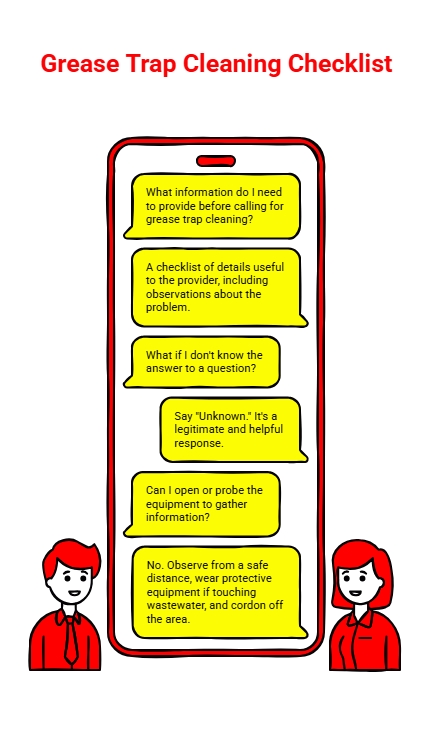
Checklist graphic showing what information to provide before grease trap cleaning, how to handle unknown details, and why staff should observe equipment safely without opening it.

The checklist below organizes the details a provider may find useful. Here, “grease trap cleaning” refers to the professional service you are considering requesting — it does not mean the reported symptom has already been traced to the trap. Not every item will apply. If you do not know the answer to a particular question, say so. “Unknown” is a legitimate and helpful response.

Do not open, probe, measure, disassemble, or enter any equipment to gather this information. These are observations you or your staff can note without performing any inspection. Ensure staff observe from a safe distance, do not touch wastewater without proper protective equipment, and cordon off the affected area to prevent slip hazards.


Before You Call: Restaurant Backup or Odor Clarification Checklist

What to Note Useful Detail What Not to Assume
Where the issue appeared Sink, floor drain, trap area, multiple fixtures, or another location Do not decide which component caused it
What happened Slow drainage, visible backup, odor, overflow, or another condition Do not label the cause unless confirmed by a qualified professional
When it started Approximate time and date Timing alone does not establish a diagnosis
Current status Active now, stopped, intermittent, or recurring A change in status does not prove what happened
Areas or fixtures affected Identify only what staff actually observed Do not infer a cause from which areas are affected
What staff observed Concise firsthand observations from the people who saw or smelled the issue Avoid letting secondhand descriptions become technical conclusions
Visible waste or overflow State what was visible and where Do not interpret what the material means
Last known service Date and type of the most recent relevant service, if available Recent or overdue service alone does not prove cause
Site access Trap or access point location and any constraints (locked area, delivery zone, tight clearance) Do not assume the truck or crew can access the area without confirmation
Operating window When the restaurant can accommodate a service visit Do not assume emergency or after-hours availability
Location Houston, Alvin, or other city/area Published service-area coverage does not guarantee a specific appointment

For example, imagine the prep sink and floor drain both slow down during a Friday dinner rush. The kitchen manager notices an odor near the back hallway around 8:15 p.m. Reporting all three details (which fixtures, the approximate time, and whether the issue is still active) gives the provider a clearer picture than “something is wrong with the grease trap.”

The person calling may not have witnessed the first occurrence. If the kitchen manager or a line cook saw the initial symptom, collect their description before placing the call. Consolidating staff observations into a concise summary saves time for everyone.

If you need a more detailed framework for recording an active incident before the service crew arrives, see what to document before the service crew arrives.


Clarify the Service Scope Before Assuming Cleaning Will Solve the Concern

Grease trap cleaning is a specific service — the work the provider expects a particular visit to include. The reported condition at your restaurant may or may not align with what that service is designed to address. Rather than assuming the match, confirm it.

When speaking with a provider, try questions like these to clarify scope:

  • “Based on what I described, is grease trap cleaning the service you would initially discuss?”
  • “Will the crew assess the reported condition before finalizing scope?”
  • “Is there information or access you need before arrival?”
  • “If this falls outside routine cleaning, how will that be identified?”

The provider may confirm that cleaning is the appropriate starting point, or they may indicate that an on-site assessment is needed first. Either answer gives you a clearer path forward.

If the issue returned shortly after a prior cleaning, report that timeline without concluding that the earlier service failed. Mention the approximate date and what has changed since then. The recurrence could indicate something that cleaning alone may not resolve. For more context, see problems that return after cleaning or, for odor-specific recurrence, why odors may return after cleaning.


Confirm Access and Operating Constraints Before the Visit

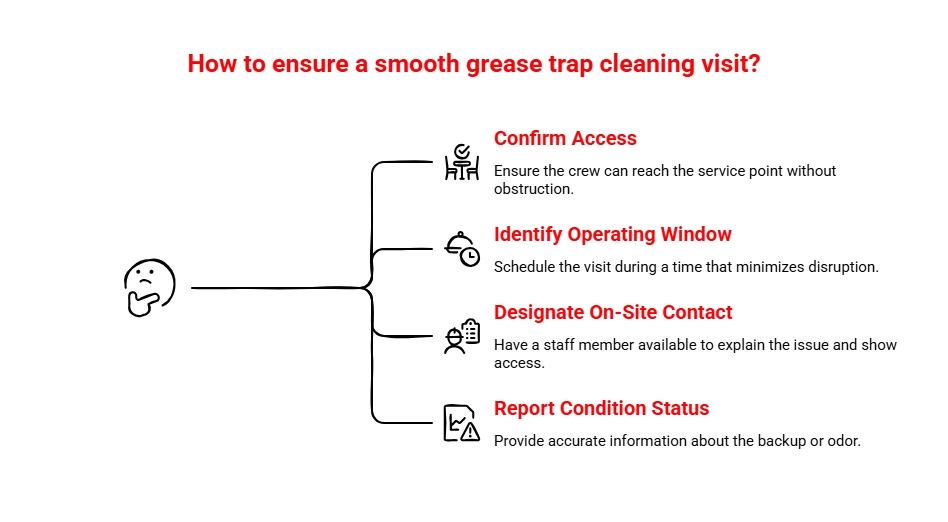
Infographic showing four ways to prepare for grease trap cleaning: confirm access, choose an operating window, assign an on-site contact, and report current conditions.

Even when the service itself is relevant, the visit still has to work operationally.

Note how the crew would reach the relevant service point. Is the access area inside the building, in a side alley, behind a locked gate, or in a shared lot? Are there delivery schedules, dumpster placements, or parked vehicles that could block access during certain hours?

Identify the operating window that works for the restaurant. A visit during peak dinner hours creates different challenges than a visit before opening. If the issue only appears during heavy kitchen output (Friday and Saturday evenings, for example), communicating that pattern helps the provider understand both the timing constraint and the condition itself.

Confirm who will be on site to explain what staff observed. The person who scheduled the visit may not be working when the crew arrives, so having a prepared staff member available to describe the condition and show the access point makes the visit more efficient.

Consider a related scenario. Staff notice a backup at 7:30 p.m., but by closing time the condition is no longer active. The person making the service call the next morning did not witness it directly. The useful response is to provide the original time, what the on-duty staff saw, the current status, and the restaurant’s available access window. The manager does not need to explain why the condition changed — the provider can assess that on site.

If the condition is still active when you call, say so. If it has subsided but recurs at certain times, that pattern is worth reporting.


Questions to Ask the Provider Before You Assume the Job Is Scoped

A short list of practical questions can prevent mismatched expectations when you call:

  • “Does your service cover this restaurant’s location?”
  • “What information should I have ready?”
  • “Is there anything your crew needs for access?”
  • “What service window is actually available?”
  • “Will the crew confirm what work is appropriate after seeing the site?”
  • “What should I do if the condition changes before the visit?”

These questions are not a script for negotiating price or requesting a diagnosis over the phone. They confirm that the visit, the location, and the reported condition are aligned before the crew is dispatched.


Better Information Makes the Next Step Clearer

A backup or odor during restaurant operations creates real pressure to act. That pressure does not change what the symptom can actually tell you. Report what you and your staff observed. Note what is still unknown. Confirm the service scope, site access, location coverage, and timing before assuming that grease trap cleaning will resolve the concern.

A qualified provider can assess the condition on site and determine what the situation actually requires. Your job is to give them accurate information and useful questions, not to diagnose the system yourself.

Learn more about grease trap cleaning in Houston and confirm whether the service fits your restaurant’s situation. For an active backup, overflow, or urgent waste issue, Drane Ranger directs customers to call 281-489-1765 so the team can understand what is happening and discuss how it may be able to help. Current availability should be confirmed directly. You can also visit the Contact Us page.


Frequently Asked Questions

Does a restaurant backup automatically mean the grease trap needs cleaning?

Not necessarily. A backup describes what happened, not what caused it. The issue could involve the grease trap, but it could also involve another part of the drainage system. Report where and when the backup occurred, whether it is active or recurring, and what staff observed. A qualified provider can then assess the appropriate service scope.

Can an odor tell me whether the grease trap is full?

An odor is an observation worth reporting, but it does not by itself confirm that the trap is full or that a specific component has failed. Note the location and timing of the odor and share that information with the provider. Avoid treating odor alone as proof of one particular condition.

What information should I have ready when I call?

Have the restaurant location, affected areas or fixtures, what staff observed, the approximate start time, whether the condition is active or recurring, the last relevant service date if known, any site-access constraints, and the operating window when the restaurant can accommodate a visit. If you do not have all of this, say so. Partial details are still useful.

Does Drane Ranger serve both Houston and Alvin?

Drane Ranger’s published service materials list both Houston and Alvin among covered cities. Published geographic coverage does not guarantee a particular appointment or response window, so confirm availability for your specific property and requested service window when you call.

Does “urgent service” mean 24-hour availability?

Not necessarily. Drane Ranger’s published business hours are Monday through Friday, 9:00 a.m. to 6:00 p.m., and the company separately states that urgent situations are prioritized. Those are two different pieces of information. If you need service outside standard hours, ask what options are currently available rather than assuming around-the-clock staffing.

Disclaimer: This article is for general informational purposes only and does not constitute compliance, safety, technical, or professional advice. Requirements, risks, and best practices may vary by context, jurisdiction, system, provider, or use case. Confirm important decisions with the appropriate qualified professional, authority, or technical expert.


Our Editorial Process

Our expert team uses AI tools to help organize and structure our initial drafts. Every piece is then extensively rewritten, fact-checked, and enriched with first-hand insights and experiences by expert humans on our Insights Team to ensure accuracy and clarity.


By Drane Ranger Insights Team

The Drane Ranger Insights Team creates practical guidance for Houston-area businesses that need reliable liquid waste management, grease trap cleaning, septic, lift station, and wastewater compliance support. Drane Ranger Vacuum Services has served the Greater Houston area since 1985, helping customers keep operations running while following applicable waste handling and disposal requirements.