📌 Key Takeaways
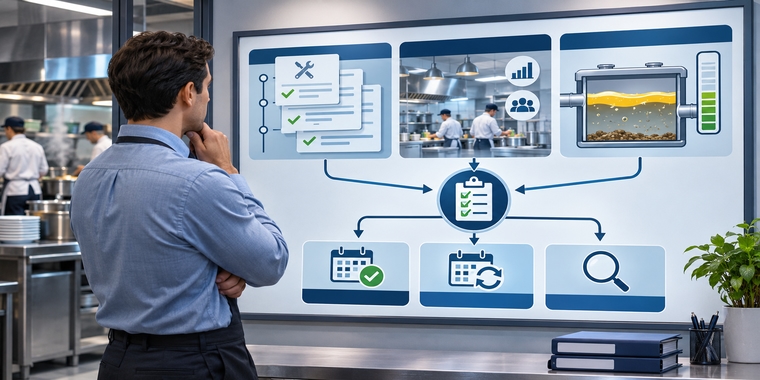
A fixed grease trap cleaning schedule may become outdated when kitchen activity, grease accumulation, or operating conditions change, making periodic review necessary.
- Kitchen Changes Warrant Review: Increased operating volume or changed food preparation can affect wastewater conditions, but neither automatically establishes how much sooner cleaning is needed.
- Service Records Explain Early Visits: Documented reasons for earlier cleanings help distinguish administrative scheduling changes from recurring maintenance concerns that may justify reassessing the established interval.
- Symptoms Do Not Confirm Causes: Slow drainage and recurring odors may warrant professional evaluation because neither observation, by itself, proves that the grease trap is full.
- Compliance Does Not Establish Suitability: Meeting an applicable regulatory baseline does not establish that the cleaning interval adequately addresses the kitchen’s actual grease and solids accumulation.
- Confirmed Needs Guide Budgeting: Annual maintenance allocations should reflect documented service requirements, while additional visits require explanation before management assumes a permanently higher cleaning frequency.
For restaurant managers, a provider’s documented assessment can clarify whether the next step is retaining the schedule, revising it, or investigating another issue.
A cleaning calendar provides predictability; documented operating evidence supports the decision to keep or change it.
~ ~ ~ ~ ~ ~ ~ ~ ~ ~ ~ ~ ~ ~ ~ ~ ~ ~
At 8:15 AM, a Houston restaurant manager reviews the annual maintenance worksheet. The grease trap cleaning appointments are already on the calendar. Yet the latest service records show that cleaning visits have occurred earlier than expected.
The schedule has not changed. So why does it no longer seem to fit?
This illustrative situation highlights a common maintenance planning challenge. Restaurant operations can change while an established service schedule remains untouched.
A fixed grease trap cleaning schedule can become outdated when kitchen activity, grease accumulation, or operating conditions change. Restaurant managers should periodically review service records, current kitchen activity, and recurring maintenance observations. A qualified provider can then help determine whether the existing interval remains appropriate for the site.
The goal is not to abandon scheduled cleaning. It is to ensure that the schedule continues to reflect the conditions it was designed to manage.
A Cleaning Schedule Can Stay Fixed While the Kitchen Changes
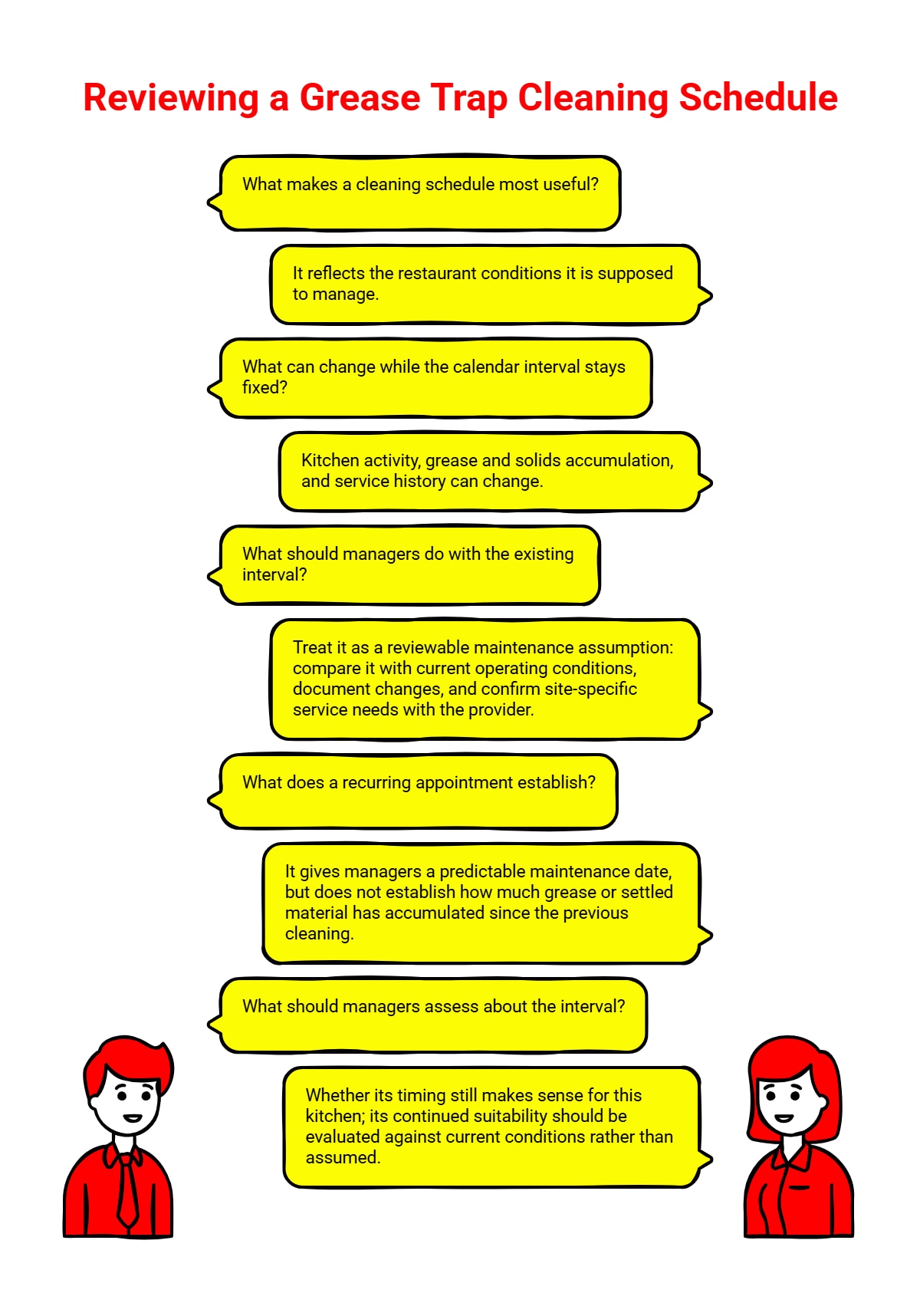
A grease trap cleaning schedule is most useful when it reflects the restaurant conditions it is supposed to manage. Kitchen activity, grease and solids accumulation, and service history can change while a calendar interval remains fixed. Restaurant managers should therefore treat the existing interval as a reviewable maintenance assumption: compare it with current operating conditions, document what has changed, and confirm site-specific service needs with the provider rather than assuming one schedule fits every kitchen.
A recurring appointment gives managers a predictable maintenance date. It does not establish how much grease or settled material has accumulated since the previous cleaning.
That distinction matters because grease trap cleaning frequency is influenced by conditions inside the restaurant, not simply the passage of time.
Consider two operating periods at the same restaurant. During the earlier period, kitchen activity follows a relatively consistent pattern. Management establishes a recurring cleaning arrangement based on the service requirements identified at that time.
Later, the restaurant becomes busier or changes its food preparation activities. The cleaning appointments remain unchanged because the existing arrangement is familiar and convenient.
The original interval may still be suitable. However, its continued suitability should be evaluated against the restaurant’s current conditions rather than assumed.
A maintenance calendar answers one question: When is the next cleaning planned?
A service-frequency review answers another: Does that timing still make sense for this kitchen?
Both questions deserve attention. The first supports scheduling consistency. The second helps management assess whether that consistency remains operationally appropriate.
What Can Change Between Grease Trap Cleanings?
Restaurant Grease Trap Cleaning Frequency depends on several connected factors. Understanding these relationships helps managers identify when an established interval deserves another look.
Restaurant operating volume and kitchen activity
A restaurant’s operating volume can change without any adjustment to its maintenance calendar.
A busier kitchen may prepare more food, wash more equipment, or operate for longer periods. Changes in menu preparation and kitchen routines may also affect the materials entering the wastewater system.
These developments can alter the operating conditions under which the original service interval was established.
However, an increase in restaurant activity does not automatically establish how much sooner the trap should be cleaned. The effect depends on the kitchen’s wastewater characteristics, the grease trap system, and the findings from previous service visits.
In busy Houston kitchens, for example, adding late-night service hours or increasing fryer turnover can push FOG and settled solids to the 25% threshold in six to eight weeks rather than a full 90-day quarter—even while surface drain flow inside the kitchen still appears normal.
Management should document meaningful changes in activity and discuss them with the service provider.
For example, a manager who notices that the restaurant has become consistently busier should compare the current operating pattern with the period when the cleaning arrangement was established.
The question is whether the earlier service recommendation still reflects the operation as it functions today.
Drane Ranger’s related discussion of revisiting grease trap cleaning arrangements when restaurant activity changes provides additional context for that comparison.
Grease and solids accumulation
Grease traps are designed to retain fats, oils, and grease, commonly called FOG, before kitchen wastewater enters the downstream drainage system.
They also collect settled solids that require removal during professional service.
Accumulation occurs over time, but the amount and rate of buildup can differ between commercial kitchens. Even the same restaurant may experience changing accumulation conditions as its activities evolve.
Across commercial wastewater standards and municipal FOG codes, the “25% rule” serves as a standard operational benchmark: once combined floating grease and settled solids reach 25% of the trap’s total liquid depth, separation efficiency drops sharply and the unit requires pumping.
The Texas Commission on Environmental Quality’s commercial-kitchen FOG guidance explains why managing fats, oils, and grease is part of responsible wastewater operations. The agency also identifies kitchen practices that can help reduce FOG-related problems.
This reinforces an important distinction: a calendar records elapsed time, while service findings provide information about actual operating conditions.
A cleaning date alone cannot establish whether accumulation has remained consistent.
Managers should ask their provider what was observed during previous visits and whether those findings support the current interval.
Recurring Drainage And Odor Observations
Kitchen operating problems may also provide reasons to review a service arrangement.
Relevant observations include:
- Drainage becoming noticeably slower during normal kitchen operations.
- Unpleasant odors recurring around affected drains or the grease trap area.
- Similar complaints appearing before successive scheduled visits.
- Wastewater-related concerns requiring additional professional attention.
These observations should not be treated as automatic proof that the grease trap is full.
A slow drain may involve a restriction elsewhere in the plumbing system. Odors can also have causes unrelated to the trap’s accumulation level.
The practical response is to record the observation, identify where it occurred, and note whether it has happened before.
For an illustrative example, imagine a restaurant manager noticing slow drainage during evening service. The next scheduled cleaning is still some distance away, but the manager remembers a similar problem during an earlier operating period.
Rather than immediately assuming that the service interval is inadequate, the manager checks the previous service notes and asks for professional evaluation.
That approach preserves the distinction between an observed symptom and a confirmed cause.
Previous Service Findings
Service history provides another important source of information.
A previous visit may have revealed conditions that affect future maintenance planning. The provider may also have recommended an earlier follow-up or identified an issue requiring separate attention.
Such findings deserve review before the next cleaning date is simply carried forward.
Drane Ranger describes recurring service planning as being based on site volume, system type, and operating needs. Its commercial grease trap cleaning services include the removal of accumulated waste from commercial kitchen systems.
The broader principle is straightforward: service recommendations should reflect the specific system and its operating conditions.
Why a Familiar Cleaning Interval Can Become an Outdated Assumption
Most restaurant managers have good reasons for maintaining an established service schedule.
Recurring appointments simplify coordination. Staff members know when service is expected. Maintenance expenses can be incorporated into operating plans, and management avoids reconsidering the arrangement before every visit.
These are practical advantages.
The problem begins when the schedule continues unchanged even though the conditions supporting it have materially shifted.
A restaurant may retain an interval because it was previously recommended, because the current arrangement has been convenient, or because no formal process exists for reviewing it.
None of these reasons establishes that the interval remains suitable.
The Difference Between An Established Interval And A Validated Interval
An established interval is the schedule currently being followed.
A validated interval is one that has been reviewed against relevant operating information and applicable requirements.
The distinction becomes clearer when management asks what evidence supports the current arrangement.
If recent service records show consistent findings and the restaurant’s operating conditions remain comparable, those observations may support retaining the interval.
If the records repeatedly show earlier-than-planned visits or materially changing conditions, the existing schedule deserves reconsideration.
Neither outcome should be assumed without reviewing the evidence.
The goal is not to make every cleaning appointment subject to a lengthy analysis. It is to recognize meaningful changes that justify reassessing the schedule.
Why The Distinction Matters Operationally
An interval that no longer reflects current service needs can create uncertainty about when maintenance should occur.
Managers may find themselves coordinating unplanned visits, responding to recurring concerns, or explaining differences between expected and actual maintenance activity.
Those situations can complicate staffing arrangements and maintenance budgeting.
They do not necessarily mean that the original schedule was unreasonable. They indicate that the available information needs to be reviewed.
A good schedule is not necessarily a permanent schedule. It is one that remains supported by current operating evidence.
Use Service Records Before Deciding to Change the Interval
When a cleaning arrangement appears unsuitable, changing the calendar immediately may seem like the simplest response.
However, choosing another interval without reviewing the available information can replace one uncertain assumption with another.
Service records provide a more disciplined starting point.
Compare Planned Service Dates With Actual Visits
Begin by reviewing the most recent completed cleanings.
Identify when each visit was scheduled and when it actually occurred. If a cleaning happened earlier than planned, determine why.
An additional visit might have been requested because of a reported drainage problem, a provider observation, or another operational concern.
The reason matters.
A visit brought forward for administrative convenience does not carry the same meaning as one prompted by recurring wastewater-related symptoms.
Management should avoid treating every schedule change as evidence that the grease trap requires more frequent cleaning.
Review What The Provider Documented
The date of service is useful, but it is not the whole record.
Relevant documentation may include the work performed, waste quantities where available, observations about trap conditions, issues identified, and recommendations for subsequent service.
Drane Ranger’s first-party service information describes records containing service dates, waste quantities, disposal facility information, and identified system issues.
These records support the broader maintenance review by giving management a documented account of previous service activity.
For example, a provider’s recommendation to reassess the next cleaning date is more useful when the record also explains what prompted that recommendation.
Without the explanation, a future manager may struggle to understand why the schedule was changed.
Separate Evidence From Assumptions
This is an important discipline when evaluating restaurant maintenance decisions.
Documented fact: A previous cleaning occurred before the planned service date, and the reason was recorded.
Unconfirmed assumption: The restaurant requires a permanently shorter cleaning interval because that visit occurred early.
The first statement describes an event. The second draws a conclusion that requires further evaluation.
Likewise, a recurring odor is an observation. It is not, by itself, proof of excessive grease accumulation.
Managers should make these distinctions visible when reviewing the maintenance history.
The result is a clearer conversation with the provider and a stronger basis for deciding what should happen next.
Connect Service History With Operational Changes
Service records become more useful when they are compared with kitchen activity during the same period.
A manager should identify whether meaningful operational changes occurred before the service pattern changed.
For instance, a restaurant may have expanded its food production activity around the same time that additional cleaning visits began occurring.
That timing provides a reason to investigate the relationship. It does not prove that the operational change caused the additional service requirement.
The provider should evaluate the relevant site conditions before drawing a conclusion.
Service-Frequency Review Checklist for Restaurant Managers
Use this checklist when reviewing an established grease trap cleaning schedule. It is designed to separate observable facts from assumptions that require professional confirmation.
Restaurant activity and operating conditions
- Has restaurant operating volume materially changed since the current interval was established?
- Have food preparation or kitchen operating patterns changed?
- Have drainage, odor, or other wastewater-related concerns appeared before scheduled cleaning?
- Are recurring observations documented with their dates and locations?
Cleaning and service history
- Are the dates of recent grease trap cleaning visits available?
- Did any cleaning occur earlier than originally planned?
- Is the reason for each additional or early visit documented?
- Do previous records describe recurring findings or changes in trap conditions?
- Has the provider documented a recommended date or interval for future service?
Current maintenance assumptions
- Can management explain why the current service interval was established?
- Does the explanation reflect recent operating information?
- Are the service scope and relevant site conditions documented?
- Have applicable regulatory requirements been distinguished from operational recommendations?
Provider confirmation
- Has the provider reviewed the relevant service history and operating changes?
- Has the provider explained what supports retaining or reassessing the existing interval?
- Are unresolved questions and the next recommended action documented?
How to use the findings: If the available evidence continues to support the current schedule, document why it is being retained. If operating conditions or service findings have changed, request a professional reassessment. If the records point to an unresolved drainage problem, seek evaluation of the cause rather than assuming a schedule adjustment will resolve it.
The checklist should produce a documented maintenance decision, not simply another appointment date.
What to Confirm With the Grease Trap Service Provider
A service-frequency discussion is most productive when management provides relevant records and asks questions that relate directly to the restaurant’s operating conditions.
The following questions help distinguish a routine appointment recommendation from a site-specific maintenance assessment.
What Operating Conditions Support The Recommended Interval?
Ask which characteristics of the restaurant and its wastewater system the provider considers relevant.
These may include operating volume, waste generation, grease trap characteristics, and previous service findings.
The provider should be able to explain the basis for the recommendation without suggesting that every restaurant requires the same cleaning frequency.
What Did The Previous Cleaning Reveal?
Request clarification about the observations made during the last service visit.
Were there findings that affect the next planned cleaning? Did the provider identify any unresolved issues? Does the recent history support the established schedule?
This discussion helps connect the next appointment to documented conditions.
Do Recurring Symptoms Indicate A Timing Problem Or Another Issue?
Share the restaurant’s recorded drainage and odor observations.
Ask whether the pattern supports reviewing the cleaning frequency or investigating another possible cause.
The distinction matters because additional grease trap cleaning is not a substitute for evaluating unrelated plumbing problems.
Have Site Conditions Or Service Requirements Changed?
Confirm whether the current cleaning arrangement adequately reflects the work required at the location.
Relevant considerations include service access, cleaning scope, operating conditions, and any recommendations recorded during earlier visits.
These factors should be discussed before management changes the arrangement.
Which Statements Are Regulatory Requirements?
Ask the provider to distinguish applicable legal obligations from site-specific maintenance recommendations.
Request the relevant official source when a particular cleaning deadline or operating threshold is described as mandatory.
This keeps regulatory compliance and operational judgment connected without treating them as interchangeable.
What Information Should Be Recorded After The Next Visit?
Agree on what the service documentation should capture.
A useful record identifies the work performed, relevant observations, unresolved issues, and the suggested next-service timing.
It should also make clear who is responsible for reviewing any outstanding concern.
This level of communication supports continuity when responsibility moves between restaurant managers or shifts.
Houston Grease Trap Requirements and Site-Specific Cleaning Needs
Houston restaurant operators must consider applicable wastewater requirements alongside the operating needs of their particular kitchen.
The two considerations are related, but they serve different purposes.
Regulatory requirements establish obligations that a facility must satisfy. Operational maintenance planning determines whether the established service arrangement adequately reflects the restaurant’s conditions.
The Houston Health Department’s special waste generator guidance identifies responsibilities relevant to restaurants and establishments with grease interceptors, including permitting and waste-manifest recordkeeping. It also directs operators to the City’s Chapter 47 requirements, which establish a baseline cleaning interval of at least every 90 days (unless an approved waiver applies) and restrict floating grease, oil, and settled solids to no more than 25 percent of the interceptor’s wetted height. Those requirements should be checked against the current official ordinance and any provisions applicable to the particular facility.
Those requirements should be checked against the current official ordinance and any provisions applicable to the particular facility.
Meeting a regulatory baseline does not eliminate the need to evaluate actual grease and solids accumulation. Some kitchens may need professional attention before the 90-day mark or the next planned appointment because their operating conditions have changed.
State waste-management requirements are also relevant. The Texas Commission on Environmental Quality’s guidance for municipal liquid waste generators explains the responsibilities associated with transporting and disposing of waste, including grease trap waste.
TCEQ guidance addresses waste handling and transportation. It does not replace the need to establish an appropriate cleaning arrangement for the individual restaurant.
For businesses in Houston or nearby Alvin, the applicable municipal requirements should be confirmed for the actual facility location. A restaurant should not assume that every local jurisdiction applies identical rules.
The practical objective is to maintain a schedule that satisfies applicable obligations while responding appropriately to documented site conditions.
Cleaning Frequency Also Affects Annual Restaurant Maintenance Planning
Grease trap cleaning is a recurring operational responsibility. Its expected frequency therefore contributes to the restaurant’s annual maintenance allocation.
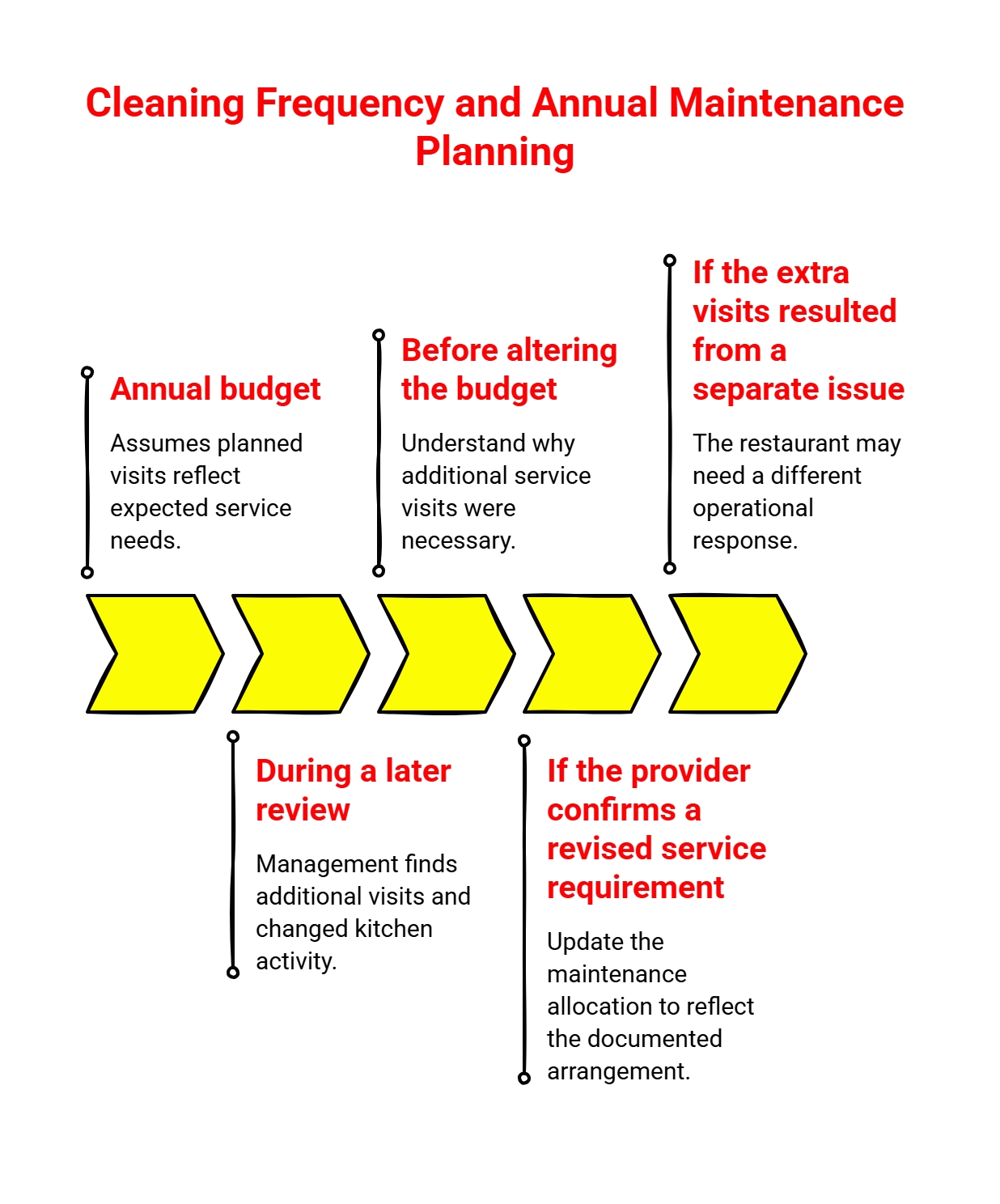
An annual budget built around an established cleaning schedule assumes that the planned number of visits reasonably reflects expected service needs.
If that assumption changes, the financial plan may need review.
For example, consider an illustrative restaurant whose maintenance worksheet reflects its existing recurring arrangement. During a later review, management finds that additional service visits have occurred and that kitchen activity has changed.
The appropriate response is to understand why those visits were necessary before altering the budget.
If the provider confirms a revised service requirement, management can update the maintenance allocation to reflect the documented arrangement.
If the extra visits resulted from a separate issue, the restaurant may need a different operational response.
This distinction prevents maintenance planning from becoming an exercise in adjusting numbers without examining their underlying causes.
Why The Lowest Individual Service Expense Is Not The Only Consideration
The financial value of a maintenance arrangement cannot be assessed solely from the price of one cleaning visit.
Restaurant operators also need to consider the service scope, the frequency of recurring visits, documentation, and how the arrangement fits normal operations.
An apparently inexpensive individual visit does not establish that the overall service arrangement is appropriate.
Likewise, more frequent cleaning does not automatically guarantee lower annual maintenance expenditure or eliminate the possibility of unexpected repairs.
The financially responsible approach is to establish the service requirements first, then plan the corresponding maintenance allocation.
For further guidance, Drane Ranger’s annual restaurant grease trap maintenance budgeting guide explains how recurring cleaning fits into broader maintenance planning.
Build a Reviewable Cleaning Schedule Instead of Relying on Calendar Dates Alone
A well-managed grease trap cleaning schedule provides predictability while remaining responsive to meaningful changes in restaurant operations.
That requires more than recording the next appointment.
After a completed service visit, management should preserve the relevant documentation and note the provider’s next recommended timing.
When restaurant activity changes, those records should be compared with current operating conditions. Recurring symptoms or earlier-than-planned visits deserve attention, particularly when they indicate that the original maintenance assumptions may no longer apply.
The review does not always need to result in a new cleaning interval.
Sometimes the evidence supports keeping the existing arrangement. In other cases, the provider may recommend a different schedule or further evaluation of the wastewater system.
What matters is that the decision has a documented basis.
Restaurant managers should be able to answer three practical questions:
- What operating conditions support the current cleaning schedule?
- What do recent service records and observations reveal?
- What has the provider confirmed about the next appropriate action?
When those answers are available, maintenance planning becomes more transparent and easier to explain to ownership, staff, and future managers.
For site-specific information about professional service, Drane Ranger provides grease trap cleaning in Houston for commercial kitchens and other applicable facilities.
The most useful immediate action is to compare recent service records with current kitchen activity. Identify what has changed, what the records establish, and what still requires professional confirmation.
The calendar establishes the maintenance plan. Current operating evidence determines whether that plan still fits the kitchen.
Disclaimer: Grease trap maintenance requirements vary according to applicable regulations, system characteristics, and operating conditions. This content is intended for general educational purposes and does not replace current official regulatory guidance or site-specific professional advice. Confirm legal obligations with the relevant authority and discuss cleaning frequency with a qualified service provider.
Our Editorial Process
Our expert team uses AI tools to help organize and structure our initial drafts. Every piece is then extensively rewritten, fact-checked, and enriched with first-hand insights and experiences by expert humans on our Insights Team to ensure accuracy and clarity.
About the Drane Ranger Insights Team
The Drane Ranger Insights Team is our dedicated engine for synthesizing complex topics into clear, helpful guides. While our content is thoroughly reviewed for clarity and accuracy, it is for informational purposes and should not replace professional advice.