
📌 Key Takeaways
Restaurant grease trap cleaning frequency deserves review when current kitchen activity no longer matches the conditions behind the existing schedule, but changes alone do not establish a new interval.
- Kitchen Changes Warrant Review: Changes in menus, preparation methods, meal volume, or operating hours provide context for reassessment without independently proving that earlier cleaning is necessary.
- Accumulation Notes Clarify Service Records: Total evacuated volume alone does not establish cleaning frequency; technician notes on accumulation depth and trap condition help explain changing conditions.
- Recurring Symptoms Support Evaluation: Repeated slow drains, odors, or unusual conditions support professional evaluation, but their varying causes prevent an automatic diagnosis of interceptor problems.
- Municipal Requirements Remain Separate: Applicable requirements depend on the property’s jurisdiction, and provider recommendations do not replace municipal obligations or establish that previous service met every requirement.
- Actual Visits Inform Maintenance Planning: Comparing completed visits with the assumed service pattern helps owners and finance-aware operators assess whether annual maintenance allocations reflect actual cleaning activity.
For Houston restaurant managers, dated kitchen logs, service records, and documented observations provide a clearer basis for discussing whether the current interval remains appropriate.
A supported cleaning schedule connects operating conditions, recorded findings, and applicable requirements rather than relying on calendar tradition alone.
~ ~ ~ ~ ~ ~ ~ ~ ~ ~ ~ ~ ~ ~ ~ ~ ~ ~
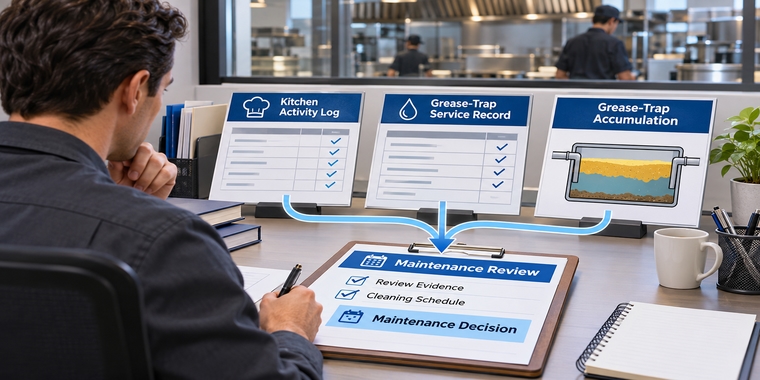
At 8:15 a.m., a Houston restaurant manager checks cleaning dates against an annual maintenance worksheet. The printer hums while the manager notices that several visits occurred earlier than planned. This is an illustrative example.
Restaurant grease trap cleaning frequency deserves review when current kitchen activity no longer matches the assumptions behind its schedule. Menu changes, accumulation, and service records help managers decide when to seek professional reassessment; none independently establishes a new interval.
Why Kitchen Activity Can Change the Usefulness of an Existing Cleaning Interval
The interval between professional grease trap cleaning visits is shaped by applicable requirements and actual accumulation or operating conditions. For a restaurant manager, that interval also determines how many maintenance visits must be anticipated. A busier kitchen may therefore need a different service pattern than the one assumed when the current schedule was established. Compare service history and operating conditions before using the interval as the basis for future maintenance planning.
A grease trap or interceptor collects fats, oils, grease, and settled solids from kitchen wastewater. Calendar dates alone cannot show how much has accumulated. A schedule established under an earlier menu and workload may deserve review even when every booked visit occurred.
Under City of Houston Code of Ordinances Chapter 47, Article XI (Sec. 47-512), interceptors within incorporated city limits must be fully evacuated at least every 90 days, or sooner if floating grease and settled solids reach 25% of the trap’s wetted depth, unless the facility holds an approved Notice of Waiver from the Houston Health Department. Confirm applicable requirements and exceptions for the property; a restaurant in Alvin should not assume Houston city rules govern its address.
The regulatory baseline addresses legal duties. An operating schedule reflects actual conditions and professional findings. Meeting the calendar baseline does not establish that accumulation remained low.
What Restaurant Managers Should Compare Against the Current Schedule
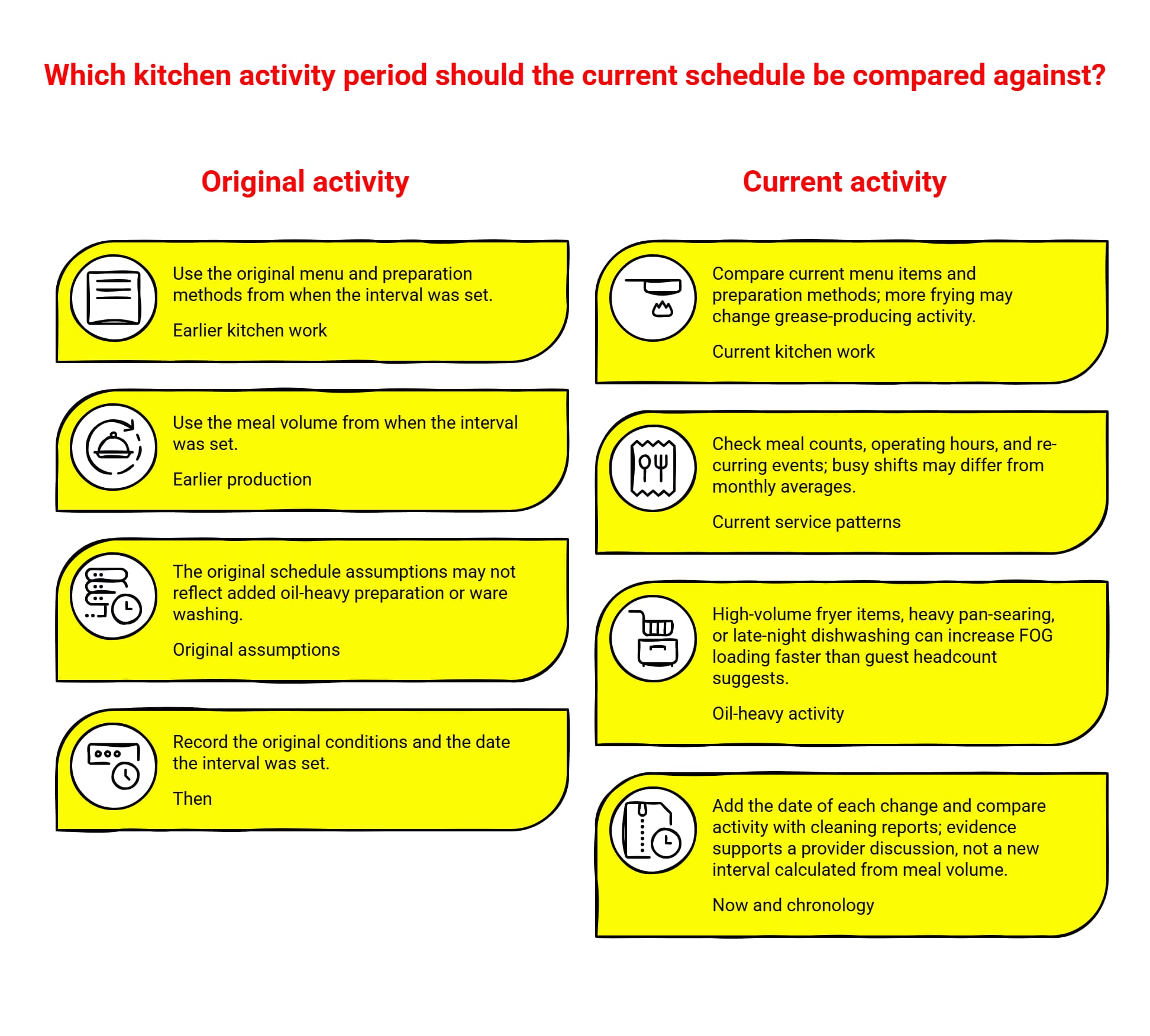
Start with the kitchen’s work, not the next appointment. Compare current menu items, preparation methods, and production volume with conditions when the interval was set. More frying may change grease-producing activity, but it does not prove earlier cleaning is necessary. Adding high-volume fryer items, heavy pan-searing, or late-night dishwashing shifts can increase fats, oils, and grease (FOG) loading far faster than overall guest headcount suggests, because interceptor buildup tracks oil-heavy prep and ware washing discharge rather than dining-room traffic alone. Check changes in meal counts, operating hours, and recurring events.
Check changes in meal counts, operating hours, and recurring events. A consistently busy shift may tell a different story from a monthly average. Reduced activity also deserves documentation, not an automatic extension.
For example, a general manager finds that an added evening service is missing from the assumptions behind the current schedule. The manager compares the change date with cleaning reports and finds one visit was moved forward. That evidence supports a provider discussion, not a new interval calculated from meal volume.
For owners and finance-aware operators, the same review tests whether the annual maintenance allocation reflects actual visits rather than an inherited assumption. It does not predict an expense.
In practice, management can create a simple then-and-now comparison: original menu and meal volume on one side, current kitchen activity on the other. Add the date of each change rather than relying on memory. That chronology gives a provider a better starting point than saying the restaurant simply feels busier.
How to Review Service Records Without Guessing at a New Interval
Compare recent completed service dates with booked dates. Note gaps, moved appointments, and reasons for early visits. A missed booking differs from additional cleaning prompted by observed conditions.
Drane Ranger describes service records containing dates, waste quantities, disposal-facility information, and identified system issues. It retains service histories and plans recurring visits around volume, system type, and operating needs.
Service dates establish timing; waste quantities describe removal; system-issue notes flag observations. No individual field determines frequency. When reviewing past FOG manifests and service records, compare the total evacuated volume against technician notes on accumulation depth and trap condition rather than treating every pump-out as identical. Because Houston requires complete evacuation of the interceptor’s contents on every visit, total pumped gallonage usually stays consistent—but if core-sampling notes repeatedly show floating grease and settled solids approaching the 25% wetted-depth threshold before the 90-day mark, or flag grease carryover near the outlet baffle, that physical trend indicates kitchen output is outpacing the current schedule. Clarify cleaning scope, access limitations, and the reasoning behind the next-service recommendation.
A next-service recommendation is a planning judgment, not proof that the previous visit met every requirement. Keep the provider’s recorded observation separate from the manager’s interpretation. If an older report lacks a reason for an early cleaning, mark that reason as unknown rather than inventing one. A short note naming the shift, fixture, and date can make later follow-up more precise.
Date and locate slow drains, odors, or unusual conditions between visits. Their causes vary; repeated symptoms support evaluation, not an automatic interceptor diagnosis. Learn more about whether a restaurant cleaning schedule may be too infrequent.
Before scheduling a review call with your provider, pull your recent kitchen logs, service records, and FOG manifests into the worksheet below so you can separate verified records from unconfirmed assumptions.
Restaurant Activity Checklist
Does Your Cleaning Interval Still Match Kitchen Activity?
Use this review with kitchen logs and service paperwork. Date each entry and mark it verified record or assumption to confirm. Leave requirements and recommendations blank until checked.
| What changed? | What to check in your records |
| Menu or food preparation: ______ | Menu change date; notes on grease-producing processes: ______ |
| Meals prepared or customers served: ______ | Shift or sales-volume records and comparison period: ______ |
| Opening hours or recurring busy periods: ______ | Staffing and operating logs; event dates: ______ |
| Last several cleanings: ______ | Scheduled versus completed service dates: ______ |
| Unplanned or moved-forward visits: ______ | Reason recorded; provider’s service notes: ______ |
| Trap or drain observations: ______ | Dates, locations, recurrence, and any documented findings: ______ |
| Next-service advice: ______ | Provider’s written recommendation and supporting explanation: ______ |
| Requirements for this address: ______ | Applicable authority or official guidance confirmed: ______ |
This is an evidence log, not a frequency calculator or compliance determination. For changed volume, read about revisiting a cleaning arrangement after busier service.
When to Discuss the Interval With a Service Provider
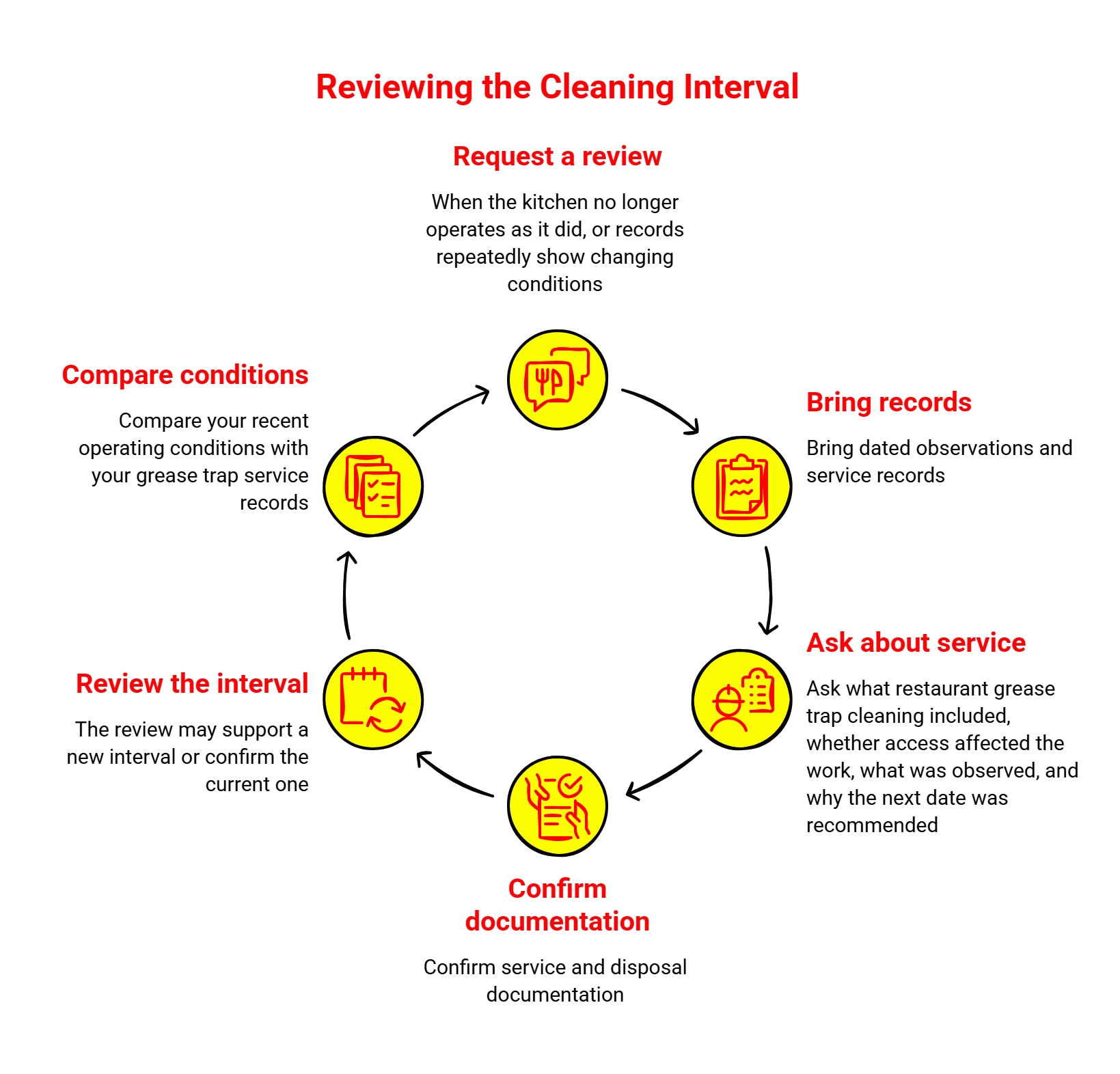
Request a review when the kitchen no longer operates as it did when the interval was set, or when records repeatedly show changing conditions before planned visits. An isolated odor or busy shift proves little. An active wastewater problem deserves prompt evaluation rather than waiting for routine cleaning.
Bring dated observations and service records. Ask what restaurant grease trap cleaning included, whether access affected the work, what was observed, and why the next date was recommended. Confirm service and disposal documentation. Provider guidance does not replace municipal requirements.
The review may support a new interval or confirm the current one. The owner gains a defensible assumption; the general manager, a clearer handoff; and the finance-aware operator, a comparison between planned and actual visits.
Back at the Houston manager’s worksheet, the next cleaning date now has supporting records, not just tradition. Before changing the schedule, compare your recent operating conditions with your grease trap service records. For further guidance, read Drane Ranger’s Houston grease trap cleaning guidance.
Our Editorial Process
Our expert team uses AI tools to help organize and structure our initial drafts. Every piece is then extensively rewritten, fact-checked, and enriched with first-hand insights and experiences by expert humans on our Insights Team to ensure accuracy and clarity.
About the Drane Ranger Insights Team
The Drane Ranger Insights Team is our dedicated engine for synthesizing complex topics into clear, helpful guides. While our content is thoroughly reviewed for clarity and accuracy, it is for informational purposes and should not replace professional advice.