Grease Trap Service Records After a Problem Visit: A Houston Restaurant Manager’s Review Checklist

📌 Key Takeaways

Restaurant managers can assess a repeat grease trap problem by comparing service scope, records, and the symptom timeline before assigning blame.

  • Compare All Records: The author recommends reviewing incident notes, provider records, and Houston manifests together before judging a service visit.
  • Check Scope Against Work: Compare what management requested with what the provider documented as completed before deciding whether expectations were met.
  • Question Missing Details: Vague or incomplete notes create questions that need clarification, not automatic proof that the provider performed poorly.
  • Look For Patterns: Reviewing several service cycles can reveal recurring issues with timing, scope, symptoms, limitations, and communication.
  • Separate Manifest From Service: Houston waste manifests document regulated waste transfer, while provider records explain work performed, findings, and limitations.

Clear records turn recurring problems into better questions.

Houston restaurant managers will make more informed provider decisions by using the record-review framework and follow-up questions that follow.

~ ~ ~ ~ ~ ~ ~ ~ ~ ~ ~ ~ ~ ~ ~ ~ ~ ~

The slow drain is back. Maybe it is an odor, or a backup concern that returned sooner than expected. You pull up the invoice from last week’s service visit looking for an explanation, and the line items tell you what you were billed for, not what actually happened inside the trap.

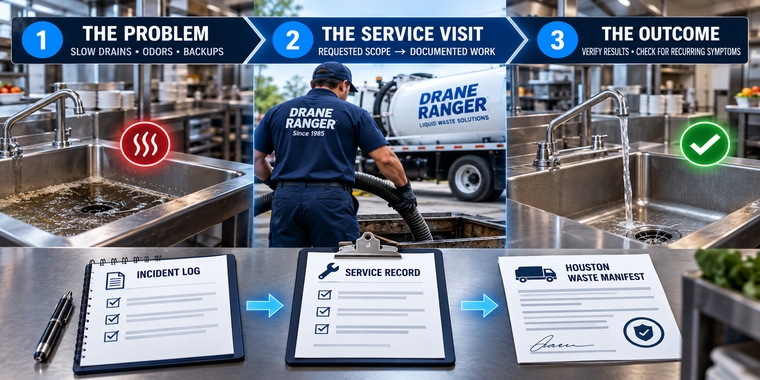
A recurring grease trap problem after a service visit deserves follow-up, but it does not automatically mean the service was deficient. Before deciding what to do next, put the paperwork to work. Gather your internal incident record, the provider’s service documentation, and (for Houston restaurants) the applicable waste manifest. Each answers a different question, and comparing them side by side is the fastest way to separate what you know from what you still need to ask.


Gather the Three Record Sets Before Judging the Visit

Most post-visit confusion starts because relevant records are scattered across different people and formats. Before forming a conclusion, collect three categories of documentation.

Your internal incident record captures what staff observed before and during the problem: which fixtures were affected, when symptoms started, and what was communicated to the provider. Names and timestamps matter here, especially when the employee who noticed the problem is off shift by the time service occurs. If your team did not log this, the article on what to document before the service crew arrives covers a practical process for next time.

The provider’s service documentation may include a work order, technician notes, service report, photos, follow-up messages, or email correspondence. This is where the service scope (the specific work the provider was asked to perform) and any findings or limitations should appear.

The waste manifest is a separate regulated document in Houston. A manifest is a City-required form documenting the collection, transportation, and disposal of covered waste. It serves a waste-transfer function, not a diagnostic one.

These three record types answer different questions:

Record Type Primary Purpose Useful Question It Answers What It Does Not Establish by Itself
Internal incident log Captures what staff observed What symptoms triggered the service call? Whether the provider caused or resolved the condition
Provider service record Documents requested and completed work What scope was performed, and what was found? Whether all possible causes were investigated
Invoice Records billing What you were charged for Technical details of the work or system condition
Houston waste manifest Documents regulated waste transfer How was waste movement documented? A diagnosis of the operational problem


Use a Post-Problem-Visit Checklist to Review What Was Documented

Do not grade the paperwork by length. Ask whether it helps you reconstruct the visit. The checklist below is not a list of legally required service-report fields. It is a set of management review categories: questions your records should help you answer after a problem visit produces an unclear outcome.

Review Question What to Look For What the Record Can Tell You Follow-Up if Unclear
What problem triggered the visit? Incident date and time, symptoms, affected fixtures Establishes the original reported problem “Which reported symptoms did the service address?”
What service was requested? Work order or scope language Sets expectations for what was included “Was anything outside the requested scope?”
What work is documented as completed? Service notes, actions performed Shows documented work “What exactly was done at each access point?”
What condition was found? Buildup, blockage, or condition notes Gives context for the technician’s observations “What did the technician observe before and after service?”
Were there access or scope limitations? Inaccessible areas, blocked access, exclusions Identifies unresolved uncertainty “Was anything not inspected or serviced?”
What waste or service details were recorded? Quantity or disposal-related information where applicable Supports reconciliation with other records Compare with the required manifest rather than assuming the service report itself is the compliance document
What recommendation or follow-up was recorded? Return visit, schedule adjustment, repair or evaluation note Shows next-step communication “What condition would trigger additional evaluation?”
What happened after service? Your internal symptom timeline Connects the documentation to what you observed after the provider left “How quickly did the same or a different symptom return?”

The most important comparison is requested scope versus documented work. Without those two reference points, you cannot evaluate whether the provider addressed what you needed. Suppose management believed the visit included a broader evaluation, but the work order records only a pump-out. The paperwork does not establish that the broader evaluation occurred simply because management expected it. Ask what was requested, authorized, and completed.

The condition, access, and waste details reveal whether the record explains what the technician encountered or simply confirms that a service occurred. Access limitations deserve close attention. If a technician could not reach an area or a condition was outside the agreed scope, the record should identify that uncertainty.

The final two rows connect documentation to outcome. If the provider recommended a return visit or noted an unresolved condition and the restaurant did not act on it, the recurring symptom may trace to that gap rather than the completed work.


Match the Paperwork to the Symptom Timeline
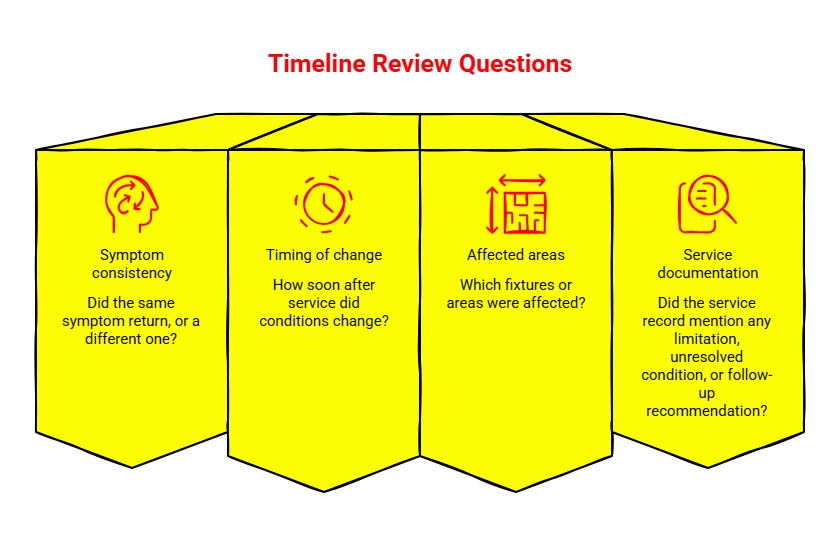
Infographic listing four questions for reviewing recurring grease trap issues: symptom consistency, timing of changes, affected areas, and service documentation.

Once the records are assembled, compare them against what happened before and after service.

Consider a hypothetical situation: a restaurant manager reports slow drainage in three prep-area sinks. The provider performs a pump-out. The service record documents the pump-out and volume removed but says nothing about whether a downstream line was evaluated. Two weeks later, the same sinks drain slowly again.

The useful conclusion is not “the pump-out failed.” The records do not explain whether the returning symptom falls inside or outside the original scope. The right next step is a specific question, not a verdict.

Shift handoffs can complicate that review. A morning manager, closing manager, and technician may each have seen a different part of the sequence. A time-stamped incident log helps reconcile those observations without relying on memory alone.

When reviewing the timeline, ask yourself:

  • Did the same symptom return, or a different one?
  • How soon after service did conditions change?
  • Which fixtures or areas were affected?
  • Did the service record mention any limitation, unresolved condition, or follow-up recommendation?

If the provider documented a limitation (that a section was inaccessible or a separate evaluation was recommended), a recurring symptom in that area may not reflect on the completed scope. For more on how recurrence relates to service evaluation, see this guide on grease trap problems after cleaning.


Treat Missing or Vague Notes as Questions, Not Proof of Poor Service

A common mismatch: the manager assumed the visit included a full inspection of connected lines, but the paperwork documents only a pump-out. That gap between expected scope and documented scope may mean the request was interpreted differently, or that the broader inspection was never part of the agreement. The record creates a question worth asking, not a conclusion.

Do not turn a gap into a verdict. Incomplete documentation warrants clarification, not automatic blame. A missing detail is a reason to ask a specific question, not evidence of deficient work.

Documentation quality and service quality are related but not identical. Short paperwork can also occur during an urgent or after-hours disruption. That context does not make the record sufficient, but brevity alone does not prove poor work. Ask for clarification while the visit is still recent.

When the record is vague, ask pointed questions:

  • What was inspected, and what was not?
  • What condition did the technician observe before and after service?
  • Did access issues affect the scope?
  • Was a follow-up recommendation communicated verbally but not documented?

Frame the conversation around clarifying what happened rather than assigning fault. “The record does not explain whether the downstream line was included in scope” is more productive than “you didn’t do the job right.”

This distinction also matters when ownership wants an immediate provider decision. One sparse record may justify clarification. Repeated patterns across several visits, such as unclear scope, unresolved limitations, communication gaps, or inconsistent follow-up, provide a stronger basis for evaluating the arrangement.


In Houston, Separate Provider Service Notes From the Required Waste Manifest

For Houston restaurants, one critical distinction often gets lost: the provider’s service notes and the Houston waste manifest are not the same document. Consider what happens when a restaurant has all three record types. The invoice confirms a charge. The service notes describe what the technician did and found. The manifest confirms that Fats, Oils, and Grease (FOG) waste was collected through the City’s regulated process. Each serves a separate function, and none alone reconstructs the full picture.

Under current Houston Code (Chapter 47, §47-502), a completed manifest is required before covered waste is removed from a trap, interceptor, or other covered device. The code establishes a generator copy, which the transporter leaves with the generator, and a generator return copy, which the transporter must return within 15 days after the interceptor is cleaned. On current City forms, these are the white and yellow copies, which the generator (the restaurant) must retain on site for at least five years..

Current Houston Health Department guidance directs covered establishments to keep generator and returned-generator manifest copies on site. During inspections (which can occur without advance notice), investigators may request yellow and white waste-manifest copies along with other documents such as the original FOG permit. The Houston Health Department has also noted that Chapter 47 changes are being proposed, so verify current requirements before relying on specific details. To prevent paperwork from scattering across shifts, designate specific managers authorized to sign the manifest and define exactly where the white and yellow copies must be filed before they leave the building.

The manifest confirms that a regulated waste-transfer process was followed, not what condition the technician found or what limitations applied. Those answers come from the provider’s service record.

This distinction applies within Houston city limits. Do not assume Houston’s Chapter 47 requirements apply to Alvin or other nearby municipalities; verify documentation requirements for each jurisdiction separately. The invoice and manifest documentation distinction is covered in greater detail elsewhere.


Turn the Review into Six Provider-Evaluation Questions
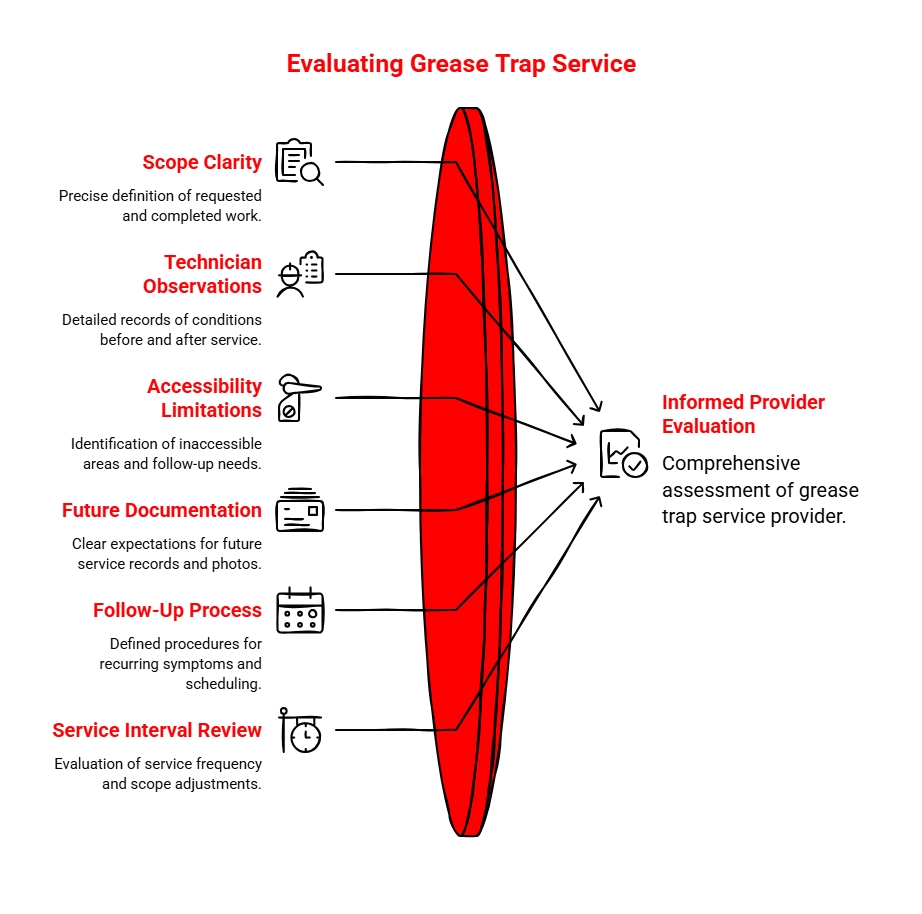
Infographic showing six factors for evaluating grease trap service, including scope clarity, technician observations, access limits, documentation, follow-up, and service intervals.

After comparing your records, convert remaining gaps into specific questions.

  1. What exact scope was requested and completed? Confirm whether the documented work matches what management expected. Compare the answer with the work order and technician notes.
  2. What conditions did the technician observe before and after service? Ask for recorded observations rather than a conclusion reconstructed later.
  3. Was anything inaccessible, excluded, or left for separate follow-up? Access limitations may explain why symptoms returned without reflecting poorly on the completed scope. Clarify any boundary management may have misunderstood.
  4. What documentation will the provider supply after future visits, and when? Set expectations for the detail you need going forward, including service records, invoices, and applicable manifest paperwork. Do they provide before-and-after photos of the trap’s interior? Photos eliminate ambiguity about the condition found and the thoroughness of the cleaning
  5. If the same symptom returns, what is the provider’s follow-up process, and how does scheduling work across your locations? If your operations span Houston and surrounding areas, ask how regional routing affects response. Do not assume regional coverage means identical response arrangements.
  6. Does the recurring-service interval or scope need review? If patterns emerge across multiple visits, the frequency or agreed scope may need adjustment. See this guide to review whether the cleaning schedule is too infrequent.

When evaluating a provider, look for recurring patterns in scope clarity, findings, limitations, communication, follow-up, and operational fit. Paperwork alone should not become an automatic instruction to retain or replace a provider. A commercial grease trap cleaning service that communicates scope, findings, limitations, and follow-up clearly makes this review easier for the manager on the other side of the paperwork.


FAQs

Is a grease trap invoice the same thing as a Houston waste manifest?

No. An invoice is a billing record. Under current Houston Code (Chapter 47), the waste manifest is a separate regulated document required when covered waste is removed from an interceptor. They serve different purposes, and one does not substitute for the other.

Does a recurring problem after cleaning mean the service was done incorrectly?

Not necessarily. A recurring symptom is a reason to investigate, not an automatic verdict. Compare the recurrence timeline, documented scope, any noted limitations, and whether the returning symptom matches the original condition.

What if the service record only says the trap was pumped?

Treat that as limited information rather than evidence of poor work. Ask what condition was observed, what was included in scope, whether anything was inaccessible, and whether follow-up was recommended.

Should a restaurant manager review more than one service visit?

Yes, when the problem is recurring. Comparing records across several service cycles can reveal patterns in timing, scope, symptoms, limitations, and communication that a single visit review cannot establish.


Use the Records to Improve the Next Decision

When a grease trap concern returns, compare the original problem, documented service scope, and post-service outcome before drawing a conclusion. Keep operational notes separate from Houston manifest obligations, and turn ambiguity into specific questions. Across multiple service cycles, those records give management a stronger basis for deciding whether the next step is clarification, a scope adjustment, recurring-service review, or broader provider evaluation.

With the records aligned, you can steer the next provider conversation toward factual clarification rather than assumption.

Disclaimer: This article is for general informational purposes only and does not constitute compliance, safety, technical, or professional advice. Requirements, risks, and best practices may vary by context, jurisdiction, system, provider, or use case. Confirm important decisions with the appropriate qualified professional, authority, or technical expert.


Our Editorial Process

Our expert team uses AI tools to help organize and structure our initial drafts. Every piece is then extensively rewritten, fact-checked, and enriched with first-hand insights and experiences by expert humans on our Insights Team to ensure accuracy and clarity.


By Drane Ranger Insights Team

The Drane Ranger Insights Team creates practical guidance for Houston-area businesses that need reliable liquid waste management, grease trap cleaning, septic, lift station, and wastewater compliance support. Drane Ranger Vacuum Services has served the Greater Houston area since 1985, helping customers keep operations running while following applicable waste handling and disposal requirements.
After Grease Trap Cleaning: What Houston Restaurant Managers Should Confirm Before Affected Work Resumes

📌 Key Takeaways

Houston restaurant managers should record what the provider completed, what remains open, and who owns the next action before the provider leaves.

  • Define the Completed Scope: Cleaning completion only confirms the work the provider identifies as finished, not that every related issue is resolved.
  • Record Provider Instructions: Write down any restriction, limitation, or follow-up instruction exactly as the provider gives it.
  • Document the Handoff: Record completed work, unresolved observations, follow-up ownership, and the status of service paperwork before the provider leaves.
  • Name the Follow-Up Owner: Assign open items to a specific person so they do not disappear across several manager shifts.
  • Do Not Guess Causes: Returning odors or slow drains do not prove the cleaning failed or confirm the original problem is gone.

Clear handoffs prevent assumptions from becoming operational decisions.

Houston restaurant managers will get a cleaner shift change, using the practical handoff guidance that follows below.

~ ~ ~ ~ ~ ~ ~ ~ ~ ~ ~ ~ ~ ~ ~ ~ ~ ~

The service provider finishes at 5:15 p.m. You are leaving at 5:30. Dinner is already building, and your floor manager catches you at the pass with a reasonable question: “Are we good now?”

That question is hard to answer well because it asks for a verdict rather than information. You do not need to become a grease trap technician to answer it responsibly. You need a precise account of three things: what the provider actually completed, what remains open, and what has to travel with the next manager.

Houston restaurants deal with this handoff constantly, often during a rush and often with the person who booked the service nowhere near the building. The few minutes before the technician leaves are the cheapest opportunity you will have to get that account on the record.


Start With One Distinction: Cleaning Complete Is Not the Same as Every Question Resolved

When a provider says the work is finished, that statement describes the job they were assigned. It is an accurate answer to a scope question.

It is not automatically an answer to every other question a restaurant might have. A completed cleaning does not, by itself, tell you whether a connected fixture behaves differently now, whether the cause of an earlier backup has been identified, or whether some condition in the kitchen falls outside what the provider was hired to address. None of that means something is wrong. It means the completion message covers a defined set of work, and only the provider can tell you where its edges are.

So the useful move is not to interpret the message. It is to ask the provider to state what it covers.

Provider completed Management may still need clarified
The specific cleaning work assigned for this visit Whether anything related was observed but not part of that work
The service on the grease trap or interceptor itself Whether any connected drain, fixture, or line was within scope
Removal and haul-away of the collected waste What documentation was left on site and what is still pending
Any follow-up the provider has recommended Who owns that follow-up, and by when


Confirm What the Provider Completed, and What Was Outside the Visit

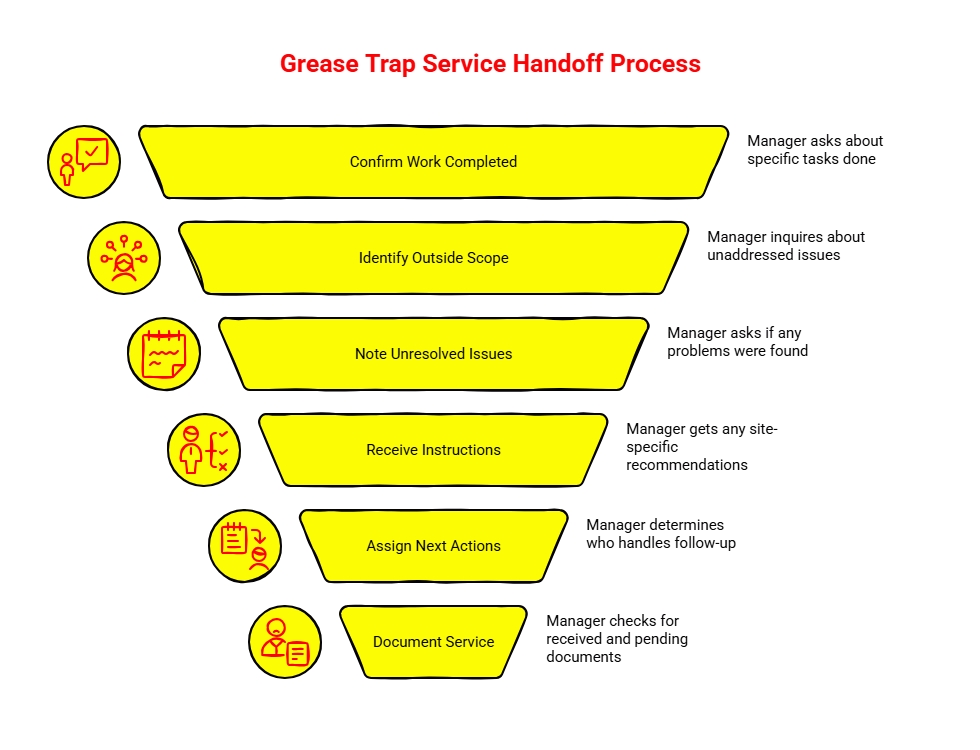
Six-step grease trap service handoff process covering completed work, unresolved issues, instructions, next actions, and service documentation.

Turning a general completion statement into a defined scope takes about 90 seconds of conversation. Ask plainly, and write the answers down as the provider gives them rather than translating them into your own summary.

Useful questions include: What specific work was completed today? Was the visit limited to the grease trap or interceptor? Was any related condition noticed but left outside the assigned work? Is anything being referred for further inspection, repair, or a separate service? Is follow-up already recommended, and on what timeline?

Do not assume that a cleaning visit included diagnosis or repair of connected plumbing. Providers are frequently engaged for the cleaning itself, and a manager who assumes more than that can hand the next shift a false sense of resolution. If you want broader context on how a service visit is typically structured, the breakdown of what to expect from a professional grease trap cleaning is a reasonable background read on another day. During the visit itself, the provider in front of you is the better source.

Keep the conversation to communication, not technical verification. You are establishing what was done and what was not. You are not evaluating the work.

The Six-Point End-of-Service Manager Handoff

  1. What work did the provider complete?
  2. What was outside the provider’s service scope or not evaluated?
  3. Did the provider identify anything unresolved?
  4. Did the provider give any site-specific restriction, limitation, or follow-up instruction?
  5. Who owns the next action, and when?
  6. What service documentation was received, and what remains pending?


Ask About Any Site-Specific Limitation Before Affected Work Moves Forward

If activity around part of your kitchen was interrupted during the visit, the relevant question is whether the provider gave any instruction about it.

Ask directly: Is there any restriction or condition affecting the area or the work that was disrupted? Do you want us to wait on anything, such as another service call, a repair, an inspection, or a decision from someone else? The answer may well be that there is no further instruction, and a plain no is a complete answer worth recording as such — the alternative is a manager inventing a condition the provider never gave. Whatever they say, record it exactly. The wording matters more here than anywhere else, because a specific, limited instruction turns into something much broader once it passes through two or three people.

Two boundaries are worth holding. First, keep the affected activity or area distinct from the restaurant as a whole. A visit that disrupted one part of the kitchen is not the same as a building-wide event, and the handoff should not blur the two. Second, do not treat the provider’s completion message as a clearance. A grease trap service provider reports on their own work. They are not in a position to grant regulatory permission, and management should not infer it from a completed job.

Testing fixtures, running equipment, and flushing lines are not manager tasks, and no single procedure fits every restaurant.

If the visit followed a sewage backup or another condition that may involve food-safety rules, any specific requirement about ceasing or resuming operations should be confirmed against the current requirements of the appropriate regulatory authority. Do not rely on a service provider, a blog, or an older summary for that answer.


Write Down the Handoff Before the Provider Leaves

A conversation that lives only in your memory has a short shelf life, particularly at 5:30 on a Friday. A short written note takes a minute and survives the shift. To make this easier during a rush, keep a printed copy of this checklist clipped to the manager logbook.

Capture seven fields:

  • Date and time the visit ended
  • Provider and type of service visit
  • Work the provider stated as complete
  • Any unresolved observation the provider mentioned
  • Any provider-stated limitation or follow-up instruction, in their words
  • Responsible manager and next action
  • Documentation received, and documentation still expected

That last field deserves a moment, because paperwork often arrives in two stages. Under Section 47-502 of the Houston Code of Ordinances, the generator copy of the waste manifest is left with the generator at the time of service, while the completed generator return copy comes back within 15 days after cleaning. That distinction keeps you from chasing a document too early or forgetting one still outstanding. Verify current requirements with the City of Houston if the details matter to your recordkeeping.

Use the provider’s words in the note rather than your own summary. “Fixed,” “cleaned,” and “cleared” get used interchangeably in a kitchen, and they do not mean the same thing. A note saying the trap was cleaned describes the visit. A note saying the problem was fixed asserts something the provider may never have said.

Write the note while the provider is still on site. If something in your record does not match what they said, that is the moment to ask, not tomorrow. When the visit followed an earlier backup, the record is easier to reconcile if someone already captured what to document before the service crew arrives.


Make the Shift Change Explicit

The handoff most often fails at the manager-to-manager seam, where ‘the grease trap people came’ substitutes for everything the provider actually said.

Tell the incoming manager six things:

  1. What changed during the visit
  2. What the provider said was complete
  3. What remains unresolved, if anything
  4. What restriction or instruction was given, in the provider’s wording
  5. Who owns the follow-up
  6. What condition should prompt another call to the provider

Keep that last item qualitative. “If the same odor or slow drain comes back, note when and where, and call the provider” is useful. A diagnostic threshold is not, and it asks staff to assess a system they were never trained to assess.

A compact version fits on one line in the manager log:

Completed: ___ | Unresolved: ___ | Provider instruction: ___ | Follow-up owner: ___ | Documentation: ___

Name a person in that fifth field. An open item assigned to “management” belongs to no one in particular, and items like that routinely survive three or four shifts without anyone making the call.

Consider a hypothetical Houston restaurant where cleaning wraps up shortly before the general manager leaves. Instead of “we’re all set,” the outgoing GM hands over the written note: work completed as stated, one observation the provider flagged for follow-up, the provider’s instruction about one prep area recorded as given, the GM named as the person calling tomorrow, and the return copy of the manifest still outstanding. The incoming floor manager knows what is settled and what is not.


If the Handoff Is Incomplete, or Symptoms Remain, Do Not Fill In the Gaps Yourself

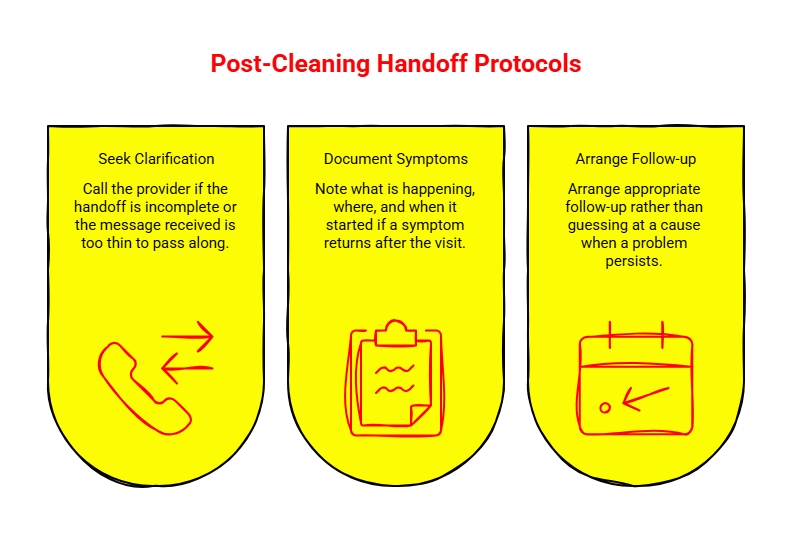
Infographic showing three post-cleaning grease trap steps: seek clarification, document recurring symptoms, and arrange appropriate follow-up when problems persist.

Sometimes the provider leaves before anyone gets a clear account, or the message you received is too thin to pass along. Call the provider and ask for clarification. A follow-up phone call is a normal part of service, and it is far better than a manager reconstructing the visit from a sentence overheard on the line.

The same restraint applies if a symptom returns. Picture a kitchen that reported an odor and a slow drain, had the trap cleaned that afternoon, and smells the same thing again by nine that evening. The recurrence establishes neither that the cleaning failed nor that the original problem is gone; both conclusions skip a step. An intermittent odor or slow drain often does not appear during the hour the technician is on site, which is one reason an earlier complaint can outlive a completed visit. Note what is happening, where, and when it started — that timeline is also the most useful thing you can hand the provider if a return visit is needed — keep any provider-stated limitation intact, and arrange appropriate follow-up rather than guessing at a cause. The guidance on grease trap problems after cleaning covers what is worth escalating and how to frame the callback.


Common Questions

Does “cleaning complete” mean every grease-related problem is resolved?

No blanket conclusion should be drawn from it. It means the provider completed the scope they identify as complete. Ask whether anything fell outside that scope or requires follow-up, and record the answer as given. Completion also says nothing about how much of the restaurant was affected during the visit, or whether any part of it needed to pause. That depends on the situation and on what the provider told you, not on the cleaning report.

What belongs in the manager-to-manager handoff?

Work completed, any unresolved observation, any provider-stated limitation in the provider’s own wording, the follow-up owner and timing, and the status of documentation received or still pending. Keep it to what was said rather than what you concluded.

What should we do if odors, slow drains, or other symptoms return after cleaning?

Document when and where the symptom appeared, then contact the provider for follow-up. Do not diagnose the cause from the symptom alone, and do not treat its return as proof that the service was inadequate.


The Handoff Is the Deliverable

A good end-of-service handoff answers three questions and no more than three: what was completed, what remains open, and who owns the next action. It does not require technical knowledge, and it does not ask you to judge a system you did not service. It asks you to capture what the provider told you, accurately, before the person who told you drives away.

Use the six-point handoff before the provider leaves.

Drane Ranger provides commercial grease trap cleaning in the Houston area, and you can contact Drane Ranger with service questions.

Disclaimer: This article is for general informational purposes only and does not constitute compliance, safety, technical, or professional advice. Requirements, risks, and best practices may vary by context, jurisdiction, system, provider, or use case. Confirm important decisions with the appropriate qualified professional, authority, or technical expert.


Our Editorial Process

Our expert team uses AI tools to help organize and structure our initial drafts. Every piece is then extensively rewritten, fact-checked, and enriched with first-hand insights and experiences by expert humans on our Insights Team to ensure accuracy and clarity.


By Drane Ranger Insights Team

The Drane Ranger Insights Team creates practical guidance for Houston-area businesses that need reliable liquid waste management, grease trap cleaning, septic, lift station, and wastewater compliance support. Drane Ranger Vacuum Services has served the Greater Houston area since 1985, helping customers keep operations running while following applicable waste handling and disposal requirements.
Grease Trap Problems After Cleaning: 6 Questions Houston Restaurant Managers Should Ask the Provider

📌 Key Takeaways

Recurring grease-trap problems need a structured review of service scope, access, records, and evidence before blaming the cleaning provider.

  • Separate Symptoms From Causes: Odors, slow drains, or backups may return even when the grease trap was properly serviced.
  • Confirm the Service Scope: Ask exactly what the provider cleaned, what was excluded, and whether access problems limited the work.
  • Check the Service Records: Work orders, technician notes, and manifests can show what happened during service and where waste went.
  • Ask for Evidence: Providers should separate documented observations from possible causes and explain what any follow-up visit would investigate.
  • Review Ongoing Service Fit: Service timing, coverage, and communication should reflect the restaurant’s actual conditions rather than a standard schedule.

Better records and better questions lead to clearer decisions.

Houston restaurant managers can use these questions to compare providers and prepare for the service evaluation that follows.

~ ~ ~ ~ ~ ~ ~ ~ ~ ~ ~ ~ ~ ~ ~ ~ ~ ~

The cleaning visit is finished, but the odor is back, the kitchen sink is draining slowly, or a backup warning is developing. That outcome deserves attention. It does not tell you whether the previous service was incomplete, whether the original scope excluded something important, or whether a separate issue needs investigation.

Before you call the provider to complain or search for a replacement, organize the conversation around six question categories. Each one targets a specific gap: what the visit covered, what limited it, what the technician observed, what records you should have, why the provider thinks the symptom returned, and whether the ongoing service plan fits your operation.


Before You Call It a Failed Cleaning, Separate the Outcome From the Cause

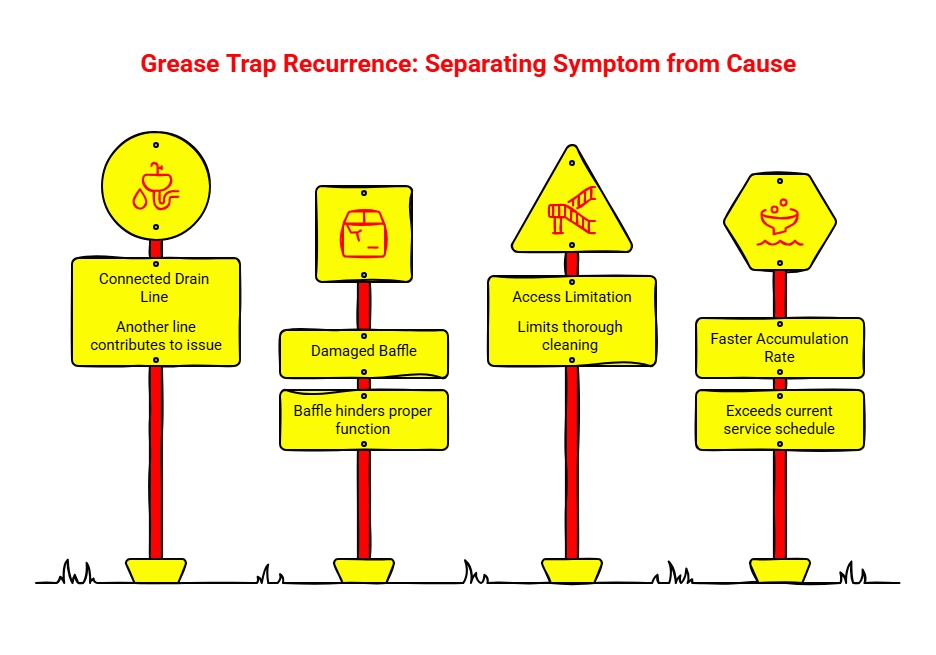
Diagram showing four possible causes of recurring grease trap issues: connected drain lines, damaged baffles, access limitations, and faster grease accumulation.

While a recurring symptom is a legitimate reason to follow up, it does not inherently prove poor workmanship. The trap may have been fully serviced while a connected drain line, a damaged baffle, an access limitation, or an accumulation rate faster than the current schedule accounts for contributed to the recurrence.

Build a simple timeline before contacting the provider: service date, any symptom-free period, date the symptom returned, and operational impact. Have your records assembled. If you need help preparing for an active backup, see what to document before a service crew arrives.

For instance, a manager might notice the same odor returning two weeks after a scheduled pump-out. The instinct is to blame the service crew, but the recurrence could involve the trap, a floor drain tied to a separate line, or accumulation that exceeded the service interval. Asking structured questions, rather than making an accusation, leads to a more useful next step.

For a broader look at which post-cleaning warning signs justify escalation, see grease-trap problems after cleaning.

Documents to have open during the call:

  • Previous work order or service agreement
  • Invoice from the most recent visit
  • Manifest copies (generator copy and, if received, the return copy)
  • Technician notes or photos supplied by the provider
  • Your internal incident timeline (dates, symptoms, operational impact)
  • Previous service dates for comparison

1. “What Exactly Was Included in the Service?”

The word “cleaning” can describe significantly different scopes. One company may fully evacuate the interceptor — Houston’s Chapter 47 code term for the device commonly called a grease trap — scrape interior surfaces, and clear crossover pipes. Another may pump standing liquid without removing settled solids. Full evacuation means the complete removal of all liquid and solid contents from the trap, not a partial removal. Unless you confirm what the quoted service included, you cannot evaluate what it missed.

Ask the provider to identify:

  • Whether the interceptor was fully evacuated.
  • What material was removed (liquid, floating grease, settled solids, or all three).
  • Which components were part of the quoted scope.
  • Whether any line work was included or explicitly excluded.
  • Whether additional work was recommended but not authorized.
  • Whether the visit was maintenance, emergency pumping, inspection, or a combination.

For restaurants within Houston city limits subject to Chapter 47, current Houston Code §47-512 requires full evacuation of a covered interceptor or holding tank at least every 90 days, with more frequent evacuation under specified conditions (including when fats, oils, and grease, known as FOG, plus sediment reaches at least 25% of the wetted height). That requirement does not mean every service includes line cleaning, hydro-jetting, scraping, photography, or camera inspection.

In one common scenario, a manager discovers that line cleaning was never part of the original scope, even though both parties assumed the other had addressed it. Two providers can quote different services under the same word. Clarifying scope eliminates that ambiguity. For more context on commercial grease-trap cleaning scope, review what professional service typically involves.

2. “Was Everything Accessible, or Did Anything Limit the Job?”

A technician cannot address what cannot be safely reached. Covers buried under equipment, parked vehicles blocking access points, locked enclosures, or active kitchen operations can all reduce the scope of a visit without appearing on the final paperwork.

Ask:

  • Were all intended access points reachable on the day of service?
  • Did site conditions (covers, vehicles, stored equipment, locks) create a limitation?
  • Was management informed of any access issue during or after the visit?
  • Did the limitation change what the crew could complete?
  • What needs to be different before the next visit?

Frame these as information-gathering questions. The goal is to determine whether a site condition, rather than service quality, explains the persistent symptoms. A useful answer connects the limitation to the work — something like “the second access point was blocked, so that portion of the planned service was not completed” gives you an operational next step. A vague “access was difficult” does not.

Before authorizing another visit, confirm the access plan and service window with the provider. That reduces the chance of a repeat scenario where undefined conditions limit the scope again.

3. “What Did You Observe Before and After the Cleaning?”

Vague reassurance (“everything looked fine”) is not a documented observation. A useful provider should describe what was found on arrival, what condition the system was in when the crew finished, and whether anything unusual was recorded.

Request:

  • The condition observed on arrival (accumulation level, flow, visible damage).
  • Any unusual accumulation or blockage the technician documented.
  • Written technician notes from the visit.
  • Before and after photos, if the provider routinely captures them.
  • Any visible damage or access issue recorded.
  • The condition observed at the end of service.

Keep one distinction in mind: an observation (“heavy accumulation was documented on the inlet side”) is a recorded fact. A diagnosis (“this is definitely what caused the odor”) is an interpretation that may require further investigation. Documentation practices vary across providers, so do not assume photos, camera inspection, scraping records, or a particular post-service test should exist. Ask what this provider documented and what the technician based later conclusions on.

If the records are thin, ask what evidence supports the current explanation rather than treating missing detail as automatic proof of bad service. If odor is the primary returning symptom, why grease-trap odors can return after cleaning explores several categories worth considering.

4. “Where Is the Service and Waste-Disposal Documentation?”

For restaurants within Houston city limits handling waste regulated under Chapter 47, documentation extends beyond an ordinary service invoice. A manifest is a waste-transfer record that documents the generator, transporter, vehicle, collection date, waste type and quantity, and intended disposal site. It is a separate and legally distinct document from the invoice.

Current Houston Code §47-502 requires a completed manifest before city-regulated waste is removed from a trap or interceptor. The transporter leaves the generator copy with you at the time of service and must return the completed generator-return copy within 15 days. Sections 47-502 and 47-522 require applicable generator manifest records to be retained on site for five years. Section 47-511 also requires that a generator not allow a transporter to remove waste unless the transporter’s vehicle displays current, valid registration decals.

Confirm with the provider:

  • Do I have the generator copy of the manifest?
  • Has the completed return copy arrived within 15 days?
  • Do the service dates match across the manifest and work order?
  • What specific waste quantity (in gallons) was recorded, and what is the receiving facility’s TCEQ registration number or identified disposal site?
  • Which transporter and vehicle handled the load?

Imagine a situation where a Houston restaurant manager has the invoice confirming payment but cannot locate the manifest. The invoice proves a transaction occurred. It does not confirm where the waste was transported, what quantity was removed, or which disposal site received it. Those details belong on the manifest. Verify current requirements before relying on them for a compliance decision, and note that requirements outside Houston city limits may differ.

5. “Why Do You Think the Symptoms Returned, and What Do You Recommend Next?”

This is where the conversation shifts from reconstruction to evaluation. A provider who can explain what evidence supports their theory, what remains uncertain, and what the follow-up visit would specifically investigate is offering a more useful answer than one who simply guarantees the next visit will solve the problem.

Ask:

  • What evidence supports your explanation for the recurrence?
  • Are you describing something you observed, or a possibility you want to investigate?
  • What would the follow-up visit specifically check or address?
  • What part of the system or service falls outside your scope?
  • What would prompt you to recommend another trade or specialist?
  • Will the follow-up be documented, and who owns communication afterward?

A useful answer separates known facts, plausible causes, and next diagnostic steps. A concerning answer offers unexplained certainty or a blanket guarantee. The symptom alone does not establish the cause, and neither does the provider’s first theory without supporting evidence.

Unless an active operational emergency requires immediate action, agree on the follow-up scope before authorizing another visit. Confirm who will report the findings, especially when peak service periods make vague callback promises hard to manage.

6. “Does the Recurring Service Plan and Response Coverage Still Fit This Restaurant?”

A single unsatisfactory outcome is also an opportunity to review whether the ongoing maintenance relationship is structured correctly.

Ask:

  • What service interval do you recommend for this restaurant, and what observations support it?
  • What condition would cause you to shorten the interval?
  • How is recurring service documented and tracked?
  • What happens when symptoms appear between scheduled visits?
  • Which locations does your team actually cover, and what scheduling commitments can you make for this site?

For sites subject to Houston Chapter 47, current §47-512 sets a legal minimum of full evacuation at least every 90 days, with more frequent service under specified conditions including the 25% accumulation threshold. That minimum is not necessarily the right interval for every kitchen. A high-volume restaurant may reach the threshold well before 90 days. To evaluate whether your schedule matches actual conditions, review whether your cleaning schedule is too infrequent.

Coverage and jurisdiction are separate considerations. A provider may serve Houston and Alvin, but Houston Chapter 47 should not be assumed to govern an Alvin restaurant. If the provider serves multiple cities across the Greater Houston area, confirm that coverage and scheduling commitments apply to your specific location.


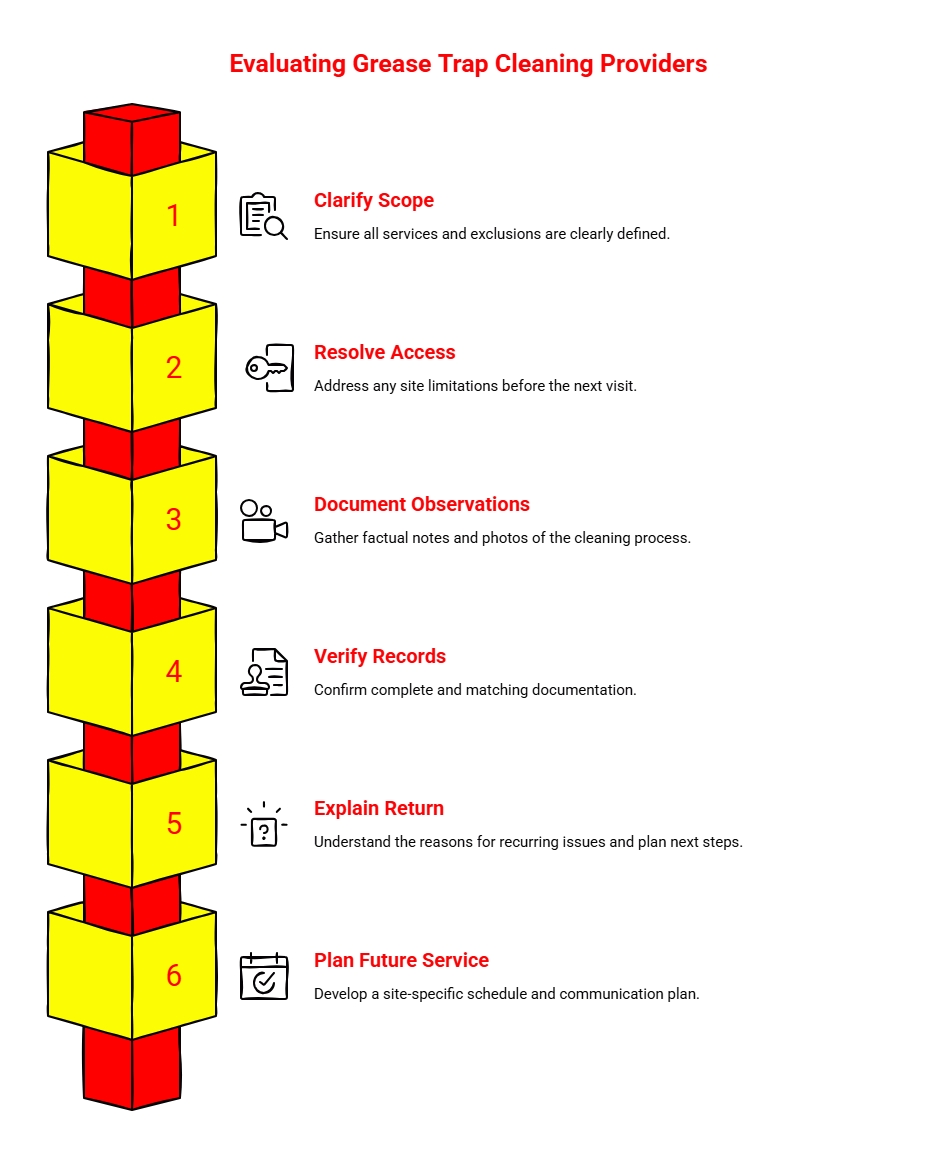
Use This 6-Question Provider Evaluation Scorecard

Infographic outlining six steps for evaluating grease trap cleaning providers, from clarifying scope and access to verifying records and planning future service.

Use the following table when speaking with your current provider or evaluating a replacement. Each row corresponds to one of the six question categories above.

Question to Ask Evidence to Request What a Useful Answer Sounds Like What Should Prompt Another Question Next Decision
What was included? Work order and invoice detailing scope Specific services and exclusions stated Vague “we cleaned it” with no detail Clarify scope before authorizing follow-up
Was access complete? Technician notes on site conditions Specific limitation or confirmation of full access An unreported limitation appears later Resolve the access barrier before the next visit
What did you observe? Service notes, photos if available Documented facts separated from assumptions No documented basis for the explanation Ask how the conclusion was reached
Where are the records? Manifest copies plus service paperwork Complete, matching records with dates and disposal site Missing or incomplete documentation Request correction from the transporter
Why did it return? Explanation with evidence and next-step plan Evidence, uncertainty, and next check are separated Guaranteed resolution or unsupported certainty Seek further professional evaluation
Does future service fit? Schedule, coverage, and communication plan Site-specific interval logic and realistic commitments One-size-fits-all answer with no reasoning Compare provider fit with an alternative

Use the scorecard to compare providers on scope, documented observations, complete records, communication, follow-up logic, recurring-service planning, and location coverage. Price matters commercially, but it does not tell you whether two proposals cover the same work.


Frequently Asked Questions

Do recurring odors or slow drains prove the grease-trap cleaning was done incorrectly?

No. Recurrence warrants evaluation, but the symptom alone does not establish the cause or prove poor workmanship. The trap may have been properly serviced while a connected drainage issue, an access limitation, or a faster-than-expected accumulation rate contributed. Review scope, access limitations, observations, documentation, and what changed after the visit before reaching a conclusion. If the provider gives a diagnosis, ask what evidence supports it.

What paperwork should a Houston restaurant ask for after grease-trap service?

For city-regulated waste subject to Houston Chapter 47, you should receive the generator copy of the manifest at the time of service and the completed generator-return copy within 15 days after cleaning. Current §§47-502 and 47-522 require applicable generator records to be retained on site for five years. Separately, request the work order or invoice describing service scope. A manifest and an invoice serve different purposes. Verify current requirements before relying on them.

Should I change grease-trap providers after one unsatisfactory visit?

Not automatically. Evaluate whether the provider can explain scope, limitations, observations, documentation, follow-up, and scheduling logic. If answers remain incomplete or the operational fit is poor after a reasonable effort, comparison with another qualified provider is a reasonable next step.


Make the Next Decision From the Record

A frustrating recurrence should lead to better questions, not an automatic accusation or another undefined service call. Compare what was promised, what was accessible, what the technician actually documented, whether the records are complete, and whether the proposed next step follows from the available evidence. Then judge the provider’s communication, recurring-service logic, and ability to support the restaurant operationally.

Use the six-question scorecard when you speak with your current provider or compare another provider.

If your restaurant needs professional grease-trap service in the Houston area, contact Drane Ranger to discuss the service need or call 281-489-1765. For additional Houston-area service information, visit the grease-trap cleaning in Houston page.

Disclaimer: This article is for general informational purposes only and does not constitute compliance, safety, technical, or professional advice. Requirements, risks, and best practices may vary by context, jurisdiction, system, provider, or use case. Confirm important decisions with the appropriate qualified professional, authority, or technical expert.


Our Editorial Process

Our expert team uses AI tools to help organize and structure our initial drafts. Every piece is then extensively rewritten, fact-checked, and enriched with first-hand insights and experiences by expert humans on our Insights Team to ensure accuracy and clarity.


By Drane Ranger Insights Team

The Drane Ranger Insights Team creates practical guidance for Houston-area businesses that need reliable liquid waste management, grease trap cleaning, septic, lift station, and wastewater compliance support. Drane Ranger Vacuum Services has served the Greater Houston area since 1985, helping customers keep operations running while following applicable waste handling and disposal requirements.

Temporary Cleanup Is Not Enough: Signs a Restaurant Needs Follow-Up Grease Trap Service

📌 Key Takeaways

A clean kitchen is not proof the grease trap issue is over; recurring symptoms under normal use may justify follow-up service.

  • Watch For Recurrence: Watch what returns during normal service, because repeat drainage, odor, or fixture problems matter more than surface cleanup.
  • Patterns Across Fixtures: Problems affecting several fixtures or areas may signal something broader than one local drain problem.
  • Workarounds Still Matter: If staff still limit sink use or change routines, normal kitchen operation has not fully returned.
  • Document The Recurrence: A time-stamped record of symptoms, locations, kitchen load, photos, and service history gives providers clearer information.
  • Verify After Follow-Up: Check performance through at least two to three normal service cycles before treating the issue as resolved.

Clean floors do not prove the system is fixed.

Houston restaurant managers will spot stronger follow-up signals and prepare better service records using the guidance below.

~ ~ ~ ~ ~ ~ ~ ~ ~ ~ ~ ~ ~ ~ ~ ~ ~ ~

The floor is mopped, the standing water is gone, and the strongest odor has faded. For a Houston restaurant manager who just dealt with a grease-related backup or odor incident, that visible improvement feels like progress. But one question remains: when normal kitchen operations resume, does everything actually work the way it did before the incident?

If your kitchen is dealing with an active backup or overflow right now, focus on containment, keep people away from the affected area, and contact a qualified service provider. This article is for the period after that immediate response, when the visible mess is handled but the manager is not yet sure the underlying issue is resolved.

Surface recovery versus system resolution is the distinction that matters here. A clean floor confirms that staff handled the immediate mess. It does not confirm that drainage, odors, and fixture performance will hold up during the next busy service period. The difference becomes clear only after the kitchen returns to normal use, and that observation window is where this article focuses.

You will learn which recurring patterns justify follow-up service, what to document so a provider can act on useful information instead of a vague report, and how to prepare for professional reassessment.


A Clean Kitchen Does Not Automatically Mean the Grease Trap Issue Is Resolved

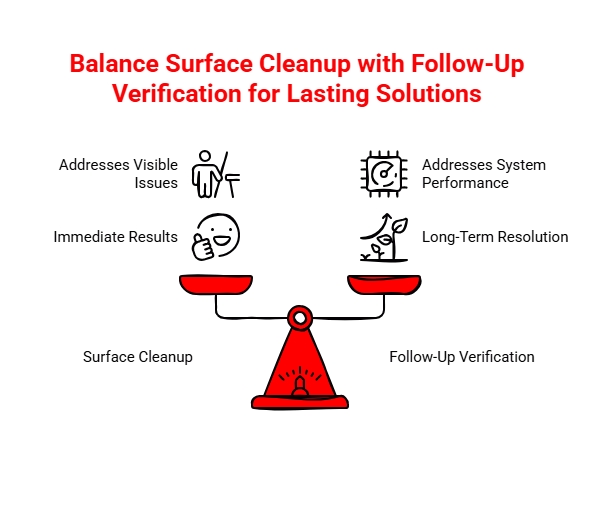
Illustration comparing surface cleanup for visible, immediate issues with follow-up verification focused on system performance and long-term resolution.

Cleanup addresses what staff can see and smell in the affected area: residue on the floor, standing water near a drain, or a lingering odor in the kitchen. That work is necessary, but it answers a different question than the one that matters next.

Follow-up verification asks whether drainage speed, odor levels, fixture performance, and day-to-day operations return to normal once the kitchen resumes its regular workload. A prep sink that drains fine when one cook rinses a cutting board may behave differently when three stations are running simultaneously during a Friday dinner rush. The gap between surface recovery and system resolution is where recurring problems hide.

A recurrence after cleanup does not automatically identify the cause. A returning odor does not prove the grease trap is full. Several slow drains do not prove the trap caused the problem. A recent service visit does not establish that every later symptom shares the same explanation. The manager’s role is to recognize and document the pattern, not diagnose the inside of the system.


Surface Cleanup vs. Follow-Up Signal

Surface Recovery Follow-Up Signal
Floor is clean and dry Drainage slows again under normal use
Visible residue removed Odor returns or appears in a new location
Strongest smell has faded More than one fixture shows the same pattern
Staff completed immediate response Operations still require workarounds

Recurrence after cleanup does not automatically identify the cause. It does, however, tell you that the situation deserves closer observation before you assume the problem is over.


Signs the Restaurant May Need Follow-Up Grease Trap Service

A single observation rarely tells the full story. The value of any symptom comes from its pattern: when it returned, where it appeared, whether it spread, and whether it changed how the kitchen operates. Fats, oils, and grease (FOG) can affect drainage, odor, and fixture performance in ways that are not always visible after surface cleanup.


The Same Symptom Returns After Normal Operations Resume

Timing matters more than the symptom itself. A slow drain that reappears five minutes after cleanup likely reflects residual debris in the line. A slow drain that returns the next day, during a normal service period, after the kitchen appeared fully recovered, carries more weight.

For example, a restaurant cleans the affected area after a backup incident, and the kitchen appears normal through a quiet afternoon. The following morning, during full prep-line use, the same drain slows again. That recurrence under load is a different signal than a brief repeat during initial cleanup.

Record whether the recurrence happened minutes, hours, or a full shift after the original incident seemed resolved. Note what the kitchen was doing at the time: light prep, full-volume service, or end-of-day cleaning. A sink used heavily during prep provides different context from one that sat mostly unused before someone noticed a change. Recording what was happening when the symptom appeared helps a provider understand the recurrence without asking staff to determine its cause.


More Than One Fixture or Area Starts Showing the Same Pattern

One sluggish drain could reflect a localized issue. When two prep sinks and a floor drain in different areas all begin slowing during normal use, the pattern suggests something broader than a single clogged line.

Consider a situation where one sink drains normally after cleanup, but later two prep-area fixtures begin slowing during regular service. That spread is worth documenting: which fixtures are affected, when each one started showing symptoms, and whether the problem appeared simultaneously or spread over hours or shifts. If different shifts use those fixtures differently, include that context rather than assuming every employee observed the same conditions.


Odor Returns, Moves, or Becomes More Persistent

A faint smell near the original incident area may linger briefly after cleanup. That is different from an odor that returns during the next service period, appears near a fixture that was not involved in the original event, or grows stronger instead of fading.

For example, a restaurant cleans the affected area after an odor incident. The smell fades through the evening, but returns during the next busy period, strongest near a different drain. That shift in location and timing is worth recording rather than immediately attributing to the trap.

Odor alone does not identify the source. FOG-related smells can originate from the trap, from residue in connected lines, from floor drains, or from organic material unrelated to the grease system. What matters for follow-up purposes is the location where the odor is strongest, the time of day it appears, and whether it accompanies other symptoms such as slow drainage. For a deeper look at odor-specific recurrence, see why grease trap odors return after cleaning.


Visible Conditions Return After Cleanup

Residue or another visible condition that reappears after cleanup belongs in the recurrence record alongside drainage and odor observations. Note the location, time, and operating conditions when staff observe it. Use photos when they can be taken safely from the normal work area, and include timestamps so the provider can match them to the recurrence timeline. For example, taking a wide shot of standing water near the prep line timestamped at 7:00 PM during a rush is far more useful than a close-up of a drain grate the next morning.

Do not ask employees to open, measure, enter, pump, clear, jet, or otherwise inspect the grease trap or interceptor to create additional evidence. The manager’s observation role covers what is visible during normal kitchen operations, not what is happening inside the system.


Staff Still Have to Work Around the Problem

The most practical test of resolution is whether the kitchen can operate normally. If staff are still avoiding a particular sink, running smaller loads through the dishwasher, altering cleanup routines, or monitoring a drain “just in case,” the incident is not fully resolved. It has simply moved from an acute disruption to a managed inconvenience.

Consider a kitchen where the visible mess is gone, but staff continue limiting use of one fixture to avoid triggering another disruption. These workarounds are easy to normalize over a few shifts. Ask whether any fixture, drain, or area is still being used differently than before the incident. If the answer is yes, that restriction belongs in the follow-up record.


Follow-Up Service Evidence Checklist

Use this checklist to organize observations before contacting a provider. One concise record is more useful than scattered verbal reports from multiple shifts.

Field What to Record
Date and time symptom returned Specific date, approximate time, and shift
Fixture or location Which sink, drain, or area is affected
Staff observation What was seen, smelled, or heard
Single or multiple fixtures Whether more than one area shows the pattern
Operating conditions Kitchen load at the time (prep, full service, closing)
Prior service date and scope When the last service visit occurred and what was done, if known
Photos available Yes or no; include timestamps if possible
Operational impact Any fixture restrictions, altered routines, or lost capacity
Follow-up action taken What the manager did next (called provider, continued monitoring, etc.)

A recurring pattern warrants professional reassessment. The checklist above gives your provider the information needed to scope the follow-up visit effectively.


Build a Recurrence Timeline Before You Call

A provider responding to “it happened again” has very little to work with. A concise recurrence timeline lets the provider scope the visit more effectively and arrive better prepared.

Before calling, assemble a single record (one page, one digital note, or one printed checklist) that covers:

  • the original incident date, time, and what staff observed;
  • what cleanup or professional service was performed afterward;
  • when symptoms returned and in which fixtures or areas;
  • whether the recurrence was a one-time event or a repeating pattern;
  • any photos with timestamps;
  • staff observations across shifts, consolidated into one account;
  • current operating restrictions or workarounds still in place;
  • the prior service provider’s name, date, and scope of work, if that information is available.

If you did not personally witness the original incident because another shift handled it, reconstruct the sequence from time-stamped staff notes, available photos, and existing service documentation rather than filling missing details with assumptions.

Consolidating observations from different shifts matters because individual recollections diverge quickly. A written, time-stamped record replaces “I think it was Tuesday” with something a technician can actually use. Keeping all evidence together in one digital note or folder—timeline, photos, prior service records, and follow-up observations—prevents information from scattering across texts, shift notes, and individual phones. For a more detailed documentation framework, see what to document before the service crew arrives.


Prepare the Site and Information for Follow-Up Service

Once you decide the recurrence pattern warrants professional reassessment, a few preparation steps reduce friction on the day of the visit.

Identify the access point and a site contact. Confirm where the grease trap or interceptor is located and who will be available to provide access and answer questions during the visit. Coordinate access around kitchen operations so the crew can reach the required area without discovering an avoidable access problem after arrival.

Gather prior service documentation. If the restaurant has a service record, manifest, or invoice from the most recent visit, have it available. Knowing what was done previously helps the provider determine what to evaluate next.

Provide the recurrence timeline. Share the consolidated record you built. Specific dates, affected fixtures, and operating conditions give the technician a starting point that is far more productive than a general description.

Describe the current status. Tell the provider whether the condition is active, intermittent, or currently quiet. This distinction matters because a provider may arrive while the symptom is not occurring. A clear timeline can show what happened even when the kitchen looks normal during the visit.

Explain any ongoing restrictions. If the kitchen is still limiting use of certain fixtures or areas, the provider should know before arriving.

Limit your team’s role strictly to external observation; leave all internal system diagnostics and physical interventions to the technicians. The manager’s role in this workflow is observation, documentation, access coordination, and communication with a qualified commercial grease trap cleaning provider.


After Follow-Up, Verify the Outcome Instead of Assuming It

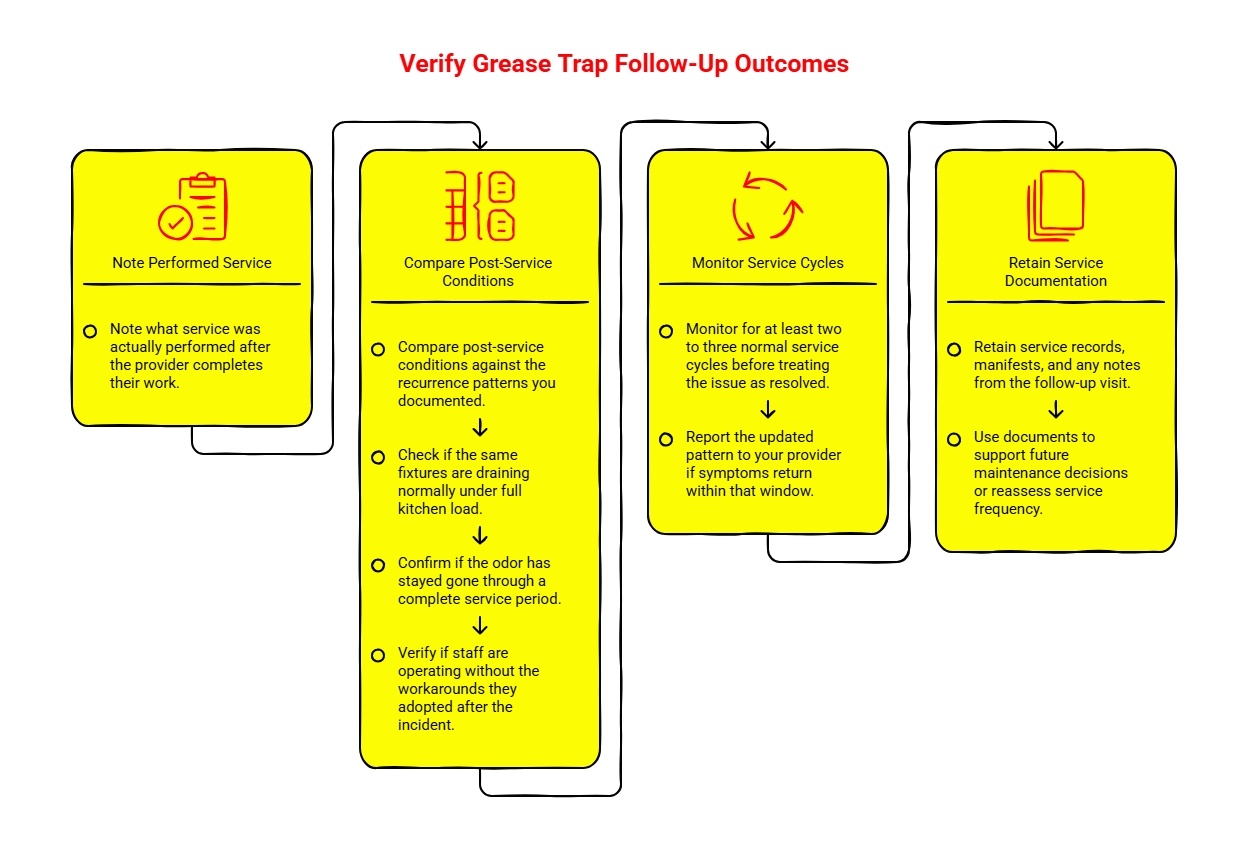
Flowchart showing how to verify grease trap follow-up results by noting service performed, comparing conditions, monitoring service cycles, and retaining documentation.

The same principle that applies after the original incident applies after follow-up service: visible improvement is a start, not confirmation.

After the provider completes their work, note what service was actually performed. Compare the post-service conditions against the recurrence patterns you documented. Are the same fixtures draining normally under full kitchen load? Has the odor stayed gone through a complete service period? Are staff operating without the workarounds they adopted after the incident?

Monitor for at least two to three normal service cycles before treating the issue as resolved. If the same symptoms return within that window, report the updated pattern to your provider rather than restarting from zero. Your earlier documentation still applies and gives the provider a longer view of the problem.

Retain service records, manifests, and any notes from the follow-up visit. These documents support future maintenance decisions and, if symptoms recur across multiple service cycles, may indicate a need to reassess service frequency. Repeated recurrence between scheduled service cycles raises a separate question from handling one post-cleanup callback: whether the restaurant’s normal service interval needs review. For that analysis, see how to tell whether your cleaning schedule is too infrequent.


Houston Managers Should Keep Service Timing Separate From Symptom Tracking

Within incorporated Houston city limits, current Code Section 47-512 requires full evacuation of interceptors and holding tanks at least every 90 days. The code also requires more frequent evacuation when specified conditions apply, including when 25 percent or more of the wetted height contains floating materials, sediment, oils, or greases.

That regulatory schedule and a symptom-driven callback are related but separate questions. Meeting the 90-day requirement does not mean the system is functioning well between visits, and a recurrence pattern between scheduled services is worth communicating to your provider regardless of when the next mandated evacuation falls. Restaurants operating outside incorporated Houston city limits should confirm the requirements that apply in their specific jurisdiction.


Frequently Asked Questions

Can a restaurant still need follow-up grease trap service if the visible mess is already cleaned?

Yes. Cleanup and system verification address different things. If drainage, odors, or fixture performance have not returned to normal under regular kitchen use, the underlying issue may still need professional attention regardless of how the kitchen looks. One isolated observation may not justify the same response as a consistent recurrence, so watch for a pattern before deciding.

Does a returning grease odor prove the grease trap is full?

No. Odor recurrence has several possible explanations, including residue in connected lines, floor-drain issues, or organic material unrelated to the trap. Document the odor’s location, timing, and any accompanying symptoms rather than diagnosing the cause from the smell alone.

What information should a kitchen manager have ready for a follow-up service call? 

Prepare the original incident date, a timeline of when symptoms returned, which fixtures or areas are affected, photos with timestamps, staff observations from relevant shifts, any prior service records, current operating restrictions, and whether the condition is active or intermittent.


When the Pattern Says It Is Not Over, Give the Provider Something to Work With

A clean kitchen and a resolved grease trap issue can look identical from the dining room. The difference emerges when the kitchen returns to full operation. Recurring symptoms, spreading patterns, persistent odors, and ongoing workarounds all indicate that the situation deserves professional reassessment, not just another round of surface cleanup.

The most productive thing a manager can do is replace “it happened again” with a concise, time-stamped recurrence record. That record turns a vague concern into actionable information.

If grease-related symptoms keep returning after cleanup, contact Drane Ranger at 281-489-1765 to discuss follow-up grease trap service for your Houston-area restaurant.

Disclaimer: This article is for general informational purposes only. It is not a substitute for advice from a qualified professional, provider, or official source relevant to your situation. Always verify important decisions with the appropriate expert, authority, or service provider.


Our Editorial Process

Our expert team uses AI tools to help organize and structure our initial drafts. Every piece is then extensively rewritten, fact-checked, and enriched with first-hand insights and experiences by expert humans on our Insights Team to ensure accuracy and clarity.


By Drane Ranger Insights Team

The Drane Ranger Insights Team creates practical guidance for Houston-area businesses that need reliable liquid waste management, grease trap cleaning, septic, lift station, and wastewater compliance support. Drane Ranger Vacuum Services has served the Greater Houston area since 1985, helping customers keep operations running while following applicable waste handling and disposal requirements.