
📌 Key Takeaways
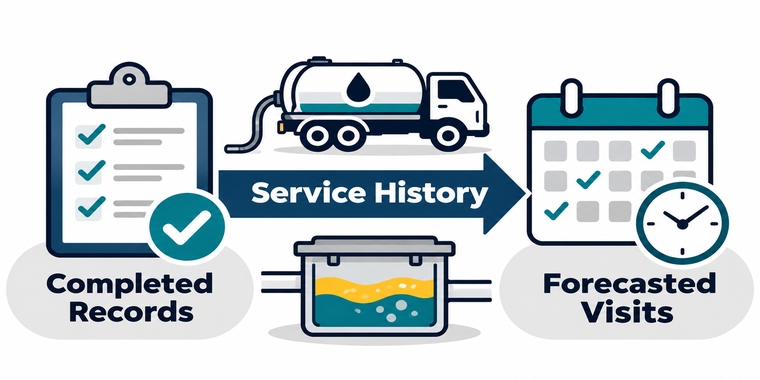
Annual grease trap service plans should begin with completed cleaning records, documented conditions, and provider recommendations, then account for current kitchen activity.
- Service Reports Establish Completed Work: Service reports document completed cleaning and observed conditions, while invoices confirm billing and charges for the recorded service scope.
- Extra Visits Need Context: An additional cleaning during unusually heavy kitchen activity belongs in the next forecast only after reviewing whether those conditions may recur.
- Forecasts Remain Provisional: Management’s estimated visits remain separate from completed dates and documented provider recommendations, with missing evidence or conflicting information clearly flagged.
- Requirements Differ From Recommendations: Local requirements establish obligations for the restaurant’s address, while provider recommendations inform maintenance planning based on documented site conditions.
- Comparable Charges Inform Budgets: Counting proposed visits within the budget period and using charges for comparable work creates a planning allocation, not a promised price.
For Houston restaurant managers, reviewing completed cleanings against the remaining forecast during the year helps explain additional visits and document reasons for budget changes.
A defensible annual plan preserves the evidence, uncertainty, and reasoning behind each projected visit.
~ ~ ~ ~ ~ ~ ~ ~ ~ ~ ~ ~ ~ ~ ~ ~ ~ ~
At 8:15 AM, a Houston restaurant manager is revisiting the annual maintenance worksheet. The printer hums beside a stack of cleaning invoices. Last year’s budget allowed for fewer grease trap visits than the restaurant actually received. Which number belongs in the next plan?
This is an illustrative situation, not a customer case. The answer begins with completed service records, not an arbitrary annual visit count. Existing cleaning dates, documented conditions, and provider recommendations give management a starting point for forecasting future visits. Test those facts against current kitchen activity.
Start With the Cleaning Records You Already Have
Gather the most recent complete service cycle, then include earlier records if they explain unusual visits or recurring issues. Use a service report to establish what was completed; use an invoice to confirm billing and charges. Keep the two distinct.
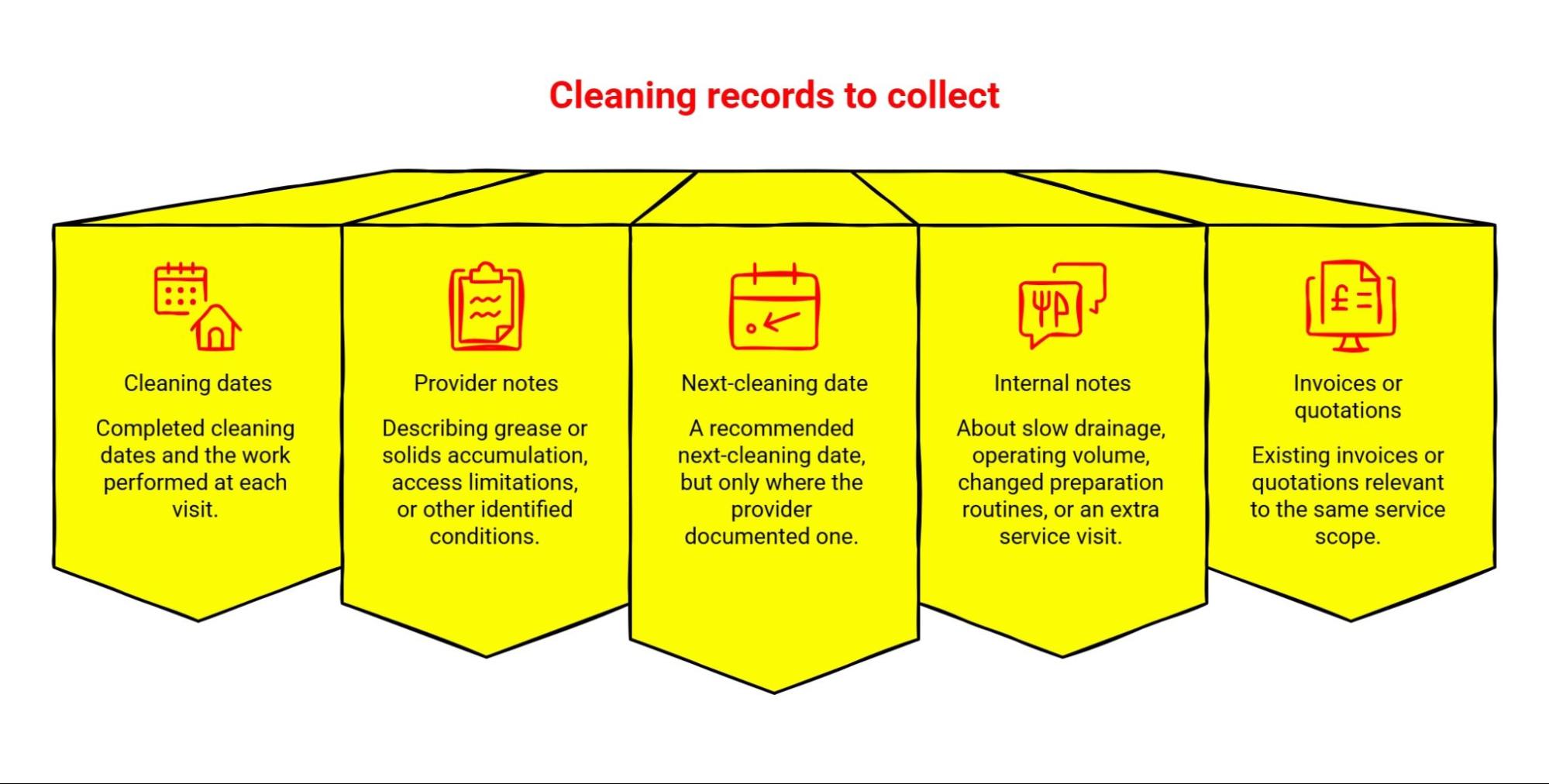
Collect these records together:
- Completed cleaning dates and the work performed at each visit.
- Provider notes describing grease or solids accumulation, access limitations, or other identified conditions.
- A recommended next-cleaning date, but only where the provider documented one.
- Internal notes about slow drainage, operating volume, changed preparation routines, or an extra service visit.
- Existing invoices or quotations relevant to the same service scope.
Drane Ranger describes maintaining service histories and recording service dates, waste quantities, disposal facility information, and identified system issues. Enter those details only when the records contain them. Waste-disposal documentation remains separate from the restaurant’s planning worksheet.
If a problem visit produced unclear paperwork, the Grease Trap Service Records After a Problem Visit: A Houston Restaurant Manager’s Review Checklist helps identify what to clarify before relying on that record.
Build One Annual Service Visit Log
Place completed visits in chronological order. Keep factual history, professional advice, and management’s future estimates in separate fields. An estimate is not an appointment.
| Completed visit date | Observed conditions | Provider notes | Recommended next date | Operating context | Estimated future visit | Assumption status |
| 2026-03-14 (Illustrative example) | 20% FOG cap, 10% settled solids (30% total); heavy baffle buildup | Trap over 25% threshold; recommend shortening cycle from 90 to 60 days | 2026-05-13 | Added weekend brunch service in Feb; fryer volume up ~25% | 2026-05-12 (and every 60 days thereafter: 6 visits/yr) | Review needed — confirm whether brunch fryer load remains permanent before locking 60-day budget |
Completed visit date, observed conditions, and provider notes document what is known. Recommended next date records advice actually given by the provider. Estimated future visit is management’s provisional entry, not a scheduled appointment. Operating context explains whether kitchen activity was normal or materially different.
Use supported when the estimate has relevant history and consistent provider guidance. Use uncertain when dates or notes are missing. Use review needed when changed conditions or conflicting information make the assumption unreliable. Record the reason for that status beside the log, and never fill an evidence gap with a guessed fact.
As each visit occurs, preserve the original forecast and add the completed date to the history. This leaves a visible trail of what management expected and what happened.
Turn the History Into a Provisional Visit Forecast
Read the log as a sequence, not merely a total. Check the spacing between completed visits. Then review the condition reported at each visit and any recommendation made for the next one. Was work performed as expected, brought forward, or added for a separate concern?
Suppose, in a hypothetical restaurant, the service history shows routine visits plus an extra cleaning during unusually heavy kitchen activity. Copying the total number of visits into the next year’s budget would overlook why the additional work occurred. Ignoring the extra visit would overlook it as well. The useful question is whether the operating conditions that prompted it are likely to recur.
Translate the reviewed pattern into proposed future visits, marking each as an estimate. When records conflict, note what needs clarification before committing to a date. A single completed visit cannot establish a reliable recurring interval.
Before calculating future intervals from your log, establish two practical guardrails: your local statutory minimum and the 25% rule. Within City of Houston limits, commercial grease traps must be pumped at least every 90 days regardless of fill level, while wastewater standards call for service whenever combined floating fats, oils, and grease (FOG) and settled solids reach 25% of the unit’s total liquid depth. If historical service reports show accumulation consistently reaching 25% before the 90-day mark—which often happens every 30 to 60 days in busy kitchens—confirm a shorter interval with your provider; if accumulation stays well below 25%, your applicable municipal requirement still sets the longest interval you can legally budget.
For the financial allocation, count the proposed visits within the budget period. Relate that count to documented charges or an existing provider quotation for a comparable service scope. If charges varied because work or access requirements differed, keep that uncertainty visible instead of treating one invoice as a universal per-visit rate. The resulting allocation is a planning assumption, not a promised service price.
Adjust the Forecast When Restaurant Conditions Have Changed
Historical spacing is only useful while the conditions behind it remain relevant. The U.S. Environmental Protection Agency explains that maintenance frequency depends heavily on the amount of fats, oils, and grease generated and the establishment’s management practices.
Look for material changes in meals served, food preparation, dishwashing activity, or recorded grease and solids accumulation. Also review trap characteristics, access conditions, and changes in the work included in service visits. These variables deserve attention because they can affect how a provider interprets the earlier history.
A recurring slow drain or odor is a reason to document the symptom and seek an appropriate evaluation. It does not prove that the cleaning interval is wrong or that an earlier service was inadequate. The guidance on recognizing when a grease trap cleaning schedule may be too infrequent explains how to examine recurring patterns.
When restaurant activity has shifted, a review of the cleaning arrangement during busier service can help organize the operational changes for a provider discussion. Do not assign a new service interval from a change in activity alone.
Check the Forecast Against Provider Guidance and Current Requirements
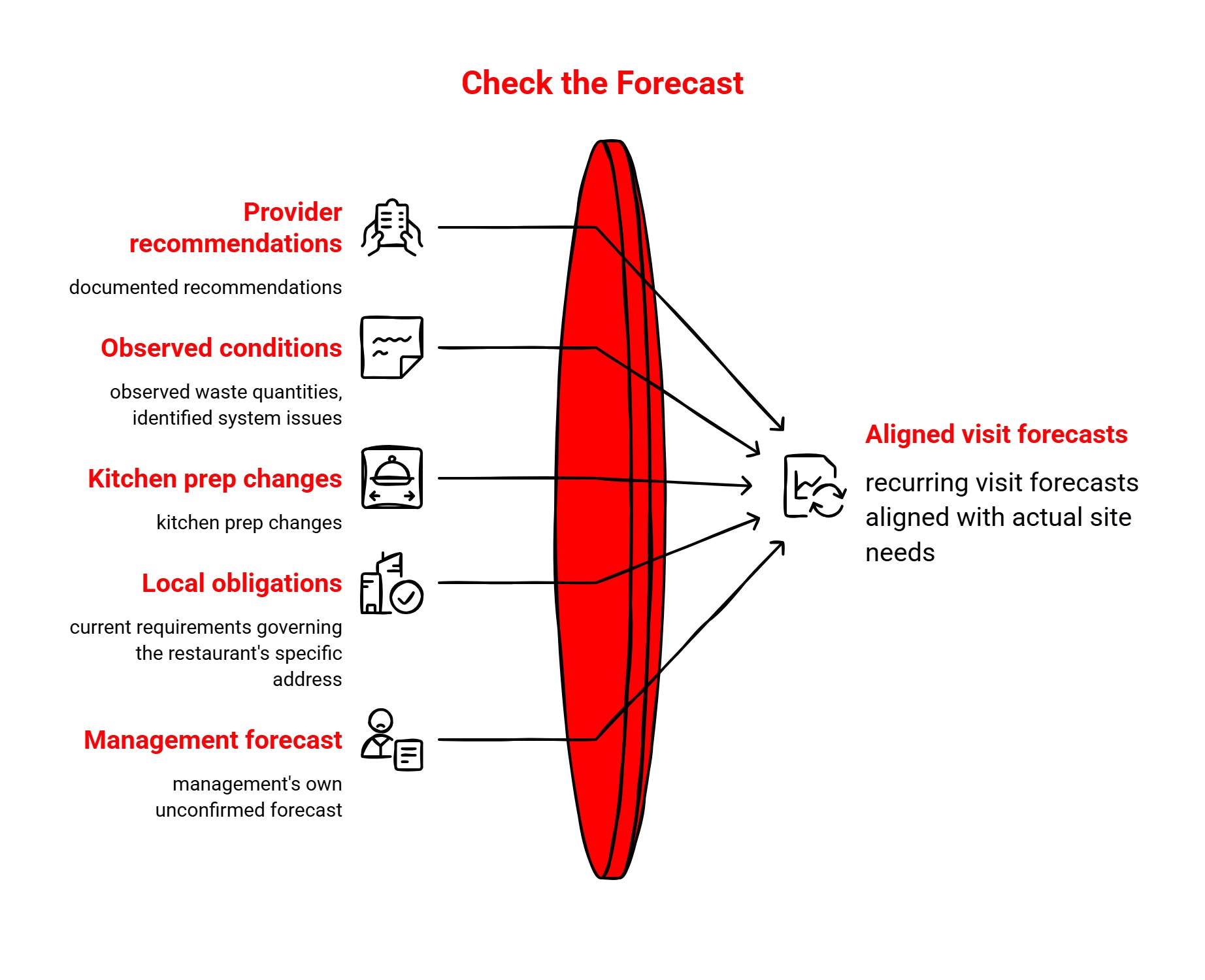
Review provisional dates with the provider’s documented recommendations. Where a recommendation differs from the historical pattern, ask which observed condition or site requirement explains it. Preserve the answer in the log rather than silently changing the forecast.
Across Greater Houston kitchens served by Drane Ranger, budgeting misses commonly happen when managers count routine quarterly pump-outs from accounting invoices without checking service records for observed waste quantities, identified system issues, or separate visits for hydro-jetting and urgent emergency response. Comparing technician observations on accumulation and system condition against kitchen prep changes helps keep recurring visit forecasts aligned with actual site needs.
Local obligations need a separate check. The City of Houston identifies grease trap inspections within its food-service business requirements. Confirm the current requirements governing the restaurant’s specific address with the appropriate authority. An operation in Alvin should not assume that every Houston municipal provision applies to it.
A regulatory requirement establishes an obligation. A site-specific provider recommendation informs maintenance planning. Neither should be mistaken for management’s own unconfirmed forecast.
Review the Visit Plan During the Year Instead of Freezing It
Treat the annual forecast like a kitchen staffing plan: it allocates resources for expected work, but actual demand may require adjustment. After each completed cleaning, update the history, check the remaining estimated visits, and record any reason for changing them.
At each actual-versus-budget review, identify additional visits and what explains the difference. Retain the earlier estimate so ownership can understand the variance without reconstructing decisions from memory.
A defensible maintenance allocation does not depend on predicting every visit perfectly. It depends on showing the evidence behind each assumption, the uncertainty still unresolved, and the circumstances that justify an update.
Explore our guides for related service timing advice. Read the grease trap service-record review checklist to make sure the information you are using for next year’s plan is complete.
Our Editorial Process
Our expert team uses AI tools to help organize and structure our initial drafts. Every piece is then extensively rewritten, fact-checked, and enriched with first-hand insights and experiences by expert humans on our Insights Team to ensure accuracy and clarity.
About the Drane Ranger Insights Team
The Drane Ranger Insights Team is our dedicated engine for synthesizing complex topics into clear, helpful guides. While our content is thoroughly reviewed for clarity and accuracy, it is for informational purposes and should not replace professional advice.