
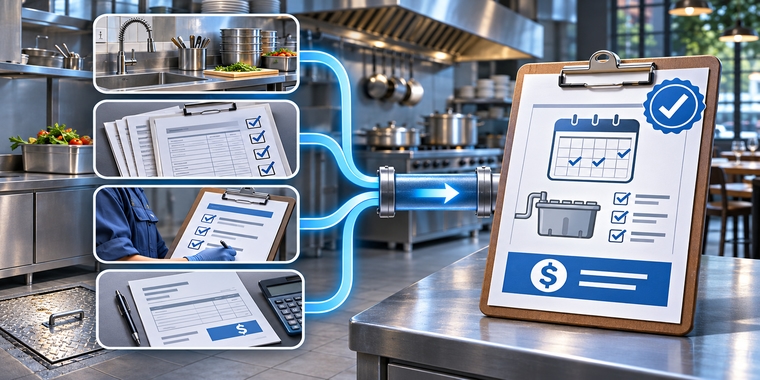
📌 Key Takeaways
Last year’s grease trap budget may miss this year’s cleaning visits because current kitchen conditions, documented service history, and provider recommendations can change the expected frequency.
- Spending Does Not Establish Frequency: Previous expenditure may reflect missed, postponed, or additional cleanings, so approved allocations, actual spending, and completed visits provide different planning information.
- Kitchen Changes Warrant Review: Longer hours, greater meal production, or different preparation practices may change accumulation, but increased activity does not automatically require more cleaning visits.
- Service Records Support Visit Forecasts: Completed service dates, recorded waste quantities, system findings, and provider recommendations help establish whether previous cleaning assumptions remain supported.
- Symptoms Do Not Confirm Fullness: Recurring slow drains or odors warrant attention, but neither independently establishes that the grease trap is full or another pump-out is necessary.
- Verified Inputs Support Budget Calculations: Confirmed expected visits multiplied by the verified quoted cost per visit establish planned recurring cleaning expenditure, with other documented maintenance costs calculated separately.
For restaurant owners, general managers, and finance teams, recording completed visits, actual charges, unexpected expenses, and operational interruptions provides evidence for the next budget review.
A defensible allocation connects documented cleaning needs with verified costs and clearly identified uncertainties.
~ ~ ~ ~ ~ ~ ~ ~ ~ ~ ~ ~ ~ ~ ~ ~ ~ ~
Consider an illustrative budget review at a Houston restaurant. A manager opens last year’s maintenance worksheet beside a stack of grease trap service records. The kitchen now handles a different workload, and the completed cleaning dates do not match the original plan.
Does last year’s budget still reflect what the kitchen needs?
Last year’s grease trap budget may miss this year’s cleaning visits because expected service frequency depends on operating conditions, not historical spending alone. Changes in kitchen activity, grease accumulation, completed visits, or provider recommendations can affect the forecast. Use previous records as the baseline, compare them with current conditions, and confirm uncertain assumptions before approving the new allocation.
Myth: Last Year’s Number Is the Safest Starting Budget
Reusing an approved maintenance allocation seems sensible. The amount is familiar, previous invoices are available, and management can avoid rebuilding another budget line.
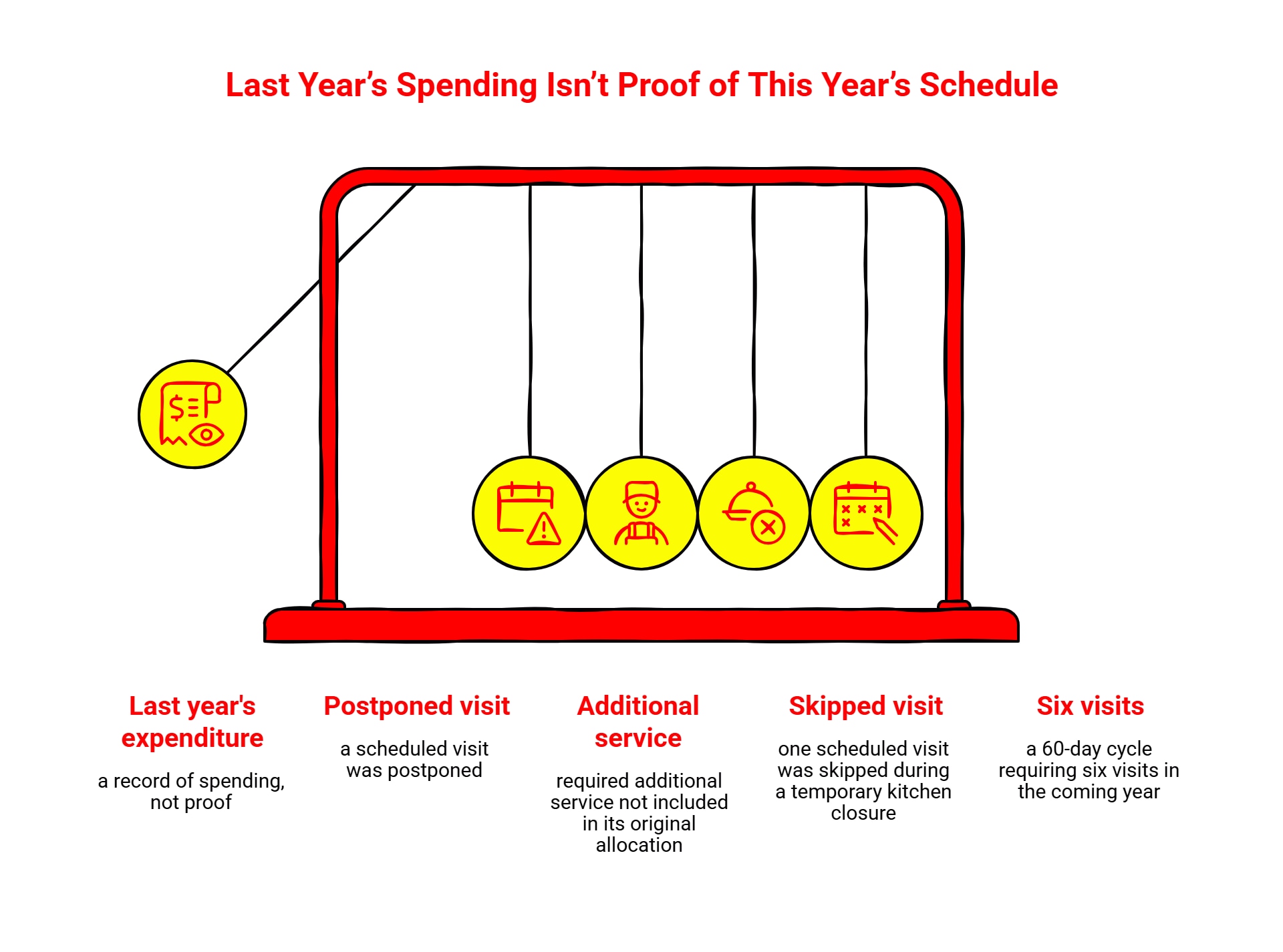
However, last year’s expenditure is a record of spending, not proof that the same cleaning schedule remains appropriate.
A restaurant may have spent less than planned because a scheduled visit was postponed. Another may have required additional service that was not included in its original allocation. Neither outcome establishes the correct frequency for the coming year.
For example, a Houston restaurant that budgeted for four quarterly pump-outs might finish the year under budget if one scheduled visit was skipped during a temporary kitchen closure—even though adding a high-volume weekend brunch service actually pushed accumulation onto a 60-day cycle requiring six visits in the coming year.
Start by comparing three documented figures: the approved allocation, actual expenditure, and completed cleaning visits. Identify any difference between the plan and what occurred.
For broader financial planning, Drane Ranger’s guide on how to budget for grease trap cleaning in your annual restaurant maintenance plan explains how recurring cleaning fits into maintenance expenditure.
Reality: The Visit Assumptions Behind the Budget Can Change
Restaurant operating volume influences the waste entering a grease trap. Longer operating hours, greater meal production, or different food preparation practices may change grease and solids accumulation.
The U.S. Environmental Protection Agency explains that grease interceptor maintenance frequency depends substantially on the amount of fats, oils, and grease a facility generates and its waste-management practices.
In practice, many municipal standards—including the City of Houston’s 25% rule—require pumping a grease trap once combined floating fats, oils, and grease (FOG) and settled solids reach 25% of the unit’s total liquid depth, regardless of how many weeks have passed since the last service.
This means a change in restaurant activity deserves investigation, not an automatic increase in cleaning visits.
For example, a restaurant introducing another preparation shift may create a different wastewater pattern. This is an illustrative operational change, not evidence that every expanded kitchen requires more frequent pumping.
The correct planning relationship is:
Current kitchen conditions → Appropriate cleaning requirements → Expected service visits → Annual maintenance allocation
The first comparison establishes whether the old cleaning assumption remains credible. Provider observations and applicable requirements help determine the appropriate interval.
Restaurants experiencing operational changes can also review when busier service warrants reconsidering an existing grease trap cleaning arrangement.
Compare Last Year’s Service Record With This Year’s Kitchen
Begin with completed service records rather than estimated cleaning dates.
Check the service date, recorded waste quantities, identified system issues, and any recommendation about the next cleaning. Where available, compare disposal documentation and upcoming appointment information.
A cleaning invoice establishes a financial transaction. Supporting service and disposal records provide additional information about the work performed and waste handling.
Next, ask the general manager whether operating hours, preparation methods, or kitchen throughput have changed. Record recurring drainage or odor concerns without assuming they prove the grease trap is full.
For unclear service history, use Drane Ranger’s grease trap service records review checklist.
The goal is to establish which previous assumptions remain supported and which need confirmation.
Use the Past-vs.-Current Cleaning Visit Worksheet
Use documented information wherever available. Enter Confirm for an unverified date, cost, cleaning interval, or provider recommendation. The final column should identify the action needed before the budget is approved.
| Review item | Last year | Current year or condition | Evidence / planning action |
| Cleaning visits | Record dates and completed visit count | Record completed and expected visits | Compare actual visits with the plan |
| Kitchen activity | Document previous operating pattern | Record changes in hours, production, or preparation | Confirm material changes |
| Grease and solids | Enter documented service observations | Enter current findings or Confirm | Ask provider whether timing should change |
| Provider recommendation | Record previous cleaning advice | Record current recommendation or Confirm | Verify proposed interval |
| Recurring symptoms | Record documented drainage or odor concerns | Note current symptoms and recurrence | Request evaluation where appropriate |
| Missing records | Identify unavailable documents | Record outstanding information | Obtain missing evidence |
| Visit forecast | Record previous planned frequency | Enter proposed frequency or Confirm | Verify assumptions with provider |
| Service cost | Record documented charges | Enter current quotation or Confirm | Use verified prices |
| Budget comparison | Record approved allocation and actual spending | Record proposed allocation | Explain the difference |
| Planning implication | Note previous assumptions | State what remains valid or has changed | Record required approval or confirmation |
Complete the worksheet separately for each restaurant location when operating conditions differ.
Four Signs the Old Planning Assumption Deserves Another Look
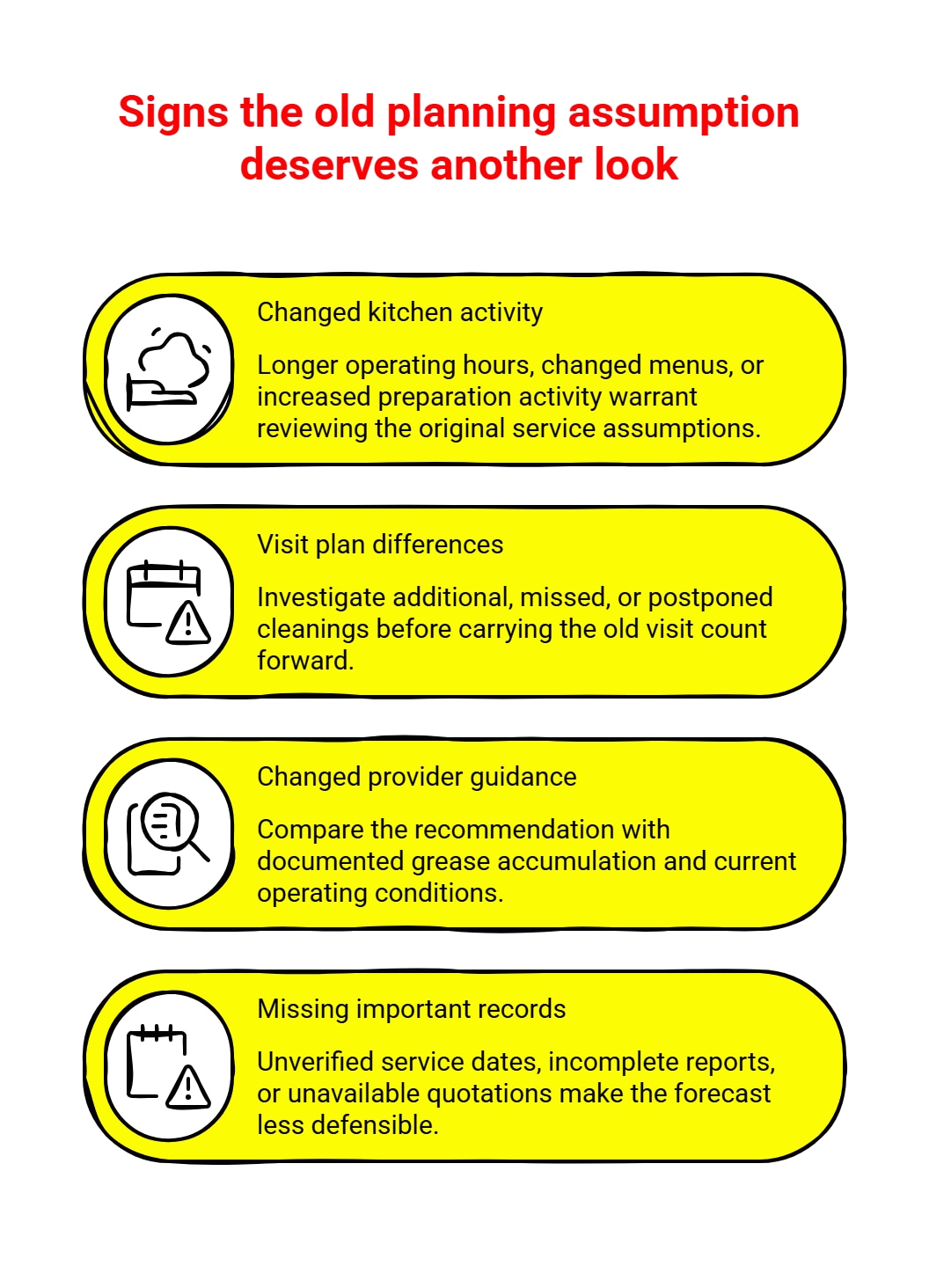
- Kitchen activity has changed. Longer operating hours, changed menus, or increased preparation activity warrant reviewing the original service assumptions.
- Completed visits differed from the plan. Investigate additional, missed, or postponed cleanings before carrying the old visit count forward.
- Provider guidance has changed. Compare the recommendation with documented grease accumulation and current operating conditions.
- Important records are missing. Unverified service dates, incomplete reports, or unavailable quotations make the forecast less defensible.
Recurring slow drains or odors also deserve attention, but they do not independently establish that another pump-out is necessary. Review the warning signs of an insufficient cleaning schedule before drawing conclusions.
What Not to Put Into the New Budget Without Evidence
Avoid invented service prices, assumed savings, universal cleaning intervals, unsupported penalties, or promises that an additional cleaning prevents every backup.
Build the preliminary annual cleaning allocation using:
Confirmed expected visits × Verified quoted cost per visit = Planned recurring cleaning expenditure
Include other documented maintenance costs separately. Where service scopes or prices differ, calculate each category using its own verified inputs.
Applicable regulatory requirements must also be distinguished from operational recommendations. The Houston Health Department’s special waste guidance addresses requirements within incorporated city limits. Harris County’s water services guidance distinguishes county responsibilities from those of public sewer system operators.
Confirm which authority applies to the restaurant before using a required interval in the forecast.
A Better Budget Question
Instead of asking, “What did the restaurant spend last year?” ask:
What cleaning frequency do current operating conditions, documented service history, and verified provider guidance support?
Owners need an allocation they can defend. General managers need service timing that accommodates kitchen operations. Finance teams need a forecast they can compare against actual expenditure.
After each cleaning, record whether the planned visit occurred, its actual charge, any unexpected service expense, and any related operational interruption. Review these findings during the next budget cycle.
Reuse the Evidence, Not the Assumption
Last year’s grease trap allocation remains a useful financial reference. Its underlying visit assumptions deserve review before being carried forward.
Start with the service records, complete the worksheet, and resolve entries marked Confirm. Where the evidence remains incomplete, discuss the relevant operating conditions and service recommendations with a qualified commercial provider.
A defensible annual grease trap maintenance budget begins with verified cleaning needs rather than an unchanged historical figure.
Our Editorial Process
Our expert team uses AI tools to help organize and structure our initial drafts. Every piece is then extensively rewritten, fact-checked, and enriched with first-hand insights and experiences by expert humans on our Insights Team to ensure accuracy and clarity. Each guide is reviewed against real-world commercial kitchen and liquid waste management practices informed by Drane Ranger’s trained, licensed, and certified team serving the Greater Houston area since 1985.
About the Drane Ranger Insights Team
The Drane Ranger Insights Team is our dedicated engine for synthesizing complex topics into clear, helpful guides. While our content is thoroughly reviewed for clarity and accuracy, it is for informational purposes and should not replace professional advice.